City, University of London Institutional Repository
Citation
:
Palmarini, R., Fernandez del Amo, I., Bertolino, G., Dini, G., Erkoyuncu, J. A., Roy, R. ORCID: 0000-0001-5491-7437 and Farnsworth, M. (2018). Designing an AR interface to improve trust in Human-Robots collaboration. Procedia CIRP, 70, pp. 350-355. doi: 10.1016/j.procir.2018.01.009This is the published version of the paper.
This version of the publication may differ from the final published
version.
Permanent repository link: http://openaccess.city.ac.uk/22025/
Link to published version
:
http://dx.doi.org/10.1016/j.procir.2018.01.009Copyright and reuse:
City Research Online aims to make research
outputs of City, University of London available to a wider audience.
Copyright and Moral Rights remain with the author(s) and/or copyright
holders. URLs from City Research Online may be freely distributed and
linked to.
City Research Online: http://openaccess.city.ac.uk/ [email protected]
ScienceDirect
Available online at www.sciencedirect.com Available online at www.sciencedirect.com
ScienceDirect
Procedia CIRP 00 (2017) 000–000www.elsevier.com/locate/procedia
2212-8271 © 2017 The Authors. Published by Elsevier B.V.
Peer-review under responsibility of the scientific committee of the 28th CIRP Design Conference 2018.
28th CIRP Design Conference, May 2018, Nantes, France
A new methodology to analyze the functional and physical architecture of
existing products for an assembly oriented product family identification
Paul Stief *, Jean-Yves Dantan, Alain Etienne, Ali Siadat
École Nationale Supérieure d’Arts et Métiers, Arts et Métiers ParisTech, LCFC EA 4495, 4 Rue Augustin Fresnel, Metz 57078, France
* Corresponding author. Tel.: +33 3 87 37 54 30; E-mail address: [email protected]
Abstract
In today’s business environment, the trend towards more product variety and customization is unbroken. Due to this development, the need of agile and reconfigurable production systems emerged to cope with various products and product families. To design and optimize production systems as well as to choose the optimal product matches, product analysis methods are needed. Indeed, most of the known methods aim to analyze a product or one product family on the physical level. Different product families, however, may differ largely in terms of the number and nature of components. This fact impedes an efficient comparison and choice of appropriate product family combinations for the production system. A new methodology is proposed to analyze existing products in view of their functional and physical architecture. The aim is to cluster these products in new assembly oriented product families for the optimization of existing assembly lines and the creation of future reconfigurable assembly systems. Based on Datum Flow Chain, the physical structure of the products is analyzed. Functional subassemblies are identified, and a functional analysis is performed. Moreover, a hybrid functional and physical architecture graph (HyFPAG) is the output which depicts the similarity between product families by providing design support to both, production system planners and product designers. An illustrative example of a nail-clipper is used to explain the proposed methodology. An industrial case study on two product families of steering columns of thyssenkrupp Presta France is then carried out to give a first industrial evaluation of the proposed approach.
© 2017 The Authors. Published by Elsevier B.V.
Peer-review under responsibility of the scientific committee of the 28th CIRP Design Conference 2018.
Keywords:Assembly; Design method; Family identification
1. Introduction
Due to the fast development in the domain of communication and an ongoing trend of digitization and digitalization, manufacturing enterprises are facing important challenges in today’s market environments: a continuing tendency towards reduction of product development times and shortened product lifecycles. In addition, there is an increasing demand of customization, being at the same time in a global competition with competitors all over the world. This trend, which is inducing the development from macro to micro markets, results in diminished lot sizes due to augmenting product varieties (high-volume to low-volume production) [1]. To cope with this augmenting variety as well as to be able to identify possible optimization potentials in the existing production system, it is important to have a precise knowledge
of the product range and characteristics manufactured and/or assembled in this system. In this context, the main challenge in modelling and analysis is now not only to cope with single products, a limited product range or existing product families, but also to be able to analyze and to compare products to define new product families. It can be observed that classical existing product families are regrouped in function of clients or features. However, assembly oriented product families are hardly to find.
On the product family level, products differ mainly in two main characteristics: (i) the number of components and (ii) the type of components (e.g. mechanical, electrical, electronical).
Classical methodologies considering mainly single products or solitary, already existing product families analyze the product structure on a physical level (components level) which causes difficulties regarding an efficient definition and comparison of different product families. Addressing this
Procedia CIRP 70 (2018) 350–355
2212-8271 © 2018 The Authors. Published by Elsevier Ltd. This is an open access article under the CC BY-NC-ND license (http://creativecommons.org/licenses/by-nc-nd/3.0/)
Peer-review under responsibility of the scientific committee of the 28th CIRP Design Conference 2018. 10.1016/j.procir.2018.01.009
ScienceDirect
Procedia CIRP 00 (2017) 000–000
www.elsevier.com/locate/procedia
2212-8271 © 2017 The Authors. Published by Elsevier B.V.
Peer-review under responsibility of the scientific committee of the 28th CIRP Design Conference 2018.
28th CIRP Design Conference, May 2018, Nantes, France
Designing an AR interface to improve trust in Human-Robots collaboration
Riccardo Palmarini
a*, Iñigo Fernandez del Amo
a, Guglielmo Bertolino
b, Gino Dini
b, John Ahmet
Erkoyuncu
a, Rajkumar Roy
aand Michael Farnsworth
baSchool of Manufacturing, Cranfield University, College Rd Cranfield, MK430AL, UK bDipartimento di Ing Civile e Industriale, Universita’ di Pisa, Via Diotisalvi 2, 56126 PI, IT
* Corresponding author. Tel.: +44 1234 750 111. E-mail address: [email protected]
Abstract
In a global, e-commerce marketplace, product customisation is driven towards manufacturing flexibility. Conventional caged robots are designed for high volume and low mix production cannot always comply with the increasing low volume and high customisation requirements. In this scenario, the interest in collaborative robots is growing. A critical aspect of Human-Robot Collaboration (HRC) is human trust in robots. This research focuses on increasing the human confidence and trust in robots by designing an Augmented Reality (AR) interface for HRC. The variable affecting the trust involved in HRC have been estimated. These have been utilised for designing the AR-HRC. The proposed design aims to provide situational awareness and spatial dialog. The AR-HRC developed has been tested on 15 participants which have performed a “pick-and-place” task. The results show that the utilisation of AR in the proposed scenario positively affects the human trust in robot. The human-robot collaboration enhanced by AR are more natural and effective. The trust has been measured through an empirical psychometric method also presented in this paper.
© 2017 The Authors. Published by Elsevier B.V.
Peer-review under responsibility of the scientific committee of the 28th CIRP Design Conference 2018.
Keywords: Augmented Reality; robot; digital engineering.
1.Introduction
We are entering a new era of manufacturing; one in which mass production has given way to mass customization. A global marketplace, built on rich e-commerce platforms and make-to-order product configurations, has made it a great time to be a consumer but a challenging one to be a manufacturer. The fact is, conventional robots were designed for speed, precision and payload. They are built to do one thing at a time, in one place, repeatedly and for high volume, low mix production. Nowadays industries have the need of being more flexible [1]. Collaborative robots (cobots) could be developed specifically to address the lower volume, higher mix applications that have historically been impractical to automate. Cobots have been defined by Akella [2] as a sub-set of Intelligent Assist Devices (IADs) for “direct, physical interaction with a human operator in a shared workspace”. They are well suited for flexible manufacturing environments because they are designed to be safe to deploy around people
with no guarding. They also tend to be less expensive to purchase and deploy than their caged counterparts, which means a faster return on investment for their owners. Given the growing trend, one might think that the use of robots in industry becomes increasingly popular and widespread. This brings with it the need for a careful analysis of the issues related to the safety of the workplace. The latter, in fact, will see human operators and robots working always more and more closely to each other’s [3].
Trust has been identified as a key element for successful Human-Robot collaboration (HRC) [4]. To appropriately understand the development of trust between human and robots, it is vital to effectively quantify the level of trust. Such a measurement tool would offer the opportunity for system designers to identify the key aspects to increase trust in HRC. Moreover, it is the authors’ belief that HRC system could benefit from the use of AR. The latter, in fact, can be designed to provide digital information for increased situational awareness, enable the use of natural spatial dialog, allow for
ScienceDirect
Procedia CIRP 00 (2017) 000–000
www.elsevier.com/locate/procedia
2212-8271 © 2017 The Authors. Published by Elsevier B.V.
Peer-review under responsibility of the scientific committee of the 28th CIRP Design Conference 2018.
28th CIRP Design Conference, May 2018, Nantes, France
Designing an AR interface to improve trust in Human-Robots collaboration
Riccardo Palmarini
a*, Iñigo Fernandez del Amo
a, Guglielmo Bertolino
b, Gino Dini
b, John Ahmet
Erkoyuncu
a, Rajkumar Roy
aand Michael Farnsworth
baSchool of Manufacturing, Cranfield University, College Rd Cranfield, MK430AL, UK bDipartimento di Ing Civile e Industriale, Universita’ di Pisa, Via Diotisalvi 2, 56126 PI, IT
* Corresponding author. Tel.: +44 1234 750 111. E-mail address: [email protected]
Abstract
In a global, e-commerce marketplace, product customisation is driven towards manufacturing flexibility. Conventional caged robots are designed for high volume and low mix production cannot always comply with the increasing low volume and high customisation requirements. In this scenario, the interest in collaborative robots is growing. A critical aspect of Human-Robot Collaboration (HRC) is human trust in robots. This research focuses on increasing the human confidence and trust in robots by designing an Augmented Reality (AR) interface for HRC. The variable affecting the trust involved in HRC have been estimated. These have been utilised for designing the AR-HRC. The proposed design aims to provide situational awareness and spatial dialog. The AR-HRC developed has been tested on 15 participants which have performed a “pick-and-place” task. The results show that the utilisation of AR in the proposed scenario positively affects the human trust in robot. The human-robot collaboration enhanced by AR are more natural and effective. The trust has been measured through an empirical psychometric method also presented in this paper.
© 2017 The Authors. Published by Elsevier B.V.
Peer-review under responsibility of the scientific committee of the 28th CIRP Design Conference 2018.
Keywords: Augmented Reality; robot; digital engineering.
1.Introduction
We are entering a new era of manufacturing; one in which mass production has given way to mass customization. A global marketplace, built on rich e-commerce platforms and make-to-order product configurations, has made it a great time to be a consumer but a challenging one to be a manufacturer. The fact is, conventional robots were designed for speed, precision and payload. They are built to do one thing at a time, in one place, repeatedly and for high volume, low mix production. Nowadays industries have the need of being more flexible [1]. Collaborative robots (cobots) could be developed specifically to address the lower volume, higher mix applications that have historically been impractical to automate. Cobots have been defined by Akella [2] as a sub-set of Intelligent Assist Devices (IADs) for “direct, physical interaction with a human operator in a shared workspace”. They are well suited for flexible manufacturing environments because they are designed to be safe to deploy around people
with no guarding. They also tend to be less expensive to purchase and deploy than their caged counterparts, which means a faster return on investment for their owners. Given the growing trend, one might think that the use of robots in industry becomes increasingly popular and widespread. This brings with it the need for a careful analysis of the issues related to the safety of the workplace. The latter, in fact, will see human operators and robots working always more and more closely to each other’s [3].
Trust has been identified as a key element for successful Human-Robot collaboration (HRC) [4]. To appropriately understand the development of trust between human and robots, it is vital to effectively quantify the level of trust. Such a measurement tool would offer the opportunity for system designers to identify the key aspects to increase trust in HRC. Moreover, it is the authors’ belief that HRC system could benefit from the use of AR. The latter, in fact, can be designed to provide digital information for increased situational awareness, enable the use of natural spatial dialog, allow for © 2018 The Authors. Published by Elsevier Ltd. This is an open access article under the CC BY-NC-ND license
(http://creativecommons.org/licenses/by-nc-nd/3.0/)
Riccardo Palmarini et al. / Procedia CIRP 70 (2018) 350–355 351
2 Palmarini et al/ Procedia CIRP 00 (2018) 000–000
multiple collaborative partners and enable local and remote collaboration [5]. Using AR to display information, such as robot state, progress and even intent, will enhance understanding, grounding, and thus collaboration.
This research focuses on understanding the trust development in HRC and design and develop an AR solution for increasing it. In Section 2 the background of this project is summarised. Section 3 describes the methodology utilised for this research. Results and discussion are in Section 4 and Section 5 respectively. Final considerations and conclusions are in Section 6
2.Background
A significant amount of assembly tasks in various manufacturing processes still require the flexibility and adaptability of the human operator [6]. In such processes, it is neither feasible nor cost-effective to introduce full automation. The manufacturing industry has shown growing interest in the concept of industrial robots working as teammates alongside human operators [7]–[10]. Considering recent technological developments, health and safety regulations have been updated to reflect that in some circumstances it is safe and viable for humans to work more closely with industrial robots [11]. Industrial HRC can enhance manufacturing efficiency and productivity since the weakness of one partner can be complemented by the strengths of the other [12]. However, the integration of humans and robots within the same workspace can be a challenge for the human factors community. For example, the installation of large assemblies requires operators to cooperate with large and high payload robots under minimised physical safeguarding [13]. One key aspect that can determine the success of a HRC system is the degree of trust of the human operator in the robotic teammate [4], [14], [15]. With the concept of industrial HRC being embraced further, trust needs to be explored in depth in order to achieve successful acceptance and use of industrial robotic teammates.
The continuous increase of robot installations across different manufacturing disciplines is expected to increase the need for human and robot co-existence and collaboration. Historically, industrial robots have been used in factories as a standalone system and operating autonomously [16]. Most of the time, where robots were implemented, they were surrounded by fences and guards for safety purposes. Essentially this allowed no room for real time interaction. The increasing need for flexibility and adaptability along with the prohibitive cost for implementing full automation, the manufacturing industry has shown growing interest in the development of collaborative robots able to work alongside human operators [7], [9].
The rationale of HRC is that the weaknesses of the human operator can be complemented by the strengths of the robot and vice versa [12]. As described earlier certain manufacturing processes require the sensory skills and ability of the human worker to react to external influences, such as tolerances or process variations. Thus, the application of full automation in these types of processes is not a viable solution allowing the human operator to retain a key role. However, human operators lack accuracy, repeatability, speed and strength. Industrial
robots on the other hand are very accurate and do not suffer from fatigue. Furthermore, industrial HRC can enhance employee working conditions by delegating heavy, repetitive and sometimes dangerous tasks to the robots. Examples include instances where workers are required to perform a task within a confined space or carry out tasks which pose very high physical load.
2.1. HRC in Industry
The first introduction of assistive robotic devices in production environments was in 1996 by Edward Colgate and colleagues [17]. These assistive robotic devices were mechanical devices, primarily providing guidance through servomotors while a human operator is providing the motive force. Since then additional work has been directed towards developing assistive robotic workmates. Following several examples.
PowerMate is an intuitive robotic assistant utilised to assist operators in assembly and handling tasks. This is a stationary Robot and it has physical contact with the human operator. The interaction occurs through a force-torque-sensor enabling the robot to move when the operator applies force. The main purpose of this system is to assist the assembly of heavy parts. The human worker, on the other side, ensures the final component has been precisely assembled.
“Flexible Assembly Systems through Workplace-Sharing and Time-Sharing Human-Machine Cooperation (PISA)” is a project which aims to support human operators with powerful tools in order to complete a task. The focus of the project is to develop novel intelligent assistance systems, provide planning tools for their integration and to achieve reusability of assembly equipment.
Co-operative Robot Assistant (CORA) is another example of collaborative robot. It can be fixed on a table, and its purpose is to physically interact with a human worker standing across the table. CORA consists of a seven DOFs manipulator arm in combination with a two DOF stereo camera mounted on its head.
Turtlebot was designed to assist the operator in a common assembly task. It can move around the ground floor. It can recognize the environment through the “Odometry Map”. Generally, this kind of collaborative robot could be used for the pick and place task.
2.2. Design of AR for HRC
of functions, Software Development Kits (SDK), game engines and 3D cad modelling platforms.
Other features that characterise an AR system are, among the others: the object tracking method, the user interface and the authoring solutions [18]. It is not always easy to identify the requirements of the AR system that has to be designed, for this reason Palmarini et al [20] proposes a survey based method to drive the designers in choosing the right AR features for a specific application.
Several studies have explored the utilisation of AR in HRC. Bischoff [21] research in 2004, proposed AR for overlaying the robot coordinates system over the real environment in order to de-skill the robot programming and operation. Fang [22], in 2009, developed RPAR-II (Robot Programming AR) for assisting users in robot programming both on-site and off-site. The virtual robot is overlaid on the real one allowing interaction and path planning on the real working environment. More recently Andresson [23] developed the AR-Enhanced Multimodal Robot-Programming Toolbox (AR-EMRPT) for programming industrial robots by demonstration, instructions, observation and context techniques. The goal was to improve training, programming, maintenance and monitoring of robots in both the training facility with a physical robot and within a complete virtual environment.
The common driver in all the AR-HRC designs for supporting industrial applications is always to de-skill the Human-Robot operations while improving the situational awareness. Humans, in fact, determine their trust in cobots by observing their characteristics, performance and ways of accomplishing a task [4].
3.Methodology
This section describes the methodology utilised for assessing the trust involved in the HRC and designing the AR application for enhancing trust in HRC.
Firstly, the variables affecting the trust involved in the HRC have been estimated and weighted. It has been done through literature and industrial experts’ knowledge. These have been used to build two rating scale tables named: “Voice of the Users” (Table 2) and “Voice of Engineers” (Table 3).
The first table is a Likert scale table. It considers the main aspects in AR-HRC in terms of Human aspect, Robot aspect and Augmented Reality information aspect. A scale from 1 to 5 (low relevance – high relevance) has been used for rating the relevance of the “elements” (robot, human and AR) on their respective “trust related themes” (Performance, safety, digital information). The “Voice of the Users” table aims to find which one is the most relevant component in the AR-HRC collaboration. It has been filled independently by 15 participants between students and technicians.
The second table has been named “Voice of Engineers”. It is a relationship matrix for determining the relationship between trust-related themes and the technical HRC aspects. Relationships can either be weak, moderate, or strong and respectively carry a numeric value of 1, 3 or 9. The participants were 5 engineers with heterogeneous background. These have been reunited and after an open discussion on the HRC topic, have filled the proposed rating Table 3 together. The results of
[image:4.595.326.537.105.292.2]the trust-affecting variables estimation are reported in Section 4 (Table 2 and Table 3).
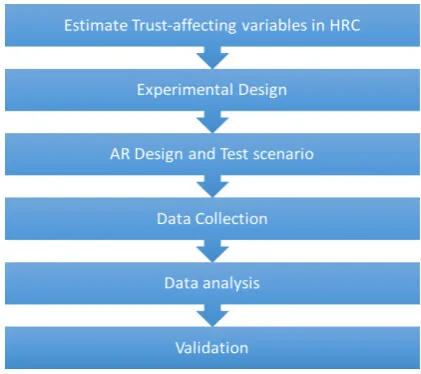
Figure 1 - Study methodology for evaluating trust in AR-HRC.
Based on these results, it has been possible to design the test. The test consisted of carrying out a maintenance operation utilising the AR-HRC system designed and developed and answering the Likert scaled questionnaire (Table 1) designed for assessing the trust involved in the operation.
Participants were informed regarding their right to withdraw and anonymity. For the validation on AR-HRC scenario they have been requested to share the same workspace and collaborate with an industrial robot to complete a task. The operation training could be used as a strategy to raise operators’ awareness regarding the ability and limitations of the robot and assist matching operators’ perceptions with the system’s actual capabilities.
Nr. Questions
1 I felt safe interacting with the robot
2 I trusted that the robot was safe to cooperate with me 3 The way the robot moved made me uncomfortable 4 Knowing the spatial movements in advance made me
feel more comfortable
5 I felt more safe because I knew in advance the path movements
6 I felt more safe because I knew in advance the arm movements
7 I prefer to know the movements of the robot in advance 8 I prefer to see the complete animation of the robot and
then start the procedure
[image:4.595.308.558.490.677.2]9 I prefer to see the animation of the robot 5 seconds in advance
Table 1 - Questionnaire utilised for understanding trust involved in AR-HRC. The answer has to be as Likert scale: from strongly disagree to Strongly agree (5 levels in total).
Riccardo Palmarini et al. / Procedia CIRP 70 (2018) 350–355 353
4 Palmarini et al/ Procedia CIRP 00 (2018) 000–000
accurate idea of the robot spatial movements. The task chosen for the test was a “pick and place” of an electronic card. The robot was very close to operator and close to work station. More about the AR implementation in this HRC scenario is explained in Section 3.1
Once the maintenance task is completed, the participants were asked to complete the Likert scaled questionnaire reported in Table 1. This have been used for measuring the participants trust in the AR-HRC system developed. The results of the questionnaire are reported in Section 4.
3.1. Design of the AR-HRC architecture
This section describes the design of AR in the HRC. The system has been developed with Unity3D and Vuforia SDK. The robot utilised is the Turtelbot (programmed in ROS). The requirements of the system have been captured from the “Voice of the Users” and “Voice of Engineers” tables described in the previous section and reported in Sec 4.
The AR-HRC has been developed to provide accurate context awareness to the technician by giving him the information about the robot movements in advance.
The system utilised Vuforia SDK for recognising the marker attached to the robot hence align the virtual robot with the real one. The movements of the robot were captured from the ROS and transferred to the tablet application in advance. These movements have been applied to the virtual robot aligned to the real one therefore providing the animation of the full robot plan on the real working environment.
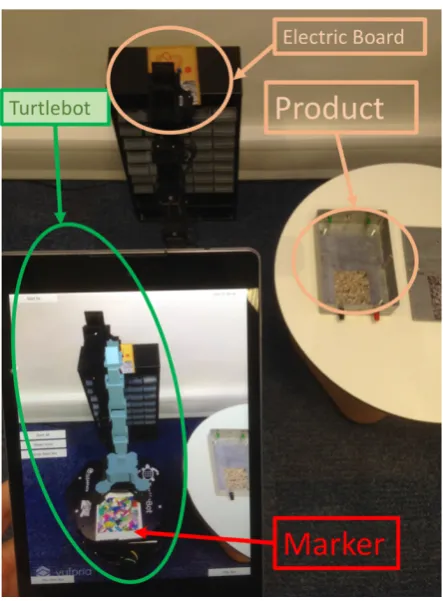
In Figure 2 it is possible to see one of the participants interacting with the robot. The marker utilised for recognising the robot and aligning the virtual robot real time is placed on the basement of the Turtlebot. The product to be maintained is on the table. Once the participant is introduced to the test, he is provided with the tablet for experiencing the AR-HRC.
In Figure 3, is shown the AR visualisation of the robot designed for improving the trust in HRC. The virtual Turtlebot is overlaid over the real one through a hand-held device. The electric board that is pick-and-placed by the robot is placed on the top of the black toolbox. The product where the electric board has to be assembled is on the table on the right.
The user can start the animation of the cobot to understand what movements it is going to do once started. In this case, the arm would pick up the electric board and place it in the product. In summary, the design of the AR-HRC developed utilised:
• Hardware: HHD
• Development Platform: Unity 3D + Vuforia SDK • Tracking method: Marker-based
• Interaction method: Dynamic 2D/3D
[image:5.595.322.545.67.336.2]Its scope is to support the assembly operation of an electric board within an Industrial environment.
Figure 2 - Test scenario and one of the participants interacting with the Turtlebot.
Figure 3 - The application developed in unity and a frame of the animation overlaid on the real Turtlebot.
4. Results
[image:5.595.322.544.374.675.2]1. Asking to 15 participants which aspects among the one listed in Table 2 (“Voice of the Users”) were more important for them.
2. Asking to 5 engineers with exposure to HRC which of the aspects listed in Table 3 (“Voice of Engineers”) were more relevant for them.
Element (1) Trust-related
themes (2) relevance Average (2 on 1)
Percentage of relevance (2
on 1)
Robot Performance 3.40 0.29
Human Safety 4.30 0.37
AR Digital
Information 3.93 0.34
Table 2 - Voice of the Users.
[image:6.595.310.551.189.337.2]Table 2 reports the average results of the Likert scaled tables filled by the 15 participants. A scale from 1 to 5 (low relevance – high relevance) has been used for rating the relevance of the “elements” (robot, human and AR) on their respective “trust related themes” (Performance, safety, digital information). Table 2 “Percentages of relevance” are reported on the first row of Table 3 and have been used for weighting the results of the “Voice of the Engineers” table.
Trust-related themes
Technical
HRC aspects Perf
or
m
an
ce
Sa
fe
ty
A
R
in
fo
rm
at
io
n
R
el
ev
an
ce o
f
R
ela
tio
n
%
of
R
el
ev
an
ce
R
anki
ng
Percentage relevance
0.29 0.37 0.34
Arm Movement (no cage)
3 9 1 4.2 6.67% 4
Path Movement (no cage)
9 9 1 5.34 3.44% 6
Gripper 3 9 1 4.2 6.67% 4
Context-awareness
9 9 9 9.0 14.30% 1
Task Safety 1 9 9 7.26 11.53% 2
Arm Movement 1 9 9 6.39 10.15% 3
Path Movement 1 9 9 6.39 10.15% 3 Audial
information
1 3 9 4.17 6.63% 5
Robot Tablet Controls
[image:6.595.35.287.384.645.2]1 3 9 4.17 6.87% 3
Table 3 - Voice of the Engineers
Table 3 is the relationship matrix filled by 5 Engineers together after an open discussion on HRC. The trust-related themes relationship with the HRC technical aspects have been scored as follows: 1 for weak relationship, 3 for moderate relationship and 9 for strong relationship.
The outcome has been that AR needed to provide context-awareness in order to improve the human perception of safety enhancing his trust in HRC.
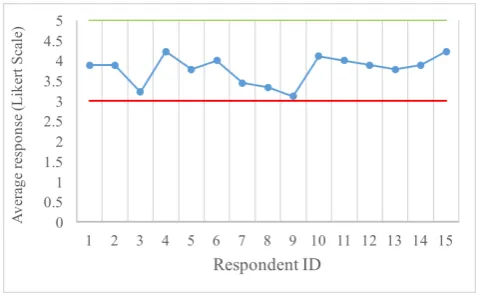
The second result is the trust involved in the designed and tested AR-HRC scenario. The AR-HRC system design and development has been described in Section 3.1. The pick-and-place test has been performed and the participants have been asked to answer the Likert scaled questionnaire in Table 1. A total of 15 participants between engineering students and university staff members (10 male/5 female) took part in the study. The average age was 27.2 (min 22, max 33). Results are shown in Figure 4.
Figure 4 - AR-HRC trust questionnaire results.
The results show that in average the trust in the AR-HRC system developed is above 3. This means that the utilisation of the proposed AR design for understanding the cobot movements in the real environment has positively affected the trust of the participants in collaborating with the cobot.
5.Discussion
The first result estimated that human-safety and context-awareness to be the key variables affecting trust in HRC. The results from this study are in agreement with the literature [5][3]. The context-awareness which in this case is the workspace awareness defined as “the up-to-the-minute knowledge of other participants’ interactions with the shaped workspace” [24], is essential for providing the human technician with the confidence necessary for working in safety.
The second result showed an average trust in the AR-HRC scenario proposed always above 3 on a 1 to 5 scale. Even if it has not been compared with the same scenario without the utilisation of AR, it still provides a valuable indication of the trust involved. This can be used for future comparison with different AR support designs for the same pick-and-place task even the same AR support design for a different task.
Riccardo Palmarini et al. / Procedia CIRP 70 (2018) 350–355 355
6 Palmarini et al/ Procedia CIRP 00 (2018) 000–000
6. Conclusion
This project focused on understanding the variables affecting the trust involved in HRC and designing an AR-HRC system for increasing the trust of the human operators in collaborating with robots within an industrial environment.
The interest in cobots has been described in sections 1 and 2. These provide a flexible solution for the increasing industrial customisation needs. Their implementation is still detained by the lack of human trust in collaborating with robots.
Context-awareness and human safety have been found to be one of the key variables affecting the trust in HRC. An AR-HRC system designed to provide context-awareness for improving human safety has been developed and tested on a pick-and-place task. The AR-HRC shows the robot movements by overlaying a virtual animation of the cobot on the real environment, real time. The operator can see the operations that the cobot will carry out once started, in advance. This solution has been tested and has shown a great potential in enhancing the participants trust in the turtlebot utilised for the test.
Future studies should compare the results of this study with different scenarios and AR-HRC systems. The scenario should include a real industrial cobot which, would be more effective in understanding the human trust in cobots. The AR system for supporting HRC should take advantage of recent advancements in head-mounted displays and provide a more immersive virtual scenario for improving the workspace awareness.
Acknowledgements
The project raises from the collaboration between the Through-life Engineering Services Centre at Cranfield University (UK) and the Department of Civil and Industrial of the University of Pisa (IT).
References
[1] J. Krüger, T. K. Lien, and A. Verl, “Cooperation of human and machines in assembly lines,” CIRP Ann. - Manuf. Technol., vol. 58, no. 2, pp. 628–646, 2009.
[2] P. Akella, M. Peshkin, E. Colgate, W. Wannasuphoprasit, N. Nagesht, J. Wells ’, S. Holland ’, T. Pearson ’, and B. Peacockt, “Cobots for the automobile assembly line,” Proc. 1999 IEEE Int. Conf. Robot. Autom., no. May, pp. 728–733, 1999.
[3] J. Fryman and B. Matthias, “Safety of Industrial Robots: From Conventional to Collaborative Applications,” Robot. Proc. Robot. 2012; 7th Ger. Conf., pp. 1–5, 2012.
[4] A. Freedy, E. DeVisser, G. Weltman, and N. Coeyman, “Measurement of trust in human-robot collaboration,” in 2007 International Symposium on Collaborative Technologies and Systems, 2007, pp. 106–114.
[5] S. Green, M. Billinghurst, X. Chen, and G. Chase, “Human-Robot Collaboration: A Literature Review and Augmented Reality Approach in Design,” Int. J. Adv. Robot. Syst., vol. 5, no. 1, pp. 1– 18, 2007.
[6] Z. Ding and B. Hon, “Constraints analysis and evaluation of manual assembly,” CIRP Ann. - Manuf. Technol., vol. 62, no. 1, pp. 1–4, 2013.
[7] M. Hägele, W. Schaaf, and E. Helms, “Robot assistants at manual workplaces - Effective co-operation and safety aspects,” Proc. 33rd Int. Symp. Robot., p. 6, 2002.
[8] R. D. Schraft, C. Meyer, C. Parlitz, and E. Helms, “PowerMate - A Safe and Intuitive Robot Assistant for Handling and Assembly Tasks,” in ICRA, 2005.
[9] A. De Santis, B. Siciliano, A. De Luca, and A. Bicchi, “An atlas of physical human-robot interaction,” Mech. Mach. Theory, vol. 43, no. 3, pp. 253–270, 2008.
[10] V. V. Unhelkar, H. C. Siu, and J. a. Shah, “Comparative performance of human and mobile robotic assistants in
collaborative fetch-and-deliver tasks,” Proc. 2014 ACM/IEEE Int. Conf. Human-robot Interact. - HRI ’14, pp. 82–89, 2014. [11] ISO, “Robots and robotic devices-safety requirements for industrial
robots,” IEEE Trans. Human-Machine Syst., vol. 1, 2011. [12] D. Bortot, M. Born, and K. Bengler, “Directly or on Detours?: How
Should Industrial Robots Approximate Humans?,” in Proceedings of the 8th ACM/IEEE International Conference on Human-robot Interaction, 2013, pp. 89–90.
[13] M. Walton, P. Webb, and M. Poad, “Applying a Concept for Robot-Human Cooperation to Aerospace Equipping Processes,” in SAE Technical Paper, 2011.
[14] R. Parasuraman and V. Riley, “Humans and Automation: Use, Misuse, Disuse, Abuse,” Hum. Factors, vol. 39, no. 2, pp. 230–253, 1997.
[15] J. Y. C. Chen and M. J. Barnes, “Human #x2013;Agent Teaming for Multirobot Control: A Review of Human Factors Issues,” IEEE Trans. Human-Machine Syst., vol. 44, no. 1, pp. 13–29, Feb. 2014. [16] A. M. Zanchettin, L. Bascetta, and P. Rocco, “Acceptability of
robotic manipulators in shared working environments through human-like redundancy resolution,” Appl. Ergon., vol. 44, no. 6, pp. 982–989, 2013.
[17] J. E. Colgate, J. Edward, M. A. Peshkin, and W. Wannasuphoprasit, “Cobots: Robots For Collaboration With Human Operators.” 1996. [18] R. Palmarini, J. A. Erkoyuncu, R. Roy, and H. Torabmostaedi, “A
systematic review of augmented reality applications in
maintenance,” Robotics and Computer-Integrated Manufacturing. 2018.
[19] S. K. Ong, M. L. Yuan, and A. Y. C. Nee, “Augmented reality applications in manufacturing: a survey,” Int. J. Prod. Res., vol. 46, no. 10, pp. 2707–2742, 2008.
[20] R. Palmarini, J. A. Erkoyuncu, and R. Roy, “An innovative process to select Augmented Reality ( AR ) technology for maintenance,” 2016.
[21] R. Bischoff and A. Kazi, “Perspectives on augmented reality based human-robot interaction with industrial robots,” 2004 IEEE/RSJ Int. Conf. Intell. Robot. Syst. (IEEE Cat. No.04CH37566), vol. 4, pp. 3226–3231, 2004.
[22] H. Fang, S. K. Ong, and A. Y.-C. Nee, “Robot Programming Using Augmented Reality,” 2009 Int. Conf. CyberWorlds, pp. 13–20, 2009.
[23] N. Andersson, A. Argyrou, F. Nägele, F. Ubis, U. E. Campos, M. O. De Zarate, and R. Wilterdink, “AR-Enhanced Human-Robot-Interaction - Methodologies, Algorithms, Tools,” Procedia CIRP, vol. 44, pp. 193–198, 2016.