JOURNAL OF VIROLOGY, Apr. 1987, p. 1248-1252 Vol. 61, No. 4 0022-538XI87/041248-05$02.00/0
Copyright C 1987,AmericanSociety forMicrobiology
Mutational
Analysis
of
Open Reading
Frame E4 of Bovine
Papillomavirus
Type
1
KATHRYNNEARY, BRUCE H. HORWITZ,AND DANIEL DIMAIO*
Department ofHuman Genetics, Yale University SchoolofMedicine, NewHaven, Connecticut 06510-8005
Received 14July1986/Accepted 18 December1986
Open reading frame (ORF)E4 is a 353-base-pairORF of bovinepapillomavirus type 1. To determinethe biological activities ofthisORFin mouse C127cells,weanalyzedtheeffectsof two constructed mutationswhich arepredictedtopreventsynthesis of ORFE4proteinswhileleavingthe amino acidsequenceencodedbythe overlapping ORF E2 unchanged. Neither mutation interfered with theabilities of the mutants to efficiently inducefocusformation, induce growth in soft agarose,ortransactivateaninducible bovinepapillomavirustype 1enhancer. Also,neither mutation prevented establishmentof the viral DNA as an extrachromosomalplasmid intransformedcells.These results suggest thatORFE4proteinsare notrequiredfor thesebiologicalactivities, and theyareconsistent with the observation ofothers (J.Doorbar, D.Campbell, R. J. A.Grand, and P. H. Gallimore, EMBO J.5:355-362, 1986)that the ORF E4proteinof a humanpapillomavirusis associatedwith late geneexpression during papilloma formation.
Bovinepapillomavirus type1(BPV) induces theformation
offibroepithelialtumors inanimals andoncogenically
trans-forms certain established lines ofrodent cells in vitro (15,
24). Mouse C127 cells transformed by BPV form focion a
monolayer ofnormalcells,display anchorageindependence,
and are tumorigenic (8, 17). In the nuclei of these
trans-formed cells, the viral DNA is maintained as a circular
plasmid (14, 16). A 5,500-base-pair fragment of the viral genome contains eight open reading frames (ORFs),
desig-natedORFs EltoE8,whicharethoughttoencodeproteins responsible for the biological activities ofthe virus (2, 17, 29). Mutational analysis ofthe viral genome indicates that ORFsEl, E2, E7, and E6-7playaroleinmaintenance ofthe
viralDNA as an autonomous plasmid (1, 3, 10, 18, 19) and
that ORFs E2, E5, and E6 are involved in inducing the appearanceof transformed foci(3-5, 10, 22,26-28, 33).ORF E2isalsorequired for transactivation ofanenhancerlocated
in the BPV long control region (31, 35). As part of our
evaluation of the biological activity of each of the viral ORFs, we constructed base substitution mutations that
should prevent synthesis of the putative protein product(s)
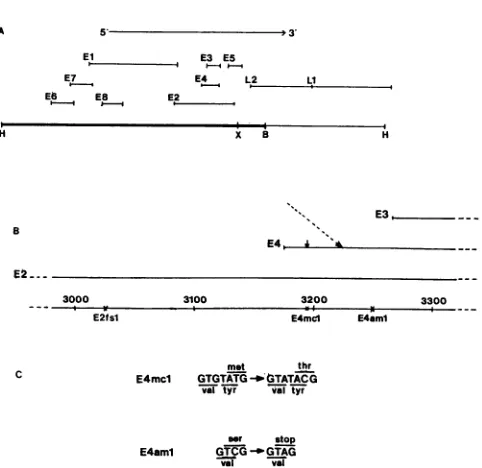
of ORFE4, andwe analyzed theeffects ofthesemutations. ORFE4isa353-base-pair ORF(nucleotide [nt]3173to nt
3526)thattotally overlaps with ORF E2 in a different reading
phase (Fig. 1A) (2). BPV-transformed cells and bovine
fibropapillomas contain mRNAs that are unspliced in the
ORFE4region,aswell as RNAs withasplicejunction at nt 3224 (Fig. 1B) (32, 34). If an ORF E4 gene product is encoded by an unspliced mRNA, translation presumably
initiatesatthe first and only methionine codon in ORF E4,
located at nt 3191. The E4mcl mutation changes bases at
positions3189 and 3192 to convert this codon to a threonine codon(Fig. 1B and C). If a spliced mRNA is used, ORF E4 would be spliced in frame to either ORF E6 or ORF El,
depending
upon which upstream splice donor is used (32,34). The E4aml mutation is a single-base substitution at
position 3249which creates an amber termination codon in ORF E4 25bases 3' to the mRNA splice acceptor site at nt 3224 (Fig. 1B and C). This mutation would affect the
synthesisof E4 proteins that initiate at the E4 methionine, as
*Correspondingauthor.
well as proteins translated from spliced E4 messages. Nei-therof these mutations alters the amino acid sequence of the
protein product encoded by the overlapping ORF E2 (Fig. 1C). Both mutations were constructed by oligonucleotide-directedmutagenesisofasegmentof BPVDNA; theywere
subsequently cloned separately into the full-length viral genome (13, 21, 36).
To test the transforming activity ofthese mutants, we
separated the viral DNA from its bacterial plasmid vector andassayedit for itsabilitytoinduce focionC127 cells(8).
In several independent experiments, transfection was per-formed by the calcium phosphate precipitation method, as previously described (4, 9),with 100 ng ofBamHI-digested
plasmid DNA for each plate, and foci were stained and counted 14 days after transfection. Both of the ORF E4 mutants (pE4aml and pE4mcl) induced C127 cell focus formation (1,378and 1767 foci per .g of viralDNA,
respec-tively)asefficientlyasdidwild-typeBPV DNA (pBPV-142-6; 1,444 foci per ,ug). Foci induced by the E4 mutants
appeared at the same time andwere the same size as foci induced by wild-type BPV DNA. We have previously
re-portedthatboth ORFs E2 andE5arenecessaryfor efficient focus formationby full-lengthBPVbutthat neither ORF E2 norORF E5mutantsaretotally transformation defective (3, 4). To determine whether theresidualfocus-forming ability
of these mutantswas due to weaktransforming activity of the ORF E4protein,wetested theactivityof double mutants in which each of theORFE4mutations was combined with either an E2 or an E5 mutation. BPV DNA containing a
211-base-pair deletion in ORF E2 transformed at approxi-mately2%of the levelof wild-typeBPV,and double mutants
containing the ORF E2 deletion plus either of the ORF E4 mutations transformed atthis level as well (Table 1). BPV DNA containing a frameshift mutation in ORFES induces about0.5% as manyfoci as doeswild-type BPV DNA (4). DoublemutantscontainingtheORFESmutation plus either of the ORF E4mutationswere no moredefective than is the ORF ESsinglemutant(Table1). Therefore, ORF E4 is not a
transforming gene as assayed by focus formation in C127 cells.
Weestablished cell linesfrom transformedfoci induced by the ORF E4 mutants. In semisolid medium, these cells
1248
on November 10, 2019 by guest
http://jvi.asm.org/
NOTES 1249
H
El E3 E5
t4 §_
E7 E4 L2 Li
E6
,~
E8 E2A.
x i H
I" E3,
E4, I& >IL
3000 3100 E2fts c 3200 Em E4mc1 E4aml met thr
E4mcl GTGTATG-_OTATACG
vaI tyr voi tyr
ser stop
E4aml GTCG GTAG
vai val
FIG. 1. (A)Genetic organization ofBPV. Thelineatthi
representsthe7,945-base-pairgenomeof BPV, linearizedt ageatthe unique HindIII(H)site. (X, BstXI; B, BamHI.) I aboverepresentthetranslational ORFs,and thearrowindic
direction of transcription (reproduced fromreference 4). (1 tions inORFE4.Thefigurerepresentsaportion of the viral
aroundthe 5' end of ORFE4,andthelocations of ORFsE2, E4 are indicated. The x's indicate the positions ofcon
mutations inORF E4 and ORF E2. E2fsl is aframeshifi
containinganinsertion of16base pairsatthe FspIsite(nt 3( downward arrowindicates the positionof theORFE4me
triplet; the slantedarrowindicatestheposition ofthe splice site. (C) Base substitution mutations. Mutations in ORF constructed by oligonucleotide-directed mutagenesis (36)
as atemplate M13-R4(3, 21), an M13-BPV recombinant
theEscherichia colidutungstrain (13). Thesequencesint tothe left of thearrows aretherelevantwild-type BPVse(
and those to the right are the mutant sequences. Phag4
containingthesemutationswereidentified byAccIdigestii orhybridizationtothe mutagenicoligonucleotide(aml).Afi subclonedinto the viralgenome, themutationswereconfi DNAsequencing(20).Aminoacids above thetripletscorre
the wild-type and mutant ORF E4 protein sequences, ai
belowcorrespond tothe ORF E2proteinsequence(2).
efficiently formed colonies indistinguishable from c formedby cells transformed by wild-typeviral DNA(
In addition, a cell* line established from a single p
induced focus was plated in agarose, and cloned cl
were established from fourindividual, well-separate
nies.During approximately 25 subsequent cellgenera
continuous passage, each of these cell lines exhi uniform, piled-upappearance with no obvious evid anunstable transformed phenotype (datanotshown To determine whether ORF E4 is required fol chromosomal BPVreplication, weanalyzed thestat BPVDNA inmouseC127 cells transformed bythe mutantsby the Southern blotting technique (30, 33) A number of celllineswereestablished from individ induced by wild-type viral DNA and by the two C mutants. Viral DNA isolated from three of four c(
establishedwithwild-type DNAmigrated at thepos full-length supercoiled circularBPV DNA molecule larly, threeof fourcell lines inducedby pE4amlanc four cell lines induced by pE4mcl contained unit
circular,extrachromosomal BPV DNA. Moreover,the cells transformedby wild-type DNA or the mutant BPV DNAs contained similaramounts of viral DNA. After digestion of DNAsfrom these cell lines with HindIII,whichcutsoncein
the BPVgenome,wild-type andmutantviralDNAsmigrated attheposition of full-length linear BPVmolecules (datanot shown). In addition, one cell line induced by wild-type
DNA,aswellasonecell lineinduced by each of the ORF E4
mutants, contained extrachromosomal viral DNA that had
apparentlysufferedrearrangement,and theviral DNA inone
cell line induced by E4mcl had apparently integrated into cellular DNA. These results indicated that neither ORF E4 mutationprevents BPV DNA from becoming stably
estab-3300 lishedas a plasmid in transformed mouse cells, but we have
not ruled out more subtle effects of the mutations on
replication.
The 5' noncoding region of BPV DNA contains a tran-scriptionalenhancer which is only active in the presenceof
an intact ORFE2, but aroleforORF E4 in transactivation
has notbeen ruled out(31, 35). Totestthis possibility, we
used the assay described by Spalholz et al. (31), in which
efficient expression of a bacterial chloramphenicol
acetyl-transferase gene in plasmid p407-1 requires the BPV
e
bottom transactivation function. We cloned each ORFE4mutation
bycleav- into plasmid C59, which contains BPV ORFs E2, E3, E4,
rhesltnes
and E5 under the control of simian virus 40regulatory
c)
Muta-
sequences,andwetestedtheability
of theresulting
plasmids
genome (C59-E4mcl and
C59-E4aml)
totransactivatechloramphen-IE3,
and icol acetyltransferase geneexpression fromp407-1.
Neither istructed mutation affected transactivation, whereas a mutationthatt mutant disrupts ORF E2 profoundlyinhibited this activity (Fig. 4).
)23).The This paper reports the construction of base substitution
thionine mutations which shouldpreventtranslation of BPVORF E4
acceptor but whichare silent in theoverlapping ORF E2. Neither of
by
uwsienre
the mutationswetested causeddefectsinfocus formationin grownin C127 cells or in transactivation of an inducible BPVen-he
figure
hancer in CV1 cells. The viral DNA was maintained as aquences, plasmid in manytransformed cell lines established with the
e DNAs mutants,andthe cellsefficientlyformed colonies inagarose.
on(mcl) Ouranalysis thus indicated that ORF E4 is notessential for
terbeing these invitrobiological activities. There are three possible
irmedby explanations for theseresults. (i) ORF E4is not a
protein-spondto coding sequence. (ii) the mutations do not prevent its
ex-rnd those pression,or(iii) it is required foranactivity other than those
we tested. Thepresence ofanORF in the samepositionas
BPV ORFE4 in allsequencedpapillomavirusgenomesand .olonies theanalysisof ORFE4codonusage stronglysuggest thatit (Fig. 2).
E4aml-ell lines TABLE 1. C127 cell transformation by doublemutantsa zd colo-ttionsin ibited a lence of I). r extra-:eof the )RFE4 (Fig. 3). Lualfoci )RF E4 ell lines sition of s.
Simi-dtwoof length,
Plasmid MutantORF(s) No.offoci/lg
pBPV-142-6 None 1,399
pE2-NIL E2 22
pE2-4A E2 and E4(E4aml) 20
pE2-4M E2 andE4(E4mcl) 45
pE5-XL2 E5 4
pE5-4A ES and E4(E4aml) 3
pE5-4M E5and E4(E4mc1) 12
aThe 211-base-pairNcoI fragment (nt2878 to 3089) was deleted from
p142-6 (6, 25) and fromboth ORF E4 mutants togenerate the ORF E2
mutants. Aframeshiftmutation atthe BstXI site in BPV DNA has been previously described(4). Afragmentcontainingthis mutation wasinserted intoboth ORF E4mutants togenerate the ORFE5mutants.Transformation
wasperformedbythecalciumphosphateprecipitation method,aspreviously
described(4, 9), with 100ngofBamHl-digestedplasmidDNA for eachplate,
andfociwerestainedandcounted14daysaftertransfection.
VOL.61, 1987
on November 10, 2019 by guest
http://jvi.asm.org/
[image:2.612.57.298.65.299.2] [image:2.612.316.554.575.665.2]1250 NOTES
I.'A
S_b
MWI
B A
V
C M
S
.
D
FIG. 2. Colony formationinsemisolid medium. Transformed celllineswereestablished fromaplate containing>50 foci inducedbythe indicated viral DNAs. Cellswerethen grown in0.3%agarosein Dulbecco modified Eagle medium-10% fetal calfserumfor 2 weekswith refeeding every 4 days. Colonies were photographed by phase-contrast microscopy. Panels: A, C127 cells; B, cells transformed with pBPV-142-6;C, cells transformedwith pE4mcl; D, cells transformedwithpE4aml.
isaprotein-coding region (5, 23, 24a).Moreov al.(7)haverecentlydetectedhumanpapillom; E4 protein products in human papillomavir human papillomas.
Translation of the vast majority of, and
a b c d e f g h
Q_
g41140A
0
aimFIG. 3. State of viral DNA in transformed cel cell lineswere established from individual foci ind pE4mcl, or pE4aml. After approximately 20 c
low-molecular-weight DNA was prepared fromea
andelectrophoresedon a1%agarosegel.Aftertrai
lulose, and hybridization to BPV DNA labeled M translation, viral sequences were detected by a
DNAsfrom different clonal cell lines establishedv
(lanesatod), pE4mcl (etoh), orpE4aml(ito1)
,er, Doorbaret eucaryotic mRNAsinitiatesatAUG codons(12).Therefore, avirus laORF the E4mcl
mutation,
which removes the sole methionine us la-induced codonin ORF E4, ispredicted
toprevent translation oftheintact ORF. The amber mutant E4aml can express
only
I perhaps all, eight codons ofORF E4 downstream ofthesplice acceptor
site,whereasthewild-type spliced ORF has thepotentialto encode 101 aminoacids. Although it ispossiblethat thefirst k eight amino acids downstream of the splice confer full
biological activityto aprotein product ofthespliced RNA,it isdifficultto reconcile thiswiththeconservedlengthof the ORF in the sequenced viruses.It isalsopossible thatalow level ofinitiation at the mutant ATG codon (or at some
other, nonconventional initiation codon) orofreadthrough
past the amber codon would allow synthesis of enough E4
*,
* protein for biological activity.We feel that it is most likely that ORF E4 is a gene
involved
inanactivitywehave notassayed. Different assaysfor transformation may revealarequirement for BPV ORF E4.Detectionoflargequantitiesof humanpapillomavirus la ORF E4proteinsincellsexpressingviral structuralproteins ls. Transformed raises another intriguing possibility, namely, that
ORF
E4-uced
Pg426o
by encodes proteins required for productive viral growth in ellgenerations,
animals(7). Moreover, the most abundant viral RNAspecies
nsfer
tonitrocel-
in theproductively
infectedepithelial
component
of bovine vith 32P by nick fibropapillomas couldpotentially encode an ORF E4protein tutoradiography.product
(C. Baker,personal
communication). The results vithpBPV-142-6reported
here areconsistent with ORF E4playing
arole in wereused. productive infection, but we cannot directly test this hypo-J. VIROL..S
:?. ... ..:
AN
on November 10, 2019 by guest
http://jvi.asm.org/
[image:3.612.73.540.79.400.2] [image:3.612.71.298.523.645.2]cm ACCM
no
BPVt
wild
type
.m
F
E2f
sl
E4am1
^ w
~~E4mc1
FIG. 4. Transactivation of the BPV enhancer. CV-1 cells were
transfected with p407-1 aloneorwith p407-1 plus either C59 (con-taining wild-type DNA [31]) or a derivative of C59 containing a
defined mutation in ORF E2(E2fsl)orORFE4(E4aml, E4mcl).At 48 h after transfection, cellularextracts were preparedand
chlor-amphenicol acetyltransferase activitywasdetermined aspreviously
described (31). The figure shows an autoradiogram of labeled
reactionproducts separated by thin-layer chromatography.
Abbre-viations: CM, chloramphenicol; ACCM, acetyl-chloramphenicol.
thesis because there is currently no in vitro system for the
propagation of papillomaviruses. Regardless ofthe biologi-cal activities eventuallyattributed toit, our results indicate that neither efficient C127 cell focus formation nor
transactivationrequires BPV ORF E4,agenetotally embed-ded in the coding region of ORF E2, which is required for both activities.
We thank B. Spalholz and P. Howley for instruction in the transactivation assay and the gift of essential reagents. We also
tharnk S.Basergaforadvice,J.Floryforhelpwithphotography,and
D. Guralskifor technical assistance.
This work was supported by a grant from the National Cancer Institute(CA-37157). D.D. is therecipientofaMallinckrodt Scholar
Award.
LITERATURE CITED
1. Berg,L.J.,K.Singh,and M. Botchan. 1986.Complementation
ofabovine papillomavirus low-copy-numbermutant: evidence
for a temporal requirement ofthe complementing gene. Mol.
Cell. Biol. 6:859-869.
2. Chen,C.Y.,P. M.Howley,A.D.Levinson, and P. H.Seeburg. 1982.Theprimarystructureand thegenetic organizationof the
bovine papillomavirus type 1 genome. Nature (London) 299:530-535.
3. DiMaio,D. 1986. Nonsensemutation in openreadingframe E2
of bovinepapillomavirus DNA. J. Virol. 57:475-480.
4. DiMaio,D.,D.Guralski,andJ.T. Schilier. 1986. Translationof
openreadingframeE5of bovinepapillomavirusisrequiredfor
its transforming activity. Proc. Natl. Acad. Sci. USA 79:
4030-4034.
5. DiMaio, D., J. Metherall, K. Neary, and D. Guralski. 1986.
Genetic analysis of cell transformation by bovine
papil-lomavirus. UCLASymp.Mol. Cell. Biol. 32:437-456. 6. DiMaio, D., R. H. Treisman, and T. Maniatis. 1982. Bovine
papillomavirus vector that propagates as a plasmid in both
mouse and bacterial cells. Proc. Natl. Acad. Sci. USA
79:4030-4034.
7. Doorbar,J.,D.Campbell,R.J. A.Grand,and P. H.Gallimore. 1986. Identification ofthe human papilloma virus-la E4 gene
products. EMBOJ.5:355-362.
8. Dvoretzky, I., R. Shober, S. K.Chattopadhy,and D. R. Lowy.
1980. A quantitative in vitro focus forming assay for bovine
papillomavirus. Virology103:369-375.
9. Gorman,C.M., and B. Howard. 1983.
Expression
ofrecombi-nant plasmids in mammalian cells is enhanced
by
sodiumbutyrate. Nucleic Acids Res. 11:7631-7648.
10. Groff,D.E.,and W. D. Lancaster. 1986.Genetic
analysis
ofthe 3'transformingregiontransformation andreplicationfunctions of bovinepapillomavirus
type1.Virology
150:221-230. 11. Hirt, B. 1967. Selective extraction ofpolyoma
DNA frominfectedmousecell cultures. J. Mol. Biol. 26:365-369. 12. Kozak,M.1983.Comparisonof initiation ofprotein
synthesis
inprocaryotes, eucaryotes, and organelles. Microbiol. Rev. 47:1-45.
13. Kunkel, T. 1985. Rapid andefficient site-specific
mutagenesis
without phenotypic selection. Proc. Natl. Acad. Sci. USA 82:488-492.
14. Lancaster, W.D. 1981. Apparentlack of
integration
of bovinepapillomavirusDNAin virus-induced
equine
andbovine tumor cells andvirus-transformedmousecells.Virology
104:251-255. 15. Lancaster,W. D. andC. Olson. 1982. Animalpapillomaviruses.
Microbiol. Rev. 46:191-207.
16. Law, M.-F.,D.R.Lowy, I.Dvoretzky,and P. M.Howley.1981. Mousecellstransformedbybovine
papillomavirus
containonly
extrachromosomal viralDNA sequences. Proc.Natl. Acad.Sci. USA78:2727-2731.
17. Lowy,D.R.,I.Dvoretzky,R.Shober,M.-F.Law,L.Engel,and P. M. Howley. 1980. In vitro
tumorigenic
transformationby
adefined
sub-genomic fragment
of bovinepapilloma
virus DNA. Nature(London)297:72-74.18. Lusky, M., and M. Botchan. 1984. Characterization of the bovine papillomavirus
plasmid
maintenance sequences. Cell 36:391-401.19. Lusky, M.,andM. R. Botchan.1985.Genetic
analysis
ofbovinepapillomavirustype 1
trans-acting
replication
factors.J. Virol. 53:955-965.20. Maxam,A. M., and W.Gilbert. 1980.
Sequencing
end-labeledDNAwith
base-specific
chemicalcleavages.
MethodsEnzymol.
65:499-560.
21. Messing,J.1983. New M13
cloning
vectors.MethodsEnzymol.
101:20-77.
22. Nakabayashi, Y., S. K.Chattopadhyay,andD.R.Lowy. 1983.
The
transforming
function of bovinepapillomavirus
DNA. Proc.Natl. Acad. Sci. USA80:5832-5836.
23. Pettersson, U. 1986. The
organization
andexpression
ofpapil-lomavirusgenomes. In P.
Howley
and N. Salzman (ed.), Thepapillomaviruses. Plenum
Publishing Corp.,
NewYork. 24. Pfister, H. 1984. TheBiology
andbiochemistry
ofpapil-lomaviruses. Rev.
Physiol.
Biochem.Exp.
Pharmacol. 99:111-181.24a.Pfister, H.,T.Iftner,and P. G. Fuchs. 1985.
Papillomaviruses
from
epidermodysplasia
verruciformispatients
and renalal-lograft recipients,
p. 85-100. In P.Howley
andT.Broker(ed.),Papillomaviruses:
molecular andclinicalaspects.Alan R. Liss,Inc., NewYork.
25. Sarver, N.,J. C.Byrne, and P.M. Howley. 1982. Transforma-tion and
replication
in mousecells ofabovinepapillomavirus-pML2
plasmid
vector that can be rescued in bacteria. Proc.Natl. Acad. Sci. USA79:7147-7151.
.6. Sarver, N.,M.S. Rabson, Y.-C.Yang,J. C.Byrne, andP. M.
Howley.
1984. Localization andanalysis
of bovinepapil-lomavirus type 1
transforming
functions. J. Virol. 52:377-388. 27. Schiller,J.,W.C.Vass,andD. R.Lowy. 1984.Identification ofa second
transforming region
of bovinepapillomavirus.
Proc. Natl. Acad. Sci. USA81:7880-7884.on November 10, 2019 by guest
http://jvi.asm.org/
[image:4.612.73.267.72.320.2]1252 NOTES
28. Schiller, J. T., W. C. Vass, K. H. Vousden, and D. R. Lowy. 1986. E5 open readingframe of bovine papillomavirus type 1 encodesatransforminggene. J. Virol.57:1-6.
29. Schwartz, E., M. Durst, C. Demankowski, 0. Lattermann, R.
Zech, E. Wolfsperger, S.Suhai, and H.zurHausen. 1983. DNA
sequence and genome organization of human genital
papil-lomavirus type6b. EMBOJ.2:2341-2348.
30. Southern, E. M. 1975. Detection of specific sequences among
DNAfragmentsseparatedby gelelectrophoresis.J. Mol.Biol. 98:503-517.
31. Spalholz, B. A., Y.-C. Yang, and P. M. Howley. 1985. Transactivation ofabovine papillomavirus transcriptional
reg-ulatoryelement bytheE2geneproduct. Cell42:183-191.
32. Stenlund,A., J.Zabielski, H. Ahola, J. Moreno-Lopez,and U.
Pettersson. 1985. The messenger RNAsfrom the transforming
region of bovine papilloma virus type 1. J. Mol. Biol. 182:541-554.
33. Wahl, G.M.,M.Stern, and G. Stark. 1979. Efficient transfer of large DNA fragments from agarose gels to diazobenzyloxy-methyl-paperandrapid hybridization byusing dextran sulfate. Proc.Natl. Acad. Sci. USA76:3683-3688.
34. Yang, Y.-C., H. Okayama, and P. M. Howley. 1985. Bovine papillomavirus contains multiple transforming genes. Proc. Natl. Acad. Sci. USA82:1030-1034.
35. Yang,Y.-C.,B.Spalholz,M. Rabson,andP. M.Howley. 1985. Dissociation of transforming and trans-activation functions for bovine papillomavirus type 1. Nature (London) 318:575-577.
36. Zoller,M.,andM.Smith. 1983.Oligonucleotide-directed
muta-genesis. Methods Enzymol. 100:468-500.
J. VIROL.