City, University of London Institutional Repository
Citation
: Kyriazis, N., Koukouvinis, F. ORCID: 0000-0002-3945-3707 and Gavaises, E.
ORCID: 0000-0003-0874-8534 (2018). Modelling cavitation during drop impact on solid
surfaces. Advances in Colloid and Interface Science, 260, doi: 10.1016/j.cis.2018.08.004
This is the submitted version of the paper.
This version of the publication may differ from the final published
version.
Permanent repository link:
http://openaccess.city.ac.uk/21973/
Link to published version
: http://dx.doi.org/10.1016/j.cis.2018.08.004
Copyright and reuse:
City Research Online aims to make research
outputs of City, University of London available to a wider audience.
Copyright and Moral Rights remain with the author(s) and/or copyright
holders. URLs from City Research Online may be freely distributed and
linked to.
City Research Online:
http://openaccess.city.ac.uk/
[email protected]
Modelling cavitation during droplet impact on solid
surfaces
Nikolaos Kyriazisa,∗, Phoevos Koukouvinisa, Manolis Gavaisesa
aSchool of Mathematics, Computer Science & Engineering, Department of Mechanical
Engineering & Aeronautics, City University London, Northampton Square EC1V 0HB, United Kingdom.
Abstract
The impact of a liquid water droplet on a solid surface at conditions inducing cavitation inside its volume has rarely been addressed in the literature. A re-view is conducting on relevant studies, focusing mainly on the numerical models suitable for droplet impact at such conditions. The process is also investigated by developing a compressible two-phase flow model that incorporates a phase-change suitable for cavitation formation and collapse. Thermodynamic closure is based on a barotropic Equation of State (EoS) representing the density and speed of sound of the co-existing liquid, gas and vapour phases as well as liquid-vapour mixture. To overcome the known problem of spurious oscillations occur-ring at the phase boundaries due to the rapid change in the acoustic impedance, a new hybrid numerical flux discretization scheme is proposed, based on approx-imate Riemann solvers; this is found to offer numerical stability and has allowed for simulations of cavitation formation during droplet impact droplet to be pre-sented for the first time. Following a thorough justification of the validity of the model assumptions adopted for the cases of interest, numerical simulations are firstly compared against the Riemann problem, for which the exact solution has been derived for two materials with the same velocity and pressure fields. Following, the model is validated against the single experimental data set
avail-∗Corresponding author
Email addresses: [email protected](Nikolaos Kyriazis),
[email protected](Phoevos Koukouvinis ),[email protected]
able in the literature for a 2-D planar droplet impact case [1]. The results are found in good agreement against these data that depict the evolution of both the shock wave generated upon impact and the rarefaction waves, which are also captured reasonably well. Moreover, the location of cavitation formation inside the droplet and the areas of possible erosion sites that may develop on the solid surface, are also well captured by the model. Following model val-idation, numerical experiments have examined the effect of impact conditions on the process, utilising both planar and 2-D axisymmetric simulations. It is found that the absence of air between the droplet and the wall at the initial configuration can generate cavitation regimes closer to the wall surface, which significantly increase the pressures induced on the solid wall surface, even for much lower impact velocities. A summary highlighting the open questions still remaining on the subject is given at the end.
Keywords: Cavitation, droplet impact, approximate Riemann solvers, OpenFOAM
1. Introduction
Droplets impacting onto solid or liquid surfaces are of significant importance in many engineering applications, oceanography, food science and even forensics; see selectively [2, 3, 4, 5, 6] among many others. For isothermal conditions, the Weber We, Reynolds Re, OhnesorgemathOh and Froude Fr numbers are fre-5
quently utilised to characterise the droplet impact outcome; these are defined as We =ρlu2impD
σ , Re =
ρluimpD
µl ,/mathOh= √
We and Fr = u√imp
gD respectively. In
these relations,uimp is the impact velocity normal to the wall surface,D is the
droplet diameter,µland ρl are the dynamic viscosity and density of the liquid
droplet respectively,σ is the surface tension andg is the gravitational acceler-10
liquid and the surrounding media behave as incompressible media. Still, out of 15
the very broad literature on the subject, or interest to the present paper are the cases of impact at velocities of the order of 200m/s (M ≈ 0.6 for air at room temperature and atmospheric pressure) which are high enough for com-pressibility effects to become important. Moreover, at such conditions pressure waves developing within the liquid during impact may induce cavitation for-20
mation within the droplet volume. Cavitation as a phenomenon involves the formation of vaporous/gaseous cavities in the bulk of liquid, due to localized static pressure drop. This can happen due to strong accelerations, high veloci-ties or pressure waves. In the first case, cavitation is termed as ’hydrodynamic’ and may occur in any device operating with liquids, e.g. propellers, turbines, 25
pumps, valves etc. In the second case, cavitation is termed as ’acoustic’, since it is induced by the presence or interaction of acoustic waves. Phase-change dur-ing cavitation is inertial driven [3] as opposed to temperature difference driven. Moreover, for the high impact velocity conditions leading to cavitation forma-tion, the impact outcome is expected to be in the splashing regime, where a 30
corona is initially formed and gradually disintegrates into a number of droplet fragments. Such impact velocities can be realised, for example, in steam turbines and aircraft components. The steam in the turbine engine operating at low pres-sure conditions is prone to condensation and thus, water droplets are formed. These droplets travel with the flow and can impact the turbine blades with high 35
speeds [4, 9]. The problem is further complicated by the subsequent cavitation formation and collapse induced by the pressure waves developing within the droplet’s volume. At such conditions, surface erosion and damage may occur, not only because of the impact pressure, but also due to the pressure increase occurring during the collapse of the cavitation bubbles. The early experimental 40
was achieved by a projected third plate. The shock waves produced and the resulting vapour formation due to cavitation within the bulk of liquid has been observed qualitatively. So far, no other studies are known in this field. The present paper aims to contribute to this area by conducting initially a literature review on the subject, followed by numerical simulations from a purpose-built 50
computational model. The literature reviews starts with a summary of relevant numerical works for droplet impact of incompressible liquids, while touching on phase-change phenomena observed at elevated wall temperatures and the role of wettability. Then a short review on phase-change models and numerical methodologies for cavitation, relevant to the current study is included, followed 55
by a review of the studies that have addressed the role of compressibility during droplet impact. As there is no computational work reported in the literature for droplet impact in the presence of cavitation formation and subsequent col-lapse, the paper presents results from a newly developed computational fluid dynamics flow solver suitable for such conditions. Following validation against 60
the experiments of Field et al. [1], parametric studies aim to provide further inside on the problem physics.
2. Literature Review
2.1. Summary of methodologies applied to droplet impact assuming
incompress-ible liquids
65
Both experiments and complex numerical simulations based on the solution of the Navier-Stokes equations have been utilised to characterise the impact process of liquid droplet onto solid or liquid surfaces. Within the context of incompressibility and at conditions that surface tension (i.e. sufficiently small We numbers) dominates the temporal development of the phenomenon, La-70
surface tension and viscosity while, the volume of fluid (VOF) model was in-75
troduced by Hirt and Nichols [13]; later Youngs [14] proposed a 3-D volume tracking algorithm (see also [15]). Aniszewski et al. [16] made a comparative study among different VOF methodologies. Numerous follow-up studies have addressed the problem under various impact conditions [17, 18, 19], different flu-ids [20], elevated wall temperatures [21], impact on non-flat [22, 23] or complex 80
[24] surfaces and impact of stream of droplets [25, 26]. Apart from the VOF method, the Piece-wise linear Interface Calculation (PLIC) approach [27, 28], the Weighted Linear Interface Calculation (WLIC) method, which was intro-duced by Yokoi [29] and independently by Marek et al. [30] and the Tangent of Hyperbola for Interface Capturing (THINC) interface reconstruction scheme, 85
which was described by Xiao et al. [31]; the more recent works of [32, 33] are an extension of THINC scheme. Fukai et al. [7] developed a finite element model (FEM) for the incompressible flow equations but the hyperbolic character of the equations was obtained by the artificial compressibility method. Although the VOF method was originally developed and has been mainly used for incom-90
pressible flows, it has been also extended to compressible fluids, see for example [32, 34, 35, 36, 37, 38]. Nowadays, VOF methods with arbitrary unstructured meshes have become popular and have been implemented in the open source CFD toolbox OpenFOAM [39, 40]. Along these lines, Gerris, an open source in-compressible VOF solver with adaptive mesh refinement capabilities, originally 95
developed by Popinet [41], has been used for two-phase flows where surface ten-sion is prevalent but without modelling phase-change phenomena (see also [42]). Overall, such methods are in principle applicable to cases with cavitation devel-oping during the droplet impact; however, as it is demonstrated later, accurate modelling of the liquid-gas interface becomes important at time scales much 100
2.2. Phase-change phenomena during droplet impact induced at elevated
tem-perature conditions
Droplet impact occurring at temperature differences between the impacting 105
liquid and the solid target are important for many heating/cooling applications as well as physical systems. Numerous studies are available for cases where phase-change phenomena take place during droplet impact. Almost exclusively, such phenomena are thermally driven, as opposed to pressure-driven (cavitation) phase-change. Depending on the temperature, pressure, liquid properties [43] 110
and surface wall conditions [44], surface wetability (contact angles) [45, 46], various post-impact regimes have been identified, such as contact evaporation (stick), nucleate boiling, film boiling, rebound (Leidenfrost) with or without breakup and splashing [44, 47, 48, 49]. The latter is observed for sufficiently high We numbers; surface temperature and the induced heat transfer are known 115
to dominate the process. Similarly, liquid vaporisation can occur when droplets are moving within a surrounding hot air environment. Such conditions prevail in combustion engines [3] and fluidised beds [50]. On the modelling aspect of such processes, most efforts simulate phase-change through vaporisation of the liquid-gas interface. The first works on droplet evaporation employed a body-120
fitted grid at the liquid-gas interface, rendering the methodology applicable only for 2-D axisymmetric problems. This approach has been used for single [51] and multicomponent [52] spherical droplets, as well as at high pressure conditions [53]. Pasandideh-Fard et al. [21] were the first who developed a VOF method for modelling heat transfer during droplet impingement. Later 125
on, Strotos et al. [54] employed a VOF method in connection with a local evaporation model based on the kinetic theory aiming to study the phase-change on the droplet interface and the heat transfer between the surrounding air, the droplet and the wall (see also [55]). Harvie et al. [56] simulated droplet impacts on hot surfaces; they employed an implicit pressure-based algorithm 130
vapour phases (vapour layer model). Some other researchers employed semi-analytical and experimental approaches for evaporation and heat transfer in 135
droplets [57, 58, 59, 60, 61]. VOF methodologies for tracking the free surface of droplets impacting a solid surface have been also developed by Pasandideh-Fard et al. [62, 63], Rieber and Frohn [64], Bussmann et al. [22] and more recently the author’s group and co-workers, see Malgarinos et al. [65]. In order to have a more accurate reconstruction of the interface, Guo et al. [8] invoked 140
the moment of fluid (MOF) method to investigate droplet impingement and splashing on dry and wet surfaces. In the MOF method, which is an extension of the VOF model, the centroid of each material is integrated along with the volume fraction for each material. A number of studies also deal with nucleate boiling within the impacting droplet, which greatly modifies the impact outcome 145
(see for example [60]). Numerical works on nucleate boiling employ VOF and Level-Set methods for treating the different phases [66]. Still, the time scale in nucleate boiling phenomena is significantly larger, compared to cavitation phenomena [67]. This can be demonstrated through the Jakob Janumber, which is of the order Ja∼760 and therefore, the flow is inertia driven [68]. Thus, the 150
relevant models are not applicable to the cases considered here.
2.3. The role of wettability
Wettability is known to be one of the most influential parameters during droplet impacts. Depending on surface wettability (or the contact angleθc),
sur-faces are classified into hydrophobic (θc >>90◦) and hydrophilic (θc <<90◦).
155
This surface characteristic is of significant importance and has been studied extensively, both experimentally and numerically, due to its industrial appli-cations, for instance in heat transfer or to avoid adhesion of dirt. Moita and Moreira [69] investigated experimentally the effect of wettability and surface topography during water and fuel droplet impacts. They used different ma-160
common approach is to implement contact angle boundary conditions at the computational cells adjacent to the wall [65]. Fukai et al. [17] were the first 165
who adjusted the contact angle during droplet impact by implementing ap-propriate boundary conditions. Another approach which has been followed in several works [62, 71, 19, 72], was originally proposed by Brackbill et al. [73], is the CSF model. In the latter, the surface tension force is modified accordingly by changing the normal vector at the free surface in order to define the contact 170
angle. While static contact angle approximations are sufficient for low veloc-ity impacting droplets, the more complete dynamic contact angle models [23] have been proposed for higher We droplet impacts, but for cases where surface tension is taken into consideration. The most prevalent dynamic contact angle approaches are the quasi-dynamic contact angle model [21], Kistler’s law [74], 175
Shikhmurzaev’s model [75] and the wetting force model, based on the work of Antonini et al. [76]. The wettability of the impacting droplet is also strongly re-lated to the surface topography. Although there are several experimental studies investigating the effect of surface roughness on droplet impacts [77, 69, 70], this is not feasible when employing the conventional numerical methods. In order 180
to model surface roughness, CFD analysis to a sub-micron level must be per-formed, which renders such simulations unfeasible. The only available numerical studies utilise molecular dynamics simulations (see for example [78]) aiming to model surface topography.
To the best of the author’s knowledge, there is no study that addresses the 185
possible influence of wettability during cavitation collapse near walls. In the absence of relevant studies, this area remains open for further investigations and it is not addressed here.
2.4. Models for cavitation and interaction with surfaces
As the physics and relevant models for cavitation are the primary focus of the 190
problems of engineering interest. The thermodynamic closure of such models is also briefly addressed; finally models suitable for cavitation erosion are briefly 195
mentioned; these are relevant to the interaction of cavitation with surfaces but they go beyond the focus of the present work.
2.4.1. Models suitable for single-bubbles (microscales)
From a historical perspective, interaction of cavitation bubble collapse with a nearby solid surface has been studied since 1970 [79]. Along similar lines are 200
the investigations of [80, 81] on bubble deformation and collapse near a wall, em-ploying the Boundary Element Method (BEM). This method is still being used for high fidelity bubble simulations [82] and interactions with deformable bod-ies [83, 84]. Despite its relative simplicity and accuracy, BEM is susceptible to instabilities and it is difficult to handle topological changes of the bubble inter-205
face [85], which require regularization and smoothing. Moreover, the potential solver, at the core of BEM, lacks small scale dissipative mechanisms leading to singularities [86]. Extensions of BEM involve Euler/Navier-Stokes flow solvers, which may include compressibility effects as well and sharp interface/ interface capturing/tracking techniques [87]. More recent work employs multiphase flow 210
techniques for handling of the gas/liquid interface [88, 89] using a Homoge-neous Equilibrium Model. Apart from single fluid approaches, various interface tracking methodologies have been employed for the prediction of pressure due to bubble collapse. A notable example of high-end simulations of bubble cloud collapse is [90]; the authors performed simulation of a resolved bubble cloud, 215
consisting of 15,000 bubbles in the vicinity of a wall, using a supercomputer. Representative studies using the Volume Of Fluid (VOF) approach to predict bubble collapses and jetting phenomena include [91, 92, 93]. Instead of VOF, other authors [94, 95] used the Level Set (LS) technique for analyzing the effect of different bubbles at different distances from nearby walls. Both techniques 220
[86], such as the one used in [96] for the simulation of gas bubbles collapsing in finite/infinite liquid domains. This method differs from VOF or LS, in the sense 225
that the interface is explicitly tracked by a set of Lagrangian marker points that define the interface topology, enabling high fidelity simulations and predictions to be made, without smearing of the interface. Assessing current methodologies, the treatment of the vapour/gas and liquid mixture, both Homogeneous Equilib-rium [89] or non-equilibEquilib-rium interface tracking immiscible fluid methodologies 230
are applicable. While both methodologies have been successfully employed for studying the pressure field generated on the wall due to the collapse of nearby bubbles for various configurations, the methodology of interface capturing is definitely less restricting, allowing one to simulate gaseous/vaporous mixtures within the bubble, while also prescribing finite rate of mass transfer and giv-235
ing the opportunity of imposing surface tension, which is important in the case of bubble nucleation. The front tracking method has the advantage of being capable of incorporating the capabilities of the interface tracking and the two fluid approach, without interface diffusion; however, it is somewhat problematic in complicated interface topologies [97]. With regards to simultaneous simula-240
tions of pressures resulting from the collapse of cavitating bubbles and material response to induced load, very few studies have been published [98, 99, 100].
2.4.2. Cavitation models suitable for engineering scales
Cavitation models applied to length/time scales of practical or engineering interest, can be classified into three categories. The first approach invokes the 245
thermodynamic equilibrium assumption, leading to an effective mixture equa-tion of state that returns the vapour volume fracequa-tion directly from the cell-averaged fluid state [88]. As this mixture model constitutes a natural sub-grid scale model for the thermodynamic fluid state, recovering the limit of individ-ual bubbles for sufficient resolution, it seamlessly can be employed within a 250
dy-namics, detailed investigations of incipient cavitation or wall-bubble interactions may depend on other processes, for example, gas content, wall crevices and lo-255
cal heating effects. For such phenomena at single bubbles, interfacial effects are potentially important and can be treated by sharp-interface methods [102, 88]. The second approach is based on the introduction of a rate equation for the generation of vapour that employs explicit source/sink terms. Both Eulerian-Eulerian and Eulerian-Eulerian-Lagrangian formulations can be used to track the vapour 260
production and its interaction with the liquid. For example, Eulerian-Eulerian models use a bubble-cloud model applied to Reynolds-averaged turbulence mod-elling [103, 104] and LES. In the model of [105] instead of treating cavitation as a single mixture, the two-fluid method was employed; two sets of conservation equations are solved, one for the liquid and one for the vapour phase. With 265
this approach the two phases can have different velocities. Another variant of the bubble model is the approach of [106, 107] in which the classical interface capturing Volume of Fluid (VOF) method was utilised for simulating the scalar volume fraction of a bubble cloud. Similar models are currently available in commercial CFD models [108, 109, 110]. Typically, these models utilize the 270
asymptotic form of the Rayleigh-Plesset equation of bubble dynamics. They all require information on the bubble number density and population present in the liquid prior to the onset of cavitation, while, depending on their complexity and sophistication, they may include or ignore mass transfer between the liquid and the vapour phases and may consider or not gas content in the liquid. It is 275
clear that at their current state such models require case-by-case tuning of the involved parameters in order to predict realistic cavitation images.
The Eulerian-Lagrangian formulation also aims to provide a coupling be-tween the interaction bebe-tween the liquid (Eulerian) and vapour (Lagrangian) states. One of the most important models in this category is the Lagrangian 280
Some models do exist for predicting the collapse process of individual vapour/air 285
bubbles or bubble clouds within the bulk of the liquid or even near a wall sur-face (selectively [116, 117, 118, 119]) but most of them have not been applied to flows of industrial interest while effects such as chemical composition change, heat transfer and liquid heating are ignored. It is also worth mentioning that effects of dissolved gas, multi-component fluids (such as fuels) and pre-existing 290
nucleation sites in the fluid have not been investigated so far.
The third approach for describing cavitation effects is by employing Proba-bility Density Functions (PDF) and related transport models. In [120] a PDF transport model is used for the vapour fraction, based on the Boltzmann trans-port equation, in order to model the highly dynamic and stochastic interaction 295
of the turbulent flow field with the cavitation structures. An additional novelty of [120] is the fact that the solution of the PDF is done entirely in an Eule-rian framework, avoiding the expensive cost and the inaccuracies induced by coupling an Eulerian and Lagrangian solver. The authors have shown that by coupling the PDF method with a compressible LES framework, they obtained 300
good results for a variety of Venturi-like tubes and shapes. The applicability of such models to engineering-scale problems has not been tested yet. Finally, apart from the aforementioned models, which are based on the finite volume framework, there have been efforts for describing cavitation using alternative frameworks. Examples of such works may include (a) simulation of cavities 305
due to the entry of high speed objects, using the mesh-less Smoothed Particle Hydrodynamics (SPH) [121] and the Finite Element method (FEM) [122], (b) simulation of cavities at the wake of submerged bodies in liquid [123], using Distributed Particle Methods and focusing on the SPH method in particular, (c) simulations of forward step geometries, resembling the orifice of injectors, 310
underlying flow phenomena with less uncertainties over the physics for general flow types.
2.4.3. Thermodynamic closure
A common issue that is found in bubble dynamics simulations in the recent literature is the EoS of the materials involved and, more generally, material 320
properties and their variation in respect to pressure and temperature. It is well known that gas/vapour bubbles may be at sub-atmospheric conditions when at maximum size, but during the last stages of the collapse pressures may reach the order of GPa and temperatures of several thousand degrees K. In the lit-erature, however, it is commonly assumed that liquids behave according to the 325
stiffened gas EoS and the gas/vapour as an ideal gas [90, 125, 126] despite the strong evidence that the stiffened gas EoS may not be adequate, since it cannot replicate at the same time both the correct density and speed of sound of the liquid [127]. For this reason, many researchers have recently turned towards more accurate relationships for describing the materials involved [89] and [128] 330
developed by the authors. Such accurate EoS have been formulated by NASA [129, 130] or in other investigations [131].
2.4.4. Cavitation erosion
With regards to cavitation erosion, two concepts can be followed. The first concept is to calculate the whole cavity development from macro to mi-335
cro scales. These computations attempt to model the shock waves that are produced upon the collapse of a cavity bubble cluster, where the kinetic energy flux from the liquid flow is largely converted into the acoustic power associated with the shock waves that are emitted upon collapse. It is hypothesized that it is these shock waves that produce the most important mechanism causing 340
size distributions of these bubbly clouds while fully compressible formulation of 345
the liquid/vapour phases have been used, in order to capture the shock waves. Clearly, such models have a limitation on the resolution that can be employed and the initial conditions employed. The other concept attempts to separate the flow problem into a large scale problem that can be addressed by e.g. a multi-phase RANS/LES solvers and a micro-scale problem that can be addressed 350
by either a numerical model or by a semi-empirical erosion model or damage functions [136, 137, 138, 139, 140, 141, 142, 143].The developed correlations are based on generic concepts of the acoustic pressure emitted upon bubble collapse, the formation of micro-jets or even on the absolute pressure itself, the number of collapsing bubbles, the energy cascade from large structures to smaller ones 355
or the potential energy contained in a shed cavity exceeds a certain damage threshold. Nevertheless, these correlations, despite they have given promising results in some cases, they do not predict damage itself but aim to indicate locations more vulnerable to erosion; moreover, no correlation can claim a uni-versal validity. To this end, the present paper is not making a new contribution 360
to the known literature. It can be however mentioned that the develop solver is generic and thus, it can be in principle combined with any surface erosion model available.
2.5. Droplet impact and cavitation formation
The aforementioned studies regarding cavitation have never been applied so 365
far to cases of droplet impact. There are some studies addressing compressibil-ity effects but have been considered only a small part of the relevant literature. The analytic solutions of Heymann [144] and Lesser [145] were the first who considered compressibility. Heymann [144] performed a quasi-steady state 2-D analysis of the dynamics of impact between a compressible liquid droplet 370
also gave an analytic solution of the 3-D droplet impact problem. Numerical 375
simulations have been also employed. For example, a front tracking solution procedure was invoked by Haller et al. [146] for high-speed impact of small size droplets. A rectangular finite difference Eulerian grid and a moving lower dimension Lagrangian one to track the location of the wave fronts have been utilized (see also [147]). In another compressible approach, Sanada et al. [148] 380
used the multicomponent Euler equations to model high-speed droplet impact. They developed a third-order WENO scheme with an HLLC Riemann solver and the time advancement was achieved by a third-order TVD Runge-Kutta. More recently, Niu and Wang [149] developed a compressible two-fluid model for the Euler equations and they proposed an approximated linearized Riemann 385
solver for the liquid-gas interface. Surface tension was neglected due to high We number, as well as in the above high-speed droplet impacts. Furthermore, they showed that higher impact speed results in higher impact pressure and possible damage in the solid surface. Algorithms able to handle liquid-gas interface have been also developed by Lacaze et al. [150], ¨Orley et al. [151] and Gnanaskandan 390
and Mahesh [152] but droplet impacts have not been simulated so far. More recently, Shukla et al. [34] solved the multi-component compressible flow equa-tions with an interface compression technique aiming to capture the thickness of the interface within a few cells.
2.6. The present contribution
395
Despite the observations of Field et al. [1], to author’s best knowledge, there is no other experiment and no numerical study published in which the formation and development and cavitation within the bulk of the impacting droplet is considered; the only relevant numerical study is the work of Niu et al. [149], where cavitation zones have been identified but without actually 400
simulating the phase-change process. The aforementioned experimental data of Field et al. [1] have not been so far simulated by any of the studies available in the open literature.
numerical algorithm implemented in OpenFOAM. For modelling cavitation the 405
thermodynamic closure is achieved by a barotropic approach for the three phases [151]. In order to keep the conservative form of the solved equations, the gas phase is modelled by a VOF-like method. Moreover, a hybrid numerical flux, which is free of numerical dispersion in the phase boundaries and suitable for a wide range of Mach number flows, is also proposed. The numerical model is 410
utilised to demonstrate and quantify the effect of pressure-driven phase change taking within the droplet’s volume during the initial stages of impact. The pres-sures induced on the solid wall during the collapse of cavitation are computed as function of the impact conditions and are compared to those resulting from the impact itself. Moreover, the influence they have of the temporal development 415
of the splashing liquid during the initial stages of impact are explained. The remaining paper is organized as follows. In the following section, the numerical method is described, including the EoS for the three phases and the time/space discretization employed. Then the results are presented and dis-cussed; verification and validation of the numerical method is performed against 420
the the exact Riemann problem and the 2-D drop impact experiment [1], re-spectively. Then a parametric study utilising 2-D axisymmetric droplet impacts is performed for different impact velocities; the most important conclusions are summarised at the end. Finally, in Appendix A, the methodology for deriving the exact solution to the Riemann problem for the multi-material Euler equa-425
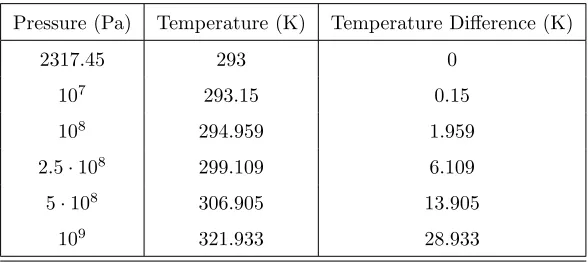
tions is discussed; this methodology was used to obtain the exact solution for the benchmark Riemann problem. In Appendix B, the temperature difference in an isentropic compression process is calculated, justifying that way the choice of the barotropic EoS.
3. Numerical Method
430
single-phase solver rhoCentralFoam. Initially, the main assumptions adopted for the application of the model to droplet impact cases inducing cavitation are 435
justified, followed by the mathematical description of the model itself.
3.1. Model assumptions
For the cases of droplet impact investigated here, the flow can be considered inertia driven since the Reynolds number Re is 106; typically this is calculated for impact velocity 110m/s,D= 10mm,ρl= 998.207kg/m3and thus, the
vis-440
cous effects can be neglected. Moreover, interest is focused primarily during the initial stages of impact when cavitation formation and its subsequent collapse take place; these occur during the early stages of splashing which is also inertia driven, so the solution of the Euler equations instead of the full Navier-Stokes are rendered suitable for capturing the relevant physics. Furthermore, the mini-445
mum Weber number We in the present droplet impact simulations is calculated to be around 105 and thus, surface tension is negligible; the minimum Froude
number Fr is 88 and therefore the gravitational forces are insignificant compared to the inertia ones. Due to the high impact velocities which result in high We and therefore neglecting the surface tension, contact angle boundary conditions 450
are not explicitly defined. Zero gradient boundary condition in the transport equation for the gas mass fraction is used at the wall instead (equivalent to a contact angle of 90◦). Surface wettability plays an important role only when a low velocity field is noticed in the lamella and therefore adhesion forces become significant [24]. However, in the present study the lamella velocity is approxi-455
mately 10 times higher than theuimp= 110m/sand therefore such effects are
ignored.
In the HEM approach which is followed in the present work, infinite nucle-ation points and infinite mass transfer are assumed, so thermodynamic equilib-rium is achieved instantaneously. This methodology has been demonstrated to 460
not been used in the present study. The droplet is initially placed next to the wall impinging with velocityuimpinto stagnant air and as a consequence, there
465
is no droplet motion in the air before the impact. The latter would necessitate sharp interface schemes in order to avoid having a diffusive interface while the droplet is travelling in the air. In addition, at later stages of splashing, which are not simulated in the present study, sharp interface algorithms are necessary in order to provide a smear-free interface. Finally, temperature effects are not 470
taken into account in the present study, since they are negligible. The interested reader is addressed to Appendix B, where this assumption is justified.
3.2. Governing equations
The three dimensional compressible Euler equations in conservative form are considered:
475
∂U
∂t +
∂Fk(U) ∂xk
= 0, in Ω, (1)
wherek= 1,2,3 denotes thex, y, zdirections. The following initial and bound-ary conditions are used for the PDE system:
U(x,0) =U0(x), in Ω, (2)
U=UD, on ∂ΩD, (3)
∂U
∂n =UN, on ∂ΩN, (4)
where
U=hρ ρYg ρu1 ρu2 ρu3
iT
is the conservative solution vector,ρis the mixture density,ρYgis the gas mass
480
¯ ¯
F is the convective term and can be analysed into x, y and z components: ¯
¯
F=hF1 F2 F3
i
, where: 485
F1=
ρu1
ρYgu1
ρu21+p
ρu1u2
ρu1u3
, F2=
ρu2
ρYgu2
ρu2u1
ρu2 2+p
ρu2u3
F3=
ρu3
ρYgu3
ρu3u1
ρu3u2
ρu2 3+p
(5)
3.3. Thermodynamic Model
A homogeneous-mixture approach is used for describing the liquid, liquid-vapour regime (referred as mixture from now on) and gas phases, which means that the three phases are in mechanical and thermal equilibrium. The mixture densityρis:
ρ=βlm[ (1−αv)ρl+αvρv] +βgρg, (6)
In the above relation, the subscripts l, m, g represent the liquid, mixture and gas regimes respectively, whereaslmrefers to the liquid-vapour mixture which is governed by a single EoS and it is treated as a single fluid. The density of the componenti=l, m, g can be found from:
490
ρi= mi
Vi
= Yim
βiV
= Yi
βi
ρ, (7)
whereβ is the volume fraction of theicomponent:
βi= Vi V,
X
i
βi= 1, (8)
Yi is the mass fraction of the icomponent: Yi=
mi m,
X
i
and the local volume fraction can be calculated from the formula:
αv=
0, ρ≥ρl,sat βlmρρl,sat−ρlm
l,sat−ρv,sat, ρ < ρl,sat
(10)
The single fluid model for the liquid and mixture is extended by a transport equation for the non-condensable gas. A linear barotropic model has been uti-lized for the pure liquid and mixture (lm). The densityρlm of the latter is:
495
ρlm=ρl,sat+
1
c2(p−psat), c=
cl, p≥psat
cm, p < psat
(11) whereρl,satis the density of the liquid at saturation condition andcis the speed
of sound of the liquid or the mixture, depending on the saturation pressurepsat.
The gas phase, has been modelled by an isothermal ideal gas EoS and thus, the gas density is given by:
ρg= p RgTref
, (12)
where the reference temperature isTref = 293.15K and the specific gas
con-stant isRg = 287.06J/(kg K). The barotropic approach is followed since the
temperature difference in the following simulations is negligible (the interested reader is referred to Appendix B, where the temperature difference in an isen-tropic compression process is calculated).
500
Differentiating isentropically Eq. (11) with respect to density, constant speed of sound for the liquid and mixture is found for water: cl = 1482.35m/sand cm = 1m/s, following Brennen [68] and ¨Orley et al. [151]. For the ideal gas,
the speed of sound is calculated from:
cg=
p
RgTref, (13)
In the three phase mixture, the speed of sound between lm and g phases is determined by the Wallis speed of sound [68, 156]:
1
ρc2 =
1−βg ρlmc2lm
+ βg
ρgc2g
In order to calculate the pressure of the mixture, a closed form equation of state 505
describing the co-existence of three phases is employed from Eq. (6):
ρ=βlm
h
ρl,sat+
1
c2(p−psat)
i
+βg p RgTref
, (15)
replacing the volume fractionβg from Eq. (7) and eliminatingβlmby using Eq.
(9) and Eq. (12), a quadratic equation for the pressure is derived:
Ap2+Bp+C= 0, (16)
where
A= 1
c2, (17)
B =ρ(Yg−1) +ρl,sat− p c2 −
YgρRgTref
c2 , (18)
C=YgρRgTref
p
sat
c2 −ρl,sat
. (19)
In the case of two real solutions p1, p2 ∈R, the largest root of Eq. (16) is
510
kept. The speed of sound in Eq. (17), (18) and (19) is set to either cl or cm,
depending on the pressure at the previous time step for identifying the liquid or mixture regions. Therefore, Eq. (16) is solved iteratively, in case the computed pressure does not fulfil the original assumption. In practice, the algorithm is repeated for no more than three iterations.
515
3.4. Discretization
Due to the large variation in the speed of sound, the Mach number in three phase flows can range from 10−2 up to 102 or even higher [157]. As it can be seen in the previous sub-section from Eq. (13) and (11), the speed of sound can vary from 1m/s in the mixture regime, up to 1482.35m/s in the liquid 520
dispersion in low Mach number flows [158, 159, 160]. In order to handle the low Mach number problem, a hybrid flux, suitable for multiphase flows, is proposed here for first time.
525
The aforementioned flux is based on the Primitive Variable Riemann Solver (PVRS) [161] and the Mach consistent numerical flux of Schmidt et al. [162]. That way, an efficient and robust solver is developed, by utilizing an approxi-mated Riemann solver, instead of the exact one. At the same time, the numerical scheme is suitable for subsonic up to supersonic flow conditions. The numerical 530
inviscid flux in thekdirection at thei+ 1/2 interface takes the following form:
Fik+1/2=ρL/Ru?k
1
YgL/R
uL/R1
uL/R2
uL/R3
+p?
0 0
δ1k
δ2k
δ3k
, (20)
where the interface velocityu?
k is approximated by: u?k = 1
CL+CR[C LuL
k +C RuR
k + (p
L−pR)], (21)
andCis the acoustic impedance C=ρc. The interface pressurep? is:
p?= (1−β)p?,incr+βp?,comp. (22)
In Eq. (22), the interface pressure is the sum of the incompressible and the compressible parts, where the incompressible contribution is:
535
p?,incr= C
LpR+CRpL
CL+CR , (23)
and the compressible contribution is:
p?,comp=C
LpR+CRpL+CRCL(uL k −u
R k)
Depending on the Mach number, the contribution of the incompressible or the compressible part in Eq. (22) is more dominant and the weighted termβ is :
β = 1−e−αM, (25)
where the Mach numberM is defined as:
M =max|u L|
cL ,
|uR| cR
. (26)
The blending coefficient is α∼(10,100). For incompressible single phase flow, 540
Eq. (23) is taking the form of 12(pL+pR) since CL =CR. However, for
two-phase flows, Eq. (23) is much closer to the exact solution.
Linear interpolation (2nd order spatial accuracy) with van Leer flux limiter has been used [163]. A four stage Runge-Kutta (RK), 4th order accurate in time has been implemented for time advancement [161], in order to capture the 545
waves which are propagating in the domain.
4. Results
In this section, verification and validation of the numerical method is per-formed; then, the effect of various impact velocities on a 2-D axisymmetric droplet impact is investigated. The Riemann problem is chosen for verifying 550
the algorithm accuracy and demonstrating its ability to resolve wave dynamics. Possible difficulties of the numerical scheme, which is prone to numerical dif-fusion and dispersion, especially at the phase boundaries are also investigated. The 2-D planar droplet impact case is then selected for qualitative validation of the propagating shock and the reflected expansion waves against available 555
experimental data. Finally, the 2-D axisymmetric droplet impingement on a solid wall is modelled for different impact velocities, in order to investigate the extent of the cavitation zone and how bubble collapse can possibly lead to mate-rial erosion. The droplet impact simulations are summarised in Table 1, where the Reynolds, Weber and Froude numbers are calculated.
Table 1: Numbering, description, impact velocity, Reynolds, Weber and Froude numbers of the
droplet impact cases which have been simulated. As wedge are denoted the 2-D axisymmetric
simulations and no air means that in the initial condition the droplet is attached to the wall,
in comparison to the rest of the simulations where the droplet is 3 cells above the wall in the
beginning of the simulation.
Name Description uimp(m/s) Re We Fr
1 planar 2-D 110 1.1·106 1.67·106 351.2 2 wedge 110 1.1·106 1.67·106 351.2
3 wedge 27.5 2.75·105 1.05·105 87.8
4 wedge 55 5.5·105 4.19·105 175.6
5 wedge 82.5 8.2·105 9.43·105 263.4
6 wedge 220 2.2·106 6.71·106 702.4
7 wedge 550 5.5·106 4.19·107 1756
8 wedge, no air 27.5 2.75·105 1.05·105 87.8
4.1. Riemann Problem
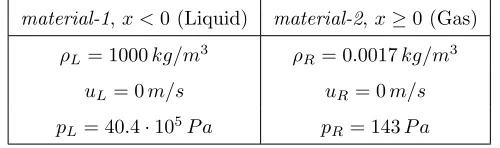
The first benchmark case is the Riemann problem in the computational do-mainx∈[−0.5,0.5] with initial conditions for the left state: ρL = 998.2kg/m3, uL = 0m/s, Yg = 0 and for the right state: ρR = 0.017kg/m3, uR = 0m/s, Yg = 1. Wave transmissive boundary conditions have been used for the left
565
and the right sides of the shock tube, that isUn+1(x=L) =Un(x=L) and
Un+1(x = 0) = Un(x = 0). A CFL number of 0.5 was chosen for the time
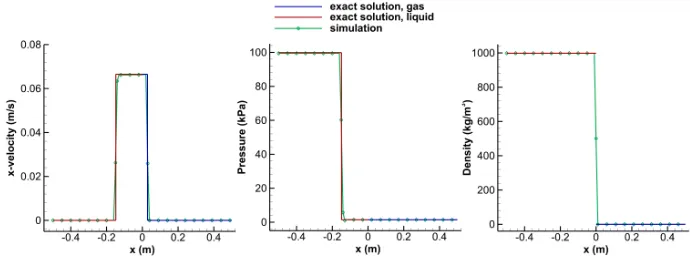
step selection in the explicit algorithm. Comparison between the exact and the numerical solution is shown in Fig. 1 at timet= 0.1µs, where second order of spatial accuracy with 500 equally spaced cells in the x direction was used for 570
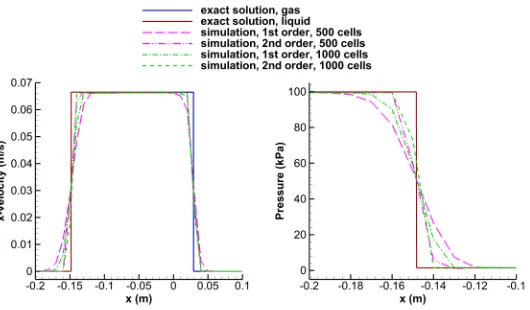
obtaining the numerical solution. A close-up view in order to compare first and second order in space schemes with resolution either 500 or 1000 equally spaced cells in the x direction is shown in Fig. 2. In Fig. 1, the exact solution of the Riemann problem and the computed one are in satisfactory agreement and the wave pattern has been correctly captured. As it was expected in Fig. 2, the 2nd 575
in the 1st order schemes. In addition, the computed solution is getting closer to the exact by increasing the mesh resolution and the numerical diffusion is eliminated. No dispersion is noticed at the boundary interface (between the gas and the liquid), which is the case when using conventional schemes such as 580
[image:26.612.132.477.261.394.2]HLLC or similar. The exact solution of the Riemann problem is not trivial for multi-material cases and it has been derived following the Appendix A of the present paper.
Figure 1: Verification of the two-phase solver in the Riemann problem. Comparison of the
x-velocity (left), pressure (middle) and density (right) between the exact and the numerical
solution at timet= 0.1 µs. Second order accuracy in space with 500 cells has been used.
4.2. Planar droplet impact
The second test case examined is a planar ’droplet’ impact on a solid wall for 585
which experimental data are available [1]. A 2-D simulation, with second order discretization in space was performed in order to validate the algorithm against the 2-D experimental data of Field at al. [1]. A circular cross-section water column of D = 10mm in diameter is placed between two transparent plates, separated by a small distance. The impact is modelled by a third plate which 590
is projected with velocity 110m/s among the two plates. For the numerical simulation, the centre of the droplet was placed at (x0, y0) = (0,0.00505)m in
Figure 2: Close-up view of the Riemann problem. Comparison of the x-velocity (left) and
pressure (left) between the exact and the numerical solution at timet= 0.1µs. First and
second order spatial accuracy schemes with resolution of 500 and 1000 cells have been used.
the droplet radius has been kept until distance 2Rin the positive and negative 595
x-direction and until 1.5R in the positive y-direction. After that, a stretching ratio of 1.05 has been applied, resulting in a total amount of 380kcells. A CFL number of 0.5 was chosen for the time step selection (∆t ∼5·10−9s) in the explicit algorithm. Initially, the pressure of the surrounding air and the water droplet is atmospheric,p(t= 0) = 101326P a. In this way, the initial density for 600
the two phases is calculated from the barotropic EoS:ρl(t= 0) = 998.207kg/m3
and ρg(t = 0) = 1.204kg/m3. Zero gradient boundary conditions have been
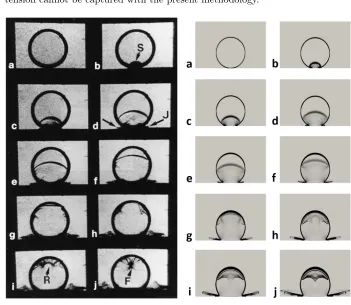
selected for the right, left and upper faces, whereas the lower face is set as wall. In Fig. 3 the experiment [1] (left) and the numerical solution (right) for the droplet impact are compared.
605
The main mechanisms noticed both in the experimental work [10, 1] and past numerical simulations [146, 148, 149] are jetting, as well as shock and expan-sion waves; these are also identified in the present study. In the aforementioned compressible numerical studies, cavitation was not modelled and different im-pact conditions were simulated compared to the present work. In frame(a)the 610
the information of the impact has not travelled in the rest of the droplet, which is still moving with the impact velocity [144]. Those two regions are separated by the shock front (frame(b)), which is created by individual wavelets emanat-615
ing from the contact edge [145, 10]. In the preliminary stages of the impact, the edge velocity is higher than the speed of sound and there is a tendency to de-crease. As long as the edge velocity is higher than the shock speed, the shock is attached to the contact edge. When the edge velocity reaches the critical value of the shock speed, the shock wave is detached from the contact line (frame(c)) 620
and it is propagating in the rest of the liquid (until frame(g)). This mechanism is responsible for the expansion of the liquid and the jetting, which is created in the contact edge (frame (d), denoted as J in the experimental results). In frames(e), (f ) and (g), the shock wave is reflected normal to the free surface as an expansion wave which focuses in the inner region of the drop. These low 625
pressure areas are potential cavitation regimes and their extent, as well as the volume of the vapour depend on the impact velocity [149]. In frames(g), (h), the shock wave reaches the highest point of the drop and it is then reflected downwards. In the last frames, the jetting is more advanced and the reflected shock is shown in the upper middle of the drop at frames(i) and(j) (denoted 630
as R in frame(i) and focused to point F in frame(j) of the experiment). Comparing the present simulation with previous experimental studies of Field et al. [1], similar wave structures at the same time scale are noticed. The edge pressure in the contact edge is around 0.22GP a and it exceeds the wa-ter hammer pressure [10], which is estimated about 0.16GP a, where the water 635
hammer pressure is defined aspwh=ρlcluimp. The shock wave moving upwards
and its reflection have been recognized at similar time frames between the ex-periment and the simulation. Furthermore, the jetting (starting from frame(d)) is around ten times the impact speed, or even higher, as it has been mentioned in [10]. Rarefaction waves have been also identified in the later stages of the 640
However, in the experimental study the maximum volume of vapour is in the centre of the droplet, whereas in the present work, vapour is more dominant 645
[image:29.612.129.480.186.491.2]on the upper sides, perimetrically of the droplet. This is because bulk liquid tension cannot be captured with the present methodology.
Figure 3: Validation of the numerical solution (right) against experiment (left) for a 2-D drop
impact on a solid wall with impact velocity 110m/s. The interframe time ist= 1µs. The
left figure is taken from Field et. al [1].
4.3. 2-D axisymmetric droplet impact
The previous simulation is now performed in a 2-D axisymmetric computa-tional domain, in order to model the impact of spherical droplets. A 3-D simula-650
tion would generally had captured the 3-D interfacial instabilities due to surface tension, but since the We number is above 105and in order to reduce the
impact time scale istimpact =D/uimp and in the present configuration for
im-pact velocity uimp = 110m/s is calculated to betimpact ≈9·10−5s, whereas
655
the cavitation collapse time is approximated from the characteristic Rayleigh timetcav = 0.915R0,vap
q ρ
l
p∞−psat and it is calculated to betcav≈2.2·10 −5s.
Starting from the half of the 2-D meshes of 4.2, a wedge of 5 degrees has been simulated by taking advantage of the axial symmetry. The same initial and boundary conditions are kept, apart from the wedge faces and the axis of sym-660
metry. At the beginning, a grid independence analysis is performed and then, the effect of the impact velocity’s magnitude is investigated for the intermediate grid. Second order accurate spatial discretization schemes have been used for this simulation and a CFL number of 0.5 was chosen for the time step selection (∆t ∼3·10−10s) in the explicit algorithm. In the following figures, pressure 665
has been non-dimensionalized with the water hammer pressure pwh, velocity
with the impact velocity uimp and the dimensionless time is calculated from: t = T−tbimp
D/cl , where tbimp = 0.00005/uimp is the time of the impact, based on
the initial configuration (in cases where the droplet is not attached to the wall, but there is air between them). This way, the shock wave will be at the same 670
y-position at a given non-dimensional time for all impact velocities.
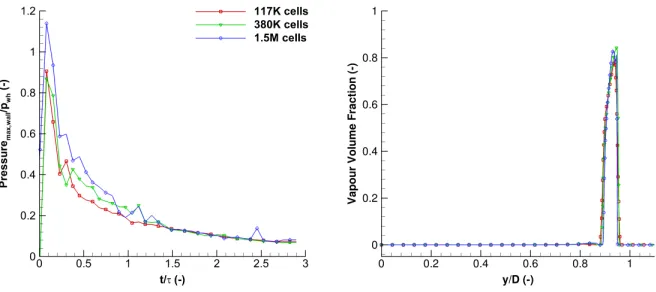
In Fig. 4 the results of the grid independence study are shown having as impact velocity 110m/s. Three different grids have been utilized, with 117k, 380k and 1.5M cells. In the fine area: (0,2R)×(0,1.5R) the resolution of 330×225, 660×450 and 1320×900 cells has been used for the three different 675
grids. On the left-hand side of Fig. 4, the maximum wall pressure with respect to time is shown and on the right-hand side the generated volume of vapour at a line parallel to the y axis (x= 0.6mm) at timet = 1.19 is plotted. The maximum wall pressures are similar for all grids and the peak noticed in the vapour volume fraction after y = 0.8 is almost identical for all resolutions. It 680
can be concluded from the above study that there is convergence of the solution for the selected grid resolutions. The intermediate grid (380kcells), referred as
In Fig. 5 and 6 the evolution of the droplet impact is shown forcase 2. More 685
specifically, in Fig. 5 the pressure field (left slice) and the velocity magnitude (right slice) are shown in conjunction with the iso-surface of 0.5 gas mass frac-tion on the left figures, whereas on the right figures, the numerical Schlieren is depicted by utilizing different scales for the inner and the outer computational domain of the droplet in order to capture the different waves, which are propa-690
gating in the liquid water and in the air. In Fig. 6 the wall pressure (lower slice) and the vapour volume fraction (upper slice) combined with the iso-surface of 0.5 gas mass fraction are demonstrated for case 2. The main mechanisms and the flow pattern in the 2-D axisymmetric simulation (case 2) are similar to the planar one (case 1) for the same impact velocity (110m/s). At timet = 0.44 695
the droplet has already impacted the wall and the shock wave is visible in the Sclieren figure. The jetting has started, however it is more evident at time
t = 0.89 and it is responsible for the non-spherical shape of the droplet. As the shock moves to the upper half of the droplet, it is reflected on the droplet surface and expansion waves, which are moving downwards, are noticed in the 700
Schlieren figures, starting from timet = 0.89. Those rarefaction waves create low pressure areas and thus, cavitation is noticed at timest= 1.19 andt= 1.48 (see also Fig. 6). The maximum wall pressure is realised at the moment of the impact and it decreases afterwards (see Fig. 11).
The planar and the axisymmetric solutions exhibit many similarities; nev-705
ertheless, there is a discrepancy in the pressure field between case 1 andcase 2. The maximum wall pressure is higher in case 1, as it can be seen in Fig. 7 and has been also noticed in previous studies [10]. In case 1 the shock wave propagates in a cylindrical pattern and it is reflected on the upper half surface of the cylinder, whereas incase 2 the shock wave travels in a spherical pattern 710
and it is reflected on the upper surface of the spherical droplet. The three-dimensionality of the latter results in a shock wave of the half pressure strength (∼10M P a), compared to the planar case (∼20M P a).
In Fig. 8, the above results are compared to lower impact velocities, 55m/s
as in the left image of Fig. 5 is followed here as well. The droplet spreading at lower impact speeds is less dominant and the droplet is closer to the spherical shape, as it can be seen from the droplet iso-surface plots. On the other hand, incase 2 the transition to splashing is evident, as the jetting area is split to two different regions. Furthermore, the high pressure area and the lamella are larger 720
in case 2 but the ratio|umax|/uimp in all cases (case 2-4) is between 7.2 and
11, whereas the ratio pmax/pwh is around 0.13. Although the above indicate
similar non-dimensional maximum pressures and jetting velocities regardless the impact velocity, it is worth pointing out that the maximum pressure and velocity fields are significantly lower incase 3 and4. For example, the jetting velocity 725
is reduced by even one order of magnitude (∼1400m/sincase 2 and∼190m/s
incase 4 ).
In order to compare the vapour generated for each impact velocity at the same non dimensional time t = 1.48, slices with the vapour volume contour (upper) combined with the same iso-surface are shown in Fig. 9 forcase 2, 3
730
and4. For the highest impact velocity (case 2) the vapour volume is increased even one order of magnitude compared to the values of lower velocities. It can be concluded that the amount of the vapour and the extent of the cavitation area, which is generated at later stages, monotonically depends on the impact velocity (this is also evident in Fig. 11 where 6 different impact velocities are 735
examined). The wall pressure (bottom) is also depicted in Fig. 9; although the maximum is approximately the same for all cases, it extends to a larger area for higher impact velocities.
At a later stage of the droplet impact (Fig. 10), the splashing is more evident than at timet= 1.48. In Fig. 10 the pressure field (left slice) and the velocity 740
magnitude (right slice) are shown in conjunction with the iso-surface of 0.5 gas mass fraction on the left figures, whereas on the right figures the wall pressure (lower slice) and the vapour volume fraction (upper slice) combined with the iso-surface of 0.5 gas mass fraction are demonstrated forcase 2. Several vaporous regions have been created from the rarefaction waves and they start collapsing 745
regions have just collapsed respectively. A peak in the pressure due to the shock wave created by the collapse is noticed at timest= 3.56 andt= 3.64, however the location (far away from the wall) and the strength (maximum pressure is 0.09pwh) cannot denote erosion.
750
In Fig. 11 a parametric study for six different impact velocities (case 2-7) is performed for the intermediate grid resolution, where the maximum wall pressure (left) and the generated volume of vapour (right) with respect to time are plotted. As it has been already discussed in the previous paragraph and in previous studies [7, 149], it is straightforward that higher impact velocities 755
result in higher wall pressures (although the ratio pmax,wall
pwh is almost constant
regardless of the impact velocity). More production of vapour due to the reflec-tion of a stronger shock developing during the liquid-solid contact is calculated. The cavitation inside the droplet may also contribute to pressure increase on the solid surface at the bubble collapse stage. This is shown on the wall pressure 760
figure, where at higher impact velocities there are small peaks occurring at later times (case 7).
It is remarkable that the initial configuration can affect the existence or not of cavitation and material erosion close to the wall, even for low impact velocities. As initial condition incase 8 is now selected the droplet to be attached to the 765
wall (in contrast tocase 1-7), so there is no air between them. To demonstrate that the impact velocity is not the determining factor here, uimp = 27.5m/s
was selected. Surprisingly enough, in Fig. 12 vapour is created at the impact point and a vaporous region is formed above it due to a rarefaction wave at an early stage of the impact. The maximum vapour volume fraction created is 770
even three times higher thancase 2 at timet= 1.48, where the impact velocity is four times larger. Consequently, there is a significant increase in the pressure field due to the collapse, as it can be observed in Fig. 13, which results in around 60% higher wall pressure, compared tocase 3. In practice, the above case can be realised at steam turbine blades, where the rarefied environment implies very 775
Figure 4: Grid independence study for three different grids (coarse, intermediate, fine).
Max-imum wall pressure with respect to time is shown on the left. The values of the vapour
volume fraction on the right figure are exported at a line parallel to the y axis starting from
x= 0.6mm, z= 0 at timeT= 0.083. Wall pressure is divided bypwh, time is measured from
the moment of the impact and it is non-dimensionalized withτ =D/cl, whereas distancey
has been divided by the drop diameterD.
5. Conclusions
In the present work, the impact of droplets onto solid surfaces at conditions inducing cavitation within its volume have been addressed. Initially, a litera-ture review on the subject has been given, focusing primarily on computational 780
studies. It is apparent that the vast majority of them assume incompressible liquids and aim to resolve the temporal development of the droplet/gas inter-face. Some studies also aim to consider the heat transfer and phase-change phenomena induced during impact at elevated wall temperature. Under such conditions, wettability effects and contact angle play a dominant role to the im-785
pact outcome, with vast literature reporting relevant findings. However, more relevant to the present study are the conditions at high impact velocities where liquid compressibility becomes important. For conditions inducing cavitation within the droplet’s volume, only one set of experiments is reported in the lit-erature while no computational study has been performed so far. Aiming to 790
Euler equations, able to model gaseous, liquid and vapour phases has been de-veloped in OpenFOAM. Moreover, a Mach number consistent numerical flux, capable of handling a wide range of Mach number flows and producing smooth solutions at the phase boundaries has been proposed. The main model assump-795
tions and simplifications have been justified for the flow conditions of interest to the present study. The developed algorithm was then validated against the Riemann problem, followed by the comparison against the 2-D planar ’droplet’ impact experiment, showing satisfactory agreement, as similar flow patterns have been identified. Following, simulation of the impact of spherical droplets 800
on a solid surface have been performed, including for the first time the simula-tion of cavitasimula-tion formasimula-tion and collapse. These cavitasimula-tion regimes are formed by the reflection of the shock wave on the outer surface of the droplet as an expansion wave.
The droplet impact time scale istimpact =D/uimp and in the present
con-805
figuration for impact velocity uimp = 110m/s is calculated to be timpact ≈
9·10−5s, whereas the cavitation collapse time is approximated from the
char-acteristic Rayleigh timetcav = 0.915R0,vap
q ρ
l
p∞−psat and it is calculated to be
tcav ≈2.2·10−5s. The significantly larger time scale (timpact ≈9·10−5s) of
the droplet impact phenomenon in comparison to the characteristic time of the 810
cavitation collapse (tcav≈2.2·10−5s) justifies why the collapse of the vaporous
regions inside the droplet don’t affect the shape of the droplet and its splashing. The impact velocity strongly affects the droplet shape and spreading, as well as the jetting velocity and the volume of vapour produced in the upper area of the droplet. Increased impact velocity may result in more damage and possibly 815
material erosion not only because of higher impact pressure, but also due to the collapse of the vaporous bubbles inside the droplet. However, in order to notice significant pressure increase due to the bubble collapse, the impact velocity must be extremely high which is rather difficult to be realised in practical applications such as steam turbines. Apart from that, the initial location of the droplet with 820
initial stages of the impact. If there is no gas between the droplet and the solid surface, pressure can get close to its maximum value, which is at the moment of the impact (pwh) and material erosion may take place (pwh = 160M P afor
825
uimp = 110m/sand the yield strength of steel is 200−300M P a). It should
be clarified here that the above phenomenon can even occur at low impact velocities, for instance at impact velocityuimp= 27.5m/s.
Acknowledgements
The research leading to these results has received funding from the MSCA-830
ITN-ETN of the European Union’s H2020 programme, under REA grant agree-ment n. 642536. The authors would also like to acknowledge the contribution of The Lloyd’s Register Foundation. Lloyd’s Register Foundation helps to protect life and property by supporting engineering-related education, public engage-ment and the application of research.
835
Appendix A. Exact Riemann problem for multi-material problems
In this section, the methodology for finding the exact solution to the Rie-mann problem for the multi-material Euler equations is derived. In the literature there are limited works discussing exact Riemann solvers for multi-material ap-plications. Mainly, these focus on multiple velocities, pressures and temperature 840
fields, see e.g. [164, 165]. The discussion here will be limited to just two different materials sharing the same velocity, pressure and temperature fields. The mate-rials will be referred to asmaterial-1 andmaterial-2, however the methodology may be extended to any number of materials. For the sake of generality, the discussion will not be limited to an explicit form of equation of state. Instead, 845
that will be examined is of the form p=p(ρ, Y) orp=p(ρ, e, Y), where Y is the mass fraction of material-2, defined in Eq. (9). Following Toro [161], the form of the Riemann problem solved is:
∂U ∂t + ∂F(U)
∂x = 0
U(x,0) =
UL, x<0
UR, x≥0
(A.1)
The same nomenclature as in the rest of the paper is used.
Appendix A.1. Pressure is only a function of density and mass fraction
855
In case the mixture pressure is only a function of density and mass fraction,
p=p(ρ, Y) the conservative variables and the flux vector are:
U= ρ ρu ρY
, F(U) =
ρu
ρu2+p
ρuY , (A.2)
To derive the Jacobian matrix, it is convenient to recast theUandF(U) vectors and equation of statep=p(ρ, Y), as:
U= u1 u2 u3
, F(U) =
u2
u22 u1 +p
u1,uu31
u3u2
u1 , (A.3)
p=p
u1,
u3
u1
The Jacobian matrix is calculated as: 860
A(U) =
∂f1 ∂u1 ∂f1 ∂u2 ∂f1 ∂u3 ∂f2 ∂u1 ∂f2 ∂u2 ∂f2 ∂u3 ∂f3 ∂u1 ∂f3 ∂u2 ∂f3 ∂u3 (A.5)
After calculating all terms and replacing back the conservative variables:
A(U) =
0 1 0
∂p ∂ρ−u
2− ∂p ∂Y
Y
ρ 2u
1
ρ ∂p ∂Y
−uY Y u
(A.6)
The eigenvalue analysis of the Jacobian matrix results to:
λ1=u−c
λ2=u
λ3=u+c
(A.7)
and right eigenvectors:
K1=
1
u−c
Y
, K2=
∂p ∂Y
u∂Y∂p
Y∂Y∂p −ρ∂p∂ρ
, K3=
1
u+c Y (A.8)
wherecis the speed of sound equal toq∂p∂ρ. The waves associated withλ1,λ3
eigenvalues are non-linear waves (shock waves or rarefaction waves) and theλ2
865
Appendix A.2. Pressure is a function of density, internal energy and mass
frac-tion
In case the mixture pressure is only a function of density, internal energy and mass fraction,p=p(ρ, e, Y) the conservative variables and the flux vector are: 870 U= ρ ρu ρE ρY
, F(U) =
ρu
ρu2+p
u(ρE+p)
ρuY , (A.9)
whereE= 1/2u2+e, withethe internal energy. To derive the Jacobian matrix,
it is convenient to recast theUandF(U) vectors and EoSp=p(ρ, e, Y) as:
U= u1 u2 u3 u4
, F(U) =
u2
u22 u1 +p
u1,uu31 −
u22
2u1,
u4 u1 u2 u1
u3+p
u1,uu3
1 −
u2 2
2u1,
u4
u1
u4u2
u1 , (A.10)
p=p
u1,
u3
u1
− u
2 2
2u1
,u4 u1