Christian REIMER et al. On-chip frequency combs and telecommunications signal processing meet quantum optics Front. Optoelectron. (2018)
https://doi.org
RESEARCH ARTICLE
On-chip frequency combs and telecommunications signal
processing meet quantum optics
Christian REIMER1, Yanbing ZHANG1, Piotr ROZTOCKI1, Stefania SCIARA1,2, Luis Romero CORTÉS1,
Mehedi ISLAM1, Bennet FISCHER1, Benjamin WETZEL3, Alfonso CINO2, Sai T. CHU4, Brent LITTLE5,
David MOSS6, Lucia CASPANI7, José AZAÑA1, Michael KUES1,8, Roberto MORANDOTTI (*)1,9,10,* 1 Institut National de la Recherche Scientifique – Centre Énergie, Matériaux et Télécommunications (INRS-EMT), 1650
Boulevard Lionel-Boulet, Varennes, Québec, J3X 1S2, Canada
2 Department of Energy, Information Engineering and Mathematical Models, University of Palermo, Palermo, Italy 3 Department of Physics & Astronomy, University of Sussex, Falmer, Brighton BN1 9QH, UK
4 Department of Physics and Material Science, City University of Hong Kong, Tat Chee Avenue, Hong Kong, China 5 State Key Laboratory of Transient Optics and Photonics, Xi’an Institute of Optics and Precision Mechanics, Chinese Academy
of Science, Xi’an, China
6 Centre for Micro Photonics, Swinburne University of Technology, Hawthorn, Victoria 3122, Australia 7 Institute of Photonics, Department of Physics, University of Strathclyde, Glasgow G1 1RD, UK 8 School of Engineering, University of Glasgow, Rankine Building, Oakfield Avenue, Glasgow G12 8LT, UK 9 Institute of Fundamental and Frontier Sciences, University of Electronic Science and Technology of China, Chengdu 610054,
China
10 National Research University of Information Technologies, Mechanics and Optics, St Petersburg, Russia
© Higher Education Press and Springer-Verlag GmbH Germany, part of Springer Nature
Abstract Entangled optical quantum states are essential towards solving questions in fundamental physics and are at the heart of applications in quantum information science. For advancing the research and development of quantum technologies, practical access to the generation and manipulation of photon states carrying significant quantum resources is required. Recently, integrated photonics has become a leading platform for the compact and cost-efficient generation and processing of optical quantum states. Despite significant advances, most on-chip non-classical light sources are still limited to basic bi-photon systems formed by two-dimensional states (i.e. qubits). An interesting approach bearing large potential is the use of the time or frequency domain to enabled the scalable on-chip generation of complex states. In this manuscript, we review recent efforts in using on-on-chip optical frequency combs for quantum state generation and telecommunications components for their coherent control. In particular, the generation of bi- and multi-photon entangled qubit states has been demonstrated, based on a discrete time domain approach. Moreover, the on-chip generation of high-dimensional entangled states (quDits) has recently been realized, wherein the photons are created in a coherent superposition of multiple pure frequency modes. The time- and frequency-domain states formed with on-chip frequency comb sources were coherently manipulated via off-the-shelf telecommunications components. Our results suggest that microcavity-based entangled photon states and their coherent control using accessible telecommunication infrastructures can open up new venues for scalable quantum information science.
Keywords
Received March 19, 2018; accepted
1
Introduction
In the last few decades, research has greatly intensified towards realizing universal quantum computers as well as simulators, with the promise of being able to perform calculations that are beyond the capability of conventional classical computers. To implement a quantum computer, or quantum information processing in general, physical systems are required that can support the preparation, manipulation, and measurement of quantum information [1]. Technologies that provide these characteristics are being advanced in several platforms including electronic, trapped ions, solid state, nuclear magnetic resonance, and superconducting systems [2]. What all these platforms have in common is that quantum states are very delicate, can quickly deteriorate, and are highly sensitive towards noise. This characteristic usually requires highly sophisticated experimental facilities, a core technological challenge towards achieving quantum computers. Among the many quantum platforms, photons (particles of light) are very promising, as they exhibit very high noise tolerance [3]. Indeed, the low decoherence of light, which has already been exploited for classical telecommunications [4], transfers to very high noise tolerance in quantum applications. Additionally, photons are ideally suited to interact with other quantum platforms, while information can be encoded into their different degrees of freedom, such as polarization, phase, path, frequency, time, and more, which in the classical domain has enabled multiplexing in current telecommunication networks. In addition, photons exhibit excellent transmission properties through e.g. free-space or optical fibers, which in turn enables the possibility to create quantum communication networks [5]. However, optical states with significant quantum resources (i.e. large Hilbert spaces), which are a key cornerstone for realizing optical quantum computers, remain difficult to prepare and control, in large parts because of increasing experimental complexity and the need of operations that act probabilistically.
To address these issues, optical quantum research has focused on two main directions: i) increase the quantum resource, and ii) reduce the device complexity to achieve scalable systems. In the first case, an immediate approach would be to boost the number of photons, which will in turn lead to larger entangled states [6–8], similarly to the approach used for other quantum platforms [9,10]. However, this comes with significant drawbacks, since the generation of optical entangled states is commonly achieved with photon pairs in probabilistic processes. As such, increasing the number of photons means incrementing the number of probabilistic sources, which lowers their efficiency. Furthermore, multi-photon states are highly sensitive towards losses and noise. The combination of these drawbacks has so far limited the generation of optical states to ten entangled photons [6]. A different approach, that is unique and ideally suited for optical system, is to simultaneously exploit multiple modes (polarization, spatial, temporal, spectral) of fewer photons to achieve large optical quantum states [11–13]. Optical frequency combs, which are broadband optical sources that have equidistantly-spaced spectral modes, directly suit this direction. Due to their well-defined spectral locations, frequency combs have served as extremely precise optical rulers, enabling a revolution in high-precision metrology and spectroscopy [14]. Recently, the classical frequency comb concept has been extended to the quantum world for the preparation of non-classical states [15,16]. This approach brings about many benefits, especially for the creation of large states. First, optical combs offer many experimentally-accessible frequencies within a single spatial mode, where photons of different wavelengths are transmitted together in a single waveguide. Furthermore, the intrinsic multi-frequency-mode characteristics enable the generation of many entangled quantum states simultaneously, with the density of these quantum channels controllable via the spectral mode separation. Finally, the frequency domain is complementary to other degrees of freedom, enabling the creation of even larger-scale quantum states. Quantum frequency combs have until now been utilized for the generation of heralded single photons [17–21], as well as two-photon entangled states via the time [22–25], path [26] and frequency [27] degrees of freedom. In addition, very complex states, e.g. cluster states [28,29], and multipartite entanglement [16,30], have been predicted and achieved for applications in quantum signal processing, including quantum logic gates [27], and spectral linear optical quantum computation [31].
2
Quantum optical frequency combs
preparation using so-called squeezed states, where quantum information is encoded in continuous quadratures of the optical fields, has been remarkably successful, allowing the generation of many complex states. Examples include the simultaneous realization of quadripartite entangled quantum states [29]. Richer excitation spectra and more tailored nonlinear optical interactions have been predicted to enable larger states [30] including recent experimentally demonstrated multipartite entangled state covering up to 115,974 nontrivial partitions of a 10-mode state [32].
Although large complex quantum states have been widely investigated, bulk-optic based approaches require large, expensive, and very complex setups, not suitable for out-of-the lab applications. Furthermore, the quantum states that have been demonstrated with such OPO approaches have not yet achieved the level of squeezing required (with a threshold value of 20.5 dB) for fault-tolerant optical quantum computation [33], being typically limited by loss which degrades the squeezed states. In addition, the spectral modes of a large OPO cannot be individually addressed due to their small spectral separation. Reducing the size of the resonant cavities would allow access to individual frequency modes and, in turn, also allow one to exploit single or entangled photons instead of (or in addition to) squeezed states. Therefore, the miniaturization of optical frequency combs will bring not only more compact devices but may open up novel opportunities.
In order to address the second main challenge of realizing compact and scalable devices, integrated (on-chip) photonics has established itself as a promising platform for quantum optics [34,35]. Compact and mass-producible photonic chips (particularly those compatible with the silicon chip industry) enabled compact, cost-efficient, and stable devices for the generation and processing of non-classical optical states. This is highlighted by the demonstration of on-chip single photon sources [36,37], generation of entangled states [25,26,38], as well as the realization of basic algorithms [39–41]. Integrated quantum photonics is ideally suited to generate quantum optical frequency combs. Certainly, the on-chip realization of optical combs is a very active research field [42,43], and many of its principles are reflected in the first demonstrations of chip quantum combs. As materials used for on-chip integration typically exhibit third-order optical nonlinearity, spontaneous four-wave mixing (SFWM) can be used for the generation of integrated quantum frequency combs [21].
3
On-chip comb of heralded single photons
Figure 1. Quantum frequency comb generation in integrated microring resonators. (a) Via spontaneous four-wave mixing inside the nonlinear microcavity [48], two pump photons at frequency (𝜔") are converted to one signal and one idler photon at
frequencies (𝜔# and 𝜔$), with energy conservation demanding (𝜔#+ 𝜔$= 2𝜔"). Inset: an integrated Hydex photonic chip (based on a high refractive index glass with similar properties to silicon oxynitride) compared to a Canadian one-dollar coin. (b) A broad measured quantum frequency comb spectrum spanning from the S to the L telecommunications band [22].
Figure 2. Photon coincidence, and auto-correlation measurement. The high coincidence to accidental ratio in the photon coincidence peak (a) shows that the source can be used as a good quantum source. The dip in the heralded autocorrelation peak (b) confirms that the photons can be used as heralded single photons. The single photon autocorrelation peaks for both signal (c) and idler (d) photons are reaching two, confirming that the photons are emitted into pure states.
4
On-chip comb of entangled multi-photon states
An important step following the realization of correlated photon pairs is achieving entanglement. Entangled photon pair generation has been demonstrated in silicon and silicon nitride microring resonators by means of energy-time [23–25], or path-entanglement [26] approaches. In addition, because of the multi-channel property, these on-chip entangled quantum sources exhibit compatibility with telecommunications wavelength multiplexing techniques [17,22]. With respect to quantum frequency combs, their multimode nature can be used here to achieve highly parallel generation of entangled states. In particular, a double-pulse excitation of a single resonance was used to demonstrate the realization of time-bin entangled photon pairs over the entire frequency comb spectrum [22]. The
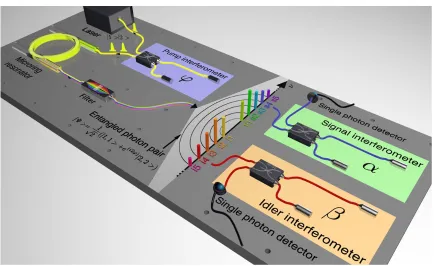
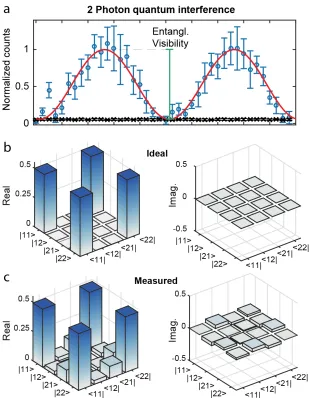
[image:4.612.123.490.267.554.2]phase-locked double pulses were prepared using stabilized fiber-interferometers, and the excitation power was chosen such that the double pulses only emit one photon pair, which is then in a superposition of two temporal modes, see Figure 3. For their characterization, the photons were sent to a set of unbalanced interferometers, which enables the implementation of projection measurements for quantum interference and tomography measurements, see Figure 4. Most remarkably, due to the resonance characteristics of the cavity, the coherence time of the excitation field is matched to that of the photons. This configuration enables the generation of multiple entangled photons pairs simultaneously over multiple spectral lines. This distinctive multimode characteristic of the frequency comb allowed the demonstration of the first four-photon entangled states on a chip, by post-selecting two signal and idler pairs on different resonances simultaneously. The realization of this four-photon entangled state was confirmed through quantum interference as well as quantum state tomography, see Figure 5 [22].
Figure 3: Experimental setup for generation and characterization of time-bin entangled quantum frequency comb.
Figure 5: Four-photon quantum state tomography. By performing tomography on the four-photon state, the first generation of a multi-photon entangled state on a photonic chip was confirmed [22].
5
On-chip comb of high-dimensional entangled photon states
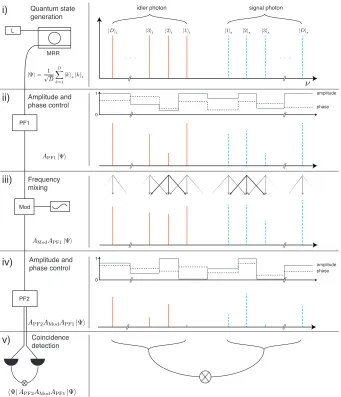
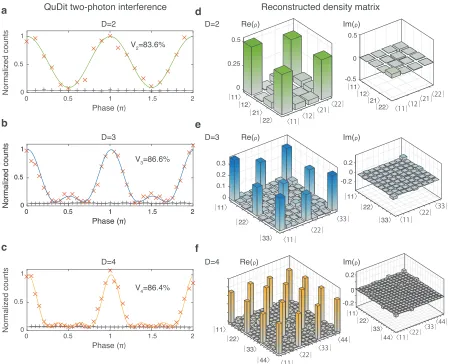
From a different point of view, photon pairs (signal and idler) can be generated in a quantum superposition of many frequency modes [27]. This was achieved by injecting a nonlinear resonator with a spectrally-filtered mode-locked laser to excite a single resonance of the microring at ~1550 nm wavelength, in turn producing pairs of correlated signal and idler photons spectrally-symmetric to the excitation field covering multiple resonances, see Fig. 6. Considering the quantum nature of this process, the individual photons were intrinsically generated in a superposition of multiple frequency modes [27]. Due to the energy conservation of SFWM, this approach leads to the realization of a two-photon high-dimensional frequency-entangled state. To characterize the high-dimensional states, a novel manipulation scheme was developed, which is capable to perform basic gate operations for coherent state control. The quantum gate was realized using a configuration composed of two programmable filters and one electro-optic phase modulator, as schematized in Fig. 6 and explained in more detail in Fig. 7. The first programmable filter was used to impose an arbitrary spectral amplitude and phase mask on the high-dimensional state, see Fig. 7 ii). The manipulated state was then sent to an electro-optic phase modulator, which was driven by an RF frequency synthesizer. The imposed optical phase modulation generated coherent sidebands from the input frequency modes. When the sideband frequency shift was chosen to match the spectral mode separation of the quantum state, i.e. the rings FSR, these input frequency modes were coherently mixed. Then, a second programmable filter (Fig. 7 iv) was used to select different, individual frequency components of the manipulated state through the application of a second amplitude mask. Finally, each of the two photons was routed to a separate single photon detector for coincidence detection. High-visibility measured quantum interference and state tomography (Fig. 8) confirmed the first generation of high-dimensional entangled states on a photonic chip.
<LLLL| <LLSS| <SSLL| <SSSS| |LLLL> |LLSS> |SSLL> |SSSS> 0.2 0.1 0 -0.2 -0.1 0 0.1 0.2 <SSSS|<SSLL| <LLSS|<LLLL| |SSSS> |SSLL> |LLSS> |LLLL> <LLLL| <LLSS| <SSLL| |LLSS> |SSLL> |SSSS> 0.1 0.2 0 <LLLL| <LLSS| <SSLL| <SSSS| |LLLL> |LLSS> |SSLL> |SSSS> -0.2 0.2 0 -0.1 0.1
4 Photon qubit state - ideal
4 Photon qubit state - measured
a)
Re
( )
^Im
( )
^b)
Re
( )
^Im
( )
^ρ
ρ
Figure 6: Experimental setup for the generation and characterization of high-dimensional quantum states with on-chip optical frequency combs. The microring resonator is excited with single pulses from a mode-locked laser, generating photon pairs in a superposition of frequency modes. Using a combination of programmable filters and am electro-optic phase modulator, the quantum states can be coherently manipulated and projection measurements can be performed [27].
[image:8.612.137.478.281.678.2]Figure 7: Experimental realization of coherent manipulation of high-dimensional frequency-bin entangled quantum states. Individual steps to control, manipulate and characterize the high-dimensional quantum states are displayed, i) The initial states |Y〉 were generated using the micro- ring resonator (MRR)-based operational principle illustrated in Fig. 1. ii), Using a
idler photon signal photon
|2⟩i |1⟩i |3⟩i
|D⟩i |1⟩s |2⟩s |3⟩s |D⟩s
i) Quantum state
generation
Amplitude and phase control
Amplitude and phase control Frequency mixing ii)
iii)
iv)
v) Coincidence
detection
0
1 amplitude
phase
0 1
amplitude phase
PF2 PF1
Mod L
MRR
APF1|Ψ⟩
AModAPF1|Ψ⟩
APF2AModAPF1|Ψ⟩
ν |Ψ⟩=√1
D D
!
k=1
|k⟩s|k⟩i
programmable filter (PF1), any arbitrary spectral phase and amplitude mask can be imposed on the quantum states for
[image:9.612.81.531.130.494.2]manipulation. iii) An electro-optic modulator (Mod) driven by a radio-frequency synthesizer was used to coherently mix different frequency components of the high-dimensional states. iv) A second programmable filter (PF2) can impose an amplitude and phase mask and route the signal and idler to two different paths. v) The photons were then detected using single photon counters and timing electronics [27].
Figure 8: Quantum interference and quantum state tomography of high-dimensional entangled photon states. The visibilities of the quantum interference of quDits with D = 2 (a), D = 3 (b) and D = 4 (c), exceed the visibilities required to violate a Bell inequality for the D=2, D=3 and D = 4 states. Full quantum state tomography revealed that the experimentally
reconstructed density matrix of the entangled quDit states are in very good agreement with the expected maximally entangled states [27].
6
Conclusion and outlook
On-chip quantum optical frequency combs have been shown to be able to generate complex entangled optical states, which were not realized by other means, such as on-chip path or polarization entanglement. Considering how successful the quantum frequency comb approach is even in bulk systems (emitting squeezed states), it is conceivable that the potential of on-chip quantum combs is extremely significant, and the here reviewed experiments only represent the first steps [49]. Furthermore, merging the fields of quantum optical frequency combs with telecommunications signal processing will enable even more functionalities and has the potential to advance the field of quantum optics towards large-scale implementation. Indeed, following our first realizations of multi-photon and high-dimensional entangled on a chip, several other groups have achieved significant and related breakthroughs. These include the realization of frequency-bin entangled combs with 50 GHz spacing [50], using the same coherent manipulation scheme reviewed here. Reducing the mode spacing is particularly interesting once the spacing reaches frequencies achievable by electronics, which will enable more versatile quantum state control.
0 0.25 0.5 0 0.1 0.2 0.3 QuDit two-photon interference
D=2
D=3
D=4
Reconstructed density matrix
Re(ρ) D=2
D=3
D=4
V2=83.6%
V3=86.6%
V4=86.4%
11〉 12〉 21〉 22〉 〈22 〈21 〈12 〈11 Im(ρ) 11〉 22〉
33〉 〈11 〈22
〈33
11〉 22〉
44〉 〈11 〈22 〈33
33〉 〈44
Re(ρ) Im(ρ)
Re(ρ) Im(ρ)
Normalized counts
Phase (π)
0 0.5 1 1.5 2
0 0.5 1 a b c d e f 11〉 12〉 21〉 22〉 〈22 〈21 〈12 〈11 11〉 22〉
33〉 〈11 〈22
〈33
11〉 22〉
44〉〈11〈22 〈33
33〉 〈44
-0.5 0 0.5 -0.2 0 0.2 -0.2 0 0.2 Normalized counts
Phase (π)
0 0.5 1 1.5 2
0 0.5 1
Normalized counts
Phase (π)
0 0.5 1 1.5 2
0 0.5 1
Normalized counts
Phase (π)
0 0.5 1 1.5 2
Indeed, using an extension of the basic manipulation scheme shown in Fig. 6 and 7, it has been shown that by employing two phase modulators and an additional amplitude/phase filter, more complex quantum gates such as Pauli and Hadamard gates can be implemented in the frequency domain [51,52]. This indicates that the processing of optical quantum information by means of telecommunications infrastructure is a very promising direction. In parallel, significant work has also been dedicated towards further scaling time-bin encoded schemes. In particular, fully integrated interferometers have been realized, which will enable compact state preparation and characterization on a photonic chip.
References:
1. Lloyd S. Universal quantum simulators. Science, 1996, 273(5278): 1073–1078 doi:10.1126/science.273.5278.1073 PMID:8688088
2. Ladd T D, Jelezko F, Laflamme R, Nakamura Y, Monroe C, O’Brien J L. Quantum computers. Nature, 2010, 464(7285): 45– 53 doi:10.1038/nature08812 PMID:20203602
3. O’Brien J L. Optical quantum computing. Science, 2007, 318(5856): 1567–1570 doi:10.1126/science.1142892 PMID:18063781
4. Pfeifle J, Brasch V, Lauermann M, Yu Y, Wegner D, Herr T, Hartinger K, Schindler P, Li J, Hillerkuss D, Schmogrow R, Weimann C, Holzwarth R, Freude W, Leuthold J, Kippenberg T J, Koos C. Coherent terabit communications with microresonator Kerr frequency combs. Nature Photonics, 2014, 8(5): 375–380 doi:10.1038/nphoton.2014.57 PMID:24860615
5. Kimble H J. The quantum internet. Nature, 2008, 453(7198): 1023–1030 doi:10.1038/nature07127 PMID:18563153
6. Wang X L, Chen L K, Li W, Huang H L, Liu C, Chen C, Luo Y H, Su Z E, Wu D, Li Z D, Lu H, Hu Y, Jiang X, Peng C Z, Li L, Liu N L, Chen Y A, Lu C Y, Pan J W. Experimental ten-photon entanglement. Physical Review Letters, 2016, 117(21): 210502 doi:10.1103/PhysRevLett.117.210502 PMID:27911530
7. Yao X C, Wang T X, Chen H Z, Gao W B, Fowler A G, Raussendorf R, Chen Z B, Liu N L, Lu C Y, Deng Y J, Chen Y A, Pan J W. Experimental demonstration of topological error correction. Nature, 2012, 482(7386): 489–494 doi:10.1038/nature10770 PMID:22358838
8. Lu C Y, Zhou X Q, Gühne O, Gao W B, Zhang J, Yuan Z S, Goebel A, Yang T, Pan J W. Experimental entanglement of six photons in graph states. Nature Physics, 2007, 3(2): 91–95 doi:10.1038/nphys507
9. Blatt R, Wineland D. Entangled states of trapped atomic ions. Nature, 2008, 453(7198): 1008–1015 doi:10.1038/nature07125 PMID:18563151
10. Kandala A, Mezzacapo A, Temme K, Takita M, Brink M, Chow J M, Gambetta J M. Hardware-efficient variational quantum eigensolver for small molecules and quantum magnets. Nature, 2017, 549(7671): 242–246 doi:10.1038/nature23879 PMID:28905916
11. Kwiat P G. Hyper-entangled states. Journal of Modern Optics, 1997, 44(11-12): 2173–2184 doi:10.1080/09500349708231877 12. Barreiro J T, Langford N K, Peters N A, Kwiat P G. Generation of hyperentangled photon pairs. Physical Review Letters, 2005, 95(26): 260501 doi:10.1103/PhysRevLett.95.260501 PMID:16486324
13. Xie Z, Zhong T, Shrestha S, Xu X A, Liang J, Gong Y X, Bienfang J C, Restelli A, Shapiro J H, Wong F N C, Wei Wong C. Harnessing high-dimensinal hyperentanglement through a biphoton frequency comb. Nature Photonics, 2015, 9(8): 536–542
doi:10.1038/nphoton.2015.110
14. Udem T, Holzwarth R, Hänsch T W. Optical frequency metrology. Nature, 2002, 416(6877): 233–237 doi:10.1038/416233a PMID:11894107
15. Zaidi H, Menicucci N C, Flammia S T, Bloomer R, Pysher M, Pfister O. Entangling the optical frequency comb: Simultaneous generation of multiple 2 × 2 and 2 × 3 continuous-variable cluster states in a single optical parametric oscillator. Laser Physics, 2008, 18(5): 659–666 doi:10.1134/S1054660X08050186
16. Roslund J, de Araújo R M, Jiang S, Fabre C, Treps N. Wavelength-multiplexed quantum networks with ultrafast frequency combs. Nature Photonics, 2014, 8(2): 109–112 doi:10.1038/nphoton.2013.340
17. Reimer C, Caspani L, Clerici M, Ferrera M, Kues M, Peccianti M, Pasquazi A, Razzari L, Little B E, Chu S T, Moss D J, Morandotti R. Integrated frequency comb source of heralded single photons. Optics Express, 2014, 22(6): 6535–6546
doi:10.1364/OE.22.006535 PMID:24664002
19. Azzini S, Grassani D, Strain M J, Sorel M, Helt L G, Sipe J E, Liscidini M, Galli M, Bajoni D. Ultra-low power generation of twin photons in a compact silicon ring resonator. Optics Express, 2012, 20(21): 23100–23107 doi:10.1364/OE.20.023100
PMID:23188274
20. Reimer C, Kues M, Caspani L, Wetzel B, Roztocki P, Clerici M, Jestin Y, Ferrera M, Peccianti M, Pasquazi A, Little B E, Chu S T, Moss D J, Morandotti R. Cross-polarized photon-pair generation and bi-chromatically pumped optical parametric oscillation on a chip. Nature Communications, 2015, 6(1): 8236 doi:10.1038/ncomms9236 PMID:26364999
21. Caspani L, Xiong C, Eggleton B J, Bajoni D, Liscidini M, Galli M, Morandotti R, Moss D J. Integrated sources of photon quantum states based on nonlinear optics. Light, Science & Applications, 2017, 6(11): e17100 doi:10.1038/lsa.2017.100
22. Reimer C, Kues M, Roztocki P, Wetzel B, Grazioso F, Little B E, Chu S T, Johnston T, Bromberg Y, Caspani L, Moss D J, Morandotti R. Generation of multiphoton entangled quantum states by means of integrated frequency combs. Science, 2016, 351(6278): 1176–1180 doi:10.1126/science.aad8532 PMID:26965623
23. Mazeas F, Traetta M, Bentivegna M, Kaiser F, Aktas D, Zhang W, Ramos C A, Ngah L A, Lunghi T, Picholle É, Belabas-Plougonven N, Le Roux X, Cassan É, Marris-Morini D, Vivien L, Sauder G, Labonté L, Tanzilli S. High-quality photonic entanglement for wavelength-multiplexed quantum communication based on a silicon chip. Optics Express, 2016, 24(25): 28731–28738
doi:10.1364/OE.24.028731 PMID:27958516
24. Jaramillo-Villegas J A, Imany P, Odele O D, Leaird D E, Ou Z Y, Qi M, Weiner A M. Persistent energy–time entanglement covering multiple resonances of an on-chip biphoton frequency comb. Optica, 2017, 4(6): 655–658 doi:10.1364/OPTICA.4.000655
25. Grassani D, Azzini S, Liscidini M, Galli M, Strain M J, Sorel M, Sipe J E, Bajoni D. Micrometer-scale integrated silicon source of time-energy entangled photons. Optica, 2015, 2(2): 88–94 doi:10.1364/OPTICA.2.000088
26. Silverstone J W, Santagati R, Bonneau D, Strain M J, Sorel M, O’Brien J L, Thompson M G. Qubit entanglement between ring-resonator photon-pair sources on a silicon chip. Nature Communications, 2015, 6(1): 7948 doi:10.1038/ncomms8948
PMID:26245267
27. Kues M, Reimer C, Roztocki P, Cortés L R, Sciara S, Wetzel B, Zhang Y, Cino A, Chu S T, Little B E, Moss D J, Caspani L, Azaña J, Morandotti R. On-chip generation of high-dimensional entangled quantum states and their coherent control. Nature, 2017, 546(7660): 622–626 doi:10.1038/nature22986 PMID:28658228
28. Yokoyama S, Ukai R, Armstrong S C, Sornphiphatphong C, Kaji T, Suzuki S, Yoshikawa J, Yonezawa H, Menicucci N C, Furusawa A. Ultra-large-scale continuous-variable cluster states multiplexed in the time domain. Nature Photonics, 2013, 7(12): 982– 986 doi:10.1038/nphoton.2013.287
29. Pysher M, Miwa Y, Shahrokhshahi R, Bloomer R, Pfister O. Parallel generation of quadripartite cluster entanglement in the optical frequency comb. Physical Review Letters, 2011, 107(3): 030505 doi:10.1103/PhysRevLett.107.030505 PMID:21838341 30. Chen M, Menicucci N C, Pfister O. Experimental realization of multipartite entanglement of 60 modes of a quantum optical frequency comb. Physical Review Letters, 2014, 112(12): 120505 doi:10.1103/PhysRevLett.112.120505 PMID:24724640
31. J. M. Lukens, P. Lougovski, Frequency-encoded photonic qubits for scalable quantum information processing. 4, 8–16 (2017).
32. Gerke S, Sperling J, Vogel W, Cai Y, Roslund J, Treps N, Fabre C. Full multipartite entanglement of frequency-comb Gaussian states. Physical Review Letters, 2015, 114(5): 050501 doi:10.1103/PhysRevLett.114.050501 PMID:25699426
33. Menicucci N C. Fault-tolerant measurement-based quantum computing with continuous-variable cluster states. Physical Review Letters, 2014, 112(12): 120504 doi:10.1103/PhysRevLett.112.120504 PMID:24724639
34. Bonneau D, Silverstone J W, Thompson M G. in Silicon Photonics III, L. Pavesi, D. J. Lockwood, Eds. (Springer, ed. 3rd, 2016), pp. 41–82.
35. Tanzilli S, Martin A, Kaiser F, De Micheli M P, Alibart O, Ostrowsky D B. On the genesis and evolution of integrated quantum optics. Laser & Photonics Reviews, 2012, 6(1): 115–143 doi:10.1002/lpor.201100010
36. Sharping J E, Lee K F, Foster M A, Turner A C, Schmidt B S, Lipson M, Gaeta A L, Kumar P. Generation of correlated photons in nanoscale silicon waveguides. Optics Express, 2006, 14(25): 12388–12393 doi:10.1364/OE.14.012388 PMID:19529670
37. Engin E, Bonneau D, Natarajan C M, Clark A S, Tanner M G, Hadfield R H, Dorenbos S N, Zwiller V, Ohira K, Suzuki N, Yoshida H, Iizuka N, Ezaki M, O’Brien J L, Thompson M G. Photon pair generation in a silicon micro-ring resonator with reverse bias enhancement. Optics Express, 2013, 21(23): 27826–27834 doi:10.1364/OE.21.027826 PMID:24514299
38. Horn R T, Kolenderski P, Kang D, Abolghasem P, Scarcella C, Della F A, Tosi A, Helt L G, Zhukovsky S V, Sipe J E, Weihs G, Helmy A S, Jennewein T. Inherent polarization entanglement generated from a monolithic semiconductor chip. Scientific Reports, 2013, 3(1): 2314 doi:10.1038/srep02314 PMID:23896982
40. Politi A, Matthews J C F, O’Brien J L. Shor’s quantum factoring algorithm on a photonic chip. Science, 2009, 325(5945): 1221-1221 doi:10.1126/science.1173731 PMID:19729649
41. Spring J B, Metcalf B J, Humphreys P C, Kolthammer W S, Jin X M, Barbieri M, Datta A, Thomas-Peter N, Langford N K, Kundys D, Gates J C, Smith B J, Smith P G, Walmsley I A. Boson sampling on a photonic chip. Science, 2013, 339(6121): 798–801 doi:10.1126/science.1231692 PMID:23258407
42. Kippenberg T J, Holzwarth R, Diddams S A. Microresonator-based optical frequency combs. Science, 2011, 332(6029): 555– 559 doi:10.1126/science.1193968 PMID:21527707
43. Pasquazi A, Peccianti M, Razzari L, Moss D J, Coen S, Erkintalo M, Chembo Y K, Hansson T, Wabnitz S, Del’Haye P, Xue X, Weiner A M, Morandotti R. Micro-combs: A novel generation of optical sources. Physics Reports, 2017, 729: 1–81
doi:10.1016/j.physrep.2017.08.004
44. Jiang W C, Lu X, Zhang J, Painter O, Lin Q. Silicon-chip source of bright photon pairs. Optics Express, 2015, 23(16): 20884– 20904 doi:10.1364/OE.23.020884 PMID:26367942
45. Hemsley E, Bonneau D, Pelc J, Beausoleil R, O’Brien J L, Thompson M G. Photon pair generation in hydrogenated amorphous silicon microring resonators. Scientific Reports, 2016, 6(1): 38908 doi:10.1038/srep38908 PMID:27996014
46. Carmon T, Yang L, Vahala K. Dynamical thermal behavior and thermal self-stability of microcavities. Optics Express, 2004, 12(20): 4742–4750 doi:10.1364/OPEX.12.004742 PMID:19484026
47. Roztocki P, Kues M, Reimer C, Wetzel B, Sciara S, Zhang Y, Cino A, Little B E, Chu S T, Moss D J, Morandotti R. Practical system for the generation of pulsed quantum frequency combs. Optics Express, 2017, 25(16): 18940–18949 doi:10.1364/OE.25.018940 PMID:29041085
48. Moss D J, Morandotti R, Gaeta A L, Lipson M. New CMOS-compatible platforms based on silicon nitride and Hydex for nonlinear optics. Nature Photonics, 2013, 7(8): 597–607 doi:10.1038/nphoton.2013.183
49. Caspani L, Reimer C, Kues M, Roztocki P, Clerici M, Wetzel B, Jestin Y, Ferrera M, Peccianti M, Pasquazi A, Razzari L, Little B E, Chu S T, Moss D J, Morandotti R. Multifrequency sources of quantum correlated photon pairs on-chip: a path toward integrated Quantum Frequency Combs. Nanophotonics, 2016, 0: 1–12 doi: 10.1515/nanoph-2016-0029
50. Imany P, Jaramillo-Villegas J A, Odele O D, Han K, Leaird D E, Lukens J M, Lougovski P, Qi M, Weiner A M. 50-GHz-spaced comb of high-dimensional frequency-bin entangled photons from an on-chip silicon nitride microresonator. Optics Express, 2018, 26(2): 1825–1840 doi:10.1364/OE.26.001825 PMID:29401906
51. Lu H H, Lukens J M, Peters N A, Odele O D, Leaird D E, Weiner A M, Lougovski P. Electro-optic frequency beam splitters and tritters for high-fidelity photonic quantum information processing. Physical Review Letters, 2018, 120(3): 030502
doi:10.1103/PhysRevLett.120.030502 PMID:29400520

![Figure 5: Four-photon quantum state tomography. By performing tomography on the four-photon state, the first generation of a multi-photon entangled state on a photonic chip was confirmed [22]](https://thumb-us.123doks.com/thumbv2/123dok_us/1409438.93852/7.612.139.479.74.428/figure-tomography-performing-tomography-generation-entangled-photonic-confirmed.webp)