Using targeted risk in seismic design codes:
A summary of the state of the art and outstanding issues
John Douglas – Chancellor’s Fellow (Lecturer), PhD, University of Strathclyde, Department of Civil and
Environmental Engineering, Glasgow, UK e-mail: [email protected]
Athanasios Gkimprixis – PhD student, MSc., University of Strathclyde, Department of Civil and Environmental Engineering, Glasgow, UK e-mail: [email protected]
Abstract: Over the past decade there have been various studies on the development of seismic design maps using the principle of “risk-targeting”. The basis of these studies is the calculation of the seismic risk by convolution of a seismic hazard curve for a given location (derived using probabilistic seismic hazard analysis) with a fragility curve for a code-design structure (ideally derived from structural modelling). The ground-motion level that the structure is designed for is chosen so that the structure has a pre-defined probability of achieving a certain performance level (e.g. non-collapse). At present seismic design maps developed using this approach are only applied in practice widely in the US but studies have also been conducted on a national basis for France, Romania and Indonesia, as well as for the whole of Europe using the European Seismic Hazard Model.
This short article presents a review of the state of the art of this technique, highlighting efforts to constrain better some of the input parameters. In addition, we discuss the difficulties of applying this method in practice as well as possible paths forward.
Keywords: seismic hazard, earthquake engineering, fragility curves, risk targeting, design
1. Introduction
Current seismic building codes (e.g. Eurocode 8), based on results from a probabilistic seismic hazard analysis (PSHA), generally adopt a constant hazard approach to define the ground motions used for design. In other words, the peak ground acceleration (PGA, or other intensity measure, IM, e.g. spectral acceleration) used for design in one location has the same probability of being exceeded in a given year as the design PGA in another location. Often this annual probability is 1/475=0.0021 (equivalent to 10% in 50 years or a return period of 475 years assuming a Poisson process). Ten years ago, Luco et al. (2007) proposed a new approach that targets a constant risk level across a territory. This has three principal advantages over the use of design levels defined in the traditional way: transparency, a uniform risk level across a territory and the ability to compare (and ideally control) risk for different types of hazard (e.g. earthquake and wind). It does come, however, with the disadvantage of making more choices explicit, rather than implicitly assumed because of convention (e.g. the choice of 475 years as the design return period).
The procedure of Luco et al. (2007), although often using different input parameters (see below), has been applied to France (Douglas et al., 2013), Romania (Vacareanu et al., 2017), Indonesia (SNI, 2012) and at a European scale (Silva et al., 2016), as well as forming the basis of the current US seismic design code (ASCE, 2016). Despite its numerous attractions (see above) and the fact that it is a relatively simple procedure to implement, there are a number of outstanding issues. For example, Douglas et al. (2013) note that the collapse probabilities targeted by Luco et al. (2007) appear to be at least an order of magnitude too high when compared with observed damage in previous earthquakes.
problems and some potential solutions, which are currently being investigated by the authors.
2. Method and required inputs to risk targeting
The risk of collapse (or other level of structural damage) of a building at a given site from earthquake shaking can be estimated by convolving the seismic hazard curve, expressing the probability of different levels of ground motion, with the fragility curve, expressing the probability of collapse given these ground motions (e.g. Kennedy, 2011). This so-called “risk integral” forms the basis of the risk-targeting approach. For this approach, there needs to be a link between the design acceleration and the fragility curve used to compute the risk of collapse. For a standard fragility curve based on the lognormal distribution, a single point on this curve (if the standard deviation is fixed) is required to define the building’s fragility completely. A convenient choice is to use the design IM and the corresponding probability of a building attaining the considered damage state when subjected to that IM.
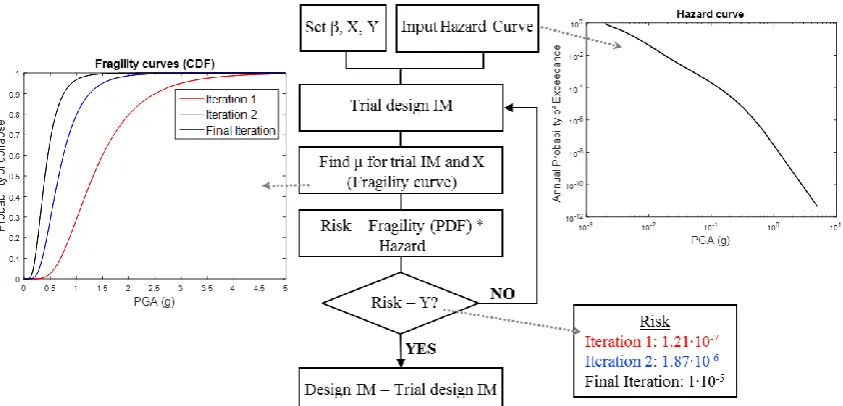
[image:2.595.95.517.415.618.2]The general procedure for finding the design value for the considered IM (e.g. PGA) is shown in Fig. 1. The key input parameters, using the nomenclature of Douglas et al. (2013), are: β (the standard deviation of the fragility curve assuming a lognormal distribution), X (the probability of collapse given the design IM) and Y (the targeted annual probability of collapse). Seismic design codes generally do not report these values and hence assessing them has been the focus of considerable efforts over the past decade (see following section).
Fig. 1 – Flowchart of the method to find risk-targeted design parameters. μ is the mean of the fragility curve assuming a lognormal distribution.
integration of the derivative of the fragility curve with the hazard curve using the trapezium rule works well.
The seismic hazard curve used within the calculation needs to be defined down to potentially very low probabilities of exceedance because the probabilities of collapse (or another damage state) defined by the fragility function are often far from one for large accelerations. This means that the hazard curve may need extrapolation, for which the power-law expression (based on the IMs for the smallest calculated probabilities) works well for most examples tested to date. We validated our algorithm by comparing our results with those from the Risk-Targeted Ground Motion Calculator available on the USGS website.
2.1. Previous studies
A summary from the literature of the three key inputs to the procedure is given in this section (we are assuming that the seismic hazard curve has been correctly defined by a recent PSHA for a wide range of probabilities of exceedance and that lognormal fragility curves are used).
ASCE (2005) provides design criteria for nuclear power plants and critical facilities based on a risk-targeting framework. The targeted risk ranges from 10-5 to 10-4, while for lower design categories values up to 10-3 are given in Braverman et al. (2007). To comply with the code, a nuclear plant must have a smaller than 1% chance of unacceptable performance for the design IM and less than 10% for 1.5 times the design IM.
Kennedy (2011) comments on the ASCE (2005) approach and implements it for 28 US nuclear plants. With a β in the range 0.3 to 0.6, the Seismic Core Damage Frequencies (SCDFs) are between 6∙10-7 and 6∙10-6. Based on this, the United States Nuclear Regulatory Commission (2007) has set a target SCDF of 10-5.
Luco et al. (2007) use generic fragility curves with β=0.8. They assume a probability of collapse under the ground motion corresponding to a 2,475-year return period equal to 10%. The ATC-63 project initially proposed this value after analysing buildings designed with ASCE 7-05. Luco et al. (2007) find that the 2003 NEHRP design ground motions led to non-uniform risk across US territory. By targeting the average collapse probability in 50 years, which they found to be around 1%, Luco et al. (2007) calculated new design ground motions with ratios of 0.7 to 1.15 of the 2003 proposal.
The results of that report were considered for the ASCE 7-10 and 2009 NEHRP Provisions. The latter propose the convolution of a hazard curve with a fragility curve with β=0.8 (decreased to 0.6 in ASCE 7-10), X=0.1 and a target probability of collapse of 1% in 50 years. Liel et al. (2015) comment on ASCE 7-10 and suggest modifications to consider subduction earthquakes and near-fault effects. With the same X and β as in the regulation, the probability of collapse in 50 years was from 0.21% to 0.62%, for areas affected by subduction earthquakes, while at near-fault sites, the risk was much higher, reaching in some cases 6%.
found a variation of Y between 0.1∙10-4 and 0.5∙10-4 and between 0.4∙10-4 and 1.4∙10-4, when they considered structural uncertainties.
Fajfar and Dolšek (2012) examined a three-storey RC building with no provisions for earthquake resistance. They found an annual probability of collapse equal to 0.65∙10-2. When designed with EC8, this risk reduced to 2.22∙10-4 or to 2.7∙10-4 when they accounted for epistemic uncertainties.
Ramirez et al. (2012) examine 30 buildings designed using the 2003 International Building Code (IBC) together with the ASCE provisions. They find the probabilities of collapse at the design PGA to be in the range 0.4% to 4.2% for these buildings.
Douglas et al. (2013) try to avoid significant changes in the existing design ground motions for France, which correspond to a 475-year return period. Considering previous studies, as well as the results of some sensitivity analyses, they finally choose β= 0.5 and X=Y=10-5. Under these assumptions, the estimated risk-targeted design PGAs are not very different from the values proposed by the current French code.
Ulrich et al. (2014a) present fragility curves for three-storey RC buildings designed according to Eurocodes 2 and 8 for different levels of design PGA, ag. They find yielding
probabilities between 0.14 (for ag=0.07g) and 0.85 (for ag=0.3g) and in the range 1.7∙10-7
(ag = 0.07g) to 1.0∙10-5 (ag=0.3g) for the probabilities of collapse at the design PGA.
In Martins et al. (2015) fragility curves are also derived, firstly considering the spectral acceleration at the fundamental period of vibration Sa(T1). This results in β ranging from
0.35 to 0.45, which increased up to 0.8 when they used PGA instead. For a three-storey RC building, they found the X to be equal to 5.20∙10-3 and 2.21∙10-2 for design accelerations of 0.2 and 0.4g, respectively, which change to 3.95∙10-3 and 5.57∙10-2 for a five-storey RC building. Then, using Sa(T1) as the IM, the annual probabilities of collapse for the
three-storey buildings were 9.50∙10-5, 1.67∙10-5 and 1.07∙10-5 and 1.78∙10-4, 7.34∙10-5 and 2.97∙10-5 for the five-storey buildings, for design accelerations of 0.0g, 0.2g and 0.4g, respectively.
Silva et al. (2016) study the fragility curves derived by the European project Syner-G and find an average value of β=0.5, which they consider as a lower bound. Assuming a 10% probability of collapse at the 2,475-year ground motion and the hazard curves derived by SHARE, for two values of β (0.6 and 0.8) they find a probability of collapse at the 475-year design acceleration ranging from 10-3 to 10-2. Choosing then a value of X=10-3 and Y= 5.0∙10-5 (by relating the risk of collapse to human losses), they propose new design maps for Europe.
Following a different approach, Tsang and Wenzel (2016) firstly define an acceptable fatality risk. Based on a literature review they choose a value of 10-6 for the acceptable annual fatality rate. They then estimate the corresponding limit for the targeted annual risk of complete structural damage as roughly 10-4. For a different limit state, the annual risk of “Real collapse” falls within the range 6∙10-6
to 8∙10-6.
Tsang et al. (2017) investigate buildings with precast RC columns designed using the
risk-targeted ground motions (MCER) proposed in IBC-2012 and ASCE/SEI 7-10.
Theoretically, a 10% probability of collapse under the MCER in 50 years is expected. They
6.1% was found). In addition, the average annual collapse risk was estimated as 2.5∙10-6 (with a maximum of 1.6∙10-4), while the regulation imposes 2∙10-4. Also, the value of 0.25% in a design life of 50 years (5∙10-5 annually), as proposed in Silva et al. (2016), was in some cases exceeded. Judd and Charney (2014) state that “the assumed ASCE 7-10 fragility curve is conservative” and “the conditional probability of collapse may exceed 10%”.
In Vacareanu et al. (2017) the proposed values of Luco et al. (2007) and Silva et al. (2016) are tested for Romania. Compared to previous uniform hazard maps, the risk distribution changes significantly when targeting uniform risk. Vacareanu et al. (2017) calculate the ratios between the design PGA for a mean return period of 475 years and those resulting from risk targeting for Y= 2∙10-4, β = 0.8 and X= 0.1 and 0.001. For the lower X, the ratios were below 0.6 whilst for the higher X they were larger than 1.0. Finally, considering two mean return periods, 475 and 2475 years, new risk maps are derived using X= 0.1 and 0.001. Based on the distribution of risk over the country, they conclude that using X= 0.001, as proposed in Silva et al. (2016), leads to a less realistic distribution of Y.
Following US practice, the philosophy of risk targeting has been followed by the new Indonesian Earthquake Resistance Building Code SNI 1726-2012. By setting a target of 1% for the probability of collapse in 50 years, this code maps risk-targeted spectral response accelerations for 0.2s and 1.0s. The generic fragility curves follow a lognormal distribution with X=10%. Considering the material properties and human-related parameters representative of the broader area of Indonesia, Sengara et al. (2016) report values of β around 0.7, which is adopted by SNI 1726-2012.
3. Outstanding issues and possible solutions
As can be seen by Section 2 there is an increasing number of studies that have attempted to apply the risk-targeting approach to different areas or sought to constrain the various inputs upon which this technique relies. Despite these studies a number of problems remain, which we highlight in this section along with a brief discussion of potential solutions.
As noted above, when evaluating the risk integral, ground motions for very low probabilities of exceedance are sometimes needed. A power-law extrapolation appears to work well for most examples we have studied to date. Further research on the technicalities of the calculations, however, needs to be conducted to define a stable procedure that works for all possible inputs.
Once the targeted risk is chosen, unless great changes to the accelerations currently used for design are accepted by practicing engineers, the probability of collapse at the design acceleration is automatically implied, as shown by Figure 3 of Douglas et al. (2013). Here there is a trilemma: any two out of the three input parameters, design IM, X and Y, can be chosen independently but not all three. The solution to this potential problem is to check all three values are physically reasonable. This trilemma may be the reason for the apparently high target collapse probabilities used by Luco et al. (2007) as they were forced to adopt them once X had been defined and they did not want the design IM to change greatly from the previous code.
There is a need to derive fragility curves for a wide variety of code-designed structures with different geometries and materials. Previous studies have adopted generic fragility curves that scale constantly with design acceleration so that the iterative procedure used to converge to the targeted risk is simple. As shown by Figure 3 of Ulrich et al. (2014b), however, this desired feature appears not to be true for current design codes, as they were not created with risk targeting in mind. It is possible, however, to generate a suite of fragility curves for all potential design accelerations and then to use the appropriate ones when iterating to find the actual design acceleration for a location.
Two issues concerning the used fragility functions are: what value of β to use and, indeed, whether the lognormal distribution should continue to be used? Fragility curves that are used within the risk targeting calculations can imply very strong buildings (e.g. Table 1 of Douglas et al., 2013) as well as non-negligible chances of collapse for very low ground accelerations. This is a consequence of the high values of β that need to be used to account for different types of structures of varying geometries. Two solutions to this problem are: a) adopt a different functional form for the fragility curve that equals zero for low ground accelerations and unity for very high accelerations, or b) move from generic fragility curves for all types and geometries to a curve covering only a small set of structures. The second of these changes would mean a change of philosophy of design codes to being associated with a single map giving the design accelerations for all structures to potentially many maps giving design accelerations for different structural types and geometries. This additional complexity, however, appears to be necessary if the risk-targeting approach is to imply physically realistic buildings and levels of risk.
4. Conclusions
Crowley et al. (2013) propose that ‘Risk-targeted seismic design actions’ should be considered for future versions of the Eurocodes. A call echoed by Formichi et al. (2016) in a report on the background and application of Eurocodes, published on behalf of the European Commission. The report also proposes that changes made in other international seismic design codes should be considered when updating the Eurocodes. It is, therefore, clear that application of the risk-targeting approach is being seriously discussed in Europe. Therefore, additional research effort to this end could provide valuable input for the development of risk-targeted design maps for new buildings in Europe.
level of risk) need input from other domains, including decision makers. In the coming years we plan to tackle these issues, particularly with respect to future Eurocodes.
Acknowledgements
The second author of this article is undertaking a PhD funded by a University of Strathclyde “Engineering The Future” studentship, for which we are grateful. We thank Florin Pavel for sharing the submitted version of Vacareanu et al. (2017).
References
ASCE (2005) Seismic Design Criteria for Structures, Systems and Components in Nuclear Facilities. American Society of Civil Engineers, ASCE Standard 43-05
ASCE (2016) Minimum Design Loads for Buildings and Other Structures, ASCE Standard 7-16. American Society of Civil Engineers, Reston, VA. Not seen.
Braverman JI, Xu J, Ellingwood BR., Costantino CJ, Morante RJ, Hofmayer, CH (2007) Evaluation of the Seismic Design Criteria in ASCE / SEI Standard 43-05 for Application to Nuclear Power Plants. Agencywide Documents Access and Management System (ADAMS) - USNRC.
Crowley H, Weatherill G, Pinho R (2013) Suggestions for Updates to the European Seismic Design Regulations. SHARE Deliverable 2.6. Universita degli Studi di Pavia.
Douglas J, Ulrich T, Negulescu C (2013) Risk-targeted seismic design maps for mainland France. Natural Hazards 65(3): 1999-2013
Fajfar P, Dolšek M (2012) A practice-oriented estimation of the failure probability of building structures. Earthquake Engineering and Structural Dynamics 41: 531–547.
FEMA (2009) NEHRP Recommended Seismic Provisions for New Buildings and Other Structures (FEMA P750). Federal Emergency Management Agency.
Formichi P, Danciu L, Akkar S, Kale O, Malakatas N, Croce P, Nikolov D, Gocheva A, Luechinger P, Fardis M, Yakut A, Apostolska R, Sousa ML, Dimova S, Pinto A (2016) Eurocodes: background and applications. Elaboration of maps for climatic and seismic actions for structural design with the Eurocodes. EUR, doi: 10.2788/534912.
Goulet C, Haselton C, Mitrani-Reiser J, Beck J, Deierlein G, Porter K, Stewart, J (2007) Evaluation of the seismic performance of a code-conforming reinforced-concrete frame building - from seismic hazard to collapse safety and economic losses. Earthquake Engineering and Structural Dynamics 36: 1973–1997.
Judd JP, Charney FA (2014) Earthquake risk analysis of structures. In: Proceedings of the 9th International Conference on Structural Dynamics, EURODYN 2014, 2929–2938.
Kennedy RP (2011) Performance-goal based (risk informed) approach for establishing the SSE site specific response spectrum for future nuclear power plants. Nuclear Engineering and Design, 241:648–656.
Labbé PB (2010) PSHA outputs versus historical seismicity: Example of France. In: Proceedings of Fourteenth European Conference on Earthquake Engineering.
Liel AB, Luco N, Raghunandan M, Champion, CP (2015) Modifications to risk-targeted seismic design maps for subduction and near-fault hazards. In: 12th International Conference on Applications of Statistics and Probability in Civil Engineering, ICASP12, Vancouver, Canada
Luco N, Ellingwood BR, Hamburger RO, Hooper JD, Kimball JK, Kircher CA (2007) Risk-targeted versus current seismic design maps for the conterminous United States. In: SEAOC 2007 convention proceedings
Martins L, Silva V, Crowley H, Bazzurro P, Marques M (2015) Investigation of structural fragility for risk-targeted hazard assessment. In: 12th International Conference on Applications of Statistics and Probability in Civil Engineering, ICASP12, Vancouver, Canada
Ramirez CM, Liel AB, Mitrani-Reiser J, Haselton CB, Spear AD, Steiner J, Deierlein GG, Miranda E (2012) Expected earthquake damage and repair costs in reinforced concrete frame buildings. Earthquake Engineering and Structural Dynamics, 41: 1455–1475.
Sengara IW, Sidi ID, Mulia A, Muhammad A, Daniel H (2016) Development of risk coefficient for input to new Indonesian seismic building codes. Journal of Engineering and Technological Sciences, 48(1): 49–65.
SNI (2012) Tata cara perencanaan ketahanan gempa untuk struktur bangunan gedung dan non gedung. Badan Standardisasi Nasional, ICS 91.120.25;91.080.01. Report 1726:2012. In Indonesian
Tsang HH, Wenzel F (2016) Setting structural safety requirement for controlling earthquake mortality risk. Safety Science, 86: 174–183.
Tsang HH, Lumantarna E, Lam NTK, Wilson JL, Gad E (2017) Annualised collapse risk of soft-storey building with precast RC columns in Australia. Mechanics of Structures and Materials: Advancements and Challenges, 1681–1686.
Ulrich T, Negulescu C, Douglas J (2014a) Fragility curves for risk-targeted seismic design maps. Bulletin of Earthquake Engineering 12(4): 1479-1491
Ulrich T, Douglas J, Negulescu C. (2014b) Seismic risk maps for Eurocode-8 designed buildings, In: Proceedings of the Second European Conference on Earthquake Engineering and Seismology. United States Nuclear Regulatory Commission (2007) A performance-based approach to define the site
specific earthquake ground motion. Technical report 1.208