0022-538X/84/020615-06$02.00/0
Copyright
©)
1984,American Society forMicrobiologyNucleotide Sequence Analysis of the Long Terminal Repeat of
Integrated Bovine Leukemia Provirus
DNA
and
of Adjacent Viral
and
Host Sequences
DOMINIQUE COUEZ,l* JACQUELINE
DESCHAMPS,'2
RICHARDKETTMANN,"2
ROBERT M.STEPHENS,3
RAYMOND V. GILDEN,3
ANDARSENE
BURNY'2
Departement
deBiologie Moleculaire,
Universite Libre deBriuxelles,
1640Rhode-St-Genese,
1 andFaculte
desSciencesAgronomiques
de
l'Etat, 5800 Gembloux,2 Belgium, and National Cancer Institiute, Frederick Cancer Research Facility,
Frederick,
Maryland
217013
Received 6April 1983/Accepted 7 October 1983
The
nucleotide
sequenceof the 3' long terminal
repeat andadjacent viral and host
sequences wasdetermined fora
bovine
leukemiaprovirus cloned from
abovine
tumor. Thelong
terminalrepeatwasfound
to
comprise
535nucleotides
andtoharboratboth endsanimperfect
inverted repeatof 7 bases. Promoter-like sequences(Hogness box
and CATbox),
anmRNAcapping site,
anda coreenhancer-related
sequence weretentatively located. No kinship
wasdetected between this bovine leukemia
proviral fragment
andother retroviral
long
terminalrepeats,including
that of human T-cellleukemia
virus.Retroviruses
provide useful
systems
tostudy
the
integra-tion of
foreign
DNA
into
eucaryotic
genomes
and the
regula-tion of
expression
of
the
viral
genes
(2,
48). The
provirus,
the
integrated form of
the virus genome,
contains
the
viral genes
flanked
by long terminal repeat (LTR) sequences
covalently
linked
tocell DNA. The
integration
eventcauses
the loss
of
(usually)
2
base
pairs
(bp)
atthe
distal
end
of
each
LTRand
the appearance
of
inverse repeats of
afew
bp in cell DNA
(8,
17, 39, 44,
45).
Encoded in the LTRs
aresignal sequences for
regulating the
transcription
of viral genes and
for processing
the
transcripts by
the
addition
of
polyadenylic
acid-contain-ing tails. LTRs also contain
potential
Z-DNA-forming
se-quences
and
coreenhancer sequences
thought
tobe part
of
enhancer elements
(27, 47). All these
regulatory
structuresplay
arole
in
activating
the
expression
of viral
genes.
They
also
activate
the
expression of
acellular
gene
in
leukosis
induced by avian leukosis
virus. In
sometumors,
avian
leukosis virus
integrates immediately
upstream
of the c-myc
gene
and
activates
it
by
downstream
promotion (14, 26).
In
other tumors,
provirus integration
exerts aregional effect,
regardless
of orientation and
position
(28, 30). Downstream
promotion makes
useof the LTR promoter; the
regional
activation suggests that the viral
DNAcontains sequences
that enhance
expression
from
heterologous
promoters. An
enhancing activity
has been
recently identified
in the Rous
sarcoma
virus promoter (21). It has been
localized
partly (88
bp)
in the 5' end of the LTR within the
U3
region
and
partly
(55 bp)
in the viral sequences
flanking
the 5'
boundary of
the
LTR
from circular
DNA. In
this case, the
enhancing effect is
only
present
atthe
3' end
of
naturally
acquired proviruses.
The
availability of
DNA
clones of
the
bovine
leukemia
virus (BLV) genome has allowed
investigations of the mode
of action of the virus in
inducing
the
tumorphase
of
enzootic
bovine leukosis
(5, 19, 20). The
provirus
found in the
tumorcell is in
arepressed
state,
integrated
in different
chromo-somes
in
different
tumors(D.
Gregoire,
D.Couez,
J.
Des-champs,
S.
Heuertz, M.-C.
Hors-Cayla,
J.
Szpirer,
C.
Szpirer,
A.Burny, G.
Huez, and
R. Kettmann,submitted
for
publication).
Possible
explanations of
the BLVmode
of
*
Corresponding
author.action
include (i)
cell
transformation
by
aviral product at a
particularly critical
stage
of
cell
differenciation
or
(ii)
en-hancement
of
expression of
one or
several cellular
onco-genes.
The
sites of
BLV
provirus integration
in
bovine
tumors
being multiple (20), it can be hypothesized that the
provirus integrates
at
a
crucial spot in host DNA and is
transposed later on to a secondary site, where it is found in
the tumor.
Two sets
of
data
motivated our in-depth studies of the
BLV
provirus
structure:(i) The presence at rather high
frequency
(25%
of total cases) of proviruses with deletions in
tumor
tissue. The
systematic
occurrence
of
the
deletion
in
the 5' moiety
of the
provirus
was
indicative of the putatively
important
role played by the 3' side
of the molecule in the
neoplastic process.
(ii)
The
discovery of the human T-cell
leukemia
virus (HTLV) (31, 32) and
of its
apparent
unique-ness
among
the
Retroviridae,
except
for
adistinct but
clear-cut
relatedness
toBLV
(29).
Since
the
U3
region
of the LTR has been
repeatedly
(3, 34,
43) suspected of
playing
akey role in
leukemogenesis by
a
number of leukemia viruses,
wefirst focused our attention
on
the
detailed
structureof the
proviral
LTR
cloned
from
a tumortissue.
This work
wasin progress when
Seiki
etal.
(37)
published
the LTR sequence
of
HTLV, thus
allowing
adirect
comparison
between
corresponding regions of
the
related
proviral
agents.
Localization of
LTRsequences
withinintegrated
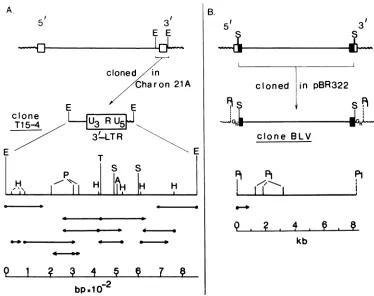
BLV DNA andsequencing strategy. An EcoRI
tumorDNA
fragment
designated
T15-4,
containing
the
right
viral LTR with
flank-ing
cellular and viral sequences,
waspreviously
cloned in
Charon
21 A
phage (7, 22).
The
fragment
wasrecovered
from
an
EcoRI digest of
the
recombinant
phage after agarose gel
electrophoresis
and
electroelution.
An8.3-kilobase
(kb)
Sacl
fragment
containing
the
BLVinformation
(5), except for
104bases
missing
because of
asecond
Sacl
site in the
LTR,
wassubcloned
into the
PstI site of pBR322
by
the
method of
Villa-Komaroff
etal. (46). Restriction
of the cloned
BLV DNAwith
PstI
generated four
fragments
of
1.2, 0.5,
1.4, and
5.2
kb
(Fig.
1B). The 5' LTR-gag gene
junction fragment (1.2
kb)
wasrecovered
asdescribed above for the EcoRI DNA
fragment.
615
on November 10, 2019 by guest
http://jvi.asm.org/
5,
3
E E
cloned
nCharon
21A
EE
,.lone
Ti
5-43
R
\
3LLT
R
E
H
,
,\1
T
S S
p
IR I
E
H
-.--&- -
--4-.
9
1
?
a
4
$
bpxlo72
B.
5,
3,
S
cloned
in
pBR322
.L
11~~~~~~~~~~~~~~~~~~~~~~~~~~~~~~~~~~~~~~~~~~~~~~~~~~~~~~~~~~~~~~~~~~~~~~~~~~~~1
Fs
Fclone BLV
FP
P
Pi
9?
.a,
4
0b
, [image:2.612.116.490.75.371.2]kb
FIG. 1. Molecular cloning of BLV LTRs andstrategyfordetermining their nucleotidesequence.Box,LTRDNA; straight line, viral DNA;
wavyline, cellular DNA; A, Aval; E, EcoRI; H,HpaII;P. PvuII;
PI,
PstI;S,Sacl; T. TaqI. (A) EcoRItumorDNAfragment designated T15-4, containing the 3'LTRwithflanking viraland cellularsequences,wasclonedin Charon21A. ThisfragmentwasisolatedfromaEcoRIdigestoftherecombinant phage, and its single restrictionmap wasestablished. The T15-4 fragmentwasthencutwith TaqI,HpaII,and PillII and
wassubcloned in M13mp7, mp8, ormp9. (B)The 8.3-kb Sacl fragment containing all the BLVinformationwasclonedinto the PstI site of
pBR322. This cloned BLV DNAwascutwithPstI, and the 1.2-kb PstI fragment which bears the Us of the 5' LTRwassubcloned in M13mp8.
These differentsubclonesweresequenced by the method of Sangeretal.(36). Horizontalarrowsindicatethe direction andextentofsequence
determination obtained by cleaving the DNA with the indicated endonuclease.
The map of the EcoRI
fragment
T15-4 was based onrestriction
endonuclease cleavage products obtained and
visualized either
onagarosegels
afterstaining
withethidium bromide orby autoradiography
afterlabeling
of 5' ends with[y-32P]ATP
and T4polynucleotide
kinase.Tousea
shotgun
approach
asdescribedby Messing
etal.(24, 25),
the T15-4 fragment was cut withTaqI,
HpaII, orPvullI
and inserted into the AccI or SmaI site of thecoliphage
M13mp7, mp8,
ormp9.
Aftercloning,
thesesetsof smallfragments
yielded
banks of recombinantphages
in which the T15-4fragment
wasrepresented piecemeal
with the twocomplementary
DNA strands present in separate clones. The nucleotide sequences of the clonedsingle-stranded DNAsweredetermined
by
the method ofSanger
etal.
(36).
Figure 1A provides
a summary of the strategy used todetermine the entire sequence. Each
piece
of DNA wassequenced
at leasttwice,
and the sequences were readby
twodifferentinvestigators.
Theentireprimary
structurewasconstructed
by compiling
the dataobtained andaligning
the successivefragments by overlaps
andcomplementarities
(Fig. 2A).
The 1.2-kb PstI
fragment
derived fromclonedBLV DNAwas
subcloned into the
PstIsite of phage M13mp8, and
sequenceanalysis
waslimited
tothe terminalregions.
The 8.3-kb
Sacl
fragment was also subcloned into amodified
pUC8
vector.This
clone has
been usedfor
com-plete sequencing
of the T15proviral
genome, except for asmall
SacI fragment (104 bases)
located within the LTR.Sequencing
wasperformed
inboth directions over the500-bp
regions
atboth ends of thelarge fragment by
themethod of Maxam and Gilbert(23).
This sequence was thencom-pared
with that obtainedindependently
from the EcoRIfragment.
The
complete
sequence of the T15-4fragment
and the 5'LTR-gag
junction fragment
is shown inFigure
2. Theplus
strand
(same
sense as viralRNA)
ispresented.
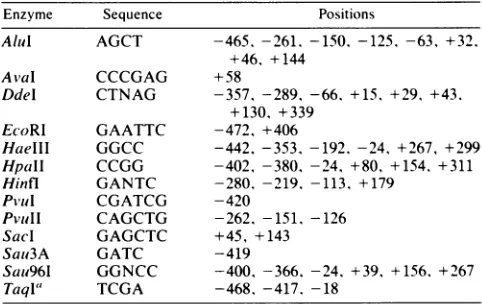
The sites for a number of restriction endonucleases are
presented
inTable 1. Itshould benoticed that theTaqI
sitesat
positions
-467 and -416 wereapparently
not accessibleto the enzyme.
The strategy used to delineate LTR boundaries rested upon
sequencing
of the entire3' LTR and theright-hand
side of the 5' LTR. Thepoint
ofsequencedivergence
identified the limit between the LTR andgagregions (for
the 5'LTR;
Fig. 3B)
and between the LTR and cellulargenomic
DNA(for
the 3'LTR;
Fig. 3A).
Suchatransitionpoint
wasfoundcorresponding
to the residues numbered 321 inFig.
2. Residue 321 of the 5' LTR(Fig. 2B)
and the stretch of 18 bases(TGGGGGCTCGTCCGGGAT) complementary
tothe 3' sequence of tRNAPro(13)
wereseparated only by
oneT residue.Divergence
of the T15-4 and 5'LTR-gag
sequences,together
with theposition
for accommodation of initiator tRNAPrO, was consistent with the idea that the sequenceA
c
on November 10, 2019 by guest
http://jvi.asm.org/
5'
G AATTCGAGCT GCCCCTTATCGTCTGTCCCC GCGATCGACC TATTCCTAAC
ACCGGTTACA CTGTG'GTCC AGTCCTAAGG
GACCCIACGC TCACCTGGTC AGAATTGGTT
TGATTCACCC TTAAAATTAC AGCTGTTAGA
'LTR
TTTTTTGAGG GGGAGTCATT TATGAAAG
rBS. IR E
CCACCGCCCC GTAAACCAGA CAGAGACGTC ACGGCAGCTG GTGGTCAGAA TCCCCGTACC GAAAAATCCA CACCCTGAGC TGCTGACCTC
L;31
:GCCGGCC
CTGTCGAGTT AGCGGCACCA' CCCTAGTGCT CAGCTCTCGG TCCTGAGCTC GGTCGGCTAT CCGGCAGCGG TCAGGTAAGG GGTTCTCGGC TGAGACCGCC GCGAGCTCTA TCCACGTGGA CTCTCTCTCT TGCCTCCTGA TGGCTTGCAC CCGCGTTTGT TTCCTGTCTT 271 CGCGCTCTCT CCCTCGGCGC CCTCTAGCGG 321!6GCACT
GGACATGACT TAGAGACTGA 371 GCAGGTGGGC AGGTTTATAA GAAGCACATTCAAACGCCCG GCCTGTCTTG CGGTCCCCCT TCCCCATACG CCTTACAACG CTTCCTCCAT GCTAGCGGGA AACTAAGACT AAATGAATGG CTCTCCCGCC ATCATGCAGG CCTAGCGCCG
ZDNA
AGCTGCCAGA GAAGCTGCTG TCCA CCCCTTTCCC ACCTG GAT AAATTAATAA 5'CAP
GAAGCGTTCT CCTCCTGAGA TCTTGCTCCC GAGACCTTCT CAAACCACGG TTTGGAGGGT TCTCCGGTCC TCTGACCGTC CCCCGCGCTC CAAGGGCGTC ACTTTCTGTT TCTCGCGGCC
3'LTR
CCAGGAGAGA CCGGCAAACA IR ACAACAACCA TCTTGAGGTG GGTTTGAATT C 3'
B.
'.5
TGCAGGGGGGGGGGGGAGCTCTCTTGCTCCCGAGACCTT...
5'LTR
321... GCGGCCAGGAGAGACCCGGAACAAAATGGGGGCTCGTCCGGGATT
IR| PBS
FIG. 2. (A) Nucleotidesequenceof theintegrated3' LTR withadjacentviral and cellularDNA inT15-4fragment. (B)Partialnucleotide
sequenceofthe5' LTRin1.2-kbPstlfragment.Thesequenceoftheplusstrand(samesenseasviralRNA)ispresented.Position1 inthe se-quence corresponds tothe 5' end of the RNAgenome, the cappingsite (
I
). Important featuresof the BLV LTR sequence: IR, inverted repeat; Z-DNA,zoneofZ-DNA; E,enhancercoresequence: U3. uniquesequence derived fromthe 3' end ofgenomicRNA;PSB+, plus-strandbindingsite: PBS-, tRNAPrObindingsite; LH, RU,locally homologous regionstoU3 regionsof thesimiansarcomavirusLTR.The possible promotersequences Hognessand CATboxesareshown in boxes....CAAACAA included the
expected
inverted repeat knowntoexistatboth ends of LTRs. Indeed, the search for the inverted repeat of CAAACAApointed
to sequenceTCATTTG,
numbered -215 to -209 inFig. 2A, although
these
proposed
invertedrepeatsdidnotexactly
match(they
areimperfect
inverted repeatsowing
to two ACpairs).
Moreover,
the left-handboundary
of'all 3' LTRs studied sofar is
adjacent
to apurine
tract,thought
to act as aplus-strand
primer-binding
site(3, 38, 40).
In the Roussarcomavirussystem,atleast 9andat most29 of the nucleotides of this
region adjacent
toU3
were demon-stratedtobenecessaryforgrowth,
eveninthepresenceofahelper
virus. It was concluded that thepolypurine
tractprovided
acis-acting
functionnecessaryforretrovirus
repli-cation(40).
The purine arrayGAGGGGAG
from residues -224to-216 isanobvious candidatefor suchafunctionandconfirms the strongconservative behavior of this sequence in evolution.
The
single
T residue mentioned above asbeing
locatedbetween the inverted repeat and the tRNAPrO
binding
sitewas
lacking
on theright
sideof the
T15-4fragment.
A fewbp, usually
two, are eliminatedfrom the ends ofboth LTRsat some
point
beforeorduring
integration (8, 39, 44, 45).
Inthe present case,
only
oneT-Abp
wasapparently
involvedin this process. Based upon the observations and assump-tions detailed above
(Fig. 2),
itwasconcluded that the BLV LTR extendedfrom
the nucleotide T labeled -215 tothe
nucleotide A labeled
+321, totaling
535 residues.TABLE 1. Restriction
endonuclease
sitesof T15-4 DNAEnzyme Sequence Positions
Alul
AGCT -465, -261, -150, -125, -63, +32. +46, +144AvaI CCCGAG +58
Ddel CTNAG -357, -289, -66, +15, +29, +43, +130, +339
EcoRI GAATTC -472, +406
HaellI GGCC -442, -353, -192, -24, +267, +299
HpalI
CCGG -402, -380, -24, +80, +154, +311 Hinfl GANTC -280, -219, -113, +179Pv'UI
CGATCG -420PvUII CAGCTG -262,
-151.
-126Sacl GAGCTC +45, +143
SaO3A GATC -419
Sau96I GGNCC -400, -366, -24, +39, +156, +267
Taql"
TCGA -468, -417. -18aTwo
TaqI
sites (-468, -417) wereresistant
to endonucleasedigestion.
A.
-471
-430
-380 -330
-280
-230
-180 -130
-80 -30 21 71 121 171 221
-431 -381 -331
-281 -231
-181
-131 -81 -31
20 70 120 170 220
270
320
370
411
on November 10, 2019 by guest
http://jvi.asm.org/
[image:3.612.322.563.553.705.2]B 1.2 lkh V."ST1 ft'-r11 11t
A C
I-:.,ii*,
a...
a
Om ...
::7. .U-.
U-w
.C,hC,, ( i G{A ^; A(; ^A I
;/_3E
C FIG. 3. Autoradiograms of sequencing gelsillustrating the point ofsequencedivergenceamongthetwofragments analyzed.(A) T15-4 fragment containing the 3' LTR with an adjacent cellular se-quence; (B)Pstlfragment of1.2kb bearing the U5 of the5' LTR, andthenucleotidesequencededuced from theautoradiograms. The sequences commonly found in A and B accompanied by samples fromeachof the reactions (lanes designatedACGT)werefractionat-ed by electrophoresis in a6% polyacrylamide gel containing 7 M urea. Afterelectrophoresis at 1,500 Vfor 1.5 or3 h, the gel was
removedfor autoradiography.
Potential
transcription
regulatory
sites in the BLV LTR. Oncethe
boundaries of the BLV LTR were delineated andthe tRNAPrO
initiator
sitewaslocated,
it becamepossible
tolocate
theputative
viral RNAcapping
site at the GAAG sequence and to number the left-side G of this sequence asresidue
number 1.The
assignment
was madepossible
by
taking
advantage
of the size of BLV strong-stopcDNA(320
± 1 nucleotides
[37])
for BLVproduced
by
thechronically
infected
fetal
lambkidney
cell line.Once
presently
known LTRsareallarranged
according
to thesamegeneral
scheme,
oneshouldfindupstream fromthecapping
site thetwotranscriptional regulatory
entitiescalled the TATA(or
Hogness)
box(11,
12)
and the CAT box(10).
The TATA box element has been
tentatively
identifiedwithin the
AT-rich region extending
betweenpositions
-44 and-28; the
5' side of this sequence,TGATAAA,
is the closesttothestandardrecognized
sequence,NTATAAAN,
and runs
from
-44 to -38. The sequence CCAACToc-curred between
positions
-97 and -92 andwastakenastheputative
CAT box. Thepositions
of all threetranscriptional
signals
relative toeach otherareinaccordance withwhatisknown
inother virus systems(9,
17, 35, 41, 44).
An obvious candidate for the
polyadenylation signal (8,
26)
would be the AATAAA sequenceextending
betweenpositions
-35 and-30, nearly adjacent
to thepresumed
TATA
box.
Noexperimental
attempt has been madeso far tolocate theadenylation site;
CAistheconsensussequence(33).
In HTLVLTRs,
thepolyadenylation
site has beententatively assigned
to a TAor aTGpair
but not to aCA(37).
A number of CA and TG were found in theregion
where a
polyadenylation site
wastheoretically expected
tobelocated. Accuratedetermination of this site is
mandatory
before the R
region
can beexactly
delineated.A computer search was carried out to
identify
DNA segmentsofalternating purine-pyrimidine
sequences consid-ered tobepotential
Z-DNA-forming regions
andkey
struc-tures oftranscription enhancers
(27).
Such structureswerefound as
pairs
with nucleotide sequences between themvarying
in
length from
50
to80
bp. They
seem toexist in
many
retrovirus
LTRs
(27),
and in
some systems, atleast,
the
enhancers
involve viral
sequences atthe 3' end
of
proviral
DNA but
outside the LTR (21).
Our data point
tothe
sequence
TACACGTGTGGT
(-374
to-365)
asthe
best
candidate
region
with
Z-DNA-forming potential.
However,
this
DNA segment is
located
outside the LTR. In the LTR
itself, the computer analysis showed one 8-bp segment,
ATCATGCA
(-200
to-192),
with
onebp
out
of
alternation.
A
6-bp
segment,
CACGTG, was found at positions 388
to
393 in
cell DNA. Another segment of interest is the
core
enhancer element with
the consensus sequence
5'-cAGGAAGTGAA-3'
(15)
or5'-TGGAAAG-3'
(47),
in
which
one
critical
replacement appears to be the first G. The BLV
LTR
contains
the segment
5'-TGAAAG-3' at positions -206
to
-201,
a6-bp sequence consistent with the consensus
sequences mentioned above.
However, the
assumptions
made here
arehypothetical, and the homologies observed
with
known core sequences of enhancer elements may
be
coincidental. The role of
these sequences in the activation
of
transcription should now
be explicitly tested.
Protein-coding potential. As illustrated in Fig. 4, there is
nolarge
openreading frame in the BLV LTR. The largest
oneexists in
frame A and extends
over aregion of about
200
nucleotides, but it does
notcontain
anyinitiation
codon
ATG.
Comparison
of
the BLV LTR with the LTRs
from
othermammalian retroviruses.
The overall
size
of the BLV
LTR,
321 -r
[image:4.612.61.296.72.235.2]
1-A B C
FIG. 4. Readingframeanalysisof the BLV 3' LTR. Totheright of theLTRbox,horizontal linesrepresentthepositionoftranslation termination codons (TAA,TGA, TAG)found in thethree different reading framesdesignated A, B, and C.
A. T115 'ttr;8an'}c5t
A
C2
G T
.' 4.
pL
up
U
::
GAGGG.AAjCAAGA.
-
216r-_I
on November 10, 2019 by guest
http://jvi.asm.org/
[image:4.612.369.497.370.683.2]535
nucleotides,
and
its right-hand
boundary,
immediately
adjacenttoa
18-bp
sequencecomplementary
tothe 3'
end of
tRNAPr,
(13), arepeculiarities shared
by LTRs
in
mammali-an viruses. Theprimer
tRNAused
by BLV had
notbeen
identified
yet.The
presenceof the
tRNAPro
complementary
sequence strongly suggests that
tRNAPro
is
usedin BLV
retrotranscription, as in Moloney murine leukemia and
sar-coma
viruses (8, 44, 45),
spleen necrosis
virus (38),
baboon
endogenous virus (41), simiansarcoma virus (6), and HTLV
(37). Thus, all analyzed mammalian type C viruses use
tRNAPrO
asprimer molecules,whereas avianviruses
special-ize in using
tRNATrP
(4, 42). The only knownexception
tothis rule is
avian
spleennecrosis
virus, which also usestRNAPrO.
Interestingly enough,
spleen
necrosis
virus
dis-plays homologies with mammalian
retroviruses
(1, 16),and
thus fits within the frame
of
thepropositionof
Devareetal.
(6)
that
the
tRNAPrO
binding site might
be
amarker for the
evolutionary
relationship
amongretroviruses.
A computer-assisted search by the method
of Kaneshisa
(18) was usedto lookfor homologous subsequences in BLV LTR and LTRs of Moloney leukemia virus, simian sarcoma
virus, Rauscher leukemia virus, gibbonape leukemia
virus,
baboon endogenous virus, and HTLV. Except for two
locally homologous regions, TGCACCCGCGTTTG TTTCCT and CTCC CTCGGCGC, found at successive positions in
SSV-U3
(positions
313and
350 [6])and
BLV-RUs (positions 226 and 279), no
significant
homology wasrevealed between BLV LTR and thosecited above, includ-ing HTLV. It thus seems that, aside from a number
of
practicallyinvariant structuresandsignals, LTRsfulfill their biological functions while being permissive to genetic
drift.
We did not, indeed, expect many similarities to appearbetween BLV and murine LTRs since only a very
distant
relationship seems toexistbetween the bovine virusand the murine group. Somewhat to our surprise, we reached the same conclusion when comparing BLV and HTLV LTR
sequences. The human virus LTRis significantly longer (37)
(754 bp),with noapparent homologyto BLV. It should thus be concluded that similarities between BLV and HTLV
found in several
structural
proteins (27) had
a morestringent
biological
function
tofulfill than the overall base
sequenceof
LTR besides the basic, well-conserved signals like
inverted
repeats, CAT and TATA boxes, the capping site, and promoter binding sites forretrotranscription.We thank M. Heilporn and D. Denicourt for help in some
experiments. Wealsothank R. Herzog and C. Wilmartfor theirkind
help with computeranalyses.
This work was supported by the Fonds Cancerologique of the
Caisse Generale d'Epargneet de Retraite and the Fonds National
Belge dela Recherche Scientifique (credit aux chercheurs). D.C.
received a fellowship from the Institut pour la Recherche
Scien-tifique dans l'Industrie et ['Agriculture. J.D. is an Assistant of the
Fonds Cancerologique de la Caisse Generale d'Epargne et de Retraite. R.K. is aChercheurQualifie ofthe Fonds National dela
Recherche Scientifique.
ADDENDUM INPROOF
A recent publication by Tsimanis et al. (Nucleic Acids
Res. 11:6079-6087, 1983) enablesustolocate the
polyadeny-lic acid addition site at base C, position 234. It follows that
the R region of BLV LTR is 234 bp long,a valuevery similar
to that found for the HTLV LTR (R = 228
bp),
thusreemphasizingthe similarities that exist between both
virus-es.
LITERATURECITED
1. Barbacid, M., E. Hunter, and S. A. Aaronson. 1979. Avian reticuloendotheliosis viruses: evolutionary linkage with mam-maliantypeC retroviruses. J. Virol. 30:508-514.
2. Bishop, J. M. 1978. Retroviruses. Annu. Rev. Biochem. 47:35-88.
3. Czernilofsky,A.P., W.DeLorbe, R. Swanstrom, H. E. Varmus, J. M. Bishop, E. Fischer, and H. M. Goodman. 1980. The nucleotide sequenceof an untranslated but conserved domain at the 3' end of the avian sarcoma virus genome. Nucleic Acids Res. 8:2967-2984.
4. Dahlberg, J. E., R. C. Sawyer, J.M.Taylor, A. J. Faras, W. E. Levinson, H. M. Goodman, and J. M.Bishop. 1974. Transcrip-tion of DNA from the 70S RNA of Rous sarcoma virus: identification of a specific 4S which serves as primer. J. Virol. 13:1126-1133.
5. Deschamps, J., R. Kettmann, and A. Burny. 1981.Experiments with cloned complete tumor-derived bovine leukemia virus information prove that the virus is totally exogenous to its target animal species. J. Virol. 40:605-609.
6. Devare, S. G., E. P. Reddy, J. D. Law, and S. A. Aaronson. 1982. Nucleotide sequenceanalysis of the long terminal repeat of integrated simian sarcoma virus: evolutionary relationship with othermammalian retroviral long terminal repeats. J. Virol. 42:1108-1113.
7. de Wet, J.R., D. L.Daniels, J. L.Schroeder, B. G. Williams, K. Denniston-Thompson, D. D. Moore, and F. R. Blattner. 1980. Restriction mapsfor twenty-oneCharon vector phages. J. Virol. 33:401-410.
8. Dhar, R., W. L. McClements, L. W.Enquist, and G. F. Vande Woude. 1980. Nucleotide sequences of integrated Moloney sarcoma provirus long terminalrepeats and their host and viral junctions. Proc. Natl. Acad. Sci. U.S.A. 77:3937-3941. 9. Donehower, L. A., A. L. Huang, and G. L. Hager. 1981.
Regulatory and coding potential of the mouse mammary tumor virus longterminal redundancy. J. Virol. 37:226-238.
10. Efstratiadis, A., J. W. Posakony, T. Maniatis, R. W. Lawn, C. 0. Connell, R. A. Spritz, J. K. Deriel, B. G. Forget, S. M. Weissman, J. L. Slightom, A. E. Blechl, 0. Smithies, F. E. Baralle, C.C. Shoulders, and N. J. Proudfoot. 1980. The
struc-tureand evolution of the human globin genefamily. Cell 21:653-668.
11. Gannon, F., K. O'Hare, F. Perrin, J. P. LePennec, C. Benoist, M.Cochett, R. Breathnach, A. Royal, A.Garapin,B.Cami,and P. Chambon.1979.Organisation and sequencesatthe 5' end ofa
cloned complete ovalbumin gene. Nature (London) 278:428-433.
12. Gilboa, E., S. Goff, A. Shields, F. Yoshimura, S.Mitra, and D. Baltimore. 1979. In vitro synthesis ofa9kbp terminally redun-dant DNAcarrying theinfectivity of Moloney murine leukemia virus. Cell 16:863-874.
13. Harada, F. G., G. Peters, and J. E.Dahlberg. 1979. The primer tRNA for Moloney murine leukemia virus DNA synthesis. Nucleotide sequence and aminoacylation oftRNA"'". J. Biol. Chem. 254:10979-10985.
14. Hayward, W. S., B. G. Neel, and S. M. Astrin. 1981. Activation of a cellular onc gene by promoter insertion in ALV-induced lymphoid leukosis. Nature (London) 290:475-480.
15. Hearing, P., and T. Shenk. 1983. The adenovirus type 5 ElA transcriptional control region contains a duplicated enhancer element. Cell 33:695-703.
16. Hunter, E., A. S. Bhown, and J. C. Bennett. 1978. Amino-terminal amino acid sequence of the major structural polypep-tides of avianretroviruses: sequence homology between reticu-loendotheliosis virus p30 and p30s ofmammalian retroviruses. Proc. Natl. Acad. Sci. U.S.A. 75:2708-2712.
17. Ju, G., and A. M.Skalka. 1980. Nucleotide sequence analysis of the longterminalrepeat (LTR) of avian retroviruses: structural similarities with transposable elements. Cell 22:379-386. 18. Kanehisa, M. I. 1982. Los Alamos sequence analysis package
fornucleic acids and proteins. Nucleic Acids Res. 10:183-195. 19. Kettmann, R., J. Deschamps, Y. Cleuter, D. Couez, A. Burny, and G. Marbaix. 1982. Leukemogenesis by bovine leukemia
on November 10, 2019 by guest
http://jvi.asm.org/
virus: proviral DNAintegration and lack of RNA expression of viral long terminal repeat and 3' proximate cellular sequences. Proc.Natl. Acad. Sci. U.S.A. 79:2465-2469.
20. Kettmann, R., J. Deschamps, D. Couez, J.-J. Claustriaux, R. Palm, and A. Burny. 1983. Chromosome integrationdomain for bovine leukemia provirus in tumors. J. Virol. 47:146-150. 21. Luciw, P. A., J. M. Bishop, H. E. Varmus, and M. R. Capecchi.
1983. Location and functionof retroviralandSV40sequences that enhance biochemicaltransformation after microinjectionof DNA.Cell33:705-716.
22. Maniatis, T., R. C. Hardison, E. Lacy, J. Lauer, C.O'Connell, D. Quon, D. K. Sim, and A. Efstratiadis. 1978.The isolationof structuralgenesfrom libraries ofeucaryoticDNA.Cell 15:687-701.
23. Maxam, A. M., and W. Gilbert. 1977. A new method for sequencing DNA. Proc. Natl. Acad. Sci. U.S.A.74:560-564. 24. Messing, J., R. Crea, and P. H. Seeburg. 1981. A system for
shotgun DNAsequencing. NucleicAcidsRes. 9:309-320. 25. Messing, J., B. Gronenborn, B. Muller-Hill, and P. H.
Hof-schneider. 1977. Filamentous coliphage M13 as acloning vehi-cle: insertion ofaHindIIIfragment ofthelacregulatory region inM13replicativeformin vitro. Proc.NatI. Acad. Sci. U.S.A. 74:3642-3646.
26. Neel, B. G., W. S.Hayward, H. L. Robinson, J. Fang, and S. M. Astrin. 1981. Avian leukosis virus-induced tumors have com-mon proviral integration sites and synthesize discrete new RNAs: oncogenesis bypromoterinsertion. Cell23:323-334. 27. Nordheim, A., and A. Rich. 1983. Negatively supercoiled simian
virus40DNA contains Z-DNA segmentswithin transcriptional enhancersequences. Nature(London)303:674-679.
28. Nusse, R., and H. E. Varmus. 1982. Many tumorsinduced by the mouse mammary tumor virus contain a provirus integrated in the sameregionof thehost genome. Cell31:99-109.
29. Oroszlan, S., M. G.Sarngadharan, T. D. Copeland, V. S. Ka-lyanaraman, R. V. Gilden, and R. C. Gallo. 1982. Primary structure analysis ofthe major internal protein p24 ofhuman type C T-cell leukemia virus. Proc.
NatI.
Acad. Sci. U.S.A. 79:1291-1294.30. Payne, G.S., J. M. Bishop, and H. E. Varmus. 1982. Multiple arrangements of viral DNA in an activated host oncogene in bursallymphomas. Nature(London) 295:209-213.
31. Poiesz, B. J., F. W. Ruscetti, A. F. Gazdar, P. A. Bunn, J. D. Minna, and R. C.Gallo. 1980. Detection and isolationoftype-C retrovirus particles from fresh and culturedlymphocytes ofa patientwith cutaneous T-cell
lymphoma.
Proc. Natl.Acad. Sci. U.S.A. 77:7415-7419.32. Poiesz, B. J., F. W. Ruscetti, M. S. Reitz, V. S.Kalyanaraman, and R. C. Gallo. 1981. Isolation of a new type-C retrovirus (HTLV)inprimary uncultured cells ofapatient with Sezary T-cell leukemia. Nature(London) 294:268-271.
33. Proudfoot,N.J.,andG. G. Brownlee. 1974.
Sequence
atthe 3' endoftheglobinmRNAshowshomologywithimmunoglobulin light chain mRNA. Nature(London)252:359-362.34. Robinson, H. L., B. M. Blais, P. L. Tsichlis, and J. M. Coffin. 1982. At least two regions of the viral genome determine the oncogenic potential ofavianleukosis viruses. Proc. Natl. Acad. Sci. U.S.A. 79:1225-1229.
35. Rushlow, K. E., J. A. Lautenberger, E. P.Reddy, L. M. Souza, M. A. Baluda, J. G. Chirikjian, and T. S.Papas. 1982. Nucleo-tide sequence analysis of the long terminal repeat of avian myeloblastosis virus and adjacent host sequences. J. Virol. 42:840-846.
36. Sanger, P., S. Nicklen, and R. Coulson. 1977. DNA sequencing with chain-terminating inhibitors. Proc. Natl. Acad. Sci. U.S.A. 74:5463-5467.
37. Seiki,M., S. Hattori, and M. Yoshida. 1982. Human adult T-cell leukemia virus: molecular cloning of the provirus DNA and the unique terminal structure. Proc. Natl. Acad. Sci. U.S.A. 79: 6899-6902.
38. Shimotohno, K., S. Mizutani, and H. M. Temin. 1980. Sequence of retrovirus provirusresembles that ofbacterial transposable elements. Nature(London) 285:550-554.
39. Shimotohno, K., and H. M. Temin. 1980. No apparent nucleo-tidesequence specificity in cellular DNAjuxtaposed to retro-virusproviruses. Proc. Natl. Acad. Sci. U.S.A. 77:7357-7361. 40. Sorge, J., and S. H. Hughes. 1982. Polypurine tractadjacentto
theU3 region ofthe Rous sarcoma virusgenomeprovidesa cis-acting function. J. Virol.43:482-488.
41. Tamura, T., M. Noda, and T. Takano. 1981. Structure ofthe baboon endogenous virus genome: nucleotide sequenceofthe LTR.Nucleic AcidsRes. 9:6615-6625.
42. Taylor, J. M. 1977. Ananalysis ofthe roleof tRNAspeciesas primers for the transcription into DNA of RNA tumor virus genomes. Biochim. Biophys. Acta473:57-71.
43. Tsichlis, P. N., and J. M. Coffin. 1980. Recombinants between endogenous and exogenousavian tumorviruses: roleofthe C region and other portions of the genome in the control of replicationandtransformation. J. Virol.33:238-249.
44. VanBeveren,C., J. G. Goddard,A.Berns, andI. Verma.1980. Structure ofMoloney murineleukemia viral DNA: nucleotide sequence ofthe 5' long terminal repeat and adjacent cellular sequences. Proc. Natl. Acad. Sci. U.S.A. 77:3307-3311. 45. Van Beveren, C.,E. Rands, S. K. Chattopadhyay, D. R.Lowy,
andI. M. Verma. 1982. Long terminal repeat ofmurine
retro-viral DNAs: sequence analysis, host-proviral junctions, and preintegration site. J. Virol.41:542-556.
46. Villa-Komaroff, L., A. Efstratiadis, S. Broome, P.Lomedico,R. Tizard, S.P. Naker, W. L. Chick, and W. Gilbert. 1978. A bacterial clone synthesizing proinsulin. Proc. Natl. Acad. Sci. U.S.A.75:3727-3731.
47. Weiher, H., M. Konig, and P. Gruss. 1983. Multiple point mutations affecting the simian virus 40 enhancer. Science 219:626-631.
48. Weiss, R.,N.Teich,H.Varmus,andJ. Coffin (ed.). 1982. RNA tumor viruses, 2d ed. Cold Spring Harbor Laboratory, Cold Spring Harbor,N.Y.