City, University of London Institutional Repository
Citation
:
Acar, O. A. & van den Ende, J. (2016). Knowledge Distance, Cognitive-Search Processes, and Creativity: The Making of Winning Solutions in Science Contests.Psychological Science, 27(5), pp. 692-699. doi: 10.1177/0956797616634665
This is the published version of the paper.
This version of the publication may differ from the final published
version.
Permanent repository link:
http://openaccess.city.ac.uk/15326/Link to published version
:
http://dx.doi.org/10.1177/0956797616634665Copyright and reuse:
City Research Online aims to make research
outputs of City, University of London available to a wider audience.
Copyright and Moral Rights remain with the author(s) and/or copyright
holders. URLs from City Research Online may be freely distributed and
linked to.
City Research Online: http://openaccess.city.ac.uk/ [email protected]
Psychological Science 2016, Vol. 27(5) 692 –699 © The Author(s) 2016 Reprints and permissions:
sagepub.com/journalsPermissions.nav DOI: 10.1177/0956797616634665 pss.sagepub.com
Research Article
Who is more likely to come up with the next scientific breakthrough in the field of chemistry, a cultural anthro-pologist or a chemical engineer? Scholars have provided a number of strong arguments about why a chemical engineer (i.e., an insider) rather than an anthropologist (i.e., an outsider) might be more likely to demonstrate scientific creativity. After all, insiders know the territory, which is often considered to be a prerequisite for being able to make a novel contribution to a knowledge domain (e.g., Amabile, 1983; Weisberg, 1999). From a cognitive perspective, obtaining “mental representations that support reasoning” is considered a necessary first step for scientists in enabling them to generate new ideas (Ericsson, 1999, p. 332).
Historically, however, outsiders have been responsible for some major breakthroughs in various scientific domains, such as medicine (Ben-David, 1960) and biol-ogy (Mullins, 1972). Outsiders may have an advantage over insiders when it comes to solving scientific prob-lems that require novelty because they have access to perspectives from their own domain that might be fresh
and novel for the other domain (e.g., Jeppesen & Lakhani, 2010; Kuhn, 1962). In addition, the acquisition of domain knowledge has been associated with increased inflexibil-ity (Dane, 2010; Lewandowsky & Kirsner, 2000; Sternberg & Lubart, 1995). One notable example with rich empiri-cal evidence is the Einstellung effect (e.g., Bilalic´ , McLeod, & Gobet, 2008a; Lovett & Anderson, 1996; Luchins, 1942), which occurs “when the first idea that comes to mind, triggered by previous experience with similar situations, prevents alternatives being considered” (Bilalic´ , McLeod, & Gobet, 2008b, p. 553). It is often argued that such limi-tations occur because people’s domain knowledge affects their initial mental representation of a problem and thus subsequently shapes the solutions that they come up with. With particularly intractable problems, that initial representation can be hard to shake off, even though the
Corresponding Author:
Oguz Ali Acar, School of Management and Business, King’s College London, 150 Stamford St., London SE1 9NH, United Kingdom E-mails: [email protected], [email protected]
Knowledge Distance, Cognitive-Search
Processes, and Creativity: The Making of
Winning Solutions in Science Contests
Oguz Ali Acar
1,2and Jan van den Ende
21School of Management and Business, King’s College London, and 2Rotterdam School of Management,
Erasmus University
Abstract
Prior research has provided conflicting arguments and evidence about whether people who are outsiders or insiders relative to a knowledge domain are more likely to demonstrate scientific creativity in that particular domain. We propose that the nature of the relationship between creativity and the distance of an individual’s expertise from a knowledge domain depends on his or her cognitive processes of problem solving (i.e., cognitive-search effort and cognitive-search variation). In an analysis of 230 solutions generated in a science contest platform, we found that distance was positively associated with creativity when problem solvers engaged in a focused search (i.e., low cognitive-search variation) and exerted a high level of cognitive effort. People whose expertise was close to a knowledge domain, however, were more likely to demonstrate creativity in that domain when they drew on a wide variety of different knowledge elements for recombination (i.e., high cognitive-search variation) and exerted substantial cognitive effort.
Keywords
creativity, cognition, domain knowledge, search variation, search effort, innovation, problem solving
Knowledge Distance, Cognitive Search, and Creativity 693
proposed solutions may have proved inadequate (Bilalic´ et al., 2008b; Kaplan & Simon, 1990; Smith, 1995). Because they are constantly exposed to domain knowl-edge, insiders are more prone than outsiders to problems of inflexibility.
Some evidence suggests that both insiders and outsid-ers can be a source of creative ideas; however, the precise role played by the distance between an individual’s exper-tise and a particular knowledge domain, or knowledge distance, remains unclear. Perhaps the right question is not whether people whose expertise is distant from a knowledge domain are more likely to demonstrate cre-ativity than those whose expertise is closer to that domain, but rather when they might do so. Specifically, taking into account how individuals solve problems might help to shed light on conflicting arguments about the relationship between creativity and knowledge distance; creativity is dependent not only on the initial mental representation of the problem (which is affected by the distance between one’s expertise and the knowledge domain), but also on the way in which different solutions to the problem are explored (e.g., Amabile, 1983; Campbell, 1960; Schilling, 2005; Simonton, 2003). Prior research has suggested that the primary sources of creativity are cognitive-search pro-cesses (i.e., ways to explore solutions) that lead people to see novel associations between existing ideas, concepts, and knowledge elements (Hennessey & Amabile, 2010; Mednick, 1962; Mobley, Doares, & Mumford, 1992; Mum-ford & Gustafson, 1988). Albert Einstein, for example, emphasized the importance of novel associations for his own creative processes: “The psychical entities which seem to serve as elements in thought are certain signs and more or less clear images which can be combined. . . . This combinatory play seems to be the essential feature in productive thought” (Mednick, 1962, p. 220).
Two main cognitive processes are identified as critical for effective recombination of different knowledge ele-ments. The first process is cognitive-search variation, or simply search variation, which refers to variation in terms of the knowledge elements used for recombina-tion. This process is likely to enhance the chances of making a novel association because drawing on more elements implies a larger number of potential connec-tions between them. Schilling and Green (2011), for example, found that when scientists draw on more knowledge domains for their articles (i.e., cite articles from a variety of disciplines), they are more likely to make atypical associations between disciplines and pro-duce high-impact articles. The second process, cognitive-search effort, or simply search effort, is the amount of attention devoted to creating a novel solution and is related to the intensity aspect of attention (Kahneman, 1973). Search effort is important because it increases one’s cognitive-processing capacity to notice connections
between different elements and to make sense of these connections in such a way that they can be recombined to generate a novel solution to a given problem (De Dreu, Baas, & Nijstad, 2008; Li, Maggitti, Smith, Tesluk, & Katila, 2013).
Our hypothesis was that the relationship between the distance from one’s expertise to a particular knowledge domain and one’s creativity in that domain depends on the cognitive-search processes (i.e., search effort and search variation) in which one engages. In other words, we expected that cognitive processes that led to the spot-ting of novel associations (and, in turn, to greater creativ-ity) would differ for people according to their knowledge distance. People whose expertise lay within (or close to) a particular domain were expected to see these novel associations by defocusing (i.e., seeking out a wider vari-ety of possible knowledge sources); this would enable them to (a) avoid the tendency to gravitate toward the usual solutions and (b) increase the number of novel knowledge elements to recombine.
Going outside the domain is likely to help people overcome a fixation (e.g., Einstellung) that can arise because they are drawing instinctively on their existing domain knowledge. Therefore, going outside the domain may activate a more flexible mind-set, one characterized by avoidance of conventional routes of thinking. This sort of mind-set, which can be referred to as a think- different mind-set, might be helpful in going beyond typ-ical associations between knowledge elements (Sassen-berg & Moskowitz, 2005). A broader search in different domains is also likely to allow these individuals to access additional knowledge elements that they can use as a basis for forming novel associations. At the same time, using this much wider knowledge base effectively requires problem solvers to make substantial cognitive effort. This is because realizing the full potential of these diverse knowledge elements requires one to allocate sig-nificant cognitive capacity to making sense of these unfa-miliar elements and exploring new connections between them (Li et al., 2013).
(Fleming, 2001). It is worth noting that we expect that exposure to a problem that is distant from one’s field of expertise will activate a think-different mind-set for out-siders (similar to the expected impact of high search variation for insiders), and this is likely to facilitate the forming of novel associations between different knowl-edge elements.
We assessed the relationship among knowledge dis-tance, cognitive processes of problem solving, and cre-ativity in the context of science contests. Our data from 230 people who generated solutions to real science prob-lems supported our prediction that creativity is signifi-cantly associated with the interaction between an individual’s knowledge distance and his or her cognitive-search effort and cognitive-cognitive-search variation.
Method
Empirical setting
This study was conducted in collaboration with InnoCen-tive, an online, global, prize-based science-contest plat-form. We selected this particular context for three reasons. First, this platform offered a unique opportunity to study the role of knowledge distance in creativity, given that people from all over the world from different back-grounds participated in these contests. Second, this plat-form involved real-world science problems, which typically arose in research and development departments within organizations and were thus of high external validity. Third, these contests offered great potential for finding solutions to challenging scientific problems in various scientific disciplines, and it was therefore impor-tant to have an understanding of how they worked.
InnoCentive acts as an intermediary between its cli-ents and its community. When a client shares a specific problem with InnoCentive, the problem is posted on the InnoCentive online platform in the form of a contest. People interested in solving the problem read the descrip-tion of it and submit their soludescrip-tions in the form of a writ-ten report. The client assesses the submissions, selects the winning solution, and gives a monetary prize to the winner. Note that InnoCentive also posts nonscientific problems, such as those related to business models or marketing. To remain focused on scientific problem solv-ing, we investigated two specific types of contests that focus exclusively on scientific problems: reduction-to-practice contests (i.e., those that require a detailed description of the solution and physical evidence proving that the solution will work) and theoretical contests (i.e., those that require a detailed description of the solution and supporting precedents for the solution). An example of a reduction-to-practice challenge is development of “an enzyme stabilizer at high pH”; an example of a
theoretical challenge is formulation of “a simple, stable, and safe injectable suspension placebo that has no phar-macological and biological activity” (Jeppesen & Lakhani, 2010, p. 1021).
Sample and data collection
We drew on different sources of data to measure inde-pendent and deinde-pendent variables. Indeinde-pendent variables were measured using a Web survey, and the dependent variable was extracted from company archives. Our sam-ple consisted of all participants in reduction-to-practice and theoretical contests in the 2.5 years before the data collection (between December 2009 and May 2012). Using contact information from InnoCentive, we sent an e-mail to 3,005 solvers. This customized e-mail contained a URL link to the survey and asked for information relat-ing to one specific contest—the last one for which the respondent had submitted a solution. In an attempt to increase the response rate, we sent a reminder 1 week after the initial e-mail, at a different time of day on a dif-ferent day of the week, and we changed the text of the initial e-mail. In total, 744 responses were received, cor-responding to a 24.8% response rate. Of these, 646 (21.5%) were usable for further analysis (i.e., respondents had answered at least one question relating to the inde-pendent variables of this study). Our survey included all contests, including those that were still open, under eval-uation, or withdrawn. We therefore took a subsample of contests that had a selected winner at the time of data collection. The findings reported in the article are based on the data from this subsample, which consisted of 230 respondents (207 male, 12 female, 11 with unreported gender). The average age of our sample was 44.29 years (SD = 14.44), and 82.6% had at least an undergraduate degree (for discussion and analyses relating to potential response bias, see the Supplemental Material available online).
Measures
Knowledge Distance, Cognitive Search, and Creativity 695
expectation: The correlation between knowledge dis-tance and experience in solving similar problems was negative and significant (r = −0.40, p < .001, N = 227). Experience was measured by asking respondents to report their experience in solving similar problems on a scale from 1 to 7 (1 = not experienced at all, 4 = moder-ately experienced, 7 = very experienced).
Cognitive-search variation was measured with two items developed on the basis of prior literature (De Dreu et al., 2008; Schilling & Green, 2011; Simonton, 2003). Respondents were asked to indicate the extent to which they had drawn on a variety of related and different domains while developing the solution, using a scale from 1 to 7 (1 = single domain, 4 = moderate variety of domains, 7 = wide variety of domains; α = .89). To avoid ambiguity, we provided the respondents with an explan-atory text: “Solvers might solve the challenges by inten-sively using their knowledge of a single knowledge domain or by incorporating their knowledge of various domains.” We validated the search-variation measure against social network ties (i.e., the number of ties con-tacted in relation to problem solving). Prior research identified social network ties as a main source for access and exposure to diverse information that can be used for conceptual associations (Granovetter, 1973; Perry-Smith, 2006); the number of ties should therefore be positively correlated with the variation measure. The correlation between search variation and number of ties was positive and significant (r = 0.17, p = .010, N = 217), confirming our expectation. The number of ties was assessed by counting how many people an individual contacted, con-sulted, or interacted with when devising the solution.
Cognitive-search effort was assessed by asking respon-dents to report how much time they had spent devis-ing their solution—a commonly used indicator of the amount of cognitive resources expended in a task (e.g., Garbarino & Edell, 1997). Specifically, solvers were asked to indicate the total number of hours they had spent gen-erating their final solution, and this included thinking about the solution, reading and researching it, and dis-cussing it with other people. This variable was log- transformed because of high skewness. Single-item self-report measures of cognitive effort have been widely used in prior research, and their construct validity is extensively documented (e.g., Yeo & Neal, 2004, 2008).
With respect to the dependent variable, we calculated an individual’s likelihood of proposing a winning solu-tion to the contest (i.e., odds of winning). The data for this variable were collected from the archives of Inno-Centive, and the variable was coded as 0 if a solution was not a winner and 1 if it was a winner. The main rationale behind using this variable was that a winning solution was selected on the basis of its creativity—that is, it was the most creative solution generated for a certain
problem. There is no universally accepted definition of creativity, but scholars often agree that creativity involves an element of novelty and usefulness from the perspec-tive of the domain or of the organizations concerned (Hennessey & Amabile, 2010).
To investigate the extent to which the solutions were selected according to their creativity, we conducted seven semistructured in-depth interviews with employees in InnoCentive who had extensive knowledge of how com-panies select winning solutions. Specifically, we inter-viewed all employees who were responsible for mediating the communication between companies and individual problem solvers (i.e., innovation program managers and assistants). This communication included written feed-back about why each solution in our sample had or had not been a winner. These employees also worked with the companies to draw up problem descriptions, and this required them to engage in extensive discussions about what the companies expected from a winning solution. We therefore thought it was reasonable to expect these employees to be informed about the main criteria for selecting winning solutions.
The interviews confirmed our expectation that winning solutions are selected on the basis of their creativity— winning solutions demonstrate outstanding performance in terms of novelty (i.e., novel for the organization that has posted the problem and different from the solutions submitted by other participants) and are also potentially useful (i.e., valuable to the organization in terms of solving the problem). Some illustrative quotes from the interviews include: “[to win] you do not just need a solu-tion but the most novel solusolu-tion,” “[companies that post the problems] evaluate . . . [solutions] on the basis of novelty and feasibility [i.e., whether it can potentially be used by the company]” or “[companies that post the problems want] a novel idea meeting all the [solution] requirements.”
approach and used the odds of creating the most suc-cessful outcomes in creative tasks (e.g., new product ide-ation, academic writing, and patented inventions) as an indicator of creativity (e.g., Bayus, 2013; Schilling & Green, 2011; Singh & Fleming, 2010).
Finally, we included the total number of solutions sub-mitted for the contest as a control variable in our model because the number of competing proposals would have a direct influence on the odds of winning (for further discussion regarding measurement protocols, see the Supplemental Material).
Results
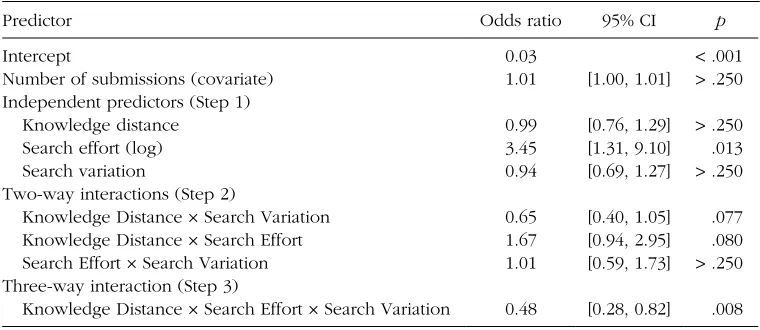
Means, standard deviations, and correlations are reported in Table S1 in the Supplemental Material. We used a hier-archical logistic regression model to assess the interactive effects of knowledge distance, search variation, and search effort on the likelihood of generating the winning solution. To create two-way interaction variables, we multiplied standardized versions of respective variables. To create a three-way interaction term, we multiplied standardized knowledge-distance, search-variation, and search-effort variables. We entered these variables in the first step; two-way interactions between these variables in the second step; and the three-way interaction variable in the third step. The results of this analysis are presented in Table 1. As expected, the three-way interaction was significant (odds ratio = 0.48, p = .008). In terms of model fit, adding the three-way interaction variable in Step 3
provided an overall good fit and accounted for signifi-cantly more variance than the previous model (i.e., the model with independent predictors and two-way interac-tions), χ2(8) = 23.09, p = .003, Δχ2(1) = 7.25, p = .007.
None of the other models provided as good a fit (see the footnote in Table 1).
It is also worth noting that search effort was signifi-cantly related to the likelihood of winning (odds ratio = 3.45, p = .013), whereas knowledge distance and search variation were not. Adding these three variables in Step 1 provided a marginally better fit than the intercept-and-covariate-only model, Δχ2(3) = 7.18, p = .066. The
two-way interactions between knowledge distance and search effort (odds ratio = 1.67, p = .080) and between knowl-edge distance and search variation (odds ratio = 0.65, p = .077) were marginally significant, whereas the interaction between search effort and variation was not significant (odds ratio = 1.01, p > .250). The addition of the two-way interactions accounted for more variance than the model with independent predictors only, Δχ2(3) = 8.60, p = .035
(for a discussion of the robustness of these results, see the Supplemental Material).
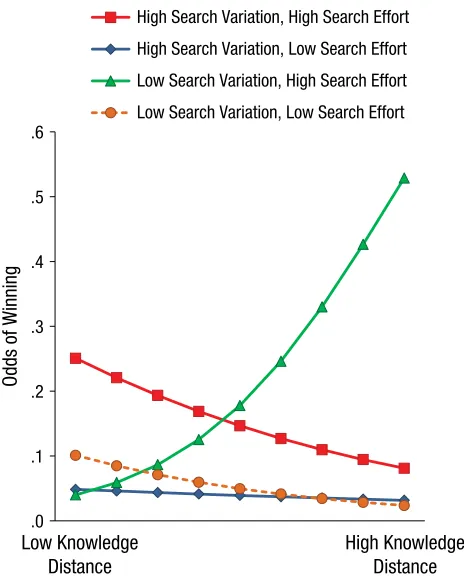
[image:6.603.111.491.480.645.2]To facilitate the interpretation of this interaction, we plotted how knowledge distance was related to likeli-hood of winning at low and high levels of search varia-tion and search effort (i.e., at 1 SD below the mean and 1 SD above the mean, respectively). Figure 1 depicts these relationships and shows that knowledge distance was positively related to the likelihood of winning when search variation was low but search effort was
Table 1. Results of the Hierarchical Logistic Regression Analyses Predicting Winning Solutions
in Science Contests
Predictor Odds ratio 95% CI p
Intercept 0.03 < .001
Number of submissions (covariate) 1.01 [1.00, 1.01] > .250 Independent predictors (Step 1)
Knowledge distance 0.99 [0.76, 1.29] > .250
Search effort (log) 3.45 [1.31, 9.10] .013
Search variation 0.94 [0.69, 1.27] > .250
Two-way interactions (Step 2)
Knowledge Distance × Search Variation 0.65 [0.40, 1.05] .077 Knowledge Distance × Search Effort 1.67 [0.94, 2.95] .080 Search Effort × Search Variation 1.01 [0.59, 1.73] > .250 Three-way interaction (Step 3)
Knowledge Distance × Search Effort × Search Variation 0.48 [0.28, 0.82] .008
Note: N = 218. The odds-of-winning variable was coded as 0 if a solution was not a winner and as 1 if it was a winner. The intercept-and-covariate-only model did not provide a good fit, χ2(1) = 0.06, p = .802. Including
the independent predictors in Step 1 also did not lead to a good fit, χ2(4) = 7.24, p = .124, Δχ2(3) = 7.18, p =
.066. Adding two-way interactions in Step 2 led to a better model fit, χ2(7) = 15.84, p = .027, Δχ2(3) = 8.60,
p = .035. Adding the three-way interaction in Step 3 provided a significantly better fit and explained more variance, χ2(8) = 23.09, p = .003, Δχ2(1) = 7.25, p = .007. These results and regression coefficients remained
Knowledge Distance, Cognitive Search, and Creativity 697
high. However, knowledge distance was negatively related to the likelihood of winning when both search variation and search effort were high. The association between knowledge distance and creativity was negli-gible when search effort was low, regardless of whether search variation was high or low. Overall, problem solvers whose expertise was highly distant from the knowledge domain and who were engaged in a high level of search effort, but who had a low level of search variation, had the highest odds of winning the science contest.
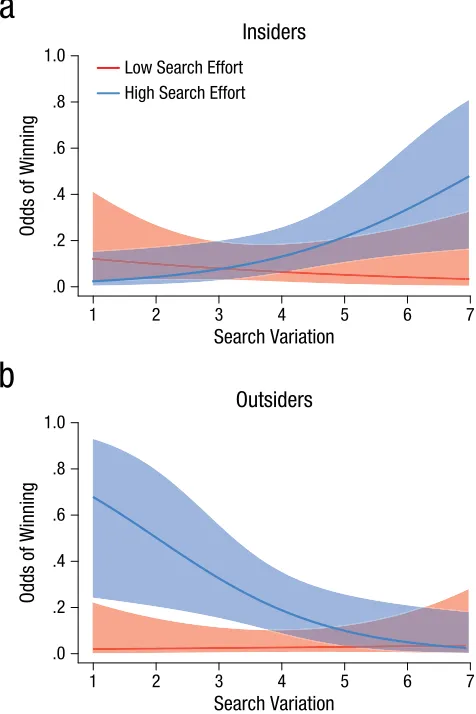
To show how the interactive effect of search effort and search variation was associated with creativity for outsid-ers and insidoutsid-ers (i.e., for individuals who are 1 SD above the mean and 1 SD below the mean of the knowledge-distance score, respectively), we created two two-way interaction graphs (Fig. 2). Not surprisingly, for both out-siders and inout-siders, the odds of winning were quite low when the level of search effort was low, regardless of the level of search variation (i.e., search variation was not related to creativity when search effort was low). For high levels of search effort, variation was negatively related to creativity for outsiders, whereas this associa-tion was positive for insiders.
Discussion
In this study, we investigated how individuals’ creativity in a scientific domain is related to their knowledge dis-tance from that particular domain. Our results showed that the relationship between knowledge distance and creativity depended on the extent of cognitive-search effort and search variation. We found that individuals’ knowledge distance was positively related to creativity only when they engaged in a focused search (i.e., they did not vary the search a great deal) and exerted a con-siderable amount of effort. However, being closer to the knowledge domain was positively associated with cre-ativity when an individual combined a wide variety of different knowledge elements and exerted substantial search effort. It is worth noting that the creativity we refer to is closer to what some scholars call radical creativity, “big C” creativity, or eminent creativity, which concerns breakthrough ideas that are substantially different from existing ideas; this is distinct from incremental creativity, “little C” creativity, or everyday creativity, which concerns refinements, minor adaptations, or extensions of existing ideas (Hennessey & Amabile, 2010; Madjar, Greenberg, & Chen, 2011). As a whole, this study provides a cognitive account that may explain conflicting evidence with regard to the link between knowledge distance and cre-ativity (Dane, 2010; Weisberg, 1999).
This contribution, however, must be qualified in the light of two important limitations of this study. First, the data collected in this study were correlational in nature. Although the data enabled us to observe how naturally occurring variations in knowledge distance and cognitive-search behavior were related to creativity in the solving of real-world science problems, it did not allow a precise determination of causality. We therefore encourage future researchers to use experimental manipulations to show more explicitly the causal role of search behavior in influ-encing creativity. The second limitation is that the inde-pendent variables of this study relied on self-report measures. Although our knowledge-distance and search-variation measures were validated against theoretically rel-evant constructs, and prior empirical evidence supports construct and predictive validity of self-report measures for search effort (Yeo & Neal, 2004, 2008), it would be valuable to use objective measures of these constructs in future studies. For example, social desirability might have led to biases in the measurement of our independent vari-ables, or our respondents might not have had the ability to assess these variables accurately. This second point may not be of great concern, however, given that most of the respondents in our sample had a master’s or doctoral degree in a scientific field. It might also be worth noting that the main emphasis in this work was on the interaction effect of self-report measures on an objective dependent
.0 .1 .2 .3 .4 .5 .6
Low Knowledge Distance
High Knowledge Distance
Odds of Winning
[image:7.603.54.286.65.358.2]High Search Variation, High Search Effort High Search Variation, Low Search Effort Low Search Variation, High Search Effort Low Search Variation, Low Search Effort
measure; in such cases, the chances of creating artificial links because of method biases are slim (Evans, 1985; Pod-sakoff, Mackenzie, Lee, & PodPod-sakoff, 2003).
From a practical standpoint, our findings offer a way in which insiders may overcome their widely noted prob-lems related to creativity (Sternberg & Lubart, 1995; Weis-berg, 1999). That is, if insiders of a particular domain spend significant amounts of time seeking out knowledge from a wide variety of other fields, they are more likely to be creative in that domain. The findings also indicate that if solvers’ attention is focused on a relatively restricted range of knowledge areas while they are also making a considerable cognitive effort, the solvers’ knowledge dis-tance can turn their lack of knowledge in a domain into an advantage. In addition, for organizers of science con-tests (and other organizations that aim to stimulate scien-tific development, such as those that provide funding for
research), our results emphasize the importance of being open to those outside a scientific domain. Such organiza-tions could take a more proactive approach to encourag-ing outsiders, who are more likely to solve challengencourag-ing scientific problems when they engage in the “right” cogni-tive processes. We hope this study will help to harness more effectively the remarkable creative potential of peo-ple from a variety of knowledge backgrounds to solve significant scientific problems.
Action Editor
Leaf Van Boven served as action editor for this article.
Author Contributions
O. A. Acar developed the study concept; undertook the data collection, testing, and analysis; and drafted the manuscript. J. van den Ende supervised the data collection, testing, and analy-sis and provided critical revisions to the manuscript. Both authors approved the final version of the manuscript for submission.
Declaration of Conflicting Interests
The authors declared that they had no conflicts of interest with respect to their authorship or the publication of this article.
Funding
Data collection for this study was made possible by the generous funding of the Erasmus Research Institute of Management. Open access for this article was funded by King’s College London. The funders had no role in study design, data collection and analysis, decision to publish, or preparation of the manuscript.
Supplemental Material
Additional supporting information can be found at http:// pss.sagepub.com/content/by/supplemental-data
References
Amabile, T. (1983). The social psychology of creativity: A com-ponential conceptualization. Journal of Personality and
Social Psychology, 45, 357–376.
Bayus, B. L. (2013). Crowdsourcing new product ideas over time: An analysis of the Dell IdeaStorm community.
Management Science, 59, 226–244.
Ben-David, J. (1960). Scientific productivity and academic organization in nineteenth-century medicine. American
Sociological Review, 25, 828–843.
Bilalic´ , M., McLeod, P., & Gobet, F. (2008a). Inflexibility of experts—Reality or myth? Quantifying the Einstellung effect in chess masters. Cognitive Psychology, 56, 73–102.
Bilalic´ , M., McLeod, P., & Gobet, F. (2008b). Why good thoughts block better ones: The mechanism of the perni-cious Einstellung (set) effect. Cognition, 108, 652–661. Campbell, D. T. (1960). Blind variation and selective
reten-tion in creative thought as in other knowledge processes.
Psychological Review, 67, 380–400.
1 2 3 4 5 6 7
Low Search Effort High Search Effort
Insiders
a
Odds of Winning
Search Variation
1 2 3 4 5 6 7
Search Variation .0
.2 .4 .6 .8 1.0
.0 .2 .4 .6 .8
1.0 Outsiders
Odds of Winning
[image:8.603.52.290.71.428.2]b
Knowledge Distance, Cognitive Search, and Creativity 699
Dane, E. (2010). Reconsidering the trade-off between exper-tise and flexibility: A cognitive entrenchment perspective.
Academy of Management Review, 35, 579–603.
De Dreu, C. K. W., Baas, M., & Nijstad, B. A. (2008). Hedonic tone and activation level in the mood-creativity link: Toward a dual pathway to creativity model. Journal of Personality
and Social Psychology, 94, 739–756.
Ericsson, K. A. (1999). Creative expertise as superior reproduc-ible performance: Innovative and flexreproduc-ible aspects of expert performance. Psychological Inquiry, 10, 329–333.
Evans, M. (1985). A Monte Carlo study of the effects of cor-related method variance in moderated multiple regression analysis. Organizational Behavior and Human Decision
Processes, 36, 305–323.
Fleming, L. (2001). Recombinant uncertainty in technological search. Management Science, 47, 117–132.
Garbarino, E. C., & Edell, J. A. (1997). Cognitive effort, affect, and choice. Journal of Consumer Research, 24, 147–158. Granovetter, M. (1973). The strength of weak ties. American
Journal of Sociology, 78, 1360–1380.
Hennessey, B., & Amabile, T. (2010). Creativity. Annual Review
of Psychology, 61, 569–598.
Jeppesen, L. B., & Lakhani, K. (2010). Marginality and problem-solving effectiveness in broadcast search. Organization
Science, 21, 1016–1033.
Kahneman, D. (1973). Attention and effort. Englewood Cliffs, NJ: Prentice-Hall.
Kaplan, C. A., & Simon, H. A. (1990). In search of insight.
Cognitive Psychology, 22, 374–419.
Kuhn, T. S. (1962). The structure of scientific revolutions. Chicago, IL: University of Chicago Press.
Lewandowsky, S., & Kirsner, K. (2000). Knowledge partitioning: Context-dependent use of expertise. Memory & Cognition,
28, 295–305.
Li, Q., Maggitti, P., Smith, K., Tesluk, P. E., & Katila, R. (2013). Top management attention to innovation: The role of search selection and intensity in new product introduc-tions. Academy of Management Journal, 56, 893–916. Lovett, M. C., & Anderson, J. R. (1996). History of success and
current context in problem solving: Combined influences on operator selection. Cognitive Psychology, 31, 168–217. Luchins, A. S. (1942). Mechanization in problem solving: The
effect of Einstellung. Psychological Monographs, 54(6, Whole No. 248).
Madjar, N., Greenberg, E., & Chen, Z. (2011). Factors for radical creativity, incremental creativity, and routine, noncreative performance. Journal of Applied Psychology, 96, 730–743. Mednick, S. A. (1962). The associative basis of the creative
pro-cess. Psychological Review, 69, 220–232.
Mobley, M. I., Doares, L. M., & Mumford, M. D. (1992). Process analytic models of creative capacities: Evidence for the com-bination and reorganization process. Creativity Research
Journal, 5, 125–155.
Mullins, N. (1972). The development of a scientific specialty: The phage group and the origins of molecular biology.
Minerva, 10, 51–82.
Mumford, M. D., & Gustafson, S. B. (1988). Creativity syndrome: Integration, application, and innovation. Psychological
Bulletin, 103, 27–43.
Perry-Smith, J. (2006). Social yet creative: The role of social relationships in facilitating individual creativity. Academy
of Management Journal, 49, 85–101.
Podsakoff, P. M., Mackenzie, S. B., Lee, J., & Podsakoff, N. P. (2003). Common method biases in behavioral research: A critical review of the literature and recommended reme-dies. Journal of Applied Psychology, 88, 879–903.
Sassenberg, K., & Moskowitz, G. B. (2005). Don’t stereotype, think different! Overcoming automatic stereotype activa-tion by mindset priming. Journal of Experimental Social
Psychology, 41, 506–514.
Schilling, M. A. (2005). A “small-world” network model of cog-nitive insight. Creativity Research Journal, 17, 131–154. Schilling, M. A., & Green, E. (2011). Recombinant search and
breakthrough idea generation: An analysis of high impact papers in the social sciences. Research Policy, 40, 1321–1331. Simonton, D. K. (2003). Scientific creativity as constrained sto-chastic behavior: The integration of product, person, and process perspectives. Psychological Bulletin, 129, 475–494. Singh, J., & Fleming, L. (2010). Lone inventors as sources of
breakthroughs: Myth or reality? Management Science, 56, 41–56.
Smith, S. M. (1995). Fixation, incubation, and insight in mem-ory and creative thinking. In S. M. Smith, T. B. Ward, & R. A. Finke (Eds.), The creative cognition approach (pp. 135–156). Cambridge, MA: MIT Press.
Sternberg, R. J., & Lubart, T. I. (1995). Defying the crowd:
Cultivating creativity in a culture of conformity. New York,
NY: Free Press.
Weisberg, R. (1999). Creativity and knowledge: A challenge to theories. In R. J. Sternberg (Ed.), Handbook of creativity (pp. 226–250). Cambridge, England: Cambridge University Press. Yeo, G. B., & Neal, A. (2004). A multilevel analysis of effort,
practice, and performance: Effects of ability, conscientious-ness, and goal orientation. Journal of Applied Psychology,
89, 231–247.