· · · ···
··· * · · · ·Τ ···· ··· ··· ··· ; · ; · ; * ···
·:
:·
:·:·:'ζ
• · ··· ·· ··· ··· • ······
•Σ···
•Σ···
·Σ·Σ·Σ·Σ·Σ·Σ·Σ·Σ·Σ
·Σ·Σ·Σ·Σ·Σ·Σ·Σ·Σ·Σ
··· ···
•
·ι·.
:
:
:
· : · :
· : · : · : · : · : · χ ·
• ¿ • ï
*
m»mΣ·Σ·Σ·Σ
•ι·:·:·:·
βΣ·
•sti· :
• » • • • » • • • ι·Ι·Σ·:
· : · : · : · ' • • • • • • S · Σ · Ζ · ΗEuropean Union
Regional Policy
and Cohesion
·!·!·Ι·Σ·ΐ
ΛΨΛΨΛ•;Ì·:
• ζ «
· : · : · : ·
· ζ · ζ «
Σ·Σ·Σ···2
·Σ·Σ·ϊ····*
·Σ·Σ·Σ·2·Σ·
• Σ · ζ · ·
. = . : · :
•»••••••s
ι·χ·ν
.-Σ·Σ·Σ·Σ··
ί·Σ·Σ·Σ····«
•Σ···,
•Σ···.
Σ · · · ϊ
Regional development studies
The spatial consequences
of the
iñfegratiqff
*rjM>4of thè^Tìew^ernrran Länder
into the Community
J
Γ
1
If ι
European Commission
t
\ ■
European Union
Regional Policy and Cohesion
Regional development studies
The spatial consequences
of the integration
of the new German Länder
into the Community
Already published in the series Regional development studies
01 — Demographic evolution in European regions (Demeter 2015)
02 — Socioeconomic situation and development of the regions in the neighbouring countries of the Community in Central and Eastern Europe
03 — Les politiques régionales dans l'opinion publique
04 — Urbanization and the functions of cities in the European Community
05 — The economic and social impact of reductions in defence spending and military forces on the regions of the Community
06 — New location factors for mobile investment in Europe 07 — Trade and foreign investment in the Community regions:
the impact of economic reform in Central and Eastern Europe 08 — Estudio prospectivo de las regiones atlánticas — Europa 2000
Study of prospects in the Atlantic regions — Europe 2000 Étude prospective des régions atlantiques — Europe 2000
09 — Financial engineering techniques applying to regions eligible under Objectives 1, 2 and 5b 10 — Interregional and cross-border cooperation in Europe
11 — Estudio prospectivo de las regiones del Mediterráneo Oeste Évolution prospective des régions de la Méditerranée - Ouest
Evoluzione delle prospettive delle regioni del Mediterraneo occidentale 12 — Valeur ajoutée et ingénierie du développement local
13 — The Nordic countries — what impact on planning and development In the Union ? 14 — Development prospects of the central Mediterranean regions (Mezzogiorno-Greece) 15 — The spatial consequences of the Integration of the new German Länder into the
Community
16 — The impact of the development of the countries of Central and Eastern Europe on the Community territory
17 — Étude prospective des régions de l'arc alpin et périalpin Studio delle prospettive delle regioni dell'arco alpino e perialpino 18 — The prospective development of the northern seaboard
20 — Evolución prospectiva de las regiones interiores (y de los espacios rurales de baja densidad de población en la Comunidad)
Évolution prospective des régions intérieures (et des espaces ruraux de faible densité de population de la Communauté)
22 — The perspective development of the central and capital cities and regions 23 — La notoriété des politiques régionales en Europe
24 — Cohesion and the development challenge facing the lagging regions
25 — In den Regionen für die Regionen Europas — Über die Aneignung eines neuen gewerk-schaftlichen Arbeitsfeldes
At regional level on behalf of Europe's regions — Developing a new field of trade union activity
Forthcoming publications in this series
19 — L'impact sur le développement régional et l'aménagement de l'espace communautaire des pays du Sud et de l'Est méditerranéens (PSEM)
21 — The regional impact of the Channel Tunnel throughout the Communit
Cataloguing data can be found at the end of this publication
Luxembourg: Office for Official Publications of the European Communities, 1996
ISBN 92-826-8803-8
© ECSC-EC-EAEC, Brussels · Luxembourg, 1996
Reproduction is authorized, except for commercial purposes, provided the source Is acknowledged
Preface
Each year, the European Commission's Directorate-General for Regional Policy and Cohesion launches a number of studies in the field of regional policy and regional planning. These studies mainly aim at providing a basis for policy formulation internally, as well as the preparation of programmes and initiatives and a basis for analysing the impact of current or planned activities. The most interesting or innovative of these are published in a series entitled Regional development studies.
With this series, the Directorate-General hopes to stimulate discussion and action in a wider sphere on the research results received. The publication of the studies is addressed to politicians and decision-makers at European, regional and local level, as well as to academics and experts in the broad fields of issues covered.
It Is hoped, that by publicizing research results, the Commission will enrich and stimulate public debate and promote a further exchange ot knowledge and opinions on the issues which are considered important for the economic and social cohesion of the Union and therefore for the future of Europe.
Contents
1. Introduction 1
2. Present economic situation and trends 3
General trends 3 Employment 4 Business registrations and closures 6
GDP, incomes and prices 6
Investment 7 Foreign trade 9
3. Spatial dimensions of global developments:
a picture of trends and situations in the new German Länder 11
3.1. Privatization 11
3.2. Economic specialization, sectoral growth and decline 14
Agriculture under strong adjustment pressure 15 Further decline in extractive and producer goods industries 17
Slight improvement in capital and consumer goods industry 18
Dynamic development in the building sector 18 Service sector: boom of private services but large surplus manpower in the public sector 18
Wholesale and retail trade 20
Tourism 20 Summary of trends during 1989-91 20
3.3. Unemployment 21 Registered unemployment 21
Short-time work, job-creation schemes and related measures 22
Unemployment of women 22
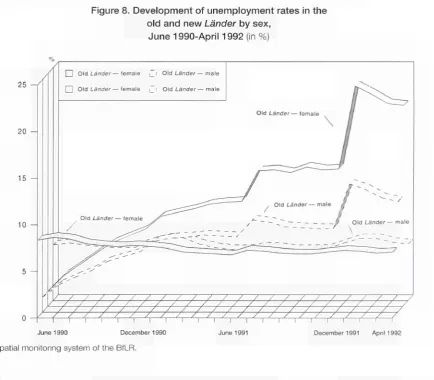
3.4. Patterns of commuting 30
3.5. Natural population movements and migration patterns 30
3.6. Spatial patterns in the new German Länder: situation and outlook 35
Brandenburg, Saxony-Anhalt and Thuringia 36
Saxony 37 East Berlin 38 General picture of spatial patterns 39
4. Locational strengths and weaknesses 41
4.1. The new German Länder in comparison with EC problem regions:
business survey on factors of location in eastern Germany 42
Assessment of locational quality 42 Importance of locational factors 45 Trends In the assessment of locational strengths and weaknesses 45
Priorities for Improvement 45 Self-assessment and external assessment 45
Summary of findings 49
4.2. Assets for future development 49
Skills of the workforce 49 R&D activities 49
4.3. Main development obstacles 52
Energy 52 Environmental pollution 52
Conversion 57 Housing 57
4.4. Factors with rapid improvements 60
Transport infrastructure 60 Telecommunications 60
4.5. The special situation of border regions in eastern Germany 65
Spatial development potential 65
4.6. The position of the new German Länder in Europe:
a comparison of selected factors of location 67
Method 67 Locational factors 68
Labour costs 68 Human resources 69 Accessibility 71 Manufacturing density 71
Business services 72 Efficiency costs 73 Summary of findings 74
4.7. Settlement structure and locational weaknesses 74
5. Medium-term prospects of the new German Länder in the Community 81
5.1. Medium-term prospects - results of a business survey 82
Research and development 82 Medium-term personnel needs by qualification profiles 84
5.2. Accessibility and developments of accessible market potential 88
5.3. Benefits to economic growth in the Community from the new German
Länder
88
Global growth effects 88
Medium-term effects 92
5.4. Investment needs In the medium and long term 92
5.5. The positioning of the new German
Länder
in the Community - medium-term
spatial prospects 94
6. Scenarios of spatial development in the new German
Länder
in the long term 95
6.1. Forecasts of economic development and consequential trends 95
Removal of infrastructural deficits 97
Environmental improvement 97
Reform of administration 97
Migration trends 97
Adjustment pressure from reform processes in Central and Eastern Europe 98
6.2. Trend scenario of spatial development in the new German
Länder
98
Development centres in atrend scenario 98
The example of the Berlin/Potsdam metropolitan area in a trend scenario 98
Problem regions in atrend scenario 99
Growth axes In atrend scenario 100
Regional competitiveness 100
Trend scenario: summary of spatial implications 101
6.3. Principles for future spatial development 103
The guidelines for regional planning 103
Principles for settlement structures 103
Principles for the environment and land use 106
Principles for transport planning 106
6.4. Policy scenario 106
Development centres in a policy scenario 109
Rural areas in a policy scenario 113
Long-term prospects of the border regions in a policy scenario 113
Policy scenario: summary of spatial implications 114
6.5. Likely and desirable trends In the new German
Länder
List of tables, figures and maps
Tables
1. Registration and closure of businesses in the new German Länder, January-May 1993 5
2. GDP level, 1991 6 3. Growth of income, prices and unit labour costs, 1991-92 7
4. Development of wages and productivity in eastern Germany, 1990-92 7
5. Investment in the new and old German Länder, 1991-92 8
6. Investment In manufacturing by ownership, 1991-92 8
7. Foreign and intra-German trade, 1991-92 10 8. Privatization by the State Trust Agency 14 9. Reduction in cultivated area, stock of cattle and stock of pigs, 1989-91 17
10. Employees In the public sector, 30.6.1991 20 11. Development of persons employed by sector of activity in the new German Länder,
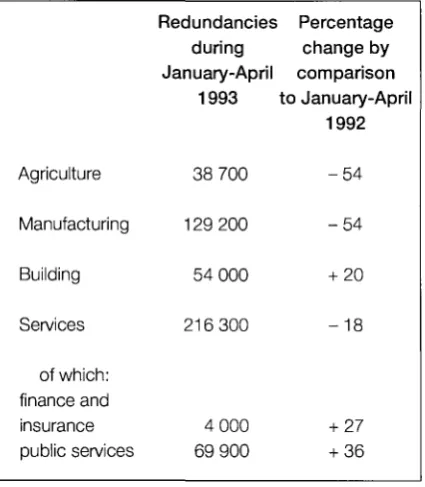
November 1989-July 1991 21 12. Persons newly registered as unemployed during January-April 1993 by comparison to the same
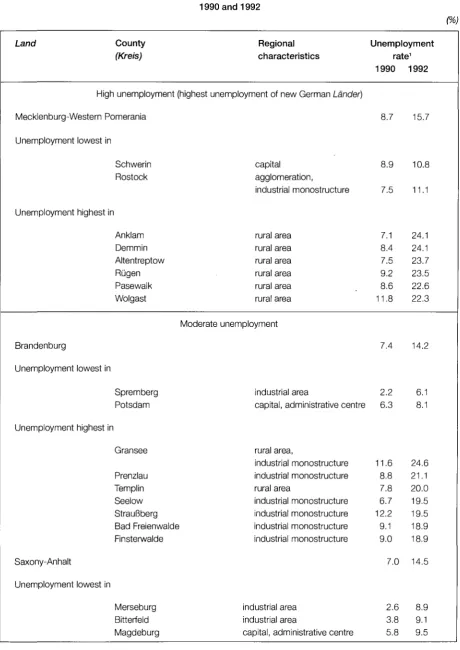
period In 1992 22 13. Groups of Länder and counties (Kreise) according to levels of regional unemployment, 1990 and 1992 23
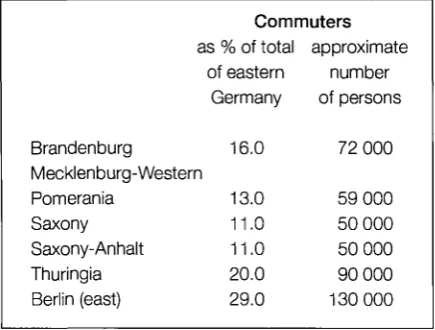
14. Commuters in the new German Länder, 1992 30
15. Quality and availability of infrastructure, 1992 43 16. East German company assessment of the quality of regional infrastructure endowment
by spatial types, 1992 44 17. Infrastructure endowment in eastern Germany in comparison with EC problem regions, 1992 46
18. Importance of the kinds of infrastructure for the respective company, 1992 47
19. Trends in the assessment of infrastructure, 1990-92 48
20. Network density, 1990 64 21. Infrastructure projects within the framework of the programme on German unification, 1990 64
22. Relative regional position of the new German Länder with regard to labour costs, 1992 68 23. Relative regional position of the new German Länder with regard to the demographic
component, 1992 69 24. Relative regional position of the new German Länder with regard to the know-how potential, 1992 .... 70
25. Relative regional position of the new German Länder with regard to accessibility in terms of
transport of goods, 1992 70 26. Relative regional position of the new German Länder with regard to accessibility in terms of
joint use, 1992 71 27. Relative regional position of the new German Länder with regard to manufacturing density, 1992 72
28. Relative regional position of the new German Länder with regard to business services, 1992 72 29. Relative regional position of the new German Länder with regard to efficiency costs, 1992 73
30. Research and development in east German enterprises, 1992 82 31. Share of selected markets in total sales and regional distribution of east German
suppliers, 1996/97 87 32. Contribution of German unification to growth of GDP in selected EC countries, 1990-91 92
33. Investment needs in the new German Länder, 1991-2005 93
34. Annual growth rate in the new German Länder ensuring equalization of GDP per capita between
the new and old German Länder 96
35. Scenario of wage and employment growth in the new German Länder, 1993-2000 96 36. Comparison of unit labour costs between new German Länder and other
Figures
1. Net production index, January 1991-July 1992 3 2. Employment by economic sectors in eastern Germany, 1990-92 4
3. Registration and closure of businesses in the new German Länder, 1990-93 5
4. Distribution of east German exports by product groups, 1989-91 10 5. Example of the profile of activities: agricultural employees In the former GDR, 1989 15
6. Unemployed, participants in job-creation schemes, early retirees, 1990-92 26 7. Number of unemployed persons, short-time workers, employees in job-creation schemes and
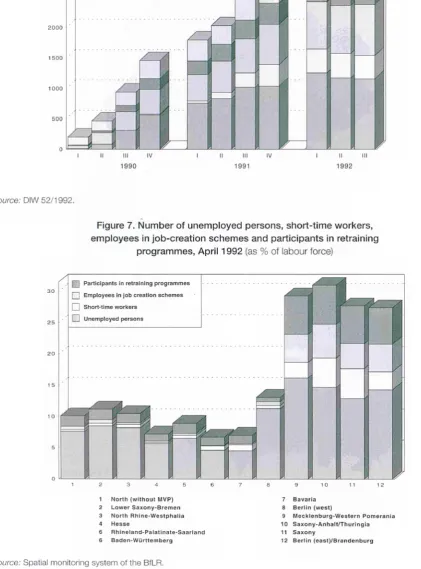
participants in retraining programmes, April 1992 26 8. Development of unemployment rates in the old and new Länder by sex, June 1990-Aprll 1992 29
9a. Natural population movements and migration in the new German Länder, 1990 and 1991 32 9b. Demographic movements - live births in relation to mortality in the new German Länder,
1990 and 1991 32 10. Factors with the highest priority for improvement for east German companies, 1992 45
11. Mid-term recruitment demand of east German firms by qualification profiles, 1992 85 12. Regional distribution of sales areas and suppliers of east German industry, 1992 and 1996/97 86
13. Competitors and markets in east German industry, 1992 89
Maps
1. Employment in State Trust Agency enterprises, October 1991 12 2. Development of number of gainfully employed persons in State Trust Agency enterprises 13
3. Monostructure and dominant sectors of industry 16
4. Degree of economic specialization 19 5. Unemployment rates as of 31 December 1992 25
6. Unemployment and short-time work 27
7. Unemployment of women 28
8. Migration from the new to the old German Länder 33
9. Internal migration 34
10. Spatial patterns in the new German Länder 40
11. Employment by level of qualification 50 12. Industry-related research and development 51
13. Sulphur dioxide emissions 53
14. Contaminated areas in the new German Länder 54
15. Damage to forests 55 16. Groundwater contamination with nitrates 56
17. Military sites of CIS forces 58 18. Housing standards 59 19. Infrastructure projects - trunk roads 61
20. Infrastructure projects - railways 62 21. Infrastructure projects - inland waterways 63
22. Spatial development potentials in the German-Polish border area 66
23. Cities and counties according to settlement structure 75
24. Average size of communes 76 25. Settlement structure 77
26. Main locational factors in the new German Länder 79
27. Changes in accessibility of counties in Germany in private transportation due to German unification .. 90 28. Changes in accessibility of counties in international transport due to the Kassel-Bebra railway link 91
29. Trend scenario - long-term spatial patterns In the new German Länder 102
30. General principles for settlement structures 105 31. General principles for the environment and land use 107
32. General principles for transport planning 108
33. Development centres of the new German Länder 110
1. Introduction
The process of German unification has reached a critical stage. The regional disparities between eastern and western Germany are still enormous in terms of stan-dard of living, employment, business activity, infrastruc-ture and environmental conditions, with the people in the east undergoing grave social hardship and problems. The transfer of capital to the new German
Länder, which is meant to spur their economy and to promote the convergence of living conditions in the two parts of Germany, places a heavy burden on the popula-tion in the western Länder. Yet the effects in terms of improvement of the competitive situation of the new
Länder lag behind expectations. In addition, in the pre-sent economic crisis, the new Länder are faced with a lack of investment and a fight for jobs between eastern and western Germany. Moreover, investors increasingly 'go further east' to save on labour costs.
and obstacles and are exposed to different degrees of adjustment pressure. The spatial development is char-acterized by great differences, ranging from slow pro-gress to mounting instability. In general the North-South divide observed in western Germany is even more pronounced in the new Länder.
The study describes the socioeconomic situation of the new German Länder. Then determinants of spatial development, potentials and obstacles, trends and per-spectives in the medium term are outlined for the various regions of the new German Länder. Moreover scenarios of future development in the new Länder are presented and their likely spatial impact is discussed.
However, the situation in the new German Länder which may seem uniform at first sight, is by no means homo-geneous. Individual areas and regions differ greatly in terms of locational advantages, development potentials
2. Present economic situation and trends
General trends
German unification and the sudden exposure of the east German economy to world trade as well as the simulta-neous collapse of Comecon trade have produced a pro-found crisis of adjustment in the east German economy.
Net output of the manufacturing industry had dropped by January 1991 to 70% of its level of the
second half of 1990. While it remained relatively stable at this level until the end of 1991, it again declined at the beginning of 1992 to 61.8% of the original level (second half 1990) and stayed at this low level up to August 1992.
Only non-metallic industry has succeeded in raising out-put substantially since 1992. The greatest slumps in output have been recorded in wood-processing,
tex-Figure 1. Net production index, January 1991 -July 1992
(Second half 1990 = 100)
Non-metallic industry
Wood-processing
o 1/1991
Source: DIW 52/1992.
Manufacturing industry, total
Office machinery and equipment
tiles, foundries and manufacturing of office machinery and equipment (see Figure 1).
With regard to the labour-market, employment de-creased substantially during 1990-93. Thus, for in-stance, employment in agriculture and in manufacturing is at present at about 50% of early 1990. Consequen-tially registered unemployment, underemployment (short-time work, for instance) and hidden unemploy-ment (early retireunemploy-ment schemes, training programmes) increased up to a total of 3 million people of which as yet over 1 million are registered as unemployed.
In 1993 trends towards a halt of further deterioration of the socioeconomic situation are visible. Overall further substantial increases of unemployment and job losses are not expected for 1993. From a spatial perspective a clear North-South divide can be observed. In the larger agglomerations there are signs of economic stabilization.
Employment
The breakdown of production has resulted in a drastic loss of employment. Between the first quarter of 1990
and the third quarter of 1992 employment in the new
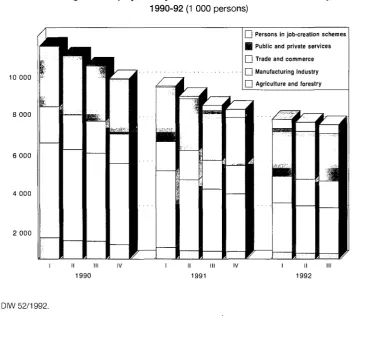
Länder decreased by more than a third. The most seri-ous loss of jobs was suffered by agriculture which now-adays employs only 26% of the former workforce. (This is partly attributable to the déconcentration of the agri-cultural sector, i.e. activities made redundant which were included in agriculture in the former system, such as service units.) All other economic sectors have wit-nessed job losses too. Manufacturing industry at present employs less than 50% of the workforce it had in the first quarter of 1990, trade and transport just about 25% and services about 20% less than in the first quarter of 1990 (see Figure 2).
The share of industry has fallen to less than half the aver-age west German level. Even the formerly highly indus-trialized Länder of Saxony and Thuringia nowadays show a level of industrial employment which is lower than that of the agriculturally oriented western Länder of Schleswig-Holstein and Lower Saxony. The service sector although expanding has not been able to offset the industrial job losses by far.1
[image:16.595.111.501.426.768.2]WSI Mitteilungen 1993.
Figure 2. Employment by economic sectors in eastern Germany, 1990-92 (1 000 persons)
10 000
8 000
6 000
4 000
2 000
~] Persons in job-creation schemes | Public and private services
~] Trade and commerce ~] Manufacturing Industry j9 Agriculture and forestry
Source: DIW 52/1992.
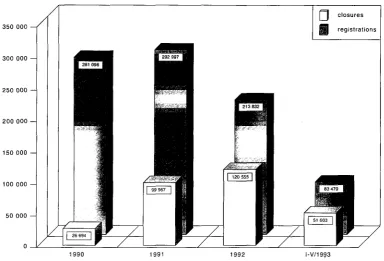
Figure 3. Registration and closure of businesses in the new German Länder, 1990-93
300 000
200 000 —
50 000
closures registrations
1992 -V/1993
[image:17.595.73.458.126.387.2]Source: Federal Statistical Office, August 1993.
Table 1. Registration and closure of businesses in the new German Länder, January-May 1993
New German Länder
Brandenburg
Mecklenburg-Western Pomerania
Saxony Saxony-Anhalt Thuringia Berlin (east)
Registrations
83 479
13 096
9 061 23 530 14 442 14 043 9 307
January-May 1993
Closures
51 603
8118
5 145 14 846
9 240 9 804 4 450
Closures as percentage of registrations
61.82
61.99
56.78 63.09 63.98 69.81 47.81
Source: Federal Statistical Office, August 1993.
Business registrations and closures
The job creation and early retirement schemes launched to ease the pressure on the labour-market and the large flow of migrants and commuters to the western Länder
could In no way offset the loss of jobs in the eastern
Länder.
The problem of unemployment Is aggravated by the fact that there are not enough private businesses generating additional employment. Moreover, many businesses are closing down shortly after their establishment thus not contributing to the reduction of unemployment (see Annex I, Table 14).
As can be seen from Figure 3, from 1990 to 1993 busi-ness registrations decreased from about 282 000 in 1990 to about 212 000 in 1992. During the same period business closures increased from about 27 000 to about 121 000. The data available for the first five months of 1993 indicate further deterioration of the rela-tionship between closures and registrations. While in 1990 closures represented about 10% of registrations this ratio increased to about 56% in 1992 and 62% between January and May 1993.
Table 1 displays the recent situation for eastern Germany and the individual Länder. Business closures represent highest shares (as a percentage of registrations) in Thu-ringia (about 70%) and smallest shares in eastern Berlin (about 48%).
GDP, incomes and prices
The slump in production in the new Länder in 1991 resulted in a decrease of real GDP of 31.4% against the previous year. Even though in 1992 GDP rose by 4.5%, a comparison of per capita GDP in the western and the
new Länder shows the enormous lag of the latter (see Table 2).
Prices and wages have risen sharply In the new Länder
since unification. The inflation rate in the new Länder
was around 19.1% In 1991 and 16.5% in 1992, exceed-ing by far the inflation rate in the western Länder of 4.1 and 4.5% respectively and also the EC average of 5.5 and 5.0% respectively.
In pursuance of the objective of raising eastern wages and salaries to western levels as laid down in the unifica-tion agreement, there has been a strong increase since 1990. In 1991 wages and salaries rose by 9.3%, in 1992 by 21.5% compared to the previous year. Their rate of Increase was thus far above that in the old
Länder which stood at 7.9% (1991) and 6.0% (1992) as against the previous year (see Table 3). According to estimates by the DIW the monthly gross income per full-time employed person (employed minus short-full-timers) was about ECU 1 075 in the first quarter of 1992 which was equivalent to about 60% of the west German actual wage.1 By the end of 1992 it should have
reached just under 70%. Further increases were renegotiated in 1993. They will stretch, however, over a longer period than initially planned.
One of the greatest problems at present is that the increase in wages and salaries in many industries is not matched by an increase in labour productivity (see Table 4). It places the new German Länder in a dilemma: since labour productivity continues to be low, rising wages will reduce the region's attractiveness to foreign investors (see Table 36). These will either move to locations in Central and Eastern Europe, where labour productivity is similar to that of the eastern Länder but wage and other costs are much lower. Or they will invest in the
DIW 1-2/1993.
Table 2. GDP level, 1991
New German Länder
Old German Länder
EUR 12 (including new German Länder)
GDP total
(billion ECU)
91.5 1 300.0 5 293.5
GDP per capita
(ECU PPS)
7 460 22 350 19 210
Source: Institut für Wirtschaftsforschung Halle 1992.
Table 3. Growth of income, prices and unit labour costs, 1991-92
(percentage change compared to previous year)
New German
Länder
Old German
Länder
EUR 12
Real GDP
1991
-31.4
3.7
0.7
1992
- 4 . 5
1.5
1.1
1991
19.1
4.1
5.5
Prices
1992
16.5
4.5
5.0
Income
1991
9.3
7.9
7.1
1992
21.5
6.0
6.7
Unit labour costs1
1991 1992
52.7 14.0
4.2 5.5
6.0 5.3
' Unit labour costs: compensation per hour divided by the corresponding output per hour. Source: DIW 1-2/1993.
western Länder where wage costs are admittedly still higher, but accompanied by much higher productivity levels. The other side of the dilemma is, however, that the wage differential between the new and old Länder
leads many workers to commute to or leave for the western Länder (see Chapter 3.4).
Despite a considerable reduction of employment, pro-ductivity (in terms of GDP per hour worked) has thus increased less than wages (gross income from depen-dent employment per hour worked).
Investment
A special problem is the rise in unit labour costs (com-pensation per hour divided by the corresponding output per hour) in the new Länder. They rose in 1991 by more than 50% and in 1992 by another 14%, which adds up to a far greater increase than in the western Länder or in the Community on average.
Investment activities in the new Länder increased by 35.8% in 1991 and by another 29.8% in 1992. Alto-gether the investment made in the new Länder amounted to ECU 42.3 billion in 1991 and ECU 54.9 billion in 1992 which is equivalent to 14.7% (1991) and 18.0% (1992) of investment made in western Germany (see Table 5).
Table 4. Development of wages and productivity in eastern Germany, 1990-92
(ECU per hour)
Wages1
Productivity2
first half
5.54
9.77
1990
second half
6.23
9.52
first half
8.18
9.08
1991
second half
11.59
10.40
1992 first half
10.76
9.78
1 Gross income from dependent employment per hour worked.
2 GDP (in constant prices) per hour worked. Source: DIW 39/1992.
Table 5. Investment in the new and old German Länder, 1991 -92
(billion ECU at current prices)
Fixed asset investment
of which:
in equipment
in plant construction
New German
Länder
42.3
20.6
21.7
1991 Old German
Länder
288.0
133.3
154.7
New German
Länder
54.9
23.6
31.4
1992 Old German
Länder
304.3
133.7
170.6
Source: DIW 1-2/1993.
While in 1991 investment in equipment with 98.6% recorded the highest growth rate in eastern Germany against the previous year, in 1992 the biggest increase was seen in plant construction where investment rose by 44.7% compared to the previous year.
Investment concentrated on industries such as road vehicle construction, rock and stones, food, tobacco and beverages, steel, mechanical engineering, chemi-cals and electrical engineering, which accounted for two thirds of total investment in 1991 and 1992.
Investment in manufacturing both in 1991 and 1992 were made to a major part by companies owned by west Ger-man entrepreneurs. According to DIW estimates, ECU 6.5 billion was invested in manufacturing in 1991 and investments in the order of ECU 9.5 billion were planned in 1992, which is an increase of 45% (see Table 6).'
Considering the tremendous lag of the new Länder,
capital spending so far has been rather moderate. It is expected that in 1993 private investment will increase again by 9%, a figure which may be too optimistic though in the light of the present economic slowdown in Germany as a whole and in the Community.
DIW 52/1992.
Table 6. Investment in manufacturing by ownership, 1991-92
(as % of total enterprises)
Enterprises
of which:
enterprises owned by the State Trust Agency
private enterprises2
of which:
independent entrepreneurs west German-owned enterprises foreign-owned enterprises
1991
100
31
69
26
34
9
1992'
100
25
75
24 43 8
1 Planned.
2 Including partly privatized enterprises. Source: DIW 52/1992.
Generally one cannot yet speak of a self-sustained catching-up process in the new Länder. It has to be taken into account, moreover, that the positive develop-ments in the economic branches which have been wit-nessing increases in output and investment are to be attributed largely to public procurement and purchasing. Against the background of the economic slowdown expected (In 1993 GDP growth is estimated at +3.5% in the new Länder and at -1.0% in the western Länder),'
and of the current budgetary difficulties, these positive impulses rather threaten to subside in 1993.
Foreign trade
Not much is left of the former GDR's position in foreign trade. Exports by the new Länder in 1992 barely reached a third of the level held by the GDR in 1989, imports fell to a quarter of their 1989 level. This decline is attributable to the losses incurred in their trade with the countries of Central and Eastern Europe: trade with Bulgaria, Romania and Hungary is virtually non-existent while trade with the former Soviet Union, Poland and the Czech Republic and Slovakia has decreased by 70 to 80%.
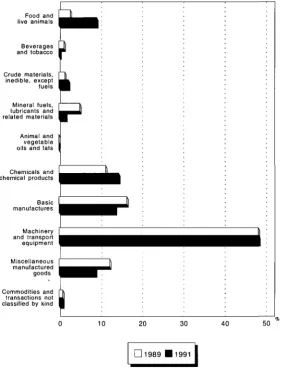
As can be seen from Figure 4 the structure of east Ger-man exports hardly changed between 1989 to 1991. A notable exception is livestock where exports increased considerably. This is mainly due to restructuring in agri-culture and the collapse of large agricultural combines. As a consequence the meat processing industry in western Germany bought east German livestock in large quantities at low prices.
In general, it is not so much the structure of exports which changed after 1989 but the volume. The volume of exports, still at a high level in 1989, fell to 51% in 1991 (see Annex I, Table 18). Compared to the average volume of Imports between 1985 and 1989, the volume of imports decreased to 54% in 1990 and to about 30% in 1991.
Table 7 shows the share of eastern Germany in total German foreign trade. In 1991 the share of exports from eastern Germany was 7.3%, in 1992 8.4%. Imports into the new Länder, by contrast, accounted for a large pro-portion of total German imports, reaching 27.4% in 1991 and 31.1% in 1992.
Nevertheless, the former State-trading countries are stili the most important trading partners for east German industry, more than half of their exports go to Central and Eastern Europe.2
The new Länder and the German capital, Berlin, are in a favourable geographical position as regards access to the north and East European countries. This is espec-ially true for Berlin, the Baltic coast region, Brandenburg and Saxony. However, whether this locational factor is an advantage rather than a disadvantage depends on what use the regions make of their indigenous potential. There are relatively well-developed sea and railway con-nections, via which the former GDR had handled a large part of its extensive trade with the Central and East European countries.
Up to 1990, between 60 and 80% of foreign trade (exports and imports) of the former GDR was with Come-con countries. Even in 1991 about 66% of exports and almost 60% of imports still went to or came from Central and East European countries. The share of foreign trade with industrialized Western countries, among them EC countries, increased between 1990 and 1991, while the volume of foreign trade decreased with almost all trading partners (except imports from OPEC countries).
The major part by far of the demand in the eastern
Länder was satisfied by supplies from the western
Länder. 90.6% of imports into the new Länder came from the western Länder in 1991 (in 1992, 93.1%). This adds up to about 20% of the trade volume of the old
Länder.
The structure of foreign trade of the former GDR in the 1980s, figuring high export shares of raw materials and heavy engineering, underlines the weakness of the east German economy. This must also be taken into account in assessing future prospects.
For 1993 exports from the new Länder are expected to increase in real terms by 10.5% against the previous year, at the same time a further increase in imports is expected (+7.5%). This means that a substantial trade balance deficit will persist. In 1992 it was ECU -93.5 billion (1991 prices) which exceeded the deficit of the two preceding years.3
The future of east German foreign trade will much depend on the advances of restructuring and also to a large extent on the revival of the traditional export mar-kets in Central and Eastern Europe. The prospects for future developments in foreign trade are discussed in Chapter 5.
See DIW 1-2/1993.
¡WD 1993. DIW 1-2/1993.
Figure 4. Distribution of east German exports by product groups, 198991 (as % of total)
Food and live animals
Beverages and tobacco
Crude materials, inedible, except fuels
Mineral fuels, lubricants and related materials
Animal and vegetable oils and fats
Chemicals and chemical products
Basic manufactures
Miscellaneous manufactured goods
Commodities and transactions not classified by kind
10 20 30 40 50
D1989 ■ 1991
[image:22.595.178.463.115.506.2]Source: Federal Statistical Office, 1992.
Table 7. Foreign and intraGerman trade, 199192
1 intraGerman trade not included.
Source: DIW 12/1993.
(billion ECU)
Total German trade1
Old German Länder
of which: Exports to the new
German Länder
New German Länder
Exports
1991
424.2 516.4
103.3 30.8
1992
426.8 540.7
122.2 35.9
Imports
1991
412.5 421.6
19.9 113.9
1992
422.3 440.7
27.8 131.3
Trade balance 1991
11.7 94.8
83.1
1992
4.6 99.9
95.4
3. Spatial dimensions of global developments:
a picture of trends and situations in the new
German
Länder
The dramatic changes in eastern Germany following uni-fication can hardly be assessed systematically at present. Socioeconomic patterns and trends are subject to rapid change. In many fields official statistics and short-term economic forecasts are outdated before they are published. Against this background an assessment of spatial consequences Is bound to be speculative to some extent.
sectoral restructuring in combination with décon-centration of units of production and the spatial inci-dence of these global trends with regard to patterns of employment;
spatial labour-market patterns resulting from macro-developments and adaptation processes in the new German Länder,
In an effort to clearly discern medium-term forecasts (Chapter 5) and long-term scenarios (Chapter 6) from the available empirical evidence and in order to avoid the fallacy of subjective generalization, the present chapter is confined to a description of factual spatial trends and patterns as they appear in the light of official data and analyses.
Moreover, this chapter elucidates on spatial dimensions of general developments. Hence the analysis is directed towards spatial trends and patterns which can be observed in relation to global decisions and historical events which are not spatial or regional in nature, but which nonetheless result in certain spatial situations and developments.
The topics dealt with on this basis in the present chapter are:
(i) the state of privatization of State-owned enterprises which, in spatial terms, indicates differentials in the propensity of investors to allocate resources;
(iv) population movements (natural and migratory) and consequential spatial patterns due to the integration process and the persisting prosperity gap;
(v) patterns of commuting and the spatial impact of glo-bal wage differentials which were initiated politically.
In bringing together the spatial dimensions inherent in these topics an attempt has been made to deliver an analytical photograph of the state of the unification pro-cess. Chapter 4 deals with spatial trends, patterns and locational factors which do or will constitute obstacles to, or opportunities for, future spatial development in the new German Länder.
3.1. Privatization
In 1989 the so-called State Trust Agency (Treuhand) was established to initiate and implement the privatization of the State-owned enterprises of the former GDR. This has been regarded as one of the most important
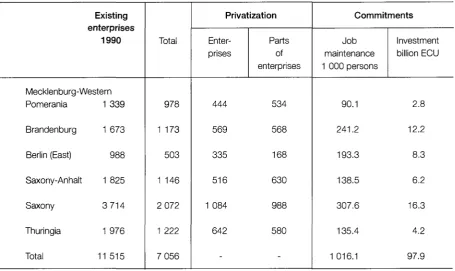
conditions for market economy and economic upswing. If its work is judged by the speed of the privatization pro-cess, the Agency has successfully discharged the task entrusted to it. Several of its regional branch offices at the end of 1992 had implemented the privatization pro-jects assigned to them. By April 1992, 7100 of the 11 500 enterprises existing in the new Länder in 1990 had been privatized.
Map 1 shows the regional distribution of the persons employed in enterprises held by the State Trust Agency in 1991. Most of them are located in southern regions which are strongly geared to such industries as metal works, mechanical engineering and chemicals, whereas relatively few of them are found in primarily agriculturally oriented Mecklenburg-Western Pomerania - with the exception of Rostock (shipyards).
Commitments to invest, which have been made to date, involve a volume of about ECU 51 billion. Moreover commitments have been made to preserve 1 million
jobs. Saxony where 32% of all State Trust Agency enter-prises are located is in the lead as regards investment and job maintenance commitments with 33.8 and 32% respectively. There is evidence, however, that commit-ments made with regard to job maintenance cannot be complied with by a substantial number of companies.
In terms of numbers of privatized enterprises the greatest progress in privatization has been recorded in Saxony: over 2 000 enterprises were privatized between 1990 and April 1992 (see Table 8).
However, there are two aspects which dim these obvi-ous achievements. For one, the State Trust Agency has accumulated a pile of debts in the course of selling State-owned enterprises (some ECU 102 billion by late September 1992), which has put a further strain on the federal budget. Secondly, some of the newly privatized enterprises are not able to fulfil their commitments vis-à-vis the Agency (e.g. to preserve jobs, to invest) owing to the difficult economic situation in which they find
Map 1. Employment in State Trust Agency enterprises, October 1991 (as % of total)
Share of gainfully employed persons in State Trust Agency enterprises
in October 1991 in total gainfully employed persons in 1990 as %
less than 20 20 to less than 23 23 to less than 26 29 to less than 29 32 to less than 32
tm 32 and more
.
.: .
I
s 6 *o e
Federal boundary Boundary of Employment
AB Werkstattbericht Nr. 1 6/15 6 1992 • Berlin data refer to East Berlin only
r I
NB: Berlin data refer to East Berlin only.
Sources: State Trust Agency, February 1992 and July 1992; Spatial monitoring system of the BfLR IAB Werkstattbericht No 1.6/15.6.1992.
Map 2. Development of number of gainfully employed persons in State Trust Agency enterprises
'Schleswig Holstein
m i d 1991
S,
Niedersachsen Γ
..'.· ;. Λ , I cafe
V l'.l·!.!.! .f.^
, vj ESS l
ι V_, j ν .Γ , <jL S » cesa \ ;
t!3¡3i \ ι
Y > .»
\¿v~
c
Bayern
V
Development of number of gainfully employed persons In State Trust Agency e n t e r p r i s e s (1.1.1991 = 100) ! ~l ^ess than 30
Π 30 to ¡ess than 35 Γ~| 35 to less than 40 I 40 to ¡ess than 50
vj 50 to less than 60 §¡¡ 60 to less than 70 Η 70 to less than 80
I 80 and more
100 kr Source: IAB Werkstattbericht No 1.6/15.6.1992.
Survey of 4 894 State Trust Agency enterprises which account for 69% of the total number of 2 million
gainfully employed persons as at 10rd 1991 " Berlin data refer to East Berlin only. Federal boundary
Boundary of Employed Office District
Table 8. Privatization by the State Trust Agency
(interim results April 1992)
Existing enterprises
1990
Mecklenburg-Western Pomerania 1 339
Brandenburg 1 673
Berlin (East) 988
Saxony-Anhalt 1 825
Saxony 3 714
Thuringia 1 976
Total 11515 Total
978
1 173
503
1 146
2 072
1 222
7 056
Privatization
Enter-prises
Parts of enterprises
444 534
569 568
335 168
516 630
1 084 988
642 580
-Commitments
Job maintenance 1 000 persons
90.1
241.2
193.3
138.5
307.6
135.4
1 016.1
Investment billion ECU
2.8
12.2
8.3
6.2
16.3
4.2
97.9
Source: State Trust Agency, February 1992 and July 1992.
themselves. The present recession aggravates this problem.
The job guarantees cover only a small fraction of the former employees of companies which have been taken over. When the State Trust Agency began its work, the number of employees was 4.1 million. This means that about 3.1 million employees have not (or not yet) been taken over by the privatized firms.1
As regards the enterprises which are still to be priva-tized, it may be assumed that many will be difficult to sell or only at a very low price because of unfavourable general conditions. Adverse conditions are for instance:
(i) structural maladjustment in tandem with lack of efficiency;
(ii) obsolete technologies and poor state of buildings;
(iii) environmentally harmful technologies, polluted sites and the resulting costs of rehabilitation of the environment;
State Trust Agency 2/1992.
(iv) shortcomings in regional infrastructure;
(v) unsolved ownership issues;
(vi) the breakdown of former Central and East European markets;
(vii) the low attractiveness for foreign investors;
(viii)the international economic recession.
The proportion of persons employed by the State Trust Agency in total employment has decreased considerably, amounting in early 1993 to about 40% of the level of 1 January 1991. It is expected that the majority of com-panies will be privatized by the beginning of 1994. Still, at the beginning of 1993 about 260 000 of the industrial jobs are in enterprises of the State Trust Agency which makes the Agency the major industrial employer.
3.2. Economic specialization, sectoral
growth and decline
A general problem is the strong dependence of regions and locations on declining industries; in the first two
years following unification, agricultural restructuring was also a major problem (see Map 3). Several regions and counties in Mecklenburg-Western Pomerania, Branden-burg and Saxony-Anhalt, for example, have been char-acterized by a strong predominance of agriculture. Other regions like Saxony and in Saxony-Anhalt, espe-cially the Halle-Bitterfeld area, have been dominated by large-scale industrial monostructures in mining and chemicals production. A rather large proportion of out-dated industrial facilities is found in Saxony.
There are a variety of problem factors with which tradi-tional industrial locations in the new German Länder
have to cope. These relate mostly to the previous eco-nomic system and entail the low level of productivity compared with Western standards, the poor condition and age of plant and technical equipment, the predomi-nance of large-scale companies characterized by inflexible and obsolete structures, the lack of market experience as well as insufficient product quality.
The special features inherent in problems of restructur-ing in the new German Länder can be illustrated by looking at the activities of the employed and their secto-ral attribution in the economic system of the former GDR. As can be seen from Figure 5, nearly 50% of the agricultural workforce were engaged in activities which in the economic and statistical systems of Western Europe are not included in the primary sector but in the
building and construction industry or in services. A simi-lar situation can also be observed in manufacturing industry.
An overview of employment trends in selected sectors is given subsequently.
Agriculture under strong adjustment pressure
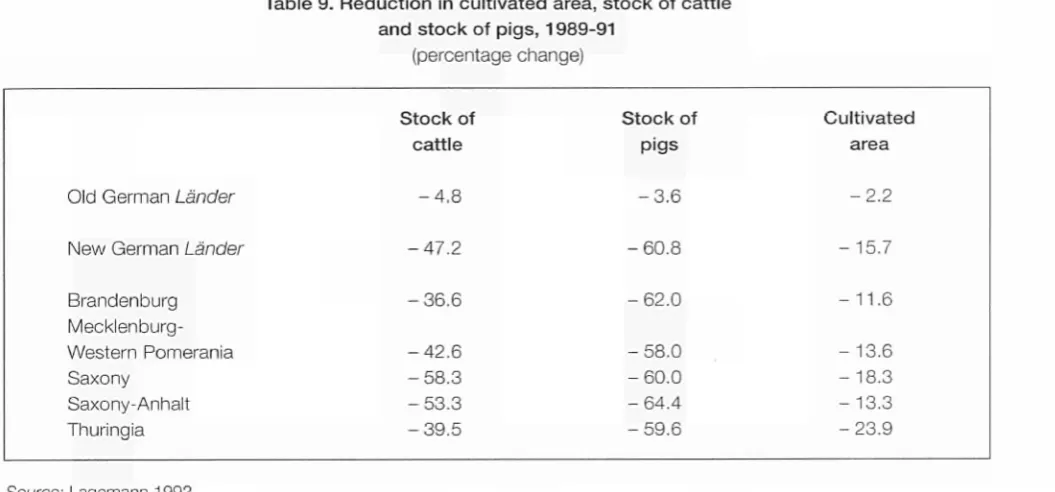
Similar to other sectors, agriculture in the new Länder is undergoing a painful restructuring process. Production has continuously shrunk both in terms of cultivated land and livestock numbers since 1989. It is true, though, that productivity increases of 24% in 1989 to 1991 -mostly through abandonment of marginal land - have led to increases in yields (see Table 9 and Annex I, Table 12).
Whether this process will lead to a regionally-differenti-ated economic development is difficult to assess at this stage. The situation in Mecklenburg-Western Pomerania and Brandenburg apart from the areas around Berlin is highly unfavourable, and especially for regions where natural conditions are poor and employment alternatives scarce.
A survey conducted in the structurally weak rural areas of Neubrandenburg suggests that - according to opti-mistic estimates - merely 16.3% of the persons employed in agricultural producer cooperatives in 1989
Figure 5. Example for the profile of activities: agricultural employees in the former GDR, 1989
(as % of total)
Agricultural production 53.74
Others 6.03
Agrochemichal centres 3.07 Sociocultural sector 40.06 Storage, processing 2.33 Building/repair 14.45
Administration/management/secretarial 15.44
Source: Empirica sectoral adjustment model (SAM), empirica 1991b.
Map 3. Monostructure and dominant sectors of industry
Monostructural problems
S h a r e of economic sector with highest number of persons employed on total number of persons
employed in 1 9 8 9 in percent
I |
α
u
Π
D
I
21
23
26
30
36
less t h o r
to less than
to less thon
to less than
to less thon
and m o r e 21
23
26
30
3 6
+■
3 8 2 9 4 8 34- 3 8 2 9
F r e q u e n c i e s
Minimum: 16.8 Maximum: 6 2 . 0 Mean value: 2 7 . 5
" Enclosed city counties are aggregated in s u r r o u n d i n g counties.
" Data on Berlin only East Berlin.
B o y e r n
S c h l e s w i g
Holstein
Hesse
Niedersachsen
Dominant sectors of activity
Dominant sectors of activity in the county 1 9 8 9
D
Π
B a y e r n
Nonproductive sectors
Agriculture and forestry, fishery
Water, energy, fuelsectors Chemical industry
Production of metals Mechanical and electrical, engineering, motor véhicules
Light industry
Textile industry
S h a r e o f d o m i n i n a n t s e c t o r
of a c t i v i t y i n p e r c e n t
i | ¡ess than 25 I ,' j 25 to less thon 30
I : : : JO and more
* E n c l o s e d city c o u n t i e s are a g g r e g a t e d in s u r r o u n d i n g c o u n t i e s .
* Data on Berlin only
East Berlin.
Source: Spatial M o n i t o r i n g S y s t e m of the BfLR b o u n d a r i e s county.
100 k m
Table 9. Reduction in cultivated area, stock of cattle and stock of pigs, 1989-91
(percentage change)
Old German Länder
New German Länder
Brandenburg Mecklenburg-Western Pomerania Saxony
Saxony-Anhalt Thuringia
Stock of cattle
- 4 . 8
- 4 7 . 2
- 3 6 . 6
- 4 2 . 6 - 5 8 . 3 - 5 3 . 3 - 3 9 . 5
Stock of pigs
- 3 . 6
- 6 0 . 8
- 6 2 . 0
- 5 8 . 0 - 6 0 . 0 - 6 4 . 4 - 5 9 . 6
Cultivated area
- 2 . 2
- 1 5 . 7
- 1 1 . 6
- 1 3 . 6 - 1 8 . 3 - 1 3 . 3 - 2 3 . 9
Source: Lagemann 1992.
will retain their jobs by the end of 1993.' It will be difficult for these large numbers of dismissed workers to find alternative employment as jobs continue to be abolished in other economic sectors too.
Good chances of development are predicted for arable farming, in particular for the intensive production of cash crops, especially in the black soil and loess areas in the regions of Magdeburg, Halle, northern and central Thur-ingia, Leipzig up to the upper Lausitz and parts of Bran-denburg (Fläming). In some parts of Mecklenburg-West-ern Pomerania there are opportunities for cash crops as well as for food processing. Agricultural areas in Bran-denburg offer prospects for agricultural production close to consumers (Berlin), for extensive fodder pro-duction and for the cultivation of special crops. Few spatial differentiation trends are found at present in live-stock farming.2
The rural areas in particular lack a network of centres of higher-order centrality which could act as a focus attracting economic activity and production-related and sociocultural ¡nfrastructural facilities, benefiting the whole area. This is clearly evident in the regions of Schwerin, Neubrandenburg, Altmark as well as in the north and south of Brandenburg. Rural areas are inade-quately supplied with such ¡nfrastructural facilities/ ser-vices, which constitutes an obstacle to the economic development of the rural regions.
Bielenski et al. 1992. See Lagemann 1992.
Up to now the productivity reserves of the rural areas have not been tapped. Activities outside agricultural pro-duction (e.g. ecology, nature conservation, preservation of rural communities, soft tourism) have been inadequately utilized.
Further decline in extractive and producer goods industries
From the beginning of 1991 to early 1992, extractive and producer goods industries suffered a decline in their turnover and in the number of orders, but they are expecting a slight increase in output and orders in the course of the year 1992.
The most favourable development is registered in extrac-tive industries (rock, stone and related minerals with the exception of calcareous limestone and brickwork) which is largely attributable to company structure (a large num-ber of smaller production units), strong links to local mar-kets, and the big demand (by the building sector). Regions and locations in Saxony-Anhalt and Branden-burg and some regions in Saxony and Thuringia have profited especially from the favourable trend. By contrast, large parts of the chemical industry, particularly basic chemicals, are up against serious economic problems. Saxony-Anhalt, in particular the region of Halle-Bitterfeld, is strongly affected (see Map 4). The situation in the iron and steel industry as well as in the production of non-fer-rous metals is similarly unstable as regards orders, out-put and turnover. Brandenburg and locations in Saxony,
Saxony-Anhalt and Thuringia are the most strongly affected. Lignite mining, by contrast, is at present in a rel-atively stable state, but it is necessary to prepare effec-tively for the necessary structural changes, especially in the regions of Halle-Leipzig and Cottbus.
Slight improvement in capital and consumer goods industry
The capital goods industry recorded a slight improve-ment in turnover and orders compared to early 1991, yet another decrease in output. However, the picture varies greatly among companies. Relatively favourable developments have been observed In several sensitive sectors such as steel and light-metal construction, some branches of iron, sheet-metal and metal goods production and the automobile industry, mainly benefit-ing locations in Saxony and Thurbenefit-ingia, and some loca-tions in Saxony-Anhalt and in Brandenburg. The electri-cal industry, by contrast, is in a state of high instability, which affects particularly the region of Berlin-Frankfurt-on-Oder as well as locations in Thuringia and Saxony.
The consumer goods industry has registered growth in output as well as in turnover and orders compared with the beginning of 1991. This development is largely accounted for by the printing industry and paper produc-tion, and, to a lesser extent, by the plastics and leather goods industry. Also rubber and wood processing are doing fairly well, to the benefit of locations in all Länder.
However, most recent surveys warn against too much optimism. The prospects especially in the textile and cloth-ing industry and in glass production are highly uncertain, which will have a destabilizing impact on the Erzgebirge region and other regions of Saxony and, to some extent, on Brandenburg and Thuringia. There are indications that wood processing, too, may be facing harder times.
The relatively strongest economic recovery in the manu-facturing sector has taken place in the food, beverage and tobacco industry, especially in beverage production and meat processing. It was triggered mainly by the increasing demand for locally produced foodstuffs which has been recovering since its slump after unifica-tion. The dairy industry and confectionery production, on the other hand, show no uniform trend so far. Their development prospects vary from location to location across all Länder and regions.
Dynamic development in the building sector
It should be recalled, however, that east German firms have not participated in this development all along. A growing problem is that domestic construction workers have to compete more and more with cheaper foreign workers, so-called contract workers from neighbouring countries (such as Poland). It may be assumed that some of the losses of building jobs in Saxony-Anhalt (-9.9%) and east Berlin (- 18.7%) between November 1989 and July 1991 are attributable to this competition.
Service sector: boom of private services but large surplus manpower in the public sector
The service sector has scored the best results on the way towards restructuring and adjustment to market conditions. In 1991 it accounted for two fifths of the gross value-added in the new Länder.1 Growth has been
particularly dynamic in retail trade, banking and insurance as well as in private service firms and in the liberal professions.2
The latter especially have seen a steep increase in the number of both self-employed and employees (e.g. physicians, lawyers). While their number had been esti-mated at 6 000 to 7 000 in October 1990, it is assumed to have doubled by the end of 1990 and even risen 10-fold by mid-1992. In its catching-up process, the ser-vice sector, which had been underdeveloped in the for-mer GDR, has thus been able to absorb some of the workers who have been laid off by other sectors. How-ever, its absorptive capacity is not sufficient, in terms of structure, volume or prospects, to cope with redundan-cies in agriculture and industry.
Moreover, workers have become or are becoming redundant in the public sector or in the wake of closures of State enterprises in which services were incorpor-ated. There are only estimates available on the original number of employees in the public sector (due to defini-tion problems, fragmentary data). Yet it is assumed that by mid-1992 about 640 000 employees had been dismissed from the public sector.
Even though there is a considerable shortage of person-nel, in particular with regard to civil servants experienced in some administrative core functions, 1.1 million per-sonnel in the civil service in the new Länder constitute a large surplus manpower compared to the western
Länder (see Table 10). It can be seen from the compari-Given the huge demand for construction work, the
building sector is experiencing a dynamic development. DIW 20/21/1992. DIW 12/13/1992.
Map 4. Degree o1
F~j-^
u-'
¡ft
economic specialization
e l \ y
>w / L Χ λ ! <Γ~7 ^ ι »Hamburgr
Ι * * χ / x«y^^^\r»Brennen Γ ^ >
^ í ! ^ /
) y ' — . \ 1—'j »Hannover
\ s A / A ρ
>
iii—.
Ι \ l ~ r V «Dortmund f _ ^ j r J .DüsseldorfJt-^ ν / \ \ ^ ^ j ~.v-*^
¿ ^ " ¿ ^ A L
cr
·<πτ
S ' V J5 <XSÍ7 "y çT S ) Kassel ^ ^ ,
Κ
Γ""
7"» Köln
\ì
φ
/ ^ χ
^
\ f f » B o n n ^ V>j S^~~^^J~i
VrsT
r V X í JK
( l ,S / »Frankfurt a.M. <§> \ _ ^ j — u / Mainz\ l^fe> f ^ v .
*"v > r VMannheim j Ί _ Λ \ Saarbrücken / ^ \ λ ^ ^ / r^ ^ ^ f c >
/ / ¿Stuttgartςχ'
/>¿GCr
/.rør
ƒ Freiburg i.Br.--k, /js^ ~ ~ | y
100 k m ^ ^ ^ V
Economic b r a n c h e s employing more than 2 0 % of w a g e a n d salary e a r n e r s in primary a n d s e c o n d a r y sectors in 1 9 8 9
[M| Agriculture and forestry
A Chemical industry, power supply, ^ ^ mining and metallurgical industries
A Mechanical engineering, motor vehicle ind ™ and m a n u f a c t u r e r s of electrical appliance
<§> Light manufacturing and textile industry
■ι Schwerin
;
Η
\
Η¿Magdeburg
Ï 1 A
W Erfurt>
•
Φ
ustry s
φ/
Φ
^•Nürnberg
\
·
Ì
«Rostock
11
¿ Ä
Η
ί *Β
- ν / ¿Potsdam
> A ~ y "
7 Leipzig I ^ .
Γ · \
">~/ "yCnemnitz
<^φ
φ \
Λ"1 »München
νΦ
Π
ï)
erlin L i
Frankfurt OJ
A * \
ζλ CottbusA
J f c Dresden /
r ι ι ι '4. u j
Land b o u n d a r y Regional policy area boundary
Í Source: Spatial Monitoring System of \ the Federal Research Institu
> te for Regional
t \ Geography and Regional V / Planning (BfLR)
Regional Policy Report 1 9 9 1
Table 10. Employees in the public sector, 30.6.1991
(employees per 10 000 inhabitants)
Old German Länder
New German Länder
Brandenburg Mecklenburg-Western Pomerania Saxony Saxony-Anhalt Thuringia Berlin (east) Länder 309 389 312 355 340 322 329 1 039 'Gemeinden' 221 407 498 491 361 403 346
-Source: DIW 52/1992.
son at Länder and local levels (personnel per 10 000 inhabitants) that still more dismissals especially at local level are imperative.'
Wholesale and retail trade
Restructuring in trade is still going on. Indications of this trend are:
(i) the growing penetration of the markets by more competitive marketing chains, the opening of large-scale trading centres often on the outskirts of conur-bations (e.g. Saale-Park between Halle and Leipzig);
(ii) the decline of small-scale trading businesses at tra-ditional urban locations (which is a consequence of the above trend but also of rising rents for premises);
(iii) the disappearance of no longer competitive small establishments in retail trade;
(iv) the large-scale discontinuance of small rural selling posts which are no longer profitable;
(v) the new establishment of highly specialized retail stores in the city centres.
The restructuring of trade in the new German Länder is still characterized by a good deal of random and
disor-DIW 52/1992.
derly growth which needs to be consolidated in line with demand. This is especially true of retail trade.
Also the wholesale trade has not yet become stabilized since western trading chains with their relatively rigid cooperation relationships and product spectrum are still expanding, which had led to the elimination of suppliers in the new Länder already in 1990.
Tourism
Great hopes had been placed in many areas on tourism as an economic factor stabilizing the economic situa-tion in the new Länder, but these have hardly material-ized. What happened was that more people travelled abroad, from which travel agencies may have profited, while tourism at home declined. The number of holiday-makers in the new Länder has almost generally decreased compared with the preceding years. Thurin-gia, which formerly had many private caterers and Mecklenburg-Western Pomerania have been affected negatively. The decline in the indigenous demand in the new Länder could not be offset by visitors from the western Länder.
The causes for the unsatisfactory situation of tourism in the new Länder are complex. They include inadequate advertising/public relations, distorted price-performance ratios, or the poor image of some regions and inade-quate local conditions (e.g. ¡nfrastructural and environ-mental shortcomings). Another underlying cause is that several enterprises, which are administered by the State Trust Agency, were not able to compete because of contentious ownership questions or pending privatiza-tion.
In general it is mostly price increases, sometimes with-out prior service and environmental improvements, that are to blame for lack of competitiveness of east German tourism as against other areas with similar profiles. The prospects are discussed in Chapter 6.
Summary of trends during 1989-91
During 1989 and 1991, the most recent years for which official employment data are available, the situation is characterized by considerable differences across
Länder and economic sectors. Manufacturing industry, for instance, suffered an average decrease of its work-force of about 21.5% in the new Länder as a whole from November 1989 to July 1991. In some Länder the decrease was well above the average. Brandenburg, for instance, has lost almost 32% of the jobs in the metal