differences and effects of menstrual cyclicity on speech
.
White Rose Research Online URL for this paper:
http://eprints.whiterose.ac.uk/1942/
Article:
Whiteside, S.P., Hanson, A. and Cowell, P.E. (2004) Hormones and temporal components
of speech: sex differences and effects of menstrual cyclicity on speech. Neuroscience
Letters, 367 (1). pp. 44-47. ISSN 0304-3940
https://doi.org/10.1016/j.neulet.2004.05.076
[email protected] https://eprints.whiterose.ac.uk/
Reuse
Unless indicated otherwise, fulltext items are protected by copyright with all rights reserved. The copyright exception in section 29 of the Copyright, Designs and Patents Act 1988 allows the making of a single copy solely for the purpose of non-commercial research or private study within the limits of fair dealing. The publisher or other rights-holder may allow further reproduction and re-use of this version - refer to the White Rose Research Online record for this item. Where records identify the publisher as the copyright holder, users can verify any specific terms of use on the publisher’s website.
Takedown
If you consider content in White Rose Research Online to be in breach of UK law, please notify us by
White Rose Research Online
http://eprints.whiterose.ac.uk/
This is an author produced version of a paper subsequently published in
Neuroscience Letters.
White Rose Research Online URL for this paper:
http://eprints.whiterose.ac.uk/1942/
Published paper
Whiteside, S.P., Hanson, A. and Cowell, P.E. (2004) Hormones and temporal
components of speech: sex differences and effects of menstrual cyclicity on
speech. Neuroscience Letters, 367 (1). pp. 44-47.
Hormones and temporal components of speech: sex differences and
effects of menstrual cyclicity on speech
Sandra P. Whiteside*, Anna Hanson, Patricia E. Cowell
*Department of Human Communication Sciences, University of Sheffield, Sheffield S10
2TA, United Kingdom. Tel: +44 (0)114 2222447, Fax: +44 (0)114 2730547.
Email:
[email protected]
. Corresponding Author.
Department of Human Communication Sciences, University of Sheffield, Sheffield S10 2TA,
United Kingdom
Correspondence: S P Whiteside
Abstract
Voice onset time (VOT) is a salient acoustic parameter of speech which signals the “voiced”
and “voiceless” status of plosives in English (e.g. the initial sound in ‘bat’ vs. the initial sound in
‘pat’). As a micro-temporal acoustic parameter, VOT may be sensitive to changes in hormones
which may affect the neuromuscular systems involved in speech production. This study adopted
a novel approach by investigating the effects of menstrual cycle phase and sex on VOT. VOT
data representing the 6 plosives of English (/p b t d k g/) were examined for 7 women (age
20-23 years) at two phases of the menstrual cycle (day 18-25: High Estrogen and Progesterone;
day 2-5: Low Estrogenand Progesterone). Results indicated that menstrual cycle phase had a
significant interaction with the identity of the plosive (F (5,30) = 5.869, P < .002). Menstrual
cycle phase also had significant effects on the contrasts between cognate voiced and voiceless
plosives (F (1, 6) = 11.444, P < .02); samples from the high hormone phase displayed an
enhanced voiced/voiceless contrast. Subsequently, VOT data samples from the two phases of
the menstrual cycle were compared with those from 5 men in order to explore sex differences at
different phases of the menstrual cycle. Low hormone phase samples displayed no significant
sex differences for either VOT values (F (1,10) = 2.085, P > .05), or the contrast between voiced
and voiceless cognates (F (1,10) = .407, P > .05). In contrast, the high hormone phase VOT
samples displayed significant plosive by sex interactions (F (5,50) = 4.442, P < .005). In
addition, significant sex differences were found for the contrasts between cognate voiced and
voiceless plosives (F (1,10) = 5.019, P < .05); the women displayed a more marked
voiced/voiceless contrast. The findings suggest that ovarian hormones play some role in
shaping some temporal components of speech.
Keywords: menstrual cycle, voice onset time, sex differences, speech, young adults,
Research has shown that many sex differences in language that were once explained by
testosterone-mediated effects alone are now believed to be the result of active differentiation in
both sexes, i.e., masculinisation in males and feminisation in females [4]. Ovarian estrogen is
known to affect the organisation of many neurobehavioural systems in both humans and
non-human species [1,3,13]. Fluctuations of ovarian estrogen are known to affect a number of
activational parameters at the neuroanatomical, neurofunctional and behavioural levels
[7,15,18]. In humans, performance on various tests of cognition and behaviour has been shown
to alter systematically as a function of hormonal changes across the menstrual cycle. These
include reports of motor and perceptual skills [8,19] and functional laterality in perception [17].
Overall, the literature indicates that certain abilities are positively affected, and others negatively
affected, at particular phases of the menstrual cycle that correspond to high levels of circulating
ovarian estrogen [14] and in some cases, also to progesterone [9]. However, much remains
unclear about the organisation and co-ordination of speech production systems as a function of
activation by ovarian hormones across the menstrual cycle.
The emergence of speaker sex differences during puberty in the frequency characteristics
of speech and the voiceis well established [11], and is largely explained by sexual dimorphism
of the larynx [10] and supralaryngeal vocal tract [5] due to the rises in hormone levels during
puberty. Although there have been some attempts to investigate sex differences in the temporal
domain of speech in adults, these findings are less well established [6,16], and little or no
attention has been paid to the influence of hormones on the temporal components of speech.
Furthermore, while there is some evidence for the developmental emergence of sex differences
in the temporal speech domain, this area remains to be fully explored in light of the rises in
hormone levels during puberty for both males and females [22]. One temporal component of
speech is voice onset time (VOT), a parameter which plays a crucial role in the perception and
production of voiced and voiceless stop consonants (e.g. bat vs. pat, cap vs gap) [12,20].
We report on a study which examined the VOT patterns of six stop consonants of English
in 7 women aged 20-23 yearsat two phases of the menstrual cycle (day 18-25: High Hormones
women (mean age 21;8) and five men (mean age 22;3) participated in the study. All participants
were native speakers of English with no known speech, language or hearing problems. All
women participants fulfilled the following criteria: i) they were not taking oral contraceptives,
either at the time of the study, or for at least one year prior to the study; ii) they had not been
pregnant or lactating in the year prior to the study; iii) they had regular menstrual cycles of
between 25-35 days (mean 30.71 days S.D 2.87); and iv) they were not taking any hormonally
based medication. All subjects completed the vocabulary and matrix subtest of the Wechsler
Abbreviated Scale of Intelligence [21] to control for individual variations in IQ; the men had an
average IQ of 117.8, and the women an average IQ of 117.7.
Speech samples were collected from the women on two separate occasions to encompass
naturally fluctuating levels of hormones during the menstrual cycle; once between days 2-5
(mean day 4.6, SD 0.53) when estrogen and progesterone levels were low (menstrual - low
EP-phase), and once between days 18-25 (mean day 21.14, SD 2.73) when estrogen and
progesterone levels were high (midluteal - high EP-phase). Day one of the cycle is defined by
the onset of menstruation. Date of testing for the midluteal phase was confirmed by checking
the date of onset for the next menstrual period. All participants were tested within sixteen days
counting backward from the onset of the next cycle (mean 10 days, SD 5.42). Three participants
were tested first during the low-EP phase, whilst the other four had their first test session during
the high-EP phase to counterbalance any possible learning effects. Young men display diurnal
variations in testosterone, with the highest and lowest levels occurring in the morning and late
afternoon, respectively [2]. Speech samples were therefore collected from the men during a
single session between 2.30pm and 5pm to control for diurnal variations in male testosterone
levels.
In English, the plosives /p t k/ are classed as "voiceless", and /b d g/, their respective
"voiced" cognates. Speech samples representing all six plosives were therefore collected as
follows. Each subject produced five repetitions of all plosive consonants (/p b t d k g/) in a
syllable initial position in a target word within the frame "Say ______ again". The target words
dart, card, and guard. This gave a possible total of 90 speech samples (5 repetitions x 18 target
words) for each subject, and an overall total of 1710 samples for all 12 subjects (1260 samples
for the 7 women (630 for each phase of the menstrual cycle), and 450 for the 5 men). The
phrases and target plosives were elicited using a verbal repetition task.
The speech data were recorded in a quiet room. Data were recorded directly onto a DAT
(Digital Audio Tape) recorder (Sony, model TCD-D3). Subsequently, speech samples from each
subject were digitized onto a Kay Elemetrics Computerized Lab (CSL) model 4300 using a
sampling rate of 16 kHz. From this digital information, sound pressure waveforms and wideband
(146 Hz) FFT spectrograms were generated and displayed. VOT measurements were made
directly from the spectrograms by measuring the distance between the release of the plosive
and the onset of voicing (marked by the first visible sign of low frequency periodic acoustic
activity in the spectrograms). The point of closure release was taken as the transient burst of the
plosive's release. In the cases where measures of VOT needed validation, sound pressure
waveforms were used. In the cases where both the speech waveform and the spectrogram were
referred to for validation, the VOT measurement was taken from the same data source. In the
cases where VOT was unclear (e.g. plosives being released with affrication or the presence of
background noise), the speech sample was discarded. All VOT measurements were taken in
milliseconds. To ensure consistency in the VOT measurements, a test of inter-rater reliability
was carried out. The inter-reliability measures were conducted by randomly selecting one
subject for reanalysis by a second rater. A Pearson’s product-moment correlation was used to
calculate the level of inter-rater reliability. A significant correlation coefficient (r = 0.99, P <
0.0001) demonstrated that there was a high level of inter-rater reliability.
In addition, the effects of estrogen and sex on the contrast between the "voiced" and
"voiceless" plosives was examined for each place of articulation (bilabial, alveolar, velar). This
was done by calculating the mean differences between the VOT values of the "voiceless"
bilabial plosive /p/ and its "voiced" cognate /b/, the "voiceless" alveolar plosive /t/ and its
voiced-voiceless contrast was calculated by subtracting the "voiced" VOT values from the
"voiceless" VOT values for all three places of articulation.
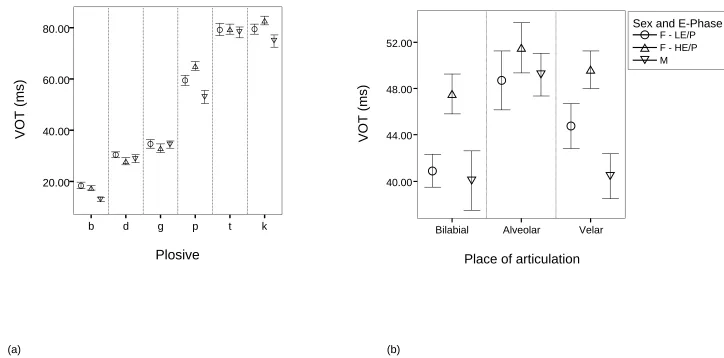
Mean VOT values for low and high estrogen menstrual phase data samples are illustrated
in Fig. 1 (a) by plosive, and mean values for the voiced-voiceless contrast for low-EP and
high-EP menstrual phase samples are displayed in Fig. 1 (b) by place of articulation. Effects of
menstrual cycle phase on VOT by plosive and the voiced-voiceless contrast by place of
articulation were tested using 2 two-factor ANOVA where phase (low-EP and high-EP) and
plosive (b, d, g, p, t, k) were repeated measures. There were significant plosive effects (F (5, 30)
= 360.216, P < .0001), and the order of magnitude for VOT values by plosive was as follows: b <
d < g <p <t < k. Multiple comparisons with Bonferroni adjustment revealed significant
differences (P < .05) for all between plosive comparisons except for t and k. These results are
totally in line with previously published data, and represent the VOT patterns of voiced and
voiceless plosives of English for all three places of articulation [12,16,22]. Results also indicated
that there were no significant menstrual cycle phase effects on VOT overall (F (1, 6) = .314, P >
.05). There was, however, a significant interaction between menstrual cycle phase and plosive
(F (5, 30) = 5.869, P < .002), whereby the voiced plosives (b, d, g) displayed shorter VOT values
for the EP phase, and the voiceless plosives p and k displayed longer values for the
high-EP phase (see Fig. 1(a)). The voiced-voiceless contrast displayed no significant effects for
either place of articulation (F (2,12) = 3.208, P > .05) or place of articulation by menstrual cycle
phase interaction effects (F (2,12) = 3.433, P > .05). There were however, significant menstrual
cycle phase effects for the voiced-voiceless contrast (F (1, 6) = 11.444, P < .02); high-EP phase
samples displayed an increased voiced-voiceless contrast across all places of articulation, and
post-hoc paired t-tests with Bonferroni adjustment (significant at P =.017) revealed that this was
significant for the bilabial place of articulation (t6 = 6.131, P = .001) (see Fig 1(b)).
Subsequently, VOT data samples representing the two phases of the menstrual cycle
were compared with those from the 5 men in order to explore the nature and extent of sex
differences at different phases of the menstrual cycle. Four mixed design ANOVAs with plosive
to test for sex differences for the low-EP, and high-EP phase VOT samples, and the
voiced-voiceless contrast data. For the low-EP phase, the following results were found. There were
significant plosive effects (F (5, 50) = 419.638, P < .0001), and the order of magnitude for VOT
values by plosive was as follows: b < d < g <p < k < t. Multiple comparisons with Bonferroni
adjustment revealed significant differences (P < .05) for all between plosive comparisons except
for t and k. In addition, the low estrogen phase samples displayed no significant sex differences
(F (1,10) = 2.085, P > .05),or significant plosive by sex interactions (F (5,50) = 1.051, P > .05)
for the low estrogen phase VOT samples. The contrast between voiced and voiceless cognates
for low-EP phase samples displayed significant place of articulation effects (F (2, 20)=7.903, P <
.005), but no significant sex differences (F (1,10) = .407, P > .05), or significant place of
articulation by sex interactions (F (2, 20) = .705, P > .05). The following results were found for
the high-EP phase VOT samples. Firstly, as for the low-EP phase samples, there were
significant plosive effects (F (5, 50) = 452.221, P < .0001), and the order of magnitude for VOT
values by plosive was as follows: b < d < g <p < k < t. Multiple comparisons with Bonferroni
adjustment revealed significant differences (P < .05) for all between plosive comparisons except
for t and k. Secondly, although the women displayed significantly longer VOT values than the
men, these trends did not reach significance (F (1,10) = 2.871, P > .05). There were, however,
significant sex by plosive interactions (F (5, 50) = 4.442, P < .005) which were characterized by
the women having longer VOT values for the plosives p, b, and k (see Fig. 1(a)). The contrast
between voiced and voiceless cognates displayed significant place of articulation effects (F (2,
20) = 5.081, P < .02), and significant sex differences (F (1,10) = 5.019, P < .05); the women
displayed greater voiced/voiceless contrasts for all three places of articulation, and post-hoc
independent t-tests with Bonferroni adjustment for multiple comparisons reached significance for
the velar place of articulation (t10 = 2.843, P = .017 - see Fig 1(b)). Place of articulation by sex
interactions were not significant (F (2,20) = 1.4, P > .05).
The results suggest that hormonal cyclicityhas a significant effect on at least one temporal
component of speech; voice onset time. High-EP phase VOT samples appear to display shorter
net effect of this is that the High-EP phase samples display an increased distinction between the
voiced and voiceless cognates (p/b, t/d, k/g); a pattern which will result in enhancing the
intelligibility and clarity of phonetic structures in speech output. In addition, sex differences in
VOT values appear to be enhanced during the high-EP phase, thus paralleling some of the
effects of menstrual cycle phase on VOT of voiceless plosives. However, whether the menstrual
cycle effects reported here are due to cyclical changes in the peripheral tissue systems involved
in speech production, or effects on the central nervous system, or indeed both sets of factors,
requires further investigation. Menstrual cycle phase is a factor that has not been considered in
the study of VOT patterns in adults, which may explain why reports of sex differences in the
VOT patterns of adults have been inconsistent; studies have reported both a presence and
absence of significant sex differences [see 22 for a summary of these trends]. However, the
results of this study are consistent with the notion that the rise of hormones around puberty may,
in part, be responsible for the developmental emergence of sex differences that have been
observed in the VOT patterns of children aged between 10 and 11 years (mean age 10;7 years)
[22], and may therefore explain the presence of significant sex differences in the VOT patterns
of adults [e.g. 16, and as summarized in 22].
In summary, the results suggest that hormones play some role in shaping the VOT
patterns of speech. Both menstrual cycle phase and sex appear to affect this temporal
component of speech; high and low estrogen samples display similar patterns to sex differences
observed for high-EP phase samples, therefore suggesting that estrogen may have the effect of
enhancing sex differences in speech. In addition, samples from the high-EP phase appear to
display greater voiced-voiceless contrasts which will contribute to enhanced speech intelligibility.
However, a factor that should not be overlooked is that the data were contrasted between the
menstrual and midluteal phases when both estrogen and progesterone were at low and high
levels, respectively. Therefore, further investigation is required to determine the precise role of
these ovarian hormones on VOT and other speech parameters, and their effect on sex
Acknowledgements
Our thanks go to the participants who made this study possible. We also wish to thank the
following people who assisted with subject recruitment, data collection, database management
and inter-rater reliability analysis: Elinor Hughes, Jatender Mohal, Helen Robson, and Michelle
Sims.
References
[1]
Bimonte, H.A. and Denenberg, V.H., Estradiol facilitates performance as working memory load increases, Psychoneuroendocrinology, 24 (1999)161-173.[2]
Diver, M.J., Imtiaz, K.E., Ahmad, A.M., Vora, J.P. and Fraser, W.D., Diurnal rhythms of serum total, free and bioavailable testosterone and of SHBG in middle-aged mencompared to those in young men, Clinical Endocrinology, 58 (2003) 710-717.
[3]
Fitch, R.H., Cowell, P.E. and Denenberg, V.H., The female phenotype: Nature's default, Dev. Neuropsych., 14 (1998) 213-231.[4]
Fitch, R.H. and Denenberg, V.H., A role for ovarian hormones in sexual differentiation of the brain, Behav. Brain Sci., 21 (1998) 311-352.[5]
Fitch, W.T. and Giedd, J., Morphology and development of the human vocal tract: A study using magnetic resonance imaging. J. Acoust. Soc. Am., 106 (1999) 1511- 1522.[6]
Fitzsimons, M., Sheahan, N. and Staunton, H., Gender and integration of acoustic dimensions of prosody: implications for clinical studies, Brain Lang.. 78 (2001) 94-108.[7]
Gould, E., Woolley, C.S., Frankfurt, M. and McEwen, B.S., Gonadal steroids regulate dendritic spine density in hippocampal pyramidal cells in adulthood, J. Neuroscience, 10(1990) 1286-1291.
[9]
Hausmann, M., Becker, C., Gather, U. and Gunturkun, O., Functional cerebral asymmetries during the menstrual cycle: a cross-sectional and longitudinal analysis,Neuropsychologia, 40 (2002) 808-816.
[10]
Kahane, J. C., Growth of the human prepubertal and pubertal larynx, J Speech Hear Res., 25 (1982) 446-455.[11]
Lee, S., Potamianos, A. and Narayanan, S., Acoustics of children's speech:Developmental changes of temporal and spectral parameters., J. Acoust. Soc. Am., 105
(1999) 1455-1468.
[12]
Lisker, L. and Abramson, A.S., A cross-language study of voicing in initial stops: acoustical measurements, Word, 20 (1964) 384 - 422.[13]
Mack, C. M., Fitch, R. H., Cowell, P. E., Schrott, L. M. and Denenberg, V. H., Ovarian estrogen acts to feminize the female rat's corpus callosum, Dev. Brain Res., 71 (1993)115-119.
[14]
Maki, P.M., Rich, J.B. and Rosenbaum, R.S., Implicit memory varies across the menstrual cycle: estrogen effects in young women, Neuropsychologia, 40 (2002)518-529.
[15]
Rudnick, C.N. and Woolley, C.S., Estrogen regulates functional inhibition of hippocampal CA1 pyramidal cells in the adult female rat, J. Neurosci., 21 (2001) 6532-6543.[16]
Ryalls, J., Zipprer, A. and Baldauff, P., A preliminary investigation of the effects of gender and race on voice onset time, J. Speech Lang. Hear. Res., 40 (1997) 642 - 645.[17]
Sanders, G. and Wenmoth, D., Verbal and music dichotic listening tasks revealvariations in function cerebral asymmetry across the menstrual cycle that are phase and
task dependent, Neuropsychologia, 36 (1998) 869-874.
[19]
Saucier, D. M. and Kimura, D., Intrapersonal motor but not extrapersonal targeting skill is enhanced during the midluteal phase of the menstrual cycle, Dev. Neuropsych., 14(1998) 385-398.
[20]
Simos, P.G., Diehl, R.L., Breier, J.I., Molis, M.R., Zouridakis, G. and Papanicolaou, A.C., MEG correlates of categorical perception of a voice onset time continuum in humans,Cog. Brain Res., 7 (1998) 215-219.
[21]
Wechsler, D., Wechsler Abbreviated Scale of Intelligence. The Psychological Corporation, San Antonio, 1999.b d g p t k
Plosive
20.00 40.00 60.00 80.00V
O
T
(
m
s)
A B C A B CA B C
AB C
A B
C
A B C A
F - LE/P
B F - HE/P
C M
Sex and E-Phase
Bilabial Alveolar Velar
Place of articulation
40.00 44.00 48.00 52.00
V
OT
(
m
s
)
A B C A B C A B C [image:14.842.52.776.99.457.2](a) (b)
Fig. 1. Mean values for: (a) VOT (in ms) by plosive (b d g p t k) for sex and low (LE/P) and high (HE/P) estrogen/progesterone data samples, (b)
voiced/voiceless contrasts (in ms) by place of articulation for sex and low (LE/P) and high (HE/P) estrogen/progesterone data samples. Error bars