Editor-in-chief Prof. Janusz Kacprzyk Systems Research Institute Polish Academy of Sciences ul. Newelska 6
01-447 Warsaw Poland
E-mail:[email protected] Further volumes of this series can be found on our homepage: springer.com
Vol. 97. Gloria Phillips-Wren, Nikhil Ichalkaranje and Lakhmi C. Jain (Eds.)
Intelligent Decision Making: An AI-Based Approach, 2008 ISBN 978-3-540-76829-9
Vol. 98. Ashish Ghosh, Satchidananda Dehuri and Susmita Ghosh (Eds.)
Multi-Objective Evolutionary Algorithms for Knowledge Discovery from Databases, 2008
ISBN 978-3-540-77466-2
Vol. 99. George Meghabghab and Abraham Kandel Search Engines, Link Analysis, and User’s Web Behavior, 2008
ISBN 978-3-540-77468-6
Vol. 100. Anthony Brabazon and Michael O’Neill (Eds.) Natural Computing in Computational Finance, 2008 ISBN 978-3-540-77476-1
Vol. 101. Michael Granitzer, Mathias Lux and Marc Spaniol (Eds.)
Multimedia Semantics - The Role of Metadata, 2008 ISBN 978-3-540-77472-3
Vol. 102. Carlos Cotta, Simeon Reich, Robert Schaefer and Antoni Ligeza (Eds.)
Knowledge-Driven Computing, 2008 ISBN 978-3-540-77474-7 Vol. 103. Devendra K. Chaturvedi
Soft Computing Techniques and its Applications in Electrical Engineering, 2008
ISBN 978-3-540-77480-8
Vol. 104. Maria Virvou and Lakhmi C. Jain (Eds.) Intelligent Interactive Systems in Knowledge-Based Environment, 2008
ISBN 978-3-540-77470-9 Vol. 105. Wolfgang Guenthner
Enhancing Cognitive Assistance Systems with Inertial Measurement Units, 2008
ISBN 978-3-540-76996-5
Vol. 106. Jacqueline Jarvis, Dennis Jarvis, Ralph R¨onnquist and Lakhmi C. Jain (Eds.)
Holonic Execution: A BDI Approach, 2008 ISBN 978-3-540-77478-5
Vol. 107. Margarita Sordo, Sachin Vaidya and Lakhmi C. Jain (Eds.)
Advanced Computational Intelligence Paradigms in Healthcare - 3, 2008
ISBN 978-3-540-77661-1
Vol. 108. Vito Trianni
Evolutionary Swarm Robotics, 2008 ISBN 978-3-540-77611-6
Vol. 109. Panagiotis Chountas, Ilias Petrounias and Janusz Kacprzyk (Eds.)
Intelligent Techniques and Tools for Novel System Architectures, 2008
ISBN 978-3-540-77621-5
Vol. 110. Makoto Yokoo, Takayuki Ito, Minjie Zhang, Juhnyoung Lee and Tokuro Matsuo (Eds.) Electronic Commerce, 2008
ISBN 978-3-540-77808-0 Vol. 111. David Elmakias (Ed.)
New Computational Methods in Power System Reliability, 2008
ISBN 978-3-540-77810-3
Vol. 112. Edgar N. Sanchez, Alma Y. Alan´ıs and Alexander G. Loukianov
Discrete-Time High Order Neural Control: Trained with Kalman Filtering, 2008
ISBN 978-3-540-78288-9
Vol. 113. Gemma Bel-Enguix, M. Dolores Jim´enez-L´opez and Carlos Mart´ın-Vide (Eds.)
New Developments in Formal Languages and Applications, 2008
ISBN 978-3-540-78290-2
Vol. 114. Christian Blum, Maria Jos´e Blesa Aguilera, Andrea Roli and Michael Sampels (Eds.)
Hybrid Metaheuristics, 2008 ISBN 978-3-540-78294-0
Vol. 115. John Fulcher and Lakhmi C. Jain (Eds.) Computational Intelligence: A Compendium, 2008 ISBN 978-3-540-78292-6
Vol. 116. Ying Liu, Aixin Sun, Han Tong Loh, Wen Feng Lu and Ee-Peng Lim (Eds.)
Advances of Computational Intelligence in Industrial Systems, 2008
ISBN 978-3-540-78296-4
Vol. 117. Da Ruan, Frank Hardeman and Klaas van der Meer (Eds.)
Intelligent Decision and Policy Making Support Systems, 2008
ISBN 978-3-540-78306-0
Vol. 118. Tsau Young Lin, Ying Xie, Anita Wasilewska and Churn-Jung Liau (Eds.)
Ying Xie
Anita Wasilewska
Churn-Jung Liau
(Eds.)
Data Mining:
Foundations and Practice
Department of Computer Science San Jose State University San Jose, CA 95192 USA
Dr. Ying Xie
Department of Computer Science and Information Systems Kennesaw State University Building 11, Room 3060 1000 Chastain Road Kennesaw, GA 30144 USA
Department of Computer Science The University at Stony Brook Stony Brook, New York 11794-4400 USA
Dr. Churn-Jung Liau Institute of Information Science Academia Sinica
No 128, Academia Road, Section 2 Nankang, Taipei 11529
Taiwan
ISBN 978-3-540-78487-6 e-ISBN 978-3-540-78488-3
Studies in Computational Intelligence ISSN 1860-949X
Library of Congress Control Number: 2008923848
c
2008 Springer-Verlag Berlin Heidelberg
This work is subject to copyright. All rights are reserved, whether the whole or part of the material is concerned, specifically the rights of translation, reprinting, reuse of illustrations, recitation, broad-casting, reproduction on microfilm or in any other way, and storage in data banks. Duplication of this publication or parts thereof is permitted only under the provisions of the German Copyright Law of September 9, 1965, in its current version, and permission for use must always be obtained from Springer-Verlag. Violations are liable to prosecution under the German Copyright Law.
The use of general descriptive names, registered names, trademarks, etc. in this publication does not imply, even in the absence of a specific statement, that such names are exempt from the relevant protective laws and regulations and therefore free for general use.
Cover design: Deblik, Berlin, Germany Printed on acid-free paper
The IEEE ICDM 2004 workshop on the Foundation of Data Mining and the IEEE ICDM 2005 workshop on the Foundation of Semantic Oriented Data and Web Mining focused on topics ranging from the foundations of data mining to new data mining paradigms. The workshops brought together both data mining researchers and practitioners to discuss these two topics while seeking solutions to long standing data mining problems and stimulat-ing new data minstimulat-ing research directions. We feel that the papers presented at these workshops may encourage the study of data mining as a scientific field and spark new communications and collaborations between researchers and practitioners.
To express the visions forged in the workshops to a wide range of data min-ing researchers and practitioners and foster active participation in the study of foundations of data mining, we edited this volume by involving extended and updated versions of selected papers presented at those workshops as well as some other relevant contributions. The content of this book includes stud-ies of foundations of data mining from theoretical, practical, algorithmical, and managerial perspectives. The following is a brief summary of the papers contained in this book.
A new subspace clustering algorithm for high dimensional binary val-ued dataset is proposed in the paper “An Algorithm for Mining Weighted Dense Maximal 1-Complete Regions” by Haiyun Bian and Raj Bhatnagar. To discover patterns in all subspace including sparse ones, a weighted den-sity measure is used by the algorithm to adjust denden-sity thresholds for clusters according to different density values of different subspaces. The proposed clus-tering algorithm is able to find all patterns satisfying a minimum weighted density threshold in all subspaces in a time and memory efficient way. Al-though presented in the context of the subspace clustering problem, the al-gorithm can be applied to other closed set mining problems such as frequent closed itemsets and maximal biclique.
In the paper “Mining Linguistic Trends from Time Series” by Chun-Hao Chen, Tzung-Pei Hong, and Vincent S. Tseng, a mining algorithm dedicated to extract human understandable linguistic trend from time series is proposed. This algorithm first transforms data series to an angular series based on an-gles of adjacent points in the time series. Then predefined linguistic concepts are used to fuzzify each angle value. Finally, the Aprori-like fuzzy mining algorithm is used to extract linguistic trends.
In the paper “Latent Semantic Space for Web Clustering” by I-Jen Chiang, T.Y. Lin, Hsiang-Chun Tsai, Jau-Min Wong, and Xiaohua Hu, latent semantic space in the form of some geometric structure in combinatorial topology and hypergraph view, has been proposed for unstructured document clustering. Their clustering work is based on a novel view that term associations of a given collection of documents form a simplicial complex, which can be decomposed into connected components at various levels. An agglomerative method for finding geometric maximal connected components for document clustering is proposed. Experimental results show that the proposed method can effectively solve polysemy and term dependency problems in the field of information retrieval.
The paper “A Logical Framework for Template Creation and Information Extraction” by David Corney, Emma Byrne, Bernard Buxton, and David Jones proposes a theoretical framework for information extraction, which al-lows different information extraction systems to be described, compared, and developed. This framework develops a formal characterization of templates, which are textual patterns used to identify information of interest, and pro-poses approaches based on AI search algorithms to create and optimize tem-plates in an automated way. Demonstration of a successful implementation of the proposed framework and its application on biological information extrac-tion are also presented as a proof of concepts.
complement operation. They also present a deep analysis on where the fuzzy system works and fails. Finally, the paper points out that the controversy on “complement” concept can be avoided by either following the additive prin-ciple or renaming the complement set as the conjugate set.
In the paper “Three Approaches to Missing Attribute Values: A Rough Set Perspective” by Jerzy W. Grzymala-Busse, three approaches to missing attribute values are studied using rough set methodology, including attribute-value blocks, characteristic sets, and characteristic relations. It is shown that the entire data mining process, from computing characteristic relations through rule induction, can be implemented based on attribute-value blocks. Furthermore, attribute-value blocks can be combined with different strategies to handle missing attribute values.
The paper “MLEM2 Rule Induction Algorithms: With and Without Merg-ing Intervals” by Jerzy W. Grzymala-Busse compares the performance of three versions of the learning from example module of a data mining system called LERS (learning from examples based on rough sets) for rule induction from numerical data. The experimental results show that the newly introduced ver-sion, MLEM2 with merging intervals, produces the smallest total number of conditions in rule sets.
To overcome several common pitfalls in a business intelligence project, the paper “Towards a Methodology for Data Mining Project Development: the Importance of Abstraction” by P. Gonz´alez-Aranda, E. Menasalves, S. Mill´an, Carlos Ruiz, and J. Segovia proposes a data mining lifecycle as the basis for proper data mining project management. Concentration is put on the project conception phase of the lifecycle for determining a feasible project plan.
The paper “Finding Active Membership Functions in Fuzzy Data Mining” by Tzung-Pei Hong, Chun-Hao Chen, Yu-Lung Wu, and Vincent S. Tseng proposes a novel GA-based fuzzy data mining algorithm to dynamically de-termine fuzzy membership functions for each item and extract linguistic as-sociation rules from quantitative transaction data. The fitness of each set of membership functions from an itemset is evaluated by both the fuzzy supports of the linguistic terms in the large 1-itemsets and the suitability of the derived membership functions, including overlap, coverage, and usage factors.
Improving the efficiency of mining frequent patterns from very large datasets is an important research topic in data mining. The way in which the dataset and intermediary results are represented and stored plays a cru-cial role in both time and space efficiency. The paper “A Compressed Vertical Binary Algorithm for Mining Frequent Patterns” by J. Hdez. Palancar, R. Hdez. Le´on, J. Medina Pagola, and A. Hechavarr´ia proposes a compressed vertical binary representation of the dataset and presents approach to mine frequent patterns based on this representation. Experimental results show that the compressed vertical binary approach outperforms Apriori, optimized Apriori, and Mafia on several typical test datasets.
effects is inherently inexact and imprecise. The chapter “Na¨ıve Rules Do Not Consider Underlying Causality” by Lawrence J. Mazlack argues that it is important to understand when association rules have causal foundations in order to avoid na¨ıve decisions and increases the perceived utility of rules with causal underpinnings. In his second chapter “Inexact Multiple-Grained Causal Complexes”, the author further suggests using nested granularity to describe causal complexes and applying rough sets and/or fuzzy sets to soften the need for preciseness. Various aspects of causality are discussed in these two chapters.
Seeing the needs for more fruitful exchanges between data mining practice and data mining research, the paper “Does Relevance Matter to Data Min-ing Research” by Mykola Pechenizkiy, Seppo Puuronen, and Alexcy Tsymbal addresses the balance issue between the rigor and relevance constituents of data mining research. The authors suggest the study of the foundation of data mining within a new proposed research framework that is similar to the ones applied in the IS discipline, which emphasizes the knowledge transfer from practice to research.
The ability to discover actionable knowledge is a significant topic in the field of data mining. The paper “E-Action Rules” by Li-Shiang Tsay and Zbigniew W. Ras proposes a new class of rules called “E-action rules” to enhance the traditional action rules by introducing its supporting class of objects in a more accurate way. Compared with traditional action rules or extended action rules, e-action rule is easier to interpret, understand, and apply by users. In their second paper “Mining e-Action Rules, System DEAR,” a new algorithm for generating e-action rules, called Action-tree algorithm is presented in detail. The action tree algorithm, which is implemented in the system DEAR2.2, is simpler and more efficient than the action-forest algorithm presented in the previous paper.
In his first paper “Definability of Association Rules and Tables of Critical Frequencies,” Jan Ranch presents a new intuitive criterion of definability of association rules based on tables of critical frequencies, which are introduced as a tool for avoiding complex computation related to the association rules corresponding to statistical hypotheses tests. In his second paper “Classes of Association Rules: An Overview,” the author provides an overview of im-portant classes of association rules and their properties, including logical as-pects of calculi of association rules, evaluation of association rules in data with missing information, and association rules corresponding to statistical hypotheses tests.
to extract rules by describing gene expression differences among significantly expressed genes in leukemia.
In the paper “Using Association Rules for Classification from Databases Having Class Label Ambiguities: A Belief Theoretic Method” by S.P. Sub-asinghua, J. Zhang, K. Premaratae, M.L. Shyu, M. Kubat, and K.K.R.G.K. Hewawasam, a classification algorithm that combines belief theoretic tech-nique and portioned association mining strategy is proposed, to address both the presence of class label ambiguities and unbalanced distribution of classes in the training data. Experimental results show that the proposed approach obtains better accuracy and efficiency when the above situations exist in the training data. The proposed classifier would be very useful in security moni-toring and threat classification environments where conflicting expert opinions about the threat category are common and only a few training data instances available for a heightened threat category.
Privacy preserving data mining has received ever-increasing attention dur-ing the recent years. The paper “On the Complexity of the Privacy Problem” explores the foundations of the privacy problem in databases. With the ulti-mate goal to obtain a complete characterization of the privacy problem, this paper develops a theory of the privacy problem based on recursive functions and computability theory.
In the paper “Ensembles of Least Squares Classifiers with Randomized Kernels,” the authors, Kari Torkkola and Eugene Tuv, demonstrate that sto-chastic ensembles of simple least square classifiers with randomized kernel widths and OOB-past-processing achieved at least the same accuracy as the best single RLSC or an ensemble of LSCs with fixed tuned kernel width, but require no parameter tuning. The proposed approach to create ensembles uti-lizes fast exploratory random forests for variable filtering as a preprocessing step; therefore, it can process various types of data even with missing values. Shusahu Tsumoto contributes two papers that study contigency table from the perspective of information granularity. In the first paper “On Pseudo-statistical Independence in a Contingency Table,” Shusuhu shows that a con-tingency table may be composed of statistical independent and dependent parts and its rank and the structure of linear dependence as Diophatine equa-tions play very important roles in determining the nature of the table. The second paper “Role of Sample Size and Determinants in Granularity of Con-tingency Matrix” examines the nature of the dependence of a conCon-tingency matrix and the statistical nature of the determinant. The author shows that as the sample size N of a contingency table increases, the number of 2×2 matrix with statistical dependence will increase with the order ofN3, and the
average of absolute value of the determinant will increase with the order ofN2.
query. Then the Hierarchical Agglomarative Clustering algorithm and subse-quent portioning and feature selection and reduction processes are applied to generate a natural representation of the hierarchy of concepts inherent in the system. Although the proposed mechanism is applied to an FAQ system as proof of concept, it can be easily extended to any IR system.
Classification Association Rule Mining (CARM) is the technique that uti-lizes association mining to derive classification rules. A typical problem with CARM is the overwhelming number of classification association rules that may be generated. The paper “Mining Efficiently Significant Classification Asso-ciate Rules” by Yanbo J. Wang, Qin Xin, and Frans Coenen addresses the issues of how to efficiently identify significant classification association rules for each predefined class. Both theoretical and experimental results show that the proposed rule mining approach, which is based on a novel rule scoring and ranking strategy, is able to identify significant classification association rules in a time efficient manner.
Data mining is widely accepted as a process of information generalization. Nevertheless, the questions like what in fact is a generalization and how one kind of generalization differs from another remain open. In the paper “Data Preprocessing and Data Mining as Generalization” by Anita Wasilewska and Ernestina Menasalvas, an abstract generalization framework in which data preprocessing and data mining proper stages are formalized as two specific types of generalization is proposed. By using this framework, the authors show that only three data mining operators are needed to express all data mining algorithms; and the generalization that occurs in the preprocessing stage is different from the generalization inherent to the data mining proper stage.
Unbounded, ever-evolving and high-dimensional data streams, which are generated by various sources such as scientific experiments, real-time produc-tion systems, e-transacproduc-tions, sensor networks, and online equipments, add fur-ther layers of complexity to the already challenging “drown in data, starving for knowledge” problem. To tackle this challenge, the paper “Capturing Con-cepts and Detecting Concept-Drift from Potential Unbounded, Ever-Evolving and High-Dimensional Data Streams” by Ying Xie, Ajay Ravichandran, Hisham Haddad, and Katukuri Jayasimha proposes a novel integrated archi-tecture that encapsulates a suit of interrelated data structures and algorithms which support (1) real-time capturing and compressing dynamics of stream data into space-efficient synopses and (2) online mining and visualizing both dynamics and historical snapshots of multiple types of patterns from stored synopses. The proposed work lays a foundation for building a data stream warehousing system as a comprehensive platform for discovering and retriev-ing knowledge from ever-evolvretriev-ing data streams.
in their paper. The layered framework focuses on the data mining questions and issues at different abstract levels with the aim of understanding data mining as a field of study, instead of a collection of theories, algorithms, and software tools.
The papers “How to Prevent Private Data from Being Disclosed to a Malicious Attacker” and “Privacy-Preserving Naive Bayesian Classification over Horizontally Partitioned Data” by Justin Zhan, LiWu Chang, and Stan Matwin, address the issue of privacy preserved collaborative data mining. In these two papers, secure collaborative protocols based on the semantically se-cure homomorphic encryption scheme are developed for both learning Support Vector Machines and Nave Bayesian Classifier on horizontally partitioned pri-vate data. Analyses of both correctness and complexity of these two protocols are also given in these papers.
We thank all the contributors for their excellent work. We are also grateful to all the referees for their efforts in reviewing the papers and providing valu-able comments and suggestions to the authors. It is our desire that this book will benefit both researchers and practitioners in the filed of data mining.
Compact Representations of Sequential Classification Rules
Elena Baralis, Silvia Chiusano, Riccardo Dutto, and Luigi Mantellini. . . 1
An Algorithm for Mining Weighted Dense Maximal 1-Complete Regions
Haiyun Bian and Raj Bhatnagar. . . . 31
Mining Linguistic Trends from Time Series
Chun-Hao Chen, Tzung-Pei Hong, and Vincent S. Tseng . . . . 49
Latent Semantic Space for Web Clustering
I-Jen Chiang, Tsau Young (‘T. Y.’) Lin, Hsiang-Chun Tsai,
Jau-Min Wong, and Xiaohua Hu. . . . 61
A Logical Framework for Template Creation and Information Extraction
David Corney, Emma Byrne, Bernard Buxton, and David Jones . . . . 79
A Bipolar Interpretation of Fuzzy Decision Trees
Tuan-Fang Fan, Churn-Jung Liau, and Duen-Ren Liu. . . .109
A Probability Theory Perspective on the Zadeh Fuzzy System
Qing Shi Gao, Xiao Yu Gao, and Lei Xu . . . .125
Three Approaches to Missing Attribute Values: A Rough Set Perspective
Jerzy W. Grzymala-Busse. . . .139
MLEM2 Rule Induction Algorithms: With and Without Merging Intervals
Towards a Methodology for Data Mining Project Development: The Importance of Abstraction
P. Gonz´alez-Aranda, E. Menasalvas, S. Mill´an, Carlos Ruiz,
and J. Segovia. . . .165
Fining Active Membership Functions in Fuzzy Data Mining
Tzung-Pei Hong, Chun-Hao Chen, Yu-Lung Wu,
and Vincent S. Tseng . . . .179
A Compressed Vertical Binary Algorithm for Mining Frequent Patterns
J. Hdez. Palancar, R. Hdez. Le´on, J. Medina Pagola,
and A. Hechavarr´ıa . . . .197
Na¨ıve Rules Do Not Consider Underlying Causality
Lawrence J. Mazlack . . . .213
Inexact Multiple-Grained Causal Complexes
Lawrence J. Mazlack . . . .231
Does Relevance Matter to Data Mining Research?
Mykola Pechenizkiy, Seppo Puuronen, and Alexey Tsymbal . . . .251
E-Action Rules
Li-Shiang Tsay and Zbigniew W. Ra´s. . . .277
Mining E-Action Rules, System DEAR
Zbigniew W. Ra´s and Li-Shiang Tsay. . . .289
Definability of Association Rules and Tables of Critical Frequencies
Jan Rauch . . . .299
Classes of Association Rules: An Overview
Jan Rauch . . . .315
Knowledge Extraction from Microarray Datasets
Using Combined Multiple Models to Predict Leukemia Types
Gregor Stiglic, Nawaz Khan, and Peter Kokol. . . .339
On the Complexity of the Privacy Problem in Databases
Bhavani Thuraisingham. . . .353
Ensembles of Least Squares Classifiers with Randomized Kernels
Kari Torkkola and Eugene Tuv . . . .375
On Pseudo-Statistical Independence in a Contingency Table
Role of Sample Size and Determinants in Granularity of Contingency Matrix
Shusaku Tsumoto . . . .405
Generating Concept Hierarchies from User Queries
Bob Wall, Neal Richter, and Rafal Angryk . . . .423
Mining Efficiently Significant Classification Association Rules
Yanbo J. Wang, Qin Xin, and Frans Coenen . . . .443
Data Preprocessing and Data Mining as Generalization
Anita Wasilewska and Ernestina Menasalvas . . . .469
Capturing Concepts and Detecting Concept-Drift from Potential Unbounded, Ever-Evolving and High-Dimensional Data Streams
Ying Xie, Ajay Ravichandran, Hisham Haddad,
and Katukuri Jayasimha. . . .485
A Conceptual Framework of Data Mining
Yiyu Yao, Ning Zhong, and Yan Zhao . . . .501
How to Prevent Private Data from being Disclosed to a Malicious Attacker
Justin Zhan, LiWu Chang, and Stan Matwin . . . .517
Privacy-Preserving Naive Bayesian Classification over Horizontally Partitioned Data
Justin Zhan, Stan Matwin, and LiWu Chang . . . .529
Using Association Rules for Classification from Databases Having Class Label Ambiguities: A Belief Theoretic Method
S.P. Subasingha, J. Zhang, K. Premaratne, M.-L. Shyu, M. Kubat,
Classification Rules
Elena Baralis, Silvia Chiusano, Riccardo Dutto, and Luigi Mantellini
Politecnico di Torino, Dipartimento di Automatica ed Informatica Corso Duca degli Abruzzi 24, 10129 Torino, Italy
[email protected], [email protected], [email protected], [email protected]
Summary. In this chapter we address the problem of mining sequential
classifica-tion rules. Unfortunately, while high support thresholds may yield an excessively small rule set, the solution set becomes rapidly huge for decreasing support thresh-olds. In this case, the extraction process becomes time consuming (or is unfeasible), and the generated model is too complex for human analysis.
We propose two compact forms to encode the knowledge available in a sequential classification rule set. These forms are based on the abstractions of general rule, specialistic rule, and complete compact rule. The compact forms are obtained by extending the concept of closed itemset and generator itemset to the context of sequential rules. Experimental results show that a significant compression ratio is achieved by means of both proposed forms.
1 Introduction
Association rules [3] describe the co-occurrence among data items in a large amount of collected data. They have been profitably exploited for classification purposes [8, 11, 19]. In this case, rules are called classification rules and their consequent contains the class label. Classification rule mining is the discovery of a rule set in the training dataset to form a model of data, also called classifier. The classifier is then used to classify new data for which the class label is unknown.
Data items in an association rule are unordered. However, in many ap-plication domains (e.g., web log mining, DNA and proteome analysis) the order among items is an important feature. Sequential patterns have been first introduced in [4] as a sequential generalization of the itemset concept. In [20,24,27,35] efficient algorithms to extract sequences from sequential datasets are proposed. When sequences are labeled by a class label, classes can be mod-eled by means of sequential classification rules. These rules are implications where the antecedent is a sequence and the consequent is a class label [17].
E. Baralis et al.: Compact Representations of Sequential Classification Rules, Studies in Computational Intelligence (SCI)118, 1–30 (2008)
In large or highly correlated datasets, rule extraction algorithms have to deal with the combinatorial explosion of the solution space. To cope with this problem, pruning of the generated rule set based on some quality indexes (e.g., confidence, support, andχ2) is usually performed. In this way rules which are
redundant from a functional point of view [11, 19] are discarded. A different approach consists in generating equivalent representations [7] that are more compact, without information loss.
In this chapter we propose two compact forms to represent sets of sequen-tial classification rules. The first compact form is based on the concept of generator sequence, which is an extension to sequential patterns of the con-cept of generator itemset [23]. Based on generator sequences, we define general sequential rules. The collection of all general sequential rules extracted from a dataset represents a sequential classification rule cover. A rule cover encodes all useful classification information in a sequential rule set (i.e., is equivalent to it for classification purposes). However, it does not allow the regeneration of the complete rule set.
The second proposed compact form exploits jointly the concepts of closed sequence and generator sequence. While the notion of generator sequence, to our knowledge, is new, closed sequences have been introduced in [29,31]. Based on closed sequences, we define closed sequential rules. A closed sequential rule is the most specialistic (i.e., characterized by the longest sequence) rule into a set of equivalent rules. To allow regeneration of the complete rule set, in the compact form each closed sequential rule is associated to the complete set of its generator sequences.
To characterize our compact representations, we first define a general framework for sequential rule mining under different types of constraints. Con-strained sequence mining addresses the extraction of sequences which satisfy some user defined-constraints. Example of constraints are minimum or maxi-mum gap between events [5,17,18,21,25], sequence length or regular expression constraints over a sequence [16, 25]. We characterize the two compact forms within this general framework.
We then define a specialization of the proposed framework which addresses the maximum gap constraint between consecutive events in a sequence. This constraint is particularly interesting in domains where there is high correlation between neighboring elements, but correlation rapidly decreases with distance. Examples are the biological application domain (e.g., the analysis of DNA sequences), text analysis, web mining. In this context, we present an algorithm for mining our compact representations.
2 Definitions and Notation
LetIbe a set of items. A sequenceSonIis an ordered list of events, denoted
S = (e1, e2, . . . , en), where each eventei ∈S is an item inI. In a sequence,
each item can appear multiple times, in different events. The overall number of items inS is the length ofS, denoted|S|. A sequence of lengthnis called
n-sequence.
A datasetDfor sequence mining consists of a set of input-sequences. Each input-sequence inDis characterized by a unique identifier, named Sequence Identifier (SID). Each event within an input-sequenceSID is characterized by its position within the sequence. This position, named event identifier (eid), is the number of events which precede the event itself in the input-sequence. Our definition of input-sequence is a restriction of the definition proposed in [4, 35]. In [4, 35] each event in an input-sequence contains more items and theeididentifier associated to the event corresponds to a temporal timestamp. Our definition considers instead domains where each event is a single symbol and is characterized by its position within the input-sequence. Applicative examples are the biological domain for proteome or DNA analysis, or the text mining domain. In these contexts each event corresponds to either an aminoacid or a single word.
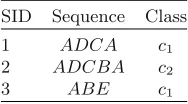
When dataset D is used for classification purposes, each input-sequence is labeled by a class label c. Hence, dataset Dis a set of tuples (SID, S, c), where S is an input-sequence identified by the SID value and c is a class label belonging to the setCof class labels inD. Table 1 reports a very simple sequence dataset, used as a running example in this chapter.
The notion of containment between two sequences is a key concept to characterize the sequential classification rule framework. In this section we introduce the general notion of sequence containment. In the next section, we explore the concept of containment between two sequences and we formalize the concept of sequence containment with constraints.
Given two arbitrary sequencesX andY, sequenceY “contains”Xwhen it includes the events inX in the same order in which they appear inX [5, 35]. Hence, sequenceX is a subsequence of sequenceY. For example for sequence
[image:17.439.173.267.535.587.2]Y =ADCBA, some possible subsequences areADB,DBA, andCA. An arbitrary sequence X is a sequence in dataset D when at least one input-sequence inD “contains”X (i.e.,X is the subsequence of some input-sequences inD).
Table 1.Example sequence dataset D
SID Sequence Class
1 ADCA c1
2 ADCBA c2
A sequential rule [4] inDis an implication in the formX →Y, where X
andY are sequences inD(i.e., both are subsequences of some input-sequences inD).XandY are respectively the antecedent and the consequent of the rule. Classification rules (i.e., rules in a classification model) are characterized by a consequent containing a class label. Hence, we define sequential classification rules as follows.
Definition 1 (Sequential Classification Rule).A sequential classification ruler:X →c is a rule for Dwhen there is at least one input-sequence S in Dsuch that (i)X is a subsequence ofS, (ii) and S is labeled by class labelc.
Differently from general sequential rules, the consequent of a sequential classification rule belongs to set C, which is disjoint from I. We say that a ruler:X →ccovers (orclassifies) a data objectdifd“contains”X. In this case,rclassifiesdby assigning to it class labelc.
3 Sequential Classification Rule Mining
In this section, we characterize our framework for sequential classification rule mining. Sequence containment is a key concept in our framework. It plays a fundamental role both in the rule extraction phase and in the classification phase. Containment can be defined between:
• Two arbitrary sequences. This containment relationship allows us to de-fine generalization relationships between sequential classification rules. It is exploited to define the concepts of closed and generator sequence. These concepts are then used to define two concise representations of a classifi-cation rule set.
• A sequence and an input-sequence. This containment relationship allows us to define the concept of support for both a sequence and a sequential classification rule.
3.1 Sequence Containment
A sequenceX is asubsequence of a sequence Y whenY contains the events inX in the same order in which they appear inX [5, 35].
Sequence containment can be ruled by introducing constraints. Constraints define how to select events inY that match events inX. For example, in [5] the concept of contiguity constraint was introduced. In this case, events in sequence Y should match events in sequence X without any other inter-leaved event. Hence, X is a contiguous subsequence of Y. In the example sequence Y = ADCBA, some possible contiguous subsequence are ADC,
DCB, andBA.
Before formally introducing constraints, we define the concept of matching function between two arbitrary sequences. The matching function defines how to select events inY that match events inX.
Definition 2 (Matching Function). Let X = (x1, . . . , xm) and Y =
(y1, . . . , yl) be two arbitrary sequences, with arbitrary length l and m ≤ l. A function ψ : {1, . . . , m} −→ {1, . . . , l} is a matching function between X and Y if ψ is strictly monotonically increasing and ∀j ∈ {1, . . . , m} it is xj=yψ(j).
The definition of constrained subsequence is based on the concept of matching function. Consider for example sequences Y = ADCBA, X =
DCB, and Z = BA. Sequence X matches Y with respect to function
ψ(j) = 1 +j (with 1≤j≤3), and sequenceZ matchesY according to func-tionψ(j) = 3 +j (with 1≤j≤2). Hence, sequencesX andZ matchY with respect to the class of possible matching functions in the formψ(j) =offset+j.
Definition 3 (Constrained Subsequence). Let Ψ be a set of matching functions between two arbitrary sequences. Let X = (x1, . . . , xm) and Y =
(y1, . . . , yl) be two arbitrary sequences, with arbitrary length l and m≤l. X is a constrained subsequence of Y with respect to Ψ, written as X Ψ Y, if there is a functionψ∈Ψ such thatX matches Y according to ψ.
Definition 3 yields two particular cases of sequence containment based on the length of sequences X and Y. When X is shorter than Y (i.e., m < l), thenX is astrictconstrained subsequence ofY, written asXΨ Y. Instead,
when X andY have the same length (i.e.,m=l), the subsequence relation corresponds to the identity relation betweenX andY.
Definition 3 can support several different types of constraints on subse-quence matching. Both unconstrained matching and contiguous subsesubse-quence are particular instances of Definition 3. In particular, in the case of contiguous subsequence, setΨ includes the complete set of matching function in the form
3.2 Sequence Support
The concept of support is bound to datasetD. In particular, for a sequence
X the support in a dataset Dis the number of input-sequences in Dwhich contain X [4]. Hence, we need to define when an input-sequence contains a sequence. Analogously to the concept of sequence containment introduced in Definition 3, an input-sequenceS contains a sequenceX when the events in X match the events in S based on a given matching function. However, in an input-sequence S events are characterized by their position within S. This information can be exploited to constrain the occurrence of an arbitrary sequenceX in the input-sequenceS.
Commonly considered constraints are maximum and minimum gap straints and windows constraints [17, 25]. Maximum and minimum gap con-straints specify the maximum and minimum number of events in S which may occur between two consecutive events inX. The window constraint spec-ifies the maximum number of events inS which may occur between the first and last event inX. For example sequenceADAoccurs in the input-sequence
S=ADCBA, and satisfies a minimum gap constraint equal to 1, a maximum gap constraint equal to 3 and a window constraint equal to 4.
In the following we formalize the concept of gap constrained occurrence of a sequence into an input-sequence. Similarly to Definition 3, we introduce a set of possible matching function to check when an input-sequenceS in D contains an arbitrary sequenceX. With respect to Definition 3, these matching functions may incorporate gap constraints. Formally, a gap constraint on a sequenceXand an input-sequenceScan be formalized asGap θ K, whereGap
is the number of events inSbetween either two consecutive elements ofX(i.e., maximum and minimum gap constraints), or the first and last elements ofX
(i.e., window constraint),θis a relational operator (i.e.,θ∈ {>,≥,=,≤, <}), andK is the maximum/minimum acceptable gap.
Definition 4 (Gap Constrained Subsequence).Let X= (x1, . . . , xm)be an arbitrary sequence and S = (s1, . . . , sl)an arbitrary input-sequence in D, with arbitrary lengthm≤l. LetΦbe a set of matching functions between two arbitrary sequences, andGap θ K be a gap constraint. SequenceX occurs in S under the constraint Gap θ K, written as X Φ S, if there is a function ϕ ∈ Φ such that (a) X Φ S and (b) depending on the constraint type, ϕ satisfies one of the following conditions
• ∀j∈ {1, . . . , m−1},(ϕ(j+ 1)−ϕ(j))≤K, for maximum gap constraint • ∀j∈ {1, . . . , m−1},(ϕ(j+ 1)−ϕ(j))≥K, for minimum gap constraint • (ϕ(m)−ϕ(1))≤K, for window constraint
universe of all possible matching functions, relationX ΦScan be formalized
as (a) X S and (b) X satisfies Gap θ K in S. This case corresponds to the usual definition of gap constrained sequence as introduced for example in [17, 25].
Based on the notion of containment between a sequence and an input-sequence, we can now formalize the definition of support of a sequence. In par-ticular,supΦ(X) =|{(SID, S, c)∈ D | X Φ S}|. A sequence X is frequent
with respect to a given support thresholdminsupwhensupΦ(X)≥minsup.
The quality of a (sequential) classification rule r :X →ci may be
mea-sured by means of two quality indexes [19], rule support and rule confi-dence. These indexes estimate the accuracy of r in predicting the correct class for a data object d. Rule support is the number of input-sequences in D which contain X and are labeled by class label ci. Hence, supΦ(r) = |{(SID, S, c) ∈ D | X Φ S ∧c = ci}|. Rule confidence is given by
the ratio confΦ(r) = supΦ(r)/supΦ(X). A sequential rule r is frequent if supΦ(r)≥minsup.
3.3 Framework Properties
The concise representations for sequential classification rules we propose in this work require the pair (Ψ, Φ) to satisfy the following two properties.
Property 1 (Transitivity). Let (Ψ, Φ) define a constrained framework for mining sequential classification rules. LetX,Y, andZ be arbitrary sequences in D. If X Ψ Y and Y Ψ Z, then it follows that X Ψ Z, i.e., the subsequence relation defined byΨ satisfies the transitive property.
Property 2 (Containment).Let (Ψ, Φ)define a constrained framework for mining sequential classification rules. Let X,Y be two arbitrary sequences in D. If X Ψ Y, then it follows that {(SID, S, c) ∈ D | X Φ S} ⊇ {(SID, S, c)∈ D |Y ΦS}.
Property 2 states the anti-monotone property of support both for se-quences and classification rules. In particular, for an arbitrary class label c
it issupΦ(X→c)≥supΦ(Y →c).
Albeit in a different form, several specializations of the above framework have already been proposed previously [5, 17, 25]. In the remainder of the chapter, we assume a framework for sequential classification rule mining where Properties 1 and 2 hold.
3.4 Specializations of the Sequential Classification Framework
In the following we discuss some specializations of our (Ψ, Φ)-constrained framework for sequential classification rule mining. They correspond to partic-ular cases of constrained framework for sequence mining proposed in previous works [5, 17, 25]. Each specialization is obtained from particular instances of function setsΨ andΦ.
Containment between two arbitrary sequences is commonly defined by means of either the unconstrained subsequence relation or the contiguous subsequence relation. In the former, setΨ is the complete set of all possible matching functions. In the latter, setΨ includes all matching functions in the form ψ(j) = offset+j. It can be easily seen that both notions of sequence containment satisfy Property 1.
Commonly considered constraints to define the containment between an input-sequence S and a sequence X are maximum and minimum gap con-straints and window constraint. The gap constrained occurrence ofX within
S is usually formalized as X S and X satisfies the gap constraint in S. Hence, in relation X Φ S, set Φ is the universe of all possible matching
functions andX satisfiesGap θ K in S.
• Window constraint. Between the first and last events in X the gap is lower than (or equal to) a given window-size. It can be easily seen that an arbitrary subsequence ofXis contained inSwithin the same window-size. Thus, Property 2 is verified. In particular, Property 2 is verified both for unconstrained and contiguous subsequence relations.
• Minimum gap constraint. Between two consecutive events inX the gap is greater than (or equal to) a given size. It directly follows that any pair of non-consecutive events inXalso satisfy the constraint. Hence, an arbitrary subsequence of X is contained inS within the minimum gap constraint. Thus, Property 2 is verified. In particular, Property 2 is verified both for unconstrained and contiguous subsequence relations.
• Maximum gap constraint. Between two consecutive events inX the gap is lower than (or equal to) a given gap-size. Differently from the two cases above, for an arbitrary pair of non-consecutive events inX the constraint may not hold. Hence, not all subsequences of X are contained in input-sequence S. Instead, Property 2 is verified when considering contiguous subsequences of X.
used to analyze word sequences which occur within a given window size, or where the gap between two consecutive words is less than a certain size [6].
The concise forms presented in this chapter can be defined for any frame-work specialization satisfying Properties 1 and 2. Among the different gap constraints, the maximum gap constraint is particularly interesting, since it finds applications in different contexts. For this reason, in Sect. 6 we address this particular case, for which we present an algorithm to extract the proposed concise representations.
4 Compact Sequence Representations
To tackle with the generation of a large number of association rules, several al-ternative forms have been proposed for the compact representation of frequent itemsets. These forms include maximal itemsets [10], closed itemsets [23, 34], free sets [12], disjunction-free generators [13], and deduction rules [14]. Re-cently, in [29] the concept of closed itemset has been extended to represent frequent sequences.
Within the framework presented in Sect. 3, we define the concept of con-strained closed sequence and concon-strained generator sequence. Properties of closed and generator itemsets in the itemset domain are based on the anti-monotone property of support, which is preserved in our framework by Prop-erty 2. The definition of closed sequence was previously proposed in the case of unconstrained matching in [29]. This definition corresponds to a special case of our constrained closed sequence. To completely characterize closed se-quences, we also propose the concept of generator itemset [9,23] in the domain of sequences.
Definition 5 (Closed Sequence).An arbitrary sequenceX inDis a closed sequence iff there is not a sequence Y in D such that (i) X ψ Y and (ii) supΦ(X) =supΦ(Y).
Intuitively, a closed sequence is the maximal subsequence common to a set of input-sequences inD. A closed sequenceXis a concise representation of all sequences Y that are subsequences of it, and have its same support. Hence, an arbitrary sequence Y is represented in a closed sequence X when Y is a subsequence ofX andX andY have equal support.
Similarly to the frequent itemset context, we can define the concept of
closure in the domain of sequences. A closed sequence X which represents a sequenceY is thesequential closure of Y and provides a concise representa-tion ofY.
The next definition extends the concept of generator itemset to the do-main of sequences. Different sequences can have the same sequential closure, i.e., they are represented in the same closed sequence. Among the sequences with the same sequential closure, the shortest sequences are called generator sequences.
Definition 7 (Generator Sequence). An arbitrary sequence X in D is a generator sequence iff there is not a sequence Y in D such that (i) Y Ψ X and (ii)supΦ(X) = supΦ(Y).
Special cases of the above definitions are the contiguous closed sequence
and thecontiguous generator sequence, where the matching functions in setΨ
define a contiguous subsequence relation. Instead, we have an unconstrained closed sequence and an unconstrained generator sequence whenΨ defines an unconstrained subsequence relation.
Knowledge about generators associated to a closed sequence X allow generating all sequences having X as sequential closure. For example, let closed sequence X be associated to a generator sequence Z. Consider an arbitrary sequence Y with Z Ψ Y and Y Ψ X. Then, X is the
sequen-tial closure of Y. From Property 2, it follows that supΦ(Z)≥ supΦ(Y) and supΦ(Y) ≥ supΦ(X). Being X the sequential closure of Z, Z and X have
equal support. Hence,Y has the same support asX. It follows that sequence
X is the sequential closure ofY according to Definition 6.
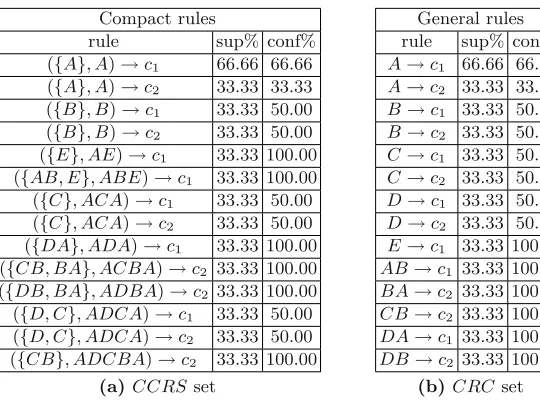
In the example dataset,ADBAis a contiguous closed sequence with sup-port 33.33% under the maximum gap constraint 2. ADBA represents con-tiguous sequencesBA,DB,DBA,ADB,ADBAwhich satisfy the same gap constraint.BA andDB are contiguous generator sequence forADBA.
In the context of association rules, an arbitrary itemset has a unique clo-sure. The property of uniqueness is lost in the sequential pattern domain. Hence, for an arbitrary sequence X the sequential closure can include sev-eral closed sequences. We call this set theclosure sequence set ofX, denoted
CS(X). According to Definition 6, the sequential closure for a sequenceX is defined based on the pair of matching functions (Ψ, Φ). Being a collection of sequential closures, the closure sequence set of X is defined with respect to the same pair (Ψ, Φ).
Property 3 . Let X be an arbitrary sequence in D and CS(X) the set of sequences inDwhich are the sequential closure ofX. The following properties are verified. (i) IfX is a closed sequence, thenCS(X)includes only sequence X. (ii) Otherwise,CS(X)may include more than one sequence.
In Property 3, case (i) trivially follows from Definition 5. We prove case (ii) by means of an example. Consider the contiguous closed sequencesADCAand
5 Compact Representations of Sequential
Classification Rules
We propose two compact representations to encode the knowledge available in a sequential classification rule set. These representations are based on the concepts of closed and generator sequence. One concise form is a lossless rep-resentation of the complete rule set and allows regenerating all encoded rules. This form is based on the concepts of both closed and generator sequences. Instead, the other representation captures the most general information in the rule set. This form is based on the concept of generator sequence and it does not allow the regeneration of the original rule set. Both representations provide a smaller and more easily understandable class model than traditional sequential rule representations.
In Sect. 5.1, we introduce the concepts of general and specialistic classi-fication rule. These rules characterize the more general (shorter) and more specific (longer) classification rules in a given classification rule set. We then exploit the concepts of general and specialistic rule to define the two compact forms, which are presented in Sects. 5.2 and 5.3, respectively.
5.1 General and Specialistic Rules
In associative classification [11, 19, 30], a shorter rule (i.e., a rule with less ele-ments in the antecedent) is often preferred to longer rules with same confidence and support with the intent of both avoiding the risk of overfitting, and re-ducing the size of the classifier. However, in some applications (e.g., modeling surfing paths in web log analysis [32]), longer sequences may be more accurate since they contain more detailed information. In these cases, longest-matching rules may be preferable to shorter ones. To characterize both kinds of rules, we propose the definition of specialization of a sequential classification rule.
Definition 8 (Classification Rule Specialization). Let ri : X →ci and rj : Y → cj be two arbitrary sequential classification rules for D. rj is a specialization of ri iff (i) X Ψ Y, (ii) ci = cj, (iii) supΦ(X) = supΦ(Y), and (iv)supΦ(ri) =supΦ(rj).
From Definition 8, a classification rulerj is a specialization of a ruleriifri
is more general thanrj, i.e.,rihas fewer conditions thanrj in the antecedent.
Both rules assign the same class label and have equal support and confidence. The next lemma states that any new data object covered by rj is also
covered by ri. The lemma trivially follows from Property 1, the transitive
property of the set of matching functionsΨ.
With respect to the definition of specialistic rule proposed in [11, 19, 30], our definition is more restrictive. In particular, both rules are required to have the same confidence, support and class label, similarly to [7] in the context of associative classification.
Based on Definition 8, we now introduce the concept of general rule. This is the rule with the shortest antecedent, among all rules having same class label, support and confidence.
Definition 9 (General Rule).Let R be the set of frequent sequential clas-sification rules forD, andri∈ R an arbitrary rule.ri is a general rule inR iffrj ∈ R, such that ri is a specialization ofrj.
In the example dataset,BA→c2is a contiguous general rule with respect
to the rules DBA → c2 and ADBA → c2. The next lemma formalizes the
concept of general rule by means of the concept of generator sequence.
Lemma 2 (General Rule). Let Rbe the set of frequent sequential classifi-cation rules for D, and r ∈ R, r: X → c, an arbitrary rule. r is a general rule in RiffX is a generator sequence inD.
Proof. We first prove the sufficient condition. Letri:X→cbe an arbitrary
rule inR, whereX is a generator sequence. By Definition 7, ifX is a generator sequence then∀rj:Y →cinRwithY Ψ Xit issupΦ(Y)> supΦ(X). Thus, ri is a general rule according to Definition 9. We now prove the necessary
condition. Let ri : X →c be an arbitrary general rule in R. For the sake of
contradiction, letX not be a generator sequence. It follows that∃rj : Y → c in R, with Y Ψ X and supΦ(X) = supΦ(Y). Hence, from Property 2, {(SID, S, c) ∈ D | Y Φ S} = {(SID, S, c) ∈ D | X Φ S}, and thus supΦ(ri) = supΦ(rj). It follows that ri is not a general rule according to
Definition 9, a contradiction.
By applying iteratively Definition 8 in set R, we can identify some par-ticular rules which are not specializations of any other rules in R. These are the rules with the longest antecedent, among all rules having same class label, support and confidence. We name these rulesspecialistic rules.
Definition 10 (Specialistic Rule). Let R be an arbitrary set of frequent sequential classification rules for D, and ri ∈ R an arbitrary rule. ri is a specialistic rule inRiffrj ∈ Rsuch thatrj is a specialization ofri.
For example, B → c2 is a contiguous specialistic rule in the example
dataset, with support 33.33% and confidence 50%. The contiguous rules
ACBA → c2 and ADCBA → c2 which include it have support equal to
33.33% and confidence 100%.
Lemma 3 (Specialistic Rule).LetRbe the set of frequent sequential classi-fication rules forD, andr∈ R,r:X →c, an arbitrary rule.ris a specialistic rule in RiffX is a closed sequence inD.
Proof. We first prove the sufficient condition. Letri:X→cbe an arbitrary
rule in R, where X is a closed sequence. By Definition 5, if X is a closed sequence then ∀rj : Y → c in R, with X Ψ Y it is supΦ(X) > supΦ(Y).
Thus, ri is a specialistic rule according to Definition 10. We now prove the
necessary condition. Let ri : X → c be an arbitrary specialistic rule in R.
For the sake of contradiction, letX not be a closed sequence. It follows that
∃rj : Y → c in R, with X Ψ Y and supΦ(X) = supΦ(Y). Hence, from
Property 2,{(SID, S, c)∈ D |Y Φ S}={(SID, S, c)∈ D |X ΦS}, and
thussupΦ(ri) =supΦ(rj). It follows thatriis not a specialistic rule according
to Definition 10, a contradiction.
5.2 Sequential Classification Rule Cover
In this section we present a compact form which is based on the general rules in a given setR. This form allows the classification of unlabeled data without information loss with respect to the complete rule setR. Hence, it is equivalent toRfor classification purposes.
Intuitively, we say that two rule sets are equivalent if they contain the same knowledge. When referring to a classification rule set, its knowledge is represented by its capability in classifying an arbitrary data object d. Note that dcan be matched by different rules in R. Each rule r labels d with a classc. The estimated accuracy ofrin predicting the correct class is usually given byr’s support and confidence.
The equivalence between two rule sets can be formalized in terms of rule cover.
Definition 11 (Sequential Classification Rule Cover).LetR1andR2⊆
R1be two arbitrary sequential classification rule sets extracted fromD.R2is
a sequential classification rule cover ofR1if (i)∀ri ∈ R1,∃rj∈ R2, such that ri is a specialization ofrj according to Definition 8 and (ii)R2 is minimal.
WhenR2⊆ R1 is a classification cover ofR1, the two sets classify in the
same way an arbitrary data objectd. If a ruleri∈ R1 labelsd with classc,
then inR2 there is a rulerj, whereri is a specialization ofrj, andrj labels d with the same class c (see Lemma 1). ri and rj have the same support
and confidence. It follows that R1 and R2 are equivalent for classification
purposes.
Definition 12 (Classification Rule Cover). Let R be the set of frequent sequential classification rules forD. The classification rule cover ofRis the set
CRC={r∈ R|r:G→c∧G∈ G}, Gis the set of generator sequences inD.
(1)
The next theorem proves that the CRC rule set is a sequential classifica-tion rule cover ofR. Hence, it is a compact representation ofR, equivalent to it for classification purposes.
Theorem 1.LetRbe the set of frequent sequential classification rules forD. The rule setCRC⊆ R is a sequential classification rule cover ofR.
Proof. Consider an arbitrary rule ri ∈ R. By Definition 12 and Lemma 2,
there exists at least a rule rj ∈ CRC, rj not necessarily identical to ri,
such that rj is a general rule and ri is a specialization of rj according to
Definition 8. Hence, it follows that the CRC rule set satisfies point (i) in Definition 11. Consider now an arbitrary rulerj ∈CRC. By removingrj, (at
least)rj itself is no longer represented inCRC by Definition 9. Thus, CRC
is a minimal representation ofR(point (ii) in Definition 11).
5.3 Compact Classification Rule Set
In this section we present a compact form to encode a classification rule set, which, differently from the classification rule cover presented in the previ-ous section, allows the regeneration of the original rule setR. The proposed representation relies on the notions of both closed and generator sequences.
In the compact form, both general and specialistic rules are explicitly rep-resented. All the remaining rules are summarized by means of an appropriate encoding. The compact form consists of a set of elements named compact rules. Each compact rule includes a specialistic rule, a set of general rules, and encodes a set of rules that are specializations of them.
Definition 13 (Compact Rule).Let M be an arbitrary closed sequence in D, and G(M) the set of its generator sequences. Let c ∈ C be an arbitrary class label.F: (G(M), M)→cis a compact rule forD.F represents all rules r:X →ci forDwith (i) ci=c and (ii)M ∈ CS(X), i.e.,M belongs to the sequential closure set ofX.
By Definition 13, the rule set represented in a compact rule F : (G(M), M) → c includes (i) the rule r : M → c, which is a specialistic rule since M is a closed sequence; (ii) the set of rules r : G → c that are general rules since G is a generator sequence for M (i.e., G ∈ G(M)); and (iii) a set of rulesr:X →cthat are a specialization of rules in (ii). For rules in case (iii), the antecedent X is a subsequence of M (i.e., X Ψ M) and
it completely includes at least one of the generator sequences in G(M) (i.e.,
In the example dataset, the contiguous classification rules BA → c2, DB → c2, DBA → c2, ADB → c2, and ADBA → c2 are represented in
the compact rule ({BA, DB}, ADBA)→c2.
The next lemma proves that the rules represented in a compact rule are characterized by the same values of support and confidence.
Lemma 4.Let F : (G(M), M)→c be an arbitrary compact rule for D. For each rule r:X →c represented in F it is (i) supΦ(X) = supΦ(M)and (ii) supΦ(r) =supΦ(M →c).
Proof. Let r : X → c be an arbitrary rule, and F : (G(M), M) → c an arbitrary compact rule for D. Ifr is represented inF, then by Definition 13 it isM ∈ CS(X). Thus, by Definition 6,X Ψ M andsupΦ(X) =supΦ(M).
Hence, from Property 2 (containment property) it follows supΦ(X → c) = supΦ(M →c).
We use the concept of compact rule to encode the set R of frequent se-quential classification rules. We propose a compact representation ofRnamed
compact classification rule set (CCRS). This compact form includes one com-pact rule for each specialistic rule inR. Each compact rule includes the spe-cialistic rule itself and all general rules associated to it.
Definition 14 (Compact Classification Rule Set). Let R be the set of frequent sequential classification rules for D. Let Mbe the set of closed se-quences, andGthe set of generator sequences inD. The compact classification rule set (CCRS) is defined as follows
CCRS={F : (G(M), M)→c}, G(M)⊆ G ∧ M ∈ M (2)
where ∀r : M → c in R such that M ∈ M, then ∃F : (G(M), M)→ c and G(M)contains all generator sequences for M.
The following theorem proves thatCCRS is a minimal and complete rep-resentation ofR.
Theorem 2.LetRbe the set of frequent sequential classification rules forD, and CCRS the compact classification rule cover of R. CCRS is a complete and minimal representation of R.
Proof. We first prove thatCCRS is a complete representation ofR. By De-finition 14, setCCRS includes one compact rule for each specialistic rule in
R. Hence,∀ri : X →c in R, there is a compact ruleF : (G(M), M)→c in CCRS, withM ∈ CS(X). This compact rule encodesri. HenceCCRS
com-pletely representsR. We then prove thatCCRSis a minimal representation of
R. Consider an arbitrary compact ruleF: (G(M), M)→cinCCRS.F(also) encodes specialistic rule ri : M → c in R. From Property 3 it follows that
the sequential closure set ofM includes only sequenceM (i.e.,CS(M) =M). Hence, F is the unique compact rule in CCRS encoding ri. By removing
this rule, ri is no longer represented in CCRS. Thus, CCRS is a minimal