This is a repository copy of
Trade and exchange
.
White Rose Research Online URL for this paper:
http://eprints.whiterose.ac.uk/11112/
Book Section:
Sindbæk, Søren and Arthur, P. (2008) Trade and exchange. In: Graham-Campbell, J. and
Valor, M., (eds.) The Archaeology of Medieval Europe. Acta Jutlandica, 83:1; Humanities
Series, 79 . Aarhus University Press , Århus , pp. 289-315.
[email protected] https://eprints.whiterose.ac.uk/ Reuse
Items deposited in White Rose Research Online are protected by copyright, with all rights reserved unless indicated otherwise. They may be downloaded and/or printed for private study, or other acts as permitted by national copyright laws. The publisher or other rights holders may allow further reproduction and re-use of the full text version. This is indicated by the licence information on the White Rose Research Online record for the item.
Takedown
If you consider content in White Rose Research Online to be in breach of UK law, please notify us by
)IiS&
VOLUME 1
EIGHTH TO TWELFTH CENTURIES AD
The Archaeology of
Medieval Europe
Edited by James Graham-Campbell with Magdalena Valor
after the year 1000 because of the greater number of documentary sources and a more vis-ible material culture than before. The four tendencies that Lopez saw as characterising European economic expansion during the course of the tenth century are:
(I) The redistribution of the rural population so as to eliminate opposing excesses of overpopulation and depopulation, of saturation and waste;
(2) A greater regard for the profession of merchant than in the past, thus being able to attract and conserve capital and energy;
(3) The importance and utility of machines and techniques beginning to be recognised in practice, if not in theory; and
(4) The extreme political fragmentation and the weakness of governments favouring local and private initiatives.
The new millennium had got off to a splendid start. The twelfth century closed with the fall of Byzantine Constantinople to the western states, in 1204, and the consolidation of a Mediterranean-wide Venetian trade-empire (see also pp 451-2). Within a generation, Marco Polo was able to look to new horizons.
PART 2: NORTHERN EUROPE by Sroren M Sindbcek
If the history of Mediterranean trade during the period C800-1200 is one of decline and reluctant recovery that of Northern Europe is decidedly one of growth. One reason for this is the different points of departure. By qoo, Europe's northern seas had never wit-nessed a system of exchange on the scale and complexity of that in the Mediterranean dur-ing Antiquity. Durdur-ing the followdur-ing centuries, however, the development of commerce in the North corresponded ever closer to that of the Mediterranean, resulting in a twelfth-century economy no less advanced or extensive than that ofImperial Rome, but within an even wider geographical frame. Intriguingly, and hardly by accident, this process was set in motion at the very moment when the Late Antique economy ceased in the Mediterranean, in the closing decades of the seventh century. Throughout much of the period concerned here, trade remained a modest appendage to traditional forms of exchange. Its key histor-ical importance was as a steady motor of social change and innovation.
The Emporia Network
Silver coins, sailing ships and towns, the bench-marks of early market exchange, appear in earnest on and around the northern seas of Europe, beyond the old Imperial fron-tier, during the seventh and eighth centuries. Being the means, vessels and locations of an exchange, which had grown beyond gift-exchange, plunder and tribute, to include
302 Medieval Archaeology
the focused, calculated and nominally impersonal relationships of
エ セ
。 、 ・
L
they signal the beginning of a commercial economy.The ships of エィ セ ウ age are still unknown to us, except for images on Gotlandic pic-ture-stones; the coms, however, are familiar. The so-called sceattas, struck since the last
quarter of the seventh century, were a light silver-denomination on the model of earl-ier Merovingian gold tremisses, but effectively the first coinage in post-Roman Northern
Europe suited to the transactions of a rural small-holding economy (Abramson 2006, xi). The distribution of sceattas clusters along the Rhine, in England and around the
North Sea coast into south-east Denmark, with sporadic finds in the rest of Scandinavia and the Baltic Sea region. This distribution is echoed by a number of Frankish prod-ucts, such as quernstones, pitchers, glass vessels and textiles (Gabriel 1988). They mark the ュ 。 セ ョ arteries of a long-distance exchange that had attained a level of intensity and regularIty not found elsewhere in Northern Europe at this period.
The hub of this network was Dorestad in the Frisian Rhine delta, also one of the most prolific mints of sceattas (van Es & Verwers 2002). From Dorestad merchants commuted to a small group of strategically located ports, including Quentovic in France, Hamwic and Lundenwic in England, Ribe in Denmark, and Birka in Sweden (see Chapter 4). These wics or 'emporia' were undefended landing-sites, mostly placed at political
bound-aries or topogra.phical barriers, consisting of modestly-sized permanent settlements that swelled seasonally into large markets (Callmer 1994; Hodges 2006, with refs). They dif-fer
。
イ
」
セ
。 ・ ッ ャ ッ ァ ゥ 」 。 ャ ャ
ケ セ イ
ッ ュ
more local markets through finds that include items brought by foreIgners for theIr personal use (e.g. domestic pottery), and by the regular practice of crafts that consumed imported raw materials, such as bead-making or bronze-casting.Towards the end of the eighth century, Arabic silver coins (dirhams) appear first in
Russia, then in the Baltic Sea region, along with mass-produced glass beads and other items (Callmer 1995; Noonan 1998). Staraya Ladoga (in north-west Russia) and possibly Truso (east Poland) became critical links to the Near Eastern economy through trade in fur and probably slaves. The Oriental beads arrived in sufficient quantities to oust the local production of glass beads at sites like Ribe within few years. The influx of silver was prob-ably no less significant, and it also found its way through the Mediterranean (McCormick 2001,369). In 793/4 it provided Charlemagne with the means to introduce a larger and
ィ
セ
。
カ
ゥ ・
イ ー
・ ョ
セ ケ
L
weighing 1. 7 grams. This Carolingian reform-coinage was soon matched byKing Offa, m England, as also by the so-called 'Hedeby' coins in Denmark.
These. new currencies, as well as an increasing body of trade legislation, point to the growmg volume of exchange and to the ambition of rulers to control it (Verhulst 2.002, 87f ). The period saw intensified conflicts over attempts to monopolise the empo-na, whose locations suggest that they had originally acted as neutral zones. In the early ninth
」 ・
セ エ オ イ ケ
L
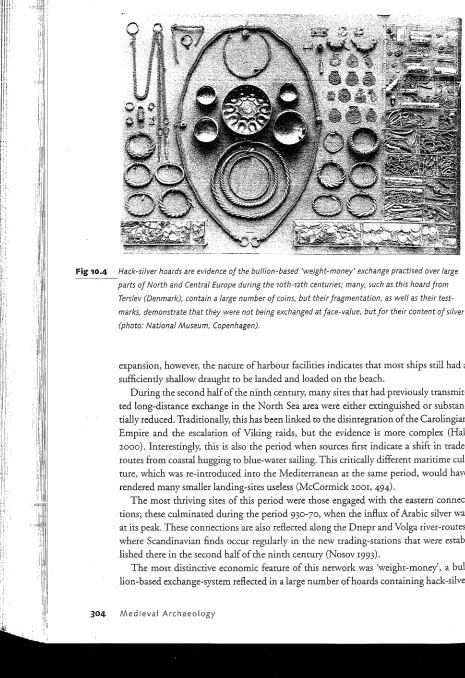
Hedeby (Box 4·3) was founded at the base ofJutland as a Danish response to-PtanKJ.-sh-aa.vartce(Carnap-'::Bornlieim & Hilbert R P P W L h キ ャ エ ィ セ セ ヲ ウ I N While Dorestad became strangled between Carolingian and Viking ambitions, Hedeby took over its role as the hub for sea-trade in Northern Europe (Theuws 2004). Bridging the Baltic and the North Sea, it opened routes for a new set of satellites, including Kaupang in south-ern Norway, Arhus in Jutland, and Ralswiek in north-eastsouth-ern Germany. In spite of thisFig 10.4 Hack-silver hoards are evidence of the bullion-based 'weight-money' exchange practised over large
parts of North and Central Europe during the 10th-12th centuries; many, such as this hoard from Terslev (Denmark), contain a large number of coins, but their fragmentation, as well as their test-marks, demonstrate that they were not being exchanged at face-value, but for their content of silver
(photo: National Museum, Copenhagen).
expansion, however, the nature of harbour facilities indicates that most ships still had a sufficiently shallow draught to be landed and loaded on the beach.
During the second half of the ninth century, many sites that had previously transmit-ted long-distance exchange in the North Sea area were either extinguished or substan-tially reduced. Traditionally, this has been linked to the disintegration of the Carolingian Empire and the escalation of Viking raids, but the evidence is more complex (Hall 2000). Interestingly, this is also the period when sources first indicate a shift in trade-routes from coastal hugging to blue-water sailing. This critically different maritime cul-ture, which was re-introduced into the Mediterranean at the same period, would have rendered many smaller landing-sites useless (McCormick 200I, 494).
The most thriving sites of this period were those engaged with the eastern connec-tions; these culminated during the period 930-70, when the influx of Arabic silver was at its peak. These connections are also reflected along the Dnepr and Volga river-routes, where Scandinavian finds occur regularly in the new trading-stations that were estab-lished there in the second half of the ninth century (Nosov I993).
The most distinctive economic feature of this network was 'weight-money', a bul-lion-based exchange-system reflected in a large number of hoards containing hack-silver
(e.g. Fig IO.4), often including whole or fragmented coins, found across IScandinavia and East Europe (Brather I996; Hardh I996). With no central authority to define the value of coins, 'weight-money' exchange was facilitated by Oriental types of scales and weights introduced in the late ninth century (Steuer et al2002; Graham-Campbell &
Williams 2007). Unlike the nominal coinage in a monetarised economy, bullion did not lose its value over time and could therefore be saved by hoarding. This explains the existence of so many Northern hoards as compared with Western Europe; however, sil-ver was used as more than a means of storage. The great fragmentation present in many hoards shows that 'weight-money' was being used even for trivial transactions.
The Urban Revival
Up until the tenth century, all ship-wrecks known from the Northern seas belong to all-purpose vessels, designed to carry a large crew and a modest cargo; however, a division then took place into slender warships and bulky transport-vessels (see Chapter 9). The latter were plainly dependent on organised protection and on the availability of proper landing facilities. Their appearance therefore marks an important threshold in both the volume of exchange and its organisation.
A similar tendency towards more proficient regulation is reflected in coinage. The influx of Arabic dirhams dried up in the late tenth century, probably together with the Central Asian mines which had supplied the silver for them. Within the 'weight-money' zone of Northern and Eastern Europe, they were initially replaced by coins from Western Europe, in particular north German issues - the Sachsenpfennige - struck in increasing numbers after the opening of the Rammelsberg silver mines, in the Harz mountains (Steuer 2005). More importantly, however, the system of exchange based on intrinsic value was receding. In England, King Edgar's reform in 973 established the first uniform, nominal coinage to circulate in all England. Domestic coins were increas-ingly minted in Norway and Denmark in the eleventh century and, from the I070s, Denmark maintained a regulated, nominal currency (cf. Fig 10.5). The Slavic lands, on the other hand, mostly stuck to the bullion economy and only produced limited num-bers of domestic coins as prestige issues (Spufford I988; cf also Kilger 2000).
This new structure of exchange was supported by an increase in new urban founda-tions, which appeared during the tenth century. The burhs in England, Burgstadte in Germany, and similar places throughout Northern Europe, show a different organiza-tion to that of the earlier emporia. They combined regional administrative centres and trading-places within one, usually fortified site. Some important centres changed loca-tions in this process. From the mid-eleventh century, activities at Hedeby (Box 4-3) shifted to nearby Schleswig, which was able to receive ships with a deeper draught (Fig
M Y セ X Q M[ M ゥ ャ ャ Mr オ ウ ウ ゥ 。 Lエ Z ィ ・ ᄋ Mー P f Q [ P ヲs エ 。 f 。 ェ 。M l M 。 M、 P ァ 。 M 「 ・ ・ 。 ュ ・ ᄋ ェオ ウ エ an appendix to the budding Novgorod, the new centre of power in a settled region.
Fig 10.5 Four silver pennies struck in the later 11th century, from left to right, with obverse at top and reverse
below: (1) Germany, Siegfried I, archbishop ofMainz (1060-84); (2) Low Countries, William of Pont,
bishop of Utrecht (1054-76); (3) Anglo-Saxon England, Edward the Confessor (1042-66), minted at
Lewes (Sussex); and (4) Denmark, Sven Estridsson (1047-76), minted at Roskilde (Zealand), with a runic
inscription reading 'Suen reo tano[ru]m ',for 'Sven rex danorum' (© Fitzwilliam Museum, Cambridge).
Scandinavia, all rose to importance during the tenth and eleventh centuries. Through centres such as these Norse settlers in the North Atlantic supplied Arctic exotica, such as walrus-ivory (Box 2.1), while Slavs in Bohemia or Moravia began to receive amber from the Baltic (RoesdahI2003; Krumphanzlova 1992).
The use of regulated nominal coinage consolidated throughout most of Europe during the twelfth century, as witnessed by the use of increasingly debased coins. The monopoly of coins was certainly of great value to lords, who could order recurring sub-stitutions at exchange rates in their favour. It was less conducive to international trade, which continued in consequence to rely heavily on bullion silver. By accident, it was also to terminate the use of coins in the regions where exchange still relied on metal value. In Novgorod, fewer and fewer coins were available after the eleventh century, when they were replaced by an exchange almost entirely based on furs and other pay-ments in kind (Martin 1986; Rybina 1999).
In II43, Lubeck was founded in the south-western corner of the Baltic as part of the German colonisation east of the Elbe, the Ostsiedlung. Complemented by some other new foundations, it was to eclipse Schleswig as the main port of the Baltic Sea in the early thirteenth century. Along with Lubeck, Visby (Gotland) and Bergen (western Norway), all grew into ports of prime importance. About the same time, the cog devel-oped and gradually displaced the Nordic clinker-built ships as the principal trading-ves-sels of the Northern seas (see Chapter 9), although perhaps not, as once claimed, for the simple reason of scale: the huge thirteenth-century wreck from Bryggen, in Bergen,
306 Medieval Archaeology
shoWS that a late Nordic clinker-built vessel could easily compete with· the capacity of contemporary cogs (Berggren et al2002). Rather, the new ships, towns and currencies were the furnishings of a new set of actors and a new network, one that was to develop into the Hanseatic League (see Vol 2).
places, Networks and Organisation
Early medieval trade was as much an instance of communication as one of economy. 'Trade-routes' were journeys taken on a regular basis, defined by the knowledge and experience of travellers. Details in the development and arrangement of connections were decisive for the robustness of systems and for the possibility of their control, and thus for the historical development of exchange and communication.
In the emporia network, long-distance exchange mostly took place in bulk between specific localities, situated to act as spatial and temporal buffers between traffics. Local markets communicated with the emporia, but not with the long-distance traffic between them. While this network was sometimes remarkably effective, it was also extremely vulnerable. Successful emporia could be deserted within a few years if connections failed or reconfigured (Sindb<ek 2007).
The urban network established from the tenth century onwards was far more robust, but entailed a different problem. The eighth-century network of emporia had been socially a small world, in which a merchant from Dorestad was probably personally acquainted with his partner in Birka. The need for formal institutions and enforcement was therefore less pronounced than later.
By contrast, the mature urban network of the High Middle Ages, which linked large numbers of towns with crowds of strangers, required an increasingly elaborate body of regulation, institutional sanction and coercive force to buttress peaceful and lawful cooperation. Even during the Carolingian period, the elite presided over markets and collected tolls. Merchants, for their part, formed partnerships, companies and guilds. Yet, the formation of towns allowed both for a more efficient monopoly of coins and markets, and for better possibilities of commercial organisation.
The shift from emporia to towns also held implications for local exchange. The few international emporia of the Carolingian period were a clearly distinct orbit from the regional distribution that took place in fairs and markets. In Western Europe these have a documented, or assumed, connection to monasteries or other great estates, as in the case of Flixborough, in northern England (Loveluck 1998). Their equivalents in Scandinavia appear similarly associated with lordly residences or 'central-places', such as the complex at Uppakra, in southern Sweden (Nasman 2000; Pestell & Ulmschneider 2003). As towns were established from the tenth century onwards, local exchange
M 「 ・ 」 。 ュ ・ M 。 ウ ウ ゥ ァ ョ ・ 、M エ ッ M B エ ィ ・ ュ [ キ ィ ゥ ャ ・M ッ エ ィ Z ・ イ エ ケ ー G ・ ウ M ッ ヲ ュ 。 t ォ ・ セ ァ イ 。 、 オ 。 ャ ャ ケ lost importance or were prohibited (Ulriksen 1994; Naylor 2004)
Archaeologically, the search for local markets is often directed towards the metal-rich 'productive sites', discovered in recent years by metal-detectorists. The social char-acter of local markets remains little known, but it is likely that many were held in
fig 10.6 This barrel of silver fir, which grew in the upper reaches of the Rhine, probably con-tained wine before it was reused as a well
in Hedeby. It is almost 2m long and
testi-fies to a scale of commerce well beyond
the exchange of occasional luxury items (photo: Stiftung Schleswig-Holsteinische
Landesmuseen Schlofi Cottor! Schleswig).
ciation with periodical general-assemblies. Some interesting cultural variations stand out: in England, 'productive sites' reveal a remarkable level of coin circulation (and loss), during the eighth and ninth centuries, whereas in Scandinavia (by contrast) exchange appears to have been conducted as barter, except in emporia.
It would be false to think that local exchange was organised along the same lines in every region. Within the Seine area, from the Carolingian period, exchange was centred on the annual wine-market at St Denis, creating a regular, cyclical pattern. In the Rhine area, by contrast, markets were continuously established on the occasion of the great assemblies held, in changing towns, by the itinerant Carolingian court. In consequence, no locus or similar event to St Denis existed there (McCormick 2001, 647f).
Trade-Goods
Ceramics are less enlightening for the study of early medieval trade in Northern Europe than in the Mediterranean area (see Box ro.I). Amphorae were rarely used, as wine and other liquids were transported in barrels (Fig ro.6), and few fine-wares were exchanged for their own merit. Only a few wares had a regular, supra-regional distribution (cf. Ludtke & Schietzel2001). The Rhenish Badorf and later Pingsdorf wares (see pp 225-7), produced in the Vorgebirge, south of Cologne, were used throughout the Rhine area and are regularly found in ports in the North Sea region. An exceptional Frankish--product, the eighth/ninth-centuryTating-ware pitchers, black burnished and decorated with tin-foil applications (see p 226 & Fig 7.I3), occurs even further afield, having been found in Russia and at Borg, in Lofoten (northern Norway); it may either have been an admired (Christian?) souvenir or traded as a fine-ware.
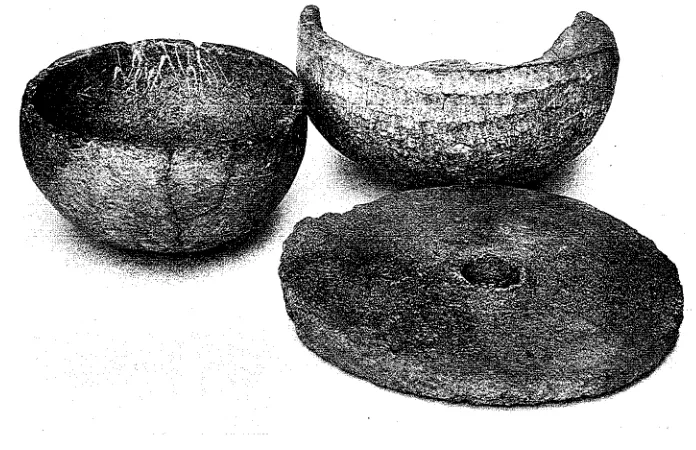
Stone objects provide some of the best archaeological evidence for long-distance trade in Northern fig 10.7
Europe: Viking period steatite vessels found on the shore at Hals Barre, Jutland, and a Mayen quern-stone from the 10th-century fortress at Trelleborg, Denmark (photo: National Museum, Copenhagen).
Apart from this, pottery was mostly produced for local consumption and is rarely found outside its region of production. Only ports regularly present pottery of a mixed origin, undoubtedly used by foreigners residing there. Ceramics of more remote deriva-tion are excepderiva-tional; among more than roo,ooo sherds from Hedeby, there is only one piece of a Byzantine amphora and a few fragments of Central Asian mercury-flagons to point to contacts beyond Northern Europe (Helm I997; Steuer 2002, I60).
In contrast to ceramics, many things that did hold significance in exchange are elu-sive as archaeological objects. In general, for a thing to become a regular object of trade or exchange requires that there exists an imbalance between availability and demand, and that a way can be found of overcoming this imbalance. In medieval trade, the last was often the decisive moment. For objects like furs, spices, or semi-precious stones, which were obtained from very distant sources, the limited access (and hence rarity) probably even raised the demand for them as objects of gift-exchange.
For some items the incentive for exchange was created by geographically restrict--ed-occurrence. This is true forstone tools and utensils (Fig ro.7 & Box ro.2), minerals
[image:6.1032.71.545.9.701.2] [image:6.1032.608.956.63.288.2]-Northern Europe comprises a broad band offertile Sea area is an indication that Carolingian trade
lowland set between two mineral-rich mountain was transhipped across the foot ofJutland, rather
ranges - in Central Europe and along the Atlantic rim. From early on, this economic situation
cre-ated important incentives for trade and exchange. Stone objects are the most durable form of
archae-ological evidence from the resulting relationships. Moreover, they can often be traced by petrological
analysis to a specific place of origin.
than being sailed on the risky route around the north of the peninsula.
Another characteristic material for querns was garnet-muscovite slate from Hyllestad, in western
Norway. Hyllestad querns were exported from the tenth century over large parts of Northern Europe. The combination of soft slate and hard
Quernstones were utilitarian objects of essen- garnets gave an excellent wearing surface, which
tial value for an agrarian economy (Fig ro.7). One was appreciated into the twentieth century. In the
of the finest materials for querns in Europe, the Baltic Sea area, querns were often made of
sand-porous basalt found in the Mayen region, south stone, which did not, however, become objects of
of Cologne, became a major export during the long-distance export (Carelli & Kresten 1997).
Carolingian period (Parkhouse 1997). Its 、 ゥウ エ イ ャセ M M M M M Mc cゥ ッ ォ ゥ ョ ァ vessels carved out of the easily
work-bution along the Rhine and the coastlands of the able but robust and heat-resistant steatite were in
North Sea emphasises the same 'Frisian' trade- use since the Iron Age in many parts of Norway
zone as the sceattas (Fig I). The heavy querns were and in the Shetlands, where the stone occurs
nat-rarely transported long distances overland and urally. From the early decades -of the ninth
cent-are found in inland areas only along major, navi- ury, however, they were also traded on a
signifi-gable rivers. Their virtual absence in the Baltic cant scale into Denmark and southern Sweden,
310 Medieval Archaeology
Fig1
Quernstones of Mayen basalt found
their way into the orbit of North Sea emporia during the 8th-70th centuries; their distribution traces an outline of the main coastal
sail-ing routes of the Carolsail-ingian period, in particular (data from Parkhouse
7997; Sindbi£k 2005; and personal
research).
where no natural sources exist (Fig ro.7). When rological studies have identified the source of
sev-Norse colonists settled in the British and North eral products (e.g. Mitchell et al 1984; Resi 1990).
Atlantic Islands in the ninth-tenth centuries,
ste-atite bowls were also brought into these regions
(Fig 2). Outside the area of Scandinavian
settle-ment they are found only in ports, such as Rals-wiek or Wolin on the South Baltic coast,
presum-ably brought by Scandinaviin sailors. The close association of steatite vessels with Scandinavians, together with the considerable effort put into
transporting them over long distances, suggests
that they had a significance related to cultural identity (Forster & Bond 2004). Unfortunately, no technique has yet been developed that can
trace products to individual quarries.
Hones were another stone product traded in quantity. From the eighth century onwards, good
quality schist hones from sources in Central Eu-rope, the British Isles and Scandinavia increasingly
replaced local stones in the lowland regions.
Pet-The most characteristic type is the fine grained,
and almost white, schist from Eidsborg in
Tele-mark (southern Norway), widely distributed since
the tenth century at latest (Myrvoll 1985).
A prominent example of stone-trade in the Slavic world is the spindle-whorls made of scarlet
slate from the Ovruc region, north-west of Kiev
(Gabriel 1988). Unlike querns, the whorls did not
pose restrictions on land transport and are found
across the entire Slavic world from the Volga -t()
the Elbe, and occasionally in Scandinavia.
Even building stones were exchanged over long distances, in particular exotic stones for ornamental details: examples include the well-known 'black stones' discussed in letters between
Charlemagne and King Offa (see Box 15.3).
By Sroren M Sindbi£k
Fig2
-Steatite vessels were traded on a
Significant scale during the 9th-nth centuries into Denmark and the
newly-founded Norse settlements in the North Atlantic islands, but were not adopted among othergroups; the dotted line encloses the area of natural occurrence (data from Resi
7979; Foster & Bond 2004, with
refs; Sindbi£k 2005; and personal
research).
Fig 10.8 Iron leg-shackles are rare material evidence of an
important commodity in early medieval Northern Europe: slaves; this 11th-century example is from Brest, Mecklenburg, NE Germany (photo:
Landesmuseum in Schwerin).
by the workshops and the powers that possessed them. The high value of these things relative to their weight would merit transport even in small-scale cargoes, and all were exchanged throughout the Middle Ages.
Debates about the complexity of medieval economics often focus on things that were exchanged as a way of organizing production. Agrarian surplus was traded early in the form of high-value, labour-intensive products like textiles. But when did basic products like grain or wine become commodities? Both were certainly redistributed locally and were sometimes moved over kmg distances between the scattered holdings of Carolingian monasteries and estates (McCormick 200I, 698f). But evidence is still inconclusive as to whether an extensive grain-trade existed before the establishment of urban centres in the tenth century. The evolution of bulk cargo in particular raises dis-cussions about a possible 'commercial revolution'.
One low-value staple product the history of which, as a commodity, is now being studied in some detail is fish (see Box 6.3). The evidence of fish-bone from archaeolog-ical sites in England shows that marine fish rapidly became available inland in the dec-ades around IOOO. The 'fish-event' may, however, be connected specifically to the intro-duction of preservation by salting, rather than showing a general development in the organisation of exchange.
A related class of products was manufactured goods like combs, textiles, shoes, iron objects or pottery. The raw-materials for these, and the skills for producing them, could be acquired virtually anywhere, whence their transformation into manufactured goods was motivated only as a division oflabour. This signals an important step for local trade. Comb-making is widely evidenced as a pre-urban specialisation practised in local mar-kets from the Carolingian period (Ashby 2006). Textiles were produced mostly within households, but according to standardized norms, which established certain fabrics as commodities Q0rgensen I992; and see Chapter 7).
One final commodity of key importance in medieval trade was slaves. Slaves might be considered a higher form of agrarian surplus, yet the uncommon agency of the pro-duct, and the complexities introduced by Christian ethics, favoured procurement from distant sources, and hence long-distance trade. Although possibly the most significant , European export of the early medieval period, hinted at in many written sources, the slave-trade is virtually invisible in the archaeological record (c£ Fig IO.8). The history of this aspect of early medieval European trade may yet be uncovered by future genetic studies.
BIBLIOGRAPHY
Abramson, T (2006) Sceattas-An Illustrated Guide: Es, WA van and Verwers, WHJ (2002) :Auf stieg, BIUte
Anglo-Saxon Coins and Icons, King's Lynn und Niedergang der friihmittelalterlichen
Han-Arcamone, MG (1994) 'Una nuova iscrizione runica da delsmetropole Dorestad', in Brandt, K, MUller-Monte Sant'Angelo', in Carletti, C and Otranto, G Wille, M and Radtke, C (eds), Haithabu und die
(eds), Culto e ゥ ョウ セ、 ゥ 。 ュ ・ ョエッ micaelici nell1talia merid- fiihe Stadtentwicklung im niirdlichen Europa,
ionale fra tarda antichita e medioevo, Bari, 185-9 NeumUnster, 281-302
Arthur, P (2000) 'Macine intorno al Mille: Aspetti del Fentress, E and Perkins, P (1988) 'CountingMrican commercio dalla Grecia e dalla Sicilia in eta medi- Red Slip Ware', Africa Romana 5, 205-14 evale, in Brogiolo, GP (ed), II Congresso Nazionale Forster, AK and Bond, JM (2004) 'NotthAtlantic
net-di Archeologia Menet-dievale, Florence, 485-9. works: preliminary research into the trade of steatite
Arthur, P (2002) Naples from Roman Town to City- in the Vtking and Norse periods', in Housley, RA
State: an Archaeological Perspective, The British and Coles, G (eds), Atlantic Connections
andAdapt-School at Rome Monograph Series 12 ations. Economies, Environments and Subsistence in
Lands bordering the North Atlantic: Oxford, 218-29
Ashby, SP (2006) 'Trade in Viking Age Britain:
iden-tity and the production and distribution of bone Francovich, R (ed) (1993) Archeologia delle attivita
and antler combs', in Arneborg, J and Gronnow, B estrattive e metallurgiche, Florence
(eds), Dynamics of Northern Societies, Copenhagen, Gabriel, I (1988) 'Hof- und Sakralkultur sowie
Gebrau-273-9 chs- und Handelsgut im Spiegel der Kleinfunde
Barnish, SJB (1991) Cassiodorus, variae, Liverpool von Starigard/Oldenburg', Bericht der
Riimisch-Germanischen Kommision 69, I03-29I
Bass, G and Van Doorninck, FH (1982) Yassi Ada, A
Seventh Century Byzantine Shipwreck, Texas Gelichi, S (2006) 'Venezia tra archeologia e storia: la
costruzione di un'identita urbana', in Augenti, A Berggren L, Hybel, N and Landen, A (eds) (2002) (ed), Le citta italiane tra fa tarda antichita e l'alto
Cogs, Cargoes, and Commerce: Maritime Bulk Trade
medioevo. Atti del convegno (Ravenna, 26-28 febbraio
in Northern Euro"e, II50-I400, Papers in Mediaeval
r 2004), Florence, 151-83
Studies 15, Toronto
Goitien, SD (1967) A Mediterranean Society, The Jewish
Berti, G and Gelichi, S (1995) 'Ceramiche, ceramisti
Communities of the Arab World as portrayed in the
e trasmissioni tecnologiche tra XII e XIII secolo
Documents of the Cairo Geniza, Vol I, Berkeley/Los
nell'Itaiia centro settentrionale', in Miscellanea in
Angeles
memoria di Giuliano Cremonesi, Dipartimento di
Scienze archeologiche dell'Universita di Pisa, 409-45 Graham-Campbell, J and Williams, G (eds) (2007)
Silver Economy in the Viking Age, Walnut Creek, CA
Brather, S (1996) 'Friihmittelalterliche
Dirham-Schatz-funde in Europa. Probleme ihrer wirtschaftsges- Haldon, JF (1990) Byzantium in the Seventh Century.
chichtlichen Interpretation aus archaologischer The Transformation of a Culture, Cambridge Perspektive', Zeitschrift for Archaologie des Mittel- Hall RA (2000) 'The decline of the Wic?', in Slater,
alters 23/24,73-153 TR (ed), Towns in Decline, AD IOO-I600, Ashgate,
Callmer, J (1994) 'Urbanization in Scandinavia and the I20-I36
Baltic region c, AD 700-nOO', in Ambrosiani, B Hayes, JW (1972) Late Roman Pottery, London and Clarke, H (eds), Developments around the Helm, R (I997) 'Eine byzantinischeAmphorenscherbe
Baltic and the North Sea in the Viking Age. The aus Haithabu', Archaologisches Korrespondenzblatt
Twelfth Viking Congress, Stockholm, 50-90 27, 185-8
Callmer, J (I995) 'The influx of oriental beads into Hendy, MF (I9 85) Studies in the Byzantine Monetary
Europe during the 8th century', in Rasmussen, M Economy c. 300-I 450, Cambridge et al (eds), Glass beads - Cultural History,
Technol-Hodges, R (1988) Primitive and Peasant Markets,
ogy, Experiment and Analogy, Lejre, 49-54
London Carelli, P and Kresten, P (I997) 'Give us today our
daily bread. A study oflate Viking Age and Hodges, R (2006) Goodbye to the Vikings? Re-reading
P4rlyMedievaLArchaeology, London )
-m:eaievai-quernst6nes-in South Ms」 。 ョ 、 ャ ョ 。カャ 。ZセG L⦅ セ _ _ ...L
Acta Archaeologica 68, I09-37 Hodges, R and Mitchell, J (1985) San Vincenzo al
Volturno, The ArchaeolocJ"II, Art and Territory 0+ an
Carnap-Bornheim, C and Hilbert, V (2007) 'Recent 6./' y .
archaeological research in Haithabu', in Henning, Early Medieval Monastery, Oxford
J (ed), Post-Roman Towns, Trade and Settlement Hardh, B (1996) Silver in the Viking Age. A
Regional-in Europe and Byzantium, Vol I. The Heirs of the Economic Study, Acta Archaeologica Lundensia,
314
J0rgensen, LB (1992) North European Textiles untilAD
IOOO, Aarhus
Kilger, C (2000) Pfennigmarkte und Wahrungsland-schaften. Monetarisierungen im sachsisch-slawischen
Grenzland ca. 965-II20, Commentationes de
nummis saeculorum JX..XI in Suecia repertis, Nova series 15, Stockholm
Knific, T (1994) 'Vranje near Sevnica: a late Roman settlement in the light of certain pottery finds',
Arh Vest 45, 2II-37
Krumphanzlova, Z (1992) Nuber, its significance in the early middle ages', Pamdtky Archeologicke 83,
350-71
Lopez, RS (1976) The Commercial Revolution of the
Middle Ages, 95o-I350, Cambridge
Loveluck, C (1998) 'A high status Anglo-Saxon settle-ment at Flixborough, Lincolnshire', Antiquity 72, 146-61
Ludtke, H and Schietzel, K (eds) (2001) Handbuch zur
mittelalterlichen Keramik in Nordeuropa, Vols 1-3,
Neumunster
Magnusson, G (1995) 'Iron production, smifhing and iron trade in the Baltic during the late Iron Age and early Middle Ages (qth-13th Centuries)" in Jansson, I (ed), Archaeology East and West of the Baltic. Papers from the Second Estonian - Swedish
Archaeological Symposium. Sigtuna, May I99I,
Stockholm, 61-70
Mannoni, T and Murialdo, G (eds) (2001) S. Antonino: un insediamento fortificato nella Liguria Bizantina,
2 vols, Istituto Internazionale di Studi Liguri, Collezione di monografie preistoriche ed archeo-logiche 12, Bordighera
Martin, J (1986) Treasure of the Land of Darkness. The Fur Trade and its Significance for Medieval Russia,
Cambridge
McCormick, M (2001) The Origins of the European
Economy: Communications and Commerce,
C.300-C.900, Cambridge
Mitchell, JG, Asvik, H and Resi, HG (1984) 'Potas-sium-argon ages of schist honestones from the Viking Age sites at Kaupang (Norway), Aggersborg (Denmark), Hedeby (West Germany) and Wolin (Poland), and their archaeological implications',
Journal of Archaeological Science II, 171-6
Myrvoll, S (1985) 'The trade in Eidsborg hones over Skien in the medieval period', Iskos 5, 31-47 Naylor, J (2004) An Archaeology of Trade in Middle
Saxon England, British Archaeological Research
Reports, British Series 376, Oxford
Noonan, TS (1998) The Islamic World, Russia and the
Vikings, 750-900: the Numismatic Evidence,
AldershotfBrookfield
Medieval Archaeology
Nosov, EN (1993) 'The problem of the emergence of early urban centres in Northern Russia, in , Chapman, J and Dolukhanov, PM (eds), Cultural
Transformations and Interactions in Eastern Europe,
Aldershot, 236-56
Nasman, U (2000) 'Exchange and politics: the eighth-early ninth century in Denmark', in Wickham, C and Lyse Hansen, I (eds), The Long Eighth Century.
Production, Distribution and Demand, The
Trans-formation of the Roman World II, Leiden, 35-68
Panella, C (1993) 'Merci e scambi nel Mediterraneo tardoantico', in Storia di Roma 3, L'Eta tardoantica,
II. Iluoghi e Ie culture, Turin, 613-97
Panella, C and sセッオャL L (2001) 'Consumo e produzione aRoma tra tardoantico e altomedioevo: Ie merci, i contesti', in Roma nell'Alto Medioevo, XLVIII Setti-mane di Studio del Centro italiano di Studi sull'Alto
Medioevo, Spoleto, 757-820
Parkhouse, J (1997) 'The distribution and exchange of Mayen lava quernstones in early medieval North-west Europe', in Boe, G de and Verhaeghe, F (eds),
Exchange and Trade in Medieval Europe. Papers of
the :'vfedieval Europe Brugge I997' Conference, Vol 3,
Zellik, 97-106
Pestell, T and Ulmschneider, K (eds) (2003) Markets in Early Medieval Europe. Trading and 'Productive'
sites, 650-850, Macclesfield
Piccirillo, M (1986) Um Er-Rasas Kastron Mefo.a,
Jerusalem
Pirenne, H (1937) Mahomet et Charlemagne, Brussels Rautman, M (1998) 'Hand-made pottery and social
change: the view from Late Roman Cyprus',
Journal of Mediterranean Archaeology II, 81-104
Resi, HG (1979) Die SpecksteinJunde aus Haithabu,
Berichte uber die Ausgrabungen in Haithabu 14, Neumunster
Resi, HG (1990) Die Wetz- und Schleifiteine aus
Haithabu, Berichte uber die Ausgrabungen in
Haithabu 28, Neumunster
Riley, JA (1979) 'The Coarse Portery from Berenice', in Lloyd, J (ed), Excavations at Sidi Khrebish,
Beng-hazi (Berenice) II, Supp. to Libya Antiqua 5, 91-467
Roesdahl, E (2003) 'Walrus ivory and other northern luxuries: their importance for Norse voyages and settlements in Greenland and America, in Lewis-Simpson, S (ed), Vinland Revisited: the Norse World
at the Turn of the First Millennium, StJohns, 145-52
Rybina, EA (1999) 'Trade of Nov go rod in the 10th-15th centuries established through archaeological 、 。Zエ。セᄋ ᄋ
in Glaser, M (ed), Liibecker Kolloquium zur
Stad-tarchaologie im Hanseraum II: Der Handel, Lubeck,
447-56
Sagu1, Land Manacorda, D ,(;1995) Tesedra della Crypta Balbi e il Monastero di S. Lorenzo in Pallacinis', Archeologia'Laziale 12:1, 121-34 Sedikova, L, Arthur, P, Yashaeva, T and Carter, J C
(2003) 'Medieval Chersonesos', in Mack, G and Carter, JC (eds), Crimean Chersonesos, City, Chora,
Museum, and Environs, Texas, 29-40
Sindbrek, SM (2005) Ruter og rutinisering.
Vikinge-tidens jjernhandel i Nordeuropa, Copenhagen.
Sindbrek, SM (2007) 'Networks and nodal points: the emergence of towns in Early Viking Age Scandi-navia, Antiquity 81, II9-32
Spufford, P (1988) Money and its Use in Medieval
Europe, Cambridge
Steuer, H, Stern, WE and Goldberg, G (2002) 'Der Wechsel von der Munzgeld- zur Gewichtsgeld-wirtschaft urn 900 und die Herkunft des Munz-silbers im 9. und 10. Jahrhundert', in Brandt, K,
Muller-Wille, M and Radtke, C (eds), Haithabu und die friihe Stadtentwicklung im nordlichen
Europa, Neumunster, 133-67
Steuer, H (2005) 'Minting, silver routes and mining in Europe: economic expansion and technical innovation', in Heitzmann, J and Schenkluhn, W (eds), The World in the Year IOOO, Lanham/New York/Oxford, 105-17
Theuws, F (2004) 'Exchange, religion, identiry and central places in the early Middle Ages',
Archaeo-logical Dialogues 10:2, 121-38
Tobler, T (ed) (1874) Vi'ta seu potius hodoeporicon sancti Willibaldi - Commemoratorium de casis Dei vel monasteriis -Itinerarium Bernardi, monachi franci.
Descriptiones terrae sanctae: ex saeculo VIII, IX, XlI
etxv,Leipzig (reprinted 1974; Hildesheim/New
York)
Ulriksen, J (1994) 'Danish sites and settlements with a maritime context, AD 200-1200', Antiquity 67,
797-8II
Verhulst, A (2002) The Carolingian Economy,
Cambridge
Ward-Perkins, B (2005) The Fall of Rome and the End
of Civilisation, Oxford
Wartburg, M-L von (1995) 'Production du sucre de canne 11. Chypre: un chapitre de technologie medievale', in Balard, M and Ducellier, A (eds),
Coloniser au moyen age, Paris, 126-31