Rochester Institute of Technology
RIT Scholar Works
Theses Thesis/Dissertation Collections
9-1-2009
GPU acceleration of object classification
algorithms using NVIDIA CUDA
Jesse Patrick Harvey
Follow this and additional works at:http://scholarworks.rit.edu/theses
This Thesis is brought to you for free and open access by the Thesis/Dissertation Collections at RIT Scholar Works. It has been accepted for inclusion in Theses by an authorized administrator of RIT Scholar Works. For more information, please [email protected].
Recommended Citation
GPU Acceleration of Object Classification Algorithms Using
NVIDIA CUDA
by
Jesse Patrick Harvey
A Thesis Submitted in Partial Fulfillment of the Requirements for the Degree of Master of Science in Computer Engineering
Supervised by
Dr. Andreas Savakis
Department of Computer Engineering Kate Gleason College of Engineering
Rochester Institute of Technology Rochester, NY
September, 2009
Approved By:
_____________________________________________ ___________ ___
Dr. Andreas Savakis, Professor and Head
Primary Advisor – R.I.T. Dept. of Computer Engineering
_ __ ___________________________________ _________ _____
Dr. Muhammad Shaaban, Associate Professor
Committee Member – R.I.T. Dept. of Computer Engineering
_____________________________________________ ______________
Dr. Roy Melton, Lecturer
Thesis Release Permission Form
Rochester Institute of Technology
Kate Gleason College of Engineering
Title: GPU Acceleration of Object Classification Algorithms Using NVIDIA CUDA
I, Jesse Patrick Harvey, hereby grant permission to the Wallace Memorial Library to reproduce
my thesis in whole or part.
_____________________________, Jesse Patrick Harvey
D
EDICATION
This document is dedicated to the family, friends, faculty and staff who have encouraged and
A
CKNOWLEDGEMENTS
This work would not have been possible without the support, advice and encouragement of my
thesis committee. I would like to express my gratitude to my advisor Dr. Andreas Savakis and
the other members of my committee, Dr. Roy Melton and Dr. Muhammad Shaaban.
I would like to thank the staff of the Computer Engineering department. The office staff was
always helpful with dealing with the technicalities of the thesis process while Mr. Richard
Tolleson and Mr. Charles Gruener made sure I had the necessary resources to complete my
work.
Lastly, I would like to thank the students of the Real Time Vision lab and CUDA club who
Abstract
The field of computer vision has become an important part of today’s society, supporting
crucial applications in the medical, manufacturing, military intelligence and surveillance
domains. Many computer vision tasks can be divided into fundamental steps: image acquisition,
pre-processing, feature extraction, detection or segmentation, and high-level processing. This
work focuses on classification and object detection, specifically k-Nearest Neighbors, Support
Vector Machine classification, and Viola & Jones object detection.
Object detection and classification algorithms are computationally intensive, which
makes it difficult to perform classification tasks in real-time. This thesis aims in overcoming the
processing limitations of the above classification algorithms by offloading computation to the
graphics processing unit (GPU) using NVIDIA’s Compute Unified Device Architecture
(CUDA).
The primary focus of this work is the implementation of the Viola and Jones object
detector in CUDA. A multi-GPU implementation provides a speedup ranging from 1x to 6.5x
over optimized OpenCV code for image sizes of 300 x 300 pixels up to 2900 x 1600 pixels while
having comparable detection results. The second part of this thesis is the implementation of a
multi-GPU multi-class SVM classifier. The classifier had the same accuracy as an identical
implementation using LIBSVM with a speedup ranging from 89x to 263x on the tested datasets.
The final part of this thesis was the extension of a previous CUDA k-Nearest Neighbor
implementation by exploiting additional levels of parallelism. These extensions provided a
speedup of 1.24x and 2.35x over the previous CUDA implementation. As an end result of this
T
ABLE OFC
ONTENTSChapter 1 – Introduction ... 1
Chapter 2 – Background ... 3
2.1 - k-Nearest Neighbor Classification... 3
2.2 - Support Vector Machines ... 5
2.2.1 - Binary Support Vector Machines ... 5
2.2.2 - Multiclass Support Vector Machines ... 7
2.3 - Viola & Jones Object Detection ... 8
2.3.1 - Cascade of Weak Classifiers ... 8
2.3.2 - Integral Image ... 9
2.4 - Graphics Processing Unit (GPU) ... 10
2.5 GPGPU Programming Frameworks ... 12
2.5.1 – Legacy Environments ... 12
2.5.2 – Sh and Brook for GPUs ... 13
2.5.3 - NVIDIA CUDA ... 13
2.5.4 - ATI Stream ... 14
2.5.5 – OpenCL ... 14
2.6 NVIDIA CUDA ... 14
2.6.1 - CUDA Programming Model ... 15
2.6.3 - Memory Hierarchy ... 17
2.6.4 - Compute Capability ... 20
2.6.5 – Occupancy... 21
2.6.6 - Multiple GPUs ... 22
2.6.7 – OpenMP ... 22
Chapter 3 – Previous Work ... 24
3.1 – k-Nearest Neighbor Classification ... 24
3.2 – Support Vector Machines ... 25
3.3 – Viola & Jones Object Detector ... 27
Chapter 4 – GPU Implementation... 29
4.1 - Parallel Primitives... 29
4.1.1 – Reduction ... 29
4.1.2 - Scan ... 31
4.1.3 - Stream Compaction ... 32
4.2 – Algorithm Implementations ... 34
4.2.1 – k-Nearest Neighbor Classification ... 34
4.2.1.1 – Classifying a single test point ... 34
4.2.1.2 – Nearest neighbor classifier (k=1) ... 35
4.2.2 – Support Vector Machines ... 36
4.2.3.1 – Training Data ... 39
4.2.3.2 – Preprocessing ... 40
4.2.3.3 – Context Creation ... 40
4.2.3.4 – Integral Image ... 41
4.2.3.5 – Lighting Correction ... 43
4.2.3.6 – Tree Evaluation ... 43
4.2.3.7 - Stage Evaluation ... 45
4.2.3.8 – Inter-stage Processing ... 46
4.2.3.9 – Window Skipping ... 47
4.2.3.10 - Feature Scaling ... 47
4.2.3.11 – Function Calls ... 50
Chapter 5 – Results ... 53
5.1 – k-Nearest Neighbor Classification ... 54
5.1.1 – Classifying a single test point ... 54
5.1.2 – Nearest Neighbor Classifier (k=1) ... 56
5.2 – Support Vector Machine ... 57
5.3 – Viola & Jones Object Detector ... 60
5.3.1 – OpenCV Versions ... 60
Chapter 6 – Conclusions and Future work ... 73
L
IST OF
F
IGURES
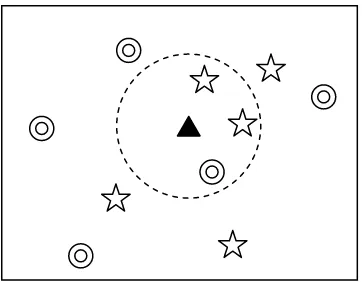
Figure 2.1 – The unknown test point (triangle) is classified as the class that occurs most often
within its closest neighbors. In this case, a star. ... 3
Figure 2.2 -There are many hyperplanes that could be used to separate the two classes of data. .. 6
Figure 2.3 – The optimal hyperplane maximizes the margin or space between the datasets. The points touching the edges of the hyperplane are selected as the support vectors. ... 6
Figure 2.4 - Viola & Jones example face detection cascade ... 8
Figure 2.5 – Feature evaluation using the integral image ... 9
Figure 2.6 - CPU vs. GPU comparison of floating point operations per second. [16] ... 11
Figure 2.7 - CPU vs. GPU bandwidth comparison. [16] ... 11
Figure 2.8 - Transistor allocation for CPU and GPU. [16] ... 12
Figure 2.9 - CUDA Grid layout. [16] ... 15
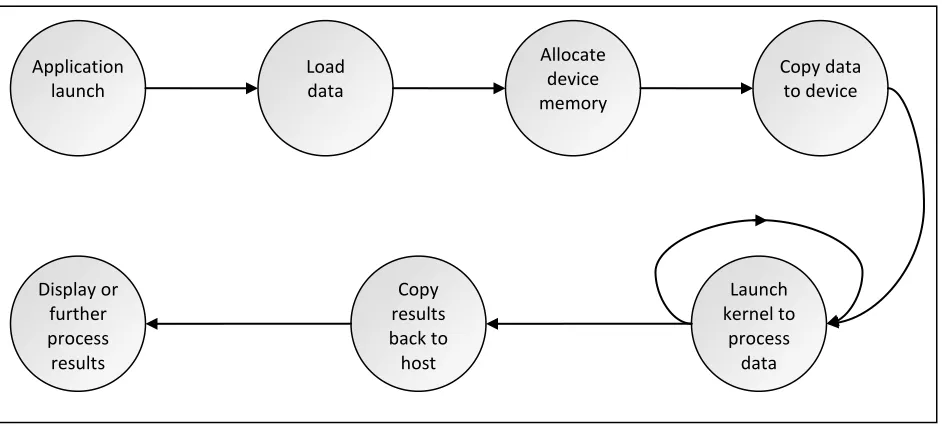
Figure 2.10 - Common CUDA program flow ... 17
Figure 2.11 - CUDA memory heirarchy. [16] ... 18
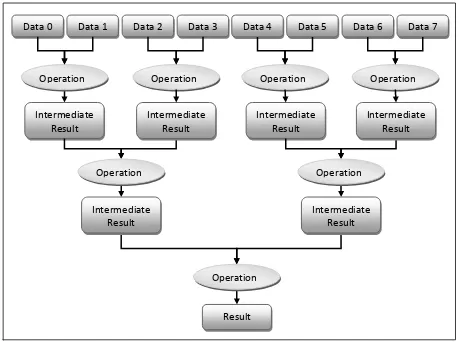
Figure 4.1 – Reduction as a tree of operations... 30
Figure 4.2 – Multiple reduction calls to process a list of data ... 31
Figure 4.3 - Binary tree depiction of scan procedure. ... 32
Figure 4.4 - Stream compaction example ... 33
Figure 4.5 - Depection of the 2D reduction. The values down each column are accumulated by the threads in the associated column of the overlapping thread block. ... 36
Figure 4.6 – Multi-GPU multiclass SVM algorithm ... 37
Figure 4.7 - Cascade structure ... 40
Figure 4.9 – Texture fetch conversion from int2 to double ... 42
Figure 4.10 – Tree structure from OpenCV trained classifier data file ... 44
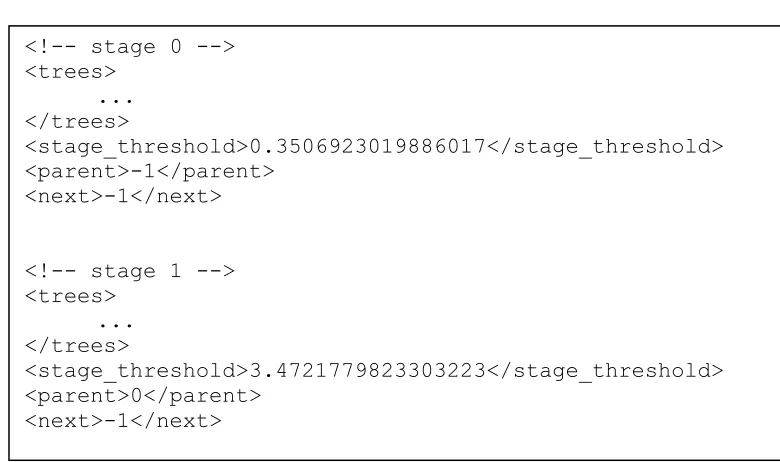
Figure 4.11 – Stage structure from OpenCV trained data file ... 45
Figure 4.12 – Pseudo code for scaled feature weight correction ... 48
Figure 4.13 – Alternating scale iterations are assigned to available GPUs to best balance the workload ... 49
Figure 4.14 - Parallel execution of scale iterations across multiple GPUs ... 50
Figure 4.15 – OpenCV detection function call ... 51
Figure 4.16 – CUDA detection function call ... 51
Figure 5.1 – Results for k-NN single test point classification ... 54
Figure 5.2 – Profiling of the k-NN CUDA implementation for 256 reference points, 1 query point and a dimension of 8192 ... 55
Figure 5.3 - Profiling of the k-NN CUDA implementation for 1024 reference points, 1 query point and a dimension of 8192 ... 56
Figure 5.4 – Results for k-NN nearest neighbor classifier (k=1) ... 56
Figure 5.5 – Profiling of the k-NN CUDA implementation for 8192 reference points, 4 query points and a dimension of 8192 with k=1 ... 57
Figure 5.6 - Profiling of the k-NN CUDA implementation for 8192 reference points, 8192 query points and a dimension of 8192 with k=1 ... 57
Figure 5.7 – Differences between OpenCV versions... 60
Figure 5.9 – CUDA implementation detection results on rehg-thanksgiving-1994, displaying all
detections without grouping ... 61
Figure 5.10 - OpenCV results after averaging and grouping of detected faces ... 62
Figure 5.11 – CUDA implementation results after averaging and grouping of detected faces .... 62
Figure 5.12 – Viola & Jones JUDYBATS results comparison ... 63
Figure 5.13 – Star Trek (original2) classification comparison ... 64
Figure 5.14 – News Radio classification comparison ... 65
Figure 5.15 – Seinfeld classification comparison ... 66
Figure 5.16 – Oksana classification comparison ... 67
Figure 5.17 – Plot of Viola & Jones speedup vs. the number of starting windows in an image .. 69
Figure 5.18 – Plot of speedup with transition to multi-GPU vs. the number of starting windows70 Figure 5.19 – Register usage effect on occupancy ... 71
L
IST OF
T
ABLES
Table 5.1- Number of support vectors in the trained classifiers ... 58
Table 5.2 - Multi-class SVM results for the MNIST database ... 58
Table 5.3 - Multi-class SVM results for the USPS database ... 58
G
LOSSARY
CPU Central Processing Unit
CUDA Compute Unified Device Architecture
CUDPP CUDA Data Parallel Primitives Library
Device A CUDA capable device (GPU)
GPGPU General-purpose computing on graphics processing unit
GPU Graphics Processing Unit
Host Referring to application execution on the CPU
OpenCV Open Computer Vision Library
OpenMP API for multi-platform shared-memory parallel programming
Chapter 1
–
I
NTRODUCTIONThe primary focus of this thesis is the efficient implementation of object detection and
classification algorithms on Graphics Processing Units (GPUs). These algorithms are crucial
components of many computer vision algorithms. In order to understand information from an
image or video, objects in the media need to be segmented and classified. It is often desirable to
process these images in real-time, however the object detection and classification algorithms
tend to be very computationally intensive. This work overcomes the processing limitations of the
above classification algorithms by offloading computation to the graphics processing unit (GPU).
The GPU is a massively parallel device which is capable of processing the large amounts
of data required to perform the classification and detection tasks very quickly. Speedups are
obtained over previous implementations by exploiting data independent calculations and
executing them in parallel on the GPU. Two of the algorithms in this work exploit an additional
level of parallelism by running multiple parallel tasks in parallel using multiple GPUs. The
implementations in this thesis were benchmarked against previous works, and the results were
analyzed to explain any performance bottlenecks.
The rest of this thesis is organized in the following manner. Chapter 2 provides the reader
with the background information necessary to understand the implementation details discussed
later. Each algorithm is detailed while the GPU hardware and CUDA are introduced. Chapter 3
describes supporting work for the algorithms covered in this thesis. Additionally, the differences
between the previous work and the current implementations are covered. Chapter 4 discusses the
CUDA implementation for each of the algorithms covered in this work. The implementation
implementation. Both the classification accuracy and timing benchmarks are provided and
discussed. Chapter 6 details possible extensions to the algorithms covered in this work. Lastly,
Chapter 7 provides final conclusions and closing remarks.
Chapter 2
–
B
ACKGROUND2.1
-
K-N
EARESTN
EIGHBORC
LASSIFICATIONK-Nearest Neighbor (k-NN) classification is among the simplest of classification
algorithms and a good first choice when little knowledge about a dataset is available. A query
point is classified by a majority vote of the k closest training points (neighbors), with the object
being assigned to the most common class.
The k-NN algorithm has been used in a wide variety of applications including optical character
recognition [1] [2], content-based image retrieval, signal processing [3] and fraud detection [4].
In the base algorithm, the training phase consists of storing feature vector representations of
training data with associated class labels. Other k-NN algorithms attempt to reduce the number
of distance calculations to be performed. Among these methods are algorithms that organize the
training data into trees [5] or hash the training data into bins [6].
During classification, the query point is represented as a vector in the feature space.
[image:17.612.215.396.268.409.2]Distances from the query vector to all training vectors are computed, and the k closest samples Figure 2.1 – The unknown test point (triangle) is classified as the class that occurs most often within its closest neighbors. In this
are used to determine the class of the test point. This distance is often the sum of differences
between each element of two data vectors. As an example, the Euclidean distance is provided:
. ) ( 1 2 ) , (
n i i i q pEuclidean p q
D
Several different cases of the k-NN classifier were examined for possible implementation as each
one provides different levels of parallelism.
Classifying a single test point:
It is often the case that only a single point needs to be classified at a time. Consider for
example, processing a video feed where only a single frame of data is available. In this
case, there are two possible levels of parallelism:
1. Distance calculation between the test point and each training point
2. Difference calculations for the distance calculation between the test point and
each training point
As it offers a finer grain of parallelism, the latter case provides a greater number of
independent calculations for the GPU to process. As reported in Section 5.1.1, exploiting
these extra calculations provides a speedup over an existing CUDA k-NN
implementation.
Classifying multiple test points at a time:
Having multiple test points available for classification provides much more data for the
GPU to process. In this case, the distances between all test points and support vectors can
k distances. This case provides the greatest level of parallelism and a sufficient amount of
computation to utilize the GPU fully and efficiently.
Nearest neighbor classifier (k=1):
If only the nearest neighbor is used to classify the test point, a different approach can be
used for the final classification. When k is greater than one, the k shortest distances must
be determined, often with a sort. As reported in Section 5.1.2, when only the single
shortest distance is required, finding the minimum value can be less costly than
performing a full sort.
2.2
-
S
UPPORTV
ECTORM
ACHINESSupport Vector Machines (SVMs) [7] are another method for classifying data. This is
done by constructing a hyperplane that separates the classes. The base SVM implementation is a
binary classifier, which is only able to differentiate between two classes. SVMs have also been
adopted to solve multiclass problems [8] [9]. SVMs have been used for many applications
including face detection [10], data mining [11] and medical diagnosis [12].
2.2.1 -BINARY SUPPORT VECTOR MACHINES
The base SVM is a binary classifier. Binary support vector machines are able to differentiate
only between two classes. During the training phase, a hyperplane is found that separates the two
different classes with a maximum margin as seen in Figure 2.3 below. Only the training points
During classification, the algorithm merely needs to determine on which side of the
hyperplane the query point lays. This can be done by computing a relatively simple decision
function:
𝐼 𝑧 = 𝑠𝑖𝑔𝑛 𝛼𝑖𝐾 𝑧, 𝑐𝑖 + 𝑏0 𝑆𝑢𝑝𝑝𝑜𝑟𝑡𝑉𝑒𝑐𝑡𝑜𝑟𝑠
α = Support vector weight c = Support vector z = Test vector b = bias
K = kernel function
The kernel function above should not be confused with CUDA terminology. The SVM
kernel is a function that maps the input data into a higher dimensional space so the two classes
can be separated more easily. Common kernels include:
Linear: 𝐾𝐿𝑖𝑛𝑒𝑎𝑟(𝑎, 𝑏) = 𝑎 ∙ 𝑏𝑇
Polynomial of degree n: 𝐾𝑃𝑜𝑙𝑦𝑛𝑜𝑚𝑖𝑎𝑙 𝑎, 𝑏 = (𝑎 ∙ 𝑏𝑇+ 1)𝑛
Radial Basis Function (RBF): 𝐾𝑅𝐵𝐹 𝑎, 𝑏 =− 𝑎−𝑏 2𝜎2 2
Figure 2.3 – The optimal hyperplane maximizes the margin or space between the datasets. The points touching the edges of the hyperplane are selected as
the support vectors. Figure 2.2 -There are many hyperplanes that could be
2.2.2 -MULTICLASS SUPPORT VECTOR MACHINES
The multiclass support vector machine extends the functionality of the binary support vector
machine to enable classification between three or more classes. The primary algorithms for
multiclass SVMs split the classification problem into multiple binary problems, each with its
own classifier. The two dominating implementations are:
One-against-all classification:
The one-against-all (OAA) classifier requires a trained SVM for each class. During
training, the label for the targeted class is set to positive while all other labels are set
to negative. During classification, each test point is run through each of the
classifiers. The test point is then assigned to the class with the maximum classifier
response.
One-against-one classification:
In the one-against-one (OAO) algorithm, a SVM is trained to differentiate between
each possible pair of classes. During classification, each test point is run through all
classifiers, and the point is assigned to the class chosen by the greatest number of
classifiers.
The accuracy of these classifiers was compared in [13]. The error rates were similar for
both algorithms across the datasets studied. From the aspect of this work, the classification
process for each is similar:
Run each test point through each of the trained classifiers
As such, the one-against-all classifier was selected for implementation but the one-against-one
classifier would have been an equally plausible choice.
2.3
-
V
IOLA&
J
ONESO
BJECTD
ETECTIONViola & Jones [14] is a commonly used object detection algorithm that is well-known for
its face detection performance.
2.3.1 -CASCADE OF WEAK CLASSIFIERS
The Viola and Jones object detector is a strong classifier composed of many weak
classifiers. These weak classifiers are simple to allow for fast processing, only performing a
weighted sum of rectangular features. By combining these weak classifiers into a cascade, a final
classifier is created that is able to eliminate non-face regions quickly while keeping nearly all
face regions.
In order to process images in real-time, the earlier cascade stages have a limited number
of features and attempt to remove only windows that have a low probability of being faces. As
the cascade stages progress, a greater number of increasingly complex classifiers are used to
Stage 0: 3 features
NOT
Face Face
Stage 1: 9 features
Stage 19: 108 features
Not Face Not Face Not Face
Face Face
Face …
reduce false positive classifications. If one of the cascade stages classifies a window as non-face,
no further stages process it. This ensures that only the regions with a high probability of being
faces will be subjected to the more intensive computations.
2.3.2 -INTEGRAL IMAGE
Viola and Jones were the first to introduce the concept of an integral image or summed
area table (SAT). The integral image at location x, y contains the sum of the pixels above and to
the left of x, y, inclusive.
𝑖𝑖 𝑥, 𝑦 = 𝑖(𝑥′, 𝑦′)
𝑥′≤𝑥,𝑦′≤𝑦
Using the integral image, the sum of any rectangular feature can easily be calculated with only a
few array lookups rather than a runtime pixel by pixel summation. A feature at location (x, y)
with width w and height h can be calculated using the integral image with four array references.
) 1 , 1 ( ) 1 , 1 ( ) 1 , 1 ( ) 1 , 1 ( ) , , ,
(x y wh ii x y ii xw yh ii x yh ii xw y RecSum
These lookups are depicted in Figure 2.5 below.
R
R
e
e
c
c
S
S
u
u
m
m
(
(
x
x
,
,
y
y
,
,
w
w
,
,
h
h
)
)
ii(x-1, y-1)
ii(x-1, y+h-1)
ii(x+w-1, y-1)
ii(x+w-1, y+h-1)
A variant of the integral image stores the squared sum for use in calculating the standard
deviation.
𝑖𝑆𝑖 𝑥, 𝑦 = 𝑖 𝑥′, 𝑦′ 2
𝑥′≤𝑥,𝑦′≤𝑦
Tilted features are not within the scope of this thesis, however their support would
require an additional integral image. As described in [15], a rotated integral image can be used to
compute the values of 45º rotated rectangles. The rotated integral image is defined as the sum of
the pixels of a rotated rectangle with the bottom most corner at (x, y) and extending upwards to
the boundaries of the image.
' ' , ''
,'
)
,
(
x x y y y yy
x
i
y
x
iRi
In order to detect objects of different sizes, the classifier is run over the image multiple
times. Before each iteration, the classifier window and features are scaled larger until one of the
window dimensions is greater than its associated image dimension. These independent iterations
provide a source of parallelism, allowing multiple feature scales to be processed in parallel.
In order to find objects at different locations in an image, the classifier window slides
across the image. As the window slides across the image, the step size or spacing between one
window and the next is a function of the current feature scale. Processing independent windows
at multiple locations offers an additional level of parallelism.
2.4
-
G
RAPHICSP
ROCESSINGU
NIT(GPU)
Traditionally, graphics processing units have been used as dedicated rendering devices
increasingly programmable and are now capable of performing much more than graphics specific
computations. The specialized rendering hardware provides an advantage for the GPU over the
[image:25.612.141.472.172.403.2]CPU when performing compute-intensive, highly parallel computations.
Figure 2.6- CPU vs. GPU comparison of floating point operations per second. [16]
[image:25.612.141.471.461.697.2]This advantage is primarily due to the transistor allocation for the GPU vs. the CPU. The
majority of the transistors on the GPU are devoted to data processing rather than flow control
and data caching.
Figure 2.8- Transistor allocation for CPU and GPU. [16]
2.5
GPGPU
P
ROGRAMMINGF
RAMEWORKSThe GPU is a powerful device, capable of processing a massive amount of data in a short
amount of time. However, software is required to program the GPU actions, and programming
interfaces are required to access the hardware.
2.5.1 –LEGACY ENVIRONMENTS
Early GPGPU relied on lower level languages such as OpenGL for programming the
devices. OpenGL is primarily used for programming 2D and 3D graphic applications but
provides access to the hardware that GPGPU requires. GPGPU programming through OpenGL
requires a great deal of knowledge about the hardware such as textures and shaders.
Programming through OpenGL and other early frameworks is considered a very low level
2.5.2 –SH AND BROOK FOR GPUS
Sh and Brook for GPUs (BrookGPU) were two of the earliest high-level languages and
programming environments. These programming frameworks provide a level of abstraction from
the graphics hardware so the programmer does not require in-depth knowledge of GPU textures
and shaders.
BrookGPU is a compiler and runtime implementation of the Brook stream programming
language, and it is implemented as an extension to the C programming language. Sh is a
metaprogramming language that is implemented as a C++ library. Both BrookGPU and Sh
support NVIDIA and ATI GPUs on both Windows and Linux. Sh has been commercialized and
expanded with additional support for the cell processor and multicore CPUs. BrookGPU has
been adopted for use in ATI Stream.
2.5.3 -NVIDIACUDA
NVIDIA realized the necessity for an easy method to program these powerful devices.
“In November 2006, NVIDIA introduced CUDA, a general purpose parallel computing
architecture – with a new parallel programming model and instruction set architecture – that
leverages the parallel compute engine in NVIDIA GPUs to solve many complex computational
problems in a more efficient way than on a CPU.” [16]
As CUDA is a framework built around the C programming language, CUDA applications
are fairly easy to implement. However, a great deal of time and knowledge is required to
optimize the applications for the specialized hardware. Special care has to be taken with memory
access patterns and algorithm design to obtain maximum efficiency. CUDA is cross-platform but
2.5.4 -ATISTREAM
ATI Stream by AMD is a similar concept to that of NVIDIA’s CUDA. Both provide a
high level interface for programming the stream processors on the GPUs. ATI Stream utilizes
Brook+, a compiler and runtime package for GPGPU programming to provide control over GPU
hardware. ATI Stream is cross-platform but only runs on AMD GPUs. ATI Stream and CUDA
both have their positives and negatives. For the work of this thesis, NVIDIA’s CUDA was
preferred over ATI Stream for its previous use at the institution.
2.5.5 –OPENCL
NVIDIA and AMD both plan to support OpenCL (Open Computing Language). OpenCL
is the first open standard for general-purpose parallel programming of heterogeneous systems.
OpenCL supports not only GPU programming but also a diverse mix of multi-core CPUs, GPUs,
Cell-type architectures and other parallel processors such as DSPs. OpenCL will provide a
programming framework and environment most closely related to NVIDIA’s CUDA. During the
time period of this work, OpenCL was still very new so it was not considered for
implementation. However, it is believed the transition from CUDA to OpenCL would be a
relatively straightforward process.
2.6
NVIDIA
CUDA
As the majority of work required for this thesis is the implementation of existing
sequential algorithms using CUDA, some details regarding CUDA development must first be
2.6.1 -CUDAPROGRAMMING MODEL
CUDA programmers develop code for the GPU by creating C functions called kernels.
Only one kernel can be run on the device at a time, and all configured threads execute the kernel
in parallel. The threads are grouped into thread blocks which are then organized in a grid as seen
in Figure 2.9 below.
When a kernel is launched, the blocks of the grid are distributed to multiprocessors with
available execution capacity. The threads of a block execute concurrently on a single
multiprocessor. As each thread block completes its work, the multiprocessors are freed, and a
[image:29.612.167.444.336.693.2]new block is launched in its place.
To manage the numerous threads, the multiprocessor employs a single-instruction,
multiple-thread (SIMT) architecture. This allows each thread to execute independent of the other
threads on one of eight scalar processors. Instructions are issued to groups of 32 threads called
warps, which execute one common instruction at a time. If the instructions assigned to threads
within a warp differ due to conditional branching, the warp executes each path sequentially while
disabling threads that are not on the path. When all branch paths are complete, the threads join
back to the common execution path. It is for this reason that code within conditional statements
such as if/else should be limited.
Given the above information, it is now relevant to note that the GPUs of concern for this
work have the following specifications:
The maximum number of threads per block is 512
The maximum size of each dimension of a grid of thread blocks is 65535
The maximum number of active blocks per multiprocessor is 8
The maximum number of active threads per multiprocessor is 1024
The maximum number of active warps per multiprocessor is 32
CUDA also provides limited synchronization between threads of the same block via the
syncthreads function call. Upon hitting a syncthread, each thread will wait until all remaining
threads reach the call. Syncthreads is primarily used to coordinate communication between the
threads within a block to prevent read/write data hazards with shared or global memory. The
only way to synchronize across thread blocks is by breaking the computation into multiple
2.6.2 –CUDAPROGRAM FLOW
Most CUDA applications follow a set program flow. The host first loads data from a
source such as a text file and stores it into a data structure in host memory. The host then
allocates device memory for the data and copies the data to the allocated space. Kernels are then
launched to process the data and produce results. These results are then copied back to the host
for display or further processing.
2.6.3 -MEMORY HIERARCHY
As shown in Figure 2.11 below, there are five main regions of memory on the device.
Device Memory: All threads have read/write access to the device DRAM.
Registers: Each multiprocessor has read/write access to a limited number of 32 bit hardware
registers.
Shared Memory: All threads within a block have access to a common shared memory region.
The amount of shared memory available per multiprocessor is limited to 16 KB with a small
[image:31.612.72.543.244.457.2]quantity reserved for built in variables. Application launch Load data Allocate device memory Copy data to device Launch kernel to process data Copy results back to host Display or further process results
Constant Memory: A read-only constant cache is shared by all scalar processor cores and
speeds up reads from the constant memory when all threads of a half warp access the same
location. The total amount of constant memory is 64 KB. The cache working set for constant
memory is 8 KB per multiprocessor.
Texture Memory: A read-only texture cache is shared by all scalar processor cores and
speeds up reads from the texture memory space. The texture cache is optimized for 2D
spatial locality, so threads of the same warp that read texture addresses that are close together
will achieve best performance. The cache working set for texture memory varies between 6
[image:32.612.160.449.336.650.2]and 8 KB per multiprocessor.
CUDA also has a “local” memory space, which has the same speed as device memory. Local
memory is automatically used to store local scope arrays and additional variables if there are
insufficient registers available. The above mentioned data is summarized in Table 2.1 below.
Table 2.1 - Summary of CUDA memory heiarchy [17]
Memory Location Cached Access Scope
Register On-chip No Read/Write Individual thread Local Off-chip No Read/Write Individual thread
Shared On-chip No Read/Write All threads within a block Global Off-chip No Read/Write All threads + host
Constant Off-chip Yes Read All threads + host Texture Off-chip Yes Read All threads + host
The global memory bandwidth is used most efficiently when simultaneous memory
accesses by threads in a half-warp can be coalesced into a single memory transaction of 32, 64,
or 128 bytes. On devices with compute capability 1.3, coalescing is achieved for any pattern of
addresses requested by the half-warp as soon as the words accessed by all threads lie in the same
segment of size equal to:
32 bytes if all threads access 8-bit words,
64 bytes if all threads access 16-bit words, and
128 bytes if all threads access 32-bit or 64-bit words .
If a half-warp addresses words in n different segments, n memory transactions are issued;
therefore it is necessary to arrange data so that they can be read from global memory in a
coalesced manner. If coalescing reads is not possible, use of the texture cache is often the next
While discussing memory, it is worth mentioning zero copy. Introduced in CUDA 2.2,
zero copy allows GPU threads to access host memory directly. When data are written to zero
copy allocated memory from the device, the data transfer is automatically overlapped with kernel
execution. This however requires the host to synchronize explicitly with the device before
attempting to read any zero copy memory. Zero copy requires that the device can map host
memory; this can be checked by calling cudaGetDeviceProperties() and checking the
canMapHostMemory property.
2.6.4 -COMPUTE CAPABILITY
The compute capability of a device is defined by a major revision number and a minor
revision number. Devices with the same major revision number are of the same core architecture.
The minor revision number corresponds to an incremental improvement to the core architecture,
possibly including new features.
The algorithms in this work were developed to utilize the features of newer devices with 1.3
compute compatibility. The main advantages of compute capability 1.3 devices over earlier
devices include:
Support for double-precision floating point numbers
16,384 registers per multiprocessor vs. 8,192
Support for atomic functions operating in shared memory
Support for atomic functions operating on 64-bit words in global memory
2.6.5 –OCCUPANCY
Occupancy is defined as the ratio of the number of active warps per multiprocessor to the
maximum number of active warps. A higher occupancy results in the hardware being more fully
utilized. The greatest benefit from high occupancy is the latency hiding during global memory
loads. An increase in occupancy does not guarantee higher performance. As discussed in Section
2.6.1, each multiprocessor has a limited set of registers and shared memory. These resources are
shared between all thread blocks running on a multiprocessor.
Occupancy can be increased by decreasing the resources used by each thread in a block,
or by decreasing the number of threads launched in each block. As shared memory is manually
managed, local or global memory can easily be substituted instead. Register usage is more
difficult to manage as registers are automatically used during memory transfers and calculations.
CUDA provides two additional mechanisms to limit register usage.
The maxrregcount compiler flag can be used to specify the maximum number of
registers each CUDA kernel can use. If specified, the compiler uses local memory rather
than the extra registers.
The volatile keyword can also be used to limit register usage. Rather than immediately
evaluating a variable, the CUDA compiler may inline it to be evaluated later. This can
result in redundant calculations if the variable is used more than once. Each time the
variable is computed, additional registers may be used, increasing the register count. The
volatile keyword is essentially a method for suggesting that the compiler evaluates the
2.6.6 -MULTIPLE GPUS
CUDA supports the use of multiple GPUs in a single application. The GPUs are
completely independent of each other, with their own memory space and instructions. Each GPU
must be programmed and setup separately. Generally, a CPU thread is launched to manage each
GPU. The OpenMP API was selected to manage the host threads.
2.6.7 –OPENMP
OpenMP is a shared memory multiprocessing API that was selected to manage the host
level parallelism as it is:
Multi-Platform
A C/C++ interface
Portable and Scalable
Used by OpenCV1
OpenMP uses preprocessor directives to signify parallel blocks of code. For this work, the
typical OpenMP usage includes:
Set number of OpenMP threads to be equal to the number of GPUs in the system using
omp_set_num_threads()
Perform serial code block
Execute parallel code block via preprocessor directive #pragma omp parallel
Join threads
Execute serial code block
The next chapter examines some of the previous work that has been done with these
algorithms. Previous implementations and attempts at accelerating the algorithms are introduced
Chapter 3
–
P
REVIOUSW
ORKThe algorithms implemented in this thesis have already been functionally proven.
However, the required computation time often makes them impractical for use in real time
computer vision tasks. CUDA has been successfully used to accelerate applications in many
fields including cryptography [18], mathematical model simulations [19] and image processing
[20]. Many applications report speedups in the range of 1.5x to 400x depending on the degree of
parallelism in the algorithm.
3.1
–
K-N
EARESTN
EIGHBORC
LASSIFICATIONSince the introduction of k-Nearest Neighbors, many attempts have been made to
improve its performance. Many of these optimizations focus on restructuring or reformatting the
data to help minimize the search space for nearest neighbors.
The k-d tree method [5] relies on organizing the data into a binary tree where each
training point is stored as a node. Once established, the k-d tree allows a search to be performed
over only the closest neighbors of a query point, greatly reducing the work that has to be done.
While the use of k-d tree increases performance by decreasing the search space, it relies on
complex data structures and recursive tree traversal algorithms, neither of which map well onto
the GPU.
Gionis et al. [6] note that “if the number of dimensions exceeds 10 to 20, searching in k-d
trees and related structures involves the inspection of a large fraction of the database, thereby
doing no better than brute-force linear search” and instead examine a scheme for approximate
similarity search based on hashing. During training, a method called locality sensitive hashing
query point can then be accomplished by hashing the point and retrieving elements stored in the
bin that would contain the hashed query point.
As with k-d trees, the hashing method requires that the training data be preprocessed in
order to optimize classification. Instead of manipulating the training data for a more efficient
search, this work focuses on a linear search approach of computing the distance to all neighbors.
This approach exploits the parallelism of independent points and the underlying computations to
obtain a speedup over sequential implementations.
The brute force approach has been implemented on CUDA in [21]. This implementation
exploits multiple test points as the main source of parallelism as it computes and sorts distances
in parallel. This thesis extends the work in [21] by adding functionality to exploit different
sources of parallelism when dealing with fewer test points.
3.2
–
S
UPPORTV
ECTORM
ACHINESThe original foundation for Support Vector Machines was introduced in [22]. Since then,
several implementations have followed including LIBSVM and the SVM functionality of
MATLAB’s Bioinformatics Toolbox. Both of these applications provide the ability to train and
classify a support vector system. At the time of writing, LIBSVM [23] supported linear,
polynomial, RBF and sigmoid kernels, while MATLAB supported linear, polynomial, RBF,
multilayer perceptron (MLP) and user generated kernels.
In an effort to exploit the parallelism in SVM classification and training, two parallel
CUDA implementations have been developed. GPUSVM [24] reports a speedup of 81-138x over
CUBLAS2 to perform dot product calculations in parallel followed by a parallel reduction to
compute the classification sum for each test point.
CUSVM [25] followed GPUSVM with a similar implementation that also included
regression and support for mixed precision arithmetic. CUSVM supports only the Gaussian
kernel and few details on the classification implementation are provided. A speedup of 22x -
172x over LIBSVM is reported for various datasets.
In order to handle greater amounts of data and exploit additional parallelism, [26] used
CUDA to implement an incremental least squares SVM (LS-SVM) for handling billions of data
points with high dimensionality (up to 103). A speedup of 65x over a sequential CPU
implementation and over 1000x over LIBSVM is reported. LS-SVM processes chunks of data
points in parallel on the GPU using the vendor supplied CUBLAS library for matrix operations.
The calculation results are copied back to the CPU for final classification.
Zhang et al. [27] also take advantage of multiple test points by using a SVM to classify
windows, or sub-regions of an image in parallel. The GPGPU scan-window based object
detection framework was used to detect pedestrians with a speedup of “more-than-ten-times”
over a sequential CPU implementation. The low level GPGPU implementation process varies
greatly from that of CUDA.
As with k-NN, these previous works target multiple query points as the main source of
parallelism and design the parallel algorithms to exploit it best. This work used a previous SVM
implementation to exploit a different source of parallelism, multiple classifiers running across
multiple GPUs to create a multiclass SVM classifier.
3.3
–
V
IOLA&
J
ONESO
BJECTD
ETECTORViola and Jones introduced their object detection algorithm in [14]. This algorithm is
extended in [15] with the addition of rotated features and alternative boosting algorithms. This
extended algorithm was implemented as part of the OpenCV library. The OpenCV
implementation offers the ability to enable OpenMP to distribute strips of an image across
multiple CPU threads. The use of OpenMP allows OpenCV to exploit parallelism, but not at the
level of GPUs.
The concepts introduced by Viola and Jones are not only applicable for their object
detector. Several phases of the object detection process have been parallelized for use in other
projects. For example, [28] introduces a new integral image algorithm for the GPU. The
algorithm was implemented in Brook and uses parallel prefix sum operations to compute the
integral image in stages. A speedup of 10x over “the best available CPU implementation” was
reported for large images. Allusse et al. [29] also implement parallel integral image generation
but use the CUDPP3 library to perform the parallel sums for a speedup ranging from ~0.06x for
128x128 images to ~3x for 2048x2048 images.
While no other CUDA implementations of the Haar classifier based object detector could
be found, parallel implementations exist for other platforms. The work in [30] processes up to
three feature classifiers in parallel using a FPGA hardware architecture for a 35x speedup over a
similar sequential CPU implementation.
An exceptional amount of knowledge can be gained from the previous work, especially
the OpenCV implementation. However, implementing the Viola & Jones object detector on
CUDA required a substantially different implementation process.
The next chapter discusses this thesis’ GPU implementation of k-Nearest Neighbor
Classification, Multi-class Support Vector Machines and Viola and Jones Object Detection. This
includes both the high level algorithms and data parallel primitives that are required to perform
Chapter 4
–
GPU
I
MPLEMENTATIONMany computer vision tasks require fast response times. The proposed algorithms can be
very computationally intensive, making them difficult to use for real-time tasks. By taking
advantage of the parallel nature of these algorithms, execution on the GPU can be done in a
fraction of the original time. Offloading processing to the GPU also frees the CPU for other
tasks such as device IO, reporting or user interaction.
4.1
-
P
ARALLELP
RIMITIVESA set of data-parallel algorithm primitives are used quite frequently to implement parts of
larger algorithms. Fortunately, a variety of these parallel primitives have already been
implemented in CUDA.
Several of these are implemented as examples in the CUDA Software Development
Kit (SDK).
The CUDA Data Parallel Primitives (CUDPP) library also provides several
implementations.
Thrust is an open-source library that provides a high-level interface to many of these
parallel primitives.
Several of these primitives are used as part of the algorithms implemented in this thesis; any
libraries used will be detailed in later sections.
4.1.1 –REDUCTION
A reduction is a method for processing a list of data elements to build up a single return
value. In this thesis, reductions are used to find the sum and minimum value in a list of elements.
The operation for a sum reduction would be addition and min for a minimum reduction.
This process maps well onto the GPU where each thread block is responsible for reducing
a section of the data array. Each block produces a result and all of these results must then be
combined. This is accomplished by calling the kernel an additional time to reduce these results.
Operation
Result Data 0 Data 1
Operation
Intermediate Result
Operation
Intermediate Result
Data 2 Data 3
Operation
Intermediate Result
Data 4 Data 5
Operation
Intermediate Result
Operation
Intermediate Result
Data 6 Data 7
Operation
[image:44.612.77.536.70.412.2]Intermediate Result
As the operations involved in a reduction tend to be very simple, each thread within a
block does very little work. In order to hide latencies, it is often beneficial to have a single thread
process multiple elements. This is done by having each thread perform the operation while
reading multiple data points from global memory into shared memory. Once the data is in shared
memory, all threads work together to reduce the data. Additional information regarding the
NVIDIA SDK reduction implementation, including code, is available in the NVIDIA whitepaper
[31].
4.1.2 -SCAN
A scan, also known as a prefix sum, is an algorithm that produces an output array in
which every element is the sum of the elements before it. For example, an input of
a0,a1,a2...,an1
would produce the array
a0, a0a1 , a0 a1a2 ,..., a0a1a2...an1
.Call 0 – 4 blocks
In the CUDA SDK scan implementation, the threads within a thread block work together
to process the data in two phases. The first phase is called the up-sweep or reduce phase. This
phase performs a reduction to compute and store the intermediate partial sums. The second phase
is referred to as the down-sweep phase in which the partial sums are used to populate the output
array. As noted in [32], this process is most easily depicted as a binary tree:
Figure 4.3 - Binary tree depiction of scan procedure.
At each level of the down-sweep phase, each vertex is passed to the left child while the sum of
the vertex and the left child from the up-sweep phase is passed to the right child. The binary tree
data structure does not map well onto the GPU; it is merely a concept used to determine what
elements the threads in a block process. The above figure depicts an exclusive scan, where each
element in the results of a scan contains the sum of all previous elements. An inclusive scan contains
the sum of all elements up to and including the value at the index. The inclusive scan can be
constructed by shifting the results from an exclusive scan left and inserting the total sum in the
last position. Additional information regarding the NVIDIA SDK scan implementation,
including code is available in the NVIDIA whitepaper [33].
4.1.3 -STREAM COMPACTION
The stream compaction algorithm is used to remove unwanted values from an array of
decreasing memory usage, memory transfer bandwidth requirements and wasted processing.
Stream compaction requires two phases, the first of which determines the output indices for the
valid input data. The second phase places the input data into the output array at the indices
generated in the previous phase.
The first phase requires a secondary array that has a value of 1 in indices of important
values and a 0 in the indices of all other values. A scan is then performed on this array to
generate the output indices. This array is used as a lookup table to place the actual input values
into the output array as in the following example:
Stream compaction is implemented with two kernel calls. The first of which processes the scan,
and the second handles the copy to the output.
1 1 0 0 1 0 1 1 0 0 0 1
0 1 2 2 2 3 3 4 5 5 5 5 + + + + + + + + + + + 4 5 -1 -3 8 -2 6 9 -4 -9 -1 1
4 5 8 6 9 1
4 5 -1 -3 8 -2 6 9 -4 -9 -1 1
0 1 2 2 2 3 3 4 5 5 5 5 Phase 1: Scan
[image:47.612.157.455.310.642.2]Phase 2: Copy to output
4.2
–
A
LGORITHMI
MPLEMENTATIONS4.2.1 – K-NEAREST NEIGHBOR CLASSIFICATION
The work in [21] already provides a very fast and efficient implementation of the base
k-NN algorithm. The basic algorithm of this work is:
Compute the distances from all test points to all known vectors in parallel
Sort the distances for each test point in parallel
Take the square root of the closest k distances in parallel
Copy the results from the GPU to the CPU
Rather than duplicating this work, this thesis focused on optimizing the implementation for two
different cases: classifying a single test point and classifying test points when k=1.
4.2.1.1– Classifying a single test point
As the previous work focused on classifying multiple test points at a time, there was
sufficient data to fully and efficiently utilize the GPU without utilizing the finest grain of
parallelism. In the previous implementation, each thread was responsible for computing the
distance from a reference point to a query point by calculating
.
)
(
1 2 ) , (
n i i i qp
p
q
D
With only a single test point however, additional parallelism must be exploited to utilize
the device fully. The new implementation breaks the distance calculation apart, making each
2.i
i q
p
A parallel reduction is then used to accumulate the partial sums for each distance computation.
The previous algorithm resumes with a parallel sort of the distances to find the k closest
neighbors.
4.2.1.2– Nearest neighbor classifier (k=1)
The change to the algorithm in this case is simply substituting the parallel sort with a
minimum reduction. The CUDA SDK reduction example was used as the base reduction
algorithm. However, several changes were necessary.
The base reduction would simply return the minimum value of the list. For this
implementation, the index of the minimum value is also required. This requirement not
only introduces extra overhead, but also introduces divergent branches into the algorithm.
Fortunately, very limited work is done within the branches so the branch penalty should
be minimal.
The base reduction is designed to handle one-dimensional data arrays while the k-NN
data is two-dimensional. A naive solution would be to call the reduction kernel once for
each column of data. However, this will result in a great deal of kernel launch overhead.
Another approach would be to launch a thread block to reduce each column of the array.
This approach is more efficient than the previous but is still not optimal. The limited
number of threads per block makes it impossible to control how many values each thread
is responsible for accumulating before the reduction. Instead, a reduction was
implemented which used two-dimensional thread blocks. The threads in a column work
this manner, the threads within multiple blocks work together to reduce multiple columns
of the array at a time.
The initial reduction results in multiple partial sums for each column. These values are
then accumulated using another reduction.
4.2.2 –SUPPORT VECTOR MACHINES
The GPUSVM classifier was used as the binary classifier for the multiclass SVM
implementation. GPUSVM formats the support vectors and test points into matrices so all
calculations can be done with simple matrix multiplication. The kernel calculations are
performed using an NVIDIA provided matrix multiplication routine (SGEMM). A reduction was
then performed to accumulate the computed values.
An SVM was trained for each class in the database using GPUSVM. A multi-GPU
approach was used to run all test points through each of the classifiers. The maximum response
from all classifiers was then determined for each test point.
Figure 4.5 - Depection of the 2D reduction. The values down each column are accumulated by the threads in the associated column of the overlapping thread block.
Block (0, 0) Block (1, 0)
Several options are available for the final classification.
Find the maximum classifier response iteratively on the host:
This method provides the most straightforward implementation, but requires that the
results for each classifier be copied back to the host. The test points do not fit in
device memory all at once, so intermediate results are already copied back to the
device. For this reason, performing the final classification on the host has proven to
be the fastest for the tested databases. The final classification time was negligible
when compared to the amount of time taken for classification.
Find the maximum classifier response iteratively on the GPU:
This approach exploits the data independence of the test points to perform the final
classification of each test point in parallel. Each thread is responsible for classifying a
Test_Data = Read(Test Data File)
// Run test points through each classifier
In Parallel DO
CPU_ID = My CPU Thread ID
FOR CLASS_ID in CPU_ID:(num classes ÷ num GPUs) DO
Model = Read(CLASS_ID Classifier File)
Results[CLASS_ID] = Classify(Model, Test_Data)
CLASS_ID += num GPUs
// Perform the final classification
FOR TP in each test point DO
Class = MAX(Results[All Classes][TP])
test point by determining which classifier has the maximum response. As discussed
above, there is insufficient memory to hold all results on the device, so the
intermediate results are copied back to the host. In order to perform the final
classification on the device, these results must first be copied back to device memory.
The overhead of this memory transfer outweighs the benefits of the parallel
classification.
Perform a maximum reduction:
This method follows the same concept as the previous one: perform the final
classification in parallel. Rather than performing an iterative search for the maximum
value, a reduction could be used to find the maximum classifier response. However,
this method has the same drawback as the iterative approach on the GPU; the
intermediate results must first be copied back to the device. Additionally, most
multiclass problems have a limited number of classes. In the MNIST database [34]
for example, only ten values would need to be reduced for each test point. In this
case, the overhead of the reduction can easily outweigh the parallel benefits.
Ultimately, performing the final classification on the host offered the best performance. This
may change if, for example, enough memory is available to hold all results on the GPU rather
than copying them back to the host.
4.2.3 –VIOLA &JONES OBJECT DETECTOR
The OpenCV implementation of the Viola & Jones object detector was used as a
reference for the CUDA implementation. As such, the CUDA implementation was designed to
produce results that were similar to those produced by the OpenCV implementation. In order to
calculations. This requires that the CUDA implementation be run on a compute capability 1.3
card as earlier cards do not support double precision.
From a high level, the Viola & Jones program flow is as follows:
Read and preprocess the image using OpenCV
Create integral images
Copy integral images to device
Classify the image on the device
Copy detected faces back to the host and display the results
4.2.3.1– Training Data
OpenCV provides a set of pre-trained detectors for eyes, frontal faces, profile faces,
lower body, upper body and full body in the form of XML files. The OpenCV object detector
accepts the file name for a trained detector to use for classification. This file is read at application
launch and used to setup data structures to represent the cascade.
The cascade is composed of a set number of stages, each with a set number of trees. The
trees are composed of features which contain a set number of rectangles. To prevent the
overhead of copying the data structures to the device and the associated uncoalesced memory
accesses, the cascade data was hard coded in the CUDA kernels. An application was created to
parse the trained classifier data file and output CUDA classifier kernels. These kernels were then
Figure 4.7 - Cascade structure
4.2.3.2– Preprocessing
OpenCV is used to read and preprocess the image. The image is read in and converted to
an 8 bits per pixel, grayscale data array. The face detection example provided with OpenCV
performs histogram equalization over the entire image before generating the integral image. This
step is not necessary; thus it was not implemented in CUDA. However, histogram equalization is
a parallelizable process, making it a good candidate for a CUDA implementation.
4.2.3.3– Context Creation
A CUDA context is comparable to a CPU process. The context tracks all resources and
actions, allowing CUDA to clean up after itself automatically. The CUDA context must be
created for each GPU before any CUDA calls can be made in an application. To prevent the
context from being created during the classification call, a function was written to create the
context at application launch.
Cascade
Stage 0
Tree 0
Feature 0
Rect 0
...
Rect
N
...
Feature
N
...
Tree
N
...
...
...
...
As the Viola & Jones CUDA implementation is multi-GPU, some additional work must also
be done in this function.
Determine the number of GPUs in the system
Create a host thread for each device using OpenMP
Associate a CUDA device with each of the host threads
Enable zero-copy on each device
Create a CUDA context for each device under the associated host thread
4.2.3.4– Integral Image
As specified in Section 2.3.2, the integral image at location x, y contains the sum of the
pixels above and to the left of x, y, inclusive. The integral image can be quickly and easily
generated with a nested for loop over the columns and rows of the input image. As noted in
Section 3.3, it is also possible to generate the integral image on the GPU using two parallel
prefix sums and a matrix transpose. However, the performance gains from the parallel processing
offer a minimal speedup and actually cause a slowdown when working with smaller images. As
the results show in Section 5.3, the speedup is already acceptable for large images while a
slowdown for smaller images would be very detrimental. For this reason, the integral image is
built on the host and then copied to the device.
The integral image is used to calculate the values of face detection features. As the
features are not consecutive, it is not possible to coalesce the memory access to the integral
images. To account for this, and exploit any two-dimensional spatial locality that may exist in
the integral image fetches, the integral image is bound to the texture cache. The integral squared
squared values from images with large dimensions, resulting in very large values. In order to
support these large numbers, the integral squared image must store double precision values.
Unfortunately, the texture cache does not support double precision data. In order to bind
the integral squared image to the texture cache, it must first be converted to the CUDA int2 data
type. This is done by using a union in which either a double or int array can be set or read:
These values are then converted back to double precision values by the kernel when read from
the texture cache using built in CUDA intrinsic functions as suggested in [35].
In order to avoid the overhead of copying a large array of double precision numbers to
the device, an attempt was made to store the square root of the integral squared image. The value
would be calculated, as it was previously, but the square root would be taken before storing the
value into a single precision floating point array. The values were squared when being read back
on the device. This implementation was slower than storing double precision values, presumably
due to the overhead of taking the square root and then squaring each value. This method also
introduced a source of classification error due to the precision of the calculations.
static __inline__ __device__ double fetch_double(texture<int2, 2> t, int x,
int y) {
int2 v = tex2D(t, x, y);
re
![Figure 2.7 - CPU vs. GPU bandwidth comparison. [16]](https://thumb-us.123doks.com/thumbv2/123dok_us/55664.5113/25.612.141.472.172.403/figure-cpu-vs-gpu-bandwidth-comparison.webp)
![Figure 2.9 - CUDA Grid layout. [16]](https://thumb-us.123doks.com/thumbv2/123dok_us/55664.5113/29.612.167.444.336.693/figure-cuda-grid-layout.webp)
![Figure 2.11 - CUDA memory heirarchy. [16]](https://thumb-us.123doks.com/thumbv2/123dok_us/55664.5113/32.612.160.449.336.650/figure-cuda-memory-heirarchy.webp)