SIAM J. NUMER.ANAL. c 2013 Society for Industrial and Applied Mathematics Vol. 51, No. 3, pp. 1585–1609
ON THE ADAPTIVE SELECTION OF THE PARAMETER IN
STABILIZED FINITE ELEMENT APPROXIMATIONS
∗MARK AINSWORTH†, ALEJANDRO ALLENDES‡, GABRIEL R. BARRENECHEA§, AND
RICHARD RANKIN¶
Abstract. A systematic approach is developed for the selection of the stabilization parameter for stabilized finite element approximation of the Stokes problem, whereby the parameter is chosen to minimize a computable upper bound for the error in the approximation. The approach is ap-plied in the context of both a single fixed mesh and an adaptive mesh refinement procedure. The optimization is carried out by a derivative-free optimization algorithm and is based on minimizing a new fully computable error estimator. Numerical results are presented illustrating the theory and the performance of the estimator, together with the optimization algorithm.
Key words.stabilized finite element method, stabilization parameter, computable error bounds, derivative-free optimization
AMS subject classifications.65N15, 65N30
DOI.10.1137/110837796
1. Introduction.
The numerical approximation of the Stokes problem
gener-ally follows one of two complementary approaches. The first consists of using discrete
velocity-pressure spaces satisfying the discrete inf-sup condition. Many such methods
are available in the literature (see [20, 10] for extensive reviews). However, one
per-ceived drawback of this approach is the fact that the discrete spaces cannot be of the
same polynomial order in both variables while maintaining stability. The second
ap-proach consists of adding so-called stabilizing terms to the discrete formulation using
an equal (or the lowest unequal) order velocity-pressure combination. These
stabiliz-ing terms can depend on residuals of the equation at the element level or can simply
be based on compensating for the inf-sup deficiency of the pressure. For extensive
reviews on different alternatives for stabilized finite element methods, see [6, 30].
One characteristic feature of stabilized methods is the presence of a positive
con-stant multiplying the stabilization term. Naturally, the question of the selection of
the actual value of the stabilization parameter in practical computation arises, which,
although not affecting the rate of convergence, can have a significant impact on the
absolute value of the error. Considerable effort has been expended in the quest to
avoid having to make an ad hoc decision about the specific choice of the parameter.
∗Received by the editors June 17, 2011; accepted for publication (in revised form) March 20,
2013; published electronically May 28, 2013. The first and fourth authors were supported by the Engineering and Physical Sciences Research Council of Great Britain under the Numerical Algorithms and Intelligent Software (NAIS) for the evolving HPC platform grant EP/G036136/1.
http://www.siam.org/journals/sinum/51-3/83779.html
†Division of Applied Mathematics, Brown University, Providence, RI 02912 (mark ainsworth@
brown.edu).
‡Departamento de Matem´atica, Universidad T´ecnica Federico Santa Mar´ıa, Casilla 110-V,
Val-para´ıso, Chile ([email protected]). This author was supported by the Faculty of Science of Strathclyde University and Comisi´on Nacional de Investigaci´on Cient´ıfica y Tecnol´ogica – CONICYT (Chile) through a research studentship and grant 79090008, Fortalecimiento del grupo de An´alisis y Modelamiento Matem´atico, Valpara´ıso.
§Department of Mathematics and Statistics, University of Strathclyde, Glasgow G1 1XH, Scotland
¶Computational and Applied Mathematics Department, Rice University, Houston, TX 77005
1585
Variational multiscale methods (including residual-free bubbles and, recently, Petrov
Galerkin Enriched methods [22, 11, 4, 5, 3]) may be regarded as a systematic approach
to the selection of an explicit, closed form of the value of the stabilization parameter,
thereby rendering the methods parameter-free.
In this work our approach is based on the premise that the best parameter is the
one for which the error is minimal. Of course, the true value of the error is generally
unknown. However, if a computable quantity
η(α) is available, which depends on
the value
α
of the stabilization parameter, and for which a two-sided bound on the
true error in an appropriate norm
|||
(
e
V, e
P)
|||
holds, i.e., there exists a constant
c >
0
independent of
α, for which
(1.1)
c η(α)
≤ |||
(
e
V, e
P)
||| ≤
η(α),
then we may, in lieu of minimizing the true error, seek the value of
α
which minimizes
the value of
η(α). This approach constitutes an objective, rational approach to the
selection of the stabilization parameter. Of course, the quality of the results will
reflect the quality of the bounds (1.1): If
c
= 1, then we would be minimizing the
true error, but this is, of course, unrealistic. In any case, what is really needed is
for the value of
α
at which
η(α) has a minimum to coincide with the value of
α
at
which the true error has a minimum. The development of a method for defining a
computable quantity
η(α), satisfying (1.1) up to higher-order oscillation terms, is a
key component of our approach and occupies section 5. As a fringe benefit, we obtain
an expression for
η(α) which enables us to estimate the error for virtually any existing
stabilized method for the Stokes problem.
The search for the optimal value of the stabilization parameter has been
consid-ered before. For example, in [8] a residual based a posteriori error estimator was also
minimized in order to obtain a value for the stabilization parameter (see also [25] for
convection-diffusion problems), while in [31] the value is chosen by minimizing the
condition number of the associated Schur complement system for the pressure field.
The development of the measure
η(α) is only one part of the story and we must
also select an algorithm for approximating its minima. The expression for
η(α)
de-pends on the stabilized finite element approximation obtained using a particular value
α
for the stabilization parameter. Thus, each evaluation of
η(α) entails the
compu-tation of a finite element approximation.
Furthermore, one does not have ready
access to derivative information. These considerations suggest the use of a
derivative-free optimization (DFO) approach to search for the value
α
optfor which
η(α) is
minimized.
Numerical examples are presented showing the performance of the approach in
the case of a fixed mesh for a variety of stabilized finite element methods. The results
indicate that the algorithm does indeed enable us to select a near-optimal value of the
stabilization parameter. The approach is then applied to the case of finite element
approximation on a sequence of adaptively refined meshes, again yielding satisfactory
results.
We summarize the main features of the work:
•
the construction of a fully computable a posteriori error bound which is robust
with respect to the stabilization parameter and which is applicable to a wide
range of stabilized finite element methods;
•
the selection of the value of the stabilization parameter based on
minimiz-ing the a posteriori error bound; and
•
the combination of this approach with an adaptive refinement procedure.
ADAPTIVE SELECTION OF THE STABILIZATION PARAMETER
1587
The paper is organized as follows. In the next section we give some preliminaries
that will be needed throughout the manuscript along with a description of the different
stabilized finite element methods considered. Sections 3 and 4 are devoted to the
optimization procedure, the summary of the main results of the a posteriori analysis,
and numerical examples. Finally, the technical proofs related to the a posteriori error
estimate are given in section 5, and conclusions are drawn in section 6.
2. Preliminaries.
For a bounded open domain,
G
⊂
R
d, where
d
= 1,
2;
L
2(G)
denotes the space of square integrable functions over
G,
L
20(G) represents functions
belonging to
L
2(G) with zero average in
G,
H
1(G) is the usual Sobolev space, and
H
01(G) denotes the subspace of
H
1(G) consisting of functions whose trace is zero on
the boundary of
G. Let (
·
,
·
)
Gdenote the inner product in
L
2(G) (or in
L
2(G)
2,
L
2(G)
2×2when necessary). The norm of the space
H
m(G) is denoted by
·
m,G
,
with the convention that when
m
= 0 we have that
·
0,G=
·
L2(G). We use
bold letters to denote the vector-valued counterparts of the Sobolev and Lebesgue
spaces, e.g.,
H
10(G) =
H
01(G)
×
H
01(G), and use an extra underaccent to denote their
matrix-valued counterparts, e.g.,
≈
L
2(G) =
L
2(G)
2×2.
Let Ω
⊂
R
2be an open polygonal domain with boundary Γ. Let
{P}
be a family
of partitions of Ω, where each partition is built up using shape regular triangles
K
such that Ω =
K∈PK
and the nonempty intersection of two distinct elements is
either a single common edge or vertex of both elements.
2.1. Notation.
For convenience, we shall summarize all the notation used
through-out the manuscript related to the partition of the domain.
For a fixed partition
P
let
• E
denote the set of all edges;
• E
I⊂ E
denote the set of interior edges;
• E
Γ⊂ E
denote the set of boundary edges;
• V
denote the set
{
x
n}
of all element vertices;
•
Ω
n=
{
K
∈ P
:
x
n∈
K
for a fixed
x
n∈ V}
;
• E
n=
{
γ
∈ E
:
x
n∈
γ
for a fixed
x
n∈ V}
;
•
λ
ndenote the usual barycentric coordinate associated to the vertex
x
n∈ V
and let
λ
(n1)=
λ
n0
Tand
λ
(n2)=
0
λ
n T.
For an element
K
∈ P
let
•
Pn
(K) denote the space of polynomials on
K
of total degree at most
n;
• E
Kdenote the set containing the individual edges of the element;
•
Ω
˜
K
=
{
K
∈ P
:
K
∩
K
=
∅}
;
•
Ω
K=
{
K
∈ P
:
E
K∩ E
K=
∅}
;
• |
K
|
denote the area of
K;
•
v
K=
|1 K|K
v d
x
denote the mean value of
v
on the element
K;
•
h
Kdenote the diameter of
K;
•
n
ˆ
Kγ
denote the unit exterior normal vector to edge
γ
∈ E
K.
For an edge
γ
∈ E
let
•
Pn
(γ) denote the space of polynomials on
γ
of total degree at most
n;
• V
γ=
{
x
n∈ V
:
x
n∈
γ
}
denote the set of endpoints of an edge
γ;
• |
γ
|
denote the length of
γ.
We also define the projection operator Π
K:
L
2(K)
→
P
1(K)
2by
(2.1)
(
t
−
Π
Kt
,
θ
)
K= 0
∀
θ
∈
P
1(K)
2.
2.2. Model problem.
We are interested in the following Stokes problem: For
given data
f
∈
L
2(Ω), find a velocity
u
and a pressure field
p
such that
u
=
0
on Γ
and
(2.2)
−
νΔ
u
+
∇
p
=
f
and
∇ ·
u
= 0
in Ω
,
where
ν >
0 is the fluid viscosity. The weak formulation of the Stokes problem then
reads as follows: Find (
u
, p)
∈
H
10(Ω)
×
L
20(Ω) such that
(2.3)
A
(
u
, p;
v
, q) =
F
(
v
)
for all (
v
, q)
∈
H
10(Ω)
×
L
20(Ω),
where
(2.4)
A
(
u
, p;
v
, q) =
ν(
∇
u
,
∇
v
)
Ω−
(p,
∇
·
v
)
Ω+ (q,
∇
·
u
)
Ωand
F
(
v
) = (
f
,
v
)
Ω.
The well-posedness of problem (2.3) is a consequence of two facts: the bilinear
form
ν(
∇
u
,
∇
v
)
Ωis coercive on
H
10(Ω) owing to Poincar´
e’s inequality and hence is
also coercive on the subspace
(2.5)
X
=
v
∈
H
10(Ω) :
∇
·
v
= 0
,
and there exists a constant
β >
0 such that
(2.6)
sup
v∈H1 0(Ω)\{0}
(q,
∇
·
v
)
Ω∇
v
0,Ω
≥
β
q
0,Ω
∀
q
∈
L
20(Ω).
The constant
β
is known as the inf-sup constant for the domain Ω. For more details
concerning the well-posedness of problem (2.3), see [20].
2.3. Stabilized finite element methods.
For nonnegative integers
m, let
X
hm=
v
∈
L
2(Ω) :
v
|K∈
Pm
(K)
∀
K
∈ P
and
X
mh= (X
m h)
2
. Let
V
h
=
X
1h∩
H
10(Ω) and let
Q
h⊂
X
h1∩
L
20(Ω). A stabilized
finite element approximation of the Stokes problem then reads as follows: Find a pair
(
u
h, p
h)
∈
V
h×
Q
hsuch that
(2.7)
A
(
u
h, p
h;
v
, q) +
α
S
(
u
h, p
h,
f
;
q) =
F
(
v
, q)
∀
(
v
, q)
∈
V
h×
Q
h,
where
S
(
u
h, p
h,
f
;
q) is the stabilization term and the parameter
α
is a positive
con-stant, sometimes referred to as the
stabilization parameter
. Often, the developers of
a particular stabilized method give a recommendation
α
recfor the value of the
sta-bilization parameter to be used in practical computations, but in some cases no such
value is identified. Many stabilized finite element methods are available, and below
we give examples of stabilized finite element methods which can be used to
approx-imate the solution of the Stokes problem. We shall employ various combinations of
discrete velocity-pressure spaces, depending on the particular choice of stabilization
(see Table 1).
•
Galerkin least-squares type methods (GLS) [24, 30, 23, 19, 26]: The stabilizing
term is given by
S
(
u
h, p
h,
f
;
q) =
−
K∈Ph
2Kν
(
f
+ Δ
u
h− ∇
p
h,
∇
q)
K+
γ∈EI
|
γ
|
ν
([[p
h]]
γ,
[[q]]
γ)
γ,
ADAPTIVE SELECTION OF THE STABILIZATION PARAMETER
1589
Table 1
Discrete velocity-pressure space combinations used in conjunction with the stabilized formulations.
Method Velocity spaceVh Pressure spaceQh P2
1−P0 X1h∩H01(Ω) Xh0∩L20(Ω) P2
1−Pcts1 X1h∩H01(Ω) Xh1∩L20(Ω)∩ C(Ω) P2
1−Pdis1 X1h∩H10(Ω) Xh1∩L20(Ω)
where [[v]]
γdenotes the jump of
v
across
γ, and may be used in conjunction with a
P
21
−
P
cts1or a
P
21−
P
dis1or a
P
21−
P
0pair. For this type of method the stabilization
parameter is often recommended to be taken as
α
rec= 1/24.
•
Brezzi and Pitk¨
aranta (BP) [12]: The stabilizing term reads
S
(
u
h, p
h,
f
;
q) =
K∈Ph
2Kν
(
∇
p
h,
∇
q)
Kfor a
P
21−
P
cts1
pair. For this method the authors do not recommend a particular
choice of
α, so in the absence of further information, we select
α
rec= 1.
•
Polynomial pressure methods (PPS) [9, 17]: The stabilizing term reads
S
(
u
h, p
h,
f
;
q) =
K∈P1
ν
((I
−
Ψ)p
h,
(I
−
Ψ)q)
K,
and the operator Ψ may be taken as (Ψv)
|K=
v
Kfor the
P
21−
P
cts1
pair or a Cl´
ement-like interpolant for the
P
21−
P
0pair. (See section 6 in [9] for more details about the
operator Ψ.) This method is recommended with a stabilization parameter
α
rec= 1.
See also [7] for a more general version of this class, called local projection stabilized
methods.
All the previous methods constitute stable and convergent schemes. However,
alternative methods exist based on discretizing a regularization of the basic Stokes
problem. Such methods, while stable, are inconsistent and nonconvergent in general,
but can nevertheless deliver useful approximations if the value of the regularization
parameter
α
is judiciously selected. One example of such a method is the following:
•
Penalty pressure-type methods (PEPS) [13]: The stabilizing term reads
S
(
u
h, p
h,
f
;
q) =
K∈P(p
h, q)
Kand may be used in conjunction with a
P
21−
P
cts1
or a
P
21−
P
1disor a
P
21−
P
0pair. We
take
α
rec= 1.
The estimators that we obtain are valid for all the above mentioned methods.
Moreover, they remain valid in the case of nonhomogeneous Dirichlet data
u
=
u
Don Γ, for given
u
D∈
X
1h∩
H
1(Ω). Furthermore, from now on,
c
and
C
will denote
positive constants which are independent of any mesh size, the viscosity
ν, and the
stabilization parameter
α.
3. An algorithm for selecting the stabilization parameter on a given
mesh.
Although the a priori rate of convergence of a stabilized method is independent
of the value of the stabilization parameter (provided the discrete problem is
well-posed), the absolute value of the error varies depending on the choice of the parameter.
In order to illustrate this point we consider two example problems.
Problem
1.
We consider Ω = (0,
1)
2(the unit square).
For this domain, a
lower bound of 0.38 for the value of the inf-sup constant
β
is proved in [32]. We
took
ν
= 1 and let
f
be such that the exact velocity and pressure are given by
u
=
[x
2(x
−
1)
2y(y
−
1)(2y
−
1),
−
y
2(y
−
1)
2x(x
−
1)(2x
−
1)] and
p
=
xy(1
−
x)(1
−
y)
−
1/36.
Problem
2.
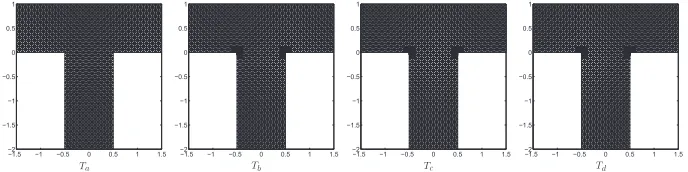
We consider the T-shaped domain Ω = ((
−
1.5,
1.5)
×
(0,
1))
∪
((
−
0.5,
0.5)
×
(
−
2,
1)). From [32] we have that 0.1 is a lower bound for the
inf-sup constant
β
for this domain. We took
ν
= 1 and let
f
=
0
and imposed Dirichlet
boundary conditions of
u
= (y,
0) on
x
=
±
1.5,
u
= (1,
0) on
y
= 1 and
u
= (0,
0)
elsewhere on the boundary.
We shall present results for Problems 1 and 2 obtained using meshes
S
to
S
dand
T
ato
T
dshown in Figures 1 and 2, respectively.
The following norm is used to measure the velocity and the pressure errors:
|||
(
e
V, e
P)
|||
=
ν
2∇
e
V02,Ω
+
β
2e
P20,Ω1/2
.
The values of norms of the errors obtained for various stabilized schemes and
various values of the stabilization parameter on fixed meshes from Figures 1 and 2
are illustrated in Figures 3 and 4 for Problem 1. For Problem 2, since we do not have
at hand the analytical solution, we build a numerical reference solution and compute
the errors with respect to it. For that, we solved Problem 2 using a Taylor–Hood
discretization (
P
cts2
−
P
cts1) on a highly refined mesh which we obtained following the
same refinements as in Figure 2 (refine about the reentrant corners) until we built a
mesh with 261,348 elements, and used that solution as an “exact” solution to compute
the errors with respect to. The results are depicted in Figure 5. It is clear that in some
cases the choice of the parameter
α
can significantly affect the errors. In particular,
an inappropriate choice can result in a loss of a factor of two, or sometimes much
more, in the accuracy compared with a more judicious choice. In terms of practical
computation this means that a careful choice of
α
can sometimes be at least as effective
as a global mesh refinement.
Fig. 1. Uniform meshesSwith 512,Sa with 2048,Sbwith 4096, and Sc with 8192elements
and distorted meshSdwith 412elements for Problem1.
Fig. 2. Meshes Ta with 2560, Tb with 5076, Tc with 7108 and Td with 11,006 elements for
Problem 2.
[image:6.612.83.433.461.532.2] [image:6.612.91.435.575.661.2]ADAPTIVE SELECTION OF THE STABILIZATION PARAMETER
1591
Fig. 3. Comparison of the estimated and true errors for different values ofαusing meshSc
for Problem 1.
Fig. 4. Comparison of the estimated and true errors for different values ofα using meshSd
for Problem 1.
ADAPTIVE SELECTION OF THE STABILIZATION PARAMETER
1593
Fig. 5. Comparison of the estimated and true errors for different values ofα using meshTc
for Problem 2.
Ideally, we would like to select the best value of the stabilization parameter for
each problem, each mesh, and each discretization scheme. The following result, which
summarizes the findings of section 5, will be helpful in this respect.
Theorem 3.1.
Let
α >
0
and
e
V=
u
−
u
hand
e
P=
p
−
p
hdenote the error
in the velocity and pressure approximations obtained using a stabilized finite element
formulation. Then,
(3.1)
ν
∇
e
V0,Ω
≤
η
V(α),
β
e
P0,Ω
≤
η
P(α),
and
|||
(
e
V, e
P)
||| ≤
η(α),
where the velocity and pressure error estimators are given by
(3.2)
η
V(α)
2= Φ
2c+
ν
2Φ
2ncand
η
P(α)
2= (Φ
∗c+
ν
Φ
nc)
2,
respectively, and the total error estimator is given by
(3.3)
η(α) =
η
V(α)
2+
η
P(α)
21/2,
with
Φ
c,
Φ
ncand
Φ
∗c, being given in
(5.21)
,
(5.22)
, and
(5.29)
, respectively. Moreover,
there exists a positive constant
c
independent of
α
,
ν
and any mesh size, such that
(3.4)
c η
K(α)
2≤
K∈Ω˜Kν
2∇
e
V20,K
+
β
2e
P02,K
+
h
2Kf
−
Π
Kf20,K
,
where
η
K(α)
is given in
(4.1)
.
Proof
. The upper bounds follow from Theorems 5.2 and 5.3. The proof of (3.4)
is given in section 5.5.
It should be borne in mind that the estimator
η(α) is computed using the finite
element approximation obtained using the value
α
as the stabilization parameter.
The values of the quantities
η(α),
η
V(α), and
η
P(α) are shown along with the true
errors in Figures 3 to 5. We first observe that both components of the error and
the estimator seem sensitive to the choice of
α
and that both components of the
estimator have a similar qualitative behavior to the individual errors. We observe
as well that the total error
|||
(
e
V, e
P)
|||
and the complete estimator
η(α) are more
in agreement than both the components, in terms of sensitivity to the choice of
α.
Significantly, both exhibit minima at roughly the same locations. This correlation
suggests selecting the stabilization parameter
α
to minimize the upper bound
η(α)
for the true error
|||
(
e
V, e
P)
|||
. While the values of the estimated and true errors may
differ, the proximity of the minimizers means that the resulting choice of
α
will be
near optimal.
It remains to select an appropriate method for obtaining the minimizer of
η(α).
We use the trust-region DFO algorithm (see [14] and references therein) to
approxi-mate the minimizer of
η(α). For the reader’s convenience, we give a brief description
of the method, which is described in full detail in [15, 16].
We begin by choosing constants
ε
D,
Λ,
Δ
max>
0, 0
≤
tol
0≤
tol
1<
1, 0
< ω
0<
1
< ω
1and a trust-region radius Δ
0∈
(0,
Δ
max]. Construct a fully quadratic model
(in the sense of section 3 in [16]) by evaluating
η(α) at a set of three sample points
α
0=
{
α
1, α
2, α
3}
to obtain a quadratic interpolant, given by
m
0(α) =
c
0+
αg
0+
α
2H
0,
where
c
0, g
0, H
0∈
R
. Denote by
D
0(α) = max
{|
g
0+ 2αH
0|
,
|
2H
0|}
and choose any
initial point
χ
0from the sample points; in our case we take the one with minimum
value of
η(α). If there are two such choices for
χ
0, then choose the one maximizing
D
0(χ
0), and if there are still two choices, either is used at random. If there are three
such choices, then use a model-improvement algorithm (Algorithm 6.2 from [16]),
based on moving the sample points in order to obtain a fully quadratic model. Set
k
= 0.
If
D
k(χ
k)
≤
ε
Dcall Algorithm 6.2 from [16] to obtain a new quadratic model;
otherwise compute the step
s
kthat sufficiently reduces the model
m
k(α) by solving
the trust-region problem
min
s∈(−Δk,Δk)m(χ
k+
s).
Compute
η(χ
k+
s
k) and define
ρ
k=
η(χ
k)
−
η(χ
k+
s
k)
m(χ
k)
−
m(χ
k+
s
k)
.
ADAPTIVE SELECTION OF THE STABILIZATION PARAMETER
1595
If
ρ
k≥
tol
1or if both
ρ
k≥
tol
0and the model is fully quadratic, then the new
iterate
χ
k+1=
χ
k+
s
kreplaces the sample point with the largest value of
η(α),
resulting in a new sample set
α
k+1from which we obtain a new fully quadratic
model
m
k+1(α); otherwise use Algorithm 6.2 from [16] and define
m
k+1(α) to be the
(possibly improved) model.
Update the trust-region radius as follows. Set
Δ
k+1∈
⎧
⎪
⎪
⎨
⎪
⎪
⎩
{
min
{
ω
1Δ
k,
Δ
max}}
if
ρ
k≥
tol
1and Δ
k<
Λ
D
k(χ
k),
[Δ
k,
min
{
ω
1Δ
k,
Δ
max}
]
if
ρ
k≥
tol
1and Δ
k≥
Λ
D
k(χ
k),
{
ω
0Δ
k}
if
ρ
k<
tol
1and
m
kis fully quadratic,
{
Δ
k}
if
ρ
k<
tol
1and
m
kis not fully quadratic.
Take
α
opt= arg min
{
η(α) :
α
∈
α
k+1}
, increment
k, and repeat the algorithm.
In Figure 6 the DFO search is presented for the
GLS
(
P
21−
P
cts1
) and
PEPS
(
P
21−
P
0) methods using mesh
S
cfrom Figure 1 and mesh
T
dfrom Figure 2. We measure the
gain using the approximation
α
optof the optimal value for the stabilization parameter
compared with the recommended value
α
recby calculating the percentage gains, i.e.,
G
V= 100
η
V(α
recη
)
−
η
V(α
opt,V)
V(α
rec)
%,
where
α
opt,V≈
arg min
{
η
V(α)
}
,
G
P= 100
η
P(α
rec)
−
η
P(α
opt,P)
η
P(α
rec)
%,
where
α
opt,P≈
arg min
{
η
P(α)
}
,
G
= 100
η(α
rec)
−
η(α
opt)
η(α
rec)
%,
where
α
opt≈
arg min
{
η(α)
}
.
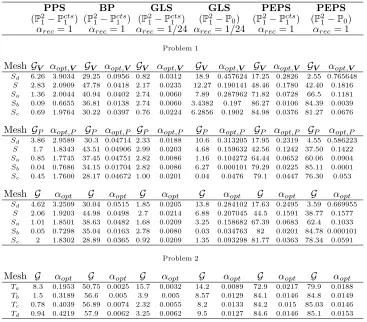
The findings of performing the DFO search on fixed meshes are shown in Table
2, where we present the percentage gains and the approximations of the optimal
value for the stabilization parameters
α
opt, α
opt,V, and
α
opt,P. We notice that the
optimal values achieved with the separate estimators are different, each one providing
a significant gain on the estimator. On the other hand, the value achieved by the
total estimator is (at least in most cases) between those two values and can provide a
significant reduction on the estimator. The numerical results from Figures 3–5 suggest
that this reduction, of up to 80% in some cases with respect to the reference value for
α, induces a significant gain on the error as well.
4. Selection of the stabilization parameter on a sequence of adaptively
refined meshes.
The results in the previous section are concerned with fixed meshes.
We now apply the approach in the context of an adaptive mesh refinement procedure,
driven using the local error indicator
(4.1)
η
K(α)
2= Φ
2c,K+
ν
2Φ
nc,K2+
Φ
∗c,K+
ν
Φ
nc,K2,
where Φ
cis given by (5.21), Φ
ncis given by (5.22), and Φ
∗cis given by (5.29).
Ideally, one would optimize over
α
on every mesh constructed throughout the
adaptive refinement procedure. In practice, the cost of such a procedure would be
prohibitive and, fortunately, is unnecessary. Instead we optimize the choice of
α
once
on the initial mesh, and then retain this value on all the subsequent adaptively refined
meshes.
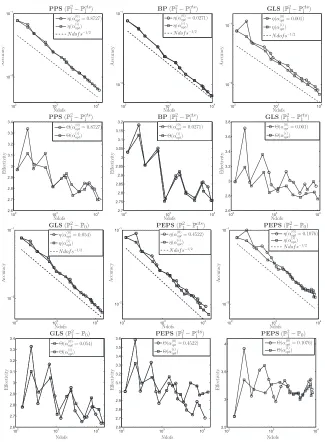
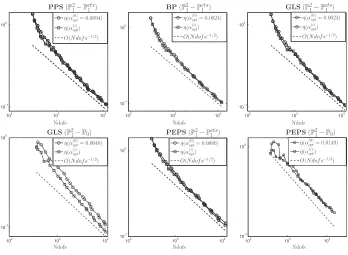
In Figures 7 and 8 we present the results obtained using both the
idealized
algo-rithm
and the proposed
practical algorithm
to approximate the same problems
consid-ered in the previous section. We define the effectivity index Θ(α) =
η(α)/
|||
(
e
V, e
P)
|||
Fig. 6.DFO search for Problems 1and 2on fixed meshesSc andTd, respectively.
and show the performance of the algorithms for a variety of stablized methods. The
meshes used to start the algorithms are shown in Figure 9. The results show the
good behavior of the error estimator and that the performance of both algorithms
is virtually identical, indicating that the optimal choice of
α
changes little from the
value obtained based on the initial coarse mesh.
ADAPTIVE SELECTION OF THE STABILIZATION PARAMETER
1597
Table 2
Percentage gainsG,GV,GP, andαopt’s for Problem 1using the fixed meshesSd,S,Sa,Sb,
andScand for Problem 2using the fixed meshesTa,Tb,Tc, andTd.
PPS
BP
GLS
GLS
PEPS
PEPS
(
P
21−
P
cts1
) (
P
21−
P
cts1) (
P
21−
P
cts1)
(
P
12−
P
0)
(
P
21−
P
cts1)
(
P
21−
P
0)
α
rec= 1
α
rec= 1
α
rec= 1/24
α
rec= 1/24
α
rec= 1
α
rec= 1
Problem 1
Mesh
G
Vα
opt,VG
Vα
opt,VG
Vα
opt,VG
Vα
opt,VG
Vα
opt,VG
Vα
opt,VSd 6.26 3.9034 29.25 0.0956 0.82 0.0312 18.9 0.457624 17.25 0.2826 2.55 0.765648
S 2.83 2.0909 47.78 0.0418 2.17 0.0235 12.27 0.190141 48.46 0.1780 42.40 0.1816
Sa 1.36 2.0044 40.94 0.0402 2.74 0.0060 7.89 0.287962 71.82 0.0728 66.5 0.1181
Sb 0.09 0.6655 36.81 0.0138 2.74 0.0060 3.4382 0.197 86.27 0.0106 84.39 0.0039
Sc 0.69 1.9764 30.22 0.0397 0.76 0.0224 6.2856 0.1902 84.98 0.0376 81.27 0.0676
Mesh
G
Pα
opt,PG
Pα
opt,PG
Pα
opt,PG
Pα
opt,PG
Pα
opt,PG
Pα
opt,PSd 3.86 2.9589 30.3 0.04714 2.33 0.0188 10.6 0.313205 17.95 0.2319 4.55 0.586223
S 1.7 1.8343 43.51 0.04906 2.99 0.0203 4.68 0.159632 42.56 0.1242 37.50 0.1422
Sa 0.85 1.7745 37.45 0.04751 2.82 0.0086 1.16 0.104272 64.44 0.0652 60.06 0.0904
Sb 0.04 0.7686 34.15 0.01704 2.82 0.0086 6.27 0.000101 79.29 0.0225 85.11 0.0001
Sc 0.45 1.7600 28.17 0.04672 1.00 0.0201 0.04 0.0476 79.1 0.0447 76.30 0.053
Mesh
G
α
optG
α
optG
α
optG
α
optG
α
optG
α
optSd 4.62 3.2509 30.04 0.0515 1.85 0.0205 13.8 0.284102 17.63 0.2495 3.59 0.669955
S 2.06 1.9203 44.98 0.0498 2.7 0.0214 6.88 0.207045 44.5 0.1591 38.77 0.1577
Sa 1.01 1.8501 38.63 0.0482 1.68 0.0209 3.25 0.158682 67.39 0.0683 62.4 0.1033
Sb 0.05 0.7298 35.04 0.0163 2.78 0.0080 0.03 0.034763 82 0.0201 84.78 0.000101
Sc 2 1.8302 28.89 0.0365 0.92 0.0209 1.35 0.093298 81.77 0.0363 78.34 0.0591
Problem 2
Mesh
G
α
optG
α
optG
α
optG
α
optG
α
optG
α
optTa 8.3 0.1953 50.75 0.0025 15.7 0.0032 14.2 0.0089 72.9 0.0217 79.9 0.0188
Tb 1.5 0.3189 56.6 0.005 3.9 0.005 8.57 0.0129 84.1 0.0146 84.8 0.0149
Tc 0.78 0.4039 56.89 0.0074 2.32 0.0055 8.2 0.0133 84.2 0.015 85.03 0.0146
Td 0.94 0.4219 57.9 0.0062 3.25 0.0062 9.5 0.0127 84.6 0.0146 85.1 0.0153
Idealized algorithm: Adaptive mesh refinement and DFO search.
1:
Construct mesh
P
0. Set
i
= 0.
2:
Performing the DFO algorithm on the fixed mesh
P
i, compute
α
(opti).
3:
For each element
K
in
P
i, compute a local error indicator
η
K(α
(opti)).
4:
Triangle
K
is marked for refinement if
η
K(α
(opti))
≥
12max
K∈Pi
η
K(α
(opti)).
5:
From step
4
deduce a new mesh using longest edge bisection refinement.
6:
Set
i
←
i
+ 1 and return to step
2
.
Practical algorithm: Adaptive mesh refinement and DFO search.
1:
Construct mesh
P
0.
2:
Performing the DFO algorithm on the fixed mesh
P
0, compute
α
(0)optand set
i
= 0.
3:
For each element
K
in
P
i, compute a local error indicator
η
K(α
(0)opt).
4:
Triangle
K
is marked for refinement if
η
K(α
(0)opt)
≥
12max
K∈Pi
η
K(α
(0)opt).
5:
From step
4
deduce a new mesh using longest edge bisection refinement.
6:
Set
i
←
i
+ 1 and return to step
3
.
Fig. 7.Performance of the idealized and practical algorithms applied to Problem 1.
5. A posteriori error estimator.
We now turn to the derivation of the error
estimator
η(α) used in the selection of the stabilization parameter.
5.1. The error equation.
Recall that
e
V=
u
−
u
h∈
H
10(Ω) and
e
P=
p
−
p
h∈
L
20(Ω) denote the errors in velocity and pressure, respectively, where (
u
, p) is the
solution of (2.3) and (
u
h, p
h) is the solution of (2.7). Thanks to (2.3) and (2.4), the
errors satisfy, for all
v
∈
H
10(Ω) and
q
∈
L
20(Ω),
(5.1)
A
(
e
V, e
P;
v
, q) =
K∈P(
f
,
v
)
K−
ν(
∇
u
h,
∇
v
)
K+ (p
h,
∇
·
v
)
K−
(q,
∇
·
u
h)
K.
[image:14.612.93.418.93.535.2]ADAPTIVE SELECTION OF THE STABILIZATION PARAMETER
1599
Fig. 8.Performance of the idealized and practical algorithms applied to Problem 2.
Fig. 9. Initial meshes S0 and T0 for Problems 1 and 2, respectively, for the idealized and
practical algorithms.
Let
{
g
γ,K}
be a set of equilibrated boundary fluxes which are such that
g
γ,K∈
P
1(γ)
2for each
γ
∈ E
Kfor all
K
∈ P
,
(5.2)
g
γ,K+
g
γ,K=
0
if
γ
=
E
K∩ E
Kfor distinct
K, K
∈ P
,
and, for all
K
∈ P
, satisfy the first-order equilibration condition
(5.3) (
f
,
θ
)
K+
γ∈EKg
γ,K,
θ
γ
−
ν
(
∇
u
h,
∇
θ
)
K+ (p
h,
∇
·
θ
)
K= 0
∀
θ
∈
P
1(K)
2
.
A process to obtain such equilibrated boundary fluxes will be described in section
5.3. Now, (5.2) allows us to incorporate the boundary fluxes into (5.1) and integrate
[image:15.612.83.431.95.350.2]by parts to yield
A
(
e
V, e
P;
v
, q)
=
K∈P
⎛
⎝(
r
K,
v
)
K+
γ∈EK(
R
γ,K,
v
)
γ+ (
f
−
Π
Kf
,
v
)
K−
(q,
∇
·
u
h)
K⎞
⎠
(5.4)
for all
v
∈
H
10(Ω) and
q
∈
L
20(Ω), where the interior residuals
r
K∈
P
1(K)
2are
given by
(5.5)
r
K= Π
Kf
− ∇
p
hon
K,
and the boundary residuals
R
γ,K∈
P
1(γ)
2are given by
(5.6)
R
γ,K=
g
γ,K−
ν
∇
u
h|Kn
ˆ
Kγ+
p
h|Kn
ˆ
Kγon
γ
∈ E
K.
Let
≈
σ
∗K
∈
P
2(K)
2×2be the unique solution to the following problem:
minimize
≈
σ
∗K
0,Ksubject to
≈
σ
∗K
n
ˆ
Kγ=
R
γ,Kon each
γ
∈ E
K,
−
div
≈σ
∗K
=
r
Kin
K.
Note that since integration by parts and (2.1) allow us to write (5.3) as
(5.7)
(
r
K,
θ
)
K+
γ∈EK(
R
γ,K,
θ
)
γ= 0
∀
θ
∈
P
1(K)
2,
the existence of such a
≈
σ
∗K
follows from [29]. Moreover, integration by parts also
yields that
(5.8)
≈
σ
∗K
,
∇
v
K
= (
r
K,
v
)
K+
γ∈EK
(
R
γ,K,
v
)
γ∀
v
∈
H
10(Ω).
Also, let
≈
σ
K=
≈
σ
∗K
−
curlζ
−
1
2
tr
≈
σ
∗K
−
curlζ
I
,
where tr denotes the trace of a matrix,
I
is the identity matrix, and
ζ
∈
H
10(K)
∩
P
3(K)
2is such that
≈σ
K0,Kis minimized. From [27], we know that
(5.9)
≈
σ
K,
∇
v
K
= (
r
K,
v
)
K+
γ∈EK
(
R
γ,K,
v
)
γ∀
v
∈
X
.
Formulas for the quantities involving
≈
σ
∗K
and
σ
≈Kwhich are required to compute our
estimator, namely,
≈
σ
∗K
0,Kand
≈σ
K0,K, are given in section 5.4.
5.2. Guaranteed upper bounds for the errors.
In order to obtain a
guar-anteed upper bound for the errors we use the Helmholtz-type decomposition of the
gradient of the velocity error from [18], given by
(5.10)
∇
e
V=
∇
e
c+
≈