Contents lists available atScienceDirect
Journal
of
Mathematical
Analysis
and
Applications
www.elsevier.com/locate/jmaa
Nonlocal
diffusion,
a
Mittag-Leffler
function
and a two-dimensional
Volterra
integral
equation
S. McKeea,∗, J.A. Cuminatob
a
DepartmentofMathematicsandStatistics,StrathclydeUniversity,Glasgow,Scotland,UnitedKingdom b
DepartamentodeMatemáticaAplicadaeEstatística,ICMC-USP- SãoCarlos,SãoCarlos,Brazil
a r t i cl e i n f o a b s t r a c t
Articlehistory:
Received9May2014
Availableonline2October2014 SubmittedbyM.J.Schlosser
Keywords:
Mittag-Lefflerfunction
Two-dimensionalVolterraintegral equation
Non-localdiffusion
Inthis paper weconsider a particularclassof two-dimensionalsingular Volterra integralequations.Firstlyweshowthattheseintegralequationscanindeedarisein practicebyconsideringadiffusionproblemwithanoutputfluxwhichisnonlocalin time;thisproblemisshowntoadmitananalyticsolutionintheformofanintegral. Morecrucially,theproblemcanbere-characterizedasanintegralequationofthis particularclass.Thisexamplethenprovidesmotivationforamoregeneralstudy:an analyticsolutionisobtainedforthecasewhenthekernelandtheforcingfunction arebothunity.Thisanalyticsolution,intheformofaseriessolution,isavariant oftheMittag-Lefflerfunction.Asaconsequenceitisanentirefunction.AGronwall lemmaisobtained.Thisthenpermitsageneralexistenceanduniquenesstheorem tobeproved.
© 2014ElsevierInc.All rights reserved.
1. Introduction
Inthisarticleweshallconsidertheclassof secondkindVolterraintegralequationsoftheform
y(t) =
t
0 τ
0
k(t, τ, σ)y(σ)
(t−τ)α(τ−σ)β dσ dτ+f(t), 0≤α, β <1, (1.1)
where(t, τ, σ)∈Ω=. {0≤σ≤τ ≤t ≤T}and y(0)=f(0).
Inaddition,thefunctions kand f areassumedtobesufficientlysmoothand k(t, t, t)≡0 forall t ∈[0, T].
2. A diffusionproblem
Considerthenonlocal(intime)diffusionproblem
* Correspondingauthor.
E-mailaddresses:[email protected](S. McKee),[email protected](J.A. Cuminato).
http://dx.doi.org/10.1016/j.jmaa.2014.09.067
∂c ∂t(x, t) =
∂2c
∂x2(x, t), 0< x <1, t >0, (2.1) ∂c
∂x(0, t) = 0, t >0, (2.2)
∂c
∂x(1, t) =− t
0
1
π(t−τ)c(1, τ)dτ, t >0, (2.3)
subjectto initialcondition c(x, 0)=c0.
Take LaplaceTransformswithrespectto t:
d2¯c
dx2(x, s)−s¯c(x, s) =−c0
yielding thesolution
¯
c(x, s) =A(s) cosh√sx+B(s) sinh√sx+c0
s,
where ¯c(x, s)=0∞e−stc(x, t)dt. From (2.2)wehave
¯
c(x, s) =A(s) cosh√sx+c0
s.
Set x = 1 andsolvefor A(s):
A(s) =
¯
c(1, s)−c0
s
/cosh√s
or
¯
c(x, s) =(¯c(1, s)−
c0
s)
cosh√s cosh
√
sx+c0
s. (2.4)
Differentiatewithrespectto xand employ(2.3):
(¯c(1, s)−c0
s)
cosh√s
√
ssinh√s=−L
t
0
1
π(t−τ)c(1, τ)dτ
=−√1
s¯c(1, s)
byconvolution. Therefore
¯
c(1, s) =c0
s −
coth√s
√ s 1 √ s ¯
c(1, s). (2.5)
However [2],
L−1 coth
√
s
√
s
= 1 + 2
∞
n=1
e−n2π2t= √1
πt
1 + 2
∞
n=1 e−n2/t
. (2.6)
Using (2.6)and applyingconvolutiontwiceweobserve that(2.5)transformsto
c(1, t) =c0− t 0 τ 0 1
π(t−τ)
1 + 2
∞
n=1
e−n2/(t−τ)
1
√
or
c(1, t) =c0−
1
√
π t
0 τ
0
1
(t−τ)1/2(τ−σ)1/2
1 + 2
∞
n=1
e−n2/(t−τ)
c(1, σ)dσ dτ. (2.7)
Wenotethatthisintegralequationisanexampleof theclass ofintegralsequationsgiven by(1.1).
3. Analyticsolution
Consider(2.5)and solveforc¯(1, s):
¯
c(1, s) = c0
s+ coth√s =
c0sinh√s
ssinh√s+ cosh√s. (3.1)
Usingtheresiduetheorem(fordetails,seeAppendix A)weobtain
c(1, t) = c0
π ∞
0
e−xtsin√xcos√x
x2sin2√x+ cos2√xdx (3.2)
or,alternatively,
c(1, t) = c0
π ∞
0
e−y2t
ysin 2y
y4sin2y+ cos2ydy (3.3)
writing y=√x.
Returningto(2.4)andnotingthat[1]
L−1 cosh √
sx
cosh√s
=π ∞
n=1
(−1)n−1(2n−1) cos 2n−1 2 πx
e−(2n−1)2π2t/4
thesolution c(x, t) maybewrittendownasaconvolution integral
c(x, t) =c0+ t
0
π ∞
n=1
(−1)n−1(2n−1) cos 2n−1 2 πx
e−(2n−1)2π2(t−u)/4
∗c0 π
∞
0
e−y2uysin 2y
y4sin2y+ cos2ydy−c0
du. (3.4)
Uponinterchangingtheintegralsandintegratingwithrespect to uweobtain
c(x, t) =c0
1 +π ∞
n=1
(−1)n−1(2n−1) cos(2n−1)πx 2
4 (2n−1)2π2
e−((2n−1)π)2t/4−1
+ 1
π ∞
0
e−y2t−e−((2n−1)π)2t/4
(((2n−41)π)2 −y2)(y4sin2y+ cos2y)ysin 2y dy
However,
4
π ∞
n=1
(−1)n−1 2n−1 cos
2n−1 2 πx
is readilyidentified astheFourierseriesofunity,so furthersimplificationispossible,giving
c(x, t) =c0
4
π ∞
n=1
(−1)n−1 (2n−1)cos
(2n−1)πx
2 e
−((2n−1)π)2t/4
+
∞
n=1
(−1)n−1(2n−1) cos(2n−1)πx 2
∞
0
(e−y2t
−e−((2n−1)π)2t/4
)ysin 2y dy
(((2n−41)π)2 −y2)(y4sin2y+ cos2y)
. (3.5)
4. Ananalyticsolutionto(1.1)whenk(t,τ,σ)≡1andf(t)≡1
Recall theintegralequation
y(t) =
t
0 τ
0
k(t, τ, σ)y(σ)
(t−τ)α(τ−σ)β dσ dτ+f(t), 0≤α, β <1. (4.1)
ByconsideringadiffusionprobleminSection2wewereabletodemonstratehowsuchintegralsmightarise and thishasprovided themotivationfor amoregeneralstudy ofthis classofintegralequations. Weshall firstconsider(4.1)abovewith k(t, τ, σ)≡1 and f(t)≡1.Weshallseethatitisthenpossibletowritedown ananalyticsolutionto thisintegralequation intermsofavariantof theMittag-Lefflerfunction[4].
Theorem 1.Theintegral equation (4.1)with k(t, τ, σ)≡1and f(t)≡1admits theanalyticsolution
y(t) =E2−α−β
Γ(1−α)Γ(1−β)t2−α−β (4.2)
where
Ea(z) =
∞
k=0 zk
Γ(ak+ 1), a >0, (4.3)
is theMittag-Lefflerfunction.
Proof. Byinterchanging theorderofintegrationin(4.1),itisreadilyseenthat
y(t) = 1 +B(1−α,1−β)
t
0
(t−τ)1−α−βy(τ)dτ (4.4)
where B(1−α, 1−β) istheBetafunction.SetupthePicarditerates
yn+1(t) = 1 +B(1−α,1−β) t
0
(t−τ)1−α−βyn(τ)dτ (4.5)
Supposethatafter kiterationswehave
yk(t) = k−1
ν=0
(Γ(1−α))ν(Γ(1−β))ν Γ((2−α−β)ν+ 1) t
(2−α−β)ν (4.6)
andthisis trueforall k= 1, 2, · · ·, n.
Weshallnowuseinductiontoprovethat(4.6)istruefor k=n +1,andconsequentlyall n.Consider(4.5):
yn+1(t) = 1 +B(1−α,1−β) t
0
(t−τ)1−α−β
n−1
k=0
(Γ(1−α))k(Γ(1−β))k Γ((2−α−β)k+ 1) t
(2−α−β)k
dτ
= 1 +B(1−α,1−β)
n−1
k=0
(Γ(1−α))k(Γ(1−β))k Γ((2−α−β)k+ 1)
t
0
(t−τ)1−α−βτ(2−α−β)kdτ. (4.7)
Nowwiththevariable transformation τ=wt,weseethat
t
0
(t−τ)1−α−βτ(2−α−β)kdτ =B2−α−β,(2−α−β)k+ 1t(2−α−β)(k+1).
Thus
yn+1(t) = 1 +B(1−α,1−β) n−1
k=0
(Γ(1−α))k(Γ(1−β))k Γ((2−α−β)k+ 1)
∗B2−α−β,(2−α−β)k+ 1t(2−α−β)(k+1)
= 1 +
n−1
k=0
(Γ(1−α))k+1(Γ(1−β))k+1 Γ((2−α−β)(k+ 1) + 1) t
(2−α−β)(k+1)
=
n
k=0
(Γ(1−α))k(Γ(1−β))k Γ((2−α−β)k+ 1) t
(2−α−β)k
whereusehasbeen madeofthestandardrelationship
B(x, y) =Γ(x)Γ(y)/Γ(x+y). (4.8)
Theinductionstepisthereforecomplete.Thus
y(t) = lim
n→∞yn(t) = ∞
k=0
(Γ(1−α))k(Γ(1−β))k Γ((2−α−β)k+ 1) t
(2−α−β)k
=E2−α−β
Γ(1−α)Γ(1−β)t2−α−β.
Since the Mittag-Lefflerfunction is an entire function,clearly the solution of (4.1)is also an entire func-tion. 2
4.1. Relationship with theexponential function
y(t) =E1(z) =E1
Γ(1−α)Γ(α)t= expΓ(1−α)Γ(α)t. (4.9)
This isalsoreadilyobtainablebyconsidering(4.4)which,inthecaseof β = 1−α,reduces to
y(t) =B(1−α, α)
t
0
y(u)du+ 1
yieldingthesolution
y(t) = expB(1−α, α)t= expΓ(1−α)Γ(α)t
since y(0)= 1.
5. Gronwallinequality
Lemma 1.Given
y(t)≤
t
0 τ
0
k(t, τ, σ)y(σ)
(t−τ)α(τ−σ)βdσ dτ+f(t), 0< α, β <1,
then
y(t)≤F E2−α−β
KΓ(1−α)Γ(1−β)t2−α−β (5.1)
where Ea(z)istheMittag-Lefflerfunction, |k(t, τ, σ)| < K and|f(t)| < F.
Proof. ConsiderthePicarditerates
yn+1(t) =F+K t
0 τ
0
yn(σ)
(t−τ)α(τ−σ)βdσ dτ, n= 0,1,2, . . .
with y0(t)=F.
Assumethat
yk(t)≤F ∞
k=0
Kk(Γ(1−α))
k(Γ(1−β))k Γ((2−α−β)k+ 1) t
(2−α−β)k
is trueforall k= 1, 2, . . . , n.
Theinductionproofisessentiallythesameas inTheorem 4.3 andweobtain
y(t) = lim
n→∞yn(t)≤nlim→∞F n
k=0
Kk(Γ(1−α))
k(Γ(1−β))k Γ((2−α−β)k+ 1) t
(2−α−β)k.
Againfollowing theideasofTheorem 4.3 itcanbe clearlyshownthat
y(t)≤F E2−α−β
6. Existenceanduniqueness
Inthis section weshall addressthequestionof existenceand uniquenessofasolution toEq. (1.1). We havethefollowing result.
Theorem 2. Let k(t, τ, σ) and f(t) be sufficiently smooth functions on Ω and [0, T] respectively. Then
Eq.(1.1) hasa uniquesolution.
Proof. From (4.2)weobservethat
φ(t) =E2−α−β
KΓ(1−α)Γ(1−β)t2−α−β
isthesolutiontothefollowingproblem
φ(t) = 1 +K t
0 τ
0
φ(σ)
(t−τ)α(τ−σ)β dσ dτ. (6.1)
Also,it followsfrom thedefinitionofthe Mittag-Lefflerfunctionthat φ(t) >1,∀t ∈[0, T], so thatwecan definethenormin C[0, T]:
x φ= sup t∈[0,T]
|x(t)|
φ(t)
(6.2)
whichisequivalenttotheinfinitenormin C[0, T],(see[3]).WeagainsetupthePicarditerationforsolving
(1.1),
y0(t) =f(t)
yn+1(t) =f(t) + t
0 τ
0
k(t, τ, σ)yn(σ)
(t−τ)α(τ−σ)βdσ dτ (6.3)
andprovethattheoperator H:C[0, T]→C[0, T] definedby
Hx(t) =f(t) +
t
0 τ
0
k(t, τ, σ)x(σ) (t−τ)α(τ−σ)βdσ dτ
iswell definedin C[0, T] andisacontractionintheBanachspace (C[0, T], · φ).
Thefactthat Hx ∈C[0, T] followseasilyfrom f and kbeing smoothfunctions.Now
Hx1(t)−Hx2(t)≤ t
0 τ
0
|k(t, τ, σ)| |x1(σ)−x2(σ)|
(t−τ)α(τ−σ)β dσ dτ
≤K t
0 τ
0
|x1(σ)−x2(σ)|
(t−τ)α(τ−σ)βdσ dτ (6.4)
where K= maxΩ{|k(t, τ, σ)|}.Dividing(6.4)throughby φ(t) andusingthedefinitionofthenorm · φwe
|Hx1(t)−Hx2(t)|
φ(t) ≤
K φ(t)
t
0 τ
0
|x1(σ)−x2(σ)| φ(σ)
φ(σ)
(t−τ)α(τ−σ)βdσ dτ
≤ K
φ(t) x1−x2 φ
t
0 τ
0
φ(σ)
(t−τ)α(τ−σ)β dσ dτ
= K
φ(t) x1−x2 φ 1
K
φ(t)−1
=
1− 1
φ(t)
x1−x2 φ =δ x1−x2 φ
where δ <1 since φ(t) >1,∀t ∈[0, T].
It remainstotakethesupremumof theleft-handsideto givetheresult
Hx1−Hx2 φ≤δ x1−x2 φ.
This provesthat H isacontraction.TheBanachfixedpoint theoremcanthenbe appliedtoshow that thePicarditerationconvergesto asolutionof(1.1).
To proveuniquenesswerequiretheGronwall lemmaoftheprevioussection.If x1(t) and x2(t) areboth
solutionsof(1.1)then z(t)=x1(t)−x2(t) isalsoasolutionof(1.1)with f(t)≡0.Clearly z(t) satisfiesthe
assumption ofLemma 1.Thislemma canthenbe appliedto z(t) togive
z(t)≤F E2−α−β
KΓ(1−α)Γ(1−β)t2−α−β
where F isthemaximumoftheforcingterm f,whichinthiscaseisidenticallyzero.Hence z(t) isidentically zeroandthis provestheuniquenessofthesolution. 2
Remark1.NotethatTheorem 2remainstrueeven whenEq.(1.1)is nonlineari.e. k≡k(t, τ, σ, y) aslong
as kisLipschitzcontinuousinthe y-variable,i.e.
k(t, τ, σ, y1)−k(t, τ, σ, y2)≤L y1−y2 , ∀(t, τ, σ)∈Ω
where ListheLipschitzconstant.
7. Concludingremarks
This paper has been concerned with a special class of two dimensional Volterra integral equations. A nonlocaldiffusionproblem wasintroducedanditwasshownthatthisproblemcouldbere-characterized as atwo-dimensionalVolterra integralequation oftype(1.1).Thediffusionproblemwasshownto havean analytic solution.
Withthismotivationtheintegralequationwasstudiedinmoredetail.Weshowedthat,whenthekernel andforcingfunctionarebothchosentohavethevalueofunity,thisgaverisetoananalyticsolutioninterms of avariantoftheMittag-Lefflerfunction.AGronwall inequalitywasdemonstrated andthenemployed to proveexistenceanduniqueness.
Acknowledgments
Fig. 1.Hankel contour.
Appendix A
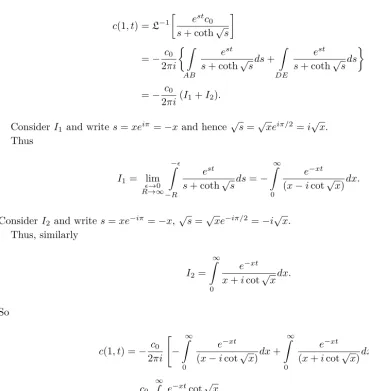
FromtheHankel contour(seeFig. 1)weobserve that
1 2πi
γ+i∞
γ−i∞
estc¯(1, s)ds=−
Hk
1 2πi
Hk
est¯c(1, s)ds
where the sum is over thesegments AB and DE. This isevident since theintegrals around thecircle of radius R (R→ ∞)andaroundthecircle BCD ofradius ( →0)arebothzero.
Thus
c(1, t) =L−1 e
stc 0 s+ coth√s
=− c0 2πi
AB
est
s+ coth√sds+
DE
est s+ coth√sds
=− c0
2πi(I1+I2).
Consider I1 andwrite s =xeiπ =−xandhence√s=√xeiπ/2=i√x.
Thus
I1= lim →0 R→∞
−
−R
est
s+ coth√sds=− ∞
0
e−xt
(x−icot√x)dx.
Consider I2 andwrite s =xe−iπ =−x,√s=√xe−iπ/2=−i√x.
Thus,similarly
I2=
∞
0
e−xt x+icot√xdx.
So
c(1, t) =− c0 2πi
−
∞
0
e−xt
(x−icot√x)dx+
∞
0
e−xt
(x+icot√x)dx
= c0
π ∞
0
or equivalently,
c(1, t) = c0
π ∞
0
e−xtsin√xcos√x x2sin2√x+ cos2√xdx.
References
[1]G.Doetsch,IntroductiontotheTheoryandApplicationsofLaplaceTransforms,Springer-Verlag,1974.
[2]B. Jumarhon, S. McKee, T. Tang, The proof of an inequality arising from a reaction–diffusion study in a small cell, J. Comput.Appl.Math.51(1994)99–101.
[3]D. Kershaw,SomeresultsforAbel–Volterraintegralequationsofthesecondkind,in:C.T.H.Baker,G.F.Miller(Eds.), TreatmentofIntegralEquationsbyNumericalMethods,AcademicPress,1982,pp. 273–282.