City, University of London Institutional Repository
Citation
: Sikora, I. (1998). Medium Range Aircraft Fuel Policy in the Light of Available
Software, and Knowledge in the Industry. Paper presented at the KoREMA,1998, 25 - 28
Nov 1998, Stubicke Toplice - Graz - Vienna, Croatia-Austria.
This is the unspecified version of the paper.
This version of the publication may differ from the final published
version.
Permanent repository link:
http://openaccess.city.ac.uk/2584/
Link to published version
:
Copyright and reuse:
City Research Online aims to make research
outputs of City, University of London available to a wider audience.
Copyright and Moral Rights remain with the author(s) and/or copyright
holders. URLs from City Research Online may be freely distributed and
linked to.
City Research Online:
http://openaccess.city.ac.uk/
[email protected]
MEDIUM RANGE AIRCRAFT FUEL POLICY IN THE LIGHT OF
AVAILABLE SOFTWARE, AND KNOWLEDGE IN THE INDUSTRY
Ivan Sikora
Flight Operations, Emirates Airline, Dubai, UAE
Summary
The rational use of fuel in aviation industry together with the improved operational safety level
and productivity are common and permanent goal that all airlines in the world strive to achieve.
Different environmental influences and constraints affect each of them through multiple layers of
activities. The constant awareness of them and mastering equipment airline exploits make
reach-ing those goals more viable. Croatia Airlines is the sole Croatian scheduled air carrier. Bereach-ing
ma-jor consumer of fuel and having in mind international sense that air transportation has Croatia
Airlines has to obey worldwide applied criteria. Paper lists environmental influences together with
airline characteristics that make fuel policy so important factor. It compiles theoretical foundation
together with methods used in formulating fuel policy. Operational data and its use for deriving
one of the indicators related to medium range aircraft fuel consumption are listed at the end.
1.
INTRODUCTION
Although airfoil and its properties were known to mankind long time ago the real spin off for avia-tion was its ability to exploit them. 1903. Kitty Hawk Wright Flier's flight was exactly the result of ability to produce enough power to go for speeds that put in use notions known by many other enthu-siasts before famous brothers. The machine they used that day had the source of energy that connects it with almost all other flying machines since than - fuel.
Fuel is one among other threads that today as well as than makes aviation possible. But as well as technology has advanced from the early days the number of factors and constraints in the industry have diversified, too. Even in such sophisticated and important field of human activity there are some basic elements each and every participant must take into take account. Airlines and manufac-turers common goal is to use the equipment in the best way.
And as it was stated in [1]:
"... tough competitive environment forces airlines to reduce their operational costs in every facet of their business. Every method to achieve this goal has to be taken into account. As safety and accident prevention are prime factors in aircraft operation they also must be taken into account. Beside them every airline has to take in account other aspects of air transport industry: Air Traffic Control, engine deterioration, flight operations management, in-strument accuracy or aerodynamic deterioration."
It is not intention to give ready made solutions to any of the problems mentioned in this paper. Its broad prospective is just to list and justify practices already in place and to focus future actions - papers on still to be formulated and implemented practices. Prior to going deeper into the explanation there are few terms mentioned in the paper that deserve definition.
EUROCONTROL = European agency for Air Traffic Control harmonization and implementation of agreed policies. It conducts studies, implements the results of research, maintains databases and strives to facilitate air traffic within the European congested airspace.
SITA = Originally set as ground communication network for air traffic users today provides different services for the same population. One among ser-vices is computer based flight planning.
LIDO = Set of services provided by one of the German Lufthansa Airlines' companies. Same as SITA provides access to different services but main application is computer based flight planning.
2.
FUEL POLICY
Fuel policy is affected by environment where airline operates. Influences can be put under three broad areas:
1.Administrative area - the law and legal con-straints,
2.Economics area - fuel prices,
3.Technology and operational area - airways and their availability, interaction between air-frame and power plant, internal acts and prac-tices within the firm.
2.1
Administrative area - the law and legal
constraints
Legal area within air transport industry can be divided into international and national jurisdiction. International jurisdiction covers broad regulatory issues applicable to production and certification of new and modification of existing aircraft type and models. Different international bodies issue regula-tions that has advisory role only (for example ICAO Annexes).
National jurisdiction further outlines and im-poses mores strict rules to operational issues related to aircraft registered in the particular country and operated by companies in it. If such a jurisdiction is within the country that produces aircraft itself or is well known for its good practices than it becomes accepted world wide as general rule.
2.2
Economics area - fuel prices,
[image:3.595.342.494.188.314.2]Commercial appeal of air transportation lies in the range aircraft can cover in relatively short time span. Simple logical reasoning leads to the conclu-sion that greater payload makes the cost per unit transported lower. Hence the amount of fuel used for such a transportation influences the fare to be charged per kg of cargo or a passenger transported. World has restricted oil reserves. They affect the price of jet fuel. While in the seventies that was much more important even today, at the end of the nineties, it can not be neglected. Air transportation is still if not the most efficient but than very close to that position considering passenger kilometer per liter of fuel used. Different manufacturers' and in-dependent sources as [2] lead us to figure 1.
Figure 1. Fuel Efficiency of Different Transporta-tion Modes
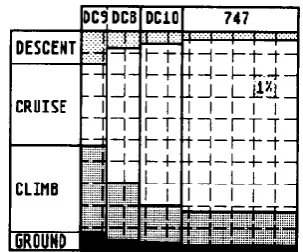
[image:3.595.76.280.613.730.2]If we focus on air transportation itself figure 2. differentiates particular flight phases for different aircraft types. With long range operation (the Boe-ing B747 or DC-10) main fuel consumption is in cruise, while short and medium range operations (DC 9 or DC 8) have spread that more evenly be-tween particular flight phases. Those differences than should be accounted for by different ap-proaches in relevant Fuel Policies.
Figure 2. Different Flight Phases Fuel Consumption by Aircraft Type
2.3
Technology and operational area -
air-ways and their availability, interaction
be-tween airframe and power plant, internal
acts and practices within the firm.
Technology and operational area (airways and their availability, interaction between airframe and power plant, internal acts and practices within air-lines) is the third broad area that acts upon and modifies Fuel Policy within a firm. The one of the most important characteristics of air transportation comparing it to the surface modes of transportation is the possibility of direct flight between two geo-graphical points. Unfortunately military flying and air traffic control made that characteristics genuine-ly preserved ongenuine-ly in certain world areas. Europe and the United States of America are not among them. One of the Eurocontrol studies has shown that for example distances between 11 European city pairs are 7.3% greater than their direct distance [2]. In the USA this difference is slightly smaller but still around 3%. Hence availability of air traffic routes affects Fuel Policy.
Contemporary computer based Flight Plan cal-culation services allow timely flight plan calcula-tion based on real time weather data over the area particular flight is to cover. Systems, provided by different companies (SITA, LIDO), give flexibility to Flight Operations within particular airline to ac-commodate for possible weather system constraints or any other factor it has to take care about (fuel prices, the way company wants to operate its fleet, Air Traffic Control). Aircraft equipment and the way it is operated should then follow prescribed flight plan parameters leading to flight profile and characteristics as close as possible to it.
[image:4.595.79.274.391.535.2]Even well chosen airframe and powerplant combination during time worsen in its performance. As any other hardware airframe follows similar pat-tern in its operational life. Exposure to specific en-vironment and conditions puts more emphasis on particular characteristics. Figure 3. shows aerody-namic critical areas related to their smoothness[3]. Thorough knowledge of that area gives advantage in setting maintenance procedures and standard practices. Strict adherence to them results in less penalty on fuel consumption and makes deciding whether corrective action should be taken more discretion free process.
Figure 3. Aerodynamic Smoothness Critical Areas One of areas where potential for the improve-ment lies is the understanding of relation between predicted and actual performance obtainable in dai-ly operation. Monitoring specific parameters within a fleet could lead to invaluable information that fur-ther delineate Fuel Policy or modify already ac-cepted one. This is basically post flight action where custom made software used in the proper manner can derive from available data invaluable guidelines for further operation.
3.
AIRPLANE PERFORMANCE
MONITORING
For any Flight Operations Department in an air-line flight starts long time before any of the passen-gers board the plane or cargo is put on its position in the cargo hold. Although they have certain
spe-cific aspects flight phases generally follow planning - execution - feedback flow. Each of these phases nowadays give an airline opportunity to apply au-tomation. It is only the matter of available funds and general mind set in the company whether it will opt for it or not. The wise use of automation leads to more safe, economical, and even more attractive product for general public.
3.1
Theoretical foundations
The aircraft performance deterioration versus baseline endows three main origins: engine perfor-mance degradation, airframe deterioration and op-erational environment related conditions. The craft performance baseline is established by the air-craft manufacturer and represents a fleet average of brand new aircraft and engines. This average is es-tablished in advance of production aircraft. Normal scatter of brand new aircraft leads to performance above and below the baseline.
Those reasons have forced aircraft manufactur-ers to develop different software packages in order to help airlines determine where aircraft in their fleets stand in relation to baseline aircraft. Airbus Industrie has developed "The Aircraft Performance Monitoring (APM)" and the "In-Flight Program (IFP)". These programs effectively compare rec-orded data with the performance baseline.
Being Airbus Industrie's customer Croatia Air-lines has been provided with APM and IFP soft-ware and has started to implement APM softsoft-ware in performance degradation trend monitoring in its operation for A320 aircraft. Commonality among Airbus Industrie aircraft is retained with that soft-ware too. Therefore its application for A319 or any other future fleet once the system is established is just the matter of different database use within main software module.
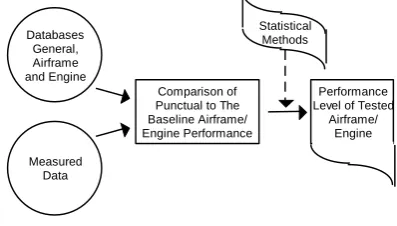
Once the data has been recorded and validated to be relevant for the further analysis it is further processed by the APM software. For each airframe and powerplant combination APM software uses corresponding databases. Figure 4. derived from [4] delineates the applied procedure.
Databases General, Airframe and Engine
Measured Data
Comparison of Punctual to The Baseline Airframe/ Engine Performance
Performance Level of Tested
Airframe/ Engine Statistical
Methods
[image:4.595.315.514.595.708.2]3.2
Practical application and concerns
Large number of parameters must be recorded prior to take off and in flight to determine the air-craft performance level with accuracy. There are strict measurement procedure and precautions lated to performing performance audit. They are re-lated to different phases: dispatch, prior to take off and in flight. It is important to maintain good com-munication and coordination between flying crew and operations engineer auditing performance.
Minimum time span and sampling frequency for data recording together with parameters that have to be recorded are strictly prescribed. The way data will be recorded depends on available equipment. The most simple way is manual recording on board the aircraft. The other more sophisticated is print-ing out required data usprint-ing onboard equipment. The third way is downloading the data directly from the aircraft to ground station. All of listed systems have advantages and disadvantages.
Manual data recording requires the presence of flight operations engineer aboard the aircraft during performance audit. Such a procedure leads to the selection of favorable flight phase because that ex-tra crew member is dedicated to such a task. Alt-hough data is being recorded manually that does not degrade its quality more if it is recorded by electronic means too and printed out in the cockpit.
Downloading data from the aircraft directly to ground station represents almost ultimate automa-tion applicaautoma-tion in the process of performance au-dit. Large number of predefined data is gathered but such a quantity do not always lead to quality. The reason for dumping data is almost always sta-bility of flight criteria. Data samples are recorded either during complete flight or when predefined limits are met. The only problem is that the lack of dedicated crew member especially in the medium range flight operations, like in the example of Croa-tia Airlines, leads to increased workload of flight crew. The presence of additional crew member with strictly defined and dedicated mission on board will almost always lead to at least one usable block of data.
The influence in the measurement of each indi-vidual parameter on the final result is not the same. There are various factors causing measurement bias and impacting the credibility of the APM results. They range from erroneous weight data (aircraft, cargo and baggage, standard passenger weight) to technical factors (erroneous fuel lower heating val-ue or fval-uel flow meter accuracy).
Punctual airframe/ engine capability is repre-sented by Specific Range (aircraft fuel mileage ca-pability measured in [NM/ kg of fuel] )measured under already listed stabilized conditions. A low standard deviation value used in statistical elimina-tion of measurement points provides a high level of confidence in results, because it means that all re-sults are consistent and within a limited range.
4.
CONCLUSION
Planning - performing - analysis are three main points to be addressed within Fuel Policy. Planning using actual weather data in real time with accurate aircraft related data. Computer flight planning ser-vices providers offer the first part. Company re-sponsibility is to provide the remaining data.
Operational airline audits are not able to reach precision of 1% accuracy that is reached during performance flight tests in Toulouse. Therefore the use of APM program is for trending purposes rather than determining absolute performance levels. It is vital then to implement and regularly perform au-dits within a company.
It is also company responsibility to educate flight crews together with flight operations person-nel in order to build and maintain mutual under-standing of common goal - fuel wise operation. In the same time fuel policy guidelines must not be put out of the reach for constructive and well founded objections and modifications.
Only in that manner environmental influences will be something that company will take into ac-count and act according to them. They will not cre-ate its future.
5.
REFERENCES
[1] J.J Speyer, "Getting Hands-on experience With Aerodynamic Deterioration", FAST, 21, 15-24, May, 1997.
[2] J. Wagenmakers, "Aircraft Performance Engineering", Prentice Hall International, Hemel Hempstead, 1991.
[3] "Airplane Maintenance for Fuel Conserva-tion For Boeing 707/ 727/ 737/ 747 Jet Transports", Boeing Commercial Airplane Company, Seattle, March 1981.