City, University of London Institutional Repository
Citation
:
Baronchelli, A., Felici, M., Caglioti, E., Loreto, V. & Steels, L. (2005). Self-organizing communication in language games. Paper presented at the First European Conference on Complex Systems ECCS'05, 14-18 Nov 2005, Paris, France.This is the accepted version of the paper.
This version of the publication may differ from the final published
version.
Permanent repository link:
http://openaccess.city.ac.uk/13931/Link to published version
:
Copyright and reuse:
City Research Online aims to make research
outputs of City, University of London available to a wider audience.
Copyright and Moral Rights remain with the author(s) and/or copyright
holders. URLs from City Research Online may be freely distributed and
linked to.
City Research Online: http://openaccess.city.ac.uk/ [email protected]
Self-Organizing Communication In Language Games
A. Baronchelli
†, M. Felici
†, E. Caglioti
‡, V. Loreto
†and L.
Steels
]† Physics Dept. and INFM-SMC La Sapienza University, P.le A. Moro 2, 00185 Rome, ITALY
‡Mathematics Dept. La SapienzaUniversity, P.le A. Moro 2, 00185 Rome, ITALY
] SONY CLS, 6 rue Amiot, 75005 Paris, FRANCE
Keywords:
Language games, Communication, Self-organization, Negotiation dynamics, Shared conventions, Social bookmarkings.
Abstract:
From the point of view of semiotic dynamics language is an evolving com-plex dynamical system. In this perspective, unrevealing the mechanisms that allow for the birth of shared conventions is a major issue. Here we de-scribe a very simple model in which agents negotiate conventions and reach a global agreement without any intervention from the outside. In particular we focus on the possibility of predicting on which of the several competing conventions the agreement is reached. We find from simulations that early created conventions are favored in the competition process and this advan-tage can be quantified. Beyond the specific results presented here, we think that this paper provides an example of a new way of investigating language features where simple models allow for the investigation of precise problems and, possibly, for analytical approaches.
Corresponding Author: Andrea Baronchelli
Physics Dept. and INFM-SMC La Sapienza University, P.le A. Moro 2, 00185 Rome, ITALY
Recently the study of the self organization and evolution of language and meaning has led to the idea that language can be seen as a complex dy-namical system [1]. In this perspective, the theoretical tools developed in complex systems science acquire a central role for the study of the self gen-erating structures of language systems.
Language is a semiotic system that relates signs (words, grammatical constructions) to the world through the intermediary of conceptualization. Such a semiotic system can then be used for communication in the sense, for example, that signs can be used to draw attention to objects of the physical world. Once relaxed the hypothesis of staticity of a language, a natural and very interesting question is how new conventions, developed in local interactions among few individuals, can become stable in the whole population. Said in different words, the problem is to determine the behavior of a system of many components, endowed with an individual structure, that interact with each others. The analogy with problems of n-body systems of interacting particles, well known in physics, is then obvious and stimulating. Here we discuss an extremely simple multi-agent model, the Naming Game [Baronchelli A, Felici M, Caglioti E, Loreto V and Steels L: unpub-lished 2005], in which agents play pairwise games in order to negotiate con-ventions, i.e. associations between forms and meanings. In this way the attention is focused only on cultural spreading, without resorting to any evolutionary issues [2, 3].
In particular we deal with a population of N agents whose aim is to agree on the name to give to a certain object (the presence of a single object corresponds to the denial of homonymy). Each agent is characterized by its inventory, i.e. a list of words that can be dynamically updated. Agents have empty inventories at timet= 0 and at each time step (t= 1,2, ..) two players are picked at random to play an interaction: one of them plays as
speaker and the other ashearer. Their interaction obeys the following rules:
• The speaker randomly extracts a word from its inventory, or, if its inventory is empty, invents a new word.
• If the hearer has the word selected by the speaker in its inventory, the interaction is a success and both players maintain in their inventories only the winning word, deleting all the others.
• If the hearer does not have the word selected by the speaker in its inventory, the interaction is a failure and the hearer updates its inven-tory adding the new word.
0 20000 40000 60000 80000 1e+05 0
5000 10000 15000
N w
(t)
0 20000 40000 60000 80000 1e+05
time
0 0.2 0.4 0.6 0.8 1
[image:4.595.118.417.126.327.2]S(t)
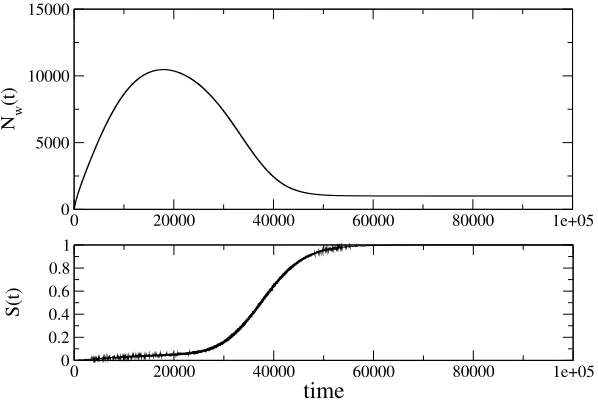
Figure 1: System evolution: We show here the evolution in time of the total number of words Nw(t) and the success rate S(t) for a population of N = 1000
agents. As it is clear the population is able to build up an effective communication system in whichNw=N, i.e. each agent has only one word. Moreover the success
rate in this state is equal to 1 indicating that all interactions are successful.
the beginning the curve grows due to the invention process. It follows a further period of growth in which agents perform unsuccessful interactions. While increasing in size, however, inventories correlate with each other, so that at a certain point the number of words, having reached a maximum, starts decreasing. This is due to successful communications between agents, that increase in their number till the system reaches a final convergence state in which all the agents have the same unique word, thus being able to perform only successful interactions. In Figure 1 it is reported the success rate curve too. Obtained averaging over several different runs of the pro-cess, this curves shows the probability that an interaction at a given time is successful. As just discussed, the system evolves to a situation of con-vergence through an intermediate state in which words are eliminated while the success probability increases. It is important noting that the developed communication system is not only effective (every agent understands all the others) but also efficient (no memory or computational resources are wasted for comprehension in the final state).
equiv-0.2 0.4 0.6 0.8 1 birth of the winning word (normalized position)
10-4
10-3
10-2
P winning word
10-4
10-3
[image:5.595.120.415.122.342.2]10-2
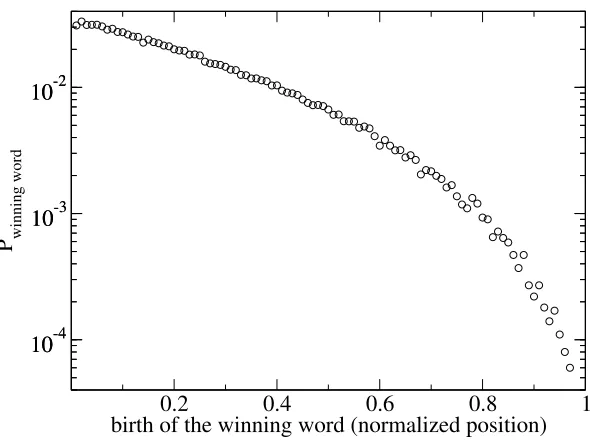
Figure 2: Winning word probability distribution (order): We investigate how the probability for a word to dominate is affected by its invention order. We label the first invented word with 1, the second invented word with 2 and so on till the last invented one. Then labels are normalized with the tag of the last invented word. Early invented words are more likely to become dominant since they have more chances to propagate at the beginning. Data are obtained for a population of
N = 1000 agents by averaging results from 105 runs.
0 500 1000 1500 2000 creation of the winning word (time)
10-6 10-5 10-4 10-3 10-2
P winning word
[image:6.595.119.411.126.333.2]y=(1/τ)exp(-t/τ)
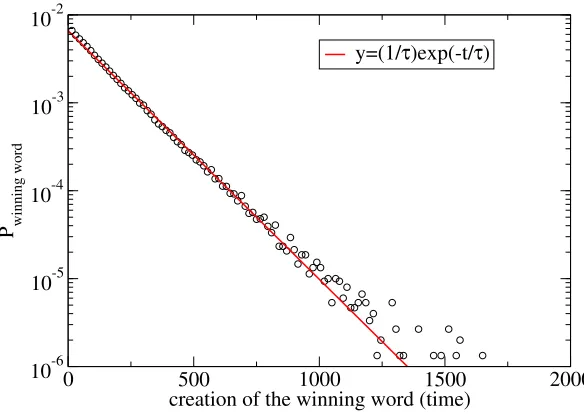
Figure 3: Winning word probability distribution (time): We plot here the probability that a word created at a given time becomes the dominating one. Data, relative to a population of N = 1000 agents, are well fitted by an exponential distribution (hereτ '150).
shown that data from simulations are well fitted by an exponential distri-bution. In Figure 2 this behavior was not found due to the presence of a cutoff (the last invented word) that is absent here.
In conclusion, we have seen how the view of language as an evolving systems casts several interesting issues that can be addressed in the frame-work of complex science methods. A profitable approach consists, in our opinion, in the definition and study of simple models that allow for precise investigations of specific problems. Then, in this perspective, the definition of a reasonable model is in itself an important goal. Here we have presented an interesting model in which agents negotiate conventions according to ele-mentary rules and manage to reach a global agreement. We have also shown that, even though all words (or conventions) are equivalent in the model, the moment of their invention affects (exponentially) their probability of becoming dominant.
1
Acknowledgements
not reflect the Commission’s opinion. The Commission is not responsible for any use that may be made of data appearing in this publication. A. Barrat and L.D. are partially supported by the EU under contract 001907 (DELIS).
References
[1] Steels L: Language as a complex adaptive system. In Shoenauer M (ed): Proceedings of PPNS VI. Lecture Notes in Computer Science, Berlin, Germany, September 2000. Springer-Verlag.
[2] Hurford J: Biological evolution of the Saussurean sign as a component of the language acquisition device, Lingua 1989; 77:187-222.