S
TRATHCLYDE
D
ISCUSSION
P
APERS IN
E
CONOMICS
D
EPARTMENT OF
E
CONOMICS
U
NIVERSITY OF
S
TRATHCLYDE
G
LASGOW
THE EXPORT BASE MODEL WITH A SUPPLY-SIDE
STIMULUS TO THE EXPORT SECTOR
B
Y
HA, SOO JUNG AND SWALES, J. KIM
The Export Base Model with a Supply-Side Stimulus to the Export Sector
Ha, Soo Jung and Swales, J. Kim
Department of Economics, University of Strathclyde, Scotland, UK
Draft
Paper delivered at the Western Regional Science Association Annual Conference, Sedona, Arizona, February, 2010.
Abstract
In the export-base model, the level of a region’s economic activity is underpinned by the performance of its export sector (Daly, 1940; Dixon and Thirlwall, 1975; Kaldor, 1970; North, 1955). This theory is now almost universally represented as a primitive version of the familiar Input-Output (IO) or Keynesian demand-driven approach, where regional output is linked to regional exports through a rather mechanistic multiplier process (Romanoff, 1974). Further, in a standard IO inter-regional framework, the expansion of output in one region always generates positive impacts on other regions. That is to say, there is always a positive spread, and no negative backwash, effect.
However, these models typically embody no supply-side constraints. What is more, the stimulus to the export sector is often thought to come through supply-side improvements (North, 1955; McCombie, 1992). Whilst accepting that the development of a healthy export base is generally central to promoting the growth of the regional economy, the relationship is likely to be much more complex than is usually thought. Also whilst an increase in regional exports typically increases economic activity in the target region, the effect on other regions is less straightforward (Myrdal, 1957).
In this paper we begin by using a single-region IO analysis of the operation of a stylised export base model. The impact of a conventional increase in export demand is compared to a situation in which increased competitiveness underpins the improved export performance. This analysis is then extended through the use of an inter-regional (Scotland–Rest of the UK) Computable General Equilibrium (CGE) model. In simulation, different exogenous demand and supply side disturbances are calibrated so as to generate the same long-run expansion in Scottish manufacturing exports. The subsequent specific evolutions of regional GDP and employment in both Scotland and the rest of the UK (RUK) are then tracked.
JEL Classifications: R11, R13, R58
1. Introduction
The notion that exports play a crucial role in determining the economic performance of small open economies is a familiar one. It can be expressed in a comparative static or dynamic form. A stylised account in a regional setting proceeds in the following way. The local economy is divided into export and domestic sectors. Export sectors only supply output that is sold outwith the region, whilst domestic sectors solely supply local consumption and intermediate demand. The export-base model asserts that the level of economic activity in the region is positively related to the level of exports, with the causal mechanism flowing from export to domestic sectors. Output in the export sector is determined exogenously whilst the output of the domestic sectors is generated endogenously through some form of multiplier process. In the dynamic model, the growth of the regional economy is a positive function of the growth of its exports. In the most extreme versions of the export-base model, the ratio of total output to exports is fixed.1
Export-base models typically have a demand-side orientation. In particular the models assume no supply side constraints, especially for the domestic sectors.2 In fact the most common characterisation of the regional export-base approach is as a primitive form of the standard regional Input-Output (IO) model (Romanoff, 1974). From this vantage point, the IO model is taken to be superior in that it identifies a greater number of exogenous demands and provides a better account of the multiplier process. However, even if the strength of IO analysis is accepted, this does not imply that the regional export-base model has no relevance. In particular, we argue that the export-base approach gives a useful framework for considering the long-run equilibrium of a regional economy that receives an exogenous shock to its export sector.
analytically in a single-region Input-Output context and then through simulation using a two-region Computable General Equilibrium (CGE) model parameterised on data from Scotland and the Rest of the UK (RUK).
A related issue in the regional economics literature is the impact that the expansion of one region has on the level of economic activity in other regions. In a standard inter-regional IO framework, this is always positive. However, an economy with a more active supply side offers a wider range of possibilities. In particular, the outcome will be the net impact of positive spread and negative backwash effects (Myrdal, 1957).
The remainder of the paper is structured as follows. Section 2 investigates the characteristics of the export base approach using single-region Input-Output (IO) analysis. Section 3 describes the inter-regional Computable General Equilibrium (CGE) model used in this paper, AMOSRUK. Section 4 discusses the simulation strategy and Section 5 reports the simulation results. Section 6 is a short summary.
2. Theory: An IO Framework
In this section, we develop a stylised export base model within an Input-Output framework. In this model there are n production sectors. One is an export sector, with exports x and output qx. The remaining domestic sectors have no export demand and
their outputs are represented by the (n-1) x 1 vector qd. The first step is to present arguments, and appropriate techniques, for endogenising all final demands other than exports. The analysis is then extended to consider the effect of introducing an increase in export competitiveness within the same IO context. This analysis is relevant because in the long run it is plausible to think of small open regions that receive a demand shock as operating as if they had an IO structure. That is to say, a model that has clear neo-classical characteristics, but subject to small-open-region assumptions, has IO properties in the long run in response to exogenous demand disturbances (McGregor et al, 1996).
Equation (1) is a standard demand driven IO model that has been extended so that consumption, investment and government expenditure are endogenised. Consumption is endogenised in the conventional manner represented by the Type II multiplier. Investment is endogenised using the assumption that the economy is initially in long-run equilibrium with base-year investment just covering depreciation. Finally government expenditure is endogenised through linking expenditure to population which itself is linearly related to the level of economic activity. This implies that the base-period accounts and subsequent IO model can be presented as:
(1) 0 0
0
x x
x d d d
q x q
b B d d
+ =
The dd vector is an (n+1) x 1 vector of domestic outputs and regional value added, so that:
(2)
d
d q
d w
π
=
where w and π are the scalars for total regional wage and profit incomes.
The (n+1) x 1bxvector is the technical production coefficients for the export sector:
(3)
x
x x
x a
b l
k
=
where the (n-1) x 1 vector ax comprises the standard Leontief fixed production coefficients for IO analysis, so that each element ai,x is the input of domestic sector i
directly used in the unit production of the export sector x. Similarly, the scalars lx and
kx are fixed production coefficients for the “non-produced” factor inputs, labour and
The (n+1) x (n+1) Bd matrix incorporates the Leontief technical coefficients and the “non-produced” factor inputs coefficients for production in the domestic sectors. It also includes the coefficients that endogenise household consumption, investment and government expenditures:
(4) 0 0
0 0
d d d d
d d
d
A c g j
B l
k
+
=
. d
A comprise the standard Leontief fixed production coefficients where element ai,j in
the matrix is the input of domestic sector i directly used in the unit production of the domestic sector j. Similarly elements li and ki of the 1 x (n-1) vectors ldand kdare the unit labour and capital inputs to domestic sector i.
The coefficients in the (n-1) x 1 vectors cd, jd and gd endogenise consumption, investment and government demand. For consumption, the coefficient ci is given as
the ratio of base year household consumption of domestic commodity i divided by total base year wage income. This is the conventional treatment.3
For investment, the procedure adopted in equations (1) and (4) assumes no variation across sectors in either the ratio of other value added to capital stock, the sectoral composition of that capital stock, or the depreciation rate. This means that the composition of investment demand is invariant to changes in composition of output and that the level of regional investment expenditure is a linear function of total regional profit income, π. A more general formulation is given in Appendix 1.
Section 3 of the paper is run in the single-region form, the imposition of flow migration leads to population growing in line with employment. If government expenditure is therefore linked to population, which is itself proportionate to employment, it is appropriate to endogenise government expenditure in long-run analysis. This is done here by assuming that the wage does not vary across sectors so that government expenditure is a linear function of wage income. Again a more complex relationship is appropriate that directly links employment (and therefore population) to sectoral outputs. This is outlined in Appendix 1 but a more complex formulation of this type will not affect the general argument.
If the focus of the analysis is on the Marshallian long run, then equation (1) is a valid basis for calculating the Leontief inverse. It will also prove useful to represent the inter-relationships outlined in equation (1) in a slightly different manner. Domestic output, the regional wage and profits payments can be given as:
(5) B dd d +b xx =dd
Rearranging (5) in the familiar fashion gives:
(6) dd =
[
I−Bd]
−1b xxNote that in equation (6) we have the classic export-led model with all activity variables being linearly related to the level of exports, x. Similarly by dividing both sides of equation (6) by the scalar x, the export base multipliers can be represented as:
(7) ddm =
[
I−Bd]
−1bxwhere
(8)
m d
m m
d
m q
d w
π
=
Each element, qmd of the n-1 x 1 vector
m d
q gives the increase in the output of domestic sector d resulting from a unit increase in the output of the export sector. This also equals the initial ratio of the output of that sector to the output of the export sector. The endogenous variables wm and πm are the changes in total regional wage and profit income that result from a unit increase in regional exports. These marginal values also equal the corresponding initial average values.
It will be convenient here to calculate a more conventional scalar export base multiplier value as:
(9)
1
1
n m
q d
d
M q
−
=
=
∑
This is the ratio of domestic to export output.4
A number of reservations need to be made concerning the demand-led model outlined here. First, in the model all resources are assumed to be freely available to the regional economy at their base-year prices. That is to say, they are in completely elastic supply. For capital and labour this is a reasonable assumption in the Marshallian long run if the small-open-economy assumptions are made about the exogeneity of the interest rate and if inter-regional migration takes a flow equilibrium form. However, the updating of capital and labour supplies takes time and over shorter time periods factor supplies will be less elastic. Also there are clearly no region-specific resources in this analysis.
Third, pure export industries are rare: almost all sectors at the regional level supply both domestic and export markets. Also the export base will be made up of a range of industries with different multiplier values. Further, in practice it is difficult to quantify regional trade flows. In the UK, these are not collected for the English regions, Northern Ireland or Wales. Even in Scotland, where officially constructed Input-Output tables identify trade flows by industrial sector, these data are regarded as having a low degree of accuracy.
2.2 The demand-driven model with a supply-side shock to the export sector
The export-base model often implicitly underpins regional policy. However, policy makers typically wish to induce a supply-side shock to the export sector: that is to say, to increase regional competitiveness through some supply-side intervention. The most straightforward way of conceptualising this is to introduce an improvement in efficiency to the export sector. This would take the form of reducing at least one of the technical coefficients in the Leontief production function for the export sector. Where all coefficients are reduced in an equal proportion, we refer to this here as an overall neutral efficiency improvement. We investigate the properties of such an efficiency improvement first. We when consider the effect on efficiency changes that are not overall neutral.
2.2.1 An overall neutral efficiency increase
If there is an overall neutral increase in efficiency of γ (where 1>γ>0), the new vector of export-sector production coefficients, bx′ can be represented by:
(10) bx′ =bx
(
1−γ
)
where the prime superscripts indicates the new values.
(11) x x ηγ
∆ =
where η is the price elasticity of demand for the region’s export sector, given a positive value. Note that although the price of exports has fallen, the price of domestic output remains unchanged. Because all the output of the export sector is used outwith the domestic economy, there is no feedback to the price of other domestic commodities through the Leontief price equations. Therefore there is no change in the production coefficients for the domestic sectors. Substituting equation (10) into equation (7) gives the new multiplier values:
(12) ddm′ =
[
I−Bd]
−1bx′ =[
I−Bd]
−1bx(1−γ
)=ddm(1−γ
)This implies that the new multiplier values are (1-γ) times the initial values. Similarly the new scalar output multiplier is given by:
(13) Mq′ =(1−γ)Mq
It is important to be clear about the interpretation of equation (13). This is that after the efficiency improvement, the revised production parameters for the export sector generate a relationship between the new level of exports and domestic output that is given by the multiplier value Mq′.
In the case of the demand driven export base multiplier, marginal and average values are the same. That is to say, as exports rise, domestic output expands proportionately. However, in the case where the expansion in the export base occurs through supply-side stimulus, the marginal and average multiplier values diverge. For the marginal value:
(14) q+ ∆ =q Mq′(x+ ∆x)
(15) q=M xq
so that substituting equations (11), (13) and (15) into equation (14) and rearranging gives:
(16) q Mq Mq x Mq 1 1
x x γ η
∆
′
= − ∆ = − −
∆ ∆
where ∆Mq =Mq−Mq′
Equation (16) clearly illustrates the fact that the marginal multiplier is lower than the average and raises the possibility that the value of the marginal multiplier could in fact be negative. A negative marginal multiplier requires
(17) 1
1−γ >η
Given that 1 > γ > 0, if the export sector faces an inelastic demand schedule, the marginal export base multiplier will be negative. In order to increase exports the proportionate reduction in unit inputs is greater than the proportionate increase in exports and the total input use falls, thereby generating the negative multiplier value. Note that this would mean that the total output rises by less than the original export stimulus.5
2.2.2 A non-neutral efficiency increase
However, the marginal and average output multiplier can never be greater than, and typically are less than, the corresponding demand-driven output multiplier.
2.3 Inter-regional IO based model
Imagine the analysis were extended to a multi-regional IO-based model, where there was a shock to the export sector of one region. The impact on other regions would qualitatively follow the domestic results identified earlier in this section of the paper. In the standard demand driven case, the impact on the output of all other regions is always non-negative. Similarly, where the stimulus to the export sector takes the form of increased efficiency, the impact is always lower than for the demand shock and will be non-positive where the impacts on the “domestic” sectors of the region experiencing the direct shock is negative.
3. CGE model
The Computable General Equilibrium model that we use here is AMOSRUK, the inter-regional version of the AMOS simulation framework, parameterised on data for the UK7. The model structure includes two endogenous regions – Scotland and the rest of the UK (RUK) – and one exogenous region – the rest of the world (ROW). For each region there are three transactor groups – households, firms and the government – and three commodities and activities – manufacturing, non-manufacturing and sheltered. There are four main components of final demand: household consumption, investment, government expenditure and exports to the rest of the world.
AMOSRUK is a flexible CGE model that offers a wide range of model closures corresponding to different time periods of analysis and labour market options. In this paper, regional wages are determined through a bargaining process, represented by a wage curve. Migration is generated by a Harris-Todaro type function. Both the bargaining and migration functions are econometrically parameterised on UK regional data (Layard et al., 1991).
In production, local intermediate inputs are combined with imports from the other region and the rest of the world via an Armington link (Armington, 1969). This composite intermediate input is then combined with labour and capital, in the form of value added, to determine each sector’s gross output. Production functions at each level can be CES, Cobb-Douglas or Leontief. The simulations in this paper use CES production functions at the value-added and gross-output level, and Leontief production functions at the intermediate-inputs level.
Consumption demand is linear in real income and homogenous of degree zero in all nominal variables. The model deviates from the strict export base approach in that real government expenditure is set exogenously. Both inter-regional and international exports are price sensitive. However, while non-price determinants of export demand from the rest of the world is taken to be exogenous, export demand to the other UK region is fully endogenous, depending not only on relative prices, but also on all elements of intermediate and final demand in the other region.
For the simulations, the main parameter values are as follows: the elasticity of substitution in the CES production functions is set at 0.3 (Harris, 1989) and the Armington assumption is applied to both inter-regional and international trade with an elasticity of substitution of 2.0 (Gibson, 1990). The parameter determining the speed of adjustment from actual to desired capital stock is set at 0.5, following econometric work on the determination of investment in the Scottish economy.
The model is initially parameterised to be in long-run equilibrium in the base period. That is to say, if the model is run forward with no change in any exogenous parameters, the model will simply continually replicate the base period values. It also implies that base period investment is only covering capital stock depreciation and that population is in long-run equilibrium with no net in-migration or out-migration.
4. Simulation set up
The simulations for this paper involve introducing various exogenous demand and supply disturbances to the model so as to generate a long-run stimulus to Scottish exports of an identical scale. There are two sets of simulations. In the first set we introduce the exogenous shocks in a single step and report results over 50 periods. In the second set, the exogenous disturbances to Scottish manufacturing exports are introduced in a more gradual way and the focus is the impact on economic activity in the first 10 periods.
For the first set of simulations we begin with the demand stimulus and make a 10% step-change in the demand for Scottish manufacturing exports to the rest of the world (ROW). The manufacturing sector is chosen as this is the most export intensive of the Scottish sectors separately identified in the model. The increase in export demand comes from ROW as this can be adjusted exogenously: RUK export demand is determined endogenously. The model is then run for 50 time periods.
significant stimulus to both the ROW and RUK exports. In order that the demand- and supply-side stimuli should have effects on Scottish manufacturing exports of a similar scale, the size of each efficiency increase is determined in the following way. It is calibrated so as to generate the same aggregate increase in the combined Scottish ROW and RUK manufacturing exports in period 50 as occurs with the demand disturbance.
We introduce three different types of efficiency improvement to Scottish manufacturing sector in order to increase the sector’s competitiveness and therefore also its exports. These are a Hicks-neutral, a Harrod-neutral and a Solow-neutral shock. A Hicks-neutral efficiency improvement is one that increases the effectiveness of value added, as against intermediate inputs, in the production function. A 10% Hicks-neutral efficiency increase implies that the composite (capital and labour) value-added input becomes 10% more efficient. Presenting this in a slightly different way, the same output could be produced with the same level of intermediate inputs but 10% less composite value-added inputs. A Harrod-neutral efficiency improvement is one that increases the efficiency of just the labour input in the production function, whilst a Solow-neutral efficiency improvement only increases the capital efficiency in production. In order to generate the appropriate increase in Scottish manufacturing exports that match the 10% ROW demand stimulus, efficiency increases of 4.525% for Hicks-neutral, 13.925% for Harrod-neutral and 7.275% for Solow-neutral are required.
For the second set of simulations the ultimate scale and nature of the exogenous disturbances is similar to those in the first set of simulations, except that these disturbances are introduced gradually, in equal increments, over the first 5 periods, rather than as a step change in period 1.
increase is 0.905% above the base value, in period 2, 1.810% above base, subsequently increasing in equal steps to period 5 when it is 4.525% above base. Again this value is then retained for the subsequent simulation periods.
In both sets of simulations, the model is run with no aggregate national or regional balance of payments or public sector borrowing constraints imposed. 8 Real government expenditure is held fixed at the base year value. Bargaining labour market closures are used in each region and flow equilibrium migration is allowed between regions.
5. Simulation results
We wish to compare the evolutions of the Scottish (regional) and the rest of the UK (extra-regional) economic activity in response to demand and supply shocks to Scottish manufacturing exports. We begin by looking at the impact of the demand shock in some depth.
5.1 Demand simulations
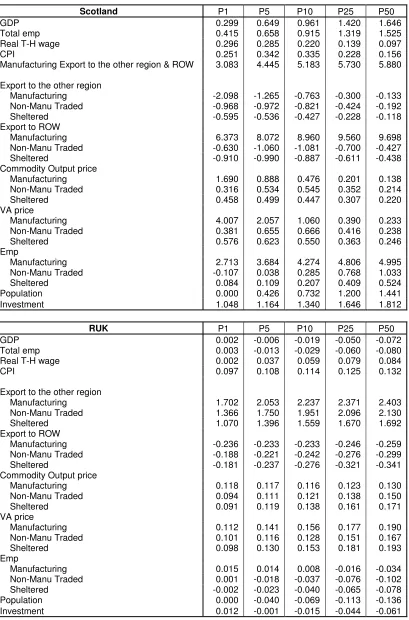
The results for key variables of the simulation run for the 10% step increase in Scottish exports to ROW are given in Table 1. These figures represent deviations from a fixed base. Results are given for periods 1, 5, 10, 25 and 50. Figures in the top half of the table show the impact on the Scottish economy: those in the bottom half show the impact on the RUK.
These conditions are close to being met in this model. The minor deviation comes through the migration function. In the simulations performed here, the total UK population is fixed, although individuals can migrate between regions. In this case, an exogenous increase in Scottish export demand from ROW increases labour demand in the UK as a whole and therefore long-run real wages rise. The result is that labour is not in infinitely elastic supply to Scotland (and the out-migration has negative impacts on the RUK economy too).
However, in the small region receiving the demand shock (Scotland), the increase in wage is small, relative to the size of that shock. Although exports are price sensitive, manufacturing ROW exports increase by 9.7% by period 50 and there is only a very minor reduction of 0.1% in manufacturing exports to the rest of the UK (RUK). The expansion in output and employment in the non-manufacturing traded and sheltered sectors are due to the standard indirect and induced multiplier effects. By period 50, employment and GDP have increased by 1.5% and 1.6% respectively. Scottish activity builds up over time in a monotonic manner as initial short-run restrictions in both labour and capital stock are eased through investment and immigration.
Therefore in the long run, under this simulation the Scottish economy reacts in a manner similar to an extended IO system, where household consumption and investment are endogenous. There are only small changes in prices to affect the choice of techniques in production or composition of the vector of household consumption goods. However, government expenditure has been held constant so that the full extent of the export-base model is not identified.
mechanism but is also aided by the fact that the increases in RUK prices are, at this point, slightly less than the increases in corresponding Scottish prices.
However, there is an associated increase in the real (and also nominal) wage that occurs because of the out-migration possibilities to Scotland and this increases RUK prices. These price increases have an adverse effect on RUK exports to the ROW, which fall by 0.3% in all sectors by period 50. The net impact on output is negative, given the much greater scale of ROW trade. Essentially, in this case the positive spread effects of increased demand from Scotland are more than offset by the adverse backwash effects caused by out-migration and the subsequent increased real wages. Also for the RUK in period 1 there are positive output and employment effects. However, in all subsequent periods these variables decline monotonically as migration effects dominate.
5.2 Supply-side simulations
5.2.1 Hicks-neutral efficiency improvement
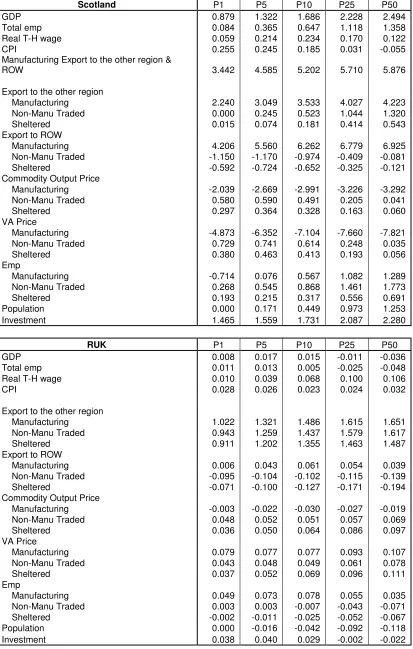
As suggested in Section 2, supply side disturbances can take a variety of forms. In the simulations performed here, we introduce a range of efficiency shocks to the manufacturing sector. Each is calibrated to generate the same expansion in manufacturing exports as was produced by the demand stimulus discussed in Section 5.1. We examine the results for one of these, the Hicks neutral efficiency improvement, in some detail. These figures are presented in Table 2. The outcomes from the other forms of efficiency change are related to this benchmark case.
figure for the value added input per unit of manufacturing output is therefore endogenous to the model.
The first key point is that with the efficiency improvements, it is not possible to limit the effective shock just to ROW exports. An improvement in efficiency in our model would generate an increase in competitiveness in all export markets. In order to produce a stimulus of a comparable size, we therefore introduce an efficiency shock that will increase total Scottish manufacturing exports in the long run by the same amount as the 10% ROW export demand disturbance. Table 1 reveals that this implies a shock that would increase total long-run Scottish manufacturing exports by 5.9%. The appropriate long-run expansion in manufacturing exports requires a 4.5% Hicks-neutral efficiency increase. Table 2 shows that this generates a 6.9% and 4.2% increase in exports to ROW and RUK respectively.
To explore the effect of this efficiency increase, begin with the impact on the recipient region, Scotland. Comparing the long-run (50 period) results with those for the demand stimulus, the first important point is that the expansion in GDP is markedly higher, 2.5% against 1.6%. This contradicts the theoretical result derived in Section 2 for a uniform efficiency shock to all inputs applied to an exclusively export-sector in an IO model. However remember that the Hicks neutral efficiency shock does not apply to intermediate inputs. Further, manufacturing is not exclusively an export sector. There are therefore other supply-side impacts that are likely to have a positive impact on Scottish economic activity. Finally, the efficiency improvement is introduced here in a general equilibrium system that, unlike IO, has price sensitivity in the form of substitution and competitiveness effects.
demand stimulus. Therefore crowding out effects on other sectors are reduced. This is shown Table 2 by the increased exports to RUK in the non-manufacturing traded and sheltered sectors and the relatively small reduction in these sectors’ exports to the ROW.
Whilst the GDP increase is higher for the Hicks-neutral efficiency improvement, employment change is slightly lower. This reflects the increased efficiency in production and there is a lower increase in Scottish population, reflecting lower levels of migration. However, the real wage increases more under the efficiency improvement than under the demand stimulus, and the fall in the unemployment rate (not reported here) is greater. As with the demand stimulus, the increase in Scottish output and employment is monotonic over time.
Again, the impact on the RUK economy is a little more complex. In the long run, RUK GDP and employment decline. However, these reductions, of .04% and .05%, are less than for the demand shock Consider first the RUK export performance. The stimulus to the level of RUK exports to Scotland is lower than with the conventional demand shock, because RUK loses price competitiveness with Scotland. However, the negative impact on ROW exports from RUK is much lower than with the export demand simulation. This is because RUK long-run manufacturing price falls in this simulation and the price increases that occur in other sectors are small.
The time paths of the changes in RUK GDP and employment are less straightforward with the Hicks-neutral efficiency change. In particular, initially RUK GDP and employment are above their base-level values for a number of periods.9 In this case it takes some time before the negative effects of out-migration on economic activity outweigh the demand stimulus created by the efficiency disturbance to Scottish manufacturing.
5.2.2 Harrod- and Solow-neutral efficiency improvements
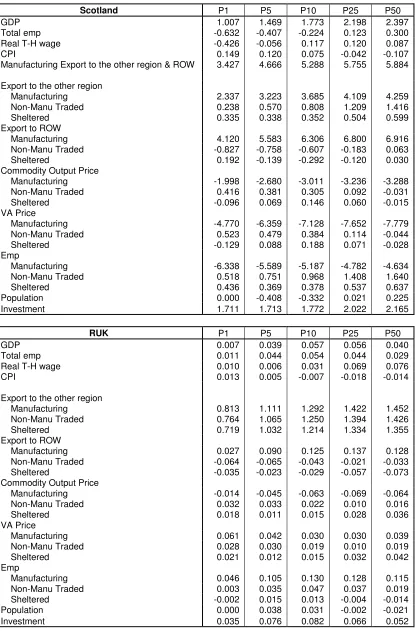
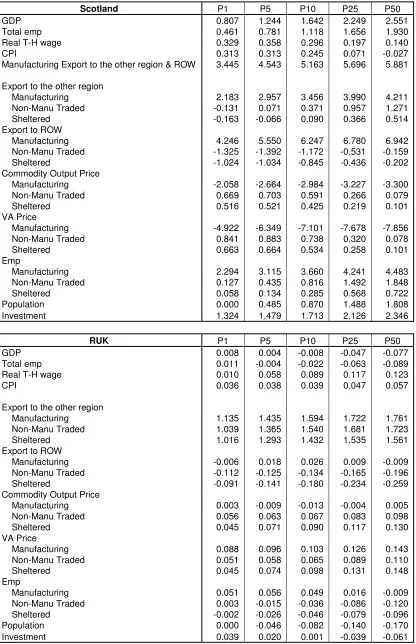
sector, the size of the efficiency shocks need to be calibrated in order to generate the appropriate expansion in total Scottish manufacturing exports. The corresponding efficiency changes are therefore greater than for the Hicks-neutral shock, where effectively both capital and labour efficiency is improved equally. The Harrod- and Solow-neutral efficiency increases are 13.9% and 7.3% respectively and the results are shown in Tables 3 and 4.
The impact on Scottish GDP is very similar in all the efficiency improvement simulations: each generates a larger stimulus than occurs for the conventional demand disturbance. Further, from a comparison of the information given in Tables 1-4 it is clear that the evolution of the Scottish GDP impacts is very similar for all of the efficiency shocks. However, the impact on Scottish employment is very different across the three supply-side simulations (though in all the long-run impact is positive). As stated in Section 3, in the present simulations, the imposed value of the elasticity of substitution between capital and labour in the production of value added is 0.3. This relatively low value means that with an increase in labour efficiency, there is a reduction in the labour intensity of production, where labour is measured in natural units. Therefore with the Harrod-neutral shock, Scottish total employment initially falls. On the other hand, for the Solow-neutral efficiency shock, production becomes more labour intensive and the impact on total Scottish employment is greater in this case than for the conventional demand shock.
manufacturing output falls in RUK so that RUK manufacturing exports to ROW rise. Also although commodity prices in other RUK sectors rise under the Harrod-neutral efficiency increase, these price increases are less than under the Hicks- or Solow-neutral simulations.
5.3 Demand and efficiency shock comparison
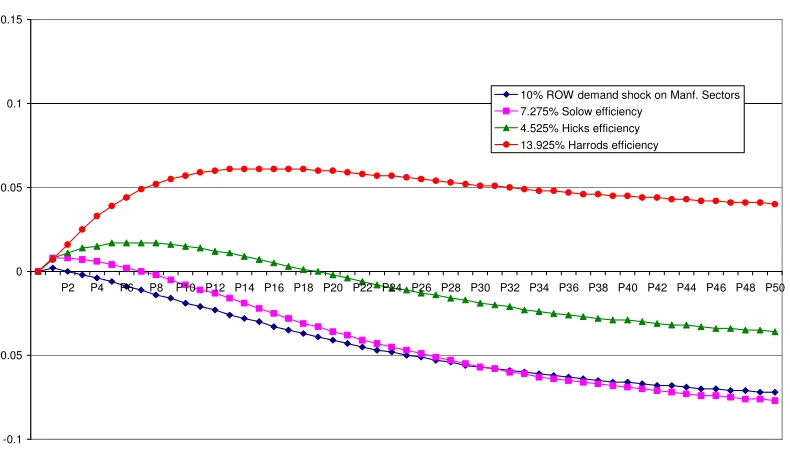
Figures 1, 2, 3 and 4 give the Scottish and RUK GDP and employment changes associated with the four export shocks to the Scottish manufacturing sector. In each the change from the base period values is tracked over 50 periods.
Figure 1 reinforces the argument made in the previous subsections concerning the impact on Scottish GDP. All the efficiency shocks show a jump of around 1% in period 1, with the subsequent effects rising to around 2.5% above the base period values by period 50. The figure for the demand shock is always markedly below the efficiency results. Its long-run value, at 1.6%, is only 2/3 the increase associated with the efficiency change.
Figure 2 gives the Scottish employment change figures. There is a similarity between these results for the four stimuli only in so far as after the first period, the employment change increases over time for all simulations. As the capital stock and population gradually adjust, the impacts on Scottish employment increase. However, the size of the employment effects differs radically across the simulations. Where the efficiency improvement occurs for the productivity of value-added as a whole (Hicks-neutral) or for labour (Harrod-neutral), the employment impact is less than for the corresponding export demand simulation. For the Harrod case, this is particularly marked, with employment initially falling and only retaining its base-period level in period 19. Only where the efficiency improvement is capital augmenting (Solow-neutral) is employment higher than with the manufacturing export demand stimulus.
overwhelmingly negative. After the first period, RUK economic activity is adversely affected by the expansion in Scotland and this decline becomes more marked over time. As argued in Section 5.1, the impact of out-migration on the RUK real wage reduces activity by more than any expansionary effect coming through the increase in RUK exports to Scotland.
For each of the efficiency shocks, there is a period of time over which the RUK employment and GDP rise. With these supply-side disturbances, there are two sources of demand stimuli for RUK. The first is the increased economic activity in Scotland, which generates higher RUK exports to Scotland. (Recall also that this GDP increase is greater than with the demand shock). The second is the reduced price of Scottish manufactured goods which, when used as imported elements of RUK intermediate or household demand, increase the competitiveness of exports from RUK to ROW. Both these impacts would be expected to produce larger demand stimulus effects to RUK with the efficiency shocks than with the demand shocks. However, against these positive demand stimuli, there are possible negative real wage effects as a result of inter-regional migration.
As is clear from Figure 1, the Scottish GDP changes produced by each form of efficiency shock are very similar. Therefore we expect the demand effects to also be similar for the RUK. However, the employment impacts are very different. Take first the Harrod-neutral change. This produces initially a fall in Scottish employment and a decline in the Scottish real wage. This generates migration from Scotland to RUK and an additional benefit to the RUK economy in terms of an easing of the labour market pressure. Even where the employment rises in Scotland under the Harrod-neutral efficiency gain (that is after period 18), these employment changes are relatively low and the demand-side impacts on the RUK continue to dominate the negative population effects, so that RUK GDP and employment continue to be above the base period value into the long run.
maximised in period 7 and employment in period 4. Further, RUK GDP and employment remain above their base period values until periods 20 and 12 respectively. For the Solow-neutral efficiency improvement, the positive employment in Scotland is greater than for the demand shock. However, initially the additional positive demand impacts for the RUK associated with the efficiency shock outweigh the more adverse RUK labour market impacts. For the Solow–neutral efficiency increase, RUK GDP and total employment fall below their base year values by period 8 and 5 respectively. As the system approaches long-run equilibrium the RUK GDP and employment reductions under the Solow-neutral efficiency change are slightly greater than for the demand shock.
5.4. A more gradual introduction of the demand and supply shocks
Figures 5, 6, 7 and 8 present the proportionate changes in Scottish and RUK GDP and employment over the first ten periods following export demand- and supply-side shocks to the Scottish manufacturing sector where the disturbances have been introduced gradually, in equal increments, over the first 5 periods, rather than as a step change in period 1.
Consider first the impact on Scottish GDP reported in Figure 5. Again the supply-side efficiency shocks generate very similar increases that are consistently larger than those for the demand shock. However, for Scottish employment, presented in Figure 6, the results are much more disparate. In this case, the Harrod-neutral efficiency shock produces declining employment up to period 5. After that point employment slowly rises but is still 0.3% below its base period value in period 10. With all the other stimuli to the Scottish manufacturing exports, employment rises monotonically, though in the Hicks–neutral case employment change is initially very low.
Solow-neutral case has fallen below its base-period level. The changes in RUK employment, given in Figure 8, are qualitatively very similar. Again, negative backwash effects replace the initial, weak, positive spread effects in all the simulations, apart from the Harrod-neutral case.
Generally introducing the stimuli to the Scottish manufacturing exports in a more gradual manner does not change the qualitative story produced with the one-step change reported earlier in the paper. As perhaps should be expected, spreading the step change over a longer time period has a bigger effect on the Scottish, rather than the RUK, results as the initial change is a bigger and more idiosyncratic shock to the Scottish economy. The change in the RUK is proportionately smaller and more diffuse.
6. Conclusion
That a region’s economic performance depends crucially upon the strength of its export sectors is a traditional notion in regional economics. Linked to this is the idea that the expansion of one region might have a positive or negative impact on other regions through the relative size and interaction of spread and backwash effects. Export base theory is almost always built upon a strictly Keynesian or IO demand-driven approach. However, discussion of the stimulus to the export sector, both in analytical and policy settings, often stresses supply-side improvements to competitiveness as a means of strengthening the region’s export base. In this paper we have analysed the impact of different forms of stimulus to a region’s export sector. In particular, we compare the conventional exogenous demand shock to alternative supply-side (efficiency) improvements. We use a model that has no long-run regional-specific fixed resources.
efficiency-supply-side stimuli to the Scottish manufacturing sector using a inter-regional CGE approach, the associated simulations fail to replicate these analytical results. Why is that so?
First, none of the efficiency disturbances that are introduced to the Scottish manufacturing sector are fully neutral. Rather they are all, as is conventionally the case, focussed on elements of the production of value added. This means that there is a substitution towards value added in general and towards the use of particular factor inputs to value added in these simulation results.
Second, in practice it is not possible to separate industries into pure export and pure domestic sectors. Almost all production sectors of a regional economy will have a mixture of domestic and extra-regional demand. However, in the CGE model it is much easier to focus an exogenous export demand shock than it is the supply shock. That is to say, in these simulations where the stimulus comes as an increase in efficiency, there will almost certainly be positive impacts on the competitiveness of other Scottish sectors and all sectors in RUK not present with the export demand shock.
Third, we did not apply the shocks to a stand-alone regional model. Rather we used the two region UK model where although Scotland is small relative to RUK, price effects do occur which move the model away from the strict IO interpretation. In this model, UK aggregate population is constant and this acts as a national resource constraint.
Table 1. 10% export demand shock from ROW on manufacturing-traded sector in Scotland
Scotland P1 P5 P10 P25 P50
GDP 0.299 0.649 0.961 1.420 1.646 Total emp 0.415 0.658 0.915 1.319 1.525 Real T-H wage 0.296 0.285 0.220 0.139 0.097 CPI 0.251 0.342 0.335 0.228 0.156 Manufacturing Export to the other region & ROW 3.083 4.445 5.183 5.730 5.880
Export to the other region Manufacturing -2.098 -1.265 -0.763 -0.300 -0.133 Non-Manu Traded -0.968 -0.972 -0.821 -0.424 -0.192 Sheltered -0.595 -0.536 -0.427 -0.228 -0.118
Export to ROW
Manufacturing 6.373 8.072 8.960 9.560 9.698 Non-Manu Traded -0.630 -1.060 -1.081 -0.700 -0.427 Sheltered -0.910 -0.990 -0.887 -0.611 -0.438 Commodity Output price Manufacturing 1.690 0.888 0.476 0.201 0.138 Non-Manu Traded 0.316 0.534 0.545 0.352 0.214 Sheltered 0.458 0.499 0.447 0.307 0.220
VA price
Manufacturing 4.007 2.057 1.060 0.390 0.233 Non-Manu Traded 0.381 0.655 0.666 0.416 0.238 Sheltered 0.576 0.623 0.550 0.363 0.246
Emp
Manufacturing 2.713 3.684 4.274 4.806 4.995 Non-Manu Traded -0.107 0.038 0.285 0.768 1.033 Sheltered 0.084 0.109 0.207 0.409 0.524 Population 0.000 0.426 0.732 1.200 1.441 Investment 1.048 1.164 1.340 1.646 1.812
RUK P1 P5 P10 P25 P50
GDP 0.002 -0.006 -0.019 -0.050 -0.072 Total emp 0.003 -0.013 -0.029 -0.060 -0.080 Real T-H wage 0.002 0.037 0.059 0.079 0.084 CPI 0.097 0.108 0.114 0.125 0.132
Export to the other region Manufacturing 1.702 2.053 2.237 2.371 2.403 Non-Manu Traded 1.366 1.750 1.951 2.096 2.130 Sheltered 1.070 1.396 1.559 1.670 1.692
Export to ROW
Manufacturing -0.236 -0.233 -0.233 -0.246 -0.259 Non-Manu Traded -0.188 -0.221 -0.242 -0.276 -0.299 Sheltered -0.181 -0.237 -0.276 -0.321 -0.341 Commodity Output price Manufacturing 0.118 0.117 0.116 0.123 0.130 Non-Manu Traded 0.094 0.111 0.121 0.138 0.150 Sheltered 0.091 0.119 0.138 0.161 0.171
VA price
Manufacturing 0.112 0.141 0.156 0.177 0.190 Non-Manu Traded 0.101 0.116 0.128 0.151 0.167 Sheltered 0.098 0.130 0.153 0.181 0.193
Emp
[image:29.595.97.506.109.729.2]Table 2. 4.525% Hicks neutral efficiency increase on manufacturing-traded sector in Scotland
Scotland P1 P5 P10 P25 P50
GDP 0.879 1.322 1.686 2.228 2.494 Total emp 0.084 0.365 0.647 1.118 1.358 Real T-H wage 0.059 0.214 0.234 0.170 0.122 CPI 0.255 0.245 0.185 0.031 -0.055 Manufacturing Export to the other region &
ROW 3.442 4.585 5.202 5.710 5.876
Export to the other region Manufacturing 2.240 3.049 3.533 4.027 4.223 Non-Manu Traded 0.000 0.245 0.523 1.044 1.320 Sheltered 0.015 0.074 0.181 0.414 0.543
Export to ROW
Manufacturing 4.206 5.560 6.262 6.779 6.925 Non-Manu Traded -1.150 -1.170 -0.974 -0.409 -0.081 Sheltered -0.592 -0.724 -0.652 -0.325 -0.121 Commodity Output Price Manufacturing -2.039 -2.669 -2.991 -3.226 -3.292 Non-Manu Traded 0.580 0.590 0.491 0.205 0.041 Sheltered 0.297 0.364 0.328 0.163 0.060
VA Price
Manufacturing -4.873 -6.352 -7.104 -7.660 -7.821 Non-Manu Traded 0.729 0.741 0.614 0.248 0.035 Sheltered 0.380 0.463 0.413 0.193 0.056
Emp
Manufacturing -0.714 0.076 0.567 1.082 1.289 Non-Manu Traded 0.268 0.545 0.868 1.461 1.773 Sheltered 0.193 0.215 0.317 0.556 0.691 Population 0.000 0.171 0.449 0.973 1.253 Investment 1.465 1.559 1.731 2.087 2.280
RUK P1 P5 P10 P25 P50
GDP 0.008 0.017 0.015 -0.011 -0.036 Total emp 0.011 0.013 0.005 -0.025 -0.048 Real T-H wage 0.010 0.039 0.068 0.100 0.106 CPI 0.028 0.026 0.023 0.024 0.032
Export to the other region Manufacturing 1.022 1.321 1.486 1.615 1.651 Non-Manu Traded 0.943 1.259 1.437 1.579 1.617 Sheltered 0.911 1.202 1.355 1.463 1.487
Export to ROW
Manufacturing 0.006 0.043 0.061 0.054 0.039 Non-Manu Traded -0.095 -0.104 -0.102 -0.115 -0.139 Sheltered -0.071 -0.100 -0.127 -0.171 -0.194 Commodity Output Price Manufacturing -0.003 -0.022 -0.030 -0.027 -0.019 Non-Manu Traded 0.048 0.052 0.051 0.057 0.069 Sheltered 0.036 0.050 0.064 0.086 0.097
VA Price
Manufacturing 0.079 0.077 0.077 0.093 0.107 Non-Manu Traded 0.043 0.048 0.049 0.061 0.078 Sheltered 0.037 0.052 0.069 0.096 0.111
Emp
Table 3. 13.925% Harrods neutral efficiency increase on manufacturing-traded sector in Scotland
Scotland P1 P5 P10 P25 P50
GDP 1.007 1.469 1.773 2.198 2.397 Total emp -0.632 -0.407 -0.224 0.123 0.300 Real T-H wage -0.426 -0.056 0.117 0.120 0.087 CPI 0.149 0.120 0.075 -0.042 -0.107 Manufacturing Export to the other region & ROW 3.427 4.666 5.288 5.755 5.884
Export to the other region Manufacturing 2.337 3.223 3.685 4.109 4.259 Non-Manu Traded 0.238 0.570 0.808 1.209 1.416 Sheltered 0.335 0.338 0.352 0.504 0.599
Export to ROW
Manufacturing 4.120 5.583 6.306 6.800 6.916 Non-Manu Traded -0.827 -0.758 -0.607 -0.183 0.063 Sheltered 0.192 -0.139 -0.292 -0.120 0.030 Commodity Output Price Manufacturing -1.998 -2.680 -3.011 -3.236 -3.288 Non-Manu Traded 0.416 0.381 0.305 0.092 -0.031 Sheltered -0.096 0.069 0.146 0.060 -0.015
VA Price
Manufacturing -4.770 -6.359 -7.128 -7.652 -7.779 Non-Manu Traded 0.523 0.479 0.384 0.114 -0.044 Sheltered -0.129 0.088 0.188 0.071 -0.028
Emp
Manufacturing -6.338 -5.589 -5.187 -4.782 -4.634 Non-Manu Traded 0.518 0.751 0.968 1.408 1.640 Sheltered 0.436 0.369 0.378 0.537 0.637 Population 0.000 -0.408 -0.332 0.021 0.225 Investment 1.711 1.713 1.772 2.022 2.165
RUK P1 P5 P10 P25 P50
GDP 0.007 0.039 0.057 0.056 0.040 Total emp 0.011 0.044 0.054 0.044 0.029 Real T-H wage 0.010 0.006 0.031 0.069 0.076 CPI 0.013 0.005 -0.007 -0.018 -0.014
Export to the other region Manufacturing 0.813 1.111 1.292 1.422 1.452 Non-Manu Traded 0.764 1.065 1.250 1.394 1.426 Sheltered 0.719 1.032 1.214 1.334 1.355
Export to ROW
Manufacturing 0.027 0.090 0.125 0.137 0.128 Non-Manu Traded -0.064 -0.065 -0.043 -0.021 -0.033 Sheltered -0.035 -0.023 -0.029 -0.057 -0.073 Commodity Output Price Manufacturing -0.014 -0.045 -0.063 -0.069 -0.064 Non-Manu Traded 0.032 0.033 0.022 0.010 0.016 Sheltered 0.018 0.011 0.015 0.028 0.036
VA Price
Manufacturing 0.061 0.042 0.030 0.030 0.039 Non-Manu Traded 0.028 0.030 0.019 0.010 0.019 Sheltered 0.021 0.012 0.015 0.032 0.042
Emp
Table 4. 7.275% Solow neutral efficiency increase on manufacturing-traded sector in Scotland
Scotland P1 P5 P10 P25 P50
GDP 0.807 1.244 1.642 2.249 2.551 Total emp 0.461 0.781 1.118 1.656 1.930 Real T-H wage 0.329 0.358 0.296 0.197 0.140 CPI 0.313 0.313 0.245 0.071 -0.027 Manufacturing Export to the other region & ROW 3.445 4.543 5.163 5.696 5.881
Export to the other region Manufacturing 2.183 2.957 3.456 3.990 4.211 Non-Manu Traded -0.131 0.071 0.371 0.957 1.271 Sheltered -0.163 -0.066 0.090 0.366 0.514
Export to ROW
Manufacturing 4.246 5.550 6.247 6.780 6.942 Non-Manu Traded -1.325 -1.392 -1.172 -0.531 -0.159 Sheltered -1.024 -1.034 -0.845 -0.436 -0.202 Commodity Output Price Manufacturing -2.058 -2.664 -2.984 -3.227 -3.300 Non-Manu Traded 0.669 0.703 0.591 0.266 0.079 Sheltered 0.516 0.521 0.425 0.219 0.101
VA Price
Manufacturing -4.922 -6.349 -7.101 -7.678 -7.856 Non-Manu Traded 0.841 0.883 0.738 0.320 0.078 Sheltered 0.663 0.664 0.534 0.258 0.101
Emp
Manufacturing 2.294 3.115 3.660 4.241 4.483 Non-Manu Traded 0.127 0.435 0.816 1.492 1.848 Sheltered 0.058 0.134 0.285 0.568 0.722 Population 0.000 0.485 0.870 1.488 1.808 Investment 1.324 1.479 1.713 2.126 2.346
RUK P1 P5 P10 P25 P50
GDP 0.008 0.004 -0.008 -0.047 -0.077 Total emp 0.011 -0.004 -0.022 -0.063 -0.089 Real T-H wage 0.010 0.058 0.089 0.117 0.123 CPI 0.036 0.038 0.039 0.047 0.057
Export to the other region Manufacturing 1.135 1.435 1.594 1.722 1.761 Non-Manu Traded 1.039 1.365 1.540 1.681 1.723 Sheltered 1.016 1.293 1.432 1.535 1.561
Export to ROW
Manufacturing -0.006 0.018 0.026 0.009 -0.009 Non-Manu Traded -0.112 -0.125 -0.134 -0.165 -0.196 Sheltered -0.091 -0.141 -0.180 -0.234 -0.259 Commodity Output Price Manufacturing 0.003 -0.009 -0.013 -0.004 0.005 Non-Manu Traded 0.056 0.063 0.067 0.083 0.098 Sheltered 0.045 0.071 0.090 0.117 0.130
VA Price
Manufacturing 0.088 0.096 0.103 0.126 0.143 Non-Manu Traded 0.051 0.058 0.065 0.089 0.110 Sheltered 0.045 0.074 0.098 0.131 0.148
Emp
Figure 1: GDP in Scotland
0 0.5 1 1.5 2 2.5 3
P2 P4 P6 P8 P10 P12 P14 P16 P18 P20 P22 P24 P26 P28 P30 P32 P34 P36 P38 P40 P42 P44 P46 P48 P50 10% ROW demand shock on Manf. Sectors 13.925% Harrods efficiency
4.525% Hicks efficiency 7.275% Solow efficiency
Figure 2: Total Employment in Scotland
-1 -0.5 0 0.5 1 1.5 2 2.5 3
P2 P4 P6 P8 P10 P12 P14 P16 P18 P20 P22 P24 P26 P28 P30 P32 P34 P36 P38 P40 P42 P44 P46 P48 P50 10% ROW demand shock on Manf. Sectors
[image:33.595.104.490.362.576.2]Figure 3: GDP in RUK
-0.1 -0.05 0 0.05 0.1 0.15
P2 P4 P6 P8 P10 P12 P14 P16 P18 P20 P22 P24 P26 P28 P30 P32 P34 P36 P38 P40 P42 P44 P46 P48 P50 10% ROW demand shock on Manf. Sectors 7.275% Solow efficiency
4.525% Hicks efficiency 13.925% Harrods efficiency
Figure 4:Total Employment in RUK
-0.1 -0.05 0 0.05 0.1 0.15
P2 P4 P6 P8 P10 P12 P14 P16 P18 P20 P22 P24 P26 P28 P30 P32 P34 P36 P38 P40 P42 P44 P46 P48 P50 10% ROW demand shock on Manf. Sectors 7.275% Solow efficiency
[image:34.595.99.494.95.324.2]Figure 5: GDP in Scotland (10 periods) 0 0.2 0.4 0.6 0.8 1 1.2 1.4 1.6 1.8
P1 P2 P3 P4 P5 P6 P7 P8 P9 P10
% o f d if fe re n c e f ro m b a s e S1 S2_harrod S2_hicks S2_solow
Figure 6: Total Employment in Scotland (10 periods)
-0.6 -0.4 -0.2 0 0.2 0.4 0.6 0.8 1 1.2
P1 P2 P3 P4 P5 P6 P7 P8 P9 P10
[image:35.595.99.486.331.617.2]Figure 7: GDP in RUK (10 periods) -0.02 -0.01 0 0.01 0.02 0.03 0.04 0.05 0.06
P1 P2 P3 P4 P5 P6 P7 P8 P9 P10
% o f d if fe re n c e f ro m b a s e S1 S2_harrod S2_hicks S2_solow
Figure 8: Total Employment in RUK (10 periods)
-0.03 -0.02 -0.01 0 0.01 0.02 0.03 0.04 0.05 0.06
P1 P2 P3 P4 P5 P6 P7 P8 P9 P10
[image:36.595.100.485.400.622.2]Appendix 1: A more general endogenising of investment and government
expenditure.
Equation (1) in the text shows a means of endogenising household consumption, investment and government expenditures. A theoretically more satisfactory endogenisation is shown in equation (A1.1).
(A1.1) .
0 0 0 0
0
0 0 0
0 0 0
x x
x x d d d d d d
x d
x d
q x q
a k A K c q q
l l w w
p p
γ
ρ
ρ
+ +
+ =
For the endogenisation of investment expenditure, kx is an (n-1) x 1 vector where the element ki,x represents the direct investment demand for the output of domestic sector
i as a result of a unit expansion in the export sector. In this formulation the assumption is that the adjustment has been made to a new long-run equilibrium where investment lust covers depreciation. This implies that:
(A1.2) ki x, =λi x x, c dx
where λi,x is the domestic input of sector I in the investment demand for capital in the
export sector, cx is the capital stock per unit or output of the export sector and dx is the
rate of capital depreciation in the export sector.
Similarly Kd is an (n-1) x (n-1) matrix where the element ki,j represents the direct
investment demand for the output of domestic sector i as a result of a unit expansion in sector j. Again:
(A1.3) ki j, =λi j, c dj j
with the notation as for the export sector. A practical issue here is that parameterisation of equations (A2) and (A3) must be such that the base period set of vector of outputs must be consistent with the base period vector of investment demands. This means that for base-periods values of the export sector output and the domestic output vector (qxB,qdB), where the B superscript stands for the base period values, the base period investment vector, B
d
(A1.4)
B x
B B B
x d B d
d q
k K j
q =
equation (A1) links government expenditure directly to total population, ρ. For the export sector, px is a scalar which gives the domestic population directly associated
with the production of one unit of the export good. By directly associated, we mean the number of workers required to produce one unit plus their (non-working) dependents. Therefore:
(A1.5) x (1 )
x x x l p w ϕ = +
where the wage rate, w, and the dependents per worker, φ, potentially vary across sectors. A corresponding expression applies for each element, pi, of the 1 x (n-1)
vector pd.Again equation (A5) and the corresponding domestic parameters must be consistent with the base-period values, so that:
(A1.6)
B x
B B B
x d B
d q p p q
ρ
= Each element, γi, of the (n-1) x 1 vector
γ
d gives the government domestic expenditure per person on the output of sector i. The elements of this vector are parameterised by dividing the elements of the base period government expenditure vector by the domestic population.The analysis proceeds in a manner equivalent to Section 2, but with the B matrix being replaced by the D matrix here, so that equation (2) in the text is replaced by:
(A1.7)
[ ]
d x d
x
x
q a q
D w l x w
(A1.8) 0 0
0 0
d d d d
d
d
A K c
D l
p
γ
+
=
Appendix 2: AMOSRUK Condensed Model Listing
Value-added prices (A2.1)
Commodity prices (A2.2)
Consumer price index (A2.3)
Capital price index (A2.4)
Labour demand (A2.5)
Capital demand (A2.6)
Capital rental rate (A2.7)
Household income (A2.8)
Commodity demands (A2.9)
Consumption demand (A2.10)
Intermediate demand (A2.11)
Investment demand (A2.12)
Government demand (A2.13)
Interregional export demand (A2.14) International export demand (A2.15)
Capital stock (A2.16)
Desired capital stock (A2.17)
User cost of capital (A2.18)
Investment (A2.19)
National population (A2.20)
x sx
i i
K ====K
( , )
x x x x
i i n k
pv ==== pv w w
( , x , y, w)
x x x
i i i j i
p p pv p p p − −− − = = = = w
x xx x xy y xw
i i i i i i
i i i
cpi ====∑∑∑∑
θ
p ++++∑∑∑∑θ
p ++++∑∑∑∑θ
pw
x xx x xy y xw
i i i i i i
i i i
kpi ====∑∑∑∑
γ
p ++++∑∑∑∑γ
p ++++∑∑∑∑γ
p( , , , )
x x x x x x
i i i i i n
N ====N Q p pv w
( , , , )
x x x x x x
i i i i i k
K ====K Q p pv w
x x x x x x x x x x
n n k k
Y ====ϕ N w ++++ϕ K w ++++L T u f
x x x x x xy xw
i i i i i i i
Q ====C ++++J ++++I ++++G ++++X ++++X
( x, y, w, )
x x x
i i
C ====C p p p Y
( x, y, w, )
x x x x
i i ij j
j I ====I p p p ∑∑∑∑b ∆K
N
x x
i i
G ====α G
( x, x, x, y, w)
x x
i i
J ====J Q pv p p p
( x, y, w, N, y, y, )
xy xy y
i i
X ====X p p p G J Q Y
( x, w, w)
xw xw
i i
X ==== X p p D
, (1 ) , 1 , 1
sx x sx x
i t i i t i t
K ==== −−−−
δ
K −−−− ++++∆K −−−−* *
, , ( , , , )
sx sx x x x x
i t i t i i i K ====K Q p pv ucc
( )
x x x
ucc ====ucc kpi
*
, ( , , ) , 1
x sx sx x sx
i t i t i t i i t K
λ
K Kδ
K∆ ==== −−−− ++++ −−−−
N s r
Regional population (A2.21) Migration (A2.22) Unemployment rate (A2.23)
Bargaining (A2.24)
Quasi IO (A2.25)
Wage Spillover (A2.26)
Endogenous variables: cpi: consumer price index kpi: capital price index m: Scottish immigration
p: commodity price pv: value-added price u: unemployment rate ucc: user cost of capital
n
w : nominal wage rate k
w : capital rental rate C: consumption D: foreign demand
G: government expenditure I : investment demand J: intermediate demand K: capital demand
s
K : capital supply K
∆ : capital stock adjustment L: population
N: employment Q: output
x x x i
x i
x x
L T
N
u
L T
−
−
−
−
∑
∑
∑
∑
=
=
=
=
s x x
n
w ====β cpi
x y
n n
w ====w
1 1
s s s
t t t
L ====L−−−− ++++m−−−−
, , , ,
s r
s s t t s r s
t s r t t t
t t
w w
m m u u L
cpi cpi = == =
( ,
)
x x x x
n n
X : exports
Y: household income
Parameters and exogenous variables: b: capital coefficient
f : benefit payment per registered unemployed D: rest of the world demand
T: participation rate (do we need this?)
α
: government expenditure coefficientβ: real wage coefficient
δ : depreciation rate
ϕ: regional share of factor income
θ: consumption expenditure share
γ : capital expenditure share
λ: capital stock adjustment parameter
Subscripts: ,
i j: sectors k: capital n: labour t: time
Superscripts: r: rest of the UK s: Scotland
w: rest of the world ,
x y: generic regional identifiers
Functions: (.)
m : migration function (.), (.)
p pv : cost function (.)