
arXiv:0902.4011v3 [math.CO] 22 Jan 2010
EINAR STEINGR´IMSSON AND BRIDGET EILEEN TENNER
Abstract. A permutationτcontains another permutationσas a pattern ifτhas a subsequence whose elements are in the same order with respect to size as the elements inσ. This defines a partial order on the set of all permutations, and gives a graded posetP. We give a large class of pairs of permutations whose intervals inP have M¨obius function 0. Also, we give a solution to the problem whenσoccurs precisely once inτ, andσandτsatisfy certain further conditions, in which case the M¨obius function is shown to be either−1, 0 or 1. We conjecture that for intervals [σ, τ] consisting of permutations avoiding the pattern 132, the magnitude of the M¨obius function is bounded by the number of occurrences ofσinτ. We also conjecture that the M¨obius function of the interval [1, τ] is−1, 0 or 1.
1. Introduction
In this paper, permutations are of the letters 1,2, . . . , n(for variousn) and apatternin a permu-tationπis a subsequence in π, the relative sizes of whose elements come in some prescribed order. For example, a 123-pattern is simply an increasing subsequence of length three. The permutation 246153 has two occurrences of the pattern 123, namely the subsequences h246i and h245i. The permutation 246153 also has one occurrence of the pattern 3142, namely the subsequence h4153i. It is easy to see that the set of all permutations (of arbitrary, positive, numbers of letters) forms a graded poset P with respect to pattern containment. That is, a permutation σ is smaller than another permutationτ inP ifσoccurs as a pattern inτ.
A classical problem for any poset, first explicitly mentioned by Wilf [5] in this particular case, is to understand its M¨obius functionµ. The first result so far in this direction was given by Sagan and Vatter [3], who solved the problem in the case of layered permutations. They noted that the poset of layered permutations is isomorphic to a certain poset of compositions of an integer, and they gave a formula for computing the M¨obius function of that poset. A permutation is layered if it is the concatenation of decreasing sequences, where the letters in each sequence are smaller than all letters in later sequences. An example of such a permutation is 321546987.
Looking at examples of the M¨obius function of intervals in the pattern poset, it is easy to infer that this is hard to understand in the general case. In particular, the M¨obius function for this poset does not alternate in sign with rank, which is a discouraging starting point.
In this paper, we present some results for this problem. Most of our results stem from looking at particular occurrences of a pattern σin a permutation τ and analyzing the complement inτ of an occurrence. In particular, in Section 3, we give a large class of pairs of permutations σ and τ
for which the M¨obius function of the interval [σ, τ] is 0 (Theorem 3.2). These intervals occur when there is a sequence of consecutive letters ofτthat are not in any occurrence ofσ, and which form an interval of values{a, a+1, . . . , a+b}for someaand someb≥1. One such pair is (132,859324617): no letter of the contiguous subsequence 324 belongs to any occurrence of the pattern 132 in 859324617. In Section 4, we solve the problem in the case where σoccurs precisely once in τ and the com-plement ofσinτ satisfies certain conditions. The M¨obius function in this case is either−1, 0, or 1 (Corollary 4.12). This follows from a more general result (Theorem 4.11) about a particular kind of
2000Mathematics Subject Classification. Primary 05A05; Secondary 06A07, 37F20. Key words and phrases. M¨obius function, permutation, permutation pattern, poset.
fixed occurrence ofσinτ. We believe that there are other interesting classes of intervals also having M¨obius function−1, 0 or 1, as we explain below.
In the final section, we conjecture that if the permutations in an interval [σ, τ] avoid the pattern 132 (equivalently, ifτavoids 132), then the absolute value of the M¨obius function of [σ, τ] is bounded by the number of occurrences of σin τ. Due to the symmetries among 132, 231, 213 and 312, the pattern 132 can be replaced by any one of the other three patterns in this conjecture. Thus, this conjecture is equivalent to the conjecture that if the absolute value of the M¨obius function of an interval [σ, τ] exceeds the number of occurrences of σin τ thenτ must contain all of the patterns 132, 231, 213 and 312. Observe also that if this conjecture holds, then, for intervals [σ, τ] whereσ
occurs precisely once inτ, the M¨obius function must be 0, 1 or−1.
Finally, we conjecture that if a permutation τ avoids 132, then the interval [1, τ] has M¨obius function −1, 0 or 1.
2. Definitions and notation
LetSn be the set of permutations of the letters{1,2, . . . , n}. We represent permutations in
one-line notation, meaning that the permutationσ∈ Sk is denotedσ=σ(1)σ(2)· · ·σ(k). Throughout
this section, fix permutationsσ∈ Sk andτ∈ Sn, withk≤n.
Definition 2.1. Ifπis a permutation of a set ofkintegers, then itsstandard formis the permutation of {1,2, . . . , k} whose letters are in the same relative order of size as those of π. We say that two permutations areorder isomorphic if they have the same standard form.
For example, the standard form of both 3615 and 4725 is 2413, meaning that 3615, 4725, and 2413 are all order isomorphic to each other.
Definition 2.2. The permutation τ contains σ (also, τ has a σ-pattern) if there exist indices
i1 < · · · < ik such that σ is order isomorphic to τ(i1)· · ·τ(ik). If τ does not contain σ, then τ
avoids σ.
Ifτ has a σ-pattern, withi1<· · ·< ik as in Definition 2.2, then τ(i1)· · ·τ(ik) is an occurrence
ofσ in τ. The substringτ(ij1)· · ·τ(ijℓ) will be denotedhσ(j1)· · ·σ(jℓ)i, and occurrences ofσ will be distinguished by subscripts: hσii. When speaking of an occurrencehσiit is necessary to know in what larger permutation this occurrence sits (τ in the current discussion). In many instances this will be clear from the context, and will not be specified further.
Example 2.3. Letτ = 74136825 andσ= 1243. Thenh1365i andh1385iare the only two occur-rences ofσin τ. We can namehσi1=h1365iandhσi2=h1385i.
Ifτ has aσ-pattern, andhσiis a particular occurrence ofσinτ withx∈τ\ hσia letter ofτnot inhσi, then we will simplify notation somewhat and write
hσi+x:=hhσi ∪ {x}i (1)
to indicate the occurrence of a pattern in τ (different from the σ-pattern) formed by the letters
hσi ∪ {x}. The notationhσi+S is analogously defined, wheneverS is a subset of letters inτ\ hσi.
Example 2.4. With the notation of Example 2.3,hσi1+ 2 =h13625iandhσi1+ 7 =h71365i.
Definition 2.5. Ifτ containsσ, then writeσ≤τ. Ifσ≤τ, butσandτ are not order isomorphic (in particular,σ6=τ), then writeσ < τ. Ifσ < τ andk=n−1, thenτ covers σ. LetP denote the poset of all permutations of arbitrary, positive, numbers of letters, ordered by pattern containment. That is, the partial ordering onP is defined by the relation≤.
Two elements s and t in a poset P determine an interval [s, t] = {x∈ P | s ≤x ≤ t}, with [s, t] =∅ ifs6≤t inP. We also define the half-open interval [s, t) ={x∈P |s≤x < t}.
two permutationsσandτ, whereσ≤τ, is the difference between the number of letters ofτ and of
σ. This number is also called therank of the interval.
Definition 2.6. Given an interval [s, t] in a posetP, theM¨obius functionµP of this interval, written
µwhen no confusion will arise, is recursively defined by
µ(s, t) =
0 ifs6≤t,
1 ifs=t, and
− P
s≤x<t
µ(s, x) otherwise.
(2)
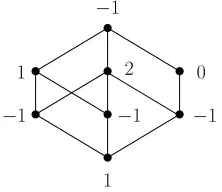
From Definition 2.6, it is clear that if s 6= t, then the sum of the values µ(s, x) over all xin the interval [s, t] equals zero. For an example of how the M¨obius function can be computed from Definition 2.6, see Figure 1.
1
1 −1
−1 −1
0
[image:3.612.252.363.257.353.2]−1 2
Figure 1. Computing the M¨obius function of an interval: the number at each element in this poset gives the value of the M¨obius function of the interval from the minimum element to that element.
Definition 2.7. We regard patterns (permutations)σin the permutation pattern posetP as func-tions fromP toN, whereσ(τ) is the number of occurrences ofσin τ.
Note that ifσ6≤τ, thenσ(τ) = 0.
Example 2.8. Let σ = 231 and τ = 23541. Then σ(τ) = 5 because there are five distinct occurrences of the patternσin τ: h231i,h251i,h241i,h351i, andh341i.
Definition 2.9. If a permutationτ maps a non-singleton interval onto an interval, then this image is aninterval block. More precisely, fix an integerb ≥1. If τ has a factor (consecutive substring)
I=τ(a)τ(a+ 1)· · ·τ(a+b), where the set of values{τ(a), τ(a+ 1), . . . , τ(a+b)}consists of all the numbersa′, a′+ 1, . . . , a′+b for somea′, thenI is aninterval block.
Example 2.10. The permutation 71342865 has interval blocks 34, 342, 1342, 65 and 71342865.
This definition may bring to mindsimple permutations: π is simple if it has no interval blocks other thanπitself. For information about these permutations, see [2] and [1].
Definition 2.11. Suppose that σ ≤ τ in P, and fix an occurrence hσi of σ in τ. If τ has an interval block that does not intersect the occurrencehσi, then the pair (hσi, τ) has aninterval block. Otherwise the pair isinterval free.
Definition 2.12. Suppose that σ ≤ τ. If τ has an interval block that does not intersect any occurrence ofσ, then the pair (σ, τ) has aninterval block.
Example 2.13. Letσ= 2341 andτ= 162395784. The pair (σ, τ) has interval blockI= 23 because the occurrences ofσin τ, namelyh6784iandh5784i, are each disjoint fromI.
Definition 2.14. Suppose that σ ≤ τ, and that hσi is a particular occurrence of σ in τ. Set
C:=τ\ hσito be the complement ofhσiinτ. Let theoccurrence poset [hσi, τ] denote the partially ordered set consisting of permutations formed by deleting arbitrary subsets of letters of C from τ. Two such permutations are considered equivalent if they are order isomorphic and if the specified occurrencehσiis in the same positions in each. A permutationρis covered byπifρcan be obtained fromπby removing a letter ofπ\ hσi. This defines the partial ordering in [hσi, τ].
[image:4.612.177.475.248.371.2]In particular, if σ(τ) = 1, then [hσi, τ] = [σ, τ]. If τ = 634521, where we have overlined the letters in a particular occurrencehσiof the pattern 321, then the permutations obtained by deleting any single letter of C = {3,5,1} are 53421, 53421 and 52341. Note that the first two of these are identical as permutations, but are considered distinct here becausehσiis in different positions. Figure 2 depicts the intervals [σ, τ] and [hσi, τ] for this example.
4231 634521
53421 34521
3421 4321 4231
52341
321
[321,634521]
634521
53421
4321
52341
321
[321,634521]
53421
4231
Figure 2. The posets [σ, τ] and [hσi, τ], with σ = 321, τ = 634521, and hσi =
h642i. In the latter poset, the letters in the occurrencehσiare marked.
When no confusion will arise, the M¨obius function of the interval [hσi, τ] will be denoted
µ(hσi, τ) :=µ[hσi,τ](hσi, τ).
Definition 2.14 will be helpful for analyzing the M¨obius function of a generic interval [σ, τ] inP
because the M¨obius function can be computed as an alternating sum of chains according to length. In any chain from τ to σin P, the final element must be a σ-pattern. Thus this chain highlights a particular occurrence of σ in τ and removes the other letters successively. Of course, we must exercise caution because there may be some overcounting of these chains. One instance in which there can be no overcounting is whenσ(τ) = 1, and hence [σ, τ] = [hσi, τ].
3. Pairs with interval blocks
Throughout this section, fixσ∈ Sk andτ ∈ Sn such thatσ≤τ in P, and fix an occurrencehσi
ofσinτ.
Theorem 3.1. Let σ∈ Sk andτ∈ Sn, withσ≤τ. If the pair (hσi, τ)has an interval block, then
µ(hσi, τ) = 0.
ρ∈[hσi, τ] such thatρ6≤π, the pair (hσi, ρ) must contain an interval block becauseρmust contain at least two letters originating fromI.
Because [hσi, π] is a closed interval in [hσi, τ], the sum of the values of the M¨obius function over this interval is zero. Thus
µ(hσi, τ) = − X
ρ∈[hσi,τ)
µ(hσi, ρ)
= − X
ρ∈[hσi,π]
µ(hσi, ρ)− X
ρ∈[hσi,τ)
ρ6≤π
µ(hσi, ρ)
= − X
ρ∈[hσi,τ)
ρ6≤π
µ(hσi, ρ). (3)
Now, each ρ in the summation in Equation (3) is strictly smaller than τ, so the rank of [hσi, ρ] for each such ρ is strictly less than n−k. Moreover, the pair (hσi, ρ) contains an interval block. Hence, by the inductive hypothesis,µ(hσi, ρ) = 0 for all such ρ, which implies that µ(hσi, τ) = 0,
completing the proof.
As discussed earlier, the poset [hσi, τ] will be a helpful tool for the analysis of intervals inP. In fact, Theorem 3.1 can be translated readily into a statement about intervals inP, as shown in the following theorem. The proof of this result is entirely analogous to that of the previous theorem.
Theorem 3.2. If the pair(σ, τ)has an interval block, then
µ(σ, τ) = 0.
Proof. Considerσ∈ Sk andτ∈ Sn, withσ≤τ inP.
We prove the theorem by induction on n−k, the rank of the interval [σ, τ]. Since (σ, τ) has an interval block, n−k must be at least 2. In the case n−k = 2, which serves as the basis of the induction, the pair (σ, τ) as precisely one interval block (with two elements), which we call I. This implies that the poset [σ, τ] is a three element chain, where the middle element is obtained by removing one of the two letters ofI fromτ. The M¨obius function of such a chain is 0, as desired.
Assume that the result holds for all intervals of rank less thann−k, where n−k≥3. Let I be an interval block in the pair (σ, τ), where [σ, τ] has rankn−k. Letπbe the permutation obtained from τ by deleting all but one letter from I, but otherwise leavingτ intact. For each permutation
ρ∈[σ, τ] such that ρ6≤π, the pair (σ, ρ) must contain an interval block becauseρmust contain at least two letters originating fromI.
Because [σ, π] is a closed interval in [σ, τ], the sum of the values of the M¨obius function over this interval is zero. Thus
µ(σ, τ) = − X
ρ∈[σ,τ)
µ(σ, ρ)
= − X
ρ∈[σ,π]
µ(σ, ρ)− X
ρ∈[σ,τ)
ρ6≤π
µ(σ, ρ)
= − X
ρ∈[σ,τ)
ρ6≤π
µ(σ, ρ). (4)
Now, each ρin the summation in Equation (4) is strictly smaller than τ, so the rank of [σ, ρ] for each suchρis strictly less thann−k. Moreover, the pair (σ, ρ) contains an interval block. Hence, by the inductive hypothesis,µ(σ, ρ) = 0 for all such ρ, which implies that µ(σ, τ) = 0, completing
There are several things to note about Theorem 3.2. First, the result does not hold if there is an interval block in τ that is disjoint from some, but not all, occurrences ofσ in τ. For example, let
σ= 12 andτ= 3412. The interval block 12 is disjoint from the occurrencehσi1=h34i, but not from the occurrencehσi2=h12i. However, if one considers the poset [hσi1, τ], thenµ[hσi1,τ](hσi1, τ) = 0,
whereasµ[σ,τ](σ, τ) = 1.
Also, the converse of Theorem 3.2 is false. For example, let σ = 1 and τ = 123. The pair (σ, τ) does not have an interval block, butµ(σ, τ) = 0. Thus, the property µ(σ, τ) = 0 cannot be characterized completely by the presence of an interval block.
4. Intervals describing a fixed occurrence
Throughout this section, fixσ∈ Sk andτ ∈ Sn such thatσ≤τ in P, and fix an occurrencehσi
ofσinτ.
In this section we give two results showing that the M¨obius function of a class of intervals is 1 or −1, the sign depending on only on the rank of the interval. The first of these, Theorem 4.4, deals with intervals that are boolean algebras. That, in turn, is the basis for an extension to a more general result in Corollary 4.12.
Definition 4.1. Lethσibe an occurrence ofσinτ. Aregion inτ (with respect toσ) is a maximal consecutive substring of the complement ofhσiinτ.
We now define a quality of a pair (hσi, τ), which informally means that every pair of distinct letters inτ\σis separated either in value or in position by some letter ofhσi. This quality is defined more precisely as follows.
Definition 4.2. The pair (hσi, τ) isseparated if for allx < ythat are in the same region ofτ\ hσi, there exists aj such thatx <hσ(j)i< y.
Example 4.3. The pair (hσi, τ) = (h653i,146253) is separated: although 1 and 4 lie in the same region ofτ\ hσi, we have 1<hσ(1)i=h3i<4.
The pair (hσi, τ) = (h764i,1357264) is not separated because 1 and 3 belong to the same region ofτ\ hσi, but the only letter between them in value, the 2, does not lie inhσi.
Theorem 4.4. The interval [hσi, τ] is boolean if and only if the pair (hσi, τ) is separated. In this case, therefore, µ(hσi, τ) = (−1)n−k, wherek andnare the ranks of σandτ, respectively.
Proof. The only letters that can be deleted fromτ in the interval [hσi, τ] are elements of τ\ hσi, since letters of the occurrence hσi must be intact in each element of the interval. Suppose that
σ∈ Sk andτ ∈ Sn, so [σ, τ] has rankn−k. It is boolean if and only if the letters of τ\ hσi can
be removed in any order, always yielding distinct permutations. This happens if and only if at no point are there lettersxandx+ 1 adjacent in ρ\ hσifor someρ∈[hσi, τ]. This is equivalent to the
pair (hσi, τ) being separated.
It is well known that the M¨obius function of a boolean algebra is±1, the sign depending only on rank. This yields the following corollary.
Corollary 4.5. If σ(τ) = 1 and the pair (hσi, τ) is separated, then µ(σ, τ) = (−1)n−k, where k
andnare the ranks of σ andτ, respectively.
It should be noted that [σ, τ] can be boolean even if σ(τ) > 1. For example, the intervals [123,1324] and [12,3412] are both boolean, even though 123(1324) = 12(3412) = 2. It would thus be interesting to characterize boolean intervals.
form µ(hσi, τ) = (−1)r, wherer is the rank of [hσi, τ]. We believe that this property holds for a
large class of intervals and give one such subclass here.
A few preliminaries are necessary before proving Theorem 4.11.
Definition 4.6. The subposetJhπi, ρKof [hπi, ρ] consists of allω∈[hπi, ρ] such that the pair (hπi, ω) is interval free. In particular, it is always the case that hπi ∈ Jhπi, ρK, andρ∈ Jhπi, ρKif the pair (hπi, ρ) is interval free.
Remark 4.7. By Theorem 3.1, the posetJhσi, τKis obtained by removing from [hσi, τ] only elements
π with µ(hσi, π) = 0. When the pair (hσi, τ) is interval free, we are thus replacing [hσi, τ] by a subposet,Jhσi, τK, which has the same M¨obius function as [hσi, τ].
Definition 4.8. A subset S of a graded poset P has the rank property if it contains as many elements of even rank in P as it does of odd rank. Such anS is called RP. If S is all ofP we use the same terminology forP itself.
The following lemma suggests the relevance of the rank property.
Lemma 4.9. An RPposet P has the following properties.
(a) If X ⊆P isRPas well, then P\X isRP.
(b) If P is bounded, with minimal elementˆ0and maximal elementˆ1, and ifµP(ˆ0, x) = (−1)rk(x)
for all x∈[ˆ0,ˆ1), thenµP(ˆ0,ˆ1) = (−1)rk(P).
Proof. Part (a) is obvious. By Definition 2.6,
µ(ˆ0,ˆ1) =−r0+r1−r2+· · · −(−1)rk(P)−1rrk(P)−1, (5)
whereri is the number of elements of rankiinP. The posetP is RP, so
r0+r2+r4+· · ·=r1+r3+r5+· · ·,
with one sum going torrk(P)−1 and the other torrk(P). This is equivalent to
(−1)rk(P)r
rk(P)=−r0+r1−r2+· · · −(−1)rk(P)−1rrk(P)−1.
Thus equation (5) simplifies toµ(ˆ0,ˆ1) = (−1)rk(P)r
rk(P). Sincerrk(P)= 1, this means thatµ(ˆ0,ˆ1) =
(−1)rk(P), proving part (b).
We will show that under particular conditions, the posetJhσi, τKis RP, regardless of whether the pair (hσi, τ) is interval free. When the pair is interval free, and thusτ ∈ Jhσi, τK, this will imply thatµ(hσi, τ) = (−1)n−k in both [hσi, τ] andJhσi, τK.
Recall Definition 2.14 of the setC=τ\ hσi: C consists of those values of [1, n] that are not part of the occurrencehσi. This set holds the key to the proof because we have fixed the occurrencehσi
ofσinτ, so elements of [hσi, τ] differ only in the letters ofC.
Any permutation ρ∈[hσi, τ] can be identified with the subset of lettersρ\ hσi ⊆C. However, there may be distinct subsetsS and S′ of C for which the permutations hσi+S and hσi+S′ are order isomorphic, having the occurrencehσiin the same places. Of course, two such permutations correspond to the same element of [hσi, τ]. When discussing something of the formhσi+S, where the letters ofS are added to the occurrencehσi, it will be understood that this indicates the order isomorphic element in [hσi, τ] (or inJhσi, τKas appropriate), having the occurrencehσiin the same positions.
Definition 4.10. Two letters aandb, witha < b, in the complement ofσ inτ are similar if they are in the same region and there is noc∈ hσisuch thata < c < b. Agroup of similar letters in the complement consists of two or more similar letters.
As an example, ifτ= 357128469 andhσi=h184i, then the regions are 357−2−69. The letters 3 and 5 are not similar, since 4∈ hσi. The letters 5 and 7 are similar, because the only letter between them in value, namely 6, belongs to the complement ofhσi.
Theorem 4.11. Fix σ∈Sk and τ ∈Sn, where k < n, and let hσibe an occurrence of σ in τ. If
there is at most one maximal group of similar letters in all the regions ofτ, thenJhσi, τK isRP.
Proof. Suppose that there is no maximal group; that is, no two letters in the same region are similar. Then the pair (σ, τ) is separated, so, by Theorem 4.4, the intervalJhσi, τK is a nontrivial boolean algebra, which is RP.
Now suppose that there is a unique maximal group of similar letters, and that it consists ofm≥2 letters. We prove the result by induction on (n−k)−m.
Ifn−k=m, then the entire complementτ\ hσi is this group ofmsimilar letters, which forms an interval block. ThusJhσi, τKconsists of two elements: the elementhσiand the element obtained by adding tohσia single letter from the complementτ\ hσi. This poset is obviously RP.
Now assume the result for all (n−k)−m < r, wherer≥1 and suppose that (n−k)−m=r. This means that in addition to the group ofmelements, there arerother letters inτ\ hσi, none of which is similar to any other letter in its respective region. Suppose thatxis one of these letters. Then the posetJhσi, τKis isomorphic to the disjoint union of the posetsJhσi, τ\ {x}K⊔Jhσi+x, τK, based on whether an element ofJhσi, τKincludes the letterxor not. Each of these intervals satisfies the hypotheses of the theorem, and by induction we know that they are both RP. ThereforeJhσi, τK
is RP as well.
Corollary 4.12. If σand τ satisfy the hypotheses of Theorem 4.11, and the pair (σ, τ)is interval free, thenµ(σ, τ) = (−1)n−k.
Proof. This follows from Lemma 4.9 and Theorem 4.11.
The hypotheses of Theorem 4.11 cannot be weakened to encompass all interval free pairs (σ, τ). The smallestτfor which there are counterexamples [hσi, τ] withµ(σ, τ)6=±1 have length 10, where the shortestσhave length 3. The only counterexample in that case, up to trivial symmetries, is when
σ= 321 andτ = 2,5,1,7,3,10,4,6,9,8 (we use commas here to clarify which values are two-digit numbers). The only occurrence of σin τ here ish10,9,8i, so the complement is 25173−46, which has no interval blocks, butµ(σ, τ) = 0.
Another counterexample, where the M¨obius function has value 2, is
σ= 2341, τ = 2,3,8,1,6,12,4,10,5,9,7,11,2.
Here the only occurrence of 2341 ish2381i. Thus the complement is a single region of eight letters.
5. Open problems
We have gathered data to support the following two conjectures.
Conjecture 5.1. Suppose that τ avoids the pattern 132 (or, equivalently, 312, or 213, or 231). Then µ(1, τ)is either 0,1, or−1.
Conjecture 5.2. Suppose thatτ, and hence the entire interval [σ, τ]for any σ, avoids the pattern 132(or, equivalently,312, or213, or231). Then we have |µ(σ, τ)| ≤σ(τ).
Observe that if Conjecture 5.2 holds, then, for intervals [σ, τ] whereσoccurs precisely once inτ, the M¨obius function must be 0, 1 or−1.
Additionally, recalling Section 4, it would be interesting to characterize the boolean intervals in the poset of permutation patterns.
Acknowledgment
We are indebted to Eric Babson for very helpful discussions, and to an anonymous referee for many valuable suggestions.
References
[1] M. H. Albert, M. D. Atkinson, and M. Klazar, The enumeration of simple permutations,J. Integer Seq.6(2003), 03.4.4.
[2] R. Brignall, A survey of simple permutations, arXiv:0801.0963v2.
[3] B. E. Sagan and V. Vatter, The M¨obius function of a composition poset,J. Algebraic Combin.24(2006), 117–136. [4] R. P. Stanley, Enumerative Combinatorics, vol. 1, Cambridge Studies in Advanced Mathematics, no. 49,
Cam-bridge University Press, CamCam-bridge, 1997.
[5] H. Wilf, The patterns of permutations,Discrete Math.257(2002), 575–583.
The Mathematics Institute, School of Computer Science, Reykjav´ık University, Iceland E-mail address: [email protected]
![Figure 2 depicts the intervals [σ, τ] and [⟨σ⟩, τ] for this example.](https://thumb-us.123doks.com/thumbv2/123dok_us/1696714.123058/4.612.177.475.248.371/figure-depicts-intervals-s-t-s-t-example.webp)
