BIODIVERSITY VERSUS NATURE:
VALUES IN CONFLICT
by
Ben Ridder, BSc, BEnvDes(Hons)
Submitted in fulfilment of the requirements for the Degree of
Doctor of Philosophy
Declaration of Originality
This thesis contains no material which has been accepted for a
degree or diploma by the University of Tasmania or any other
institution, except by way of background information and duly
acknowledged in the thesis.
To the best of my knowledge and belief this thesis contains no
material previously published or written by another person except
where due acknowledgement is made in the text of the thesis, nor
does the thesis contain any material that infringes copyright.
Signed:
13
Row\
(B
en Ridder)
Statement of Authority of Access
This thesis may be made available for loan and limited copying in
accordance with the Copyright Act 1968.
Signed:
13
fte-Al
(Ben Ridder)
ABSTRACT
Biodiversity versus Nature: Values in Conflict
In just a few decades, biodiversity conservation has become the dominant goal within natural area management. The rapid rise to predominance of this concept is widely regarded as a triumph for conservation. However, biodiversity values form only a subset of the many values broadly associated with nature. As the concept of biodiversity becomes more deeply entrenched within management structures, official activities will gradually remake the natural
landscape in a way that reflects this subset of values. It is argued that this is a problem, and one that is generated not just by the dominance of the concept per se, but by a general lack of awareness of the full range of values associated with nature, or, more precisely, our actual motivations for valuing nature in the variety of ways that we do.
To explore this problem, and to generate some insight into possible solutions, the justifications typically presented for conserving biodiversity are examined. It is demonstrated that the ubiquitous claim that biodiversity is essential for the maintenance of ecosystem services is undermined by the dependence of most
services on species associations that are highly substitutable or resilient to environmental change. By contrast, the strongest
argument for conserving 'diversity' is that it has intellectual interest,
particularly for those who dedicate themselves to the biological
sciences.
The values more broadly associated with nature are then
examined, initially through review of such terms as 'naturalness',
'wildness', and the 'autonomy of nature'. The most prevalent
explanation for the value of such qualities is that wild nature is
evocative of some larger-than-human context. However, the view
that nature has value 'for itself' — that is, inherent value — is
subsequently shown to have a number of other sources. These are
described as 'motives', of which four are identified:
(1) The experience of connection with nonhuman life;
(2) Scientific interest in nature;
(3) Respect for the larger context; and
(4) Dissatisfaction with the abstractions of modern society.
The first constitutes the dominant motive for animal welfare
groups, while the second provides the dominant motive for biologists
whose primary concern is the conservation of biodiversity. Motive
three is particularly associated with 'spiritual' values, while motive
four provides a convincing explanation for the value of naturalness
and wildness, being qualities diminished by intentional human
activity.
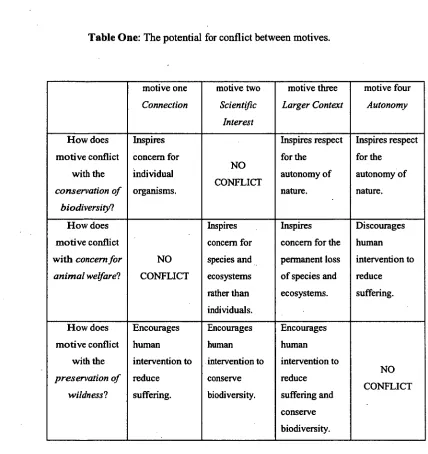
The potential for conflict and convergence between these motives
explored. This exercise is assisted by two conflict case studies: the
debates between animal welfare activists and conservationists, and
between proponents of ecological restoration and wilderness
preservation. The latter serves to highlight the need for wildness
values to be accorded a greater level of legal protection, as there is
the risk that such values will be eroded by conservation programs
oriented primarily toward safeguarding biodiversity. Greater
awareness of the motives underlying the value of wild nature will
assist in achieving this end.
ACKNOWLEDGEMENTS
Wild nature may well be an essential counterpoint to the abstractions of modern life. Yet, in the construction of this dissertation, the role of counterpoint has been provided by Rachael. She is the antidote to my introspective academic inclinations, assisted by Joseph, whose limited grasp of spoken English has not dulled his capacity to distract us both from higher pursuits.
Despite their hands-off approach, the influence of my supervisors has been considerable. Pete Hay has reinforced a dedication to the organic accretion of clutter, and a creative disdain for bureaucracy. Without his support, this doctorate would have not been. In Aidan Davison I found the perfect guide to academic culture. His humble views on the communication of ideas and captivating enthusiasm for journal impact factors and publication benchmarks have been formative.
Many others warrant mention, but to these four people go my particular thanks.
CONTENTS
Introduction
PART A
WHAT IS BIODIVERSITY?
The Dominance of Biodiversity
PART B
WHAT VALUES DOES THE
CONSERVATION OF BIODIVERSITY PROTECT?
The Value of Biodiversity: Ecosystem Services The Value of Biodiversity: Commercial Opportunity The Non-Instrumental Values of Biodiversity
PART C
WHAT ARE THE VALUES ASSOCIATED WITH NATURE?
The Values of Naturalness Inherent Values in Nature The Axiology of Inherent Value
Dissatisfaction with the Abstractions of Modern Society
PART D
HOW DO THE VALUES ASSOCIATED WITH BIODIVERSITY AND NATURE CONFLICT?
Motive Conflict and Convergence: Animal Welfare Motive Conflict and Convergence: Ecological Restoration
Chapter One
INTRODUCTION
Suppose one could make out a good case for conserving the variety of nature on all three grounds — because it is a right relation between man and living things, because it gives opportunities for richer experience, and because it tends to promote ecological stability...
Charles Elton (1958) 1
Is the only reasonable conservation objective to which we can aspire in the twenty-first century the construction of so-called protected areas that are nothing more than scientifically designed and intensively managed arks to salvage as much biodiversity as possible from the deluge of humanity? Most current literature on international conservation proceeds from the assumption that the answer is "yes" and therefore seeks scientific and technical solutions developed by conservation biologists, park planners, and public-land managers. There is almost no formal discussion in international conservation circles today of how we might resist the disappearance of the wild both within and outside of so-called protected areas around the world.
Edward Whitesell (2001) 2
Charles S. Elton, The Ecology of Invasions by Plants and Animals, (London:
Methuen, 1958), p. 145.
I. THE PROBLEM
Biodiversity is shorthand for biological diversity. In just a few decades, it has become the dominant concept within natural area management. Assessments of biodiversity are used to evaluate the success of management strategies in existing reserves, and provide a crucial justification for creating new reserves. This is not just the case in one or
two western countries where, as a result of unusual circumstances, the concept has managed to capture the collective imagination. Rather it is a global phenomenon, being a feature of all United Nations agreements relating to environmental management since the Convention on Biological
Diversity was introduced in 1992, and most environmental policy
documents produced by multinational corporations and internationally-focused environmental non-government organisations. Similarly, all western countries, and a great proportion of other countries, have accorded biodiversity a crucial role within legislative frameworks for environmental management and protection. Such enthusiasm is reflected in the attitude of the general public — at least among the environmentally-aware middle classes — which has also come to acknowledge the value of conserving `biodiversity'. This trend follows the widespread conversion of practitioners of the biological sciences, with the prevalence of the term `biodiversity' within scientific databases having escalated since the first articles to include it were published in the mid-1980s.
enterprise, and the average citizen, is invariably perceived as a good thing by those who value 'nature' not just for its instrumental uses but simply because it exists. The suggestion that a greater management focus on biodiversity might constitute a 'problem' could well be dismissed as a contrived quibble, hyped-up and embroidered by a struggling researcher hoping to generate the contention necessary to launch his academic career. However, this is far from the case.
The concept of biodiversity is not, in itself, a problem. It is, rather, a
potential source, and manifestation, of problems. These arise because biodiversity values — the values particularly associated with biodiversity form only a subset of the many values that are broadly associated with nature. It is fallacious to suggest that declining species diversity renders a
natural area devoid of natural values. For most people untrained in the biological sciences diminished biodiversity is unlikely to be noticed. Up to a point, the aesthetic, spiritual, recreational, educational, and psychological values of natural areas will be little affected by the loss of obscure species. Yet, the dominance of the concept of biodiversity ensures that biodiversity values are prioritised by default, with the remaining values protected only to the extent that they are consistent with biodiversity values. With popular support for the conservation of biodiversity grounded to a large extent in concern for the more general values of nature it can be argued that the
success of the concept of biodiversity has a destabilising effect on efforts to protect nature. Two possible outcomes present themselves:
conservation policies on the values of nature that are inconsistent with biodiversity values.
(2) The concept of biodiversity becomes more deeply entrenched within the governing structures of society, leading to
transformation of the natural landscape such that it reflects
values consistent with the conservation of biodiversity.
Given the current emphasis on biodiversity it seems more likely that what will be lost in the process are the values of nature that are incompatible with the values of biodiversity. This seems particularly tragic when it is recognised that, for many people, value is attributed to biodiversity under the mistaken assumption that the term is simply a technical way of
referring to 'nature'. By this path, a significant proportion of the values popularly attributed to biodiversity might well be wrongly assigned. This is an important issue, and one that is generated not just by the dominance of biodiversity values, but by a general lack of awareness of the full range of
II. THESIS STRUCTURE
To fully explore this problem, and generate some insight into possible solutions, this dissertation is structured around the following question:
"Is management undertaken to conserve biodiversity compatible with
protecting the values associated with nature?"
In working towards this objective, the thesis is divided into four parts and twelve chapters:
PART A What is biodiversity?
Chapter Two — Background information on the concept of biodiversity, including a basic definition, clarification of its meaning, and an overview of the degree to which it has been incorporated within international and national systems for managing natural areas.
PART B What values are protected by the conservation of
biodiversity?
Chapter Three — Consideration of the value of biodiversity for sustaining ecosystem services.
Chapter Four — Consideration of the commercial value of biodiversity, and of problems associated with justifying conservation on the basis of
Chapter Five — Consideration of the non-instrumental values of
biodiversity, being its intrinsic value, and values arising from an intellectual interest in biodiversity.
PART C What are the values associated with nature?
Chapter Six — Examines the definition and value of 'naturalness', which
has a significant bearing on the value of nature.
Chapter Seven — Examines the meta-ethical issue of what category of value
should be investigated. The most appropriate category is deemed to consist of values that are both non-instrumental and non-intrinsic. These are termed 'inherent values'.
Chapter Eight — Proposes an axiology of inherent value, consisting of four
'motives' for valuing nature 'for itself'.
Chapter Nine — Describes the fourth motive.
PART D How do the values associated with biodiversity and nature conflict?
Chapter Ten — Considers the conflict between advocates of biodiversity
conservation and animal welfare groups.
Chapter Eleven — Considers the conflict between advocates of biodiversity
conservation and 'preservationists'.
Chapter Twelve — Considers the ethical prospects opened up by the
axiology of inherent value.
III. METHODOLOGY
In addressing the above question this dissertation traverses a variety of methodological terrain. While this much at least can be gleaned from the structural overview, a breakdown of the methods employed will be useful.
Chapter three involves examination of the ecological arguments deployed in support of the notion that the conservation of biodiversity is essential for the maintenance of ecosystem services. In consequence the literature examined is largely scientific, or consists of commentary provided by scientists. Most of chapter six, and parts of chapter two, involve clarification of the definitions of various terms, again through critical review of the available literature. Chapters ten and eleven are largely dedicated to case-studies that serve to demonstrate the values and motives uncovered in earlier chapters. Chapter twelve considers the insights generated by the dissertation so far, and applies them to the management of natural areas. In a methodological sense, these various approaches are relatively unproblematic, provided the tasks are undertaken in as even-handed a manner as possible. However, more needs to be said regarding the philosophical approach taken in the discussion of values, and the motivations underlying values, which dominates chapters four and five, the end of chapter six, and all of chapters seven, eight and nine.
Most of the literature referred to in the text that follows is sourced from environmental philosophers, although occasional contributions from sociologists and psychologists are also included. The benefits of a
involved and secondly the detailed pursuit of a range of moral and value questions that thought about the environment is bound to raise." 3 He also points out that, when attempting to persuade people to adopt particular values over others, a philosophical approach is unavoidable. 4 However, this dissertation is not intended to be a treatise on why we should conserve nature, but railer an investigation into why we already do so. This is not dissimilar to the project undertaken recently by Allan Greenbaum, who asked:
How do people come to value nature 'for its own sake'?
Specifically, how do ecologists, conservation biologists, naturalists and others who seek to defend species, ecosystems, 'ecologically significant' natural areas, or (more abstractly) wildness, biodiversity or ecological integrity, come to hold these entities or conditions to be intrinsically valuable?3
Such an approach is in keeping with the advice of Eugene Hargrove that, rather than attempting to revolutionise how people think about the world, environmental philosophers should direct their energy to describing how people think about the world. 6 It follows that the axiology developed
3 Christopher Belshaw, Environmental Philosophy: Reason, Nature and Human Concern, (Chesham: Acumen, 2001), P. 9.
4 Ibid., p. 14.
5 Allan Greenbaum, "Nature Connoisseurship,"
Environmental Values 14 (2005): 389.
6 Eugene C. Hargrove, "Environmental Ethics Without a Metaphysics," in
partway through the dissertation should not be thought of as 'an ethic' in the same way that consequentialism or deep ecology are. It is more a device for highlighting some of the inadequacies of existing ethical approaches, including the identification of issues that environmental ethics needs to consider if it is to increase its relevance for the understanding of
environmental attitudes and resolution of environmental conflicts. In this regard, Belshaw's comment — that "a philosophical approach is
unavoidable" — remains relevant, insofar as the case is made below for greater recognition of certain values that have been somewhat neglected.
Perhaps the most potent criticism that can be directed towards a theoretical philosophical approach is the likelihood of it being essentially irrelevant for the actual, physical, conservation of nature. Some comfort is provided here by Bernard Williams, who notes that such approaches:
can indeed run the risk of seeming frivolous or indecently abstract when questions of practical urgency are at the front of political attention. Moreover, it is not simply a matter of urgent political decisions; some of the broader philosophical considerations are not immediately shaped to any practical decision, and it is a mistake to make it seem as though they were. They are, rather, reflective or explanatory considerations, which may help us to understand our feelings on these questions, rather than telling us how to answer
them.'
It is the critical evaluation of existing practices that might arise from such reflection that elicits the following response from David Takacs, a passage that is just as apt here as it was in the opening chapter of his book, The Idea of Biodiversity: Philosophies of Paradise:
To 'deconstruct' an idea is not difficult, and I attempt to do that here with biodiversity. Yet how does one deconstruct constructively? How to make it so that others do not misuse my analyses to obstruct those biologists attempting to stem the destruction of biological diversity? How does one bring advocacy to scholarship while remaining far enough removed from the events one chronicles to make some stab at objectivity? How can one feel about the natural world as strongly as I do... and not believe that those feelings approach the truth in some sense? How can I balance my healthy skepticism about conservation biologists' proselytizing on behalf of biodiversity against my fervent hope that they succeed? In reporting the tensions at whose nexus biodiversity is located, I hope to resolve some of them in myself'
William Cronon, in his introduction to the controversial Uncommon Ground: Rethinking the Human Place in Nature, extends the value of such 'constructive deconstruction' beyond the generation of insights that might be regarded as closer to 'the truth'. He makes the persuasive claim that the environment movement as a whole will benefit:
8 David Takacs, The Idea of Biodiversity: Philosophies of Paradise, (Baltimore: The Johns Hopkins University Press, 1996), p. 8.
We believe that any movement that merits the most passionate support of its followers — as environmentalism surely does — also deserves their most thoughtful and soul-searching criticism. Troubling as such criticism can sometimes seem, its goal in the end must be to deepen and enrich our understanding of the problems we struggle to solve, by helping us see the unexamined, sometimes contradictory, assumptions at the core of our own beliefs — assumptions that can distract or defeat us if we embrace or act on
them unthinking,ly.9
It is with these weighty ambitions in mind that the following investigation of the 'problem' of biodiversity takes place. It is time to delve into the background material presented in chapter two, after a brief comment on the meaning of the key terms 'conservation' and 'preservation'.
IV. TERMINOLOGY
'Nature conservation' has traditionally described the protection of nature for human benefit, whereas 'nature preservation' was once the term reserved for the protection of nature on grounds other than the assessment of utility. Since the days of Gifford Pinchot and John Muir,
conservationists and preservationists have disagreed over these divergent principles. However, in recent years there has been a shift away from these
9 William Cronon, "Introduction: In Search of Nature," in Uncommon Ground: Rethinking the Human Place in Nature, paperback edition, ed. William Cronon (New York: W.W. Norton, 1996), p. 26.
established meanings,`° encouraged by the tendency of scientists to refer to all efforts to protect nature as 'conservation', even when those efforts are justified by non-instrumental arguments. This inconsistency is
encapsulated in the sub-disciplinary title 'conservation biology', the practitioners of which are largely unified by a belief in the intrinsic value of biodiversity (discussed in chapter two). Similarly, 'preservation' has come to refer to the protection of natural areas by way of a 'hands-off management approach. These new terminological habits will be respected in the text below.
The term 'environmentalist' will be employed to refer to people who are likely to attribute some form of non-instrumental value to nature, and consider that, in some situations, these values take precedence over the exploitation of nature for human benefit.
As to the meaning of 'nature', much has been written on this difficult term and its social construction.' There is little reference to this literature in the text that follows, although a similar approach is adopted insofar as the dissertation amounts to a study of the social construction of the value of nature. The differences between the two are subtle, and in many respects they comprise the same project, for what determines our understanding of something other than its value? Value is determined by the intersection of the personal, the social, and the physical reality of nature, each of which
I° William M. Adams, "Rationalization and Conservation: Ecology and the Management of Nature in the United Kingdom," Transactions of the Institute of British Geographers 22 (1997): 278-79.
I I A review of this literature is provided by David Demeritt, "What is the 'Social Construction of Nature'? A Typology and Sympathetic Critique," Progress in Human Geography 26 (2002): 767-90.
will contribute to the thesis under examination as it unfolds. To avoid the
possibility of confusion, 'nature' will almost invariably be used to describe that which is not human, rather than the essential character of things, which can also be described by this term.
PART A
WHAT IS BIODIVERSITY?
Chapter Two
THE DOMINANCE OF BIODIVERSITY
"Biological diversity" means the variability among living organisms from all sources including, inter alia, terrestrial, marine and other aquatic ecosystems and the ecological complexes of which they are part; this includes diversity within species, between species and of ecosystems.
Convention on Biological Diversity (1992)
If the biota, in the course of aeons, has built something we like but do not understand, then who but a fool would discard seemingly useless parts? To keep every cog and wheel is the first precaution of intelligent tinkering. Aldo Leopold (1953)1
I. INTRODUCTION
Outlined below is the history of the term `biodiversity', and examples of its dominance within environmental management systems at the international and national levels. This is followed by discussion of the meaning of biodiversity, with particular focus on the existence of two different
1 Aldo Leopold, A Sand County Almanac With Other Essays on Conservation from Round River, (New York: Oxford University Press, 1966), p. 177.
interpretations, and the value of the concept of biodiversity, as distinct
from the value of biodiversity itself. The chapter concludes with a review of authors who have suggested that the dominance of biodiversity, by which is meant the dominance of the concept, is not entirely in the best
interests of those who value nature.
II. THE ASCENDANCY OF BIODIVERSITY
The most commonly cited definition of biodiversity, reproduced above, is that contained within the United Nations Convention on Biological
Diversity. This definition refers to three levels of diversity — genes, species,
and ecosystems — although, in theory, any criteria for distinguishing living organisms could be considered. The term's wide scope has generated considerable discourse on its meaning, reviewed in 2004 by Julia Koricheva and Helena Siipi. 2 Most of the concerns raised about the definitional shortcomings of biodiversity are of little relevance to the topic at hand, except for the ease with which it can be extended beyond a particular focus on diversity to refer to nonhuman life in general. This issue is discussed in detail later in this chapter.
2 Julia Koricheva and Helena Siipi, "The Phenomenon of Biodiversity," in Philosophy and Biodiversity, ed. Marldcu Olcsanen and Juhani Pietarinen (Cambridge: Cambridge University Press, 2004), pp. 29-38.
The first public appearance of the term was at a conference — the Forum on BioDiversity — held in 1986 in Washington, DC.3 On its acceptance by the scientific community, David Takacs notes that "in 1988, biodiversity
did not appear as a keyword in Biological Abstracts, and biological
diversity appeared once. In 1993, biodiversity appeared seventy-two times,
and biological diversity nineteen times."4 Updating these statistics to 2005,
and using the Web of Science database rather than Biological Abstracts, it
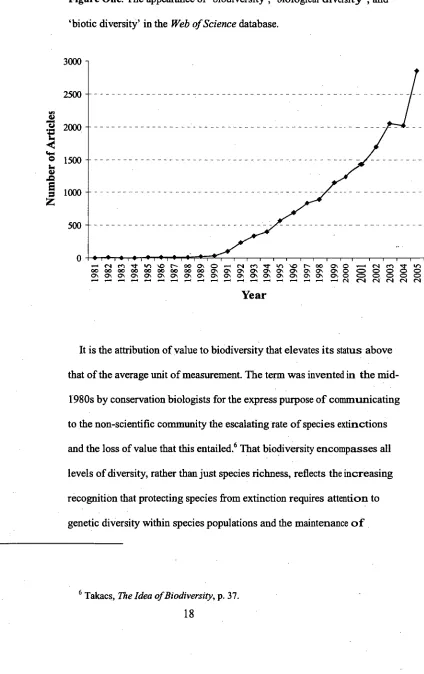
appears that the meteoric rise of biodiversity has continued. Between 1981
and 1990, 'biological diversity' appears between one and 11 times per year.5 The first occurrence of `biodiversity' is in 1987, appearing in two articles. By 1990 this figure is up to 19, and increases steadily to 1,158 in
2000, and 2,729 in 2005. In comparison, 'biological diversity' increases in occurrence from 35 in 1991, to 76 in 2000, and 121 in 2005. This is depicted in figure one below.
3 Edward 0. Wilson (ed.), Biodiversity, (Washington, DC: National Academy Press, 1988)
4 David Takacs, The Idea of Biodiversity: Philosophies of Paradise, (Baltimore: The Johns Hopkins University Press, 1996), p. 39.
Num
ber
o
f Ar
tic
les
3000
2500
2000
1500
1000
500
[image:26.565.80.504.106.780.2]0
Figure One: The appearance of `biodiversity', 'biological diversity', and
'biotic diversity' in the Web of Science database.
el en Tr WI S 00 O C, •—■ CI en .cr kr) N 00 cAci el en .1- if)
oo oo oo oo oo oo oo co oo aN as as as as as as CT CT, CT 0 <0 0 0 0 0 CT CT 01 CT CT 01 CT 01 CT 01 CT CT CT 01 CT CT 01 01 01 0 CZ, 0 0 0 0
N c■I CM C-4
Year
It is the attribution of value to biodiversity that elevates its status above
that of the average unit of measurement. The term was invented in the mid-1980s by conservation biologists for the express purpose of communicating to the non-scientific community the escalating rate of species extinctions and the loss of value that this entailed.6 That biodiversity encompasses all levels of diversity, rather than just species richness, reflects the increasing recognition that protecting species from extinction requires attention to genetic diversity within species populations and the maintenance of
6 Takacs, The Idea of Biodiversily, p. 37.
ecosystem processes upon which the species depends. This holistic, long-term perspective has been long-termed the 'ecosystem approach',7 the need for which is emphasised by a particular shortcoming of endangered species legislation, being that by the time a species is listed for protection, its population may be so diminished, and its habitat so disrupted, as to make extinction inevitable.'
Conservation biology attained recognition as an independent discipline after a conference on the subject was held in California in 1978.9 The number of journals dedicated to conservation biology has proliferated since this time, and includes Biological Conservation (since 1969), Conservation
Biology (since 1987), Biodiversiry and Conservation (since 1992), Pacific
Conservation Biology (since 1993), and Conservation Genetics (since
2000). Such is the dominance of biodiversity that it is possible for all conservation journals with a focus on biology or ecology to be reconceived as biodiversity journals.
7 Timothy M. Hennessey and Dennis L. Soden, "Ecosystem Management: The Governance Approach," in Handbook of Global Environmental Policy and Administration, ed. Dennis L. Soden and Brent S. Steel (New York: Marcel Dekker, 1999), pp. 29-48.
8 See Daniel J. Rohlf, "Six Biological Reasons Why the Endangered Species Act Doesn't Work — and What to Do About It," in Environmental Policy and Biodiversity, ed. R. Edward Grumbine (Washington, DC: Island Press, 1994), pp.
184-94.
9 George W. Cox, Conservation Biology: Concepts and Applications, second edition, (Dubuque: Wm. C. Brown Publishers, 1997), pp. 2-6; Malcolm L. Hunter, Fundamentals of Conservation Biology, second edition, (Malden, USA: Blackwell
Science, 2002), pp. 14-16.
It should be noted that not all conservation biologists immediately
jumped onto the biodiversity bandwagon. For example, the index of
Conservation Biology in Theory and Practice, by Graeme Caughley and
Anne Gunn, published in 1996, includes no reference to 'diversity', 'biological diversity', or `biodiversity'. The focus of the text is instead directed to the particular management issues surrounding endangered species. While there is only the barest mention of the Convention on
Biological Diversity, many pages are dedicated to the Convention on
International Trade in Endangered Species of Wild Fauna and Flora and
the 'red books' produced by the World Conservation Union (IUCN) containing listings of rare and endangered species.") Gunn has since indicated that their neglect of the concept of biodiversity reflected the belief that 'species' were (and are still) the primary focus of most biodiversity conservation efforts!'
In the years since the emergence of conservation biology and the neologism `biodiversity', immense energy has been expended on surveys to document unknown species and the historic and current biodiversity of particular areas, on experiments investigating the role of diversity in population dynamics and ecosystem function, and on programs to maintain, restore, and promote biodiversity. This scientific interest and activity has stimulated, and in turn has been driven by, the demands of
10 Graeme Caughley and Anne Gunn, Conservation Biology in Theory and Practice, (Cambridge: Blackwell Science, 1996), pp. 379-388.
environmental activists, governments, and the general public, who seek
action to prevent harm to natural systems, remedy past damage, and conserve particular species and ecosystems. Such demands manifest in a
plethora of organisations, agreements, policies, and nature reserves whose purpose relates to the conservation of biodiversity. Of particular
significance in this process has been the role of the United Nations.
III. ENVIRONMENTAL POLICY
• Most international activity on biodiversity is coordinated and funded by the
United Nations (UN), particularly through the UN Environment Program (UNEP) and the UN Educational, Scientific and Cultural Organisation (UNESCO). The most relevant agreement administered by the UN is the
Convention on Biological Diversity (CBD), which emerged from the
Conference on Environment and Development (UNCED) in Rio de Janeiro in 1992. Under the convention, participating nations essentially agree to do
all they reasonably can to protect biodiversity. At the 2002 UNCED, held in Johannesburg, the convention was strengthened by the commitment of
participating nations to establish an international network of national and regional protected areas by 2010. At present, 168 countries are signatories to the CBD.I2 Related to the convention, and also proposed at the Rio conference, is Local Agenda 21, which is administered by the UN
12 See the website for the Convention on Biological Diversity
(http://www.biodiv.org).
Commission on Sustainable Development. Signatories to this agreement acknowledge, among other things, that to be beneficial in the long-term,
development must not diminish biodiversity."
The CBD and the concept of biodiversity have given rise to a process of
conversion among existing UN conventions, such as the Ramsar
Convention on Wetlands, which came into existence in 1971. Although this
predates widespread interest in biological diversity it has since been reinterpreted such that biodiversity is now a central priority:
The official name of the treaty — The Convention on Wetlands of
International Importance especially as Waterfowl Habitat — reflects
its original emphasis on the conservation and wise use of wetlands primarily to provide habitat for waterbirds. Over the years, however, the Convention has broadened its scope to cover all aspects of wetland conservation and wise use, recognizing wetlands as ecosystems that are extremely important for biodiversity conservation in general and for the well-being of human communities. 14
This conversion has also occurred with the Man and the Biosphere
Programme (MAD), which was officially launched in 1970 and is
13 See the website of the UN Division for Sustainable Development (http://www.un.orgjesa/sustdev/documents/agenda21).
14 See the website for the Ramsar Convention (http://www.ramsar.org/about1about_infopack_2e.htm).
administered by UNESCO. In 1995 the International Coordinating Council of MAB reviewed the existing objectives in light of the Rio conference, and particularly the CBD. This gave rise to 'the Seville Strategy', which places far greater emphasis on the role of MAB in conserving
biodiversity.15
Other high-level UN sponsored agreements of significance for the protection of biodiversity, although not explicitly justified in these terms, include the international ban on commercial whaling administered since
1946 by the International Whaling Commission, the Washington
Convention on International Trade in Endangered Species of Wild Fauna
and Flora (CITES — 1973), the Bonn Convention on the Conservation of
Migrating Species of Wild Animals (1979), the Convention to Combat
Desertification (1994), and the UN Forum on Forests (2000).16 Other
significant projects sponsored by the UN include the World Conservation Monitoring Centre (WCMC), whose work is specifically targeted towards gathering information on global biodiversity, and the Millennium
Ecosystem Assessment.I7
15 See the website for the MAB (http://www.unesco.org/mab/doc/Strategy.pdf).
16 See the websites for the International Whaling Commission
(http://www.iwcoffice.org), CITES (http://www.cites.org), the Bonn Convention
(http://www.cms.int ), the Convention to Combat Desertification
(http://www.unccd.int), and the Forum on Forests (http://www.un.org/esa/forests).
17 See the websites of the WCMC (http://www.unep-wcmc.org ) and the
There are also many non-government organisations involved in similar
activities. The IUCN, for example, was instrumental in drafting the CBA,18
and has been producing the 'red books' since 1962.19 Through the World Commission on Protected Areas (WCPA), the IUCN is particularly influential in the field of protected area management,2° and significantly defines 'protected area' as "an area of land and/or sea especially dedicated to the protection and maintenance of biological diversity, and of natural and associated cultural resources, and managed through legal or other effective means."21
For the European Union, which currently consists of 25 member states, the first significant nature conservation agreement was the Bern
Convention on the Conservation of European Wildlife and Natural Habitats, which came into effect in 1982. In the 2004 Declaration on the
Role of the Bern Convention in the Conservation of Biological Diversity,
the standing committee of the convention provides some indication of the extent to which the concept of biodiversity has become the primary focus
18 Fiona McConnell, The Biodiversity Convention: A Negotiating History, (London: Kluwer Law International, 1996), pp. 26-27.
19 See the biography for Sir Peter Scott available on the website of the Wildfowl & Wetlands Trust (http://www.wwt.org.uldabout/Peter%20Scott.pdf).
20 See the website of the WCPA (http://www.iucn.org/themes/wcpa).
21 International Union for the Conservation of Nature and Natural Resources,
Guidelines for Protected Area Management Categories, (Gland: IUCN, 1994), p. 7.
of their efforts.22 The conservation of biodiversity was itself written into legislation in the 1992 European Union Directive on the Conservation of
Natural Habitats and Wild Fauna and Flora (the 'Habitats Directive').23 It
was under this Directive that the Natura 2000 network of protected areas was established.24 In addition, the European Union approved a
`Biodiversity Strategy' in 1998, which made provision for the preparation of `biodiversity action plans' by member countries.25
At the national level, there has been a widespread shift, particularly in affluent countries, to incorporate the concept of biodiversity within legislation and systems governing the management of natural areas and, to a lesser extent, other activities that impact on nonhuman life. This is apparent from the national reports that are submitted to the secretariat of
22 Standing Committee of the Convention on the Conservation of European
Wildlife and Natural Habitats, Strasbourg Declaration on the Role of the Bern Convention in the Conservation of Biological Diversity. Adopted 30 November 2004. Available from the website of the Council of Europe
(http://www.coeint/t/e/Cultural_Co-operation/Environment).
23 Council of the European Committees, Directive on the Conservation of Natural Habitats and Wild Fauna and Flora, Adopted 21 May 1992. Available from the website of the European Commission
(http://ec.europa.eu/environment/nature).
24 See the website summarising the activities and legislation of the European
Union (http://europa.eu/scadplus/legjen/lvb/128076.htm).
25 See the website of the European Commission
(http://ec.europa.eu/environment/docum/9842sm.htm).
the CBD outlining the measures taken to satisfy the requirements of the Convention.26
Biodiversity also features within the mission statements of many large corporations, such as BHP Billiton,27 Coca-Col a,28 DuPont,29
ExxonMobil,3° and General Motors.31
IV. CLARIFYING THE MEANING OF
BIODIVERSITY
Of particular relevance for consideration of the value of biodiversity is the confusing use of this term in contexts that are one or more steps removed from the quality of 'diversity'. An explanation is found in the Biodiversity
Synthesis produced by the Millennium Ecosystem Assessment (MEA):
the value of the diversity of genes, species, or ecosystems per se is often confused with the value of a particular component of that
26 See the website of the CBD (http://www.biodiv.org/reports/default.aspx).
27 See the website of BHP Billiton
(http://sustainability.bhpbilliton.com/2006/environrnent/caseStudies/biodiversity)
28 See the website of Coca-Cola Enterprises
(http://www.cokecce.com/srclib/corporate_responsibility/envirotunent14.html).
29 See the website of DuPont Biotechnology
(http://www2.dupont.corn/Bioteclutology/en_US/difference/principles.htm).
30 See the website of ExxonMobil
(http://exxonmobil.com/Corporate/Citizenship/biodiversity.asp).
31
See the website of General Motors
(http://www.gm.com/company/gmability/sustainability/reports/05/600_enviromne
nt).
diversity. Species diversity in and of itself, for example, is valuable
because the presence of a variety of species helps to increase the capability of an ecosystem to be resilient in the face of a changing
environment. At the same time, an individual component of that diversity, such as a particular food plant species, may be valuable as a biological resource. The consequences of changes in biodiversity
for people can stem both from a change in the diversity per se and a change in a particular component of biodiversity. Each of these aspects of biodiversity deserves its own attention from decision-makers, and each often requires its own (albeit connected) management goals and policies.32
Koricheva and Siipi describe this as a distinction between the scientific concept and the popular concept of biodiversity, 33 although given that scientists also have a tendency to conflate the two when arguing for
conservation, a more accurate way of understanding the distinction is that it is between 'biological diversity' and 'nonhuman life'. Whereas the focus of the former is on 'diversity', the latter can be used to refer to a single organism or species, the diversity of species, or all species in total. Given that the formal definition of `biodiversity' relates specifically to 'diversity', it should be emphasized that although the 'nonhuman life' sense of
32 Millennium Ecosystem Assessment, Ecosystems and Human Well-being: Biodiversity Synthesis, (Washington, DC: World Resources Institute, 2005), p. 2.
biodiversity is often convenient, it is also incorrect and misleading.
Conflation of the two is widespread and has a range of policy implications, which arise because management oriented toward the conservation of 'diversity' can be quite different to management oriented toward protecting certain valued species. To avoid confusion, Philipp Mayer recommends that "specific features of biodiversity should be distinguished, for reasons of clarity, from biodiversity per se... a study titled 'The biodiversity of arthropods' is much vaguer than one titled `The species richness of arthropods — a feature of biodiversity.'"34 Although he prefers the term 'feature', similar terms include `facet', 'element', and 'component' (of biodiversity).
As suggested by the MEA, this distinction has particular significance when considering the value of biodiversity, for the values associated with biological diversity form a tiny subset of the values more broadly
associated with nonhuman life. However, the MEA does not emphasise the extent to which conflation of these two meanings can mislead. For
example, the textbook Living in the Environment includes the sub-heading "why should we care about biodiversityr, beneath which is presented a list of values associated with particular species and natural areas, including
34 Philipp Mayer, "Biodiversity — The Appreciation of Different Thought Styles and Values Helps to Clarify the Term," Restoration Ecology 14 (2006): 109.
ecosystem services, recreation opportunities, aesthetics, and so on. 35 This
list makes it clear that the author is referring to the values of particular
components of biodiversity, rather than biological diversity itself. If he had
confined himself to the more formal usage, retaining a focus on 'diversity',
then the list of values would have been much reduced. For example, only a
few recreation opportunities could be listed, such as photographing
specimens of many different species of bird. A similar mistake is apparent
in a study of "public perceptions of biodiversity" in Canada, which actually
questioned people on the value of forests and natural areas. 36 Another
example is the enormous (750-page) report commissioned by UNEP,
entitled Cultural and Spiritual Values of Biodiversity, throughout which is
discussed the spiritual value of particular trees, certain plants with healing
properties, and crops essential to indigenous diets." In some respects it
makes sense to refer to these values as being associated with a 'diversity'
of species, rather than particular species, as the report does contain a
'diversity' of examples. Yet in each particular case described in the report
it is not usually a diversity of species that is valued, but certain useful or
35G. Tyler Miller, Living in the Environment: Principles, Connections, and Solutions, thirteenth edition, (Pacific Grove: Brooks/Cole-Thomson Learning,
2004), pp. 568-570.
36 Loren Vanderlinden and John Eyles, "Public Perceptions of Biodiversity:
Models and a Case Study," in Biodiversity in Canada: Ecology, Ideas, and Action,
ed. Stephen Bocldng (Peterborough: Broadview Press, 2000), pp. 237-270. 37 Darrell A. Posey (ed.), Cultural and Spiritual Values of Biodiversity,
(Nairobi: United Nations Environment Program, 1999)
significant species. It is the compilers of the report, engaging in a process of generalisation, who are associating the values with the aggregate rather than the specific.
The definitional ambiguity is most apparent when arguments are being presented for the conservation of biodiversity. Gretchen Daily and ten co-authors, for example, highlight a variety of human benefits associated with the use of particular species, including the harvesting of fish from aquatic ecosystems, the use of animals and animal products found in grassland ecosystems, timber, fibre, and foodstuffs from forest ecosystems, and so on. The authors state that biodiversity is the source of these ecosystem goods, yet in most of their examples it is not the diversity of species that provides the goods, but particular species. Despite the contradiction, these arguments are presented in support of conserving the full diversity of species.38
The ambiguity surrounding the meaning of biodiversity is a significant contributing factor to the problem at the heart of this dissertation. That biodiversity values form only a subset of the values generally associated with nonhuman life is a notion that will be viewed with scepticism by those who have come to believe that biodiversity values encompass all of these values.
38 Gretchen C. Daily, et al., "Ecosystem Services: Benefits Supplied to Human
Societies by Natural Ecosystems," Issues in Ecology 2 (1997): 1-16.
V. THE VALUE OF THE CONCEPT
Aside from the values associated with biodiversity itself, which are
discussed through the course of the next three chapters, the concept of biodiversity also has considerable value. One of the most important
grounds for this value is its scientific basis. The concept of biodiversity is
associated with an ecological approach, which in turn provides an
empirical grounding for the management of natural areas. Management
strategies that do not take account of ecological interdependencies, species
population dynamics, habitat requirements, and so on, are less likely to be
successful in the task of conserving valued aspects of nature. 39
Because biodiversity can be quantified (although not without
difficult?) it becomes possible to rank areas on this basis, which is
especially useful for bureaucratic processes such as determining priorities
and assigning resources. Thus, Timo Peuhkuri and Pekka Joldnen tie the
escalating interest in biodiversity to the "globalization and scientization" of
environmental problems.41 Similarly, in his description of an influential
39 Takacs, The Idea of Biodiversity, pp. 52-59.
443 See Sahotra Sarkar, "Defining 'Biodiversity% Assessing Biodiversity," The
Monist 85 (2002): 131-55.
41 Timo Peuhkuri and Pekka Jokinen, "The Role of Knowledge and Spatial
Contexts in Biodiversity Policies: A Sociological Perspective," Biodiversity and
Conservation 8 (1999): 135. See also David John Frank, "Science, Nature, and the
Globalization of the Environment, 1879-1990," Social Forces 76(1997): 409-35.
report produced in 1993 on biodiversity in the United Kingdom, Adams observes that:
In some ways the most remarkable feature of this latest turn of debate about conservation concerns not the details of the action proposed, but the way in which that action is conceived of.
Biodiversity Challenge is a set-piece of applied business management thinking. In the new language of biodiversity,
conservation efforts must be targeted on critical priorities, and locked into a tight programme of activities designed to achieve a specified and agreed output in a predicted time and within a known budget. These ideas match the contemporary rhetoric of public life, and quite fundamental shifts in the way people think — not only about the proper work of government, but also about themselves and
world about them.42
It has been suggested that the scientific nature of the concept might prove problematic for conservationists. Desiree McGraw notes that the "species-specific and site-"species-specific treaties, which pre-dated the CBD, made it easier for the public to embrace 'charismatic animals', such as pandas and seal pups, and to explore 'exotic sites' such as the rainforests of Borneo and
42 William M. Adams, Future Nature: A Vision for Conservation, revised
edition, (London: Earthscan Publications, 2003), p. 50.
Brazil."43 Yet, `biodiversity' does have a high public profile, and, arguably, would not feature so prominently within legislation and organisation mission statements if it did not.
As discussed in the previous section, in the shift from a scientific to a managerial concept, `biodiversity' has undergone a process of
simplification that has not necessarily disadvantaged conservationists. An inherent conservation bias is also apparent in the way the concept
generalises value from specific nonhuman entities to, potentially,
everything. Biodiversity describes a quality of the natural world to which all its aspects, including humans, contribute. As each organism, species or ecosystem is potentially dependent upon other organisms, species, and ecosystems, assigning value to any individual thing implies assigning an associated value to all the things upon which it depends. individual organisms can be assigned value for contributing to the genetic diversity of their community and species. This reflects the application of the
precautionary principle, which is discussed in the following two chapters. The willingness of conservationists to exaggerate the dangers of exploiting nature in order to strengthen the grounds for its protection is a frequent theme of 'anti-environmentalist' authors like Bjorn Lomborg,
43 Desiree M. McGraw, "The Story of the Biodiversity Convention: From
Negotiation to Implementation," in Governing Global Biodiversity: The Evolution
and Implementation of the Convention on Biological Diversity, ed. Philippe G. Le
Prestre (Aldershot: Ashgate, 2002), p. 26.
44 Bryan G. Norton, Why Preserve Natural Variety?, (Princeton: Princeton
University Press, 1987), pp. 62-66.
Gregg Easterbrook, and Ronald Bailey.45 However, there also exists a related discourse among conservationists whereby criticism is directed
towards those who promote arguments for conserving biodiversity that do not truly reflect their own personal reasons for doing so. This tendency has led some to suggest that the honesty of conservation scientists has been
compromised by the desire to build support for conservation goals.46 In August 2000, debate among scientists investigating relationships between
biodiversity and ecosystem functioning spilled onto the pages of Science
after a letter was published in the Bulletin of the Ecological Society of America (ESA), signed by eight prominent researchers, accusing the ESA of unscientific bias.47 This led to a meeting of the aggrieved parties at a
45 Ronald Bailey, Eco-Scam: The False Prophets of Ecological Apocalypse, (New York: St. Martins Press, 1993); Gregg Easterbroolc, A Moment on the Earth:
The Coming Age of Environmental Optimism, (Harmondsworth: Penguin, 1995);
Nom Lomborg, The Skeptical Environmentalist: Measuring the Real State of the
World, (Cambridge: Cambridge University Press, 2001).
46 See, for example, K.S. Shrader-Frechette and Earl D. McCoy, "How the Tail Wags the Dog: How Value Judgments Determine Ecological Science,"
Environmental Values 3 (1994): 107-20; Talcacs, The Idea of Biodiversity, pp. 253-
254, 266-270; Dwight Barry and Max Oelschlaeger, "A Science for Survival: Values and Conservation Biology," Conservation Biology 10 (1996): 905-911;
Paul Roebuck and Paul Phifer, "The Persistence of Positivism in Conservation
Biology," Conservation Biology 13 (1999): 444-46.
47 David A. Wardle, et a/., "Biodiversity and Ecosystem Function: An Issue in
Ecology," Bulletin of the Ecological Society of America 81(2000): 235-239;
specially organized conference in December 2000 and the eventual publication of a consensus paper in 2005.48
As discussed further in chapter four, the 'personal reasons' for valuing biodiversity are difficult to extricate from the non-instrumental values associated with nature and nonhuman life more generally. As noted by William Cronon:
an apparently more 'scientific' concept than wilderness, biological diversity in fact invokes many of the same sacred values, which is
why organizations like the Nature Conservancy have been quick to employ it as an alternative to the seemingly fuzzier and more problematic concept of wildemess.49
Many people might support the rational arguments presented for
biodiversity conservation, such as the maintenance of ecosystem services or the commercial benefits of as-yet =exploited genetic material, but their true reasons for this support are less utilitarian. Their stated belief in the value of biodiversity might instead reflect a more general concern for
48 Jennifer B. Hughes and Owen L. Petchey, "Merging Perspective on
Biodiversity and Ecosystem Functioning," Trends in Ecology and Evolution 16
(2001): 222-23; D.U. Hooper, etal., "Effects of Biodiversity on Ecosystem Functioning: A Consensus of Current Knowledge," Ecological Monographs 75
(2005): 3-35.
49 William Cronon, "The Trouble With Wilderness," in Uncommon Ground:
Rethinking the Human Place in Nature, paperback edition, ed. William Cronon
(New York: W.W. Norton, 1996), p. 81.
nature. These value-priorities encourage and reinforce the conflation of the two different interpretations of tiodiversity', which, in turn, bolsters the case for biodiversity conservation.
Because of its numerous benefits for government bureaucrats, natural area managers, and conservation activists, the concept of biodiversity has gained considerable momentum since its entry into the public arena, akin to 'efficiency' for economic administrators, or 'journal impact' for academic administrators. As in these other spheres, the domination of particular management concepts can have unforeseen, and unwelcome,
consequences. A brief review of those authors who have drawn attention to the potential problems arising from the dominance of `biodiversity' is presented below.
VI. RECOGNITION OF THE PROBLEM
The 'problem' under investigation is that management oriented to
conserving global biodiversity does not necessarily protect the full range of values associated with nature and nonhuman life. Recognition of this
problem generally appears in tandem with expressions of concern for the loss of 'wildness' or 'wilderness values'. Such concerns appear to be most
prevalent in the United States, having been discussed by authors including David Cole, Jack Turner and Edward Whitesell. Turner has been the most forceful of this group, with the last chapter of his collection of essays, The
Abstract Wild, largely dedicated to a lament for the fate of wildness under scientific management by conservation biologists.50 Whitesell, whose output on this subject appears to consist of just one chapter in the edited volume, The World and the Wild, employs a similar tone to Turner.51 Cole's observations are more measured, being confined to the pages of journals relating to conservation science and wilderness management This
is perhaps a reflection of his position as a scientist with the Aldo Leopold Wilderness Research Institute, which is funded by the United States Forest Service. Of his work, Most pertinent to the subject at hand is a 2005 paper published in the International Journal of Wilderness. Here he raises the concern that the symbolic values of wilderness are potentially undermined by the scientifically-justified activities taken to protect ecological values.52
In the United Kingdom the dominance of the concept of biodiversity in environmental management is also the occasional subject of concern. For example, there have been several brief articles in the journal of the British Association of Nature Conservationists that have drawn attention to this
5° Jack Turner, The Abstract Wild, (Tucson: The University of Arizona Press,
1996), pp. 107-25.
51 Edward A. Whitesell, "Mapping the Wild," in The World and the Wild, ed. David Rothenberg and Marta Ulvaeus (Tucson: University of Arizona Press,
2001), pp. 185-197.
issue." Perhaps the highest profile author of recent time to express such concerns has been Peter Taylor, whose book, Beyond Conservation: A
Wildland Strategy, is the most comprehensive account of `rewilding' in Europe and the UK. He suggests that a focus on conserving habitat suitable for rare species will soak up funds that might otherwise be made available for returning agricultural land to nature. Most rare species in the UK survive only under conditions that require ongoing active management to maintain, and because of the impetus behind the UK Biodiversity Action Plan, there is less money available for `rewilding,
.54 Other British authors who have drawn attention to the potential for conflict between wildness
and the focus on conserving biodiversity include William Adams and Steven Trudgi11.55 A more focused piece is presented by Kate Rawles. Although she recognises the danger posed to 'naturalness' by biodiversity- oriented management, her primary interest is the callous attitude toward the
53 See, for example, Paul Evans, "Biodiversity: Nature For Nerds?" ECOS 17
(1996): 7-12; James Fenton, "Scotland: Reviving the Wild," ECOS 20 (2000): 67-
69; Peter Rhind, "Give Nature a Chance," ECOS 25 (2004): 85-91. 54 Peter Taylor, Beyond Conservation: A Wildland Strategy, (London:
Earthscan, 2005), p. 217.
"William M. Adams, "When Nature Won't Stay Still: Conservation,
Equilibrium and Control," in Decolonizing Nature: Strategies for Conservation in a Post-Colonial Era, eds. William M. Adam and Martin Mulligan (London: Earthscan Publications, 2003), pp. 220-46; Adams, Future Nature, revised edition;
Steven Trudgill, The Terrestrial Biosphere: Environmental Change, Ecosystem
Science, Attitudes and Values, (Harlow: Pearson Education, 2001); Steven
Trudgill, "Psychobiogeography: Meanings of Nature and Motivations for a
lives of sentient animals encouraged by attention to the survival of species and ecosystems.56
In Australia, this issue has apparently aroused no interest. In addition to the lack of scholarly discussion on the matter, there appears to be little interest from the general public. In 2005, for example, the Department of Conservation and Land Management in Western Australia conducted a public consultation program for a proposed biodiversity conservation strategy for that state. Of the 173 submissions, none mentioned the natural values that might possibly be threatened by policies oriented towards biodiversity.57
VII. ALTERNATIVE CONCEPTS
It should be acknowledged that biodiversity is only one among a wide range of concepts employed to assess and manage natural areas. Not only are there other ecological concepts, such as ecological integrity and ecosystem health, but there exist broader management concepts, such as social and economic sustainability, in addition to traditional considerations like legality, public and political opinion, and cost. The position taken here
56 Kate Rawles, "Biological Diversity and Conservation Policy," in Philosophy
and Biodiversity, ed. Marklcu Olcsanen and Juhani Pietarinen (Cambridge:
Cambridge University Press, 2004), pp. 199-216.
"Department of Conservation and Land Management, Summary and Analysis
of Public Submissions on the Discussion Paper Towards a Biodiversity
Conservation Strategy for Western Australia, (Perth: Department of Conservation
and Land Management, 2005).
is that, in the management of natural areas, biodiversity is the dominant ecological concept. Also that, on account of its central role within relevant international agreements and national legislation, biodiversity concerns can usurp even such politically important factors as popularity and cost.
The dominance of the concept of biodiversity among other ecological concepts is demonstrated by its prominence within treaties, laws, policies and management plans at every scale from the United Nations to local government authorities. It is also apparent that biodiversity is an
indispensable component of other concepts employed to manage natural areas, including sustainable development, ecological health, and ecological integrity.
The need to conserve biodiversity is a key aspect of sustainable development. Both concepts figured prominently at the 1992 UNCED in Rio de Janeiro. Robert Costanza, et al., note that:
Biologically, sustainability means avoiding extinction, and living to survive and reproduce. Economically, it means avoiding major disruptions and collapses, hedging against instabilities and
discontinuities. At its most basic level, sustainability always concerns temporality and, in particular, longevity.58
58 Robert Costanza, Michael Mageau, Bryan Norton and Bernard C. Patten, "What is Sustainabilityr in Ecosystem Health, ed. David Rapport, Robert
Costnn7a, Paul R. Epstein, Connie Gaudet and Richard Levins (Malden: Blackwell Science, 1998), P. 234.
Included within the Rio Declaration on Environment and Development was reference to the need to "conserve, protect and restore the health and integrity of the Earth's ecosystem".59 Although the architects of the
declaration were referring to 'health' and 'integrity' in a general sense, this terminology coincides with two management concepts that might be seen as alternatives to `biodiversity'. David Rapport defines ecosystem health as follows:
Its essence is to marry knowledge of how environmental systems behave (that is, impacts of stress pressures on ecosystems) with knowledge of what is desirable and acceptable. This question necessitates considering the widest possible implications of change — change in human health, economic opportunity, cultural integrity, and aesthetics — in terms of societal values... As an integrative science, ecosystem health goes far beyond the boundaries of stress ecology, a field that concerns itself with the strictly biophysical aspects of the problem. It explicitly takes into account the wider territory of socioeconomic, human health, legal, and policy aspects.°
59 Rio Declaration on Environment and Development (Principle 7). Available
from the website of the UN Division for Sustainable Development
(http://www.un.orglesa/sustdevidocuments/agenda21).
6° David Rapport, "Need for a New Paradigm," in Ecosystem Health, ed. Rapport, et al., pp. 3-17.
J. Baird Callicott suggests a 'working definition' of ecosystem health to be
"a condition of normality in the linked processes and functions that compose ecasystems."61 Laura Westra notes that ecosystem health is a "condition that may apply even to nonpristine or somewhat degraded ecosystems, provided they function successfully as they presently are."62 Ecosystem health has much in common with sustainability, in so far as a 'healthy' ecosystem must be able to sustain itself; to "maintain its
metabolic activity level as well as its internal structure and organization... [and] prove resilient to outside stresses over a time and space frame relevant to that system".63 With 'organization' to a large extent described by biodiversity, and, as is claimed by many ecologists, with the resilience - of ecosystem functioning largely determined by biodiversity,64 maintaining biodiversity is therefore considered necessary for the maintenance of
ecosystem health. As discussed in the next chapter, it is likely that the conservation of biodiversity is not essential for the maintenance of many ecosystem services, in which case it is possible that an ecosystem could be
61 J. Baird Callicott, "The Value of Ecosystem Health," Environmental Values 4
(1995): 357.
62 Laura Westra, "Ecosystem Integrity and Sustainability: The Foundational
Value of the Wild," in Perspectives on Ecological Integrity, ed. Laura Westra and
John Lemons (Dordrecht: Kluwer Academic Publishers, 1995), p. 32.
63 Robert Costanza, Michael Mageau, Bryan Norton and Bernard C. Patten,
"Predictors of Ecosystem Health," in Ecosystem Health, ed. Rapport, et al., p. 241.