CSG 15 (Rev. 6/02) 1
Final Project Report
(Not to be used for LINK projects)
Two hard copies of this form should be returned to:
Research Policy and International Division, Final Reports Unit DEFRA, Area 301
Cromwell House, Dean Stanley Street, London, SW1P 3JH.
An electronic version should be e-mailed to [email protected]
Project title
Conversion to Organic Production Software (OrgPlan)
DEFRA project code
OF 0159
Contractor organisation
and location
Institute of Rural Studies
Llanbadarn Campus, University of Wales
Aberystwyth
Total DEFRA project costs
£ 97 k including
extension
Project start date
01/09/00
Project end date15/05/01
Executive summary (maximum 2 sides A4)
The Organic Conversion Planner (OrgPlan) is a computer program for farmers and advisors reducing the time input necessary for planning a conversion to organic farming.
Conversion planning can help to identify whether organic management is suited to the farm and potential problems during the conversion period itself. This involves an assessment of the current situation of the farm, based on which proposals for an organic 'target (endpoint)' can be developed. This includes proposed rotation(s), cropping and stocking plan for the specific farm situation and the proposals need to be tested for their technical and financial feasibility, including impact on forage supply, nutrient requirements and financial budgets. In a final step a more detailed strategy for getting from the current situation to the target situation needs to be worked out. On the basis of such a plan a farmers can make an informed choice about the feasibility of a conversion and planning can help to reduce the risk of conversion.
General whole farm planning methods can be broadly split into budgeting and optimisation methods. The former uses input and output data from existing enterprises or standard data, whereas the latter uses mathematical models to determine the optimal choice of enterprises for a maximisation of a key indicator, e.g. profit. OrgPlan uses the budgeting approach, building on experience with mainly German speaking budgeting software for organic conversion. It overcomes a number of key limitations of spreadsheet based budgeting approaches in relation to access to standard enterprise data, additional support tools (e.g. rotation planner) and ease of use.
The software is structured into three major sections:
In Central Resources basic standard data and farm profiles are entered, viewed and adjusted, and rotations can be planned. Access is also provided to the advisory section, containing documents about organic production standards, organic managmenet notes and a software help file. It is also possible to access these from other sections of the software.
After adding whole farm financial data the results are transferred into the Report Builder where profit and loss and cash-flow forecasts for the scenario can be generated. Reports can be viewed on screen, printed (HTML format) or exported for further analysis in other packages (spreadsheets).
A key aim in developing the software was to reduce the time input needed for conversion planning.
The software is windows based and follows the layout of the EMA software (developed by UH). It was programmed in Microsoft (MS) Visual Basic, using MS Access databases for the storage of data. It used results of several DEFRA funded research projects and has relevance to the Organic Conversion Information Service (OCIS).
A series of nine basic steps are needed to use the software to plan conversion. These are: viewing and modifying standard enterprise data, viewing and modifying rotations, creating a farm profile, creating and planning a conversion scenario, getting first feedback on the scenario, adding whole farm financial data, planning new investment during the scenario period and viewing and printing reports and/or export data for further analysis in other packages.
The basic planning tool has been released as part of the EMA 2002 software (EMA Plan). Because of the sensitive nature of the financial calculations that are the main feature of OrgPlan, further field testing of the programme in conjunction with the Organic Standard Data Collection is envisaged in the autumn of 2002 for with experienced Organic Farming
CSG 15 (Rev. 6/02) 3
Scientific report (maximum 20 sides A4)
1 Introduction
The increased rate of conversion to organic production in the UK has led to a rising demand for information and advice to support this process. Conversion planning can help to reduce risks associated with conversion by identifying potential problems relating to resource constraints, in particular land and capital requirements, financial returns and cash flow. Currently, advisors base planning on personal experience and expertise, using historical and market data, which can make the process very time consuming and expensive.
The aim of the project was to develop a computer software package that would make conversion planning simpler and less time consuming. OrgPlan is intended as a tool to help farmers and consultants assess the feasibility of conversion to organic farming. Its main intended use is in support of the Organic Conversion Information Service (OCIS), which is available in all regions of the UK and is funded by the national governments. The software also supports more detailed conversion planning including a cropping plan, forage and concentrate budgets, farm gate and rotational nutrient budgets for N, P and K, cash flow budget and multi-period profit and loss forecasts and provides technical information on principles of organic husbandry and key standards of organic production.
The software is windows based, following the already established layout of the EMA programme, developed by AERU at UH. It can run either independently, or as part of the EMA software (EMA Plan).
2 Background for conversion planning
Techniques for conversion planning were first developed in Germany and Switzerland as student projects during the early 1980s and were subsequently adopted by organic farming advisors, including organic advisors in the United Kingdom. Conversion planning was also used in some case study research of the conversion process (e.g. Freyer, 1991; Lampkin, 1992).
Conversion planning can help farmers to assess the technical and financial feasibility of the conversion, guide them through the difficulties of the conversion process, and help with applications to certification bodies and for organic aid. Conversion planning has frequently been suggested as a strategy to reduce the risk of conversion (MacRae et al., 1989; Padel, 1988; Rantzau et al., 1990), yet in surveys of converting farms in Germany and Norway there was very little planning (Løes, 1992; Vogtmann et al., 1993).
The case study farmers' studied by Padel (2002) demonstrated the benefits of conversion planning in helping to assess the financial and technical feasibility and reduce the chance of costly mistakes, particularly feed shortages. Planning should assess the farm in its current situation, develop an organic endpoint for it, and set out the steps of the transition over the necessary number of years leading to certification, including a cropping plan showing which fields are to be converted first (Padel, 2002). However, the cost of detailed conversion planning, due to the time input involved, has so far been prohibitive of its widespread use.
There are three steps in the process of planning an organic conversion:
1. Assessing the current situation - The assessment of the current farming system and management is important in helping to identify the personal and resource limitations that are likely to be faced during the conversion (Schmid, 1987). This includes soil and climatic conditions, building capacities, quotas, labour and available capital.
2. Setting organic goals - It is very important that the personal expectations (ideally of all people working on the farm) and farm specific goals for the conversion are clarified right at the start of the process, especially ideas about possible additional enterprises and marketing strategies (Rantzau et al., 1990).
3. Preparing a strategy to achieve those goals - In achieving this it is first necessary to decide on a conversion strategy, i.e. a staged or single-step conversion. This provides the basis for more detailed planning, to enable setting out the timing of the main management and soil improvement measures, as identified in the cropping and livestock plans. The preparation of budgets will help to illustrate likely changes in resources, capital investment and cash flow during the conversion period, and must cover a period of several years. The plan should also include steps to enhance the animal welfare, environmental and nature conservation characteristics of the farm.
A full conversion plan would imply a multi-period analysis of financial and physical aspects of the whole farm and should also include guidance on how to enhance the animal welfare, environmental and nature conservation characteristics of the farm. Financial aspects, in particular cash flow during the transition phase, also need to be considered. Effective planning of the transition phase requires linkages between years and, ideally, re-planning during the conversion period to
Existing farm planning methods can be broadly split into budgeting and optimisation approaches. The former use average costs and average financial output to forecast likely future development and the latter using marginal cost theory (e.g. linear programming). Both methods have advantages and disadvantages. Ideally, a combination of both would allow the to find an optimum balance between maximum income against minimum risk and cost (Dabbert, 1991). However, it has proved difficult to integrate both methods in one software package. OrgPlan is therefore based on the budgeting approach, but with several safeguards to assess the feasibility of the assumptions (e.g. rotation rules, nutrient budgets) built in. The user has the flexibility to correct standard data and to proceed (even if recommend values are exceeded), and the programme allows for alternative variants of a plan to be explored.
Good quality information at all stages of the planning process is a prerequisite for effective, realistic conversion. Valuable information for the planning process comes from the farm itself. In the UK, reliable data for organic farming are available for yields, prices and input costs and gross margins (Lampkin and Measures, 2001; Lampkin and Measures, 1999). This information needs to be adapted to the particular circumstances of the individual farmer, which requires detailed information about the current farming system (such as intensity of input use). As for the likely implications on the fixed costs, the available information is more limited, but the current fixed costs of the farm, including all financial
commitments increased by a safety margin, should give a good indication (Measures and Padel, 1999).
It was not the intention to replace, but rather to enhance the human expertise in conversion planning with the development of the software. Therefore one main aim with was to take over routine calculations so that the planning process can be speeded up and/or more detailed and or different options can be considered.
3 Results
The project had four key objectives specified in the project application and the agreed in extension period : 1. Development of a detailed outline of the programme;
2. Writing of draft software and documentation (several sub-objectives); 3. Testing of draft software and corrections,
4. Final polishing and first release of the software.
All objectives were met, but due to the nature of the work involved were addressed in a different order to what was originally envisaged. The report is therefore based on the key structure of the software rather. Due to staffing problems at the key contractor the project experienced some substantial delays.
3.1 Software structure
The main aim of the software development, to reduce the time input for conversion planning, has been considered in several ways:
• A set of standard data is provided with the software. The user can customize these by creating new enterprises and rotations in the central resources section, which can subsequently be used for any scenario, thus avoiding data entry repetition.
• Financial, nutrient and other data for each enterprise are embedded within the conversion scenario, so that the user can get instant feedback on financial, nutrient and forage implications when constructing a conversion scenario, before more detailed financial planning can be carried out.
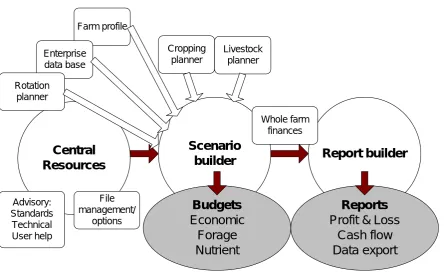
The software is structured in three major sections, which are described in more detail below.
Central Resources: Basic standard data and farm profiles are entered, viewed and adjusted, and rotations can be planned. Access is also provided to the advisory section (also possible from other sections of the software). A number of options regarding file management, change of colours, rates of the organic aid scheme etc can be set.
Scenario Planning creates new files for a scenario (the planning of several years of a farm during conversion and/or under organic management) in which cropping and livestock plans are generated. A first assessment of the scenario at whole farm gross margin level can either be viewed on screen (as data tables or charts), or exported for further calculation and additional whole farm financial data can be added.
Report Builder transfers the results of the whole farm planning of a scenario into profit and loss and cash-flow forecasts. Data can be viewed on screen, printed (HTML format) or exported for further analysis in other packages
CSG 15 (1/00) 5
Central
Resources
Scenario
builder
Report builder
Farm profile
Enterprise data base
Cropping planner
Livestock planner
Rotation planner
Budgets
Economic
Forage
Nutrient
Whole farm finances
Reports
Profit & Loss
Cash flow
Data export
Advisory:Standards Technical User help
File management/
[image:5.595.30.475.67.339.2]options
Figure 1: Basic structure of OrgPlan
A series of nine basic steps are needed to use the software to plan conversion. These are: viewing and modifying standard enterprise data, viewing and modifying rotations, creating a farm profile, creating and planning a conversion scenario, getting first feedback on the scenario, adding whole farm financial data, planning new investment during the scenario period and viewing and printing reports and/or export data for further analysis in other packages.
The software was written in MS Visual Basic with use of Access databases. Prototype ideas for all main Graphical User Interfaces (GUI) were presented to the project steering committee and amended in the light of the discussion, before the calculation routines were programmed. In the following sections the purpose, functioning, the underlying assumption and calculation routines are described briefly for all key sections. Further details can be found in the technical manual that accompanies the software.
3.2 Central Resource Section
3.2.1 Farm profile builder
A farm profile is the description of a farm in its current state (i.e. prior to conversion. This must be created before a conversion scenario can be planned. A demo-farm example is provided. In this section general details of the farm can be stored, including such as contact details. The first two letters of the postcode are used to determine the climatic region in which the farm is located, which is used in the nitrogen budget calculation. The farm profile also further contains a list of fields (with up to two years of cropping), the current livestock, and an inventory of buildings and machinery for the financial planning of the farm.
Various data to be used in OrgPlan are already covered in the EMA software (Environmental Management of Agriculture, developed by UH). Where OrgPlan runs within the EMA environment (EMA Plan), farm profile data can be imported from or exported to EMA, but OrgPlan provide input masks for all data needed so that users who only want to use OrgPlan do not need to access other sections of EMA.
3.2.2 Enterprise database
unit for livestock enterprises usually reflects income and output inccurred by the production of one unit (e.g. one finished head of cattle), as they would all need to be present on the farm to achieve the same output in following years. Inputs and outputs that represent NPK or forage movements (fertilizers, manure, feed and concentrates) need to be allocated to each particular enterprise and must not be entered in the fixed cost section even of they reflect bulk purchases used in several enterprises for the budgeting calculations to work accurately.
The Graphical User Interface (GUI) is split into several tabs:
• an "Economic" tab containing and financial weight data (in kg for the nutrient mass budget), colour coded to distinguish inputs an outputs. are stored.
• The "Nutrients & ME" tab contains N, P and K values (in %) for all in- and outputs that represent movement of nutrients, and ME values for all that feedstuffs.
• Under "Other Properties" a number of parameters needed are stored needed for calculating ME requirements of ruminant livestock and nutrient budgets, such as N fixation for legumes, whether crop residues are incorporated etc.. OrgPlan contains a standard enterprise database with 50 organic enterprises. Conventional data are included for those enterprises where the data were available from the main data source; in-conversion data are included where appropriate. Data in the economic section are based on the 2001 edition of the Organic Farm Management Handbook and the 2000/2001 edition of SAC Farm Management Handbook. Inputs and Outputs contain NPK and ME values collated by SAC/IACR and IRS from a variety of sources and own estimates (see also sections nutrient and forage budgets below). The user can customise this database and can save several versions, either based on the original data, or newly generated . A regular update of the standard data set is envisaged.
3.2.3 Rotation planner
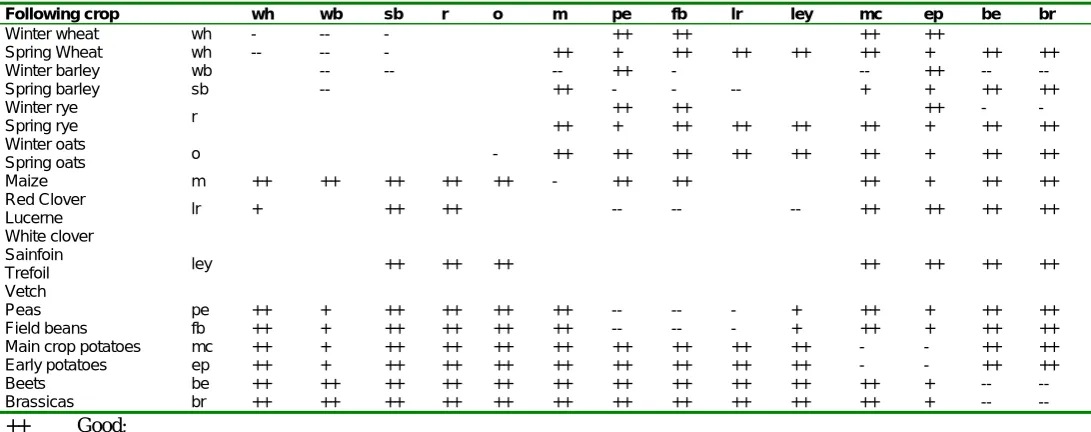
[image:6.595.26.577.539.605.2]OrgPlan highlights the importance of rotations for organic farming systems by providing a tool that encourages and supports the development of rotations by showing important indicators and basic rules of rotation planning. However, the design of a set of crop rotations requires the expertise of the farmer and advisor in the context of the real farm situation and cannot accurately be determined by a theoretical model. What is right in one situation may be not appropriate under different conditions. The user might also deliberately want to explore an extreme scenario to examine its likely impact. OrgPlan therefore does not restrict the user to proceed with a rotation that does not comply with the rotation rules. The basic rules used for assessing the rotations are the proportions of crop categories, minimal interval periods, a table of suitable cropping sequences and a rotational nutrient budget. The first check is related to the proportion of crops in one category. A rotation having, for example, 75% cereal crops is unlikely to be sustainable, and to be not recommended in an organic system. Cropping enterprises are placed in one following categories: cereals, forage legumes & leys, other fodder crops, grain legumes & oil seeds, roots & vegetables, green manure, outdoor husbandry and permanent pasture as well as permanent cropping. The 'rule’ recommends proportions for some crop categories in the rotation, for programming purposes minimum and maximum restrictions are placed on each crop category. A standard text informs the user about risks and likely implications of the rotation or combination of crops (see Table 1)
Table 1 Recommended proportions of crop categories in rotations
Crop category Min (%) Max (%)
Cereals 0 50 (2)
Forage & Green manure legumes & leys 20 (1) 100 Other fodder crops 0 33 (3) Grain legumes & oil seeds 0 25 (4) Roots & vegetables 0 75 (5)
(1) Rotation does not contain enough fertility building and is likely to lead to weed problems. (2) Rotation is likely to lead to problems with cereal diseases and grass weeds.
(3) Rotation is likely to lead to reduced organic matter in the soil because of frequent cultivations. (4) Rotation is likely to lead to problems with pests and diseases of grain legumes and/or oil seeds.
(5) Rotation does not contain enough fertility building; is likely to lead to reduced organic matter in the soil because of frequent cultivations; regular supply of organic manure is essential.
CSG 15 (1/00) 7
Table 2 Minimum cropping intervals for some crops
Crop Minimum Interval between crops (years)
Red clover 5*
Lucerne 5**
Oil seed rape 4
Oats 3
Peas 4
Fodder & sugar beets 5 Brassicas beets (Swedes, turnips) 4
Onion 6
Potatoes 6
[image:7.595.23.571.92.200.2]*) max. 3 years continuous use, after that period the break of 5 years applies. **) max of 5 years continuous use, after that period break of 5 years. Source: Faustzahlen fuer die Landwirtschaft and own experience
Table 3 The suitability of different crop combinations in the rotation
Following crop wh wb sb r o m pe fb lr ley mc ep be br
Winter wheat wh - -- - { { { ++ ++ { { ++ ++ { {
Spring Wheat wh -- -- - { { ++ + ++ ++ ++ ++ + ++ ++
Winter barley wb { -- -- { { -- ++ - { { -- ++ -- --
Spring barley sb { -- { { { ++ - - -- { + + ++ ++
Winter rye { { { { { { ++ ++ { { { ++ - -
Spring rye r { { { { { ++ + ++ ++ ++ ++ + ++ ++
Winter oats
Spring oats o { { { { - ++ ++ ++ ++ ++ ++ + ++ ++
Maize m ++ ++ ++ ++ ++ - ++ ++ { { ++ + ++ ++
Red Clover
Lucerne lr + { ++ ++ { { -- -- { -- ++ ++ ++ ++
White clover Sainfoin Trefoil Vetch
ley { { ++ ++ ++ { { { { { ++ ++ ++ ++
Peas pe ++ + ++ ++ ++ ++ -- -- - + ++ + ++ ++
Field beans fb ++ + ++ ++ ++ ++ -- -- - + ++ + ++ ++
Main crop potatoes mc ++ + ++ ++ ++ ++ ++ ++ ++ ++ - - ++ ++
Early potatoes ep ++ + ++ ++ ++ ++ ++ ++ ++ ++ - - ++ ++
Beets be ++ ++ ++ ++ ++ ++ ++ ++ ++ ++ ++ + -- --
Brassicas br ++ ++ ++ ++ ++ ++ ++ ++ ++ ++ ++ + -- --
++ Good;
+ Good, but unnecessary. Other crops make better use of the preceding one. Could be used in combination with catch crop or green manure ;
{ Possible;
- Limited applications – not advisable if preceding crop harvested late, in dry areas, if pest risk exists (mainly nematodes), or id danger of lodging (e.g. spring barley after legumes).
-- inadvisable
Source: Faustzahlen für die Landwirtschaft (adjusted).
3.2.4 Advisory section
[image:7.595.26.572.258.474.2]3.2.5 File management
[image:8.595.26.550.159.314.2]OrgPlan uses three different types of files, which are stored in specific directories (see Table 4). For the creation of new entries six different types of database files are used.
Table 4 Basic files types and names
File types/Name Extension Location (user file) Description/Notes
Report/ data export .html csv_html For viewing in browers Report/ data export .rtf csv_html Further word processing
Data export/ report .csv csv_html For further analysis in spreadsheets Scenario files .scn scenario A new file is created for each new scenario Database files
BlankScene .mdb dbases (scenarios) Structure for new scenario Enterprises_blank .mdb dbases
(standard, enterprise)
Structure for a new Enterprise Database ESC_blank .mdb dbases
(ESC)
Structure for new Enterprise Standard Components (ESC) database
OrgPlanFarms .mdb dbases Stores the farm profiles
RotationRules .mdb dbases Stores the rotation analysis rules
Blank_Farm .mdb dbases Used for exporting/importing farm profile data
3.3 Scenario planning
Scenario planning is the main feature of the software with which conversion scenarios can be developed and assessed. The software creates the scenario file in which all the specified data from the farm profile, enterprise data and rotations etc are copied, before the Cropping and livestock planner can be accessed. Once a scenario is created any changes made to either cropping plans or enterprise gross margins to reflect the specific assumptions/conditions of this planning process are stored as part of the scenario file, and not with the main user enterprise database in the Central Resources section. In a second step, once the scenario appears reasonably balanced on the basis of the first feasibility checks, more detailed planning with the Whole Farm Financial Planning tool and Investments Planner can follow.
3.3.1 Cropping and livestock planner
The GUI 'Cropping Planner' provides the user with a good overview of the whole cropping system at any particular time in the planning process, by showing a grid in which crops are allocated to individual fields for each year of the scenario. Crops can be entered either directly or through applying rotations (developed in the rotation planner) to individual field, which also helps to reduce entry time. Existing cropping data from the farm profile (up to two years) can be transferred into the scenario file. Crop entries must be colour coded to reflect the status (conventional, in conversion or organic) of the crop in each field and year. This determines which set of enterprise data are used for further calculations. The finished cropping plan can be printed or exported into other software, for example to be attached to the application for
certification.
From the 'Cropping Planner' the user has access to the 'Field Manager' where further information about each individual field (rent, information about suitability for specific rotations, actual conversion date for certification records) in the scenario can be managed and stored. Fields can be split (into a maximum of 4 parts either permanently or for just one year) and later restored into one field, or also removed from for parts of a scenario or permanently from the farm profile. The crop sequence in an individual field can be evaluated for compliance with the crop rotation rules and a nutrient budget at the field level.
The livestock planner serves as a platform to plan the type and scope of the livestock enterprises used in the scenarios and follows a similar layout.
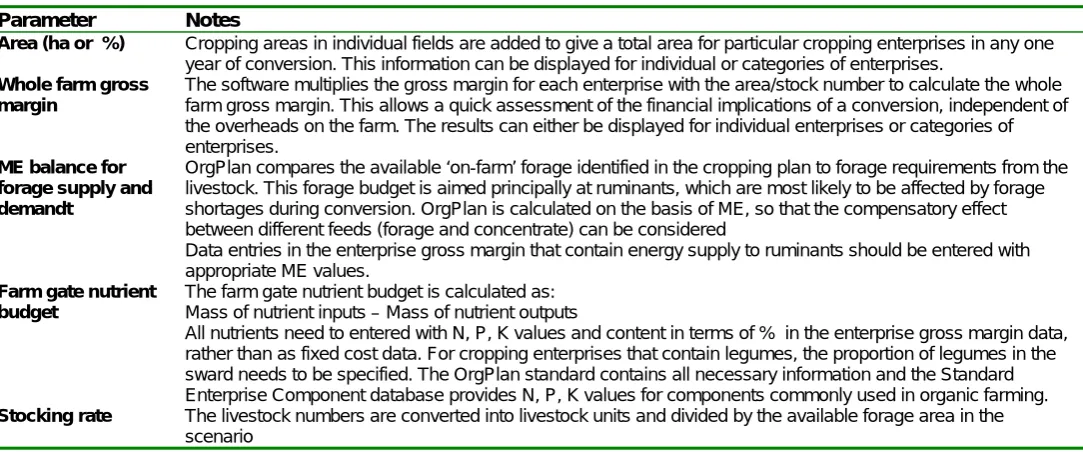
3.3.2 Scenario evaluation
CSG 15 (1/00) 9
Table 5 Summary of the scenario evaluation procedures
Parameter Notes
Area (ha or %) Cropping areas in individual fields are added to give a total area for particular cropping enterprises in any one year of conversion. This information can be displayed for individual or categories of enterprises.
Whole farm gross margin
The software multiplies the gross margin for each enterprise with the area/stock number to calculate the whole farm gross margin. This allows a quick assessment of the financial implications of a conversion, independent of the overheads on the farm. The results can either be displayed for individual enterprises or categories of enterprises.
ME balance for forage supply and demandt
OrgPlan compares the available ‘on-farm’ forage identified in the cropping plan to forage requirements from the livestock. This forage budget is aimed principally at ruminants, which are most likely to be affected by forage shortages during conversion. OrgPlan is calculated on the basis of ME, so that the compensatory effect between different feeds (forage and concentrate) can be considered
Data entries in the enterprise gross margin that contain energy supply to ruminants should be entered with appropriate ME values.
Farm gate nutrient budget
The farm gate nutrient budget is calculated as: Mass of nutrient inputs – Mass of nutrient outputs
All nutrients need to entered with N, P, K values and content in terms of % in the enterprise gross margin data, rather than as fixed cost data. For cropping enterprises that contain legumes, the proportion of legumes in the sward needs to be specified. The OrgPlan standard contains all necessary information and the Standard Enterprise Component database provides N, P, K values for components commonly used in organic farming.
Stocking rate The livestock numbers are converted into livestock units and divided by the available forage area in the scenario
3.3.3 Forage budget
Shortage of forage can be a serious problem during the conversion period, as a result of decreasing forage yields through the withdrawal of nitrogen fertilizers, and restrictions on purchased feeds. Converting from a conventional to an organic system involves establishing clover in the swards (usually by reseeding with clover rich mixtures) and changes in the enterprise mix. Farmers also usually reduce the intensity of concentrate input during conversion (Haggar and Padel, 1996; Padel, 2002). In OrgPlan, the annual energy requirements of the ruminant livestock enterprises are calculated
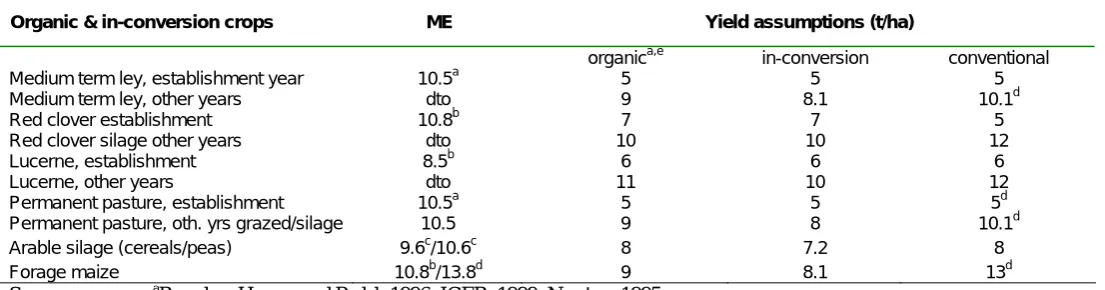
dynamically, considering a range of independent variables relating to production and concentrate intake. The energy values for each enterprise are calculated on the basis of assumptions. Some standard values have been set for each enterprise (based on the 2001 Organic Farm Management Handbook (Lampkin and Measures, 2001) for variable assumptions (e.g. production, concentrate use), but these can be adjusted by the user. Other assumptions (e.g for ME requirement for preganancy) have been pre-set as constant parameters, derived from standard literature of ration planning (e.g. AFRC, 1990; Chamberlain and Wilkinson, 1996). Table 9 below shows the assumed ME values of concentrates used in organic enterprise, for conventional enterprises values from the SAC developed ration planning programme feedbyte were used.
The balancing calculation for the ruminant enterprises subtracts energy supplied by feed sources directly allocated (such as concentrate and bulk feed) from the ME requirement at enterprise level. For other livestock enterprises (pig & poultry, horses) the ME requirements are considered as a constant value, independent of their intake of other feed inputs, and are stored as 'Other properties'.
Table 6 ME supply and yield assumptions for forage enterprises
Organic & in-conversion crops ME Yield assumptions (t/ha)
organica,e in-conversion conventional Medium term ley, establishment year 10.5a 5 5 5 Medium term ley, other years dto 9 8.1 10.1d
Red clover establishment 10.8b 7 7 5 Red clover silage other years dto 10 10 12
Lucerne, establishment 8.5b 6 6 6 Lucerne, other years dto 11 10 12
Permanent pasture, establishment 10.5a 5 5 5d Permanent pasture, oth. yrs grazed/silage 10.5 9 8 10.1d
Arable silage (cereals/peas) 9.6c/10.6c 8 7.2 8 Forage maize 10.8b/13.8d 9 8.1 13d
Sources: aBased on Haggar and Padel, 1996; IGER, 1999; Newton, 1995
b
Lampkin and Measures (2001)Organic Farm Management Handbook;
c
MAFF (1984) Energy allowances for feeding systems for ruminants;
d
SAC (2000/2001) Farm Management Handbook
e
Own estimates based on various sources.
3.3.4 Nutrient budgets
Although the nature and amounts of inputs and outputs vary between farming systems, regions and even fields, the mass balance concept provides a framework that can be applied systematically across a wide range of scales and farming systems (Watson and Stockdale, 1999). Such a mass balance cannot claim to be an accurate representation of nutrient flows, but gives an indication of the nutrient dynamics. The DEFRA funded research into P and K on organic farms concluded that farm gate budgets provide a semi-quantitative way of assessing the impact of rotations/farming systems on soil reserves, whereby organic farming systems can show both P and K surpluses and deficits depending on management. Imports of supplementary feed and bedding materials provide a key route for nutrient supply to mixed systems. This illustrates that it is important to assess the nutrient situation specifically for a farm or farming system rather than to rely on standardized recommendations (see final report OF 0114), highlighting the value of including nutrient budgeting as part of the conversion planning process
Balancing nutrient inputs and outputs of a system requires an exact idea of the systems boundaries, both in space and time. The time boundaries for the nutrient budgets in OrgPlan are determined as financial years through the gross margin concept to which the nutrient budgets are attached. This allocates inputs and outputs to the year of a crop harvest, although a particular input might have entered the previous year.
With regards to the space boundaries OrgPlan allows two options to be considered, the farm gate and rotational budget. The farm gate budget identifies whether the farm is stable in terms of the nutrient balance for N, P and K; the the
rotational budget (accessed through the rotation planner in the Central Resource Section) evaluates specific crop rotations. The mass balancing approach adopted in both cases does not take internal nutrient transfers into account, but manures brought into the system or used on farms can be added as an input to individual enterprises. The mass balancing approach also implies that no losses due to management (for example through leaching) are taken into account.
The balancing process is shown in the evaluation section of the GUI 'Cropping and Livestock Planner'. The calculation has two stages, similar to the forage budget calculations. At first the nutrient balance of each enterprise is calculated and the result stored as part of the data in the generic or scenario specific enterprise gross margin table (the calculations differ somewhat for the two options). For the N budget, leguminous fixation, natural N-decomposition and NH3-volatisation are taken into account (see below). In a second step the annual the total farm gate nutrient budget is calculated by multiplying with the size of each enterprise. The results need to be interpreted in the context of one year, but as OrgPlan allows planning the conversion process over a several years it is likely that some misallocations will level out over time.
3.3.4.1 The farm gate nutrient budget
The main emphasis in OrgPlan is on the farm gate nutrient budget, which treats the farm as a black box, ignoring all internal nutrient transactions. Only nutrients that enter and leave the farm via the imaginary farm gate are considered. These include fertilizer, brought in manures, concentrates and nitrogen from the air through fixation as inputs, and, as outputs, crops, milk, meat or sold manure, and atmospheric depositon. The difference between inputs and outputs is the nutrient surplus or deficit, expressed in kg/ha per year.
CSG 15 (1/00) 11
yield levels have been adjusted) rather than relying entirely on standard enterprise data. Information whether straw is incorporated or removed from the field (in 'Other Properties' tab of the cereal enterprises) can also affect the nutrient budget.
3.3.4.2 The rotation budget
In addition to farm gate budget OrgPlan allows for the budgeting of individual crop rotations, as sometimes used by advisory and certification bodies. This rotation balance should be understood as a sub-system to the farm gate approach, following the same mass balancing approach and differing from the farm-gate budget only through the spatial boundaries. In mixed systems, Farm Yard Manure represent a significant resource of both P and K, alongside imports of feed and bedding, which are considered in the farm gate budget. Such farm-internal nutrient movements are not automatically taken into account in the rotational budget. Because manure applications vary between farms, no standard values were set in the standard enterprise data. Such nutrient flows can be considered, if they are added (including N, P, K content values) as inputs into to appropriate enterprises.
[image:11.595.25.441.356.401.2]Further information is needed about the harvesting regime, summarized under ‘other properties’. For the harvest regime of crops to determine how much nutrients are likely to be left on the field. Four options are given (cut &remove, grazing by dairy, grazing other ruminants, green manure), but OrgPlan cannot consider mixed use of a sward. Because of the overall aim to limit the data requirements, OrgPlan uses a simple approach to estimate the amount of nutrients remaining on a grazed field for the rotational nutrient budget (see Table 7). The software presumes a linear relationship between nutrients remaining on a field via dung and urine and the proportion of the total yield used by grazing, depending on the type of livestock grazing. The amount of N, P and K remaining on the field is calculated based on this DM yield, which is stored in the input entries in the enterprise tables.
Table 7 Grazing return factors for N, P and K
Nutrient return factor % of grazed nutrient intake
Enterprise N P K
Dairy cows 50
All other ruminant enterprises 80 35 77
Source: Own estimates
3.3.5 Nitrogen fixation, deposition and NH3-volatisation
The nitrogen budget in OrgPlan differs from the P and K budgets, because atmospheric inputs and outputs have to be considered. Nitrogen fixation is considered for enterprises with legumes, and the natural N-deposition (D) in kg/ha. This value is determined by the geographical location, which can be looked up based on the farms postcode and is entered via the farm profile, NH3-volatisation is determined within the livestock enterprises.
In OrgPlan leguminous N-fixation is included as proposed by Korsaeth and Eltun ( 2000). This formula was further amended to calculate N-fixation based on annual yield (kg N ha-1) rather than individual cuts, and the parameters Nleg, F and R are adapted correspondingly (Table 8). Variables for other legumes likely to be considered by OrgPlan users, but not covered by the original source were estimated based on other sources.
Equation 1 Amended N-Fixation formula in OrgPlan (after Korsaeth and Eltun, 2000)
ik i i i
fix Y*L *Nleg *F *R
N =
i = the legume, k is the year of the ley, Y is the total annual yield (kg DM ha-1), Li is the proportion of legume i (kg kg-1), Nleg is the N content in the
legume (kg N kg-1 DM), F
i (kg N kg-1) is the fraction of Nleg originating from fixation, Rjk is the factor that accounts for the net accumulated fixed N,
which occurs below stubble height.
In addition to the existing parameters (Nleg, F =fixation factor 1 in OrgPlan, R =fixation factor 2) the calculation of the N-fixation requires the proportion of the legume’s total DM yield (Li) and the total DM yield (Y).
Yield estimates included in the 'economic' tab of each cropping enterprise must also be included for green manure enterprises, even if not removed from the field. For mixed swards (legumes and non legumes) values for the legume proportion of the DM yield must also be specified. The N, P and K content of the total yield is determined by the mass of the legume (in kg) DM as a proportion of the total DM yield, by multiplying the nutrient content of each component (Ci
Table 8 Parameter values for the N-fixation formula
R =fixation factor 2
Legume Nleg F= fixation factor 1
Year 1 >Year 2
White clover [1] 0.03715 0.923 1.45 1.03 Red clover [1] 0.03025 0.923 1.45 1.03
Lucerne [2] 0.03500 0.900 1.4 1.03 Sainfoin [2] 0.03000 0.850 1.4 1.03 Trefoil [2] 0.03000 0.850 1.35
Vetches [1] 0.03100 0.654 1.2 Tares [2] 0.03300 0.654 1.2 Lupines [2] 0.02500 0.654 1.05 Field beans [2] 0.02800 0.654 1.045 Field peas [1] 0.02800 0.654 1.045
Sources: [1]Korsaeth A and Eltun R (2000)
[2]Nleg according to Heinzman (1981), F and R own estimates
3.3.6 Nutrient data for standard enterprise databases
Nutrient values had to be identified for all material components of the standard enterprise database, based on work carried out under the DEFRA project Optimisation of P and K management within organic farming systems (see also final report for OF 0114).
Table 9 Assumed N,P, K and ME values for concentrates in organic enterprises
%RP % organic % N %P %K ME
Concentrate, dairy 18 2.8 0.45 0.8 12.8
Concentrate, other gr. Livestock 16 2.5 0.45 0.8 12.1
Layer feed 16 2.5 0.45 0.8 12
Poultry feed 15 80 2.4 0.45 0.8 12
Concentrate pigs 16 80 2.6 0.45 0.8 12
Mineral feed sheep 0.85 0.07 2.18 0
Sources: Own estimates
3.3.7 Detailed financial planning with whole farm finances tool
Once a scenario appears balanced and the scenario file is open the 'Whole Farm Finances' tool can be accessed. The software displays relevant data from various sections in a table: the sum of variable costs for the enterprises, data derived from the farm inventory (e.g. machinery depreciation), farm rent from the farm profile, and income from the organic aid scheme (if switched on). This forms the basis for further financial reports that can be generated.
[image:12.595.32.570.356.495.2]CSG 15 (1/00) 13
3.3.8 Report builder
The report builder can generate four different types of reports as tables and/or charts in a number of different formats for viewing, printing or further analysis in other packages:
• Profit and loss forecasts
• Cash flow forecasts
• Investments plan
• Detailed cash flow (intended for further analysis)
• Gross margins (at enterprise, whole farm or field level)
4 Conclusion
The software is aimed at farmers and advisors and should provide easy access to essential information about organic farming and conversion, such as electronic access to major standards, technical documents and assistance with feasibility checks.
It is intended to enhance rather than replace human expertise in planning the conversion to organic farming. One of the potential benefits of the software is that it should speed up the process of creating conversion plans. This has been achieved mainly in two ways.
• An Organic Standard database (based on the Organic Farm Management Handbook) with financial, nutrient and other data is provided and can be modified in the light of his/her own experiences at a generic level ('Central Resources Section'). The user has this available for several different scenarios reducing the data entry repetition.
• The scenario planning process provides instant feedback on the financial impact, and nutrient and forage budgets when constructing a conversion scenario, allowing the user to balance a plan roughly before more detailed planning is carried out.
The concept of OrgPlan has been presented and positively received at several meetings with farmers and consultants, including some working in the conventional sector. A first test of a prototype of the software by organic farming advisors during 2001 has highlighted the potential, apart from identifying a number of bugs and errors that have since been corrected. The testing also indentified that a simple guide was needed, leading to the writing of step-by-step guide that explains how the software can be used. The basic planning tool has been released as part of the EMA 2002 software (EMA Plan).
5 Related and future work
OrgPlan builds on results from several other DEFRA/ MAFF funded projects: Development of the programme EMA (Environmental Management for Agriculture (CSA 2628 & 4452); Economics of organic farming (OF 0125 & OF 0190); and Optimisation of P and K management within organic farming systems (OF 0114 and SEERAD funded work). A prototype of the software has been used by the contractor in work on modelling different strategies of organic milk production as part of the systems study on organic milk production (OF 0146).
The software also has relevance to DEFRA supported OCIS (Organic Conversion Information Service). Development of computer-based tools to support the OCIS process was a key recommendation of the evaluation of this free advice scheme. The success of the on-farm advice of the scheme could be further enhanced if advisers are in a better position to consider the financial impact of the conversion on a holding.
Because of the sensitive nature of the financial calculations that are the main feature of OrgPlan, further field testing of the programme in conjunction with the Organic Standard Data Collection with experienced Organic Farming Consultants is envisaged in the autumn of 2002.
The process of obtaining reliable standard data for the nutrient content of some inputs/outputs (e.g. organic compound feeds) has shown that there is need for further work regarding the development of a standardised approach for nutrient budgeting, particularly if these are to be used with a regulatory relevance, for example in the context of UK Organic production standards and inspection procedures.
6 References
ANON (2000) Final project report to DEFRA Optimisation of phosphorus and potassium management within organic farming systems (Project codeOF 0114 published on DEFRA website).
AFRC (1990) Nutritive requirements of ruminant animals: energy. Agricultural and Food Research Council.; London. Chamberlain, A. T. and J. M. Wilkinson (1996) Feeding the Dairy Cow. Chalcombe Publications; Welton.
Dabbert, S. (1991) Farm planning on organic farms - theoretical issues and practical applications. Paper presented at the '6th European Association of Agricultural Economics Congress', Den Haag, September 1991.
Freyer, B. (1991) Ökologischer Landbau: Planung und Analyse von Betriebsumstellungen. Ökologie und Landwirtschaft, Verlag Josef Margraf; Weikersheim, FRG.
Haggar, R. and S. Padel (ed.) (1996) Conversion to organic milk production. Technical Review No 4, IGER; Aberystwyth. Heinzman (1981)
IFOAM (1998) Basic standards for organic production and processing. International Federation of Organic Agriculture Movements; Tholey-Theley.
IGER (1999) Final report to MAFF: Organic Milk Production: post-conversion phase (unpublished). OF0113, Aberystwyth. Korsaeth, A. and R. Eltun (2000) Nitrogen mass balances in conventional, integrated and ecological cropping systems and the relationship between balance calculations and nitrogen runoff in an 8-year field experiment in Norway. Agriculture Ecosystems & Environment 79 (2000), 199-214.
Lampkin, N. (1992) Conversion to organic farming. PhD-Thesis, University College of Wales, Aberystwyth.
Lampkin, N. and M. Measures (2001) 2001 Organic Farm Management Handbook. University of Wales, Aberystwyth and Organic Advisory Service; Aberystwyth, Wales and Newbury.
Lampkin, N. H. and M. Measures (ed.) (1999) 1999 Organic Farm Management Handbook. Welsh Institute of Rural Studies and Elm Farm Research Centre; Aberystwyth and Hamstead Marshall.
Løes, A. K. (1992) Aktuelle Omleggningsproblemer - a Spørreundersøkelse (Actual conversion problems - a survey). No 9, Norsk Senter for økologisk Landbruk. Tingvoll.
MacRae, R. J., S. B. Hill, J. Henning and G. R. Mehuys (1989) Agricultural science and sustainable agriculture: a review of the existing scientific barriers to sustainable food production and potential solutions. 6 173-219.
Measures, M. and S. Padel (1999) Conversion planning, New Entrants. Paper presented at the '11th National Conference on Organic Food and Farming', Cirencester.
Newton, J. (1995) Herbage production from organic farms. Journal of the RASE 156, 24-34.
Padel, S. (1988) Umstellungsplanung: Risikoabschätzung für zukünftige Bio-Bauern. Bioland 88 (3), 16-19.
Padel, S. (2002) Conversion to organic milk production: the change process and farmers information needs. PhD-Thesis, University of Wales.
Padel, S., J. Tzilivakis, M. Measures, C. A. Watson and E. Stockdale (2002) Development of software to plan conversion to organic production (OrgPlan). In: UK Organic Research 2002. Organic Center Wales, Aberystwyth, pp 169-172.
Rantzau, R., B. Freyer and H. Vogtmann (1990) Umstellung auf oekologischen Landbau. Angewandte Wissenschaft, 389. Landwirtschaftsverlag; Muenster-Hiltrup, FRG.
Schmid, O. (1987) Besonderheiten bei der Umstellung auf Biolandbau: Konsequenzen fuer die Planung. In: Kursunterlagen zum Bioberaterseminar 15.9.87, Forschungsinstitut fuer Biologischen Landbau; Oberwil, Switzerland.
Soil Association (1999) Standards for organic food and farming. Soil Association; Bristol.
Tzilivakis, and K.A. Lewis (2001) The development of software to support planning conversion to organic agriculture. Proceedings of the Third European Conference of the European Federation for Information Technology in Agriculture, Food and the Environment (vol. 1). June 18-20, 2001, Montpellier, France. pp 119-123
UKROFS (2001) Standards for Organic Food Production. UK Register of Organic Food Standards; London.
Vogtmann, H., B. Freyer and R. Rantzau (1993) Conversion to low external input farming: a survey of 63 mixed farms in West Germany. Paper presented at the 'Agroecology and Conservation issues in temperate and tropical regions', Padua. Watson, C. A. and E. A. Stockdale (1999) Whole Farm Nutrient Budgets: What do they tell us? In: Accounting for Nutrients: a