Using
mat
K sequence data to unravel the phylogeny of Casuarinaceae
Dorothy A. Steane,
a,*Karen L. Wilson,
band Robert S. Hill
c,daSchool of Plant Science, University of Tasmania, Private Bag 55, Hobart, TAS 7001, Australia bRoyal Botanic Gardens Sydney, Mrs. Macquaries Road, Sydney, NSW 2000, Australia
cCentre for Evolutionary Biology and Biodiversity, South Australian Museum, North Terrace, Adelaide, SA 5000, Australia dDepartment of Environmental Biology, University of Adelaide, Adelaide, SA 5005, Australia
Received 7 May 2002; revised 17 December 2002
Abstract
Casuarinaceae are a Gondwanic family with a unique combination of morphological characters not comparable to any other family. Until recently, the 96 species in the family were classified in a single genus,Casuarina s.l.A recent morphological revision of the family resulted in the splitting ofCasuarina s.l. into four genera—Allocasuarina,Casuarina s.s.,Ceuthostoma, andGymnostoma. This study usesmatK sequence data from 76 species of Casuarinaceae and eight outgroup taxa to examine the phylogenetic structure within the Casuarinaceae. The study demonstrates the monophyly of the four genera and examines the relationships within the family; it tests the validity of the infra-generic subdivision ofAllocasuarina; it discovers geography-based infra-generic subdivisions withinGymnostomaandCasuarina; and, finally, provides a molecular framework on which to trace the evolution of xeromorphy in the Casuarinaceae.
Crown CopyrightÓ2003 Published by Elsevier Science (USA). All rights reserved.
1. Introduction
The family Casuarinaceae originally contained a single genus,Casuarina L. However, over the last two decades a morphological revision of Casuarinaceae resulted in the splitting of Casuarina into four genera (Johnson and Wilson, 1989): Gymnostoma L. Johnson (18 species; one in northeastern Queensland, the rest in Malesia, the Solomons, Fiji and New Caledonia), Ceu-thostoma L. Johnson (two species in Malesia, from Palawan and Borneo to New Guinea),CasuarinaL. (17 species; six in Australia, the rest extending from the Bay of Bengal to Polynesia) and Allocasuarina L. Johnson (endemic to Australia; 58 species, divided among 14 sections). All of these genera grow in tropical climates, but Casuarina extends into warm temperate regions of Australia and Allocasuarina is concentrated mainly in warm to cool temperate regions (southern Australia). The splitting of Casuarina into four genera and the naming of numerous new species of Allocasuarina has received some criticism; see for example, exchanges
be-tween Hwang (1990, 1991a,b, 1992), Crisp (1991) and Johnson (1991).
Casuarinaceae are a Gondwanic family. Pollen at-tributed to Casuarinaceae has been found in Paleocene through to Miocene deposits in South Africa (Coetzee and Muller, 1984; Coetzee and Praglowski, 1984), Ar-gentina (Archangelsky, 1973), New Zealand (Milden-hall, 1980) and Australia (Johnson and Wilson, 1989; Macphail et al., 1994). As well as being the second most widely distributed genus of Casuarinaceae today, Gym-nostomais the oldest and most broadly distributed genus in the fossil record. Megafosssils of Gymnostoma are recorded from Paleocene sediments in New South Wales (Scriven and Hill, 1995), Eocene in South Australia, Victoria and Queensland (Christophel, 1980, 1989), Ol-igocene in Tasmania (Hill and MacPhail, 1983) as well as the Miocene of New Zealand (Campbell and Holden, 1984) and South America (Frenguelli, 1943). There are only a couple of records ofCasuarinafrom the Miocene and Pliocene (Campbell and Holden, 1984; Christophel, 1989) and there is no certain fossil record of Allocasu-arinauntil the early Pleistocene (Jordan, 1997), although some fossils currently reported asCasuarinamay belong to this genus (Dilcher et al., 1990). Casuarinaceae no
Molecular Phylogenetics and Evolution 28 (2003) 47–59
www.elsevier.com/locate/ympev PHYLOGENETICS AND
EVOLUTION
*
Corresponding author. Fax: +61-3-62262698.
E-mail address:[email protected](D.A. Steane).
longer occur in New Zealand, South America or southern Africa.
Phylogenetic relationships among the genera of Ca-suarinaceae are unclear. Johnson and Wilson (1989) suggested thatGymnostomaandCeuthostomarepresent the more primitive members of the family, while Allo-casuarinarepresents the most derived genus. The extreme morphological reduction seen in this family, as well as the unique combination of morphological traits (e.g., drooping equisetoid twigs, reduced scale-like leaves in whorls forming toothed sheaths at each node, inflores-cences with alternating whorls of tooth-like bracts and reduced flowers, wind-pollination, woodyÔconeÕ-like in-fructescences, winged samaras as fruits), make compar-ative studies of morphology difficult. Evidence from the fossil record is inconclusive. The oldest megafossils, from Late Paleocene sediments, have been assigned to an ex-tinct species ofGymnostoma(see Scriven and Hill, 1995), with non-xeromorphic characters such as stomata in open grooves and few or no trichomes. These plants probably grew in moist environments, ideal for preser-vation in the fossil record. Fossils of xeromorphic plants are generally rare because the dry environmental condi-tions in which they exist are not conducive to the pres-ervation of the plants in the fossil record. Xeromorphic Casuarinaceae began to appear in the megafossil record 20–30 million years ago, corresponding with the desic-cation of the Australian continent. This change may represent either the adaptation of non-xeromorphic plants to the increasing aridity, or the geographic and taxonomic radiation and increase in population sizes of xeromorphic taxa that were already in existence in small patches of dry habitat, but which expanded their ranges rapidly with the onset of arid conditions.
Morphological character distributions among the genera are complex and preliminary cladistic analyses (Johnson and Wilson, unpub.) have suggested that phylogenetic and biogeographic relationships among genera may not be decipherable from morphology alone. Within Casuarinaceae xeromorphic plants were grouped together (by Poisson, 1874) asÔCryptostomaeÕ(species of the current generaCasuarinaandAllocasuarina), as dis-tinct fromÔGymnostomaeÕ(Gymnostoma). As the name suggests, the stomata of the Cryptostomae (including
Ceuthostoma) are concealed in deep furrows. Those of Gymnostomae are exposed in shallow furrows and are therefore more prone to water loss. WhileCeuthostoma
shares this xeromorphic feature with Casuarinaand Al-locasuarina, its general morphology resembles that of
Gymnostoma(Johnson and Wilson, 1989). For this rea-son, the phylogenetic position ofCeuthostomarelative to the other three genera remains unresolved.
Not only are the phylogenetic relationships within Casuarinaceae unclear, but the sister group of the family also remains enigmatic, given the isolated position of the family in terms of morphological and molecular data. As stated earlier, the combination of morphological traits (see above) that characterise this family is unique, making comparative studies of morphology difficult. Manos and Steele (1997) in their molecular study of the
ÔhigherÕ Hamamelids placed Casuarinaceae in a clade with Betulaceae, Myricaceae, and Ticodendraceae. Their combined analysis of rbcL and matK sequence data indicated that, of the taxa included in their study, Betulaceae was the most likely sister taxon. These data were verified in an rbcL analysis of the Hamamelidae and their allies by Qiu et al. (1998).
Although Casuarinaceae have been thoroughly re-vised and described, phylogenetic information about the group is limited. Sogo et al. (2001) carried out a study of
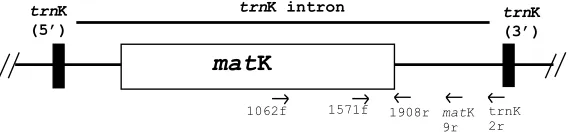
rbcL and matK sequences in the family; their results support the recognition of four genera, but their study was based on a limited number of species. In this study we looked at 76 species of the 96 recognised in the family. We amplified approximately 1500 bp of sequence from the 30 end of thematK gene (andtrnK intron; see Fig. 1) from the chloroplast genome (Hilu and Liang, 1997; Neuhaus and Link, 1987; Olmstead and Palmer, 1994), and used the data to reconstruct a more detailed phylogeny of the Casuarinaceae. This phylogenetic framework was used to to examine the evolution of xeromorphy in Casuarinaceae: did it arise just once before the divergence of Ceuthostoma, Allocasuarina, and Casuarina, or did it arise more than once, with
Ceuthostoma acquiring xeromorphic characters in par-allel withCasuarinaandAllocasuarina?
2. Materials and methods
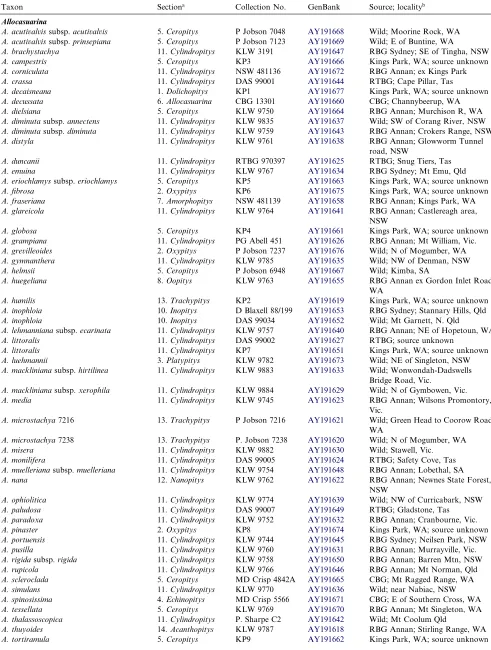
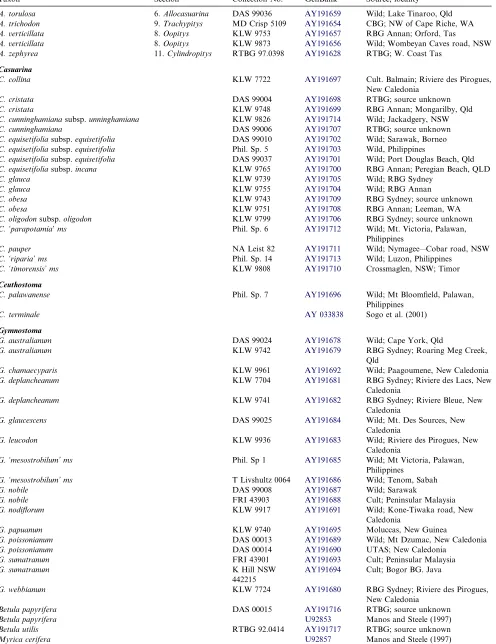
[image:2.595.160.447.643.709.2]Ninety-one samples of Casuarinaceae (representing 53 species of Allocasuarina, 11 species ofCasuarina, 1 species of Ceuthostomaand 11 species ofGymnostoma) and three samples of two outgroup taxa (Betula and
Table 1
Casuarinaceae taxa used in the analysis ofmatK sequence data
Taxon Sectiona Collection No. GenBank Source; localityb
Allocasuarina
A. acutivalvissubsp.acutivalvis 5.Ceropitys P Jobson 7048 AY191668 Wild; Moorine Rock, WA A. acutivalvissubsp.prinsepiana 5.Ceropitys P Jobson 7123 AY191669 Wild; E of Buntine, WA
A. brachystachya 11.Cylindropitys KLW 3191 AY191647 RBG Sydney; SE of Tingha, NSW
A. campestris 5.Ceropitys KP3 AY191666 Kings Park, WA; source unknown
A. corniculata 11.Cylindropitys NSW 481136 AY191672 RBG Annan; ex Kings Park A. crassa 11.Cylindropitys DAS 99001 AY191644 RTBG; Cape Pillar, Tas
A. decaisneana 1.Dolichopitys KP1 AY191677 Kings Park, WA; source unknown A. decussata 6.Allocasuarina CBG 13301 AY191660 CBG; Channybeerup, WA A. dielsiana 5.Ceropitys KLW 9750 AY191664 RBG Annan; Murchison R, WA A. diminutasubsp.annectens 11.Cylindropitys KLW 9835 AY191637 Wild; SW of Corang River, NSW A. diminutasubsp.diminuta 11.Cylindropitys KLW 9759 AY191643 RBG Annan; Crokers Range, NSW A. distyla 11.Cylindropitys KLW 9761 AY191638 RBG Annan; Glowworm Tunnel
road, NSW
A. duncanii 11.Cylindropitys RTBG 970397 AY191625 RTBG; Snug Tiers, Tas A. emuina 11.Cylindropitys KLW 9767 AY191634 RBG Sydney; Mt Emu, Qld A. eriochlamyssubsp.eriochlamys 5.Ceropitys KP5 AY191663 Kings Park, WA; source unknown
A. fibrosa 2.Oxypitys KP6 AY191675 Kings Park, WA; source unknown
A. fraseriana 7.Amorphopitys NSW 481139 AY191658 RBG Annan; Kings Park, WA A. glareicola 11.Cylindropitys KLW 9764 AY191641 RBG Annan; Castlereagh area,
NSW
A. globosa 5.Ceropitys KP4 AY191661 Kings Park, WA; source unknown
A. grampiana 11.Cylindropitys PG Abell 451 AY191626 RBG Annan; Mt William, Vic. A. grevilleoides 2.Oxypitys P Jobson 7237 AY191676 Wild; N of Mogumber, WA A. gymnanthera 11.Cylindropitys KLW 9785 AY191635 Wild; NW of Denman, NSW A. helmsii 5.Ceropitys P Jobson 6948 AY191667 Wild; Kimba, SA
A. huegeliana 8.Oopitys KLW 9763 AY191655 RBG Annan ex Gordon Inlet Road, WA
A. humilis 13.Trachypitys KP2 AY191619 Kings Park, WA; source unknown
A. inophloia 10.Inopitys D Blaxell 88/199 AY191653 RBG Sydney; Stannary Hills, Qld A. inophloia 10.Inopitys DAS 99034 AY191652 Wild; Mt Garnett, N. Qld
A. lehmannianasubsp.ecarinata 11.Cylindropitys KLW 9757 AY191640 RBG Annan; NE of Hopetoun, WA A. littoralis 11.Cylindropitys DAS 99002 AY191627 RTBG; source unknown
A. littoralis 11.Cylindropitys KP7 AY191651 Kings Park, WA; source unknown A. luehmannii 3.Platypitys KLW 9782 AY191673 Wild; NE of Singleton, NSW A. macklinianasubsp.hirtilinea 11.Cylindropitys KLW 9883 AY191633 Wild; Wonwondah-Dadswells
Bridge Road, Vic.
A. macklinianasubsp.xerophila 11.Cylindropitys KLW 9884 AY191629 Wild; N of Gymbowen, Vic. A. media 11.Cylindropitys KLW 9745 AY191623 RBG Annan; Wilsons Promontory,
Vic.
A. microstachya7216 13.Trachypitys P Jobson 7216 AY191621 Wild; Green Head to Coorow Road, WA
A. microstachya7238 13.Trachypitys P. Jobson 7238 AY191620 Wild; N of Mogumber, WA A. misera 11.Cylindropitys KLW 9882 AY191630 Wild; Stawell, Vic. A. monilifera 11.Cylindropitys DAS 99005 AY191624 RTBG; Safety Cove, Tas A. muellerianasubsp.muelleriana 11.Cylindropitys KLW 9754 AY191648 RBG Annan; Lobethal, SA A. nana 12.Nanopitys KLW 9762 AY191622 RBG Annan; Newnes State Forest,
NSW
A. ophiolitica 11.Cylindropitys KLW 9774 AY191639 Wild; NW of Curricabark, NSW A. paludosa 11.Cylindropitys DAS 99007 AY191649 RTBG; Gladstone, Tas A. paradoxa 11.Cylindropitys KLW 9752 AY191632 RBG Annan; Cranbourne, Vic.
A. pinaster 2.Oxypitys KP8 AY191674 Kings Park, WA; source unknown
A. portuensis 11.Cylindropitys KLW 9744 AY191645 RBG Sydney; Neilsen Park, NSW A. pusilla 11.Cylindropitys KLW 9760 AY191631 RBG Annan; Murrayville, Vic. A. rigidasubsp.rigida 11.Cylindropitys KLW 9758 AY191650 RBG Annan; Barren Mtn, NSW A. rupicola 11.Cylindropitys KLW 9766 AY191646 RBG Annan; Mt Norman, Qld A. scleroclada 5.Ceropitys MD Crisp 4842A AY191665 CBG; Mt Ragged Range, WA A. simulans 11.Cylindropitys KLW 9770 AY191636 Wild; near Nabiac, NSW A. spinosissima 4.Echinopitys MD Crisp 5566 AY191671 CBG; E of Southern Cross, WA A. tessellata 5.Ceropitys KLW 9769 AY191670 RBG Annan; Mt Singleton, WA A. thalassoscopica 11.Cylindropitys P. Sharpe C2 AY191642 Wild; Mt Coolum Qld
Table 1 (continued)
Taxon Sectiona Collection No. GenBank Source; localityb
A. torulosa 6.Allocasuarina DAS 99036 AY191659 Wild; Lake Tinaroo, Qld A. trichodon 9.Trachypitys MD Crisp 5109 AY191654 CBG; NW of Cape Riche, WA A. verticillata 8.Oopitys KLW 9753 AY191657 RBG Annan; Orford, Tas
A. verticillata 8.Oopitys KLW 9873 AY191656 Wild; Wombeyan Caves road, NSW A. zephyrea 11.Cylindropitys RTBG 97.0398 AY191628 RTBG; W. Coast Tas
Casuarina
C. collina KLW 7722 AY191697 Cult. Balmain; Riviere des Pirogues,
New Caledonia
C. cristata DAS 99004 AY191698 RTBG; source unknown
C. cristata KLW 9748 AY191699 RBG Annan; Mongarilby, Qld
C. cunninghamianasubsp.unninghamiana KLW 9826 AY191714 Wild; Jackadgery, NSW
C. cunninghamiana DAS 99006 AY191707 RTBG; source unknown
C. equisetifoliasubsp.equisetifolia DAS 99010 AY191702 Wild; Sarawak, Borneo C. equisetifoliasubsp.equisetifolia Phil. Sp. 5 AY191703 Wild, Philippines
C. equisetifoliasubsp.equisetifolia DAS 99037 AY191701 Wild; Port Douglas Beach, Qld C. equisetifoliasubsp.incana KLW 9765 AY191700 RBG Annan; Peregian Beach, QLD
C. glauca KLW 9739 AY191705 Wild; RBG Sydney
C. glauca KLW 9755 AY191704 Wild; RBG Annan
C. obesa KLW 9743 AY191709 RBG Sydney; source unknown
C. obesa KLW 9751 AY191708 RBG Annan; Leeman, WA
C. oligodonsubsp.oligodon KLW 9799 AY191706 RBG Sydney; source unknown C. ‘parapotamia’ms Phil. Sp. 6 AY191712 Wild; Mt. Victoria, Palawan,
Philippines
C. pauper NA Leist 82 AY191711 Wild; Nymagee—Cobar road, NSW
C. ‘riparia’ ms Phil. Sp. 14 AY191713 Wild; Luzon, Philippines
C. ‘timorensis’ ms KLW 9808 AY191710 Crossmaglen, NSW; Timor
Ceuthostoma
C. palawanense Phil. Sp. 7 AY191696 Wild; Mt Bloomfield, Palawan,
Philippines
C. terminale AY 033838 Sogo et al. (2001)
Gymnostoma
G. australianum DAS 99024 AY191678 Wild; Cape York, Qld
G. australianum KLW 9742 AY191679 RBG Sydney; Roaring Meg Creek,
Qld
G. chamaecyparis KLW 9961 AY191692 Wild; Paagoumene, New Caledonia
G. deplancheanum KLW 7704 AY191681 RBG Sydney; Riviere des Lacs, New
Caledonia
G. deplancheanum KLW 9741 AY191682 RBG Sydney; Riviere Bleue, New
Caledonia
G. glaucescens DAS 99025 AY191684 Wild; Mt. Des Sources, New
Caledonia
G. leucodon KLW 9936 AY191683 Wild; Riviere des Pirogues, New
Caledonia
G. ‘mesostrobilum’ ms Phil. Sp 1 AY191685 Wild; Mt Victoria, Palawan, Philippines
G. ‘mesostrobilum’ ms T Livshultz 0064 AY191686 Wild; Tenom, Sabah
G. nobile DAS 99008 AY191687 Wild; Sarawak
G. nobile FRI 43903 AY191688 Cult; Peninsular Malaysia
G. nodiflorum KLW 9917 AY191691 Wild; Kone-Tiwaka road, New
Caledonia
G. papuanum KLW 9740 AY191695 Moluccas, New Guinea
G. poissonianum DAS 00013 AY191689 Wild; Mt Dzumac, New Caledonia
G. poissonianum DAS 00014 AY191690 UTAS; New Caledonia
G. sumatranum FRI 43901 AY191693 Cult; Peninsular Malaysia
G. sumatranum K Hill NSW
442215
AY191694 Cult; Bogor BG. Java
G. webbianum KLW 7724 AY191680 RBG Sydney; Riviere des Pirogues,
New Caledonia
Betula papyrifera DAS 00015 AY191716 RTBG; source unknown
Betula papyrifera U92853 Manos and Steele (1997)
Betula utilis RTBG 92.0414 AY191717 RTBG; source unknown
[image:4.595.61.557.89.733.2]Myrica) were collected from the wild or from cultivated specimens in botanic gardens (Table 1). Tissue was frozen in liquid nitrogen and stored at )70°C, dried using silica gel (Chase and Hills, 1991) or preserved in a CTAB/salt solution (Thomson, 2002).
DNA was extracted using a modified CTAB protocol (Doyle and Doyle, 1990). Approximately 0.1 g of green tissue (ÔneedlesÕ) was ground under liquid nitrogen and was transferred to a 1.5 ml eppendorf tube. Five hun-dred ll of hot (65°C) CTAB buffer (0.02 M EDTA, 1.4 M NaCl, 0.1 M Tris pH 8.0, 2% CTAB, 0.7% v/v DTT, 2% soluble PVP) was added. The slurry was in-cubated at 65°C for 30 min with occasional shaking, followed by extraction with an equal volume of chlo-roform:isoamyl alcohol (24:1). Phases were separated by centrifugation for 10 min at 20,000g. The aqueous phase was removed and re-extracted with chloroform:isoamyl alcohol. Two volumes of cold 95% ethanol were added to the aqueous phase, mixed gently, and incubated on ice for 10 min. The DNA was pelleted at 20,000g for 5 min. The pellet was washed briefly in 76% ethanol/ 0.01 M sodium acetate and was re-centrifuged for 5 min. The supernatant was removed, the pellet was air-dried and resuspended in 100ll TE (10 mM Tris, pH 8.0, 1 mM EDTA). When necessary, DNA was cleaned using a Prep-A-Gene DNA purification kit (Bio-Rad, USA) according to manufacturerÕs instructions.
A 1500 bp fragment from the 30end of thematK gene was amplified using primers 1062f andtrnK 2r (Fig. 1, Table 2) in the PCRs. Each PCR had a final volume of 50ll and contained 10–20 ng genomic DNA, 160lM each dATP, dCTP, dTTP, and dGTP, 4 mM MgCl2, 0.5lM forward (1062f) and reverse (trnK 2r) primers, 1.25 U Taq DNA polymerase (Qiagen, Germany) and 1 Qiagen Taq DNA polymerase buffer. Cycling con-ditions were: initial melting at 94°C for 5 min; 30 cycles of 94°C for 1 min, 45°C for 1 min, 72°C for 2 min; final extension at 72°C for 15 min. More recalcitrant samples (e.g. those prepared from silica-dried tissues) were am-plified using Advantage 2 DNA polymerase (Clontech, USA). The 25ll reactions were prepared following the recommendations of the manufacturer: 0.4lM of each primer (1062f and trnK 2r), 400lM each dNTP, 1
Advantage 2 Polymerase mix and 1 Advantage 2 polymerase buffer. Cycling conditions were as follows: 95°C for 1 min; 35 cycles of 95°C for 30 s, 54°C for 30 s, 68°C for 3 min; final extension at 68°C for 3 min. PCR products were cleaned using a QIAquick DNA Cleanup System (Qiagen, Germany).
PCRproducts were sequenced in both directions us-ing a suite of 3–5 primers (Fig. 1, Table 2), includus-ing three that were custom-designed for this study (1062f, 1571f, 1908r) and two more conserved primers (matK9r and trnK2r; Manos and Steele, 1997; Steele and Vilga-lys, 1994). PCRproducts were sequenced using an ABI Prism BigDye Terminator Cycle Sequencing Ready Reaction Kit (PE Biosystems, USA) following the rec-ommendations of the manufacturer. Sequencing prod-ucts were fractionated on a Perkin–Elmer 373 DNA sequencer. ThematK partial sequences for each sample were aligned and checked using Sequence Navigator version 1.0.1 (Applied Biosystems, USA). All sequences are lodged in GenBank (Accession Nos. AY191618– AY191717). The data set is lodged in TreeBASE (study Accession No. S838; matrix Accession No.M1354).
Complete sequences from all samples were aligned by eye. Some of the sequences were identical or differed only by autapomorphies. To simplify the data set and accelerate analyses, taxa with identical sequences (ig-noring autapomorphies) were pooled into single termi-nal units (Gymnostoma 1, Allocasuarina Group 1,
AllocasuarinaGroup 2,AllocasuarinaGroup 3; see leg-end to Fig. 2). Additional matK sequences for Ceu-thostoma terminale(Sogo et al., 2001) and outgroup taxa
Table 1 (continued)
Taxon Sectiona Collection No. GenBank Source; localityb
Myrica gale KLW 9788 AY191715 RBG Tomah; source unknown
Nothofagus cunninghamii U92859 Manos and Steele (1997)
Ticodendron U92855 Manos and Steele (1997)
Trigonobalanus U92866 Manos and Steele (1997)
aSection refers toAllocasuarinaonly. bBogor BG
—Bogor Botanic Gardens, Java; CBG—Australian National Botanic Gardens, Canberra; DAS—D.A. Steane; FRI—Forestry Re-search Institute Malaysia (FRIM), Kuala Lumpur, Malaysia; KP—Kings Park and Botanic Garden, Perth; E—east; N—north; NE—northeast; NSW—New South Wales; Qld—Queensland; R—River; RBG Annan—Royal Botanic Gardens Sydney (Mt Annan site); RBG Sydney—Royal Bo-tanic Gardens Sydney (Sydney site); RBG Tomah—Royal Botanic Gardens Sydney (Mt Tomah site); RTBG—Royal Tasmanian Botanical Gardens, Hobart; SA—South Australia; SE—southeast; SW—southwest; Tas—Tasmania; UTAS—School of Plant Sciences, University of Tasmania; WA— Western Australia.
Table 2
Primer sequence and location
Primer Sequence Startc
1062f 50GTGGAAATTCCGTTTTCTCTACG 30 1062 1571f 50GGATCCTTTCATTCATT 30 1571 1908r 50ACTAAYGGGATGGCCTRATGC 30 1908 matK 9ra 50CAATCATTCGTGATTGGCCAG 30 2282 trnK 2rb 50AACTAGTCGGATGGAGTAG 30 2573
aPrimer designed by Manos and Steele (1997). bPrimer designed by Steele and Vilgalys (1994).
[image:5.595.43.539.80.141.2][Betula, Myrica, Nothofagus, Ticodendron, and Trigo-nobalanus; (Manos and Steele, 1997)] were obtained from GenBank (Table 1) and added to the data set. Fifteen indels (insertion/deletion events), of which seven were autapomorphic, were coded as binary characters. The sequence characters for these indels were excluded from the analysis, such that each indel received equal weighting regardless of the number of nucleotides
in-volved. Phylogenetic analyses were carried out using PAUP* 4.0 b3 (Swofford, 1999).
Percentage pairwise base differences were calculated using the PAIRWISE BASE FREQUENCIES option in the DATA menu of PAUP* 4.0 b3. These values are corrected for gaps and ambiguities.
[image:6.595.122.482.65.458.2]Maximum parsimony analyses involved heuristic search strategies as described by Catalaan et al. (1997);
(see also Steane et al., 2002). The data set was boot-strapped using 10,000 replicates of the Ôfast, stepwiseÕ
option of PAUP* 4.0b3 (see Mort et al., 2000).
Bayesian phylogenetic analyses were conducted with MrBayes 2.01 (Huelsenbeck and Ronquist, 2001). The equal rates model (Kimura, 1981) with unequal base frequencies (BAEFREQ¼EMPIRICAL) was selected as the best fit model of nucleotide substitution (Mod-eltest v. 3.06; Posada and Crandall, 1998). Bayesian analysis was started from a random tree and run for 106 generations. We used four incrementally heated Markov chains, employing the default heating values. The Markov chains were sampled at intervals of 100 generations, resulting in a final set of 10,001 sample points. Stationarity was reached after 130,000 genera-tions; 1300 sample points were discarded as burn-in. The remaining sample points were used to generate a
50% majority rule consensus. The percentage of sample points recovering any particular clade represents that cladeÕs posterior probability (Huelsenbeck and Ron-quist, 2001).
3. Results
[image:7.595.137.452.64.490.2]A total of 106 sequences (98 Casuarinaceae and eight outgroup sequences) were included in the data set. Pooling of identical sequences resulted in 86 operational taxonomic units (OTUs) and 1502 aligned bases. Actual sequence lengths were generally much shorter than 1502 bp because of the large number of gaps introduced by highly divergent taxa. Most sequences were 1400 bp. There were 244 potentially phylogenetically informative characters included in the analysis.
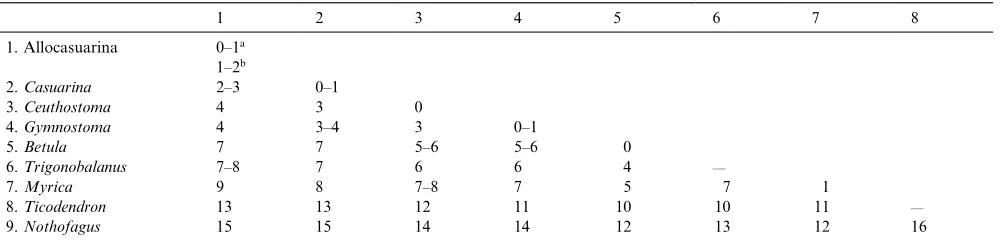
Pairwise sequence differences, corrected for gaps and ambiguities, are shown in Table 3. Within Casuarina-ceae these values ranged from 0% between species within a genus to 4% between genera. Among the outgroup genera, Betula was the most similar to Casuarinaceae (5–7% base differences), as was also found by Manos and Steele (1997) and other workers;Nothofaguswas the least similar, with 14–15% pairwise differences. Despite the low percentage difference among Casuarinaceae taxa, there were sufficient phylogenetically informative characters to produce well-resolved consensus clado-grams with good statistical support for many clades (Fig. 2).
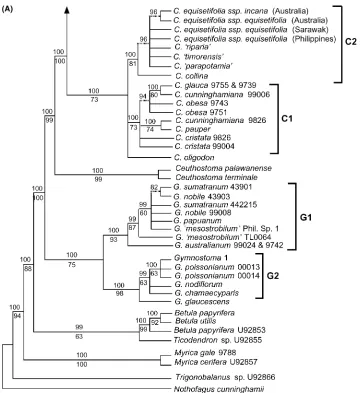
Maximum parsimony (MP) and Bayesian inference yielded consensus cladograms with highly congruent topologies, the latter being slightly more resolved. The strict consensus from the MP analysis and the majority rule consensus from the Bayesian analysis are shown in Fig. 2. Bayesian analysis resulted in a mean lnLvalue of
)6509.36, variance of 88.94 and a 95% credibility in-terval of )6528.90 to )6491.99. Two other Bayesian analyses, one using equal rates and equal base fre-quencies, the other using a gamma distribution of rate variation, yielded respectively identical and almost identical topologies to that shown in Fig. 2, but lower lnL values (results not shown). The heuristic MP anal-ysis yielded 93137 most parsimonious trees of length 464 (excluding autapomorphies; 700 including autapomor-phies), consistency index excluding autapomorphies, CI¼0.679 and retention index, RI¼0.919.
Within the ingroup, the four genera are supported as monophyletic, with moderate (73% inCasuarina, 75% in
Gymnostoma) to strong (95% in Allocasuarina, 99% in
Ceuthostoma) bootstrap support and strong (100%) posterior probability values (Fig. 2).Allocasuarinaand
Casuarinaform a clade (100% bootstrap support, 100% posterior probability, Fig. 2; branch support¼12 steps, Fig. 3A). Ceuthostoma is sister to Allocasuarina+ Ca-suarina (this clade has 99% bootstrap support, 100% posterior probability, Fig. 2A; branch support¼42 steps, Fig. 3A), and Gymnostoma is sister to
Ceuthos-toma+Casuarina+Allocasuarina (this clade has 100% bootstrap support, 100% posterior probability, Fig. 2A; branch support¼21 steps, Fig. 3A). Within each of the large clades (i.e., Gymnostoma, Casuarina, and Alloca-suarina) there is distinct phylogenetic structure. Gym-nostoma comprises two major clades, G1 and G2, both of which have good bootstrap (Fig. 2A) and branch (Fig. 3A) support and 100% posterior probability (Fig. 2A). Clade G1 comprises Malesian species (G. nobile,G. sumatranum, andG.‘mesostrobilum’) as well as G. aus-tralianum from Northern Australia. The other clade, G2, is purely New Caledonian (G. chamaecyparis, G. deplancheanum, G. glaucescens, G. leucodon,G. nodiflo-rum,G. poissonianum, andG. webbianum).
Similarly, geographic partitioning of taxa also occurs in Casuarina. Clade C1 comprises only Australian spe-cies ofCasuarina. Clade C2 is more cosmopolitan, with species from Timor, the Philippines and New Caledonia, as well as the widespread Casuarina equisetifolia (four representatives from Australia, Philippines and Sarawak (Borneo)). The relationships within these two main clades remain unresolved, as does the phylogenetic po-sition of the New Guinean species, Casuarina oligodon
(in a hard polytomy, i.e. there are insufficient data to resolve the node; there is no conflict between charac-ters).
[image:8.595.56.557.89.209.2]Within Allocasuarina several small clades have high bootstrap values but most clades have bootstrap pro-portions less than 70% (Fig. 2B) and there are frequent hard polytomies. Posterior probability values for many of these clades, however, is high (>95%). Clades that were found by Bayesian analysis that were not found by cladistic analysis usually had a relatively low posterior probability (Fig. 2B, branches with dotted lines). Simi-larly, the clade that was found by cladistic analysis that was not found by Bayesian analysis had a bootstrap value<50% (Fig. 2B, branch marked with asterisk). The taxonomic sections delimited by Wilson and Johnson (1989) exhibit some phylogenetic integrity. The largest section, Cylindropitys (section 11; 27 out of 30 species represented) appears to be monophyletic; the monotypic
Table 3
Corrected percentage pairwise differences within and between genera
1 2 3 4 5 6 7 8
1. Allocasuarina 0–1a 1–2b
2.Casuarina 2–3 0–1
3.Ceuthostoma 4 3 0
4.Gymnostoma 4 3–4 3 0–1
5.Betula 7 7 5–6 5–6 0
6.Trigonobalanus 7–8 7 6 6 4 —
7.Myrica 9 8 7–8 7 5 7 1
8.Ticodendron 13 13 12 11 10 10 11 —
9.Nothofagus 15 15 14 14 12 13 12 16
a
Within sections. b
section Nanopitys (section 12) appears to be sister to
Cylindropitys (11). The small section Trachypitys (sec-tion 13; two of three species represented) appears to be polyphyletic:Allocasuarina microstachyaandA. humilis
appear in a clade (A3; Fig. 2B) with the monotypic sections Acanthopitys (section 14) and Amorphopitys
(section 7), as well as representatives of sections Oxy-pitys (section 2) and Allocasuarina (section 6). Of the remaining sections, Ceropitys (section 5) is the largest with nine species, and appears to be polyphyletic (Figs. 2 and 3). Species from section Ceropitys arise from four nodes on the cladogram. Within Ceropitys there is a well-supported monophyletic group (A1; bootstrap support¼96%, posterior probability¼100%, Fig. 2B; branch support¼5, Fig. 3B) comprisingA. eriochlamys,
A. campestris, A. tessellata, and two subspecies of A.
acutivalvis. The other species of section Ceropitys asso-ciate with species of sections Oxypitys (section 2),
Platypitys(sect. 3) andEchinopitys(sect. 4). Three other members of section 5,Ceropitys(A. globosa,A. tortira-mula, and A. scleroclada) appear in a well-supported clade (A2; bootstrap percentage¼98%, posterior prob-ability¼100%, Fig. 2B; branch support¼4, Fig. 3B) with Allocasuarina luehmannii (the sole member of sec-tion 3, Platypitys, from eastern Australia) plus both species from section 4, Echinopitys (A. corniculata and
A. spinosissima). The position of A. helmsii (section
Ceropitys) is unresolved, whileA. dielsianagrouped with
A. pinaster(section 2,Oxypitys; but bootstrap support is only 50%). Another apparently polyphyletic section is
[image:9.595.54.535.72.461.2]Oxypitys (section 2), with one of its species, Allocasua-rina fibrosa, apparently sister to allAllocasuarinaexcept
A. decaisneana(section 1,Dolichopitys). One species of sectionOxypitys, Allocasuarina grevilleoides, is sister to
A. microstachya (section 13, Trachypitys) (bootstrap support¼92%, posterior probability¼100%, Fig. 2B; branch support¼5 steps, Fig. 3B). This clade falls within a partly unresolved clade (A3), comprising spe-cies from sectionsAllocasuarina(section 6—one of two species),Amorphopitys(section 7—monospecific), Trac-hypitys(section 13—two out of three species were sam-pled), and Acanthopitys (section 14—monospecific). Clade A3 has poor bootstrap support (51%) but high posterior probability (99%; Fig. 2B). The scattered placing of species of sectionOxypityssuggests the need
for re-evalution of this section, notably whether the morphological similarities such as unusual branchlet arrangement are convergent.
4. Discussion
Bayesian inference is a relatively recent addition to the analytical toolbox for phylogenetics. Like maximum likelihood analysis, Bayesian estimation is based on the likelihood function. However, whereas a maximum likelihood value represents the probability of the data given a hypothesis (i.e., a tree), Bayesian inference provides the probability of a hypothesis (i.e., a tree) given the data (Lewis, 2001). One very attractive ad-vantage of Bayesian analysis over maximum likelihood is that it requires fewer computational resources, so that large data sets can be analysed more readily. Also, be-cause the estimation of branch support accompanies tree estimation, additional bootstrap analyses are not re-quired. Likelihood-based phylogenetic analyses provide alternatives to parsimony analysis that tend to be less sensitive to artifacts like long branch attraction. In this study a maximum likelihood analysis was not possible because of the large size of the data set. Bayesian inference provided a practical alternative, with the resulting phylogeny providing additional support for the major clades identified by maximum parsimony analysis.
The phylogeny of the Casuarinaceae presented here offers strong support for the four genera defined by Johnson and Wilson (1989).Gymnostomais sister to the other three genera, and this supports the hypothesis that the encryption of stomata in the other three genera has a single origin. This transition can probably be dated to the Late Oligocene at least, based on the recent dis-covery of Casuarinaceae branchlets with encrypted sto-mata in sediments of this age from Riversleigh in northeastern Australia (Guerin, 2001). The fossil record of Gymnostoma significantly precedes this date (Late Paleocene; Scriven and Hill, 1995), but it still cannot be determined from the fossil record whether encryption of stomata is the ancestral or derived condition in the family. Within the clade containing Ceuthostoma+ Al-locasuarina+Casuarina, Ceuthostoma is sister to the other two genera, suggesting that four leaves (repre-sented by the longitudinal phyllichina; Johnson and Wilson, 1989) per whorl is the ancestral condition, since this also occurs inGymnostoma. This suggests that more than four leaves per whorl is the derived condition. In-creasing the number of leaves per whorl allows for more developed encryption of stomata. In plants with four leaves per whorl, the stems tend to be square and al-though shallow furrows may develop (e.g., in some
Gymnostoma species), the stomata do not tend to be inside the furrows. Increasing the number of articles
[image:10.595.47.293.60.542.2]allows for a rounder, more sclerenchymatous stem (see Johnson and Wilson, 1989) and reduces the amount of space between the leaves. Furrows in such a stem take up a greater proportion of the room between phyllich-nia, increasing the likelihood that stomata will occur inside the furrows. This encryption of stomata, and in-creased amounts of sclerenchyma, would have had a selective advantage in a dry climate, eventually leading to very closed furrows with highly protected stomata.
WithinGymnostoma, two clades can be identified, one in New Caledonia and one in Australia/Malesia. Re-cently, Swenson et al. (2001) hypothesised that Nothof-agus had reached New Caledonia via long distance dispersal from New Zealand, and that the closely related group of extant species there have probably evolved from a single colonist species. A similar scenario may well be true for Gymnostoma—as well as New Caledo-nian species of Araucaria, Agathis (Setoguchi et al., 1998) andMetrosideros(Wright et al., 2000, 2001)—and would explain the well defined clade of extant species in New Caledonia. This hypothesis requires further testing to distinguish it from the possiblity that the New Cale-donian species are descendents from a single Gondwa-nan ancestor. It is significant that while the Casuarinaceae have a fossil record in New Zealand that dates back to the Paleocene (ca 55–65 mya; Macphail et al., 1994), it does not extend back to the time when New Zealand is believed to have separated from Gondwana, ca. 85–90 mya. This suggests a requirement for dispersal (from Australia to New Zealand; see Winkworth et al., 2002) in the family at an early stage (or a poorly known fossil record, e.g., see Crisp (1991)). The wide distribution of C. equisetifolia today is a modern example of the ability of species within the family to achieve dispersal. The two subspecies of C. equisetifolia, subsp. equisetifolia and subsp. incana, in this study, collected from Queensland, Australia, group with other Casuarina species from the Indomalesian region.Casuarina equisetifoliais dispersed by wind and sea (and possibly also by humans) and is found on tropical and subtropical coastlines of northern and northeastern Australia, Burma to Vietnam, Malesia, Melanesia and Polynesia; records from India, the Ma-scarenes and other tropical areas are regarded as the result of relatively recent introductions, either deliberate or accidental (Johnson and Wilson, 1989). The grouping ofC. equisetifoliawith Indomalesian species (Clade C2; Fig. 2A) rather than the endemic Australian species (Clade C1; Fig. 2A) suggests that C. equisetifoliais ei-ther a relatively new species that came to Australia from Indomalesia, or evolved in Australia (from an ancestor that was also common to the other Indomalesian taxa) and then dispersed to other regions.
ThematK results of Sogo et al. (2001) do not support the division of Casuarina into clades C1 and C2. This appears to be because their data set (1014 bp) did not
include a highly informative region of ca. 300 bp at the 30 end of the matK gene. Inclusion of the Sogo et al. (2001) Casuarina sequences in our data set resulted in conspecific samples grouping together in clades C1 and C2 (data not shown).
On morphological grounds, C. cunninghamiana and
C. oligodon might be expected to group with clade C2 and C. collina with clade C1. Our molecular data, however, suggest that phylogenetic groupings coincide more closely with the speciesÕ biogeography than with morphological traits, suggesting morphological conver-gence between species. Similar phenomena have been reported for other taxa [e.g., Banksia (Mast and Giv-nish, 2002); Clerodendrum (Steane et al., 1999); Costa-ceae (Specht et al., 2001)]. Our results call for a re-examination of morphological characters in Casuarina
and study of additional genes to verify the results re-ported here.
Casuarina and Allocasuarina are sister taxa, quite similar both in morphology and inmatK sequence data. Since the divergence of Ceuthostoma and Casua-rina+Allocasuarinathere has been a major radiation of species, especially in Allocasuarina. The xeromorphic characters developed in the ÔcryptostomesÕ allowed Ca-suarina and especially Allocasuarina to diversify and exploit the increasing variety of niches that arose with the gradual desiccation of Australia over the past 30 million years. The dark, shiny samaras inAllocasuarina, for example, are unique in the family. The inflated cells of their mesocarp layer have walls that are spirally thickened; these thickenings expand through the weak exocarp and hold water around the fruit when moist-ened (Ladd, 1989). The spirals are also present in Ca-suarinaand water is held by them, but these species have a stronger exocarp so that the spirals do not break through the exocarp and trap less water than in Allo-casuarina. The composition of the spirals is suggested to be cellulosic by Ladd (1989) rather than hygroscopic polysaccharides as thought by Torrey (1983). The end result is a moist, mucilaginous-looking samara; as sug-gested by Turnbull and Martensz (1983) and Torrey (1983), this could be considered an adaptation for rapid germination and establishment in habitats with erratic water supply, as found in so many parts of Australia.
Johnson and Wilson (1989) recognised 14 sections in
Allocasuarina. Although the matK data do not provide enough information to resolve fully the relationships among the sections, they do indicate that section 11,
aligned with biogeography than with morphology. However, while the geographic partitioning within
GymnostomaandCasuarinais most likely due to ancient biogeography (e.g., vicariant evolution, long distance dispersal), the events leading to the biogeographic pat-terns seen inAllocasuarinaare possibly more recent and may not reflect species phylogeny per se. It is possible that within Allocasuarina, reproductive isolation be-tween some species is incomplete, and interspecific hy-bridisation may occur among some sympatric species from different sections (e.g., the Western Australian species in clade A3), a phenomenon that could result in the sharing of chloroplast genomes among morpholog-ically distinct taxa. Extensive sharing of chloroplast haplotypes—attributed to some form of horizontal transfer, such as hybridisation—between species has been observed among Tasmanian species ofEucalyptus
(Steane et al., 1998; McKinnon et al., 2001), as well as northern hemisphere Armeria (Gutieerrez Larena et al., 2002),Quercus(Belahbib et al., 2001) andPinus(Matos and Schaal, 2000). Some Western Australian eucalypts also demonstrate extensive sharing of chloroplast hapl-otypes, but in this case lineage sorting, rather than hy-bridisation, has been proposed as the most likely mechanism [Dean Nicolle, (Flinders University, South Australia), pers. comm.]. We are undertaking further work using more variable DNA sequences [e.g., the
psbA–trnH spacer region of the chloroplast DNA and the nuclear ribosomal internal transcribed spacer (ITS) regions] that may help to clarify the intersectional rela-tionships withinAllocasuarina.
Acknowledgments
We would like to thank the following individuals and institutions for providing us with plant material for the study: David Albrecht (Alice Springs Herbarium, Northern Territory); Australian National Botanic Gar-dens, Canberra; Bill Baker and Mark Chase (RBG Kew, England); Tim Brodribb (Harvard University, USA); Richard Chung (Forest Research Institute, Kuala Lumpur, Malaysia); Andrew Ford and Bernie Hyland (CSIRO, Atherton, Queensland); Greg Jordan (Uni-versity of Tasmania, Australia); Kings Park and Botanic Garden, Perth, Western Australia; Tanya Livshultz (LH Bailey Hortorium, USA); Domingo Madulid (National Museum, Manila, Philippines); Kay Morgan (Sydney, NSW); Royal Botanic Gardens Sydney, New South Wales (especially Peter Jobson, Joy Everett, Ken Hill, Natasha Leist, Steve Skinner, and Gillian Towler); Royal Tasmanian Botanical Garden, Hobart, Tasma-nia; Philip Sharpe (Coolum, Queensland); Runi Sylves-ter, Pusat Penyelidikan Hutan, Sarawak; Luke Vanzino, Hobart, Tasmania. Our thanks also go to Annette Blanchfield, Peter Bundock and Ashley Edwards for
technical assistance. This research was funded by the Australian Biological Resources Study (ABRS), 1999– 2000 and the Australian Research Council.
References
Archangelsky, S., 1973. Palinologia del paleoceno de Chubut. 1. Descripciones sistematicas. Ameghiniana 10, 339–399.
Belahbib, N., Pemonge, M.-H., Ouassou, A., Sbay, H., Kremer, A., Petit, R.J., 2001. Frequent cytoplasmic exchanges between oak species that are not closely related:Quercus suberandQ. ilexin Morocco. Mol. Ecol. 10, 2003–2012.
Campbell, L.D., Holden, A.M., 1984. Miocene Casuarinaceae fossils from Southland and Central Otago, New Zealand. New Zeal. J. Bot. 22, 159–167.
Catalaan, P., Kellogg, E.A., Olmstead, R.G., 1997. Phylogeny of Poaceae subfamily Pooideae based on chloroplast ndhF gene sequences. Mol. Phylogenet. Evol. 8, 150–166.
Chase, M.W., Hills, H.H., 1991. Silica gel: an ideal material for field preservation of leaf samples for DNA studies. Taxon 40, 215–220. Christophel, D.C., 1980. Occurrence ofCasuarinamegafossils in the
Tertiary of south-eastern Australia. Aust. J. Bot. 28, 249–259. Christophel, D.C., 1989. Evolution of the Australian flora through the
Tertiary. Pl. Syst. Evol. 162, 63–78.
Coetzee, J.A., Muller, J., 1984. The phytogeographic significance of some extinct Gondwana pollen tyeps from the Tertiary of the southwestern Cape (South Africa). Ann. Missouri Bot. Gard. 71, 1088–1099.
Coetzee, J.A., Praglowski, J., 1984. Pollen evidence for the occurrence ofCasuarinaandMyricain the Tertiary of South Africa. Grana 23, 23–41.
Crisp, M., 1991. Samaras and feathers, or Casuarinas on the wing? Aust. Syst. Bot. Soc. Newsl. 67, 23–25.
Dilcher, D.L., Christophel, D.C., Bhagwandin, H.O., Scriven, L.J., 1990. Evolution of the Casuarinaceae: morphological comparisons of some extant species. Am. J. Bot. 77, 338–355.
Doyle, J.J., Doyle, J.L., 1990. Isolation of plant DNA from fresh tissue. Focus 12, 13–15.
Frenguelli, J., 1943. Restos deCasuarinaen el Mioceno de el Mirador, Patagonia central. Notas del Museo de la Plata, Paleontologia 56, 349–354.
Guerin, G., 2001. Plant megafossils from the Oligocene of Riversleigh, Queensland and Little Rapid River, Tasmania. B.Sc. Hons. Thesis, Department of Environmental Biology, University of Adelaide. Gutieerrez Larena, B., Fuertes Aguilar, J., Nieto Feliner, G., 2002.
Glacial-induced altitudinal migrations in Armeria (Plumbagina-ceae) inferred from patterns of chloroplast DNA haplotype sharing. Mol. Ecol. 11, 1965–1974.
Hill, R.S., MacPhail, M.K., 1983. Reconstruction of the Oligocene vegetation at Pioneer, northeast Tasmania. Alcheringa 7, 281–299. Hilu, K.W., Liang, H., 1997. ThematK gene: sequence varition and
application in plant systematics. Am. J. Bot. 84, 830–839. Huelsenbeck, J.P., Ronquist, F.R., 2001. MRBAYES: Bayesian
inference of phylogeny. Bioinformatics 17, 751–755.
Hwang, Y.H., 1990. The Casuarinaceae: a palynological review. Aust. Syst. Bot. Soc. Newsl. 62, 4–5.
Hwang, Y.H., 1991a. The Casuarinaceae: a biogeographic-based theory. Aust. Syst. Bot. Soc. Newsl. 68, 14–16.
Hwang, Y.H., 1991b. The Casuarinaceae: a few problematic fossil records. Aust. Syst. Bot. Soc. Newsl. 66, 15–16.
Hwang, Y.H., 1992. The Casuarinaceae:Allocasuarinais unsupported. Aust. Syst. Bot. Soc. Newsl. 70, 16–18.
Johnson, L.A.S., Wilson, K.L., 1989. Casuarinaceae: a synopsis. In: Crane, P.R., Blackmore, S. (Eds.), Evolution, Systematics, and Fossil History of the Hamamelidae, Volume 2: ‘‘Higher Hamame-lidae.’’ Systematics Association Special Volume No. 40B, Claren-don Press, Oxford, pp. 167–188.
Jordan, G.J., 1997. Evidence of plant extinction and diversity from Regatta Point, western Tasmania, Australia. Bot. J. Linn. Soc. 123, 45–71.
Kimura, M., 1981. Estimation of evolutionary distances between homologous nucleotide sequences. Proc. Natl. Acad. Sci. USA 78, 454–458.
Ladd, P.G., 1989. The status of Casuarinaceae in Australian forests. In: Frawley, K.J., Semple, N.M. (Eds.), AustraliaÕs Ever Changing Forests. Special Publn No. 1, pp. 63-85. Dept of Geog. and Oceanography, Aust. Defence Force Academy, Campbell, ACT, Australia.
Lewis, P.O., 2001. Phylogenetic systematics turns over a new leaf. Trends Ecol. Evol. 16, 30–37.
Macphail, M.K., Alley, N.F., Truswell, E.M., Sluiter, I.R.K., 1994. Early tertiary vegetation: evidence from spores and pollen. In: Hill, R.S. (Ed.), History of the Australian Vegetation: Cretaceous to Recent. Cambridge University Press, Cambridge, pp. 189–261. Manos, P.S., Steele, K.P., 1997. Phylogenetic analyses of ÔHigher
HamamelididaeÕbased on plastid sequence data. Am. J. Bot. 84, 1407–1419.
Mast, A.R., Givnish, T.J., 2002. Historical biogeography and the origin of stomatal distributions inBanksiaandDryandra (Prote-aceae) based on their cpDNA phylogeny. Am. J. Bot. 89, 1311– 1323.
Matos, J.A., Schaal, B.A., 2000. Chloroplast evolution in thePinus montezumae complex: a coalescent approach to hybridization. Evolution 54, 1218–1233.
McKinnon, G.E., Vaillancourt, R.E., Jackson, H.D., Potts, B.M., 2001. Chloroplast sharing in the Tasmanian eucalypts. Evolution 55, 703–711.
Mildenhall, D.C., 1980. New Zealand late Cretaceous and Cenozoic plant biogeography: a contribution. Palaeogeography, Palaeocli-matology, Palaeoecology 31, 197–233.
Mort, M.E., Soltis, P.S., Soltis, D.E., Mabry, M.L., 2000. Comparison of three methods for estimating internal support on phylogenetic trees. Syst. Biol. 49, 160–171.
Neuhaus, H., Link, G., 1987. The chloroplast trnAtys(UUU) gene from mustard (Sinapsis alba) contains a class II intron potentially coding for a maturase-related polypeptide. Curr. Genet. 11, 251– 257.
Olmstead, R.G., Palmer, J.D., 1994. Chloroplast DNA systematics: a review of methods and data analysis. Am. J. Bot. 81, 1205–1224. Poisson, J., 1874. Recherches sur lesCasuarinaet en particulier sur
ceux de la Nouvelle-Caleedonie. Nouvelle Archives du Museeum dÕHistoire Naturelle 10, 59–111.
Posada, D., Crandall, K.A., 1998. Modeltest: testing the model of DNA substitution. Bioinformatics 14, 817–818.
Qiu, Y.L., Chase, M.W., Hoot, S.B., Conti, E., Crane, P.R., Sytsma, K.J., Parks, C.R., 1998. Phylogenetics of the Hamamelidae and their allies: parsimony analyses of nucleotide sequenes of the plastid generbcL. Int. J. Plant Sci. 159, 891–905.
Scriven, L.J., Hill, R.S., 1995. Macrofossil Casuarinaceae: their identification and the oldest macrofossil record, Gymnostoma antiquumsp. nov., from the Late Paleocene of New South Wales, Australia. Aust. Syst. Bot. 8, 1035–1053.
Setoguchi, H., Osawa, T.A., Pintaud, J.-C., Jaffree, T., Veillon, J.-M., 1998. Phylogenetic relationships within Araucariaceae based on rbcL gene sequences. Am. J. Bot. 85, 1507–1516.
Sogo, A., Setoguchi, H., Noguchi, J., Jaffree, T., Tobe, H., 2001. Molecular phylogeny of Casuarinaceae based onrbcL andmatK gene sequences. J. Plant Res. 114, 259–464.
Specht, C.D., Kress, W.J., Stevenson, D.W., DeSalle, R., 2001. A molecular phylogeny of Costaceae (Zingiberales). Mol. Phylogenet. Evol. 21, 333–345.
Steane, D.A., Byrne, M., Vaillancourt, R.E., Potts, B.M., 1998. Chloroplast DNA polymorphism signals complex interspecific interactions in Eucalyptus (Myrtaceae). Aust. Syst. Bot. 11, 25– 40.
Steane, D.A., Scotland, R.W., Mabberley, D.J., Olmstead, R.G., 1999. Molecular systematics of Clerodendrum (Lamiaceae): ITS se-quences and total evidence. Am. J. Bot. 86, 98–107.
Steane, D.A., Nicolle, D., McKinnon, G.E., Vaillancourt, R.E., Potts, B.M., 2002. Higher level relationships among the eucalypts are resolved by ITS-sequence data. Aust. Syst. Bot. 15, 49–62. Steele, K.P., Vilgalys, R., 1994. Phylogenetic analyses of
Polemonia-ceae using nucleotide sequences of the plastid genematK. Syst. Bot. 19, 126–142.
Sugita, M., Shinozaki, K., Sugiura, M., 1985. Tobacco chloroplast tRNALys(UUU) gene contains a 2.5-kilobase-pair intron: an open reading frame and a conserved boundary sequence in the intron. Proc. Natl. Acad. Sci. USA 82, 3557–3561.
Swenson, U., Backlund, A., McLoughlin, S., Hill, R.S., 2001. Nothofagusbiogeography revisited with special emphasis on the enigmatic distribution of subgenusBrassosporain New Caledonia. Cladistics 17, 28–47.
Swofford, D.L., 1999. PAUP*. Phylogenetic analysis using parsimony (* and other methods), Version 4. Sinauer, Sunderland, Massa-chusetts, USA.
Thomson, J.S., 2002. An improved non-cryogenic transport and storage preservative facilitating DNA extraction from ’’difficult’’ plants collected at remote sites. Telopea 9, 755–760.
Torrey, J.G., 1983. Root development and root nodulation in Casuarina. In: Midgley, S.J., Turnbull, J.W., Johnston, R.D. (Eds.),Casuarinaecology, management and utilization: proceed-ings of an International Workshop, Canberra, Austraila, 17–21 August 1981. CSIRO, Australia, pp. 180–192.
Turnbull, J.W., Martensz, P.N., 1983. Seed production, collection and germination in Casuarinaceae. In: Midgley, S.J., Turnbull, J.W., Johnston, R.D. (Eds.), Casuarina ecology, management and utilization: proceedings of an International Workshop, Canberra, Austraila, 17–21 August 1981. CSIRO, Australia, pp. 126–132. Wilson, K.L., Johnson, L.A.S., 1989. Casuarinaceae. Flora of
Australia 3, 100–174.
Winkworth, R.C., Wagstaff, S.J., Glenny, D., Lockhart, P.J., 2002. Plant dispersal N.E.W.S. from New Zealand. Trends Ecol. Evol. 17, 514–520.
Wright, S.D., Yong, C.G., Dawson, J.W., Whittaker, D.J., Gardner, R.C., 2000. Riding the ice age El Ni~nno? Pacific biogeography and evolution ofMetrosiderossubgMetrosideros(Myrtaceae) inferred from nuclear ribosomal DNA. Proc. Natl. Acad. Sci. USA 97, 4118–4123.