Running head: AGE AND SELF-EFFICACY IN THE UNEMPLOYED
Individual Differences in Age and Self-Efficacy in the Unemployed Majella J. Albion
Karen M. Fernie Lorelle J. Burton
University of Southern Queensland
Document produced using Microsoft Word 2002
Address for correspondence: Dr Majella Albion
Department of Psychology
University of Southern Queensland TOOWOOMBA QLD 4350
Abstract
Individual Differences in Age and Self-Efficacy in the Unemployed Unemployment is a pervasive and ongoing societal issue which has well-documented and demonstrable negative consequences. When
compared with employed people, unemployed people have higher levels of depressive affect (Feather & Davenport, 1981; Feather & O'Brien, 1986), lower levels of self-esteem (Muller, Hicks, & Winocur, 1993), and higher incidences of psychological distress (Banks & Jackson, 1982; Henwood & Miles, 1987). Winefield et al. (2002) suggested that many negative
psychological outcomes of unemployment are due to the influence of the Western work ethic which promotes the perception of a person being a failure if unemployed. While the experience of unemployment is generally aversive, the impact on individuals’ psychological well-being is not
uniform, neither is it universal.
& Macintyre, 2001; Muller et al., 1993; Murphy & Athanasou, 1999), unemployment and self efficacy (Nesdale & Pinter, 2000), and personality and coping (Park, 1998; Waters, 2000), this paper will focus on individual differences and self-efficacy within the unemployed population.
Idiosyncratic reactions to the experience of unemployment have been associated with a variety of individual difference variables, one of which is age (Jackson & Warr, 1984; Warr & Jackson, 1984). While
considerable research has appropriately focused on the critical issues related to youth unemployment, the changes associated with globalization,
redundancy, and technological development have meant that unemployment is also becoming an increasingly prevalent issue for older people. Age-related differences in the experience of unemployment need to be identified and explored in order to avoid a “one size fits all” approach to providing relevant and effective assistance to the unemployed.
Gurney (1980) noted that for young people, employment provides a critical gateway to other transitions. Therefore, the effect of unemployment can be to frustrate these transitions due to the significance placed on
attaining an independent occupation or employment status as a means of achieving adult identity and status. Winefield and Tiggemann (1989)
the normative experience for young people being involvement in occupations or in study or vocational training directed towards future occupational goals. Hannan, ORiain, and Whelan (1997) observed that the types of role pressures experienced by unemployed youth were different from the pressures experienced by those who were married and middle aged. Whereas young people’s distress was associated with their frustrated
transition into adulthood and independence, older people had additional financial strain and concerns with loss of their role as provider.
Kulik (2001) found age differences in physical health outcomes for unemployed people, with middle-aged persons reporting poorer health than younger groups. Kulik suggested that these reported differences may be due to feelings of discouragement rather to actual health conditions. Young people were in fact able to perceive some advantages to being unemployed, such as having more time to devote to themselves. Despite these differences, Kulik found no age differences in the idea of the centrality of work.
Proactive Coping, Proactive Attitude, and Self-Efficacy
Coping can be defined as the continual changing of both behavioural and cognitive efforts to manage the demands of internal and external
during unemployment. These static conceptualisations of coping contrasted with the dynamic definition provided by Folkman et al. (1986) and did not allow for the changing nature of coping responses over time and various situations. Results from a study conducted by Turner, Kessler, and House (1991) indicated that individuals could take a proactive approach to reducing the negative aspects of unemployment by adopting cognitive coping strategies. Proactive individuals regard the journey of their life as being determined by individual factors, not external ones, and take
responsibility for changing their situation. Similarly, Schaufeli (1997) found that his sample of unemployed college graduates behaved in a proactive manner, being active agents instead of passive victims, which consequently reduced the psychological impacts of unemployment. Incorporating these ideas, Waters developed a new model which included reciprocal
relationships between cognitive appraisal of stressors and the resulting coping efforts employed to deal with these stressors.
One such set of instrumental activities is defined by Greenglass, Schwarzer, Jakubiec, Fiksenbaum, and Taubert (1999) as proactive coping (PC).
According to Greenglass et al., PC is multi-faceted, having both behavioural and cognitive dimensions, and occurring simultaneously in various domains of human thought, emotional, and action systems. It includes a number of strategies for setting and pursuing goals. These include initiation -
acknowledging and utilising information and resources; reflection - envisioning success and anticipating future problems; planning – deciding how to deal with problems; and prevention - taking preventive steps in order to avoid disaster. Schwarzer (1999) described people using PC as being both autonomous and self determined, in reference to both setting and realising goals. It would seem likely that variations in PC would significantly impact on the way individuals react to the experience of unemployment.
Individuals with a proactive attitude, according to Schwarzer (1999), believe that sufficient resources exist, external resources being goods and services, and internal resources characterised as intelligence, courage, and strength. Additionally, proactive individuals take responsibility for their own growth, responsibility for past events, and, significantly for job-seeking individuals, responsibility for making future events happen. They focus on solutions for problems regardless of attribution (Schwarzer, 1999), and being values-driven, they internalise and are guided by their personal, yet socially mediated (but not necessarily socially acceptable) values. Having a vision, Schwarzer’s proactive individuals try to create meaning in life by striving for ambitious goals, and set goals in line with their vision.
A related concept is generalised self-efficacy (GSE), which Schwarzer (1993) defined as people’s optimistic belief in their ability to cope with a variety of stressful or challenging situations. Efficacious people are more able to persevere in the face of challenges because they believe they can change situations and behaviours to produce more positive
outcomes (Schieman & Campbell, 2001). The concept of self-efficacy was enunciated and refined by Bandura (1977), who observed that people who perceived themselves as powerless to exert influence over situations tended to be overwhelmed by apprehension, apathy, and despair. Bandura
or through vicarious experience and observation. His social cognitive theory posited that through a process of differential reinforcement, successful behaviours could be learnt and unsuccessful behaviours unlearnt.
The concept of self-efficacy can be effectively applied to the
experience of unemployment, both for adolescents having difficulty entering the workforce, and for adults whose employment has been interrupted or curtailed. Bandura (1997) noted that efficacy is most likely to be negatively evaluated at life transition points, as people are faced with adapting to new situations and having to learn new behaviours. He asserted that loss of agency is inherent in the transition process of adolescence, as repertoires of behaviours established in childhood are superseded by more adult activities. The imposition of additional negative self-evaluations associated with unemployment can be particularly debilitating at this life stage. Older workers facing job transitions are presented with another occasion for self-assessment. Success in managing these transitions will lead to increased self-efficacy (Bandura, 1997), while experiences such as job loss are likely to weaken efficacy beliefs. Effecting positive changes in efficacy beliefs of unemployed people has been shown to influence outcomes, such as
increased job-search activity (van Ryn & Vinokur, 1992). This
intensification of effort was also associated with improved employment prospects (Eden & Aviram, 1993). Schwarzer (1997) promotes the
stable sense of personal agency, and one that contrasts with other constructs of optimism, by explicitly referring to it as a sense of personal competence to deal with challenging situations.
This study examined the constructs of proactive coping, proactive attitude, and generalised self-efficacy as measured in a sample of
unemployed people. Generalised self-efficacy is a desirable attribute for this specific group who are faced with the aversive consequences and situational disadvantages associated with unemployment, and as such, GSE was
presented as an outcome variable. Schmitz and Schwarzer (1999) and Taubert (1999) found that while PC, PA, and GSE are conceptually distinct constructs, they are related. Therefore, the first hypothesis of this study was that significant relationships among PC, PA, and GSE would be evidenced for this sample.
The impact of age was also investigated. Jackson and Warr (1984) found that age had a moderating effect on psychological outcomes of unemployment, with no relationship between length of time unemployed and poor psychological health for young jobseekers or those nearing the end of their working life, but a significant relationship for those who
internal personal characteristics associated with age-related differences rather than external situational factors, and as such, particular attention was paid to the two attitudinal factors: PA, which is the belief in the existence of adequate internal and external resources to effect positive change
(Schwarzer, 1999), and GSE, the belief in one’s ability to cope and
persevere in the face of challenges (Schwarzer & Jerusalem, 2000). While PA and GSE may be seen as reciprocal constructs, this study focused on one direction of the relationship, that is, the pathway by which PA acts as an antecedent to GSE. People first need to know they have adequate resources to face life challenges, before they can be confident of using those resources to effect changes.
Bandura’s (1997) social learning theory suggests that the successful negotiation of life challenges is likely to enhance efficacy beliefs as people get older. The more opportunities that people have to effectively use
Method Participants
Details from 104 unemployed people were collected about age; gender; city; length of time since last work; and type, hours, and duration of most recent occupation. The sample consisted of 55 males and 49 females, aged from 18 to 57 (M = 30.80 yrs, SD = 12.04 yrs), attending Job Search Training courses. The average length of time since working full time was almost 16 months, and 24 had never worked full time. Three participants had never been employed at all.
Materials
Proactive Coping Scale (PC; Greenglass et al., 1999).
This 14-item scale measures ability to commit to and engage in the autonomous and self directed setting and attainment of challenging goals (e.g., “I visualise my dreams and try to achieve them”). A 4-point rating scale was used. Taubert (1999) reported relatively high alpha reliability coefficients of .85 (Canadian sample) and .80 (Polish Canadian sample). Overall, Taubert found the scale to have factorial validity, good construct validity, and high external validity.
Proactive Attitude Scale (PA; Schwarzer, 1999).
items on a 4-point scale, with possible total scores ranging from 8 to 32. Schmitz and Schwarzer (1999) found the scale’s internal consistency to be .75. Although being conceptually distinct, an association was also found between PA and GSE (r = .56).
General Self-Efficacy Scale (GSE; Schwarzer & Jerusalem, 2000). The GSE consists of 10 items relating to people’s feelings of mastery in a variety of situations (e.g., “I am certain that I can accomplish my goals”). Participants were again asked to rate their agreement with each of the statements on a 4-point scale, yielding a total score range of 10 to 40. Research has shown that the GSE is a reliable scale which has convergent and discriminant validity, shown by a negative correlation with anxiety and depression and positive correlation with self esteem and optimism
(Schwarzer, 1993; Schwarzer, Babler, Kwiatek, Schroder, & Zhang, 1997; Schwarzer & Born, 1997). Alpha reliability coefficients for the GSE scale were satisfactory, ranging from .75 to .90.
Procedure
Trainers in Toowoomba and Cairns administered the surveys from July to September, 2002. Clients were assured of confidentiality and that participation was voluntary. The total number of clients trained at these two offices during this period was 109, and 104 surveys were returned,
Results Data Screening
Analyses were performed using the SPSS Version 11.0 for
Windows. Data screening revealed no outliers, but there was one case with significant amounts of missing data. This case was deleted. All other data were considered suitable for further analysis.
Two new variables were computed based on the
employment/unemployment questions. The first, currently working, was a dichotomous variable differentiating those who were currently working (2) and those who were not (1). A second variable, employment status, was computed based on whether people had previously ever had full time or part time employment. A value of 1 indicated that they had never worked full time, part time, or as a casual. A value of 2 indicated that they had
previously worked part time or as a casual, but not full time, and a value of 3 indicated that they had previously worked full time.
Descriptive Statistics
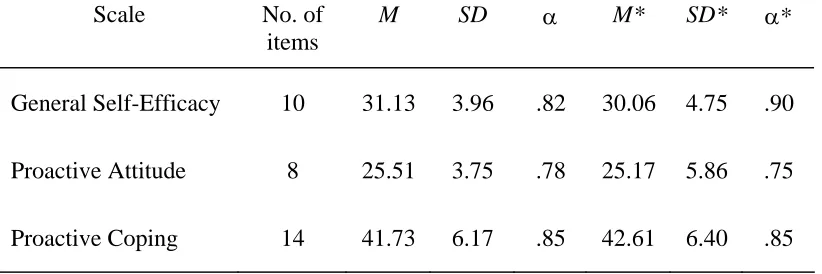
______________________________________ Insert Table 1 about here
______________________________________
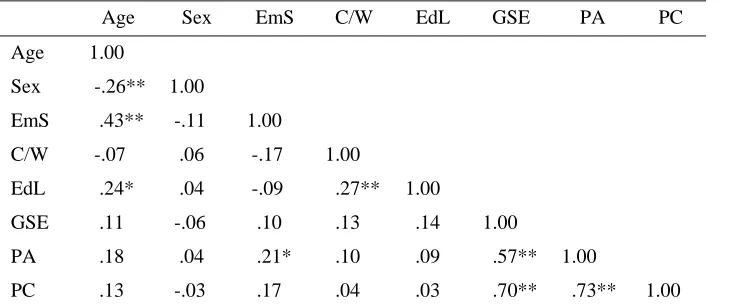
The correlation matrix showing relationships between GSE, PA, PC, and the demographic variables is presented in Table 2.
______________________________________ Insert Table 2 about here
______________________________________
Significant correlations among the three scales of GSE, PA, and PC indicated strong positive relationships, GSE/PA (r = .57, p < .01), GSE/PC (r = .70, p < .01), and PA/PC (r = .73, p < .01). Previous research (Schmitz & Schwarzer, 1999; Taubert, 1999) found similar associations among the three factors and noted the importance of recognising that these scales represent theoretically distinct facets of active coping. The dimensionality of the scales was not assessed in this study, as the relatively small sample size (104) precluded factor analysis of the 32 items defining the constructs.
Moderating and Mediating Effects on GSE
Baron and Kenny (1986) described the different ways in which moderator and mediator variables account for differences in people’s behaviour. A moderator variable affects the direction and/or strength of the relation between an independent variable (IV) and a dependent variable (DV), and is preferably not correlated with either. Mediator variables account for the relation between the IV and the DV, and explain the underlying process. Complete mediation occurs when the relation between the IV and DV becomes zero, illustrating that the effect of the IV on the DV is mediated through the third variable. The relationship is partially mediated if it is diminished, but remains significant, when the third variable is controlled (Baron & Kenny).
Previous research (Hannan et al., 1997; Jackson & Warr, 1984) had indicated that age had a moderating relationship on psychological outcomes. While for these data, age was not significantly correlated with PA or GSE, thus meeting one of the desirable criteria for a moderator (Baron & Kenny, 1986), a link with age was evidenced through the significant correlation of age with employment status (r = .43, p < .01), and between employment status and PA (r = .21, p < .05).
demonstrated more simply by showing that the correlation between PA and GSE is different across age groups. Before using the interaction method, this more simple approach was taken. The sample was divided into older and younger participants using a median split method and separate correlations were carried out for both groups. In each case, PA and GSE were
significantly correlated, but the relationship for the younger group (r = .41, p < .01), was weaker than that for the older group (r = .73, p < .01). The difference between these two correlations was tested using Fisher’s z, and proved to be significant (z = 2.39, p< .05).
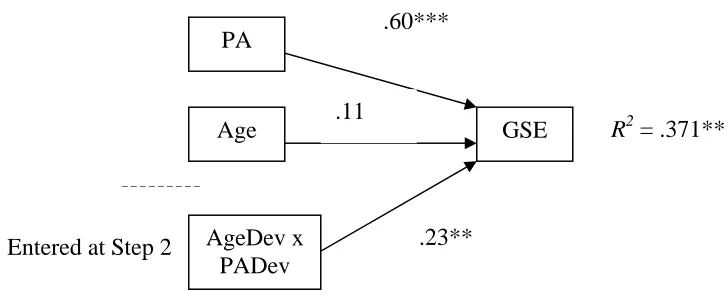
The apparent moderation effect of age was then also tested by the hierarchical regression technique in which the interaction term, consisting of the product of age and PA deviation scores, was entered at the second step of the regression, following the entry of the first order variables at step one. Deviation rather than raw scores were used for this analysis to avoid
multicollinearity problems, and were derived by finding the difference between each score and the group mean (Aiken & West, 1991). The inclusion of the interaction term did significantly add to the prediction of GSE (∆R2
= .05, p < .01), indicating the presence of a moderation effect, that is, that the influence of PA on GSE varied significantly according to the age of the respondents (See Figure 1).
_____________________________________________________
Insert Figure 1 about here
In order to explain the process underlying this age-patterned difference, further analyses were conducted to examine for variables that might act as mediators in the relationship between PA and GSE. A possible candidate was the variable, employment status. It is likely that past
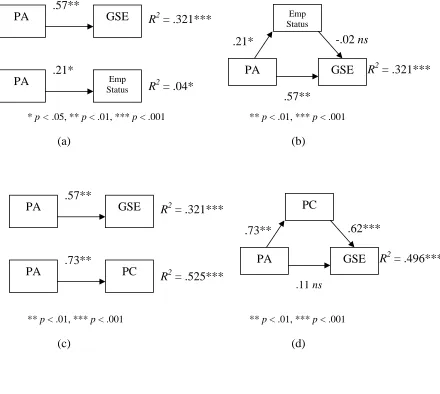
experiences in obtaining full time work would have an impact on the translation of an attitude about viable options (PA) into efficacy beliefs about an individual’s ability to achieve positive employment outcomes. Inspection of the correlation data supported this possible link. Another variable to be considered was PC. Proactive coping is goal-oriented, purposeful behaviour, and as such, PC is also likely to impact on the relationship between people’s attitudes about opportunity and their beliefs of personal agency. These two possible mediation effects were tested by first establishing that PA was a significant predictor of GSE, and then by seeing if this relationship was reduced to insignificance by the inclusion of the proposed mediators into the regression (Baron & Kenny, 1986). As step one, GSE was regressed onto PA, and the relationship was found to be significant (β = .57, p < .01).
In order to test for a mediating effect of employment status, GSE was then simultaneously regressed onto PA and employment status. No mediating effect was found, the relationship between PA and GSE
and GSE was in fact reduced to insignificance (β = .11, p > .05), providing evidence for a complete mediating effect for PC. The mediating effect was further tested and confirmed using the Sobel test (p < .001; Preacher & Leonardelli, 2001). The two mediation models tested above are summarised in Figure 2.
______________________________________ Insert Figure 2 about here
______________________________________
It was acknowledged in the introduction that the relationships among these variables may be bidirectional, and alternative models may also be proposed to define their interrelationship. A number of competing models were tested using the methods described above, using PA as a mediator between PC and GSE, and using PC as an outcome rather than an antecedent variable. None of these alternative models demonstrated a significant mediation effect, thus providing additional support for the hypothesised causal direction of the model presented in Figure 2(d).
Discussion
findings in earlier unemployment research (Jackson & Warr, 1984) of moderating effects for age. Jackson and Warr suggested that this moderating relationship was due to financial factors such as poverty and financial stress. Hannan et al. (1997) similarly reported fewer financial strains for
unemployed young people than older unemployed people. While
acknowledging that these situational influences undoubtedly impose strain on those who are unemployed, this current project’s focus was on the dispositional influences of the unemployment experience, and looked for ways in which these factors may also account for some of the differences in outcomes and experiences across age levels.
part-time only, or not at all. It could be expected that the link between PA and GSE might be higher for those who had previously been successful in obtaining full-time work than for those who had not. While intuitively appealing, this relationship was not demonstrated for these data.
The second variable to be investigated as a possible mediator
between PA and GSE was the behavioural concept, proactive coping. In this case, PC was found to mediate the influence exerted by PA on GSE.
Greenglass et al. (1999) defined PC as self-starting behaviour. While PA is important for achieving life goals, and has implications for motivation and action (Schwarzer, 1999), it is predominantly through the actual instigation of and persistence with appropriate actions that self-efficacy is achieved. Bandura (1997) noted that the success with which future challenges are managed depends largely on personal efficacy built upon the experience of previous success. It is through doing, that we know that we can do. Bandura further stressed this point by stating that being able to achieve desired goals or prevent undesired outcomes provided people with the incentive they needed to take further control over their lives.
The fact that the cognitive attribute of PA is more readily converted into GSE for older people than younger ones can then be explained by the role of the behavioural construct, PC. Lifelong learning occurs as
individuals negotiate and capitalise upon the various crises and
self-appraisal and the development of self-efficacious beliefs. Bandura (1997) describes people as being both producers and products of social systems, as they engage in “agentic transactions” (p. 6) of adaptation and change to deal with ongoing life circumstances. Through this engagement with social systems, many skills, including those described by Taubert (1999) as proactive coping skills, are gained and refined over the life span.
Results of this study can be used in the development of training and development courses for the unemployed. With increasing funding pressures on organisations providing assistance to the unemployed, it becomes
increasingly important to target and customise assistance in order to maximise results. Unemployed persons with low self-efficacy will benefit from interventions in the form of cognitive reappraisals and behavioural modifications that increase feelings of personal control and self efficacy, as well as suitable coping strategies, in order to increase their well-being during unemployment.
training were associated with intensified job-seeking efforts and therefore increased success in obtaining work.
However, it is important to recognise that GSE training is not a panacea for all unemployed people. In fact, Eden and Aviram (1993) included the caveat that GSE training was wasted on those who already had high efficacy levels. Results of this study would suggest that it is also important to adapt courses according to the age and experience of
participants. As age differences in relating attitude to efficacy is attributable to differences in behavioural proactive coping strategies, the focus of courses should be different for different age levels. For older people, it is important for them to recognise and utilise the skills they have already acquired through their previous experiences of job-seeking and
employment. For younger people it will be beneficial to provide skills training in those particular coping strategies that are likely to provide them with the outcomes they desire.
error variance by including a more objective measure of some specific behaviours.
This study has focused on one individual difference variable, age, and one set of psychological constructs – proactive attitude, proactive coping, and general self-efficacy – and their influence on the experience of unemployment. While the results are useful in terms of adding value to training programs and personal development interventions with young people, it is acknowledged that there are a number of other factors which could be productively explored in order to help people further cope with unemployment and/or successfully obtain employment. Future research in this area will continue to identify both situational and dispositional
References
Aiken, L. S., & West, S. G. (1991). Multiple regression: Testing and interpreting interactions. Newbury Park, CA: Sage.
Bandura, A. (1977). Self-efficacy: Toward a unifying theory of behavioral change. Psychological Review, 84, 191-215.
Bandura, A. (1997). Self-efficacy: The exercise of control. New York: Freeman.
Banks, M. H., & Jackson, P. R. (1982). Unemployment and risk of minor psychiatric disorder in young people: Cross-sectional and
longitudinal evidence. Psychological Medicine, 12, 789-798. Baron, R. M., & Kenny, D. A. (1986). The moderator-mediator variable
distinction in social psychological research: Conceptual, strategic, and statistical considerations. Journal of Personality and Social Psychology, 51, 1173-1182.
Canny, S. P. (1996). Locus of control and coping strategies among
emergency response personnel following a traumatic incident : Does this interaction affect symptom reduction? Paper presented at the National Occupational Stress Conference, Brisbane.
Creed, P. A., Machin, M. A., & Hicks, R. E. (1999). Improving mental health status and coping abilities for long-term unemployed youth using cognitive-behaviour therapy based training interventions. Journal of Organizational Behavior, 20, 963-978.
Creed, P. A., & Macintyre, S. R. (2001). The relative effects of deprivation of the latent and manifest benefits of employment on the well-being of unemployed people. Journal of Occupational Health Psychology, 6, 324-331.
Creed, P. A., Muller, J., & Machin, M. A. (2001). The role of satisfaction with occupational status, neuroticism, financial strain and categories of experience in predicting mental health in the unemployed.
Personality and Individual Differences, 30, 435-447.
Diener, E., Suh, E. M., Lucas, R. E., & Smith, H. L. (1999). Subjective well-being: Three decades of progress. Psychological Bulletin, 125, 276-302.
Eden, D., & Aviram, A. (1993). Self-efficacy training to speed reemployment: Helping people to help themselves. Journal of Applied Psychology, 78, 352-360.
Feather, N. T., & Davenport, P. R. (1981). Unemployment and depressive affect: A motivational analysis. Journal of Personality and Social Psychology, 41, 422-436.
Feather, N. T., & O'Brien, G. E. (1986). A longitudinal study of the effects of employment and unemployment on school leavers. Journal of Occupational Psychology, 59, 121-144.
Folkman, S., Lazarus, R., Dunkel-Schetter, C., DeLongis, A., & Gruen, R. (1986). The dynamics of a stressful encounter: Cognitive appraisal, coping, and encounter outcomes. Journal of Personality and Social Psychology, 50, 992-1003.
Greenglass, E., Schwarzer, R., Jakubiec, D., Fiksenbaum, L., & Taubert, S. (1999). The Proactive Coping Inventory (PCI): A multidimensional research instrument. Paper presented at the 20th International Conference of the Stress and Anxiety Research Society (STAR), Cracow, Poland.
Gurney, R. M. (1980). The effects of unemployment on the psycho-social development of school leavers. Journal of Occupational Psychology, 53, 205-213.
Henwood, F., & Miles, I. (1987). The experience of unemployment and the sexual division of labour. In D. Fryer & P. Ullah (Eds.), Unemployed people (pp. 94-110). Milton Keynes, England: Open University Press.
Jackson, P. R., & Warr, P. B. (1984). Unemployment and psychological ill-health: The moderating role of duration and age. Psychological Medicine, 14, 605-614.
Kulik, L. (2001). Impact of length of unemployment and age on jobless men and women: A comparative analysis. Journal of Employment
Counseling, 38, 15-28.
Larsen, R. J., & Ketelaar, T. (1991). Personality and susceptibility to positive and negative emotional states. Journal of Personality and Social Psychology, 61, 132-140.
Muller, J., Hicks, R. E., & Winocur, S. (1993). The effects of employment and unemployment on psychological well-being in Australian clerical workers: Gender differences. Australian Journal of Psychology, 45, 103-108.
Murphy, G. C., & Athanasou, J. A. (1999). The effect of unemployment on mental health. Journal of Occupational and Organizational
Nesdale, D., & Pinter, K. (2000). Self-efficacy and job-seeking activities in unemployed ethnic youth. Journal of Social Psychology, 140, 608-615.
Park, C. L. (1998). Stress-related growth and thriving through coping: The roles of personality and cognitive process. Journal of Social Issues, Summer, 1-12.
Preacher, K. J., & Leonardelli, G. J. (2001). Calculation of the Sobel test. [online]. Retrieved 23 June 2003, from the World Wide Web:
http://quantrm2.psy.ohio-state.edu/kris/sobel/sobel.htm
Schaufeli, W. B. (1997). Youth unemployment and mental health: Some Dutch findings. Journal of Adolescence, 20, 281-292.
Schieman, S., & Campbell, J. E. (2001). Age variation in personal agency and self-esteem: The contexts of physical disability. Journal of Aging and Health, 13, 155-186.
Schmitz, G. S., & Schwarzer, R. (1999). Teachers' proactive attitude: Construct description and psychometric analyses. Zeitschrift fur Empirische Padagogik, 13, 3-27.
Schwarzer, R. (1997). General perceived self-efficacy in 14 cultures [online]. Retrieved 24 March, 2002, from the World Wide Web:
http://www.fu-berlin.de/gesund/skalen/Language
Schwarzer, R. (1999). Proactive attitude scale [online]. Retrieved 24 March, 2002, from the World Wide Web:
http://www.fu-berlin.de/gesund/skalen/Language
Schwarzer, R., Babler, J., Kwiatek, P., Schroder, K., & Zhang, J. X. (1997). The assessment of optimistic self-beliefs: Comparisons of the German, Spanish, and Chinese versions of the Generalised Self-Efficacy scale. Applied Psychology: An International Review, 46, 69-88.
Schwarzer, R., & Born, A. (1997). Optimistic self-beliefs: Assessment of general perceived self-efficacy in thirteen cultures. World
Psychology, 3, 177-190.
Schwarzer, R., & Jerusalem, M. (2000). General perceived self-efficacy scale [online]. Retrieved 24 March, 2002, from the World Wide Web: http://www.fu-berlin.de/gesund/skalen/Language
Turner, J. B., Kessler, R. C., & House, J. S. (1991). Factors facilitating adjustment to unemployment: Implications for interventions. American Journal of Community Psychology, 19, 521-541.
van Ryn, M., & Vinokur, A. D. (1992). How did it work? An examination of the mechanisms through which an intervention for the
unemployed promoted job-search behavior. American Journal of Community Psychology, 20, 577-597.
Warr, P. B., & Jackson, P. R. (1984). Men without jobs: Some correlates of age and length of unemployment. Journal of Occupational
Psychology, 57, 77-85.
Waters, L. E. (2000). Coping with unemployment: A literature review and presentation of a new model. International Journal of Management Reviews, 2, 169-182.
Winefield, A. A., & Tiggemann, M. (1989). Unemployment duration and affective well-being in the young. Journal of Occupational Psychology, 62, 327-336.
Table 1
Means, Standard Deviations, and Alpha Coefficients for the General Self-Efficacy, Proactive Attitude, and Proactive Coping scales (N = 103)
Scale No. of
items
M SD α M* SD* α*
General Self-Efficacy 10 31.13 3.96 .82 30.06 4.75 .90 Proactive Attitude 8 25.51 3.75 .78 25.17 5.86 .75
Proactive Coping 14 41.73 6.17 .85 42.61 6.40 .85
Table 2
Correlational Data for Demographic Variables, the GSE, PA, and PC scales (N = 103)
Age Sex EmS C/W EdL GSE PA PC
Age 1.00
Sex -.26** 1.00
EmS .43** -.11 1.00
C/W -.07 .06 -.17 1.00
EdL .24* .04 -.09 .27** 1.00
GSE .11 -.06 .10 .13 .14 1.00
PA .18 .04 .21* .10 .09 .57** 1.00
PC .13 -.03 .17 .04 .03 .70** .73** 1.00
Note. EmS = employment status, C/W = currently working, EdL = highest level of education, GSE = General Self-Efficacy, PA = Proactive Attitude, PC = Proactive Coping
_ _ _ _ _ _ _ _ _
PA
Age
AgeDev x PADev
.11
.60***
.23**
GSE R2 = .371**
Entered at Step 2
[image:34.595.117.481.178.332.2]** p < .01, *** p < .001
.57**
PA GSE
.21*
Emp Status PA
GSE
PA R2 = .
.21* -.02 ns
321*** Emp
Status R2 = .321***
R2 = .04*
.57**
* p < .05, ** p < .01, *** p < .001 ** p < .01, *** p < .001
(a) (b)
.57**
PA GSE
.73**
PC PA
GSE
PA R2 = .496***
.73** .62***
PC
R2 = .525*** 321*** R2 = .
.11 ns
** p < .01, *** p < .001 ** p < .01, *** p < .001
(c) (d)
Figure 2. (a) Model showing Beta coefficients from the regression of Emp Status and GSE on PA.
(b) No mediation effect for Emp Status.
(c) Model showing Beta coefficients from the regression of PC and GSE on PA.
[image:35.595.116.556.136.530.2]