Design and analysis of a composite beam for infrastructure applications
Part III: Experimental results and nonlinear FE analysis
By
Mario Springolo1, Amar Khennane2* , Gerard van Erp3
1,2
Faculty of Engineering and Surveying, The University of Southern Queensland, Toowoomba, Qld 4350, Australia
3
Professor, Executive Director, Fibre Composite Design and Development Centre. The University of Southern Queensland, Toowoomba, Qld 4350, Australia
Abstract:
Using the analytical approaches developed, the cross section of the new fibre composite beam described in the prequels to this paper is designed in order to avert secondary failure modes. A series of specimens have been built and put through a thorough testing regime to establish the performance of the beam. To gain confidence in the analytical models and achieve further understanding of the beam behaviour, a rigorous nonlinear finite element analysis is also presented. It was found that the analytical model agreed relatively well with the experiment and the FE analysis, thus validating the underlying assumptions.
Keywords: composite beam, nonlinear finite element, Abaqus, Python, bending, shear,
moment shear interaction
Biographical notes: Mr Mario Springolo has submitted his PhD to the Faculty of Engineering and Surveying at USQ. He is currently working as a structural engineer with Larken Teys consulting Pty Ltd. http://www.larkinteys.com.au
Biographical notes: Dr Amar Khennane holds a BE from Tizi-Ouzou, Algeria, an M.Sc.
from Heriot Watt, UK, and a PhD, from UQ, Australia. Before joining the Faculty of Engineering and Surveying at the University of Southern Queensland, he was a researcher with the Cooperative Research Centre for Advanced Composite Structures, Ltd, Australia. His research interests are in composite materials: micro-mechanics, durability and through life estimation of composite structures, and computational mechanics.
Biographical notes: Professor Van Erp was born and educated in the Netherlands and
INTRODUCTION
The new fibre composite beam described in the prequels is put through a testing program that includes tests designed for primary and secondary failure modes. In particular, the behaviours in bending, shear, combined bending and shear, buckling, and lateral torsional buckling were investigated. A detailed description of the experimental set up and the complete results are given in [1], and only the most important results are reported herein.
In particular, it was found that the core material cracks prior to the ultimate failure of the beam. This was caused by the low failure strain of 0.6% of the core when compared to the main unidirectional laminates, which have a failure strain around 2%. Associated with the cracking of the core is localised de-bonding at the interface between the laminates and core. In addition, it was found that the different constituents of the beam exhibited different behaviours in tension and compression. The FRP laminates were found to undergo progressive damage due to matrix cracking, fibre-matrix de-bonding and fibre breakage before failure. The best approach to model these phenomena appears to be at micro-mechanical level. However, such an analysis is impossible for large components such as structural elements. Previously some research efforts have assumed equivalent homogeneity to make limited progress. In the present paper, instead of ignoring the lack of homogeneity, attention will be focussed on the internal structure of the material, since it is the latter that governs the behaviour of the composite system and consequently its failure. The approach favoured herein considers the damage progression in the constituents.
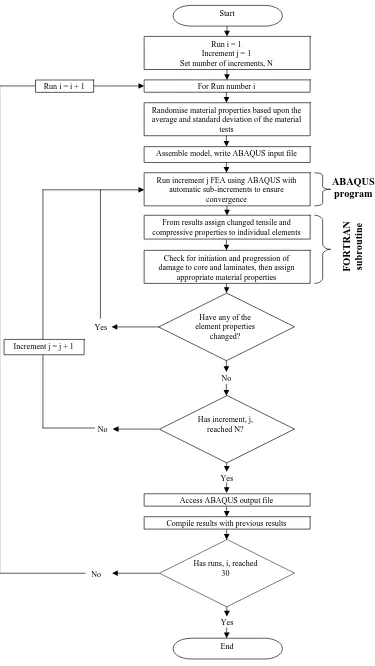
model the nonlinear behaviour of an FRP beam. The obtained results will be compared to both the analytical and experimental results.
FINITE ELEMENT ANALYSIS
Modelling the FRP beam using ABAQUS
To model the progressive matrix, shear, and compressive failure of the laminates, the existing formulations by Chang et al. [8] were also incorporated within a user defined Fortran subroutine.
PURE BENDING
Finite element model
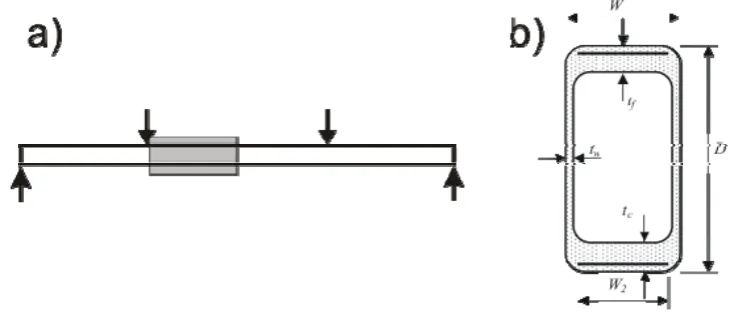
Figure 2 shows the loading details and the geometrical details of the cross section used to simulate the beam under pure bending. Only the shaded area, pure bending part, shown on Figure 2-a is analysed.
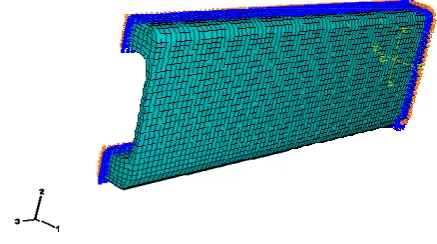
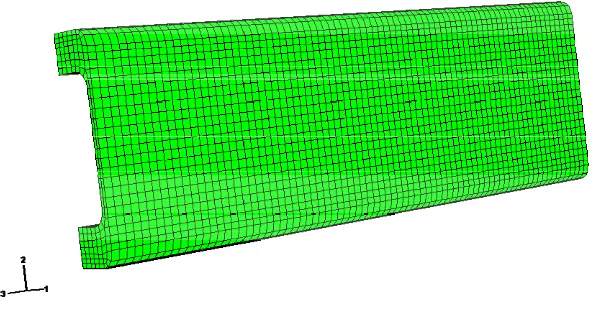
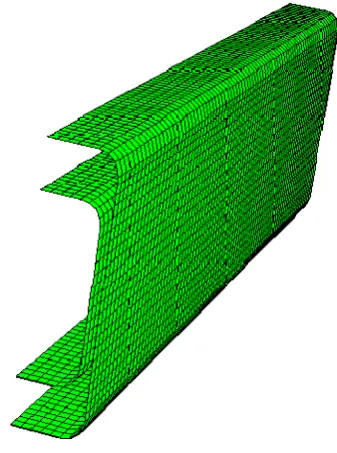
Due to symmetry, only half of the section is analysed as shown on Figure 3 representing the finite element mesh and boundary conditions. The nodes on the left face were constrained to remain on a plane to comply with the Bernoulli hypothesis that plane sections remain plane. The nodes on the right hand cross section are fixed in both the first and third direction but free to move in the third (vertical) direction except for three nodes in the middle of the section that are totally restrained. This is necessary to avoid any rigid body movement of the model. The nodes on the longitudinal face of symmetry are only constrained in the first (transversal) direction.
Material properties
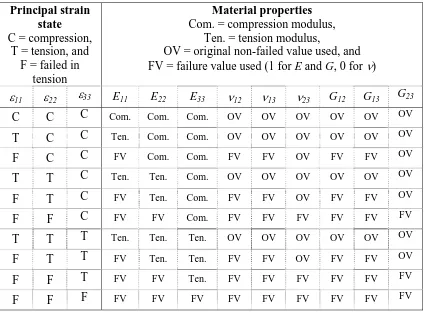
Material properties were randomly assigned to the brick and shell elements in the models. The distribution was based upon the average and standard deviation recorded in testing the laminates and the Particulate Filled Resin (PFR) shown in Table 1 of Part I of the prequel. To ensure that results were statistically valid, 30 models, each with a different randomisation sequence, were analysed for each loading configuration. Both the assigning of tensile and compressive properties, and the modelling of progressive failure was achieved within ABAQUS via a user defined Fortran subroutine. The core material cracking and FRP tensile capacities were based on a maximum strain criterion. To simulate the cracked behaviour of an element, the tensile and shear moduli, respectively parallel and perpendicular to the direction of failure, were re-set to one. The 10 different principal strain states possible as represented on Table 1. For example, if a brick element representing a laminate is under a state of tension (T) in the direction of ε11, and compression (C) in the directions of ε22 and ε33, then the tensile
modulus E11 will be used in the direction of ε11, while the compressive moduli E22 and E33
will be used in the directions corresponding to ε22 and ε33. Original non-failed value (OV) for
Poisson’s ratios and shear moduli will also be used. However, if it has already failed in any direction (represented by the letter F), then failed values (FV) for the elastic properties in that direction will be used. Table 1 is used to model the progressive matrix, shear, and compressive failure of the laminates using the damage formulation developed by Chang et al. [8]
Results and discussion
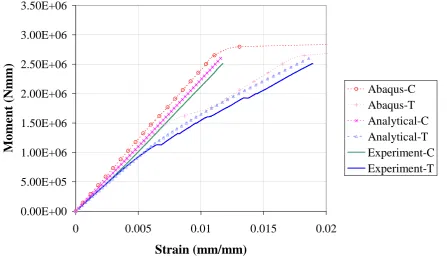
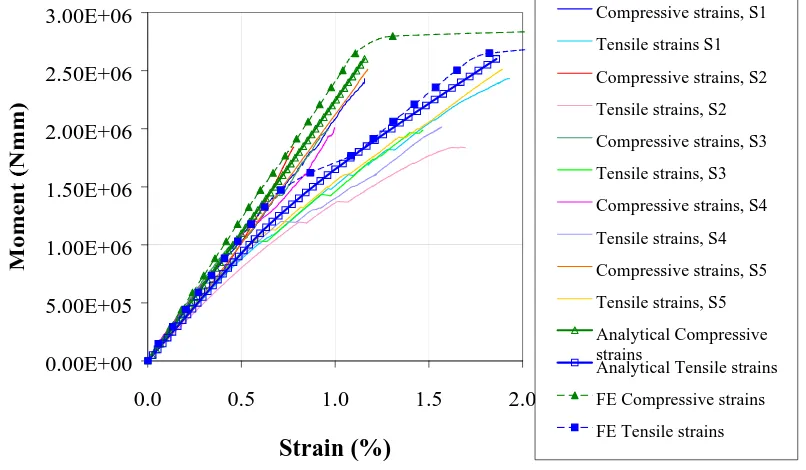
correlation with both the experimental and analytical results. Furthermore, the FEA and analytical ultimate capacity predictions agree very well with the experimental results.
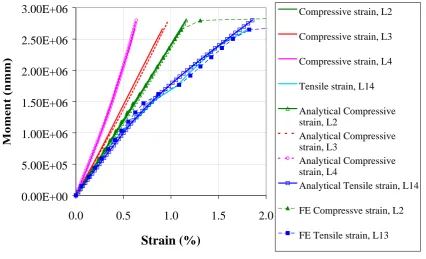
The difference in the analytical and FEA predictions of tensile strains, between moments of 1E6 to 1.75E6 Nmm on Figure 7, could be attributed to the fact that the FEA model does not provide for core-laminate de-bonding. Given the current state of knowledge, this de-bonding behaviour cannot be modelled reliably, regardless of the FEA package chosen. As mentioned previously, the characterisation of this phenomenon is still under investigation. However, the FEA results converge to the analytical predictions above a moment of 1.75E6 Nmm, which is of prime importance as far as prediction of loading capacity is concerned. To further test the validity of the developed FEA approach a number of models with altered beam geometry are compared against experimental data. As can be seen on Figure 8 to Figure 11, the FEA predictions are consistent for all the beam geometries tested.
MODELS UNDER SPECIFIC LOADING REGIMES
The developed approach provides excellent correlation with analytical and experimental results under a state of pure bending. To establish the overall applicability of the approach, it is used to model the beam behaviour, and predict the occurrence of following range of failure modes:
• moment buckling of the webs,
• combined shear and bending,
Moment buckling of the webs
Testing for web buckling required the manufacture and testing of separate web specimens. These specimens are modelled as per the four-point bending test arrangement. The first buckling mode, as predicted by the model, is shown on Figure 12. Comparison of results, as shown on Table 2, shows that the analytical and finite element solutions are similar and agree well with the experimental results.
Combined shear and bending
Six beams loaded in four-point bending were analysed. Due to symmetry, only half spans were modelled. The lengths of the spans were successively reduced to obtain the interaction diagrams between moment and shear. Figure 13 shows the two extremes of the model geometry’s. The obtained failure predictions, together with the analytical and experimental results, are plotted on Figure 14. It can be seen that the FEA results reproduce the trend of the experimental results shown as dots on the plot. However, the FE results correlate with the analytical results only at either high-shear and low moment or low-shear and high-moments. Furthermore, the general trend shown by the FE results seems to follow occurrences of cracking in the core material as experimentally observed.
Shear buckling of the webs
To model shear buckling, a web specimen similar to that used to test for moment buckling, was modelled. The first predicted buckling mode is shown on Figure 15. As with moment buckling, comparison of the results, as reported on Table 3, shows good agreement between the analytical, FE and experimental results.
In line with the experimental set up, a two-meter long cantilevered beam was modelled. The model was solved to obtain the eigenvalues. Figure 16 shows the first predicted buckling mode. As shown on Figure 17, there is some variability between the experimental, theoretical and FEA results. The Eurocomp formulation for FRP beams is substantially lower than the other methods. The remainder of the predictions lie within 27% of each other. The FEA is within 11% of the critical moment as observed in the experimentation.
CONCLUSIONS
The behaviour of the developed beam has been well described using advanced nonlinear finite element analysis that incorporates heterogeneous material property description and damage progression in the individual constituents of the beam. In particular, the developed FE approach captured the interaction between shear and bending better than any other method
The simplified analytical formulas described in the sequels show very good agreement with both the experimental results and FE analysis. These formulas were initially formulated for designing the experimental program. However, in the light of the observed accuracy, these formulas could constitute the basis for designing these FRP beams.
References
1. Springolo, M. New fibre-reinforced polymer box beam: investigation of static behaviour. PhD thesis. Faculty of Engineering, The University of Southern Queensland, Australia. 2005. http://adt.usq.edu.au/adt-QUSQ/public/adt-QUSQ20050421.122411/
2. Ascione L, Feo G, Mancusi G. On the statical behaviour of fibre-reinforced polymer thin-walled beams. Composites Part B: Engineering. 2000; 31B(8): 643-653.
3. Barbero EJ, Lopez-Anido R, Davalos JF. On the mechanics of thin-walled laminated composite beams. Journal of Composite Materials. 1993; 27(8): 806-829.
4. Davalos JF, Qiao P. Analytical and experimental study of lateral distortional buckling of FRP wide-flange beams. Journal of Composites for Construction. 1997; 1(4): 150-159.
5. Davalos JF, Salim P, Qiao R., Lopez-Anido R, Barbero E J. Analysis and design of pultruded FRP shapes under bending. Composites Part B: Engineering. 1996; 27(3/4): 295-306.
6. Haj-Ali R, Kilic H. Nonlinear behavior of pultruded FPR composites. Composites Part B: Engineering. 2002; 33(3):173-191
7. Taufik A, Barrau JJ, Lorin F. Composite Beam Analysis with Arbitrary Cross Section. Composite Structures. 1999; 44(2/3): 189-194.
Symposium and Exhibition - Tomorrow's Materials: Today. SAMPE, Covina, CA, USA, 1989 p:559-568.
9. Hibbitt, Karlsson & Sorensen Inc., 'ABAQUS', ver 6.4, Hibbitt, Karlsson & Sorensen, Inc., Pawtucket. RI 02860-4847, USA, 2003
Table 1: Material properties for failure modelling
Principal strain state
C = compression, T = tension, and
F = failed in tension
Material properties
Com. = compression modulus, Ten. = tension modulus,
OV = original non-failed value used, and FV = failure value used (1 for E and G, 0 for ν)
ε
11ε
22ε
33 E11 E22 E33ν
12ν
13ν
23 G12 G13 G23C C C Com. Com. Com. OV OV OV OV OV OV
T C C Ten. Com. Com. OV OV OV OV OV OV
F C C FV Com. Com. FV FV OV FV FV OV
T T C Ten. Ten. Com. OV OV OV OV OV OV
F T C FV Ten. Com. FV FV OV FV FV OV
F F C FV FV Com. FV FV FV FV FV FV
T T T Ten. Ten. Ten. OV OV OV OV OV OV
F T T FV Ten. Ten. FV FV OV FV FV OV
F F T FV FV Ten. FV FV FV FV FV FV
Table 2: Moment buckling of the web specimen
Analytical FEA Experimental
Buckling moment
Table 3: Shear buckling of the web
Analytical FEA Experimental
ABAQUS program
No
Yes Has runs, i, reached
30
End
Compile results with previous results Yes
Start
For Run number i
Randomise material properties based upon the average and standard deviation of the material
tests
Assemble model, write ABAQUS input file
From results assign changed tensile and compressive properties to individual elements
Run increment j FEA using ABAQUS with automatic sub-increments to ensure
convergence
Yes
Have any of the element properties
changed?
No
Check for initiation and progression of damage to core and laminates, then assign
appropriate material properties Run i = 1
Increment j = 1 Set number of increments, N
No Run i = i + 1
Has increment, j, reached N? F O RT RAN subrout in e
Increment j = j + 1
[image:15.595.110.485.67.733.2]0.00E+00 5.00E+05 1.00E+06 1.50E+06 2.00E+06 2.50E+06 3.00E+06 3.50E+06
0 0.005 0.01 0.015 0.02
Strain (mm/mm)
Moment (Nmm)
[image:21.595.82.530.188.450.2]Abaqus-C Abaqus-T Analytical-C Analytical-T Experiment-C Experiment-T
0.00E+00 5.00E+05 1.00E+06 1.50E+06 2.00E+06 2.50E+06 3.00E+06
0.0 0.5 1.0 1.5 2.0
Strain (%)
Compressive strain, L2
Compressive strain, L3
Compressive strain, L4
Tensile strain, L14
Analytical Compressive strain, L2 Analytical Compressive strain, L3 Analytical Compressive strain, L4
Analytical Tensile strain, L14
FE Compressve strain, L2
[image:22.595.89.516.217.476.2]FE Tensile strain, L13
0.00E+00 5.00E+05 1.00E+06 1.50E+06 2.00E+06 2.50E+06 3.00E+06
0.0 0.5 1.0 1.5 2.0
Strain (%)
Compressive strains, S1
Tensile strains S1
Compressive strains, S2
Tensile strains, S2
Compressive strains, S3
Tensile strains, S3
Compressive strains, S4
Tensile strains, S4
Compressive strains, S5
Tensile strains, S5
Analytical Compressive strains
Analytical Tensile strains
FE Compressive strains
[image:23.595.99.502.229.464.2]FE Tensile strains
0.00E+00 5.00E+05 1.00E+06 1.50E+06 2.00E+06 2.50E+06 3.00E+06
0.0 0.5 1.0 1.5 2.0
Strain (%)
Compressive strain, S1
Tensile strain, S1
Compressive strain, S2
Tensile strain, S2
Analytical Compressive strain
Analytical Tensile strain
FE Compressive strain
[image:24.595.100.508.268.511.2]FE Tensile strain
0.00E+00 5.00E+05 1.00E+06 1.50E+06 2.00E+06 2.50E+06 3.00E+06 3.50E+06 4.00E+06
0.0 0.5 1.0 1.5 2.0
Strain (%)
Moment (Nmm)
Tensile strains, S1
Tensile strains, S2
Analytical Compressive strains
Analytical Tensile strains
FE Compressive strains
[image:25.595.84.516.249.503.2]FE Tensile strains