ISSUES IN PROCESSING UNSTABLE TWISTED FIBRE
ASSEMBLIES
C.D. Tran1, G.H.M. van der Heijden2 and D.G. Phillips3 1,3 CSIRO Textile and Fibre Technology, P.O. Box 21, Geelong, VIC 3216, Australia, 2 Centre for Nonlinear Dynamics, Civil Engineering Building, UCL, London, UK.
Abstract
During yarn formation by ring spinning, fibres are bent into approximately helical shapes and an unbalanced torque or twist-liveliness is created. Generally, the torque depends on yarn geometric factors such as the yarn twist and linear density and the fibre properties. In order to prevent the instability of yarn (e.g., snarling), twist-liveliness must be controlled. A practical solution to the problem of twist-liveliness is the formation of a two-fold yarn. This twisting or plying process produces a yarn structure where the energy of the system is determined by purely geometrical constraints of the plied structure and consequently when an energy minimum is reached the plied yarn obtained from the process is torsionally balanced and torque-free.
In the present paper, the instability of twisted textile yarns will be interpreted using the Topological Conservation Law (Fuller, 1971) which has been developed to study the dynamics of twisted rods by Van der Heijden et al. (2003). The present work considers the equilibrium configuration of a series of multi-ply twisted yarns (2, 4, 8, and 16 strands) of finite length. The influence of structural properties (the number of strands, the diameter and twist of each strand) on the parameters of a balanced multi-ply yarn (writhe and twist) using a topological invariant of the twisted yarn (link) is established and investigated using experimental results obtained at CSIRO. Keywords: Topological conservation law, writhe, twist, link, multi-ply, balance twisted yarn, instability.
1. Introduction
For the last decade, one of the important subjects of the dynamics of twisted yarns is the source of their instability. In fact, issues of instability for twisted structures are well-known, such as snarling of yarn or the skewing of knitted fabrics. For example, if the ends of a freshly-spun yarn are brought together, the yarn will buckle locally and jump into a ply or form a snarl. By assuming helical shapes for the centre-line of strands in the ply, expressions of forces and moments in the ply can be obtained using the static equilibrium equations. Recently, based on the topological conservation law (TLC) (Fuller, 1971, 1978) for the dynamics of rods, Thompson et al. (2002) has employed the dynamics of a elastic fibre to model a single DNA molecule and analysed its super-coiled equilibrium ply configurations and Van der Heijden et al. (2003) have modeled the non-linear jump behaviour of twisted clamped rods. In the present work, the application of this law (TCL) to the instability of textile twisted yarns will be considered. The equilibrium configuration of a series of multi-ply twisted yarns of finite length and some influences of structural properties on a balanced multi-ply yarn (writhe and twist) are investigated and presented. 2. Model of a multi ply yarn
by the position of a curve in space ri(s) where s is the arc length along the central axis of the yarn.
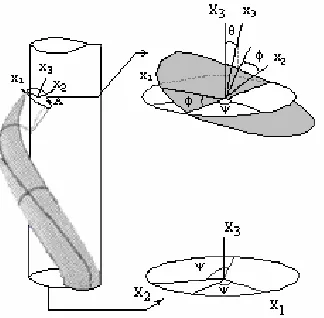
Let {X1, X2, X3} be a fixed rectangular Cartesian coordinate system, and {x1, x2, x3} a moving coordinate system whose two axes coincide with the principal axes of the strand cross section (x1 and x2) and the third axis x3 coincides with the tangent to the strand
3 d ds
=
r
x (see Fig.1). Let ψ, θ, φ be the angular twist in the strand, the helical angle inclination of the strand and the angular rotation of the fiber around the x3 axis, respectively.
Fig. 1 Schema of a strand (r) wound on a cylinder (R): the fixed cartesian and moving coordinate frames.
For the sake of presentation, considering strands wound on a cylinder in the left handed side helix as shown in Fig.1. The centreline of a strand (i) can be expressed in fixed frame (Neukirch and Van der Heijden, 2002, Van der Heijden, 2001) as follows
i
( )
s in 11
−
=
r K r (1a)
With n
cos sin
n n
sin cos
n n
π π
−
π π
=
K
2 2
0
2 2
0
0 0 1
and
R sin R cos
s cos
− ψ
= ψ
θ
r1 (1b)
Where '
( )
s sin ;( )
Rθ
ψ = − ψ 0 =0 (1c)
Hence, the position vector rA,i of a point on the surface of a strand i can be determined by
A,i
( )
i( )
1 2R sin r sin sin r cos cos cos
s, s r sin r cos R cos r sin cos r cos cos sin
s cos r cos sin
− ψ + φ ψ + φ θ ψ
φ = + φ + φ = ψ − φ ψ + φ θ ψ
θ − φ θ
[image:2.612.226.388.212.371.2]The geometrical model considered here is based on elastic rod mechanics in which the following assumption is introduced: the distance of the centreline of two adjacent strands is minimum and equal to the diameter of each strand. This is expressed as follows:
m cos cos m sin n
π
+ θ − θ − ρ=
2 2
2
2 4
2 2 (3a)
m cos sin sin msin n
π
θ + θ θ − =
2 2 0
(3b)
Where m si 1 si, R
R r
+ −
= ρ =
Equations (1b,c) and 3 d ds
= r
x yields to 3
sin cos sin sin cos θ ψ
= θ ψ
θ
x (4)
Let u, whose components are u1,u2, u3, be the curvatures and the twist of strand in the moving frame, the governing equations of the evolution of a strand (the centreline) are given by
i
i d
i 1, 2, 3
ds = × =
x
u x (5)
Because the centreline of each strand lies on a cylinder of R, a cylindrical coordinate frame {er, eψ, ez} is introduced as follows
r 1 2
1 2
z 3
sin cos ;
cos sin ;
ψ
= − ψ − ψ
= − ψ + ψ
=
e X X
e X X
e X
(6a)
With r r 3 z
d
d d d
; ; sin cos
ds ds ds ds
ψ
ψ ψ
ψ ψ
= e = − = − θ + θ
e
e e x e e (6b)
3. Governing equations of a multi-ply yarn
3.1 Link, twist and writhe in textile engineering (Kinematic equation)
For this presentation, consider a single Z twisted yarn of length L whose ends are glued together to form a closed loop or hank. Let the number of total end rotations of the yarn, before being formed into the hank, be specified as the link which is a topological invariant, i.e. it is unaffected by any deformations and is defined for as the following formula (Van der Heijden et al., 2003 and Fuller, 1971)
k w r
Where w 3 L 1 T = u ds
2π
∫
is the total twist, and Wr (named the writhe) is a property of centre-lineof the single yarn. It is produced from the out-of-plane deformation to form a snarl or plied yarn and equal to the signed crossing number averaged over planar projections from all possible directions (see Thompson et al. (2002), p.963). In a spinning process, the concept of the “twist” that is inserted into a single twisted yarn, is actually the ‘link’ per an unit length of yarn. If applying a rotation of Ω (rads) in a single yarn of length L, the spinning twist per length τ (positive for Z twist and negative for S twist) and twist angle are given by, respectively
, tan r L
Ω
τ = θ = τ. (8)
Since the twist is assumed constant along the yarn in textile engineering, the link is written as follows
k
L L
2 2
Ω τ
= =
π π. (9)
A similar explanation holds for a multi-ply assembly from more than one hank and the details can be seen in Neukirch and Van der Heijden (2002).
3.2. Kinetic balance Equations
Consider a multi-ply yarn of n strands whose physical and geometrical parameters are mentioned in previous sections. The governing equations of a strand for the force F and moment M are given by (Fraser and Stump, 1998a,b; Thompson et al., 2002; Stump and van der Heijden, 1999)
d
0 ds+ =
F
p (10a)
d d
+ = 0
ds ds×
M r
F (10b)
Where p is the pressure (force per unit length) on a strand in which the constitutive relations between the stresses and trains are assumed linear and given by
3
3 3 3
d
B Cu
ds
= × x +
M x x (11)
and B and C are the two principal bending stiffness and torsional rigidity of strands, respectively. Let (Fr, Fψ, Fz) be the components of F in the cylindrical coordinate, we have
(
)
3 F cosψ F sinz r F cosr ψ F sinr z
× = θ + θ − θ − θ
F d e e e (12)
From (12) and (11), the differential balance equation (10b) is rewritten as follows 2
2
3 z
2
d d d
B B sin cos Cu sin F cos F sin
ds ds
ds ψ
θ ψ ψ
− + θ θ − θ = − θ − θ
2
r 2 3
d d d d
F B sin 2B cos Cu
ds ds ds
ds
ψ ψ θ ψ
= − θ − θ + (14)
3 du
C 0
ds = (15)
The derivatives of F in the cylindrical frame are given by
r F dF r z
dF F dF
sin p; = sin ; 0
ds R ds R ds
ψ ψ
= − θ − θ = (16)
With the assumption θ and u3 are constant, equations (14), (16) and (11) show that the components of F are all constant and are calculated as follows
r o Z
3 3 0
2 F 0
F F
n
M B Cu
F sin cos
nR R R
ψ
=
=
= + θ − θ
(17)
where Fo and Mo are the axial force and moment applied to the multi-ply yarn, respectively. From (17), the differential balance equation (13) is rewritten by
2 2
3 0 0
3
r F rM
C
2n sin cos n ru cos 2 sin cos 0
B B B
ρ ρ
θ θ − ρ θ + θ + θ = (18)
With a given initial twist u3, it can be expressed as follows (Antman, 1995, Love, 1904)
3
d d sin 2 sin 2
u cos
ds ds L 2R 2R
φ ψ Ω θ θ
= + θ = − = τ − (19)
Substituting (19) into (18) yields
2 2
3 C Cr r F0 rM0
2n sin cos n sin 4 n cos 2 sin cos 0
4B BL B B
ρ ρ
θ θ + θ − τρ θ + θ + θ = (20)
3.3 The balance of a multi-ply yarn
When removing applied force and moment (Fo = Mo = 0), the multi-ply yarn reaches the balanced state and the equation (18) yields to
3 1 r
2n sin cos n sin 4 n cos 2 0
4 L
θ θ + γ θ − τ γ ρ θ = (21)
where C B
4. Examples and discussions
In this work, the balance of multi ply yarns of 2, 4, 8, 16 strands will be considered and investigated. The analysis is carried out using a range of different yarn counts and initial twists in which the relationships between twist angle (link) of strands and helical angle of the multi-ply yarn (or the corresponding quantity) are determined. Although the torsional and bending stiffnesses of strands depend on the structural parameters of the yarn, the ratio of the torsional and bending stiffness (γ) and the Poisson’s ratio (ν) are assumed constant at about 0.7 and 0.43, respectively, in the present work. Furthermore, the radius of wool worsted strands is calculated as a function of the yarn counts using the packing fraction of 0.63 by Booth, (1975).
Plies from one hank
For plied twisted yarns from one hank, i.e., two strands (n = 2, R = r (ρ =1)): this is a popular and simple case of multi-ply yarns. In the balance state, the kinematic and balance kinetic equations yields
2
o 0
1
tan = r = - tan2 (1 2 sin ) 2
ψ τ θ + ν θ (22)
where ψo is the twist angle of the two strands. The link and writhe can be determined from (7)-(8) and (22)
(
)
(
)
k L
L sin 2 1 tan 2
2 r
= ν β − + ν β
π (23)
r L
W sin 2
2 r
= − β
π (24)
Fig. 2. Relationship between the twist angle Fig. 3. Relationship between the twist angle of strand and helix twist angle of balance of strand and helix twist angle of a balance
plied yarn using different γ’s plied yarn using different yarn counts
given in terms of the ratio of twist angle of the strand to the helix angle of the plied yarn (Figure 2) or the ratio of writhe to link ( Figure 3). It can be seen that this relationship depends clearly but not strongly on the geometrical property of strands (yarn count, packing fraction). The results also show good agreement between the present analysis using the TLC and kinetic balance and the experimental analysis (Fig.4). The difference between the theoretical values and the experimental results is always less than 8% for two strand plied yarns.
Fig. 4. The relationship between twist of strand Fig. 5. The relationship between twist of strands and helix twist angle of a plied yarn: comparison and helix twist angle of a multi ply yarn for between experimental results and the results the different cases of used yarn counts : 80, from the present work using strands of 80 Tex. Tex 100 Tex and 140 Tex using 4 strands.
Plies from more than two hanks
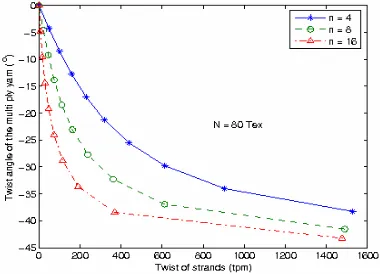
The influence of the number of strands and their yarn count on the structural stability of a multi-ply n-strand yarn is considered in the following. Figure 5 shows the theoretical relationship between twist angle of strands and the helical angle of the multi ply yarn of strands with respect to yarn count (80 Tex, 100 Tex, 140 Tex ) at the balance situation. The relationship in Figure 6 shows the effect of an increased number of strands from 4 to 16.
Fig. 6. Relationship between twist of strands and helix twist angle of plied yarn for the cases of 4, 8, 16 strands of 80 Tex
[image:7.612.318.503.162.303.2] [image:7.612.100.293.164.306.2] [image:7.612.211.401.488.625.2]5. Conclusion
The Topological Conservation Law is used in combination with the governing equations to simulate the equilibrium configuration of a balanced multi-ply yarn. The influence of structural properties on the parameters of a balanced multi-ply yarn is also established and investigated using preliminary experimental results obtained at CSIRO. The relationship of the link and writhe of a given closed yarn structure may allow some multi-ply twisted yarns to be designed whose instability can be controlled.
Acknowledgements
This work was supported by a grant of computing time from Australia Partnership for Advanced Computing (APAC) National Facility. Canh-Dung Tran is supported by a CSIRO Postdoctoral Research Fellowship. All of this support is gratefully acknowledged. References
Antman, S.S., Nonlinear problems of Elasticity, Springer, New-York (1995).
Booth, J.E., Textile Mathematics, Vol 2, Textile Institute, Manchester (1975).
Fraser, W.B. and Stump, D.M., The equivalibrium of the convergence point in two-strand yarn plying. Int. J. Solids Structures 35(3-4), 285-298 (1998a).
Fraser, W.B. and Stump, D.M., Twist in balanced ply structures, J. Text. Inst., 89(3) Part 1, 485-497 (1998b).
Fuller, F.B. Decomposition of the linking of a closed ribbon: a problem from molecular biology. Proc. National. Acad. Sci. USA 75 3557-3561 (1978)
Fuller, F.B. The writhing number of a space curve. Proc. National. Acad. Sci. USA 68 815-819 (1971)
Love, A.E.H., A treatise on the mathematical theory of elasticity, Cambridge, 1906.
Neukirch, S. and van der Heijden, G.H.M. Geometry and mechanics of uniform n-plies: from engineering ropes to biological filaments, J. Elasticity, 69, 41-72 (2002).
Thompson, JMT, van der Heijden GHM, Neukirch S. Supercoiling of DNA plasmid: mechanics of the generalized ply. Proceeding of the Royal Society of London A; 458:959-85, (2002).
Van der Heijden, G.H.M., Neukirch, S., Goss, V.G.A. and Thompson, J.M.T., Instability and self-contact phenomena in the writhing of clamped rods, Int. J. Mech. Sci. 45 161-196 (2003).