Problem based learning in system design teams
Robert L Fulcher
Faculty of Engineering and Surveying, University of Southern Queensland fulcherb@usq,edu.au
Christopher P Snook
Faculty of Engineering and Surveying, University of Southern Queensland [email protected]
Full citation:
Fulcher, Robert L. and Snook, Christopher P. (2006) 'Problem based learning in system design teams.' In: ( 17th Annual Conference of the Australasian Association for Engineering Education, 10-13 Dec 2006, Auckland. New Zealand. )
Abstract: The University of Southern Queensland (USQ) has a very distinctive educational offering especially with respect to learning modes. Along with the traditional on campus mode it has distance and on line modes of learning. The Faculty of Engineering and Surveying mirrors these offerings within its four disciplines of agricultural, civil and environmental (ACE), electrical, electronic and computer (EEC), mechanical and mechatronic (MM) and surveying and land information (SLI). Furthermore each discipline is charged with the responsibility of teaching design throughout all its programs namely, associate degree, bachelor of engineering technology and bachelor of engineering degrees. The mechanical and mechatronic engineering discipline has developed a specific structure to do this based on traditional and problem based learning styles. This paper focuses specifically on the course MEC3303 System Design. It describes how this course began and continues to evolve as well as the factors that have influenced this evolution. A short survey of different University engineering programs with respect to their teaching of design is made. USQ programs are placed at the higher end of the survey in terms of the percentage of design courses. Speculation is made on MEC3303’s future. Being created in and for a flexible learning
environment allows this course to develop many possible modes of offering depending on student demand as well as adding supplementary material to incorporate international students. The engineering profession has learnt that being flexible and adapting to change is the key to success in the 21st century and MEC3303 is no exception.
Keywords: engineering design, problem based learning, team learning.
Introduction
The University of Southern Queensland (USQ) is a major provider of tertiary courses by distance education, with 75% of its 26,000 students studying in distance or "off-campus" mode. The Faculty of Engineering and Surveying, a foundation faculty of USQ's predecessor Darling Downs Institute of Advanced Education (DDIAE) in 1967, shows a similar
The Faculty has a strong commitment to providing quality higher education opportunities to as broad a cross-section of the Australian community as possible. The Faculty offers
engineering and surveying courses that meet the needs of industry and the wider community for associate, paraprofessional and professional staff. In addition, a number of coursework and research postgraduate courses are also available.
The Faculty of Engineering and Surveying has a special academic structure with overall financial and academic control vested in the Dean and Associate Dean portfolios. There is no separate departmental structure; instead academic staff are grouped into related disciplines under the direction of an appointed Head of Discipline. Currently academic staff are grouped under the four discipline sections of agricultural, civil and environmental (ACE), electrical, electronic and computer (EEC), mechanical and mechatronic (MM) and surveying and land information (SLI) (Baker 2002). The Faculty offers about 130 courses and this paper will concentrate on those involved with what is generally describe as mechanical design studies.
Structure of mechanical design studies program at USQ
Per Engineers Australia accreditation criteria guideline (section 3.2.3 – engineering design and projects should be about 20% of the total program), between 20 to 22% of most mechanical and mechatronic engineering programs are dedicated to teaching design principles. This is embodied in the academic courses of ENG1100 Introduction to
Engineering Design (first level course on 2D drafting skills), MEC2304 Solid Modeling (first level course on 3D drafting skills), MEC2301 Design of Machine Elements (second level course in machine component design), MEC3302 Computational Mechanics in Design (third level course on FEA), MEC3303 System Design (third level course on designing systems), ENG4111 & ENG4112 Research Project Part 1 and 2 (fourth level project courses) as well as the practice courses of Mechanical Practice 2 and Professional Practice 2. This paper will focus on the penultimate course MEC3303 as this incorporates the Engineers Australia graduate generic attributes (Engineers Australia 2006):-
• Ability to undertake problem identification, formulation and solution
• Ability to utilize a systems approach to design and operational performance
• Ability to function effectively as an individual and in a disciplinary and multi-cultural teams, with the capacity to be a leader or manager as well as an effective team member
ENG1100 Introduction to Engineering Design (level 1) fosters creativity and introduces conceptual design, computer aided design and drafting early in the course. It introduces the engineering design method as well as engineering handbooks and commercial catalogues to give students a foundation to which they can relate future studies in the more advanced courses of the program. It uses the textbook, Engineering Drawing, 6th edition, McGraw Hill, by Boundy AW, 2001.
MEC2301 Design of Machine Elements (level 2) aims to integrate the knowledge that the student has gained earlier in their course and to focus the student's analytical skills towards synthesis of solutions by working through the design and failure analysis of several simple, commonly used mechanical devices. Juvinall, RC & Marshek, KM 1999, Fundamentals of Machine Component Design, 4th edition, Wiley and Standards Association of Australia 1999, Design Standards for Mechanical Engineering Students, (SAA HB6) are the set textbooks.
MEC3302 Computational Mechanics in Design (level 3) provides students with an understanding of the operation and limitations of computer aided engineering (CAE) and analysis systems, and provides opportunities to develop the basic skills required to operate such systems. Material presented will include the architecture of CAE systems, numerical methods, finite element methods, computer graphics, engineering methods of CAE, optimisation, solid feature based parametric modelling, and technical information management systems. The advantage of a CAE process is demonstrated by several engineering assignments that students must complete on a CAE facility throughout the
semester. Considerable emphasis is placed on the appropriate use of the finite element method in the design process. Adams, V & Askenazi, A 1999, Building Better Products with Finite Element Analysis, Onword Press, Santa Fe, NM is the prescribed text.
MEC3303 System Design (level 3) leads the student to an understanding of the philosophy and methodology of the design process in the context of systems which embrace political, sociological, economic, technical and ergonomic aspects. It then provides practice through assignments and workshops in developing the student's ability to discern the relevant factors and design accordingly, to interact within a design team, and to communicate ideas and concepts through oral and written presentation. In this course the student is introduced to a number of specialist topics not covered elsewhere in their course of study. This is a senior course and it is assumed that the student has the maturity, knowledge and skills base
commensurate with having completed the first two years of their undergraduate course. Ertas, A. & Jones, J. C. 1996, The Engineering Design Process, 2nd edition, Wiley is the text used.
ENG4111 & ENG4112 Research Project Part 1 and 2 (level 4) prepare the student for professional-level technical project work. With the guidance of supervisor/s, the student will augment, integrate and demonstrate skills spanning both the technical and non-technical dimensions of engineering and spatial science at the professional level. The project
(ENG4111 Research Project Part 1 immediately followed by ENG4112 Research Project Part 2) will develop and test the ability to define and analyse the problem, to develop solutions to the problem, to make the necessary decisions, convert ideas into useful outcomes and to cope with the unexpected problems encountered in testing and evaluation. All of this must be accomplished in a tight timeframe, within resource limitations and with due regard for safety, social and ethical considerations. In short, the individual project is a good indicator of overall professional ability.
Philosophy behind MEC3303
• Standard learning modules to be included as a technical resource with a workbook format.
• Opened-ended project problems to be solved at least to the conceptual design stage – problem based learning.
• Solve project problems in a team environment of nominally four (4) members – effective team building and performance.
• Self reflection of effectiveness of group project work.
• Multi modal offerings in on campus and external modes
• Assessment of group project by grading but standard marking of technical learning modules via individual assessment in assignment and / or examination.
Content and operation of MEC3303
The course specifically covers the topics of design philosophy, the engineering design process, system design approach and engineering specialisations in noise control, hydraulics & pneumatics and system reliability. System design approach includes system modelling, synthesis and analysis, design economics, marketing analysis, optimisation and human factor engineering.
Currently (2006) 60 % of marks are allocated to group project, 10% to an assignment about reflective learning based group project work and 30 % to a closed book final examination. The next section will look at how assessment has varied over time, to reinforce the major objectives and dual nature of group work verses individual work evaluation.
Setting up project groups on campus is straight forward via a face to face class interaction. For external interaction, extensive use has been made of the internet using WebCT software to firstly allocated students to respective teams and secondly to facilitate team communication while being monitored by staff. Team building and performance via the internet is not easy and careful mentoring is required to make it work. The same mentoring occurs on campus but team difficulties can be identified earlier and immediate corrective action taken before team performance is affected. Externally, such difficulties surface later and corrective action may not be so timely. Nevertheless this monitoring has been very successful and group
MEC3303 System Design Enrolments
0 10 20 30 40 50 60 70 80 90
1997 1998 1999 2000 2001 2002 2003 2004 2005 2006
Year
N
um
be
r of
S
tude
nt
s
ONC S2
[image:5.595.116.479.74.287.2]EXT S2
Figure 1: MEC3303 Enrolments
Figure 1 depicts the student enrolments by mode since 1997. Before 1999 only on campus mode was offered. In 1999 there was about 35% on campus and 65% external mode. Currently there is about 40% on campus and 60% external enrolments. Of these external enrolments, about 50% are from overseas locations such as Singapore, Malaysia and Hong Kong. Recently a small enrolment of students has been forthcoming from South Africa, India and the Middle East. External offering enrolments have varied widely from 20 to 90 while on campus numbers have stabilised at about 30.
MEC3303 System Design Pass Rates
50 60 70 80 90 100
1997 1998 1999 2000 2001 2002 2003 2004 2005
Year
Pa
s
s
R
a
te
%
ONC S2
[image:5.595.117.478.427.637.2]EXT S2
Figure 2: MEC3303 Pass Rates
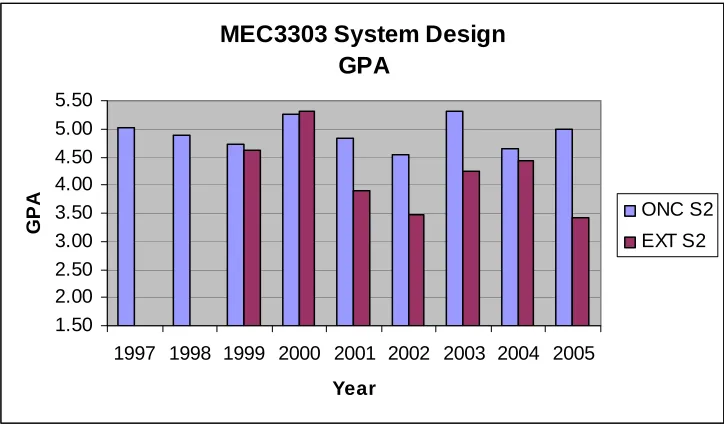
MEC3303 System Design GPA
1.50 2.00 2.50 3.00 3.50 4.00 4.50 5.00 5.50
1997 1998 1999 2000 2001 2002 2003 2004 2005
Year
GP
A
[image:6.595.116.478.73.287.2]ONC S2 EXT S2
Figure 3: MEC3303 Course Grade Point Average
Figure 3 gives the course GPA by mode of study. On campus mode has about 5.0 GPA that is an average student grade of credit. Again external mode varies greatly from 3.5 to 5.25. Within this external cohort of students, it has been noted that whenever a low GPA occurs, it has coincided with about a 10% students not participating. Furthermore overseas student GPA was also low. Nevertheless external mode GPA is generally below on campus GPA even though it has matched on campus GPA in 1999, 2000 and 2004.
Observations and comments
• Group project topics are purposely changed over time and have moved towards more mechanical designed system problems
• Generally high pass rates have been forthcoming except for 2002 and 2005 external.
• Students still need to progress to detailed design stage in group project. Current course has a considerable amount of problem based learning but real world solution
implementation is seldom achieved!
• 2004 saw the introduction of Formula SAE race car project topics to offer students real world results for their design activities.
• Students still have difficulty in integrating skills from other courses (computational mechanics in design and solid modeling) into project work.
Generally students successfully gain realistic, professional practice design skills and demonstrate an ability to work in a team on open ended problems and solutions while enjoying a design challenge.
Continuous development of MEC3303
As in any continuous improvement system, MEC3303 has evolved over time. This section looks at the areas that have changed significantly. Objectives and content have remained constant even though a further specialisation area of condition monitoring has been
to introduce different project topic challenges. The course assessment is probably the most modified part of the course as shown in Table 1.
MEC3303 System Design Assessment Weighting %
Year Assignment Group project Examination PR% - ONC PR% - EXT
1998 - 2002 30 40 30 closed 94 67
2003 0 50 50 open 100 89
2004 0 60 40 open 95 88
2005 0 60 40 closed 93 62
[image:7.595.71.523.672.759.2]2006 10 60 30 open
Table 1: MEC3303 Assessment Schemes
Originally the assignment assessed engineering specialisations, group project the team project and final examination general design knowledge. Since 2003 specialisation areas were
assessed by examination in either open or closed book format. In 2006 a reflective learning exercise via a 10% assignment has been added to formalise the student self assessment and review of their group project. This is experimental at this stage but should reinforce teamwork effectiveness and value. Basically since 2002 the weighing for Group Project has steadily increased from 40% to 70% to reflect the student effort given to this part of the course. Pass rates have held constant for on campus students but have shown variation for external students only with respect to open and closed examination format. This is to be further researched.
What next for MEC3303?
The 10% weighted assignment introduced this year will be used as a reflective learning exercise for students with respect to evaluating teamwork and group dynamics (Brodie 2004). Team processes and performance evaluation as well as individual member contribution will be assessed by rating scale surveys. Students will then self assess their team’s performance and comment on their experiences. It has been planned to introduce more workbook
specialisations into the course such as machine condition monitoring. This will then be used to allow students to select specialisation areas appropriate to their project. Thus workbook material becomes more of an information resource for projects rather than conventional course material.
How does USQ mechanical design studies compare with other Universities?
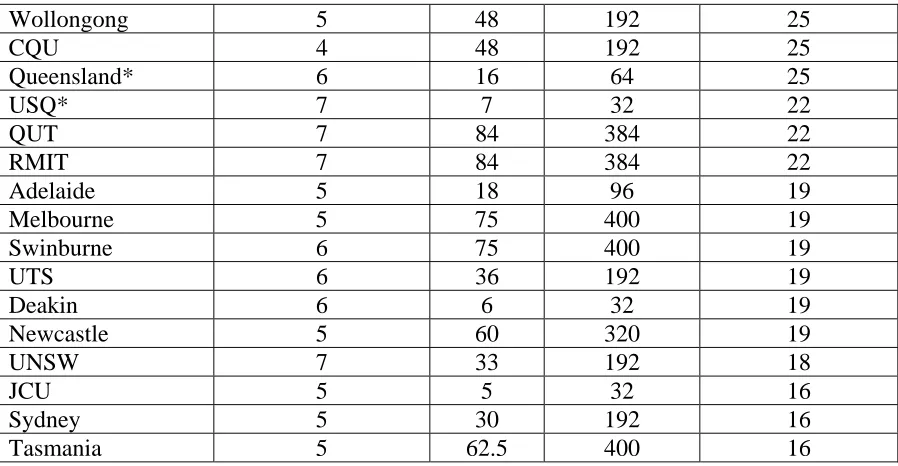
A short survey of internet sites of eighteen Australian university programs was made, to view the proportion of compulsory design courses therein and to see if other programs have a similar course to MEC3303. Nominally the bachelor of mechanical engineering program was selected as it is a standard offering at most institutions and well known to the authors.
Proportion of Design Courses in B Eng Mechanical Programs from Selected Australian Universities
University Number of Compulsory
Courses in Design
Credit points
Program Credit Points
% Design
Curtin 6 150 400 37.5
Wollongong 5 48 192 25
CQU 4 48 192 25
Queensland* 6 16 64 25
USQ* 7 7 32 22
QUT 7 84 384 22
RMIT 7 84 384 22
Adelaide 5 18 96 19
Melbourne 5 75 400 19
Swinburne 6 75 400 19
UTS 6 36 192 19
Deakin 6 6 32 19
Newcastle 5 60 320 19
UNSW 7 33 192 18
JCU 5 5 32 16
Sydney 5 30 192 16
[image:8.595.72.521.69.302.2]Tasmania 5 62.5 400 16
Table 2: Proportion of Design Studies in Mechanical Engineering Programs
Table 2 depicts the results noting that courses containing minor sections in said studies were not counted in the survey. It is also noted that explicit problem solving (engineering skills) type courses were also excluded but final year project was included.
The USQ program (22%) was amongst the programs that exceeded the nominal 20% average but not the highest which was Curtin at about 37.5%. There has certainly been a trend towards increasing the proportion of design type courses over time; with many Universities now including problem based learning. Problem based learning courses have been introduced at USQ and CQU which require teamwork and communications objectives so it can be argued that their respective programs are allocating even higher proportion of time to said studies.
Programs with the an asterisk in Table 2 have a specific course called Systems Design or project work outside of final year project. A review of these specific courses indicates that they are mainly at level 3 of their respective programs and have a wide range of open ended projects undertaken mainly in teams just like MEC3303. Like USQ these programs seem to be using system Design course as a forerunner of final year project work. Formula SAE appears to be prominent in the type of course. Western Australia best depicts this approach to design education.
Conclusion
The course MEC3303 System Design and its companion courses have evolved over time as a response to a flexible learning environment defined by several modes of study and continuous development due to a changing student profile, especially overseas enrolments, and distance education enhancements via Engineers Australia accreditation reviews. Obviously some technical content has made way for this development but in a world that demands flexibility and adaptation, this area of study has become crucial for engineering students to perform well in the 21st century rapid proto-type, design environment.
References
Atherton J S (2005), Teaching and Learning Problem-based Learning : Available: http://www.learningandteaching.info/teaching/pbl.htm Viewed 9 October 2006
Baker, G (2002). Self Review: Faculty of Engineering and Surveying, AUQA USQ Review 2002.
Brodie, L.M. (2004), Reflective Writing By Distance Education Students In An Engineering Problem Based Learning Course, 5th Asia Pacific Conference on Problem Based Learning - Pursuit of Excellence in Education, Petaling Jaya, Malaysia, 15-17 March, 2004.
Brodie, L.M. & Porter, M.A (2006), Problem Based Learning for On-campus and Distance Education Students in Engineering and Surveying , 2005, 2006 International Conference on Engineering Education, Liverpool, England.
Central Queensland University (2006), Student Handbook, Undergraduate, Bachelor of Engineering (Mechanical) viewed 5 May 2006. . Retrieved from
http://handbook.cqu.edu.au/Handbook/programs_4.jsp?s=4&code=CA87
Curtin University of Technology (2006), Department of Mechanical Engineering, Bachelor of Engineering (Mechanical), Courses Handbook 2006, viewed 5 May 2006. Retrieved from
http://handbook.curtin.edu.au/courses/17/171410.html
Deakin University (2006), Department of Mechanical Engineering, Bachelor of Engineering (Mechanical), Course Search, viewed 5 May 2006. Retrieved from
http://www.deakin.edu.au/courses/search/course.php?customer_cd=C&service_cd=C&service_item=S367& version_number=1&element_cd=MAJORS-STRUCTURE&sub_item_number=5
Engineers Australia (2006). Engineers Australia accreditation criteria guidelines revised 2 February 2005, viewed 5 May 2006. Retrieved from http://www.ieaust.org.au/membership/accreditation.html
James Cook University (2006), Faculty of Engineering, Bachelor of Engineering (Mechanical), viewed 5 May 2006. . Retrieved from http://www.eng.jcu.edu.au/About%20Us/Mechanical%20Engineering/index.shtml University of Melbourne (2006), Faculty of Engineering, Bachelor of Engineering (Mechanical), viewed 5 May
2006. . Retrieved from http://www.unimelb.edu.au/HB/areas/NMECENG.html#S11447
University of Newcastle (2006), School of Engineering, Bachelor of Engineering (Mechanical), viewed 5 May 2006. . Retrieved from http://www.newcastle.edu.au/school/engineering/overview_mechanical.html University of New South Wales (2006), School of Mechanical and Manufacturing Engineering, Bachelor of
Engineering (Mechanical), viewed 5 May 2006. . Retrieved from
http://www.mech.unsw.edu.au/content/prospective_students/Programs_UG.cfm?ss=2#MECH University of Sydney (2006), Handbook, Bachelor of Engineering, viewed 5 May 2006. . Retrieved from
http://www.aeromech.usyd.edu.au/current/BE-mech.shtml
University of Tasmania (2006), courses and Units, Bachelor of Engineering (mechanical engineering), viewed 5 May 2006. . Retrieved from
http://courses.utas.edu.au/portal/page?_pageid=53,33203&_dad=portal&_schema=PORTAL&P_COURSE_ CODE=N3A&P_SCHEDULE_CODE=FULL&P_YEAR=2006
University of Technology Sydney (2006), UTS: Handbook, Bachelor of Engineering, viewed 5 May 2006. . Retrieved from http://www.handbook.uts.edu.au/eng/ug/c10067.html
Queensland University of Technology (2006), Course Details, Bachelor of Engineering (Mechanical), viewed 5 May 2006. . Retrieved from
http://www.courses.qut.edu.au/cgi-bin/WebObjects/Courses.woa/wa/selectMajorFromMain?structureID=all&courseID=3557#all
Swinburne University of Technology (2006), Engineering and Industrial Sciences, Bachelor of Engineering (Mechanical Engineering) viewed 5 May 2006. Retrieved from
RMIT University (2006), Aerospace, Mechanical & Manufacturing, Bachelor of Engineering (Mechanical Engineering) viewed 5 May 2006. Retrieved from
http://www.rmit.edu.au/browse;ID=BP066#program_structure
USQ (2006), University of Southern Queensland Handbook, 2006, viewed 5 May 2006. . Retrieved from http://www.usq.edu.au/handbook/current/eng.html
University of Adelaide (2006), School of Mechanical Engineering, Programs & Courses, Bachelor of Engineering (Mechanical), viewed 5 May 2006. Retrieved from
http://www.adelaide.edu.au/calendar/ug/eng/.
University of Queensland (2006), Programs and Courses, Bachelor of Engineering (Mechanical), viewed 5 May 2006. Retrieved from http://www.uq.edu.au/study/program.html?acad_prog=2001
University of Western Australia (2006). Engineering, Computing and Mathematics, Bachelor of Engineering (Mechanical), Study Guide for 2006, viewed 5 May 2006. . Retrieved from
http://www.ecm.uwa.edu.au/study_guides/be/mech
University of Woollongong (2006). Course Handbook. Bachelor of Engineering (Mechanical), viewed 5 May 2006. Retrieved from http://www.abc.net.au/health/papers/paper11.htm.
Acknowledgements