Rochester Institute of Technology
RIT Scholar Works
Theses Thesis/Dissertation Collections
6-2016
Process capability for a complete electronic product
assembly
Flavia Carvalho Resende [email protected]
Follow this and additional works at:http://scholarworks.rit.edu/theses
This Thesis is brought to you for free and open access by the Thesis/Dissertation Collections at RIT Scholar Works. It has been accepted for inclusion in Theses by an authorized administrator of RIT Scholar Works. For more information, please [email protected].
Recommended Citation
Process capability for a complete electronic product
assembly
by
Flávia Carvalho Resende
Thesis submitted in partial fulfillment of the requirements for the
Degree of Master of Science in Manufacturing and Mechanical System
Integration
Rochester Institute of Technology
College of Applied Science & Technology
Department of Manufacturing and Mechanical System
Integration
Rochester Institute of Technology
College of Applied Science & Technology
Master of Science in Manufacturing and Mechanical System
Integration
Thesis Approval Form
Student Name: Flávia Carvalho Resende
Thesis Title:
Process capability for a complete electronic product
assembly
Thesis Committee
Name
Signature
Date
Dr. Robert Parody
Chair
Dr. S. Manian Ramkumar
Committee member
Dr. James Lee
Abstract
There are many studies about the process capability indices which are used to study if a
process can meet specification. Unfortunately, there are few studies about the product capability.
So, the main aim of this thesis is to present an alternative to determine the product capability. It
is important to determine if when the quality characteristics of a product are assembled the final
product will still meet the specification. This study proposes an approach to determine the
product capability using the 𝐶𝑝𝑚 to analyze the capability of the quality characteristic. Also, this
thesis proposes the use of weight to determine the influence of the quality characteristic in the
final quality of the product. This study was divided in four steps, the first one the definition of
the product and quality characteristics that will be used. The second one is the simulation study
where the estimators used to determine the process capability indices are defined. The third one
is the characteristic study which presents the CPI and the yield for the characteristics analyze.
Acknowledgments
I would like to present my gratitude to who, directly and indirectly, helped to conclude
this thesis.
Professor Dr. Robert Parody, who accepted to be my adviser and guided me during all the
process to develop this project.
Professor Dr. Manian Ramkumar, who help me to better understand the project and open
my mind about the paths that this project could take.
My mother, who always supported me and even away, is present in my day, taking care
of me and being an example to me.
My brothers, Samuel and Thyago, who are always there for me.
My friends from Brazil, who even away are present in my day.
My friends from here, especially, Marcos, Celline, Danial, Mariah, Aaron and
Alessandra, who make easier these two years away from my hometown.
And finally, I would like to thank CAPES/CNPq for funding my master program under
the Brazilian Scientific Mobility Program (Ciência sem Fronteiras), process number
I
Table of Contents
1. Introduction ... 1
2. Related Work ... 3
2.1. Process Capability ... 3
2.1.1. Process Capability Index 𝑪𝒑 ... 3
2.1.2. Process Capability Index 𝑪𝒑𝒌 ... 5
2.1.3. Process Capability Index 𝑪𝒑𝒎 ... 5
2.2. Process Capability for entire product ... 6
2.3. Sensitivity Analysis ... 10
2.4. Process capability in the electronic industry ... 11
3. Methodology ... 13
3.1. Define the product ... 13
3.2. Simulation Study ... 13
3.2.1. Sample Size Analysis ... 14
3.3. Characteristic Study ... 14
3.4. Product Study ... 16
3.4.1. Determining the weight 𝒘𝒊... 18
3.4.2. How to analyze the product to determine the product capability ... 18
3.4.3. Process capability using the PCIs ... 19
3.4.4. Process capability using the yield ... 21
3.4.4.1. Process capability for nom-normal samples ... 22
4. Results ... 25
4.1. Define the product ... 25
4.2. Simulation Study ... 25
4.3. Characteristic Study ... 26
4.4. Product Study ... 26
4.4.1. Determining the weight 𝒘𝒊... 26
4.4.2. Product capability using the PCIs ... 32
II
5. Discussion... 38
5.1. Simulation Analyses ... 38
5.2. Quality Characteristics Analyses ... 38
5.3. Product Capability Analyses ... 43
6. Conclusion ... 45
7. Reference ... 47
Appendix A: Yield to Process Capability Conversion (𝑪𝒑𝒌) ... 50
Appendix B: Yield values for different 𝑪𝒑𝒎 ... 51
Appendix C: Simulation Study ... 53
Appendix D: Data Assumption Test ... 54
III
List of Figures
Figure 1 Distribution for five different samples (Montgomery, 2009) ... 4
Figure 2 MPPAC with capability zones ... 9
Figure 3 Flowchart for the studied of the product quality ... 20
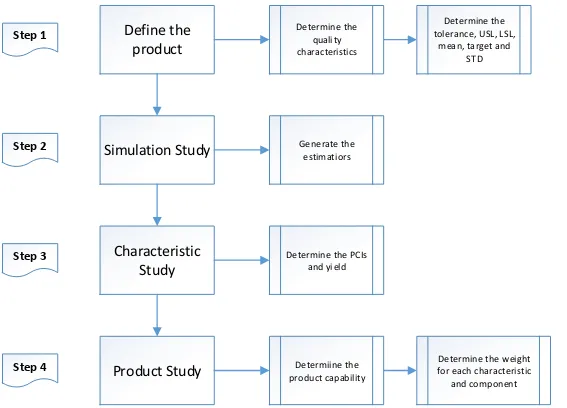
Figure 4 Flowchart methodology ... 24
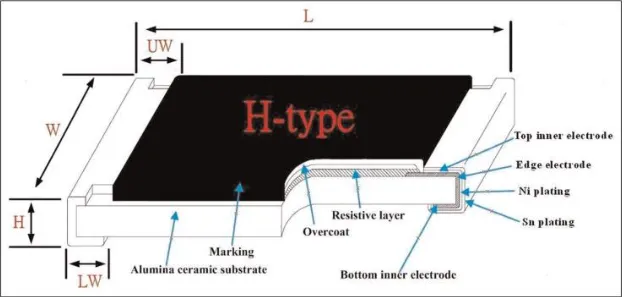
Figure 5 H-type chip resistor (Ouyang et al., 2013) ... 27
IV
List of Tables
Table 1 The Cpm values and respective yield (Chen and Huang, 2007) ... 17
Table 2 Probability Distributions and their respective yield ... 23
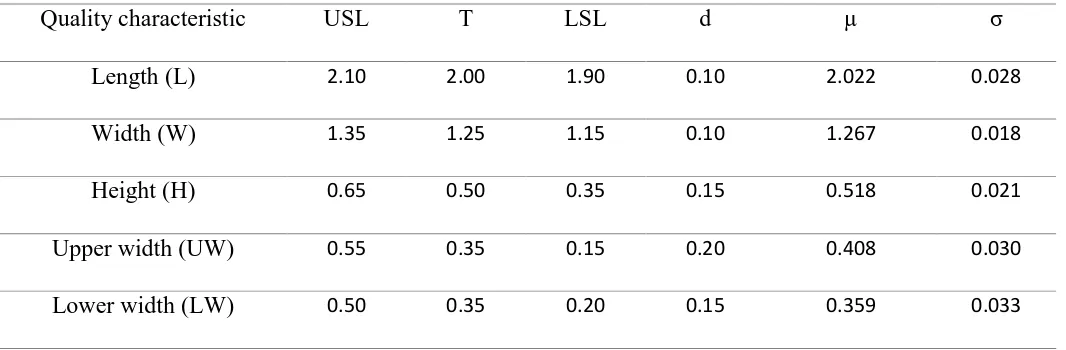
Table 3 : Specification of the H-type chip resistor(unit: mm) (Ouyang et al., 2013) ... 28
Table 4: Mean and variance for the quality characteristic. ... 29
Table 5: PCIs for the quality characteristics ... 30
Table 6 Yield for the quality characteristics ... 31
Table 7 Process capability for the components using the PCIs ... 33
Table 8 Process capability for the components using the PCIs (without weight) ... 34
Table 9 Process capability for the components using the yield ... 35
Table 10 Process capability for the components using the yield (without weight) ... 37
Table 11 Comparison between the real data and the simulation data ... 40
Table 12 Quality characteristics summary results ... 41
V
Table of Abbreviations
PCI Process Capability Index
LSL Lower Specification Limit
USL Upper Specification Limit
1
1. Introduction
Quality is the new wave trend for companies nowadays and for good reason. Every
company wants to reduce their costs and increase customer satisfaction. The best way to do this
is by increasing the quality management of their products. By doing this, the number of
nonconformities and the time spent in inspection will decrease alongside with the increase in
reliability of the product and customer satisfaction. Usually, the increase of quality will result in
the increase of total cost, so it is extremely important to balance this quality improvement with
the final cost of the product.
To achieve this balance, it is necessary to determine the deficiencies of the process, the
best yield of the components, and to identify the improvements that will have more of an impact
on the quality of the process. Unfortunately, in general, the resources available for improvements
are limited. It is difficult to determine the deficiencies of the process because a product is made
of different components with different standard quality characteristics (Ouyang, Hsu, & Yang,
2013). Also, a consequence of this process complexity is that it is hard to determine what
improvements will have more of an impact on the final product.
In the electronic industry, these difficulties are even worse. The tolerance design of the
components is tight, so the stability and reliability of the components will have a high impact on
the quality of the product. Even small deviation can cause unpredictable results to the system
(Zhai, Zhou, Ye, & Hu, 2013). Besides this, the output of some components will directly impact
the output of others, so it is extremity important to analyze all of the connections between the
parts and determine which components are more crucial for the whole product.
Due to all of these difficulties, there are many studies about the improvement of quality,
2
three parameters that have been widely used to measure the ability of the process to meet
specification, they are the process yield, process expected loss, and the process capability indices
(PCIs) (Chen, Huang, & Li, 2001). The process yield is the percentage of products units that
pass the inspection, the process expected quality loos is the cost related with poor quality, and
the PCIs are indices used to determine if a process if capable to meet the specifications. The
higher the PCIs and process yield, the lower the cost due to poor quality.
There are many studies about PCIs and how they can be used to determine if a product
meets the specifications. In this research, several methodologies to determine the process
capability of an entire product is presented. Given this background, the best approach to analyze
the process capability of electronical products is chosen. The Monte Carlo simulation will be
utilized to generate the data that will be used to determine the PCIs values. The report will also
3
2. Related Work
2.1.Process Capability
The process capability indices are used to determine if a process is capable of producing
products within a specification limit. It is important to remember that the use of the PCIs is
recommended just for the process in statistical control, in other words, in any process where
special causes of defects were identified and removed (Shewhart, 1939). In general, the PCI will
compare the natural variability of the process and can be defined as
𝑃𝐶𝐼 =𝐴𝑙𝑎𝑤𝑎𝑏𝑙𝑒 𝑝𝑟𝑜𝑐𝑒𝑠𝑠 𝑠𝑝𝑟𝑒𝑎𝑑
𝐴𝑐𝑡𝑢𝑎𝑙 𝑝𝑟𝑜𝑐𝑒𝑠𝑠 𝑠𝑝𝑟𝑒𝑎𝑑
(2.1)
In the last twenty years, several process capability indices were proposed. The first
generation process capability index is based on the idea that if the process is within specification
limits, the quality of the product will be good (Kureková, 2001). There are two first generation
PCIs, the 𝐶𝑝 and the 𝐶𝑝𝑘.
2.1.1. Process Capability Index 𝑪𝒑
The 𝐶𝑝 was proposed by Juran (1974) and is defined as
𝐶𝑝 = 𝑈𝑆𝐿 − 𝐿𝑆𝐿
6 ∗ 𝜎 =
𝑑 3 ∗ 𝜎
(2.2)
Where the USL and LSL are the upper and the lower specification limit respectively, the
σ in the process standard deviation and the 𝑑 is the half specification.
The 𝐶𝑝 measures the variability of the process relative to the specification limits, so the
bigger its value, the smaller the variability will be. This index doesn’t take into account the
deviation of the process mean from the target value and how the data is spread within the
4
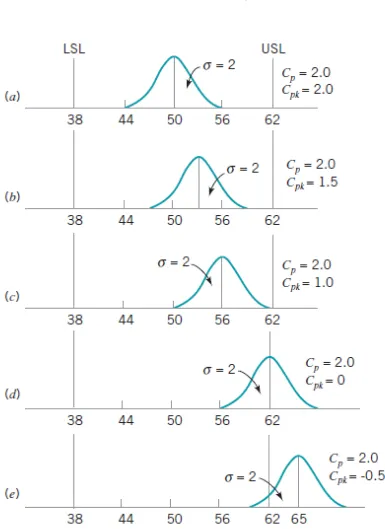
when the process has high variability and out of target. Figure 1 shows five different process
[image:14.612.115.500.130.659.2]samples that present a similar 𝐶𝑝 value:
5
Looking at Figure 1, the five samples present similar standard deviations, so the 𝐶𝑝
values are similar. Observing this result, it is possible to assume that all the processes are capable
but this assumption is wrong. The processes present data out of the specification limits and the
mean for the processes b, c, d and e are off target. Only process “a” is capable.
2.1.2. Process Capability Index 𝑪𝒑𝒌
To overcome this problem, Kane (1986) proposed the 𝐶𝑝𝑘, this index takes into
consideration the deviation of the process mean from the target value. The 𝐶𝑝𝑘is defined as
𝐶𝑝𝑘 = 𝑚𝑖𝑛𝑖𝑚𝑢𝑚 {𝐶𝑝𝑢 , 𝐶𝑝𝑙}= 𝑚𝑖𝑛𝑖𝑚𝑢𝑚 {𝑈𝑆𝐿−µ
3𝜎 , µ−𝐿𝑆𝐿
3𝜎 }
(2.3)
Where µ is the process mean.
Looking at figure 1 the distribution of the data affects the 𝐶𝑝𝑘 and also, that of the 𝐶𝑝𝑘 is
equal or smaller than the 𝐶𝑝. These values will be equal when the process is on target and when
the data mean is equal to the target process.
The 𝐶𝑝 and 𝐶𝑝𝑘 are independent of the target value, so the use of these indices are
recommended for cases where the reduction of the variability and process yield are important
(C.-W. Wu, Pearn, & Kotz, 2009). When the target differs from the mean between the upper and
lower specifications, these process capabilities indices will lead to the wrong acceptance of the
process. In contrary, these indices don’t analyze the cost related with the departure from the
target.
2.1.3. Process Capability Index 𝑪𝒑𝒎
To overcome these limitations, the second generation process capability index (𝐶𝑝𝑚) was
proposed. Being within the specification limits alone will not be enough to ensure that the
product has high quality, it is also necessary to analyze how the values studied are spread within
6
The 𝐶𝑝𝑚was proposed by (Chan et al., 1988) and (Hsiang & Taguchi, 1985)
independently and it is defined as
𝐶𝑝𝑚 = 𝑈𝑆𝐿 − 𝐿𝑆𝐿
6(𝜎2 + (µ − 𝑇)2)1/2
(2.4)
Where T is the target value of the process. Looking at this equation, it is possible to
notice that the minimum value of 𝐶𝑝𝑚is 0 and that the maximum value will occur when µ − 𝑇 =
0 and this value is equal to 𝐶𝑝, so
0 ≤ 𝐶𝑝𝑚 ≤ 𝑈𝑆𝐿 − 𝐿𝑆𝐿
6 ∗ 𝜎 = 𝐶𝑝
(2.5)
To apply these PCIs to analyze a process, the sample used in the study must follow a
normal distribution in order to calculate the PCIs necessary to use as estimators to replace µ
(process mean) and 𝜎 (process standard deviation). Instead of using µ and 𝜎, the sample mean
(𝑋̅) and the sample variance (S) will be used. They are defined as
𝑋̅ = ∑𝑥𝑖 𝑛
𝑛
𝑖=1
(2.6)
S = √∑(𝑥𝑖−𝑥̅)
2
𝑛 − 1
𝑛
𝑖=1
(2.7)
For a sample that follows the normal distribution these estimators will be reliable, but for
a different distribution they are not dependable. Other more appropriate and complex PCIs must
be used (Pearn & Chen, 1997).
2.2.Process Capability for entire product
In relation to the information presented in the previous section, the process capability
7
single product’s characteristic. However, it is necessary to determine if when all these processes
are put together, if the final product will also be able to meet the specifications required.
To determine the process capability of a final product some approaches were proposed.
The first approach to calculate the process capability for an entire product was presented by
Bothe (1992). Overall, this method uses the characteristic yield to determine the process
capability of the product. Firstly, it is necessary to determine the yield of each characteristic and
in order to determine this value it is necessary to calculate the 𝑍𝑈𝑆𝐿and 𝑍𝐿𝑆𝐿, that are defined as
𝑍𝑈𝑆𝐿 =
𝑈𝑆𝐿 − µ 𝜎
(2.8)
𝑍𝐿𝑆𝐿 =
µ − 𝐿𝑆𝐿 𝜎
(2.9)
Using the 𝑍𝑈𝑆𝐿 and the Z-table it is possible to determine the probability of the product
be below the upper specification limit (Prob. Bad Below) and the probability of the product to be
above the upper specification limit (Prob. Bad Above). The yield of the characteristic with
bilateral specification is equal to
𝑌𝑖𝑒𝑙𝑑𝑛 = 𝑃𝑟𝑜𝑏. 𝐺𝑜𝑜𝑑 = 1 − (Prob. Bad Below + Prob. Bad Above) (2.10)
For unilateral specification, the yield will be determined as
𝑌𝑖𝑒𝑙𝑑𝑛 = 𝑃𝑟𝑜𝑏. 𝐺𝑜𝑜𝑑 = 1 − (Prob. Bad Below or Prob. Bad Above) (2.11)
The yield of the product will be equal to the product of the yield of all characteristics, as
shown below
𝑃𝑟𝑜𝑑𝑢𝑐𝑡 𝑌𝑖𝑒𝑙𝑑 = ∏ 𝑌𝑖𝑒𝑙𝑑𝑛
𝑛
𝑖=1
(2.12)
Using this information is possible to determine the 𝐶𝑝𝑘 of the product using the
8
𝐶𝑝𝑘 = 𝑍𝑆𝑐𝑜𝑟𝑒 3
(2.13)
Where the 𝑍𝑆𝑐𝑜𝑟𝑒 is determined using Z-table and the probability (𝑝𝑏𝑎𝑑) that the product
will not meet specification, this value is defined as
𝑝𝑏𝑎𝑑 =1 − 𝑝𝑟𝑜𝑑𝑢𝑐𝑡 𝑦𝑖𝑒𝑙𝑑
2
(2.14)
For each 𝐶𝑝𝑘 value there is a respective yield value for the product. For example, for
𝐶𝑝 = 1, the yield of the process is equal to 93.30%. Appendix A presents example 𝐶𝑝𝑘 and its
respective yield.
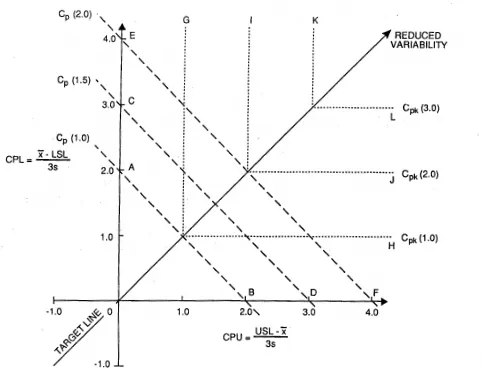
Another method used to analyze the product capability was proposed by Singhal (1990).
He presented a visual tool, the Multiprocess Performance Analysis Chart (MPPAC), that presents
how the processes behaves in a multi process environment. The chart shows the 𝐶𝑝, 𝐶𝑝𝑘, the
departure of the process mean from the target, and the variability of the process. One of the
limitations of this chart is that it does not present where the process capability must be to ensure
the quality of the product, so it is not possible to analyze the performance of the process.
To overcome this problem, Singhal (1992) proposed an improvement to the chart. He
added capability zones to it . Figure 1 presents this chart.
This is a very useful visual tool to analyze different processes, but the chart presents
some limitations it that it cannot be used to determine the final product quality. Other charts
(Chen et al., 2001; Ouyang et al., 2013) were proposed to analyze multi-processes, but they were
9
10
Nowadays, there is an approach that studies the product capability and has been widely
used (Chen et al., 2001; C. C. Wu, Kuo, & Chen, 2004; Yu, Sheu, & Chen, 2007). Knowing that
𝑝 = ∏ 𝑝𝑖
𝑛
𝑖=1
(2.15)
This method assumes that for a desired 𝑝, the product yield, the characteristic yield must
be at least 𝑝𝑖 = 𝑝1/𝑛. To apply this equation, the characteristics must to be independent. This
information can be added to the charts presented to help to determine the capability zones. This
is a quick way to determine the product capability but this method will result in some loss.
When a minimum value for the yield of the product is fixed, all the characteristics need to
meet this requirement. In many cases, some parts of the product don’t need to present high
quality as the final product and occasionally the part that is critical for the product and this
minimum value is not enough to ensure the quality of the final product. The best approach is to
look each part individually first and determine the specifications and level of quality of each one
looking how it will impact in the final product.
2.3.Sensitivity Analysis
With the data presented, it is possible that it may still be missing some important
information to determine the process capability of a product. These approaches don’t take into
consideration the level of impact of quality of different characteristic in the final product. When
the process capability of the product is calculated, it is necessary to take in consideration the
weight of the unit (Mu, He, Chang, & Ma, 2009).
Yu, Sheu & Chen (2007) presented one approach to add the influence of importance of
the characteristic in the calculation of the process capability for the product. Their proposal
11
𝑃𝐶𝐼𝑐𝑚 = [∏(𝑃𝐶𝐼𝑖)𝑤𝑖
𝑛
𝑖=1
]
1 ∑𝑛𝑖=1𝑤𝑖
(2.16)
Where 𝑤𝑖 is an integer number between 1 and 5. The most important characteristic will
have 𝑤𝑖 = 5 and the less important 𝑤𝑖 = 1.
Another alternative was proposed by Mu at el (2009). In his approach, firstly, the weight
is multiplied by the PCI and then all the PCIs are summed. The equation proposed by him is
presented bellow
𝑃𝐶𝐼𝑇2 = ∑ 𝑤𝑖
𝑛
𝑖=1
∗ 𝑃𝐶𝐼𝑖
(2.17)
Where 𝑤𝑖 is a number between 0 and 1.
To determine the value of the weight is important to look the type of process that will be
analyzed. For example, for a medical process, the characteristics must to be studied take into
account the risk that poor quality will have to the patient. The scale used to the weight must be
aligned to the safety of the patient. For a mechanical process, the weight must to be decide
following the characteristics that will have a bigger impact in the functionality of the product.
2.4.Process capability in the electronic industry
The electronic products are different than others types of products, due to tighter
tolerance and specification limits, so the process yield sensitivity will have a bigger impact in the
quality of the product (Huang & Kong, 2010). It is extremely important to determine the best
tolerance requirements and specification limits. Spence (1984) presented a parameter space,
which is a chart that uses as a input the output of different characteristics and relate these
information. He presents an idea of cost and quality balance, so the parameter space will not be
12
It is important to do a sensitivity analysis to determine what parameters will be
13
3. Methodology
This research aims to present an approach to determine the process capability of
electronic products. This research was divided into 4 phases: define the product, simulation
study, quality characteristic study and product study.
3.1.Define the product
To start this analysis, it is necessary to determine the product that will be studied and
what quality requirements are. Knowing the product, the next step is to determine the quality
characteristics that will be used to determine the quality of the final product.
The quality characteristic is a quantitative characteristic of a component that has impact
on the quality of the final product. This characteristic can be measured and its data is used to
determine if the characteristic does or does not meet the specifications.
For each quality characteristic, it is necessary to determine the specification limits, mean,
standard deviation, target, and quality requirements. The data acquired will be used to determine
the yield and the process capability indices.
3.2.Simulation Study
To calculate the yield and the process capability indices of the characteristics, it is
necessary to calculate their estimator, that is the sample mean (𝑋̅) and the sample variance (𝑆2).
To determine these values, a sample of the process data is required. This sample can be obtained
in two ways: using real data of the manufacturing process or using a simulation.
To obtain the data using the first option is not easy, it is necessary to find a company
record of the data as well as permission to use such information, so the second option was used
14
random data using the sample mean and standard deviation. To run the Monte Carlo simulation,
the first step to determine the sample size.
3.2.1. Sample Size Analysis
It is necessary to determine the sample size for each one of the characteristics. To
determine this number, the following equation will be used
𝑛 = [100 ∗ 𝑧 ∗ 𝑆
𝐸 ∗ 𝑥̅ ]
2 (3.1)
Where z is the z-score related to the confidence interval required for the data, E is the
error percentage acceptable for the mean. The equation presents three unknown variables: n, S
and 𝑥̅. For this case, 𝑆 and 𝑥̅ can be replaced by the historical data, σ and µ respectively (Driels
& Shin, 2004). How the characteristics differ in mean and variance, the sample size will be
different as well. But, how the same product is being analyze, the sample size will be equal to the
sample size of the characteristic that has the bigger value.
This research uses electronic products as the subject. The variance and tolerance for this
kind of product is tight, so any variance can result in impact of the quality of the product. The
confidence interval must to be high and the error must to be low.
Using the sample size, standard deviation, and mean it was possible to create random data
for all of the characteristics. It is important to remember that the data must be in statistical
control and must follow the normal distribution.
3.3.Characteristic Study
Using the estimators calculated in the section Simulation Study, it will be possible to
determine the yield of the characteristic and the process capability index. In this project, the 𝐶𝑝,
𝐶𝑝𝑘 and 𝐶𝑝𝑚 were calculated and compared. To determine the value of these indices, the
15
𝐶𝑝𝑖=
𝑈𝑆𝐿 − 𝐿𝑆𝐿
6 ∗ 𝑆 =
𝑑 3 ∗ 𝜎
(3.2)
𝐶𝑝𝑘𝑖 = 𝑚𝑖𝑛𝑖𝑚𝑢𝑚 {𝐶𝑝𝑢 , 𝐶𝑝𝑙}= 𝑚𝑖𝑛𝑖𝑚𝑢𝑚 {𝑈𝑆𝐿−𝑥̅
3∗𝑆 , 𝑥̅−𝐿𝑆𝐿
3∗𝑆 }
(3.3)
𝐶𝑝𝑚𝑖 =
𝑈𝑆𝐿 − 𝐿𝑆𝐿 6(𝑆2+ (𝑥̅ − 𝑇)2)1/2
(3.4)
Where 𝑖 is a number between 1 and n.
It was also used to calculate the yield of the product using the 𝐶𝑝𝑘 and 𝐶𝑝𝑚. The yield
using the 𝐶𝑝𝑘 is calculated following the equation x
𝑝𝑖 = %𝑌𝑖𝑒𝑙𝑑 = ϕ(3 ∗ 𝑍𝑚𝑖𝑛) (3.5)
The Appendix A presents a table with the yield value for respective 𝐶𝑝𝑘.
To determine the yield using the 𝐶𝑝𝑚, it is necessary to use the equation proposed by
Chen and Huand (2007). The relationship is presented below
𝑝𝑖 = %𝑌𝑖𝑒𝑙𝑑 = ϕ (1 + √1/(3 ∗ 𝑐)
2− (S/𝑑)2
𝑆/𝑑 ) + ϕ (
1 − √1/(3 ∗ 𝑐)2− (S/𝑑)2
𝑆/𝑑 )-1
(3.6)
Where 𝐶𝑝𝑚𝑖 = 𝑐, 𝑑 = (𝑈𝑆𝐿 − 𝐿𝑆𝐿)/2.
Knowing that
0 ≤ 𝐶𝑝𝑚 ≤𝑈𝑆𝐿 − 𝐿𝑆𝐿
6 ∗ 𝜎 =
𝑑 3 ∗ 𝜎
(3.7)
We conclude that 𝜎/𝑑 is between zero and 1/3𝑐. This relationship can be approximated
to 𝜎 𝑑 = ℎ 30∗𝑐 (3.8)
Where h is a integer number between 1 and 10. Using this relationship, Chen and Huang
16
presents these result. Appendix b presents the table with the yield values for 𝐶𝑝𝑚 varying
between 0 and 1 with 0.01 as increments and h varying between 1 and 10.
For the unilateral specification, the 𝐶𝑝𝑙 and the 𝐶𝑝𝑢 will be used as process capability
indices. In this case, for the characteristics with lower specification limits, the yield and the 𝐶𝑝𝑙
will be calculated as
𝐶𝑝𝑙𝑖 = (1/3)𝜙−1∗ (𝑝𝑙)
𝑝𝑙 = %𝑌𝑖𝑒𝑙𝑑 = 𝑃(𝑥 > 𝐿𝑆𝐿) = 𝜙(3𝐶𝑝𝑙𝑖)
For the characteristics with upper specification limits, the yield and the 𝐶𝑝𝑢 will be
calculated as
𝐶𝑝𝑢𝑖 = (1/3)𝜙−1∗ (𝑝𝑢)
𝑝𝑢 = %𝑌𝑖𝑒𝑙𝑑 = 𝑃(𝑥 < 𝑈𝑆𝐿) = 𝜙(3𝐶𝑝𝑢𝑖)
3.4.Product Study
The last phase of this study is to determine the process capability of the product. To
determine the product process capability, two approaches were used: using the process capability
indices and process yield. Aside from the PCIs and the yield, it is necessary to know the
influence of each characteristic in the quality of the final product. This influence is numeral
17
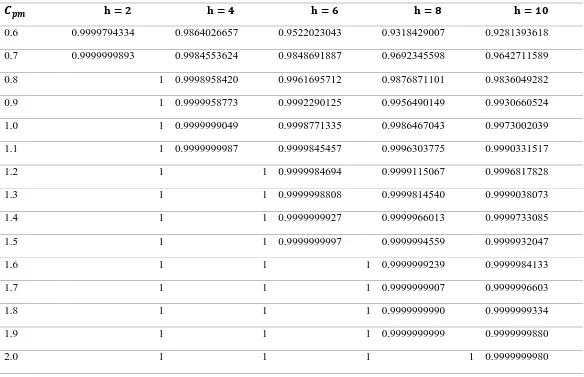
Table 1 The Cpm values and respective yield (Chen and Huang, 2007)
𝑪𝒑𝒎 𝐡 = 𝟐 𝐡 = 𝟒 𝐡 = 𝟔 𝐡 = 𝟖 𝐡 = 𝟏𝟎
0.6 0.9999794334 0.9864026657 0.9522023043 0.9318429007 0.9281393618
0.7 0.9999999893 0.9984553624 0.9848691887 0.9692345598 0.9642711589
0.8 1 0.9998958420 0.9961695712 0.9876871101 0.9836049282
0.9 1 0.9999958773 0.9992290125 0.9956490149 0.9930660524
1.0 1 0.9999999049 0.9998771335 0.9986467043 0.9973002039
1.1 1 0.9999999987 0.9999845457 0.9996303775 0.9990331517
1.2 1 1 0.9999984694 0.9999115067 0.9996817828
1.3 1 1 0.9999998808 0.9999814540 0.9999038073
1.4 1 1 0.9999999927 0.9999966013 0.9999733085
1.5 1 1 0.9999999997 0.9999994559 0.9999932047
1.6 1 1 1 0.9999999239 0.9999984133
1.7 1 1 1 0.9999999907 0.9999996603
1.8 1 1 1 0.9999999990 0.9999999334
1.9 1 1 1 0.9999999999 0.9999999880
18
3.4.1. Determining the weight (𝒘𝒊)
The weight was calculated comparing the influence of the quality characteristic in the
final quality of the product. The higher value is given to the most important characteristic and the
weight of the other characteristics will be determined based on the most important one. There are
many ways to determine the weights; to standardize it, each characteristic was assigned a value
𝑘𝑖 between 1 to 10, where 10 is the most important and 1 is the least important quality
characteristic.
Using these values, it is possible to determine 𝑤𝑖 for any approach. For example, for the
approach presented by Yu et al. (2007), 𝑤𝑖 is a number between 1 and 5, so it will be equal to
𝑤𝑖 = 𝑘𝑖/2 (3.9)
For the approach presented by Mu at el (2009), 𝑤𝑖 is a number between 0 and 1, so it will
be equal to
𝑤𝑖 =
𝑘𝑖 ∑𝑛𝑖=1𝑘𝑖
(3.10)
3.4.2. How to analyze the product to determine the product capability
To manufacturing a product, many parts must to be assembled together. A company can
manufacture all the components need or can get it from outside suppliers. When we try to
determine the quality of the product all this parts used to manufacture the product must to be
studied such as the quality of the characteristics, the components quality and the quality of the
parts provided by the suppliers.
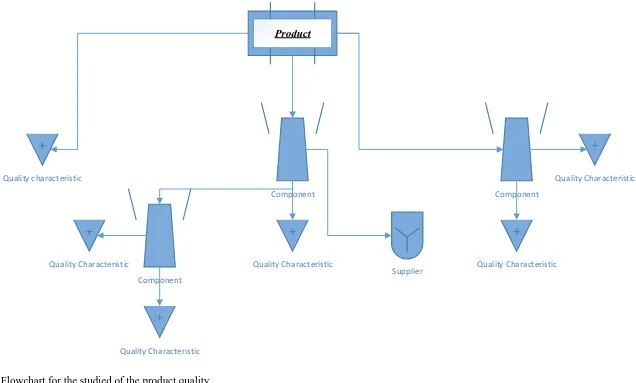
The quality characteristic is the part that is studied individually, it is a part that is
independent of all the others parts of the product. The component is built of different quality
characteristics, so the quality of this part will depended of the quality of the characteristics. The
19
how this part is provided by an outsource, the quality of this part will be analyzed as a quality
characteristic.
To determine the quality of the product is necessary to look the interaction between
quality characteristics, quality characteristics and components, quality characteristics and parts
provided by suppliers, components and parts provided by suppliers, and quality characteristics,
components and parts provided by suppliers. The figure 3 presents a flowchart of this interaction.
3.4.3. Process capability using the PCIs
Analyzing everything that was presented in the previous sections, it is possible to notice
that the most used PCI to determine the capability of a product is the 𝐶𝑝𝑘. In this project, instead
of using the 𝐶𝑝𝑘, the 𝐶𝑝𝑚 was used. In addition, the capability of the product will also be
calculated using the weight of influence of each characteristic in the final product. Also, it will
be presented in an equation to analyze not just components assembling to form the product, but
also the subcomponents.
Using the PCI to determine the product capability, the weight will be calculated using the
Mu at el (2009) approach. For a component with n quality characteristic the PCI is defined as
𝑃𝐶𝐼𝑖𝑐 = ∑ 𝑤𝑖
𝑛
𝑖=1
∗ 𝑃𝐶𝐼𝑖
(3.11)
Where the PCI can be replaced by the 𝐶𝑝𝑘 and 𝐶𝑝𝑚 and the 𝑤𝑖 is the weight for each
quality characteristic.
To determine the product capability is necessary to look all the parts that are assembled
to manufacture this product. So the product capability is defined as
𝑃𝐶𝐼𝑝 = ∑(𝑤
𝑖 𝑝
∗
𝑔
𝑖=𝑖
𝑃𝐶𝐼𝑖𝑔)
20
Product
Component Component
Quality characteristic
Supplier Quality Characteristic
Component
Quality Characteristic
Quality Characteristic
[image:30.792.111.747.72.455.2]Quality Characteristic Quality Characteristic
21
Where 𝑤𝑖𝑝 is the weight for each one of the parts, that can be: quality characteristic,
component and part provided by suppliers. The 𝑃𝐶𝐼𝑖𝑔 is the process capability of each part and g
is the number of parts.
To compare, the weight will be also calculated using the Yu et al. (2007) approach. The
equation below shows how to calculate the capability for a component
𝑃𝐶𝐼𝑖𝑐 = [∏(𝑃𝐶𝐼𝑖)𝑤𝑖
𝑛
𝑖=1
]
1 ∑𝑛𝑖=1𝑤𝑖
(3.13)
For a product with g components, the product capability is defined as
𝑃𝐶𝐼𝑝= {∏ 𝑃𝐶𝐼
𝑖 𝑔 𝑔
𝑖=1
}
1
∑𝑛𝑖=1𝑤𝑖𝑔 (3.14)
To determine the product capability, different approaches with and without the use of the
weights were calculated and compared. Also, instead of using only the 𝐶𝑝𝑚, the 𝐶𝑝𝑘 was also
analyzed. Doing so allows comparison of the two process capability indices to determine the
advantages of the use of the 𝐶𝑝𝑚.
It is important to remember that, the 𝐶𝑝𝑚 and 𝐶𝑝𝑘 is used to analyze characteristics with
bilateral specification. For characteristics with unilateral specification, the 𝐶𝑝𝑢 will be used for
characteristics with just upper specification limits and 𝐶𝑝𝑙 for characteristics with just lower
specification limit and
3.4.4. Process capability using the yield
Analyzing what was presented in the previous sections, it is known that the PCI can be
22
component, the yield will be used. Using the yield value and the tables presented in Appendix A
and B, it is possible to determine the 𝐶𝑝𝑚 and 𝐶𝑝𝑘 for the product.
In this case, the yield of the product can be determined using the following equation
𝑌𝑝𝑐𝑖𝑝 = ∏ 𝑌𝑝𝑐𝑖𝑐
𝑚
𝑖=1
(3.15)
Where the 𝑌𝑝𝑐𝑖𝑐 is the yield of each quality characteristic and the m is the number of
quality characteristics. To compare with the results obtained in the previous section, the yield
will be calculated using the 𝐶𝑝𝑚 and 𝐶𝑝𝑘.
3.4.4.1. Process capability for nom-normal samples
Extending the equations presented in the previous section for other types of sample
distributions, it will be possible to determine the yield of the product. It is important to remember
that anything different from a normal distribution in this case, the yield can’t be converted into a
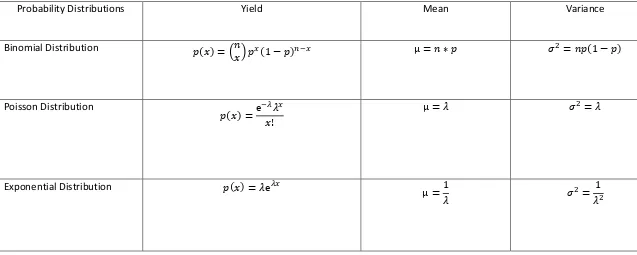
process capability index. Table 2 presents how to calculate the yield for different distributions.
The flowchart in figure 4 summarizes all the steps required to determine the product
23
Table 2 Probability Distributions and their respective yield
Probability Distributions Yield Mean Variance
Binomial Distribution 𝑝(𝑥) = (𝑛
𝑥) 𝑝𝑥(1 − 𝑝)𝑛−𝑥 µ = 𝑛 ∗ 𝑝 𝜎
2= 𝑛𝑝(1 − 𝑝)
Poisson Distribution
𝑝(𝑥) =е
−𝜆𝜆𝑥
𝑥!
µ = 𝜆 𝜎2= 𝜆
Exponential Distribution 𝑝(𝑥) = 𝜆е𝜆𝑥 µ =1
𝜆 𝜎
2 = 1
24
Define the
product
Simulation Study
Characteristic
Study
Product Study
Determine the quality characteristics
Generate the estimatiors
Determine the PCIs and yield
Determiine the product capability
Determine the tolerance, USL, LSL,
mean, target and STD
Determine the weight for each characteristic
and component
Step 1
Step 4 Step 2
[image:34.792.72.639.69.477.2]Step 3
25
4. Results
The objective of this thesis is to determine the best approach to calculate the process
capability of products in the electronic industry. The results obtained will be presented following
the steps of the methodology.
4.1.Define the product
The product chosen for this study is the same one used by Ouyang, Hsu & Yang (2013)
in their paper. The product is the H-type chip resistor as show in the figure 4.
The characteristics analyzed are length, width, height, upper-width, and lower-width. The
mean, standard deviation, upper and lower specification limit, and the target are presented in the
table 3.
To apply the ideas presented in this paper, instead of considering the five quality
characteristic as part of one component, they will be analyzed in groups. The length, width, and
height will be analyzed as a quality characteristic of one component and the upper and lower
width as quality characteristic of another component. The final product is composed of these two
parts.
4.2.Simulation Study
The first step is to run the simulation; this is to determine the number of samples. In this
case, the sample size (n) is 761. The Appendix C presents how these values were calculated. To
run the simulation, it was ran using the Excel function NORMINV; this function generates
random numbers that follows the normal distribution. Appendix C also presents the steps on how
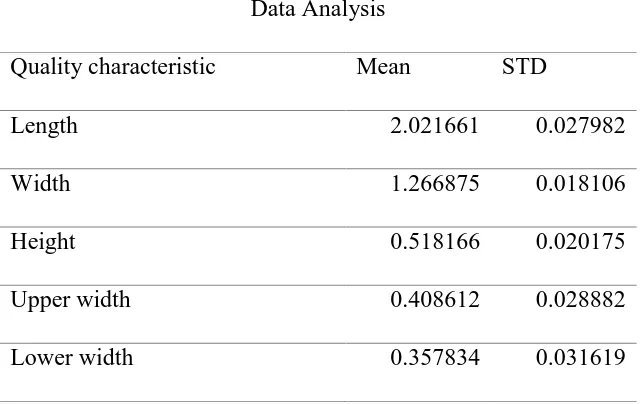
to use this function. Using this data, the estimators were calculated. Table 4 presents these values
26
For this study, the data obtained in the simulation must be in statistical control and follow
the normal distribution. Appendix D shows the test for these assumptions.
4.3.Characteristic Study
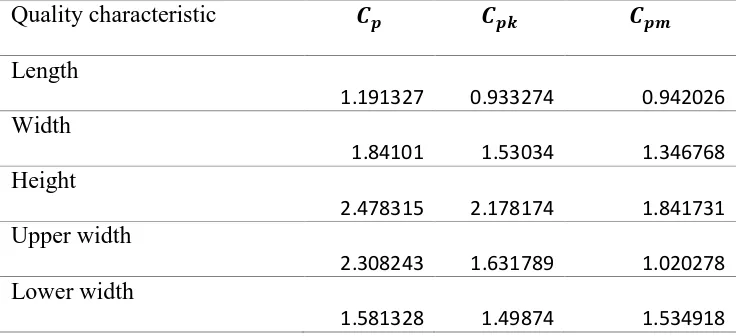
Using the data obtained in the last section, the 𝐶𝑝, 𝐶𝑝𝑘 and 𝐶𝑝𝑚 was calculated. Table 5
presents the results.
Using this data, it is also possible to determine the yields of the characteristics. The yield
was calculated using the method presented by Bothe (1992). Table 6 presents these results.
The yield was also calculated using the method presented by Chen & Huang, 2007. Table
7 presents the results obtained.
The Appendix E presents the equations that were used in this section.
4.4.Product Study
To calculate the product process capability, the yield and PCIs that were calculated in the
previous section were used. Aside from this, it is also necessary to determine the weight of each
characteristic. To do this, the first step is to determine what characteristics are more important.
4.4.1. Determining the weight (𝒘𝒊)
For the quality characteristics of the product, we will assume that for the first component
the most important quality characteristic is the length (𝑘 = 10), followed by the height (𝑘 =
7) and then the width (𝑘 = 5). For the second component, the most important is the upper width
(𝑘 = 10), followed by the lower width (𝑘 = 8). Observing the components, the first (𝑘 = 9) is
27
28
Table 3 : Specification of the H-type chip resistor(unit: mm) (Ouyang et al., 2013)
Quality characteristic USL T LSL d µ σ
Length (L) 2.10 2.00 1.90 0.10 2.022 0.028
Width (W) 1.35 1.25 1.15 0.10 1.267 0.018
Height (H) 0.65 0.50 0.35 0.15 0.518 0.021
Upper width (UW) 0.55 0.35 0.15 0.20 0.408 0.030
29
Table 4: Mean and variance for the quality characteristic.
Data Analysis
Quality characteristic Mean STD
Length 2.021661 0.027982
Width 1.266875 0.018106
Height 0.518166 0.020175
Upper width 0.408612 0.028882
30
Table 5: PCIs for the quality characteristics
Quality characteristic 𝑪𝒑 𝑪𝒑𝒌 𝑪𝒑𝒎
Length
1.191327 0.933274 0.942026
Width
1.84101 1.53034 1.346768
Height
2.478315 2.178174 1.841731
Upper width
2.308243 1.631789 1.020278
Lower width
31
Table 6 Yield for the quality characteristics
Quality characteristic Prod. Good using Bothe approach
Prod. Good using Chen & Huang approach Length
0.9974366 0.989537
Width
0.9999978 0.999984
Height
1 1
Upper width
0.9999995 0.999998
Lower width
32
4.4.2. Product capability using the PCIs
The first analysis follows the method presented by Mu at el (2009). The weight is
between 0 and 1. Table 7 presents the value of the weight of each characteristic as well as the
𝐶𝑝𝑚𝑖𝑐 and 𝐶𝑝𝑘𝑖𝑐 for each one of the components.
𝐶𝑝𝑘𝑝 = 9 ∗ 𝐶𝑝𝑘1
𝑐 + 10 ∗ 𝐶
𝑝𝑘2𝑐
19 = 1.4938
𝐶𝑝𝑚𝑝 = 9 ∗ 𝐶𝑝𝑚1
𝑐 + 10 ∗ 𝐶
𝑝𝑚2𝑐
19 = 1.261455
To determine the influence of the use of the weights, it is necessary to repeat this analysis
[image:42.612.210.401.408.480.2]and use the characteristics and components with the same weight. The results are presented in
table 8.
Using the results presented in Table 8, it is possible to determine the product capability
indices.
𝐶𝑝𝑘𝑝 = 1 ∗ 𝐶𝑝𝑘1
𝑐 + 1 ∗ 𝐶
𝑝𝑘2𝑐
2 = 1.556264
𝐶𝑝𝑚𝑝 =1 ∗ 𝐶𝑝𝑚1
𝑐 + 1 ∗ 𝐶
𝑝𝑚2𝑐
2 = 1.32722
The first analysis follows the method presented by Yu et al. (2007). In this case, the
weight is between 1 and 5. Table 9 presents the weight for each one of the characteristics and
also the 𝐶𝑝𝑚𝑖𝑐 and 𝐶𝑝𝑘𝑖𝑐 for each one of the components.
𝐶𝑝𝑘𝑝 = √𝐶𝑐
𝑝𝑚14.5∗ 𝐶𝑝𝑚25
(4.5+5)
= 1.449035
𝐶𝑝𝑚𝑝 = √𝐶𝑝𝑘14.5∗ 𝐶𝑐𝑝𝑘25
(4.5+5)
33
Table 7 Process capability for the components using the PCIs
Quality characteristic Weight (𝒘𝒊) 𝑪𝒑𝒌𝒊 𝑪𝒑𝒌𝒊∗ 𝒘𝒊 𝑪𝒑𝒎𝒊 𝑪𝒑𝒎𝒊∗ 𝒘𝒊
Length
0.454545 0.933274 0.424215 0.942026 0.428194
Width
0.318182 1.53034 0.486926 1.346768 0.428517
Height
0.227273 2.178174 0.49504 1.841731 0.418575
First Component 𝐶𝑝𝑘1𝑐 = 1.406181
𝐶𝑝𝑚1𝑐 = 1.275286 Upper width
0.555556 1.631789 0.90655 1.020278 0.566821
Lower width
0.444444 1.49874 0.666107 1.534918 0.682186
Second Component 𝐶𝑝𝑘2𝑐 = 1.572656 𝐶
34
Table 8 Process capability for the components using the PCIs (without weight)
Quality characteristic Weight (𝒘𝒊) 𝑪𝒑𝒌𝒊 𝑪𝒑𝒌𝒊∗ 𝒘𝒊 𝑪𝒑𝒎𝒊 𝑪𝒑𝒎𝒊∗ 𝒘𝒊
Length 0.333333 0.933274 0.311091 0.942026 0.314009
Width 0.333333 1.53034 0.510113 1.346768 0.448923
Height 0.333333 2.178174 0.726058 1.841731 0.61391
First Component 𝑪𝒑𝒌𝟏 1.547263 𝑪𝒑𝒎𝟏 1.376842
Upper width 0.5 1.631789 0.815895 1.020278 0.510139
Lower width 0.5 1.49874 0.74937 1.534918 0.767459
35
Table 9 Process capability for the components using the yield
Quality characteristic Weight (𝒘𝒊) 𝑪𝒑𝒌𝒊 𝑪𝒑𝒌𝒊𝒘𝒊 𝑪
𝒑𝒎𝒊 𝑪𝒑𝒎𝒊𝒘𝒊
Length
5 0.933274 0.70802 0.942026 0.741847
Width
3.5 1.53034 4.433611 1.346768 2.834815
Height
2.5 2.178174 7.002153 1.841731 4.60326
First Component 𝐶𝑝𝑘1𝑐 =
1.324351 𝐶𝑝𝑚1𝑐 = 1.229214
Upper width
5 0.933274 0.70802 0.942026 0.741847
Lower width
4 1.53034 4.433611 1.346768 2.834815
Second Component
5 𝐶𝑝𝑘2 𝑐 =
36
To determine the influence of the use of the weight, it is necessary to repeat this analysis
[image:46.612.214.402.210.280.2]and use the characteristics and components with the same weight. The results are presented in
table 10.
Using the PCI for the first and second components presented in the Table 10, it is
possible to determine the product capability.
𝐶𝑝𝑘𝑝 = √𝐶𝑐
𝑝𝑚11∗ 𝐶𝑝𝑚21
2
= 1.510935
𝐶𝑝𝑚𝑝 = √𝐶𝑝𝑘11∗ 𝐶𝑐 𝑝𝑘21
2
= 1.288639
4.4.3. Process capability using the yield
Using the yield obtained in the table 6 it is possible to determine the product yield. Using
this value and the data presented in the Appendix A and B it is possible to determine the 𝐶𝑝𝑘𝑝 and
the 𝐶𝑝𝑚𝑝 .
For the 𝐶𝑝𝑘𝑝 , the yield used is obtained by the product of the data presented in the table 6
𝑌𝐶𝑝𝑘𝑝 = 99.7426
Using this value and the data presented in Appendix A, we have that
𝐶𝑝𝑘𝑝 = 1.45
For the 𝐶𝑝𝑚𝑝 , the yield used is obtained by the product of the data presented in the table 7
𝑌𝐶𝑝𝑘𝑝 = 98.94
Using this value and the data presented in the Appendix B, we have that
37
Table 10 Process capability for the components using the yield (without weight)
Quality characteristic Weight (𝒘𝒊) 𝑪𝒑𝒌𝒊 𝑪𝒑𝒌𝒊𝒘𝒊 𝑪𝒑𝒎𝒊 𝑪𝒑𝒎𝒊𝒘𝒊
Length
0.33 0.933274 0.966061 0.942026 0.97058
Width
0.33 1.53034 1.237069 1.346768 1.160503
Height
0.33 2.178174 1.475864 1.841731 1.357104
First Component 𝐶𝑝𝑘1𝑐 =
1.459811 𝐶𝑝𝑚1𝑐 = 1.326968
Upper width
0.5 1.631789 1.277415 1.020278 1.010088
Lower width
0.5 1.49874 1.22423 1.534918 1.238918
Second Component 𝐶𝑝𝑘2𝑐 =
1.56385 𝐶𝑝𝑚2
𝑐 =
38
5. Discussion
To better analyze the results, the discussion will be divided into three parts. The first one
presents the discussion of the simulation results, the second presents the quality characteristic
study results analyses and the third presents the product study results analyses.
5.1.Simulation Analyses
To determine if the data obtained in the simulation is accurate, it is necessary to compare
the values obtained for the mean and standard deviation with the historical values. Table 11
presents the results obtained for the µ, σ, 𝑋̅ and 𝑆. Also, the table presents the error for this data.
The results presented in Table 11 of the simulation is accurate. For the mean, all of the
errors are less than 1%, so the data generated presents values close to the mean. For the standard
deviation, the errors are less than 5%for four characteristics, and the 𝑺is smaller than the
historical standard deviation.
5.2.Quality Characteristics Analyses
The process capability indices are used to determine if a process is capable of meeting the
specification, Table 12 presents 𝐶𝑝, 𝐶𝑝𝑘 and 𝐶𝑝𝑚 values. Looking at this table, all of the quality
characteristics has the 𝐶𝑝 as the biggest value This happen because this CPI doesn’t analyze the
departure of the mean from the target as well as the distribution of the sample. If the mean is not
equal to the target, the 𝐶𝑝 will induce a wrong acceptance of the process. Figure 5 shows that all
the characteristics presented are off target.
The 𝐶𝑝 doesn’t analyze how the mean is located in relationship to the specification limits.
If the distance between the mean to the upper and lower specification limit is different, the 𝐶𝑝
39
𝐶𝑝𝑘 is more sensitive to how the data is spread and also to the location of the mean
relative to the specification limits. The 𝐶𝑝𝑚 is more sensitive to the mean departure from the
target. Table 12 shows the variability between the mean and the target as well as the variability
between the mean and the specification limits.
Analyzing table 12 it is possible to conclude that the upper width presents the biggest
variance between the mean and the target, due to this, the 𝐶𝑝𝑚 presents a smaller value. Lower
width and the length present similar values for the 𝐶𝑝𝑚 and 𝐶𝑝𝑘; this happens because the
variability between the mean and target is small and the distance between the mean and the
specifications limits are close.
Even with the variability between the mean and the target (being lower for the width), the
mean is not centered between the specifications limits, so the 𝐶𝑝𝑚 also presents a small value.
For the height, the variance between the mean and target and the distance between the mean and
40
Table 11 Comparison between the real data and the simulation data
Quality Characteristic µ 𝒙̅ error (%) σ 𝑺 error (%)
Length
2.02200
2.02166 0.01677 0.02800 0.02798 0.07143
Width
1.26700
1.26688 0.00987 0.01800 0.01811 0.58889
Height
0.51800
0.51817 0.03205 0.02100 0.02018 3.92857
Upper width
0.40800
0.40861 0.15000 0.03000 0.02888 3.72667
Lower width
0.35900
41
Table 12 Quality characteristics summary results
Quality characteristic
µ T µ − 𝑻
µ ∗ 𝟏𝟎𝟎
USL USL- µ LSL µ-LSL 𝑪𝒑 𝑪𝒑𝒌 𝑪𝒑𝒎
Length 2.021661 2 1.071446 2.1 0.078339 1.9 0.121661 1.191327 0.933274 0.942026
Width 1.266875 1.25 1.332018 1.35 0.083125 1.15 0.116875 1.84101 1.53034 1.346768
Height 0.518166 0.5 3.505826 0.65 0.131834 0.35 0.168166 2.478315 2.178174 1.841731
Upper width 0.408612 0.35 1.434417 0.55 0.141388 0.15 0.258612 2.308243 1.631789 1.020278
42
43
5.3.Product Capability Analyses
The product capability analyzes the capability of a product to meet the quality standard
required. To determine this, it is necessary to analyze the quality characteristics and the
components of the product. In this project, the product capability was determined using the PCIs
and the yield.
Using the PCIs, the product capability was determined with and without the influence of
weight in the quality characteristics. Table 13 summarizes the results obtained in this study.
Observing the results presented in table 13, it is possible to arrive to some conclusions.
First, the use of the weight will impact in the product capability. The difference between the PCI
with and without the use of the influence of the quality characteristic shows the importance of
this study. The use of the weight results in a more accurate PCI value because in a manufacturing
process a product is composed of different components and each one will have a different
influence in the final quality of the product. Using the weight first will allow to determine if each
characteristic is critical. Secondly, it will help in determining where the investment must be done
to improve the product quality.
In analyzing the 𝐶𝑝𝑘 and the𝐶𝑝𝑚 values, he 𝐶𝑝𝑚 is smaller than the 𝐶𝑝𝑘. This shows that
the use of the 𝐶𝑝𝑘 to analyze the product capability can lead to a wrong acceptance of the
product.
Using the yield to determine the product capability, we have that the 𝐶𝑝𝑘𝑝 is equal to 1.45
and the 𝐶𝑝𝑚𝑝 is equal to 0.95. Observing the results presented in the table 14, it is possible to
conclude that the use of the yield to determine the 𝐶𝑝𝑘𝑝 is accurate, but to determine the 𝐶𝑝𝑚𝑝 this
approach will present some errors. This happens because for the 𝐶𝑝𝑘𝑝 , the value of the yield will
44
Table 13 Product capability using the PCI of the characteristics and components
Chen and Huan approach Yu et al approach
With 𝑤𝑖 Without 𝑤𝑖 With 𝑤𝑖 Without 𝑤𝑖
𝑪𝒑𝒌 1.4938 1.556264 1.449035 1.510935
45
6. Conclusion
Observing everything that was presented in this thesis, it is possible to conclude a few
things:
The use of the Monte Carlo simulation to generate data when the real data of the
process is not available is accurate. When the deviation of mean and standard
deviation value is small, the random data created can be used to determine the
estimators of the sample.
To determine the PCIs values, the data must be in control and must follow the
normal distribution, if the data doesn’t attend this assumption, the use of the PCIs
is not possible.
Between the process capability indices presented, the 𝐶𝑝𝑚 will lead to more
accurate results because analyzing the variability of the data also presents high
sensibility to the mean deviation from the target. The use of the 𝐶𝑝 and the 𝐶𝑝𝑘 for
the process of a target will result in the wrong acceptance of the process.
To determine the capability of the product, it is necessary to firs determine the
influence of each quality characteristic in the final quality of the component that
composes the product. Lastly, it is then necessary to also determine the weight of
the component. Using this weight, the product capability will be more accurate
and also, this will help determine the right place as to where to invest in order to
result in a higher improvement of quality.
There are two approaches to apply to the weight of the process capability. One
uses the sum and the other uses the product. For this study, any of the approaches
46
The use of the yield to determine the product capability is accurate when the
process capability index analyzed is the 𝐶𝑝𝑘, for the 𝐶𝑝𝑚 . The use of the yield can
lead to the wrong results.
To analyze a process that doesn’t follow the normal distribution, the use of the
yield is a good option. It’s not possible to determine the process capability index,
but it is possible to determine the range of parts that meet the specification, which
47
7. Reference
Bothe, D. R. (1992). A Capability Study for an Entire Product. Annual Quality Congress, 46(0).
Chan, L. K., Cheng, S. W., & Spiring, F. A. (1988). A new measure of process capability: Cpm.
Journal of Quality Technology, 20(3).
Chen, K. S., & Huang, M. L. (2007). Process Capability Evaluation for the Process of Product
Families. Quality & Quantity, 41(1), 151-162. doi:10.1007/s11135-005-6223-7
Chen, K. S., Huang, M. L., & Li, R. K. (2001). Process capability analysis for an entire product.
International Journal of Production Research, 39(17), 4077-4087.
doi:10.1080/00207540110073082
Driels, M. R., & Shin, Y. S. (2004). Determining the Number of Iterations for Monte Carlo
Simulations of Weapon
Effectiveness. Retrieved from
Hsiang, T. C., & Taguchi, G. (1985). A tutorial on quality control and assurance — the Taguchi
methods. Las Vegas, Nevada: Annual Meetings of the American Statistical Association.
Huang, W., & Kong, Z. (2010). Process Capability Sensitivity Analysis for Design Evaluation of
Multistage Assembly Processes. IEEE Transactions on Automation Science and
Engineering, 7(4), 736-745. doi:10.1109/TASE.2009.2034633
Juran, J. M., Bingham, R. S., & Gryna, F. M. (1974). Quality control handbook (Vol. 3d). New
York: McGraw-Hill.
Kane, V. E. (1986). Process capability indices. 18(1), 41-52. .
Kureková, E. (2001). Measurement Process Capability – Trends and Approaches.
MEASUREMENT SCIENCE REVIEW, 1(1).
48
Mu, W., He, Y., Chang, W., & Ma, Z. (2009, 2009). A study on comprehensive evaluation model
of product producing process capability.
Ouyang, L.-Y., Hsu, C.-H., & Yang, C.-M. (2013). A new process capability analysis chart
approach on the chip resistor quality management. Proceedings of the Institution of
Mechanical Engineers, Part B: Journal of Engineering Manufacture, 227(7), 1075-1082.
Pearn, W. L., & Chen, K. S. (1997). Capability indices for non-normal distributions with an
application in electrolytic capacitor manufacturing. Microelectronics Reliability, 37(12),
1853-1858. doi:10.1016/S0026-2714(97)00023-1
Shewhart, W. A. (1939). Statistical method from the viewpoint of quality control.
Singhal, S. C. (1990). A New Chart for Analyzing Multi Process Performance. Quality
Engineering, 2(4).
Singhal, S. C. (1992). Miltiprocess Performance Analysis Chart (MPPAC) With Capability
Zones. Quality Engineering, 4(1).
Spence, R. (1984). Tolerance analysis and design of electronic circuits. Computer-Aided
Engineering Journal, 1(3), 91. doi:10.1049/cae.1984.0010
Wu, C.-W., Pearn, W. L., & Kotz, S. (2009). An overview of theory and practice on process
capability indices for quality assurance. International Journal of Production Economics,
117(2), 338-359. doi:http://dx.doi.org/10.1016/j.ijpe.2008.11.008
Wu, C. C., Kuo, H. L., & Chen, K. S. (2004). Implementing process capability indices for a
complete product. The International Journal of Advanced Manufacturing Technology,
49
Yu, K. T., Sheu, S. H., & Chen, K. S. (2007). Testing multi-characteristic product capability
indices. The International Journal of Advanced Manufacturing Technology, 34(5),
421-429. doi:10.1007/s00170-006-0598-z
Zhai, G., Zhou, Y., Ye, X., & Hu, B. (2013). A method of multi-objective reliability tolerance
design for electronic circuits. Chinese Journal of Aeronautics, 26(1), 161-170.
50
Appendix A: Yield to Process Capability Conversion (𝑪𝒑𝒌)
Yield % Sigma 𝑪𝒑𝒌
6.70% 0 0
15.90% 0.5 0.17
30.90% 1 0.33
50.00% 1.5 0.5
69.10% 2 0.67
84.10% 2.5 0.83
93.30% 3 1
97.70% 3.5 1.17
99.40% 4 1.33
99.87% 4.5 1.5
99.98% 5 1.67
99.9968% 5.5 1.83
51
Appendix B: Yield values for different 𝑪𝒑𝒎
Com h
1 2 3 4 5 6 7 8 9 10
0,05 0,00000 0,00002 0,00357 0,02383 0,05499 0,08266 0,10163 0,11264 0,11785 0,11924
0,10 0,00000 0,00034 0,01462 0,06045 0,11896 0,16895 0,20335 0,22354 0,23322 0,23582
0,15 0,00000 0,00404 0,04650 0,12143 0,19845 0,26122 0,30481 0,33096 0,34378 0,34729
0,20 0,00004 0,02878 0,11904 0,21431 0,29566 0,35963 0,40500 0,43319 0,44748 0,45149
0,25 0,00715 0,12528 0,24832 0,33858 0,40763 0,46190 0,50219 0,52861 0,54265 0,54675
0,30 0,17109 0,34495 0,42866 0,48353 0,52688 0,56388 0,59413 0,61577 0,62810 0,63188
0,35 0,70888 0,63721 0,62559 0,63070 0,64348 0,66052 0,67845 0,69353 0,70312 0,70628
0,40 0,97982 0,86456 0,79395 0,76075 0,74790 0,74708 0,75306 0,76115 0,76750 0,76986
0,45 0,99981 0,96792 0,90662 0,86075 0,83346 0,82017 0,81656 0,81835 0,82150 0,82298
0,50 1,00000 0,99535 0,96564 0,92768 0,89759 0,87826 0,86843 0,86537 0,86573 0,86639
0,55 1,00000 0,99960 0,98984 0,96665 0,94155 0,92169 0,90901 0,90287 0,90110 0,90106
0,60 1,00000 0,99998 0,99760 0,98640 0,96912 0,95220 0,93941 0,93184 0,92871 0,92814
0,65 1,00000 1,00000 0,99955 0,99511 0,98492 0,97236 0,96119 0,95353 0,94974 0,94882
0,70 1,00000 1,00000 0,99993 0,99846 0,99321 0,98487 0,97611 0,96923 0,96535 0,96427
0,75 1,00000 1,00000 0,99999 0,99957 0,99718 0,99217 0,98587 0,98024 0,97666 0,97555
0,80 1,00000 1,00000 1,00000 0,99990 0,99892 0,99617 0,99198 0,98769 0,98464 0,98360
0,85 1,00000 1,00000 1,00000 0,99998 0,99962 0,99823 0,99564 0,99256 0,99013 0,98923
0,90 1,00000 1,00000 1,00000 1,00000 0,99988 0,99923 0,99772 0,99565 0,99381 0,99307
0,95 1,00000 1,00000 1,00000 1,00000 0,99996 0,99968 0,99886 0,99753 0,99621 0,99563
1,00 1,00000 1,00000 1,00000 1,00000 0,99999 0,99988 0,99945 0,99865 0,99774 0,99730
1,05 1,00000 1,00000 1,00000 1,00000 1,00000 0,99996 0,99975 0,99928 0,99868 0,99837
1,10 1,00000 1,00000 1,00000 1,00000 1,00000 0,99998 0,99989 0,99963 0,99925 0,99903
52
1,20 1,00000 1,00000 1,00000 1,00000 1,00000 1,00000 0,99998 0,99991 0,99978 0,99968
1,25 1,00000 1,00000 1,00000 1,00000 1,00000 1,00000 0,99999 0,99996 0,99988 0,99982
1,30 1,00000 1,00000 1,00000 1,00000 1,00000 1,00000 1,00000 0,99998 0,99994 0,99990
1,35 1,00000 1,00000 1,00000 1,00000 1,00000 1,00000 1,00000 0,99999 0,99997 0,99995
1,40 1,00000 1,00000 1,00000 1,00000 1,00000 1,00000 1,00000 1,00000 0,99999 0,99997
1,45 1,00000 1,00000 1,00000 1,00000 1,00000 1,00000 1,00000 1,00000 0,99999 0,99999
1,50 1,00000 1,00000 1,00000 1,00000 1,00000 1,00000 1,00000 1,00000 1,00000 0,99999
1,55 1,00000 1,00000 1,00000 1,00000 1,00000 1,00000 1,00000 1,00000 1,00000 1,00000
1,60 1,00000 1,00000 1,00000 1,00000 1,00000 1,00000 1,00000 1,00000 1,00000 1,00000
1,65 1,00000 1,00000 1,00000 1,00000 1,00000 1,00000 1,00000 1,00000 1,00000 1,00000
1,70 1,00000 1,00000 1,00000 1,00000 1,00000 1,00000 1,00000 1,00000 1,00000 1,00000
1,75 1,00000 1,00000 1,00000 1,00000 1,00000 1,00000 1,00000 1,00000 1,00000 1,00000
1,80 1,00000 1,00000 1,00000 1,00000 1,00000 1,00000 1,00000 1,00000 1,00000 1,00000
1,85 1,00000 1,00000 1,00000 1,00000 1,00000 1,00000 1,00000 1,00000 1,00000 1,00000
1,90 1,00000 1,00000 1,00000 1,00000 1,00000 1,00000 1,00000 1,00000 1,00000 1,00000
1,95 1,00000 1,00000 1,00000 1,00000 1,00000 1,00000 1,00000 1,00000 1,00000 1,00000
53
Appendix C: Simulation Study
To calculate the sample size, it is necessary to know the confidence level required, the
error acceptable, the standard deviation, the mean and how the product studied presents a tight
tolerance. The confidence level will be 99.75%, which gives a 𝑧 = 3 , and the error will be 1%
for all the characteristics. The table below presents the data used and the sample size for each
characteristic.
Quality characteristic z e µ σ n
Length (L) 3 1 2.022 0.028 18.0
Width (W) 3 1 1.267 0.018 19.0
Height (H) 3 1 0.518 0.021 148.0
Upper width (UW) 3 1 0.408 0.030 487.0
Lower width (LW) 3 1 0.359 0.033 761.0
To use the excel function NORMINV, these steps must to be followed:
Determine the function input
o Mean
o Standard deviation
Write the function = NORMINV(rand();mean; standard deviation)
Select the cells that you want to save (the result of the simulation) and the
cell with the number of runs
Go to Data – What If Analysis – Data table
For the Column/Row input cell: select any empty cell
Click OK
54
Appendix D: Data Assumption Test
To use the process capability indices, the data must be in statistical control and must
follow the normal distribution. To check the normal distribution assumption, it is necessary to