Theses Thesis/Dissertation Collections
11-2017
How Should You plan Your App’s Features?
Selecting and Prioritizing A Mobile App’s Initial
Features Based on User Reviews
Rebaz Saber Saleh
Follow this and additional works at:https://scholarworks.rit.edu/theses
This Thesis is brought to you for free and open access by the Thesis/Dissertation Collections at RIT Scholar Works. It has been accepted for inclusion in Theses by an authorized administrator of RIT Scholar Works. For more information, please [email protected].
Recommended Citation
Features? Selecting and Prioritizing A
Mobile App’s Initial Features Based on
User Reviews
by
Rebaz Saber Saleh
A Thesis Submitted
in
Partial Fulfillment of the
Requirements for the Degree of
Master of Science in Software Engineering
Supervised by
Dr. Daniel Krutz
Department of Software Engineering
B. Thomas Golisano College of Computing and Information Sciences
Rochester Institute of Technology
Rochester, New York
The thesis “How Should You plan Your App’s Features? Selecting and Prioritizing A
Mobile App’s Initial Features Based on User Reviews” by Rebaz Saber Saleh has been
examined and approved by the following Examination Committee:
Dr. Daniel Krutz Assistant Professor Thesis Committee Chair
Dr. Christian Newman Assistant Professor
Dedication
This thesis and all of my academic achievements are dedicated to my mother, Dulbar
Acknowledgments
I would like to thank my committee members, Dr. Daniel Krutz and Dr. Christian
Newman. In particular, I would like to thank my adviser, Dr. Daniel Krutz, who provided
me with the opportunity and necessary guidance to pursue this research.
I would like to thank the Higher Committee for Education Development in Iraq(HCED),
for sponsoring my study.
Finally, I would like to thank all my family and friends, without whom I would not be
Abstract
How Should You plan Your App’s Features? Selecting and Prioritizing
A Mobile App’s Initial Features Based on User Reviews
Rebaz Saber Saleh
Supervising Professor: Dr. Daniel Krutz
The app market is extremely competitive, with users typically having several alternative
app possibilities. To attract and retain users, it is imperative for developers to consider the
ratings and reviews their apps receive. App reviews frequently contain feature requests,
sometimes hidden among complaints. Developers use these complaints and requests to
improve their apps, thus increasing their rating which is incredibly important for attracting
new users. Unfortunately, developers of new apps are at a severe disadvantage: They do
not have the benefit of existing reviews, with only the reviews of similar apps to potentially
rely upon. To address this problem, we conducted a study and developed a novel technique
that extracts feature requests from similar, existing apps to help prioritize the features and
requirements important in an initial app release.
We compared different classification models in order to identify most appropriate
clas-sifier for classifying reviews category-wise. We found that there is not one single clasclas-sifier
that could have a higher accuracy than others for all categories.Our study also involved
ex-tracting features from user reviews in the Google Play store. The features were presented to
17 Android developers twice; once without applying our technique and once after applying
considered high priority by participants; helping developers focus on what features to
con-sider for their apps. We surprisingly found that the frequency of requested features did not
Contents
Dedication. . . iii
Acknowledgments . . . iv
Abstract . . . v
1 Introduction. . . 1
1.1 Background . . . 2
1.2 Motivation . . . 3
1.2.1 Motivating Example . . . 6
1.3 Research Objectives . . . 6
2 Related Work . . . 9
3 Approach . . . 15
3.1 Raw Reviews . . . 16
3.2 Data Preprocessing . . . 18
3.2.1 String Matching . . . 18
3.2.2 Natural Language Processing . . . 20
3.3 Document Term Matrix . . . 23
3.4 Classification . . . 24
3.4.1 Learning Phase . . . 24
3.4.2 Prediction phase . . . 28
3.5 Extracting Features . . . 29
3.6 Term Feature Association . . . 31
3.7 Summary . . . 33
4 Implementation . . . 34
4.1 Challenges . . . 35
4.3 Components . . . 38
4.4 Workflow . . . 40
4.5 Summary . . . 41
5 Analysis . . . 43
5.1 Survey . . . 43
5.1.1 Structure of Survey . . . 43
5.1.2 Participants . . . 44
5.1.3 Results . . . 45
5.2 Threats to Validity . . . 48
6 Conclusions . . . 50
6.1 Current Status . . . 51
6.2 Future Work . . . 51
Bibliography . . . 54
A Diagrams . . . 59
B Survey . . . 63
B.0.1 IRB Approval . . . 63
B.0.2 Request for participation email . . . 64
B.0.3 Survey . . . 65
List of Tables
3.1 Sample user reviews. . . 17
3.2 List apps and reviews for each category. . . 18
3.3 Number of reviews before and after String Matching. . . 20
3.4 Accuracy of classification techniques using DT and Naive Bayes for each category . . . 27
3.5 Confusion matrix of Tree of social reviews . . . 28
3.6 Confusion Matrix of Naive Bayes of social reviews . . . 28
3.7 Same feature request sample (Timer). . . 30
3.8 Topics in music apps reviews . . . 31
3.9 Top requested features . . . 32
5.1 #Published apps by participants . . . 45
5.2 Feature usage before and after showing list of users requested features . . . 47
5.3 Feature priority list . . . 48
C.1 Topics in social apps reviews . . . 72
List of Figures
3.1 Approach overview . . . 15
3.2 Processing reviews for vector generation . . . 21
3.3 Document matrix process . . . 23
3.4 A portion of labeled data . . . 25
3.5 Predicted features request by the classifier . . . 29
4.1 System user case diagram . . . 39
4.2 Activity diagram for creating a new project . . . 42
A.1 Creating data matrix for classification model . . . 59
A.2 Creating data matrix of all reviews . . . 60
A.3 Processing documents(reviews) . . . 60
A.4 Classification model construction . . . 61
A.5 Applying models . . . 62
B.1 IRB approval . . . 63
B.2 Survey consent . . . 65
B.3 Survey guidelines . . . 66
B.4 Step one in the survey . . . 67
B.5 Step two in the survey - A . . . 68
B.6 Step two in the survey - B . . . 69
Chapter 1
Introduction
Due to the advance in phone technology, smart phones are used in the majority of our
daily tasks, such as email, chat, banking, reminders, etc. These tasks are performed using
mobile application which is also called an “app”. These apps are ranging from performing
a simple task such as operating the flashlight of apps to apps that are specific to games such
as “Candy Crush” and social apps such as Facebook and Twitter.
These apps are developed either by an individual developer or a team of developers in a
company or an open source community. They are making money from either paid apps,
in-app purchases or ads that are integrated into the in-apps. As of now, there are 3,287,763 in-apps in
Play Store[4]. The number of apps continues growing and new apps released frequently. In
Sep-2016 play store contained 2,419,362 while play store currently contains are 3,287,763
apps which increased by almost 1/3 comparing to last year.
While this large number of apps seems to be an advantage for the users, because they
have more options and alternatives, but it is not the case with developers, because now the
market is very competitive, the team has to spend more time and even money in marketing
and developing high quality apps in order to attract more users and keep them use the app
and its services, in order to grow their business and also maintain the apps while making a
profit for the developer as well.
In this study, our goal is to help developers to publish feature rich application, so that
their apps can emerge to the market as soon as possible and also compete with the rival
apps. To do so, we are getting benefit from the reviews that users post on other similar
associate them with real functionality inside the apps, then we propose a framework that
the developer can use in order to integrate these features rapidly in their apps.
1.1
Background
Mobile apps have been increasing popularity due to the advances in mobile technology.
Nowadays, mobile apps provide most of the daily needs of users, from calendars, reminder,
calculator, note taking to word and excel processing. In addition, Users are now able to play
video games and use videos and photo editing tools in mobile phones. In third quarter
rev-enue report 2016, Facebook announced that 90% of the daily active users are from mobile
phones which was 80% in 2014 [16]. Most of Twitter’s active users are also from
smart-phones, according to the company 83% of monthly active users are from smartphones [17].
Although the type of application significantly impact the users to mobile phones, however
as compared to last years of company data, the user base of mobile phones for Facebook
has increased significantly.
There are several mobile platforms including Android, iOS and Windows which each
being developed and maintained by a different company. Users can install new apps
through the marketplace that is provided by the company or some external app stores if
the platform allows installing apps from third-party markets. Furthermore, these
compa-nies provide tools in order to make the development and publishing new apps easier for the
developers. For instance, Apple provides Xcode which is an IDE for iOS app development
and Google has released Android Studio to facilitate developing Android apps. These
plat-forms are also providing tools and APIs in order to integrate ads and in-app purchases to
the apps by the developers. These tools allow developers and owners of the apps making
money either by selling the app, ads or in-app purchases through their apps. However,
It is reported that only 7.0% of apps in play store are paid-for app [3]. Most of mobile
apps depend on ads in order to generate revenue. Facebook mobile advertising revenue
represented approximately 84% of all advertising revenue [16] of the company and Twitter
the mobile apps attract, the more money they make. For this reason, many advertising
tech-nology companies provide APIs for developers in order to integrate ads to the mobile apps
easily.
Ads in mobile apps are added as banners, videos, and images to the apps or within
the app structure as it can be seen in Facebook’s news feed. In some apps for example
in games users are rewarded with game specific coins or other types of boosters when
they watch or click on an ad that is provided by the app. Therefore, most developers
prefer integrating ads and provide in-app purchases rather than paid apps. In addition,
depending on the type of app, some users prefer ads rather than purchases, and not all
users want to pay for the services provided by the app, but they can watch and click on the
ads. According to Appbrain [3] there are 2,953,661 free apps and 218,481 paid apps. That
means approximately 93% of the apps are free apps.
The availability of different tools and APIs makes it easy for both companies and
in-dividual developers to create and distribute their apps through the app marketplace. This
leads to releasing several apps each and every day. App marketplaces might have some
rules and regulations, but several apps are approved to be published through the
market-place without considering the quality of the app. But due to the expansion in the number of
mobile apps, it is now more competitive and more difficult to increase the user base of the
mobile app than before. Additionally, the rating and number of downloads of an app have
significant effect on the popularity of the apps since they show how users are reacted and
interested in using the app and the services or the tools provided by the app [21].
1.2
Motivation
After installing the app, users can post their feedback and experience in the app store.
Users may also rate the app. When other users try to install the app, they usually read the
average rating and some reviews of other users on the app and read number of downloads
if available, which determines popularity of the app in order to have an insight about the
the app otherwise they avoid installing the app and look for an alternative due to the high
number of available apps. Therefore, user rating and reviews and number of downloads
are very important measurements of the app popularity and quality and success of the app.
Developers have to take into account users reaction to the apps, how is their experience,
what are the users major interests in order to maximize it, and what are their main concerns
and issues in order to eliminate them to increase user satisfaction which will eventually
lead to the increase in the average rating of the app [22] and then popularity of the app as
the number of downloads increase[5].
According to a study by AppBoy [2] which was conducted in order to examine the
rea-son behind removing the apps by the users. The participants where 22 of their employees.
They found that 25.9% of the participants remove apps due to problems that exist in the
apps core functionality such as crashing and lack of update [2]. In addition, they found
that 14.8% of participants were uninstalling apps due to existing of competitor apps or
switching to an alternate app[2].For this reason, developers must now take into account the
quality of the app. They must keep testing and maintaining the app and periodically update
the app, in order to provide the users with the latest features and requirements that makes
them keep using the app otherwise the user might switch to a rival app [2].
The reviews that users post in different app stores contains their experience, opinions,
reaction, issues, feature request and etc. Developers are able to get useful information from
the users feedback and make some improvements and fixes in the app. But not all user
reviews are useful. For instance, if it is a gaming app, the user does not like the game, that
does not mean the app quality is bad, but instead the user is not interested in this kind of
game. Contrary, there are other reviews that request features in the app, if the developer
add the feature of the app, it might lead to increase number of users, and might also lead to
get high rating as a reward from the users. Because when developers respond to the need
and feature requests of users, other users will also benefit the feature and might recommend
When the number of ratings and reviews of an app increases, it is difficult for the
de-velopers to separate the informative from non-informative reviews manually or go through
them one by one. Developers now can analyze the user reviews and ratings through Google
Play Console. It allows developers identify common themes and topics used in the reviews
and how the average rating and reviews might affect rating [26]. Besides that, several
research studies [8][10] have been conducted in order to help developers extract the
in-formative reviews as well as grouping them, and help prioritizing app features and issues.
This way developers can make improvements to their apps, in order to get positive feedback
from users for next-release of the app which might lead to the success of the app [22].
Apps in the app stores distributed under several categories such as education, music,
games and sub-categories such as action and adventure in games. Most apps under same
categories share some common features in the app. For instance, social media login is a
feature that is available in most of the gaming apps. User can sign up and login with their
social accounts and share their scores and activities with friends and family. This feature
allows direct sign up through social APIs instead of providing a separate sign up and login
form for the app.
When users use an app, they might post their feedback or comments on the app which
might be in the form of a feature request in the app [20][22][13]. The app developers that
address user requests by either including the feature requested by the user or fixing a bug
report, are rewarded with high rating and positive feedback and reviews from users which
leads to increasing its popularity [5]. Other developers that have similar app under same
category might be able to get benefit from other apps user reviews and integrate the same
feature to attract more user. The user has requested a feature in an app that has been used
for a while, and gained some popularity. In contrary, developers that have released new
app, require sometime in order to engage more users to the app and get the user feedback.
Moreover, since it is a new app, it might lack some features that are considered essential
features in the app domain. Therefore, it requires sometime until the app merges into
In this study, our goal is to examine how having insights of features of other apps can
help developers get to know and familiarize themselves to the most trending features and
then prioritize the features for the release of the app so that they deliver the app in a shorter
period of time enriched with features that are most preferred by users of similar apps under
same category.
1.2.1
Motivating Example
To give a context for our work, we will now provide a specific instance where a developer
of a new app could be helped by feature information from an existing, related app. In this
example, a developer wants to create a music app similar to Spotify. The key differences
between the new app and Spotify is that in the new app, users can invite their friends to
chat and listen to the same song at the same time as well as customizing the background of
the chatting interface. These two features might seem attractive to users, but they might not
use the app if the app lacks some important features that are in existing music apps such as
‘Playlist’ and ‘Using offline’.
The developers of the new app can copy some features from Spotify and other similar
apps. But how do they decide which features are the most important features to users?
How do they know if they are still missing some important feature? Additionally, how
does the developer prioritize features? Through our study, we propose an approach to
familiarize app developers with the top requested features in the music category as well as
the frequency of the request for these features. Once this information is presented to the
developer, they can make informed decisions on which features to include and implement
first.
1.3
Research Objectives
The primary objective of this work is to study how extracting features from reviews of users
would introduce and prioritize the features and requirements for initial release of an app.
those developers who are working on a new app in a different category. However, even
the developers that have experience with app development and have already published apps
can also get benefit if they are looking to add more features to their apps and want to be
familiar with trending features in other apps. The proposed method is intended to be used
by any android developers, but due to the fact that it is hard to collect the reviews, it would
be better to be used by vendors that analyze and provide user reviews for app owners such
as Appbot and Appannie.
In this study we address three questions
• RQ1: Which classifier is the most appropriate for classifying the reviews of apps
category-wise?
In this study, we use different classifiers on the reviews of different categories and
compare the performance of each classifier. The classifiers include Naive Bayes
and Decision Tree. We found that, Naive Bayes performs better and has a higher
accuracy in two categories(tools and music) while DT has higher accuracy in a single
category(social) than Naive Bayes.
• RQ2: What is the impact of extracting features on informing developers about
features they are unaware of?
When developers create apps based on the ideas that they have, they usually collect
information from similar apps or surf Internet in order to find some features that are
common in those kind of apps and then implement it inside their apps. For example,
sharing score with friends or on social apps or using leader board to compare and
compete with their friends. Thus, we try to find out how does extracting features
and present them to developers allow them to have an insight on the most trending
features that are mentioned or requested in the user reviews.
After extracting the features from the user reviews and presenting them to the
these features in the next release of their apps. There was an increase by 12 times of
using the features after the developers see the users requests for these features.
• RQ3: How does extracting features of apps in same category help developers in
prioritizing the features for the initial release of the apps?
Sometimes developers might have listed all features that they want to include in
their app either in the current release or future releases of the app. However, they
might change the order of these features in order to deliver in time, or have their own
preferences in the feature implementations or any other reasons. Now that we have
listed all features and sorted them by most requested ones, we want study how the
user requests effect the developers plan in order to make some change to implement
user requested features in the app prior to other feature that she/he has planned before.
Based on the data collected from our survey, while developers want to include these
features in their apps, the frequency of user requests did not impact their decision of
prioritizing the features. Therefore, it help them replacing some old features with the
new ones, while still making their own decision to which features to include instead
Chapter 2
Related Work
There are several reviews posted frequently by the users after they install the app which
expresses their impressions and issues about the app. But, not all these reviews are
infor-mative to the developers. Due to the large number of reviews, it is also difficult for the
developers to analyze the reviews and get most informative data from them manually. To
overcome this issue several mining and feature analysis research studies have been done on
the user reviews to assist the developers filter the most informative reviews from all the user
reviews. The majority of these studies have been conducted in order to see how it will help
the developers with the reviews of their own apps. However, we are trying to extract and
mine these feature from a broader area, which is category. That means instead of analyzing
single app under a category, we analyze the features of a number of apps which are most
popular apps. This way, any developer can get benefit from these features that are planning
to publish an app under a specific category. Also companies and open source community
can get benefit our finding to create recommender that suggest top features included in the
app.
Chen et al. [8] propose a framework in order to automate the process of extracting useful
information from the app reviews in app marketplace. They use mining and topic
model-ing technique in order to analyze the reviews and group similar reviews and rank them,
in order to help developers identify most requested features by the users. The researchers
aim to answer three main question, first the performance of the framework, secondly are
the ranked topics are really informative and useful to developers, and finally what would
four different apps from different categories in play store and have distributed the review
data into three different datasets which are Training, Unlabeled and Test dataset. The
re-searchers assert that by using their framework there will be less necessity for man power,
and that their framework would analyze the reviews much faster than manual inspection of
the reviews. While, this study is very close to our study, but as we mentioned before, we
are working on a broader area which is category instead of individual apps.
Villarroel et al. [29] are proposing an approach to help developers prioritize the bug
fixes and feature requests in planning for the next release of the app. For this reason they
develop a tool code CLAP (Crowd Listener for Release Planning). They are using some
mining tools and techniques in order to mine the app store reviews and ratings, These tools
include Weka and clustering algorithms such as DBSCAN and then use the data to train
CLAP in order to make better recommendation for prioritizing process. The difference with
this tool and our study is that, they are working on the reviews of the same app, however
we are collecting reviews from other apps than original apps main reviews in addition we
are specifically working on extracting only features, while they have also worked on bug
fixes too. The researchers in this study[29] first process the data so that it can be classified
into bug reports, features, and other. There focus is mainly on the bug reports and feature
requests. They then cluster these data so that they can group similar bug reports and feature
requests, then they help the developer to prioritize them, in order to decide which part to
do first in the next release either bug reports, or feature requests, and among them which
are low and high priority.
In order to measure the tools accuracy, the researchers are doing some manual
evalua-tion of the data. They assign two different developers in order to analyze and decide about
the reviews and make plan on the analyzed data manually. They found out that the
accu-racy of the tool is 76%. They also tested the tool with three different software companies
in Italy in order to evaluate the results and get user feedback about the tool, and they claim
that they got positive feedback about the tool and the users asserted that the tool will help
Vu et al. [30] are using some mining techniques to analyze the reviews and group similar
reviews and visualize the change of the reviews over time, in order to help developers
identify the trends in the apps growth. In addition, they are mapping the user reviews to
keywords so that the developer can retrieve reviews that are most relevant to the keyword.
They evaluated the study on 95 different apps of 2,106,605 reviews from Google Play. They
found out that the accuracy of grouping similar reviews is 83% and 90% of returned results
are relevant to the searched keyword. Finally, the researchers assert that the tool(MARK)
will save a lot of time and effort for the developers that are concerned about specific feature
or issue from user reviews and analyze the change of their concern through time. While
they study changes in the apps over time, we are working to help them to decide which
features to include before actually tracking how it impacted the users perspective about the
app.
Similarly, Vu et al. proposing a framework in order to extract the useful information
from user reviews [31]. They implement a phrase-based technique when filtering
infor-mative from non-inforinfor-mative sentence in the reviews and then cluster the reviews. After
extracting the information, they also monitor how the user reviews change through time
in order to make it easier for the developer to see how their modification in the code is
reflected with the users. The researchers collected three million reviews from 120 different
apps within a period of time between January, to September 2015.They also evaluated their
approach on two different case studies in order to show the ability of the tool to
automati-cally detect major user opinions and support developers in understanding them.
Iacob et al. created a tool MARA (Mobile App Review Analyzer) which automates
the process of downloading the user reviews and separating features requests in the user
reviews from other reviews. They then used the LDA model to identify topics that can be
associated with the feature requests. They conducted the study on 136,988 user reviews and
found out that nearly 23% of user reviews contains feature requests. The feature request
includes adding new levels to games, re-design a feature in the app that already exists, and
Palomba et al. [22] examined how addressing the feature requests posted by the users
in the reviews of an app, would lead to the success of the app in the future. Furthermore,
they propose a framework in order to automate the process of finding the feature/bug fix
request coverage. They are linking the reviews of the users with the issues and commits
of the app and make a comparison between two different versions of the app in terms of
the apps’ rating. They use AR-Miner [8] in order to filer non-informative reviews. They
perform the study on 100 android apps and they found out that 49% of the feature requests
are addressed by the developers and following up users requested lead to the success and
increase of the user ratings in the future.
Guzman and Maalej [10] have used a Natural Language Processing, and Data Mining
techniques to filter the non-informative reviews. They have also extracted the information
about sentiments and opinion associated with the features. They performed the study on
the reviews of seven different apps on app store and play store. As a result, they found
that their approach would help developers identify the requirement and would help the
would release-planning of the app. In addition, Guzman et al. created a tool (DIVERSE)
in order to simplify the process of extracting informative reviews from user reviews in
different app stores. In addition, DIVERSE groups related reviews, as well as classifying
them into Positive, Negative, and Neutral reviews. They collected the data for seven most
popular apps on play store. They evaluate DIVERSE in order to calculate it is efficiency
and it is usefulness among developers. Eighteen developers participated in the evaluation,
four of them which worked in industry and the other fourteen were graduate students.
Consequently, they found out that their algorithm is much faster than the baseline. In
addition, the developers that use DIVERSE need less time in order to get the informative
reviews and similar user opinions from the user reviews.
Hoon et al. conducted two research studies on the structure of user reviews. They study
how the rating effect on the length of the user review and the vocabularies used in the user
review. They collected and analyzed 8.7 million reviews from 17,330 apps on the App
and users that rate the app poorly tend to leave longer reviews and also app category affects
length of the reviews. Furthermore, the range of words of is much higher in negative
opinions that the positive reviews [12].
The author of previous study, performed another study on user reviews. Hoon et al.
conducted a research in order to find the consistency of user reviews to their rates on the
apps [11]. They classify user reviews under Positive, Negative, Inconsistent Positive,
In-consistent Negative, Neutral, and Spam based on the consistency of the review to the app
rating by the user. The researchers have analyzed 29,182(27.4% of the total) reviews which
is from 25 Free Health & Fitness apps in the App Store and found that “27,685 (94.9%)
of the dataset consistent in content and rating to communicate Positive satisfaction”. As a
result, they claim that the user reviews are very consistent to user rating when the review
is limited to 5 words, In addition they report strong correlation between the aggregated
user rating and the user reviews from which the developers and users can depend on when
installing the app.
Shaw et al. [25] performed a research study on the correlation between the traditional
software quality metrics and its effect on the success of the apps. They conducted a research
on the source code of 1000 high rated apps 1000 low rated apps in order to identify the
software quality metrics in those apps. They found that there is not a high correlation
between the traditional software quality metrics and success of the app. They introduce a
set of new metrics that would lead to the success of the mobile apps. Ruiz et al. [24] also
scanned the source code of several apps in order to find the impact of the number of ads
on the app rating. As a result, they claim that there is no indication of relation between
the number of ads and the rating. But they assert that some type of ads can negatively
impact the app rating. Additionally, Bavota et al. [6] apps that use API’s which is either
change-proneness or fault-proneness are more likely to get lower rating than the apps that
use API’s which is not prone to fault and change.
Panichella et al. [23] created a framework in order to help developers extract the
They combined multiple mining techniques in order to find out if combining them would
filter user reviews faster than applying each mining technique individually. The mining
techniques include Natural Language Processing, Text analysis and Sentiment analysis.
The researchers use reviews of seven top ranked apps from both play store and apple store
from different categories and evaluate their approach. As a result, the researchers assert
that, applying their technique would help developers classify the user reviews to app
main-tenance and evolution and that the precision is 75.2% and recall is 74.2%. They also
con-clude that the precision and recall can by increased by increasing the training dataset.
Previous research studies show the importance of the user reviews, and it is impact
on the app success. They also propose some techniques and frameworks in order to help
developers extract and analyze useful information from the reviews. These studies are
conducted on the existing reviewsfor the apps. However, new apps have none or very
few reviews, which means developers cannot collect sufficient information from the user
reviews. Therefore, there is a need for some studies and tools that would help developers
with new apps to get benefit from the reviews of apps insimilar categoryto extract feature
that can be used in the initial release of an app. This way the developers can integrate
features before releasing the app so that it attracts more users, and increase the likelihood
of getting high rating without waiting a long time to increase the number of users and get
Chapter 3
Approach
To find the feature requests in the reviews, the review has to go under some mining process
in order to classify the review type and then separate the reviews that contains the feature
from other reviews. After classifying the reviews, we need to associate a feature or group
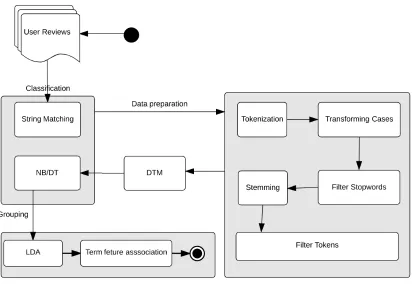
[image:26.612.106.518.346.630.2]of features to a specific requirement in the app.
Figure 3.1: Approach overview
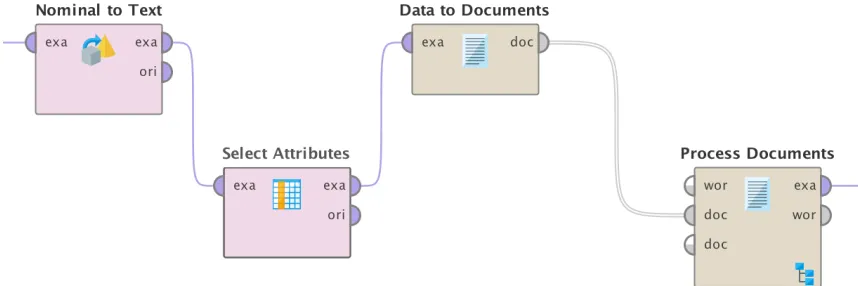
transform the data into matrix. Then we constructed our classification model in order to
classify the data and separate feature requests from others. After that we applied LDA in
order to find common themes in the reviews, and finally associated these common themes
manually with app features3.1.
For classification process, we have followed same steps described by Maalej et al. [20]
when they worked on classifying the user reviews. However, we have selected a different
model for classification after comparing the performance of different classification models.
While Naive Bayes had higher accuracy in both Tools and Music category, DT had a higher
accuracy than Naive Bayes in social category.
3.1
Raw Reviews
For the raw reviews data and their meta data we used two different datasets one that
con-tained the raw reviews [30] and the second one [18] which concon-tained information about
apps meta data. The first dataset is a Postgresql database which contains several different
tables. There are only two tables that is relevant to our study which are reviews and apps
table. We compose our dataset from these two tables. The attributes which we selected are
(appid, reviewid, raw text) from reviews table and (appid, appname) from the apps table.
We constructed a dataset from these two tables, however we needed one more attribute
which was not exist in this database which is category. Therefore, in this step we have
appid, appname, reviewid, raw text. But we are missing the category attribute.
Next, we needed to match each app with its category. For this reason, we used the
sec-ond dataset which is a database of 400,000 apps. We needed this dataset in order to match
the names of the apps, and then fetch it is category from Google Play. This dataset
con-tained these attributes(name, datePublished, numDownloadsMin, fileSize, packageName,
price, aggregateRating, softwareVersion, ratingCount, dateCrawled, url) [18]. But the only
attributes that we needed in this dataset are (name, url). The name of apps is to associate
with our data with the app name, in other words is to make a relationship with our table,
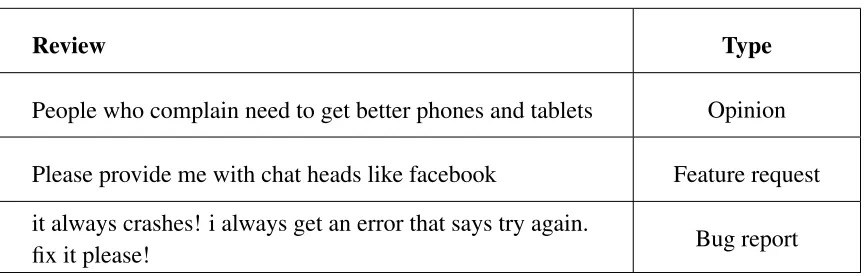
Table 3.1: Sample user reviews.
Review Type
People who complain need to get better phones and tablets Opinion
Please provide me with chat heads like facebook Feature request
it always crashes! i always get an error that says try again.
fix it please! Bug report
wrote a scraper to fetch the category.
During the process of getting category of the apps, some of the apps were not available
in play store anymore. Whenever, the script tried to fetch information about these apps,
there was a 404 error. Since the category of such apps were not found, their reviews were
automatically discarded in order to make sure that we only get the reviews that belongs to
one of the categories.
User reviews contain many different form of data that would not be useful for the
pur-pose of our study. For instance, the review might be an opinion or it might be in the form
of bug fixes or in the form of feature request as shown in 3.1. There are also some other
forms of noise, such as length of the token. For instance a user has posted a review and
wrote “Aaaaaawwwwweeessssssoooooommmmmmmeeeeee” and another user have
writ-ten “Looooooooooooooooooooooovvvvvvvvvvveeeeerrrr”. These kind of reviews does not
serve any purpose. One way for handling these types of reviews or terms in the review is
by eliminating them after tokenizing the reviews because they will be in a form of single
token. In other words the token that are very long can be discarded. These lengthy
to-kens originated either from the user review itself, or during data collection when the words
shrink and become one single word.
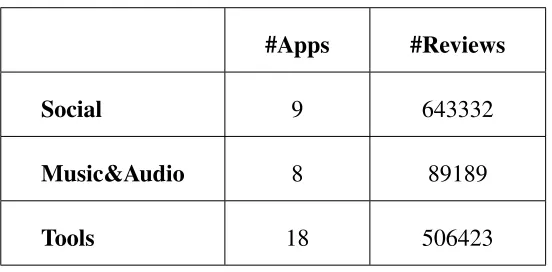
Table 3.2: List apps and reviews for each category.
#Apps #Reviews
Social 9 643332
Music&Audio 8 89189
Tools 18 506423
We select three top categories for the purpose of this study. The top categories in which
top rated apps belong to them according to Appbrain[3]. Therefore, after separating the
reviews that belong to the top categories from others, the total number of remaining reviews
is 1,238,944, which is 36% of the original number of reviews.
3.2
Data Preprocessing
The user reviews are in the form of sentence or a short paragraph. This data is noisy, it
is incomplete and an organized. We want to transform these reviews to an understandable
form through a process which is called data preprocessing in data mining. It is an
impor-tant step in data mining, and it significantly impacts the quality of the output of mining
process. Tasks in preprocessing includes Data cleaning, transformation, reduction, feature
extraction, etc. Once the data passes this stage it will be ready to further apply other mining
techniques such as classification, top modeling, etc.
3.2.1
String Matching
One of the simplest and most efficient ways to categorize a document is by searching for
category specific keywords in the text. It is required that you have a list of keywords that
would possibly identify that the document belong to a specific category. According to
would, hope, improve, miss, need, prefer, request, should, suggest, want, wish) it is
most likely identifies the document (user review) as a feature request.
There are many different techniques that would help simplifying this process. For instance,
using regular expression tools such as grep and providing it with the list of the keywords
that we look for in the document. While previous process works well, but we had the data
in a Postgresql database. Therefore, we used SQL keyword “LIKE” in order to match the
keywords.
In order to further investigate whether the keywords are accurate or not, due to the
time that takes to manually analyze the reviews, we examined 2000 reviews and found that
only on review was a feature request. After applying this technique (String Matching) the
number of reviews significantly reduced from 3,390,526 to 354,613 which is 10.45% of
total number of reviews for all apps in the data including apps from different categories
other than the categories that we have selected for our study. From the basic classification
we can conclude that as compared to other types of reviews such as bug fixes, only few
number of reviews are feature requests (if we assume that all of the reviews are counted
as feature request regardless of noise data). In addition, the sql query on the raw reviews
would match any reviews that contains the keywords or might be a part of a word. For
instance, these words (address, addict) are starting with the word “add” and it is obvious
that these words does not have the same meaning as “add” but the basic classifier would
still retrieve them. However, we cannot remove them from feature request, as it might
contain other keywords that would match feature request keyword list.
As it can be seen in Table 3.3 the least feature requests in apps belongs to Tools category,
and the most features request belong to Music category. This might be due to the fact that
there is more interaction with music apps than tools apps. Users usually stay with using
music apps much more than tool apps[15]. According to a report by comSource Music
apps(cumulative) are ranked second among the apps that are most used daily by smartphone
Table 3.3: Number of reviews before and after String Matching.
#Before #After %Remaining Reviews
Social 643332 73361 11.4%
Music & Audio 89189 13622 15.27%
Tools 506423 26293 5.19%
3.2.2
Natural Language Processing
In previous steps, we filtered the reviews in order to reduce the huge number of reviews,
so that it can be more manageable for further processing. However, we have not worked
on the raw reviews yet. That means the reviews are still as same as the time it was posted
by the user. We need to prepare the data for further processing such as classification and
topic modeling such a way that the mining models can process it. For example, in mining
we need to feed the model with a set of documents(corpus). Here in our study user each
user review is a document, that will be the input to the mining models used in the study.
However, the documents need to be processed in order to produce an organized form of
data and feed to the classification model known as corpus. We apply natural language
techniques in order to produce the corpus.
Natural language is a term used to distinguish formal languages such as computer
lan-guages(Java, C++, etc..) and mathematical expressions from human language[14]. NLP is
a term used to describe the function of any hardware or software part computer that can
manipulate human languages and process it such a way that it can be understandable by
computing machines. There are many different NLP techniques and each of them are used
for a different purpose they can also be combined in order to manipulate a text depending
on what the text is needed for. Some NLP techniques are (Sentence delimiters, Tokenizers,
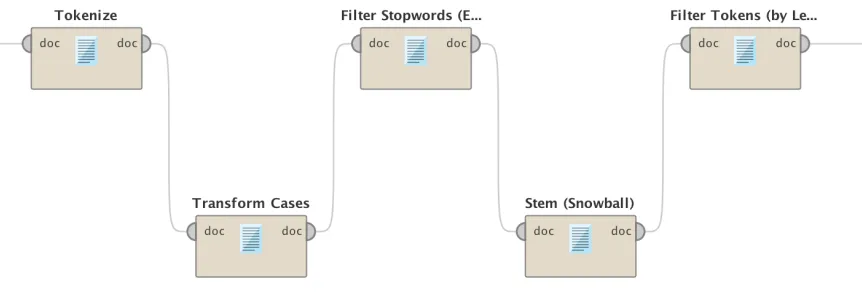
Figure 3.2: Processing reviews for vector generation
In this study we have used the techniques that would syntactically help improving the
accuracy of our classification method. The NLP techniques we used in our study are
to-kenization, stopword removal and stemming which is used in preprocessing technique in
similar work [28]. The only difference is that we have incorporate transforming letter cases
to small in order to make sure the words match regardless of their cases.
TokenizationUsers express their opinions or post the feedback in a sequence of
(char-acters or symbols or phrases) that eventually form a sentence or paragraph. In text
pro-cessing, these reviews has to be segmented in to linguistic units that would help the
min-ing process better understand the entity. The lmin-inguistic units include words, punctuations,
numbers, alpha-numeric, etc. The process of segmenting text into linguistic units is called
Tokenization [27].
In this step we input the data which user reviews, and it will generate the tokens for
each review. We have used non-letter as the tokenization mode for the reviews. It will
mostly split the words by the space as no other non-letter characters are used in reviews as
space.
Stopwordsare some English words that are repeated and used frequently in sentences.
They are used to connect words, sentence, etc. between a group of person communicating
with each other. It would be hard for audience to understand and follow the sentence
serve the process of classification. That means removing these words will not affect the
outcome of classification. However, since we are specifically looking for feature requests,
and we previously have mentioned that we have made the string matching on a set of words,
therefore we made sure that those keywords have not been removed from reviews. We have
customized the stopword list such that it does not remove our given words. In addition,
we added other keywords that is not formal English language words but still used in online
chatting or reviews such as “urs”.
In a text or a user review a word can be used in different forms within different reviews.
In one review a word might be used as the present form of the verb, and in other might
be used as past form or a noun form. For instance, the base of add, added, addition are
all “add”. Therefore, unifying different forms of words(Stemming)into their base would
give a higher frequency of the term or word usage. There the purpose of using stemmers
is “to associate variants of same term with a root form. The root can be thought of as the
form that would be normally be found as an entry in a dictionary” [14].
Stemming is the process of reducing all words that have the same stem or root to a
common form [19]. The difference arises due to Morphological Variants which is the most
common. For instance (computer, computational, computers, computing) [33]. Besides
that, there are some other reason for the difference, such as mis-spelling, abbreviation, and
valid alternative variant (e.g ‘apologise’, ‘apologize’, ‘analyse’, ‘analyze’).
The purpose of using stemmers in this study is mainly to increase the frequency of the
words used in the reviews. In addition, it will significantly decrease the dictionary size
because the large number of reviews as well as different expressions lead to the generation
of large dictionary, this is because users are free to write what every they want, there are
Figure 3.3: Document matrix process
3.3
Document Term Matrix
There are two types of matrix in terms of the organization. The first one is “Document
Term Matrix” in which the attributes represent the terms and the tuples represent the
doc-ument. The second one is “Term Document Matrix” which is opposite to first, in which
the attributes represent the documents and the tuples represent the terms. Due to the large
number of reviews and small number of attributes as well as the mining techniques used in
our study, we generate DTM instead of TDM. As a result, the attributes in the generated
matrix will represent the terms used in the user reviews and the tuples represent the user
reviews.
There are also different types of vector creation methods which are Term Frequency,
TF-IDF, Term Occurrences, Binary Term Occurrences. We have applied the term frequency
to create the vector. In addition, we made some tweaks to the methods by ensuring that the
most frequent or infrequent terms are ignored from the word list. The values are 3 for
infrequent words and 500 for frequent word list. We also kept the ‘reviewid’ with the
3.4
Classification
It is a two-step process which is used to predict class labels for a given data. It starts with
the learning step where the classifier (classification model) is constructed and then the next
step is classification, which basically is using the constructed model in first step to predict
class labels for a given data.
One of the examples that used to describe classification, is to predict whether an email
is a spam or not. Is the email legitimate or it is a junk email. The classifier immediately
does some calculation in order to determine the type of the email. There are some keywords
and symbols used in the spam emails, whenever the classifier identifies these keywords in
the email it will predict it as a spam email. There are many applications of classification
such as target marketing, fraud detection, manufacturing and medical diagnosis.
In this study, we use classification to predict the review type similar to the study that
have been conducted by Maleej et.al [20]. We are specifically looking for feature requests
in the reviews. Therefore, any other type of reviews will be discarded. This process will
further break down the huge amount of review data. As the data size reduced it will be
easier to control and faster when further processing is done on the data.
3.4.1
Learning Phase
In the first step or classification, the learning step, or the training phase, we build the
clas-sifier which describes a predetermined set of data classes. A tuple, X, is represented by an
n-dimensional attribute vector, X = (x1, x2,..., xn), depicting n measurements made on the
tuple from n database attributes, respectively, A1, A2,..., An.1 Each tuple, X, is assumed
to belong to a predefined class as determined by another database attribute called the class
label attribute.[Book]. This method of training is calledSupervised Learningbecause we
have provided the dataset with the class label attribute which basically determines whether
the given tuple is a feature request or not. The classifier will then form the rules based on
the attributes and the provided weights for each attribute and whether it is a feature or not.
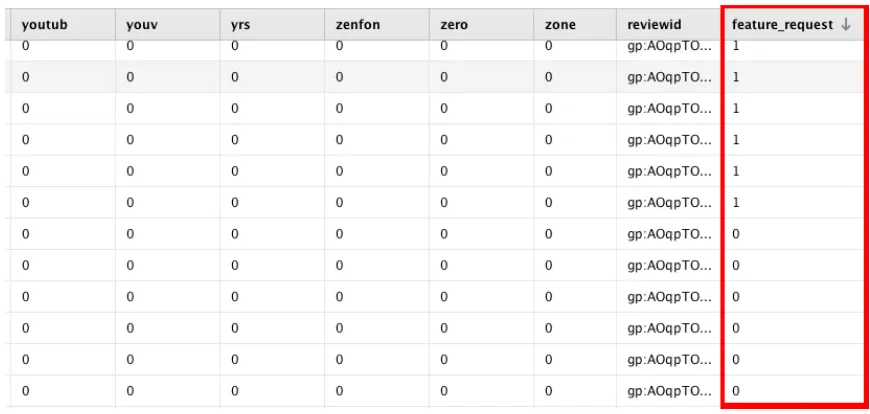
Figure 3.4: A portion of labeled data
type of classed might not be determined prior to the mining process. This method is also
called clustering, in which the model tries to identify the commonality between the tuples
and group them together.
Sampling
According to Maalej et al. [20] 150-200 reviews is adequate for the training set for each
type of review [20]. Since we are working on more than one app, and since each app
has different specification and features, we chose the top three apps from the top three
categories of apps according to Appbrain. For each app we have labeled reviews until we
got to a point that each app has at least 150 features. That means for each category the
minimum number of reviews that is labeled as feature request is 450. Because we are
working on only feature requests, therefore the ratio of feature requests to others is small.
We then selected the reviews to label after ”String Matching” in classification in order to
make sure that the review contains words that could possibly classify the review as feature
request[20]. In other words, the reviews are still raw reviews without any preprocessing.
Figure 3.4 shows a portion of the sample data it does not contain all attributes that defines
as the label of the dataset, and the “reviewid” as the id of each tuple in the dataset for future
reference if needed.
Classification Model
We have applied different algorithms in order to build the model and then chose the one that
would best fit our need for the feature selection. According to previous study [20] Naive
Bayes is better than other classifiers which are Decision Tree (DT) and MaxEnt [20] when
comparing the accuracy of these models. However, this was not the case with all categories
in our study as the accuracy of models were slightly different in different categories. The
reason might be due to the fact that we have combined the reviews of multiple apps.
There-fore, we applied and tested both Naive Bayes and Decision Tree which are very popular
binary classifiers and also have high accuracy to predict features as described in a previous
study [20]. The output and details of both classifiers are discussed in this section.
Both Naive Bayes and DT are very popular classification models. Naive Bayes is based
on Bayes Theorem which based on the assumption that predicators are independent on each
other. In other words, it assumes that the presence of a particular features is independent
on the presence of other features. Naive Bayes is simple and easy to build and does not
require large training set. On the other hand, DT is incrementally developed by breaking
down large sets of data into subsets and the result is a decision tree with two types of nodes
which are decision nodes and leaf nodes. A decision node, has two or more leaf nodes
which are either represent a decision or classification node.
We applied both techniques on the same dataset and then evaluated the results for each
algorithms and compare the performance of the two different algorithms using standard
metrics which are precision and recall. Precision is the fraction of user reviews that are
correctly classified as feature request by the classifier while recall is the fraction of correctly
classified reviews. The equation for precision and recall is as follows:
P recision= T P
T P +F P Recall=
T P
T P +F N F1 = 2∗
P recision∗Recall
P recision+Recall
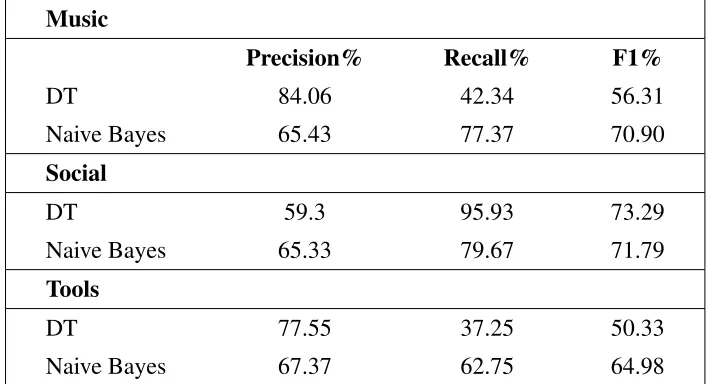
Table 3.4: Accuracy of classification techniques using DT and Naive Bayes for each cate-gory
Music
Precision% Recall% F1%
DT 84.06 42.34 56.31
Naive Bayes 65.43 77.37 70.90
Social
DT 59.3 95.93 73.29
Naive Bayes 65.33 79.67 71.79
Tools
DT 77.55 37.25 50.33
Naive Bayes 67.37 62.75 64.98
FP is the number of reviews that are classified as feature request but they are not actually a
feature request. FN is the number of reviews that are not classified as feature request, but
they are a feature request. In addition to precision and recall, we calculated F-Measure,
which is a measure of accuracy which considers both precision and recall.
Based on the results as shown in Table 3.4 we have applied different model for different
categories. We can see that Naive Bayes performs better in both music and tools review
however DT performs better in social reviews. Therefore, we applied different techniques
for different categories depending on the algorithms performance.
There are many evaluation metrics used for the predictive accuracy of a classifier.
These techniques include Holdout and random sub-sampling, cross-validation and
boot-strap methods. In this study we have applied the cross-validation technique in which we
split the data into two random tuples of total 0.75 for training and 0.25 for testing. Table
Table 3.5: Confusion matrix of Tree of social reviews
true 1 true 0
pred. 1 118 81
[image:39.612.194.422.275.376.2]pred. 0 5 52
Table 3.6: Confusion Matrix of Naive Bayes of social reviews
true 1 true 0
pred. 1 98 52
pred. 0 25 81
3.4.2
Prediction phase
Now that we have constructed the classifier in the first step of classification process, it is
time to use the constructed model to predict the user reviews in order to determine if the
user review contains a feature request or not. We have run the model on the three different
categories separately as the model construction was also done for three different categories
separately.
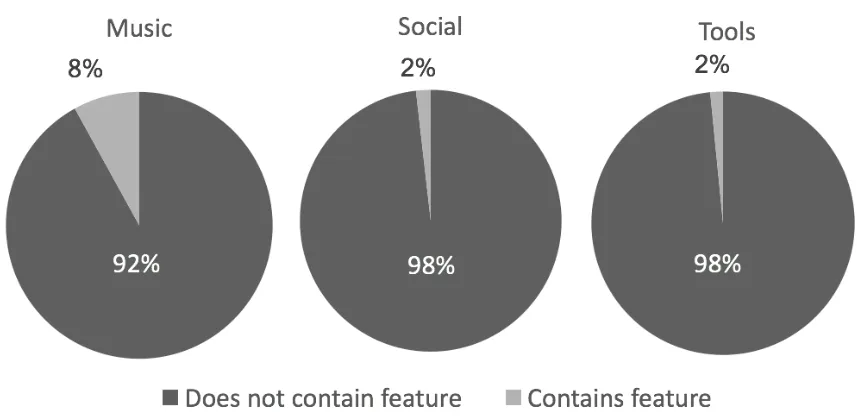
Figure 3.5 shows that the ‘social’ and ‘tools’ category have equal ratio of feature
re-quests to the reviews which is 2% and music category reviews contains the most feature
requests which is 8%. This shows that the result of the string matching of feature requests
is directly proportional to the results of classification process. That means the difference
in category does not necessarily affect the review types of users. However, if comparing
reviews under different category, music contains most feature request than both social apps
Figure 3.5: Predicted features request by the classifier
3.5
Extracting Features
In this step, we are discussing the way we want to extract the feature in the user reviews.
In a previous step we worked on separating the reviews that contains feature requests from
other types of reviews. From now on we are working on the reviews that are only predicted
as “1” by the classifier. The difference in the reviews in this step from the raw reviews is
that we have the matrix instead of the raw text. That means we do not need to repeat the
same steps that we prepare the data for the classification.
Usually multiple users request the same feature in the app. However, they use different
terms or statement to express their request. For example, some Spotify app users have
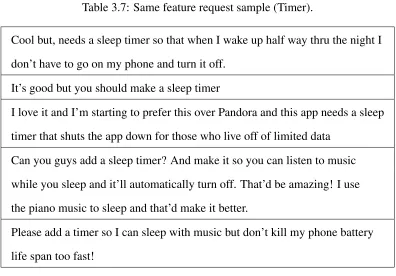
requested adding a timer to the app so that the timer stops the music player after a specific
period of time. Table 3.7 is a sample of different expressions used to ask for adding a timer
to the app. It can be clearly seen that the length of reviews is different, and other terms
used in the reviews in addition to the feature request. However, there are some similarities
between the sentences that are used to state the feature request.
We use topic modeling methods in order to find topics (features) of the reviews.
Table 3.7: Same feature request sample (Timer).
Cool but, needs a sleep timer so that when I wake up half way thru the night I
don’t have to go on my phone and turn it off.
It’s good but you should make a sleep timer
I love it and I’m starting to prefer this over Pandora and this app needs a sleep
timer that shuts the app down for those who live off of limited data
Can you guys add a sleep timer? And make it so you can listen to music
while you sleep and it’ll automatically turn off. That’d be amazing! I use
the piano music to sleep and that’d make it better.
Please add a timer so I can sleep with music but don’t kill my phone battery
life span too fast!
words in large bodies of texts” [32]. In our study user reviews will represent the bodies
of text and the words used to request the feature represents the terms that are used to form
the topics. We use the LDA baseline model in order to identify topics in the user review
corpus. LDA is a ”generative probabilistic model for collections of discrete data such as
text corpora. LDA is a three-level hierarchical Bayesian model, in which each item of a
collection is modeled as a finite mixture over an underlying set of topics. Each topic is,
in turn, modeled as an infinite mixture over an underlying set of topic probabilities. In
the context of text modeling, the topic probabilities provide an explicit representation of a
document” [7]
LDA can also be used as the learning model when classifying documents. The model
needs to be trained and tested same as other classification models. The reason why we
wanted to use in Topic Modeling is to extract the requested features intuitively. We do not
know all users feature request otherwise we would be able to list them all and there will be
Table 3.8: Topics in music apps reviews
Topic 1 Topic 2 Topic 3 Topic 4 Topic 5 Topic 6 Topic 7
1 miss chromecast hope repeat. cant sleep internet
2 replay support upload edit see timer version
3 album artist profil sing pls list cool
4 equal line chang mobil bring guy connect
5 possibl devic disappear order anymor set wifi
6 happen someth pictur comput cach mode put
7 art direct function. hit perfect pandora lot
8 definit move annoy singl otherwis includ pretti
9 help android widget gave read amaz cloud
10 info know mayb fav dont enjoy desktop
3.6
Term Feature Association
The last step in the approach is to associate the terms to the features. We need to match the
words that users use in the reviews to a feature in the application. For example, “zoom” is
a request to add zooming functionality to the photos and images.
We have manually associated the terms to the features. The automatic association is out
of the scope of this research. Some features would replace an essential existing feature in
the app, while others are an improvement to the basic feature in the app. For example, some
users request material design, if applied it will replace the basic design or theme used in the
app. However, if a user requests “Shuffle” feature it is an improvement to the current music
or video player in the app, since we do not work with how they affect the app functionality
Table 3.9: Top requested features
Music & Audio Social Tools
Replay Pause Theme
Shuffle Replay Applock
Upload Copy Post Block
Sleep Translation Notification
Lyric Zoom Schedule
Theme Material Design Kill
Offline Live RAM-Clear
Widget Repost Backup
Premium Rotate Vault
3.7
Summary
In this chapter, we discussed the process of mining user reviews and extracting the feature
requests. The user reviews undergo some process in order to prepare it for classification and
topic modeling. We started first with basic classifier, which we used SQL queries in order
to specifically filter the requests the contains the keywords that would possibly classify the
review as a feature request [13]. Then we generated the matrix from those reviews.
We then trained and tested Naive Bayes and Decision Tree in order to choose that one
that performs better for each category of the apps in order to use it in the classification
process. We found that Naive Bayes performs better in music and tools category, and DT
in social Category. We then applied topic modeling technique in order to find the common
Chapter 4
Implementation
There are many frameworks and tools that help developers create apps. Each tool has
dif-ferent approach for its construction and using it for creating new apps. Depending on the
developer’s preference of language, paradigm, ease of use, community or sometimes
join-ing an ongojoin-ing project help them decide which framework to choose. For example, some
developers prefer separating HTML from JavaScript implementations rather than writing
HTML code inside JavaScript, for this reason they pick VUE rather than ReactJS.
Some-times performance issues with some frameworks make developers migrate to other
frame-work. But in general, most frameworks for a specific language can handle all tasks that is
handled by frameworks of same language.
So far, we have been able to identify the features that are requested by users. But
sometime finding the requests is not enough for developers, as they might lack experience
to integrate the feature to the app or it might take a long time to implement it. Furthermore,
new developers do not have enough information about the packages that are available for
the frameworks that they use. In addition, there are usually more than one package available
for a specific feature. They will have to spend some time, to see and compare which ones
are better than the others.
There are some metrics that would help developers on which libraries they should use
in their apps. For example, if the package is open source and hosted on Github, they can
check number of stars, watchers, and number of open issues as well as forks to decide which
package to use. If it is hosted on npm, number of download helps a lot. There are also other
apps, it would be better for them to focus more on development rather than these secondary
time consuming tasks. Therefore, if the process of associating the requested features to the
libraries automated it will save a lot of time for developers.
When the framework or the tool that they use, automatically suggest the libraries that
they need to include in order to integrate the feature to the app, then the developer can start
immediately diving into the library api and learn how to use it inside their apps. It also
makes much easier for a team of developers to collaborate development. For example if
they use npm as their package manager, when the framework that they work on,
automat-ically includes the package in the app, it would write to the package.json file the included
library, then this file can be shared with other developers to start working on developing
immediately.
4.1
Challenges
There are some challenges with completely automating the process of including the features
inside the apps. Some of the challenges includes:
• Getting all functions of a package can be cumbersome. There is not specific
guide-lines about describing the tasks that each package can perform. Some developers use
bulletin to list all functions. Others use one paragraph to describe them, some other
reference to an external link to browse the functionalities. Meanwhile, the
function-alities cannot be extracted through scanning the code as developers follow different
naming convention and have different level of programming skills. For example, a
package is used in order to integrate authentication to an app. Some package provide
authorization with it, while others provide only authentication and requires another
package to provide authorization.
• Some open source packages are discontinued after a while. Although, they usually
• Some libraries need to be extended in order to provide all functionalities. Same as
the previous example, some packages are very popular and are very stable, however
they do not provide all functionalities. For example, if it provides only
authentica-tion, there must be a way to extend or create a separate module for authorization.
Therefore, the framework should contain all these details so that the developer does
not spend time checking for all package functionalities and dependencies.
• Providing updates to the packages is also one of other challenges. For current project
this might not be a big deal, however when they switch to another app they might face
some issues because the package api might have been changed. Some functions are
renamed, others are added and some others are removed. Therefore, the framework
should be able to track these changes and inform the developer about changes or
display the change log.
There are also other challenges that arise from using package managers to use
pack-ages inside an app. For example, how to check for security issues and vulnerabilities
inside a library and some issues with performance as well as detecting malicious
libraries.
4.2
Tools
The framework is composed of several tools but the main tools are described below.
• VUE: is one of the popular JavaScript framework for building user interface. It
is lightweight and very fast mainly because it interacts with DOM. It separates the
views or template from the js implementation which makes is easier to read and
maintain the code. It gained popularity after it was introduced as the primary UI
framework used by Laravel (PHP framework). We used VUE in order to have some
interaction with the page