Rochester Institute of Technology
RIT Scholar Works
Theses
Thesis/Dissertation Collections
2005
Shanghai Beauty
Ding Ye
Follow this and additional works at:
http://scholarworks.rit.edu/theses
This Thesis is brought to you for free and open access by the Thesis/Dissertation Collections at RIT Scholar Works. It has been accepted for inclusion in Theses by an authorized administrator of RIT Scholar Works. For more information, please [email protected].
Recommended Citation
Duane Palyka
Shanghai Beauty
BY
Ding Ye
MFA Computer Animation
SCHOOL OF FILM AND ANIMATION
ROCHESTER INSTITUTE OF TECHNOLOGY
ROCHESTER, NEW YORK
Nov 2005
Duane Palyka, Chair
Professor
School of Film and Animation
Johnny Robinson
Johnny Robinson
Professor
School of Film and Animation
Malcolm Spaull
Malcolm Spaull
Professor
DEC-08-2005 15:49 From:PRINT-WHITE
Thesis/Dissertation Author Permission Statement
Title of thesis or dissertation:
.shMj
~A.j Ee-~+y
Name of author:
))Ir\j
fe
Degree:j\U?A _
Program: _ _ ~ ~
Pkt2-...
--~A-;-"'-;-""-A-:j.r.~,0 1
-C()Ih.:~l:
:
~r
R
-
ocb.;;;;t~)=
:1
flc±:·'j-u"fe
,,{--re~c-A-;-(J-l)-{:-P'!J-y----r
ulldcr~1.and that 1 must submit a print copy of my lhcsis or di~.se.rtation to the RlT Archives, pc,-Cllm;nt RIT guidelines for the completion of my degree. I htm:hy grant to the Rochester Instilul~ uf'fcchnology amI it .. agent" the nOIl-exclusive license to archivt: and make accessible my thesis or disst:rtation in whole or in l>&rt in 1111 forms of media in perpetuity. J retain all (l1.hcr ownership rights to the copyright of thc thcsi~ or dis~rtation. I aJso retain the right to usc ill future works (such as articles OJ books) aU or part of thi:l thesis ()r dissertation.Print Rcproductwn. Pennission Granted;
L
Dinq
,
Ye
,
herehy grant permission to the Roch~sltJT Institute Technology 10 reproduce my prillt thesis or dissertation in whole or in part. I\ny reproduction will nut be ror commercial use or profit.Signature of Amhor: _ _ ---=D:..:i.:..;n:.:;qL-~.:,.;e=--__ _ _ _ _ _ _ _ _ Date:
Permission Denied;
I. _
_
_
, hereny deny permis.'iioJl to
lhl,; RIT Lihrary of the Rochester Institute of Technology to reproduce my print thesis or dissertation in whole Of in p,m_TableofContents
I. Proposal
A. Storyline
B. Approach
II. Pre-Production
A. Basic technical decision
B. Graphic style decision
Information gathering
Reference:oldpostcard,old calendar andposter, old comicbooksanddrawings
C. Character design
Character design (maincharactersandbackgroundcharacters)and wholegraphic style
D. Technical preparation
3Dbackgroundsand vehicles
Combining2dand3danimation sequence
E. Storyboard
Improvedseveraltimes
F. Making a schedule
III. Production
A. 3D scenes
Modeling, TexturingandLayout
B. 3D foreground elements
Modeling, Texturing, Rigging,IKsetup,Renderprocess,AnimationandRotoscope
C. Pencil test and Rotoscope
D. Inking and Coloring
IV. Post-Production
A. Composition and Editing
B. Aged film Style
C. Sound Effects and Music
V. Conclusion
VI. References
AppendixA (Budget, Timeline)
Appendix B (Storyboard)
AppendixC (Color Prints)
I. Proposal
Working Title: <Shanghai Beauty> (<Hyacinth>)
Producer: Ding Ye
Start Date: June 2002
End Date: Summer 2004
Running Time: Around 5 minutes
Release Format: DV NTSC
One busy night around 1930 in pre-revolution Shanghai, a lively rickshaw driver
gives a rideto the mostfamous dancerin the city. The driver fallsin lovewith the
girl, ultimately killing a manto protecther. Tragically, the rickshawdriver is killed
by a detective, who was actually working with the dancer to set up the rickshaw driver. The dancer, like the Hyacinth flower, was beautiful but deadly.
A. Storyline
A beautiful night has fallen on Nan Jing Street, the most flourishing street in old
Shanghai. Colorful neon lights flash, and crowds of people walk the street. The
most famous dancerin thecity, Mrs. A, dances and singsthe classical song "Rose,
Rose, I LoveYou" at Shanghai's largest dance hall. A young Detective C gazes at
Mrs. A, obviously attracted. Mrs. A notices Detective C, and returns his gaze.
She dances towards him and puts a rose in hisjacket pocket.
Later, in theweehoursofthe morning, the neon lightsofNanJingStreet have been
turned off, and it is quiet. Atthe main entrance ofthedance hall, some rickshaw
drivers are waitingforthe hall's rich patrons to leave forthe night. Mrs. A leaves
the dance hall and chooses the nearest driver, Guy B, a lively young man. Guy B
starts to run with his client, who soon falls fast asleep.
When the rickshaw driver reaches Mrs. A's apartment, he finds her still sleeping
soundly. Hestopshiscoach and waitsforhertowake. Suddenly, a boy runspast
them, a youngthief. Police chase afterhim, blowingtheirwhistles. Mrs. Awakes
at this sound, pays Guy B for the ride home, and approaches herapartment. At
thetopofthe stairs, sheturns to Guy Bandsays, "I needa rickshawdriver. Come
here tomorrow at 9:00pm,
okay?"
Guy B looks at her for a while and says:
"en."
Once again, Mrs. Asits in Guy B's rickshaw as he brings her tothe dance hall, the
neon lightsofNanJing streetreflecting beautifully inthe rain. Atacorner, hetrips,
and cuts his hand. When they arrive atthe dancehall, Mrs. Anoticesthe blood on
gives itto him. "Take care of yourself,"
she says.
The next day, Guy B paces in front of Mrs. A's apartment, her now clean
handkerchief in hand. Mrs. A leaves her apartment, and Guy B quickly hides her
handkerchiefin his pocket. Though Mrs. Anoticesthis,shedoesn't sayanything,
and instead smiles at Guy B.
Another night on Nan Jing street, and Guy B waits underthe cloudy sky for Mrs. A
to leave the dance hall. The neon lights are turned off, and Mrs. Aexits the hall,
but this time a fat, obviously rich man, hugs her. Mrs. A does not look happy. "You do not need to serve metoday," shetellsGuy B. "You change your rickshaw
driver?"
the fat man sneers. The fat man throws a fifty-dollar bill at Guy B and
leaveswith Mrs. A. Guy B juststands there.
Worried, guy Bwaitsfor Mrs. Aathergatefrom morning until night, untilshefinally returns. She looks exhausted, cannot walk straight, and is wounded on her neck and arms. She sees Guy B and tells him, "I am all right. Today I cannot work.
Come backtomorrow, okay?"
Shestaggers and tumbles. Blushing, Guy B helps her upstairsto herapartment. Mrs. A sits down beside the window, while Guy B
stands there awkwardly, not knowing what else he should do. On the veranda,
some beautiful hyacinth plants grow. Guy B noticesthem and tells Mrs. A, "Those flowersare reallybeautiful." "Yes," Mrs. Aresponds, "Hyacinth ismyfavorite."
A
long silence follows. Suddenly, Mrs. A hugs Guy B, and starts crying. Guy B
starts to hug Mrs. A back, but stops.
The next day, Mrs. Aasks Guy B to take hersomewhere else instead ofthe dance hall. Guy B agrees, and soon they arrive at a large and luxurious mansion.
Before entering, Mrs. A turns back, nervous, and asks Guy Bto waitfor her. Guy
B looks up at the mansion, and sees the fat rich man standing in a second story
window.
It is night, and street is quiet. Suddenly, the silence of the street is broken by a
scream, and noisecoming from one ofthe buildings. Guy Band Mrs. A run out of
the building, their clothes stained with blood. Guy B throws a bloody knife away
from them as they run. "This
way!"
Mrs. A shouts. They cut down a small,
narrow street, and a man jumps out atthem from the shadows.
Detective C stands in thedark, narrowstreet, smoking, and gazes atguy B. Guy
B begs him notto givethem away. Detective B says nothing,so GuyBand Mrs. A
continue running. Detective C turns after them and takes out his pistol. Bang.
The sun rises,
bathing
the Huang Pu River in gold. Mrs. A and Guy B stagger towardsthe riverbank, Detective Cfollowing
behindthem. Mrs. Aand Guy B lookat the river, and then at each other. They nod in silent agreement.
Splash. Detective Cpeers into theriver. Ahandkerchieffloatson the water. He
shrugs, and turns away.
Two days later, on thecorner ofNan Jing Street, a newsboy shouts, waving papers
at passersby, "Extra, Extra, magnate killed!" A man stops and buysa paper. On thefront page is a photo ofGuy B, below the headline, "Rickshaw Driver Kills and Robs Magnate. Young Detective C Investigates Murder. Money Still Lost."
Oneweeklater, Mrs.Adancesand singstheclassical song"Rose, Rose, I LoveYou,"
atthebiggest dance hall in thecity. The young detective Cgazes atMrs. A,though something has changed: he looks much wealthier than before. When the dance hall closes, Detective C hugs Mrs. Aand walks out with her, both ofthem laughing like old lovers.
B. Approach
In creatingthis animation, Iplantousetraditional2Ddrawingforall livecharacters. I will try to record liveaction references forthe movement, especially the dancing
scenes. I plan to use 3D for the background and vehicles. I will use some shaders, like Toonshader, to create the 2D and 3D objects in the same graphical style. I will compositethe 2Dand 3D elementstogetherusing AfterEffects. The main obstacle I will face is setting upthe positions and timing the animation using both 2D and 3D. I have set aside one month to research and find the correct
II. Pre-Production
Based on the good and bad experiencesof mywinterfilm process, I knew ignoring
theimportanceofpre-production costed me moretimeand effortthan if Ihad used
forethought and planning. For this film, I decided to take almost one year to
complete pre-production, halfofthetime Iplannedtotake tocompletethe project.
A. The Basic Technical Decision
During the original proposal, I started thinking about what kind of technique and
style I would use. I based my decision on my animation ability and on what I
wanted the story to represent.
I had four main characters and lots of background characters. I knew it was
impossibleto build all ofthem using Maya in this one-person project. Developing
and animating 3D clothes and hair would also be too time-consuming. I decided
my best choice was to create all of the characters traditionally, through hand
drawing.
Another concern I had was the creation of backgrounds. Because I was not
satisfied with my own drawing skill, I had two choices. One was to hire a
background artist. I tried to find someone here or in China but could not find
anyone satisfactory. My other choice was making the backgrounds in 3D. My
final decision was to use Maya to create 3D backgrounds, so that I could take
advantage ofusing Maya's moving camera.
After these deliberations, I made two essential technical decisions: Iwould use 2D
hand-drawn characters and 3D backgrounds.
B. Information Gathering and Deciding on a Graphic Style
I realized that a faithful recreation ofShanghai in the 1930s was a daunting task,
and decided a site visit was necessary. I paid a short visit to Shanghai in the
summer of 2002 and gathered information about Shanghai's glorious days in the
1930s. I collected, reviewed, and analyzed popularmagazines, postcards,
graphic calendars and comic books ofthat period to help me have a basic
understandingof people'slivesatthat time
-whattheywore, howtheycommuted,
how they entertained, etc. I also photographed the surviving old buildings and
Old graphic calendar The famous shopping mall at the 30s
After reviewing all the references, an old postcard finally gave me a strong feeling
about the direction I should take for the graphic style of my animation. As the
image below shows, a unique graphic style was created within the postcard by
watercolor painting in two primary colors, yellow-orange and gray-green. The
ragged edges and creases ofshabbypaper made thepostcard moredistinctiveand
impressive. I then decided watercolor painting with an aged film feeling was the
main graphicdirection I would take my animation in.
The old postcard
I now had other decisions to make. What kind of characters could fit into this
would not work at all. The characters should be realistic but simplified. I
discovered an old famous Chinesecomicthatdepicted several storieshappening in
Shanghai in the 1930s-1940s. The comic artist used a sketch-like outline and
exaggerated but realistic facial expressions. It is a kind of old style that has
almostbeen forgotten in modern times. I developed my own charactersfromthis
style and they fitted into the whole set verywell.
Comic book by a famous cartoon artist, Leping Zhang
C. Character Design
My film has four main characters, a Shanghai Cabaret dancer, a detective, a
rickshaw boy, and a rich merchant. It isalso only four minutes long. What does thismean? I mustlet theaudience recognizedifferentcharacters easily andclearly
through each character's appearance while using quick, MTV-style cutting. The
characters'
outside representation should show their characteristics clearly and
leadthe audiencetofitthem intothecorrecttypes. Therefore, Idesigned myown
charactersby developing some well-knownfilm roles. First, Ifollowed some basic methods, such as the silhouette rule, and I set up four characters in different
primary colors and sizes. Then I drew several sketches, asked other people's
opinions, and improved my drawings. After repeating this process several times,
I had my final versions and made detailed character sheets, include three views,
facial expressions, different costumes, etc.
The dancer may look unsophisticated, but is insidious in deep, unsatisfied with her
status quo and wanting more. Her hair is a classic flip style of the 1930s. Her
costume sets focus on multiple designs of the Chinese traditional dress
-the
5l 52
The dancing girl's costume design The detective's costume design
Thedetective isa low level officer atthebeginning ofthestory. He issearching for
any chance he can get to become rich and powerful. The gentleman's mustache
shows he is educated, and dreams of an expensive, western-like life. Hiscostume
sets are a classic business suit and coat with modern leather shoes.
The rickshaw boy is an honest and unsophisticated guy who was born in northern
China. He is young and strong. Youcan see lotsofvitality from his behavior. He
wears a classic rickshaw driver's costume.
fa
t
'J
A
i
lx^j
i
ft
The costume development ofthe rickshaw boy The fat ugly merchant
Like most evil, rich roles, the merchant was short, fat, ugly, overbearing and
silk-stocking. He has a modern gentleman's mustache and always wears a
tuxedo.
D. Technical Preparation
I devoted the first several months ofpreproduction to
solving technical problems.
I analyzed potential technical issues I might encounter in
[image:12.548.56.510.216.527.2]making this film and figured out possible solutions. Then I created short animation sequences to test
different technologies, from 3D rotoscoping to synchronization of 3D computer
generated sequences with 2D hand-drawn sequences.
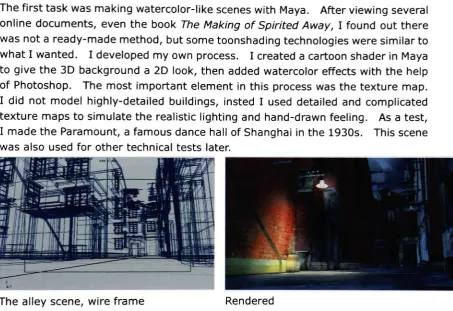
The firsttaskwas making watercolor-like scenes with Maya. Afterviewing several
online
documents,
even the book The Making ofSpiritedAway, I found out therewas not a ready-made method, butsometoonshading technologieswere similarto
whatI wanted. I developed my own process. Icreated a cartoon shaderin Maya
to give the 3D background a 2D look, then added watercolor effects with the help
of Photoshop. The most important element in this process wasthe texture map.
I did not model highly-detailed buildings, insted I used detailed and complicated
texture maps to simulate the realistic lighting and hand-drawn feeling. As a test,
I madethe Paramount, a famous dance hall ofShanghai in the 1930s. This scene
was also used for othertechnical tests later.
The alley scene, wireframe Rendered
There were several vehicles in the film. I needed them to look like the 2D
hand-drawn characters because they were all moving foreground elements.
Therefore,thevehicles would needtobe flatcolor withdark edgelines. I adjusted
the toonshader, which I used for buildings, to make flat color. Before Maya 5.0,
there was no method for creating a high quality outline in Maya. I used a simple
version ofa Maya plug-in
Tnkworks'
that had been used in the animated film The
Prince ofEgypt. Inkworks was limited and unstable in the Windows platform. It
worked only with polygon and NURBS geometries and did not support texture
mapping. Ittookme several weeks tofigureoutthe method. Thewhole process
image out with the regular Maya toonshader. The second step was rendering
outlines out using Inkworks. The final step was
combining the two images
through Photoshop or After Effects. After Maya 5.0
was released, the vector
render worked much better, so I replaced Inkworks with it. I then wrote MEL
(Maya Embeded
Language)
scripts to drive the vehicles'movement and secondary
animation.
Several old style vehicles
+
i
Compositing with dark line layer and color layer
The dancer's five cheongsams were carefully designed by researching several old
posters and books. I modeled the cheongsam by using subdivision technology
and adjusted UV maps for different texture maps. Outlines were made using
specific texture maps and adjusted in Photoshop because Tnkworks'
did not
support subdivision geometries. Body sets were also modeled and bound as
The dancer's cheongsams
Only limited panning and zooming cameras can be used in traditional animation
production. An advantage of
building
scenes in Maya was the use of a movingcamera. The problem was synchronization of the 3D computer generated
sequence with the 2D hand-drawn sequence. After attempting several industrial
softwares, such as USAnimation and Animo, I returned to After Effects. After
Effects can create 3D layers by importing limited Maya data and compositing
different types of layers.
*_ftOmportionLayarEffac._*n*onyew _rafaw_* [_E______n B
[all v2 nsssjutbc \sss_rorc_-,__^_wa_F(ITGvJ^Jtr itS^U]-trimCam T
J_SSS_&llkShnCalor [l-f_SSS_&iu5hHlnk.[1-20 1_SSS_to*r_b<i3iI<>p
[1-"tjs,SSS_tnw_du-i[1-20 ^E3E_to.tr_l.fipil,[I ^_SSS_tnv_liftLlholb[
^ _M*_wia.[l-eoo ^SSS_t<rr_.li(biOI[1
*_SSSL_Unr_riri>tai t
^SSS_to*r_>ipu [1-SD ^HKaq[O0D1-OZO0]t (_sist.[0001 -0200] i
ft_)StTutGnrtDl..p
ft_JStrutG^LDlS uv
ft_JStrt_lGn_USup
ft_JStrutO_riUZS up ft__JStrHtGapUB. up ft_JSlraatGcpUBS up
Editing tons of 3d layers atAfter Effects
E. Storyboard
I started drawing the storyboard atthe same time I began technical preparation.
followed the standard method of storyboard production for feature films. It
resulted in the film lasting more than ten minutes. I discussed this issue with
Johnny Robinson. He suggested a better method of handling length and
complexity. We picked ten indispensablescenes from theoriginal storyboard and
followed quick, MTV-style cutting to convey the most information in a short period
oftime. After several improved drafts, the storyboard had only forty-four shots
and was lessthan five minutes long.
F. Making a Schedule
After allthe pre-production work was done, I made a detailed production schedule
by carefully calculating workload. I also made several minor adjustments during
III. Production
Production began in the spring of 2003 and took one year. The production stage
covered 3D modeling, texturing, rigging, the animation process, traditional hand
drawing, andthe computercoloring processes. To complete my production I used
Maya, Adobe Photoshop and the Adobe After Effects Production Bundle.
A. 3D Scenes
There were seven scenes, and most of the scenes had multi-lighting sets for
differenttimes ofthe day. Modeling and texturing work was not difficult, was but
time-consuming. To save time and decrease my workload, I reused models as
much as possible.
To keep the correctscale, I made a small polygon man, and when I started a new
scene, I always put several men at the horizon and built several cubes as
referencesfor buildings. I modeled most ofthescenes byusing polygons because
it is simpleforcube-based objects and easy fortexture mapping. Forneon lights,
electrical wires, and Chinese lettersof outdooradvertisements, I used NURBSwith
two MEL scripts that can transform Chinese letters to curves and extrude high
quality pipelines from multi-curves. I avoided creating too much detail during
the modeling stage. Thedetailswere created lateron in the texturing process. I
only used a one direction light to illuminate the whole set for each scene. The
lighting effects and shadows weretotally made bytexture.
Because I would composite 3D scenes with other elements in After Effects, I
grouped several sets as layouts of traditional animation production so I could
render them separately and used these layers as masks in After Effects.
-_-,_ _.,,*|_.
ij b. si* *v&)es|g<g)age
:3:N%t%g*.i.mat.k^-xq
~
_1 *
*^* _r Jtg a*
m=. mm=r UBT IME UMlC "M^ 83*)
Using traditional layout method in 3D world
There werethree partsofthe 3D foreground elements: vehicles, cheongsamsand
the rickshaw with the driver. At the pre-production process, I finished most
modeling and texturing work. Work in the production process focused on rigging and animation.
I wrote several MEL scripts to enhance the vehicles animation. After I gave the
vehicle a moving path, therollingmotion ofwheels, rotation offrontwheels andthe
secondary animation of vehicles were all done by MEL scripts.
An example MEL script for controlling vehicle's wheel action. //Wheel rotation
float $distance = arclen
PathCar02~
;
float$radius= 0.398;
float $pi= 3.1416;
float$Upec= (motionPathl.fractionMode ? 1 :
PathCarOShape2.spans);
//new versionfrontwheel
float$currentCarrotateY;
float$futureCarrotateY;
float $Currentframe = '
currentTime ;
$currentCarrotateY= groupCar02.rotateY;
$Currentframe= $Currentframe+ 10;
currentTime-edit$Currentframe;
$futureCarrotateY= groupCar02.rotateY;
float$frontRotateY= $futureCarrotateY
-$currentCarrotateY;
Wheel1.rotateY=$frontRotateY;
Wheel2.rotateY=Wheel 1.rotateY;
Wheell.rotateX= motionPathl.uValue * $distance*$Upec *
180/$pi/$radius/2;
Wheel2.rotateX= Wheell.rotateX;
Wheel3.rotateX = Wheell.rotateX;
Wheel4.rotateX =Wheell.rotateX;
//forcarstop
float$CurrentDistance;
float$LastDistance;
float$Currentframe =
'
currentTime ;
$CurrentDIstance =
motionPathl.uValue *$distance *$Upec
;
if($Currentframe<=0)
{
$LastDistance =$CurrentDIstance
;
$LastTwoDistance= $CurrentDIstance
;
}
if($Currentframe>0)
{
if(($CurrentDIstance-$LastDistance)<($LastDistance-$LastTwoDistance))
{
if(groupCar02Up.rotateX < 2) groupCar02Up.rotateX=groupCar02Up.rotateX + 0.2;
}
else
{
if(groupCar02Up.rotateX > 0)groupCar02Up.rotateX=groupCar02Up.rotateX
-0.4;
else groupCar02Up.rotateX= 0;
}
$LastTwoDistance= $LastDistance;//resetlastdistance torememberlast frame's distance
$LastDistance= $CurrentDIstance ;
}
Body sets were modeled withthecheongsamforrotoscoping. Icreated a skeleton
and didthe riggingset up. I also useddriven keys forseveraljointsand a classical
double IKs method on her heels. For smooth and undistorted deformation ofthe
cheongsam during animation, I used a blending shapes method. Sixteen blend
shapes were madefor differentparts orposes ofthe cheongsam. The Mayavector
renderfunctionwas usedtogenerateimagesequencesfor rotoscoping becausethe
dark outlines helped me rotoscoping clearly.
I have one shot in my film where the
boy
pulls the rickshaw with the dancer in it.The rickshaw was made by Maya and would be composited with the hand-drawn
boy and dancer. After I did some research and considered my drawing skill, I
decidedto makea stickfigure in Maya as reference, which could be bound withthe
3D rickshaw. Rotoscoping the 3D stick figure with the rickshaw was much easier
than drawing the boy separately to follow the 3D rickshaw's movement. The IK
setsfor animatingthe rickshaw and thestickfiguretogether tookme a whole week.
The whole set is driven
by
the stick figure, who is following a moving path. Thestick figure's hands controll the rickshaw's facing direction, and the rickshaw is
restricted by the range of the two hands' movement. The cheongsam with the
reference body sets was also parented to the rickshaw and animated separately.
After all the IKs and driven keys were set up, I only animated the stick figure
manually, while the other parts of animation were driven automatically. The
quality ofthe final result was good.
C. Pencil test and Rotoscoping process
Becausethecharacters weredesigned ina realisticstyle, theirmovement could not
follow the exaggerated Disney cartoon style. It is difficult to draw realistic full
animation. Mybestchoice wasto get some references. I shot several live-action
sequences as reference by
following
the camera sets in Maya. Some of thisfootage was used for rotoscoping.
Most shots that contained camera movement were made in Maya first and then
composed with hand-drawn characters. However, for the shots based on
live-actionfootage, the3Dcamera hadtomatchthecamerasetup oftheliveaction
sequence. So, when I shotthis kind offootage, I put several cube-shaped objects
as referencesinthe background, such as boxesand tables. Thisway, I could build
several 3D spaces with these references laterto simulatethecircumstances ofthe
live action footage and then matched the camera movements.
;
/i/
/
'. /
\
A pencil testframe
D. Inking and Coloring process
The last processes of production were Inking and Coloring. The main problem of
inking was avoiding jitter lines. It took me a week to fix these problems in
Photoshop after scanning.
In ordertoget betterlinequality, I developed a newcoloring process I cleaned up
me image sequences and set up layers by using the batch actions in Photoshop.
I*6*IMIBWWs*on*&.]
mi\ ia*k'i.-*Bin>mio* _________Bfc_J_____J_a__J ^_.__>*
IV. Post-Production
One ofthe most important things
during
post-production was asset managementbecause I had such a large number of elements, from 2D image sequences to 3D
camera sets. So I made a set of rigid rules aboutfile and folder naming, version
control, etc. It was really helpful during the compositing and editing processes.
A. Composition and Editing
The main compositing and editing tools I used wereAdobe AfterEffectsand Adobe
Premiere. Because I already solved all the technical problems during
pre-production, such as synchronization of3Dcomputer generated sequences with 2D hand-drawn sequences, the compositing process was time-consuming, but
without any major difficulty. It took me almost one month to finish more than
forty single shots. Five of them were extremely complicated shots, which were filled with vehicles and background characters.
I did not put all my shotstogether in oneAfter Effectsfile forediting. There were
two reasons. First, some shots had more than thirty layers in the tree structure.
It is impossible to put all those shots in one file systematically. Second, this kind
of file would be too heavy to run on the 3D lab computers. So I did the
compositingandtheediting worktotallyseparately. After compositing, Irendered out the movie file foreach shot and edited them together in After Effects.
Because I had a well-developed storyboard and animatic, the editing went well,
and on schedule.
-;aii
9...
nun
>OT*l rm- 9fc
'y,m r, \Ji_ T^Z
)aa T.3.
oa \*>.. |\/i*eti
a.O i _-J.ii-<<' ,n -iQi.i..t..Mni * / *taJILa D_>tab4 a /
0 _> ?**.1J7_IT..1..JtKi-.( s
V - ?' tmn-odi. H-iTjrjjul /
*?_ S'
A ?i 0 irr.nfaw zur.hi
M-l ai^r^
B. Aged film style
I used a plug-in namedAged Film in Adobe Photoshop, After Effects and Premiere.
Because ofthe differences oflight and color, I used a differentset up for different
scenes.
AgedFilm
1^
1**V
--=!*!**
! iH.'-.B!HHil(j<
.!-_&.-Aged Film at Premiere
C. Sound Effects and Music
Carl Irwin was my composer. We discussed a lot during the whole production. I
suggested that he write the background sound track using the traditional musical
instrumentsfoundontheCDs of oldChinese musicIsenthim. Wealso used some
famous songs of old Shanghai in some specific scenes, such as in the Paramount
hall. After several reworked iterations, the music matched the feeling ofthefilm
well.
I edited more than one hundred sound effects using Adobe Premiere, including
special effects, background noise, voices, etc. For better quality, I used two
channels to simulate stereo. This way, the audience can easily notice the
character's position through sound effects. However, most of the detailed sound
V. Conclusion
After two years of hard work, I finally finished my thesis film on schedule.
Because ofmycomputer science background, I regarded the creation process as a systemic project, not totally an art creation. The detailed pre-production and
timeline schedule saved me plenty oftime during production and post-production.
It's very important for both animation studios and independentfilmmakers. There
are still many places that can be improved in <Shanghai Beauty>. One big
problem is howto letthe audienceclearlyunderstand allthe subtlehintsin thefilm. I will continue to improve my skills at storytelling, camera editing and my animation technique in my next film.
VI. References
Books:
<GrammarofThe Film Language> by Daniel Arijon published at 1991, USA
<Old Shanghai Monthly Calendars> published at 2003, Shanghai, China <Old Shanghai Classical Buildings> published at 1995, Shanghai, China <San Mao Liu Lang Ji> by Leping Zhang published at 1970, Shanghai, China
<The History in Comics> published at 1990, Shanghai, China
Website:
www.hiahend3d.com
www.cqtalk.com
www.chinadv.com
Toolbox:
Adobe Photoshop, After Effects, www.adobe.com
Premiere
Maya
Animo and Inkworks
Final Cut Pro
Painter
www.alias.com
www.animo.com
www.apple.com
www.corel.com
Appendix A (Timeline, Budget)
Time Line:
2002 June
2002 July 2002 Aug 2003 March
2003 June
2003 Aug 2003 Dec
2004 March
2004 May 2004 June
2004 Aug 2004 Dec
Draft Storyboard
Draft Character design
Back to China, getdetailed buildings and history material
Technical research
Finished opening scene. Finished all technical research.
Detailed Storyboard
Detailed Character design with facial expression
Detailed Animatic
Modeling background and vehicles
Drawing pencil test animation
Inking and Coloring
Compositing all scenes
Sound Effects and Music
Refining scenes
Budget:
Labor Rate Unit Time Expense
Storyboard 1870 Wk 4 7480
Modeling/Lighting/Texturing
1403 Wk 2 2806Animator 1544 Wk 12 18528
Background Design 1403 Wk 4 5612
Compositing/Editing
1089 Wk 4 4356Actors 30 Hr 40 1200
Equipment Price ^
funit
Time ExpenseWork Station 4500 1 N/A 4500
Rendering 50 Hr 50 2500
Dat Recorder 1500 1 N/A 1500
3D Software 6999 1 N/A 6999
Audio Editing Suite 520 1 N/A 520
Actual Budget:
Equipment Rate Unit Expense
VHS Tapes $0.74 10 $7.4
Sony DVCAM $13.24 1 $13.24
CR-R $0.55 50 $27.99
Background $30 20 $600
Background Music $500 1 $500
Actors $5 40 $200
__
Appendix B (Storyboard)
~*Jt c- +
' /- s^
>
j>~
r '{
r&
fw%
V
\tsM
-sJsri>T
>^^^
-5^
V>J>*
-ndSfc'x
^
'--si
f*fW\
'*__
Appendix D (Credits)
A Ding Ye Film
<Shanghai Beauty>
Music by:
Carl Irwin
"When Shall You Return"
Lyrics Jia mo Huang
Composer Xue an Liu Vocals Xuan Zhou
Color Assistant:
Wan-chun Lee
Film Crew: Chen-ni Hsu
Han-yiTseng
Wan-Chun Lee
Yan Hu
Zhen Wang
Advisors:
Duane M. Palyka
Johnny Robinson
Malcolm Spaull
Special Thanks:
Callahan Student Grant
Zhan Ye
Seth McCaughey
and all my friends
Student Produced
School of Film and Animation
Rochester Institute ofTechnology
Rochester, NY