Rochester Institute of Technology
RIT Scholar Works
Theses Thesis/Dissertation Collections
12-11-2006
Practical implementation and performance analysis
on security of sensor networks
Nidhi Verma
Follow this and additional works at:http://scholarworks.rit.edu/theses
This Thesis is brought to you for free and open access by the Thesis/Dissertation Collections at RIT Scholar Works. It has been accepted for inclusion in Theses by an authorized administrator of RIT Scholar Works. For more information, please [email protected].
Recommended Citation
Practical Implementation and Performance Analysis
On Security of Sensor Networks
By
Nidhi Verma
A Thesis submitted In Partial Fulfillment of the requirements for Degree of Master of Science in Computer Engineering
Supervised by Dr. Fei Hu
Department of Computer Engineering Kate Gleason College of Engineering
Rochester Institute of Technology Rochester, NY
November 2006
Approved by:
Dr Fei Hu
Primary Advisor – R.I.T. Dept. of Computer Engineering
Dr Marcin Lukowiak
Thesis Release Permission Form
Rochester Institute of Technology
Kate Gleason College of Engineering
TITLE: Practical Implementation and Performance Analysis on Security of Sensor Networks
I, Nidhi Verma, hereby grant permission to the Wallace Memorial Library to reproduce my thesis in whole or part.
______________________ Nidhi Verma
Dedication
This thesis is dedicated to my parents, Chandra Shekhar and Meera Verma, my sister
Shilpi Verma for their never ending love, faith and motivation. I appreciate the time given by my fiancé Abhishek Sinha to proof read the first version of this text and providing motivational guidance throughout writing the thesis I would also take the opportunity to thank my in-laws for their constant support and encouragement. I would also like to thank my close friend Juil Cha for his faith in me and help during the research phase.
Acknowledgements
Abstract
A wireless sensor network (WSN) is a network made of thousands of sensing elements
called as nodes with wireless capabilities. Their application is varied and diverse ranging from military to domestic and household. As the world of self-organizing sensor networks tip to the edge of maximum utilization, their wider deployment is adding pressure on the security front. Powerful laptops and workstations make it more challenging for small sensors. In addition, there are many security challenges in WSN, e.g- confidentiality, authentication, freshness, integrity etc. Contributions of this work are as follows:
“Symmetric”securityimplementation: This thesis work designs a symmetric-key based security in sensor hardware in the Link layer of sensor network protocols. Link Layer security can protect a wireless network by denying access to the network itself before a user is successfully authenticated. This prevents attacks against the network infrastructure and protects the network from devastating attacks.
Table of Contents
Chapter 1: Introduction 13
Chapter 2: Background 17
2.1 Sensor Networks 17
2.2 Kind of Attacks 18
2.3 Security goals for Wireless Sensor Networks 21
2.3.1 Access Control 21
2.3.2 Message Authenticity and Integrity 22
2.3.3 Confidentiality 22
2.3.4 Explicit Omission 22
2.4 Platform Motes 23
2.5 Environment 24
Chapter 3: TinyOS 26
3.1 Does TinyOS have a ISO model 26
3.2 Architecture 27
3.3 Memory Model of TinyOS 28
3.4 Modularity of TinyOS 28
Chapter 4: TinySec 33
4.1 Why Link Layer Security is needed 33
4.2 TinySec Design 34
4.5 Different modes of operation in TinySec 37
4.5.1 Enabling TinySec Mode 37
4.5.2 Key Management 40
4.5.3 Updating Keys 41
4.5.4 TinySec Files 41
Chapter 5: Encryption and Security Primitive 43
5.1 MAC 43
5.2 Initialization Vector 43
5.3 Encryption Scheme 44
5.4 Skipjack 45
5.4.1 Notation and Terminology 45
5.4.2 Basic Structure 46
5.4.3 Stepping Rules 47
5.4.4 Stepping Sequence 48
5.4.5 G Permutation 48
5.4.6 Crypto variable Schedule 50
5.4.7 F Table 50
Chapter 6: Elliptic Curve Cryptography 51
6.1 Introduction 51
6.2 Motivation for using Elliptic Curve Cryptography 51
6.3 Mathematics for RSA Vs ECC 52
6.4 Asymmetric Cryptography – fine balance 53
6.6 Authentication with Asymmetric Cryptography 56
6.7 How Elliptic Curve are used 57
6.8 Diffie Hellman/ DSA cryptosystems 58
6.9 Elliptic Curve Discrete Logarithm Problem 60
6.10 Elliptic Curve Groups 61
6.11 Implementation of ECC in NesC 62
6.12 Conclusion for ECC 70
Chapter 7: Overhead analysis 72
7.1 Memory Overhead 74
7.2 Comparison with RSA (asymmetric cryptography) 74
7.3 Comparison with Symmetric Counter Part 75
7.4 Comparison with One Time Sensors 75
7.5 Analysis of models 78
Chapter 8: Conclusion 82
List of Figures
Figure 1 Sensor Networks and Adversaries in action 17 Figure 2 Block Diagram of Mica2 platform 22
Figure 3 Mica2 Sensor 23
Figure 4 Mica2 sensor board 23
Figure 5 Block Diagram of Mica2 dot 24
Figure 6 TinyOs version of ISO Model 26
Figure 7 TinyOs Layer Structure 27
Figure 8 Configuration Wiring 28
Figure 9 NesC component 29
Figure 10 Configuration 29
Figure 11 Configuration and Module 30
Figure 12 Blink Text 31
Figure 13 Blink Diagram 31
Figure 14 TinySec Data Packet 34
Figure 15 Cipher-Block Chaining Mode Diagram 43
Figure 16 SKIPJACK Stepping Rules 45
Figure 17 G-permutation diagram 47
Figure 18 Key Length Vs Increased Security Error! Bookmark not defined.
Figure 19 EccM Directory in Cygwin 59
List of Tables
Table 1: NesC Jargon 31
Table 2: List of Libraries 32
Table 3: Encryptor and Decryptor 46
Table 4: Sample F Table 49
Table 5: Comparison chart for RSA and ECC 52
Table 6: Comparison chart for RSA and ECC (Overhead) 75
Table 7: Message Format for Energy Overhead 89
Table 8: TinySec Operating Modes for Transmitting 90
Glossary
DSA: Digital Signature Algorithm ECC: Elliptic Curve Cryptography IV: Initialization Vector
Chapter 1
Introduction
“Ithasbecomeappallinglyobviousthatourtechnology has exceeded our
humanity”
~Albert Einstein
Recently technology has started to play a very important role in our lives. There is an ocean of devices we use daily. Focusing on new applications enabled by wireless networks we can see considerable excitement on the broader deployment of its applications. The study of wireless sensor networks is challenging in that it requires an enormous breadth of knowledge from a wide variety of disciplines.
There are many security challenges in WSN [12]. Some of them are as follows: Confidentiality, Authentication, Freshness, and Integrity etc. Because of the limitations due to battery life, nodes are built with power conservation in mind, and generally spend large amounts of time in a low-power "sleep" mode or processing the sensor data.
Chapter 2
Background
2.1 Sensor Networks:
The terminology sensor network is referred to a heterogeneous system combining tiny sensors and actuators with general-purpose computing elements [1]. The important characteristics are as follows:
1. This huge sensor sea consists of innumerable low-power and low-cost wireless nodes. Their primary job is to monitor and report the conditions in the deployed environment.
2. The sensor networks have limited space and hence these hefty cryptographic protocols cannot reside on them. On the contrary these limitations can work in our favor as the adversaries have to also match the capabilities of the sensors, for e.g. even they are limited by the bandwidth restrictions (number of packets per second), hence they can‘t eavesdrop by bombarding it with fake messages.
3. Energy is the most important element of concern, it can be truly said that energy saved is energy earned. Every iota of energy used brings the wireless nodes closer to their end.
sensors energy. It can be typified by the term pursuit evasion game [6] as there is a group of pursuers who attempt to capture the evaders.
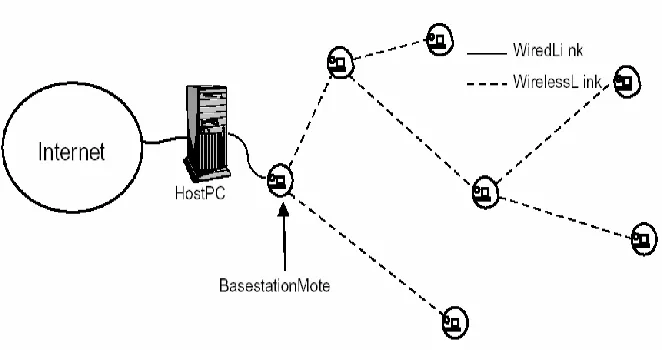
[image:18.612.144.475.156.331.2]A simple diagram will be as follows: [4]
Figure 1: Sensor Networks and Adversaries in action
2.2 Kind of Attacks [6] [15] [30] [31]:
The various kinds of attacks are as follows:
Jamming: interferences of radio frequencies
Spoofed, altered, or replayed routing information (flooding: Bombardment of messages by the invaders)
Drop, forge, modify, deletion of message packets Selective forwarding
Acknowledgement spoofing.
Some of them we will see in detail as follows:
2.2.1 Replay Attack:
Under this attack the adversary targets the routing information exchanged between nodes. It alters/ replays several times to create a loop to repel the network traffic. It may also generate false error messages, partition the network, increase end-to-end latency, etc.
2.2.2 Selective forwarding:
In a selective forwarding attack, malicious nodes may refuse to forward certain messages and simply drop them, ensuring that they are not propagated any further. An adversary interested in suppressing or modifying packets originating from a few select nodes can reliably forward the remaining traffic and limit suspicion of their wrongdoing.
2.2.3 Sink Hole Attack:
laptop class device can act as a very good sink hole. It should be noted that the reason sensor networks are particularly susceptible to sinkhole attacks is due to their specialized communication pattern.
2.2.4 Acknowledgement spoofing:
Several sensor network routing algorithms rely on implicit or explicit link layer acknowledgements. Due to the inherent broadcast medium, an adversary can spoof link layer acknowledgments for‗‗overheard‘‘packetsaddressedtoneighboring nodes. Goals include convincing the sender that a weak link is strong or that a dead or disabled node is alive.
2.2.5 HELLO flood attack:
Many protocols require nodes to broadcast HELLO packets to announce themselves to their neighbors, and a node receiving such a packet may assume that it is within (normal) radio range of the sender. This assumption may be false: a laptop-class attacker broadcasting routing or other information with large enough transmission power could convince every node in the network that the adversary is its neighbor.
2.2.6 The Sybil attack:
maintenance. Replicas, storage partitions, or routes believed to be using disjoint nodes could in actuality be using a single adversary presenting multiple identities.
2.2.7 Worm Hole Attack:
An adversary situated close to a base station may be able to completely disrupt routing by creating a well-placed wormhole. An adversary could convince nodes who would normally be multiple hops from a base station that they are only one or two hops away via the wormhole. This can create a sinkhole: since the adversary on the other side of the wormhole can artificially provide a high quality route to the base station, potentially all traffic in the surrounding area will be drawn through it if alternate routes are significantly less attractive. This will most likely always be the case when the endpoint of the wormhole is relatively far from a base station.
2.3 Security goals for Wireless Sensor Networks:
There are a number of important goals for a link layer security mechanism in sensor networks as described below:
2.3.1 Access control:
2.3.2 Message authenticity and integrity:
These are very closely related terms and should be understood clearly. Message authenticity means that the receiver node should be able to distinguish if the message packet is from the brother node or if it has been modified by an adversary. This modification is usually done when the message is in transit. Message integrity means that the message packet should be received the way it was sent and not modified. Both these concerns can be resolved by including a message authentication code with each packet.
2.3.3 Confidentiality:
Confidentiality means keeping information secret from unauthorized parties. It is typically achieved with encryption. Preferably, an encryption scheme should not only prevent message recovery, but also prevent adversaries from learning even partial information about the messages that have been encrypted. This strong property is known as semantic security.
2.3.4 Explicit omission:
amount of state that each recipient keeps. A common defense solution is to include an increasing counter with every message and reject messages with old counter values.
2.4 Platform (motes):
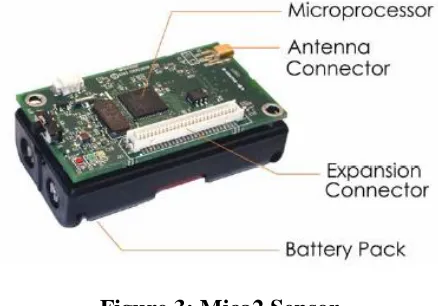
In this thesis we will see a representative sensor structure called mica2 and mica2dots. It is from the Crossbow Company [2]. The operating system is TinyOS about which we will discuss in detail later on.
The mica2 processor is an 8 bit, 7.3 mhz Atmel CPU with 128 Kb of instruction memory,
4 Kb of data ram and 512 kb of flash memory 1850 mAh capacity
[image:23.612.247.373.435.646.2]Low powered radio from Chipcon which has a range of 100 meters.
Figure 2: Block Diagram of Mica2 platform
Figure 3: Mica2 Sensor
Figure 4: Mica2 sensor board
The mica2dot has the following specifications: 1. Atmel processor
2. 4.0 MHz clock
3. 128 kB of Flash for program memory 4. 512 KB flash memory
[image:24.612.200.419.76.229.2]The block diagram of mica2 dot is as follows:
Figure 5: Block Diagram of Mica2 dot
2.5 Environment:
We used Cygwin which is Linux-like environment for Windows [3]. It is similar to dual boot operating systems except for the easy switch between windows and Linux emulation. It consists of two parts:
1) A DLL library (cygwin1.dll) which acts as a Linux API emulation layer providing the necessary Linux API functionality.
Chapter 3
TinyOS (Operating System for tiny devices)
TinyOS is the operating system for low power, scalable wireless embedded sensor networks. Two of its eminent features are open-source and component based framework. It is open source as the programmers can read, redistribute, and modify the source code. They can also improve and are welcome to discover and fix bugs. It features a
component-based framework for modular architecture and providing opportunity to improve the connectivity. Components are statically linked hence it enables rapid innovation and implementation. Also leads to code reusability. More on modularity will come in further sections. Needless to say minuscule code size is preferred as severe memory constraints are prevalent in sensor networks. TinyOS supports this and hence it is said to be light weight. The key elements are Networking / communication and power management.
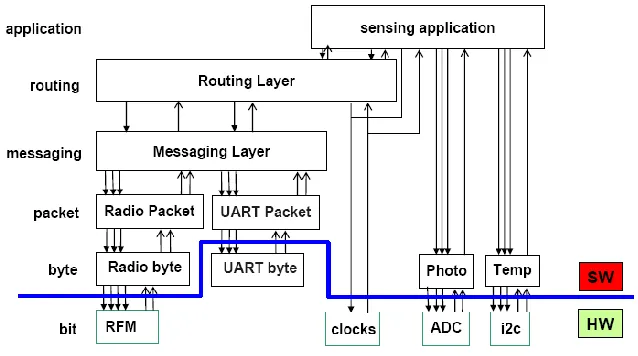
3.1 Does TinyOs have an ISO model?
Figure 6: TinyOs version of ISO Model
3.2 Architecture:
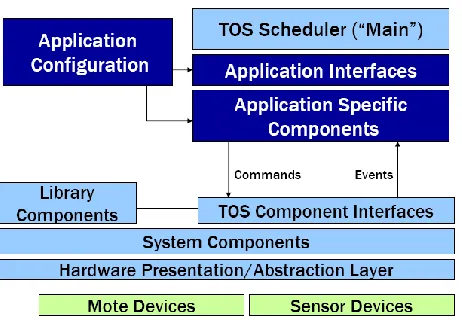
TinyOS has an Event-driven architecture. Some of the other important features are: 1. Single shared stack
2. No kernel in the traditional sense 3. No process/memory management 4. No virtual memory
Figure 7: TinyOs Layer Structure
3.3 Main Attraction – Memory Model of TinyOs:
In TinyOs the memory is allocated at run time, also the components are statically linked at compile time to determine the size requirement. The use of local variable is limited and when used is saved on stack. Use of global variable is more prevalent along with pointers to save memory.
3.4 Modularity of TinyOs:
As mentioned before TinyOs has modular structure. There are two kinds of components:
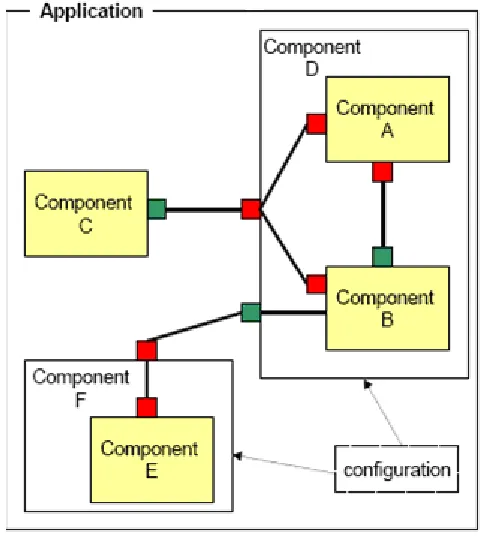
Figure 8: Configuration Wiring
The green interfaces provide the link and the red interfaces uses the links.
Figure 9: NesC component
3.4.1 More on NesC:
The code is written in NesC. The NesCoutputisa‗C‘programfilethatiscompiledand linked using gnu-gcctools for a specific Mote. The preprocessor does the conversion. The NesCfileextensionis―.nc‖.C stands for configuration. C distinguishes between the interfaces and components that provide it.
Figure 10: Configuration
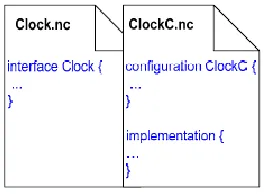
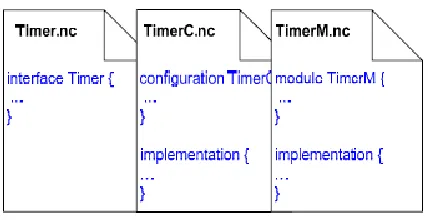
[image:30.612.240.372.479.576.2]Figure 11: Configuration and Module
3.4.2 NesC Jargon:
Interfaces Collection of events and commands Module Basic component implemented in NesC
Configuration Component made from wiring other components
Implementation Contains codes and variables for modules/ configuration Provides/ uses Defines /uses interfaces provided by component
As Alias interface to another name Call Execute the command
Signal Execute the event
Post Place task on execution queue
Task Computationally intensive low level job Async Commands/ events executed asynchronously Atomic Atomic (cant stop) execution of statement Norace Eliminates race conditions
[image:31.612.100.529.277.649.2]Figure 12: Blink Text
[image:32.612.226.377.281.472.2]Correlation:
Figure 13: Blink Diagram
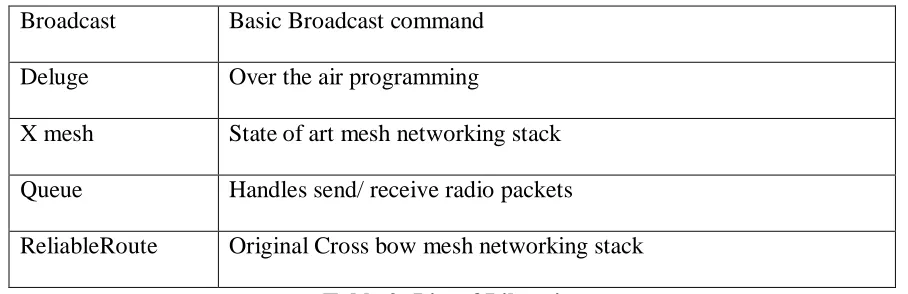
List of Libraries:
Broadcast Basic Broadcast command Deluge Over the air programming
X mesh State of art mesh networking stack Queue Handles send/ receive radio packets
[image:32.612.80.534.534.681.2]Chapter 4
TinySec: a link layer security implementation in hardware
TinySec[1] is a link layer architecture designed by a team of 3 dedicated individuals from the University of California, Berkeley. It is said to be the first fully-implemented link layer security architecture for wireless sensor networks. Some of the eminent features are:
1. Itiscalledlightweightbecauseitdoesn‘taddmuchoverheadunlike802.11, GSM, Bluetooth etc.
2. It is identified as a generic security package because it can be paired with other high level algorithms and be used as an open research platform for evaluating them. Also developers can easily integrate into other sensor network applications.
3. TinySec is portable to a variety of hardware and radio platforms. It also has a softwarecryptographicmoduleanddoesn‘tneedanyhardwareassistancelike Bluetooth, GSM etc.
4. TinySec can be used for secure pair wise communication in public key cryptography.
4.1 Why Link Layer security is needed?
the same change in environment parameters and send similar data to the base station. It will also increase the data length and use more energy.
4.2 TinySec design:
The following are the different operation modes of TinySec. It supports two different security options:
1) Authenticated encryption (TinySec-AE) and
2) Authentication only (TinySec-Auth).
With the first one: authenticated encryption, TinySec encrypts the data packet and authenticates the packet with a MAC. The MAC is computed after the data has been encrypted along with the packet header. In authentication only mode, the data is not encrypted but TinySec authenticates the entire packet with a MAC.
4.3 TinySec Packet Format:
(c)TinyOS Data Packet
Figure 14: Tinysec data Packet
The common fields are as follows: Dest: Destination address,
AM: active message type, it is similar to port numbers in TCP/IP. The AM type specifies the appropriate handler function to decrypt, extract and interpret the message on the receiver side.
Len: Length.
As observed these fields are unencrypted because it can be sent in that fashion and also it may lead to saving some save power as, a sensor node may go back to sleep mode after determining that the message is not addressed to it.
If the address and AM type are encrypted, early rejection cannot be invoked until after these fields are decrypted. This wastes power. Encrypting the length field adds little to security since the length of message can be inferred regardless.
To detect transmission errors, TinyOS senders compute a 16-bit cycle redundancy check (CRC) over the packet. The receiver re-computes the CRC during reception and
Dest (2) AM (1) Len (1) Data (0.29) CRC (2) Grp (1)
verifies it with the received CRC field. If they are equal, the receiver accepts the packet and rejects it otherwise. However, CRCs provide no security against malicious modification or forgery of packets.
To guarantee message integrity and authenticity, TinySec replaces the CRC with a MAC. The MAC protects the entire packet, including the destination address, AM type, length, source address and counter (if present), and the data (whether encrypted or not). This protects the data from tampering. It also prevents attackers from redirecting a packet intended for one node to another node, and prevents packet truncation and other attacks. Since MACs detect malicious changes, they also detect transmission errors, and TinySec does not require a CRC. The TinyOS packet format contains a group field to prevent different sensor networks from interfering with each other. It can be thought of as a kind of weak access control mechanism for non-malicious environments.
4.4 Using TinySec in TinyOS applications:
TinySec is fairly easy to apply to the traditional non-security communication stack. In order to enable TinySec, include to Makefile, “TINYSEC=true”, or in command line type:
“make platform_name_pc_mica_mica2 TINYSEC=true”
Example: Enabling TinySec default settings.
# add the following line in the Makefile
TINYSEC=true
COMPONENT=Blink
include ../Makerules
4.5 Different modes of operation in TinySec:
There are different modes of operation for transmission and receiving in TinySec. Please refer to Appendix.
4.5.1 Enabling TinySecMode:
In order to change the modes of operations, TinySecMode interface must be used which can be exported using the TinySecC component. Here are the steps to wire and setup.
a. Add―TINYSEC=true‖inMakefile
b. In the interface file (*.nc), export from TinySecC component the TinySecMode
interface.
c. Wire the module component to the TinySecC.
Example: Setting modes of operation in TinySec to transmission encrypt and authenticate and receiving authenticated only using the example program Blink. The Blink program just blinks the red led, and does not transmit or receive anything. This example
demonstrates how to wire and use the interface needed to enable TinySec.
Blink.nc configuration file:
configuration Blink {//1 Blink program
}
implementation {
components Main, BlinkM, SingleTimer, LedsC,
// 2) add TinySecC
TinySecC;
Main.StdControl -> SingleTimer.StdControl;
Main.StdControl -> BlinkM.StdControl;
BlinkM.Timer -> SingleTimer.Timer;
BlinkM.Leds -> LedsC;
// 3) Wiring
BlinkM.TinySecMode -> TinySecC.TinySecMode;
} // Blink
BlinkM.nc module file:
interface StdControl;
}
uses {
interface Timer;
interface Leds;
// 4) Add TinySecMode interface
interface TinySecMode;
}
}
implementation {
/**Initialize the component. @return Always returns <code>
SUCCESS </code> **/
command result_t StdControl.init() {
call Leds.init();
// 5) Setting modes of operation
call
TinySecMode.setTransmitMode(TINYSEC_ENCRYPT_AND_AUTH
);
call
TinySecMode.setReceiveMode(TINYSEC_RECEIVE_AUTH
ENTICATED);
return SUCCESS;
4.5.2 Key Management:
TinySec uses symmetric keys to encrypt and authenticate messages. When TinySec is first used a default key is created in a file called:
~/.tinyos_keyfile, which looks like this:
# TinySec Keyfile. By default, the first key will be
used.
# You can import other keys by appending them to the
file.
default A9FB5D03138166ABD1639B360E4263D4
When programming devices, from different computers, they must all have the same key-file.
WhenTinySecisenabled,theconceptof―groups‖nolongerexists.Themotes will only receive messages from motes that share the same key, which is enforced cryptographically.
4.5.3 Updating Keys:
TinySecControl enables the user to update TinySec keys and reset the initialization vector (IV), with these following commands:
command result_t updateMACKey(uint8_t * MACKey);
command result_t getMACKey(uint8_t * result);
command result_t updateEncryptionKey(uint8_t *
encryptionKey);
command result_t getEncryptionKey(uint8_t * result);
command result_t resetIV();
command result_t getIV(uint8_t * result)
To enable these commands TinySecControl interface must be used.
4.5.4 TinySec File:
TinySec files can be located under the directory:
/opt/tinyos-1.x/tos/lib/TinySec.
Example files using TinySec for communication can be found under the directory:
Chapter 5
Encryption and Security Primitive
This chapter is the most important as we will see the security modules.
5.1 MAC:
Earlier we had studied the security primitives for wireless security network such as message authenticity, integrity and confidentiality. Previous work has indicated that Message Authentication Code (MAC) can suffice the entire above said network needs. It is a secure checksum calculated with a cryptographic process. Under this the sender and receiver share a secret key. The sender node computes MAC over the data and appends to it. The receiver re computes the MAC (as it already knows the key) and compares the two MAC‘s.ThedataisacceptedifboththeMAC‘sareequal.Thebenefitisthattheenemy nodedoesn‘tknowthesecretMACkeysoeveniftheycanforge the data they can‘t compute the MAC and append to the data payload.
5.2 Initialization Vector:
also sent clearly with the data payload as it is used in the decryption process. The structure of IV is as follows:
Obviously :
Dst (2) : is the destination address AM (1): Active Message handler L (1): Length of data
Src (2): Source address
Ctr (2): Counter, it goes from 0 to 16
Tinysec uses 8 byte IV structure which is pre encrypted for better security. IV reuse is not a problem unless key updates are not made.
5.3 Encryption scheme:
Tinysec uses Cipher block chaining (CBC) as the encryption scheme. Firstly becauseitisdesignedtobeusedwithrandomIV‘s.Alsoencryptionof two plaintexts P, P‘withthesameIVunderCBCmode,willrevealonlythelength(inblocks)ofthe longestsharedprefixofPandP‘.ThatmeansCBCleaks only a small amount of information in the presence of repeated IVs. CBC is a kind of block cipher which operates on blocks typical 8 or 16 bytes. Also MAC protocol algorithms uses block structure hence blends well with CBC. Tinysec uses Skipjack for software implementation of block cipher.
5.4 Skipjack:
As mentioned before Skipjack [12] is the heart of operation for TinySec. We shall see the operational details and algorithm in detail now.
[image:44.612.134.490.211.389.2]Skipjack uses 80 bit crypto variable and has 4 modes of operation. One of those is cipher Block Chaining, which we shall see next. Here is the figure:
Figure 15: Cipher-Block Chaining Mode Diagram
Following sections defines the basic notational terminology:
5.4.1 Notation and terminology:
n
V : the set of all n-bit values.
word: an element of V16; a 16-bit value. byte: an element of V8; an 8-bit value.
Y
X : the bitwise exclusive-or of X and Y.
X Y: X concatenated with Y. Let X, Y be bytes, then
X Y X Y
8 2
is a word. Furthermore, X is the high-order byte, and Y is the low-order byte.
5.4.2 Basic structure:
SKIPJACK encrypts 4-word (i.e., 8-byte) data blocks by alternating between the two stepping rule (A and B) show below. A step of rule A does the following:
o G permutes w1,
o The new w1 is the xor of the G output, the counter, and w4
o word w2 and w3 shift one register to the right; i.e., become w3 and w4
respectively,
o The new w2 is the G output, o The counter is incremented by one.
Figure 16: SKIPJACK Stepping Rules
5.4.3 Stepping rules:
In the equations below, the superscript is the step number. ENCRYPT
Rule A Rule B
k k k k k counter w w G
w1 1 ( 1) 4 w1k 1 w4k
) ( 1 1 2 k k k w G
w w2k 1 Gk(w1k)
) ( 2 1 3 k k w
w w3k 1 w1k w2k counterk
) ( 3 1 4 k k w
w wk w3k
1 4
DECRYPT
Rule A-1 Rule B-1
) ( ] [ 2 1 1 1 1 k k k w G
w [ ] ( 2)
1 1 1 1 k k k w G w k k w w 3 1 2 1 3 2 1 1 1
2 [ ] ( )
Table 5: Encryptor & Decryptor
5.4.4 Stepping sequence:
The algorithm requires a total of 32 steps.
To encrypt: The input is
0 i w
, 1 i 4, (i.e., k = 0 for the beginning step). Start the counter at 1. Step according to Rule A for 8 steps, then switch to Rule B and step 8 more times. Return to Rule A for the next 8 steps, then complete the encryption with
8 steps in Rule B. The counter increments by one after each step. The output is
32 i w
, 4
1 i .
To decrypt: The input is is
32 i w
, 1 i 4, (i.e., k = 32 for the beginning step). Start the counter at 32. Step according to Rule B-1 for 8 steps, then switch to Rule A-1 and step 8 more times. Return to Rule B-1 for the next 9 steps, then complete the decryption with 8 steps in Rule A-1. The counter decrements by one after every step.
The output is
0 i w
, 1 i 4.
5.4.5 G-permutation:
Recursively (mathematically): Gk(w g1 g2) g5 g6 where
2 3
4
1 )
( i k i i
i F g cv g
g and where k is the step number (the first step is 0), F is the substitution table, and cv4k i 3 is the (4k + i-3)th byte in the cryptovariable schedule. Thus,
1 4 2
3 F(g cv ) g
g k
2 1 4 3
4 F(g cv ) g
g k
3 2 4 4
5 F(g cv ) g
g k
4 3 4 5
6 F(g cv ) g
g k
Similarly, for the inverse, [Gk] 5 6 1 2 1
)
(w g g g g where
i i
k i
i F g cv g
[image:48.612.114.497.394.633.2]g 2 ( 1 4 3) .
5.4.6 Cryptovariable schedule:
The cryptovariable is 10 bytes long (labeled 0 through 9) and used in its natural order. So the schedule subscripts given in the definition of the G-permutation are to be interpreted mod-10.
5.4.7 F Table:
The SKIPJACK F-table is given below in hexadecimal notation. The high order 4 bits of the input index the row and the low order 4 bits index the column. For example, F(7a) = d6.
Table 4: Sample F Table
Chapter 6
Elliptic Curve Cryptography
6.1 Introduction:
Elliptic curve systems as applied to cryptography were first proposed in 1985 independently by Neal Koblitz from the University of Washington, and Victor Miller, who was then at IBM, Yorktown Heights. Elliptic curve cryptography (ECC) is an approach to public-key cryptography based on the mathematics of elliptic curves. It provides fast decryption and digital signature processing. The main benefit of ECC is that under certain situations it uses smaller keys than other methods — such as RSA — while providing an equivalent or higher level of security. ECC uses points on an elliptic curve to derive a 163-bit public key that is equivalent in strength to a 1024-bit RSA key. Hence smaller number of keys lead to faster key operation and less memory need. It is said to be ideal for resource-constrained systems because it provides more "security per bit" than other types of asymmetric cryptography. One drawback, however, is that the implementation of encryption and decryption operations may take longer than in other schemes.
6.2 Motivation for using Elliptic Curve Cryptography:
2048 but in case of ECC: ECC-224 will be needed! In this section we will see the comparison between both and learn why ECC is better for the embedded sensor network as a public key algorithm. The energy analysis has been done on the Mica2dots[2], which is one of the popular research platforms for WSN. [10] It has been noted that the power required to transmit 1 bit is equivalent to roughly 2090 clock cycles of execution on the Mica2dot microcontroller. The cost of receiving one byte (28.6µJ) is roughly half of that required to transmit a byte (59.2 µJ). During transmit and receive, the microcontroller is powered on along with the wireless transceiver. The usual packet size is 32 for the payload and 9 bytes for the header. The header, ensuing a 8-byte preamble, consists of source, destination, length, packet ID, CRC, and a control byte. Receiving one 41-byte packet (including 8-byte preamble) costs 49*28.6uJ=1.40mJ and transmitting one 41-byte packet costs 49*59.2uJ=2.90mJ. To summarize:
6.3 Mathematics for RSA Vs ECC:
Verification of RSA is cheap but what makes it expensive is the signature for authentication. This is due to the fact that RSA-based key exchange protocol relies on party A to encrypt a randomly generated secret key with party B's public key, and party B decrypting the key using its private key. Now for ECC the signature
algorithm is called: Elliptic Curve Digital Signature Algorithm [ECDSA][11]. For ECDSA the signature and verification both are inexpensive. The transition from RSA-1024 to RSA-2048 the energy cost of signing increases by a factor of more than seven, while 224 signing is less than three times as expensive as ECDSA-160 signing. With ECC, both parties perform a single ECDH operation to derive the secret key. From [10]:
Table 5: Comparison chart for RSA and ECC
The above is measured in mille Joules.
Hence with the facts, figures and numbers we can clearly say that ECC is the better choice than the most popularly used encryption algorithm for WSN.
6.4 Asymmetric Cryptography as fine balance:
It has been claimed that public key cryptosystems are not feasible to
implement in these tiny devices because they are constrained with less resources but this is not true [33]. Asymmetric cryptography is a marvelous technology. Its uses are many and varied.
kind of network protocol or application requiring secure communications such as buying something on the Internet, when the vendor is using a secure server.
But asymmetric cryptography is demanding and complex, by nature. The hard problems in number theory — the key to the algorithms' functionality — are all intrinsically difficult.
Let‘s see some of the features of elliptic curve cryptography (ECC) and later see the justification so as to need this in the sensor networks.
1) ECC offers considerably greater security for a given key size
2) The smaller key size also makes possible much more compact implementations for a given level of security, which means faster cryptographic operations, running on smaller chips or more compact software. This means less heat production and less power consumption — all of which is of particular advantage in constrained devices, but of some advantage anywhere else.
3) There are extremely efficient, compact hardware implementations available for ECC exponentiation operations, offering potential reductions in implementation footprint even beyond those due to the smaller key length alone.
6.5 Why Asymmetric Cryptography?
Asymmetric cryptographic algorithms do not use a single key as in symmetric cryptographic algorithms such as AES, but a key pair. One of the keys (the public key) is used for encryption, and its corresponding private key must be used for decryption. The critical feature of asymmetric cryptography, which makes it useful, is this key pair — and more specifically, a particular feature of the key pair: the fact that one of the keys cannot be obtained from the other. In all asymmetric cryptosystems, as mentioned above, the key length is the parameter that determines how difficult both the forward and inverse algorithms are.
Hence, the inverse operation rapidly becomes more difficult as key length increases than does the forward operation.
6.6 Authentication with Asymmetric Cryptography:
In the case of asymmetric authentication methods there are two main entities: private key (in the possession of the entity wishing to prove its identity) and the public key (in the possession of anyone who wishes to verify the identity of the entity possessing the private key).
cannot solve — the problem of guaranteeing unique authentication and non-repudiation. Symmetric hashing/authentication methods — ones for which there is only one key, and both parties in the exchange use it both for authentication and for signature generation — have the distinct disadvantage that they do not, on their own, offer any way to distinguish which party to the exchange signed a given message. If both or all parties must know the key, based on cryptography alone, you cannot distinguish which signed any given message, because any of them could have. In asymmetric authentication schemes, only one party knows the private key, with which the message is signed. Any number may know the public key. Since the private key cannot be derived from the public, the signature serves as a unique identifier. If the message verifies as having been signed by the person with knowledge of the private key, we can narrow down who sent the message to one. But any number of people may have knowledge of the public key, and all of them can therefore verify the identity of the sender.
6.7 How are elliptic curves used?
The crucial property of an elliptic curve is that we can define a rule for "adding" two points which are on the curve, to obtain a 3rd point which is also on the curve. Having defined addition of two points, we can also define multiplication k*P where k is a positive integer and P is a point as the sum of k copies of P.
Alice, Bob, Cathy, David... agree on a secret) elliptic curve and a (non-secret) fixed curve point F. Alice chooses a secret random integer Ak which is her secret key, and publishes the curve point AP = Ak*F as her public key. Bob, Cathy and David do the same. Now suppose Alice wishes to send a message to Bob. One method is for Alice to simply compute Ak*BP and use the result as the secret key for a conventional symmetric block cipher (say DES).
Bob can compute the same number by calculating Bk * AP, since Bk*AP = Bk*(Ak*F) = (Bk*Ak)*F = Ak*(Bk*F) = Ak*BP.
Although the starting point and public key are known, it is extremely difficult to backtrack and derive the private key. An essential property for cryptography is that a group has a finite number of points.
6.8 The Diffie Hellman/DSA Cryptosystems and the Discrete Logarithm
Problem:
Diffie Hellman along with the Digital Signature Algorithm (DSA) based on it is another of the asymmetric cryptosystems in general use.
Diffie Hellman uses a problem known as the discrete logarithm problem as its central, asymmetric operation. The discrete log problem concerns finding a logarithm of a number within a finite field arithmetic system.
Prime fields are fields whose sets are prime that is, they have a prime number of members. These are of particular interest in asymmetric cryptography because, over a prime field, exponentiation turns out to be a relatively easy operation, while the inverse computing the logarithm is very difficult.
To generate a key pair in the discrete logarithm (DL) system, therefore, the calculation is as follows:
y=(gx)mod p
The discrete logarithm problem, using the values in the equation above, is simply finding x given only y, g and p.
Expanding that thought slightly: someone has multiplied g by itself x times, and reduced the result into the field (performed the modulo operation) as often as necessary to keep the result smaller than p. Now, knowing y, g and p, you're trying to find out what value of x they used.
It turns out that for large enough values of p, where p is prime, this is extraordinarily difficult to do — much more difficult than just finding y from g, x and p.
ECC defines its group differently. And it is, in fact, the difference in how the group is defined and particularly how the mathematical operations within the group are defined that give ECC its greater security for a given key size.
6.9 The Elliptic Curve Discrete Logarithm Problem:
The problem is computationally difficult unless the curve has a ``bad'' number of points over the given field, where the term ``bad'' encompasses various collections of numbers of points which make the elliptic curve discrete logarithm problem breakable. For example, if the number of points on E over F is the same as the number of elements of F, then the curve is vulnerable to attack. It is because of these issues that point-counting on elliptic curves is such a hot topic in elliptic curve cryptography.
The inverse operation to point multiplication finding a log in a group defined on an elliptic curve over a prime field is defined as follows: given points Q and P, find the integer k such that Q= kP.
This is the elliptic curve discrete logarithm problem and this is the inverse operation in the cryptosystem the one we effectively have to perform to get the plaintext back from the cipher text, given only the public key.
6.10 Elliptic curve groups [13]:
Many cryptosystems require the use of algebraic groups. Elliptic curves may
be used to form elliptic curve groups. A group is a set of elements with
custom-defined arithmetic operations on those elements. For elliptic curve groups, these
specific operations are defined geometrically. Introducing more stringent properties to
the elements of a group, such as limiting the number of points on an elliptic curve,
creates an underlying field for an elliptic curve group.
6.11 Implementation of ECC in NesC for Mica2: [14]
Up until now Tinysec implements symmetric key cryptography. In this section this thesis work depicts how asymmetric key cryptography can be implemented in these tiny devices.
[image:60.612.122.540.505.635.2]The code is in the following directory: /opt/tinyos-1.x/apps/EccM-2.0
EccM.nc:968: interface has no command or event named `get'
For higher version of TinyOs (greater than tinyos 1.1.0) the code has to be modified as follows:
// this is old SysTime
// call SysTime.get(&before);
// This line has to be replaced as follows
before = call SysTime.getTime32();
// this is old SysTime
// call SysTime.get(&after);
// This line has to be replaced as follows
after = call SysTime.getTime32();
Tofixthe―init‖problem,it needs to be commented out, since it gets automatically initiated.
// initialize clock
// result = rcombine(call SysTime.init(), result);
After these fixes, it should compile successfully on mica2 platform. The code then can be downloaded and tested on the mica2 hardware.
Figure 20: Installing Ecc on mica2dot (id # 1)
Figure 21: Installing Ecc on mica2dot (id # 2)
To run the demo on the two motes:
java net.tinyos.sf.SerialForwarder -comm serial@COM5:19200 –
no-gui
With the SerialForwarder backgrounded (or running in its own terminal), also the following has to be executed :
java Ecc
which will simply report to standard output any messages delivered to the UART on the programming board.
Turn both motes on, roughly simultaneously. The mote will turn on the yellow LED when the private/public keys are generated.
Here are the results for the ECC code from the window that was running
serialforwarder, which is a program written in java to the packets sent by the motes through the serial port:
$ java net.tinyos.sf.SerialForwarder comm serial@COM1:57600
Figure 22: Ecc result
In text format it is as follows: $ java Ecc
privKeyTime: 0.2384975889906269 pubKeyTime: 35.64787790540174 secKeyTime: 35.68060586769248
nxv1458@drwho3 /opt/tinyos-1.x/apps/EccM-2.0 $
The ECC code is known to be CPU intensive, and thus take a long time to generate the keys. During this time, events posted by other asynchronous events mightfilluptheTinyOS‘squeue.Duringthisdemo, timers were used to avoid this kind of problem and it is sufficient for demo purposes. As for real usage of this code, it is recommended by the author to use a cooperative threading mechanism for TinyOS such as one developed by Geoffrey Mainlands Fibers module.
6.12 Conclusion: ECCforPortableDevices,Applications…andfortheFuture
And this, in the end, is the reason ECC is a stronger option than the RSA and discrete logarithm systems for the future. The research shows that ECC is an excellent choice for doing asymmetric cryptography in portable, necessarily constrained devices.
As an example: as of this writing, a popular, recommended RSA key size for most applications is 2,048 bits. For equivalent security using ECC, a key of only 224 bits is needed. ECC also provides more security per bit and meets the constrained power demands of sensor devices [32].
The difference becomes more and more pronounced as security levels increase (and, as a corollary, as hardware gets faster, and the recommended key sizes must be increased). A 384 -bit ECC key matches a 7680-bit RSA key for security.
Chapter 7
Energy analysis:
To refresh Mica2/ Mica2dots have TinyOS as the operating system and TinySec as the security protocol. The security has been enhanced by implementing ECC.
Tinysecoperatesintwomodes:‗AE‘whichhas42bytesand‗A‘whichhas38bytes to send.
The energy equation for communicating over the distance r is as follows: e(r) = et(r) + er(r) [29] (from main thesis)
i.e. the energy spent is the sum total of energy spent is transmitting and receiving the data packets.
Note: in this document tx is used for transmitting and rx refers to receiving data. Even when the network is idle a certain non-zero level of power is radiated. Energy is spent in encrypting, decrypting, transmitting, receiving, buffering and processing.
Total p(r) = max {pmin , c.r } + prx
Here
= power loss in the path which multiplies by the distance pmin = minimum transmitter power
prx = fixed overhead for receiving data and
c = constant, function of transmitter distance from the base station
The current work has been implemented with ECC for 160 bit keys; the case scenario is as follows:
Laptop= base station Mica2= nodes
Here are the following formula has been used: Watt = Joules/ sec
= Volt * Ampere = Volt * Coulomb/Sec
Joules = Volt * Ampere * sec
From specification sheet ([2] – thesis page #80) the following is the current consumption:
Sensor board: (transmitting): 5mA Microprocessor: (transmitting): 6 mA Radio: (transmitting): 12 mA
Also after running the set up for ECC- 162 (result at page 66) time consumed is on an average= 35 sec for key generation for AE data packets. This experiment is forworstcasescenariotherefore,doesn‘tincludethepredeploymentorhardcoding of the key.
Hence, the energy calculation after running ECC (from page 66) is as follows:
At transmitting side (for Authentication encryption mode):
Energy consumed (Joules) = Key generation + energy used to transmit 42 bytes
+ signature
= 226.65 mJ [Ref: 36] + volt * (23 mA) * 35 secs + 134.2 mJ (constant for signing, irrespective of byte size)
By observation the volt (battery power) varies as a function of the distance between the transmitting and receiving entities. The mica2 uses 2 AA battery which provides 3v.
For calculation purpose and from experimental observation the volt is assumed to be 0.01 constant then the energy consumed during transmitting AE type of Tinysec data packet will be:
= .22665 + 0.01* .805 + .1342 -- Joules = .22665 + .00805 +.134
Energy consumed (Joules) = Key Verify + energy used to receive 42 bytes
= 196.23 mJ [Ref: 36] + volt * [(6+5) m A] * 35 secs = .19623 + 0.01 * .385 – Joules
= .1962 + .00385 = .2 J
There is no use of radio as the data is received in this case.
Also for the sleep mode in which the node may be residing is not considered. Considering it adds an overhead of the following [2]:
Microprocessor = 8 mA Radio = 2 mA
Sensor Board = 5 uA
Now for Authentication mode the data packet size reduces to 38 bytes. For Mica2 dots the numbers differ by the following [35]:
Energy to transmit: 59.2 microJ/byte Energy to receive: 28.6 microJ/byte
For transmitting:
Energy consumed (Joules) = Key generation + energy used to transmit 42 bytes + signature
For Receiving:
Energy consumed (Joules) = Key Verify + energy used to receive 42 bytes = 196.23 mJ+ 28.6 uJ * 42
= 196.23 mJ + 1.201 mJ = 197.43 mJ
Now for Authentication mode the data packet size reduces to 38 bytes.
7.1 Memory Overhead:
Typically nodes are deployed in thousands. In the current set up there are only 2 mica2 and 2 mica2 dots. Under pragmatic scenario for 10,000 nodes deployed each node will have 30 neighbors (for dense connection) with whom they have to share the key. If every node stores 30 keys of 192 bits, which will be way less than 1 Kbytes of RAM memory. This is the overhead for each node.
7.2 Comparison with RSA (asymmetric cryptography): [36]
Below is a comparison of energy spent (in mJ) for ECC with RSA for two different key lengths. As mentioned before RSA-1024 is equivalent to ECDSA -160 and RSA- 2048 is equivalent to ECDSA -224.
Algorithm Key Generation Signature - mJ Verify - mJ
RSA – 1024 270.13 304 11.9
Table 6: Comparison Table for ECC and RSA (Overhead)
7.3 Comparison with Symmetric Counter Part:
Although Symmetric key cryptographic systems are 2-4 times faster they require pre – distribution of keys and storage of n-1 keys. For e.g. for small network of say 1024 nodes the scheme with 128 keys will require 1024 * 128 = 16 Kbytes of Ram memory.
Even the random pair wise distribution where the secret keys stored are n * p where n is number of node and p is the probability of sharing key with other node. It is not scalable for big network system hence it gets worse.
7.4 Comparison with One Time Sensors: [35]
According to the commonly used scheme for one time sensors the nodes need to be pre loaded before deployment. It is loaded with single cryptographic key, node id and list of hashed values. For e.g for a big network of 10,000 nodes with 128 bit key value, 64 bit hash value the total Ram value will be around 80 Kbytes. For small network with ~ 1000 nodes the Ram value will be little over 8 Kbytes. Combining with another scheme even with storing the least significant bits of the Id the total ram value is 8 Kbytes.
mode (CFB), and output-feedback mode (OFB)) employ a feedback mechanism so that the encryption of a plain-text block is made dependent on the results of encryption of previous plain-text blocks. Due to the feedback mechanism, even for the same key, a given plain-text will not always map to the same ciphertext. In addition to variants due to operating mode considerations, there are variants of the basic DES algorithm such as DES-X. The corresponding energy consumption profile is plotted in figure below: [36]
Figure 23: Energy consumption for CBC and variants of DES
Proposed methods to reduce energy overhead are: 1. Alternate between sleep and idle modes
2. Synchronization using Virtual clustering of nodes on same sleep schedule. 3. Use of in-network signaling so that the neighbor nodes can go to sleep when
4. Transmission of data in store-forward format. Hence the data is sent in chunks and the nodes that have large chunks of data to be sent can access the channel.
Under this practice the nodes first listen for a certain amount of time. If there is no change in the environment and if none of the neighbors want to talk then it goes to sleep and puts a timer on itself to wake up later. It also switches off its radio. Also the nodes can synchronize with its neighbors so that they sleep and wake up at the same time. Nodes also exchange their schedule by broadcasting to its immediate neighbors. If a node receives the schedule from its neighbor before broadcasting its schedule then it adjusts its schedule accordingly. It is called a follower. In order to have collision avoidance the nodes have to contend for the medium. There is a duration field in each transmitted packet that indicates how long the transmission will be, hence it knows how long to sleep for. This can also help in the overhearing problem, so that the nodes know that the data is not meant for it.
with respect to the expected relay load, the network can maintain more uniform energy consumption. The cluster formation can either be static or dynamic. This can depend on various factors like energy remaining, distance from cluster head etc.
7.5 Analysis of models: [22]
Various models have been studied and devised for analyzing the networks. Two major categories are the Time based and Packet based models. Time based models analyzes the network in terms of time spent doing calculation, processing and how it can be reduced. The Packet based model analyzes how to make the packet size accommodate all necessary data and control information yet not over burden the nodes or for that matter the cluster head, this may also help in solving the hot-spot problem.
Analysis has also been done with [23] Network Models. They have been categorized into: Homogenous and Hybrid. Homogenous networks have similar kinds of nodes and they take turns in becoming the cluster head. Also they have similar processing power and sleep schedules. The deployment of these nodes can be either pre determined or random.
Much work has been done with traffic models. Two kinds of traffic models have been identified: Under Ad Hoc model: where nodes can be sender or receiver and they communicate one-to-one. Second kind: Sensor Traffic Model, in which all nodes are senders and they communicate to sink (cluster head).
Other models [24] suggest that the duty of being the cluster head should be rotated among the nodes which have relatively highly energy.
Conclusion
This thesis work gives a better understanding of the sensor networks in terms of their working environment, threats, attacks and security protocols. This work emphasized and brought out in light the security algorithm called Skipjack and enhanced it with Elliptic Curve Cryptography. The idea for ECC has been borrowed from Mathematics where the unique property of Elliptic curves have been used and proved that Asymmetric Cryptography can be implemented in these minuscule sensor devices. As observed it drains the battery supply but there has to be a trade off between the energy utilized and level of security threshold. This thesis work also described the energy consumption for all flavors and modes of tinysec with ECC and its overhead analysis when compared to symmetric techniques. Most of the modern sensors today operate on renewable energy source hence public key cryptography can be implemented in embedded sensor devices.
References
[1] ChrisKarlof,NaveenSastry,DavidWagner,―TinySec: a link layer security architecture for wireless sensor networks‖,Proceedings of the 2nd international conference on Embedded networked sensor systems, November 2004
[2] Crossbow Technology Inc., Processor/Radio Modules, http://www.xbow.com/
www.crossbow.com
[3] www.cygwin.com
[4] http://www.cis.upenn.edu/~lee/04cis640/slides1/TinyOS.pdf
[5] Xinkai Wang, Tieyan Li and Hongjun Wu,―Sensec User Manual‖Infocomm Security Dept. (ICSD) Institute for Infocomm Research (I2R) Sensor Network Flagship Project (SNFP: security part): Technical Report-TR v1.0
[7] A. Perrig, R. Szewczyk, J.D Tygar, V. Wen, and D.E Culler ―SPINS:Security Protocols for Sensor Networks‖,2002.SPINS:securityprotocolsforsensor networks. Wireless Network 8, 5 (Sep. 2002), 521-534.
DOI= http://dx.doi.org/10.1023/A:1016598314198
[8] C. K. Koc, "High-speed RSA implementation", Tech. Rep. TR 201, RSA Laboratories, November 1994.
[9]D.Hankerson,A.Menezes,S.Vanstone,―Guide to EllipticCurve Cryptography‖, Springer-Verlag New York, Inc. 2004. ISBN 0-387-95273-X.
[10] AS Wander,NGura,HEberle,VGupta,SCShantz,―Energy analysis of public-key cryptography for wireless sensor networks‖,Pervasive Computing and Communications, 2005. PerCom 2005. Third IEEE International Conference on 8-12 March 2005 Page(s):324 – 328: Digital Object Identifier
10.1109/PERCOM.2005.18
[11] D. Hankerson, A. Menezes, S. Vanstone, ―Guide to EllipticCurve
Cryptography‖, Springer-Verlag New York, Inc.2004. ISBN 0-387-95273-X.
[13] Book: Implementing elliptic curve cryptography, Author: Michael Rosing, Publisher: Greenwich: Manning, c1999 (Available in Wallace Library, RIT, NY, call #: (QA76.9.A25 R66 1999)
[14] Malan,D.J.;Welsh,M.;Smith,M.D,―A public-key infrastructure for key distribution in TinyOS based on elliptic curve cryptography‖.Sensor and Ad Hoc Communications and Networks, 2004. IEEE SECON 2004. 2004 First Annual IEEE Communications Society Conference on 4-7 Oct. Digital Object Identifier 10.1109/SAHCN.2004.1381904
[15] Karlof, C.; Wagner, D, ―Secure routing in wireless sensor networks: attacks and countermeasures‖, Sensor Network Protocols and Applications, 2003. Proceedings of the First IEEE. 2003 IEEE International Workshop on 11 May 2003
[16] Holger Karl and Andreas Willig. ―AShortSurvey of Wireless Sensor Networks.‖TKN Technical Report TKN-03-018, October 2003
[17] CharlieChiandMarecaHatler,―WirelessSensorNetworks:MassMarket Opportunities‖(Market Report), ON World Inc., Quarter 1, 2004,
[18] Chris KarlofandDavidWagner,―SecureRoutinginWirelessSensorNetworks: AttacksandCountermeasures,‖FirstIEEEInternationalWorkshoponSensor Network Protocols and Applications, May 2003.
[19] Wei Ye;Heidemann,J.;Estrin,D.,―An energy-efficient MAC protocol for wireless sensor networks‖,INFOCOM2002.Twenty-First Annual Joint Conference of the IEEE Computer and Communications Societies. 23-27 June 2002
[20] Duarte-Melo,E.J.;MingyanLiu;―Analysis of energy consumption and lifetime ofheterogeneouswirelesssensornetworks‖, Global Telecommunications Conference, 2002. GLOBECOM '02. IEEE Nov 2002
[21]Soro,S.;Heinzelman,W.B.;―Prolonging the lifetime of wireless sensor networks via unequal clustering‖ParallelandDistributedProcessing Symposium, 2005. Proceedings. 19th IEEE International, 4-8 April 2005
[22] Dong,Q,―MaximizingSystemsLifetimeinWirelessSensorNetworks‖, Information Processing in Sensor Networks, 2005. IPSN 2005. Fourth International Symposium on 15 April 2005 Page(s):13 - 19
[24] M.GrossglauserandD.Tse;‖Mobilityincreasesthecapacityofad-hoc wireless networks.‖IEEE INFOCOM 2001, April 2001
[25] P. Gupta and P. Kumar. Critical power for asymptotic connectivity in wireless networks. In Stochastic Analysis, Control, Optimization and Applications: A Volume in Honor of W.H. Fleming, W.M. McEneaney, G. Yin, and Q. Zhang (Eds.) Birkhauser, Boston, 1998.
[26] http://searchsmb.techtarget.com/sDefinition/0,,sid44_gci499861,00.html http://en.wikipedia.org/wiki/Duty_cycle
[27] http://www.certicom.com/index.php?action=ecc,home
[28] J.L.Gao,―AnalysisofEnergyConsumptionforAdHocWirelessSensor Networks Using a Bit-Meter-per-JouleMetric‖Page42-150 from Mission Architecture Section. Jet Propulsion Laboratory, California Institute of Technology.
[30] Jing Deng, Richard Han,Shivakant Mishra, ―DefendingAgainstTrafficAnalysis AttacksinWirelessSensorNetworks‖,in13th USENIX Security Symposium, (Poster), San Diego, CA, August, 2004.
[31] Alexander Becher, Zinaida Benenson, Maximillian Dornseif,―Tampering with Motes: Real-World Attacks on Wireless Sensor Networks‖ in Proceedings of SPC 2006.
[32] http://www.certicom.com/index.php?action=sol,sensor_overview
[33] J. AbrahamandK.S.Ramanathan,―Security Protocols for Wireless Sensor NetworksbasedonTinyDiffusionandEllipticCurves‖inProceedings of Network and Communications Systems -2006.
[34] Malan,D.J.;Welsh,M.;Smith,M.D.;‖A public-key infrastructure for key distribution in TinyOS based on ellipticcurvecryptography‖,Sensor and Ad Hoc Communications and Networks, 2004. IEEE SECON 2004. 2004 First Annual IEEE Communications Society Conference on 4-7 Oct. 2004
Conference on 8-12 March 2005
Appendix
1) The system specifications for message format are as follows:
Specifications Value units
Msg Size 40 bytes
Msg Preamble 16 bytes
Baud Rate 38400 baud
Duty Cycle 0.5 %
# of msgs to rcv/re-xmit during wake time
[image:89.612.182.450.209.404.2]5 msg
Table 7: Message Format for Energy Overhead
2) Transmit mode:
command result_t setTransmitMode( argument );
Different modes of operation for transmit
Mode Argument Description