REVI E W
Open Access
The effect of non-steroidal
anti-inflammatory drugs on the osteogenic
activity in osseointegration: a systematic
review
Jie Denny Luo
1, Catherine Miller
2, Tamara Jirjis
1, Masoud Nasir
1and Dileep Sharma
1*Abstract
Non-steroidal anti-inflammatory drugs are commonly used in implant dentistry for management of post-operative pain. The objective of this systematic review was to analyse the effect of non-steroidal anti-inflammatory drugs on the osteogenic activity of osteoblasts with an emphasis on its effect on osseointegration. A systematic literature search for in vitro, animal models, and clinical trials was conducted using Ovid, PubMed, Scopus, and Web of Science databases. Articles published since the introduction of selective COX-2 inhibitors, between January 1999 and July 2018, were selected. The integrated search followed the PRISMA statement with the following key terms: non-steroidal anti-inflammatory drug/s, titanium, osseointegration, and osteoblast. The review is registered at PROSPERO database: CRD42016051448. The titles and abstracts of each research article in the initial search (n= 875) were independently screened by two reviewers. A third independent reviewer reviewed the articles that were included by one but excluded by the other reviewer. This resulted in the cataloguing of 79 full-text manuscripts where the articles were assessed for the following criteria: the study investigates the effects of NSAIDs on
osteoblasts, explores the COX pathway and its effect on osteogenic activity, and compares the effects of NSAIDs on osteoblasts with a control group. A total of 13 articles have been included for qualitative synthesis. There is a lack of consensus in the literature to explicitly conclude that there is a relationship between the use of post-operative NSAIDs and failed osseointegration; however, osseointegration does not appear to be negatively affected by NSAIDs in the human clinical studies.
Keywords:Non-steroidal anti-inflammatory drug, Osseointegration, Osteoblast, Dental implant
Review Introduction
Non-steroidal anti-inflammatory drugs (NSAIDs) are a group of drugs with inflammatory, analgesic, and anti-pyretic effects. They are commonly used in dentistry for management of dental pain associated with inflammation. NSAIDs exert their effects through the inhibition of the cyclooxygenase (COX) enzyme, therefore interfering with the synthesis of prostaglandins (PG) and thromboxanes; PGs and thromboxanes are inflammatory mediators that are responsible for pain. COX has three isoforms: COX-1,
COX-2, and COX-3. COX-1 exhibits characteristics of a constitutive enzyme, as its activity is associated with the involvement of PGs and thromboxanes in controlling normal physiological functions [1]. COX-2 exhibits charac-teristics of an inducible enzyme in inflammatory cells and is activated in response to pathological stimuli [2]. COX-3 is a variant of COX-1, though it shares the characteristics of both COX-1 and COX-2. The osseointegration process that is observed after implant insertion can be compared to bone fracture healing through the process of an inflamma-tory response in which the recruitment of osteoprogenitor cells occurs, followed by their downstream differentiation into osteoblasts that leads to bone deposition on the implant surface [3,4]. COX-1 is expressed in normal bone and at the site of bone fracture, whilst COX-2 is
* Correspondence:[email protected]
1College of Medicine & Dentistry, James Cook University, 14-88 McGregor
Road, Smithfield, QLD 4878, Australia
Full list of author information is available at the end of the article
upregulated during inflammation and the initial stages of bone repair [5]. The effects of NSAIDs on altering bone growth, remodelling, and repair are generally not consid-ered when prescribed for post-operative pain management after implant placement.
Hypoxia occurs locally in bone tissues when pathological conditions such as implant placement and bone fractures arise [6,7]. It has been established, through clinical studies of bone cultures, that hypoxia is directly responsible for directing the synthesis of prostaglandin E (PGE) by osteo-blasts [6]. Therefore, the presence of the COX enzymes in bone healing is of importance [6]. Prostaglandins have the capacity to influence bone metabolism and can both induce and inhibit tissue repair mechanisms [6]. Local administra-tion of PGE1 has been shown to stimulate bone formaadministra-tion, increase alveolar bone height, and induce formation of new cementum and periodontal ligament adjacent to the site of delivery in canine mandibles [8,9]. Furthermore, PGE2 has been shown to stimulate replication and differentiation of osteoblasts cultured on smooth titanium surfaces thereby increasing bone formation around titanium implants [10]. Additionally, PGs can also inhibit the formation and growth of osteoblasts [6]. Therefore, altered PG levels as a result of COX inhibition can have a negative impact on the role of PG in bone tissue, potentially causing a shift in pre-cursor cell action towards bone resorption [6].
Cyclooxygenases have an important role in the production of PGs where these enzymes in bone tissues
show increased activity under the influence of
hypoxia-inducible factors [6,11]. Therefore, local activity of COX enzymes promotes bone formation and resorp-tion through the producresorp-tion of PGs [12]. Non-selective NSAIDs are reported to inhibit the activity of COX-1 equally, if not more than COX-2 [2]. Therefore, NSAIDs inhibit the production of PGs at the site of implant placement or fracture, thereby influencing the bone
healing cascade [13]. There is evidence from animal
studies that indicate that COX-2 inhibitors delay done healing in diaphyseal fracture models in rats [13]. How-ever, the exact roles of COX-1 and COX-2 in the PG production has not been ascertained in humans, and assumptions have been made suggesting a milder or non-significant inhibitory effect of selective COX-2 inhibitors on bone healing when compared to a
non-selective COX inhibitor [2, 13]. Furthermore, a
systematic review conducted by Marquez-Lara et al. highlighted the great variability regarding the impact of NSAIDs on bone healing, and that there is no consensus regarding the impact of NSAIDs following orthopaedic procedures [14]. Therefore, the rationale of the present systematic review is to address the gaps in the literature by identifying if variables such as the dosage, duration of administration, and selectivity of post-operative NSAIDs negatively affect osseointegration.
Material and methods
Protocol and registration
The systematic review was conducted in accordance with the Preferred Reporting Items for Systematic Reviews and
Meta-Analyses (PRISMA) statement [15]. The review is
registered at PROSPERO database, and the review protocol
can be accessed athttp://www.crd.york.ac.uk/PROSPERO/
display_record.php?ID=CRD42016051448.
The PROSPERO registration number is CRD4201605 1448.
Eligibility criteria
The review included in vitro, clinical and in vivo studies; animal models. Articles published since the introduction of selective COX-2 inhibitors in 1999 were included [3]. Studies published outside this time period, not in the Eng-lish language, non-peer reviewed, and review studies were excluded.
Information sources
An electronic search into four databases: Ovid, Pubmed, Scopus, and Web of Science was performed to sys-tematically identify the available literature. Articles published between January 1, 1999, and July 7, 2018, were considered.
Focus question
The focus question, used to guide the search strategy, according to the PICO schema is“Will variables such as the dosage, duration of administration, and selectivity of post-operative NSAIDs impair the bone healing around titanium implants?”
Search strategy
The search string comprised the combination of medical subject headings (MeSH) and free keywords. The linkage was conducted using the Boolean operator (AND, OR). The choice of keywords was intended to be broad to maximise the number of relevant studies considered. The following search strategy was applied to Ovid and PubMed:
1) (anti inflammatory agents, non steroidal[MeSH Terms]) AND osseointegration[MeSH Terms] 2) (anti inflammatory agents, non steroidal[MeSH
Terms]) AND osteoblast[MeSH Terms] 3) (anti inflammatory agents, non steroidal[MeSH
Terms]) AND dental implants[MeSH Terms]
Furthermore, the following search strategy was applied to Scopus and Web of Sciences to supplement records identified through Ovid and PubMed:
inflammatory drug OR non steroidal anti inflammatory drugs OR cyclooxygenase inhibition OR COX inhibition OR ibuprofen OR celecoxib) AND (osseointegration OR osteoblast OR osteoblasts OR titanium implant OR ti-tanium implants OR dental implant OR dental implants)
Study selection
The titles and abstracts of each research article in the ini-tial search were independently screened by the primary (JDL) and the second reviewer (TJ). A third independent reviewer (MN) reviewed the articles that were included by one but excluded by the other reviewer. The full-text manuscripts of the articles were catalogued in accordance to the“Eligibility criteria”section as mentioned above and were assessed for the following criteria:
The study explored the COX pathway and its role in
osseointegration.
The effects of NSAIDs on osteoblasts attached to
titanium are investigated (in vitro studies).
Data collection process
The full-text manuscripts of included studies were catalo-gued into in vitro, clinical, and in vivo studies. The data from the included studies were independently extracted by the primary (JDL) and the second reviewer (TJ) according to the“Data items”section as listed below. Disagreements or uncertainties were discussed with the third reviewer (MN) until an agreement was reached.
Data items
The data collected from the included studies were ar-ranged in the following fields:
Author (year)—reveals the author/s and year of publication
Sample (size)—describes the sample and sample size used in the study
Treatment group (size)—describes the treatments
used in study
Methodology—describes the method of drug
delivery
Parameter—describes the parameter/s that are measured
Outcome—describes the outcome/s of the
experiments
Quality and risk of bias in individual studies
The quality and risk of bias assessments were performed independently by two reviewers (JDL and TJ) during the data extraction process. Any disagreements or uncertain-ties were discussed with the third reviewer (MN) until an agreement was reached. The quality and bias assessment for all studies addressed various bias domains. A Modified
CONSORT checklist of items for reporting in vitro studies of dental materials outlined by Faggion (Tables 1 and 2) was used to assess quality and risk of bias of included in vitro studies [16]. The Cochrane Collaboration’s Tool (Table 3) was used to assess quality and risk of bias of included human clinical studies [17]. A quality assessment
of the methodology of the animal studies (Table 4) has
been performed according to items (Table 5) of the
ARRIVE guidelines [18].
Synthesis of results
The relevant data collected for qualitative synthesis are summarised in three critical analysis tables: in vitro studies (Table 6), clinical studies (Table 7), and in vivo studies (Table8).
Statistical analysis
No meta-analyses could be performed due to the hetero-geneity between the studies—different samples, experi-mental groups (drugs and concentrations), study models, and outcome measures.
Results
Study selection
The electronic search in the databases of Web of Science, PubMed, Ovid, and Scopus resulted in the identification of 875 potential titles and abstracts. After removal of the duplicates, independent screening of the abstracts resulted in the selection of 79 studies for assessment of eligibility. A total of 13 studies were eligible and are included in the systematic review (Fig.1).
Exclusion of studies
The eligibility and study selection criteria as mentioned above were applied to the 79 full-text articles. A total of 66 studies were excluded after a full-text assessment for the following reasons:
The study did not explore the role of COX pathway
in osseointegration (n= 26).
The effects of NSAIDs on osteoblasts were not
investigated on titanium (n= 24).
The study was a systematic review (n= 16).
Study characteristics
The included studies were catalogued into three groups characterised by the type of study: in vitro studies (Table 6), clinical studies (Table 7), and in vivo studies
(Table 8). The cataloguing provided a clearer
Quality and risk of bias assessment
The quality and risk of bias assessments of included studies are summarised in Tables 1, 2, 3, 4, and 5. The quality assessment revealed a high risk of bias (for one or more domain) for most of the included studies. The included in vitro studies had high risk of bias according
to the Modified CONSORT checklist [16, 19, 20]. One
clinical study was classified as unclear risk of bias (for one or more domain) according to the Cochrane Collab-oration’s Tool [17, 21]. An in vivo animal study had an
unclear risk of bias according to the ARRIVE guidelines [18,22].
Discussion
Non-steroidal anti-inflammatory drugs are widely used in clinical dentistry to manage post-operative inflammation and pain. Two systematic reviews have been performed to review the literature concerning the possible influence of NSAIDs on the osseointegration of titanium implants: a review conducted by Gomes et al. concluded that osseoin-tegration is impaired in the presence of conventional NSAIDs, whilst the review conducted by Kalyvas et al. concluded that short-term post-operative NSAIDs do not appear to negatively impact osseointegration [3, 4]. Des-pite these conflicting conclusions regarding post-operative use of NSAIDs, both Gomes et al. and Kalyvas et al. agreed that prolonged or long-term use of NSAIDs, par-ticularly in patients with chronic diseases, impaired osseointegration and, therefore, reduced the success of implant surgery [3, 4]. The current review extends on these existing reviews by identifying if dosage, duration of administration, and selectivity of post-operative NSAIDs impair osseointegration.
In vitro studies
The effects of NSAIDs on the osteogenic activity of oste-oblasts have been extensively studied at the molecular
pharmacological level [23]. However, only two studies
have been identified that investigated the effect of NSAIDs on osteoblasts attached to titanium surfaces (Table 6). In the study conducted by Boyan et al., their results demonstrated that a non-selective COX inhibitor
(indomethacin, 0.1 μM), a selective COX-1 inhibitor
(resveratrol, 1 and 10 μM), and a selective COX-2
in-hibitor (NS-398, 1 and 10μM) did not have a significant effect on the number of cells derived from human
osteo-sarcomas [20]. Furthermore, Boyan et al. demonstrated
that the NSAIDs reduced prostaglandin E2(PGE2)
pro-duction of cells attached to a rough titanium surface. Their results indicated that both COX-1 and COX-2 are involved in the production of osteocalcin, PGE2, and TGF-β1 by osteoblasts [20]. They also demonstrated that osteoblasts produced increased levels of PGE2 on rough titanium surfaces and that this was correlated with in-creased alkaline phosphatase activity and osteocalcin
production [20]. This suggests that PGE2 may have a
[image:4.595.59.539.100.142.2]role in osteoblast proliferation and differentiation on ti-tanium surfaces, and that this favourable effect of PGE2
Table 1Quality assessment of in vitro studies according to the items of the Modified CONSORT checklist [16]
Study 1 2 3 4 5 6 7 8 9 10 11 12 13 14 Summary assessment
Arpornmaeklong et al. [19] + ? + + – – – – n/a + + – + – High
Boyan et al. [20] + + + + – – – – n/a + + – + – High
Key: (+) = low risk of bias, (?) = unclear risk of bias, (−) = high risk of bias
Table 2Modified CONSORT checklist of items for reporting in
vitro studies of dental materials [16]
Item Domain
1 Abstract: structured summary of trial design, methods, results, and conclusions
Introduction
2 Scientific background and explanation of rationale with specific objectives and/or hypotheses
Methods
3 Intervention: the intervention for each group, including how and when it was administered, with sufficient detail to enable replication
4 Outcomes: completely defined, pre-specified primary and secondary measures of outcome, including how and when they were assessed
5 Sample size: how sample size was determined
6 Randomisation: method used to generate the random allocation sequence
7 Allocation: mechanism used to implement the random allocation sequence, describing any steps taken to conceal the sequence until intervention was assigned
8 Implementation: who generated the random allocation sequence, who enrolled teeth, and who assigned teeth to intervention
9 Blinding: if done, who was blinded after assignment to intervention and how
10 Statistics: statistical methods used to compare groups for primary and secondary outcomes
Results
11 For each primary and secondary outcome, results for each group, and the estimated size of the effect and its precision
Discussion
12 Trial limitations, addressing sources of potential bias, imprecision, and, if relevant, multiplicity of analyses
Other information
13 Sources of funding and other support role of funders
[image:4.595.56.293.325.717.2]was inhibited when a NSAID was present [20]. Arpom-maeklong et al. found that a non-selective COXinhibitor
(indomethacin, 0.1 μM) and a selective COX-2 inhibitor
(celecoxib, 1.5, 3.0, and 9.0μM) inhibited the growth of cell cultures derived from rat calvarias, where the effect was dose-dependent in the cultures treated with
cele-coxib [19]. Furthermore, Arpommaeklong et al.
demon-strated that PGE2 levels were significantly lower in the groups that were treated with a NSAID, and have postu-lated that PGE2, consistent with Boyan et al., may have a role in osteoblast growth and differentiation [19,20].
Clinical studies
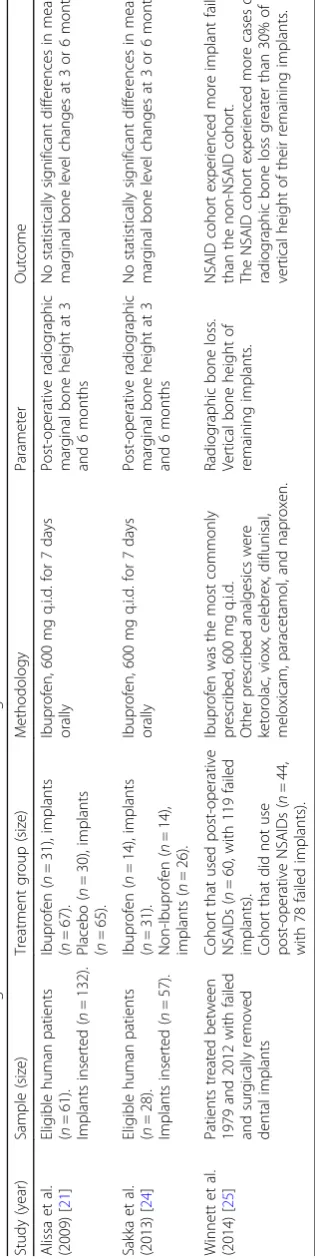
The clinical evidence demonstrating the effects of NSAIDs on the osseointegration of titanium dental im-plants is limited with only two clinical trials and one retrospective study identified in the database searches (Table 7). In the clinical trial conducted by Alissa et al., the effect of a 7-day post-operative course of ibuprofen (600 mg, taken four times daily) on the marginal bone level around dental implants was investigated [21]. They found that there were no statistically significant differ-ences between the treated and placebo groups in the mean marginal bone level around dental implants at 3 and 6 months after implant placement [21]. In a similar clinical trial conducted by Sakka et al., the effect of a 7-day course of ibuprofen (600 mg, taken four times daily) on the marginal bone level around dental implants was also investigated [24]. They found that there were no significant differences between the ibuprofen and non-ibuprofen groups, consistent with the findings of Alissa et al., when comparing the changes in marginal
bone level around dental implants [24]. However, a
retrospective study conducted by Winnett et al. postu-lated that the adverse biological events following dental implant placement were associated with perioperative use of NSAIDs [25]. Winnett et al. reported a total loss of 197 dental implants due to failed osseointegration from patients with failing implant/s (468 implants in 104 patients) treated in a postgraduate dental clinic (between
1979 and 2012). The patients (n= 60) that used NSAIDs
peri-operatively experienced a total of 119 failed
implants, whilst the non-NSAID cohort (n= 44)
experi-enced a total of 78 failed implants. Winnett et al. identi-fied that ibuprofen (600 mg, taken four times daily) was
the most commonly prescribed; however, other
prescribed NSAIDs included Ketorolac, Vioxx, Celebrex,
Diflunisal, Meloxicam, and Naproxen [25]. Despite the
clinical trials conducted by Alissa et al. and Sakka et al.,
both of whom have demonstrated that a 7-day
post-operative course of ibuprofen (600 mg, taken four times daily) did not significantly affect bone levels around dental implants at 3 and 6 months after placement, the data gathered by Winnett et al. indicates that NSAIDs may have detrimental effect on osseointegration [25].
Animal studies
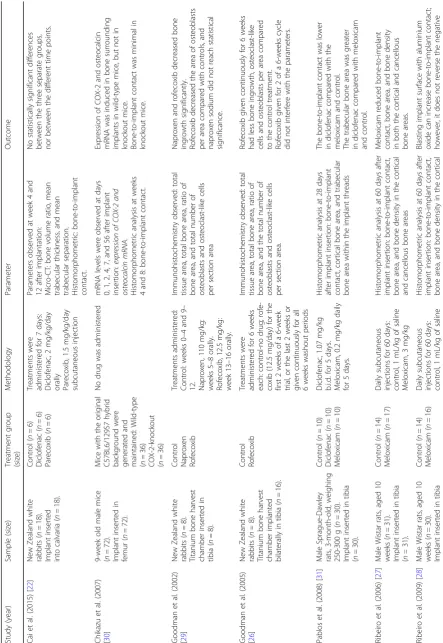
The influence of NSAIDS on bone healing in animal models has been shown to be related to the duration of treatment and drug selectivity [5]. A total of seven stud-ies were identified that investigated the effect of NSAIDs on the osseointegration of titanium implants in animals: mice, rabbits, and rats (Table8).
[image:5.595.55.539.101.164.2]The duration of treatment is a factor to consider when using NSAIDs, and a study conducted by Goodman et al. investigated the effect of a selective COX-2 inhibitor
Table 3Quality and bias assessment of human clinical studies using The Cochrane Collaboration’s Tool [17]
Study Random sequence generation
Allocation concealment
Blinding of
participants/personnel
Blinding of outcome assessment
Incomplete outcome data
Selective reporting
Summary assessment
Alissa et al. [21] + + + ? + + Unclear
Sakka et al. [24] – – – + + + High
Winnett et al. [25] n/a – – – ? + High
Key: (+) = low risk of bias, (?) = unclear risk of bias, (−) = high risk of bias,n/a= not available
Table 4Quality assessment of the methodology of the animal studies according to the items of the ARRIVE guidelines [18]
Study 5 6 7 8 9 10 11 12 13 Summary assessment
Cai et al. [22] + ? + + ? ? ? + + Unclear
Chikazu et al. [30] + – + + – – ? + + High
Goodman et al. [29] ? + + + – ? – + + High
Goodman et al. [26] ? + + + – ? – + + High
Pablos et al. [31] + ? + + – – ? + + High
Ribeiro et al. [27] + ? + + – – ? + + High
Ribeiro et al. [28] + ? + + – – ? + + High
Salduz et al. [32] – + + + ? – + + + High
[image:5.595.58.538.597.724.2](rofecoxib, 12.5 mg/kg/day) administered for 6 weeks on bone growth in a bone harvest chamber during three different time periods: initial 2 of the 6 weeks, final 2 of
the 6 weeks, and continuously for 6 weeks [26]. The
bone harvest chamber was a titanium device that was implanted into the tibia of rabbits and had an inner re-movable core with canals that allowed for bone ingrowth into the inner chamber. Their results revealed that rofe-coxib given continuously for 6 weeks significantly re-duced bone ingrowth and osteoblasts per area compared with the control (no treatment), whilst rofecoxib given for 2 weeks did not appear to interfere with bone
in-growth and number of osteoblasts [26]. Furthermore,
the studies conducted by Ribeiro et al. investigated the
effect of long-term administration (60 days) of a select-ive COX-2 inhibitor (meloxicam, 3 mg/kg/day) on the bone growth on a titanium implant [27, 28]. Their re-sults also indicated that long-term use of a selective COX-2 NSAID significantly reduces bone-to-implant contact, bone area, and bone density, ultimately leading to failed osseointegration [27]. The data gathered in both studies suggest that duration of treatment is an important factor in the use of selective COX-2 NSAIDs, as short pe-riods of rofecoxib and meloxicam did not adversely affect osseointegration [26,27].
The COX selectivity of NSAIDs and their interference with prostaglandin synthesis have been shown to inhibit
bone healing [23]. Goodman et al. performed a
follow-up study where the titanium bone harvest cham-ber was again implanted into the tibia of rabbits and the rabbits were treated with water (control), a non-selective COX inhibitor (naproxen, 110 mg/kg/day), or a selective COX-2 inhibitor (rofecoxib, 12.5 mg/kg/day) for a
4-week period [29]. Their results again demonstrated
that COX-2 inhibition significantly decreased bone in-growth, where rofecoxib also decreased the number of osteoblasts per area [29]. Furthermore, the conclusions by Goodman et al. were supported by the study by Chi-kazu et al. where titanium implants were inserted in
wild-type and COX-2-knockout mice [30]. Their results
[image:6.595.56.291.99.248.2]revealed that the expression of COX-2 was induced in bone surrounding the implants in wild-type mice, but not in COX-2-knockout mice and that the bone-to-implant
Table 5Items of the ARRIVE Guidelines [18]
Item Domain
5 Ethical statement
6 Study design
7 Experimental procedures
8 Experimental animals
9 Housing and husbandry
10 Sample size
11 Allocating animals to experimental groups
12 Experimental outcomes
13 Statistical analysis
Table 6In vitro studies that investigated the effect of NSAIDs on osteoblasts attached to titanium surfaces
Study (year) Sample Treatment group Methodology Parameter Outcome
Arpornmaeklong et al. (2009) [19]
Mouse calvaria cell line (MC3T3-E1)
Indomethacin 0.1μM Celecoxib 1.5μM Celecoxib 3.0μM Celecoxib 9.0μM Control
Incubation in treatment medium for 5 days. Investigations were performed in three experimental phases: static, log, and plateau
The following parameters were assessed at 1, 3, and 5 days: cell attachment, cell growth, cell differentiation, secretion of PGE2
Cells were able to grow and attach to titanium surface for all treatment groups. Indomethacin and celecoxib cell growth on days 3 and 5 in static phase and on day 3 in log phase.
Indomethacin and celecoxib caused a significant decrease PGE2 concentration in static and plateau but not log phases.
Boyan et al. (2001) [20]
Human osteosarcoma cell line (MG63)
Indomethacin 0.1μM Resveratrol 1μM Resveratrol 10μM NS-398 1μM NS-398 10μM
Incubation in treatment medium for 5 days. Cells were cultured on tissue culture plastic, smooth titanium, and two rough titanium surfaces: grit-blasted/acid-etched and titanium-plasma sprayed
The following parameters were assessed after 5 days: osteocalcin content, PGE2 content, and TGF-β1 content.
Indomethacin, resveratrol, and NS-398 had no effect on osteocalcin content. Indomethacin and resveratrol blocked PGE2 production. NS-398 had no effect on PGE2 production on smooth surfaces but caused a reduction on rough surfaces.
[image:6.595.57.541.463.732.2]Table
8
In
vivo
studies
using
animal
models
that
investigated
the
effect
of
NSAIDs
on
oss
eointegration
(Continued)
Study
(year)
Sampl
e
(size
)
Treat
ment
group
(size
)
Method
ology
Para
meter
Outcom
e
(n
=
30).
Melox
icam,
3
mg
/kg
and
cance
llous
bon
e
area
s
effect
s
cause
d
by
a
selective
COX-2
inh
ibitor
on
bone
healing
around
im
plants.
Saldu
z
et
al.
(201
7)
[
32
]
New
Zealand
white
rabbits,
skeletally
mature
we
ighing
3.5
–
4k
g
(n
=
40).
Titani
um
rods
im
planted
bilat
erally
in
fem
ur
(n
=
80).
Contr
ol
Diclof
enac
Cele
coxib
Treatme
nts
were
administered
for
8
we
eks:
control,
reg
ular
food
Diclofenac,
5
mg
/kg/day
intramuscularly
Cele
coxib,
3
mg/kg/
day
orall
y
Biome
chani
cal
and
histo
morp
hometri
c
analy
sis
at
8
weeks
after
implant
insert
ion:
interf
ace
failu
re
load,
bone
quality,
bone
im
plant
inte
rface,
host
reaction,
total
bon
e
area
,
and
bone-to-imp
lant
contac
t
rate
No
sig
nificant
diff
erenc
e
in
the
biome
chanical
and
histolog
ical
res
ults
betw
een
the
contact was minimal in newly formed bone in
COX-2-knockout mice [30]. The data collected by
Good-man et al. and Chikazu et al. postulated that COX-2 may have an important role in osseointegration [26, 30]. How-ever, a study conducted by Pablos et al., that investigated the effect of a non-selective COX inhibitor (diclofenac, 1.07 mg/kg/day) and a selective COX-2 inhibitor (meloxi-cam, 0.2 mg/kg/day) administered for 5 days on peri-implant healing in rats, revealed that diclofenac delayed peri-implant bone healing and negatively affected the bone-to-implant contact, whereas meloxicam had no negative effect on peri-implant healing [31]. The results of Pablos et al. were inconsistent with the results of the study conducted by Cai et al. that also investigated the effect of diclofenac (2 mg/kg/day) and a selective COX-2 inhibitor (parecoxib, 1.5 mg/kg/day) administered for 7 days on the osseointegration of titanium implants in rabbit calvarias. Their results revealed no statistically significant differences
between the experimental groups and the control [22].
Furthermore, a recent study conducted by Salduz et al. that investigated the effect of a non-selective COX inhibitor (diclofenac, 5 mg/kg/day) and a selective COX-2 inhibitor (celecoxib, 3 mg/kg/day) administered for 8 weeks on bone
growth and osseointegration on two different alternative titanium surfaces revealed no statistically significant differ-ences in the biomechanical and histological results between the experimental groups and the control, suggesting that long-term use of NSAIDs does not affect osseointegration
[32]. The data collected in animal studies regarding
duration of treatment and drug selectivity is inconsistent, and there is a lack of consensus on the influence of NSAIDs on osseointegration in animal models.
Limitations
The majority of the included studies revealed a high risk of bias, and conclusions from studies that have a high risk of bias are sufficient to affect interpretation of data [16–18]. Publication and selection bias is apparent in several included studies, as the negative effects of NSAIDs on osseointegration can be expected in the studies that administered NSAID at a high concentration and/or for a prolonged period of time. The conclusions of this system-atic review were largely based on animal studies, as there are very few published in vitro and clinical studies relating to the effect of NSAIDs on osseointegration. The effects of NSAIDs on osseointegration in animals cannot be
[image:10.595.57.541.88.424.2]translated to humans due to the vastly different pharmacokinetics.
Conclusions
The analgesic and therapeutic effects of NSAIDs are achieved by COX-2 inhibition [4]. It is likely that COX inhibition by NSAIDs is detrimental to the bone healing process, given the favourable actions of PG on this process [4]. Osteoblasts have the capacity to produce PGs, where PGE2 is most abundant, through the COX pathway though the evidence asserting that PGs have a direct role in bone healing is inconclusive [1,23]. Furthermore, there is insuffi-cient evidence in the current literature to explicitly conclude that there is a relationship between the use of NSAIDs and early implant failure. However, osseointegra-tion does not appear to be negatively affected by NSAIDs in the human clinical studies, which contrasts with the experimental in vitro and in vivo animal studies. Further-more, there are no human clinical studies that have investi-gated the effect of a selective COX-2 NSAID on osseointegration. Therefore, further research with an em-phasis in human clinical studies comparing the effect of the COX selectivity of NSAIDs on osseointegration is required.
Abbreviations
COX:Cyclooxygenase; NSAID/s: Non-steroidal anti-inflammatory drug/s; PG: Prostaglandin; PGE2: Prostaglandin E2
Acknowledgements
The authors acknowledge and are grateful for the help and preparation of manuscript by the supporting research supervisors: Dr. Ernest Jennings and Prof. Alan Nimmo.
Funding
The systematic review is funded by James Cook University College of Medicine and Dentistry as part of a Dentistry Honours Research Project.
Availability of data and materials
A meta-analysis was not conducted for this systematic review. The critical analysis tables that support the conclusions of this article are included within the article (Tables6,7and8).
Authors’contributions
All the authors have made significant contributions to the systematic review. JDL, TJ, and MN were the primary, second, and third reviewer, respectively. JDL was involved in the primary literature acquisition. JDL, TJ, and MN were all involved in the interpretation and analysis of data. TJ and MN contributed equally in designing and drafting the tables. JDL drafted the manuscript which was critically revised by DS and CM. DS and CM are the primary supervisors of the Honours Research Project. All authors read and approved the final manuscript.
Ethics approval and consent to participate
Not applicable
Consent for publication
Not applicable
Competing interests
Jie Denny Luo, Catherine Miller, Tamara Jirjis, Masoud Nasir, and Dileep Sharma declare that they have no competing interests.
Publisher’s Note
Springer Nature remains neutral with regard to jurisdictional claims in published maps and institutional affiliations.
Author details
1College of Medicine & Dentistry, James Cook University, 14-88 McGregor
Road, Smithfield, QLD 4878, Australia.2College of Public Health, Medical and
Veterinary Sciences, James Cook University, 14-88 McGregor Road, Smithfield, QLD 4878, Australia.
Received: 22 May 2018 Accepted: 13 July 2018
References
1. Salari P, Abdollahi M. Controversial effects of non-steroidal
anti-inflammatory drugs on bone: a review. Inflamm Allergy Drug Targets. 2009; 8(3):169–75.
2. Boursinos LA, Karachalios T, Poultsides L, Malizos KN. Do steroids, conventional non-steroidal anti-inflammatory drugs and selective Cox-2 inhibitors adversely affect fracture healing? J Musculoskelet Neuronal Interact. 2009;9(1):44–52.
3. Kalyvas DG, Tarenidou M. Influence of nonsteroidal anti-inflammatory drugs on osseointegration. J Oral Sci. 2008;50(3):239–46.
4. Gomes FIF, Aragão MGB, de Paulo Teixeira Pinto V, Gondim DV, Barroso FC, Silva AA, et al. Effects of nonsteroidal anti-inflammatory drugs on osseointegration: a review. J Oral Implantol. 2015;41(2):219–30. 5. Pountos I, Georgouli T, Calori GM, Giannoudis PV. Do nonsteroidal
anti-inflammatory drugs affect bone healing? A critical analysis. ScientificWorldJournal. 2012;2012:606404.
6. van Esch RW, Kool MM, van As S. NSAIDs can have adverse effects on bone healing. Med Hypotheses. 2013;81(2):343–6.
7. Fracon RN, Teofilo JM, Satin RB, Lamano T. Prostaglandins and bone: potential risks and benefits related to the use of nonsteroidal anti-inflammatory drugs in clinical dentistry. J Oral Sci. 2008;50(3):247–52. 8. Marks SC Jr, Miller SC. Local delivery of prostaglandin E1 induces
periodontal regeneration in adult dogs. J Periodontal Res. 1994;29(2):103–8. 9. Trombelli L, Lee MB, Promsudthi A, Guglielmoni PG, Wikesjo UM.
Periodontal repair in dogs: histologic observations of guided tissue regeneration with a prostaglandin E1 analog/methacrylate composite. J Clin Periodontol. 1999;26(6):381–7.
10. Dean DD, Campbell CM, Gruwell SF, Tindall JW, Chuang HH, Zhong W, et al. Arachidonic acid and prostaglandin E2 influence human osteoblast (MG63) response to titanium surface roughness. J Oral Implantol. 2008;34(6):303–12. 11. Geusens P, Emans PJ, De Jong JJA, Van Den Bergh J. NSAIDs and fracture
healing. Curr Opin Rheumatol. 2013;25(4):524–31.
12. Evans CE, Butcher C. The influence on human osteoblasts in vitro of non-steroidal anti-inflammatory drugs which act on different cyclooxygenase enzymes. J Bone Joint Surg Br. 2004;86(3):444–9.
13. Müller M, Raabe O, Addicks K, Wenisch S, Arnhold S. Effects of non-steroidal anti-inflammatory drugs on proliferation, differentiation and migration in equine mesenchymal stem cells. Cell Biol Int. 2011;35(3):235–48. 14. Marquez-Lara A, Hutchinson ID, Nuñez F, Smith TL, Miller AN. Nonsteroidal
anti-inflammatory drugs and bone-healing: a systematic review of research quality. JBJS Rev. 2016;4(3).https://doi.org/10.2106/JBJS.RVW.O.00055. 15. Liberati A, Altman DG, Tetzlaff J, Mulrow C, Gøtzsche PC, Ioannidis JPA, et al.
The PRISMA statement for reporting systematic reviews and meta-analyses of studies that evaluate health care interventions: explanation and elaboration. PLoS Med. 2009;6(7):e1000100.
16. Faggion CM Jr. Guidelines for reporting pre-clinical in vitro studies on dental materials. J Evid Based Dent Pract. 2012;12(4):182–9.
17. Higgins JPT, Altman DG, Gøtzsche PC, Jüni P, Moher D, Oxman AD, et al. The Cochrane Collaboration’s tool for assessing risk of bias in randomised trials. BMJ. 2011;343.https://doi.org/10.1136/bmj.d5928.
18. Kilkenny C, Browne WJ, Cuthill IC, Emerson M, Altman DG. Improving bioscience research reporting: the ARRIVE guidelines for reporting animal research. PLoS Biol. 2010;8(6):e1000412.
20. Boyan BD, Lohmann CH, Sisk M, Liu Y, Sylvia VL, Cochran DL, et al. Both cyclooxygenase-1 and cyclooxygenase-2 mediate osteoblast response to titanium surface roughness. J Biomed Mater Res. 2001;55(3):350–9. 21. Alissa R, Sakka S, Oliver R, Horner K, Esposito M, Worthington HV, et al.
Influence of ibuprofen on bone healing around dental implants: a randomised double-blind placebo-controlled clinical study. Eur J Oral Implantol. 2009;2(3):185–99.
22. Cai WX, Ma L, Zheng LW, Kruse-Gujer A, Stübinger S, Lang NP, et al. Influence of non-steroidal anti-inflammatory drugs (NSAIDs) on
osseointegration of dental implants in rabbit calvaria. Clin Oral Implants Res. 2015;26(4):478–83.
23. García-Martínez O, De Luna-Bertos E, Ramos-Torrecillas J, Manzano-Moreno FJ, Ruiz C. Repercussions of NSAIDS drugs on bone tissue: the osteoblast. Life Sci. 2015;123:72–7.
24. Sakka S, Hanouneh SI. Investigation of the effect of ibuprofen on the healing of osseointegrated oral implants. J Investig Clin Dent. 2013;4(2):113–9. 25. Winnett B, Tenenbaum HC, Ganss B, Jokstad A. Perioperative use of
non-steroidal anti-inflammatory drugs might impair dental implant osseointegration. Clin Oral Implants Res. 2016;27(2):E1–7.
26. Goodman SB, Ma T, Mitsunaga L, Miyanishi K, Genovese MC, Smith RL. Temporal effects of a COX-2-selective NSAID on bone ingrowth. J Biomed Mater Res A. 2005;72((3):279–87.
27. Ribeiro FV, Cesar-Neto JB, Nociti FH Jr, Sallum EA, Sallum AW, De Toledo S, et al. Selective cyclooxygenase-2 inhibitor may impair bone healing around titanium implants in rats. J Periodontol. 2006;77(10):1731–5.
28. Ribeiro FV, Nociti FH Jr, Sallum EA, Casati MZ. Effect of aluminum oxide-blasted implant surface on the bone healing around implants in rats submitted to continuous administration of selective cvclooxvaenase-2 inhibitors. Int J Oral Maxillofac Implants. 2009;24(2):226–33.
29. Goodman S, Ma T, Trindade M, Ikenoue T, Matsuura I, Wong N, et al. COX-2 selective NSAID decreases bone ingrowth in vivo. J Orthop Res. 2002;20(6):1164–9.
30. Chikazu D, Tomizuka K, Ogasawara T, Saijo H, Koizumi T, Mori Y, et al. Cyclooxygenase-2 activity is essential for the osseointegration of dental implants. Int J Oral Maxillofac Surg. 2007;36(5):441–6.
31. Pablos AB, Ramalho SA, Konig B, Furuse C, de Araujo VC, Cury PR. Effect of meloxicam and diclofenac sodium on peri-implant bone healing in rats. J Periodontol. 2008;79(2):300–6.
![Table 1 Quality assessment of in vitro studies according to the items of the Modified CONSORT checklist [16]](https://thumb-us.123doks.com/thumbv2/123dok_us/145377.22521/4.595.56.293.325.717/table-quality-assessment-studies-according-modified-consort-checklist.webp)
![Table 3 Quality and bias assessment of human clinical studies using The Cochrane Collaboration’s Tool [17]](https://thumb-us.123doks.com/thumbv2/123dok_us/145377.22521/5.595.58.538.597.724/table-quality-assessment-human-clinical-studies-cochrane-collaboration.webp)
![Table 5 Items of the ARRIVE Guidelines [18]](https://thumb-us.123doks.com/thumbv2/123dok_us/145377.22521/6.595.57.541.463.732/table-items-of-the-arrive-guidelines.webp)