O R I G I N A L A R T I C L E
Open Access
Redundant-target processing is robust
against changes to task load
Stephanie A. Morey
1*, Nicole A. Thomas
1,2and Jason S. McCarley
3Abstract
Monitoring visual displays while performing other tasks is commonplace in many operational environments. Although dividing attention between tasks can impair monitoring accuracy and response times, it is unclear whether it also reduces processing efficiency for visual targets. Thus, the current three experiments examined the effects of dual-tasking on target processing in the visual periphery. A total of 120 undergraduate students performed a redundant-target task either by itself (Experiment 1a) or in conjunction with a manual tracking task (Experiments 1b–3). Target processing efficiency was assessed using measures of workload resilience. Processing of redundant targets in Experiments 1–2 was less efficient than predicted by a standard parallel race model, giving evidence for limited-capacity, parallel processing. However, when stimulus characteristics forced participants to process targets in serial (Experiment 3), processing efficiency became super-capacity. Across the three experiments, dual-tasking had no effect on target processing efficiency. Results suggest that a central task slows target detection in the display periphery, but does not change the efficiency with which multiple concurrent targets are processed.
Keywords:Capacity coefficient, Limited capacity, Multi-task, Redundancy gain, Redundant signals effect, Super-capacity, Target detection, Workload capacity, Workload resilience
Significance statement
High-workload environments often mean dividing atten-tion between multiple visual tasks or displays. The current study examined aspects of visual display design that might influence target detection in multi-task envi-ronments. Using paired target discrimination/manual tracking tasks, we investigated the effects of target re-dundancy on participants’ ability to notice eccentric visual signals while engaged in a central task. Our goal was to assist display design by identifying factors that help multi-tasking operators to notice visual alerts and alarms in their peripheral vision.
Background
Operators in high-stress domains often need to divide attention between the central and peripheral visual fields. A pilot, for example, must also monitor for
cockpit alerts while maintaining awareness of an air-craft’s position in space (Wickens, Sebok, McCormick, & Walters, 2016), and operators in air traffic control must remain responsive to critical alerts while man-aging the flow of air traffic (Imbert et al., 2014). Simi-larly, the increasing use of head-worn displays in professional roles means that many operators are re-quired to switch attention between tasks within their central visual field and peripheral events projected onto the headset (Pascale et al., 2015). Within each of these domains, performing effectively means process-ing information presented centrally, while also dis-criminating between critical and non-critical “noise” events in the visual periphery. For system designers, this issue implies a need to understand the task and display characteristics that maximize peripheral detec-tion and discriminadetec-tion under condidetec-tions of high cen-tral load.
An obvious technique to improve target detection is to increase target salience, the feature contrast between the target and its surroundings (Itti & Koch, 2000; Theeuwes, 2010). Unfortunately, visual heterogeneity reduces feature contrast (Humphreys, Quinlan, & Riddoch, * Correspondence:[email protected]
1
College of Education, Psychology and Social Work, Flinders University, Adelaide, SA, Australia
Full list of author information is available at the end of the article
1989; Nothdurft, 1992), and in a cluttered, dynamic envir-onment like the cockpit, even events designed to be highly salient can go undetected (Nikolic, Orr, & Sarter, 2004; Steelman, McCarley, & Wickens, 2013). Alternative strat-egies for ensuring rapid target detection are, therefore, use-ful. One converging strategy is to present targets redundantly, that is, on multiple channels simultaneously. Redundant presentation generally speeds target detection (Miller, 1982; Todd, 1912), and is endorsed in human factors engineering as a method of promoting information security (Wickens & Hollands, 2000; Wickens, Prinet, Hutchins, Sarter, & Sebok, 2011). For example, vehicle col-lision warning systems often employ redundant visual or auditory signals to alert a driver of a potential collision (Ho, Reed, & Spence, 2007). Similarly, in aircraft settings, pilots respond faster to missile approach warnings as the number of informational channels delivering the warning increases (Selcon, Taylor, & McKenna, 1995).
Like a manipulation of salience, however, redundant information display is not guaranteed to aid perform-ance. Constraints on processing resources can modulate the efficiency with which concurrent events are proc-essed (Townsend & Eidels, 2011), limiting the benefits produced by a redundant target (e.g., Eidels, Townsend, Hughes, & Perry, 2014; McCarley, Mounts, & Kramer, 2007; Townsend & Nozawa, 1995). Moreover, under some conditions, the addition of the second target may produce no redundancy gain at all (Grice, Canham, & Gwynne, 1984). More surprisingly, within a multi-task environment redundant signals may actually be disrup-tive: Wickens and colleagues (Seagull, Wickens, & Loeb, 2001; Wickens & Gosney, 2003) have reported evidence that redundant audio-visual target presentation in a monitoring task can disrupt performance in an ongoing tracking task. These results suggest that the demands of encoding or recognizing redundant targets can divert processing resources from a concurrent task, producing interference. In the current experiments, we pursue this effect by examining the converse possibility, that the de-mands of a concurrent central task might limit the effi-ciency of redundant signal processing.
Measuring the efficiency of redundant-target processing
In a standard redundant-target task, participants make a speeded response to a target presented in either of two channels (e.g., on a visual channel and an auditory chan-nel). On single-target trials, a target appears in only one channel (e.g., only the visual channel); on redundant-target trials, the redundant-target is presented in both channels (e.g., on both the visual and auditory channels). The ob-server responds as soon as a target is detected in either channel, a condition known as a first-terminating stop-ping rule (Colonius & Vorberg, 1994). Under these con-ditions, redundant signals generally produce faster
responses than single targets, a phenomenon known as a
redundant signals effect (RSE) or redundancy gain
(Miller, 1982). For example, for a driver approaching a railway crossing, the presentation of both a red flashing light and a loud bell is likely to allow faster detection, and consequently a faster braking response, than either warning presented alone.
The RSE, however, may differ in magnitude under dif-ferent task constraints, and in some cases, may be en-tirely absent. The size of the RSE reflects variations in a cognitive system’s architecture and workload capacity
(Townsend & Eidels, 2011; Townsend & Nozawa, 1995), where architecture refers to the arrangement of chan-nels (e.g., serial or parallel), and workload capacity re-fers to the efficiency with which the channels operate concurrently. In addition, the RSE can also reflect variations in inter-channel dependencies (Townsend & Wenger, 2004). The simplest model of the RSE is the
unlimited-capacity, independent parallel(UCIP) model, wherein multiple channels operate with stochastic inde-pendence and each channel’s rate of processing remains unchanged, regardless of the total number of channels under operation (Townsend & Eidels, 2011). Under a first-terminating stopping rule, the UCIP model produces a redundancy gain simply because the processing time of the system as a whole is based on the output of the fastest channel on each trial. This mechanism is known as
statistical facilitation(Raab, 1962). Super-capacityoccurs when an increase in the number of operating channels (i.e., workload) results in a corresponding increase in the individual channels’ processing rates, producing a larger RSE than predicted by the UCIP model. Conversely,
limited capacityexists when an increase in workload de-creases the processing rates of the individual channels, pro-ducing a smaller RSE than predicted by the UCIP model. In situations where capacity is highly limited, the redun-dancy gain may be no different to that of a serial model.
Importantly, unless capacity is extremely limited, mean response times (RTs) alone cannot distinguish gradations in parallel processing capacity within a redundant-target task. To establish whether a system is limited, unlimited, or super-capacity, we therefore need to analyze the data at the level of the RT distributions. As a means of distin-guishing between statistical facilitation in the UCIP model and actual processing speed-ups with multiple channels, Miller (1982) established an upper bound on
performance for the UCIP model, known as the race
-model inequality. The inequality holds that in the UCIP model, the cumulative distribution function (CDF) of the redundant-target trials cannot exceed the combined CDFs for the two categories of single-target trials. Evidence that the CDF for the redundant-target trials ex-ceeds the summed CDFs for the single-target trials at
implicates a super-capacity model instead. Analogously, Grice et al. (1984) identified a lower bound on UCIP performance, providing a test of extreme capacity limita-tions. The Miller and Grice inequalities, however, are both conservative tests that are insensitive to modest variations in capacity. Townsend and Nozawa’s (1995) workload capacity coefficient, C(t), provides a more fine-grained measure of efficiency, sensitive to varia-tions in between the Miller and Grice boundaries.
C(t) rests on the conceptualization of the hazard function for speeded responses as a gauge of moment-to-moment cognitive expenditure. In a speeded task, the hazard function, h(t), indicates the instantaneous probability with which a response will occur at timet, given that a response has not yet occurred (Townsend & Ashby, 1983). The inte-grated hazard function,H(t), is the integral of the hazard function up to timet. Importantly, within the UCIP model, the integrated hazard functions for multiple operating channels are additive. In other words, if processing follows the UCIP model, the value of the integrated hazard func-tion in the redundant-target condifunc-tion at timetis equal to the sum of the values of the integrated hazard functions of the two single-target conditions at timet. Taking advantage of this constraint, Townsend and Nozawa (1995) define the capacity coefficient,C(t) as,
CðtÞ ¼ HABðtÞ HAðtÞ þHBðtÞ;
t>0; ð1Þ
where HAB(t) refers to the integrated hazard function
of the redundant-target condition, and where HA(t)
and HB(t) refer to the individual integrated hazard
functions for a target present only on channel A or channel B, respectively. Under the UCIP model, in which the integrated hazard functions for channels A and B are additive, C(t) = 1.0. Values of C(t) greater than 1.0 indicate that HAB(t) >HA(t) +HB(t), implying
super-capacity. Conversely, values less than 1.0 indi-cate thatHAB(t) <HA(t) +HB(t), implying limited capacity.
In extreme cases capacity may be fixed,C(t) = 0.5, imply-ing a zero-sum tradeoff between channels and producimply-ing performance akin to that predicted by a serial model.
A transformation of C(t) that can be used to compare performance across experiments is the standardized cap-acity score,Cz (Houpt & Townsend, 2012). Czprovides a summary capacity measure collapsed over time and suitable for comparison between experimental condi-tions. Values follow a standard normal distribution, with a score of 0 indicating UCIP-level processing, positive scores indicating super-capacity, and negative scores in-dicating limited capacity.
The capacity coefficient was developed for examining judgments of displays wherein, on single-target trials, the position of the potential second target is empty. Recent
developments have extended the approach to accommo-date analysis of displays in which single-target conditions include a distractor in place of the empty space (Little, Eidels, Fific, & Wang, 2015). The measure of processing efficiency in this case has been termed resilience, R(t) (Little et al., 2015).R(t) is calculated with the formula used to calculate C(t), except that the integrated hazard functions in the denominator of the equation represent single-target conditions on which a distractor is present,
RðtÞ ¼ HABðtÞ HAXðtÞ þHXBðtÞ;
t>0; ð2Þ
where HAX(t) is the integrated hazard function for single target A accompanied by a distractor,X, andHXB(t) is the integrated hazard function for single target B accompan-ied by theX. R(t) can, in turn, be converted to a measure of normalized resilience (Houpt & Little, 2017), referred to here asRz, analogous toCz. Resilience differs from cap-acity because, when a distractor is present on single-target trials, it can divert processing resources from the target, slowing target detection (Allen, Madden, Groth, & Crozier,1992; Ben-David, Eidels, & Donkin,2014). Resili-ence, therefore, reflects both the changes in target pro-cessing rate that occur as the number of targets increases, and the potential release from interference that occurs when a distractor is replaced by a target.
Interpretation of resilience scores is more involved than interpretation of the workload capacity scores. By definition, channels in the UCIP system operate at the same rate regardless of processing load. Thus, the UCIP model predicts a benchmark value of R(t) = 1 (Rz= 0), just as it predicts a benchmark value of C(t) = 1 (Cz= 0). More generally, a parallel self-terminating model predicts that
R(t) will not vary as a function of distractor discriminability, and that redundant-target processing will be equally effi-cient in the experimental designs with and without distrac-tors, that is,C(t) andR(t) will be equal (Little et al., 2015).
In contrast, a serial self-terminating (SST) model pre-dicts that R(t) will vary with the relative discriminability of the target and distractor. For simplicity, assume a case in which the integrated hazard functions for targets A and B are identical, both with distractors (HAX(t) =
HXB(t)), and without (HA(t) =HB(t)). On
redundant-get trials, the first item processed will always be a tar-get. The integrated hazard function for redundant-target trials will, therefore, equal the integrated hazard function for single-target trials without distractors, i.e.,
HAB(t) =HA(t). This reduces Eq. 2 to,
RðtÞ ¼ HAðtÞ
2HAXðtÞ;
t>0: ð3Þ
will vary randomly from trial to trial; on some trials only the target will be processed, and on the remaining trials, the distractor will be processed before the target. The difference betweenHAX(t) andHA(t) will thus reflect the
time needed to process the distractor on those trials on which the target is not processed first. When the time needed to process the distractor is negligible relative to the time needed to process the target,HAX(t) will equal
HA(t), and R(t) will be fixed. When the time needed to
process the distractor becomes more substantial, HAX(t)
decreases and R(t) becomes larger. In other words, the SST model predicts that resilience will be limited when distractor interference is negligible and will increase as distractor interference becomes larger.
But regardless of the underlying architecture, values of
R(t) < 1 or Rz< 0 imply that redundant targets are proc-essed slower than predicted by the UCIP model, and values of R(t) > 1 orRz> 0 imply that redundant targets are processed faster than predicted by the UCIP model (Houpt & Little, 2017). By analogy to the terminology applied to workload capacity, we will describe these ef-fects as limited capacity and super-capacity, respectively. However, it is important to note that these labels de-scribe performance of the multi-channel system as a whole and do not necessarily connote changes in the processing rates of the individual channels. As described above, for example, changes in distractor discriminability within an SST system may change R(t) from less than 1 to greater than 1, even if the target processing rate re-mains constant.
Redundant presentation of peripheral signals will thus aid detection only if the signals are processed with spare capacity or resilience. Unfortunately, existing data do not make it clear that this will be the case. Empirical data suggest that attention is weighted toward the cen-tral visual field (Carrasco, Evert, Chang, & Katz, 1995; Carrasco & Yeshurun, 1998; Wolfe, 1998), and modeling likewise suggests that elemental processing resources are denser in the central retina than in the eccentricity (Miller & Ulrich, 2003). A demanding task in the central visual field might further shift attention away from the retinal eccentricity (Leibowitz & Appelle, 1969; Reimer, 2010), engendering visual tunneling (Williams, 1985). For example, observers have higher detection thresholds for luminance probes in the visual periphery when performing a concurrent central task, with more diffi-cult central tasks producing larger threshold increases (Leibowitz & Appelle, 1969). Similarly, accuracy on a peripheral discrimination task is higher when a concur-rent central task is low in perceptual load than when it is high (Williams, 1985). Even task-irrelevant stimuli presented at fixation can interfere with processing of peripheral visual targets (Beck & Lavie, 2005; Schwartz et al., 2005). Within a peripheral redundant-target
paradigm with a simultaneous central-load task, such effects might limit processing resilience of peripheral targets, reducing the magnitude of the RSE. In addition, a prominent account of dual-task performance, mul-tiple resource theory, argues that resource competition between tasks drawing on similar processing resources will decrease performance (Wickens, 1981, 2002). According to this theory, within a dual tracking/target detection paradigm, the central tracking task may con-sume visual processing resources, limiting the atten-tional resources necessary for processing peripheral items. Based on such an effect, we would expect to see poorer efficiency when the detection task is accompan-ied by the central tracking task.
To test these possibilities, the current experiments assessed human performance within a dual-task para-digm pairing a central manual tracking task with a per-ipheral redundant-target task. We examined whether the detection of visual targets observed within a dual-task paradigm produces a redundancy gain, and if so, just how efficiently the processing compares to that of the UCIP model. In Experiments 1 and 2, we used a target detection task to assess processing resilience while per-forming under both single- and dual-task load. Finally, in Experiment 3, we designed stimuli to preclude paral-lel target processing to examine resilience within a serial model.
General method
Here, we describe methods of stimuli and procedure common to all of the experiments that follow.
Apparatus and stimuli
Stimuli were presented on a 27 Samsung LED monitor, with a resolution of 1920 × 1080 pixels (1 pixel was equal to 0.33 mm) and a refresh rate of 100 Hz. Partici-pants completed the experiment at a viewing distance of approximately 600 mm, although viewing distance was not fixed. The experimental program was created using Presentation software Version 16.5 Build 09.17.13 (Neurobehavioral Systems, 2017). Tracking task per-formance and responses to the concurrent target detec-tion task were collected via a Logitech Attack 3 (Logitech, 2017) joystick.
Peripheral stimuli appeared approximately 20 times per 60-s trial, and remained visible each time until the participant issued a joystick response or a timeout dur-ation of 2000 ms was reached. To ensure that partici-pants were unable to predict times at which a new target or distractor might appear in the periphery, the inter-stimulus interval between successive events in the per-ipheral channels was drawn from a delayed exponential distribution. The delayed exponential is the sum of a fixed delay value with a random value drawn from an exponential distribution. Here, the fixed delay was set to 1000 ms and the mean of the exponential component was set to 2000 ms. Because the exponential component of the distribution was memoryless, these parameters ensured that the interval between successive stimuli was at least 1000 ms, but was unpredictable beyond that.
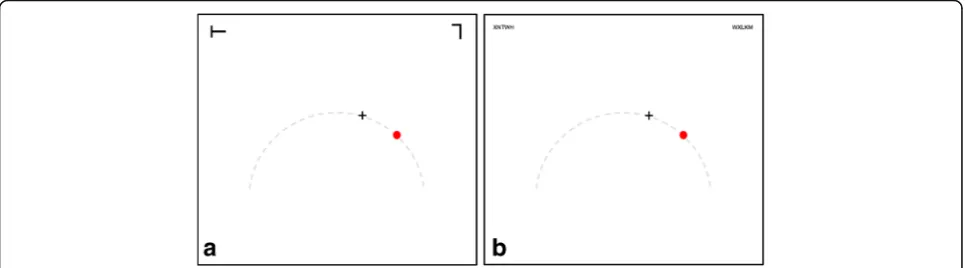
Stimuli for the pursuit tracking task were a black cursor “+” in size 10 Arial font (0.76° × 0.76° of visual angle) and a red circular marker (subtending 0.95°). Both the cursor and the marker moved along a semicircle, ex-tending into the upper visual field, with a diameter of 19.85° centered along the horizontal midline of the dis-play (see Fig. 2). The pattern of target motion was cre-ated by summing sinusoids with frequencies of 0.07, 0.15, and 0.23 Hz (Strayer & Johnston, 2001). The center point of the arc was 5.72° below the screen’s center point. The component sinusoids were randomly phase-shifted to produce a different pattern of motion on each trial. The cursor moved along the same arc, at a maxi-mum rate of 80° per second, but required manual con-trol via the joystick to maneuver. To increase task difficulty, at the start of each trial the red target ap-peared at a randomly selected location along the semi-circular path, whereas the cursor always began centered along the path. Thus, only the red marker was visible to participants. In all the experiments, the coordinates of
both stimuli were recorded every 100 ms (every three frames) throughout each of the 20 tracking intervals. Figure 1a presents a schematic stimulus representation from a left single-target dual-task trial from Experiment 1b or Experiment 2.
Procedure
Participants completed the task in a well-lit room. At the start of the session, participants were instructed to hold the joystick with two hands, allowing both thumbs to rest on the buttons on top of the joystick. To perform the detection task, participants were instructed to re-main aware of targets appearing in the upper regions of the screen. Participants were required to respond as fast as possible if a letter T appeared in either one or both peripheral stimulus locations, but to refrain from responding if both peripheral letters were Ls. Responses were made by pressing the buttons on top of the joystick with both thumbs. Bimanual joystick button responses ensured that both hemispheres were activated during the task. As our aim was to understand the attentional pro-cesses involved in target detection, using bimanual re-sponses reduced the likelihood of any stimulus-response compatibility effects (e.g., congruency between targets and response hand).
To enhance engagement, both tasks were framed within a driving scenario in which participants were asked to imagine they were driving a vehicle to the uni-versity. For the tracking task, participants aligned the cursor, representing their car, with the red marker, repre-senting an in-vehicle navigation system. For the target-detection task, participants were told to imagine that they were responding to traffic signals, where Ts repre-sented red lights and Ls reprerepre-sented green lights. Thus, participants were required to brake by issuing a joystick button press as fast as possible if they encountered a red
[image:5.595.57.540.540.674.2]light (T), but to withhold responding if a pair of green lights (LL) appeared. Participants were encouraged to re-spond as fast as possible, while maintaining accuracy.
Each tracking interval lasted 60 s, after which partici-pants were given the chance for a short break before starting the next interval. To begin a new interval, par-ticipants pulled the joystick trigger. Within each block, participants completed a total of one 60-s practice inter-val, followed by 20 experimental intervals (the number of blocks varied between experiments).
After finishing the experiment, participants com-pleted the FLANDERS questionnaire. Participants were then asked if they held a current valid driver’s license, and if so, approximately how many years of driving ex-perience they had. Finally, participants were debriefed and thanked for their time.
Experiment 1a
Experiment 1a provided a baseline estimate of resilience for a parafoveal target detection task performed alone (i.e., in a single-task condition).
Method
Participants
Twenty-five Flinders University undergraduate stu-dents (21 female; MAge= 23.08 years, SD= 5.12, Range
= 18–40) were recruited as part of a course require-ment. All participants had normal or corrected-to-normal visual acuity and corrected-to-normal color vision, and were fluent in English. Participants were screened for right-hand dominance, with a minimum Flinders Handedness Survey (FLANDERS; Nicholls, Thomas, Loetscher, & Grimshaw, 2013) score of + 5 (M= + 9.76,
SD= 0.66). Twenty participants held a current valid driver’s license, with between 0.5 and 15 years of driving experience (M= 4.69,SD= 3.61).
Apparatus and stimuli
In Experiment 1a, stimuli for the target detection task were a black capital T (target) and L (distractor) presented in 16-point Arial font (1.58° × 1.14° of visual angle) on a white background. Stimuli letters were randomly and in-dependently rotated between 0° and 270°, in steps of 90°. In addition, the black cursor was invisible to ensure that participants did not attempt to perform the tracking task.
Procedure
In Experiment 1a, the participants’ only task was to monitor and respond to peripheral targets. As such, par-ticipants were instructed to ignore the movements of the red target circle and were not instructed to perform the tracking task. Participants completed one block of 20 60-s tracking intervals. The entire process took ap-proximately 30 min.
Analysis
For statistical analysis, raw resilience scores,R(t), were
converted to standardized resilience scores, Rz,
(Houpt & Townsend, 2012) using the “sft” package (Houpt, Blaha, McIntire, Havig, & Townsend, 2014) for R (Core Team, 2016).
Analysis of RTs for correct responses, normalized re-silience scores, and root mean squared error (RMSE) for tracking performance was performed through Bayesian parameter estimation using a Markov chain Monte Carlo (MCMC) sampling procedure (Kruschke, 2013, 2015; Lee & Wagenmakers, 2013). This approach begins by as-suming a prior distribution on a parameter value of interest, then updates the prior through probabilistic sampling to approximate the posterior distribution on parameter values based on the observed data (Kruschke, 2015). Analyses were conducted using sampling func-tions from the JAGS package (Plummer, 2015) in R. RTs were analyzed in a one-way, within-participant design, with additive effects of condition (first single-target, second single-target, redundant targets) and participant. Effects were assumed to follow normal distributions with vague priors on their means and standard deviations. Following Kruschke (2015),
Yparticipant; conditionNða0þaparticipantþacondition; σy2Þ
σyUðSD=1000; SD1000Þ
a0NðM; ½100SD2Þ
aparticipantNð0; σparticipant2Þ
aconditionNð0; σcondition2Þ
σparticipant; σconditionΓðα; βÞ
α¼SD=2 β¼2SD
whereYparticipant, conditionis the RT for a given participant
in each condition, σy is the estimated standard deviation
of the normal distribution of RTs, a0 is the estimated grand mean RT,aparticipant is the participant effect,a condi-tion is the condition effect, M is the grand mean of the
case would signal that participants had tended to respond to targets in one location faster than the other. In the second case, to provide a conservative estimate of the re-dundancy gain, data were coded such that the two single-target conditions represented the faster and slower mean single-target condition for each participant. Redundancy gain was defined as the difference between the shorter of the two single-target RTs and the redundant-target RT. This method of measuring redundancy gains provides more conservative estimates than the alternative approach of comparing redundant-target RT to the mean of the single-target RTs (cf. Biederman & Checkosky,1970).
Rz and RMSE scores were estimated in a one-sample
design (Kruschke, 2013),
Yparticipant Nðu; σ2Þ
uNðM; ½100SD2Þ
σUðSD=1000; SD1000Þ
whereYparticipantis the score for a given participant,uis
the estimated grand mean score, σ is the estimated standard deviation of the normal distribution of scores,
M is the grand mean of the observed scores, and SDis the standard deviation of the observed scores.
Each parameter estimate was based on four MCMC chains, run for 1000 burn-in steps, followed by 250,000 steps each. Chains were thinned to every fifth step in to reduce sample autocorrelation, leaving a total of 50,000 samples for analysis. All estimated parameters showed Gelman-Rubin statistic values (Gelman & Rubin, 1992) of 1.01 or less, indicating satisfactory convergence of the MCMC chains (Kruschke, 2015).
Results
Error rates
Detection error rates were analyzed to ensure that par-ticipants had correctly followed instructions. As a gen-eral rule, the capacity coefficient is robust against error rates of up to 0.30 (Townsend & Wenger, 2004). No par-ticipants in Experiment 1a produced false alarm rates that exceeded this value (M= 0.10, Range= 0.01–0.20). Miss rates in all target conditions—single target on left (M= 0.01, Range= 0.00–0.09), single target on right (M= 0.01, Range= 0.00–0.07), and redundant targets (M< 0.01,Range= 0.00–0.07)—were very low. On average, participants correctly responded to approximately 72 trials in each condition: M= 71.80 (Range= 67–75) for left-targets, M= 71.68 (Range= 67–75) for right-targets, and
M= 71.56 (Range= 66–74) for redundant targets. Col-lapsed across target-present and target-absent trials,
the mean accuracy rate was very high, M= 0.97
(Range= 0.93–greater than 0.99).
RTs
In all experiments, RTs were only analyzed for correct target-present trials (i.e., excluding false-positive re-sponses). Inspection of the data suggested that partici-pants generally complied with the instructions to respond to targets bimanually, making button presses with both thumbs in quick succession. Analyses were carried out using the RT for the faster of the two button presses for each trial.
Data showed no credible difference in RTs between single targets on the left (M= 577 ms, 95% Bayesian Credible Interval (BCI) (Kruschke, 2015) = [536, 618]) and on the right (M= 568 ms, 95% BCI = [527, 610]), (left-right difference: MDiff= 9 ms, 95% BCI = [−4, 22],
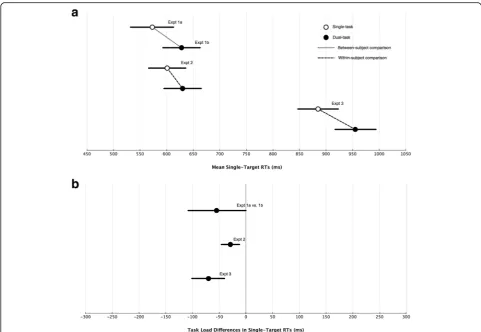
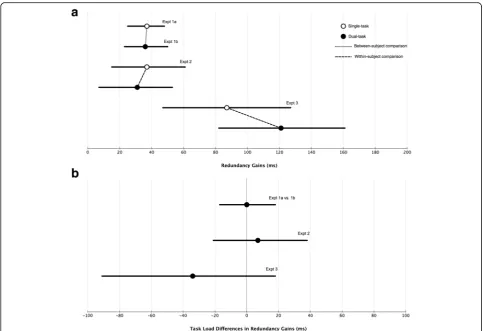
d= 0.24). The mean single-target RT provides a meas-ure of baseline response speed independent of any re-dundancy gain. Collapsed across the two single-target conditions, the mean single-target RT was 573 ms, 95% BCI = [532, 613]. Figure 2 shows the 95% BCIs for the mean single-target RT, as well as corresponding task-load differences, for Experiment 1a and the following experiments. As noted above, redundancy gains were calculated by subtracting RT for the redundant-target condition from RT for the faster single-target condition (left or right) for each participant. Even by this conser-vative measure, data gave clear evidence of a redun-dancy gain (redundant signals effect: MRSE= 37 ms,
95% BCI = [25, 48], d= 1.86), with the
redundant-target condition (M= 523 ms, 95% BCI = [482, 564]) producing shorter RTs than the faster single-target condition (M= 560 ms, 95% BCI = [519, 601]). Figure 3 presents the redundancy gain and task-load differ-ence for each experiment.
Resilience
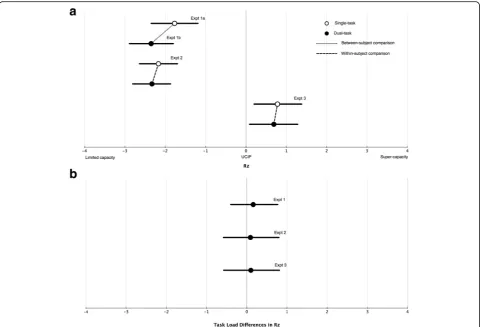
As noted above, the standardized score Rz represents the normalized mean ofR(t) across values oft, weighted inversely by the variability of R(t) at each time point (Houpt & Townsend, 2012). Values equivalent to zero represent UCIP processing, positive values indicate super-capacity, and negative values represent limited capacity. Mean Rz was credibly negative (MRz=−1.77,
95% BCI = [−2.35, −1.19]). Figure 4 compares resilience, and task-load differences in resilience, by experiment.
Tracking performance
the RMSE in angular distance of the cursor position relative to the target position. Mean RMSE was 31.34°, 95% BCI = [26.01, 36.66]. If participants followed in-structions to ignore the tracking task in Experiment 1a and perform it in the subsequent dual-task experiments, RMSE should be smaller in the later experiments.
Discussion
The goal of Experiment 1a was to provide a baseline measure of processing efficiency before any secondary task load was added. Resilience for redundant-target processing was highly limited, despite attention being wholly focused on the target detection task. Thus, within a standard distractor-present redundant-target task, the RT gains pro-duced by redundant target presentation were smaller than predicted by statistical facilitation in a UCIP model.
Experiment 1b
Experiment 1b replicated the procedure of Experiment 1a but with the addition of a central manual tracking task, to test whether concurrent task load reduced pro-cessing resilience.
Method
Participants
As we aimed to match sample size from Experiment 1a, we ran participants until we had data for 25 participants who met the inclusion criteria for detection error rates. We achieved this goal after running 29 participants (see “Error rates”section below for details on reasons for ex-clusions). All participants were undergraduate students (18 female,MAge= 23.00 years,SD= 8.86,Range= 18–55),
who received either AU$10 or course credit for their par-ticipation. None had participated in the previous experi-ment. All were right-hand dominant (MFLANDERS= 9.24,
SD= 1.43), fluent in English, and had normal color vi-sion and normal or corrected-to-normal visual acuity. Twenty-three participants held current valid driver’s licenses, with driving experience ranging from 2 to 38 years (M= 6.19,SD= 8.68).
Apparatus and stimuli
The apparatus and stimuli were identical to those used in Experiment 1a, except that the cursor in the pursuit tracking task was made visible.
[image:8.595.56.538.86.418.2]Procedure
In Experiment 1b, participants performed the peripheral target detection and manual tracking tasks concurrently. Participants were encouraged to maintain accuracy on both tasks, while also aiming to minimize RTs on the de-tection task. As in Experiment 1a, the task involved one block of tracking intervals, comprising one 60-s prac-tice interval followed by 20 60-s experimental intervals. Lastly, participants completed the FLANDERS ques-tionnaire, recorded their driving experience, and were debriefed.
Analysis
Analysis was identical to that of Experiment 1a.
Results
Error rates
As with Experiment 1a, participants with false alarm or miss rates greater than 0.30 in any of the three target conditions were excluded from analysis. Data for three participants with excessive false alarm rates (ranging 0.30–0.67) and for one participant with excessive miss
rates (as high as 0.79 in the right-single target condi-tion) were excluded. Mean false alarm rates for the remaining 25 participants were much lower (M= 0.09,
Range= 0.01–0.22). Miss rates for the remaining partic-ipants were also very low (left single targets: M= 0.01,
Range= 0.00–0.07; right single targets: M= 0.01,
Range= 0.00–0.08; and redundant targets: M= 0.01,
Range= 0.00–0.06). On average, participants correctly responded to approximately the same number of left-target trials (M= 70.88, Range= 65–74), right-target trials (M= 70.84, Range= 65–74), and redundant trials (M= 71.56,Range= 68–74) throughout the testing session. Collapsed across all trials, mean accuracy was very high (M= 0.97,Range= 0.93–greater than 0.99).
RTs
Unlike Experiment 1a, RTs to left-targets (M= 618 ms, 95% BCI = [583, 654]) were credibly shorter than those to right-targets (M= 638 ms, 95% BCI = [602, 673]), (left-right difference:MDiff=−19 ms, 95% BCI = [−36,−3],
[image:9.595.56.540.86.417.2](M= 628 ms, 95% BCI = [593, 663]) marginally lon-ger than that of Experiment 1a, with the BCI on the difference between experiments just excluding 0, (single- minus dual-task difference: MDiff=−55 ms,
95% BCI = [−108, −2], d= 0.57). Analysis confirmed that responses in the redundant-target condition (M
= 574 ms, 95% BCI = [538, 610]) were faster than in the fastest single-target condition (M= 610 ms, 95% BCI = [575, 646]), (MRSE= 36 ms, 95% BCI = [23, 50],
d= 0.78). However, there was no credible difference between the size of the redundancy gain in Experi-ment 1b and that in ExperiExperi-ment 1a, (single- minus dual-task difference: MDiff= 0 ms, 95% BCI = [−17, 18],
d= 0.04).
Resilience scores
Resilience was again limited (MRz=−2.35, 95% BCI
= [−2.89, −1.80]), indicating that redundancy gains were smaller than predicted by a UCIP model. A comparison
between Rz scores in Experiments 1a and 1b found no
credible difference, (single- minus dual-task difference:
MDiff= 0.58, 95% BCI = [−0.21, 1.37],d= 0.43).
Tracking performance
Mean RMSE was 15.16° (95% BCI = [13.04, 17.25]), credibly lower than in Experiment 1a, (single- minus dual-task difference: MDiff= 16.18, 95% BCI = [10.47,
21.87], d= 1.79). Thus, data suggest that participants in Experiment 1b engaged in the tracking task as instructed.
To test the possibility of a tradeoff in performance between the target detection and tracking tasks, bivari-ate correlations were calculbivari-ated betweenRz scores and RMSE. The credible interval on the correlation in-cluded a value of 0.0 but was wide, r(23) =−.14, 95% BCI = [−.58, .30], indicating that the data lacked reso-lution to strongly support or discredit the possibility of tradeoffs between the two tasks.
Discussion
Experiments 1a and 1b tested whether a manual tracking task impairs processing efficiency for redundant visual targets. Consistent with previous findings (Eidels et al., 2014; Townsend & Nozawa, 1995), resilience was limited capacity. More surprisingly, resilience did not appear to suffer with the addition of a concurrent, central tracking task.
[image:10.595.58.539.87.414.2]Experiment 2
Experiments 1a and 1b failed to find a clear differ-ence in processing efficiency for redundant visual
tar-gets between single- and dual-task conditions.
However, it is possible that the between-participants design of Experiment 1 simply was not sensitive enough to detect differences between the single- and dual-task conditions. To address this issue, Experi-ment 2 used a within-participants design to replicate Experiments 1a and 1b, providing a second test of the relationship between task load and target process-ing efficiency.
Method
Participants
Thirty-two Flinders University students (MAge= 23.56 years,
SD= 5.96,Range= 18–39) participated for AU$10. No par-ticipants had performed any of the previous experiments. Participants were all fluent in English, with normal color vision, and normal or corrected-to-normal visual acuity. In addition, all participants were right-hand dominant (MFLANDERS= 9.56, SD= 0.23), and 28 had
current valid driver’s licenses, with experience ranging from 1 to 20 years (M= 5.24,SD= 5.00).
Apparatus and stimuli
Apparatus and stimuli were the same as in Experiment 1.
Procedure
The tracking and discrimination tasks were performed in the same way as in Experiment 1. However, each par-ticipant completed two blocks of trials. In one block, the participant performed the target-detection task alone, following the same procedure as Experiment 1a (single-task condition). In the other block, the participant per-formed both tasks simultaneously, as in Experiment 1b (dual-task condition). Block order was counterbalanced across participants. At the beginning of each block, par-ticipants were given a 60-s practice session, before com-pleting 20 60-s intervals. Participants were given a short break between blocks. As in the previous experiments, participants finished the testing session by completing the FLANDERS questionnaire and recording their driv-ing experience. The entire session took approximately 50 min.
Analysis
Analysis was as in Experiment 1, but was adapted to ac-count for the within-participant manipulation of task load. Analysis of RTs now included additive effects of task load and the interaction of target condition by load (Kruschke, 2015),
Yparticipant;task load;condition
Nða0 þ aparticipantþatask load
þaconditionþatask load
condition; σy2Þ aparticipantN 0;σparticipant2
atask loadNð0;σtask load2Þ aconditionNð0;σcondition2Þ
atask load conditionNð0;σtask load condition2Þ
σparticipant;σtask load; σcondition;σtask load conditionΓ αð ;βÞ
α¼SD=2 β¼ 2 SD;
where deflections from the grand mean representing the ef-fects of task load, condition, and their interaction were con-strained to sum to zero across cells of the design. Likewise, analysis ofRzand RMSE included task load as an effect,
Yparticipant; task loadNða0þaparticipantþatask load; σy2Þ
σyUðSD=1000; SD1000Þ
a0NðM; ½100 SD2Þ
aparticipantNð0; σparticipant2Þ
atask loadNð0; σtask load2Þ
σparticipant; σtask loadΓðα; βÞ
α¼SD=2 β¼2SD;
where deflections from the grand mean reflecting the ef-fects of task load were constrained to sum to zero across conditions.
Results
Preliminary inspection found no effect of block order on any of the measures. As such, all analyses were carried out collapsed across block order. Analyses excluded data from three participants with excessive error rates (ran-ging from 0.44 to 0.89 in any of the target conditions), one participant who appeared not to perform the track-ing task in the dual-task condition (32.05° vs. 48.55° RMSE for the single- and dual-task, respectively), and one participant who failed to make enough button-press responses to be analyzed. These exclusions left data from 27 participants for analysis.
Error rates
False alarm rates were reasonable in both the single- (M
= 0.08, Range= 0.01–0.23) and the dual-task conditions (M= 0.08, Range= 0.01–0.21). Miss rates were low for each trial type in the single-task condition (left single:
M< 0.01, Range= 0.00–0.06; right single: M< 0.01,
Range= 0.00–0.17; right single: M= 0.01, Range= 0.00–0.07; redundant: M= 0.01, Range= 0.00–0.08). The number of targets correctly detected in each of the three trial conditions was consistent across both the sin-gle- (left-targets: M= 71.41, Range= 67–75; right-targets:
M= 71.62, Range= 69–75; redundant targets: M= 71.48,
Range= 68–75) and dual-task conditions (left-targets:
M= 70.25, Range= 59–74; right-targets: M= 71.33,
Range= 66–75; redundant targets: M= 70.71, Range= 67–74). Collapsed across target-present and -absent tri-als, mean accuracy rate was extremely high within both the single- (M= 0.98, Range= 0.94–1.00) and dual-task conditions (M= 0.97,Range= 0.89–0.99).
RTs
Consistent with Experiment 1a, data showed no differ-ence in mean RT for single targets presented on the left compared with single targets on the right for the single-task block (left:M= 601 ms, 95% BCI = [564, 639]; right:
M= 601 ms, 95% BCI = [563, 637]; MDiff= 0.79 ms, 95%
BCI = [–22, 25], d= 0.08), and in contrast with the re-sults of Experiment 1b, showed no difference in RTs for left vs. right single targets in the dual-task block (left:
M= 628 ms, 95% BCI = [591, 665]; right: M= 633 ms, 95% BCI = [596, 670]; MDiff=–5 ms, 95% BCI = [–29,
18], d= 0.14). Mean single-target RT was credibly longer when the tracking task was performed concurrently (M= 630 ms, 95% BCI = [595, 665]) than when only the
target-detection task was performed (M= 601 ms, 95% BCI
= [566, 636]), (MDiff=–29 ms, 95% BCI = [–47, –12],
d= 0.42). Comparing the fastest single-target RTs
(single-task: M= 587 ms, 95% BCI = [550, 624]; dual-task: M= 612 ms, 95% BCI = [575, 649]) with the redun-dant RTs (single-task: M= 550 ms, 95% BCI = [513, 587]; dual-task:M= 581 ms, 95% BCI = [544, 618]) revealed clear redundancy gains of roughly the same size in both the sin-gle- (MRSE= 37 ms, 95% BCI = [15, 61],d= 1.47) and
dual-task (MRSE= 31 ms, 95% BCI = [7, 53],d= 0.90) conditions,
(MDiff= 7 ms, 95% BCI = [–21, 38],d= 0.26).
Resilience
As in the previous experiments, normalized resili-ence scores for both the single- (MRz=–2.17, 95%
BCI [–2.64, –1.70]) and dual-task (MRz=–2.33,
95% BCI [–2.81, –1.87]) conditions were limited,
well below the predictions of the UCIP model (see Fig. 4). Furthermore, comparisons of resilience be-tween the dual- and single-task conditions again failed to find evidence of a difference (MDiff= 0.16,
95% BCI = [–0.39, 0.76],d= 0.13). These results replicate the findings of Experiment 1, showing no credible effect of task load on dual-channel processing efficiency.
Tracking performance
RMSE was substantially smaller in the dual-task block
(M= 16.87°, 95% BCI = [12.94, 20.78]) than in the
single-task block (M= 32.97°, 95% BCI = [29.04, 36.86]) (MDiff= 16.11, 95% BCI = [10.68, 21.46], d= 1.07),
indi-cating that participants followed instructions to perform both tasks simultaneously during the dual-task block. Data from the dual-task condition found no evidence of a trade-off between RMSE andRz, with higherRzscores predicting smaller tracking error,r(25) =–.36, 95% BCI = [–.75, .04], although the BCI on this effect included 0.
Discussion
As in Experiments 1a and b, resilience was highly limi-ted, but was not credibly smaller when participants per-formed a concurrent manual tracking task. Thus, the tracking and detection tasks did not appear to compete for processing resources (Wickens, 1981, 2002), produ-cing no performance tradeoff between the tasks.
Experiment 3
The previous experiments found that processing efficiency for redundant visual targets, as measured by resilience, was similar across single- and dual-task conditions. In both cases, resilience was limited, producing mean Rz
scores decisively below 0. Experiment 3 sought to generalize the results of Experiments 1 and 2 by testing the effects of dual-task load on Rz under conditions in which the baseline, single-task resilience scores were not highly limited.
Although neither of the first two experiments included a manipulation to diagnose system architecture, the ob-served resilience scores suggest that the left and right channels in the target detection task were processed in parallel. As noted above, a serial processing architecture can produce limited-resilience processing. This type of processing only occurs when the time needed to process a distractor is significantly lower than the time needed to process a target (Little et al., 2015). There is little reason to expect that this would have been the case in Experiments 1 and 2. Moreover, past work has shown that TL stimuli can be processed in parallel (Sung, 2008; Yamani, McCarley, Mounts, & Kramer, 2013), at least under conditions in which they are above the limits of sensory resolution and are not subject to visual crowding (Bouma, 1970) or attentional suppres-sion (Yamani et al., 2013).
Levi, 2012) in the extrafoveal retina. This design meant that stimulus onsets could still be detected in the retinal periphery. However, to identify targets and distractors, participants had to foveate the stimuli, with little per-ipheral information to guide participants preferentially toward the target on single-target trials. Assuming that target and distractors required roughly the same amount of time to process, resilience should have reached super-capacity levels (Little et al., 2015), allowing us to test the generality of our findings from the first two experiments.
Method
Participants
We planned for a sample size of 30 participants who met the performance criteria for both the target detec-tion and tracking tasks. To achieve this sample size, 34 undergraduate students from Flinders University (25 female; MAge= 21.32, SD= 3.88, Range= 17–35)
partici-pated in the experiment either for course credit or for AU$10. No participants had participated in any of the previous experiments. Participants all exhibited normal or corrected-to-normal visual acuity, normal color vi-sion, and English fluency. Participants were required to be right-hand dominant (MFLANDERS= 9.48, SD= 1.93);
one participant who failed this requirement was immedi-ately excluded from the study prior to further analysis. Thirty-one participants reported holding a current valid driver’s license, and the mean years driving experience was 3.83 years (SD= 3.19;Range= 1–15).
Apparatus and stimuli
The apparatus was the same as above. Stimuli were simi-lar except for the following changes. First, stimuli for the target detection task were reduced to 4-point font, with each letter subtending approximately 0.44° × 0.35° of visual angle. Second, targets and distractors were em-bedded within five-item letter arrays. Target letters ap-peared in the same upper left and upper right locations as in Experiments 1–2, but were flanked on both sides by two letters randomly and independently selected from the set F, H, K, M, N, V, W, X, and Z. To avoid overlap between letters, target and distractor orientations were fixed at 0°. For an illustration of a dual-task single-target trial from Experiment 3, please return to Fig. 1b.
Procedure and analysis
Procedure and data analysis were identical to Experiment 2.
Results
Data from one participant were removed from ana-lysis for high false alarm rates in both the single-(0.53) and dual-task (0.61) conditions. Furthermore, data from two participants who produced roughly
equal tracking error in both the single- and dual-task conditions (e.g., 27.58° vs. 29.64°, respectively) were also excluded.
Error rates
False alarm rates for the remaining 30 participants were acceptable within both the single- (M= 0.07, Range= 0.00–0.19) and dual-task (M= 0.08, Range= 0.00–0.26) conditions. Similarly, target miss rates were low in all trial types for both the single-task condition (left sin-gle:M= 0.01,Range= 0.00–0.16; right single:M= 0.02,
Range= 0.00–0.20; redundant target: M= 0.01, Range
= 0.00–0.18) and the dual-task condition (left single:
M= 0.03, Range= 0.00–0.15; right single: M= 0.03,
Range= 0.00–0.14; redundant target: M= 0.02, Range
= 0.00–0.14). Collapsed across target-present and
target-absent trials, mean accuracy rate was high and
approximately equal in both the single (M= 0.97,
Range= 0.84–greater than 0.99) and dual-task (M= 0.96,
Range= 0.87–greater than 0.99) conditions. A similar number of targets were detected within each of the three trial types for both the single- (left single: M= 70.60,
Range= 61–74; right single:M= 70.33,Range= 59–74; re-dundant target: M= 70.90, Range= 59–74) and dual-task conditions (left single: M= 69.77, Range= 58–74; right single: M= 69.70, Range= 60–73; redundant target:
M= 70.13, Range= 62–73). RTs
Comparisons of RTs for left and right single targets re-vealed faster responses for targets on the left than those on the right for both the single- (left: M= 794 ms, 95% BCI = [749, 838]; right: M= 976 ms, 95% BCI = [932, 1019]; MDiff=−182 ms, 95% BCI = [−227, −139], d=
1.11) and dual-task conditions (left: M= 880 ms, 95% BCI = [836, 924]; right: M= 1031 ms, 95% BCI = [987, 1074]; MDiff=−151 ms, 95% BCI = [−194, −105], d=
1.43), indicating that participants adopted a left-to-right scanning strategy under serial processing conditions. Mean single-target RT was credibly faster in the single-task condition (M= 885 ms, 95% BCI = [847, 923]) than the dual-task condition (M= 955 ms, 95% BCI = [917, 994]), (MDiff=−70 ms, 95% BCI = [−101, −40], d= 0.50). We
found clear evidence for redundancy gains when compar-ing the fastest scompar-ingle-target RTs (scompar-ingle-task: M= 776 ms,
95% BCI = [733, 818]; dual-task: M= 877 ms, 95%
BCI = [835, 920]) with redundant-target RTs (single-task:
M= 688 ms, 95% BCI = [646, 730]; dual-task:M= 756 ms, 95% BCI = [714, 798]) for both levels of task load (single-task:MRSE= 87 ms, 95% BCI = [47, 127],d= 1.41; dual-task:
MRSE= 121 ms, 95% BCI = [82, 161], d= 2.21). Although
Resilience
As expected, and in contrast to the results of the first three experiments, normalized resilience scores for both the single- (MRz= 0.78, 95% BCI = [0.20, 1.38]) and
dual-task conditions (MRz= 0.69, 95% BCI = [0.09, 1.28]) were
credibly super-capacity. However, consistent with the previous experiments, task load did not influence pro-cessing resilience (single- minus dual-task difference:
MDiff= 0.10, 95% BCI = [−0.57, 0.81],d= 0.06).
Tracking performance
RMSE was decisively smaller in the dual-task condition (M= 15.69°, 95% BCI = [11.91, 19.49]) than the single-task condition (M= 33.11°, 95% BCI = [29.29, 36.87]), (MDiff= 17.41, 95% BCI = [12.47, 22.28], d= 1.39). As in
Experiment 2, data trended in the opposite direction to a tradeoff between RMSE and Rz scores, r(28) =−.35, 95% BCI = [−.72, .02], with the credible interval just overlapping 0.
Discussion
Experiment 3 assessed target processing efficiency within a forced serial process paradigm. As expected, serial scanning produced super-capacity processing of redun-dant targets (Little et al., 2015). Notably, the large dif-ference in resilience scores found in the current experiment versus those in the earlier experiments sup-ports the idea that, when stimuli were above sensory thresholds and not compromised by crowding, target processing was in parallel and with limited-capacity. But, despite the difference in processing architecture between experiments, none of the experiments found an effect of task load on processing efficiency. Resili-ence remained largely unaffected by variations in task load, despite large variations in baseline resilience values and changes to processing architecture.
General discussion
The current studies examined redundant-target process-ing within a dual-task paradigm. As expected, a concur-rent manual tracking task increased RTs for target detection in the periphery. But, despite this difference in baseline target detection times, the efficiency with which redundant targets were processed was invariant with task load. In other words, a central task slowed re-sponses to peripheral targets, but did not change the rate at which multiple targets were processed relative to single targets. This effect was true regardless of whether targets were processed in parallel with limited resilience (Experiments 1–2), or in serial with super-capacity resili-ence (Experiment 3).
One interpretation is that the central manual tracking task and the peripheral target detection task tapped into partially independent pools of information-processing
resources (Wickens, 2002). Although multiple resource theory includes visual attention as one form of processing resource, it posits separate pools of processing resources for both focal and ambient vision, linking focal processing to the central visual field and ambient to the peripheral visual field. The theory thus allows that the task-load ma-nipulation might not have affected processing efficiency because the tracking task engaged central resources and the target detection task engaged ambient resources. Con-trary to this hypothesis, though, mean single-target RTs for dual-task conditions were credibly longer than those for single-task conditions in across all experiments. These results suggest the central tracking and peripheral detec-tion tasks likely tapped common processing resources, presumably at the stages that Wickens (2002) labels per-ception or cognition; the target and distractor stimuli of Experiment 3 were in fact designed to be indiscriminable in ambient vision, ensuring competition for focal attention between the central and peripheral tasks. Moreover, the Wickens (2002) model proposes that focal processes are specialized for detailed object perception and recognition, whereas ambient processes are specialized for spatial pro-cessing. Assuming that participants fixated near the dis-play center to perform the tracking task, the central and peripheral processing demands in the current experi-ments, therefore, would not have aligned well with the at-tentional pools hypothesized by multiple resource theory. To optimize the distribution of resources under the model, participants would have had to fixate near the boundary of the display while tracking the moving target with peripheral vision. Eye movement data might test whether any participants adopted such a strategy, or to es-timate more generally how often eye movements occurred between the central and peripheral tasks. At best, though, the data indicate that distributing task load over different resource pools would have attenuated dual-tasks costs, not eliminated them.
on the stimuli in serial, through a series of saccadic eye movements. In both cases, after detecting a target or confirming that both peripheral items were distractors, attention would have returned to the tracking task. Re-silience would have been similar across the single- and dual-task blocks, because, in both cases, attention would have been disengaged from the central task while peripheral items were being processed.
One caveat of this attention-switching account is that such a theory predicts a positive association between tracking error and resilience for the redundant targets, whereas our data trended in the opposite direction. The tendency toward better tracking among participants with higher resilience hints at individual differences in effort or ability, differences that might have masked any trade-offs between tracking and resilience. To better under-stand how attention is divided between the two tasks, future experiments might employ eye-tracking to iden-tify participants’ attentional strategies, and to test for evidence of discrete attention shifts between the center and periphery.
In application, our results indicate that redundant visual signals are likely to be as effective at aiding visual detection under multi-task conditions as under single-task conditions. This means both that redundant coding will be useful within multi-task workspaces, and that the results of single-task pilot testing can be used to predict the magnitude of RT gain that redundant signals will purchase in a multi-task environment. Thus, design guidelines for complex visual workspaces, such as pilot cockpits or vehicle dashboards, should encourage the use of redundant coding of visual alerts for enhancing detection.
The data also imply a tradeoff between redundancy gains and display complexity. We find that redundant visual targets in peripheral visual displays are of greatest value for low-salience stimuli, those that demand fo-cused attention for detection or recognition, such as when monitoring a large set of gauges or meters. Stimuli of higher salience, discriminable enough to be processed in parallel, are more likely to be processed with limited resilience and with far more modest redundancy gains. This pattern suggests that as a general guideline, display designers might trade redundant target presentation against target salience, reserving highly salient display modes for the most critical signals and presenting infor-mation that is less urgent but still time-sensitive in lower salience, redundant signals. By using redundant presen-tation as a substitute for high conspicuity, this strategy would reduce the risk of a salience-saturated environ-ment in which high-contrast signals compete for atten-tion or overwhelm the operator.
Notably, our findings only consider identical redundant visual signals. Thus, additional work will be necessary to
generalize the results to environments in which redundant signals are non-identical (Ben-David & Algom, 2009) or to environments involving auditory or multimodal stimuli (Diederich & Colonius, 2004; Fox, Glavan, & Houpt, 2014). As many warning technologies and displays employ multimodal signals (Rowe & Halpin, 2013; Selcon et al., 1995), further research should examine whether redun-dant non-identical or multimodal signals also produce equally efficient processing benefits within single- and multi-task environments.
Conclusions
Within a peripheral redundant-target paradigm, data give no evidence for poorer target processing efficiency while under the load of a secondary tracking task. As expected (Little et al., 2015), however, data do show vari-ations in processing efficiency as a function of display characteristics. Findings suggest there is a modest bene-fit to employing redundant targets in peripheral visual displays (e.g., on a vehicle dashboard) for situations in which targets are processed in parallel. However, we find that redundant displays have more substantial benefits for target items that demand serial processing.
Abbreviations
BCI:Bayesian Credible Interval (Kruschke, 2015);C(t): Capacity coefficient (Townsend & Nozawa, 1995); CDF: Cumulative distribution function;
Cz: Standardized capacity coefficient (Houpt & Townsend, 2012);d: Cohen’s
d; FLANDERS: Flinders Handedness Survey (Nicholls, Thomas, Loetscher, & Grimshaw, 2013);h(t): Hazard function;H(t): Integrated hazard function;
MAge: Mean age; MCMC: Markov chain Monte Carlo;MDiff: Mean difference
between conditions;MFLANDERS: Mean Flinders Handedness Survey score;
MRSE: Mean redundant signals effect;MRz: Mean standardized resilience score; R(t): Resilience coefficient (Little, Eidels, Fific, & Wang, 2015); RMSE: Root mean squared error; RSE: Redundant signals effect; RT: Response time;
Rz: Standardized resilience coefficient (Houpt & Little, 2017); SST: Serial self-terminating; UCIP: Unlimited capacity independent processing
Acknowledgements
Many thanks to Paul Douglas for assistance with programming, and to Kate Coden and Silas Ellery for assistance with data collection.
Funding
SAM is supported by an Australian Government Research Training Program Scholarship and a supplementary scholarship from Defence Science and Technology (DST) Group.
Availability of data and materials
The datasets supporting the conclusions of this article are available in the Figshare repository, [https://figshare.com/s/8c236c409ca0b9488d90 (Experiments 1a and 1b); https://figshare.com/s/6a31fc8ba93fc4d7a9ae (Experiment 2); https://figshare.com/s/943efcf596a15998cea5 (Experiment 3); https://figshare.com/s/68a01641c01b78e1a675 (Excluded data)].
Authors’contributions
SAM, JSM, and NAT originated the idea for the study. SAM collected the data. SAM and JSM performed the data analysis and the interpretation of the data. SAM wrote the manuscript, and JSM and NAT contributed advice along with revisions. All authors read and approved the final manuscript.
Ethics approval and consent to participate
Consent for publication
Not applicable
Competing interests
The authors declare that they have no competing interests.
Publisher’s note
Springer Nature remains neutral with regard to jurisdictional claims in published maps and institutional affiliations.
Author details
1
College of Education, Psychology and Social Work, Flinders University, Adelaide, SA, Australia.2College of Healthcare Sciences, James Cook University, Cairns, QLD, Australia.3School of Psychological Science, Oregon State University, Corvallis, OR, USA.
Received: 16 March 2017 Accepted: 25 December 2017
References
Allen, P. A., Madden, D. J., Groth, K. E., & Crozier, L. C. (1992). Impact of age, redundancy, and perceptual noise on visual search.Journal of Gerontology, 47(2), 69–74. https://doi.org/10.1093/geronj/47.2.P69.
Beck, D. M., & Lavie, N. (2005). Look here but ignore what you see: Effects of distractors at fixation.Journal of Experimental Psychology: Human Perception and Performance, 31(3), 592–607. https://doi.org/10.1037/0096-1523.31.3.592. Ben-David, B. M., & Algom, D. (2009). Species of redundancy in visual target
detection.Journal of Experimental Psychology: Human Perception and Performance, 35(4), 958–976. https://doi.org/10.1037/a0014511 .
Ben-David, B. M., Eidels, A., & Donkin, C. (2014). Effects of aging and distractors on detection of redundant visual targets and capacity: Do older adults integrate visual targets differently than younger adults?PLoS One, 9(12), 1–29. https:// doi.org/10.1371/journal.pone.0113551.
Biederman, I., & Checkosky, S. F. (1970). Processing redundant information.Journal of Experimental Psychology, 83(3), 486–490. https://doi.org/10.1037/h0028841. Bouma, H. (1970). Interaction effects in parafoveal letter recognition.Nature,
226(24), 177–178. https://doi.org/doi:10.1038/226177a0.
Carrasco, M., Evert, D. L., Chang, I., & Katz, S. M. (1995). The eccentricity effect: Target eccentricity affects performance on conjunction searches.Perception & Psychophysics, 57(8), 1241–1261. https://doi.org/10.3758/BF03208380. Carrasco, M., & Yeshurun, Y. (1998). The contribution of covert attention to the
set-size and eccentricity effects in visual search.Journal of Experimental Psychology: Human Perception and Performance, 24(2), 673–692. https://doi. org/10.1037/0096-1523.24.2.673 .
Colonius, H., & Vorberg, D. (1994). Distribution inequalities for parallel models with unlimited capacity.Journal of Mathematical Psychology, 38, 35–58. https://doi.org/10.1006/jmps.1994.1002.
Diederich, A., & Colonius, H. (2004). Bimodal and trimodal multisensory enhancement: Effects of stimulus onset and intensity on reaction time.Perception & Psychophysics, 66(8), 1388–1404. https://doi.org/10.3758/BF03195006.
Eidels, A., Townsend, J. T., Hughes, H. C., & Perry, L. A. (2014). Evaluating perceptual integration: Uniting response-time- and accuracy-based methodologies.Attention, Perception, & Psychophysics, 77(2), 659–680. https://doi.org/10.3758/s13414-014-0788-y.
Fox, E. L., Glavan, J. J. and Houpt, J. W. (2014). Evaluation of cognitive processing in redundant audio-visual signals. In P. Bello, M. Guarini, M. McShane and B. Scassellati (Eds.),Proceedings of the 36th Annual Conference of the Cognitive Science Society(pp. 475-480). Austin: Cognitive Science Society. Gelman, A., & Rubin, D. B. (1992). Inference from iterative simulation using
multiple sequences.Statistical Science, 7(4), 457–511. https://doi.org/10. 1214/ss/1177013604.
Grice, G. R., Canham, L., & Gwynne, J. W. (1984). Absence of a redundant-signals effect in a reaction time task with divided attention.Perception & Psychophysics, 36(6), 565–570. https://doi.org/10.3758/BF03207517. Ho, C., Reed, N., & Spence, C. (2007). Multisensory in-car warning signals for
collision avoidance.Human Factors: The Journal of the Human Factors and Ergonomics Society, 49(6), 1107–1114. https://doi.org/10.1518/
001872007X249965.
Houpt, J. W., Blaha, L. M., McIntire, J. P., Havig, P. R., & Townsend, J. T. (2014). Systems factorial technology with R.Behavior Research Methods, 307–330. https://doi.org/10.3758/s13428-013-0377-3.
Houpt, J. W., & Little, D. R. (2017). Statistical analyses of the resilience function.
Behavior Research Methods, 49(4), 1261–1277. https://doi.org/10.3758/s13428-016-0784-3.
Houpt, J. W., & Townsend, J. T. (2012). Statistical measures for workload capacity analysis.Journal of Mathematical Psychology, 56(5), 341–355. https://doi.org/10.1016/j.jmp.2012.05.004.
Humphreys, G. W., Quinlan, P. T., & Riddoch, M. J. (1989). Grouping processes in visual search: Effects with single-and combined-feature targets.Journal of Experimental Psychology: General, 118(3), 258–279. https://doi.org/10.1037/ 0096-3445.118.3.258.
Imbert, J.-P., Hodgetts, H. M., Parise, R., Vachon, F., Dehais, F., & Tremblay, S. (2014). Attentional costs and failures in air traffic control notifications.Ergonomics, 57(12), 1817–1832. https://doi.org/10.1080/00140139.2014.952680.
Itti, L., & Koch, C. (2000). A saliency-based search mechanism for overt and covert shifts of visual attention.Vision Research, 40(10–12), 1489–1506. https://doi. org/10.1016/S0042-6989(99)00163-7.
Kruschke, J. K. (2013). Bayesian estimation supersedes thettest.Journal of Experimental Psychology: General, 142(2), 573–603. https://doi.org/10.1037/ a0029146.
Kruschke, J. K. (2015). Chapter 9—Hierarchical models. InDoing Bayesian Data Analysis(pp. 221–264). https://doi.org/10.1016/B978-0-12-405888-0.00009-X. Lee, M. D., & Wagenmakers, E.-J. (2013). Bayesian cognitive modeling: A practical
course.Bayesian Cognitive Modeling: A Practical Course, 123. https://doi.org/10. 1017/CBO9781139087759.
Leibowitz, H. W., & Appelle, S. (1969). The effect of a central task on luminance thresholds for peripherally presented stimuli.Human Factors: The Journal of the Human Factors and Ergonomics Society, 11(4), 387–392. https://doi.org/10. 1177/001872086901100409.
Little, D. R., Eidels, A., Fific, M., & Wang, T. (2015). Understanding the influence of distractors on workload capacity.Journal of Mathematical Psychology, 68–69, 25–36. https://doi.org/10.1016/j.jmp.2015.08.005.
Logitech. (2017).Logitech Attack 3. CA, USA: Silicon Valley.
McCarley, J. S., Mounts, J. R. W., & Kramer, A. F. (2007). Spatially mediated capacity limits in attentive visual perception.Acta Psychologica, 126(2), 98–119. https:// doi.org/10.1016/j.actpsy.2006.11.004.
Miller, J. (1982). Divided attention: Evidence for coactivation with redundant signals.Cognitive Psychology, 14, 247–279. https://doi.org/10.1016/0010-0285(82)90010-X.
Miller, J., & Ulrich, R. (2003). Simple reaction time and statistical facilitation: A parallel grains model.Cognitive Psychology, 46, 101–151. https://doi.org/10. 1016/S0010-0285(02)00517-0.
Neurobehavioral Systems. (2017). Presentation version 16.5 build 09.17.13. Berkeley, CA, USA.
Nicholls, M. E. R., Thomas, N. A., Loetscher, T., & Grimshaw, G. M. (2013). The Flinders Handedness Survey (FLANDERS): A brief measure of skilled hand preference.
Cortex, 49(10), 2914–26. https://doi.org/10.1016/j.cortex.2013.02.002. Nikolic, M. I., Orr, J. M., & Sarter, N. B. (2004). Why pilots miss the green box: how
display context undermines attention capture.The International Journal of Aviation Psychology, 14(1), 39–52. https://doi.org/10.1207/s15327108ijap1401_3. Nothdurft, H. C. (1992). Feature analysis and the role of similarity in preattentive vision.Perception & Psychophysics, 52(4), 355–375. https://doi.org/10.3758/ BF03206697.
Pascale, M., Sanderson, P., Liu, D., Mohamed, I., Stigter, N., & Loeb, R. (2015). Peripheral detection for abrupt onset stimuli presented via head-worn display. InProceedings of the Human Factors and Ergonomics Society 59th Annual Meeting, 1326–1330. Santa Monica: Human Factors and Ergonomics Society.
Plummer, M. (2015). JAGS Version 4.0.0 user manual. Retrieved from https:// sourceforge.net/projects/mcmc-jags/files/Manuals/4.x/.
R Core Team. (2016).R: A language and environment for statistical computing. Vienna, Austria: R Foundation for Statistical Computing. Retrieved from https://www.r-project.org/.
Raab, D. H. (1962). Division of psychology: Statistical facilitation of simple reaction times.Transactions of the New York Academy of Sciences, 24, 574–590. https:// doi.org/10.1111/j.2164-0947.1962.tb01433.x.
Reimer, B. (2010). Impact of cognitive task complexity on drivers’visual tunneling.
Transportation Research Record: Journal of the Transportation Research Board, 2138(1), 13–19. https://doi.org/10.3141/2138-03.
Rowe, C., & Halpin, C. (2013). Why are warning displays multimodal?