"I acknowledge indeed that I have read this report and on my opinion this report is sufficient from scope and quality for requirements for the Bachelor The Degree of
Electronic Engineering (Industrial Electronic) "
Signature Author
WALL FOLLOWING MOBILE ROBOT
ROSLINAMARIA BINTI HJ ABDUL RAHMAN
This Report Is Submitted In Partial Fulfilment Of Requirements For The Bachelor The Degree Of Electronic Engineering (Industrial Electronic)
Fakulti Kejuruteraan Elektronik dan Kejuruteraan Komputer
u
"I hereby declare that this report authored by me except for the summary and excerpt in which I have clarify the sources "
Signature
Author
Date
~
: Roslinamaria binti Hj Abdul RahmanTo my late father Hj Abdul Rahman bin Roslan, My mum, Hjh. Rosnah binti Bakrin,
My brother and family, Rosely bin Hj. Abdul Rahman, My sister and family, Roslinawati binti Hj. Abdul Rahman
and
My love Mohamad Zaihan bin Borhan
APPRECIATION
Nobody gets anywhere without help from many different people along the
way. I am no exception to this. I would like to take this opportunity to thank my
family especially to my late father Hj Abdul Rahman bin Roslan (28 November
2004, 15 Syawa/1425) who been my inspiration, my mother Hjh. Rosnah binti
Bakrin to be supportive women, my fiancee Mohamad Zaihan Borhan to encourage
me.
I would like to thank Mr. Soo Yew Guan for all his support. He was able to
use the right words that sparked the wall following mobile robot inside me. He has
been, and he always is my adviser in this project.
I would like to thank to all my friends that has been very helpful in providing
information and support.
v
ABSTRACT
Robot is a machine that works automatically and can do some ~ that
human can do. Mobile robot is especially design to operate in environment such as
automated assembly halls, factories or warehouse. Mobile robot an intelligent
machine that developed to think and function according to the instruction. In this
project, a wall-following mobile robot has been designed. The wall-following
control problem is characterized by moving the robot along a wall in a desired
direction while maintaining a constant distance to the wall. There are several reasons
why autonomous mobile robots must be able to follow walls or in a more general
sense, to follow the contours· of an object. This depends of course on the type of
mobile robot and its application. Robots operating in an unknown, unstructured environment (usually outdoors) use their sensors to perceive the surrounding and replan their motions or trajectories accordingly. (Perspective information is very important in unstructured environment and for vision system. Random navigation
does not seem like a very elegant way to master a wall so the choice is
Vl
ABSTRAK
Robot adalah satu mesin dimana ia boleh berketja secara automatik dan boleh
melakukan tugas yang mana manusia boleh lakukan dimana keistimewaan robot
direkabentuk dengan atau mengikuti suasana seperti mengautomasikan pemasangan
ruang depan, k:ilang atau gudang. Robot mudah alih adalah mesin yang bijak yang
dibangunkan untuk berftkir dan berfungsi mengikut arahan. Di dalam projek ini,
robot mudah alih mengikut dinding telah dicipta. Masalah pergerakan mengikut
dinding boleh disifatkan sebagai robot yang bergerak menyusuri dinding mengikut
kehendak arahan serta mengawal jarak dengan dinding. Terdapat pelbagai sebab
mengapa robot ini dicipta. Ini bergantung kepada jenis dan aplikasinya. Robot
beroperasi di dalam suasana tidak diketahui menggunakan sensor untuk mencapai
maklumat keadaan sekeliling. (Perspektif informasi adalah amat penting di dalam
suasana yang tidak distrukturkan dan untu.k sistem penglihatan. Pergerakan secara
rambang tidak beberapa kelihatan menarik untuk menguasai dinding maka pilihan
yang baik ialah wall-following mobile robot. Cara yang paling mudah untuk
menjelaskan penciptaan projek ini ialah dengan membayangkan manusia betjalan
dengan keadaan mata yang tertutup ataupun buta. Dengan meletakkan sebelah
tangan kepada dinding dan terus menyusuri dinding tersebut hingga mencapai arab
CHAPTER Chapter 1 1.0 1.1 1.2 TITLE Project Title Declaration Dedication Appreciation CONTENT
Abstract (English Version) Abstract (Malay Version)
List of Content List of Figure List of Table List of Appendix List of Short forms
Introduction
Project Objectives and Scope of Work Problem Statements
. PAGE
Chapter 2
2.0
Chapter 3
3.0
3.1
3.2
3.3
3.4
3.5
3.6
Chapter4
4.0
4.1
4.2
4.3
Chapter 5
5.0
5.1
5.2
5.3
Vlll
Literature Review 6
Project Methodology and Data Analysis 12
The infrared (IR) Sensors Transmitter and Receiver 13
Low Power Dual Voltage Regulator (LM393) 16
The PIC16F84A Brain 18
The Motor Drive Circuit 20
Making Prototype 22
Direct Current (DC) Motor 23
Project Finding 25
Program PIC16F84A for Wall Following Mobile Robot 32
Circuit Description 35
Robot Power Supplies 37
Conclusion 38
Application 39
Improvements and Suggestion 40
Reference
Appendix A
AppendixB
Appendix C
lX
42
43
51
X
LIST OF FIGURE
NO TITLE . PAGE
1.1 Flow Chart Scope of Work 4
2.1 DR X Prototype 7
2.2 The Robot Approaches The Doorway 8
2.3 The robot passes the doorway 8
2.4 The robot turns left 90 degrees 9
2.5 The robot moves forward into the doorway 9
2.6 The robot is almost through the doorway 9
2.7 The robot is through the doorway 10
2.8 DR X Robot 10
3.1 Schematic for Infrared Sensor (Transmitter) 13
3.2 Infrared Set-up 14
3.3 Schematic for Infrared Sensor (Receiver) 15
3.4 Block Diagram Infrared Sensor Circuit 15
3.5 PIC 16F84A Pin Configuration 17
3.6 Equivalent Circuit 17
3.7 Circuit Diagram for PIC 16F84A 18
3.8 Pin Diagram for PIC16F84A 18
3.9 Twin Motor Drive Circuit 20
3.10 Permanent-magnet DC Motor Operation 23
4.1 Prototype Wall Following Mobile Robot 25
4.2 Voltage versus Length 26
XI
4.6
Block Diagram from IR Receiver30
4.7
IR Sensor Triggered PIC31
4.8
Flow Charts for Programming32
4.9
Circuit for Wall Following MobiJe Robot36
xu
LIST OF TABLE
NO TITLE
PAGE
XIII
LIST OF APPENDIX
NO TITLE PAGE
A Wall-following Control for Two-Wheeled
Mobile Robot, Proceeding of the IEEE,
International Conference on Robotics and Automation,
Hochiminh City, Vietnam May 2002 43
B Wall-following Control of a
Mobile Robot, Proceeding of the 1992 IEEE,
International Conference on Robotics and Automation,
Nice, France May 1992 51
c
Wall-following using angle information measured by a single ultrasonic Transducer,Proceeding of the 1998 IEEE,
International Conference on Robotics and Automation,
PIC IR LED k m Hz PC
v
Amp Op-ampn
J.l. AID DCAC
110 KUTKM EEPROM TIL CMOSLIST OF SHORT FORMS
Programmable Integrated Circuit Infrared
Light Emitter Diode kilo mili Hertz Printed circuit Volts Ampere Operational Amplifier ohm DllCro
Analog to Digital Direct current
Alternate current Input I Output
Kolej Universiti Tek:nikal Kebangsaan Malaysia
Electronic Erasable Programmable Read of Memory Transistor-transistor Logic
Complementary Metal-Oxide Semiconductor
1
CHAPTER I
INTRODUCTION
For this surveillance robot, the main purpose is only to stroll follows the wall,
in order to detect intruders, using reflects an Infrared (IR) or movement following
behavior. It is not desired to have the robot following walJs too closely or having all
the space covered, since the
main
purpose is just to look around for motion orInfrared sources, keeping as far as possible from all walls.
The robot keeps itself faraway from walls by having the capability of
adapting its behaviors, in order to be able to enter and explore narrow spaces and to
adapt easily to differently reflective environments. In surveillance robots, result
expected is to get an overall behavior, which permits an efficient coverage and
exploration of the entire space where it should wander about, without the problems
of getting indefinitely stuck in particular confusing situations that may occur seldom.
Wall-following mobile robot is a small three-wheel robot that follows the walls,
which it senses with its active infrared sensors. Each rear wheel has its own motor
where the single front wheel is not powered. The robot steers like a tank by rotating
the rear wheels in opposite direction.
CHAPTER I
INTRODUCTION
For this surveillance robot, the main purpose is only to stroll follows the wall, in order to detect intruders, using reflects an Infrared (IR) or movement following
behavior. It is not desired to have the robot following walls too closely or having all the space covered, since the main purpose is just to look around for motion or
Infrared sources, keeping as far as possible from all walls.
The robot keeps itself faraway from walls by having the capability of adapting its behaviors, in order to be able to enter and explore narrow spaces and to
adapt easily to differently reflective environments. In surveillance robots, result
expected is to get an overall behavior, which permits an efficient coverage and exploration of the entire space where it should wander about, without the problems of getting indefmitely stuck in particular confusing situations that may occur seldom.
Wall-following mobile robot is a small three-wheel robot that follows the walls,
which it senses with its active infrared sensors. Each rear wheel has its own motor where the single front wheel is not powered. The robot steers like a tank by rotating the rear wheels in opposite direction.
The sensors are built with infrared LED's, which are running at 36kHz and
PIC16F84A micro controller will steer the robot by reversing one of the motors and
turn to the right if the front sensor detect. If left front sensor robot will go forward
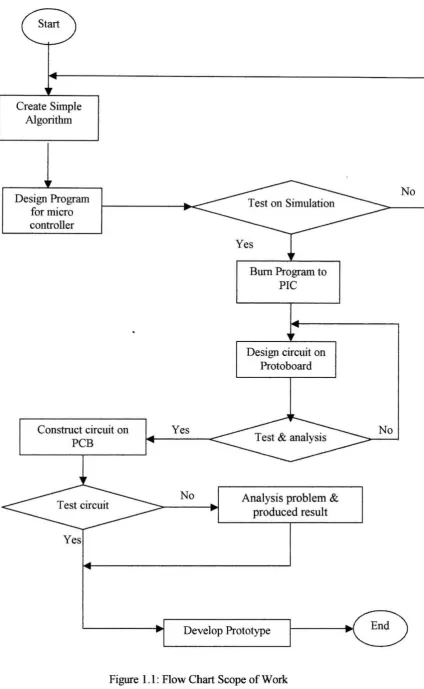
1.1 Project Objectives And Scope Of Work
The objectives of the robot are to study and investigate the ranging sensor and
the integration technique using IR sensor for the wall-following mobile robot and to
implement about simple following algorithm then after implement simple
wall-following algorithm, designing on wall-follov.ring mobile robot on micro controller PIC
Basic.
The progress to design wall-following mobile robot it is divide to three major
processes and there are designing on micro controller, design the circuit and lastly
develop the platform to produce the prototype of wall-following mobile robot.
Firstly the process is design micro controller referred to the planning of
movement the wall-following mobile robot after design the micro controller then the
simple algorithm will implement to the
.
micro controller using PIC Basic by assemblerlanguage.
3
The next process is designing on the circuitry of the robot. In this process there
are get on develop the prototype of the robot, which is from designing on circuitry, and
develop the platform. On designing the circuit for wall following after design the circuit
it will test on PROTEUS simulator to look after the problem on designing that circuit. If
the design nothing problem on the design circuit, the design circuit will transferred to
printed-circuit (PC) boards. In this progress started the planning and layout must create
to transfer circuit into PC board. Then component assembly and PC board soldering is
the next process. Develop the platform is the final construction to produce the prototype
Create Simple Algorithm
Design Program for micro controller
Construct circuit on
PCB
Yes
Burn Program to PIC
Design circuit on
Protoboard
No Analysis problem &
produced result
Develop Prototype
4
No
[image:20.533.68.493.59.749.2]5
1.2 Problem Statements
The problem in wall-following mobile robot has been study in this project is the
movement control target of the robot to sense the wall. The biggest problem facing a
robot nowadays is overall system reliability. A robot might face any combination of the
following failure modes, firstly mechanical failures, these might range from temporarily jammed movements to wedged gear trains or a serious mechanical breakdown. Secondly is electrically failures, hope it is safe to assume that the computer itself will not fail but loose connections of motors and sensors are a commonly problem. Finally sensor
unreliability, sensor will provide noisy data (data that is sometimes accurate, sometimes
not) or data that simply incorrect (transmitter fails to detect and trigger motor).
CHAPTER2
LITERATURE REVIEW
These robots are design by Mike Linnen at April 4, 2002 [5]. This can be
accomplished by using the front and rear sensor. The arrangement of sensor
positioning at left side on body of robot.
6
For a mobile robot, wall following is a useful motion in structured
environments and can be employed for obstacle avoidance. In many mobile robot
ultra sonic range sensor are used for wall following. With these robots, the range
from robot to wall is commonly measured by an ultrasonic sensor and used for
motion control. However from the point of view of vehicle motion control, the
direction angle to the wall is more useful and suitable information to realize wall
following. So Mike Linnen [5] set out to build and program a maze robot to follow
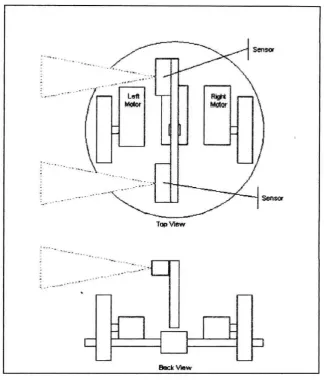
one wall. He chooses to use a differential drive system on a round body. This would
allow him to control the robot rather easily and prevent it from getting hung up on
maze walls. Mike Linnen [ 5] mounted two ultrasonic sensors on a single shaft on top
of a servomotor. The sensors were positioned 90° apart. The servomotor allowed the
robot to look parallel wall at the same time.
In order to tell if the robot was getting closer or further away from a wall a
7
be able to look at a wall and determine if the robot was parallel to it without moving forward.
:--
...
.
\ ,~····
···
Top View
... ... _,
[image:23.533.120.445.98.479.2]. __ _.
..
Figure 2.1: DR X Prototype
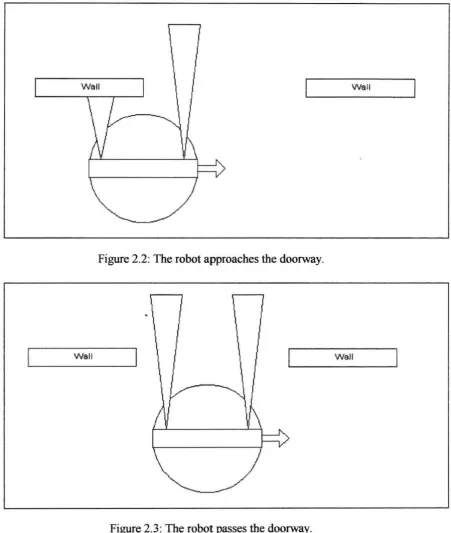
Mike Linnen [ 5] found out some other advantages of this sensor arrangement. While the robot was following a wall and it approached a doorway of the maze the first sensor would detect the opening (doorway) very easily. Once the second sensor
detected the doorway he knew the robot was directly in front of the entranceway. A
90° turn towards the entranceway would position the robot perfectly for passage
through the door. Passage through the door would also be easily detected. As the robot moved forward, both sensors could detect the door jam. The robot could
successfully determine when a door was found and navigate through the door rather
8
Well
Figure 2.2: The robot approaches the doorway.
[image:24.535.57.508.78.611.2]Wall Wall
[image:24.535.61.506.79.346.2]