APPLICATION O F THE TWO VARIABLE EXPANSION PROCEDURE T O THE
C O M M E N S U R A B U PLANAR RESTRICTED THREE-BODY P R O B L E M
T h e s i s by
R i c h a r d R. W i l l i a m s
In P a r t i a l F u l f i l l m e n t of t h e R e q u i r e m e n t s F o r t h e D e g r e e of
Doctor of Philosophy
C a l i f o r n i a Institute of Technology P a s a d e n a , California
19
66
ACKNOWLEDGEMENTS
The a u t h o r w i s h e s t o e x p r e s s his a p p r e c i a t i o n t o P r o f e s s o r P. A. L a g e r s t r o m for the a s s i s t a n c e given by h i m a s r e s e a r c h
a d v i s o r , a n d t o P r o f e s s o r J. K. Kevorkian, who originally s u g g e s t e d t h i s p r o b l e m and offered many suggestions throughout t h e c o u r s e of the work. Many thanks a r e due t o Mrs. Vivian Davies f o r typing t h e manuscript.
ABSTRACT
The n e a r l y c o m m e n s u r a b l e c a s e of the planar r e s t r i c t e d t h r e e -
body p r o b l e m is t r e a t e d by application of the two v a r i a b l e expansion procedure. The polar angle of the infinitesimal body, r a t h e r than the
t i m e , is taken a s the independent variable. A s e t of four coupled f i r s t
o r d e r differential equations, which govern the long-period behavior of
the o r b i t a l elements, i s obtained by imposing the r e q u i r e m e n t that t h e
a s s u m e d f o r m of t h e expansions must be self-consistent. The
independent v a r i a b l e i n t h e s e equations is the "slow variable". It is then found that the s h o r t - p e r i o d perturbations of the motion of the
infinitesimal body do not contain s m a l l d i v i s o r s o r s e c u l a r t e r m s .
Approximate solutions f o r the o r b i t a l e l e m e n t s a r e given, f o r
two different c a s e s . Both l i b r a t o r y and n o n - l i b r a t o r y solutions a r e
found, depending upon the initial conditions. N u m e r i c a l r e s u l t s a r e
calculated f r o m t h e s e solutions, and a r e c o m p a r e d t o n u m e r i c a l
TABLE OF CONTENTS
I. INTRODUCTION 1
11. EQUATIONS O F MOTION
6
111. METHOD OF AVOIDING SMALL DIVISORS 11
Justification f o r Use of the Two V a r i a b l e Expansion 12 P r o c e d u r e
The F o r m of the Expansions 13
Solution of the O(pO ) Equations 16
O c c u r r e n c e of S m a l l D i v i s o r s i n s I and t l 18 Explicit Inclusion of C o m m e n s u r ~ a b i l i t y i n the Expansions 20 G e o m e t r i c a l Significance of @(€I, p) 24 Dependence of the Orbital E l e m e n t s on p. 26
The O(p) Equations 2 9
S e r i e s Expansion of the P e r t u r b i n g T e r m s 3 0 R e m o v a l of Resonant P e r t u r b i n g T e r m s 3 4
IV, BEHAVIOR OF THE ORBITAL ELEMENTS 42
1. Equations f o r the Orbital E l e m e n t s 2. Use of the J a c o b i I n t e g r a l
3. Approximate Solution f o r e(9, p) e o N
% A
4. Approximate Solution f o r e(9, p)
=
p e(8,p) 58 5. C o m p a r i s o n of R e s u l t s with Calculations by Schubart64
APPENDICESVI. NOTATION
1
I. INTRODUCTION
The p l a n a r r e s t r i c t e d three-body p r o b l e m m a y be s t a t e d a s follows: Two bodies move i n c i r c u l a r o r b i t s about t h e i r common c e n t e r of m a s s , and a r e a s s u m e d t o be point m a s s e s . A t h i r d body having infinitesimal m a s s moves i n t h e o r b i t a l plane of the two l a r g e m a s s e s , u n d e r t h e i r combined gravitational attraction.
The above problem, although highly idealized, p r o v i d e s an approximate m a t h e m a t i c a l model of s e v e r a l a c t u a l p r o b l e m s which occur i n c e l e s t i a l mechanics. One s u c h p r o b l e m i s the motion of a n a s t e r o i d ( m i n o r planet) about the sun. The m a s s of a n a s t e r o i d is sufficiently small, i n c o m p a r i s o n t o the m a s s e s of t h e s u n and m a j o r planets, that the effect of the gravitational pull of the a s t e r o i d upon the motion of t h e s e l a r g e r bodies m a y be neglected.
The two l a r g e s t planets i n the s o l a r s y s t e m a r e J u p i t e r and Saturn, the m a s s of S a t u r n being approximately 0.299 that of Jupiter. ( T h e next l a r g e s t planet, Neptune, h a s a m a s s only 0.053 t h a t of Jupiter. ) The orbit of J u p i t e r l i e s much c l o s e r t o the o r b i t s of the a s t e r o i d s than does the orbit of Saturn. The r e f o r e , the p e r t u r b a t i o n s of the motion of a n a s t e r o i d c a u s e d by the g r a v i t a t i o n a l a t t r a c t i o n of J u p i t e r a r e much l a r g e r than those c a u s e d by any other single planet.
The m a s s of Jupiter, although being l a r g e i n c o m p a r i s o n t o the
m a s s e s of the other planets, i s only about 1/1047 that of the sun. T h i s
suggests the application of a perturbation p r o c e d u r e t o obtain a n
approximate s olut'ion of t h e problem.
. Another instance i n which the planar r e s t r i c t e d three-body
p r o b l e m m a y be u s e d a s a n approximate model i s t h e motion of a n
a r t i f i c i a l e a r t h s a t e l l i t e i n the o r b i t a l plane of the e a r t h - m o o n system.
In t h i s c a s e the motion of the a r t i f i c i a l satellite about the e a r t h is p e r t u r b e d by the gravitational a t t r a c t i o n of the moon.
A s e r i o u s difficulty o c c u r s i n the c l a s s i c a l v a r i a t i o n of con-
s t a n t s solution of the problem, f o r those c a s e s where t h e period of
the infinitesimal body i s c o m m e n s u r a b l e with that of the perturbing
body. This difficulty will be briefly described, following a d i s c u s s i o n
by Brouwer and Clemence. (1)
The equations of motion f o r t h e infinitesimal body a r e solved
by the method of variation of constants. The f i r s t approximation
yields a Keplerian orbit t h a t m a y be d e s c r i b e d i n t e r m s of four o r b i t a l
elements. The p e r t u r b a t i o n s caused by the gravitational a t t r a c t i o n of
the body of m a s s a r e t a k e n into account i n the next approximation,
and a s e t of four f i r s t - o r d e r equations is obtained f o r the v a r i a t i o n of the constants of integration; i.e. for the behavior of t h e o r b i t a l
with the notation '
s e m i m a j o r a x i s of the orbit of the infinitesimal body time
m a s s of the perturbing body
m e a n motion of t h e infinitesimal body m e a n motion of the perturbing body
m e a n longitude of the infinite sirnal body
a f
@
longitude of the p e r i c e n t e r of the infinitesimal body coefficients depending only on a and e ( f o r the planar r e s t r i c t e d t h r e e -body p r o b l e m )
i n t e g e r s which a r e s u m m e d over
and where ao, no, eo, woP and E a r e the corresponding unperturbed 0
Keplerian values. The s e r i e s on the r. h. s. of the above equation c a n be a r r a n g e d i n i n t e g r a l powers of the e c c e n t r i c i t y e
.
de Equations s i m i l a r i n f o r m t o the above a r e obtained f o r
-
d t
'
-
dw and-
d t'
dE
T h e s e equations a r e integrated by neglecting the v a r i - d t '
ation of the o r b i t a l e l e m e n t s of the infinitesimal body on t h e r. h. s.
,
a s is indicated by t h e u s e of a n o and eo i n s t e a d of a, n, w, andc. 0' 0' 0'
The following r e s u l t is obtained f o r the s e m i m a j o r axis:
where
The solutions f o r de, do, and 6~ a r e s i m i l a r i n f o r m t o that f o r da.
If
the m e a n motions n and n1 a r e approximately c o m m e n s u r - 0able, t h e r e will e x i s t a p a r t i c u l a r p a i r of i n t e g e r s jl= J1 and jg= J 3 n
0
f o r which
(J3$ J,
- 7 )=
0
.
The e x p r e s s i o n s f o r da, de, do, and 66n n
0
F o r c a s e s i n which t h e s e s m a l l d i v i s o r s occur, the above
solution is not valid. This is because the o r b i t a l e l e m e n t s a, e, a, and
E a s given above undergo l a r g e oscillations having amplitude p r o -
portional t o (J3 t
J,
3)-',
i n violation of the approximation that was used i n integrating the equations f o r dadt'
dt9
de dw and.%.
This isdt'
dt ' known a s the "difficulty of s m a l l divisors1'.The difficulty of s m a l l d i v i s o r s a l s o o c c u r s i n t h e v a r i a t i o n of
constants solution of the non-planar r e s t r i c t e d t h r e e -body problem, a s
well a s i n the m o r e g e n e r a l p r o b l e m where the orbit of the perturbing
body is taken a s elliptic r a t h e r than c i r c u l a r . However, i n o r d e r t o
investigate the b a s i c f e a t u r e s of the difficulty of s m a l l d i v i s o r s , with- out becoming u n n e c e s s a r i l y encumbered by a l g e b r a i c detail, i t is reasonable t o consider the s i m p l e s t p r o b l e m w h e r e the difficulty
o c c u r s -the planar r e s t r i c t e d three-body problem.
A qualitative method of treating the p r o b l e m of s m a l l d i v i s o r s h a s been given by ~ o i n c a r 6 ' ~ ) for the c a s e where the m e a n motions
a r e i n the r a t i o J'l
-
with J a positive integer. The t i m e is taken a sJ
the independent variable, and a l l the s hort-period p e r t u r b a t i o n s a r e
neglected. Two approximate i n t e g r a l s of the long-period motion a r e
obtained, because the Hamiltonian then contains neither t h e t i m e nor
the s h o r t - p e r i o d angular variable. However, only the g e n e r a l f o r m of
the Hamiltonian is given, without specifying the e x p r e s s i o n s f o r those
t e r m s which a r e multiplied by the perturbing m a s s . Hence the t i m e -
where the m e a n motions a r e i n t h e r a t i o
kK,
J J andK
being positive integers. Higher powers of the e c c e n t r i c i t y a r e r e t a i n e d i n t h e p e r -turbing t e r m s . However, i n t r e a t i n g the time-dependence of the
motion, s e v e r a l important perturbing t e r m s have i n c o r r e c t l y been
neglected, a s the r e s u l t of not having o r d e r e d t h e s m a l l quantities i n a
s y s t e m a t i c manner.
chuba art'^)
h a s published the r e s u l t s of extensive n u m e r i c a lcomputations for the n e a r l y commensurable c a s e of t h e r e s t r i c t e d
three-body problem. In h i s work, the s h o r t - p e r i o d perturbations a r e
removed by a n u m e r i c a l averaging p r o c e s s , and only the long-period
effects a r e included i n the o r b i t a l elements. These r e s u l t s provide
considerable insight into the qualitative and quantitative f e a t u r e s of the
motion f o r a wide range of initial conditions.
The purpose of the work d e s c r i b e d i n t h i s t h e s i s i s t o demon-
s t r a t e how the two v a r i a b l e expansion p r o c e d u r e m a y be u s e d t o obtain
a solution which i s f r e e of s m a l l divisors. This method e s t a b l i s h e s
the p r o p e r t i m e - l i k e v a r i a b l e f o r the long-period motion, and c l a r i f i e s
the dependence of the amplitudes of the o r b i t a l e l e m e n t s on the s m a l l
p a r a m e t e r i n the problem. Both the s h o r t - p e r i o d and long-period
EQUATIONS OF MOTION
The p l a n a r r e s t r i c t e d t h r e e - b o d y p r o b l e m will be non-
dimensionalized by choosing t h e units of m a s s , length, and t i m e a s
follows: the unit of m a s s i s c h o s e n i n s u c h a way that the l a r g e r of
the two m a s s i v e bodies h a s m a s s 1 - p , and t h e s m a l l e r one h a s m a s s
p,, where 0
<
p, 4 f o r a l l c a s e s ; the unit of length is c h o s e n s u c ht h a t the c o n s t a n t d i s t a n c e between the two m a s s i v e bodies, a s t h e y
revolve i n t h e i r c i r c u l a r o r b i t s , i s e q u a l t o 1; the unit of t i m e i s
c h o s e n s u c h that the constant angular velocity of the two l a r g e bodies
about t h e i r c o m m o n c e n t e r of m a s s i s e q u a l t o 1.
The c e n t e r of m a s s will lie on t h e line joining t h e two l a r g e
bodies, a t a d i s t a n c e p f r o m the body of m a s s 1-p. The c e n t e r of
m a s s i s a s s u m e d t o be moving a t constant r e c t i l i n e a r v e l o c i t y with
r e s p e c t t o a n i n e r t i a l f r a m e of r e f e r e n c e .
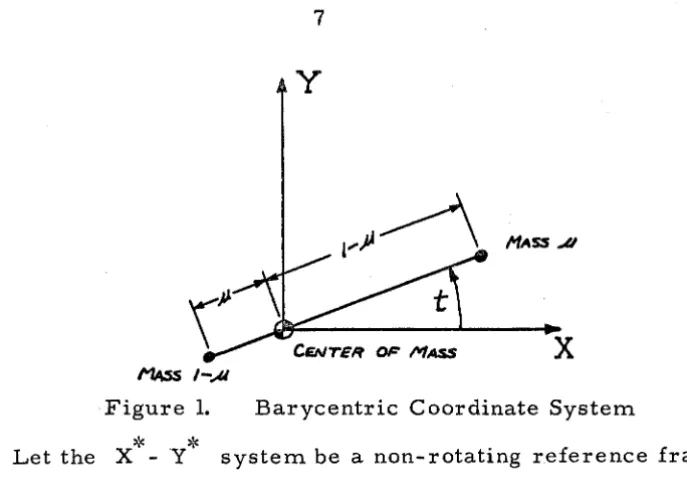
L e t the non-rotating X-Y coordinate s y s t e m have i t s o r i g i n fixed a t the c e n t e r of m a s s . T h i s f r a m e of r e f e r e n c e will be a n
i n e r t i a l one. The line of c e n t e r s will r o t a t e about t h e m a s s c e n t e r
with unit a n g u l a r velocity. Choose the angular o r i e n t a t i o n of the
X-Y s y s t e m i n s u c h a way that the positive X a x i s c o i n c i d e s with the position of m a s s p a t t i m e t
=
0. The line of c e n t e r s thenm a k e s a n angle t with t h e positive
X
axis.MASS I - !
F i g u r e 1. B a r y c e n t r i c Coordinate S y s t e m
* *
L e t t h e X
-
Y s y s t e m be a non-rotating r e f e r e n c e f r a m e c e n t e r e d a t t h e body of m a s s 1-p. A s s e e n f r o m the i n e r t i a l f r a m e*
*
X - Y , the o r i g i n of c o o r d i n a t e s of the X
- Y
s y s t e m will move a tconstant a n g u l a r velocity i n a c i r c l e of r a d i u s p about the c e n t e r of
*
sgm a s s , a n d hence the X
-
Y f r a m e i s not a n i n e r t i a l one. L e t thex*-
Y* s y s t e m have the s a m e fixed a n g u l a r o r i e n t a t i o n a s does the*
X-Y s y s t e m . The positive X - a x i s will t h e n p a s s through t h e
position of m a s s p a t t
=
0. T h e r e f o r e t h e line of c e n t e r s w i l l m a k e*c
a n angle t with the positive X -axis.
*
The g e o m e t r i c a l s i t u a t i o n i n the
x*-
Y s y s t e m i s shown i n F i g u r e 2. [image:11.520.50.448.33.712.2] [image:11.520.72.416.40.279.2]Let r denote the distance of the infinitesimal body f r o m the $
*
origin of the X
-
Y s y s t e m , and let 8 denote the angle f r o m the*
positive X a x i s to the r a d i u s v e c t o r of the infinitesimal body. The distance between the infinitesimal body and the body of m a s s p i s
&
then equal t o [l+r2-2r c o s ( 8 - t d.
The equations of motion of the infinitesimal body m a y e a s i l y be
derived in t e r m s of r and
8 ,
c o n s i d e r e d a s functions of the t i m e t. d rThey a r e a s follows ( w h e r e r
=
etc. ) :In applying the two v a r i a b l e expansion p r o c e d u r e that will l a t e r
be used t o solve t h e s e equations, a different s e t of v a r i a b l e s i s m o r e
useful. The new f o r m of the equations will make i t e a s i e r t o t r e a t i n
a p r o p e r m a n n e r the t e r m s which would otherwise produce s m a l l
divisors.
Introduce the v a r i a b l e
Then t r a n s f o r m t o 8 i n s t e a d of t a s the independent variable, s o
that s
=
~ ( 8 ) ~ t=
t(8).
This may be done by rneans of t h e followingThe equations of motion f o r the planar r e s t r i c t e d three-body
p r o b l e m then a s s u m e the following f o r m :
It i s s e e n that both the time t(8, p) and the independent
variable 8 a p p e a r explicitly i n the equations of motion, i n the
t e r m s which involve sin(8-t) and cos(6-t). The p r o b l e m i s t h e r e -
f o r e non-autonomous.
* *
Because of the manner i n which the orientation of theX
-
Y axes was specified, the initial condition on t i s a s follows:where 0, i s the initial angle between the r a d i u s vector t o the infini-
The t e r m s which involve
[
1+
s 2 - 2 s c o s ( 9 - t )I
-
2 3' lead to the o c c u r r e n c e of s m a l l divisors. These t e r m s r e p r e s e n t the gravitationala t t r a c t i o n of the body of m a s s y upon the infinitesimal body. The
dt
on the r.h.s. of eq. ( 5 ) o c c u r s a s a r e s u l t of having t e r m - y ( s
I
chosen l-yI instead of 1 , f o r the m a s s of the l a r g e r body. The r e -
maining t e r m s on the r.h. s. of eqs. ( 4 ) and ( 5 ) a r e "apparent f o r c e s "
which r e s u l t f r o m the f a c t that the X*
-
Y*
s y s t e m i s not a n i n e r t i a lr e f e r e n c e f r a m e . T h e s e "apparent f o r c e s " do not l e a d to s m a l l
divisors.
Eqs. (4) and ( 5 ) a r e a n exact m a t h e m a t i c a l r e p r e s e n t a t i o n of
the planar r e s t r i c t e d three-body problem, valid f o r a l l values of
O <
y<
$
.
T h e s e equations p o s s e s s one exact integral, the well-knownJ a c o b i integral: ~
where
C
depends only on the initial conditions.In the r e m a i n d e r of t h i s work, i t will be a s s u m e d that ~<p.<<i.
The quantity y m a y then be t r e a t e d a s a s m a l l p a r a m e t e r i n the
METHOD AVOIDING SMALL DIVISORS
The o c c u r r e n c e of s m a l l d i v i s o r s in the v a r i a t i o n of constants
t r e a t m e n t of the p r o b l e m r e s u l t s f r o m having neglected the v a r i a t i o n
of the m e a n motion, and the other o r b i t a l e l e m e n t s , while c a r r y i n g
out the integration of the p e r t u r b a t i o n equations. The s m a l l d i v i s o r s
a r e produced by the integration of t e r m s whose p e r i o d i s v e r y l a r g e
c o m p a r e d t o the o r b i t a l p e r i o d of the infinitesimal body. This
suggests the existence of a second t i m e scale, the "slow-time" scale,
over which i m p o r t a n t changes occur i n the o r b i t a l elements.
The physical r e a s o n f o r the o c c u r r e n c e of the difficulty i s the
f a c t that the p e r t u r b i n g f o r c e i s n e a r l y r e s o n a n t with the motion of
the infinitesimal body. This n e a r - r e s o n a n c e a s p e c t of the motion will
now be d i s c u s s e d briefly.
A s s u m e t h a t the infinitesimal body moves i n a n e l l i p t i c a l o r b i t
about the l a r g e r m a s s 1-p. T h i s e l l i p t i c a l o r b i t will be p e r t u r b e d by
the gravitational f o r c e e x e r t e d by the m a s s p. The distance between
the infinitesimal body and the p e r t u r b i n g body will be a p p r o x i m a t e l y
a periodic function of time, s o that the p e r t u r b i n g f o r c e i s a l s o n e a r l y
periodic. If the o r b i t a l p e r i o d of the infinitesimal body i s approx-
i m a t e l y a r a t i o n a l f r a c t i o n of the o r b i t a l p e r i o d of the p e r t u r b i n g body,
the perturbing f o r c e o s c i l l a t e s with a n e a r l y r e s o n a n t frequency. The
i m p r o p e r m a t h e m a t i c a l t r e a t m e n t of this n e a r - r e s o n a n c e l e a d s t o the
o c c u r r e n c e of s m a l l d i v i s o r s .
in the p r e s e n c e of the n e a r l y - r e s o n a n t perturbing f o r c e s .
1. Justification for Use of the Two Variable Expansion P r o c e d u r e The two v a r i a b l e expansion procedure has been d i s c u s s e d i n the l i t e r a t u r e by Cole and ~ e v o r k i a n , ' ~ ) and by Kevorkian.
( 6 )
1t is asyste'matic method of constructing an expansion, of the solution of a n o r d i n a r y differential equation containing a s m a l l p a r a m e t e r , which r e m a i n s valid f o r l a r g e values of the independent variable. T h i s method is e s p e c i a l l y useful i n p r o b l e m s where a s m a l l perturbing f o r c e produces important effects which occur over a t i m e s c a l e that is l a r g e c o m p a r e d t o the t i m e s c a l e of the m a i n f e a t u r e s of the motion.
In applying the two v a r i a b l e procedure, it is a s s u m e d that t h e exact solution m a y be r e p r e s e n t e d by a n expansion which depends explicitly upon two different t i m e ( o r t i m e - l i k e ) v a r i a b l e s , a "fast t i m e " v a r i a b l e and a "slow t i m e " variable. The use of two different v a r i a b l e s introduces a n indeterminacy into the v a r i o u s t e r m s of the expansion. This indeterminacy is r e m o v e d by r e q u i r i n g t h a t t h e a s s u m e d f o r m of the expansion m u s t he self-consistent.
The v a r i a t i o n of constants approach yields both s h o r t - p e r i o d
and long-period e f f e c t s i n the o r b i t a l elements. The s h o r t - p e r i o d
effects m u s t be r e m o v e d before the fundamental difficulty of the
p r o b l e m c a n be studied.
2. The F o r m of the Expansions
F o r p<<i, the t e r m s on the r. h. s. of eqs. ( 4 ) and ( 5 ) m a y be t r e a t e d a s s m a l l perturbations, provided that [1+ s 2 - 2s cos(8- t)] 3/2
does .not become a r b i t r a r i l y small. T h i s i m p l i e s that the infinit-
e s i m a l body m u s t not make a "close approach" t o the body of m a s s p.
Close a p p r o a c h e s cannot occur f o r o r b i t s which lie e n t i r e l y withinthe
orbit of the p e r t u r b i n g body; i.e, f o r o r b i t s having s(8, p)>1 for a l l 8.
F o r c a s e s where s(8, p)<1 during p a r t of the orbit, the p e r t u r b a t i o n s
will r e m a i n s m a l l only if [ l + s 2 - 2 s cos(8-t)] 3/2 r e m a i n s bounded
away f r o m zero. '
Orbits f o r which [ l + s 2 - 2 s cos(8-t)] 312 a p p r o a c h e s 0 will not
be c o n s i d e r e d i n t h i s work.
The solution of eqs. ( 4 ) and ( 5 ) will be sought by u s e of the two
variable expansion p r o c e d u r e i n the following f o r m :
where the slow v a r i a b l e i s
( 9 )
8 = ~ 4 e
N N
i n the t e r m s of 0 ( p ) ; i.e. i n the solutions f o r s1(f3, 8, p) and t (0, 0, p). 1
Hence, f o r the purpose of resolving the b a s i c difficulty, the t e r m s of
higher o r d e r i n p m a y be neglected.
Derivatives a r e to be calculated by the r u l e
The following expansions a r e obtained by applying t h i s derivative r u l e
t o expansions ( 8 a ) and (8b):
Applying the derivative r u l e again,
T h e s e expansions m a y be used t o e x p r e s s the 1. h. s. of eqs. ( 4 )
1/2
and
(5).
retaining a l l t e r m s of O(pO), O(p ), and O(p).It is now n e c e s s a r y t o d i s c u s s the manner i n which the p e r - turbing t e r m s on the r.h. s. of the equations of motion m a y be expanded
4' 2
0
to be retained, i t i s sufficient t o use the O(p ) approximation t o the
quantities i n b r a c e s on the r. h. s. of eqs. ( 4 ) and (5). The t e r m s which involve powers of s
3
d s d tand
TiB
m a y be ex- panded a s above. The only r e m a i n i n g t e r m s a r e t h o s e which involves i n ( 8 - t ) and c o s ( 8 - t ) .
By the expansion f o r t(8, p.) we have
H
The two v a r i a b l e expansion p r o c e d u r e will be used t o make tl(O, 0, P)
N
a bounded function of 0. T h e r e f o r e pt1(0. 0, p) will r e m a i n a quantity
of O(y), and m a y be dropped f r o m eq. (13), s o that
(14)
&(e-t)
= & [ ( e - ~ )
-AC
+&@I
=
ACvz(e-to)
fB(U$)
=
A ( e - $ )
+
B,+)
Similarly,
(15)
a(*-t)
=
m ( e - t )
+
8 ( ~ )
The following expansion i s t h e r e f o r e valid f o r the t e r m s on the
A s i m i l a r expansion i s v a l i d f o r t h e t e r m s on the r. h. s , of eq. (5). Thus t h e p e r t u r b a t i o n t e r m s of O(p) involve only t h e quantities
N N
so(O, 0, p) and to(O, 0, p) and t h e i r d e r i v a t i v e s . However, t h i s
N
a p p r o x i m a t i o n will be valid only if i t c a n be shown that t (8, 1 0, p) a n d
N
s (8, 8, p) a r e indeed bounded functions of 8,
1
3. Solution of the O(pO) Equations
0
The t e r m s multiplied by p i n t h e equations of motion l e a d to the following equations:
T h e s e a r e ' t h e equations of K e p l e r i a n motion. That i s , i f the
pertu-rbing m a s s p w e r e e q u a l t o zero, the i n f i n i t e s i m a l body would
d e s c r i b e a n u n p e r t u r b e d K e p l e r i a n o r b i t about t h e l a r g e m a s s .
In t h i s work only d i r e c t o r b i t s will be c o n s i d e r e d . That i s , i t
will be a s s u m e d t h a t both the i n f i n i t e s i m a l body and the p e r t u r b i n g
m a s s p r e v o l v e about t h e l a r g e m a s s i n a counterclockwise d i r e c t i o n
( s e e F i g u r e 2).
Eqs. (17) and (18) will be solved, r e g a r d i n g 0 a n d a s
where
N
a
=
a(8, p)=
s e m i m a j o r a x i s of the orbit of the infinitesimal bodye
= e(0,
p)= e c c e n t r i c i t y of the orbit of the infinitesimal body
~ q . (19) defines the angular momentum of the orbit. F o r r e t r o g r a d e
2
orbits, eq. (19) would be r e p l a c e d by s, 2 -1/2
W =
-a-V2(1-e ).
Only e l l i p t i c a l o r b i t s ( 0 ,< e
<
1) will be c o n s i d e r e d here. P a r a -bolic and hyperbolic o r b i t s ( e 3 1) do not produce the difficulty of s m a l l d i v i s o r s , because the motion of the infinitesimal body is not
periodic i n t h e s e c a s e s .
Eq. (18) becomes
The g e n e r a l solution of this equation i s
where A and B , a r e a r b i t r a r y functions. In t e r m s of the K e p l e r i a n o r b i t a l e l e m e n t s , t h e s e functions a r e
where
-
w
=
w(8, p)=
longitude of p e r i c e n t e r of the o r b i t of the infinitesimal bodys o that
(23)
H
The quantity tO(O, 8, p) m a y be obtained f r o m the r e l a t i o n
where
w
Eq. (22) i s s t i l l s a t i s f i e d if a n a r b i t r a r y function of 0 is added t o
If one expands the integrand on the r. h. s. of eq. (23) i n a
w
Taylor s e r i e s about e
=
0, and then holds 0 fixed while c a r r y i n gout the i n t e g r a l w. r. t. 6, the following e x p r e s s i o n i s obtained:
sinusoidal functions
,
multiplied by e, e2, e3,where T(;, p) i s a n a r b i t r a r y function which defines the position of the infinitesimal body i n i t s orbit.
4. O c c u r r e n c e of S m a l l Divisors i n s , and t ,
N
The unbounded p a r t of to(O, 8, p) i s e n t i r e l y contained i n the
quantity [ T
+
2/20]. T h e r e f o r eIt follows that
( 2 6 ) s h o r t - p e r i o d sinusoidal functions
&,
,,
(*-t)=
[~-$)@-d
f- {of 0, multiplied by e, e2, e3, etc]A s i m i l a r expansion would be valid f o r c o s ( 8 - t ).
0 N
T h e r e f o r e , if eq. ( 2 4 ) w e r e used f o r to(O, 8, p) i t would be
N N
found that the equations f o r sl(O, 0, p) and tl(8, 0, p) would contain
3/2
f o r c i n g functions which would involve sin[ (1-a )8- T] and
3/2 N
cos [ (1-a )8- T]
.
Since0
i s held fixed during the i n t e g r a t i o n s w. r. t.8,
the quantity (1-$I2) would appear a s a constant frequency. In combination with other f r e q u e n c i e s which a r e p r e s e n t i n the p e r t u r b i n gt e r m s , t h e s e t e r m s would produce sinusoidal functions of 8 having
f r e q u e n c i e s c l o s e t o z e r o and o t h e r s with f r e q u e n c i e s c l o s e t o 1, f o r c e r t a i n values of a312. Upon integration w.r.t. 0, t h e s e t e r m s would
produce s m a l l d i v i s o r s i n s1 and t 1 '
By e x p r e s s i n g the perturbing t e r m s a s functions of 0 and the
o r b i t a l e l e m e n t s a3I2, e , w , T, and then expanding i n periodic s e r i e s 1
t o d e t e r m i n e which f r e q u e n c i e s occur, i t m a y be shown that s m a l l
N
d i v i s o r s would o c c u r i n sl(O,
z,
p) and tl(6. 8, p) f o r d i r e c t e l l i p t i c a l o r b i t s i n those c a s e s where the s e m i m a j o r a x i s h a s a value s u c h t h a twhere n and m a r e r e l a t i v e l y p r i m e positive i n t e g e r s , with n >
rn
.
It m a y a l s o be shown that the perturbing t e r m s which a r e
multiplied by the f i r s t power of the e c c e n t r i c i t y would produce s m a l l
2
t e r m s multiplied by e would produce s m a l l d i v i s o r s f o r both the
3
m = l and m=2 c a s e s ; those multiplied by e would produce s m a l l
d i v i s o r s f o r the m=l, m=2, and m=3 c a s e s ; etc. Correspondingly,
one would expect the behavior of the o r b i t a l e l e m e n t s t o be somewhat
d i f f e r e n t f o r the v a r i o u s values of m.
F o r brevity, this a n a l y s i s will not be c a r r i e d out here. How-
e v e r , i t should be mentioned that the o c c u r r e n c e of s m a l l d i v i s o r s in
the above f o r m i s equivalent t o the corresponding difficulty encountered
in the v a r i a t i o n of constants t r e a t m e n t of the problem.
Although r e t r o g r a d e (clockwise) elliptical o r b i t s will not be
d i s c u s s e d h e r e , s m a l l d i v i s o r s would occur f o r c e r t a i n c a s e s where
2/2
i s the r a t i o of two positive i n t e g e r s . T h e s e s m a l l d i v i s o r s could be avoided by a method s i m i l a r t o that which will be d i s c u s s e d i n thenext section.
5. Explicit Inclusion of Commensurability i n the Expansions
A s d i s c u s s e d above, s m a l l d i v i s o r s would occur if the s e m i -
n- m m a j o r a x i s i s s u c h that a3/2(& p) i s n e a r one of the values -,
n
This suggests that the n e a r - c o m m e n s u r a b i l i t y should be taken into
account f r o m the outset, and that the s e m i m a j o r a x i s should be ex-
panded i n the f o r m
N
The e x p r e s s i o n f o r to($, 0, p) m u s t now be r e - e x a m i n e d , taking
into account expansion (27). The e x p r e s s i o n given i n eq. ( 2 4 ) w a s ob-
-
tained by holding the s l o w v a r i a b l e 8 fixed while c a r r y i n g out the
i n t e g r a t i o n w. r. t. 0. Such a p r o c e d u r e is v a l i d f o r t h e t e r m s which d o
not givk r i s e t o unbounded quantities p r o p o r t i o n a l t o 8. T h e r e f o r e
s i m i l a r s h o r t - p e r i o d s i n u s o i d a l functions of
6,
multiplied by e3, e4,-
- -
T h e r e i s no non-uniform a p p r o x i m a t i o n t o the unbounded p a r t of
-
3 4to(B, 0, p) c a u s e d by dropping the t e r m s multiplied by e
,
e,
- -
-
.
s i n c e the i n t e g r a l s of a l l s u c h t e r m s w.r.t. 0 a r e bounded.
Using eq. (27) f o r a , p , one obtains
If the i n t e g r a l on the r.h.s. of eq. ( 3 0 ) c a n be e x p r e s s e d a s a
M N
function of 8 alone, r a t h e r t h a n a s a function of both 0 a n d 0, i t
will be p o s s i b l e t o d i s t i n g u i s h between the unbounded behavior of
H
to(8, 0, p) which i s p r o p o r t i o n a l t o 0 and t h e unboundedness which i s
N
p r o p o r t i o n a l t o 0
.
T h i s will make i t possible t o avoid the o c c u r r e n c eN N
of s m a l l d i v i s o r s i n s l ( O , 0, p) and tl(O, 0, p)
.
-
]/2
T o a c c o m p l i s h t h i s i t i s n e c e s s a r y t o u s e the r e l a t i o n 0=p 6Introduce the notation
Eq. ( 2 9 ) m a y now be written a s follows:
+ 3
%
s i m i l a r s h o r t - p e r i o d sinusoidalof
0,
m u l t i p l i e d b y e 3 , e 4 ,- -
-
F o r brevity, the following notation will be used, whenever it is con- ve nie nt:
The corresponding derivative i s
Eq. (33) t h e n b e c o m e s
This e x p r e s s i o n will be u s e d f o r t f r o m this point on. 0
The t e r m
--
( n - m ) 9 r e p r e s e n t s the unbounded behavior of tn o
H
which is proportional t o 6,and (P(9, p) r e p r e s e n t s a possible unbound-
edness of to on the
;
scale. A g e o m e t r i c a l i n t e r p r e t a t i o n of @ willbe given l a t e r .
Having e x p r e s s e d t by eq. (36) i t i s n e c e s s a r y t o e x p r e s s a t
0 a t o 0
the de rivative s
a 3
and -NI i n a self-consistent manner. Theae
f o r m e r i s given by
By the derivative r u l e (10) we expect that
F o r m a l l y applying the derivative r u l e t o eq. (33), i t is found that
(38b)&(t)=
mim+~'(&+iy+
of s h o r t - p e r i o d t e r m s3
a
derivatives of s h o r t - p e r i o d t e r m s3
F r o m eqs. (37), (38a), and (38b) i t follows that( 3 9 )
.& -
dG
-a
dr
+
(&derivatives of s h o r t - p e r i o d-
&-
;%
+
-
di3
a
derivatives of s h o r t - p e r i o d t e r m s3
The quantity T(;, p) should be r e g a r d e d a s the fourth o r b i t a l
N
element, The quantity @(8, p) i s completely defined i n t e r m s of
6. Geometrical Significance of @(;, p.)
Using the approximation
i t follows that
s i m i l a r s hort-period sinusoidal functions
+ {of
6
,
multiplied by e 3,
e 4.,
- -
-
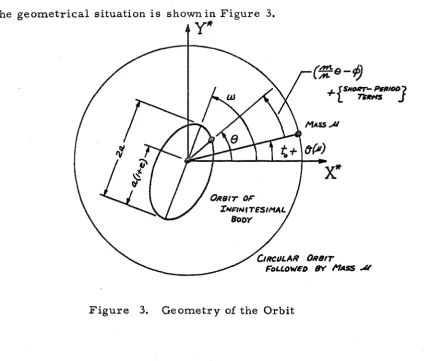
The quantity ( 8 - t ) r e p r e s e n t s the angle f r o m the line of c e n t e r s of
the two l a r g e m a s s e s t o the radius vector of the i d i n i t e s i r n a l body.
The g e o m e t r i c a l situation is shown i n F i g u r e 3.
Y*
[image:28.525.44.469.370.731.2]M N
The e l e m e n t s a(8, p ) and e(8, p) specify the s i z e and shape of
U
the slowly-varying elliptical orbit. The longitude of p e r i c e n t e r
4 0 ,
p)specifies i t s angular orientation. The quantity
4(?,
p) specifies theposition of the infinitesimal body i n i t s orbit.
- Consider the g e o m e t r i c a l situation which o c c u r s e v e r y n t h
time the infinitesimal body i s a t p e r i c e n t e r . Between two s u c h o c c u r -
ences, the i n f i n i t e s i m a l body will have completed exactly n revolutions
i n i t s elliptical orbit, and the m a s s y will have completed approx-
imately ( n - m ) revolutions i n i t s c i r c u l a r orbit. At e a c h s u c h instant,
0
= w ( ~ A ) + & ~ & T
; p a non-negative integers o that eq. (41) becomes
The simple f o r m of eq. (42) r e s u l t s f r o m the fact that e a c h of the
s h o r t - p e r i o d t e r m s i n t o vanishes when
8
= a S p * 2 nn.
The geo- m e t r i c a l situation when the infinitesimal body i s a t p e r i c e n t e r ism F i g u r e 4. G e o m e t r i c a l Significance of (-
w - 4 )
n
m
Thus the quantity ( - ) i s equal to the angle between the
p e r i c e n t e r of the infinitesimal body and the position of the m a s s p., m e a s u r e d e v e r y n t h t i m e the infinitesimal body i s a t p e r i c e n t e r .
7. Dependence of the Orbital E l e m e n t s on p
N
The e c c e n t r i c i t y i s a s s u m e d t o depend on
8
and p. i n thefollowing m a n n e r :
(43)
e(q~()
=
eo
+A%
(q4)
; e o a constantThe corresponding derivative i s
In c e r t a i n c a s e s i t will be possible to u s e the approximation
l/z
e
= e o t
O(p.
) However, if e o i s sufficiently s m a l l , i t i s n e c e s s a r y [image:30.526.39.458.29.371.2]N
The quantities w and r a r e both unbounded functions of 8, i n N
general. They will be a s s u m e d t o depend on 8 and p i n the following
manner :
(45
1
w ( q ~ ) =
W , + A ' ~ ( ~ M ) ; a. a constant(46) T ( ~ A )
=
7;
+~'fel/)
; T O a constantThe corresponding d e r i v a t i v e s a r e a s follows:
It i s not n e c e s s a r y t o a s s u m e i n advance that eo9w
,
and 70 0a r e constants. However, i f one begins with eqs. (43), (45), and (46)
d e o -
i t wil-1 be found t h a t --7;-
-
0, = 0, d T O-
-
0 ~y a s s u m i n gd 8 do do
eo,w 0
,
and 'rO t o be constants f r o m the outset, t h e s e u n n e c e s s a r ycalculations a r e avoided.
A
-
A NThe quantities ~ ( 6 , p) and ~ ( 8 , p) will be unbounded functions
N
0
J/z
of 8 i n general. Hence i t i s not c o r r e c t to write o = w
+
O(p ) o r1/2
T
= r o t
O(p ) Both t e r m s on the r. h. s. of eqs. (45) and (46) m u s t be retained.By substitution of the expansions (11) and (12) i n t o eqs. ( 4 )
and (5), the following equations a r e obtained f r o m the t e r m s which
It will now be shown that because of the f o r m of the expansions 3/2 de
da
dw
d r0 I;;
,
,
and -,
:the t e r m s which occur i n eqs. (49)d o do do d0
0
and (50) a r e actually of
0(d2),
i n s t e a d of O(p ). By eq.(19).
F r o m eq. (21), it follows that
By c a r r y i n g out the indicated derivatives i n eq.
(391,
and2 - 2 2 - 2 2
then multiplying b y s = a ( l - e )
[
1 t e c o s ( 6 - a ) ],
the following 0r e s u l t i s obtained:
z
at,
4
-9
~2p+(wl
(54)
4
=A5
[(&$-&)g+(%+~(@$e&]+M
kz&
8-a24
e2di?
t e r m s multipliedBy differentiation of eq. (54) w. r. t. 0, i t follows that
Thus, e a c h t e r m which o c c u r s in eqs. (49) and ( 5 0 ) i s v 2
actually of 0 ( p ) r a t h e r than O(yO). T h e s e t e r m s m u s t t h e r e f o r e
]/z
be included i n the O(p) equations. Hence t h e r e a r e no O(y ) e q - uations t o solve.
8. The O(p) Equations
By u s e of eqs. 1 1 , ( 2 , (1 6 , ( 4( 5 0 , and (55) i t m a y be shown that the O(y) t e r m s of the equations of motion l e a d to the foll- owing equations :
+
- 2 e A w
&
,-A
emuda%+
r&e?d'&
[a(,-@)
diF
3-
a]
.a$
2at.
"'@%)[@gf
2dkI@+&
G ~ ~ ~ ) ]
f ~ ~ @ ~ c & i ( * - ~ )-
(A-=-
[/-~~-c.-t;)f-g$&(e-tJ
[I+A,Z-~A.C~~('-~,I%
The quantity is of o(ELO), a s m a y be s e e n f r o m eq.(54).
1 2
The notation
7
( 6-)
i s m e r e l y a convenient way of writing t h i s)L O
a 5
t e r m .
9. S e r i e s Expansion of the P e r t u r b i n g T e r m s
In o r d e r t o e x p r e s s the perturbing t e r m s which involve sin(8-to)
and cos(8-t ) i n a useful f o r m , i t i s n e c e s s a r y t o expand these quan- 0
t i t i e s i n powers of e. The amount of a l g e b r a i c labor that is r e q u i r e d i n c r e a s e s v e r y rapidly a s higher powers of e a r e retained. F o r t h i s
3 4
reason, a l l t e r m s multiplied by e ,
,
e,
---
will be neglected i n ther e m a i n d e r of t h i s work. F o r o r b i t s with s m a l l e c c e n t r i c i t i e s , t h i s
should yield a reasonable approximation. The approximation could be
improved i n a s t r a i g h t f o r w a r d manner, me r e l y b y retaining the higher powers of
e.
Using eq. (36) f o r to, the quantity sin(0-t ) m a y be expand- 0
e d i n powers of e a s follows:
(59)
-(*-c)
=
.din($e-4)
-I-
~ P e k ( B - ~ ) ~ & e - + )
-~a%~!~&?(e-w)~~@$?+-(6)+{
s i m i l a r sinus oidal functionsf
of 8, multiplied by eThe quantity c o s ( 8 - t o ) m a y be expanded i n a s i m i l a r form.
The perturbing t e r m s on the r.h.s. of eqs. (57) and (58) m a y
then be expanded i n powers of e. F o r example,
s i m i l a r sinus oidal functions
3
Similar expansions can be made f o r the t e r m s -s:
(%)
s i n ( 8 - t o ) andThe expansions of
and (s: %)I [1-so cos ( 9 - t o i n
powers of e a r e quite lengthy, and a r e t h e r e f o r e given i n the appendix.
The r.h.s. of eqs. ( 5 7 ) and ( 5 8 ) have now been e x p r e s s e d a s functions of
6
and the o r b i t a l e l e m e n t s 2/2.e,w, and4.
However, t h e integration of t h e s e equations cannot be c a r r i e d out explicitly with the r.h.s. i n its p r e s e n t form.A convenient way t o c a r r y out the integration is t o e x p r e s s the v a r i o u s periodic functions of 9 i n t h e i r F o u r i e r s e r i e s ' expansions, and then t o i n t e g r a t e t h e s e s e r i e s 1 t e r m w i s e . The use of F o u r i e r s e r i e s 1 identifies the v a r i o u s frequencies which occur i n t h e p e r t u r b - ing t e r m s , t h e r e b y making i t possible t o identify and r e m o v e the t e r m s which would otherwise produce quantities proportional t o 8 i n
s l
and t l .The F o u r i e r coefficients a r e given by
N
f o r
k
= 0,1, 2,- - -
.
The value of a(@, p) i s held fixed i n c a r r y i n g out these integrations with r e s p e c t t o x.3
If a l l the perturbing t e r m s multiplied by e w e r e retained, it
2 - 9 / 2
would be n e c e s s a r y t o e x p r e s s the quantity [I+ a -2a C O S ( ~ D - $ I ) ] n
i n i t s F o u r i e r expansion. In general, one additional F o u r i e r expansion
of the above type i s r e q u i r e d f o r e a c h additional power of e t h a t i s
retained i n the perturbing t e r m s .
The s e r i e s r e p r e s e n t a t i o n of e a c h perturbing t e r m c a n be ob-
tained f r o m the above F o u r i e r expansions, by t e r m w i s e multiplication.
F o r example,
S i m i l a r expansions can be made f o r e a c h of the perturbing t e r m s .
These F o u r i e r coefficients m a y be e x p r e s s e d i n t e r m s of the
S i m i l a r e x p r e s s i o n s a r e valid f o r Bk(a) and Ck(a). They m a y a l s o be
e x p r e s s e d i n t e r m s of the complete elliptic i n t e g r a l s of the f i r s t and
second kinds, K(a) and E ( a ) , respectively. The r e c u r s i o n r e l a t i o n s
f o r the hypergeometric function m a y be u s e d t o prove c e r t a i n relation-
s h i p s between the F o u r i e r coefficients.
I n o r d e r t o obtain r e s u l t s r e l a t e d t o the behavior of the o r b i t a l
e l e m e n t s f o r a specific n u m e r i c a l value of y , i t is n e c e s s a r y to
know the n u m e r i c a l values of the F o u r i e r coefficients. T h e s e c o
-
efficients could be calculated d i r e c t l y f r o m the definitions i n eqs. (62a),
(62b), and (62c), by n u m e r i c a l integration over the r a n g e 0 6 x ,( 2 n. However, these values m a y a l s o be obtained f r o m extensive
(7)
t a b l e s published by Brown and Brouwer T h e s e t a b l e s give n u m e r -
i c a l values of G ( ~ ) (a), G ( ~ ) (a), and G ( ~ ) ( a ) f o r 0.0 6 a S 0.845,
3/2 5/2 7/2
where
f o r k
=
0,1, 2,- - -
.
The quantities G3/2, G5/2. ( k ) ( k ) and G ( k ) a r e7/2
10. Removal of Resonant P e r t u r b i n g T e r m s
2 a t l at, 1 2 a t
The quantity
[
(so -t 2sos1 -t (Sog)]
m u s t beP
known explicitly i n t e r m . s of
8
before eq. (58) c a n be solved. Henceeq. (57) will be solved f i r s t . After e x p r e s s i n g e a c h of the p e r t u r b i n g
t e r m s a s d i s c u s s e d above, eq. (57) c a n be w r i t t e n i n the following
f o r m :
where the bounded function h i s composed of t e r m s of the following 1
types :
0 2
( a ) s e v e r a l infinite s e r i e s 1 which a r e multiplied by e
,
e, e,
etc. and which contain sinusoidaJ functions of8,
whose f r e q u e n c i e s a r e independent of 8.-
-
T h e s e infinite s e r i e s'
r e s u l t f r o m the ansion of the t e r m 2
1
- 2 s o c o s ( 8 - t o )
I
s i n ( @ - t ) i n powers of e. o( b ) sinusoidal functions of
6
which r e s u l t f r o m the expansion 3 a t o 3of - s o
( w )
s i n ( @ - t ) i n powers of e. 0In c a r r y i n g out the integration of eq. (65) w. r. t.
0,
the slow v a r i a b l e will be held fixed. T h e r e f o r e any t e r m which depends onlyN
on 8 (i.e. which i s independent of -
8)
would produce a n unboundedt e r m proportional t o 8 i n the quantity 2 "o). T h i s would lead t o the o c c u r r e n c e of s i m i l a r unbounded t e r m s i n
s j Q
<
p)and tl(8,
g,
p), c o n t r a r y t o the assumptions of the o r i g i n a l two v a r -S e v e r a l t e r m s which a r e independent of 0 will occur i n the
infinite s e r i e s 1 . These a r e the t e r m s which produce s m a l l d i v i s o r s
i n the v a r i a t i o n of constants solution. F o r example, i f the i n t e g e r s m and n have values such that t h e r e e x i s t s a non-negative integer k
n n
such t h a t
-
-
1 = k , then the (--1)th t e r m of s e v e r a l of the infinitem m
s e r i e s ' will contain the quantity
Each of the s e r i e s t will contain one o r m o r e t e r m s of the above type,
depending upon the values of m and n. By a c a r e f u l inspection of the s e r i e s ' which occur on the r.h.s. of eq. ( 6 5 ) , the s u m of a l l s u c h
t e r m s m a y be determined.
F r o m t h i s point on, only the c a s e m
=
1 will be d i s c u s s e d i ndetail. This i s the most important c a s e for c o m p a r i s o n of the r e s u l t s
with the motion of a s t e r o i d s .
In o r d e r that 2 will not contain a t e r m
proportional t o 0, the s u m of a l l t e r m s on the r.h.s. s f eq.
(65)
which a r e independent of 0 must vanish. This r e q u i r e m e n t yields the following equation:++
e2dinr
@-a#)
+
s i m i l a r t e r m s multipliedby e 3 , e 4 ,
- -
-
J
3/z
The quantities Q, and
p
a r e functions of a only, and a r e de-
3/2 coefficients, e a c h multiplied by s o m e power of a
.
F o r the c a s e rn
= 2,
the r. h. s. of eq. (67) would not contain2 a t e r m multiplied by e ; the leading t e r m would be multiplied by e
.
3 F o r m = 3, the leading t e r m would be multiplied by e
,
etc.After the t e r m s which a r e independent of 0 have b e e n r e m o v e d
by means of eq. (67), eq. (65) c a n be integrated with r e s p e c t t o
8,
holding
5
fixed. The r e s u l t will be f r e e of s m a l l divisors, but will not be written out explicitly here.The e x p r e s s i o n f o r the i n t e g r a l of eq. (65) c a n then be sub-
stituted into eq. (58). The r e s u l t will be a s follows:
where t h e bounded function h2 contains t e r m s of the following types:
0 2 (a) s e v e r a l infinite s e r i e s 1 which a r e multiplied by e , e, e
etc.
,
and which contain sinusoidal functions of 0 whose frequencies a r e independent ofg.
These s e r i e s f r e s u l tf r o m the expansion of t h e quantity
+xi-
i n powers of e,and a l s o f r o m the
ae
( b ) sinusoidal functions of 8 which r e s u l t f r o m the expan
-
s i o n of the quantities s cos(0-t ) and so88
*sin($-t ) i n powers of e, and a l s o f r o m the c o r r e s p o n d - 0
a
to 1 s2 ing t e r m . contained i n[(<
+
2s04
a8
+
T ( o
G)].
P 2If a t e r m i n s i n 8 or cos 8 w e r e t o occur on the r.h. s. of eq.
(68), the r e s p o n s e t o this t e r m would contain the unbounded quantity
8 s i n
6
o r 9 c o s 8. This would c l e a r l y be a resonance effect, andN
would violate the assumption that psl(8, 8, p) r e m a i n s a s m a l l quantity
S e v e r a l s u c h t e r m s i n s i n 8 and cos 8 a r e contained i n the
infinite s e r i e s ' . F o r example, if the i n t e g e r s m and n have values
2n
s u c h that t h e r e e x i s t s a non-negative integer k f o r which
-
-1=
k,
m 2n
the (- -1)th t e r m of s e v e r a l of the infinite s e r i e s 1 will contain the m
quantity
E a c h of the infinite s e r i e s 1 will contain one o r m o r e such
t e r m s , provided that m and n have the n e c e s s a r y values. By a a2S-
1
c a r e f u l inspection of the r.h.s. of the equation for
3
+
sl, the s u m of a l l t e r m s i n s i n 8 and cos 8 may be determined.N
In o r d e r for s (8, 8, p.) not t o contain a t e r m proportional t o 8, 1
the s u m of the t e r m s i n s i n 0 and cos 8 m u s t vanish, for a l l values
of
z.
This r e q u i r e s that the coefficients of s i n 8 and c o s8
m u s tIY
vanish s e p a r a t e l y , for all values of 8. This l e a d s t o the following
t e r m s
by e
,
e,
- -
-
The quantities K ~ ~ P , yn,dnsqn, and
en
depend only on a 3/2.
They a r e defined i n the appendix.
A f t e r the t e r m s i n s i n 6 and c o s 8 have been r e m o v e d f r o m
eq.
( 6 8 )
by m e a n s of eqs. (70) and (71), the solution f o r s l will be a s follows:where the bounded function h3 contains t e r m s of the following types:
0 2
(a) s e v e r a l infinite s e r i e s ' which a r e multiplied by e
,
e, e,
e t c . , and which contain sinusoidal functions of 8. T h e s e infinite s e r i e s ' do not contain any s m a l l divisors.(b) sinusoidal functions of 6 which a r e multiplied by e,
d@ dQ d+
sinw, cos W, s i n n @, c o s n @, LNL,
,
and--.;;.
The d e r i v a t i v e s --;5 d'
,
-
dD and-
d+ m a y be e l i m i n a t e d f r o m d8 d z'
dgthe equation f o r s a f t e r the e x p r e s s i o n s f o r t h e s e d e r i v a t i v e s have 1
3/2
been found i n t e r m s of a
,
e,o,
and$I.
The r e s u l t i n g e x p r e s s i o nN
f o r ~ ~ ( 8 , 8, p) will be f r e e f r o m s m a l l d i v i s o r s .
a
The quantity
-T
a
m a y be e x p r e s s e d a s follows:a t
When the e x p r e s s i o n s for s 1 and
C(
i n t e g r a l of eq.( 6 5 ) ] - i 6 z
G)]
~2
a e
-I
a r e substituted into eq. (73), the following equation i s obtained:
where the bounded function h contains t e r m s of the following types: 4
0 2 ( a ) s e v e r a l infinite s e r i e s ' which a r e multiplied by e
,
e, e,
etc. and which contain sinusoida2 functions of 8, whose f r e q u e n c i e s a r e independent of 8.
( b ) sinusoidal functions of 8 r h i c h a r e multiplied by e,
d2 dw d?
s i n up cos W, s i n n @, --;Z
,
--;=,
and-=
.
d8 do d 8
In c a r r y i n g out the integration of eq. (74), the s a m e c o n s i d e r -
ations that w e r e d i s c u s s e d i n r e l a t i o n t o the integration of eq.
(65) will
apply. The s u m of a l l t e r m s on the r.h.s. which a r e independent of 8N
The quantities )I,
hn,
r, and5
depend only on a3I2, and a r e defined .ni n the appendix.
After the t e r m s which a r e independent of 8 have been r e m o v e d
f r o m eq. ( 7 4 ) by m e a n s of eq. (75), eq. (74) m a y be i n t e g r a t e d w.nt. 8, holding fixed. The r e s u l t i s of the following f o r m :
where the bounded function h5 contains t e r m s of the following types:
0 2 ( a ) s e v e r a l infinite s e r i e s ' which a r e multiplied by e
,
e, e,
etc. and which contain sinusoida2 functions of 8, whose f r e q u e n c i e s a r e independent of 8. These s e r i e s ' a r e f r e e f r o m s m a l l divisors.
(b) sinusoidal functions of 8 which a r e Amultiplied,,by e,
d$ d o d r
sinw, cosw, s i n n 4 , c o s n @ ,
,
,
and.
:
d8 ' d8 d8
d$ dG
The d e r i v a t i v e s --;2,
,
:
and-
dTA m a y be eliminated f r o m the ex-d8 do dZ
p r e s s i o n f o r t by u s e of eqs. (67), (70), (71), and (75). 1
Thus the a s s u m e d f o r m of the two v a r i a b l e expansions given in
eqs. ( 8 a ) and (8b) has been shown t o yield a self-consistent approx-
i m a t i o n t o the solution of eqs. (4) and (5), provided t h a t the o r b i t a l
e l e m e n t s s a t i s f y the four f i r s t - o r d e r differential equations (67), (70),
N N
(71), and (75). The p e r t u r b a t i o n t e r m s ~ s ~ ( 8 , 8, p.) and p.tl(8, 8, p),
will r e m a i n s m a l l quantities of O(y).
If t h e p e r t u r b i n g t e r m s of O ( y 2 ) w e r e taken into account, the r. h. s. of eqs. (67), (70), (71), and (75) would a l s o contain O( y) t e r m s involving a, e, o, and
(b,
The s h o r t - p e r i o d p e r t u r b a t i o n s would beIY N
accounted f o r b y t e r m s p2 s Z (0, 0, y) and y 2 t 2 (8, 8, y), similar in nature t o s, and t l
.
IV. BEHAVIOR OF THE ORBITAL ELEMENTS
In s e c t i o n 111 it was shown that the difficulty of s m a l l d i v i s o r s c a n be avoided by r e q u i r i n g t h a t the o r b i t a l e l e m e n t s of the infinites- i m a l body m u s t s a t i s f y a s e t of four coupled f i r s t - o r d e r equations, having the independent v a r i a b l e
8"
=
&
0
r a t h e r than 0. In t h i s section, some approximate solutions of t h e s e equations will be given.1. Equations f o r the O r b i t a l E l e m e n t s - ,
d8'/~
d$Eq. (67) gives one r e l a t i o n between -7and
--;;.
A secondd0 d0
r e l a t i o n m a y be obtained by multiplication of eq. (70) by - a ( l - e 2 ) c o s o and multiplication of eq. (71) by a(1-e2)sino, followed by addition of the r e s u l t s :
%
Multiplication of eq. (67) by -2a e ( l - e 2 ) % , followed by addition of the r e s u l t t o eq. (77) yields
Similarly, multiplication of eq. (70) by a(1-e2 )sin o and eq. (71) by a(1-e2)cos a, followed by addition of the r e s u l t s , yields the
following:
Eq. (75) then yields the following equation, a f t e r dropping a l l t e r m s in e 3 , e 4 , etc:
Since the angular quantity (w-n$) o c c u r s frequently i n the
N
above equations, i t s behavior a s a function of 0 will be of c o n s i d e r - do
able importance. Using the e x p r e s s i o n s f o r
-=
and9
definedd0 d z
previously, one obtains
The second t e r m on t h e r.h.s, of eq. (82) i s w r i t t e n s e p a r a t e l y f r o m
1/2 Y2
the other t e r m s of 0 ( p ) because if e ( a p ) is s m a l l of O ( p ) t h i s t e r m will become O(pO).
If the p e r t u r b i n g t e r m s of O(p2) f r o m eqs. ( 4 ) and (5) had been retained, equations (78)-(82) would contain additional t e r m s of higher o r d e r i n p on the r.h.s. T h e s e additional t e r m s would involve
3/2
a
,
e,w, and @.
Having obtained the equations f o r the behavior of t h e o r b i t a l e l e m e n t s , i t is useful t o distinguish between those t e r m s which occur on the r.h. s. of eqs. (78)-(82) because of the n e a r l y c o m m e n s u r a b l e periods, and those which would a l s o occur i n the non-commensurable case. E a c h t e r m which contains a sinusoidal function of (w-n@) is solely the r e s u l t of the commensurability. In the non-commensurable c a s e t h e s e t e r m s would not occur. The t e r m s which involve the co- efficient s p , ~ , and w a r e not the r e s u l t of the commensurability, and would t h e r e f o r e occur in the non-commensurable c a s e a s well.
1
s
This i m p l i e s that 8
=
ye is the c o r r e c t slow v a r i a b l e f o r the non- c o m m e n s u r a b l e case.A h e u r i s t i c explanation of why the angle ( a - n @ ) will tend t o
oscillate about the value 0" will now be given, f o r the c a s e m=l. This explanation is based on the c r u d e approximation that the t o t a l effect, produced by t h e m a s s y on the motion of the infinitesimal body during one complete orbit, will be qualitatively the s a m e a s the effect e x e r t e d n e a r the point of c l o s e s t approach t o the perturbing body.
F o r the c a s e m=l, t h e point of c l o s e s t a p p r o a c h o c c u r s once during e v e r y n revolutions of the infinitesimal body i n i t s orbit. If ( a - n @ ) 0°, the point of c l o s e s t approach o c c u r s e v e r y nth revolution at approximately the time of p e r i c e n t e r passage.
Let 8=8, designate a n instant when the infinitesimal body is N
a t p e r i c e n t e r , s o that
= o ( B l ,
y) wl. (See F i g u r e 4, ) L e tH
@ ( e l , y ) designate the value of @ a t t h i s s a m e instant. A s s u m e that ( w l - n o l ) = 0'. After n additional complete revolutions i n its
orbit, t h e infinitesimal body will again be a t p e r i c e n t e r , s o t h a t
N
€12 = 2 n n t w ( 8 2 , y ) ~ 2 n n t o 2 . However, w 2 will differ slightly f r o m w l , s o that the i n f i n i t e s i m a l body will have made slightly m o r e o r l e s s than n complete revolutions about the l a r g e m a s s , m e a s u r e d i n the non-
*
*
Nrotating
X
-Y
system. Also, @(Bz,y)q2
will differ slightly f r o m n-1@ Since a
%
z
-
the m a s s p. will have made approximately n'
(n-1) complete revolutions about the l a r g e m a s s (1-p).
s m a l l but
>
0°, the infinitesimal body will be slightly displaced counterclockwise f r o m the m a s s p.. The perturbing f o r c e a t the point of c l o s e s t approach will then a c t i n a clockwise direction. T h i s f o r c e will tend t o d e c r e a s e the counterclockwise angular velocity of the infinitesimal body. Since t h e m a s s p moves at constant angular velocity, i t will begin t o "catch up" with the infinitesimal body duringN
the next s u c h i n t e r v a l O2 d 8 s
=
4n7t t0(e3
,p). T h e r e f o r e , by theW
instant when 8 = €$ the angle (-
-
@ ) will have d e c r e a s e d somewhat, ns o that
( 3 -
n $,)<
( 2 -
n $,).Thus if (
-
) i s s m a l l but>
0' a " r e s t o r i n g f o r c e n c o m e s into play n e a r the point of p e r i c e n t e r passage, and t h i s r e s t o r i n g f o r c e tends t o d e c r e a s e the value of(2
-
$1).
Th i s situation will r e c u r i nn
the s a m e qualitative manner a t the end of e a c h n revolutions, s o W
long a s (-
-
) is s m a l l and>
0'. F i n a l l y (-
) will become <0°,n n
and the r e s t o r i n g f o r c e will change sign. That is, when
(E
-
@) is ns m a l l and
<
0" t h e r e s t o r i n g f o r c e will tend t o i n c r e a s e t h e angle0
(
-
) t o w a r d t h e value 0'.2
F r o m the definition of ( p ) it follows that a change i n
--
d B
r e q u i r e s a change i n
2 3 X ( ~ , p ) .
Hence oscillations of ( o-n@) about 0' will be accompanied by oscillations of:I2
(z, t . ~ ) about some fixed valuen-1 c l o s e t o
-
.
n
2. Use of the J a c o b i I n t e g r a l
r I The t e r m s on the r.h.s. of eq. ( 8 3 ) which appear t o