ELEARNING INTEGRATORS’ NARRATIVES
EXPRESSING PROFESSIONAL IDENTITY AND
EXPLAINING PATTERNS OF PRACTICE WITH ICT
A NARRATIVE INQUIRY INTO THE BELIEFS AND PRACTICES OF
FOUR TEACHERS WHO ASSIST OTHER TEACHERS TO
INCORPORATE INFORMATION AND COMMUNICATION
TECHNOLOGIES INTO THEIR CLASSROOM PRACTICES
A Thesis submitted by
Christopher Shane Byrne
M.Ed (Educational Technology); B.Ed (Computer Education); Dip Teach (Primary)
For the award of
Doctor of Education
Abstract
This research explored the complexities surrounding encouragement of the use
of Information Technology (IT) in Educational settings by classroom
practitioners. The Melbourne Declaration, made by all Australian Education
ministers in 2008 states that successful learners “are creative and productive
users of technology, especially ICT, as a foundation for success in all learning
areas”(MCEECDYA, 2008, p. 8). Early adopters of the technology encouraged
their peers to embrace these new technologies with the enticing promise that it
would motivate their students and make their job easier. These early adopters
often became teacher leaders, given the role of eLearning Coordinator or
eIntegrators (eLI’s), responsible for helping staff to integrate ICT into their
classroom practices. The study investigated this role and the patterns of practice
that could be identified during the investigation.
This study investigated four eLI’s seeking to discover the influences on their
professional duties and how their teacher identities shaped their effectiveness
and influenced the decisions that they made. A Narrative Inquiry approach was
used to listen to and retell their stories. This was grounded in the theories of
Clandinin and Connelly (1994), borrowing particularly from their work on the
commonplaces of time, place and personal-social dimensions to help focus the
study and provide a lens for analysis. The methodology included in-depth
interviews, observations, emails, and Skype calls to collect the data which would
be used to analyse the practices and beliefs of the participants over a period of
personal and social commonplaces to seek understandings of the similarities and
differences between the participants’ storied identities as eLI’s and their
effectiveness in carrying out their duties.
Results from the study confirmed a number of commonalities between the eLI’s
despite their working in dissimilar environments. These commonalities included
an acknowledgement that ICT’s needed to be offered as a tool to allow
pedagogical change to take place and not an end in themselves. The technology
also provided teachers with a vehicle to deliver content and the eLI’s used this
knowledge to further encourage classroom use of IT. Administrative tasks,
accreditation pressures and Executive staff leadership were all important factors
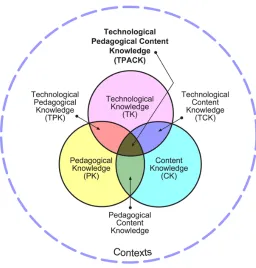
in shaping the successes that the eLI’s experienced. The TPACK framework also
fell within the scope of the study and among the conclusions that were reached;
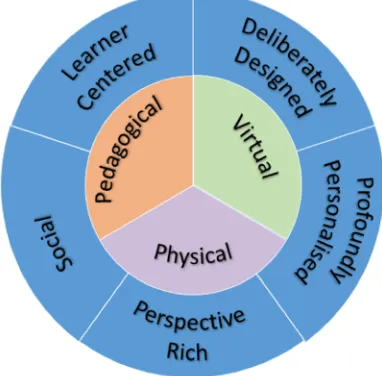
an expanded framework is offered in the study.
The study supported the conclusion that it is a combination of the narrative
commonalities that shaped the participants and their practices. The eLI was a
product of their storied identity while at the same time the actions, beliefs and
Certification of Thesis
This thesis is entirely the work of Christopher Shane Byrne except where otherwise acknowledged. The work is original and has not previously been submitted for any other award, except where acknowledged.
Student and supervisors’ signatures of endorsement are held at USQ.
Professor Peter Albion
_________________________________
Principal Supervisor
Associate Professor Dorothy Andrews
________________________________
Acknowledgements
I want to thank all the people who have assisted me in this thesis and in allowing
me to gain a deeper insight into the increasingly important role that eLI’s play
within educational institutions. I would particularly like to acknowledge the
assistance of my two supervisors, Professor Peter Albion and Associate Professor
Dorothy Andrews. Their guidance, support and encouragement were invaluable
to me during all phases of this process. The support staff at the Office of Higher
Degrees at USQ were also instrumental in keeping me on task and addressing
every concern that I had related to completing this study. Ms Marlene Barron’s
assistance with final editing was also very useful. Her careful editing, her
suggestions and her insights were very much appreciated.
I need to also acknowledge the people who got me to this point, especially the
four participants in the study without whose cooperation, patience and good
humour would make this study impossible to complete. Their willingness to open
up their classrooms, their meetings, indeed their lives to me as well as their
personal insights, philosophies and experiences has resulted in a rich collection
of data that has proved invaluable in completing this study.
This whole process took place over six years and was completed in three
countries. Whilst it didn’t impact greatly on my professional life, I do need to
acknowledge the support of Mr John Couani, the principal at St Pius X College,
Chatswood, who gave me the necessary time to conduct the research component
not directly involved in this study I wish also to acknowledge the influential roles
of Mr Vin DeCelis, Br Pat Howlett and many of the staff at Parramatta Marist in
shaping me as an educator who is willing to advocate the use of ICT to change
pedagogic practice. I also wish to acknowledge Ms Fozia Arif Bhatti whose talents
with Adobe Illustrator helped to design the SISTPACK model illustrated in the
final chapter.
I wish to acknowledge the support of my children who feigned interest in what I
was doing. There were times when I thought that it would be easier to give up
the goal of attempting this study, but the desire to provide three children with a
role model who embarked on an ambition and saw it through proved most
influential. Finally, I wish to thank my wife, Melinda, whose unending support
and encouragement allowed me to complete this task. Her willingness to take up
the slack when I was not around for family commitments and her unwavering
Dedication
Remembering and honouring Peter Richard Byrne
1933 – 2012
Table of Contents
ABSTRACT ... I
CERTIFICATION OF THESIS ... III
ACKNOWLEDGEMENTS ... IV
TABLE OF CONTENTS ... VII LIST OF FIGURES ... I LIST OF TABLES ... I
CHAPTER 1 INTRODUCTION ... 1
1.1INTRODUCTION TO THE DIGITAL WORLD ... 2
1.2SON,GET A DEGREE ... 3
1.3MY FIRST TEACHING POSITION ... 5
1.4PRIMARY TEACHING ... 6
1.5BACK TO UNIVERSITY ... 8
1.6TEACHING COMPUTING IN SECONDARY ... 9
1.7TEACHING TEACHERS IN SECONDARY ... 11
1.8WORKING IN THE TERTIARY SECTOR IN AN INTERNATIONAL SETTING ... 14
1.9RETURN TO AUSTRALIA ... 15
1.10SEEING WHAT IS POSSIBLE AND SOME OF THE BLOCKAGES ... 16
1.11PUTTING MY THEORIES INTO PRACTICE ... 17
CHAPTER 2 HISTORICAL PERSPECTIVES ... 20
2.1THE VERY EARLY YEARS ... 20
2.2THE PERSONAL COMPUTER EVOLUTION ... 22
2.3TEACHER USE NOT MATCHING THE HYPE ... 23
2.4MEANWHILE IN AUSTRALIA ... 25
2.5WHAT IS IMPEDING INTEGRATION? ... 28
CHAPTER 3 TEACHERS AND ICT INTEGRATION ... 30
3.1TEACHER BELIEFS AS A BARRIER TO INTEGRATION ... 32
3.2FACTORS WHICH CAN LEAD TO ICTINTEGRATION ... 36
3.3IDENTIFYING WHAT TEACHERS NEED IN ORDER TO INTEGRATE ICT ... 39
3.4THE TPACKFRAMEWORK ... 40
3.5THE CONTEXTUAL,COGNITIVE AND AFFECTIVE FACTORS FOR ICTINTEGRATION ... 49
3.6DELIVERING THE KNOWLEDGE ... 51
3.7ONE APPROACH –CROSS CURRICULAR CLASSES ... 52
CHAPTER 4 ELEARNING INTEGRATORS AND PEDAGOGICAL CHANGE ... 56
4.1THE EARLY YEARS ... 56
4.2AMAN OF MANY HATS ... 57
4.3AGENTS OF CHANGE,AGENTS OF PEDAGOGY ... 60
4.4BRINGING TEACHERS INTO THE FOLD –CREATING NECESSITY ... 63
4.5WHERE TO FROM HERE? ... 65
CHAPTER 5 THE WHAT AND WHY OF NARRATIVE INQUIRY ... 67
5.1TEACHER IDENTITY AS A CATALYST FOR CHANGE ... 68
5.4USING NARRATIVE INQUIRY TO INFORM TEACHER EDUCATION ... 73
5.5THE ROLE OF RESEARCHER IN NARRATIVE INQUIRY ... 75
5.6CHALLENGES TO NARRATIVE INQUIRY ... 79
CHAPTER 6 METHODOLOGY ... 82
6.1INTRODUCTION ... 82
6.2RESEARCH QUESTIONS ... 82
6.3SELECTING THE PARTICIPANTS ... 84
6.4WHY A QUALITATIVE STUDY? ... 86
6.5NARRATIVE INQUIRY ... 89
6.6COLLECTING THE DATA ... 93
6.7PUTTING IT ALL TOGETHER ... 96
CHAPTER 7 MEET THE CHARACTERS ... 101
7.1SHARON ... 101
7.2CLARKE ... 131
7.3NED ... 169
7.4STEVE ... 219
7.5CONCLUDING REMARKS ... 248
CHAPTER 8 ANALYSIS OF THE STORIED IDENTITIES ... 250
8.1THE FOUR QUESTIONS ... 250
8.2QUESTION 1 ... 251
8.2.1 The participants’ background. ... 252
8.2.2 Steve – systems need to be in place that work. ... 253
8.2.3 Ned – executive support is key. ... 255
8.2.4 Clarke – teachers need support from people who understand teachers. ... 260
8.2.5 Sharon – carefully selecting support staff is crucial. ... 264
8.2.6 Summary of the perceptions. ... 266
8.3QUESTION 2 ... 270
8.3.1 Staff view on technology – it can be intimidating. ... 271
8.3.2 Staff view on technology – school culture has a major impact. ... 272
8.3.3 eLI’s view on pedagogy and content– they can be important motivators. ... 274
8.3.4 Place is important. ... 277
8.4QUESTION 3 ... 279
8.4.1 Role modelling can be effective. ... 280
8.4.2 Redefining roles can have a positive impact. ... 283
8.4.3 Empathy and school vision – strong drivers of change. ... 285
8.4.4 Building self reliance in staff. ... 287
8.4.5 Summary ofstoried identities influencing support. ... 289
8.5QUESTION 4 ... 291
8.5.1 The personal and social commonplace. ... 292
8.5.2 The place commonplace. ... 293
8.5.3 The temporal commonplace. ... 295
8.5.4 Summary of knowledge as a guide. ... 300
8.6CHAPTER SUMMARY ... 302
CHAPTER 9 LITERATURE REVIEW ARISING FROM THE RESEARCH ... 305
9.1REINVENTING THE LIBRARY ... 305
9.1.1 The Millennials. ... 306
9.1.2 Technology in the library. ... 308
9.3EDUCATIONAL CHANGE LEADERSHIP ... 315
9.3.1 A brief background to leadership in ICT. ... 316
9.3.2 What makes a good leader. ... 318
9.3.3 What is happening on the ground. ... 321
CHAPTER 10 CONCLUSIONS ... 326
10.1SYNTHESIS OF THE RESEARCH ... 326
10.2FINDINGS FROM THE STUDY ... 329
10.3SIGNIFICANCE OF THE FINDINGS ... 331
10.4IMPLICATIONS FOR THEORY ... 334
10.5TAKING THE TPCK OUT OF TPACK ... 337
10.6IMPLICATIONS FOR ELEARNING INTEGRATORS ... 341
10.7IMPLICATIONS FOR SCHOOL EXECUTIVE ... 342
10.8FURTHER RESEARCH ... 344
10.9WHERE TO FROM HERE? ... 345
10.10CONCLUSION ... 347
REFERENCES ... 349
List of Figures
Figure 1.1. My Course subjects in 1990 -91 majoring in Computers ... 9
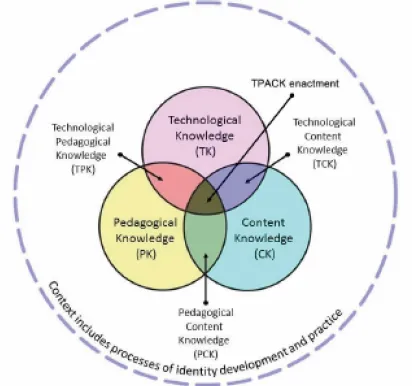
Figure 3.1. The TPACK framework (Mishra & Koehler, 2006) ... 40
Figure 7.1. Clarke’s College Project Planner ... 148
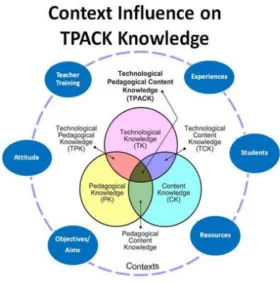
Figure 9.1. Context Influence on TPACK Knowledge (EDT514, 2016) ... 313
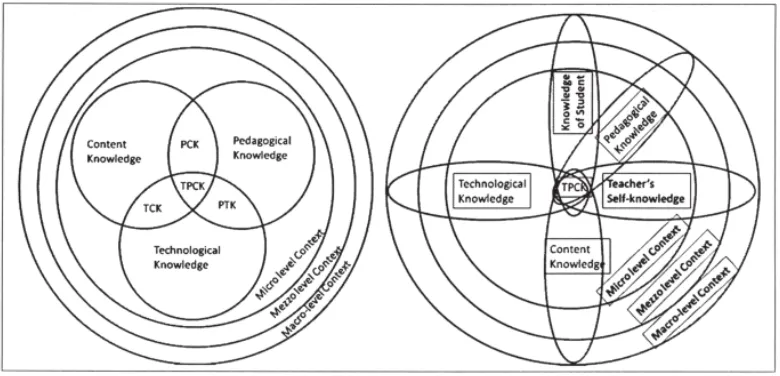
Figure 9.2. Porras-Hernández and Salinas-Amescua’s suggested representation of the TPACK framework integrating two more types of knowledge and different context levels. ... 314
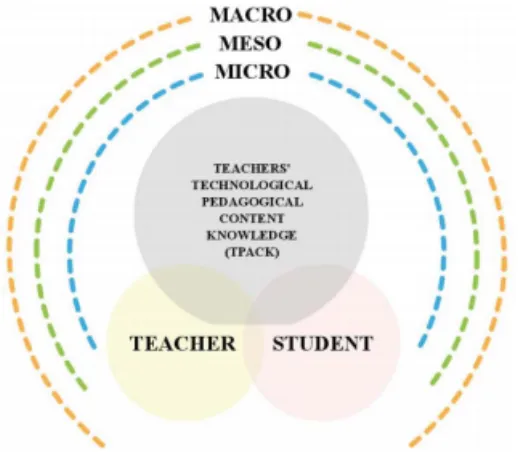
Figure 9.3. The Rosenberg and Koehler (2015, p. 189) representation of the conceptual framework advanced by Porras-Hernández and Salinas-Amescua (2013). ... 315
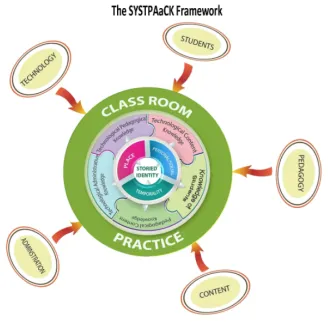
Figure 10.1. The SYSTPAaCK Framework ... 336
Figure 10.2. An elaborated representation of TPACK enactment……….341
List of Tables
Table 6.1 Summary of participants ... 85Table 8.1 Summary of how storied identities influence support of teacher adoption of ICT ... 290
Chapter 1 Introduction
This thesis uses a methodology of data collection, analysis and presentation
known as Narrative Inquiry. It uses the storied identities or personal narratives
of individuals to help to inform the researcher. As such, I choose to begin this
paper with a selection of memories from my own narrative. This will provide the
reader with some insight into the grounding that I have in the subject matter to
be studied – that being the incorporation of Information and Communication
Technologies (ICT) into classroom practices.
By starting in this manner the reader is better placed in the context of this study.
It is only through my own storied identity that I have arrived at this point and it
is my storied identity that will change because of this research and thesis. Also
sharing at least part of my story may help the reader to understand why some of
the conclusions of the study are reached, given that a Narrative Inquiry approach
necessitates sharing of stories between the participant and the researcher.
This first chapter is written to provide the reader with an insight into my
personal narrative in this field and it will provide an understanding of how I
arrived at this point of wanting to study ICT incorporation into pedagogy. It may
bring back similar memories for you. It is written in an unconventional manner
for a thesis, but quite conventional for a good story. Not that it is particularly
interesting or insightful or clever, but it is an honest reflection of my journey in
1.1 Introduction to the Digital World
I’ll cut to the chase. Well to the start of the chase. You can imagine it I know, a
15-year-old boy growing up in a New South Wales country town with limited
opportunities for anything out of the ordinary, anything new. Just a few years
before I had been given my first digital device – a watch which told the time, the
date and seconds. I’ll Google an image of it for you. Oh wait, I cannot do that. You
see, living in China has its limitations and Google is one of them.
Still, my memory of these events is as clear as the impact that they have had on
my life since then. The watch was exciting, but not for long. Like most kids around
that time, arguments with my friends abounded about much more incredibly
important issues such as whether VHS was better than Beta, whether Darth
Vader really was Luke’s father and how on earth Steve Gearin caught that ball in
the Grand Final against the Eastern Suburbs Roosters.
The year 1980 saw my school purchase 15 Tandy TRS-80 computers and place
them in a room not much bigger than an office area and certainly much smaller
than a regular classroom. I was in Year 10 at the time and was fortunate to have
a mathematics teacher, Mr. Gonzales, who was interested in computers. He
subsequently opened a store in town selling Apple computers while holding
down his teaching day job. To say ‘Gonzo’ was just interested in computers was
an understatement. He had a passion for the devices and he passed that passion
were taught how to program and used some of the few programs that came with
the devices, like mathematics drills, which we had to load via cassette tape.
On reflection, programming was an obvious thing to do with the devices, since
there were so few programs suited to Education at the time and we didn’t want
to just do mathematics drills each lesson. So at the age of 15 I was hooked. I could
program in BASIC which afforded me quite a bit of prestige amongst my peers –
it took only 3 minutes whilst the Myer sales assistant’s back was turned and I
could get a display computer to print out “Myers Sucks” in large letters on the
black and white screen for other customers to see. Good times.
Over my senior years at school, I continued to have Gonzo as my mathematics
teacher and we continued to use the TRS-80’s at every opportunity we could get,
whilst trying to study for the Higher School Certificate. As the school purchased
software, we progressed from just programming in BASIC and doing simple drill
activities, to using software like backgammon and blackjack. To be honest we
probably spent too much time in front of those computers. Because of my
interest, I became the ‘go to’ kid for other students who were struggling with
programming. Helping my peers to learn was quite a buzz. It still is.
1.2 Son, Get a Degree
My other love was sport. As I was growing up I often imagined myself as Kurt
Russell in the Disney film, “The computer wore tennis shoes” – the movie
Education Sydney, (CCES) to earn a degree in Physical Education (PE). I lasted
two weeks. It was a revelation to me, but PE is not just about playing sport all
day. I changed course to do a Primary Teaching Diploma – it was either that or
Mathematics/Science and I had only a mild interest in those subjects at the time.
My reasoning at the time was that by doing Primary I could take the students out
for sport a lot, without having to worry about the physiology or biomechanics
behind it all. My father also advised me at the time, “When you are 50 do you
want to still be running around an oval with a bunch of kids?” Actually, I do.
From a computing perspective, college was quite disappointing. CCES had a row
of about 10 computers. I don’t even remember the brand, as it was not something
that primary teachers needed to worry about. This was between the years 1983
and 1985. I had to go to a nearby University to use a computer to type up
assignments as the computer bank at CCES was locked up when a class was not
in the room… not that we had to type up assignments as handwritten essays were
the norm back then.
We had a subject called Educational Technology. I learnt how to write on a
blackboard, learnt the secret knowledge of drawing some lines on the board a
meter ruler width apart in a dark permanent marker to help with my writing. I
learnt how to use a spirit Fordigraph, and write on acetate and use an overhead
projector. Innovation consisted of acetate overlays similar to the Cel methods
used by cartoonists and putting all your content on acetate rolls that you could
take from classroom to classroom. Why a primary teacher needed that, we never
1.3 My First Teaching Position
So, aged 20 and armed with a freshly printed Diploma I got my first teaching
position at a Primary School. I knew how to teach, because the diploma proved it
and I had spent the previous 15 years observing teachers and lecturers well
practised in the art of educating. My class, a third grade, consisted of around 32
students in straight rows who were taught how I was taught. After all, it worked
on me.
About a month in, no word of a lie, I ‘discovered’ the computer lab. It was under
the library in an area that these days would certainly house the IT support
department. It featured narrow windows that could not be opened, poor lighting,
squeaky fans and around 20 beautiful, almost new, enticing Microbee computers
just waiting for my Year 3 students to use. The story was that the school had a
large Aboriginal population and as part of a government grant, a lab of computers
was put into the school. The fact that it took me a month to know they even
existed was testament to the view held by the vast majority of staff as to their
educational worth.
From that initial discovery until the end of the year my class made a constant bee
line (I resist calling it a micro-bee line) between the computer lab and our regular
classroom. My students used programs such as Raft Away River, Dinosaur
Discovery, and Maths Invaders. They published stories using WordBee. They also
of computing. These pupils were 8 years old, but they really took to the
programming – well some of them did.
1.4 Primary Teaching
Four primary schools in five years. One would think that there was something
wrong with my commitment to my job. Nothing was further from the truth.
Circumstance led me to this rather dubious employment record. It was mostly to
do with a girl, who is now the mother of my children and my life partner but also
to do with school budgeting decisions. I taught in two inner city schools after my
time on the coast, before marrying and moving back north to another Mid North
Coast Catholic primary school.
I never again had the luxury of a computer lab to take my primary classes to. I
did, however, continue in my unofficial role as ‘the go-to-guy’ when it came to
using the computers that the schools did have. At the time Apple computers were
becoming popular. We had them in large wire baskets for moving between
classrooms at one school I was at. Perhaps that is why I was the go-to-guy. None
of the female teachers wanted to lug them all around the school, although I’m
sure they were physically able.
These were the days of Carmen San Diego – not available on the Microbees, but
certainly a popular seller for the Apple II. Educational software was improving.
It was not just about drill and practice anymore, or as a substitute for an exercise
program, Visicalc regarded by many as the first ever ‘killer’ app. That was not
why Apple was becoming popular in schools I taught in. We didn’t need a
spreadsheet in the primary school. We needed programs to show off our creative
flair, like PrintShop and Bank Street Writer.
It was at this time (1987) that I was introduced to the first productivity use of the
computer for educational purposes. The 5th grade teacher, an amazing American
woman who permanently had a 2-litre bottle of coke at the teacher’s desk,
showed me how she now programmed. I am not talking coding, but rather that
horrible task all primary teachers despise, writing a teaching program. Well, she
had it all on computer and just changed the dates each year, swapped the various
themes around into different terms and cut and pasted comments, making subtle
changes to keep the program relevant. This was a time saver I was ready for.
Unfortunately, the school lost numbers and they had to lose a teacher. Last on –
first off.
The next primary school I taught at had no interest in computers. At this inner
city school there were a couple in the library, but none in the classrooms. That’s
not to say that the school was dragging its heels – it just had a different focus.
Well two. ‘New Math’ and the English Literacy In-service Course (ELIC). The
school was trying to change its pedagogy with innovations like group work in
maths, and a heavy emphasis on wonderful literature and literacy. The catch cry
I had to leave that school, as even in 1988 housing affordability in Sydney was
beyond the reach of young couples just starting out. The Mid North Coast was
much more affordable and I spent two wonderful years there, back in an Apple
environment. Each class had two Apple IIe computers. I had drifted away from
teaching programming skills to the students. There was so much more to explore
like how to teach Appleworks to the students, and how to make illegal copies of
software titles using utility programs like Disk Muncher.
While at my final primary school, I was first introduced to a whole new way of
interacting with computers. It was ‘Insanely Great’ and it was the Macintosh SE.
These machines were not for the students. We had one in the staff room (which
no one wanted to use because whatever you did was in full view of the rest of the
staff) and the Principal had one in his office. The GUI was intuitive and it meant
that I could be more productive. I created Hypercard stacks in the hope that I
would be able to take one of these machines into my classroom (I never could). I
created graphics using Macdraw and Macpaint. I experimented with Afterdark –
something called a screen saver. I bought my first computer. Not a Macintosh SE,
an Apple IIe which the school was selling. I later sold it to my mother, realizing
that it was too expensive for the use I got out of it at home.
1.5 Back to University
At this time, I decided to follow my passion. I enrolled in my ‘Fourth Year’. This
was something that many teachers did who were only 3 year trained and wanted
The University had a totally external B.Ed course which suited me on the coast. I
could specialize in Computing in Education. I looked forward to reading the
theories surrounding computers in Education and getting back into some coding.
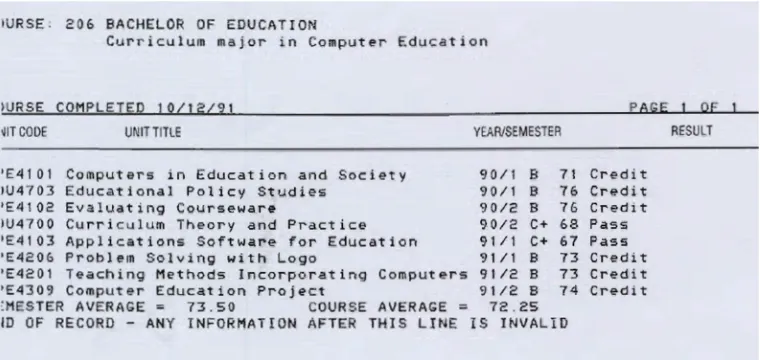
The subject list makes for interesting reading.
Figure 1.1. My Course subjects in 1990 -91 majoring in Computers
Disappointment again. No, not the fact that I achieved only a credit average. The
programming language we were required to learn was Logo. Now, don’t get me
wrong. I could see its place in the Education environment. But I wanted to learn
Delphi or Pascal or C. None of these was an option. I did, however, have the ability
to be able to say that I was completing my Fourth Year, specializing in Computing
in Education. This was enough to get me a job at Oakhill College, Castle Hill. I was
back in Sydney as a specialist Computing Studies teacher.
1.6 Teaching Computing in Secondary
Four schools in five years became five schools in 14 years. If my computing
[image:20.595.116.496.212.392.2]posting was the main course. I witnessed the introduction of the World Wide Web
(WWW) at the College. I learnt about network management using Novell OS. I
taught applications using BBC computers, Archimedes computers, PC’s and Macs.
I taught software programming using Basic and Visual Basic. I had classes full of
eager year 9 and 10 students who wanted to know about computers. I had classes
full of jaded year 11 and 12 students who realized, as did I, that the curriculum
was not offering what they wanted – Year 9 and 10 Computer Studies, followed
by 2 Unit Computing (later Information Processes and Technologies) meant four
years of Microsoft Office type applications.
At least 3 Unit Computing (later Software Design and Development) was of more
interest and possibly more benefit to students who wanted to pursue a career in
the Computing industry and there were plenty of takers there too. I witnessed
the power and versatility of networked computers – from sharing a printer,
through to Mazewars, linking computers together was beneficial. Pushing
software to a classroom full of computers at one time was great – and what a time
saver. Students having a directory dedicated to them regardless of what machine
they were on was a real advance.
Linking to computers outside the classroom was also useful. Telstra’s Discovery
service meant that I could look at my bank account details at the blistering pace
of 1200 bits per second (bps). I could put messages onto bulletin boards (at 75
bps) and have discussions with people in chat rooms. I could check out the
download it in less than 20 minutes. This was before the internet caught on or
was even known about, but the promise was there.
Perhaps the software packages that inspired me the most that the Archimedes
computers offered were a couple of multimedia authoring packages called
Genesis and Magpie. With these packages, you could create your own content by
mixing words, pictures, video clips and sound. I had played with Hypercard stacks
years before, but this was different. I could make my own content and push it to
student machines. Students could look at the content as often as they needed, at
a pace that suited them. I could not articulate differentiated learning at the time,
but this is what I could now offer my students. It was like a personal Encarta
suited just for the topics I was to teach.
1.7 Teaching Teachers in Secondary
The new millennium saw me change schools to a promoted position. I became
Computer Coordinator and Network Manager at a Central Coast Secondary
College. Initially I installed a Novell network at the College, gave each teacher an
email address, gave each student their own ‘home directory’ and took the school
to 5 computer labs, which the teachers could book online and be confident that
the computers would work.
I installed a piece of software called Net Support on the machines that would
allow teachers to control the whole lab of computers – lock the screens, monitor
only certain programs to run. It was very popular and quite reliable for most of
its features. This software allowed the teachers to feel in control of the classroom.
It meant more teachers were willing to take their classes to the computer labs.
This was combined with a decision that I pushed to get a machine on every
teacher’s desk. Having a computer in front of them made each teacher at least
able to do things like research whenever they had the time. In addition, making
some administrative tasks like reports need to be done via the computer meant
that teachers had to use them for at least some tasks. Having said that, there were
some teachers who still wrote out their report comments by hand and then
handed them to the staff secretary to be typed up.
During my time at St Edward’s I was asked to become the full time Network
Manager with no teaching load. I took this role on with the understanding that I
could review it at the end of 12 months. The review led to me opting to become
ICT Coordinator and employing a Network Manager from industry. I was still the
Computer Department Coordinator. This was an interesting double act, as my
role, as ICT Coordinator was to push ICT into all the various syllabus fields, yet
my role as Computer Coordinator was to advocate for students to be taught
computers by a specialist Computing teacher.
My own philosophy at this time was based around the idea that computers should
be used as a tool in all subjects, and students should not need to be taught Office
Suite type applications just in case they ever needed them. Using ICT in subjects
authentic use of the devices and I thought led to learning that was more
authentic. Looking at the small numbers of students doing ICT at the HSC, it
appears that the students have agreed and voted with their feet.
A final challenge that I had was based around a change in Technology and Applied
Studies (TAS) mandatory in Years 7 and 8. The Design and Technology (D & T)
teachers were required to teach the students a unit on Digital Technology. There
were six teachers and two were up to the task of teaching web design using
Dreamweaver. The problem was that all six teachers were expected to teach the
8 to 10 week program. Some of these teachers were lagging adopters and at least
one was a technophobe – to the point of refusal to turn up to planned and
mandatory PD sessions on what was put in place for them to be able to run the
project.
I solved this dilemma by creating a series of around 17 video tutorials in the form
of screen casts, which took the students through every step of the process of
creating a web site. I also created a library of resources that students could
download so that they could follow the tutorials and achieve a web site. The
tutorials were always pushing students to come up with their own ideas, creative
content and so on.
The staff were introduced to the package and shown how easy it was to run –
simply get the students to click on the link and follow the tutorials in order. Staff
were in-serviced on the basic operations of Dreamweaver and encouraged to
with the staff as they had the ability to direct the students to where they could
find answers, the staff were able to follow on themselves, students were able to
work at their own pace (dependent on staff wishes). Many staff used a
combination of their own input together with the tutorials. As they gained in
confidence they relied on the tutorials less; however, they were always there for
the staff if they thought that the students needed them.
Students were engaged, they were creating content of their own, they were able
to follow along when and where necessary and it allowed for self-paced learning.
This package was used by the staff for about 4 years, allowing them to grow in
confidence while delivering content that the students required.
1.8 Working in the Tertiary Sector in an International Setting
In 2007 I moved to the Middle East to take up a position as a Computing teacher
within the United Arab Emirates (UAE) University sector. I taught for 5 years at
the Higher Colleges of Technology. The campus I was in was a female-only
University and over the course of the five years, I taught basic computer skills
(Word, Excel, databases, touch typing etc.). I also ‘lectured’ in a Business IT
Diploma Course and an Information Technology Degree course.
Whilst I was not in a position of responsibility, I was again the ‘go-to-guy’ when
it came to using technology in the classroom. Over the course of the 5 years, I
helped introduce a 1 to 1 laptop program, gave Professional Development on Net
driving force for Net Support, which was great when we had labs, but when we
went to a wireless 1 to 1 infrastructure, a number of difficulties arose with the
use of the package. We did overcome nearly all of the difficulties; however,
reliability issues meant that staff were not keen to support the software in a
wireless environment.
During this period, I completed a University Masters in Education (Computing).
My research was based around the use of mobile technology for delivery of
content, and how effective that method of delivery was. I also started my
doctorate during this time. My work with the older students (18 – 40 year olds)
was incredibly rewarding and combined with my interest in helping staff
incorporate ICT into their teaching practices, I knew I wanted to pursue this
interest in teaching adults how to use technology. I considered that my ideal job
would be to teach future teachers how to incorporate ICT into their curriculum
areas. I am still of that mind and this doctorate is a necessary step along that path.
1.9 Return to Australia
In 2012, after five wonderful years in Higher Education in the UAE I returned to
Australia and found myself teaching in a State High School on the Central Coast
of NSW. This was my first, albeit brief, introduction to teaching in the NSW State
School System. I could see first-hand the issues surrounding the Government’s
Digital Education Revolution (DER). All the students between Years 9 and 12 had
By the time I arrived, they were only in Years 10 – 12 because the school chose
to pass ownership of the devices over to the students. This meant that when the
Year 12 cohort left, so did the devices. As of 2015 there were no Personal
Learning Devices (PLD’s) left at the school as the original Year 9 cohort had
graduated and taken the tablets with them. Therefore, in 2015 the school was
back to its one computer lab. There was a technician who was at the school most
days, but who left about 18 months after I did because government funding for
him ended with the demise of the DER.
There was no ICT coordinator position at the school in any formal sense. One of
the TAS teachers elected to take on part of the role in an unofficial capacity due
to his interest in the technology. He was severely restricted by time
considerations and the lack of direction that the school seem to have in this area.
All things considered he did quite a good job considering lack of time allowance,
the lack of resources, the lack of a budget of any type, and the lack of a clear
direction in incorporating ICT into the school.
1.10 Seeing What is Possible and Some of the Blockages
A position came up in a Western Sydney high school, and although I was very
concerned about the 2 hour commute each way, the school seemed quite
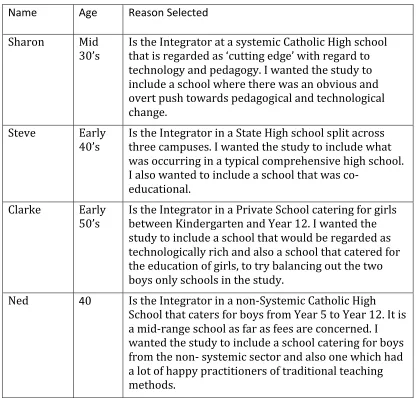
progressive. Just how progressive will become clear in later chapters of this
paper as the ICT Coordinator at school is one of the participants that I chose for
my study. As the study participants are anonymous, I’ll call the participant
when combined with modern pedagogy and collaborative teaching
methodologies. The school is a recognized frontrunner in innovative teaching
practices in Australia and I was very lucky to spend almost 2 years there.
As I will be describing the school in detail in a later chapter I will not continue
talking about it now. I did leave the school and that four-hour daily commute,
trading it for another Northern Sydney school but only 50 minutes commute each
way. Again, as the ICT coordinator at the school is part of my study, for the
purposes of anonymity I will call the ICT coordinator Ned. The school is much
more traditional than the Western Sydney one, and although they have a
one-to-one PLD environment, the school is grounded in traditional pedagogy. There is
quite a strong resistance to all things ICT at the school by a large number of the
staff. Most of these staff had been at the same school for many, many years. Again,
because I will be discussing the school in some depth in later chapters I will not
continue to describe it now.
1.11 Putting My Theories into Practice
After 2 years at the Northern Sydney school, I left, not because I was not enjoying
it – the students were great, the staff friendly, and the Principal quite supportive
of my doctorate work. About 8 months in to my time there, my son came home
from school and dropped a bombshell. “Mum, Dad, I want to go back overseas to
finish my schooling.” My wife and I could hardly contain our excitement. We had
resisted because our children were settling in nicely and the timing was all
wrong. University and HSC for our daughters had been a priority.
Our search began for a position in a school in an international setting. There were
opportunities in places like Uzbekistan, Mongolia, as well as quite a few European
postings. There were a lot of schools around South East Asia who wanted ICT
coordinators but they all required a working knowledge of the International
Baccalaureate or IGCSE and A-level British Curriculum experience. I had none of
these experiences.
Luckily, a group of International Schools were advertising for an ICT integrator.
As this was the focus of the role, they were quite happy to employ me to take on
this position, and since I had ICT and Software Design experience, they were
willing to let me teach IGCSE and IB Computer Science. So now, I am in Shanghai,
with the opportunity to put my theories and knowledge into practice once again.
I share the integrator role with another Australian who is technically excellent
and who has a great rapport with the staff.
Our brief for next year includes implementing a one-to-one device environment.
At the same time, the Head of all the schools has announced a change in pedagogy
across all 15 or so campuses in 3 countries (China, Hong Kong and the USA). So
perhaps, just perhaps I have taken a position in a school where the innovation
So now that you have an understanding of my ICT narrative it is time to consider
my journey in the context of the wider ICT research community and the historical
Chapter 2 Historical Perspectives
This chapter will look briefly at the historical perspectives of computer use in
education. It will trace the evolution of the devices as well as the changing ways
the devices have been viewed from an educational perspective. Some of the major
milestones that have shaped the way that Information and Communication
Technologies (ICT) can be used in the classroom as well as a few of the leading
thinkers on ICT use will be identified. The chapter will also outline some of the
initiatives that have occurred from external sources such as government and
corporation initiatives.
2.1 The Very Early Years
ICT have been used in schools for a myriad of purposes since the advent of the
personal computer in the late 1970’s. Since that time educators, researchers and
thinkers have all delved into the challenge of how best to use ICT with varied
success (Ertmer & Ottenbreit-Leftwich, 2013; Jonassen, 1996; Molnar, 1997;
White, 2008). The use of computers in education dates back almost as far as when
the first operational computers were put into use – the Mark 1 in 1944 at Harvard
and the better known ENIAC housed at the University of Pennsylvania, in 1946
(Levien, 1972). In 1959, Donald Bitier, who was working at the University of
Illinois, started a program called PLATO, which over time, allowed thousands of
undergraduate students to link to the University Mainframe and gain access to
the computing power it afforded. Given this as the beginning of computer use in
Highlights in the early years included the development of ‘Microworlds’ by
Seymour Papert in the 1970’s. These Microworlds included music, physics and
geometry, all designed to change the way that mathematics was taught, and as
importantly, how mathematics instruction and use was thought about in the
classroom. He developed a programming language called LOGO which was still
being used some 20 years later as a programming language students were
required to master in B. Ed courses. He further developed his ideas, with a
constructivist approach aided by the combination of LOGO with LEGO
construction kits. The theoretical underpinning was that students would learn
necessary problem solving skills based on their given or self-described problem
definition. In other words, Papert was trying to “move education from ‘computer
literacy’, an appreciation of computing, to ‘computer fluency’, the application of
computers to solve real problems” (Molnar, 1997, p. 4).
Prior to this in the 1960’s, there was a research and development attempt by
Suppes and Atkinson at Stanford University (Taylor, 1980). They attempted to
cater for differentiation between students before it was the buzzword it has
become today. They created self-paced programs in mathematics and reading,
allowing the user to work at their own speed and be corrected by immediate
feedback. This was the beginning of the use of computers for drill and practice
activities that pervaded the education sector a little later on, starting around the
2.2 The Personal Computer Evolution
In 1975 the personal computer revolution got underway with devices such as
MIT’s Altaire inspiring enthusiasts which led to better machines like the Apple II
in 1977 and the IBM PC in 1981. This evolution of technology meant that it was
now affordable for schools to put stand-alone computers into classrooms. Early
on teachers were bombarded with a range of programs that afforded
incorporation into such classroom activities as simulations, drill and practice,
presentation, research and reward. Other programs allowed teachers to transfer
paper-based activities such as writing, collating and calculating onto a computer
in the form of word processing, databases and spreadsheets.
Whilst some teachers leapt to incorporate ICT into their pedagogy, and
significant moves were made towards the incorporation of productivity software
into the education field during the 1980’s, few were incorporating ICT to change
the way they taught. This is consistent with the way Maddux (2005) conceived
educational application of Information Technology as being either type I or type
II in nature. Type I applications “simply make it easier, quicker or more
convenient to continue learning in traditional ways” (p. 20), whereas Type II
applications “make available new and better ways of teaching or learning” (p.
20).
The seed for real change occurred in 1989 when Tim Berners-Lee and Robert
Cailliau put forward a proposal at CERN which was designed to allow for a better
management of documents using computers that were connected together
and it proliferated, along with the uptake of computers worldwide, in order to
gain access to the growing amount of information that was now available.
Teachers were now able to provide their students with information as quickly as
their connection speed allowed, which at the time was quite slowly. Throughout
the 1990’s as technology improved, so too did the uptake of computers by
Education institutions.
2.3 Teacher Use Not Matching the Hype
This uptake was not without its problems and questions about the validity of the
devices as educational tools. In the early 1990’s James Kulik performed a meta-
analysis of several hundred studies into the effectiveness of computers in
education at the University of Michigan. He found in this analysis that “computer
based education could increase scores from 10 to 20 percentile points and reduce
time necessary to achieve goals by one-third” (Molnar, 1997, p. 4). However,
doing better is not analogous to doing better things, and in the classroom,
teachers were being challenged to use the devices in new and interesting ways.
In 1996, Jonassen described the ways that students in classes were expected to
interact with technology and this was summarized by Ertmer and
Ottenbreit-Leftwich, (2013) as “learning about technology (technology as a subject),
learning from technology (technology as a delivery tool), and learning with
technology (technology as a cognitive partner)” (p. 176).
It appeared that in the mid 1990’s teachers were not moving much beyond the
Tomorrow initiative reported that despite placing state of the art technology into
the classrooms, thus eliminating many of the first order barriers (see Chapter 3),
the “most difficult effort related not to securing technology for the classroom but
to the subsequent need for teachers to apply new ideas about teaching and
learning” (Ertmer & Ottenbreit-Leftwich, 2013, p. 176). The vision for many
researchers at this time (Bracewell, Breuleux, Laferrière, Benoit, & Abdous, 1998;
Collis, 1998, March; Simpson, Payne, Munro, & Lynch, 1998) was student-centred
learning aided by the use of technology, and research was proving that simply
putting the technology into the classrooms was not enough to achieve this goal
(Hooper & Rieber, 1995). The 1996 National Education Assessment Program
conducted in the United States reported that only 5% of mathematics teachers
surveyed, working in the 8th grade, used computers to help explain new
mathematical concepts. The same study found that the highest use of technology
(18%) by those teachers was drill and practice activities (Cuban, 2001).
Around the turn of the century, a change took place in how the World Wide Web
was being used. At the time of the dot com crash of 2001, rationalization of the
internet took place and the focus switched from an information provision service
to the read/write platform that Berners-Lee had originally envisioned and which
internet browsers were now able to support. Users began blogging, podcasting,
collaborating, social networking, creating wikis and a myriad of other
user-centric activities (White, 2008). This changed focus has been commonly referred
to as Web 2.0, a term first coined by Darcy (DiNucci, 1999), which was
subsequently adopted to describe this move towards social media. These web 2.0
who [could] offer feedback or support” (Ertmer & Ottenbreit-Leftwich, 2013, p.
176). The tools also offered learners a place to showcase their thoughts, ideas
and achievements to a huge audience, or a very select audience if required.
2.4 Meanwhile in Australia
What was occurring overseas was also being mirrored at the same time in
Australia. Australian Government statements dating back to before the 1990’s,
call for the need for ICT skills to help students with vocational training and other
possible benefits to learning (see Hobart Declaration on Schooling, (Australian
EducationAustralian Education Council, 1989). However, it is mainly due to the
proliferation of the WWW and the move towards Web 2.0 technologies, that
many in education began to see the need for a more focused approach to the
incorporation of ICT skills within the classroom. In 2000 a South Australian State
Government report stated, “IT literacy is becoming the ‘4th R’ of the basic
competencies every individual needs” (White, 2008, p. 44). However, the
emphasis was broadening to include the teachers as well as the students. This
emphasis on teacher competency, as well as students was not a new idea,
however, as Kenway (1998) observed that in order for teachers to be able to
creatively and competently teach their students via ICT, and to use ICT “they
must be skilled, informed and critical users themselves” (p. 83).
Although certainly not amongst the first statements about ICT integration, in
2008 the Ministerial Council for Education, Early Childhood Development and
practical ICT, design and technology skills … are … central to Australia’s skilled
economy and provide crucial pathways to post-school success” (MCEECDYA,
2008, p. 13). Whether these skills are developed through the teaching of ICT as a
subject or through the integration of ICT into subject areas is not the critical
point, rather it is that Government reports such as the Melbourne Declaration
dating back many years have highlighted the importance of the need for effective
ICT skills to be developed at school.
Around the same time as the Melbourne Declaration, a national survey in the
United States, Project Tomorrow’s Speak Up 2007, reported on teachers’ use of
ICT to facilitate student learning in and out of the classroom. Of those teachers
responding, 51% indicated their primary uses of ICT comprised asking students
to complete homework digitally, and running drill and practice packages in class
(Ertmer & Ottenbreit-Leftwich, 2010). Therefore, while educators at the time
were advocating that the best use for such tools occurred when students “use it
as a cognitive partner … to analyse information, interpret and transform that
information into their own personal knowledge, and then represent that
knowledge to others” (Ertmer & Ottenbreit-Leftwich, 2013, p. 176), it appeared
that the technologies were still being used as ‘learning from’ devices. The
National Education Association in 2008 described teachers’ efforts as “[w]e are
still woefully short of classroom environments that permit students to engage
with technology in a way that prepares them to use technology in the real world”
From an Australian student perspective, in 2005 a national assessment on ICT
literacy was developed. At this time, it found that 49% of Year 6 students reached
the proficient standard, and 61% of Year 10 students achieved proficiency.
(MCEETYA, 2007). According to Meiers, Knight, and White (2009) the report
went on to state that ICT was being used in very limited ways: “Communication
with peers and using the internet to look up information are frequent
applications, but there is much less frequent use of applications that involve
creating, analyzing or transforming information” (p. 4). A 2007 Second
International Technology in Education (SITES) survey conducted in Australia
which concentrated primarily on Science and Mathematics teachers found that
whilst 86.1% of the Science teachers and 68.6% of the Mathematics teachers
surveyed reported using ICT in their teaching, their confidence levels in
incorporating such technologies were much lower, at 56.1 and 54.1 percent
respectively (Ainley, 2010, July). Whilst these figures put Australia towards the
top of the 23 countries involved in the survey, the ICT related professional
development (PD) figures were much worse with only 48.7% of teachers
reporting participation in ICT based PD. This placed Australia 6th last (Ainley,
2010, July, p. 6).
Also happening at around the same time, with the Rudd Labor government
winning the 2007 Federal Election, the promise of a Digital Education Revolution
(DER) became Federal Government policy. This revolution promised
“sustainable and meaningful change to teaching and learning in Australian
schools that will prepare students for further education, training, jobs of the
Australia has seen a huge increase in the number of computers available in
schools with the goal of a 1:1 ratio of computers to students, especially from Year
9 onwards (Moyle, 2010). Part of the commitment was to also provide broadband
access (DEEWR, 2008) which will support the introduction of a national
curriculum by providing students in all parts of Australia with online access to
resources. Regionally, a recent study by Kong, Chan, Huang, and Cheah (2014)
indicates that in parts of Asia government expectation is still apparent, at least in
Singapore, Hong Kong, Beijing and Taiwan where their study focused. Their
report indicates that the focus of the expectation has changed from one of supply
of ICT technology as was the primary objective of the DER, to a call to emphasize
pedagogical advancement of ICT-supported classroom learning. Therefore,
today, from a political perspective too, there is an expectation that ICT will be
incorporated into curriculum and teaching practices.
2.5 What is Impeding Integration?
It appears that even in the most recent history of computers in education, there
is still a gap between the expectation and the practice. The International
Computer and Information Literacy Study (ICILS), conducted by the
International Association of Educational Achievement (IEA), reported that in
general terms, “the teachers appear to have been using ICT most frequently for
relatively simple tasks rather than for more complex tasks” (Fraillon, Ainley,
Schulz, Friedman, & Gebhardt, 2014, p. 227). Other contemporary researchers
concur with these findings, stating that teachers still “integrate such technologies
within familiar practices rather than exploring new methods of teaching”
What has intrigued researchers for many years is why this integration is
happening so slowly. The next chapter will explore the research surrounding
why teacher uptake is slow and still of concern. The chapter reports some of the
factors that have been put forward as reasons why integration is not happening
as desired, both time-wise and in the ways that the technology is being used. The
chapter will also describe some frameworks which, may assist in helping identify
what knowledge, skills and attitudes teachers need in order to accept the
technology into their teaching practices. The chapter will conclude with one
Chapter 3 Teachers and ICT Integration
There are various ways to look at integration. It can be seen in some respects to
be all about learning from ICT, in other respects related to learning through the
use of ICT. For the purposes of this proposal it is defined as the pedagogy
associated with the focus of being able to learn with the use of ICT, not as a
surrogate teacher or a methodology of presentation, but rather as a tool to
enhance learning activities and associated outcomes. This chapter looks at
barriers that exist to ICT integration and where those barriers are today. The
chapter also identifies the lack of necessary skills or attitudes that teachers
possess that require addressing so that integration takes place as well as looking
at the changing focus over time as to what are the actual perceived needs.
A number of scholars have looked into the apparent lag between ICT availability
and teacher uptake of ICT as part of a meaningful and creative pedagogy. It could
be due to the observed phenomenon that “the magnitude of change persons are
asked to make is inversely related to their likelihood of making it” (Guskey, 1994,
p. 5). Studies have revealed that if a teacher possesses more traditional beliefs
regarding pedagogy, they will implement more “low-level” technology uses
(Becker, 2000, January; Judson, 2006; Roehrig, Kruse, & Kern, 2007). On the
other hand teachers who hold a more constructivist view will implement more
“high-level” technology use (Ertmer & Ottenbreit-Leftwich, 2010). A 2008 study
concurred with this finding; however, it had an interesting caveat: “Though the
reported classroom use of ICT can hardly be described as ‘innovative’ in nature,
use” (Hermans, Tondeur, Van Braak, & Valcke, 2008)[Emphasis added]. The
report went on to state that a negative impact on the integrated classroom use of
computers was found where teachers with traditional beliefs were operating.
That is not to say that such teachers are opposed to computer technology use per
se. The Cuban, Kirkpatrick, and Peck (2001) study found “no conspicuous
evidence of teacher resistance; in fact, [they] found enthusiasm for home and
school use for class preparation, communication, and administrative tasks” (p.
832).
Research has shown there may be a number of reasons, apart from a simple
choice, which may explain why teachers have kept traditional beliefs about good
teaching practices. These include societal expectations as well as testing and
assessment regimes that encourage more traditional approaches to teaching and
learning. As Ho and Albion (2010, March) explain, “… the demands of assessment
may be limiting teacher freedom to adapt curriculum and pedagogy to integrate
ICT” (p. 7). Ertmer, Ottenbreit-Leftwich, Sadik, Sendurur, and Sendurur (2012)
reported similar attitudes towards state assessments in a study they conducted
when they wrote, “state assessments operate as the biggest barrier to other
teachers causing them to be slow to adopt new pedagogies as well as new tools”
(p. 429). The report of Ertmer et al. goes on to identify other reasons given for
slow uptake of technology and the pedagogic change that ensues, including the
observation that if school administrations were “more supportive and had an
agenda that promoted technology, it would be more widely adopted by teachers”
Another reason given in the Ertmer et al. study is best encapsulated by one of the
participants who states, “I don’t know how to do it and I don’t have the time to
learn, and if I learn I don’t have time to do it” (Coley, in Ertmer et al., 2012, p.
429). Many teachers are of the belief that technology is just one more thing to
add to the ever growing list of things to do in the classroom rather than viewing
it as something that they can incorporate into what they are already doing
(Ertmer et al., 2012). So perhaps it is their own perceptions of the role of
technology in education that are holding many teachers back.
Other studies look at a broader picture, suggesting it is the schools that need to
change. Kong et al. (2014) state that schools need to “reinterpret the objectives
and structures of school curricula for the meaningful integration of ICT into
curriculum delivery” (p. 188). However, as they point out, in and of itself this is
not enough; teachers also need to be ready to adopt ICT in their pedagogic
arrangements. Further they identify the need to have parental support, a holistic
approach to ICT incorporation into curricula, as well as professional input from
teachers, and the leadership of the school also needs to be supportive (Kong et
al., 2014).
3.1 Teacher Beliefs as a Barrier to Integration
In addition to the number of causes found to contribute to the lack of ICT
integration (see Chapter 3 introduction), Ertmer and Ottenbreit-Leftwich (2010)
state that “when learning experiences are focused solely on the technology itself,
with no specific connection to grade or content learning goals, teachers are
attributable to the observations of Richardson (1996) who noted, “The beliefs
that practicing teachers hold about subject matter, learning, and teaching [will]
influence the way they approach staff development, what they will learn from it
and how they change” (Richardson, 1996, p. 105).
More generally, Pajares (1992) puts it down to the sedentary nature of beliefs,
stating that beliefs that people form very early in life are quite resistant to
change, remaining virtually unchanged regardless of time, education or
experiences. He goes on to state that it is the educational beliefs held by teachers,
and in particular pre-service teachers that “play a pivotal role in their acquisition
and interpretation of knowledge and subsequent teaching behavior” (Pajares,
1992, p. 328). In other words, Pajares claims, it is beliefs rather than knowledge
that are stronger predictors of behaviours associated with organizing and
defining tasks. One of the findings of Ertmer et al. (2012) supports this idea
stating that “beliefs change before practice and … practices may be limited by
first order barriers, especially if beliefs are peripheral or in transition” (p. 433).
Others, such as Guskey (1985), claim the opposite, arguing that behaviour may
indeed precede beliefs – if teachers are helped to adopt new practices, then
provided these practices are successful, associated beliefs will change. For the
purposes of this study, this is a little like the ‘chicken and the egg’ question. The
concern of this study is not to determine whether beliefs precede behaviours or
whether the reverse is true. What is important is identifying barriers to
Ertmer (1999) lists a number of reasons as barriers to ICT integration including
lack of access to ICT, lack of technical support, scarcity of high quality ICT type
content in many subject areas, lack of ICT vision, deadlines, department
structures and teacher discomfort with the technology. Lim and Khine (2006) go
on to group the barriers into two distinct groups taken from work by a number
of authors (Atkins & Vasu, 2000; Cuban et al., 2001; Ertmer, 1999; Means, Penuel,
& Padilla, 2001). First order barriers are those that are extrinsic to the teacher
such as lack of access to ICT technology, lack of time, the pressure for students to
do well in exams and lack of training. Second (Shi, 2016)er barriers are described
as “barriers that interfere with or impede fundamental change … these barriers
are typically rooted in teachers’ underlying beliefs about teaching and learning
and may not be immediately apparent to others or even the teachers themselves
(Ertmer, 1999, p. 51). Ertmer and Ottenbreit-Leftwich (2013) suggest that when
considering these first and second order barriers the best way to bring more
teachers on board is “not by eliminating more first order barriers, but by
addressing the second order barriers of attitudes and beliefs” (p. 177) .
More recently, there has been the suggestion of the presence of a third order
barrier to ICT integration. Shi (2016) describes this as a teacher’s “lack of design
thinking to tackle the 'wicked problem' of ICT integration”(abstract). Shi’s work
is based on earlier research carried out by Chai, Chin, Koh, and Tan (2013) and
Tsai and Chai (2012) related to teachers’ design thinking. They argue that:
If a teacher has sufficient facility, rich digital instructional resources, positive
attitudes or strong beliefs toward technology integration, he/she may not have
dynamic, the teacher should rely on some design thinking to re-organise or
create learning materials and activities, adapting to the instructional needs for
different contexts or varying groups of learners. (p. 1058)
In other words, despite first and second order barriers being overcome,
impediments still seem to exist that are a barrier to ICT integration. This barrier
may relate to the teacher’s perceptions about the “new cultures of learning
[which] is largely learner directed without prescribed syllabi or learning
trajectory” (Chai, Tan, Deng, & Koh, 2017, p. 2)
Following from earlier work in 1993, in 2001, Cuban, Kirkpatrick, and Peck
warned that without major and fundamental changes to how schools are
organized, how teachers are prepared and how time is allocated, “… only modest,
peripheral modifications will occur in schooling, teaching, and learning. Teachers
will adapt innovations to the contours of the self-contained classroom. New
technologies will, paradoxically, sustain old practices” (Cuban et al., 2001, p.
830).
Despite more ICT access since that time, more recent studies have found that
across a number of countries teachers continue to use traditional approaches to
teaching. The 2006 IEA SITES study by Law and Pelgrum (2008) found that less
than 60% of teachers across 22 countries use ICT for teaching. The Australian
context was not part of this study; however, as already stated in the SITES study
carried out in 2007 in Australia over 86% of Science teachers and almost 69% of
Mathematics teachers were using ICT in their pedagogy (Ainley, 2010, July). More
classrooms found similar results, reporting that 68% of teachers used ICT