City, University of London Institutional Repository
Citation
:
Andriosopoulos, K., Doumpos, M., Papapostolou, N. C. & Pouliasis, P. K. (2013). Portfolio optimization and index tracking for the shipping stock and freight markets using evolutionary algorithms. Transportation Research Part E: Logistics and Transportation Review, 52, pp. 16-34. doi: 10.1016/j.tre.2012.11.006This is the accepted version of the paper.
This version of the publication may differ from the final published
version.
Permanent repository link:
http://openaccess.city.ac.uk/19146/Link to published version
:
http://dx.doi.org/10.1016/j.tre.2012.11.006Copyright and reuse:
City Research Online aims to make research
outputs of City, University of London available to a wider audience.
Copyright and Moral Rights remain with the author(s) and/or copyright
holders. URLs from City Research Online may be freely distributed and
linked to.
City Research Online: http://openaccess.city.ac.uk/ [email protected]
1
Portfolio optimization and index tracking for the shipping stock and freight markets using evolutionary algorithms
Kostas D. Andriosopoulos1*
Michael Doumpos2
Nikos C. Papapostolou3
Panos K. Pouliasis3
1 ESCP Europe Business School, 527 Finchley Road, NW3 7BG, London, UK.
2 Technical University of Crete, Department of Production Engineering and Management, 73100, Chania, Greece.
3 Cass Business School, City University London, 106 Bunhill Row, EC1Y 8TZ London, UK
Abstract
This paper reproduces the performance of an international market capitalization shipping stock index and two physical shipping indexes by investing only in US stock portfolios. The index-tracking problem is addressed using the differential evolution algorithm and the genetic algo-rithm. Portfolios are constructed by a subset of stocks picked from the shipping or the Dow Jones Composite Average indexes. To test the performance of the heuristics, three different trading scenarios are examined: annually, quarterly and monthly rebalancing, accounting for transaction costs where necessary. Competing portfolios are also assessed through predictive ability tests. Overall, the proposed investment strategies carry less risk compared to the benchmark tracked indexes while providing investors the opportunity to efficiently replicate the performance of both the stock and physical shipping indexes in the most cost-effective way.
JEL Classifications: N7, G11, G15, C6, C7
Keywords: Index Tracking; Investment Strategies; Shipping; Evolutionary Algorithms;
Optimi-zation; Stationary Bootstrap.
*Corresponding Author: ESCP Europe, 527 Finchley Road, NW3 7BG, London, UK, E-mail:
2
1. INTRODUCTION
Shipping stocks and the shipping industry should be more closely followed by investors for
a number of different reasons. Among them are the underlying economic fundamentals of the
shipping industry. Global shipping and the price that industrial companies are willing to pay to
transport goods across the world are good indicators of the supply and demand for international
trade. As the demand for international trade is directly linked to economic growth around the
world (Kavussanos and Alizadeh, 2002; Stopford, 2009), shipping is often used as an economic
indicator (Kilian, 2009). Second, the massive wave of shipping initial public offerings (IPOs) at
the beginning of the second millennium resulted in the shipping industry gaining a higher profile
in the global investment stage. Such exposure has made shipping companies a target of private
equity and big institutional interest, and this is well documented by the institutional ownership in
shipping stocks1. Furthermore, over the past years, the increase in the number of analysts
cover-ing shippcover-ing stocks may be another indication that shippcover-ing stocks and the shippcover-ing industry are
increasingly regarded by investors as a mainstream investment opportunity rather than a niche
sector for just a few specialized investors (Grammenos and Papapostolou, 2012).
The aforementioned issues provide the incentive of this paper to devise a sound investment
strategy involving shipping stocks, by addressing the index tracking problem for both stock and
physical shipping indexes. To this end, we apply two popular evolutionary algorithms, namely
the differential evolution (DE) algorithm developed by Storn and Price (1995) and a genetic
al-gorithm (GA; Holland, 1975) to address the index tracking problem in the global shipping equity
markets, as represented by a market-capitalization shipping index, constructed by 95 shipping
stocks listed on 19 stock exchanges. Our approach gives the option to US investors, who have
limited access to any of the stocks comprising the shipping index, to invest in a portfolio that
closely replicates its performance, has no exchange rate risk and includes only a small
pre-specified number of stocks. In particular, the performance of the index is reproduced by
invest-ing in US shippinvest-ing stocks.
To our knowledge, the current literature is mainly concentrated on the index tracking
prob-lem with respect to equity indexes. This paper is the first to attempt to track the performance of
1 For instance, as of March 2010, Overseas Shipholding Group had 387 institutional investors with their share in the
3 the physical shipping market, as represented by the Baltic Dry Index (BDI) and the Baltic Dirty
Tanker Index (BDTI). This has important practical implications for investors who want to
partic-ipate in the physical shipping market but often find themselves with limited investment options,
as in the case of pension funds. The two physical indexes are provided by the Baltic Exchange,
while the International Maritime Exchange (IMAREX) and investment banks also offer futures
contracts on these indexes. However, access to these products is limited with potential frictions
for investors. Investing in futures contracts entails higher risk due to the highly volatile nature of
the physical shipping markets, expiration effects and the high monthly rollover cost, which is
necessary to maintain a long-only position on the index.
In particular, nearby contracts must be sold and contracts with later deliveries must be
pur-chased. This process is referred to as “rolling”, and irrespectively of whether the futures curve is
in backwardation or contango, investors need to actively trade and accept the market prices for
both transactions, i.e. the liquidation of the current-month contract and the purchase of the
next-month contract. As a result, the frequent rolling-forward makes it very expensive to follow an
index replication strategy using exchange-traded futures. Moreover, shipping futures contracts
expire less frequently compared to financial contracts, thus rolling forward can be more costly
and vulnerable to longer duration and thinner liquidity. Finally, long-only futures indexes offer
little protection against any abrupt price changes, as they do not provide the possibility of
short-selling, and most of them are rebalanced only once a year.
Two additional unique aspects of this paper involve the analysis of different rebalancing
settings on the performance of the tracking portfolios, as well as the consideration of the data
snooping bias. A sound rebalancing framework is essential to ensure that the portfolio maintains
the optimal relative allocation over time, given that, if correlations of the assets comprising the
tracking portfolio are time-varying, the structure of the fund must adjust to accurately reflect the
benchmark index. Moreover, rebalancing deals with potential weight instability due to, for
ex-ample, structural changes in the fluctuations of prices. The aim is to provide investors and
finan-cial institutions with valuable information on whether regular revision of the portfolio formation
is able to exploit the arrival of news. This issue is examined empirically in this study, while at
the same time evaluating how much transaction costs affect performance. Besides contrasting
rebalancing strategies to replicate the considered equity and physical shipping indexes, it is also
respec-4 tive benchmark index. Thus, tracking ability is tested while controlling for data snooping. The
latter is achieved by applying Hansen’s (2005) superior predictive ability test to examine
wheth-er the best pwheth-erformwheth-er is indeed supwheth-erior compared to the competing subsets of stocks. The goal is
to determine the statistical significance of the empirical findings in three aspects, namely the
ef-ficiency of the algorithms employed, the performance of the index tracking strategies and the
implemented rebalancing schemes.
In terms of investment opportunities, the shipping industry can offer investors a number of
choices. These may range from debt and derivative related instruments (Grammenos et al., 2008;
Kavussanos and Visvikis, 2006) to equity investments in publicly listed shipping companies and
shipping-specific funds (Syriopoulos and Roumpis, 2009; Drobetz et al., 2010; Merikas et al.,
2010; Drobetz and Tegtmeier, 2011). The investment strategies proposed in this paper give
in-vestors the opportunity to replicate the performance of both stock and physical shipping markets
by investing in easily accessible stocks. Investors may also take short positions when they
be-lieve that the maritime sector is entering a downturn. Additionally, fund managers can benefit
from the proposed strategies when they overweight or underweight specific sectors according to
their market and economic outlook. Risk-averse investors who wish to track the performance of
the highly volatile maritime industry can also invest in the proposed portfolios that carry lower
volatility. Finally, there is a plethora of mutual funds and Exchange Traded Funds (ETFs) that
track passive benchmarks of stock, commodity, business sector, country, regional indexes, etc.
The results of the paper could encourage mutual and hedge fund managers to recognize the
im-portance of the maritime sector and set up similar funds2 that will track the proposed shipping
equity and physical indexes. To that end, our methodology puts forward an effective and at the
same time cost-effective way to operate such a fund.
The structure of the paper is as follows. The next section presents a literature review on
in-dex tracking methodologies for passive investment strategies, together with a description of the
problem formulation, the solution algorithms and the superior predictive ability test
methodolo-gy. Section 3 gives an explanation of the data and the construction of the market capitalization
shipping index. In section 4, the empirical results are discussed. Finally, section 5 concludes the
paper.
2 A shipping ETF can be used by ship owners or other market participants of the maritime and transportation
5
2. INDEX TRACKING FOR PASSIVE INVESTMENT STRATEGIES
Financial portfolio management is implemented by using active or passive strategies3. On
the one hand, under the active strategy, portfolio managers assume that markets are not perfectly
efficient and that there is room for exploiting any disequilibrium or mispricing conditions. As a
result, portfolio managers will attempt to pick high-performing stocks and/or time their buy/sell
decisions in order to outperform the market or other investment options. On the other hand, a
passive strategy assumes that the markets are efficient and cannot be beaten in the long run;
hence, the main activity of passive portfolio managers is to achieve the same or at least very
sim-ilar returns of a pre-specified market index. One of the most popular forms of passive trading
strategies is index tracking, which attempts to reproduce the performance of a benchmark index,
with portfolio managers having the option to choose between full or partial replication schemes4.
2.1. Problem formulation
In the search for optimally replicating an index, different studies (Gaivoronski et al., 2004;
Frino and Gallagher, 2001) focus on the performance deviations of the tracking portfolio, i.e. the
tracking error. Additionally, single-factor and Markowitz models (Larsen-Jr and Resnick, 1998;
Rohweder, 1998; Wang, 1999) have been used to replicate the performance of an index.
Fur-thermore, the use of the cointegration concept in building portfolios for index tracking is
high-lighted by Alexander and Dimitriu (2002) and Dunis and Ho (2005).
In this study we measure tracking error through the Root Mean Squared Error (RMSE)
cri-terion. In particular, we assume that there exist price data on N stocks and the price of an index
over an (in-sample) time period [1, 2,,T]. The goal is to create a tracking portfolio consisting
of at most K stocks (KN) that replicates, as closely as possible, the index for an
(out-of-sample) period [T1,T t]. The replication error of the tracking portfolio is defined as
fol-lows:
3 For a comparison between active and passive strategies see Sharpe (1991); Malkiel (1995); Sorenson et al. (1998);
Barber and Odean (2000); Frino and Gallagher (2001); Beasley et al. (2003); Konno and Hatagi (2005); Maringer and Oyewumi (2007).
4 Full replication requires the purchase of all stocks in an index. Alternatively, managers can hold portfolios that
6
21
/ T
t t t
RMSE r R T
(1)where rt and Rt are the returns for the tracking portfolio and the index, respectively.
Except for the replication error, the return of the tracking portfolio is also of interest. To
this end, we consider the mean excess return (ER) over the benchmark index, defined as follows:
1 / . T t t tER r R T
(2)
Let Pit denote the price of stock i at time t, C the available capital and xi the number of
units bought from stock i. The complete formulation of the objectives and constraints used to
solve the index tracking problem can then be expressed as follows:
Minimize: f RMSE
1
ER (3)Subject to:
1
N
iT i i
P x C
(4)1,..., i iT i i
z C P x z C i N (5)
1 N i i z K
(6)
0, 0,1 1,...,
i i
x z i N (7)
where 0 1 is a user-defined parameter that outlines the trade-off between the two objectives (tracking error and excess return). In the case 1, the tracking portfolio has as its main
objec-tive to minimize the tracking error (pure index tracking), whereas when 0, the portfolio’s
main goal is to maximize the excess return. Constraint (4) guarantees that the value of the
portfo-lio at the end of the in-sample period is equal to the available capitalC. This budgetary
limita-tion ensures that for all alternative tracking portfolios an identical amount C is invested at the
7 stocki, which is used to consider whether stock i is included in the tracking portfolio (zi 1) or
not (zi 0). The parameter is used to impose a lower bound on the proportion of the capital invested in each stock (in this study is equal to 0.01). Finally, constraint (6) defines the maxi-mum number of stocks K that can be included in the tracking portfolio.
2.2. Evolutionary solution techniques
The optimization model (3)-(7) is a complex combinatorial problem, which is difficult to
solve with analytical techniques. Thus, evolutionary algorithms have become particularly
popu-lar in this context. Evolutionary algorithms were first used for addressing the index tracking
problem by Goldberg (1989), who apply a genetic algorithm for index replication. Recent
appli-cations of genetic algorithms in index tracking and portfolio optimization can be found in the
works of Oh et al. (2005), Chang et al. (2009) and Soleimani et al. (2009). Beasley et al. (2003)
propose an evolutionary population heuristic, accounting for transaction costs and the possibility
for revision of the tracking portfolio. Their results indicate that deriving the optimal portfolio
directly from past data and not from the distribution of stock returns ultimately achieves better
results. Maringer and Oyewumi (2007) apply DE for tracking the Dow Jones Industrial Average
assuming different cardinality constraints in their selected portfolios. They report that the
maxi-mum number of stocks included in the tracking portfolio must be roughly 50% of the benchmark
index to achieve good results; any additional stocks only marginally improve the algorithm’s
performance. The DE algorithm has also been used in other recent studies using hybrid and
mul-ti-objective schemes (Krink et al., 2009; Krink and Paterlini, 2011), as well as in the context of
loss aversion (Maringer, 2008) and mutual fund replication (Zhang and Maringer, 2010). Other
recently proposed algorithmic procedures include immune systems (Li et al., 2011), hybrid
algo-rithms (Ruiz-Torrubiano and Suárez, 2009; Scozzari et al. 2012), robust optimization (Chen and
Kwon, 2012) and mixed-integer programming formulations (Canakgoz and Beasley, 2008;
Stoyan and Kwon, 2010). An overview of different methods can be found in Woodside-Oriakhi
et al. (2011).
In the context of this study, the DE algorithm and a genetic algorithm (GA) are employed.
Both algorithms are well established in the computational intelligence literature, easy to
imple-ment and (as the above brief literature overview indicates) well suited for complex financial
opti-8 mization. The application of both algorithms enables the examination of the robustness of the
results under different solution approaches.
GAs are probably the most popular evolutionary techniques. GAs are computational
proce-dures that mimic the process of natural evolution for solving complex optimization problems
(Goldberg, 1989). A GA implements stochastic search schemes to evolve an initial population
(set) of solutions through selection, mutation and crossover operators until a good solution is
reached.
Similarly to the GA framework, DE is also a stochastic optimization method. DE was
de-veloped by Storn and Price (1995) as an alternative to existing metaheurtistic approaches, and it
is well suited to continuous optimization problems. According to Storn and Price (1997),
com-pared to other rival approaches, the main advantages of DE include its fast convergence, the use
of a small set of tuning parameters, its reduced sensitivity to the initial solution conditions and its
robustness. Overall, comparisons on various benchmark problems show that DE is superior when
compared to other evolutionary algorithms (Sarker et al., 2002; Sarker and Abbass, 2004).
Both algorithms are implemented with a real-valued solution representation scheme. In
particular, each solution is represented by a real-valued vector x¡ N, where N is the number
of stocks in the sample. The K largest positive elements of x are used to identify the stocks
comprising the tracking portfolio5, and after normalization (to sum up to 1) they define the
corre-sponding stock weights (w1,,wN). The number of units bought from each stock can then be
specified as xi Cw Pi/ iT. Appendix A provides a brief description of the implementations of the
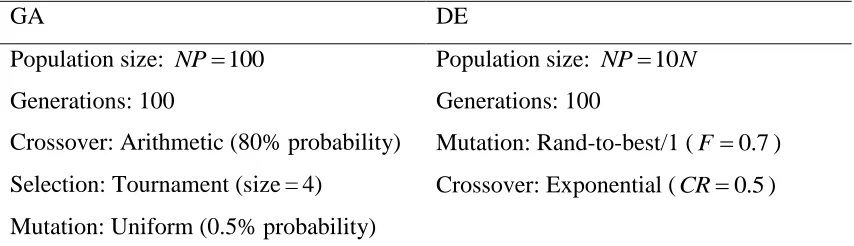
two evolutionary methods used in this study. The parameters of the algorithms were calibrated
after experimentation in order to achieve a good balance between the quality of the results and
the solution times. The selected parameters are summarized in Appendix 1, Table A1.
2.3 Superior predictive ability test
In the analysis of time series data, an important issue that needs to be considered is that of
data snooping bias. According to Sullivan et al. (1999) and White (2000), data snooping occurs
when a single data set is used for model selection and inference. When testing different
invest-ment strategies, there is a probability of having a given set of results purely due to chance rather
9 than these being truly based on the actual superior predictive ability of the competing strategies.
Predictive ability tests have been extensively used in the empirical financial economics literature
in various aspects, such as volatility forecast comparison (Hansen and Lunde, 2005), evaluation
of risk management loss functions (Bao et al., 2006) and evaluation of trading rules’
perfor-mance (Sullivan et al., 1999, Hsu et al., 2010, and Neuhierl and Schlusche, 2011), among others.
For instance, Alizadeh and Nomikos (2007) apply bootstrap techniques to approximate the
em-pirical distribution of Sharpe ratios and test different trading rules in the sale and purchase
mar-ket for ships.
To account for potential data mining and evaluate the performance of the tracking
portfoli-os in a statistically meaningful way, we employ the test of superior predictive ability (SPA)
pro-posed by Hansen (2005) as a complementary framework to the investment strategy performance
evaluation procedure. The SPA test allows for a comparison of the out-of-sample performance of
one benchmark model to that of a set of rival models. Empirically, it consists of the following:
Let LFt k, denote a loss function (for instance squared tracking error) between a prediction rt
against an actual measurementRt under a given modelk. In our case, rt and Rt are the returns at
time t for the tracking portfolio and the index, respectively. Setting k0 for the considered
benchmark model, alternative models k 1, ,l can be compared via the loss differential
, ,0 ,
t k t t k
f LF LF , for t 1, ,n, where n is the number of days of the out-of-sample period.
To test whether a benchmark tracking portfolio is outperformed by any other tracking
port-folio, the null hypothesis is set as H0: maxkE f( t k, )0. The rejection of the null provides
evi-dence that at least one tracking portfolio significantly outperforms the benchmark. Although the
expectation of ft k, is not known, by the law of large numbers it can be consistently estimated
with the sample mean fk. White (2000) suggests a reality check (RC), where the statistic is
1/2
max (k k)
RC n f . However, one major drawback is that the RC test depends heavily on the set
of rival models. As such, if poor or irrelevant models are included in the dataset, the test is
in-consistent and leads to frequent acceptance of the null hypothesis, i.e. it is conservative. As a
10
1/ 2
max ˆ
k k
kk
n f SPA
(8)
where ˆkk is a consistent estimate of the variance of
1/ 2
k
n f , kk2 limNvar n( 1/2fk)n. A
con-sistent estimator of kk and the p-value of SPA statistic can be obtained via a stationary
boot-strap6 procedure of Politis and Romano (1994). More details on this procedure are outlined in
Hansen (2005) and Hansen and Lunde (2005).
In short, to discount the possibility that the performance amongst the selected tracking
portfolios could be due to data snooping bias, the bootstrap version of Hansen’s (2005) SPA test
is implemented. To this end, by grouping the set of tracking portfolios, we conduct a battery of
tests from different perspectives, such as efficiency of the replication algorithms, e.g., DE vs.
GA, the rebalancing schemes, etc. (see section 4 for more details).
3. DATA AND BENCHMARK SHIPPING INDEXES
The dataset includes quotes for 160 stocks and two physical shipping indexes, the Baltic
Dry Index (BDI) and the Baltic Dirty Tanker Index (BDTI). Daily closing prices were
down-loaded from Datastream for the period February 15, 2006 to February 17, 2012, leading to a total
of 1,514 trading days after filtering out bank holidays. For the computational analysis, the
in-sample period consists of the first two years of the in-sample, and the remaining four years are
withheld to perform the out-of-sample analysis.
The stock data can be divided into two groups: the constituent stocks of the Dow Jones
Composite Average7 (N65 stocks), and the stocks of the constructed “Shipping” index
6 The stationary bootstrap re-samples blocks of random length from the original data to accommodate serial
depend-ence, where the block length follows a geometric distribution and its mean value equals 1 /q. Obviously, for q1
the problem is reduced to the ordinary bootstrap, which is suitable for series of negligible or no dependence. In this
paper, we use q0.25 although we also perform a sensitivity analysis to identify potential patterns, if any. The
results show no sensitivity, and similar qualitative outcomes are obtained for q{0.1, 0.15, 0.2, 0.25, 0.5}. For
more technical details on the implementation of the stationary bootstrap and the reality check, the reader is re-ferred to Sullivan et al., 1999; Appendix C, pp 1689-1690. In what follows, we use 5,000 random paths of portfo-lio returns. Having obtained the simulated paths, we finally construct the SPA statistic and obtain the p-value of the null.
7 The reason we use Dow Jones Composite Average is mainly due to investment restrictions of some large hedge
11 (N95). The latter is an arithmetic weighted index, where the weights are assigned according
to the market capitalization of each firm. It includes stocks of publicly listed international
mari-time companies that derive their revenues primarily from seaborne transportation (more than
80% during the sample period). The refined and final sample consists of daily data for 95
ship-ping stocks that are traded on 19 different stock exchanges in Europe, Asia and the Americas.
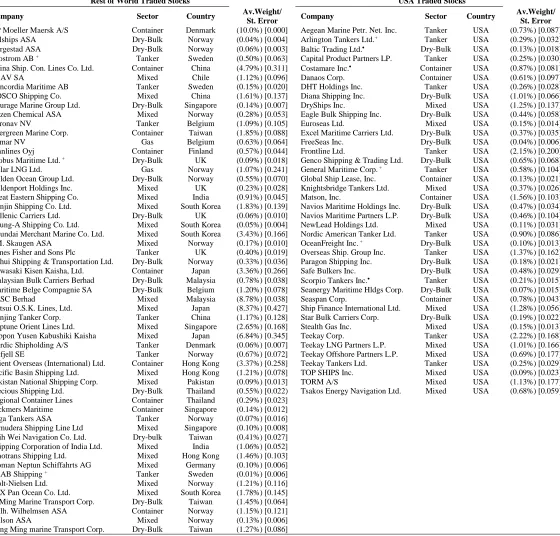
Table 1 describes the composition of the “Shipping” index. The average weights of the
constitu-ents along with their associated standard errors are also reported. To ensure that no company has
an excessive undesirable impact on the index, constituents are confined to a maximum weight of
10%. Any excess weight resulting from the imposed upper bound is distributed proportionately
among the remaining stocks, consistent with their individual market capitalization.
In the empirical analysis, the market-capitalisation-weighted equity index (henceforth
“Shipping” index) and two physical shipping indexes, BDI and BDTI, are to be tracked. DE and
GA are both employed to replicate the performance of the indexes by using a subset of stocks
included either in the Dow Jones Composite Average or the “Shipping” index (henceforth Dow
and Shipping baskets). The stocks picked from the “Shipping” index are used to form the
Ship-ping baskets. Likewise, stocks pulled out from the Dow index form the Dow baskets. For the
pe-riod examined, the average market capitalization of the “Shipping” index components ranges
from $6.7 million to $18.6 billion; the corresponding figure for Dow Jones is $1.4 to $388
bil-lion.
Our investment strategies are devised from the standpoint of a US investor with a
dollar-denominated portfolio. In particular, we examine opportunities in a portfolio composed of either
solely shipping US stocks (Shipping basket) or US stocks in general (Dow basket). This way, we
track the performance of domestic, foreign and physical markets seeking to generate a similar or
improved return-risk profile.
4. EMPIRICAL RESULTS
This section presents the empirical findings on index tracking in the shipping stock and
physical markets. To test the performance of the heuristics, three different scenarios are
exam-ined. In the first one, the algorithms are tested with rebalancing the tracking portfolios for the
out-of-sample period on an annual basis. In the second scenario, the portfolios are rebalanced
12 main purpose of testing these three scenarios is to examine whether the inclusion of additional
information into the index-tracking algorithms—by rebalancing the portfolio more frequently—
is actually more rewarding. In all rebalancing settings, transaction costs are taken into
considera-tion by appropriately adjusting the returns; a 0.75% cost is assumed for each transacconsidera-tion.
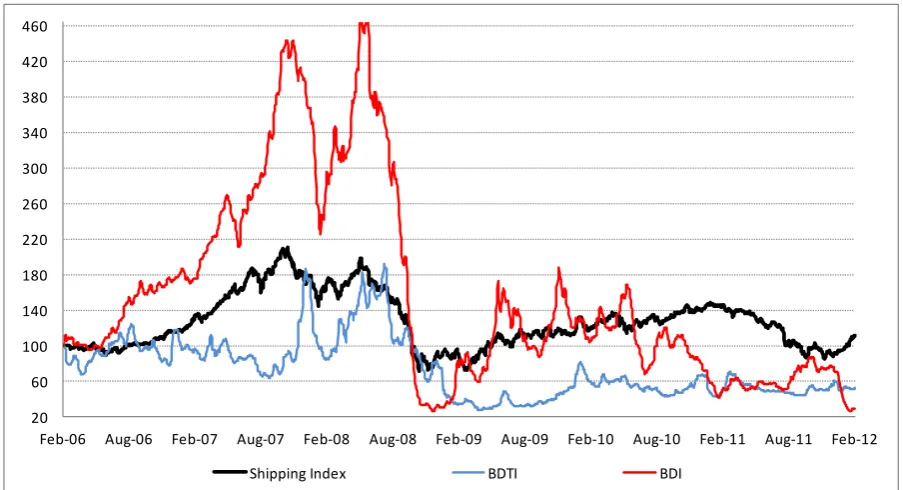
The cumulative returns of the indexes are rebased to 100, and for illustration purposes
they are presented in Figures 1-2. Figure 1 plots the “Shipping” index against three widely
known stock indexes (Dow Jones Composite Average, S&P 500 and NASDAQ 100) and one
commodity index (Dow Jones-UBS). The indexes exhibit similar behaviour, with the “Shipping”
index fluctuating in higher levels, especially before 2009, and also experiencing a more
pro-nounced collapse during the 2008 economic recession. Figure 2 displays the relative
perfor-mances of the “Shipping”, BDI and BDTI indexes. Although the indexes exhibit comparable
trends in the long-run, differences are markedly evident in the short-run. Clearly, the two
physi-cal indexes involve higher levels of volatility with relatively more frequent and large transitory
short-run deviations.
The initial investment budget of our experiments is set equal to C$100, 000. All
track-ing portfolios include at most K stocks, where K can be either 5 or 10. In addition, three
differ-ent trade-off profiles between tracking error and excess return are considered by adjusting the
parameter in equation (3); the values of represent different investment attitudes toward
portfolio construction, and are set equal to 0.6, 0.8 and 1. For example, in the case 1, the
in-vestor is interested utterly in pure replication of the index, irrespective of its performance. As
decreases, the investor is willing to deliberately accept a fraction of the tracking error, in view of
an optimum return-error combination. Implementation of the DE and GA algorithms is repeated
for a series of runs; the ensuing analysis is based on the best reported solution (where the
objec-tive function is minimized) for each particular set of parameters (see Appendix 1, Table A1).
Overall, in terms of tracking errors and excess returns, both DE and GA offer an
analo-gous outcome; yet, results tend to favor the GA, especially when the Dow basket acts as the
tracker. In what follows, we first review the findings on the shipping stock market index
track-ing. Then, the experiment is extended to the shipping physical market. Finally, the tracking
port-folios’ key statistical properties are also discussed, including the reporting of Sharpe ratios,
13
4.1 Tracking the shipping stock market
Figure 3 displays the “Shipping” index against quarterly rebalanced Dow and Shipping
baskets of maximum 10 stocks (K10), with 1 as constructed by the two evolutionary
al-gorithms. These are cumulative returns of the baskets (note that these include reallocation
trans-actions costs of 0.75% per transaction), implying that large errors have an impact throughout the
entire holding period of the out-of-sample period (due to budget constraints, at each point of
re-balancing the index and the tracking baskets differ). Thus, in terms of cumulative return levels
some differences are evident, especially for the shipping baskets. However, both baskets seem to
reasonably track the daily variations of the “Shipping” index. In addition, after the second half of
2008, the Dow basket consistently generates cumulative returns in excess of the benchmark. It
should be stressed out that, although the 2008 financial crisis caused a significant downturn in
the global equity markets, many shipping stocks, as represented by the constructed index and
se-lected baskets, exhibited positive returns until the first half of 2008, reflecting the unanticipated
boom in commodities and freight rates. Nevertheless, shortly after, freight rates also collapsed
and shipping stocks rapidly caught up with the general down-trend. Thus, the Shipping baskets
incurred substantial losses compared to the Dow baskets (see Figure 3).
Table 2 documents the out-of-sample daily root mean squared errors and mean excess
re-turns for the constructed DE and GA baskets. For all K, combinations and under all
rebalanc-ing scenarios, Shipprebalanc-ing and Dow baskets are marginally different; the average of the Dow basket
RMSEs is 0.1528 compared to 0.01526 for the Shipping basket. In terms of RMSE, the best
tracker is the Shipping GA basket with (K,) = (10, 0.6), when weights are rebalanced on a
monthly basis (Panel C, RMSE = 0.01416). This can be attributed to the high correlation
be-tween the Shipping basket and the benchmark, as the latter basket selects stocks from the
con-stituent list of the “Shipping” index. Moreover, all Shipping baskets are associated with negative
excess returns8, primarily because the shipping industry experienced an unparalleled downtrend
during the examined period. The best model to minimize the objective function of Equation 3 is
the Dow GA basket with monthly rebalancing and (K,) = (5, 0.6); this can be calculated from
the information presented in Table 2 (Eq. 3: f = λRMSE-(1-λ)(ER)
=0.6(0.01482)-(1-0.6)(0.0751/100)=0.0086).
14 Another interesting observation involves the rebalancing frequency of the investment
strat-egies. On average, rebalancing the baskets’ weights leads to improved RMSEs. For instance,
looking at the Shipping GA basket, increasing the rebalancing frequency from annually
(quarter-ly) to monthly causes a 3.4 to 8.6% (2.4 to 5.7%) improvement in the RMSEs. The subsequent
effect from quarterly to monthly is less prominent. Monthly rebalancing produces the best results
in terms of tracking errors, apart from the Dow DE baskets where annual portfolio revisions
seem superior. Still, frequent rebalancing overall trims down excess returns, mainly due to
in-creased transaction costs. Other studies such as Dunis and Ho (2005) noted that a quarterly
port-folio update is preferable to monthly or annual reallocations, where the former has the
shortcom-ing of high transaction costs and the latter is too restrictive. Thus, it is up to the investors’
risk-return appetite to decide whether rebalancing the portfolio monthly—which comes at an extra
cost—is better than less frequent revisions.
For pure replication of the benchmark index, i.e. 1, the lowest tracking error is
achieved by the Shipping GA baskets under all rebalancing strategies. Moreover, different values
of do not impact RMSEs much. Turning to the mean excess returns, these are maximized for
0.6
as expected, as the optimization procedure assigns more weight to the target for excess
return. This finding is more pronounced for monthly reallocations; however, any exceptions are
not surprising as the reported metrics for the set of investment strategies are based on the
out-of-sample period. Regarding the efficiency of DE and GA, the latter is associated with lower
track-ing errors and higher excess returns; this is evident when baskets’ readjustments take place more
often, especially in the monthly scheme.
Furthermore, Table 2 presents the results of the SPA tests. We conduct a battery of tests by
grouping the set of tracking portfolios from various aspects. The first objective is to determine
the relative efficiency of the algorithms employed, i.e. whether the tracking errors (RMSEs) are
significantly better for the DE or GA of the same parameters (K and ), baskets (either Dow or
Shipping) and rebalancing periods, using pairwise comparisons. RMSE values with the
super-script “a” attached to them denote the tracking portfolios with significantly better performance
compared to the competing algorithm. Results show that GA significantly outperforms the DE
(24 out of 36 cases), especially for quarterly and monthly rebalanced baskets. The second
objec-tive is to determine the relaobjec-tive efficiency of the replication strategies, i.e. to identify if a model
re-15 balancing scheme; that is, at each row of Table 2. RMSE values with the superscript “b” attached
to them denote the tracking portfolios with significantly better performance compared to the
competing baskets and algorithm, using joint comparison of four models per test. Yet, no
signifi-cantly lower errors can be observed for any particular basket at each set of K, and
rebalanc-ing period at 5% level (henceforth the considered level of significance examined is 5% for all
SPA tests). This implies that nominal RMSE values are statistically equivalent. In addition, the
above tests are also performed when excess returns (ER) are considered as the objective (and not
the RMSEs). ER values with superscripts “a” or “b” attached represent tracking portfolios with
significantly higher returns compared to the rival algorithm or the rival tracking basket,
respec-tively. Table 2 asserts that the GA is more effective (14 out of 24 cases), whereas only the Dow
GA basket manages to outperform all, the Dow DE, Shipping GA and Shipping DE baskets, at
certain cases (9 out of 18).
Finally, another objective is to verify the relative efficiency of the rebalancing scenarios,
i.e. whether more frequent portfolio revisions lead to significantly lower RMSEs and/or higher
ERs, for each given basket; that is, at each column of Table 2. For that reason, joint comparisons
of 13 strategies are implemented, e.g. annually rebalanced Dow basket with certain K and
parameters, all monthly and quarterly frequencies of the Dow basket and for all K and .
Re-sults are not presented here and are available from the authors upon request; however, findings
are consistent. Regarding RMSEs, monthly rebalancing generates significantly lower values; this
holds for all GA baskets as well as for the DE baskets with K5. Regarding ERs, overall,
monthly rebalancing produces significantly lower returns, and results are stronger for the DE
baskets.
4.2. Tracking the shipping physical market
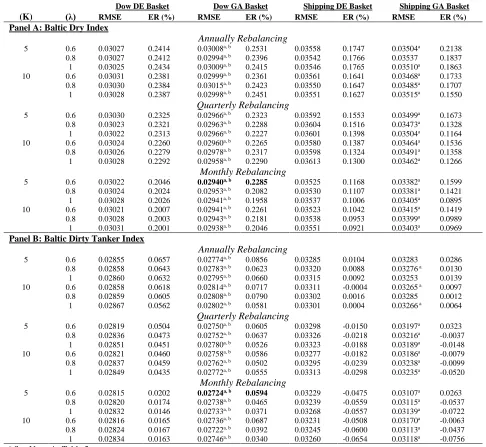
The physical shipping index tracking results are reported in Table 3. Clearly, the Dow
bas-kets outperform the Shipping basbas-kets with an average RMSE reduction close to 14%. Moreover,
the Dow baskets accomplish relatively higher excess returns in all cases; an approximate average
increase of 7.6 basis points in ER. Once more, the GA provides a superior combination of excess
returns and RMSEs; on average, excess returns are 1 basis point higher and RMSEs are 2.5
per-centage points lower compared to the DE algorithm. The best out-of-sample BDI tracker is the
16 BDTI it is the Dow basket with (K,) = (10, 0.8) under the same rebalancing frequency (Panel
B, RMSE = 0.02722).
Similar to the shipping stock index tracking exercise, the baskets still generate the highest
excess returns when 0.6, in line with the trade-off criterion (17 out of 24 cases for BDI and 20 out of 24 for BDTI). Once again, it is up to the investors’ preferences to decide on the
trade-off parameter. Moreover, as before, there is a negative relationship between rebalancing
fre-quency, tracking errors and excess returns; frequent revisions increase accuracy at the cost of
higher transaction fees. On the other hand, increasing the rebalancing frequency has a marginal
effect. Finally, should the investor increase the number of stocks included in the basket from
5
K to K10, the outcome will be only trivially altered. Overall, as highlighted in Table 3
(Panels A and B) the best model to minimize the objective function of Equation 3 is the Dow GA
basket with monthly rebalancing and (K,) = (5, 0.6), as was the case when tracking the
“Ship-ping” index.
The results of the SPA tests are also displayed in Table 3. It can be observed that both BDI
and BDTI can be tracked by the Dow GA baskets with significantly lower tracking errors
(super-script “b”), while GA is generally more accurate (super(super-script “a”). As for excess returns, there
are only few cases where significance is achieved; 24 out of 72 when comparing the algorithms
and 15 out of 72 when comparing the baskets at any given set of parameters K, and
rebalanc-ing scenarios (however, results are stronger for monthly rebalancrebalanc-ing frequencies: 3 out of 6 for
BDI and all 6 for BDTI). Overall, Dow GA baskets present better ability of replicating the
physi-cal indexes. This evidence is unanimous across RMSEs in all rebalancing scenarios; for excess
returns it is more profound in the monthly rebalancing scheme. Finally, the findings on the
rela-tive efficiency of the rebalancing periods (available from the authors upon request) are similar to
the stock index tracking problem. For BDI, regarding RMSEs (ERs) monthly (annually)
re-balancing produces significantly lower (higher) figures compared to quarterly and annually
(monthly and quarterly). For BDTI, results are mixed between the GA and DE. BDTI GA
bas-kets are associated with significantly lower errors in quarterly and monthly schemes; this does
not hold for DE baskets, where there is no clear winner according to the SPA tests. Still, for ERs,
annually rebalanced baskets are superior.
When comparing the baskets’ performance in terms of tracking the physical and shipping
17 errors, tracking BDI and BDTI is far more challenging. Yet, the less accurate tracking
perfor-mance of the physical market is not startling. It is a consequence of, first, the low correlation
be-tween the physical and financial markets and, second, the existence of diverse and unique to each
market risk factors; these act as further complexities in the effort to mimic the behavior of
physi-cal quantities using financial stocks. Hence, tracking the physiphysi-cal indexes is more demanding
because the physical and stock markets display relative autonomy in their price formation
mech-anisms and evolution. Figures 4 and 5 illustrate the relative performance of the Dow and
Ship-ping baskets in tracking the BDTI and BDI under the genetic and differential evolution
algo-rithms. As in the “Shipping” index case, note that these are cumulative returns of the baskets
(in-cluding reallocation transactions costs of 0.75% per transaction) and large errors have an impact
throughout the complete holding period, i.e. four years (due to budget constraints, at each point
of rebalancing the index and tracking baskets are not the same).
4.3. Statistical properties and risk-return profile of the constructed portfolios
Tables 4 and 5 present key statistics of the constructed baskets, the correlation of the
track-ing portfolio returns with the benchmark returns and the correspondtrack-ing Sharpe ratios. For
com-parison reasons, in Panel D of Table 4, the annualized mean and volatilities of three stock
index-es (Dow Jonindex-es Composite Average, S&P 500 and NASDAQ 100) and one commodity index
(Dow Jones-UBS) are also reported (see also Figure 2). When comparing the Sharpe ratios, only
the commodity index has similar risk-return profile to the shipping markets (negative). The
fi-nancial indexes are able to generate a better risk-return performance compared to the shipping
indexes. According to the historical annualized volatilities, the “Shipping” index exhibits
compa-rable levels of volatility with the other financial indexes; these are in the range of 26.5 to 29%.
Slightly lower is the volatility of the commodity index (23.5%), whereas BDI and BDTI are
as-sociated with fairly elevated levels of volatility. This is due to changing economic and seaborne
transportation patterns, international politics, technological advances, structural changes in the
maritime industry and major events (canal closures, embargoes and wars); all these have created
considerable uncertainty in the shipping physical markets, which strongly depend on demand and
supply fluctuations in seaborne transportation. .
Next, we turn our attention to the different tracking strategies. Moving from annual
18 higher transaction costs. It can be argued that when rebalancing, the additional information
available from the latest price data does make a difference in reducing the portfolios’ volatility,
but the small return deterioration outweighs the volatility benefits. Results are consistent for all
cases for the risk-return trade-off . The best performance for the stock index tracking, in terms
of Sharpe ratios, is reported for the Dow GA baskets that are rebalanced quarterly for (K,) =
(5, 0.6). In that case the reward-to-risk ratio equals 0.414, much higher than the benchmark
“Shipping” index of -0.406. Regarding the physical indexes tracking (see Table 5), the best
per-formance is achieved by the Dow GA baskets that are rebalanced annually for (K,) = (5, 0.6)
for both BDI and BDTI. The corresponding Sharpe ratios of the baskets are 0.357 and 0.535,
whereas the benchmark Sharpe ratios are -1.317 and -0.286, respectively.
Although the Dow baskets generate positive Sharpe ratios, at least in annually and
quarter-ly rebalancing frequencies, this does not hold for “Shipping” baskets. In general, this implies that
the tracked and benchmark indexes present differences in terms of sign (Dow baskets only)
and/or level. On the one hand, for the “Shipping” index differences in the level of annualized
re-turns can be explained by the fact that shipping stock markets have been more vulnerable to the
recent economic recession compared to other equity markets. Hence, shipping-related (Dow)
portfolios over the out-of-sample period underperform (outperform) the benchmark stock index,
as they are associated with lower (higher) annualized returns. On the other hand, physical
mar-kets have been even more susceptible to the recent economic recession, as generally both Dow
and Shipping baskets outperform the benchmark in terms of Sharpe ratios and returns. Interesting
is the case of the Dow baskets which often manage to achieve returns with opposite sign than
that of the tracked indexes. This can be attributed to the relatively lower correlation as well as the
resulting relatively lower volatilities of the Dow baskets, compared to BDI and BDTI. However,
note that more frequent rebalancing, improves tracking performance.
Moreover, for all rebalancing frequencies, Dow baskets volatilities are significantly lower
than the benchmark irrespective of whether this is the “Shipping” index or the BDI, BDTI (an
F-test of equal variances confirms this finding). The Dow baskets experience annualized volatilities
of 17% to 25%, which is less than not only all the benchmark indexes but also the Dow Jones
Composite Index itself. This implies that high diversification benefits may arise, while at the
same time, different combinations can be selected that offer reduced portfolio variance. In the
19 the “Shipping” index with US shipping stocks, no variance reduction is observed. This is not a
surprising result as stocks (K 5 or 10) are selected from a subset (N37) of a much wider
index (N95). Thus, opportunities for potential diversification benefits are rather limited.
Several studies in the literature propose different rules for settingK. Maringer and
Oyewumi (2007) argued that including roughly 50% of the available assets is suitable to get the
desirable properties in the tracking portfolios. Meade and Beasley (2004) suggested that the
op-timum number of stocks in the tracking portfolio should be the minimum number of stocks
need-ed to provide half of the capitalization of the index. However, note that none of the
above-mentioned suggestions apply to our experiment because of the limitation of using US stocks only
from our index (37 US stocks out of 95) or different stocks than the constituents of the
bench-mark index. Moreover, in the case of the physical indexes the traditional approaches do not apply
as we are constrained to use a specific set of stocks to replicate a physical quantity. This can also
explain the relatively low (and in some cases negative) correlations of the selected equity baskets
with the BDI and BDTI (between -4.4% and 14.5%); overall, our results suggest that investors
who want to participate in the physical shipping industry can still benefit from the addition of the
selected baskets to a well-diversified portfolio of assets.
Finally, Table 6 presents the total number of different stocks included in the tracking
bas-kets, throughout the entire out-of-sample period. In any case, by construction, this number
can-not exceed N65 (37) for the Dow (Shipping) baskets9. It can be observed that the GA tends to
utilize more stocks to construct the portfolios. For example the total number of stocks that the
Dow DE (GA) selects to track the “Shipping” index is 19, 30 and 35 (25, 43 and 56) for
annual-ly, quarterly and monthly rebalancing (see Table 6, Panel A: K, = 10, 0.8). For annual
portfo-lio revisions, both algorithms are more stable in the number of stocks picked between the various
cases of the risk/return trade-off, whereas portfolios are quite different in terms of their
composi-tion when increasing the rebalancing frequency.
5. CONCLUSIONS
9 For example, consider the annually rebalancing scheme. Starting with the first reallocation period (Feb 2008 to
Feb 2009), say the algorithm selects K = 4 stocks, namely s1, s2, s3, s4. We count these 4 stocks. In the next period,
Feb 2009 to Feb 2010, say the algorithm selects K = 5 stocks, namely s1, s2, d1, d2, d3. We count only the 3 new
stocks d1, d2 and d3. Thus, for Feb 2008 to Feb 2010 this gives a total of 7 stocks; and so on. In the case of
annual-ly rebalancing (4 rebalancing periods) this number cannot exceed 20 when K = 5 and 40 for K = 10, i.e. at most 5
20 In this paper, we construct an international market-capitalisation-weighted shipping index,
and its performance is reproduced by investing only in a subset of stocks within the index itself
or in a subset of stocks from the Dow Jones Composite Average. We further extend our results to
the case of physical shipping markets. In particular, using the Baltic Dry Index and the Baltic
Dirty Tanker Index as benchmarks, we assess the tracking capability of the same set of stocks. In
our methodology, we employ the differential evolution algorithm and a genetic algorithm. To
test the performance of the heuristics three different rebalancing scenarios are examined: a)
an-nually, b) quarterly and c) monthly. Transaction costs are also taken into consideration.
For the time period under investigation, and irrespective of the rebalancing frequency, the
Dow GA baskets provide the minimum tracking errors and maximum mean excess returns.
Alt-hough the physical shipping markets’ index tracking problem provided similar results, tracking
errors were much higher, mainly due to different return-risk profiles and lower correlations
be-tween the equity and physical maritime segments. Furthermore, better tracking results were
ob-tained with a monthly rebalancing strategy. Looking at Sharpe ratios, it can be noted that
annual-ly (when tracking the BDI and BDTI) and quarterannual-ly (when tracking the shipping index) strategies
perform better; this is attributed to transaction costs trimming down the returns of more frequent
rebalancing strategies. Thus, it is up to the investors’ risk/return preferences to decide whether
rebalancing the portfolio monthly, which comes with an extra cost, is better than less frequent
rebalancing. In addition, volatilities of the constructed portfolios are found to be significantly
smaller for the Dow baskets, especially when tracking the BDI and BDTI. The resulting Sharpe
ratios, with the exception of shipping baskets, are superior not only to the benchmark indexes but
also against other widely traded benchmark financial and commodity indexes. The robustness of
all results is checked by applying predictive ability tests using bootstrap simulations to determine
whether any particular basket outperforms the others in terms of tracking errors and excess
re-turns. The tests focus on the relative efficiency a) of the DE and GA algorithms employed, b) of
the tracking baskets across parameters and rebalancing strategies and c) of the rebalancing
sce-narios.
This paper could encourage mutual and hedge fund managers to set up shipping Exchange
Traded Funds (ETFs) that track our proposed shipping equity index or the two physical indexes.
Similarly, investors, private and institutional, could be motivated to follow a sector of the
21 ETFs could be utilized by ship owners, shipping market participants or other major investors to
complete parts of their investment portfolios or perform tactical investment strategies. To that
end, our proposed methodology puts forward an effective and at the same time least expensive
22
APPENDIX
A.1 Differential Evolution Algorithm
DE is a population-based stochastic optimization algorithm that employs mutation,
recom-bination (crossover) and selection operators to evolve iteratively an initial set (population) of
NP randomly generated N-dimensional solutions. At each iteration (generation), the algorithm
applies the aforementioned evolutionary operators to each one of the available solutions. In
par-ticular, let G i
x denote the solution vector i (i 1, ,NP) at a generationG, xijG be the jth
ele-ment of G i
x , and *G
x the best solution from generation G (specified according to the problem’s
objective function). Having G i
x as the starting basis, a new solution G1
i
x is constructed replacing
G i
x in the next generationG1. The solution updating process is performed in the following
three steps:
1. A mutant solution vi is constructed by combining xGi with x*G and two other randomly
se-lected (different) solutions x and x from the current generation:
*
( ) ( )
G G G
i i F i F
v x x x x x . The mutation constant F(0, 2] controls the rate at
which the population evolves.
2. The parent solution xGi and the mutant vector vi are recombined to produce a crossover
so-lution ui, using the exponential scheme as shown in Figure A1 (for simplicity the generation
index G is not shown in the figure), where l and j* are randomly selected from
{1, 2,, }N , such that the part of uiderived from vi is analogous to a user-defined
crosso-ver probability CR (with higher values corresponding to a stronger impact of vi).
3. The crossover solution ui is compared against the parent vector xi G, on the basis of the
problem’s objective function f . If ( )i ( iG)
f
f u x , then Gi 1
x is set equal to ui (ui replaces
,
i G
x in the next generation); otherwise, G 1
i
x is set equal to G i
x .
The iterative procedure terminates when a stopping criterion is met (e.g., after a predefined
23
... ... ...
Parent solution Mutant solution
Crossover solution
1, 2,,
i i iN
x x x vi1,vi2,,viN
1
i
x xi2 xi, 1 vi vi,1 vi j, * 1 xij* xiN
Fig. A1: DE’s exponential crossover scheme.
A.2 Genetic algorithm
Similarly to the DE algorithm, a GA is also a population-based stochastic optimization
pro-cess. It uses the same evolutionary operators, but implements them in a different way and does
not follow the greedy approach adopted by DE. Starting with an initial (random) population of
solutions, the algorithm proceeds iteratively over a number of generations. In the GA
imple-mented in this study, the following algorithmic steps are performed at each iteration (generation):
1. A pair of parent solutions x and y is selected from the current population using a
tourna-ment selection procedure. Under this scheme, k individuals (tournament size) are randomly
selected from the population with replacement, and only the best individual (according to the
problem’s objective function) is selected as a parent.
2. The parent solutions are used to perform the crossover operation with a pre-specified
crosso-ver probability (this probability controls the frequency with which crossocrosso-ver is performed).
Under the arithmetic crossover scheme this operation leads to a new pair of solutions
(1 )
r r
x x y { , }x y and y (1 r)xry, where r is a random number drawn from the
uniform distribution in [0, 1].
3. The crossover solutions are subject to mutation. In this study the uniform mutation strategy is
employed, under which p Nm randomly selected elements of a solution vector are replaced
by random values selected uniformly from a pre-specified range. The mutation
probabil-itypm controls the frequency of the mutation changes.
The pair of solutions resulting from the mutation operator is placed in the next generation
of solutions, and the above three steps are repeated until the new population is fully formulated.
The procedure ends as soon as a termination criterion is met (e.g., the population converges or
24
Table A1
Parameters of the algorithms
GA DE
Population size: NP100 Population size: NP10N
Generations: 100 Generations: 100
Crossover: Arithmetic (80% probability) Mutation: Rand-to-best/1 (F 0.7)
Selection: Tournament (size=4) Crossover: Exponential (CR0.5)
25
Acknowledgements
26
REFERENCES
Alexander, C., Dimitriu, A., 2002. The cointegration alpha: Enhanced index tracking and long-short equity market neutral strategies. ISMA Discussion Papers in Finance, 2002-08, ISMA Centre, University of Reading.
Alizadeh, A.H., Nomikos, N.K., 2007. Investment timing and trading strategies in the sale and purchase market for ships. Transportation Research Part B: Methodological 44(1), 126-143. Bao, Y., Lee, T-H., Saltoglu, B., 2006. Evaluating predictive performance of value-at-risk
models in emerging markets: A reality check. Journal of Forecasting 25(2), 101-128. Barber, B.M., Odean, T., 2000. Trading is hazardous to your wealth: the common stock
investment performance of individual investors. The Journal of Finance 55(2), 773-806. Beasley, J.E., Meade, N., Chang, T.-J., 2003. An evolutionary heuristic for the index tracking
problem. European Journal of Operational Research 148(3), 621-643.
Canakgoz, N.A., Beasley, J.E., 2008. Mixed-integer programming approaches for index tracking and enhanced indexation. European Journal of Operational Research 196, 384-399.
Chen, C., Kwon, R.H., 2012. Robust portfolio selection for index tracking. Computers & Opera-tions Research 39, 829-837.
Chang, T-J., Yang, S-C., Chang, K-J., 2009. Portfolio optimization problems in different risk measures using genetic algorithm. Expert Systems with Applications 36(7), 10529-10537. Drobetz, W., Schilling, D., Tegtmeier, L., 2010. Common risk factors in the returns of shipping
stocks. Maritime Policy and Management 37(2), 93-120.
Drobetz, W., Tegtmeier, L., 2011. The development of a performance index for KG funds and a comparison with other shipping-related indices. Working paper, University of Hamburg. Dunis, C.L., Ho, R., 2005. Cointegration portfolios of European equities for index tracking and
market neutral strategies. Journal of Asset Management 6(1), 33-52.
Feoktistov, V., Janaqi, S., 2004. Generalization of the strategies in differential evolution. In: The 18th International Parallel and Distributed Processing Symposium, Santa Fe, New Mexico,
USA.
Frino, A., Gallagher, D.R., 2001. Tracking S&P 500 index funds. The Journal of Portfolio Management 28(1) 44-55.
Gaivoronski, A.A., Krylov, S., Van der Wijst, N., 2004. Optimal portfolio selection and dynamic benchmark tracking. European Journal of Operational Research 163(1), 115-131.
Goldberg, D.E., 1989. Genetic Algorithms in Search, Optimization & Machine Learning. (1st ed.). Addison-Wesley.
Gompers, P.A., Metrick, A., 2001. Institutional investors and equity prices. Quarterly Journal of Economics 116(1), 229-25.
Grammenos, C.Th., Nomikos, N.K., Papapostolou, N.C., 2008. Estimating the probability of default for shipping high yield bond issues. Transportation Research Part E: Logistics and Transportation, 44(6), 1123-1138.
Grammenos, C.Th., Papapostolou, N.C., 2012. Ship finance: US public equity markets. In Talley W. K. (ed.), The Blackwell Companion to Maritime Economics. (1st ed.). Wiley-Blackwell, USA, (chapter 20).
Hansen, P.R., 2005. A test of superior predictive ability. Journal of Business and Economic Sta-tistics 23(4), 365-380.
27 Holland, J. H., 1975. Adaptation in Natural and Artificial Systems. University of Michigan Press.
(1st ed.). Ann Arbor.
Hsu, P.H., Hsu Y-C., Kuan, C.H., 2010. Testing the predictive ability of technical analysis using a new stepwise test without data snooping bias. Journal of Empirical Finance 17(3), 471-484.
Kavussanos, M.G., Alizadeh, M.H., 2002. Seasonality patterns in tanker spot freight rate mar-kets. Economic Modelling 19(5), 747-782.
Kavussanos, M.G, Visvikis I.D., 2006. Derivatives and risk management in shipping. Witherbys Publishing (1st ed.). London.
Killian, L., 2009. Not all oil price shocks are alike: disentangling demand and supply shocks in the crude oil market. American Economic Review 99(3), 1053-1069.
Krink, T., Paterlini, S., 2009. Multiobjective optimization using differential evolution for real-world portfolio optimization. Computational Management Science 8, 157-179.
Krink, T., Mittnik, S., Paterlini, S., 2009. Differential evolution and combinatorial search for constrained index-tracking. Annals of Operations Research 172, 153-176.
Konno, H., Hatagi, T., 2005. Index-plus-alpha tracking under concave transaction cost. Journal of Industrial and Management Optimisation 1(1), 87-98.
Larsen-Jr, G.A., Resnick, B.G., 1998. Empirical insights on indexing. The Journal of Portfolio Management 25(1), 51-60.
Li, Q., Sun, L., Bao, L., 2011. Enhanced index tracking based on multi-objective immune algorithm. Expert Systems with Applications 38, 6101-6106.
Markowitz, H., 1952. Portfolio selection. The Journal of Finance 7(1), 77-91.
Maringer, D., 2008. Constrained index tracking under loss aversion using differential evolution. In: Brabazon, A., O’Neil, M. (eds.), Natural Computing in Computational Finance, Studies in Computational Intelligence 100, Springer, Berlin, 7-24.
Maringer, D., Oyewumi, O., 2007. Index tracking constrained portfolios. Intelligent Systems in Accounting, Finance and Management 15, 57-71.
Malkiel, B., 1995. Returns from investing in equity mutual funds 1971 to 1991. The Journal of Finance 50(2), 549-572.
Meade, N., Beasley, J.E., 2004. An evaluation of passive strategies to beat the index. Working Paper Series, Tanaka Business School.
Merikas, A., Gounopoulos, D., Karli, C., 2010. Market performance of US listed shipping IPOs.
Maritime Economics and Logistics 12(1), 36-64.
Michalewicz, Z., 1994. Evolutionary computation techniques for nonlinear programming problems. International Transactions in Operational Research 1(2), 223-240.
Neuhierl, A., Schlusche, B., 2011. Data snooping and market-timing rule performance. Journal of Financial Econometrics 9(3), 550-587.
Oh, K.J., Kim, T.Y., Min, S., 2005. Using genetic algorithm to support portfolio optimization for index fund management. Expert Systems with Applications 28, 371-379.
Politis, D. N., Romano, J. P., 1994. The stationary bootstrap. Journal of The American Statistical Association 89(428), 1303-1313.
Price, K.V., Storn, R.M., Lampinen, J.A., 2005. Differential Evolution: A Practical Approach to Global Optimization. Springer. (1st ed.). Heidelberg.