Rochester Institute of Technology
RIT Scholar Works
Theses
Thesis/Dissertation Collections
4-17-2013
Pattern changing clothing
Yong Kwon
Follow this and additional works at:
http://scholarworks.rit.edu/theses
This Thesis is brought to you for free and open access by the Thesis/Dissertation Collections at RIT Scholar Works. It has been accepted for inclusion in Theses by an authorized administrator of RIT Scholar Works. For more information, please [email protected].
Recommended Citation
Author – Yong hwan Kwon
Degree – Master of Fine Arts Program – Industrial Design Rochester Institute of Technology College of Imaging Arts & Sciences
1
Pattern Changing Clothing
by yong hwan Kwon
Approvals
Stan Rickel
, Chief Advisor & Committee Member
Associate Professor, Graduate Program Chair, Industrial Design
Signature:
Date:
Marla K Schweppe
, Associate Advisor & Committee Member
Professor, Computer Graphic Design
Signature: Date:
W. Michelle Harris
, Associate Advisor & Committee Member
Associate Professor, Interactive Game & Media
2
Table of Contents
Abstract 5
01 Introduction 6
02 Design Background 8
- The History of Textile Technology
- The History of Modern fashion
- Fashioning Technology
- Fashioning Technology - Considerations
- Futuristic Clothing
03 Design Motivation 18
- Individuality in Fashion
- Expressive Ways of individuality
- Mass Customization
04 Problems of Current Clothing 25
- Irrational Consumption of Clothing
- Waste of Natural Resources and Harm to Nature
- De-individuation
- Fewer Responses between People and Clothing
- The Problem of Mess Customization
05 Idea Development 36
1)
Analogue way : Individual Customization
3
- Fabric Net
- Snap Buttons
- Lights & Shadows
- Surface: Multi-layered Textures
2)
Digital way : Responsible Clothing
- Collectibles (Album jacket with conductive yarn)
- EL Wire
- Digital Hanger
06
Final Concept Development and Execution 52
- Final Idea and Concept
- Pattern Study
- Final Outcome
- Scenario
- Related Technology and Issues
- E ink
07 Conclusion 75
4
List of Illustrations
01. Fashioning Technology is Fashion plus Technology 12
Mass Customization injects Buyer Participation into Product Design by Forrester Research.inc
Flow Chart – The types of Mass Customization 22
Which are dominating Industries with Mass Customization Offerings?
05. Mass-Produced Individuality and the Solutions 29
The Problem of Normal Clothing’s prompt Customization
Comparison of product variety
The Limits of Mass Customization
The Causes of External and Internal Complexity
10. Usability Testing of Custom T-shirts 35
Principle of E ink – Black and White
Principle of E ink – Color 73
List of Tables
01. Brief Summary – Problems and Solutions 7
02. Considerations 01 – Outputs toward Five Senses 13
03. Futuristic Clothing 17
5
Abstract
People’s styles and characters are changed by their environment and their relationship throughout their
lifetime. However, the garment that we wear has just one look without accessories because once we
wear clothing its appearance doesn’t change, even though it is an essential medium to express ourselves.
This thesis project’s main goal is to make a piece of responsive clothing and to provide users the
pleasure of creating their own style.
When the clothing is an active medium through interactive communication between a wearer and a
garment, it will be a responsive living object for a user. By the use of the developing display technology of
E ink, which is thin, rugged, flexible, and segmented, a wearer can change various styles that he/she
wants anytime and anyplace. When this E ink clothing displays different pattern, users will be able to
make various styles with just one garment. In addition, Pattern Changing Clothing will help wearers enjoy
expressing their individuality through the activity of changing or creating styles and patterns as individual
6
01 Introduction
Fashion is something we deal with every day; we are all faced with it every morning. Most people are not
entirely comfortable with fashion trends and most wearers are not active customers but passive followers
in that they merely buy and wear mass produced clothing. However, fashion is one of the most
expressive and creative ways of showing one’s personality to others. As an industrial designer, I would
like to design a functional garment that can play a role as a fashionable wear as well as a wearable
computer.
“Fashion is a big deal. The global apparel accessories and luxury goods market generated total revenues
of $1,334.1 billion in 2008.” 1 Also, by collaborating with various areas, the fashion industry has been
broadening the scope of the field and it increasingly affects our life-styles enormously. Now is the time for
innovating enhanced clothes. We can wear them not only for protecting our body but we can also find
delight in wearing them.
For this thesis project, general topic is fashioning technology. Developing customizable wear as a product
will be the focus. Designing custom clothing is so important in that a piece of clothing hardly changes
itself. There are a lot of wearable computer concepts already but current futuristic fashion is emphasizing
more electronic functions than basic functions of clothes such as aesthetics. At this point, we should think
what new technologies customers want on a piece of clothing. We can design fabulous clothing not as
digital wear, but as innovative clothing. The following research will concentrates more on finding ways of
changing clothing’s look, the change in trends for last 100 years, and fashioning technology.
What follows is the brief description of this thesis project
Target:
The main target audience is for women in their 20s who are sensitive to trends in the year of
2060. Making clothing according to trends won’t be easy for them. One of my design goals is for young
women to be able to easily make their own fashion look. In doing so, I can make people feel closer to
fashion as well as improve the interaction between wearers and clothing.
1
7
Problem: The irrational consumption of clothing is caused by customers’ feeling that they don’t like
old-fashioned clothing anymore. For this reason, people buy more and more clothing. Mass production, which
uses lots of natural resources, is related to this kind of consumer behavior. In addition, clothing from mass
production isn’t helpful to people to express their individuality since there are many similar clothes out
there. Current clothing consists of the aspects of visuals and materials that exist when it is produced. It
doesn’t offer anything other than those things, such as the sense of sight and a tactile sense.
Solution: If a new and smart piece of clothing can be changed visually every day by users and it offers
unusual visual aspects, consumers will be interested in the clothing. The interest in the clothing is able to
satisfy them with the garment. Furthermore, by wearing it continuously, the product’s life cycle can be
increased.
Table 1. Brief Summary – Problems and Solutions
Problem solution
Irrational consumption of clothing Providing continuous interaction between clothing and wearers to make wearers feel excitement of owning a new piece of clothing.
Various styles can be displayed with a single piece of clothing.
Waste of natural resources/ Harm to nature : New interest in a piece of clothing may extend The garment can give users satisfaction for the long-term product life cycle.
De-individuation to create his/ her own stylesDesigning an innovative product that can encourage a wearer
Fewer responses between people and clothing New and exciting interaction between users and clothes : Constant interaction between clothing and wearers by creating new fashion from one digital garment
8
02 Design Background
In order to better understand what products might be fashionable in the future, I needed to know the
general background of textile, fashion, and fashionable technology. Especially, since, I am not a fashion
major, this research was necessary and helpful to develop concepts and ideas for this collaboration,
which takes the form of fashion plus product design.
The History of Textile Technology
The textile industry has been developing since human beings made clothes to protect their bodies. The
trade of textiles from the Silk Road brought prosperity to much of the world. Industrial Revolution in the
18th century made mass production possible. After the revolution, women’s advanced social status and
increased recreation led to technological development in the textile industry. The appearance of
functional fibers such as polyamide (nylon), polyester, and microfiber made the next generation of textiles
possible.
Through studying technological innovation of textiles in the past, I was able to find the needs of textile
technologies for each generation. In the 21st century, people are looking for new clothes with original
textiles such as fiber optics fabric, light emitting fabric, and heat-reactive jackets. In addition, many
fashion designers try to combine their fashion designs with wearable technology. An example is shirts
that light up with LED ads or textiles with embedded temperature sensors. Athletic gear that changes
color to show the intensity of an athlete’s workout represents how to use recent technology in fashion
industry. Wearable technology has enough potential to change the environment of the fashion industry.
A special material or textile is possibly able to change the style of a piece of clothing as well as its
functionality but the variation of the look is limited to a few styles. Also, the development in textile is more
focused on enhanced functionality than the style of clothing. Therefore, I shifted my focus to style, not to
9
The History of Modern Fashion
In order to create an innovative garment, observing fashion trends by years is advantageous to consider
colors, textures, and styles in the future. Specifically, if designers want to anticipate trends in the future,
studying famous fashion designers’ works chronologically is very useful.
Clothing more recently has been focused on a variety of patterns and colors and designers have
emphasized individuality in clothing by adopting exquisite styles. Coco Chanel always emphasized the
personality in women’s clothing. She is quoted as saying, “I don't do fashion, I am fashion” and “In order
to be irreplaceable one must always be different.” This statement indicates that each wearer must be
active in order to create their own styles and not to be fashion followers.
Fashionable technology
Recently, the fashion industry has been looking for creative ways to go further in the future. Fashionable
technology is increasingly developing innovations in fashion. From the beginning of this thesis, it was
acknowledged that a wearable is a big picture means to develop a product. However, fashionable
technology is not common sense to ordinary people, including me and most industrial designers.
Therefore, it is necessary to study the meaning of fashionable technology and what has been done so far.
From this study, I am looking both for inspirations for a new garment and innovative technologies in
clothing. The following is the definition of fashionable technology:
“Fashionable technology refers to the intersection of design, fashion, science and technology…
Fashionable wearables are ‘designed’ garments accessories or jewelry that combines aesthetics and
style with functional technology. As designers of fashionable wearables, we view end users as
fashionable beings who are attentive to style and powerful potential of wearable technologies. Our design
philosophy is based on the notion that garments are the immediate interface to the environment and thus
are a constant transmitter and receiver of emotions, experiences, and meaning.” 2
2
10
Current clothing is always in an analogue state. That is why a wearer hardly expects changes in a
garment physically or visually. However, advanced wearable technologies make clothing responsive
anytime and anywhere. Fashionable technology can be an extensive medium to express personal
emotions, experiences, and visual preferences.
Clothing played a critical role as the one of the most essential elements of human living. When fashion
meets technology, the role of a garment can be more than merely covering or protecting a body but if a
garment looks like a device, not clothing, most people would not be attracted to it. The wearable can be
helpful to a user depending on what technologies can be used to create it. Therefore, wearable designers
should think about technology as well as style. From this point of view, I am curious about the meaning of
fashion in our society and direction of fashionable technology in the future.
According to Sabine Seymour, fashionable wearable is much more than fashion since it provides wearers
with interactive interface plus fashion what we understand it as a style, dress, adornment, and clothing.
Also, today wearables more pursue both style and comfort as a medium of self-expression than early
wearables.3
When wearables are more focused merely on technology without fashionable senses, they will be exactly
the same as early wearable computers. As Seymour mentions, if fashionable technology will concentrate
on both technology and style, it can be an innovative medium of self-expression. The important thing is
that the clothing is a supportive medium that does not outshine the wearers, and technology can give life
to the clothing.
From the book, Fashionable Technology (2008), we know the definition of fashioning technology. The
following research will show what kinds of technologies have been incorporated into fashion recently.
3
11
Wearable technology is being used in various fields such as sports and medical care. When fashion
meets technology like ubiquitous nature of tech, wearable becomes more than fashion along means of
self-expression.4
Currently, many celebrities like Katy Perry, Rihanna, and the Black Eyed Peas use fashioning technology
as a means of self-expression. Sometimes, they use the LED lights to show symbolic words or to show
themselves as fashionable beings. These cases show that fashionable technology is not only a
technological invention to improve the functionality of clothing, but also a fashionable piece of clothing.
Maggie Orth and Kerri Wallace address the trend of wearable technology and its innovative direction in
the future.
Maggie Orth, Founder and CEO of International Fashion Machines, takes the big view. She points out
that wearables combine elements of soft and hard materials, traditional and modern technologies, and old
and new aesthetics. And she argues that a wearable is “an extension of self.”
When textile designer Kerri Wallace discusses what she sees as a growing trend in the use of
technologies in the fashion world, she uses words that evoke change and embedded intelligence.
Wallace says that the tipping point occurred with, “ the excitement of items and products being intelligent
and moving this intelligence away from conventional predominately ‘hard’ products, with the possibility
and potential to become ‘soft’, ‘flexible’ and ‘invisible.’” (Wilson, 2008)
If the technology that is applied to clothing is getting supple, more flexible, and even becoming invisible,
designers will be able to design an advanced wearable with great style.
In the following cart, I summarize the relationship between fashion and technology. It shows what I
believe are the crucial elements in fashionable technology.
4
Ashley Laurel Wilson, Wearing Tech: Where Fashion Meets, 2008,
12
Fashion > Clothing, Body adornment, Beauty, Accessories Jewelry - - indicate - - Gender
Fashion = Nonverbal Communication Social status
= Iconography, Sign System Religion
= Barometer of Cultural Changes Sport & Activity
Ethic & Cultural heritage
Occupation
Individuality
Fashionable
Technology
Technology – Tools, Machines, Techniques, Crafts, Systems or Methods of organization
- Mass Production, Customization
Fashionable Technology - Intersection of design, Fashion, Science and Technology
Fashionalbe wearable; Garment, Accessories, Jewelry that combine aesthetics
And style with functional technology
Fig.1. Fashioning Technology is Fashion plus Technology5
Fashioning Technology (Considerations)
1) Inputs & Outputs
When we design fashionable wearables, we should consider several factors such as inputs and outputs.
Inputs help outputs to be activated. Outputs can be seen, felt, touched, or smelled by inputs. For example,
if you wear a LED dress that can be activated by certain codes, the software is Input and the lights of LED
are output. The reason of this research is to know what technology is used for innovative clothing, hoping
that this research will help to find a right technology on my purpose to make visible changes with a piece
of clothing.
5
Seymour, 2008
13
“A garment is seen, felt, touched, heard, and smelled. The many output options can stimulate any of our
five senses. The variables captured from the input sources are software-based data and consequently
allow computation that in turn determines the output. Outputs can stimulate the senses of the wearer or
his audience. For example, shape memory alloys change to the silhouette of a fashionable wearable
making it a visual interface for an audience and a tactile experience for the wearer.” 6
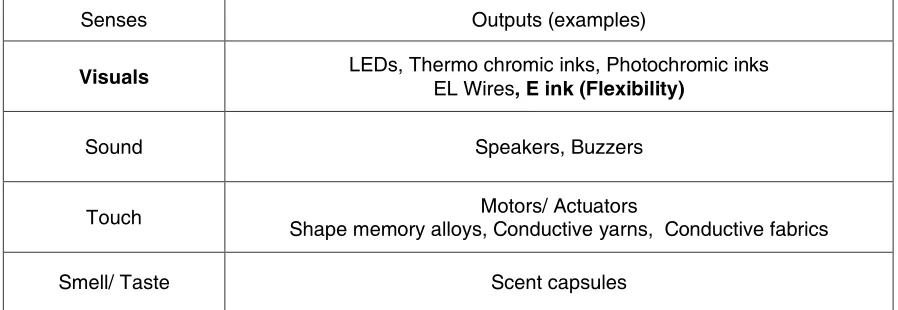
The next table shows outputs based on the five senses. As a result of my research, I decided to focus on
output’s visual aspects such as LED and E ink.
Senses Outputs (examples)
Visuals LEDs, Thermo chromic inks, Photochromic inks EL Wires, E ink (Flexibility)
Sound Speakers, Buzzers
Touch Shape memory alloys, Conductive yarns, Conductive fabrics Motors/ Actuators
[image:15.612.65.514.268.423.2]Smell/ Taste Scent capsules
Table. 2. Considerations 01 – Outputs toward Five Sense
1) Other Considerations – Software, Energy, Materials, and Communication
For designing a fashionable wearable, there are four other considerations: software, energy, materials,
and communication. Every condition systematically works with wearables. For instance, if a designer
makes LED shirts, you need to have a power source to turn on the lights. And when you want to blink
LED for a second, you need to consider software like Arduino. For users of LED shirt, a switch button and
a power button are necessary to communicate between a user and a piece of clothing. Also, a user is
able to use a wireless remote-controller, which is built in with a Bluetooth as a means of communication.
6
14
Lastly, the choice of fabrics or materials is a matter of conveying electricity. The main technical
considerations for the creation of fashionable wearables are:
(1) Software – Arduino, Photoshop, Html Editor, Flash
(2) Energy – Batteries(EP Implantable Battery) Solar Panels
Alternative Energy (Organic Photovoltaic, Carbon Nanotube Springs, Hydrogen Battery)
Human Body Itself (Nano Technology, Human Body Temperature)
(3) Materials – Electronic Textiles
Carbon Nanotubes
Nano Technology (Microfibers)
Live Organisms (Spider Silk, Human Skin Cells, Transgenic Goats)
(4) Communication (for immediate Feedback) - Ubiquitous Computing
UMTS (Universal Mobile Telecommunications System) GPRS (General Packet Radio Service)
GMS (Global System for Mobile Communications) WIFI
Bluetooth IR (Infrared) GPS
Cell Triangulation
PAN (Personal Area Network): Transferring the data using body’s own
electrical conductivity NFC (Near Field Communication)
RFID
Considerations 02 - Other Considerations7
Various Types of Batteries
In order to design activated wearables, we need a power source. Power sources like batteries are
developing rapidly these days. They look thinner and lighter than the things we invented in the past. The
following sentences will show what batteries I can possibly use as a power source for a wearable.
1) Organic Battery
Organic batteries could be lightweight and could be molded into any shape. They have the potential to
store more energy than conventional batteries and could be safer and cheaper to produce.8
7
15
Organic batteries and solar panels are more flexible and thinner than typical types of batteries. I expect
that their innovative characteristics will help designers or technicians to make wearables without heavy
weight and to design interactive clothing.
2) Nanotechnology Battery (Nano Battery)
According to ScienceDaily (Mar.22.2009), Researchers at the Maryland NanoCenter at the University of
Maryland have developed new systems for storing electrical energy derived from alternative sources.
Traditional ways of harvesting energy derived from renewable energy sources are not effective way to get
enough power. However, nanotech batteries’ power is ten times stronger than the current systems for
storing electrical energy from renewable resources.9
This battery is tinier and thinner than a normal battery. More importantly, this battery is a powerful
renewable resource using physical laws of nature by its own structural compositions, identical
nanostructures.
Thin film nanotechnology by Front-Edge Technology shows that it can be used as a power source to turn
on one Led. If we develop a smaller Nano battery with more powerful energy, it might be used for a power
on any sort of displayers including E ink Surf.
3) Human body temperature (Body as a source of energy)
“Vladimir Leonov and Ruud Vullers of the Inter university Microelectronics Centre in Belgium
have built up on past work and devised an ambitious “"energy harvester"”- a device that
essentially turns humans into big walking batteries. The research could lead to iPods and cell
phones that never lose their charge.” 10
8 Lee Clippard, Electron Switch Between Molecules Points Way To New High-Powered Organic Batteries, 2010,
<http://web5.cns.utexas.edu/news/2010/09/electron-switch>
9
ScienceDaily, Nanotech Batteries For A New Energy Future, 2009, <http://www.sciencedaily.com/releases/2009/03/090320173859.htm>
10
Jason Mick, Researchers Move Humans One Step Closer to Being Walking Batteries, 2009
16
Clothes that we wear are one of the closest materials to our skin. When clothing is an energy
harvester itself by human body temperature, there will be a great solution for getting energy to
power wearables.
People consider limited natural resources such as oil. Therefore, many researchers and scientists are
developing power sources using alternative energies, such as human body temperature. However, the
problem is that they are not powerful enough to power products. For this reason, I planned two ways for
getting power. One is to use wireless power transmission at home. Another is to use solar energy for
constant charge of energy outside the home.
Materials
Finding conductive fabric is so important for this project because it can give and take signals from images
or sounds by its conductivity. Currently E ink uses thin and flexible film as a displayer. However, when a
conductive fabric is more developed, the displayer can be replaced from film to fabric and a sheet of
transparent fabric will possibly be used as a displayer. From this point of view, I researched enhanced
fabrics with conductivity such as Carbon Nanotube Super Fabric.
Carbon Nanotube Super Fabric – Conductive fabric
In Jeffery Winters’ 2011 article, “Carbon Nanotube Super Fabric”, the author states that it is soft, strong
(50 times that of carbon steel), and conductive (potentially conducting greater current densities than
copper).
Nanotube super threads as thin as human’s hair could conduct and hold electrical charges. Electronic
devices could be directly incorporated into fabrics made of them.11
11
Jeffery Winters, Carbon Nanotube Super-fabric, 2011,
17
The previous research about materials proves that there is no problem in regard to clothing’s conductivity
in order to make an interactive wearable. I am able to use conductive threads as well as carbon nanotube
super fabric to activate signals on a piece of clothing.
Futuristic Clothing
A piece of clothing with advanced functionality can be a
great example of futuristic fashion. However, a futuristic
garment doesn’t need to be functional. Aesthetically, if
the clothes look brand new through use of unique
materials or original textures, etc., we are able to refer
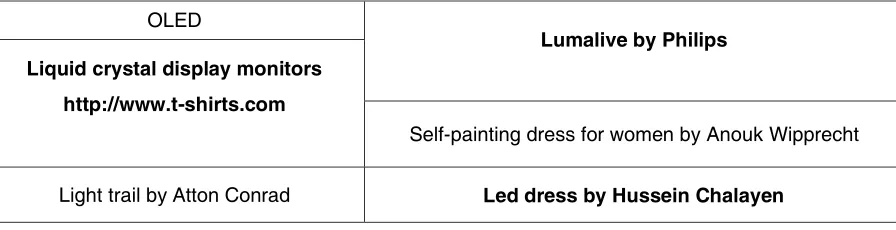
to them as futuristic fashion. The following table is
instances of futuristic fashion and by doing research of
the examples; I was able to find the current flow of futuristic fashion and was inspired to create fresh
concepts by them.
OLED
Lumalive by Philips Liquid crystal display monitors
http://www.t-shirts.com
Self-painting dress for women by Anouk Wipprecht
[image:19.612.84.532.421.536.2]Light trail by Atton Conrad Led dress by Hussein Chalayen
Table.3. Futuristic Clothing
18
03 Design Motivations
1)
Individuality in Fashion
People usually want to express their individuality through clothing but it’s difficult to judge personality just
what someone is wearing. However, the obvious thing is that what we wear is the one of important
standards to know who we are.
Fashion is - An investment of self
An unprecedented aesthetic self-observation
The pleasure of seeing and of being seen
The pleasure of exhibiting oneself to the gaze of others
A vector of Narcissistic individualization
The way of presenting and representing ourselves
This statement shows how fashion has become a medium of self-expression.
“With fashion, human beings begin observing each other endlessly; appreciating each other’s looks,
evaluating nuances of cut, color, and pattern in dress. As an apparatus for generating aesthetic and
social judgment, fashion has favored the critical gaze of the worldly-wise; it has stimulated more or less
agreeable judgments of elegance of others.” 12
For this reason, fashion became a main medium of communication, bringing unique styles to each
individual.
“Yet fashion has not been merely a stage for the appreciation of the spectacle provided by others; it has
also unleashed an investment of self, an unprecedented aesthetic self-observation. Fashion goes hand in
12
19
glove with the pleasure of seeing, but also with the pleasure of being seen, of exhibiting oneself to the
gaze of others…Fashion makes narcissism a constitutive and permanent structure of fashionable
individuals, by encouraging them to pay more attention to the way they present and represent themselves,
by inciting them to seek elegance, grace, and originality. The endless variation of fashion and the code of
elegance invite individuals to study themselves, to adapt novelties for their own use, to concern
themselves with their own dress. Fashion has not only made it possible to display one’s membership in a
given rank, class, or nation, it has also been a vector of narcissistic individualization, an instrument for
enlarging the aesthetic cult of the self, even at heart of an aristocratic age.”13
According to the book, The Empire of Fashion, fashion can be used as a medium in order to express our
individuality. Next study is the elements in fashion that can be helpful to show our personality.
Individuality is one of the important factors in fashion. However, mass-produced clothing does not
containing personality, so some major clothing companies such as Levi Strauss challenge the custom
clothing on/off line. However, custom clothing is limited to a few changes in style. My initial thought was
that technology such as LED or E ink will help to show personality through each wearer’s clothes by using
unique patterns.
(1) Individuality in color
Both colors and accessories are crucial elements of style statement. According to varied colors and
accessories, fashion style can be set up individually by them. Therefore, I researched the effect of both
factors on personality.
“Color is recognized universally as a natural component of beauty…But colors are far more than just
beautiful; they are useful. Color can be used to communicate ideas and emotions, to manipulate
perception, to create focus, to motivate and influence actions” 14
13 Lipovtsky, p.29. 14
20
Nita Leland (Exploring Color, 2000) writes “Trust your intuition, your selection of color is highly personal
as you reveal your individuality through your color choices.” (Leland, 2000)
Each person has a unique taste toward colors. When people match their favored colors on their clothing,
style can be established by oneself.
(2) Individuality in Jewelry
Stacy LoAlbo describes the meaning of layering accessories on our bodies in her book, Vintage Fashion
Accessories:
“We choose not to bow down to convention but to make our own regulations and express our individuality
through the garments and jewels we layer onto our bodies on a daily basis. The clothes we wear express
out statement that says ‘I am unique, with my own set of different rule for styles that I create.’” (LoAblo,
2009, p.10)
“Honoring and enjoying such a piece of jewelry is a way of celebrating your own individuality and value.”15
Creating new styles using accessories enables us to improve our creativity as well as individuality since
designing every style starts from self-awareness. Decorating something onto our bodies means that we
love ourselves and want to show styles to others.
From this point of view, I wonder if we have expressive ways for our own individuality and what design
factors are able to have a positive effect on our personality. At first, by doing research, I realized that
there are lots of style elements to create unique individuality and I chose five elements among them.
Expressive ways of individuality
Based on the research on individuality in fashion, I studied through which fashion elements people can
express their individuality. There are five components to show our personality:
15
21
(1) Hair styleHair color, style, or length makes someone look different.
(2) Make-up
Customizing our own face with make-up encourages people to be distinguishable.
(3) Nail Art and Accessories
Both nail art and accessories harmonizes with each individual’s artistic sense.
(4) Tattoo and Piercing
A tattoo is a very personal thing. It helps to communicate with others by use of symbolic images. Its
meaning is differentiated by each one’s intend and favored taste. People usually get tattoo to show
symbolic words, cultural or artistic preferences, or symbolic images.
(5) Pattern/ Clothing
Patterns on clothes can give visual identity to an individual because most people have different taste
toward colors, symbolic images, and relations between a pattern and clothing. As I recall one girl who
loved teddy bears so much, so she would wear various types of clothing with a teddy bear image. Her
repetitive pattern of behavior gave her the nick-name, “Little teddy bear”. This example shows that a
favorite thing can become an individual visual identity.
Moreover, most designers and companies in the fashion industry increasingly use the pattern as their
brand identity. For example, Roberto Carvalli (Italian fashion designer), Burberry, and Louis Vuitton are
using unique patterns for their distinguishable visual identity.
22
2)
Mass Customization
Mass customization is the next big wave after mass production. These days, custom clothing is one of the
most popular fields in Mass customization. The problem of current clothing is that it is excessively
produced without expressing individuality in clothing. Mass customization of clothing can possibly be the
solution for this issue. Thus, I decided to research mass customization, looking for its innovative ways to
reduce production of clothing and to prolong its life cycle. I researched the examples of mass
customization, regarding from general areas to fashion industry. The next figure displays the process of
mass customization and its types.
Fig.2. Mass Customization injects Buyer Participation into Product Design by Forrester Research.inc
Mass Customization Hardware D I Y
Custom Clothing, Custom Shoes, Headphone,
User Oriented Tuning Cars, Remodeling – Interior. Customization in our life
- Increased value
Software Cloud, i-tunes-Genius, Pinterest, Desktop display
Virtual world – Second life
Fig.3. Flow Chart – The Types of Mass Customization
Each customer’s participation on the process of mass customization shapes new and unique products for
buyers. Particularly, custom clothing is the biggest part of mass customization among many other items
by mass customization. It is rapidly developing. However, most companies which are related to mass
customization were not successful in their business. For example, Levi Strauss wasn’t successful to offer
customized jeans from 1993 to 2003. But today, many major companies such as Kraft, Hallmark, M&Ms,
23
Wrigley and the longest-running success, Nike are enjoying their heydays. I started thinking that
advanced technology will overcome limit of mass customization, especially, the area of custom clothing.
Mass customization is widely used as a medium of interrelation between products and individuals. The
fields of mass customization are varied from a car to a piece of clothing.Specially, more people engage in
custom clothing than other areas. Luxury brands’ offerings online seem to be limited.
Uche Okonkwo, she urges “online customization” in her book Luxury Fashion Branding: Trends, Tactics,
and Technique:
Currently, the online customization offerings of luxury brands are limited, mainly because
the internet and e-business strategy of the luxury fashion sector is still in the introductory
phase. (Okonkwo, 2007, p. 263)
As she writes luxury brands in the fashion industry didn’t offer many options toward mass customization.
However, when it comes to fashion in general like custom clothing, the situation can be reversed.
According to Frank T Filler’s research, fashion items are 43.2% of mass customization.
Fig.4. Which are dominating industries with mass customization offerings16
16
24
An article about mass customization in the NY Times shows that; “mass customization retailors grow
more than ten times as fast as online sales in general.” (Clair Cain Miller, Dec.22.2009). Currently, many
companies such as Zazzle, Blurb, Blue Nile, and Cafepress provide online services for customized
products. These companies are helping people quickly to create one-of-a kind product like clothing, books,
and jewelry.
25
Problems of Current Clothing
(1) Irrational consumption of clothing
People who are sensitive to trends tend to buy more clothing in order to keep up with the latest trends.
This behavior causes not only a waste of energy, but also a waste of time and money since fashion
changes so fast.
Current purchasing habits and tendencies are obsessive as well as unproductive. For example, if we
don’t want to buy more clothing, will we fall behind the trends? According to Teri Agins’ book, The End of
Fashion, “Every few years, when the silhouettes change, women and men have been compelled to go
shopping and to rebuild their wardrobes to stay in style.” (Agins, 1999, p.7)
When fashion goes out of style, people quit wearing it. This
results in wasted clothing, such as with the rise and fall in
skirt lengths for women and for men the widening and
narrowing of trousers and neckties. If we feel our clothing
is an old-fashioned item, what will we do? To that point of
view, it is a waste of clothing and people are often not
willing to buy second-hand clothing.
When we want to buy clothing, we have to spend a lot of time at many stores. The problem is that we
don’t have enough time to do that; therefore, most people might experience disappointment with their
shopping. In order to stop people’s irrational consumption and dissatisfaction, one piece of clothing might
create different looks for users. That’s why customized clothing is reasonable for customers’ contentment.
26
(2)
Waste of natural resources, harm to nature
In order to make myriad items of clothing, we have to use lots of energy causing air pollution and
exhaustion of non-renewable resources.
Furthermore, we lead animals such as wolves, coyotes, foxes, minks, and beavers to be endangered,
when people buy fur clothing. The FFA (Fur Free Alliance) claims that; “Each year fur industry kills over
50 million animals for fashion.” 17
Fashion designer Isaac Mizrahi showed chubby new fake fur jackets (2010). Many famous fashion
models, organizations such as PETA, and other people who are interested in the protection of animals
have joined the campaign of protecting endangered animal like sables. This is because people, especially,
women are eager to buy luxurious items. Why do we have to produce clothing excessively despite these
disadvantages to humans and animals? Excessive consumption of clothing is harmful to human beings
as well as our environment, the earth.
To solve this problem, developing materials or fabrics that are look-alikes for animal furs or skins might
help. For instance, when three dimensional digital images, which seem like fake materials, were
developed, fur clothing could be replaced with them. For saving energy, we may use solar energy or
some renewable resources to generate the visuals onto the garment.
(3)
De-individuation
Historically, clothing has been a protection for the human body from physical conditions and climate, as
well as protection for health. As Francois Boucher describes the functions of clothing in his book, 20,000
years of fashion: the history of costume and personal:
The Greeks and Chinese believed that Man first covered his body for some physical
reason, particularly to protect himself from the elements, while the Bible, ethnologists and
psychologists have invoked psychological reasons: modesty in the case of the ancients,
17
27
and the idea of taboo, magical influence and the desire to please for the moderns.
(Boucher, 1987, p.9~10)
Later, costumes reflected social factors such as religious beliefs, magic, aesthetics, and social status.
Therefore, fashion before the Industrial Revolution served as a traditional function more than a means of
individuality. However, these days, people are looking more for individual unique fashion. For example,
one research shows that college students express more individuality in their fashion choices than other
people.
According to one survey by Lifestyle monitor, “59% of the younger group say they like to get noticed for
their clothes, while only 44% of the older group does, similarly, 79% of the younger respondents feel
better they get a second opinion about their outfit compared to 66% of the older ones.” (Lifestyle monitor,
2010)
Most of the younger generations want to express their individuality to be differentiated from others.
However, mass produced clothes are not responsive enough of a medium to reflect their true character.
Paula Darnell and jewelry designer notes that “we all have fashion personality that guides our sense of
style, classic, trendy, casual, romantic.”18 These are all fashion personality types and she believes that
these kinds affect our life style.
Much clothing is made by mass production. It causes us to lose not only individuality to express our own
ideas or view-points onto our clothing, but also creativity since we merely wear and buy clothing which is
made not for an individual but for the majority of people. These behaviors are not active but passive,
causing us to be a fashion follower like a copycat. Mass produced clothing makes people feel awkward in
expressing their original personality through their clothes.
18
28
School uniforms are an extreme example of this problem. Students would like to be free of rules and
regulations. They want to keep up with fashions and are against school uniforms. Of course, school
uniforms have some benefits, such as instilling students with discipline and helping students concentrate
on their work in school. However, there are many negative effects resulting from dress codes.
Sarabeth Asaff writes,
Some experts believe that public education attempts to strip children of their individuality.
They believe that public education does not meet the needs of children who do not fall in
the norm, and that uniforms attempt to force every student into one mold. They see
standard dress as yet another way for public educators to remove student individuality
where they should be embracing and celebrating diversity.19
Therefore, if students create or design their own clothing, it will help to increase their unique personalities.
So, if images on their uniforms can be changeable or movable, they will use the uniform after school. Like
a cell phone, a uniform can be “turned on or off” by the design just as a cell phone would. My research is
going to find some ways of changing garments visually like Lumalive by Philips; Products include light-
emitting shirts, which integrate LED into the fabric. They have also developed jackets and a couch using
this technology.
Mass- Produced Individuality
Clothing is usually produced by mass production. Therefore, customers find it difficult to discover
uniqueness in mass-produced clothes. The article “The way we live now, Mass-Produced individuality”
criticizes mass production arguing that it results in mass-produced individuality.
Rob Walker expresses mass-produced individuality in his article, “The way we live now, Mass-Produced
Individuality”: “Lately, however, mass production has been cast not so much as the best thing that ever
happened to consumers but as an annoyance, even a problem. It stands in the way of our individuality.”
19
Sarabeth Asaff, Pros and Cons of School Uniforms, 2012,
29
(Walker, 2005, NY Times) And he points out this problem might be solved through more technological
innovation like unique and customized items for each individual.
Mass production isn’t a best solution to build our individuality
Solution – Technical Innovation (Tweak mass production – Sneakers to M&Ms)
One-to-one future
Mass Customization
Make your own stuff
Customized unique items – individuality on a mass scale
Rob Walker, The way we live now, Mass-produced individuality, Dec. 11. 2005 / NY Times
Fig.5. Mass-produced Individuality and the Solutions
(4)
Fewer responses between people and clothing
There are fewer responses between clothing and wearers. When we wear clothing, there are always
several reasons. One of the important reasons is to interact with others. In a word, some people who are
especially sensitive to follow trends like women in their 20s want to show their clothing to others in order
to show their individuality.
However, current clothing has some limitations of response between an owner and others. For instance,
once a person wears clothing, there are fewer ways of showing his or her individuality to others because
one piece of clothing has just a few looks. In order for clothing to be communicative with others all the
time, the design must be changed by users.
Clothing is hard to customize anytime and anywhere
Easy to customize Hard to customize
anytime and anywhere: Expressive way of individuality anytime and anywhere (Problem)
Hair, Make-up, Accessories Clothing/ Pattern, Tattoo/ Piercing
Fig.6. The Problem of Normal Clothing’s prompt Customization
Personally, when users create their own clothing like customized clothing, it will be one kind of interaction
30
creators of clothing. Customizable clothing enables us to feel more affection toward our own customized
clothing.
So I decided to research customized clothing and found there are some customizable services online
such as those offered by Nike, Gap, M&M, and Reebok. Contemporary businesses have begun realizing
that they have to be more user-oriented. Also, startups and major retailers are utilizing the web to create
unique products in all sorts of categories. So, we don’t even have to buy in bulk as in the past.
For example, as David Hogue notes,
We can design our own Nike’s, put our initials on M&M’s, and even design our own
Kleenex boxes. So, we can design our own product to represent our personalities.
Customization of products is on a new way of giving customers exactly what they want.
Soon, we will be able to customize shoes, clothing, etc. on the website without paying
premium prices for the privilege. These things can be active interaction between clothes
and users because the process of customized clothing reflects a person’s own thought.
However, problems of current customized clothing are that it creates more choice to get
clothing that they want, possibly too much choice, for the customer and it takes time to
receive the finished product 20
In addition, nowadays customization of clothing won’t stop producing much clothing even though custom
clothing is a unique feature that can give someone a versatile look.
(5)
The Problem of Mass Customization
Lastly, mass customization is not for both everybody and an individual. It has its own limits, even though
custom clothing makes its own way according to users’ wants. People’s preferences towards custom
items differ sharply. However, customized products are still adopting traditional way of mass production
with few changes. There are several problems with mass customization.
20
David Hogue, The Future of Online Experience #2: Custom Products, 2008,
31
First, the cost of customizable products is intrinsically more expensive than mass-produced products. For
example, the price of a single custom t-shirts’ starts at $14.95 but when a user adds an image, a text, or
both, the cost will increase to a minimum price of $20.95. Furthermore, technological difficulties in regard
to providing goods at reasonable prices cause slow delivery times and additional costs. Different price
policies among many companies make users confused about choosing the right items at a reasonable
cost. Also, when compared to individual customization like craftsman, mass customization is finite yet
offers a variety of choices.
Mass Mass Customization Craftsman
Production
Limited choices Unlimited choices
Finite yet variety of choices
(Arun N Nambiar, Mass Customization; Where do we go from here?, 2009)
Fig.7. Comparison of product variety
The above figure shows that craftsman offers limitless selections in comparison to product strategies,
mass customization and mass production. But it will have its own problems moving into the future. For
instance, it will be hard to provide a large quantity of products in a short time. It means that craftsman is
not cost-effective for production. However, technological innovation might be a good solution for the next
step of craftsman. From this point of view, this thesis is mainly focused on individual customization, which
means providing versatile options for each user to change user-oriented styles with a piece of clothing.
The purpose of the next step in this thesis is to locate impending problems of mass customization in detail.
“Mass-customization systems have three key capabilities: elicitation (a mechanism for interacting with the
customer and obtaining specific information); process flexibility (production technology that fabricates the
product according to the information); and logistics (subsequent processing stages and distribution that
Those-32
elements are connected by powerful communications links and thereby integrated into a seamless
whole.”21
Elicitation
- Hard – Customers’ uncertain decision
Troubles in communication
Too many selections for customers
Mass Customization Process Flexibility
- Time consuming process – Consumer’s laborious searching
- Limited options to select right products
- The cost of a product is still more expansive than mass-produced items
Logistics – Delay of delivery time, intangibility
Solution) Small scale crafts – Promises exciting products for customers
New opportunities for businesses
Fig.8. The limits of Mass Customization (Resource: MIT Sloan Management Review 2005)
Even though mass customization is strongly connected to three capabilities there are still problems to
solve. For example, elicitation (one of mass customization’s three key capabilities) is not easy for retailers.
Customers often have trouble deciding what they want and then communicating or acting on their
decisions. Also, buyers are easily overwhelmed by too many selections on a store shelf or a web page.
For process flexibility, retailers should reduce the cost associated with a consumer’s laborious searching
and they should treat a variety of different tastes toward products, and not limit options for users. Lastly,
21
33
when it comes to on-line services for custom products, customers have a difficult time selecting the right
products due to the intangibility of the medium.
The solution toward problems of mass customization might be small-scale crafts since they promise
exciting products for customers and offer new opportunities for businesses. What if a piece of custom
clothing gives users tangible experience in the ability to change their styles? This should be possible
through technological innovations like E ink or we might find fine solutions through customization of
products in analogue mediums. Below is a discussion of the challenges of mass customization and the
reasons why both buyers and companies are skeptical about mass customization.
External Complexity & Internal Complexity
Both Thorsten Blecker and Nizar Abdelkafi describe two main challenges of mass customization in their
article, “Mass Customization: State-of-the-Art and Challenges”:
…Many customers are still reluctant to buy customized products and companies are also
skeptical about the feasibility of the strategy in practice. The difficulties in implementing a
successful mass customization are mainly due to two main problems, which we call them
external and internal complexity. External complexity refers to the uncertainty
encountered by customers when they intend to customize their products. On the other
hand, internal complexity is experienced inside the company’s operations. It refers to the
problems faced by the company because of the extensive product variety induced in
34
The following figure shows the causes of two terms, external and internal complexity.
The Causes of External and Internal Complexity
1) External Complexity – (1) The limited information processing capacity of humans (2) Lack of consumer knowledge about the product (3) Customer ignorance about his/her real individual needs
2) Internal Complexity – proliferation of product variety
Difficult to operate increasing cost
Blowing down the velocity of the supply chain
(Resource – Mass Customization – State-of-Art and challenges by Thorsten Blecker & Nizar Abdekafi)
Fig.9. The Causes of External and Internal Complexity
External complexity happens through various customers’ reactions to customized products. Specifically,
standardizing user-oriented customization is difficult because there are many different individuals who are
looking for unique items. In addition, shoppers’ unintentional purchasing behavior causes external
complexity. In terms of internal complexity in mass customization, merchandisers have a hard time
offering reasonable prices for customers because delivery costs and installing various options require
extra money from buyers as an alternative to mass production. For these reasons, I conducted an
experience with custom clothing through usability testing on the Zazzle website in order to understand the
problems.
The Problem of Online Customization – Usability Testing on Zazzle website.
Process (The order of making custom t-shirts on Zazzle)
1) Select a specific item
2) Select gender and age
35
4) Put a picture on t-shirts and add some texts5) Select specific size and quantity 6) Make it now
Fig.10. Usability Testing of Custom T-shirts
From the usability testing on Zazzle website, I found two problems. One is that it is too difficult to control
relocating an image and a text on t-shirts. Another is that custom t-shirts’ price is still more expensive than
printed t-shirts.
Based on five challenges—irrational consumption, waste of natural resources, de-individuation, fewer
responses between people and clothing, and the problem of mass customization—I planned to develop
ideas and concepts to solve them. Most importantly, providing user experience for wearers is the focus of
my idea development since user satisfaction through voluntary activities through creating their own styles
can be the start of individual customization as an advanced mass customization. Also, the activities can
possibly help users express their individuality onto the clothing, increasing responses between people
and clothing. In regard to the problem of the waste of natural resources and irrational consumption, if
wearers like the interactive clothing, they will wear it often. Thus, the result is helpful to customers who
can then invest in fewer clothes and that behavior might affect the production rates of clothing, and
36
05. Idea Development
After doing research on current clothing’s problems, I strongly feel that we have to develop enhanced
clothing for the new generation. Clothes are not only a kind of fashion but also an important medium to
connect a wearer to another person since we wear clothes every day and go everywhere wearing them.
In addition, clothing has actually been the best portable device for carrying various tools.
The purpose of this process is to find the best way of changing styles through a piece of clothing. From
various experiments, I hope to get a solid solution to solve the problems mentioned earlier.
The idea development will be focused not on normal clothes but on customizable clothing, which is a
helpful to human beings’. And I hope that it can give immense pleasure to our lives. The clothing must
function as both a fashionable wear and a functional garment in order to change from just one look to
various styles.
According to the problems that I noted previously, irrational consumption of clothing is caused by negative
feelings toward old-fashioned clothing. This fact leads people to buy clothing frequently. Also, mass
production, which uses many natural resources, is related to this kind of consumer’ behavior. In addition,
a garment from mass production isn’t helpful to people to express their individuality since there are many
similar clothes. Current clothing is merely considered aspects of visuals and materials when they are
produced, so they don’t offer any more than such things as the sense of sight and a tactile sense. If a
new and smart piece of clothing can be changed every day by users and it offers new senses, consumers
may feel more interest in the clothing. Furthermore, with consumers wearing the clothes continuously, we
will be able to solve the aforementioned problems.
For these reasons, I decided to design customizable clothing in both ways: analogue and digital. Custom
clothing is a reasonable option to achieving customers’ satisfaction and for rational consumption because
consumers can make sure of their satisfaction through the process of customizing clothes. Also, in order
37
1)
Change the look in an analogue way
The Purpose of Design – 1. Changing the look of clothes easily
2. Use of fashion pieces of fabric
My goal is to develop a better garment that can be pleasurable, leading to continuous interaction between
clothing and wearers as current clothing doesn’t offer more than one look. A piece of clothing with various
looks makes people feel like they are wearing something new every day.
There are several ways to change the look of typical clothes in order to show individuality. People can
change their clothing by attaching and detaching cultural patterns, signs, symbols, etc., on their garment.
This allows people to show their distinctive personality by using their design sense. There are a number
of traditional ways of changing styles such as piercing, tattoo, make up, accessories, hair colors, unique
fabrics, materials, texture, initial marks, shoes, glasses, socks, stockings, and the gorgeous body itself.
When merely concerned with the alteration of clothing itself, a first thing comes to my mind is Velcro since
it is easily attachable as well as detachable. This means that Velcro allows people to decorate or to
express their own style very naturally. Other ways of changing styles are the use of a fabric net, a snap
button, natural light and shadow, and varied textured fabrics.
38
Here are my experiments to show changes of the look in analogue ways:
(1) Velcro
My initial idea is using Velcro inspired by American patchwork and quilting. By attaching and detaching
different colors, and patterns, and the textured loop side of Velcro on a hook side, with: a piece of plain
clothing as a base, people are able to make various styles.
However, the problem is the surface of Velcro can get dirty easily through contact with foreign substances.
Also, Velcro isn’t a long-lasting material. In addition, when people want to use an extra piece of Velcro to
make a certain look, additional costs are incurred.
Velcro - Idea Development and Experiment
(2) Fabric net
The biggest benefit of fabric net is that it is porous like fabric mesh and has many holes that help the air
pass through. For this reason, fabric net is usually used for summer clothes. The size of a hole can be
39
create clothing like scarves with it. In particular, fabric net has been used for traditional clothing such as
the sari in India due to the dry and hot weather conditions.
Fabric net reminds me of knit work. The only difference between fabric net and knit work is merely the
need for hands without a hooked needle. A wearer is able to make diverse styles by putting a different
colored or textured thread into the hole of a net or by hanging different elements from it like jewelry. It
also helps to make unique patterns on the net. However, in order to express their distinctive style, a user
should continuously buy different types of materials such as accessories and threads.
Images on a next page are one of my Idea developments, Fabric net.
40
Fabric net – Execution(3) Snap Buttons
Personally, this concept is the most interesting one during the stage of idea development. To make this
real, I spent a lot of time to complete the project since it required fastening a lot of buttons on a plain
white t-shirts. The initial idea came from LEGO blocks. These are a very well made customizable product.
Assembling pieces has a positive potential to develop concepts because the functionality and even the
look can be radically changed by each unit. For instance, if one piece is a small wireless speaker, it will
have a specialized function to deliver the sound and the style can be altered by diverse shapes, colors, or
41
Snap Button – Research and Ideation
42
(4) Light and Shadow
Images of shadows can be dramatically utilized in dark spaces but the shadow effect is strongly
influenced by a given environment. Below are my experiments using shadow effects on a piece of
clothing.
43
Light and Shadow – Execution
(5) Surface
This experiment started from the following question: Can people feel different textures on a piece of
clothing? The purpose of design is layering different textures by a wearer as custom clothing. Most recent
clothing styles merely offer one or two textures. Using many textures is not necessary for the beauty of
clothing itself. However, by providing a textual user experience, a normal piece of wear is able to become
a responsive garment. The experiment was initiated from twining different textured and colored thread on
the very basic form of a dress that I designed. In the result, I appreciated that I was able to feel different
textures on the garment with my hands. It makes me feel like it is a totally different item of clothing from
44
Surface - Multi-layered Textures
As I studied the change of look in an analogue way, I had so many ideas, questions and imaginations. I
wanted to share them with people. But yet, creative solutions were not coming out. My several
experiments were temporary solutions, not innovative and long-lasting ones. The reason why these ideas
are still yet too far from a final solution is that they were time consuming, not cost effective, and not very
attractive visually. For these reasons, my journey to find new solutions will go to the next level: find an
45
2)
Change the look in a digital way
The objective of Design – Reduced time of changing looks
Changing styles anytime and anywhere
Enhanced mass customization: Individual Customization
What I found most fascinating with ideations is customizable clothing, yet it needs to solve the problems
that analogue solutions had: they are time consuming and require laborious work. Also, they have limits
for changing styles anytime and anywhere, and they are more money-intensive solutions. The activities of
transforming styles will be very distracting for some users due to these reasons, while using technologies
in order to design responsible and customizable wear automatically is to solve the problems that I
mentioned. At first, I had to think what technologies are mostly matched with customizable clothes.
(1) Collectibles ( A fabric album cover is connected to conductive yarns)
There is no doubt why music is so popular among all generations. Yet, current music industry is losing a
lot of profits due to illegal downloading. Also, cell phones now include many functions including a camera,
an mp3 player, etc. It has become consumers’ most favorite portable device. Contrary to the trends,
consumers who purchase a vinyl album by a musician must appreciate the tangible and believe that the
value of music is more than the sound. Many people also consider album jackets as valuable collectibles
just as they do the LPs themselves. Currently, the young seem to be very interested in communicating
with other people about their musical tastes or personal opinions in regard to music videos on websites
like You Tube and Facebook. Furthermore, the visible value in music is simil