City, University of London Institutional Repository
Citation
:
By, R.T., Oswick, C. and Burnes, B. (2014). Looking Back and Looking Forward: Some Reflections on Journal Developments and Trends in Organizational ChangeDiscourse. Journal of Change Management, 14(1), pp. 1-7. doi: 10.1080/14697017.2014.886871
This is the accepted version of the paper.
This version of the publication may differ from the final published
version.
Permanent repository link:
http://openaccess.city.ac.uk/8361/Link to published version
:
http://dx.doi.org/10.1080/14697017.2014.886871Copyright and reuse:
City Research Online aims to make research
outputs of City, University of London available to a wider audience.
Copyright and Moral Rights remain with the author(s) and/or copyright
holders. URLs from City Research Online may be freely distributed and
linked to.
City Research Online: http://openaccess.city.ac.uk/ [email protected]
Looking Back and Looking Forwards: Some Reflections on Journal
Developments and Trends in Organizational Change Discourse
Rune Todnem By*, Cliff Oswick** & Bernard Burnes***
*Staffordshire University Business School, UK; **Cass Business School, City University London, UK, ***Stirling Management School, University of Stirling, UK;
One small step for you, a giant step for Journal of Change Management
On behalf of the Editorial Board, we wish to thank you all for your invaluable and continuous support of Routledge’s Journal of Change Management (JCM) – YOUR journal. In this annual editorial piece we wish to do two things. First, we want to reflect upon the progress made by Journal of Change Management (JCM) in working towards becoming a world leading academic journal. Second, we would like to explore some macro-level trends in the discourse on organizational change.
As caretakers of JCM the Editorial Board has a great responsibility and a great opportunity to make difference. A difference to the development of the multitude of disciplines aligned to organizational change, and a difference to those studying and working within these fields. Operating within an academic reality where rankings and impact factors are increasingly playing a crucial role in not only the perception of schools and institutions but also to the careers of individual academic s, we have identified JCM’s inclusion in Thomson Reuters’ Social Sciences Citation Index (SSCI) and an improved position in the Association of Business School’s (ABS) 2014 ‘Guide to Academic Journal Quality’ as essential to our further
development and future success. In order to succeed with our strategy we need each and every one of you to access, read and refer to the work published by JCM in preparation of your own article submissions to journals already included in the SSCI. As Neil Armstrong would have put it if he had been an Editorial Board member: That’s one small step for you, a giant step for Journal of Change Management and all disciplines aligned to organizational change.
Together with Routledge we are now making our case for inclusion in Thomson Reuters’ SSCI. When successful we will be provided with a future Impact Factor allowing us to participate – and even compete if you like - on a level playing field with more established journals. We are also eagerly anticipating a new version of the Association of Business Schools’ (ABS) International Guide to Academic Journal Quality (The Guide) where we hope to have improved our position further.
Speaker Award in Philadelphia, and Editorial Board members and colleagues are involved in the chairing of EGOS sub-themes in Rotterdam. Don’t be shy - come and say hi!
Another exciting development over the last years has been the great success of our Reflections series. In order to celebrate this success, Routledge is providing free access to the Reflections contributions for a limited time (http://bit.ly/jcm-reflections) and we have made the series the focus of this year’s JCM postcard. 2013 saw the addition of Oswick’s contribution ‘Reflections: OD or Not OD that is the Question! A Constructivist’s Thoughts on the Changing Nature of Change’ and we can promise further exciting contributions in 2014 (some already available online).
Trends in Organizational Change
This editorial piece provides an opportunity to offer some reflections on developments within the field of organizational change as a broadly defined area of inquiry. The intention is build upon some the tentative assertions we offered in an earlier editorial commentary (By, Burnes and Oswick, 2011). To this end, we have explored meta-level trends using the “Google Ngram Viewer”1 (Michel et al, 2011). The Ngram Viewer is an application which
enables phrase-usage to be charted according to the yearly count of words or phrases appearing within a large corpus of texts. The word-search database consists of 5.2 million books digitized by Google Inc. The database covers books published between 1500 and 2008 and is estimated to contain 500 billion words. Selected words or phrases are plotted on a graph if a match is found in 40 or more books in any given year and the aggregated citation level is expressed as a percentage of the total database.
We have decided to use Ngrams rather than the generally more popular Google Scholar. The primary reason for this is to do with scope and coverage. Google Scholar searches records for any instance where a specific term is mentioned in the title, abstract, keywords or the publication title, and counts this as one citation. Ngrams provide a search of all content (i.e. the whole text) and aggregates the total number of citations in each text (rather than counting the whole publication as one citation). This key difference is important insofar as Ngrams offer insights into general trends of popularity (i.e. as a multiple count common usage measure) while Google Scholar offers more focused insights (i.e. as a single count academic measure). Hence, we believe that Ngrams have more purchase in capturing wider discursive trends in organizational change.
In order to meaningfully compare concepts, we have concentrated on producing ngrams for four change-oriented constructs, namely: organizational change, organization development, planned organizational change, and change management. For our purposes, we have limited our analysis to plotting trends over the past five decades (i.e. between 1960 and 2008). This period has been specified because citation levels were extremely low, and in some instances non-existent, prior to 1960. We should also mention that our approach to plotting trends is that in keeping with the general convention for the use of ngrams
inasmuch as we have used the standard smoothing factor of 3 in all graphs. In the following subsections we consider the four chosen change constructs individually and we then
consider them on a combined basis.
Organizational Change
[image:4.595.80.523.259.414.2]‘Organizational change’ remains an enduring and generic term for all forms of change-related activity in organizations. As such, it is the most heavily used phrase of the four investigated. It has also steadily grown in popularity over the past five decades (see figure 1). It is perhaps not entirely surprising that organizational change has remained central to the discourse of change in organizational settings. In effect, any prevailing or new change concepts or approaches are incorporated and presented in relation to, or embedded within, organizational change. Hence, the overall word counts increases and we might expect the current pattern of citation to continue for this umbrella term going forwards.
Figure 1 – Citation of “Organizational Change”
Organization Development
The pattern of usage for ‘organization development’ (OD) is more complex than for
‘organizational change’ (see figure 2). The use of the term OD increased during the 1960’s and 1970’s through to a peak in 1980, followed by a gradual decline through to 1990, and then a levelling out through to 2008. In essence, OD enjoyed a significant period of popularity between 1970 and 1990.
[image:4.595.81.524.613.769.2]We would contend that the initial growth of interest in OD was largely triggered by the publication of seminal contributions to the field (e.g. Beckhard, 1969; Bennis, 1969; Lawrence and Lorsch, 1969) and interest was subsequently further fuelled by the
publication of key textbooks (e.g. French and Bell, 1972). Arguably, interest waned because the core principles of OD processes around discrete, punctuated change based upon
diagnosis and intervention became less popular than some of the emerging alternatives (Bushe and Marshak, 2009; Marshak and Grant, 2008; Oswick et al, 2005). In particular, ‘Appreciative Inquiry’ (Cooperrider and Srivastva, 1987) proposed a radical alternative to the traditional problem-centred approach of OD and, in doing, so had a significant impact upon the demise of OD. Overall, the citation pattern found in figure 2 reflects the fundamental difference between ‘organizational change’ as a generic term and ‘OD’ as specific form of change activity.
Planned Organizational Change
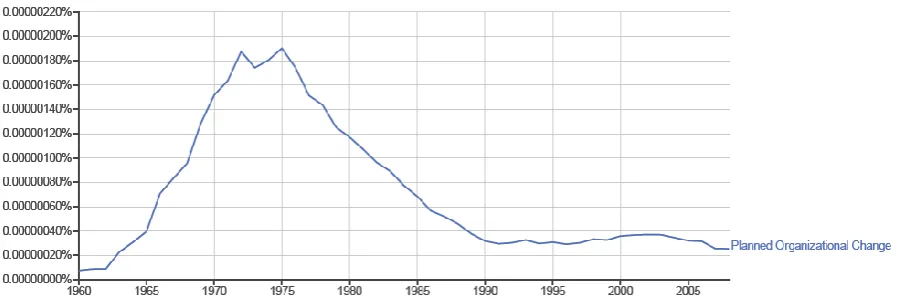
[image:5.595.77.526.490.644.2]The pattern of citation for planned organizational change is very similar to that observed for OD (see figure 3). There is a steady take up of the notion of planned organizational change which through peaks in the mid-70’s, followed by steady decline to 1990, and then a sustained level of residual citation through to 2008. Given that planned organizational change is often seen as a synonym for OD (or a subset of OD), it is not entirely surprising that it has a similar chronology of usage. Moreover, it does further reinforce the assertion that more structured and discrete forms of change activity have been superseded by more emergent change approaches (Oswick, 2009; Oswick and Marshak, 2012; By, 2005).
Figure 3 – Citation of “Planned Organizational Change”
Change Management
orientations of OD (as a discrete and bounded process) and change management (as an emergent and ongoing process of change) (Oswick and Marshak, 2012).
Figure 4 – Citation of “Change Management”
Change Approaches Compared
The discussion above has focused on the relative patterns exhibited by different approaches to change. Notwithstanding the importance of the general trends, it is also informative to also simultaneously consider the respective trajectories of, and general magnitude of interest in, the four forms of change activity (see figure 5). There are several notable features of figure 5. First, planned organizational change is by some way a far less popular term than the others plotted. This adds further support to the earlier assertion that it is generally perceived to be a subset of, or less popular synonym for, OD.
Figure 5 – Comparison of the Citation Levels for Different Change Approaches
[image:6.595.80.517.509.664.2]Third, the contrasting fortunes of OD and change management mentioned earlier are even more evident when the co-plotted (see figure 5). Moreover, it would appear that the popularity of these two change variants are closely aligned insofar as change management starts to gain momentum at exactly the point that OD begins to decline (i.e. circa 1990) and their respect patterns from that point onwards are more or less the inverse of each other in terms of growth and decline. Indeed, this citation profile resonates with the pattern found within the literature on management fads and fashions (Abrahamson, 1991; Abrahamson, 1996; Abrahamson and Eisenman, 2008; Abrahamson and Fairchild, 1999; Kieser, 1997). Kieser (1997) asserts that:
“Management fashions follow patterns which can be described by bell-shaped curves. At the start of a fashion, only a few pioneers are daring enough to take it up. These few are joined by a rising number of imitators, until this fashion is ‘out’ and new fashions come on the market” (Kieser 1997, p. 51).
The word usage patterns for both OD and planned organizational change exhibit the same bell-shaped curve associated with management fashions (see figures 2 and 3). In addition, Abrahamson and Eisenman posit that: “Lexical shifts over time serve to differentiate a fashion from its predecessor, creating a sense of novelty and progress from the earlier to the later fashions” (2008: 719). Arguably, change management has emerged as a new and novel alternative to OD.
Finally, there appears to be a modest resurgence of interest in OD form the 2000’s onwards. This perhaps coincides with a re-articulation and re-positioning of the discourse of OD in terms of the development of a new form of OD (see for example: Bushe and Marshak, 2009; Marshak, 2009; Mirvis, 2006; Woodman, 2008). This trend is most apparent in Bushe and Marshak’s (2009) delineation of ‘old diagnostic OD’ and ‘new dialogic OD’. Although the reinvention of OD may have induced a slight upswing in the citation of OD, this move is nevertheless consistent with the attributes associated with management fashions (i.e. promoting a ‘new OD fashion’ and downplaying an ‘old unfashionable OD’).
Conclusion
The discussion provided in this editorial is not intended to offer definitive insights into the changing nature of organizational change. Rather it should be viewed as a starting point for a wider conversation. In this regard, it might hopefully raise further issues and further questions.
References
Abrahamson, E. (1991) Managerial fads and fashions: The diffusion and rejection of innovations, Academy of Management Review, 16, pp. 596-612.
Abrahamson, E. and M. Eisenman (2008) Employee management techniques: Transient fads or trending fashions?, Administrative Science Quarterly, 53, pp. 719-744.
Abrahamson, E. and G. Fairchild (1999) Management fashion: Lifecycles, triggers, and collective learning, Administrative Science Quarterly, 44, pp.708-740.
Beckhard, R. (1969) Organization Development: Strategies and Models (Reading, MA: Addison-Wesley).
Bennis, W. G. (1969) Organization Development: Its Nature Origins and Prospects (Reading, MA: Addison-Wesley).
Bushe, G. R. and Marshak, R. J. (2009) Revisioning organization development: Diagnostic and dialogic premises and patterns of practice, Journal of Applied Behavioral Science, 45(3), pp. 348-368.
By, R. T. (2005) Organizational change management: A critical review, Journal of Change Management, 5(4), pp. 369-380.
By, R. T., Burnes, B. and Oswick, C. (2011) Change management: The road ahead, Journal of Change Management, 11(1), pp. 1-6.
Cooperrider, D. L. and Srivastva, S. (1987) Appreciative inquiry in organizational life, in: R. W. Woodman and W. A. Pasmore (eds), Research In Organizational Change And Development, Vol. 1, pp. 129-166 (Stamford, CT: JAI Press).
French, W. L. and Bell, C. H. (1972) Organization Development: Behavioral Science Interventions for Organizational Improvement (Englewood Cliffs, NJ: Prentice-Hall).
Kieser, A. (1997) Rhetoric and myth in management fashion, Organization, 4, pp. 49-74.
Lawrence, P. R. and Lorsch, J. W. (1969) Developing Organizations: Diagnosis and Action (Reading, MA: Addison-Wesley).
Marshak, R. J. (2009) Organizational Change: Views from the Edge (Bethel, ME: The Lewin Center).
Marshak, R. J. and Grant, D. (2008) Organizational discourse and new organization development practices, British Journal of Management, 19, pp. S7-S19.
Michel, J. B., Shen, Y. K., Aiden, A. P., Veres, A., Gray, M. K., The Google Books Team, Pickett, J. P., Hoiberg, D., Clancy, D., Norvig, P., Orwant, J., Pinker, S., Nowak, M. A. and Aiden, E. L. (2011) Quantitative analysis of culture using millions of digitized books, Nature, 331, pp. 176-182.
Oswick, C. (2009) Revisioning or re-versioning? A commentary on diagnostic and dialogic forms of organization development, Journal of Applied Behavioral Science, 45(3), pp. 369-374.
Oswick, C., Grant, D., Michelson, G. and Wailes, N. (2005) Looking forwards: Discursive directions in organizational change, Journal of Organizational Change Management, 18(4), pp. 383-390.
Oswick, C. and Marshak, R. J. (2012) Images of organization development: The role of metaphor in processes of change, in: D. M. Boje, B. Burnes and J. Hassard (eds), The Routledge Companion to Organizational Change, pp. 104-114 (Oxford: Routledge).