City, University of London Institutional Repository
Citation
:
D'Amato, V., Haberman, S., Piscopo, G., Russolillo, M. and Trapani, L. (2016).Multiple mortality modeling in Poisson Lee-Carter framework. Communications in Statistics - Theory and Methods, 45(6), pp. 1723-1732. doi: 10.1080/03610926.2014.960580
This is the accepted version of the paper.
This version of the publication may differ from the final published
version.
Permanent repository link:
http://openaccess.city.ac.uk/13966/Link to published version
:
http://dx.doi.org/10.1080/03610926.2014.960580Copyright and reuse:
City Research Online aims to make research
outputs of City, University of London available to a wider audience.
Copyright and Moral Rights remain with the author(s) and/or copyright
holders. URLs from City Research Online may be freely distributed and
linked to.
City Research Online: http://openaccess.city.ac.uk/ [email protected]
ACCEPTED MANUSCRIPT
Multiple Mortality Modeling in Poisson Lee Carter framework
Valeria D'Amato1, Steven Haberman2,Gabriella Piscopo3, Maria Russolillo1 and
Lorenzo Trapani2
1
Department of Economics and Statistics, University of Salerno, via Ponte Don Melillo, Campus
Universitario, 84084 Fisciano (Salerno), Italy
e-mail: [email protected], [email protected]
2
Faculty of Actuarial Science and Insurance, Cass Business School, City University, Bunhill
Row London, UK, e-mail: [email protected]
3
Department of Economics, University of Genoa, Via Vivaldi, 16126 Genoa, Italy - e-mail:
Abstract
The academic literature in longevity field has recently focused on models for detecting multiple
population trends (D'Amato et al. 2012b, Nijenga et al. 2011, Russolillo et a. 2011, etc.). In
particular increasing interest has been shown about “related” population dynamics or “parent”
populations characterized by similar socio-economic conditions and eventually also by
geographical proximity. These studies suggest dependence across multiple populations and
common long run relationships between countries (for instance see Lazar et al. 2009). In order to
investigate cross-country longevity common trends, we adopt a multiple population approach.
ACCEPTED MANUSCRIPT
The algorithm we propose retains the parametric structure of the Lee Carter model, extending the
basic framework to include some cross dependence in the error term. As far as time dependence
is concerned, we allow for all idiosyncratic components (both in the common stochastic trend
and in the error term) to follow a linear process, thus considering a highly flexible specification
for the serial dependence structure of our data. We also relax the assumption of normality, which
is typical of early studies on mortality (Lee and Carter, 1992) and on factor models (see e.g. the
textbook by Anderson, 1984). The empirical results show that the Multiple Lee Carter Approach
works well in presence of dependence.
Keywords
Serial and Cross-sectional Correlation, Factor Models, Vector Auto-Regression, Sieve Bootstrap,
Lee Carter model
ACCEPTED MANUSCRIPT
1Introduction
The whole financial system is dramatically threatened by the systematic improvements in
longevity phenomenon, especially regarding the welfare and public pensions. The empirical
evidence shows the presence of common factors that would affect survival rates across multiple
populations in a similar way. The reason behind is that populations of the world are becoming
more closely linked by communication, transportation, trade, technology, and disease.
Modeling mortality co-movements for multiple populations would have significant implications
for longevity risk management.
In a multi-population mortality model, the analysis is focused on more than one population by
taking into account a joint framework. The main idea behind these models lies on the
convergence indefinitely over time observed between populations having similar socioeconomic
features. The development of multiple setting is related to the several applications. First of all,
securitization of longevity risk, i.e. the transfer of longevity risk in the capital markets, which
typically occurs through the creation of derivatives or securities whose cash flows are linked to
the survival of a reference population, a more effective risk management can be obtained
throughout the study of the mortality correlations between populations. The relationship between
populations is involved in the estimation of the actual basis risk which arises from the difference
in mortality improvements between the insured population and the population to which the
standardized longevity hedging instruments are linked. Hedging instruments have been
developed in order to help pension funds to protect themselves against longevity risk, in
particular by reinsurance and longevity derivatives.
ACCEPTED MANUSCRIPT
Secondly the multiple population mortality model allows for enhancing the estimate reliability
by modeling the smaller population jointly with a larger population (Li et al. 2010).
Furthermore the multiple approach can also be used for enforcing greater consistency of the sex
differentials when an analysis on both genders has to be performed.
Recently, significant developments in multi-population modeling have been recorded.
The seminal interest in studying cross-country longevity common trends focused on modeling
the interdependence of the mortality rates of two populations. Li and Lee (2005) developed an
augmented common factor model for modeling convergent mortality dynamics. Li et al. (2011)
propose a model that measures the population basis risk involved in a longevity hedge. Cairns et
al. (2011) represents the short trends by using a mean-reverting spread, where the long-run
improvements are parallel according to biological principle. Jarner et al. 2011 develop a similar
two-step approach modeling the mortality of larger reference population and the mortality spread
between the two populations. The current studies investigate on long-run equilibrium
relationships across countries, by considering the more than two populations in the mortality
framework, for capturing valuable information about the factors driving changes in mortality
(Njienga et al., 2011; Russolillo et al., 2011). Other authors model mortality dependence
(structure) across countries using a dynamic copula approach (Yang et al. 2013). In particular,
they employ time-varying copula introducing mortality dependence and demonstrate symmetric
dependence. In the same context MacMinn et al. 2013 are the first to apply the factor copula
model to mortality fitting for multiple populations. They focus on the residual risk (tail
dependence) by setting out an efficient approach for high dimensional data. Kleinow (2013)
ACCEPTED MANUSCRIPT
shows that the period effects of different populations in a CAE model are better comparable with
each other since the impact of different age effects is eliminated. This aspect can be relevant in
effectiveness of hedge positions.
In order to study cross-country longevity common trends, it is essential to consider tools to
quantify, compare and model the strength of dependence. Therefore it is necessary to take into
account either the dependence for adjacent age groups, or the dependence structure across time
in a single population setting: a sort of intra-dependence structure (D'Amato et al. 2012b). At the
same time, it is important to consider the dependence across multiple populations, what we call
inter-dependence, for capturing common long run relationships between countries.
In a previous contribution (D'Amato et al. 2013), we kept into account the issue of
cross-sectional and time dependence, by proposing an algorithm based on the Lee Carter framework
(1992), but relaxing the assumption of normality, which is typical of early studies on mortality
(Lee and Carter, 1992) and on factor models (see e.g. the textbook by Anderson, 1984). In this
article, we extend that formulation by taking into consideration a different fitting model for
mortality data, the Poisson log-bilinear mortality model, which allows to overcome the problems
associated with the OLS method in the fitting procedure.
We also consider a bootstrap procedure for dependent data, thus preserving both the historical
parametric structure and the intra-group error correlation structure. In particular, we apply a
Sieve bootstrap algorithm (Bulhmann, 1997) to the Vector AutoRegression (VAR henceforth)
model containing the estimated common factors (both stationary and non-stationary). However,
in a previous paper (D'Amato et al. 2012b), we stated that in our context we cannot apply a
ACCEPTED MANUSCRIPT
standard Sieve bootstrap algorithm, since, when resampling the estimated common factors, a
generated regressors problem arises. In this order of ideas, our paper is based on Trapani (2012),
which develops the full blown theory to apply Sieve bootstrap to the context of non-stationary
panel factor series, developing selection rules for the order of the VAR and showing the superior
performance of Sieve bootstrap compared to first-order asymptotic. In particular, the paper is
structured as follows: Section 2 faces the issue of Multiple Alignment. In section 3, we present
the Poisson log-bilinear mortality model. Section 4 discusses the methodology to generate the
bootstrap sample by proposing the Multiple Poisson Lee Carter Panel Sieve Algorithm. Section 5
shows the results of the Numerical Application. Section 6 contains the Concluding Remarks.
2 Multiple Setting
The representation of multiple populations bases on similar mortality behaviours typical for
people which share analogous living conditions. Studying mortality experience for a group of
populations with similar mortality behaviours might improve the stability of mortality modelling
(Yang et al. 2011). Moreover it could allow for solving the problem of small population. Indeed
some authors propose the replication of the data by mixing appropriately the mortality data from
neighbouring countries (Olivieri 2011). The crucial point working with different populations is
that the dependence structure analyzed in previous works for a single dataset (D'Amato et al.,
2012a) becomes very complex and has to be taken into account under a multidimensional
approach. In fact, three kinds of dependence have to be captured: thecross sectional dependence
for adjacent age groups, across countries and serial/time dependence. In this case, the classical
Sieve bootstrap cannot be applied to the three-dimensional dataset, due to a too large number of
ACCEPTED MANUSCRIPT
cross-sectional units. D'Amato et al. 2013 originally solve this problem looking for a rational
reduction of the dataset. To this aim, they consider that the common trends between countries are
captured by the time-varying parameters kt of the LC model and propose the following
alignment of the data (we refer to Lee and Carter, 1992 for a deepened description of the
parameters involved in the Lee- Carter method). They fit separately the LC on some mortality
dataset of M different populations, composed by the same ages xa a, 1, ,aN and years
, 1, ,
tb b b T , where a represents the first age, fixed equal to zero and b the first time,
respectively. N and T represents the last age and the length of the period considered,
respectively. Once they obtain the kt’s for each country, they arrange the M time series of kt in
a matrix, generating a panel data in which the single units are represented by the different
populations and are collected in rows. In this way, they obtain a reduced dataset on which it is
possible to design a Sieve bootstrap. The framework they propose is very flexible and lends itself
to interesting extensions and more accurate formulations. One of this is the possibility to take
into account a different fitting model for mortality data. An example could be the Poisson
log-bilinear mortality model, described in the next Section.
3 The Poisson log-bilinear mortality model
D'Amato et al. (2012) develop the idea of first fitting Lee Carter parametric model, and then
re-sampling a particular class of the residuals, the so-called centred residuals, according to the Sieve
scheme, through an autoregressive approximation for generating bootstrap replications of the
data. They firstly consider the Lee Carter parametric framework because of its well known
properties (Deaton and Paxson, 2004); however, this model making use of the least-square tool
ACCEPTED MANUSCRIPT
for mortality estimation is based on the hypothesis of homoskedastic errors, but this assumption
is not confirmed by the empirical evidence. Instead, the Poisson log-bilinear model allows to
overcome the problems associated with the OLS method in the fitting procedure. Because the
number of deaths is a counting random variable, according to Brillinger (1986), the Poisson
assumption appears to be plausible. It has been argued that the number of deaths, when the
central exposed-to-risk is given, may be assumed to follow a Poisson distribution. At the same
time the promising estimates may be obtained by fitting the Poisson regression (see Renshaw and
Haberman(1997), Renshaw et al (1996), and Sithole et al. (2000)):
, , , with , exp
x t x t x t x t x x t
D Poisson E a b k (1)
where the parameters are still subjected to the constraints t 0
t
k
and x 1x
b
and the force ofmortality is thus assumed to have the log-bilinear form:
,ln x t axk bt x. (2)
Recently the Poisson version of the Lee-Carter model has been deepened and applied in actuarial
literature. Some essential improvements have been introduced by Brouhns et al. (2002) who
estimate parameters by Poisson log-bilinear regression and Renshaw and Haberman (2003) who
describe the model in the GLM terms. In the light of this consideration, we exploit the Poisson
version of the Lee Carter model in the Panel Sieve bootstrap, as an extension of the model shown
in D'Amato et al. 2013, confirming the flexible nature of the algorithm presented in our previous
work.
ACCEPTED MANUSCRIPT
4. Algorithm: Multiple Poisson Lee Carter Panel Sieve
This section discusses the methodology to generate the bootstrap sample. The preliminary step is
the construction of matrix K through the fitting of the LC model on different populations
separately.
For each population i, we fit the Poisson version of the LC model according to eq. (1),
determining ˆkti. The parameters kt i, are then arranged in a matrix KMXT. A VAR is fitted to this
matrix. The VAR is the statistical tool employed to represent how different populations are
related each other.
Let Kt = [k₁t′,…,kMt′]′ denote an (Mx1) vector of time series variables. The basic q-lag VAR(q)
has the form:
1
, 1,...,
q
t j t j t j
K A K t T
(3)Where A is the matrix of coefficient of the selected VAR(q) model.
Hence the bootstrapping algorithm is as follows:
Step 1. (PC estimation)
(1.1)For each i, estimate the kt,i in (1).
(1.2)Arrange the fitted kt,i in the matrix K
Step 2. (VAR model estimation)
ACCEPTED MANUSCRIPT
(2.1) Estimate the matrix of coefficient Aof the VAR(q) model by applying OLS to (4). The q
lag selection criteria is the Akaike’s information criterion (AIC)
(2.2) Compute the residuals , ,
1
ˆ ˆ ˆ
ˆt q t qK q j t j
j
e k A k
and center them around their mean,defining them et q, .
Step 3. (bootstrap) for b = 1,…,ℶ iterations
(3.1) (resampling)
(3.1.a) Draw (with replacement) T values from
,1
T t q t
e
to obtain the bootstrap sample
, 1T t b t
e
(3.2) (generation of the bootstrap sample)
(3.2.a) Generate recursively the pseudo sample , , , ,
1
ˆ
qK
t b q j t j b t b j
k A k e
(3.2.b) Generate kt,b as , 0, ,
1
t t b b j b
j
k k k
, with initialisation k0,b = k₀.In this way we obtain b matix KMXTb from which we can generate the pseudo sample
,1
T b xt i t
according to eq. (1).
5. Numerical Application
In the present section, we apply the methodology described in the section 4 to the historical
mortality data for five countries expected to have experienced common longevity improvements,
ACCEPTED MANUSCRIPT
on the basis of similar socio-economic features: United Kingdom (henceforth UK), France, Italy,
Spain and Belgium. The study is performed for each country on total population (composed by
male and female) ranging from 1950 to 2006, for ages from 0 up to 110 years, considered by
single calendar year and by single year of age, where the class of age above 100 years is
collected in an open age group 100+ (the data were downloaded from the Human Mortality
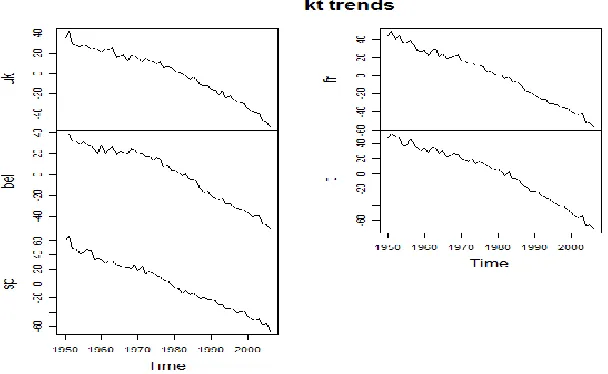
Database). The first step is the fitting of the Poisson version of the LC on the datasets of the five
selected countries. In Figure 1, we show the estimates of the trend parameters for each country:
Observing Figure 1, we note that the estimated trends of the parameter kt are quite similar for
each country, showing wherever a decreasing slope. We refer to D'Amato et al. 2013 for a
detailed description of similarities and measurement of dependence in mortality between the
selected countries.
In the second step of this numerical application, we fit the VAR model to the kt of each country
and calculate the residuals. The number of lags of the VAR model is selected through the
application of the Akaike criterion, useful to avoid the overparameterisation of the model. The
result is that the selected lagged terms are two so that each lag term Kt-q,mi for country i affect
the response Kt,mj with i = j and i≠j, q = 1,2. In other words, not only own country lags are
relevant, but each country influences the response of the others for two legs.
Figures 2-6 display, for each country, a diagram of fit, a residual plot, the auto-correlation and
partial auto-correlation function of the residuals.
Finally, we have implemented the bootstrap simulation according to the algorithm proposed in
ACCEPTED MANUSCRIPT
sample average kt. Then, we have projected them by using ARIMA models and calculated
confidence intervals. Figures 7 displays the mean of the simulated kt and the projections with
confidence intervals for UK, Belgium, Spain, France and Italy.
In Figure 7, the solid lines represent the kt trend for UK, Belgium, Spain, France and Italy, with
the confidence intervals highlighted in yellow. As it is clear by the diagrams, the trend is quite
similar between countries, that have experienced similar trends in mortality reduction due to
common social-economic factors and improvements in medical research. But if we look at the
width of the confidence intervals, we can see they are quite unequal between countries. In
particular, as result of our application it is relevant to notice the wider CI’s for Belgium, which is
the smallest of the considered countries. In the Introductin we stated that by considering a
multiple model we allow enhancing the reliability for small population mortality estimates. In
other words, the knowledge about countries with small population can be enriched by the
consideration of common features between different populations.
Further research will aim to verify the forecast goodness of the Multiple Lee Carter Approach
throughout different measures of forecast accuracy, also to test the improvement of the proposed
model with respect to the classical Lee Carter model.
6. Concluding Remarks
In the last few years there has been an increasing interest in the actuarial literature on the issue of
modeling multiple populations characterized by similar socio-economic and living conditions. It
has also been shown the problems arising when considering simultaneously different countries is
ACCEPTED MANUSCRIPT
strictly related to the dependence analysis. The existence of dependence in mortality data
involves the interactions for adjacent age groups between age and time and also across the
different populations.
From a methodological point of view, the research presented in this contribution is oriented to
consider the flexibility of the methodology proposed in a previous article (D'Amato et al. 2013).
In particular, we build on the Lee Carter method in its Poisson version to develop an approach
within this general framework. In particular, we extend the basic structure to include some cross
dependence in the error term on the basis of a tailor-made bootstrap algorithm, explained in
detail in section 4.
Another attractive methodology for our application could have been Bayesian (empirical, full)
with the kti as random effects. Bayesian simulation differs from classical simulation analysis in
that probability distributions are used to represent the uncertainty about model parameters, rather
than point estimates and confidence intervals. In the Bayesian approach, the prior information
about the distribution of parameters is modified into posterior one after the observation of
sample. In the language of uncertainty, classical simulation models only aleatory uncertainty (the
randomness of the system itself), while Bayesian simulation models both the aleatory and
epistemic uncertainty (the lack of knowledge about the system). However, as it has been
observed (Hastie et al., The Elements of Statistical Learning 2009) “bootstrap distribution
represents an approximate non-parametric posterior based on a particular choice of
noninformative prior … and is typically much simpler to carry out.” In other words, referring to
our case the prior from which we start is the fitted kt from the model and the bootstrap algorithm
ACCEPTED MANUSCRIPT
approximate the posterior information about the distribution of the parameter offering point
estimates and confidence intervals; in this way we reach a quicker results than that we should
obtain with Bayesian simulation. In actuarial application, it is important to reduce the time of
simulation to make really applicable the algorithm for practical uses; moreover, for practitioners
the quantities of interest are just the confidence intervals to estimates the impact of longevity risk
on insurance liabilities.
ACCEPTED MANUSCRIPT
References
1. Anderson, T. W., 1984, An Introduction to Multivariate Statistical Analysis, 2nd Edition, New
York: Wiley
2. Bai, J., 2004, Estimating cross-section common stochastic trends in nonstationary panel data,
Journal of Econometrics, 122, 137-183
3. Bühlmann, P., 1997, Sieve bootstrap for time series, Bernoulli, 3, 123-148
4. Cairns, A.J.G., D. Blake, K. Dowd, G.D. Coughlan, M. Khalaf-Allah, 2011, Bayesian
Stochastic Mortality Modelling for Two Populations. ASTIN Bulletin, 41(1), 29--59.
5. D'Amato V., Haberman S., Piscopo G., Russolillo M., 2013, Computational Framework for
Longevity Risk Management, Computational Management Science, DOI
10.1007/s10287-013-0178-2, Print ISSN 1619-697X, Online ISSN 1619-6988
6. D'Amato V., Haberman S., Piscopo G., Russolillo M., Trapani L., 2012b, Detecting longevity
common trends by a multiple population approach, presented at Eight International Longevity
Risk and Capital Market Solutions Conference, Waterloo, Ontario (CANADA)
7. D'Amato V., Haberman S., Russolillo M., 2012a, The Stratified Sampling Bootstrap: an
algorithm for measuring the uncertainty in forecast mortality rates in the Poisson Lee-Carter
setting. Methodology and Computing in Applied Probability, 14(1), 135-148.
ACCEPTED MANUSCRIPT
8. D'Amato V., Di Lorenzo E., Haberman S., Russolillo M., Sibillo M., 2011, The Poisson
log-bilinear Lee Carter model: Applications of efficient bootstrap methods to annuity analyses. North
American Actuarial Journal, 15(2), 315-333.
http://www.soa.org/library/journals/north-american-actuarial-journal/2011/no-2/naaj-2011-vol15-no2.aspx
9. D'Amato V., Haberman S., Piscopo G., Russolillo M., 2012b, Modelling dependent data for
longevity projections. Insurance Mathematics and Economics 51, 694-701, DOI information:
10.1016/j.insmatheco.2012.09.008
10. Dowd, K., Cairns, A.J.G., Blake, D., Coughlan, G.D., Epstein, D. and Khalaf-Allah, M.,
2011, A Gravity Model of Mortality Rates for Two Related Populations. North American
Actuarial Journal 15: 334-356.
11. Gaille S., Sherris M., 2011, Modelling Mortality with Common Stochastic Long-Run Trends.
The Geneva Papers on Risk and Insurance - Issues and Practice, 36(4), 595-621.
12. Guillen, M., Vidiella-I-Anguera, A., 2005, Forecasting Spanish natural life expectancy, Risk
Analysis, 25 (5), 1161-1170.
13. Hastie, T., Tibshirani, R., Friedman, J., 2009, The elements of statistical learning: data
mining, inference and prediction. Springer. (Chapter 2)
14. Human Mortality Database. University of California, Berkeley (USA) and Max Planck
Institute for Demographic Research (Germany). Available at www.mortality.org or
ACCEPTED MANUSCRIPT
15. Jarner S. F, Kryger E.M., 2011, Modelling Adult Mortality in a Small Population: The
SAINT model, Astin Bulletin 41 (2), p. 377-418
16. Kleinow T., 2013, A Common Age Effect Model for the Mortality of Multiple Populations,
paper presented at Ninth International Longevity Risk and Capital Markets Solutions
Conference, China
17. Lee, R.D., L. R. Carter, 1992, Modelling and Forecasting U.S. Mortality. Journal of the
American Statistical Association, 87, 659-671.
18. Li, N., R. Lee, 2005, Coherent mortality forecasts for a group of populations: An extension
of the Lee-Carter method. Demography, 42(3), 575--594.
19. Li, J.S.H., Hardy, M.R. and Tan, K.S. (2010). Developing Mortality Improvement Formulae:
The Canadian Insured Lives Case Study. North American Actuarial Journal 14: 381-399.
20. Li, J. S. H., Hardy, M. R., 2011, Measuring Basis Risk Involved in Longevity Hedges. North
American Actuarial Journal, 15(2), 177--200.
21. MacMinn R., Sun T., Chen H., 2013, A Multi-Population Mortality Model via the Factor
Copula Approach, paper presented at Ninth International Longevity Risk and Capital Markets
Solutions Conference, China
22. Njenga C., Sherris M., 2011, Longevity Risk and the Econometric Analysis of mortality
trends and volatility, Asia-Pacific Journal of Risk and Insurance, vol. 5, issue 2. 23. Olivieri A.,
2011, Forecasting mortality by mixing mortality experiences, Demography and Longevity
ACCEPTED MANUSCRIPT
24. Ornelas, A., Guillén, M., 2013, A comparison between general population mortality and life
tables for insurance in Mexico under gender proportion inequality, Revista de Metodos
Cuantitativos para la Economia y la Empresa, 16 (1), 47-67.
25. Russolillo, M., Giordano, G., Haberman, S., 2011, Extending the Lee-Carter model: a
three-way decomposition. Scandinavian Actuarial Journal, 2, 96-117.
26. Trapani, L., 2012, On bootstrapping panel factor series - Extended version. Available at
SSRN: http://ssrn.com/abstract = 2062183
27. Trapani, L., 2013, On bootstrapping panel factor series. Journal of Econometrics, 172,
127-141.
28. Yang S., Yue J.C., Yeh Y., 2011, Coherent Mortality Modeling for a Group of Populations,
Living to 100 Symposium.
29.Yang S.S., Huang H.C., Wang C., 2013, Modeling Multi-Country Mortality Dependence and
Its Application in Pricing Survivor Swaps: A Dynamic Copula Approach, paper presented at
Ninth International Longevity Risk and Capital Markets Solutions Conference, China
ACCEPTED MANUSCRIPT
Figure 1-Estimated trends of parameters kt
ACCEPTED MANUSCRIPT
Figure 2-Diagram of fit, residuals, ACF and PACF of residuals for UK
ACCEPTED MANUSCRIPT
Figure 3-Diagram of fit, residuals, ACF and PACF of residuals for France
ACCEPTED MANUSCRIPT
Figure 4-Diagram of fit, residuals, ACF and PACF of residuals for Belgium
ACCEPTED MANUSCRIPT
Figure 5-Diagram of fit, residuals, ACF and PACF of residuals for Spain
ACCEPTED MANUSCRIPT
Figure 6-Diagram of fit, residuals, ACF and PACF of residuals for Italy
ACCEPTED MANUSCRIPT
Figure 7- mean of simulated kt and projections for UK, Belgium, Spain, France and Italy