1876-6102 © 2016 Published by Elsevier Ltd. This is an open access article under the CC BY-NC-ND license (http://creativecommons.org/licenses/by-nc-nd/4.0/).
Peer-review under responsibility of the scientific committee of the Applied Energy Symposium and Forum, REM2016: Renewable Energy Integration with Mini/Microgrid.
doi: 10.1016/j.egypro.2016.11.253
Energy Procedia 103 ( 2016 ) 82 – 87
ScienceDirect
Applied Energy Symposium and Forum, REM2016: Renewable Energy Integration with
Mini/Microgrid, 19-21 April 2016, Maldives
A novel use of the hybrid energy storage system for primary
frequency control in a microgrid
Jianwei Li
a, Qingqing Yang
a, Pengfei Yao
b, Qixing Sun
a, Zhenyu Zhang
a, Min
Zhang
aWeijia Yuan
aaUniversity of Bath, Bath, BA2 7AY, United Kingdom bTsinghua University, Beijing, China
Abstract
High penetration of renewable energy causes fluctuations of power flow and results in system frequency fluctuation, which significantly affects the power system operation. The situation in microgrid (MG) is worse because of the low inertia and small time constant of the system. This paper present a novel use of the superconducting magnetic energy storage (SMES) and battery hybrid energy storage system with the function of frequency control in the MG. A hybrid power management strategy for the SMES and the battery is used to achieve, firstly, a faster primary frequency control and secondly, an improvement of battery service time.
© 2016 The Authors. Published by Elsevier Ltd.
Selection and/or peer-review under responsibility of REM2016
Keywords:Battery, Frequency control; Hybrid energy storage system (HESS); Lifetime extension; Microgrid (MG); Superconducting magnetic energy storage (SMES).
1. Introduction
Microgrid is defined as a low voltage power system which has a cluster of loads and generators and is able to provide electricity to its local area [1]. The distribution generations using renewable recourse can be integrated into a microgrid efficiently [2]. However, due to variable nature of renewable sources and fluctuating load profiles, the power supply in the MG sometimes cannot match the load demand. The unbalance between generation and load will result in system frequency fluctuation and the situation in MG
Corresponding author. Tel.: +44 1225386049; fax: +441225386305.
E-mail address: [email protected] (Weijia Yuan); [email protected] (Jianwei Li).
© 2016 Published by Elsevier Ltd. This is an open access article under the CC BY-NC-ND license (http://creativecommons.org/licenses/by-nc-nd/4.0/).
is worse because of the low inertia and small time constant of the system [3]. Therefore, frequency control is a critical in the island MG.
Battery energy storage systems which have high efficiency and large energy density [4] are believed as effective solution for power balancing in an island MG. Many works have been done to study batteries using in off-grid MG: shave peak demand and store the surplus renewable energy in [5, 6], improve power quality [5] and frequency control [3, 7]. However, the limited service lifetime and the relative low power density are mainly two disadvantages that limit the usage of battery [8, 9].
Many previous works have introduced SMES/battery HESS in different applications: improving overall system efficiency in wind applications [8], compensating fluctuating loads in railway system [10], extending battery lifetime in electrical buses [11], etc. However to the authors’ best knowledge, there is no published work using the SMES/battery HESS in the MG with the frequency control function. The improvement of battery lifetime in a battery and SMES HESS has already been proved by many previous works [10, 12], but few article does quantitative analysis of the extension of battery lifetime. In this paper, a battery and SMES hybrid energy storage system used in MG is designed and tested in simulation achieving, firstly, the frequency control function and secondly, an extension of battery lifetime. The battery lifetime in the HESS is quantitatively increased based on a battery lifetime model.
[image:2.544.140.403.286.571.2]2. System configuration and modelling
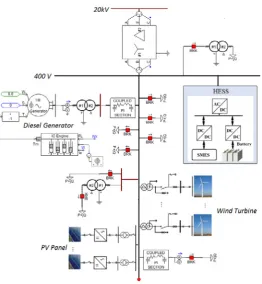
Fig. 1 Single line configuration of the MG system.
3. Control strategy
3.1. Frequency control of MG
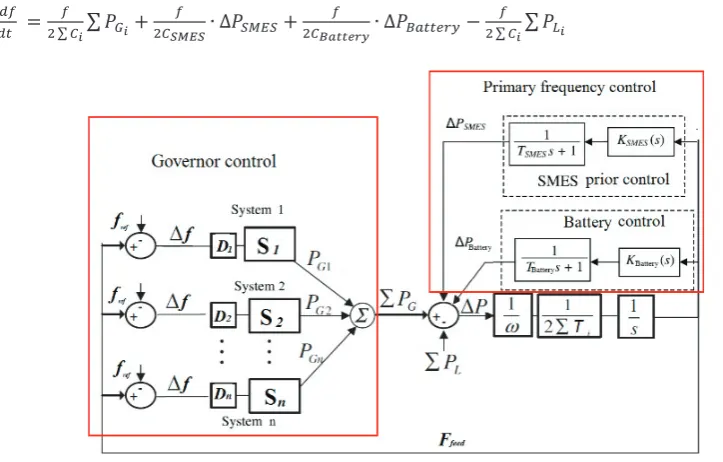
As shown in Fig. 2, the SMES/battery HESS is introduced in the proposed MG with the function of primary frequency control. The dispatchable micro-sources offer the active power sharing based on the droop mechanism. Eq. (1) is used to illustrate the frequency control of the MG following a disturbance, where Ciis the inertia constant for isystem.
ௗ ௗ௧ =
ଶ σ σ ܲீ+
ଶೄಾಶೄή οܲௌொௌ+
ଶಳೌೝή οܲ௧௧௬െ
[image:3.544.71.433.168.399.2]ଶ σ σ ܲ (1)
Fig. 2. The frequency control of the MG system
Due to the fast dynamic response performs of the HESS, the power disturbance will be firstly compensated by the energy storage. In addition, the charge/discharge speed of the SMES is much quicker than that of the battery.
3.2. Power management strategy
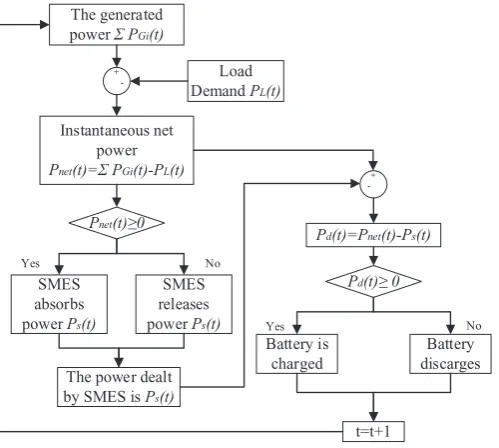
Since the response of the HESS are extremely faster than that of the governors, the dynamics of the micro-sources can be are neglected in the power management design of the primary frequency control. Several precious studies [10, 15] have proposed the control strategies of hybrid energy storage system used in renewable power or electric vehicles. Li et al. [8] introduced an overall power control algorithm used in a wind application with HESS. In this method, the power delt by battery is controled at a low frequncy. ᤹
As an improvement of the previous method, this paper proposes a new desgine of overall control stratgy (Fig. 3).
The generated powerȈPGi(t)
+
-Instantaneous net power Pnet(t)=ȈPGi(t)-PL(t)
Load DemandPL(t)
Pnet(t)0
Pd(t)=Pnet(t)-Ps(t)
Pd(t)0
Battery is charged
Battery discarges
t=t+1 SMES
absorbs power Ps(t)
SMES releases power Ps(t)
The power dealt by SMES is Ps(t)
Yes No
Yes No
+
-Fig. 3 The HESS power management strategy.
4. Simulation verification
4.1. Simulation results and discussion
The effects of the proposed SMES/battery HESS working as the frequency stabilizers in the MG system are shown in Fig. 4. The same random load changes as shown in the Fig. 4(a) are applied in three scenarios: the conventional MG (without any energy storage systems), the MG with only battery and the MG with the SMES/battery HESS. Fig. 4(b) shows the simulation results of the frequency oscillations in the proposed three cases. It is obvious that the frequency oscillations in the conventional MG are much more server than those in the other two cases. Also, the frequency fluctuations are significantly suppressed in in the MG with HESS than that of the battery only system. The peak oscillation value in the HESS is also much smaller than the other two systems. Therefore, the proposed SMES/battery HESS is able to perform a better system frequency control than the battery only system and conventional MG system.
Fig. 4. (a) Random load changes; (b) frequency oscillations in three cases
4.2. Battery lifetime extension qualification
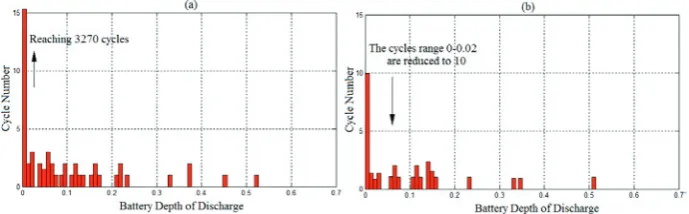
[image:4.544.156.406.63.287.2] [image:4.544.111.435.472.588.2]experiences less cycles. Secondly, with the help of the SMES, the battery power requirement for battery is less resulting the lighter depth of discharge. A battery lifetime prediction model [8] which is capable of calculating these two factors on the battery degradation process is used in this paper for battery lifetime extension analysis. It is beyond the scope of this paper to introduce this model in detail. Based on this model, Fig. 5 gives histograms to describe the cycle numbers of batteries at different depth of discharges in the battery only system and the HESS. The input is the battery state of charge data and it returns the cycle numbers at different depth of discharges. As it can be seen from the histograms the battery undergoes extensively fewer small-scale cycles and also a relatively lighter depth of discharges. Based on this model, the battery lifetime is predicted as 5.7 years in the battery only system whereas 9.2 years in the HESS resulting in a 61% extension of battery lifetime.
Fig. 5. Histograms of cycle numbers at different DODs (a) battery only system; (b) HESS
5. Conclusions
This paper proposed a battery and SMES hybrid energy system used in a MG system with the frequency control function. The frequency control method and power management strategy are introduced in this study achieving an efficient use of the SMES. The performance of the HESS is tested based on the MG system developed in the PSCARD. The simulation results show that, compere with the conventional MG and the battery only MG, the MG with the HESS performers a better frequency stabilization. Another advantage of the proposed HESS is that the battery is protected from the high frequency charge/discharge cycles and peak currents, which improves the battery service life. The extension of battery lifetime is quantitatively increased from 5.7 years in battery only system to 9.2 years in the HESS.
6. Copyright
Authors keep full copyright over papers published in Energy Procedia.
References
[1] Bhuiyan FA, Yazdani A, Primak SL. Optimal sizing approach for islanded microgrids. IET Renewable Power Generation. 2014. [2] Jia H, Mu Y, Qi Y. A statistical model to determine the capacity of battery–supercapacitor hybrid energy storage system in autonomous microgrid. International Journal of Electrical Power & Energy Systems. 2014;54:516-24.
[3] Aghamohammadi MR, Abdolahinia H. A new approach for optimal sizing of battery energy storage system for primary frequency control of islanded microgrid. International Journal of Electrical Power & Energy Systems. 2014;54:325-33. [4] Cho J, Kleit AN. Energy storage systems in energy and ancillary markets: A backwards induction approach. Applied Energy. 2015;147:176-83.
[5] Divya KC, Østergaard J. Battery energy storage technology for power systems—An overview. Electric Power Systems Research. 2009;79:511-20.
[6] Yang Q, Gu C, Le Blond S, Li J. Control scheme for energy storage in domestic households. Power Engineering Conference (UPEC), 2014 49th International Universities: IEEE; 2014. p. 1-6.
[7] Li J, Xiong R, Yang Q, Liang F, Zhang M, Yuan W. Design/test of a hybrid energy storage system for primary frequency control using a dynamic droop method in an isolated microgrid power system. Applied Energy. 2016.
[9] Li J, Yang Q, Robinson F, Liang F, Zhang M, Yuan W. Design and test of a new droop control algorithm for a SMES/battery hybrid energy storage system. Energy.
[10] Ise T, Kita M, Taguchi A. A hybrid energy storage with a SMES and secondary battery. IEEE Transactions on Applied Superconductivity. 2005;15:1915-8.
[11] Li J, Zhang M, Yang Q, Zhang Z, Yuan W. SMES/Battery Hybrid Energy Storage System for Electric Buses. IEEE Transactions on Applied Superconductivity. 2016;26:1-5.
[12] Song Z, Hofmann H, Li J, Hou J, Han X, Ouyang M. Energy management strategies comparison for electric vehicles with hybrid energy storage system. Applied Energy. 2014;134:321-31.
[13] Mohan V, Singh JG, Ongsakul W. An efficient two stage stochastic optimal energy and reserve management in a microgrid. Applied Energy. 2015;160:28-38.
[14] Li J, Zhang M, Zhu J, Yang Q, Zhang Z, Yuan W. Analysis of Superconducting Magnetic Energy Storage Used in a Submarine HVAC Cable Based Offshore Wind System. Energy Procedia. 2015;75:691-6.