Rochester Institute of Technology
RIT Scholar Works
Theses
Thesis/Dissertation Collections
2-20-2012
Art recording art: Creating an interactive visual
document of personal experience
Ben Rubin
Follow this and additional works at:
http://scholarworks.rit.edu/theses
This Thesis is brought to you for free and open access by the Thesis/Dissertation Collections at RIT Scholar Works. It has been accepted for inclusion in Theses by an authorized administrator of RIT Scholar Works. For more information, please [email protected].
Recommended Citation
ROCHESTER INSTITUTE OF TECHNOLOGY
A Thesis Submitted to the Faculty of
The College of Imaging Arts and Sciences
School of Art
In Candidacy for the Degree of
MASTER OF FINE ART
ART RECORDING ART: Creating an Interactive Visual Document of Personal Experience
by
Ben Rubin
2
Thesis Approval
Thesis Title: Art Recording Art: Creating an Interactive Visual Document of Personal Experience
Thesis Author: Ben Rubin
Chief Advisor Tom Lightfoot
_______________________________
Date: _______________________________
Associate Advisor Larry K. Quinsland
_______________________________
Date: _______________________________
Associate Advisor Roberley Bell
_______________________________
Date: _______________________________
Department Chairperson Donald Arday
_______________________________
3
Abstract
This document was submitted to fulfill the thesis requirement for the Master of Fine Arts (MFA)
at Rochester Institute of Technology (RIT). The following thesis introduction includes a Quick Response
Code (QR) and a Universal Resource Locator (URL), both of which point the reader to a complex,
interactive website housing an online version of the thesis and artwork.
This thesis explores how the notetaking process can shape personal language as it bridges the
contexts of education and art. The author appropriates the medium of notetaking and adapts it for the
world of fine art. The project documents the various paths of all thirty graduating masters students from
the College of Imaging Arts and Sciences (CIAS) who shared the Bevier Gallery for their thesis show in
2011. Through a combination of traditional and digital interactive media, the work reveals the experiential
nature of notetaking, both in terms of the notetaker and the audience. The notes themselves are visual
maps of conversations between the notetaker and his peers, taken in real-time and synchronized with
accompanying audio and video recordings. Within this thesis, physical and web experiences blend
together and become interdependent. The full library of these multimedia documents is shared in an
4
Table of Contents
ABSTRACT...3
TABLE OF CONTENTS...4
LIST OF ILLUSTRATIONS...5
INTRODUCTION...6
SITE...9
A GAME OF TAG...15
EVENT...19
INTERPERSONAL...20
VISUAL LITERACY...21
INTRAPERSONAL...24
ILLUSTRATIONS...26
5
List of Illustrations
FIGURE 1: QUICK RESPONSE CODE (QR)...6
FIGURE 2: THESIS MAP...8
FIGURE 3: VIEW FROM MY INSTALLATION...10
FIGURE 4: WEBSITE TUTORIAL VIDEO...11
FIGURE 5: ARTIST COMMUNITY WIDGET...11
FIGURE 6: NOTE INDEX WIDGET...12
FIGURE 7: WORD OVERLAPS WIDGET...13
FIGURE 8: IMAGE OVERLAPS WIDGET...13
FIGURE 9: THESIS BOOKLET VIDEO...14
FIGURE 10: MARY CLASSROOM STUDIO VIDEO...16
FIGURE 11: IMAGE TAGS...17
6
Introduction
You are standing at a doorway between two worlds.
http://goo.gl/SqYGm
Fig. 1. Quick Response Code
My written thesis is provided both in print and online. Although you can choose to continue
reading this traditional paper thesis, the artwork referred to within this document as well all supporting
media can only be found within the online format. To access the interactive online version, you can scan
the QR code (Fig.1) or put the web address above into your favorite browser.
The making of art is an exploratory process, as is the crafting of an essay or thesis. Even with a
specific end product in mind, the organic development involved in production can often shift initial goals
towards some new and unforeseen destination. Through a dialogue between self, environment, and
medium, a unique experience progressively shapes my work. I see this journey as the most significant
piece of the creative equation; informing not only the process but the meaning of the result. I am
interested in having the experience of my written thesis reflect the journey of the art, both for the reader
and the author. This has inspired me to work beyond the limitations of the traditional printed black and
white document and create an additional space for my thesis online.
Accessibility
For anyone interested in my thesis, the web simply offers more options and opportunities. Rather
than limiting my audience to those who have the time to travel to the RIT Archives to read the document
in person, or the privilege to access it using ProQuest, my work is now open to anyone from anywhere
with internet access. My thesis can be easily sent through an email, as well as linked within social
7
For interested participants with specific accessibility requirements, the internet provides a level of
user-adaptability and elasticity not available in any printed form. My thesis can be translated into different
languages, resized, highlighted, copied, pasted, and even automatically read aloud all through free online
applications. Of course, sections can also be printed if you are so inclined.
Multimedia
Another notable asset within an online environment is the option to directly utilize multimedia. The
documentation within my thesis took many forms, and involved pairing many modes of communication
together. Notes were paired with audio, and some of these amalgamations were further combined with
video in various ways. These elements were crucial for my thesis show presentation, and it seemed
counter-intuitive strictly limit them from the written thesis.
Interaction
The accessibility and multimedia features described above come hand-in-hand with a unique kind
of user interaction. Fundamental to the Internet is the concept of hyperlinks; connecting various online
spaces together through content-based portals. This encourages users to not only read but also navigate
through the space in a much more personalized and non-linear way. As the artist and writer must each
find their own path by connecting the dots, so too must the viewer or reader choose their own unique
8
Thesis Map
Fig. 2. Thesis Map.
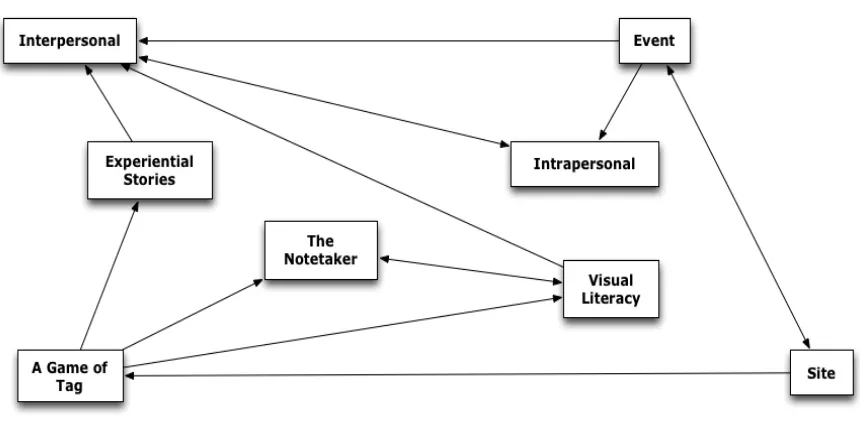
In print, the map above (Fig. 2) is an illustration of the interconnections within key concepts of my
thesis. Online, these same boxes become hyperlinks. The lines between the boxes identify bridges within
the content, and from inside the pages you can click highlighted text to connect to parallel interdependent
and related themes. The arrowheads describe which direction the links will take you, and how web traffic
[image:9.612.92.522.97.316.2]
9
Site
Integral to my thesis is a relationship between physical site and web site, as well as the space in
between. Documenting events and sharing my work involved bridging emerging technologies and
traditional media. This blended process allowed me to explore independent, complementary options for
navigating space.
Physical Site
My thesis first took shape when I began to focus on the thesis show. Abstract ambitions needed to
fill a definitive space. Each permutation of my thesis ideation was forced to face this space, which was
where most unraveled. In frustration, I eventually gave up trying to export my ideas and began simply by
examining the gallery.
The Bevier Gallery had specifications unique to itself: rules of use, regulations for the art it
contained, staff with their own preferences and quirks, and the anticipated three events shared by MFA
students from all throughout the School of Art. While the first line of gallery parameters almost put my
thesis out of business, it was the defining shared space that the gallery represented which brought it all
together in the space that I created online. Deciding to limit my focus to my fellow MFA candidates
meant I suddenly had a specific group of collaborators who were not only working along side me but
required to use the same space. I framed my entire thesis around the gravity created by our three shared
events.
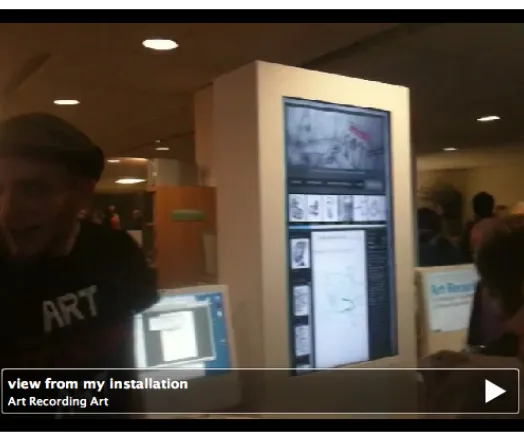
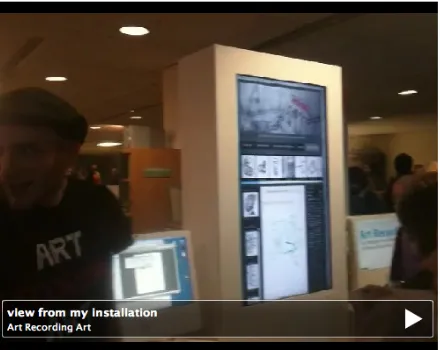
Between each of the shows, the gallery was completely repainted, redesigned, and rebuilt. A video
was taken during the third and final opening in the series (Fig. 3). It gives a 360 degree view of the space
from my corner of the gallery as I mingled with patrons. The sound is unimportant to its purpose in
sharing the context of the opening and the voices in the crowd are unintelligible, so I chose not to include
[image:11.612.175.437.69.285.2]
10
Fig. 3. View from my Installation.
Web Site
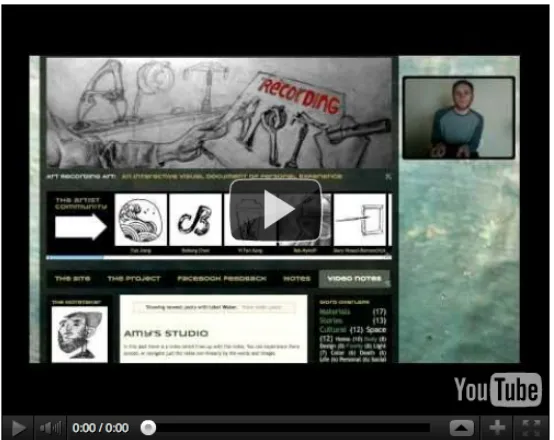
Using an online space as the source for my notes and thesis was fundamental in my aims to make
my project accessible, engaging, and interactive. All of the online services I enlisted into my thesis will
be free to host and maintain after my domain name expires in March 2013. The space was created using
two conjoined blogs for the framework, as well as integration with Facebook to allow for open feedback.
The first blog functions as storehouse for all of my multimedia notes, while the second includes the
content describing my work. All of my documentation in both spaces is organized together within a web
11
Fig. 4. Website Tutorial.
Web Navigation
There are many different ways you can navigate the notes through the Archive; by artist,
chronologically, and by overlapping themes using both word and image tags. Below you will find a
description of how you can use each of these to guide you through the space.
A list of all the artist's names can be found within the Note Archive in a scrollable bar at the top,
entitled 'Artist Community' (Fig. 5). Each artist created a personal graphic to represent their identity in
relation to their work. The individual graphics accompany each name within the bar, and you can click on
them to find all notes created with each artist.
[image:12.612.168.445.72.292.2] [image:12.612.103.519.541.629.2]
12
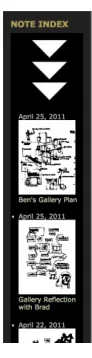
Below the Artist Community bar and on the left side of the window you will find a vertical bar
entitled 'Note Index' (Fig. 6). This contains thumbnails of all the notes within the archive organized
chronologically, beginning with the most recent. Scroll down and click on the images to access the
content.
Fig. 6. Note Index Widget
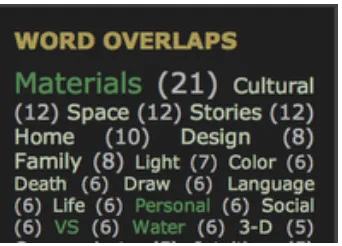
Opposite of the 'Note Index' are the Word and Image Overlaps, one stacked on top of the other
(Fig 7 and 8). Both display only the tags that were found in multiple sets of notes; overlaps within
content between different artists and throughout the progression of their project development. The
numbers paired next to the words and below the images describe frequency within the collective
content. When clicking on any of the overlaps, whether word or image, you will be linked to a list of all
the content where the tag is found. You can visually scan each document to find the specific tag in each
set of notes, and click on these to watch or listen to related points in various conversations. If the notes
are paired with video, you can line up the timelines between documents to find content. Feel free to
drag the time bar at the bottom of each set of notes ahead or back to hear more of the context of the
[image:13.612.277.323.168.347.2]
13
Fig. 7. Word Overlaps Widget
Fig. 8. Image Overlaps Widget
Blending Space
The decision to use both physical site and web site within my thesis centered around accessibility
and interactivity. Although there are plenty of traditional mediums that allow for personal documentation
of experience and context, I was interested in creating a series of documents that would not only describe
my journey but elicit experiential exploration from the audience; encouraging participation on a variety of
levels rather than one-size-fits-all passive viewing. I was able to combine the user-adaptability and unique
navigation of the web with the spontaneity and presence of physical interaction.
Navigating Space
The independent sites used for my thesis were complementary, but the navigation involved with
[image:14.612.228.399.70.193.2] [image:14.612.235.392.242.404.2]
14
intimate physicality with their various works and processes; rich, layered experiences with a focused but
limited scope. My documentation from these experiences was stored and organized online, allowing for a
detailed exploration of relationships between the recorded conversations. This provided a less
dimensional experience but comprehensively connected the dots between projects and concepts. This
process, involving both these experiences working together, was fundamental in my understanding and
appreciating their works. I needed to personally navigate the physical space and create a document in
order to benefit from the document later. I realized that most visitors at the opening wouldn't have the
hard-earned prior knowledge I had of the works, but get it all at once within a sea of other people. All the
divergent projects side by side could be just as overwhelming as all my pages of notes condensed on a
website.
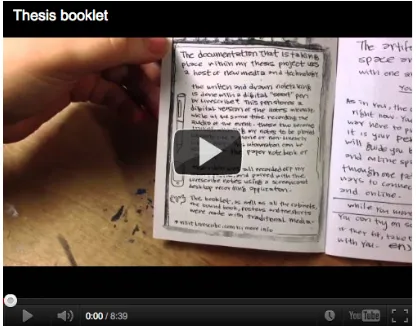
I decided to create a printed booklet to provide visitors with an alternative bridge to lead people
between the physical site and web site (Fig. 9). It traced a path through the gallery between different
projects and found commonalities between elements relating to movement, a theme rooted in physicality.
It asked simple questions and encouraged visitors to respond within the booklet and online. A video of
the booklet can be found in the online space.
[image:15.612.203.411.466.629.2]
15
A Game of Tag
You’re It! The tags that I used to organize my thesis are, in theory, not all that different from the
classic childhood game of tag, or from the kind of tag you might find on clothing at a store. They are
labels for things, and they help with sorting the 'it' from the 'not-it'. In terms of websites, they are a kind
of meta-data that can be used for clear identification (like a tag on clothing) as well as hidden to assign
roles and locations for things (like in the game). My notes using the digital pen worked in a similar
fashion. The writing and drawing marked specific points in the conversation; clear labels for unseen
highlights in audio content (my sessions with Megan Gaffney focused on video, although audio was used
as a syncing mechanism). Within my thesis, I have relied on different systems of tags, both to identify
and catalog individual elements. Below are brief descriptions of some of the different systems that I used.
Thesis Tags
It seemed only fitting for my written thesis to have the same type of navigation as the rest of my
work. I created the Thesis Map to illustrate and tie together the interrelated themes within my thesis, and
using some simple HTML created hyperlinks within the content to allow the map to function.
Video Tags
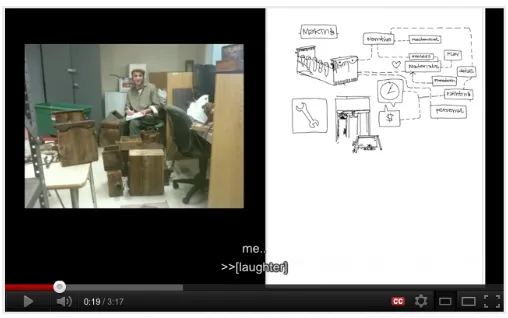
Using YouTube to synchronize the notes and video had benefits beyond extending modalities.
Specific segments within videos can be directly linked to by adding tag information to the URL, allowing
for very precise referencing. I have included some of these tagged video links within my online thesis
[image:17.612.179.433.69.228.2]
16
Fig. 10. Mary Classroom Studio Video
Note Tags
This manual system was the first step in the process, and perhaps the most important. While
documenting sessions during my thesis, my written and drawn descriptions were labeled using simplified
image and word tags to identify themes in content. This system matured through the progression of the
project as the notes and tags were integrated into the online archive.
Perhaps it is worth mentioning here that this method of tagging content in my notes with symbols
and labels began when I began working as a Notetaker at RIT. I found it improved my attention and
retention as well as providing multi-modal information for the supported students. My interest in
pursuing more interactive options for these students led me to some of the technology I used in this
project.
Archive Tags
Each set of notes was uploaded onto the Note Archive website, which involved another layer of
tagging. Each post was allowed 20 tags or 200 characters (whichever came first), allowing me to
transcribe my note tags into a much more malleable online system; not only more accessible to other
people, but to me as well. The pooled notes became searchable and allowed me to monitor the formation
17
I created categories of the archive tags. Name Tags, which identify the artists present in the post,
and Media Tags, which identify the media used, are strictly used to organize the navigation of the
website. Image Tags and Word Tags are used both for website navigation and to find content-based
overlaps within the notes. I arranged the word and image tags into 5 categories, visually correlating
frequency with size, and sorted the results with the most popular themes on top.
Image and Word Tags
"...Pictures can induce strong feelings in the reader, but they can also lack the specificity of words.
Words, on the other hand, offer that specificity, but can lack the immediate emotional charge of pictures,
relying instead on a gradual cumulative effect. Together, of course, words and pictures can work
miracles." (McCloud 1994, p.135)
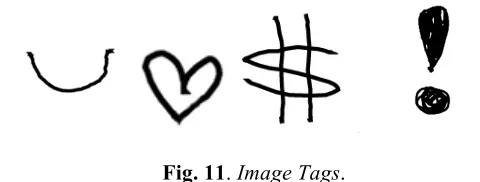
For the image tags, I chose content that could be easy to quickly draw as an icon (Fig. 11). A
graphic smile seemed to represent situations where the speaker was laughing better than any word
equivalent. Hearts were easier to incorporate into and with content to describe an artist's inspirations.
The money sign and the exclamation point were intuitively my first response when related content popped
[image:18.612.179.419.470.561.2]up.
Fig. 11. Image Tags.
I asked all the artists I worked with to create their own image to represent themselves and their work.
These were coded with the name tags on the website, allowing the notes to be sorted by artist.
For the word tags, I had initially only planned to have Exact Tags corresponding with all the notes;
If you clicked on a word or image in the side bar, it would pull up all the pages with that specific tag
18
doubles, so I began to carry around a reference sheet of word and image tags to keep themes consistent
when they came up. It was interesting to see the organic development of the trends. Some presented
themselves immediately, and I was able make early adjustments. During my first set of notes with Seul
Gi, I stopped myself from creating separate tags for all her materials (there were many!), and used
'Materials' as a Umbrella Tag to cover them all. Others wouldn't become obvious until much later. By
the time I realized that the 'Finish' tag I used in a session with George was a related double of the
'Resolution' tag within Mary's, it was too late to add anything to the notes. I created Conglomerate Tags
as a solution, linking the related themes with a 'Finish/Resolution' tag.
After the notes were uploaded into the online Note Archive, the image and word tags were utilized
to find relationships within the collective content. With 30 artists all in various stages of their thesis
19
Event
Lets start here and now. No matter how insignificant it may be, this moment has found you at a
specific crossroads between time and space as you read the words on this page. All points from this
intersection are weaved together through your perspective. Voilà! We have an event. Events can be
experienced on a personal level as well as shared with thousands of people. Perspective is a key
ingredient, and the same event can be pivotal to one person and unnoticed by another.
Within the confines of this website, you will find a web of interrelated documented events, both
minor and major, all underneath the cumulative umbrella of an MFA thesis experience at RIT. Late
nights in the studio, committee meetings, work edits, model-making, site planning, gallery prep, and
thesis installations all lead up to a final opening. This show was a requirement shared across all the
various programs in the College of Imaging Arts and Sciences, from Medical Illustration to
Woodworking and Furniture Design. Three separate shows were created to accommodate the group, each
spanning two weeks. My thesis follows all thirty MFA students, including myself, through these three
group thesis shows in the Bevier Gallery; each student presenting their own culmination of two years of
study and experience in the form of an event.
I made a Facebook page of the opening to let people know about the event, as did other artists
(Amy Vena, Yu Fen Kung, Jinhee Park) with whom I shared the gallery that evening. Viewing some of
these pages together provides a wonderful window into the inner-workings of how perspective shapes an
event. All of us experienced the same event very differently, shared the event with different people, and
even used different languages to describe our experiences. Yet the time and place was the same on all of
the invitations, and we practically stood side by side throughout the length of the show.
In a similar way, the entire process of constructing our theses reflected the same kind of
interdependent relationship. Each project was shaped through dialogue and constructive feedback from
many perspectives. Many of us shared classes together, studio space, thesis committee members,
20
Interpersonal
This thesis that you are currently reading has been influenced, shaped, and most importantly
validated by a qualified institution (The Rochester Institute of Technology). Institutionalized art lives in a
social system; it is successful only if it is identified and accepted as art by others. If my thesis committee
doesn't understand my work, it fails. Maybe the best example is that classic, enduring fixture of art
school: the art critique. Traditionally, students present work to their professor and peers and receive
constructive feedback. In this context, interpersonal communication skills are valued as much, if not
more than native artistic talent. It can be argued that the entire art establishment pivots on a similar set of
values through social validation.
Within the art school experience, peers can be as important of a resource as professors. It was as an
undergraduate that I first became involved in a shared studio setting. While the professors provided
formal assignments and expectations, it was from my classmates that I found most of my inspiration and
motivation as they too struggled through projects at all hours of the day and night. During long classes,
collaborative doodles with other students were more than a way to pass the time; they taught me about
different ways to draw, see, interpret, and share experience. It was from this seed that my interests in a
socially interactive thesis grew.
When I began toying with concepts early on, documenting my fellow graduate students was such a
natural focus for my thesis that I found myself doing it long before I formally considered it. With such a
diversity of backgrounds, perspectives, materials and pursuits, it was a curiosity and interest in learning
21
Visual Literacy
"As children, we 'show and tell' interchangeably, words and images combining to transmit a connected series of ideas. The different ways in which words and pictures can combine...is virtually
unlimited" (McCloud 1994, 152)
In the quiet dark rooms of my memory bank, sunrays shift through the dust onto a small shelf
where paperback children’s books sit cross-legged with their backs pressed against the walls. Without a
cover, and with tape holding together its pages, Crockett Johnson’s Harold and the Purple Crayon became
my first sketchbook. Aside from the associations a bald two-year-old would make with Harold, I
connected with his journey of discovery. Following a crayon like a magic compass gave me an artistic
license - just like that. Harold never passed go or collected 200 dollars. He simply let his arrow of
exploration and moon of curiosity lead the way. Creation became matter-of-fact, and fiction an extending
purple landscape of possibilities and adventure. This experience opened up an interactive world of
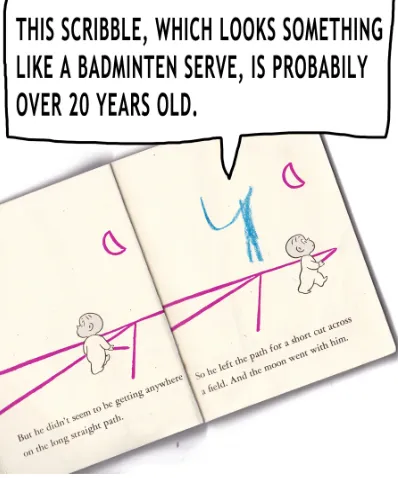
pictures for me. Without reserve, I added my own additions to Johnson's story on top of Harold with my
[image:22.612.207.406.426.665.2]own crayon (Fig. 12).
22
Visual Relationship with Education
Gradually, I watched the relationship between art and education become estranged. When school
started pushing reading and writing, art became sidelined. Art practices were polarized to specific rooms
and times. Like training wheels to a bicycle, I was weaned off visual language into an educational world
of words.
With visual media blossoming and continuously flashing outside of the classroom, I remember
becoming increasingly frustrated and bored with the lack of visual information used in school. Teachers
were unhappy about my doodling during class, but I had a hard time focusing without being visually
involved. Even making arbitrary patterned marks on my papers helped to keep me active if I felt lost.
Although it was often discouraged, I struggled to maintain and integrate my dialogue with visual
language throughout my primary and secondary education.
Although I had been aware of the magic between pictures and words well before college, it wasn't
until my notetaking job at RIT that I realized how much it influenced my memory. I used words, icons
and drawings together to document classes for supported students, and found not only did I receive
encouraging feedback from students but that my own retention and grades increased. There was
something about actively thinking in words and images during the lecture that made it easier to recall
later.
"My particular ability does not lie is mathematical calculation, but rather in visualizing effects, possibilities, and consequences." (Pinker 1997, p.285)
It is important to distinguish visual thinking and literacy from the ability to make 'art' on a
socially recognizable level. Albert Einstein, quoted above, was by no means an artist, but his ability to
think visually allowed him to imagine concepts as a means to understanding. These kind of skills aren't
necessarily taught in schools, and can even clash with traditional programs (Einstein was a ‘delayed’
23
language cannot necessarily say the same thing as the other, yet in combination both can say something
24
Intrapersonal
"Doodling may seem like an endless game of solitaire, but ironically it is the best way for me to commute between the cerebral world and connect to the one surrounding me. With a pad of paper I can dive internally, and buoy to the surface. It’s a net to catch the fleeting trivial blips of spontaneous life. A
record of experience, a root of inspiration and an open invitation for new perspectives. I carry a pad in my pocket every day." (Rubin November 23, 2011)
Perhaps the most fundamental responsibility of art and language is facilitating intrapersonal
communication. The things we say, make and do always relate to our own experiences in one form or
another. This is often overlooked. Our world is buzzing with multimedia for the masses and social
networking, but what about personal language? From our natural loosely-scripted handwriting to the
symbols and icons that populate our imaginations, personal language is fitted specifically to each
individual; a concoction of experience, associations and stories that becomes the vocabulary of their
identity. An individual's ability to make sense of their personal narrative lies at the heart of their
development.
My journals, handouts, and paper scraps all eventually found a crossroads and home within my
sketchbook. Functioning both as a pocket-sized playpen and an all-purpose junk drawer, my sketchbook
has become a space to interact with internal and external experiences. As a book, I can organize,
re-purpose, reflect on and react to these experiences over time. More than visual alchemy or aesthetics,
interacting with my records relates to how I perceive and understand these experiences while creating a
space that I can revisit and share.
"Experience is the result, the sign, and the reward of that interaction of organism and environment which, when it is carried to the full, is a transformation of interaction into participation and
communication." (Dewey1934, p.22)
Art for me is a bridge of communication connecting to a world of experience. Whether I am
25
moment that pulls me and my experiences into focus. Creating a dialogue between myself, my
26
Illustrations
Fig. 1. Quick Response Code (QR). Source: Google, http://goo.gl/SqYGm. (Accessed January 5, 2012)
Fig. 2. Thesis Map. Source: Omnigraffle Pro 3, http://benrubinmfathesis.blogspot.com/2011/10/thesis-map.html. (Accessed February 20, 2012)
Fig. 3. View from my Installation Video. Still image of video captured on April 22, 2011. Source: Facebook,
[image:27.612.78.371.290.430.2] [image:27.612.75.295.518.693.2]
27
Fig. 4. Website Tutorial Video. Still image of video captured on May 5, 2011. Source: YouTube,
http://www.youtube.com/watch?v=cXy4Z2pi8n8&feature=player_embedded. (Accessed January 5, 2012)
Fig. 5. Artist Community Widget. Source: Google Blogger, http://www.artrecordingart.blogspot.com. (Accessed January 5, 2012)
[image:28.612.75.304.113.295.2] [image:28.612.72.498.373.461.2]
28
Fig. 7. Word Overlaps Widget. Source: Google Blogger, http://www.artrecordingart.blogspot.com. (Accessed January 5, 2012)
Fig. 8. Image Overlaps Widget. Source: Google Blogger, http://www.artrecordingart.blogspot.com. (Accessed January 5, 2012)
[image:29.612.74.225.305.467.2] [image:29.612.73.254.554.694.2][image:30.612.73.332.122.282.2]
29
Fig. 10. Mary Classroom Studio Video. Still image of video captured on April 14, 2011. Source: YouTube, http://www.youtube.com/watch?feature=player_embedded&v=lSoT-DfVmuU#t=00m19s. (Accessed January 5, 2012)
[image:30.612.72.207.535.695.2]Fig. 11. Image Tags. Source: Google Blogger, http://www.artrecordingart.blogspot.com. (Accessed January 5, 2012)
Fig. 12. Crockett Johnson and Ben Rubin. Harold and the Purple Crayon. New York: Harper & Row, 1955. JPG. Source: Google Picasa,
30
Bibliography
Dewey, John. Art as Experience. New York: Penguin Group, 1934
Johnson, Crockett. Harold and the Purple Crayon. New York: Harper & Row, 1955.
McCloud, Scott. Understanding Comics. New York: HarperPerennial, 1994.
Pinker, Steven. How the Mind Works. New York: W.W. Norton & Company Inc, 1997.
Rubin, Ben. Google Blogger, "MFA Thesis: Art Recording Art." Last modified January 5, 2012. Accessed January 5, 2012. http://benrubinmfathesis.blogspot.com/2011/12/blog-post.html.