City, University of London Institutional Repository
Citation
:
Jarzabkowski, P., Bednarek, G., Burke, G. and Cabantous, L. (2012). BeyondBorders: Charting the Changing Global Reinsurance Landscape. Cass Business School, City University London.
This is the published version of the paper.
This version of the publication may differ from the final published
version.
Permanent repository link:
http://openaccess.city.ac.uk/16784/Link to published version
:
Copyright and reuse:
City Research Online aims to make research
outputs of City, University of London available to a wider audience.
Copyright and Moral Rights remain with the author(s) and/or copyright
holders. URLs from City Research Online may be freely distributed and
linked to.
Beyond borders:
Foreword: The Insurance Intellectual Capital Initiative
The Insurance Intellectual Capital Initiative (IICI) is a consortium of insurance industry organizations. It stimulates and funds research into areas of interest to the broader insurance sector, providing industry with an opportunity to invest in and build closer links with the academic community. The IICI works closely with government research councils to ensure that its projects meet industry needs, attract the right academic partners, and benefit from the research councils’ commitment to co-sponsor research with private sector institutions. Supporters of this IICI project are Amlin, Aon Benfield, Asia Capital Re, the Economic and Social Research Council, Hiscox, Liberty Syndicate Mgt, the Lloyd’s Tercentenary Foundation, the Society of Lloyd’s, Validus and the Worshipful Company of Insurers.
This report presents the full results from a two-phase study commissioned by the IICI, looking at the London, Bermuda, Continental European and Asia Pacific reinsurance markets from the perspective of cedents, reinsurers and brokers. An interim report from Phase 1 was released at Monte Carlo in 2010.
The project, undertaken by Professor Paula Jarzabkowski of Aston Business School and her research team, has been a productive collaboration between industry and academia in first raising a broad research question, and then working together regularly to shape the conduct of the research. The result is a unique study of international distinction for both the level of industry participation and the quality of the data set. The research team particularly thanks these members of the IICI Steering group: Bronek Masojada (Chief Executive, Hiscox Ltd; Chairman of the IICI and Chairman of Lloyd’s Tercentenary Foundation); Adrian Clark (Member of the UK Executive, Aon Benfield); James Illingworth (Chief Risk Officer, Amlin plc); Bill Rendall (consultant and trustee, Lloyd’s Tercentenary Foundation).
© September 2012
Professor Paula Jarzabkowski
Dr. Rebecca Bednarek, Dr. Gary Burke, Dr. Laure Cabantous, Dr. Michael Smets ISBN Number: 978-1-85449-770-3
Scope and scale of the study
Executive summary
This report is the result of a three-year study of the global reinsurance industry, covering the main stakeholders of cedents, reinsurers, and brokers. It examines the implications of profound change arising from shifts in regulation, consolidation in the key players, and increasing competition both within the reinsurance industry and from alternative capital providers. These changes are driving convergence in a market that was, until recently, characterised by significant cultural variation in buying and selling reinsurance. The findings in this report will help industry participants to take stock of their current position in the industry, the specific types of differentiation available, and how these differentiators can create advantage. Specifically, the report provides evidence-based frameworks and models that firms can use to diagnose their existing strategies and structures and consider alternatives.
The report has six sections. Section 1 is a call to arms about the current state of the industry. Section 2 differentiates between five main types of cedents according to their need for capital, the products that they purchase and the extent to which they centralise reinsurance buying. It shows that consolidation of cedents into a number of key global players has generated a trend towards centralised and global reinsurance purchasing. This has two key implications. First, centralised retention typically reduces the amount cedents spend on their reinsurance, contributing to a reported stasis in the global premium ceded to the reinsurance industry. Second, global purchasing is shifting towards large, multi-territory programmes that are not closely connected to the primary insurance industry, which lowers the overall transparency of reinsurance products. These two changes are eroding traditional beliefs about long-term relationships and continuity of cover, in favour of more opportunistic and cost-effective business relationships.
Section 3 examines reinsurers. Consolidation has created larger reinsurers that compete for market share, even as new ‘start-up’ subsidiaries are also heightening competitive pressures. While competition is becoming fiercer, as the pool of reinsurance premium remains relatively static and reinsurers seek new sources of revenue, reinsurers are not yet competing head-to-head. Rather, this section differentiates between five strategic types of reinsurer that compete from different technical bases, with different strategic appetites and perceptions of profitability. We explain the implications of these five
strategic types for a firm’s strategy, structure, and underwriting processes. Our findings show that structural tensions abound as reinsurers expand internationally, increasing the cost and complexity of their underwriting processes and altering the focus of underwriting judgement. The section also outlines potential growth trajectories for different strategic types, as some strategic positions become more crowded.
Section 4 examines the fit between different reinsurer and cedent types. It shows that some natural sources of fit within cedent-reinsurer relationships are eroding. Specifically, the shift in premium away from local to regional and global programmes generates misalignment for many reinsurers. These reinsurers need to adapt in order to create better fit in the new global landscape of centralised reinsurance buying. Section 5 examines intermediation. Brokers have illustrated their ability to add value by increasing penetration within a competitive market. This is partially due to the rapid consolidation of brokers into three main firms that have the critical mass and international reach to offer global services to their global clients. In this section we explain how brokers add value to both cedents and reinsurers. To expand their role, brokers need to generate differentiated value-propositions for cedent types and match these with different reinsurers’ appetites. They should continue to focus on the traditional distribution channel and placement services on which they receive brokerage, although these services may no longer yield the highest rents. Therefore, they need to consider how to extract value beyond brokerage for other services that they provide, particularly to key global cedents and their reinsurers. Generating alternative forms of remuneration, such as fee-for-service, is critical for the future of broking.
Table of contents
Executive summary 1
1. Globalization, convergence and competition: A call to arms 4
2. Who are the buyers and what do they want? 5
2.1 Differentiating cedents and their reinsurance needs 5
2.2 Busting myths: What do cedents really want? 11
2.3 Conclusion: Implications of changing buyer behaviour 16
3. Strategic types: Bases of competition for reinsurers 17
3.1 Strategic types and their different strategic positions 17
3.2 Structure and process: Implications for each strategic type 22
3.3 Conclusion: Implications of change for reinsurers 27
4. Fit for purpose? Matching cedents and reinsurers 29
4.1 Strategic partnering: Diagnosing fit between reinsurers and cedents 29
4.2 Conclusion: Responding to challenges for fit 31
5. Intelligent matchmaking: Adding value through brokers 32
5.1 Brokers’ added value 32
5.2 Intermediating reinsurer-cedent fit 37
5.3 Conclusion: Implications of change for brokers 39
6. Conclusion: A word of caution 40
Table of figures
Figure 2.1 Cedent positioning cube 5
Figure 2.2 Cedent purpose and product chart: Who is buying what? 8
Figure 2.3 Reinsurance procurement chart 10
Figure 2.4 Reinsurer service segmentation chart: What do cedents need? 11
Figure 2.5 Partner prioritisation chart: Core vs. periphery 12
Figure 2.6 Cedent attractiveness cube 13
Figure 3.1 Reinsurer strategic positioning tool 17
Figure 3.2 Reinsurer strategic orientation chart 21
Figure 3.3 Structural tensions for reinsurers 23
Figure 3.4 Structuring a reinsurance multinational 24
Figure 3.5 Underwriting process: Line of business led 26
Figure 3.6 Underwriting process: Market and account led 37
Figure 4.1 Strategic partner matrix 30
Figure 5.1 Brokering value triangle 33
Figure 5.2 Broker service segmentation chart: What do cedents expect? 35
Figure 5.3 Broker matchmaking map 37
1. Globalization, convergence and competition: A call to arms
The global reinsurance industry is in a period of profound change that is challenging many taken-for-granted beliefs about buying and selling reinsurance. Critically, these changes are accompanied by stasis in the amount of reinsurance premium available globally, a series of relatively flat market cycles and growing competition from alternative sources of capital. This report is a call to arms, exhorting cedents, reinsurers and brokers to re-evaluate their trading practices and more clearly define their sources of competitive advantage.
There are three main factors driving convergence and increasing competition in the reinsurance market. First, there are regulatory requirements for global equivalence in capital management, leading to greater standardization in approaches to capital reserving and capital efficiency in both primary insurers and reinsurers.
Second, the growth of vendor property catastrophe models has led to greater standardization in the evaluation of reinsurance risks in information-rich territories such as the USA and much of the UK and Western Europe. This has had spill-over effects in increasing technicality and search for better information in other classes of business and territories. Cedents, reinsurers and brokers thus need to have greater technical capacity and to take a more analytic approach to all classes of business, breaking down some prior sources of variation.
Third, there has been consolidation in cedents, reinsurers and brokers. While small and medium-sized players remain, a few key players who increasingly
transact business on a global scale dominate the market. In particular, consolidation in the primary insurance industry is changing patterns of reinsurance buying. Specifically, global and large regional cedents are centralising their reinsurance purchasing, with shifts in premium from local programmes to bundled global programmes and an increase in central retention. Such changes reduce their proportion of reinsurance spend.
These drivers of convergence have entered a market that was, until recently, characterised by significant cultural variation in the buying and selling of reinsurance. While some variation remains, it is important to take stock of the specific types of differentiation available and how these differentiators can create advantage. At the same time, it is important to question dominant assumptions about opportunism and prevailing myths about long-term business relationships, and traditional concepts of payback. As globalisation, convergence and competition increase, behaviours previously derided as opportunistic are being recast as sensible business efficiency.
2. Who are the buyers and what do they want?
While primary insurance markets vary according to their cultural, historical, economic, and political origins, reinsurance buying can be clustered according to five types, based on the nature of the parent company. Generally, there is a trend across these types towards centralised and global reinsurance purchasing. This has two key implications for the reinsurance industry. First, centralised retention typically reduces the overall proportion of reinsurance spend by cedents, so contributing to the reported stasis in global premium ceded to the reinsurance industry. Second, global purchasing changes the reinsurance products from local covers to multi-territory programmes that are not closely connected to the primary insurance industry being covered, lowering the overall transparency of reinsurance products.
2.1 Differentiating cedents and their needs
This section introduces different cedent types, explains differences in their reinsurance buying strategies, and outlines the implications of these for both cedents and reinsurers.
2.1.1 Five strategic buyer types
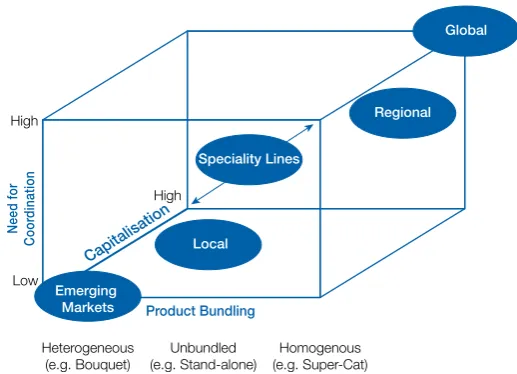
[image:9.609.308.567.442.629.2]While primary insurance markets vary, reinsurance buying patterns can be clustered into five types according to parent company characteristics: Global, Regional, Local, Emerging Market and Specialty Lines buyers. Each type exemplifies particular strategies of reinsurance buying according to their different needs. As shown in the Cedent Positioning Cube (Figure 2.1) cedents differ on three related dimensions that emphasize different priorities in the purpose, products and organization of reinsurance buying: (1) degree of capitalisation; (2) bundling of the products purchased; and (3) need for coordination of buying. Taken together, these three dimensions also indicate potential trajectories for reinsurance buying as firms grow and mature.
Key points: Reinsurer buyers
• There are five cedent types that differ in their reinsurance buying strategies according to their capitalisation, need for coordination, and product bundling
• There is a general trend for larger cedents to centralise reinsurance buying decisions, centralise retention, and bundle risk into multi-territory products, which reduces their
proportion of reinsurance spend
• Traditional beliefs about personal relationships and continuity of cover are eroding in favour of cost-effective business relationships
• These changes are increasing opportunism in buying reinsurance
• In a more opportunistic marketplace, cedents can enhance their attractiveness to reinsurers by managing their information quality and programme transparency, within the context of their market maturity
High
High
Heterogeneous (e.g. Bouquet)
Unbundled (e.g. Stand-alone)
Homogenous (e.g. Super-Cat) Low
Need for
Coor
dination
Product Bundling Capitalisation
Speciality Lines
Emerging Markets
Local
Regional Global
2. Who are the buyers and what do they want?
(cont.)
Capitalisation: The purpose of reinsurance is to support risk transfer from the cedent to the reinsurer through the provision of capital. Hence, the level of capitalisation in cedents influences their reinsurance needs. Well-capitalised insurers, particularly those with high capital efficiency arising from well-diversified portfolios, do not need reinsurance to grow or to alleviate overall volatility of the risk portfolio. Rather, they require it to cover peak risk. By contrast, less well-capitalised players require reinsurance as a source of affordable capital, enabling them to grow. In particular, transferring risk via reinsurance reduces the amount of capital they need to hold in order to stay afloat or realise their ambitions for growth. Hence, by proxy, buying reinsurance is an affordable way of freeing up or accessing more capital. Reinsurance thus needs to compete as a cost effective source of capital with both other forms of access to capital and also with a firm’s own capitalisation.
While larger, more diversified insurers are typically more capitalised than smaller, or emerging market buyers, some features of ownership structure, such as public ownership or mutual ownership, also affect the need for capital. For example, mutuals are more dependent on reinsurance as a source of capital because they do not have the same access to capital as listed companies.
Product bundling: The extent to which reinsurance products are bundled and the form that bundling takes are a feature of a cedent’s size, complexity and capitalisation. At one end, small insurance firms bundle different lines into a single product: Such as a bouquet of motor, property, fire and engineering risks. Even where lines are presented separately there may be an expectation that they will be written on a whole account basis, with the reinsurer required to take an equal share across all lines and layers. This is known as heterogeneous bundling because the ceded programme contains multiple different, or heterogeneous, risks. The reason for heterogeneous bundling is that the cedent has some small programmes that would not be viable as stand-alone programmes, or are not attractive on their own, but may be traded in a bundle with other risks. Thus, heterogeneous bundling is an efficient method of risk transfer, which remains popular with small domestic and emerging-market insurance firms. While it is complex for reinsurers to evaluate precisely the different risks being transferred, the amount of premium required is typically relatively small, and the product is often purchased on a quota share basis. As insurance firms become larger and more mature,
they develop sufficiently large programmes, they trade these on a stand-alone, line-by-line basis. Such programmes are typically single territory, or combine a few similar territories, for the cover of a single type of risk, such as a third party motor liability product, or a Cat cover. The products are generally simpler and more transparent than bundled products.
At the other extreme, large insurance companies with accumulations of a particular type of risk, favour bundling this into a multiple territory programme. For example, all Cat risk from property, marine, etc., is pulled together across territories into a single bundled programme, such as a Pan-European, or USA nationwide cover, or an even wider cover, such as the regional and global aggregates and so-called Super-Cat products purchased by large multinational insurers. This is known as homogenous bundling because the programme contains a single type of risk. These risks are typically placed on an excess of loss basis and are popular with large cedents because they enable capital and resource efficiency in purchasing cover and support the transfer of peak risk. However, homogenously bundled risk is complex to evaluate. For example, such programmes may combine mature and less developed markets, each of which has variable information quality about the precise nature of the risk in that territory. Similarly, the capital efficiency assumptions that underlie the bundling of different territories may not be clear.
2. Who are the buyers and what do they want?
(cont.)
2.1.2 Variation in cedent types
As displayed in the Cedent Positioning Cube, there are five main types of reinsurance buyers that vary according to their capitalisation, need for coordination, and type of product bundling: Emerging Market, Local, Regional, Global and Specialty Lines Buyers.
Emerging Market Buyers are not necessarily small. However, they typically have lower need for formal coordination because: i) they are less likely to have a highly diversified or complex portfolio of risks, as many products are not in demand in the
primary market; ii) they tend to operate in a single territory or small number of similar territories. Most Emerging Market Buyers require reinsurance for access to capital and to alleviate the volatility of their portfolio as a whole, because they operate on relatively small margins and reserves. Commensurate with their need for capital, they tend to favour quota share products and heterogeneous product bundling, such as bouquets and whole account cover.
Local Buyers are cedents that retain strong domestic market affiliation and usually purchase local covers as stand-alone programmes. They have relatively low need for formal, centralised coordination. While they may develop multiple lines of business, their size and scope enables reinsurance buying to remain within a relatively small span of central oversight and control. As they develop sufficient size and/or maturity, they unbundle bouquet products, developing stand-alone products, such as separate motor, property and other programmes. Because of their size, Local Buyers tend not to have high capital efficiency and reinsurance remains a necessary source of capital to support risk transfer and firm viability.
Regional Buyers are cedents that have extended beyond their domestic market to include surrounding regions, leading them to buy regional rather than predominantly local risk covers. While these may be cedents operating across multiple countries within a region, such as Europe, in large countries with diverse exposure to perils, such as the USA, a nationwide company should also be considered a Regional Buyer because it covers multiple territories and perils that diversify exposure. Regional Buyers have more complex divisional structures that necessitate coordination of reinsurance buying. They also have the scale to sustain a central reinsurance buying
department and, with increasing diversification, greater capital efficiency and, potentially, capitalisation to retain a greater share of their risk. However, need for capital may vary according to whether reinsurance is seen as a cost effective form of capital enabling growth into new territories. As Regional Buyers grow, their individual lines of business generate sufficient volume to be bundled across different territories. Therefore, there is a shift from stand-alone lines to homogenous products, such as Pan-European covers or, for regions such as the USA, multi-peril nationwide covers.
Global Buyers are at the peak of all three dimensions of the Cedent Positioning Cube. They have high need for coordination because of the diverse territories and lines of business covered and their complex multi-divisional structure. They thus benefit from centralised reinsurance buying. As they have high capital efficiency arising from diversification, as well as the size and scope to retain a significant amount of their risk, access to capital is not a key driver
of reinsurance buying. Rather, reinsurance is seen as a means of securing cover for peak risk. As part of their trend for capital efficiency and central coordination, Global Buyers tend to bundle homogenous risks across territories, developing regional or global catastrophe and per-risk programmes.
Specialty Lines Buyers are those cedents that are only in specialty areas, such as credit and surety, agriculture, marine or aviation. While they are often part of a multi-line insurer, they are separated for reinsurance purchasing to accommodate their requirement for specialised underwriting expertise. They have been partially separated in our analysis because they have some different purposes and needs from other cedents. Depending on their size, market maturity and parental structure, they may differ along the three dimensions. Hence, they are not a true ‘type’ but may reflect characteristics of one of the other types. Nonetheless, they typically have relatively low coordination needs compared to Regional or Global Buyers, buy stand-alone programmes, and tend to purchase products such as quota share (QS) that are typically associated with access to capital.
As shown by the arrows in Figure 2.1, these types also represent a trajectory for reinsurance buying as firms grow and mature. For example, as Emerging Market Buyers mature they may become Local Buyers, while growth may turn them into Regional or Global Buyers.
“We don’t buy proportional; they’re fundamentally capital support. We don’t need capital support; we have huge access to the capital markets. Any time we want money we just put up a hand.”
(Global Buyer) “We prefer
proportional; we think it’s safer. It’s been a natural progression starting with quota share and a quota share surplus. It feeds confidence in being able to write the business and yet still having the protection of a proportional treaty.”
2. Who are the buyers and what do they want?
(cont.)
Currently, the most evident trend on this trajectory is the shift towards Regional and Global Buyers, arising from a combination of acquisition and organic growth.
2.1.3 Reinsurance buying purpose and products
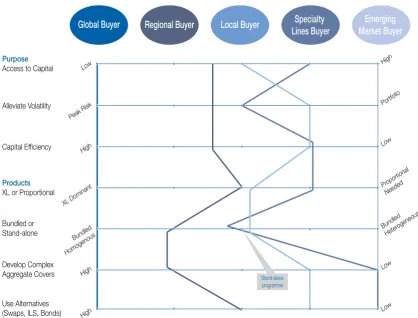
While any specific firm will vary a little from the types illustrated in the Cedent Positioning Cube, a cedent that is ‘true’ to type will cluster around some buying strategies as opposed to others. For example, a cedent seeking reinsurance as a primary source of capital is likely to also purchase proportional products. These clusters are illustrated in the Cedent Purpose and Product Chart (Figure 2.2), which shows that Global and Emerging Market Buyers cluster at opposite ends of the spectrum in terms of their reinsurance buying purposes and products.
Global Buyer Regional Buyer Local Buyer Specialty
Lines Buyer Market BuyerEmerging
Purpose
Access to Capital
Alleviate Volatility
Capital Efficiency
Products
XL or Proportional
Bundled or Stand-alone
Develop Complex Aggregate Covers
Use Alternatives (Swaps, ILS, Bonds)
Low
Peak Risk
High
XL Dominant
Bundled
Homogenous
High
High
High
Portfolio
Low
Proportional Needed
Bundled Heterogeneous
Low
Low
[image:12.609.90.509.431.749.2]Stand-alone programme
Figure 2.2 Cedent Purpose and Product Chart: Who is Buying What?
Key implications of buyer types
• Consolidation is generating a trend towards large, complex Global Buyers
• The larger and more complex a cedent is, the more centralised its reinsurance buying and the more that it tends towards homogenous bundled products
• Homogenously bundled products are complex because they are not connected to any specific local market and the assumptions about the different primary markets on which they are based may not be transparent
2. Who are the buyers and what do they want?
(cont.)
Purpose indicates the degree to which reinsurance buying is driven by access to capital and/or the need to alleviate volatility of risk. The distinction between peak risk and portfolio risk also differentiates Global and Regional Buyers who can retain a reasonable level of portfolio volatility from Local and Emerging Market Buyers who lack the capitalization and capital efficiency to do so. While Local and Emerging Market Buyers
tend towards the right-hand side of the diagram, the extent to which they are reliant on reinsurance to trade is also a useful indicator of their overall viability.
Products refers to the predominance of
non-proportional - typically excess of loss (XL) - and proportional - typically quota share (QS) - products favoured by cedent types, and is associated with access to capital. While Emerging Market Buyers typically buy QS in order to access capital on a partnering basis, their ability to grow their business and transition to XL, at least on some lines, is an indication of internal underwriting discipline and growing maturity. Local Buyers and, to a lesser extent, Regional Buyers, tend towards QS, particularly if they are mutual Regional Buyers, particularly where they are mutual insurance companies that are restricted in their ability to raise capital by other means. Specialty Lines Buyers are a separate case, as they are predominantly a QS market.
‘Bundled’ refers to three main patterns discussed in Figure 2.1, homogenous (e.g. Super Cat), stand-alone, and heterogeneous (e.g. bouquet) products. In particular, consistent with the trend to Global and Regional Buyers, there is a growing class of products that arises from centralised buyers bundling homogenous products, particularly catastrophe exposure, into large and complex regional or global covers. These products are one of the fundamental changes arising from consolidation in the primary insurance industry.
‘Alternatives’ refer to a range of primarily collateralised market products, such as swaps, Cat bonds, and Insurance Linked Securities (ILS), which are currently seen as a supplement to, but not a substitute for, reinsurance. While they are not usually particular enough to Specialty Line Buyers’ needs and are beyond the requirements of most Emerging Market and Local Buyers, they are attractive to those needing
capacity, such as Global and, to a lesser extent, Regional Buyers. They represent a growing class of products that provide viable cover. In particular, the amount of Cat capacity required to meet the demands of bundled homogenous products increases the comparison with and potential substitution from collateralised market products. They thus represent a threat to the amount of premium placed through reinsurance programmes.
2.1.4 Coordinating reinsurance buying
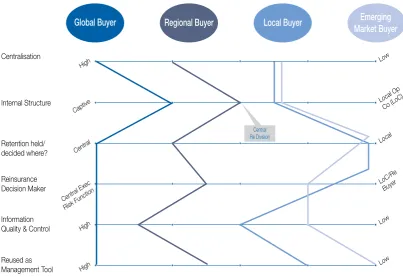
As the Reinsurance Procurement Chart (Figure 2.3 overleaf) shows, the way that reinsurance buying is coordinated affects the level of retention, the quality of information and the level of decision-making. As Specialty Lines Buyers reflect the buying patterns of various types, they are not considered separately in these results. This section explains some of the choices available to cedents in deciding how to coordinate their reinsurance buying.
Centralisation: Due to their
need for coordination, Global and Regional Buyers typically have a very centralised approach to buying reinsurance through a central reinsurance division. These reinsurance divisions vary
in type and may include one or more of the following structures: A captive; a reinsurance profit and loss division; or a service centre. Such divisions are often larger than many of the reinsurers with which they trade. Centralised buying involves assuming risk from the local operating companies (LOCs), retaining some proportion at the centre, and ceding the remainder to the reinsurance market, which can vary in the following ways: (i) transfer some of the risk to the open market in bundled homogenous programmes, so transforming the original local risk covers into a multi-territory group risk cover; and/or (ii) take a share of all the local programmes centrally and cede the remainder of each to the reinsurance market within each local territory; and/or iii) leave some covers as stand-alone local programmes where there are pricing benefits, or where it is required by local regulators.
Retention: Organizing reinsurance buying is not simply a matter of coordination but also of maximising the capital efficiency gained from group diversification. This is done by centralising decisions about the level of retention. Global and Regional Buyers make central decisions about retention, even where LOCs are able to purchase their own cover. Local and Emerging Market Buyers generally have local retentions, both by virtue of their local scope, and their primary concerns
“They start as risk traders; they don’t carry a lot of risk. Their retentions are very low. They are putting less of their own money on the risk. That’s why I call them risk traders rather than risk carriers. They take risks with the understanding that those risks are poor, but because they are highly reinsured they don’t care”.
(Reinsurer)
“Fragmented buying is just inefficient; they’re spending a lot more than if they did it smarter”.
Global Buyer Regional Buyer Local Buyer Market BuyerEmerging
Centralisation
Internal Structure
Retention held/ decided where?
Reinsurance Decision Maker
Information Quality & Control
Reused as Management Tool
High
Captive
Central
Central Exec Risk Function
High
High
Low
Local Op Co (LoC)
Local
LoC/Re Buyer
Low
Low Central
[image:14.609.106.510.112.389.2]Re Division
Figure 2.3 Reinsurance Procurement Chart
2. Who are the buyers and what do they want?
(cont.)
with risk transfer, rather than capital efficiency. Centralised buying typically raises the amount of risk retained and reduces the premium ceded to the reinsurance industry.
Information: Generally, the more centralised the buying, such as in Global and Regional Buyers, the better the quality of information underpinning the reinsurance programme. This is because the internal reinsurance division has to
assume a proportion of the risk from the LOCs and so has both access to data and a vested interest in the quality of information being received. Hence, while the bundled homogenous covers that these cedents purchase are complex, they should also be built on sound information, which may mitigate some of their problems with transparency and lack of connection to the underlying primary risk. Local Buyers often have good information about their own programmes by virtue of their closeness to the underlying business, even where they are not in information-rich territories. Emerging Market Buyers typically lack the data capture systems for collecting primary insurance data and developing it into robust reinsurance information, particularly where the underlying market is subject to
rapid change. Quality of information can thus be a key differentiator in selecting these buyers.
Decision-making authority: Generally, reinsurance buying is shifting from individual decision-making to committee decision-making, which is also shifting the nature of reinsurance relationships from personal to business-to-business relationships. All reinsurance buyers are required to justify their purchasing decisions, both in terms of cost effectiveness and extent of risk cover. In Global and Regional Buyers, this decision is usually made as part of a group risk or senior executive committee. Hence, the reinsurance buyer is a key person in the decision chain but is rarely the sole decision maker. By contrast, the reinsurance manager in a Local Buyer will often have significant decision-making authority. For Emerging Market Buyers the cost of reinsurance is a key constraint on the buyer’s decision-making authority, as reinsurance rates must reflect the profitability of the underlying primary insurance market, even where this is difficult to balance with the need for risk transfer. Hence, the perception that the lowest price is the best price in emerging markets.
“They went from buying proportional to non-prop and stopped ceding treaties from local operating entities. A lot of meat from the bone was gone for us; we lost 50% of our premium just due to this”.
2. Who are the buyers and what do they want?
(cont.)
2.2 Busting myths: What do cedents really want?
These changes in reinsurance buying dispel some myths about relationships and continuity on which the reinsurance industry has been built. Specifically, consolidation in the primary insurance industry is leading to a more pragmatic approach to reinsurance relationships, which is sometimes termed opportunistic. Hence, while opportunistic behaviour has previously been considered an industry ‘taboo’,
large cedents that cede high-volume premium are increasingly opportunistic in their reinsurance buying in all but their most core partnerships.
2.2.1 Cedent requirements from reinsurers
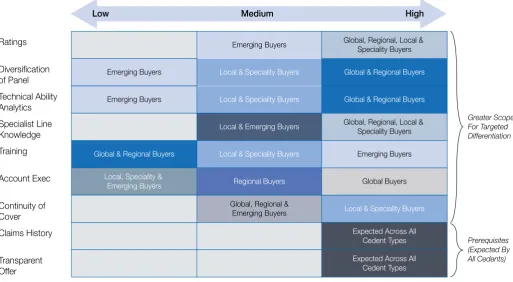
The Reinsurer Service Segmentation Chart (Figure 2.4) shows what cedents require from their reinsurers. Those items at the bottom right of
the figure – such as claims history – are prerequisites, required by all cedents. The other items – such as training and ratings – are differentiators, meaning that cedent types have different requirements that allow reinsurers to develop competencies and tailor their offering to those cedents. These differentiators should, however, be taken with some caution; they are price dependent and must meet the
terms of a consensus market. Hence, in the current world of ample capacity and fierce competition to provide capital from within and outside the reinsurance industry, price is also a critical differentiator.
While all reinsurers need to provide the prerequisite factors, they simply enable them to be in the game. For example, paying reinsurance claims is critical and neither a high security rating nor superior technical
“Price is one of the most important things for me. Because I think it could be cheaper. I have to explain to my clients, my business unit why they have to pay so much money for a reinsurance contract.”
(Cedent)
Ratings
Greater Scope For Targeted Differentiation
Prerequisites (Expected By All Cedents) Technical Ability
Analytics Diversification of Panel
Training
Account Exec
Continuity of Cover Claims History
Transparent Offer
Specialist Line Knowledge
[image:15.609.47.561.506.788.2]Low Medium High
Figure 2.4 Reinsurer Service Segmentation Chart: What do Cedents Need?
(Low to high is the strength of the cedent’s need for a particular item from their reinsurers) Emerging Buyers
Local & Speciality Buyers Local & Speciality Buyers
Local & Speciality Buyers Local & Emerging Buyers
Regional Buyers
Global, Regional & Emerging Buyers
Global, Regional, Local & Speciality Buyers
Local & Speciality Buyers Global & Regional Buyers
Global & Regional Buyers
Global, Regional, Local & Speciality Buyers
Global Buyers Emerging Buyers
Expected Across All Cedent Types
Expected Across All Cedent Types
Emerging Buyers
Emerging Buyers
Global & Regional Buyers
Local, Speciality & Emerging Buyers
Key implications of centralised
reinsurance buying
• There is a trend to centralised buying to increase efficiency of purchasing
• Centralised buying lifts the level of retention, as cedents make more effective use of their diversification for capital efficiency
• Commensurate with this shift, there is also a trend to purchasing more complex multi-territory products
2. Who are the buyers and what do they want?
(cont.)
ability will compensate for a poor claims history. Yet paying claims will not accelerate a reinsurer to the top of the list beyond other factors because it is expected that reinsurance will provide cover for claims as a base condition. Another critical prerequisite is transparency of offer. While reinsurers often say that continuity of cover is critical ‘for the relationship’, for many cedents, particularly those placing big programmes with high capacity needs, continuity is less important than transparency from their reinsurers; they want to know early if the reinsurer intends to withdraw or reduce support and why. They are then very pragmatic about the business needs of their reinsurers, such as needing higher prices than the cedent is willing to pay. Indeed, almost all cedents are willing to work with even overtly opportunistic reinsurers for capacity purposes, providing that is a clear part of their offering, and all cedents dislike reinsurers who change their message or withdraw cover unexpectedly.
Differentiators fall into a few broad categories to do with security, service and capacity. For example, security is critical as a minimum A-rating level is required within the governance code of most cedents. However security requirements for some Emerging Market Buyers are below an A-rating, meaning that the top-rated reinsurers may not even see them. While additional layers of security, such as the extra ‘guarantees’ provided by Lloyd’s, provide some additional benefit this is not a critical differentiator for Global Buyers. Rather, they conduct their own internal security ratings, including issues such as ratios of risk transfer to capitalisation, calculating the amount of risk they are willing to transfer to a reinsurer as a percentage of that reinsurer’s capitalisation. Furthermore, while diversified risk transfer has been considered important, this is primarily for capacity rather than for security reasons. For example, Global Buyers first place much of their cover with 3-5 main reinsurers, and then spread the rest across the market for capacity rather than diversification reasons, while other buyers diversify primarily to ensure that they are not overly dependent on one reinsurer, rather than to ensure capital from diverse sources.
Services, such as training, technical ability, specialist line knowledge and account executives are variable requirements, depending on the cedent’s needs. Global Buyers, for example, require reinsurers with the technical ability to understand their complex programmes but are not typically dependent on reinsurers for technical support with structuring reinsurance programmes, other than in a few exceptional cases of new product development with
Buyers are more dependent on their reinsurers to provide technical support, they typically have less information and are in less analysable regions, so that technical ability in a reinsurer is not a key differentiator; standard technical ability will be sufficient to work with these buyers. Emerging Market Buyers also appreciate services such as training that are not needed by Regional and Global Buyers. Finally, while cedents enjoy having an account executive appointed specifically to their programmes, it is not a differentiator on its own but must occur in conjunction with other factors. It is primarily beneficial to larger buyers, where the complexity of programmes warrants a dedicated point of contact from a supplier. Given that services come at a cost to reinsurers, it is important that they are targeted to areas where they can provide opportunities for differentiation and also a return on investment.
Two other factors that reinsurers often claim as differentiators are relationships and continuity of cover. While these are important to cedents, as shown in the Partner Prioritisation Chart (Figure 2.5), their expectations are in proportion with the importance that they accord to the partnership, differentiating between core and mid-tier partners and peripheral players. For example, the depth (how close the knowledge of each other), breadth (multiple points of contact in the respective firms), and frequency (number of contacts each year) of the relationship are determined by segmentation; cedents want to see more of their most important reinsurers and are satisfied with maintenance activities from others. Relationship building activities, such as conferences, site visits
Significance of Cover (+ e.g. Size, Continuity & Breadth)
Closeness of Relationship (+ e.g. Frequency, Breadth & Depth) Low
High
Low High
Peripheral Players
Mid-Tier Partners
[image:16.609.311.569.360.567.2]Core Partners
2.2.2 Ensuring attractiveness to sellers
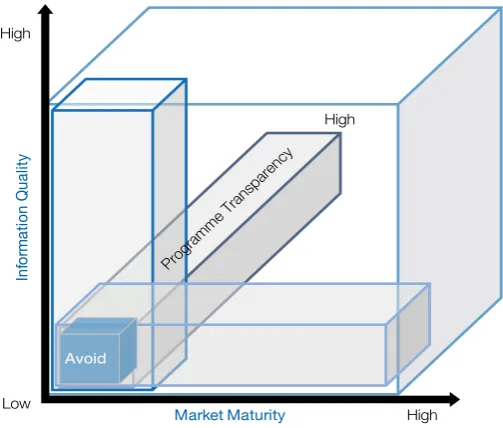
As relationships become more focused on cost-effectiveness, it is critical that cedents ensure that their business model is attractive to reinsurers. This will enable them to get the best rates in soft cycles and to access capacity in hard cycles. The Cedent Attractiveness Cube (Figure 2.6) illustrates three interrelated indicators, on which cedents may assess and enhance their attractiveness: Programme transparency, information quality and market maturity. Any cedent can improve attractiveness on the first two indicators and also mitigate the effects of low market maturity. These indicators are now explained and illustrated with some scenarios of how they may be combined by different buyer types.
Programme transparency comprises two
elements: Year-on-year consistency and technical transparency. Year-on-year consistency is important because reinsurers dislike ‘smokescreen’ structural changes that complicate comparisons, particularly after an event, as they generate an impression that there is something to hide. The more comparable programmes remain across years, the more easily reinsurers can evaluate changes in the portfolio and ask sensible questions to understand and provide adequate risk cover. Technical transparency is equally important to facilitate analysis. Programmes that fail to define inclusions and exclusions, conflate multiple perils within layers, or have complex wrap-around structures obscure the risk being reinsured and complicate underwriter analysis. The less transparent a programme is, the more broking and negotiation time it takes to place. This will make it less efficient for the
2. Who are the buyers and what do they want?
(cont.)
order to access and understand business (see Report 1(1)). However,
these necessary activities are rarely differentiators, particularly for big cedents, except with their core partners.
Similarly, issues such as the size (amount of capital), continuity (renewal of programmes) and breadth (across multiple programmes) of cover may be subsumed within significance of cover. Provision of significant capital to a cedent is a differentiator, under which issues such as continuity of cover also become important. Simply, no cedent wants to lose
a significant amount of capital from a core partner because this is more difficult to replace. There is, thus, a genuine desire to retain continuity of cover with core partners, although this is price sensitive. As cedents become more centralised in their reinsurance buying they are more prone to ‘opportunistic’ purchase, as decisions must be justified with a risk or reinsurance committee on the basis of a cost-effective business relationship. While cost-effective does not mean lowest price, only marginal increases in price can be allocated to long-term relationships. Bigger lines or better signings for core partners is a way of providing value to those business relationships, as are private placements. Yet cedents, particularly large buyers, are also pragmatic about losing continuity of cover and accepting ‘opportunism’ by reinsurers. Indeed, while both buyers and sellers have historically seen opportunism as a negative behaviour, this view is losing validity in the reinsurance industry. Rather, sound and transparent business decisions on both sides are welcome, so that withdrawal by either party on the basis of changing price expectations and risk appetites is signalled in a timely fashion prior to renewals.
(1) see Report 1 for findings on reinsurer relationship-building (Jarzabkowski et al. 2010. ‘Trading Risks: The value of relationships, models and face-to-face interaction in a global reinsurance market.’ Executive Report: Insurance Intellectual Capital Initiative).
“You see very quickly who are really the long-term players and who are the opportunistic ones. You know that with some players if you have the biggest loss in history, they will still look for the cheapest price after because they are very opportunistic. So you have to be very opportunistic with them or not work with them at all, otherwise there is no fit.”
(Reinsurer)
Market Maturity
In
fo
rm
at
io
n Qu
al
ity
Programme Transparency High
Low
High High
[image:17.609.314.566.321.535.2]Avoid
Figure 2.6 Cedent Attractiveness Cube
Key implications for relationships
and opportunism
• Traditional beliefs about reinsurance as a relationship and continuity business are eroding with all but core partners
• Cedent expectations of reinsurers are
increasingly based on cost-effective business relationships with core providers
• These changes are leading to a more
2. Who are the buyers and what do they want?
(cont.)
broker to place, decrease the chances that reinsurers will understand it, and so reduce the potential panel of quality reinsurers.
Programme transparency is particularly important with bundled products that are, by nature, complex. The technical transparency of heterogeneous programmes can be improved by supplementing this with market data, as they typically reflect the underlying conditions of a specific primary insurance market. By contrast, bundled homogenous programmes
are not closely linked to the various primary insurance markets that they cover and so may contain unintended surprises for reinsurers. Their technical transparency can be improved by high quality information that clearly shows the assumptions about capital efficiency and exposure made by the cedent in developing the programme. Lack
of transparency comes at a cost because technical reinsurers are likely to load the rate-on-line with an ‘uncertainty factor’ to compensate for a lack of analysability.
Information quality is a key dimension of risk
appraisal. It is measured by accuracy, granularity, and verifiability (see Report 1(2)). High quality information
accurately specifies the value of insured assets; for example, a particular cluster of properties in a designated area. Granularity reflects the level of detail with which insured values are covered, for instance, whether property values are aggregated by district or postcode, helping to improve the accuracy of estimates about a potential loss. Verifiability measures the extent to which cedent-provided data can be cross-checked against information from independent sources, such as vendor models, ratings agencies, or subscription databases such as Perils®. High quality information is also presented in a standardized, easily analysable form, which supports
programme transparency.
The quality of publically verifiable information and the levels of granularity available may not be fully within a cedent’s control, particularly where cedents are in less information-rich territories. For example, the granularity of data within vendor models drops steeply outside the USA and a select number of mature Western
“If the level of information is really insufficient and we don’t feel comfortable, then we don’t write. I would personally rather write a programme where I think it’s too cheap but I have good access to information, than the other way around.”
(Reinsurer) (2) Jarzabkowski et al. 2010.‘Trading Risks The value of relationships, models and face-to-face
interaction in a global reinsurance market. ’Executive Report: Insurance Intellectual
“We like to think there’s lots of technical pricing going on, but you generally have a lack of data; a lack of transparency in the risk you’re actually taking.”
(Reinsurer)
can be taken to improve information quality. For example, information about the cedent’s governance, portfolio, and underwriting practices can be provided and verified by allowing reinsurers to audit books during on-site visits. Additionally, quantitative data can be gathered to improve systems and data quality each year. Such data can be incorporated into submission documents and supplemented by brokers who may have additional market data to support cedent-specific material. Cedents can also demonstrate strong commitment to information quality by: i) ensuring that consistent information is available during every meeting with reinsurers (e.g. conference meetings should be supported by information on what a cedent writes with that reinsurer and how it has performed for the reinsurer in previous years); ii) clarifying and explaining at submission, if the information provided is different from the information given at a conference or site visit; and iii) being transparent about gaps in information. While these sound like common sense, they are often missing from cedents’ programmes.
Market maturity is strongly correlated with the other indicators, because more mature markets have greater levels of public information available, including year-on-year market data, better systems for accessing data and greater stability in the market for conducting comparisons or analysing the probability of loss. All of this increases the accuracy, granularity and verifiability of information in mature markets. Higher quality information can be converted into more transparent programmes. However, this does not automatically mean that more mature markets are more attractive to sellers. Attractiveness depends on how cedents combine the three indicators to be the most attractive or ‘best-in-class’ of their type. Below, we suggest three scenarios, relating to different levels of market maturity, as examples of how buyers may increase their attractiveness by improving their performance on the other two indicators.
Combining indicators to increase attractiveness
as well as access to modelled data. By comparison, the information they receive from Emerging Market Buyers seems sparse and may give the impression that the cedent is hiding something. Providing reinsurers with as much comparative data as possible can counteract deficiencies in public information. For example, giving as much year-on-year data as possible, explaining
gaps in data and steps taken to address these, providing explanations for projected growth, and explaining any changes that compensate for problems with past performance will heighten confidence in the particular cedent. At the same time, cooperating to provide wider market data will enable reinsurers to perform market comparisons. Quality of information and programme transparency can enable an Emerging Market Buyer to stand out from its peers as a ‘market pick’ for risk transfer. Additionally, by sharing data, a buyer can benefit from reinsurer knowledge and training and develop a closer partnership for product development, which may enable them to outperform their peers in the primary market.
In conclusion, no cedent is innately attractive to the reinsurer pool, as different reinsurer types have different strategic appetites and different perceptions about acceptable rates of return. Furthermore, reinsurers are hesitant about and/or charge more for products that they do not understand. Improving attractiveness is within the control of all cedents and will ensure their appeal to the widest set of high quality reinsurers.
2. Who are the buyers and what do they want?
(cont.)
low rates are attractive to reinsurers. They do this by providing high quality information to show the discipline of their underwriting and ability to contain losses that would erode the thin margins available on their programmes. Such information should underpin programme transparency, making it possible for reinsurers to better evaluate the rate of return against the level of risk.
2. G lobal and Regional Buyers are often combining mature markets with less developed markets and multiple perils within a bundled multi-territory product. While it is efficient for cedents to incorporate business from more and less analysable markets within a single product, these products lack transparency to reinsurers; as illustrated by the Thai floods in 2011, reinsurers do not want to find that covers contain surprises of which they were unaware. Additionally, the capital efficiency assumptions that
underlie the bundling of different territories may not be clear to the reinsurer. They do not want to take the cedents’ diversification model on faith, but rather, on transparency of information. This is particularly important as many reinsurers allocate capacity by territory and so need to know what their risk accumulation is for any particular territory, in order to understand how a global risk cover affects their own capital efficiency and diversification. Hence, it is critical that bundled multi-territory and multi-peril products: i) are transparent in identifying the different markets within them; ii) provide ample information about the types of potential risk contained within each market; iii) show clearly how information has been gathered within those markets; and iv) show how capital efficiency and risk diversification assumptions underpin the combining of different territories and perils. This will add to programme transparency by giving confidence that the quality of information underpinning the programme is consistent across all markets.
3. Emerging Market Buyers lack the type of information expected by many global reinsurers. Additionally, there are few vendor models available for such markets. Reinsurers are usually working with cedents in data-rich markets, such as the USA, where they receive extensive data packs,
Implications for improving cedent
attractiveness
• Cedent attractiveness to reinsurers arises from a combination of programme transparency, information quality and market maturity • Improving attractiveness enables a cedent to
get the best rates from the best reinsurers, regardless of the market cycle
• Attractiveness of the underlying programme becomes more important as traditional notions of relationship and business continuity erode and are replaced by cost-effective business relationships
“I see a series of the same things from clients; pushing in remote earthquake covers. For some of these treaties we need to get rape and pillage prices. We need to push for significant improvements and be prepared to walk away. Multi-territory covers expose us to multiple perils. We can’t know every little exposure the client has.”
(Reinsurer)
“We tell them ‘this is a very necessary piece of information for us and if we don’t get the quality that we need, then we would have to reflect that in the pricing.’ Whereas somebody who gives us the full transparency, you just take it.”
2. Who are the buyers and what do they want?
(cont.)
2.3 Conclusion: Implications of changing buyer behaviour
Our study has noted a number of trends that are important in charting the changing landscape of the global reinsurance industry. Taken together these trends in buyer behaviour provide both valuable templates, but also the following four caveats that should temper the shift to large-scale homogenised products:
First, centralised buying increases efficiency at the cost of reinsurer diversification. While large programmes may require much of the global capacity available, so having a large panel of reinsurers, they are also complex to write and lack transparency for most reinsurers. Hence, significant lines are placed with only a handful of key reinsurers followed by a high volume of smaller reinsurers. This calls into question the diversification of the reinsurance panel, as some 60% or more of global programmes may be placed with the top 5 reinsurers, leaving relatively small shares among the remaining 40-60 smaller reinsurers. There is thus, a trade-off between core partnerships with those reinsurers who are significant capital providers and capital lock-in, as significant capital providers may be hard to replace.
Second, bundling is complex, increases global connectivity of markets, and may contain unintended ‘surprise exposures’. Most reinsurers lack the capability to adequately analyse and understand such risks. While these reinsurers may write lines in softening market cycles, they will be cautious of unexpected losses and will focus more on understandable business, particularly in hard market cycles where they can drive the terms. Hence, it is imperative that cedents work on improving the attractiveness of their programmes for reinsurance providers.
Third, cedents may be unsure of the performance of bundled products when they face multiple unexpected events in different regions. Hence, the tendency to
bundling should be tempered with some caution about the desired level of complexity for both cedents and reinsurers. A series of smaller regional bundles, may, for example, be more attractive than a few larger bundles for many cedents.
Fourth, while homogenous, multi-territory product bundling is largely a consolidated player phenomenon, it provides a possible template for larger Emerging Market Buyers as they develop suitable information to support these covers. For example, multi-territory, multi-peril exposures are also relevant for large buyers in China and India, and these may rapidly develop covers similar to those purchased by USA nationwide insurers. Similarly, Pan-European risk covers may provide a model for other regional aggregation of risk cover. It will be critical to underpin such programmes with high quality information about exposures in, as yet, relatively unknown regions.
Summary of key trends in
reinsurance buying
• There is a trend to centralised buying as cedents grow and consolidate
• Centralisation is associated with a trend to bundled homogenous products
• Bundled homogenous products remove reinsurance premium from local programmes into global programmes
• The premium available from local programmes is declining as corporate parents assume a significant percentage of risk from their LOCs and Local Buyers are eroded through
consolidation
3. Strategic types: Bases of competition for reinsurers
Competition is becoming increasingly fierce for reinsurers. The pool of reinsurance premium available globally remains relatively static, while reinsurers seek new sources of revenue. Even as the number of larger reinsurers has increased through consolidation (each with larger market share targets), an increasing number of start-up subsidiaries are also increasing the competitive pressures. However, our findings show that reinsurers are not all competing from the same position, or for the same types of reinsurance products. Rather, reinsurers can be differentiated according to their strategic positions into five distinct strategic types, operating on different strategic appetites and perceptions of profitability. This section shows the implications of these strategic types for a reinsurance firm’s strategy, structure and underwriting process. It also outlines potential growth trajectories and areas of increasing competition as certain strategic spaces become increasingly crowded.
3.1 Strategic types and their different strategic positions
While the reinsurance industry traditionally has been segmented according to cultural stereotypes about Bermudian, Lloyd’s and Continental European reinsurance firms, these geographic sources of variation are too crude to adequately reflect the state of global competition. Rather, our research has uncovered five strategic types that compete on the basis of distinct business propositions. Although market proximity may afford locational advantages in accessing business, these strategic types are not restricted to any particular geographical region.
3.1.1 Strategic types
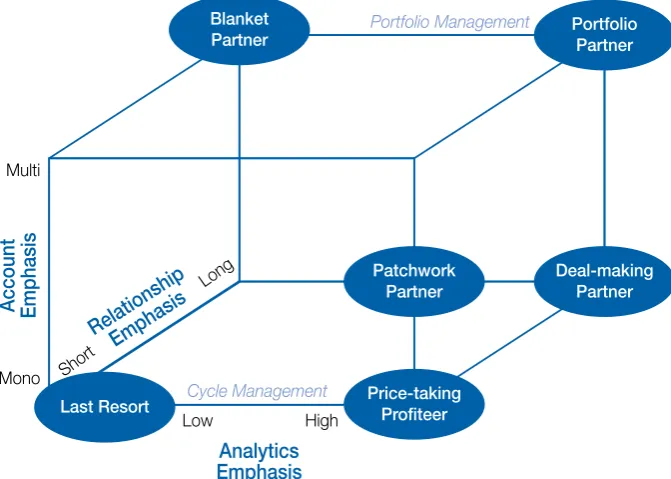
Five main types and an additional strategic ploy are plotted in the Reinsurer Strategic Positioning Tool
Key points: Strategic types
• There are 5 reinsurer strategic types with different strategic propositions based on their varying preferences for relationship longevity, whole accounts, and technical analysability • While there is increasing competition across the
market, a reinsurer’s strategic type has implications for its strategic appetite and primary strategic focus on either cycle management or portfolio management
• Structural tensions arise as reinsurers grow and expand globally, which impinges upon
underwriter empowerment and judgement • Different strategic types have different
underwriting processes that have varying degrees of trade-off between efficiency, speed and client servicing
• As reinsurers increasingly write global
programmes, they need to adjust their approach to underwriting and to exposure management, which may alter their structures and processes
Multi
Short
Long
High Low
Portfolio Management
Cycle Management Mono
Account Emphasis
Analytics Emphasis
RelationshipEmphasis
Last Resort
Portfolio Partner
Deal-making Partner Blanket
Partner
Patchwork Partner
[image:21.609.136.472.564.803.2]Price-taking Profiteer
3. Strategic types: Bases of competition for reinsurers
(cont.)
(Figure 3.1), according to the emphasis each places on three key dimensions of selecting business to underwrite: (1) relationship longevity; (2) mono-line or multi-line approaches to accounts; and (3) analysability of the business. Reinsurance firms’ varying prioritization of these dimensions in decision-making indicates their different perspectives on profitability and different strategic propositions.
Price-Taking Profiteers are
mono-line reinsurers whose strategic proposition is to provide capacity where it is needed, typically to support US catastrophe programmes. This type privileges the following in selecting business: i) deal profitability; ii) a transactional approach, where they are not willing to leverage low return deals for better ones; for example, writing a QS to get on an XL; and iii) technical and highly analysable business, such as US Cat, which
has a high RoE. The Price-Taking Profiteer typically springs up in a hard cycle to capture value at times when the market needs capacity, such as after a major event. It is, thus, very focused on short-term profitability. However, this approach, which requires strict adherence to cycle management, cannot be sustained in softer cycles unless the profiteer is protected by the capital structure of a corporate parent, which enables them to increase and decrease capital with the market cycle. Otherwise, Price-Taking Profiteers are under pressure during soft cycles to either return capital to their investors or morph into an alternative strategic type, which may be done intentionally as part of a strategy for growth and diversification, or may arise out of strategic drift from their hard line on profitability.
Deal-Making Partners are mono-line reinsurers with significant capital whose strategic proposition is to develop deals for cedents looking for tailored capital solutions, typically on catastrophe programmes. This strategic type privileges the following in selecting business: (i) programmes where large capacity is needed; (ii) discrete deals with good returns, where they can put down big lines
and write close to the risk; (iii) business relationships where there is potential for lock-in because of the high capital investment required to meet the capacity need
of a cedent; (iv) very technical and highly analysable business with a high RoE, such as big US catastrophe programmes or those requiring tailored solutions and private deals. While this type provides capital they are more than simply a capacity provider due to the significance of the deals they write, which can include taking an entire programme or layer for cedents with a particular need. They are, thus, relationship focused, within the parameters of their focus on superior returns. While there are few Deal-Making Partners, they take a disproportionate amount of the global premium available due to their business model and the capital they can provide.
Patchwork Partners are one of two ‘traditional types’ within the reinsurance industry. They are structured as line underwriters, even where they
write multiple classes of business. Their strategic proposition is to be flexible in assembling a portfolio of typically smaller lines and deals. This type privileges the following in selecting business: (i) evaluating each line on its own merits, rather than leveraging the multiple lines written across a particular cedent; (ii) continuity of relationships, but with a tendency to scale up or down their commitment according
to deal profitability in any given year, for example by moving to remote layers and watching lines; (iii) moderate technicality in conjunction with other factors, such as knowing the market or cedent when deals fall below the technical price; (iv) flexibility in moving along different dimensions in the matrix. The Patchwork Partner has a medium-term profitability horizon, offsetting lower-returning deals with more favourable ones within their overall patchwork approach to assembling a business portfolio. This type has considerable flexibility to pursue opportunities, within a clearly defined strategy of when to privilege different dimensions of our matrix. However, there is also a tendency to become ‘stuck-in-the-middle’, if Patchwork Partners drift into writing expiring lines over a succession of soft market cycles. This segment is highly competitive, comprising many small and medium-sized reinsurers, as well as encroachment from other types when they attempt small-scale diversification.
Portfolio Partners have a strategic proposition of generating capital efficiency and stable long-term returns through diversification. They thus take portfolio diversification seriously by writing multi-territory (scale), multi-line (scope), and short and long tail business
“Maximising your exposure to a risk when it’s well paid and minimising your exposure in its slightly less well paid periods. But all the time, you’re trying to hold that relationship and keep it strong.”
(Reinsurer)
“We work very hard at trying to craft the deal as opposed to just being a 5% yes or no on some Cat deal. A lot of what we do is bespoke; it’s not open market. We try to build extraordinarily strong relationships with the clients.”
(Reinsurer) “We don’t write business we don’t think is profitable. We don’t look at it as a loss leader. We just say: ‘Look, this is what we do for a living. You can show us your XLs and we’ll write them or not. Here’s the price, here’s the capacity’; and it’s more or less ‘take it or leave it’.”