City, University of London Institutional Repository
Citation
:
Lu, J., Jones, A. & Morgan, G. (2016). The impact of input quality on early sign development in native and non-native language learners. Journal of Child Language, 43(3), pp. 537-552. doi: 10.1017/S0305000915000835This is the accepted version of the paper.
This version of the publication may differ from the final published
version.
Permanent repository link:
http://openaccess.city.ac.uk/15926/Link to published version
:
http://dx.doi.org/10.1017/S0305000915000835Copyright and reuse:
City Research Online aims to make research
outputs of City, University of London available to a wider audience.
Copyright and Moral Rights remain with the author(s) and/or copyright
holders. URLs from City Research Online may be freely distributed and
linked to.
1
The impact of input quality on early sign development in native and non-native language
2 Abstract
There is much debate about the role of input and how its variation influences the child’s
growth of language. Sign development in deaf children offers a unique window onto this
question. Most deaf children are exposed to a sign language from their hearing parents who
are non-fluent adult models but a small number of children receive language input from their
deaf parents who are fluent signers. Thus it is possible to document the impact of quality of
input on early sign acquisition. The current study explores the outcomes of input in two
groups of children: deaf children of hearing parents (DCHP) and deaf children of deaf parents
(DCDP). Analysis of child sign language in an elicited vocabulary task revealed that the
groups did not differ on sign vocabulary at this age although DCDP had a more developed
semantic system indicated by their attempts to name more pictures and their more frequent
use of related signs when answering. In terms of phonological systems DCDP had more
handshape types compared with DCHP. In an analysis of naturalistic conversations deaf
parents used more sign tokens than hearing parents in their conversations with their children.
The differences in phonological repertoires found in the children were mirrored in the input
where deaf parents had more phonological types than hearing parents. Results are discussed
in terms of the effects of disrupted language acquisition on subsequent language abilities.
Keywords: phonological development, parental input, sign language, language
3
The impact of input quality on early sign development in native and non-native language learners.
The vast majority of child language learners become native speakers of at least one
spoken language. Children who are exposed to signed languages from birth from deaf parents
are also termed native signers and their sign acquisition show parallels in onset, rate, and
patterns of development compared to children learning spoken languages. Only around
5-10% of deaf children have deaf parents (DCDP) and in this small group of signers first signs
and early sign combinations appear at a similar age to first spoken words, early word
combinations, and syntax is also mastered along a similar timescale (Chamberlain, Morford,
& Mayberry, 2000; Morgan & Woll, 2002; Schick, Marschark, & Spencer, 2005; Morgan,
2014b).
The remaining 90-95% of deaf children who acquire signing are the off-spring of
hearing adults (DCHP) who do not know a sign language before their child is diagnosed deaf
(Spencer & Marschark, 2006). This means that the majority of deaf children are first exposed
to sign after the first few years. While these children are labelled non-native signers, for
them, sign is their first language. This is a very interesting question in itself, as it is almost
impossible for a hearing child not to be exposed to a spoken language from birth onwards,
although some rare cases do exist (Curtiss, 1977).
There are two aspects of this atypical language learning situation relevant here. DCHP
experience delays in exposure to both spoken and signed language because of deafness and
parents who begin to learn a sign language after their child is diagnosed deaf (Woll, 2013).
With the advent of the Newborn Hearing Screening Programme in the UK in 2006, the vast
majority of children with a hearing loss are identified by the age of six months. Even so, this
does not mean that DCHP are exposed to sign language at an early age. First, their parents do
4
until after that point. While the deaf child gets older the parents then need to start the process
of learning for them at this point, a foreign language. Secondly, DCHP receive non-native
sign input from hearing parents just learning the language. The rest of this study focuses on
this second aspect: quality of input.
There is some understanding about what these two factors mean for non-native
signers’ eventual level of mastery (Newport, 2002; Ferjan Ramirez, Lieberman & Mayberry
2013; Morgan, 2014). However this research for the most part focuses on the end-state of
non-native language acquisition. In contrast, there has not been very little examination of the
actual signing skills of young DCHP compared with same age native signers, as they are
acquiring the language. Nor has there been much work on the quality of the sign input to
DCHP from hearing parents who themselves are beginning to learn to sign. It is not
comparable to include children who are exposed to a language that is not the native tongue of
their parents (e.g. children of immigrants whose parents choose to speak the community
rather than the heritage language). This latter population do experience early input in a native
language through incidental learning and interaction with other children or adults even
though their parents speak to them in a non-native language. In contrast it is usually the case
that DCHP in the earlier years are only exposed to sign from their parents rather than the
wider deaf community.
There is one special population of children which has some overlap with DCHP.
These are children whose first language acquisition is disrupted due to international adoption
(IA) and subsequent exposure to another language in the adopted family (Gauthier &
Genesee, 2011). In the reported studies of these children the new first language develops
somewhat differently from the typical time course and leaves some long-lasting effects
especially involving the processing of phonology in working memory (Gauthier & Genesee,
5
Of the documented differences between DCHP and deaf children with deaf parents
(DCDP) one is for vocabulary. DCHP have slower sign vocabulary development than DCDP
(Mayne, Yoshinaga-Itano, Sedey and Carey, 2000; Moeller, 2000; Woll, 2012). Mayne et al.
(2000) reported an average vocabulary of 163 signs for a group of DCHP aged between 2-3
years old. This compares to an average of over 500 words for hearing children of the same
age (Fenson, Dale, Reznick, Bates, Thal, & Pethick, 1994) and over 300 signs for DCDP
(Anderson & Reilly, 2002; Woolfe, Herman, Roy, & Woll, 2010).There have been many
studies documenting how non-native signers process the phonological parameters of signs
differently to native signers. As in spoken languages, signed languages systematically
organize meaningless phonological units into meaningful ones (Stokoe, 1960; Brentari,
1998). The three main phonological parameters discussed in the literature are: handshape (the
configuration of the hand), movement (how the sign is articulated), and location (where the
sign is articulated). Similar to phoneme development in spoken language acquisition signing
children must acquire a repertoire of different handshapes found in the adult language. Again
in parallel to spoken language sounds, different handshapes used in the input to children
during their acquisition of sign language differ in their phonological complexity. For example
a fist handshape has a simpler phonological representation than a ‘Y’ handshape (as in the
telephone gesture forming a fist with protruding thumb and pinkie). For a full description of
sign language phonology see Brentari (1998).
Mayberry and Eichen (1991) addressed phonological processing as a potential
mechanism underlying differences in comprehension abilities between native and non-native
signers. They reported errors for adult native signers on a sentence shadowing task were
non-6
native adult signers produced far more errors with phonological substitutions (e.g. AND
instead of SLEEP where the orientation of the hand is the only difference between signs).
These studies demonstrate that adult signers with different language learning experiences
perform differently in language processing tasks. However they are retrospective in the sense
they demonstrate the outcomes of different early experiences rather than a description of
these experiences themselves. Rather than looking at the long-term outcomes of early
language experiences, in the current study we are interested in examining the contexts where
DCHP and DCDP are learning to sign and we focus on the phonological level.
During the early period of language acquisition all children appear to be particularly
sensitive to the process of encoding and piecing together phonological units (Vihman, 1995).
There is a relatively good understanding of sign phonological development in DCDP.
Handshape has been identified as the most difficult parameter to acquire followed by
movement and lastly locations (Meier, 2005; Boyes-Braem, 1990; Marentette & Mayberry,
2000; Morgan, 2006). When attempting to articulate a sign that contains a not yet acquired
complex handshape DCDP will often substitute the target form with a simpler one already in
their repertoire (Boyes-Braem, 1990; Marentette & Mayberry, 2000; Clibbens & Harris,
1993; and Morgan, Barret-Jones, & Stoneham, 2007). This process has been compared to
sound substitutions in spoken language acquisition; e.g. through consonant harmony (Smith,
1973; Vihman, 2005; Clibbens & Harris, 1993; Morgan, 2014). Although far less studied the
order of acquisition of phonological parameters appears to be the same for DCHP (Singleton,
Morford, & Goldin-Meadow, 1993). Morford (2003) described two deaf adolescents of
hearing parents who began to learn ASL in their late childhood (12-13 years). The children
made rapid progress in handshape development but did not produce phonological
substitutions. It is plausible that phonological substitution is a process linked to
7
simplification processes might be a different quality of phonological representations for
native signers compared with late learners. The resulting effects on DCHP’s processing
abilities could resemble the level of phonological sensitivity attained by second language
learners which might explain the findings of Mayberry & Eichen (1991).
There are some previous studies of how hearing parents sign to deaf children
(Arnesen et al., 2008; Hermans, Knoors, & Verhoeven, 2010; Musselman & Akamatsu,
1999). Lederberg (2006) argued hearing sign input constituted variable and low quality input.
Retrospectively we can assume that DCHP have some communicative experience with their
parents and at some point they formally began to learn a sign language but very little is
documented on the quality of that early input. Spencer & Lederberg (1997) found that
hearing mothers of deaf children produced as many spoken utterances as hearing mothers of
hearing children both when their children were 12 months and 18 months. However, hearing
mothers produced fewer signed utterances than deaf mothers, which in several studies has
been linked to the challenges hearing mothers have establishing joint attention with their deaf
children (Harris, 2010). Spencer & Lederberg (1997) reported that when their children were
12 months, hearing mothers produced from zero to 51 signed utterances. When the children
were 18 months old, the range was zero to 57 utterances. When signed and spoken utterances
were compared, some parents did not sign at all but used only spoken language, whereas
others were accompanying up to 81% of their spoken utterances with signed utterances.
As described previously early exposure to a sign language is quite rare in the deaf
community and so this sets up an unusual natural experiment. Deaf children with hearing
parents who sign with their children allow us to look at the importance of quality of input
from a novel perspective. Will exposure in early childhood to a sign language from hearing
parents lead to similar language acquisition patterns as described for native signers? It may be
8
is the age of acquisition only one part of the story, in the sense that timing and quality of
input are mutually important for ultimate attainment of first language development?
In summary while age of acquisition might be critical for the development of native
language abilities other factors may be implicated especially the quality of language input.
The current study investigated vocabulary and phonological handshape development in
DCHP and DCDP and examined in detail sign phonology input from deaf and hearing
parents.
Method
Participants
Fifteen child-parent dyads were included in the study (nine DCDP and six DCHP). Both
groups of children had been diagnosed severe to profoundly deaf by the time they were six
months old with a hearing loss of at least 75 decibels. At the point of data collection the
DCDP were aged between 29 and 63 months (mean age 39.22, SD = 13.19) and all of their
deaf parents were fluent signers. The DCDP were thus exposed to BSL from birth onwards.
At the point of data collection the DCHP children were aged between 34 and 60 months
(mean age = 44, SD = 11.19). All hearing parents were native English speakers and in the
period between identification of their child’s deafness and the data collection had achieved
level one BSL (Signature basic level). They indicated that they used English with their
children from birth onwards and BSL gradually from after identification at 6 months. Six of
the DCDP used hearing aids while three of them did not use any amplification. By
9 Procedure
There were two parts to the data collection: (1) a picture naming task performed by children
and (2) a spontaneous signed conversation between child and parent. Two deaf fluent BSL
signers (one of whom is the first author) coded all the signed communication from video
recordings and coded for the number and types of handshapes as well as phonological
substitutions in both children and parents.
(1) Picture Naming Task
Children were tested on the Picture Naming Game (PiNG) (Bello, Giannantoni,
Pettenati, Stefanini, & Caselli, 2012), which comprised 44 items: 22 noun and 22 verb
eliciting stimuli by a deaf fluent signer in BSL. Coders first scored if the sign was correct,
incorrect, or if there were non-responses. Errors were coded as phonological substitution (e.g.
the child substituted a different handshape to that of the target), an idiosyncratic gesture (the
child represented the action, function or shape of the target picture but not with any lexical
sign e.g. falling on the floor to sign FALL) or an alternative sign (either semantically related
or unrelated e.g., the sign FOX instead of DOG – related or HOUSE instead of SWIM -
unrelated). As a measure of children’s phonological repertoire we coded all the children’s
unique handshapes (handshape types) in this task.
(2) Spontaneous Signed Conversation
Parents and children were video-recorded during free play sessions which took place within
their homes. Adults were asked to play informally with their children using toys which they
typically played with together. Given the relatively wide age range, this was considered
10
ability to play and interact comfortably. We asked parents to ‘sign with their children as they
typically do at home.’ To avoid undue influence of the deaf person on the language of the
parent, the tester did not get involved in the conversation directly during filming. But it is
possible that having a deaf adult in the room might have made hearing parents sign more than
they normally do. Sessions were filmed for different lengths of time so ten continuous
minutes were selected for analysis from each of the recordings, typically starting five minutes
after the start of the session, to allow the dyads to settle into the interaction. All parent-child
interaction was recorded by a deaf fluent signer. As a measure of phonological repertoire we
coded all parents’ unique handshapes (handshape types) in these conversations. One deaf
parent was unable to take part in this aspect of the study.
(3) Reliability
A fluent deaf BSL signer (the first author) coded all of the data and a second deaf
BSL signer coded 20% of the spontaneous signed conversation data. Inter-rater agreement
was high for the lexical signs (Cohen’s kappa = .83) and there was substantial agreement for
handshape type (Cohen’s kappa = .71). The small number of handshape coding
11 Results
We used non-parametric tests (Mann-Whitney U) throughout because data were not normally
distributed and there was a lack of homogeneity of variance within groups.
(1) Children’s language: PiNG
Figure 1 displays the mean percentage scores on the PiNG for correct, incorrect and
non-responses. A Mann-Whitney U test (with a Bonferroni correction of p. <.02) showed that while DCDP’s (M = 58%) mean percentage score for correct responses was higher than the
DCHP (M = 34%) there was no significant difference between the groups (U =11.0, z =-1.88,
p = .07, r = -.49, ns). Similarly there was no significant difference between DCDP (M = 29%)
and DCHP (M =20%) in terms of mean percentage of incorrect responses made (U = 12.0, z
= -1.77, p = .09, r =-.46, ns). However, the mean percentage score for incorrect responses
was significantly higher for the DCHP (M = 47%) than the DCDP (M= 13%) group (U = 6, z
= -2.48, p = .01, r = -.64), showing that the DCDP attempted to name more pictures while the
DCHP left significantly more pictures unanswered.
Insert Figure 1 here
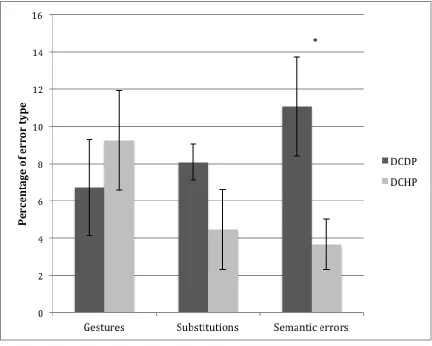
Figure 2 displays mean percentage error for use of idiosyncratic gestures, phonological
substitutions and semantic alternatives produced by DCDP and DCHP. A Mann-Whitney U
12
between the mean percentage number of idiosyncratic gestures when naming incorrectly
used by DCHP (M = 9%) compared with DCDP (M = 7%; U = 20.0, z = -.83, p = .46, r =-.21,
ns). However, the DCDP (M = 11%) were significantly more likely to sign a semantic
alternate e.g. FOX instead of DOG than DCHP (M = 4%) when they made an error (U = 8.0,
z = -2.25, p = .02, r =-.58).The error analysis therefore suggests that DCDP made more
semantic links when responding incorrectly to an item. Phonological substitutions were
calculated as the total number of substitutions divided by the total number of signs produced,
excluding the unanswered trials. DCDP produced a higher proportion of phonological
substitutions (M =8%) than the DCHP group (M = 4 %) but this was also not statistically
significant (U = 11.5, z = -1.83, p = .07, r =-.47, ns). .
Insert figure 2 here
Finally to measure the children’s phonology the number of unique handshapes used in the
PiNG by both groups of children was compared. The DCDP group produced significantly
more unique handshapes types (M = 13.56; SD = 2.7) than the DCHP group (M = 7.17 types;
SD = 5.34; U = 7.5, z = -2.32, p = .02, r =-.60).
(2) Parent’s language: Spontaneous signed conversation
The motivation for analysing the parents’ signing was to attest to the quantity (number of
sign tokens) and quality (number of vocabulary types) of the BSL, as well as the richness of
the phonological repertoire (handshape types) in the adult signinput to the children (Figure 3).
Mann-Whitney U tests (with Bonferroni corrections of p <.03) showed that during
13
90.25) compared to the hearing parents (HP) (M = 33.83; U = 7.0, z = -2.2, p = .03, r =-.59);
however there was no significant difference between the number of different vocabulary
types (i.e. different items) used in conversations by DPs (M = 43.38) and HPs (M = 29.17; U
= 14.0, z = -1.29, p = .23, r =-.34, ns).
Insert Figure 3 here
To measure differences between groups in phonology the number of unique hand shapes
produced in the spontaneous conversation were recorded. During conversations the DPs
produced a higher number of unique handshapes (M = 14.38; SD = 5.07) than the HP group
(M = 6.17; SD = 4.62). A Mann Whitney U test showed that this difference was significant
(U = 5.0, z = -2.46, p = .01, r =.66). This difference in parent phonology follows the same
pattern as described previously for the children. A Spearman’s correlation showed a strong
positive correlation between unique handshapes in both sets children from the PiNG task and
handshapes of both sets of adults produced in the spontaneous signed conversations, (r(12) =
.60, p = .02).
Discussion
This is the first study to analyse semantic and phonological characteristics of early
14
phonological repertoire and quantity/quality of signs in the input to deaf children from deaf
and hearing parents.
Comparing DCHP and DCDP’s phonological systems
There are differences in DCHP and DCDP’s phonological systems even though
DCHP are still exposed to BSL relatively early in their development. The age which the
DCHP are being exposed to BSL is early enough to be considered within the putative
‘sensitive period’ for language acquisition, i.e., the first 5-6 years of life (Newport, 2002).
Thus DCHP while being in this sensitive period are shown to have less developed semantic
links in their vocabularies and smaller phonologies as measured by handshape types. We
argue that these differences appear because, while hearing parents are using sign the early
acquisition process for DCHP is still delayed and the immediate language environment for
DCHP is less than optimal. The advantage of early exposure to a first language is therefore
modulated by the effects of a non-optimal environment.
This scenario creates an interesting comparison between the two groups. We observe
the DCHP while signing vocabulary items to comparable levels as DCDP, have fewer
phonological contrasts up to this point in their development. There are potential outcomes of
this atypical early development for future language skills. In Mayberry’s work phonology has
been pinpointed as a weak area in adult non-native signers. Adult signers who acquired sign
at differing ages display variable abilities in language processing or ‘shadowing’ tasks where
they have to use rapid sign processing and rehearse signs in working memory (Mayberry,
2010). There is a general consensus in the wider spoken language research also that delayed
language exposure most heavily affects native-like abilities in phonology. In these latter
studies differences are generally reported for second language (foreign) phonological skills
15
Incomplete first language acquisition has obvious serious consequences. Reduced
phonological skills can also lead to difficulties in the acquisition of grammar as less complete
representations at the sub-lexical level can make morpheme level analysis more difficult and
cognitively taxing. Although not an identical situation, we can return to the study of disrupted
L1 acquisition in children with international adoption (IA) as it provides a useful context for
interpreting the present data (Gauthier & Genesee, 2011). Early disrupted language
acquisition in IA has been linked to continued difficulties in processing the phonological
patterns of the new language even after several years of ‘native-like’ experience. As
Mayberry’s work (Mayberry, 2010) with adult deaf signers has attested - lifelong use of a
language acquired beyond early childhood does not endow the user with native skills in
accessing and manipulating phonology under taxing situations (ones where phonological
working memory is needed). Although the young DCHP and their hearing parents in the
current study make up a small sample, the differences we document are easily linked to the
inferior processing skills in IA and adult late signers. It is also worth mentioning that
although at this point we have identified differences in the richness of the two groups of
children’s signing these DCHP may have different future processing profiles compared to the
late exposed L1 deaf adults documented in Mayberry’s study (Mayberry, 2010). The children
in the current will have had exposure to sign and English prior to age 6 years but without a
longitudinal study we do not know what their language processing results will be like in 20 or
40 years.
We can speculate that both age of acquisition and the quality and quantity of the input
work together to bring about ultimate attainment in first language acquisition. The
mechanism that explains how atypical early development leads to later differences in
language skills in adult signers is unclear. Here we propose two factors at the phonological
16
phonological repertoires (albeit when just considering handshapes) than their DCHP peers.
Vihman (1995) argues that children build phonology through storing growing sets of
contrastive sounds. The more sounds represented in the system the easier to form categories
at the phoneme level. If DCHP have fewer numbers of contrastive handshapes while still in
the sensitive period for phonological development, they might end up with a smaller system
at the point where we assume heighted sensitivity to phonology is beginning to decline
(Bornstein, 1989; Newport 1990; Kuhl, Williams, Lacerda, Stevens, & Lindblom, 1992).
Linked to this possibility are sign perception studies by Best, Mathur, Miranda, and
Lillo-Martin (2010) and Morford et al. (2008) that suggest sparser input could discourage
categorization and hence lead to maintenance of sensitivity to phonetic contrasts to a higher
degree in late than in native signers.
The second area worth considering is the higher number of substitution errors in
DCDP than the DCHP. This difference did not reach statistical significance but we argue it is
worth considering in tandem with other results. More observations are required to expand on
this phenomenon but it might be that using typical phonological processes such as
substitution leads to a more interlinked phonological system. The process of substituting
handshapes might help children better master the function of handshapes in forming meaning.
This might be a crucial developmental milestone before developing adult form handshapes.
We do not know if the DCHP in the current study will go on to develop native abilities in
forming phonological contrasts. After all they are still young language learners. However at
this point they have both a less semantically linked vocabulary and a less rich phonological
system compared with their native signing peers and are being exposed to less optimal
language input. The question is how much will these differences impact their development of
handshape? Morford (2003) documented in much older DCHP that when they were first
17
through substitutions. Instead they rapidly acquired signs perhaps without sub-lexical
analysis and dealt less with links across simple and complex handshapes, an approach which
resembles more second language acquisition rather than first. The DCHP in the current study
are much younger than in Morford (2003) however as the IA studies suggest disruption in the
early stages of acquisition even followed by rich language exposure can lead to some atypical
patterns (Gauthier & Genesee, 2011). Do the documented differences in the current study for
DCHP also lead to a less optimal phonological system? Detailed analyses of the language
abilities as well as input of larger numbers of DCHP or conducting a longitudinal study are
required to properly test this possibility.
This is also the first analysis of sign phonology of hearing parents of deaf children.
We attempted to capture differences in native and non-native environments through an
analysis of parent input (vocabulary and phonology). While a conversation sample is a
limited corpus, it does tell us that there are important differences in the two types of
environments. The input DCDP receive is larger in quantity than DCHP although in this
sample there were no differences in number of vocabulary types. We also observed simpler
language (less fluency) from hearing parents compared with the more expansive and
articulated signs in the deaf parents. Fluency increases the likelihood that signs get
co-articulated and phonology gets altered in these processes (Ormel, Crasborn, & van der Kooij,
2013). Hearing parents as they are still at the initial stages of learning BSL, have less fluent
signing. DCHP therefore see less signs and less variability in how those signs are articulated
compared with the co-articulated input for DCDP. Finally, deaf parents produced a higher
number of contrasts in their handshapes than hearing parents, and in both groups handshape
type in the input correlated with the same phonological parameter in the children’s signing.
One important area we did not include in this study was an analysis of adult-adult signing. It
18
during the early stages of learning the language while DCDP will presumably receive
incidental input from adult-adult conversation not directed at them and this is known to also
influence language development (Akhtar, 2005).
This study would have benefited if all of the possible BSL handshapes were elicited
rather than a sub-set. There were fewer instances of pictures that elicit later acquired
handshapes. Equally, future studies will need to elicit more items than the 44 concepts in the
current study as well as control for sign frequency and handshape complexity. When
handshape complexity is controlled, then it would be intriguing to conduct an additional
analysis on whether children substitute more marked handshapes with unmarked handshapes,
replicating the results of Boyes-Braem (1990). While our participant sample size is good for
studies of young deaf children in order to better understand the role of input and native
exposure to a language it will be necessary to observe more of the children in the future.
Studies of sign language acquisition have enriched the general field of language
acquisition by describing how and why modality exerts and does not exert an influence on
development (e.g. Meier et al., 2002; Morgan, 2014b). Similarly these rare cases of disrupted
first language acquisition can shed light on the effects of age and input on linguistic skills.
Non-optimal first language exposure influences phonological development even in children
19 References
Akhtar, N. (2005). The robustness of learning through overhearing. Developmental Science,
8, 199–209.
Anderson, D. & Reilly, J. (2002). The MacArthur Communicative Development Inventory:
Normative Data for American Sign Language. Journal of Deaf Studies and Deaf
Education, 7, 83-106.
Arnesen, K., Enerstvedt, R. T., Engen, E. A., Engen, T., Hoie, G., & Vonen, A. M. (2008).
The linguistic milieu of Norwegian children with hearing loss. American Annals of the
Deaf, 153, 65–77.
Baker, A. E. & Woll, B. (2009). Sign Language Acquisition. Amsterdam: John Benjamins.
Bello A., Giannantoni P., Pettenati P., Stefanini S., & Caselli M. C. (2012). Assessing
lexicon: Validation and developmental data of the Picture Naming Game (PiNG), a
new picture naming task for toddlers. International Journal of Language and
Communication Disorders, 47, 589–602.
Best, C. T., Mathur, G., Miranda, K. A., and Lillo-Martin, D. (2010). Effects of sign language
experience on categorical perception of dynamic ASL pseudosigns. Attention,
Perception & Psychophysics, 72, 747–762.
Bornstein, M. (1989). Sensitive periods in development: structural characteristics and casual
interpretations. Psychological Bulletin, 105, 179-197.
Boyes-Braem, P. (1990). Acquisition of the handshape in American Sign Language. In
Volterra, V. & Erting, C.K. (eds.), From gesture to language in hearing and deaf
20 Brentari, D. (1998). A prosodic model of sign language phonology. Cambridge, MA: MIT
Press.
Chen Pichler, D. (2012). Language acquisition. In R. Pfau, B. Woll and M. Steinbach (eds.)
Handbook of Linguistics and Communication Science: Sign Language (pp. 647-686).
Berlin: de Gruyter.
Chamberlain, C., Morford, J., & Mayberry, R. I. (1999). Language Acquisition by Eye.
Mahwah, NJ: Lawrence Erlbaum and Associates.
Clibbens, J. & Harris, M. (1993). Phonological processes and sign language development. In
D. Messer & G.Turner (Eds). Critical influences on child language acquisition and
development(pp. 197-208). London: Macmillan, New York: St Martin's Press.
Curtiss, S. (1977). Genie: A Psycholinguistic Study of a Modern-Day Wild Child.
Perspectives in Neurolinguistics and Psycholinguistics, Boston, MA: Academic
Press.
Emmorey, K., Bellugi, U., Friederici, A. & Horn, P. (1995). Effects of age of acquisition on
grammatical sensitivity: Evidence from on-line and off-line tasks. Applied
Psycholinguistics, 16, 1-23.
Fenson, L., Dale, P.S., Reznick, J.S., Bates, E., Thal, D., & Pethick, S. (1994). Variability in
early communicative development. Monographs of the Society for Research in Child
Development, 59 (5, Serial No. 242).
Ferjan Ramirez, N., Lieberman, A.M., & Mayberry, R.I. (2013). The initial stages of
language acquisition begun in adolescence: When late looks early. Journal of Child
21
Gauthier, K. & Genesee, F. (2011). Language development in internationally-adopted
children: A special case of early second language learning. Child Development, 82(2),
1-15.
Harris, M. (2010). Early communication in sign and speech. In M. Marschark and P. E.
Spencer (eds.), Oxford Handbook of Deaf Studies, Language, and Education Volume
2. New York: Oxford University Press.
Hermans, D., Knoors, H., & Verhoeven, L. (2010). Assessment of sign language
development: The case of deaf children in the Netherlands. Journal of Deaf Studies
and Deaf Education, 15, 107–119.
Johnson, J. S. & Newport, E. L. (1989). Critical period effects in second language learning:
The influence of maturational state on the acquisition of English as a second
language. Cognitive Psychology, 21, 60-99.
Kuhl, P. K., Williams, K. A., Lacerda, F., Stevens, K. N., & Lindblom, B. (1992). Linguistic
experience alters phonetic perception in infants by 6 months of age. Science, 255,
606-608.
Lederberg, A. R. (2006). Language development of deaf children with hearing parents. In E.
Lieven (Ed.), Encyclopedia of language and linguistics (second ed., pp. 361-367).
Oxford: Elsevier Ltd.
Marentette, P. & Mayberry, R. I. (2000). Principles for an emerging phonological system: A
case study of acquisition of ASL. In C. Chamberlain, J. Morford & R. I. Mayberry
(Eds.), Language Acquisition by Eye (pp. 71-90). Mahwah, NJ: Lawrence Erlbaum
22 Masoura, E. & Gathercole, S. E. (1999). Phonological short-term memory and foreign
vocabulary learning. International Journal of Psychology, 34, 383-388.
Mayberry, R. I. & Fischer, S. D. (1989). Looking through phonological shape to lexical
meaning: The bottleneck of nonnative sign language processing. Memory and
Cognition, 17, 740-754.
Mayberry, R. I. & Eichen, E. B. (1991). The long-lasting advantage of learning sign language
in childhood: Another look at the critical period for language acquisition. Journal of
Memory and Language, 30, 486-512.
Mayberry, R. I. (2010). Early Language Acquisition and Adult Language Ability: What Sign
Language reveals about the Critical Period for Language. In M. Marschark & P.
Spencer (Eds.), Oxford Handbook of Deaf Studies, Language, and Education, (vol.
2, pp. 281-291). New York: Oxford University Press.
Mayne, A., Yoshinaga-Itano, C., Sedey, A.L., & Carey, A. (2000). Expressive vocabulary
development of infants and toddlers who are deaf or hard of hearing. The Volta
Review, 100(5), 1-28.
Meier, R. P., Cormier, K., & Quinto-Pozos, D. (Eds.) (2002). Modality and Structure in
Signed and Spoken Languages. Cambridge: Cambridge University Press.
Meier, R. P. (2005). The forms of early signs: explaining signing children’s articulatory
development. In B. Schick, M. Marschark, and P. Spencer (Eds.), Advances in the
Sign-Language Development of Deaf and Hard-of-Hearing Children (pp. 202–230).
Oxford: Oxford University Press.
Moeller, M. P. (2000). Early intervention and language development in children who are deaf
23
Morford, J. P. (2003). Grammatical development in adolescent first language learners.
Linguistics, 41(4), 681 – 721.
Morford, J. P., Grieve-Smith, A. B., MacFarlane, J., Staley, J., and Waters, G. S. (2008).
Effects of language experience on the perception of American Sign Language.
Cognition, 109, 41–53.
Morgan, G. (2006). Children are just lingual: The development of phonology in BSL. Lingua,
116, 1507-1523
Morgan, G. (2014). Critical period in language development. In P. Brooks, & V. Kempe
(Eds.), Encyclopedia of language development. (Vol. 3, pp. 116-119). Thousand
Oaks, CA: SAGE Publications, Inc.
Morgan, G (2014b). On language acquisition in speech and sign: development of
combinatorial structure in both modalities. Frontiers in Psychology: Language
Sciences. 5:1217
Morgan, G., Barrett-Jones, S. & Stoneham, H. (2007). The first signs of language:
phonological development in British Sign Language. Applied Psycholinguistics, 28,
3-22
Morgan, G. & Woll, B. (2002). The development of complex sentences in British Sign
Language. In G. Morgan & B. Woll (Eds.), Directions in Sign Language Acquisition
(pp. 255–275). Amsterdam: John Benjamins Press..
Musselman, C., & Akamatsu, C. T. (1999). Interpersonal communication skills of deaf
adolescents and their relationship to communication history. Journal of Deaf Studies
24 Newport, E. L. (1990). Maturational constraints on language learning. Cognitive Science, 14
(1990), pp. 11–28.
Newport, E. L. (2002). Critical Periods in Language Development. In L. Nadel, (Ed.),
Encyclopaedia of Cognitive Science. London: Macmillan.
Ormel, E., Crasborn O. & van der Kooij, E. (2013). Coarticulation of hand height in Sign
Language of the Netherlands is affected by contact type. Journal of Phonetics,
41-2/3: 156-71.
Petitto, L. A. (1997). In the beginning: On the genetic and environmental factors that make
early language acquisition possible. In M. Gopnik (Ed.), The inheritance and
innateness of grammars (pp. 45-69). England: Oxford University Press.
Petitto, L. A., Holowka, S., Sergio, L., & Ostry, D. (2001). Language rhythms in baby hand
movements. Nature, 413, 35-36.
Sandler, W. & Lillo-Martin, D. (2006). Sign Language and Linguistic Universals.
Cambridge, UK: Cambridge University Press.
Schick, B., Marschark, M., & Spencer, P.E.(2005). Advances in the Sign Language
Development of Deaf Children. New York: Oxford University Press
Signature Sign Language Exams. Mersey House Mandale Business Park Belmont Durham
DH1 1TH. http://www.signature.org.uk/british-sign-language
Singleton, J.L., Morford, J.P., & Goldin-Meadow, S. (1993). Once is not enough: Standards
of well-formedness in manual communication created over three different timespans.
Language, 69 (4), 683-715.
25 Spencer, P. E., & Marschark, M. (Eds.). (2006). Advances in the spoken language
development of deaf and hard-of-hearing children. New York: Oxford University
Press.
Spencer, P. E., & Lederberg, A. R. (1997). Different modes, different models:
Communication and language of young deaf children and their mothers. In L. B.
Adamson & M. A. Romski, (Eds.), Communication and language acquisition:
Discoveries from atypical development (pp. 203-230). Baltimore: Brookes.
Stokoe, W.C. (1960). Sign Language Structure: An Outline of the Visual Communication
Systems of the American Deaf, Studies in linguistics: Occasional papers (No. 8).
Buffalo: Dept. of Anthropology and Linguistics, University of Buffalo.
Sutton-Spence, R. & Woll, B. (Eds.). (1999). The Linguistics of British Sign Language: An
Introduction. Cambridge: Cambridge University Press.
Vihman, M. (1995). Phonological Development: Origins of Language in the Child. Oxford:
Blackwell.
Woll, B. (2012). Atypical signing. In Pfau, R., Steinbach, M., Woll, B. (Eds.). Sign language:
an international handbook (pp.762-787). Berlin: Mouton de Gruyter.
Woolfe, T., Herman, R., Roy, P., & Woll, B. (2010). Early lexical development in native
signers: A BSL adaption of the Macarthur-Bates CDI. Journal of Child Psychology
26 NB. Error bars represent the Standard Error of the Mean (SEM); ** p<.01
Figure 1. Mean percentage response of correct, incorrect, and non responses on the PiNG for
DCDP and DCHP
27 NB. Error bars represent the SEM; p<.05
Figure 2. Mean percentage of incorrect responses to items on the PiNG that were gestures,
phonological substitutions and semantic alternates produced by DCDP and DCHP
28 NB. Error bars represent the SEM; * p<.05
Figure 3. Mean frequency of sign tokens and type of signs of DPs and HPs observed in
spontaneous signed conversation