A STUDY ON
SALATHAMBA VAATHAM
(Dissertation Subject)
For the partial fulfillment of the requirements
to the degree of
DOCTOR OF MEDICINE (SIDDHA)
Branch I – Maruthuvam
GOVERNMENT SIDDHA MEDICAL COLLEGE
(Affiliated to the Tamil Nadu Dr. M.G.R. Medical University.)
CHENNAI – 106.
CERTIFICATE
Certified that I have gone through the dissertation
submitted by Dr. T.Suyamariyathai, a student of final M.D(s), Branch-I
Maruthuvam, Govt. Siddha Medical College, Chennai and the
dissertation work has been carried out by the individual only.
Place: Chennai
Date:
Professor and Head of the Department
Post Graduate Department
Branch-I Maruthuvam
CONTENTS
PAGE ACKNOWLEDGEMENT
I. Introduction 1
II. Aim and Objectives 5
III. Review of Literature
Siddha Aspect 7
Modern Aspect 56
IV. Materials and Methods 91
V. Properties of Trial Medicines 95
VI. Preclinical Studies 109
VII. Case Sheet Proforma 142
VIII. Results and Observation 154
IX. Biostatistics 180
X. Discussion 184
XI. Summary 191
XII. Conclusion 193
ACKNOWLEDGMENT
With Dr. Abdul Kaathar M.D(s) Principal, I/C. Govt. Siddha Medical College, Chennai-106. I was lucky enough to be like a lucky drop of water not have landed in hot iron. But shelded in an oyster, definite of becoming a pearl, so I firstly thanks to my principal.
I express my special gratitude to the respectable vice principal Professor Dr.G.Thiyagarajan, M.D.(s) & Former Principal
Dr.Rajarathinam (A) Revathy M.D.(s) G.S.M.C, Chennai – 106.
“All are equal but some are more equal than others” said George
Orwell.
My respectable and also a beloved readers Dr.P.Partheeban M.D.(s),
and Dr.K.Kanagavalli M.D(s), made a never fading intact on me through
their uncompromised, meticulous guidance and constant motivation as well as inspiration both in my studies and personal guidance with totting heart. My sense of gratitude to them with is preserved externally.
I owe my cardinal thanks to my lectures of Dr. Neelavathy M.D.(s), P.G.Dept, Dr.S.Saravana Devi M.D.(s) and Dr.S.Sankar M.D.(s). Department of Maruthuvam G.S.M.C.Chennai- 106. for their guidance and inspirations to this study work.
I thank very much to Prof Dr.S.Venkatraman, Director & Staff of
Dr.C.L.Baid Metha College of Pharmacy, Thorappakkam, Chennai and
valuable help in Bio-Chemical analysis, pharmacological and toxicological studies.
I express my thanks to Dr.T.Eevera M.Sc (Agri) Ph.d. Assit prof, Periyar Maniyammai University, Vallum, Thanjure, for his valuable help in microbiological studies.
I thank all the library staff of Dr.Ambethkaar library.
I extend my thanks to all my patients for their best co-operation for the successful completion of my work.
“There can be no friendship without confidence and confidence
without integrality”. I experienced the flavour of friendship from the
hidden treasure of friendship with Dr.R.Jeyanthi, Dr.S.Geetha Devi, and
Dr.A.Gomathi.
I wish to thank Mr. C.Navaneethakrishnan, who provide invaluable assistance at time to print out this format of dissertation work.
Last but not least, there is no gene devoid of identity. I place on record my thank to my all family members, my best half, parents, my brothers, sister who are my heart and soul and whose love has always guided my enteavour.
BIBLIOGRAPHY
mfj;jpah; 2000 Kjyhk;> ,uz;lhk; ghfq;fs; ruRtjp k`hy; E}yfk; jQ;rhT+h;> gf;fk; : 201.
mfj;jpah; itj;jpa rpe;jhkzp ntz;gh 400 vd;Dk; kzp 400 Mrphpah; kU.nr.gpNukh vk;b (rp) gjpg;ghrpupah;. S.P. ,uhkr;re;jpud; gjpg;G Mz;L khh;r; 1996 gjpg;gfk; - jhkiu E}yfk; Kjy; ghfk;.
mDgt itj;jpNjt ,ufrpak; - rPjhuhk; gpurhj; gp.uj;jpd ehafh;rd;]; ,uz;lhk; gjpg;G (1991)> gf;fk; : 162.
cly; jj;Jtk; - Mf;jpNahd; Dr.G.K.NtZNfhgy; (H.M.P.I) jkpo;ehL rpj;j kUj;Jt thhpak; (1984).
fz;Zrhkp guk;giu itj;jpak; - ,uj;jpd ehaf;fh; & rd;];> nrd;id (1991)> gf;fk; : 1.
fz;Zrhkpak; vd;Dk; itj;jpa rhfhuk; - ,uj;jpd ehaf;fh; & rd;];> nrd;id (1991)> gf;fk; : 8.
Fzghlk; fjpiuNty; gps;is jkpo; mfuhjp – Asian Educational Services, New Delhi (1992)> gf;fk; : 8.
ruNge;jpu itj;jpa Kiwfs;> thjNuhf rpfpr;ir gjpg;ghrphpah; = thRNjt rhq;jphp gp.V.
rpfpr;rh uj;d jPgk; - C.fz;Zrhkp gps;is ,uj;jpd ehaf;fh; & rd];> nrd;id (1991)> gf;fk; : .
rpj;j kUj;Jthq;fr; RUf;fk; - lhf;lh;.f.R.cj;jkuhad;> jkpo;ehL muR rpj;j mwptpay; Nkk;ghl;Lf; FOthy; ntspaplg;ngw;wJ. (1983).
rpj;j kUj;Jt Neha; ehly; Neha; Kjy; ehly; jpul;L ghfk; - 1> vk;.rz;Kf NtY H.P.I.M ,e;jpa kUj;Jtk; XkpNahgjpj; Jiw> nrd;id> (2003).
rpj;jkUj;Jtk 4448 tpahjpfs; - kfhuh[h ruNge;jpa ru];tjp k`hy; E}y; epiyak; - jhQ;rhT+h;.
jpU%yh; fUf;fpil itj;jpak;.
Njiuah; thflk; - G.jpahfuh[d;> jz;lhAjg;ghzp Rthkp jpUf;Nfhtpy;> godp (1975)> gf;fk; : 70> 71> 72.
Njiuah; ntz;gh> G.jpahfuh[d;> jz;lhAjg;ghzp Rthkp jpUf;Nfhtpy;> godp (1975)> gf;fk; : 158> 210.
guuhr Nrfuk; thjNuhf epjhd; nghd;id jpuQhd rk;ge;jh; mr;R me;jpu rhiy> kq;fyk; (1934)> gf;fk; : 59> 60.
gjhh;j;j Fzrpe;jhkzp –S.P.,uhkr;re;jpud;> jhkiu E}yfk;> nrd;id.
gjpndd; rpj;jh;fs; ghba itj;jpa rpy;yiu Nfhit.
T.V. rhk;grpt gps;is> jkpo; - Mq;fpy mfuhjp IV Volum P. 1849> 1872.
A+fp itj;jpa rpe;jhkzp.
[Ptuf;\hkph;jk; - Rg;gpukzpa gz;bjh;> kNdhd;kzp mr;Rf;$lk;.
Modern Test.
GT Gray’s Antomay P.No.1815.
Gyton’s Text book of physio logy IXth edition P.No. 315 – 320.
Harrison’s Principles of Internal Medicine.
Davidson’s Principles and practice to medicine – sixteenth edition (1991), P.No: 190.
OTHER TEXT
Data base on Medicinal Plants used in Ayurvedic – Centrall covnit for Research in Ayurveda and iddha, Department of ISM & H, Ministry of Health and Family Welfare, Govt of India (2001).
The Indian Metria Medica with Ayurvewdi, Unani and Homeo Remedies, P.No: 1099.
The useful plants of India – National Institute of Science Communication, Council of Scientific and trial Research, New Delhi (2000).
Compendium of India Medicinal Plants Central Doney Research Institute Luknow and National Institute of Science Communication, New Delhi (1960-69).
The Treatise on India Medicinal Plants Vol.3, Prof, Nrs.Asina Chatterjeen Dr.Satheesh Chandra Prakashji, National Institute of Seenu Communication, New Delhi (1997).
India Medicinal Plants Volume II, P.No: 420, 421, 608. K.R.Kiritikar and B.D.Basu Introduction Book, distributors and sellers, Debogddran 1999, P.No: 18.
India Plants and Drugs – D.Nadkarni.
Medicinal Aromatic Plants.
Alexicon of Medicinal Plants in India.
INTRODUCTION
“Health is infinite and expansive in its mode and reaches out to be
filled with the fullness of the world, where as disease is finite and reductive in
mode and endeavors to reduce the world to it self”
- OLIVER SACKS
Medicine as every one know is not merely a science but an art as well. It certainly deals with the different process of life. The art of medicine in India, has been purely associated with religion and philosophy and such is evidently based on truth. Siddha science is very ancient in origin, as old as the earliest civilization of the southern peninsula of India, where the Tamil had their highly developed languge.
The term siddha is derived from siddhi that is attainment of perfection, accompolished or achievement. Any system of medicine is only an evolution and not an overnight invention, so also the traditional Tamil system evolved with the development of mankind. Perfect health is not relative term but an absolute one. This is the first system to emphasise health as the perfect state of physical, psychological.
To quote saint Thirumoolar,
“kWg;g Jly;Neha; kUe;njd yhFk;
kWg;g JsNeha; kUe;njdr; rhYk;
kWg;g jpdpNeha; thuh jpUf;f
kWg;gJ rhitA kUe;njd yhNk”
-jpUke;jpuk;
Siddha medicine could rightly be called as a by product of the siddha practices to reach the ultimate. This is the reason why siddha medicine though a perfect science looks as a mixture of art, philosophy and science. But it is to be remembered.
“Science doesn’t need mysticism
But man needs both”
To quote Albert Einstein, the Nobel laurette,
“Science without religion is blind
And religion without science is lame”
Tholkappiyam says,
“epye;jP ePh;tsp tpRk; Nghile;Jk;
fye;j kaf;fk; cyfk; Mjypd;”
Meaning:
The world is formed of the five elements earth, water, fire, air and ether.
Thirumanthiram also has a verse stressing the fact that these five elements from the basis of the world.
“kz;zpdpy; Td;W kyh; ePU kq;fhFk;
nghd;dpdpy; mq;fp Gfo;top ahfhak;”
These five elements are in subtle state (sukumanilai) they manifest into a gross state (sthulanilai) and become visible.
Macrocosm vs Microcosm:
The world around us in the macrocosm and the human being is considered as the microcosm. The microcosm or human being are also formed by the basic five elements.
In Chinese medicine it also says “As in heaven so in earth” which is identical to sattamuni, a siddhar who said,
“mz;lj;jpYs;sNj gpz;lk; gpz;lj;jpYs;sNj mz;lk;
mz;lKk; gpz;lKk; xd;Nw mwpe;Jjhd; ghh;f;Fk; NghNj” In the organisms of man, these forces may act in an abnormal manner and causes diseases thereby planets exercise special power over some part of the body to cause disease.
Eg,
Mars - Gall bladder, Kidney
Venous - Blood & Semen, Abdomen, Uterus, Genitalia.
The siddha system of medicine is based on “Tridhosha theory” or “Trithathu theory”. The biological function of the body is governed by these distinct factors known as vaatha, pitha and kabha.
“kpfpDk; FiwapDk; Neha; nra;Ak; E}Nyhh;
tspKjyh ntz;zpa %d;W”
- jpUf;Fws;
Thiruvalluvar said above when natural harmony of the trithathu becomes altered, this disequilibrium causes various diseases.
Among “three thathus” the vaatha, may be infuriated and it harbours an various vaatha diseases.
One of the ancient siddhars “Yugimuni” has classified the diseases into 4448 out of these, he has explained vaatha diseases into “80”types one amidst them is “salathamba vaatham”.
I have selected “salathamba vaatham” as dissertation subject. This study opens new avenues for multidisciplinary studies of various aspects of the disease and treatment.
Most of the clinical features of “salasthamba vaatham” described in siddha literatures, relatively similar to the “Urinary tract infection”.
The urinary tract infection being the second common infection, I enthusiaed treat, without any side effects and to give new innovation of treatment to serve the sufferings.
I have selected “santhanaathy chooram and nerunchil – kothamalli
kudineer” for clinical study of “salathamba vaatham” as santhanaathy
AIM AND OBJECTIVES
Yugi Vaidhya Chinthamani, Yugi describe vaatha diseases into 80 types. Among them Salathmba vaatham is one of the diseases.
Salathamba vaatham incidence and its clinical profiles are mostly correlated with urinary tract infection in allopathy medicine because of its similarities.
As urinary tract infection is the second most common type of infection in human and is encountered in the clinical practice. Even though urine can support the growth of many bacteria the urinary tract is normally sterile. The mechanisms by which urinary infection is initiated are critical to the pathogenesis of renal infection. In some instances, such an infection can be life threatening, but even in a mild case, if it is neglected it can lead to the kidney damage. So, I have selected salathamba vaatham for my study.
Urinary tract infection most commonly occurs in women. Further it is influenced by social, economical, seasonal and geographical factors, the spectrum of the symptoms in this disease requires the use of several diagnostic and investigative procedures.
The prime aim of the study is to select the “salathamba vaatham” patients and treat them when the trial drugs as per the line of treatment and analyse both clinically and experimentally to prove the efficacy of the drugs.
The trial drugs are:
1. Santhanaathy choornam 0.5 gm twice a day with water 2. Nerunchil – kothamalli kudineer 40ml twice a day.
To study the clinical course of the disease “Salathamba vaatham” with deep observation on the eitiology, pathology, diagnosis, differential diagnosis, prognosis, complications and treatment by siddha aspects.
To expose the efficacy of siddhars diagnostic principles to know how this disease deranges the normal mukkutram, poripulangal, udarkattugal and envagai thervugal.
The etiology and clinical features of “salathamba vaatham” revealed in siddha literatures are compared with that of allopathy aspects.
To have an idea about the incidence of disease with age, sex, occupation, economic status, habits, family history and climatic conditions.
To have a detailed clinical investigation and to utilize the possible diagnostic tools in the confirmation of the diagnosis and prognosis of the disease.
To evaluate biochemical and pharmacological effects of the trial medicines.
To evaluate microbiological study of the trial medicine.
To evaluate the statistical analysis of clinical study.
All patients were subjected to thorough investigations during and after treatment.
REVIEW OF LITERATURES
SIDDHA ASPECT
VAATHA
Definition
It cannot be seen by eyes. However it can be detected by its functions and characters, like wind makes when it flows and touches our body.
(Sarbendra vaidhi muraikal-vaatha Roga chikitechai Page No VIII) The biological function of the body is governed by three distinct humours, known as vaatha, pitha and kabha. In a healthy man, these three humours are held in the ratio of 1: ½ : ¼ when this equilibrium is altered, it leads to disease. When vaatha is altered by diet, environmental factors, habits etc, the other two are also altered leading to vaatha diseases.
FORMATION OF VAATHA
“,Ug;ghd ehb vOgNjhBuh
<ukhd Njfj;jpy; Vyg; ngUehb
Xf;fjrkj; njhopiy Cf;f jr thAf;fs;
jf;fgb vd;Nw rhUk;”
“rhUe;jr ehb jd;dpy; %yk; %d;W
NgUkplk; gpq;fiyAk; gpd;dYld;-khWk;
ciuf;f tpuw; fhw;nwhl; Lzh;j;JNk ehrp
tiur;RopNah ikaj;jpy; te;J”
“te;j fiy %d;wpy; thAth kghdDld;
je;j gpuhzd; rkhdDf;FQ; re;jkwf;
$l;LwT Nufpj;jy; cWk; thjk; gpj;jk;
ehl;Lq; fgNkahk; ehL”
The human body is composed of 72,000 nerves. Among this, the ten are big nerves. They are otherwise called as thasa naadis. They are Edakalai, Pinkalai, Suzhumunai, Siguvai, Purudan, Gandhari, Aththi, Alambudai, Sangini, Kuru. Among these the first 3 nerves are called as “Mooladhara Naadies”.
Like that, ten vaiyus are make our body. They are piranan, abaanan, viyaanan, uthanan, samanan, nagaan, koorman kirugaran, devathathan & thananjeyan. Among ten vayus, first five are more important.
When the three nerves edakalai, pinkalai & suzhumunai are combined with abaanan, piranan and samanan respectively the three humours of vaatha, pitha, kabha are formed.
According to pancha bootha theory, the vaatha is made up of air and ether.
LOCATION
“thjj;jpd; giltPL dhgpf;Fq; fPNo”
-Njiuah; ehb Theruiyar says that vaatha lives below the umbilicus.
According to kannusamiyam ennum vaidhya segaram
“mwpa Te;jp thj kLj;j gpj;je;jhDk;
kwpAk; eLkhh;gpy;...”
-gf;fk; 7
Abdomen is the site of vaatha.
According to our text, siddha maruthuva noi nadal noi muthal nadal part-I. Vaatha lives in abaanan, stools, edakalai, anus, hip bones, skin, nerves, joints, hairfollicles, muscles etc.
According to thanvanthri naadi, umbilicus region is the site of vaatha
“NtjNk Aiuj;j thjj;jpd; tPL ghA njhg;Gs;”
-jd;te;jphp ehb According to “vaidiya sara sangirogam”
“nrg;G Ke;jp rpijAk; thjepiy
nka;g;G khKdp kpz;L Kiuj;jNj”
According to sarabendra vaidhiya muraikal, vaatha is located in the following parts,
1. Stomach 2. Hip 3. Bladder 4. Thighs 5. Foots 6. Bones
7. Generally below the parts of umbilicus.
NATURAL QUALITIES OF VAATHA:
According to our text,Noi nadal noi muthal nadal, vaatha in its natural state is responsible for
Alertness
Inspiration and expiration
Mental and physical activities
Elimination of fourteen reflexes
Unique with seven udarkattugal
Strength of five sensory organs
“xOq;Fld; jhNjo; %r; Nrhq;fp ,aq;f
vOr;rpngw vg;gzpAkhw;w-vOe;jphpa
Ntfk; Gyd;fSf;F Nktr; RWRWg;G
thfspf;Fk; khe;jh;f;Fk; thA”
-k.j.gh> gf;fk;-232
AGONIST QUALITIES OF VAATHA :
“thjq; fLik twl;rpAld; neha;ik
rPjQ; rydk; rpjwZT-VjKl
dpf; Fzj;NjhLw;Nw apaf;fe; jUkstpw;
wf;f ghpfhue; jh”
9
According to above text, vaatha has six properties. Due to had and unwanted things in our food and water makes strengthening of vaatha’s own qualities. They are,
Rough
Dry
Light
Cold
Unstable
Subtle
ANTAGONIST QUALITIES OF VAATHA:
“thj Fz khWf;Fk; khW FzNk Nehf;fpd;
XjkpU jPuk; cah;ghuk;-Nghjuth
As;s jPNah LWjpAw;Wj; jpushf
cs;s Fzj;ijNa Cl;L”
-fz;Zrhkpak;
These qualities eliminate the agonist qualities of vaatha, by giving the food supplements with the following properties they are,
Soft
Unctuous
Heavy
Hot
Stable
Solid
FUNCTIONS OF VAATHA IN OUR BODY:
Body pain
Numbness
Tremors
Dryness
Emaciation
Paralysis
Paresis
Constipation
Olguria
Excessive thirst
Horiplication
Astringent taste in the mouth
Movements
Rigidity
Black discolouration of skin
VAATHA DISEASES
SYNONYM : VALI NOIGAL
DEFINITION:
,J> tspf;Fw;wk; jd;dstpy; kpFe;J my;yJ Fiwe;J NflilAk; NghJ cl;k;gpy; Fj;jy;> Filjy;> Nehjy;> njhopy; mw;Wg;Nghjy;> eLf;fy; Kjypa Fz Ngjq;fisAz;lhf;fpg; gy tifg;gl;l Jd;gq;fis gpwg;gpf;Fk; ,ay;Gila Nehahk;. (rpj;jkUe;Jt Neha;ehly; Neha; Kjy; ehly; jpul;L ,uz;lhk; ghfk;. gf;fk; - 550)
euk;G Jthuq;fspy; nfl;l ePh; jq;fp jirapy; Cwp mjpfhpj;J typ> mrjp> rhpthq;fk; KOtJk; Nehia tpistpj;jyhk;. (Mtpaspf;Fk; mKj Kiw tpsf;fk;. gf;fk; - 354)
tha;T mjpfhpj;J kdpjd; clk;gpy; ,Uf;Fk; midj;J euk;G(Jtuq;fSf;Fk;) jirfSf;Fk; gutp tha;T mjpfhpj;J typ> mrjp> cly; KOtJk; thj Nehia gutr; nra;Ak;. (gy jpul;L itj;jpak;. gf;fk; -76)
CHARACTERISTICS OF VAATHA DISEASES:
“fhy;ifAyh;e;J jpkpUz;lhk; fz;Ze; J}q;fpr; Nrhgpj;Jf;
NfhyQ;nrhpA kq;fnky;yhq; Fjpj;Jr; rw;Nw fdq;nfhz;L
rPy kpFe;J rPh;fhzr; rpWePh; tw;wp KLFnkd;d
thyj;jlq;fz; khdidaha; khNj thjNuhfkpNj”
- mf];jpah; 2000 Kjy; ,uz;L ghfq;fs; gf;fk; 201
According to above text, vaatha disease have the features of, 1. Dryness & numbness in the hands & legs.
2. Eyes like sleepy eyes.
4. Phlegm increased. 5. Scanty micturition.
According to Theraiyar vagadam
thj Neha;fspd; ,ay;G
“thj tPW md;d kpwq;fhJ fLg;Gz;lhk; tz;z Kz;lhk;
NkhJ fl;L Nuhfk; RuKz;lh kpUkYkh Kwq;fhnjd;Dk;”
- 210 Njiuah; thflk; gf;fk;-72 1. In take of food amount decreased
2. Aches present in the body 3. Body colour changes 4. Fever
5. Cough occurs
CLASSIFICATION OF VAATHA DISEASES:
According to “Yugi Vaidhiya Chinthamani” there are 3 various school of thoughts. They are,
“vd;dNt thjkJ vz;g jhFk;
Vw;wkhk; NgUila ntopiyf; Nfsha;”
-A+fp itj;jpa rpe;jhkzp> gf;fk; -93
“jhf;fhd thje;jh ndz;g jhFk;”
-A+fp itj;jpa rpe;jhkzp
According to above two poem, the vaatha diseases are classified into 80 types.
Again he described 84 types of vaatha diseases,
“Mkg;gh thj nkz;gj;J ehYk;
mjpDila FzhFzq;fs; mlq;fshf”
gf;fk; - 131
In agasthiyar 2000, I & II parts, published by Saraswathy Mahal Library,thanjavur..
The vaatha diseases are classified into 1482.
“thpj;jpL thjgpj;j rpNyj;Jk tpahjp %d;wpy;
thpj;jpLQ; rpy Njh\j;jhy; tz;ik Kd;
Diuj;jpL kPNuo; E}Nw jd;dpnyd;gj;jpuz;L
fLj;jpdhy; thjf; $wpd; Nehnadf; fUjyhNk” (5)
-mf];jpah; 2000 According to Theraiyar vagadam,
“thj tpUj;jQ; rd;dNuhfk; #hpathjk; tUtjha;
rPj re;jputhjk; rhjputhjq; Fj;jp rPthfj;NjhL njhe;jpa thjk;
...
fpilthjk;> gilthjk; gpwTthjk; Nfo;f;fp Nyfhkd thj”
nkd;gj;njhd;W (204 - 209) -Njiuah; thflk;> gf;fk; - 70-71 Vaatha disease are classified into 81 in number
In Theraiyar vaidhiya kaviyam-1500, vaatha disease are classified into 80 in number,
“cwq;F thj nkhopa vz;gJf;F”
-gf;fk; - 89 According to Rathina Surukka Naadi Nool,
“ghug;gh tjkJ vz;gj;J ehY”
-,uj;jpd RUf;f ehb E}y; Vaatha diseases are 84 in number
According to 4448 viyadigal,
“tpsk;gpL thjNehA vz;gj;J ehYkpf;f” gf;fk; - 5
According to “Dhanvanthiri Vaidhiyam”, T.V.Sambasivampillai, dictionary, Jeeva Rakshamirtham (Subramanya Pandithary) “Aathma Rakshamirtham”
In “Sarabendra Vaidhiya Muraikal” (Vaatha Roga Chikitchai) vaatha disease are classified into 80 types. gf;fk; XX.
According to Sekarasa sekara vaidhiyam
“rPuzp thj nkz;gj; ije;jpd; rpwg;Gk; NgUk;”
-nrfuhr Nrfu itj;jpak; Vaatha diseases are classified into 85 in number.
SALATHAMBA VAATHAM
Salathamb vaatham is one of the vaatha diseases described in Yugi Vaidhiya Chinthamani.
Definition:
According to Yugi Vaidhiya Chinthamani – 800.
It is a type of vaatha disease mostly affecting anus and urethra and produces burning painful micturation, constipation, pain in the urethral orifice.
According to T.V. Sambasivam Pillai – Tamil, English dictionary volume IV Page No:1935-1936. ePh;j;jhiuAk;; kyj;JthuKk; jhf;fg;gl;L kyryk; ntsptUk;NghJ jLj;J tUj;jj;ij Az;lhf;Fk; Xh; thjNeha;. ,jdhy; ntbj;j Gz;zpw; fhZk; typiag; Nghy; ky %j;jpuk; fopAk; NghJz;lhFk;.
A nervous affection in which the urethra and the rectum are chiefly affected. It is attended with extreme pain like that experienced in tissue especially when answering or responding to the calls of nature.
(2) ePh; fLg;G-painful discharge of urine –Dysuria
ryj;jk;g thA: Nfhshwpdhy; %j;jpuhjp jilg;gl;L Ntjid Az;lhf;FNkhh; Neha;.
A kind of flatulence marked by suppression of feaces and urine followed by extreme pain due to the derangement of vayu (humour) in the body. According to N.Kathiraiver Pillai. Tamil Mozhi Agarathi.
ryj;jk;gk;
Neerkattu means neermarippu
SYNONYMS
Neerkattu vaatham
Moothira vaatham
Moothira sara vaatham
Moothira varana vaatham
Thamara vaatham
Thamba vaatham
Ushna vaatha moothira rogam
Moothirakaatham
ETIOLOGY
According to Yugi Vaidhiya Chinthamani
“vd;dNt thjkjh nzz;g jhFk;
,fj;jpNj kdpjh;fSf; nfa;AkhW
gpd;dNt nghd;jida NrhuQ; nra;J
nghpaNahh;fs; gpuhkziu J}\zpj;Jk;
td;dNj tw;nrhj;jpr; NrhuQ; nra;J
khjhgpjh FUit kwe;j Ngh;f;Fk;
fd;dNt Ntjj;ij epe;ij nra;jhy;
fhaj;jpw; fye;jpLNk thje; jhNd” 243
-A+fp itj;jpa rpe;jhkzp> gf;fk; : 92.
In yugi vaidhiya chinthamani as there is no specific etiology for salathamba vaatham, causes for all types of vaatha diseases are suitable to this disease and are described. People who have behaviors like theft,. Unrespected to elders, ignorance of vethas, will be affected by vaatha diseases.
“jhndd;w frg;NghL Jth;g;G iwg;G
rhjfkha; neQ;RfpDQ; rikj;j td;dk;
Mfhaj; NjwyJ Fbj;j yhYk;
ghndd;w gfYf;f kpuhtp opg;G
gl;bdpNa kpfTWjy; ghu nka;jy;
Njndd;w nkhopahu;Nkw; rpe;ij ahjy;
rPf;fpukha; thjkJ nrdpf;Fe; jhNd”
-A+fp itj;jpa rpe;jhkzp gf;fk; : 93
In take of food with bitter, astringent, pungent tastes, drinks, day sleep, insomnia, starvation, sexual desire etc will readily cause vaatha disease.
According to “Pararasa Sekaram-Vaatha Roganithanam”
“njhopy; ngW ifg;Gf; fhh;j; jy;Jth;j;jy; tpQ;RfpDQ; NrhWk;
gioajhk; tuF kw;iwa ige;jpid aUe;jp dhYk;
vopy;ngwg; gfYwq;fp ,utpdp Ywq;fh jhYk;
kioepfh; Foyp dhNs thjq; Nfhtpf;Fq; fhNd”
-guuhr Nrfuk; thjNuhfepjhdk;> gf;fk;-59
“fhzNt kpfTz; lhYq; fUJgl; bdptpl; lhYk;
khdid ahh;fz; Nkhf kwf;fpD kpFe;jpl;lhYk;
Mzt kyq;f lk;ik aq;ENd tplhj jhYk;
thDjd; kley; yhNs thjq; Nfhgpf;Fq; fhNd”
-guuhr Nrfuk;> gf;fk;-60
Vaatha diseases are caused by intake of bitter, astringent, pungent taste foods, previous day rice,day time sleep, insomnia, over eating, starvation, excessive sexual desire, anger, anxiety etc.
“fhyq;fz; khwp Az;Zq; fhhpaj; jhYe; jz;zPh;
rhyNt aUe;jp dhYk; re;jpap Yl;fhh;e; jhYk;
Nfhykhk; Gspg;G nea;iaf; Fiwtw tUe;jp dhYk;
thythh; Kiyey; yhNsthjKw; gtpf;Fq; fhNz”
Fear, anger, depression, excessive physical activities, weather change, abnormal diet, excessive water intake relax in evening and excessive intake of old ghee, cause, vaatha diseases.
According to “Theraiyar Vagadam”
“nta;apypy; elf;if ahYk; kpfj;jzpzph; Fbf;if ahYk;
nra;apio kfsp dhisr; Nrh;e;jD gptpf;if ahYk;
igaNt cz;if ahYk; ghfw;fha; jpd;if ahYk;
ijaNy thjNuhfQ; rdpf;F nkd; wwpe;J nfhs;Ns” (15)
-Njiuah; thflk;> gf;fk; -6 Walking during noon, excess intake of water, increased sexual inter course, late time intake of food, eating bitter gourd etc, cause vaatha diseases.
DENIAL OF 14 URGES
“thjj;ijj; jilnra; jhNyh
khh;gpNdha; Fd;k thA
Ngjpj;j Tju thjk;
ngUfpL Klk;G Nehjy;
thijfs; jpul;Lk; ty;iy
kyryq; fl;Lg; gl;Lg;
NgijNa grpj;jp ke;jk;
ngUfpNa kypj Yz;Nl”
-cly; jj;Jtk;> gf;fk;-331
Denial of vaatha produces somany diseases, among these urinary obstruction and constipation are one of the diseases.
“ePhpidj; jLj;jy; nra;apd;
ePh;f;fl;Lj; Jthuk; Gz;zhk;
ghwpLQ; re;J re;jpy;
gz;GW NehtjhFk;
Nehpyq; faUq; fhk;ak;
ghhpdp yghd thA
gz;Gwr; NrUkd;Nw”
-cly; jj;Jtk;> gf;fk;-332
When urine is denied, it produces urinary obstruction ulcer extra.
“Rf;fpye; jidalf;fpd;
RuKldPh;f; fl;lhFk;
gf;fkhq; iffhy; re;J
ghuNeha; topapwq;Fk;
kpf;f khh;Neha; Az;lhFk;
kpFj;jpLk; gpuNkfe;jhd;
jf;fNjhh; NghJkhfpd;
jhpj;jpLk; thAf; $Nw”
-cly; jj;Jtk;> gf;fk;-337
Denial of ejaculation of semen produces urinary obstruction with fever etc.
According to Theraiyar Naadi,
“cgj;jpu nkhd;Wkpy;iy clypiy tpahjpapy;iy
etkjha; thjkpQ;rpy; ebf;fpLk; tpahjpAz;L”
-Njiuah; ehb Exaggerated vaatha humour causes vaatha diseases According to Thirukkual
“kpFDq; FiwapDk; Neha; nra;Ak; E}Nyhh;
tspKjyh ntz;zpa %d;W”
-jpUf;Fws;
Three humours which increase or decrease causes diseases vaatha diseases are produced by hyper vaatha, due to any of the above other etiology.
According to T.V.Sambasivam Pillai dictionary
Due to various food and misbehavior, the alteration in five forms of vaatha (ie, vayu) produces vaatha diseases.
Causes of vaatha diseases are, take food of too hot or too cold varieties in large amount, decreased intake of food, control of nature calling, control of appetite.
PATHOLOGY
According to Thirumoolar Karukkadai Vaidhiyam-600
“thAtpdhNy kyryq; fl;bLk;”
-gf;fk; 35 According to theraiyar
“thjkyhJ Nkdp nflhJ”
-rpj;j kUj;Jt Neha; ehly; Neha; Kjy; ehly; jpul;Lghfk;-
I> gf;fk; - 363 In salathamba vaatham, among three humours, the vaatha is initially exaggerate due to certain extrinsic and intrinsic factors such as irregular food, habits and alterations in weather.
The exaggerated vaatha affects pitha humour, which is in equilibrium with vaatha. Among five vayus, abaanan and viyaanan get affected.
Affected abaanan alters fire, which is one of the five elements. This produces the following symptoms.
Burning micturition
Painful micturition
Burning and pain over external genitalia
Oliguria
Constipation
Affected viyaanan alters space, which is on of the five elements. This produces the following symptoms.
Pain all over the body
Lower abdominal discomfort
Then the exaggerated three humours affect the seven body structures (7 udal kattugal). of these, saaram, senneer, oon are affected.
CLINICAL FEATURES (Noi Guri Gunankal)
According to Yugi Vaidhiya Chinthamani
“jhndd;w kyj;Jth uj;jp NdhL
jhf;fpNa ryj;Jth ue;njhlq;fp
Ntndd;w ePhpwq;Fk; NghJ jhDk;
ntb Gz;zpy; NehTNghw; fpNyrk; gz;Zk;
thndd;w kyq;fLj;Jr; rpWfp tPOk;
kaph;f;$r;rz;lhfpNa tUj;jk; gz;Ze;
Njndd;w jpj;jpg;G Nghy;eP uhFk;
rpWjptOQ; ryj;jk;gr; nra;if ahNk”
-A+jp itj;jpa rpe;jhkzp
Burning urination
Painful urination
Pain over anus
Pain over urethra
Constipation
Frequency of urination
Pilo-erection of the skin
Body pain
Oliguria
According to Pararasasekaram
“fzf;Fw Ts;sq; fhYq; fdf;fNt File;J nehe;J
tzf;fQ;rw; wpyhkd; NkNy typj;Jw Nehf;F khfpy;
czh;g;GW Gspg;gp dhNy As;sth jq;f lk;gpy;
jzh;glh; tpUk;G neQ;rhe; ijaNy ryj;jk; gq;fhz;”
-gf;fk; 239
Pain over soles
Radiating pain to lower limbs
Among other vaatha diseases, it is caused by sour taste of foods.
According to Agasthiyar Mani 4000
“kyge;j thj ky%j;jp uj;ijr;
nrynthl;lh thAge;jk; nra;jy;-,yFFz
%j;jpuj;jpd; thjKiwapl Nehk; ePh;f;fl;Lk;
Nfhj;jpUky; fz;lnkOk; nfhs;”
-mf];jpah; kzp 4000> gf;fk;-54
Named as moothira vaatham
Urinary obstruction
Oliguria
Burning urination
Cough
According to anubhava vaidhiya devarahasiyam Page no-162
Named as mothira sara vaatham
Vaatha occupies in the urethra
Scanty, frequency of urination
Supra-pubic pain
Burning & painful urination
According to Jeva Rakshamirtham-VIIIth vaatha roga padalam
Named as Moothira sara vaatham
Vaatha occupies urethra
Scanty, painful, burning urination
Lower abdominal pain
Frequency of urination
According to Thanvanthri Vaidhiyam
jhT %j;jpu kpw;wpw;W rw;W rw;whf tPO
Nkhtpy; fy;nyhpg;gd; NghYq; FzNk Tz;lh nkd;dpw;
fhtpaq; fz;zpd; khNj %j;jpufh jnkd;Nd”
-jd;te;jphp itj;ak;> gf;fk;-210
Named as Moothira kaatham
Abdominal pain
Abdominal distention
Scanty micturation
Pain & burning in the urethra
According to Sarabendhra Chikichai Murai
“kyj;jpNdhL ryq;fl;Lk; grpahJ Njfj;jpy;
thjq;nfhs;Sk;
fyf;F kPJ kyge;j thjkhk;
ePh;fl;Lq; fz;le;jd;dpy;
tpyf;fhpa tpUkYW kpd;dJ %j;jpu
thjk; tpsq;Flk;gpy;
tYj;jp bstajpdiu ahe;Jauh
kq;Fypapd; thje;jhNd” (72)
-ruNge;jpu itj;jpa Kiwfs; thjNuhf rpfpr;ir> gf;fk;-LXII
Named as Moothira vaatham
Constipation
Oliguria
Loss of appetite
Cough
According to Jeeva Rakshamirtham Page No-$R
Named as Ushna vaatha moothira rogam
Lower abdominal pin
Haematuria or yellowish urination
Burning and painful micturition
DIAGNOSIS (Piniyari Muramai)
To deal one disease and confirm what is what, diagnosis is made out. It is very helpful to take over correct line of treatment and assess the prognosis of the disease. In siddha aspect, the diagnosis is based upon the following methods.
Poriyaal aridhal (Inspection)
Pulanaal aridhal (Palpation)
Vinadhal (Interrogation)
Envagai thervugal
This also comprises some other parameters to confirm the diagnosis they are,
Thinai (land and place)
Kaalam (seasons)
Mukkutrangal (three life principles)
Udarkattugal (seven body structures)
PORIYAAL ARIDHAL (sensory organs)
Porigal are the five organs of perception. They are
Mei - Skin
Vai - Tongue
Kan - Eye
Mooku - Nose
Sevi - Ear
Poriyal aridhal is examining the pori of the patient by the pori of the physician
PULANAAL ARIDHAL (Palpation)
Osai - Sound Suvai - Taste Oli - Vision Natram - Smell
Pulanal aridhal is examining the above five sensation by a physician.
In salathamba vaatham, most of the patients have supra pubic tenderness or lower abdomen pain, when the patients were palpated.
VINADHAL (Interrogation)
ENVAGAI THERVUGAL
The unique diagnostic principle in siddha system of medicine is “Envagai thervugal”. Somany siddhars describe in many of their literatures about the envagai theruvgal. The following verses reveals this as follows.
“ehb ];ghprk; ehepwk; nkhoptpop
kyk; Kj;jpukpit kUj;JtuhAjk;”
-Njiuah;
“nka;f;Fwp epwe; njhdp tpopehtpUkyk; iff;Fwp”
-rpj;j kUj;Jt Neha; ehly; Neha; Kjy; ehly; jpul;Lghfk;-
I> gf;fk; - 270 In Kannusamiyam Parambarai Vaidhiyam., Envagai thervugal have been mentioned as “Asttavitha paretchai”.
“njhFf;fYw;w ml;ltpjg; ghpl;ir jd;id
Jyf;fKWk; gz;bjNu njspthfg;
Gfh;fpd;w thh;j;ijiag; ghh; ehitg;ghU
tFf;fhpa Njfnkdj; njhl;Lg;ghU
tdkhd rhPuj;jpd; epwj;ijg;ghU
rfpf;fphpa kyj;ijg; ghU ryj;ijg;ghU
rhh;e;jtpop jidg; ghh;j;J njsptha;f;fhNz”
-fz;Zrhkp guk;giu itj;ak;> gf;fk; - 1 Envagai thervugal are,
1. Naadi (Pulse) 2. Sparism (Palpation) 3. Naa (Tongue)
4. Niram (Colour of the skin) 5. Mozhi (Speech)
1. Naadi (Pulse)
“clypy; caph; jhpj;jpUg;gjw;Ff; fhuzkhd rptrf;jp
vJNth mJNt jhJ my;yJ ehb vdg;gLk;”
- Neha; ehly; Neha; Kjy; ehly; jpul;L> gf;fk; - 83
Naadi is the main diagnostic scale of the siddha system. It can be felt at one inch below the wrist on the radial artery by palpation with the tip of index, middle and ring finger correspondent to vaatham, pitham, kabham.
The normal ratio of 1: ½ : ¼: of vaatham, pitham, kabham, is altered in various diseases. In salathamba vaatham, the following naadi are seen commonly.
Vaatha pitha naadi
Vaatha kabha naadi
Pitha vaatha naadi
1. Vaatha Naadi
“fhzg; ghthj kPwpy;
kyQ;ryk; nghUkpf; fl;Lk;”
-mfj;jpah; itj;jpa fhtpak; 1500
“Nktpa thjQ; nra;Aq;
Fze;jid tpsk;gf; Nfsha;
Nrtpa jhJ ehrQ;
rpWj;Jld; rpWePh; tpOk;”
-mfj;jpah; MAh;Ntjk;- 1200
2. Pitha Naadi
“Vythh; Foyha; gpj;jQ; nra;FWapak; gf;Nfsha;... rpy ePh;f; fLj;J nehe;J rpWnfd tPOkpd;ik”
-kr;rKdpehb
“nfhy;yNt gpj;jkJ NkNywp
nfhbghfy; nfhbaJ NghY}Ukhfpy;
kpuf;fNt rpWePh;jhd; fl;bg; NghNk”
-,uhk Njth; ehb
“ghhpe;j gpj;jj;jh nyOe;j Nuhfk;
...ryf;fLg;G...”
-mfj;jpah; ehb
3. Vaatha Pitha Naadi
“nghUshd thjj;jpy; gpj;jQ; Nrh;e;J
...ePupw;...
rptg;G kyk; gpbj;jYUQ;...”
-rjf ehb
SPARISAM:
Sparisam means touch. By touching the skin and various part of the body, the physician can rule out various abnormalities, such as temperature of the skin, any abnormal growth, hypersensitivity, thickening of skin, swelling, ulcers etc.
In salathamba vaatham, some patients have increased temperature and tenderness present in the abdominal regions is elicited.
NAA (Tongue)
Colour, coating, paller, dryness, ulcers, fissuer, deviation, movements, variations in taste and the conditions of gum and teeth can be noted by examining the tongue.
In salathamba vaatham, some patient’s tongue are coated, due to the complaint of constipation.
NIRAM (Colour)
In salathamba vaatham, the skin colour, depends upon the patient’s body condition.
MOZHI (Speech)
In examination of speech, the high or low pitched voice, slurred speech, aphasia, dysarthria, nasal speech, hoarseness of voice can be noted.
In salathamba vaatham, the speech is normal in all patients.
VIZHI (Eyes)
Both motor and sensory disturbances of eyes are noted. Discolouration of eyes, sunking, swelling, lacrimation, ulceration, eye lids swelling, vision, conditions of cornea, conjunctivae and pupils can be noted.
In salathamba vaatham, most of the patient have the complained of burning eyes.
MALAM (Faeces)
Colour, quantity, odour, constipation, diarrhoea, presence of blood, mucus, pus, undigested matter, tenesmus etc can be noted.
In salathamba vaatham the faeces is balck or normal in colour and constipation is present. Stools examination may show ova and cyst.
MOOTHIRAM (Urine)
”te;j ePh;f; fhpnail kzk; Eiu vQ;rnyd;
iwe;jpa Ystit aiwFJ KiwNa”
-Njiuah; ePh;f;Fwp nea;f;Fwp E}y;
The urine analysis is done in siddha system according to five parameters. They are,
Niram - It indicates the colour of urine Manam - It indicates the smell of urine
Nurai - It indicates froth of urine Enjal - It indicates quantity of urine
In addition, frequency, urgency, hesitancy of micturition, painful, burning urination any sedimentation and any associated discharge can be analysed.
NORMAL URINE
“kpfj;jbg; Gk;kpfj; NjwYk; ,d;nwdpy;
Rfj;ijj; jUk;nka;r; RghtePh; ed;Nw”
-Njiuah; ePh;Fwp nea;f;Fwp E}y; rpj;j kUj;Jt Neha;ehly; Neha; Kjdhly; jpul;L
ghfk;-1> gf;fk;-294 The normal urine should be in medium weight and moderate clearance.
NIRAM:
According to Yugi Vaidhiya Chinthamani-800
“gz;ghd thjNuh fpf;F Kj;uk;
ghhpj;Jj; njspe;jpUf;Fk; ntz;ikahFk;
gz;ghd gpj;jNuhfpf;F Kj;uk;
ghh;f;fkha; kQ;rspj;Jg; grj;jp Uf;Fk;” -134
-A+fp itj;jpa rpe;jhkzp 800> gf;fk;-50
Yugi describes that vaatha urine may be white, clear coloured and pitha urine may be yellow coloured.
In salathamba vaatham, the humours vaatha and pitha are chiefly aggravated and the colour of urine resembles vaatha urine or pitha urine.
The same has been quoted as follows
“thjNuh fk;njspe;jhd; kQ;rspj;jhd; kw;iwaJ”
-mfj;jpah; kzp 4000
“%j;jpuf; Fwpfs; Nfsha; nkhope;jpLk; thjk; ntz;ik
fhj;jpu %j;j gpj;jQ; rptg;NghL rpWFk; ePUk;”
-mfj;jpah; 2000
“nta;aJh;f; fe;jk; tPRePh; Kj;jpug;
igehs kptw;iwg; gw;WGz; FwpNa
mk;nkhop apd;nwdp ddpyNk Kjypa
Kk;kyr; RjNk %ynkd; WzNu”
-Njiuah; ePh;Fwp nea;f;Fwp E}y; rpj;j kUj;Jt Neha;ehly; Neha; Kjdhly; jpul;L
ghfk;-1> gf;fk;-294 In salathamba vaatham, the urine should be in bad smell as the diseases affect the urinary bladder and ureters.
The bad smell orginates, due to affected vaatha, pitha and kabha.
EDAI:
“mw;gKq; fdkw;wjp njspTW nkdpd;
tw;GW rPjsk; kd;dpf; fdj;Jf;
fgj;ij ,sf;fyhy; fz;l ePh; ,‡Nj”
“,J eph;g;ig ,e;jphpamop ,tw;Wz;
Kjph;Jh;g; gyj;jhd; Kisj; njdf; nfhs;f”
-Njiuah; ePh;Fwp nea;f;Fwp E}y; rpj;j kUj;Jt Neha;ehly; Neha; Kjdhly; jpul;L
ghfk;-1> gf;fk;-293 The weakness of the urinary bladder produce the urine with low specific gravity. In salathamba vaatham the urine is as per above text.
“kpf;Fj; jbj;J tpONky; kyq;fspd;
ew;Fz tOit ed;NfhJ ePNu”
-Njiuah; ePh;Fwp nea;f;Fwp E}y; rpj;j kUj;Jt Neha;ehly; Neha; Kjdhly; jpul;L
ghfk;-1> gf;fk;-293 Above verse explains that the high specific gravity indicates the affected vaatha, pitha and kabha.
In salathamba vaatham, the specific gravity of urine is high..
“ge;j nka;g; giraps fg;gLk; gUtj;
je;jhg; G+jkha; mzpy Kj;jpuj;jpy;
rk;ge;jg;gLk; jjpEiug; GdNy”
-Njiuah; ePh;Fwp nea;f;Fwp E}y; rpj;j kUj;Jt Neha;ehly; Neha; Kjdhly; jpul;L
ghfk;-1> gf;fk;-296 When five forms of kabha (ie Avalambagam, Kilethagam, Pothagam Tharpagam and Santhigam) are altered, the air communicating urine produces frothy urine.
In salathamba vaatham, the urine may not be frothy.
ENJAL
According to Thanvanthiri Vaidhiyam
“Xq;fpa thjj;Njhh;f;F ePh;tpOq; FzKiuf;fpw;
G+q;nfhb fLj;J nehe;J rpWj;Jld; nghUkp tpOk;
ghq;Fld; gpj;jj; Njhh;f;Fg; nghrpa ePh; rpte;Jfhl;b
Naq;fNt RWf;fjhf nahpj;Jld; fLj;J tPOk;”
-jd;te;jhp itj;jpak;
Above text explains that oliguria present both in vaatha, and pitha patients. In salathamba vaatham, the quantity of urine is low as vaatha and pitha get affected.
And also haematuria indicates and the presence of red blood cells in the urine.
NEIKURI
“mUe;J khwpujK; mtpNuhjkjha;
m‡fy; myh;jy; mfhyT+d; jtph;e;jow;
Fw;wstUe;jp cwq;fp itfiw
Mbf;fyrj; jhtpNa fhJnga;
njhUK$h;j;jf; fiyf;Fl;gL ePhpd;
-Njiuah; ePh;Fwp nea;f;Fwp E}y; rpj;j kUj;Jt Neha;ehly; Neha; Kjdhly; jpul;L
ghfk;-1> gf;fk;-282
METHOD
Prior to the day of urine examination the patient is advised to take a balanced diet and the quantity of food must be proportionate to his appetite and he should have a good sleep.
After waking up in the morning the first urine voided by the patient is collected in a glass container and is subjected to analysis with in 1 ½ hrs.
A drop of gingely oil is dropped into container without shaking. The nature of the neikuri should be noticed in direct sunlight.
OBSERVATION
1. Vaatha Neer
“muntd ePz;bd; m‡Nj thjk;”
When the drop of oil spreads like a snake it indicates vaatha neer.
2. Pitha Neer
“Mop Nghw; gutpd; m‡Nj gpj;jk;”
-Njiuah; ePh;f;Fwp nea;f;FwpE}y; When the drop of oil spreads like a ring it indicates pitha neer.
3. Kabha Neer
“Kj; njhj;J epw;fpd; nkhoptjd; fgNk”
When the oil drop remains as that of a pearl it indicates kabha neer.
4. Thontha Neer
“mutpyhopAk; Mopapy; muTk;
mutpd; Kj;Jk; Mopapy; Kj;Jk;
Njhw;wpy; njhe;j Njhlq;fshNk”
In salathamba vaatham, neikuri spreads like a ring some times snake and coincidence of shapes.
PROGNOSIS BY NEIKURI
“,utpdpy; tl;by; itj;Nj
Nafpd;w ryj;jpd; kPNj
,UsJ GyUq; fhiy
Vw;fNt vz;nza; nfhz;Nl
xU Jsp tpl;Lg; ghh;f;fpd;
cte;Jld; gutpw; whapd;
cj;jk rhj;a nkd;Nw
Aiuj;jd UyNfhh; Nfl;fg;
guTjy; ke;j khapd;
rhj;jpa ke;j khFk;
gtk‡ Jjf kpjpy;
gutplhf; fl;bahAd;
mudad; Njt uhY
kUj;Jt KdptuhYk;
mrhj;jpa nkd;W nrhd;dhh;
mwpTs; uwpe;J nfhs;tPh;”
-rpj;j kUj;Jthq;f RUf;fk;> gf;fk;-358
By neikuri, we can judge the prognosis of a disease. When the oil spreads well immediately, the disease is cured earlier. when the oil slowly spreads it indicates that the disease is also cured slowly. When the oil does not move in its place, the prognosis is very poor.
THINAI (Land and Place)
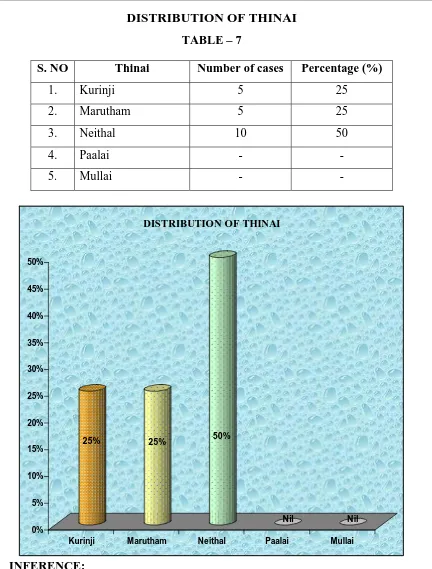
The geographical distribution of the land is classified into five regions.
S.NO LAND AILMENTS
1. Kurunji (Mountain region) Kabha Noigal
3. Marutham (Fertile region) No disease
4. Neithal (Coastal region) Vaatha Noigal
5. Palai (Desert region) Vaatha, Pitha, Kabha Noigal
PARUVA KALAM MARUBADU (Seasons)
With reference to the position of sun, the year is divided into six seasons as follows.
S. NO
Seasons & Duration Deranged
Kutram
Samapaduth um Suvai
1. Karkaalam (Early rainy) Avani –Purattasi
Aug 16- Oct 15
Vaatham Inippu Pulippu
Uppu 2. Koothirkaalam(Late rainy)
Iypasi and Karthigai Oct 16-Dec 15
Vaatham - Pitham
Inippu Kaippu Thuvarpu 3. Munpanikaalam (Early winter)
Marhazhi and Thai Dec 16-Feb 15
Pitham - Inippu Pulippu
Uppu 4. Pinpanikaalam (Late winter)
Maasi and Panguni Feb 16-April 15
Kabham Inippu Pulippu Thuvarppu 5. Elavenilkaalam (Early summer)
Chithirai and Vaigasi April 16-Jun 15
Kabham Kaippu Karppu Thuvarpu 6. Muthuvenilkaalam (Late summer
Aani and Aadi June 16-Aug 15
Kabham – Vaatham
Inippu
- Thannilai valarchi - Vetrunilai valarchi - - Thannilai adaithal.
As the disease “Salathamba Vaatham” occurs due to the derangement of vaatham, its incidence is expected more during kaarkalam & muthuvenil kaalam.
MUKKUTRANGAL
According to Yugi Vaidhiya Chinthamani,
“ebf;fpd;w thjgpj;j Nrl;g %d;W
eykh tpjpd;gphpd Gl;lf; Nfsha;
kj;jpakh kf;fpdpA khh;f;f khNk
khh;f;fkhk; gpj;je;jh df;fp dpia
krf;fpitj;J ka;ifAld; tUj;jp itf;Fk;
J}f;fe;jhd; Nrl;gkJ rykpF ahf;fpj;
Jthuq;f NlhW kpil tplhk dpw;Fk;”
-A+fp itj;jpa rpe;jhkzp> gf;fk;-76
The theory of mukkuttram forms the foundation of siddha. The primary position relegated to the equilibrated state of mukkutram in this definition of a health man indicates their importance in the maintenance of health. It can also be surmised that any disturbance in that equilibrated state leads to the development of disease in the body. They are,
1. Vali (Sustentative) 2. Azhal (Correlative) 3. Iyam (Generative)
Three vital humours occupy the lower, the middle and upper part of the body.
The vayu (or) vaatha refers to all the changes which come under the functions of central and sympathetic nervous system. The word pitha signifies the functions of thermogenesis or heat production and metabolism. Kapha signifies the functions of thermaotaxis on heat regulations. Vaatha, pitha, kabha are act upon each and every cell in the body.
VALI OR VAYU
Vali is not mere wind but also causes motion, energy and sensation of every cell in the body. It is responsible for all movements of the body. Vali controls both kanmendhriyam& gnanendhriyam.
Locomotor function through voluntary muscles are governed by kanmendhriyam and sensory functions are governed by gnanaedhriyam. Vali controls nervous system through “Dhasa Vayu”.
Below the navel region (umbilicus)
Urinary bladder, motion spermatic cord, umbilical cord, thigh, bone, skin, nerves, joints, muscles, hair follicles, pelvis and ear.
The vali is divided into 10 types according to their location & functions.
S.No Classification of vaatham
Location Functions
1. Pranan Heart, chest Respiration, digestion, sneezing coughing
2. Abaanan Anus, lower
abdomen, hip joint, bladder, genitalia
Defeacation and micturition, expulsion fetus, semen.
3. Viyaanan Heart, allover the body
Locomotion, blinking and opening of the eye.
4. Uthanan Chest, umbilicus, neck, nose
Controls breathing and speech
5. Samanan Duodenum allover GI tract
Secretion of digestive enzyme & juice. Absorption of nutritive material
6. Naagan Brain Learn all things. Blinking movement of the eye, erector pilorum.
7. Koorman Soul and mind Yawning opening and closing of eye ball, vision, lacrimation 8. Kirukaran Tongue Nasal and oral secretion.
Hunger, concentration, sneezing and cough.
9. Devathathan Anus and genitalia Fatigue, argument fighting, angry.
10. Thananjayan - Oedema, hyperacousia
Affected abaanan produces burning micturition, painful micturition, constipation and lower abdominal pain etc.
Affected viyaanan produces low backache, body pain and fatigue as it gives nutrition to all tissues
Affected samanan produces loss of appetite and indigestion. Affected kirukaran produces loss of appetite, nausea.
AZHAL
It has to be means the functions of correlative, secondarily mean gastric juice, bile, energy, heat, inflammation, anger and irritation. Azhal signifies the function of thermogenesis, metabolism and digestion, formation of various secretions and exceretions and also gives colour to skin and blood.
SEATS OF AZHAL
Pingalai, pranavayu, bladder, heart, head, umbilicus, navel, stomach, sweat, saliva, blood, eye & skin.
According to place and functions azhal can be named as follows,
Anar pitham
Ranjaga pitham
Saathaga pitham
Alosaga pitham
Prasaga pitham
VARIETIES OF PITHAM
S.No Classification of pitham
Location Functions
1. Analagam Stomach, small intestine
Gives appetite, digestion
2. Ranjagam Stomach, liver, spleen Promote haemopoiesis 3. Saathagam Heart Effective efficient 4. Alosagam Eyes Vision
In case of salathamba vaatham, analagam, ranjagam, saathgam are affected. Affected anarpitham produces loss of appetite. Ranjagam pitham affected in all patients by ingreasing the E.S.R rate
Affeced saathagam produces difficulty in performing usual works.
IYAM
Not only mean phlegm but it really has to be taken to mean the function of thermotasis or heat regulations. It may secondarily mean the formation of various preservative fluids viz. mucous and synovial fluids.
SEATS OF IYAM
Samana vayu, semen, tongue, stomach, bone marrow, fat, blood, nose, chest, nerves, bones, brain, large intestine, eye and joints.
VARIETIES OF IYAM
S.No Classification of Iyam Location Functions
1. Avalambagam Heart Supports all other iyam 2. Kilethagam Stomach Moisters & nourishes the food 3. Pothagam Tongue Gives taste sensation
4. Tharpagam Head Keeps the head cool
5. Santhigam Joints Stability, lubrication, movements of joints
In case of salathamaba vaatham, avalambagam, kilethagam, santhigam are affected.
Avalambagam affected when other forms of kabha get affected.
Affected kilethagam produces indigestion as it helps the digestion by moistening the food.
UDARKATTUGAL
They are the basic body structures, which constitute the entire body. They are seven in numbers.
1. Saaram – Chyle (Plasma)
It is responsible for the growth and development. It keeps the individual in good spirit and nourishes the blood.
In salathamaba vaatham, Saaram is affected by producing the tiredness of body.
2. Senneer (Blood)
It imparts colour to the body, it improves intelect and ability.
In the case salathamba vaatham, senneer is affected by the symptoms of haematuria .
3. Oon – (Muscle)
Gives shape to the body according to the functions of the organ. In salathamba vaatham oon is affected in most of the patients
4. Kozhuppu (Fat)
It gives lubrication to do proper function of organs of the body. It the case of salathamab vaatham, kozhuppu is not affected.
5. Enbu-(Bone)
It maintans the strcture of body. It gives protection to soft parts and allows free movement of the body.
In salathamaba vaatham enbu is not affected.
6. Moolai (Bone Marrow)
It fills the bone cavity, nourishes semen and imparts strength, endurance and shiny appearance.
7. Sukkilam or Suronitham – (Sperm & Ovam)
It is responsible for reproduction. In salathamba vaatham, sukkilam is not affected.
PROGNOSIS
The prognosis of the salathamba vaatham is good affer treatment.
DIFFERENTIAL DIAGNOSIS
Moothira Udhira vaatham
“tpsk;gNt tpLKj;jpuk; thapw; Nwhd;W
kPwpNa neQ;Rjdp yod;W NehFk;
epsk;gNt neQ;Rjdpy; tPf;f Kz;lhk;
epj;jpiuapy; yhkNy ntJk;g yhFk;
tsk;gNt tapWjdpy; NehTkhFk;
kfj;jhd tpf;fYl dpUk Yz;lhk;
msk;gNt mbtapW fdj;J NehF
kir Kj;jpu Tjpunkd;w thje;jhNd”
-A+fp itj;jpa rpe;jhkzp
Pain over the urethra
Frequency of urination
Chest discomfort
Insomnia
Stomach pain
Cough, hiccough
Lower abdominal pain are present
Sala Prameham
“ePh;tU ehsq; fLj;Jj; jLj;jilj;J
epd;W epd;W Jspj;Jspaha; apw;W tPKQ;
rhuKW kyKkjpy; kpfNt tPOe;
NrUePh; ehsKj Ye;jp kl;LQ;
nrUkp nte;J tpjdKld; Gz;ZkhFk;
ghUkpe;jf; Fzq;fs; ryg;gpuNkfj;jpd;
gz;ngdNt FUKdpth; gfh;e;j jhNk ”
-jd;te;jphp itj;ak;> ghfk;-2> gf;fk;-213
Pain over the urethra
Burning urination
Oliguria
Frequency of urination
Loose stools
Pain over the body
Fatigue &
Sever pain over the abdomen are present
Kalladaippu
According to Yugi vaidhiya Chinthamani
Colic pain occurs below the umbilicus
Oliguria
Constipation
Pain in the penis
Abdominal distention due to fluid accumulation
Nausea sensation
Increased Respiration
Blood colarish stores are expelled through the urethra
Profuse sweating
PININEEKKAM (TREATMENT)
Siddha system of medicine was an unique system of medicine in which treatment is given both for the body and mind so siddha system comprises treatment in three ways
Kappu (Prevention)
Niraivu (Restoration)
Kappu (Prevention)
“vjpujhf; fhf;Fk; mwptpdhh;f; fpy;iy
mjpu tUtjhk; Neha;”
-jpUf;Fws;
“Kf;fhy; kykJ nghy;yhj tha;T %d;W Jk;ky;
rpf;fh kyhW ryjhiu tpl;Lr; rpWeilAk;
ikf;fhL nfhz;l tpopaha; kdpjh;f;F tha;g;gnjdpy;
vf;fhy Kg;gpzp thuhj fhak; ,Uk; nghf;FNk”
-rpj;j kUj;Jthq;fhr; RUf;fk;> gf;fk; : 192
The above two text describe the general preventive measure one should evacuate gas and stools for at least one time, sneeze for 3 times and pass urine for 6 times. If follow this, one should never be diseased.
“J}q;fp tpopj;jpTld; Rj;Njh jfkUe;jpy;
xq;fp epd;w gpj;jk; xoptjd;wpf; - Njq;F
kyKj; jpue;jq;fh thjhjp Ae;jk;
jy khj;jpu %yTe; jhd;”
-gjhh;j;j Fz rpe;jhkzp
Early morning intake of pure water neutralizes Vaatha, Pitha and Kabha prevents constipation and urinary obstruction.
Neekam (Treatment)
A good physician should know about the derangement of kutram and should treat the patient on the basis of altered kuttram.
Treatment is based on,
To bring the tridhosham to normal
To treat the disease according to its symptoms through medicines
To normalize tridhosham:
“tpNur;rdj;jhy; thjk; jhOk;
tkdj;jhy; gpj;jk; jhOk;
erpa mQ;rdj;jhy; fgk; jhOk;”
Vaatha diseases can be brought down by viraesonam, by giving laxatives and purgatives according to the patient’s condition.
Since salathamba vaatham is one of the vaatha disease, So to neutralize the exaggerated Vaatha, laxative or purgative is given initially before the treatment.
For Purgation:
Vellai ennai ½ to 1 ounce (14-18 ml) for 2 days early morning.
Then the next day, the trial medicine Santhanaathy choornam 0.5gm Bd with water.
Nerunchil – Kothamalli kudineer 40 ml Bd are given.
DIET:
“nrq;fOePh; Nfhl;le; Njd;kpsF ey;nyz;nza;
jq;F ngUq; fhae; jOjhio naq;nfq;Fk;
$l;LrpW Kj;Jnea; Nfhjp xOe;jpitfs;
thl;Lkep yj;ij kjp”
-gjhh;j;j Fz rpe;jhkzp> gf;fk; : 362
Water lilly root tuber, costusroot, peppe,. Sesame oil, asafoetida, cledodendron phlomoides, castor oil and black gram are advised vaatha patients.
“khl;Lg; gwq;fptq;f khKUq;if nts;stiu
ehl;Lq; $ug;gpQ;R ew;fUiz ehl;LSiw
khfUiz aq;fUtpy; thje; njOe;J te;j
NjfUiz ew;fwpahe; Njh;”
-gjhh;j;j Fz rpe;jhkzp
Niraivu (Resturation)
Resturation of health is maintained by simplified yoga practice and good morality.
YOGASANAS:
Dhanurasanam
Salabasana
Bujangasana
Haalasana
Sarvangasana
Karppasana
Pathahasthasana
Savasana
About all asanas, stimulate the endocrine glands of abdominal regions and gonads there by preventing constipation, urinary obstruction, diabetes, menstrual problems, leucorrhoea, abdominal and uterine diseases.
Reassurance is given to all the patients for quick recovery.
MEDICAL ADVICE :
Avoid denial of urine and semen
Avoid excessive and extra marital coitus
Avoid heavy work and travel
To take water above 3 liters per day
To take water containging vegetables and fruits
Regular emptying of bladder by 3 hours interval
Empty the bladder before and after coitus
Follow good genital hygiene
Avoid alcobol and tobacco products consumption
ANATOMY OF THE URINARY TRACT
Introduction to urinary system:
The organs of the body that are concerned with the formation of urine and its elimination from the body are referred to as urinary organs. They consists of the right and left kidney, in which urine is formed, the right and left ureters, the urinary bladder in which urine is stored temporarily and is also concentrated and the urethra which carries urine from the urinary bladder to the exterior.
The urinary tract is divided into, 1. Upper urinary tract
2. Lower urinary tract
Upper urinary tract consists of, Kidneys
Ureters-(abdominal)
Lower urinary tract consists of, Ureter –(pelvic) Bladder
Urethra
KIDNEYS
The kidneys excrete the final products of metabolic activities and excess of water and salts from the blood and maintain its PH. They also have endocrine functions producing and releasing erythropoietin, renin, 1.25-hydroxy cholecalciferal and various other soluble factors.
SITUATION:
and loose areolar tissue. Superiorly, they are level with the upper border of the twelth thoracic vertebra, inferiorly with the third lumber.
The right kidney is usually slightly more caudal than the left, probably due to presence of the liver.
Colour : Reddish brown in the fresh state Shape : Bean-shaped
Length : About 11.5 Cm Breath : 5 to 7.5 Cm
Thickness : About 2.5 Cm
The left is some what longer and narrower than the right.
WEIGHT:
In the adult male, the kidney is weights 125 to 170 gm, in the adult female 115 to 155 gms..
Each kidney has two poles, two surfaces and two borders.
POLES:
Superior poles - each is related to it’s supra renal gland. Inferior poles - extend to within 5 Cm of the iliac crests.
SURFACES:
Anterior surface / ventral surface Posterior surface / dorsal surface
BORDERS:
Lateral border – it is convex
Medial border – it is concave. It’s middle part show a dipression called hilus or hilum
HILUM:
lined by the renal capsule and almost filled by the renalpelvis and vessels,numeros renal papillae indent the wall of the sinus.
RENAL CALYCES AND PELVIS:
Within the renal sinus, the kidney consists of the minor and major calyces and the renal pelvis.
The minor calyces are attached to the renal parenchyma around the bases of the variable number (4 to 13) of conical renal papillae which forms the tips of the renal pyramids. Each minor calyx is a trumpet – shaped structure which surrounds either single papillae or more.
The minor calyces unite or form two to possibly three larger chambers, the major calyces.
GENERAL RENAL STRUCTURE
The kidney is composed of an internal medulla and external cortex.
The renal medulla consists of pale, striated, conical renal pyramids. Each pyramid is upped by cortial tissue to form a renal lobe.
The renal cortex is subcapsular, arching over the bases of the pyramids and extending between them towards the renal sinus as renal columns: the peripheral regions are cortical arches and are tranversed by medullary rays, separated by the convoluted part.
RENAL MICRO STRUCTURE
The kidney is composed of many tortuous, closely packed uriniferous tubules. Each tubule consists of two distinct parts,
A secreting nephron
A collecting tubule
NEPHRON:
RENAL CORPUSCLE:
Renal corpuscles, small rounded masses averaging about 0.2 mm in diameter are visible in the renal cortex columns except in a narrow peripheral cortical zone.
There are 1 to 2 million renal corpuscles in each kidney, decreasing with age. Each has a central glomerulus of vessels and a membranous glomerular capsule (of bowman) the commencement of a renal tubule.
RENAL TUBULE:
A renal tubule consists of
Glomerular capsule
Proximal convoluted tubule
Loop of henle
Distal convoluted tubule
Junctional (connecting) tubule
Collecting duct
COLLECTING TUBULE
Collecting tubules carry fluid from several renal tubules to a terminal papillary duct (of Bellini) opening into a minor calyx at the apex of a renal papilla.
JUXTA GLOMERULAR APPARATUS:
It formed by 3 different structures.
Macula densa
Extra glomerular messangial cells
Juxta glomerular cells.
BLOOD SUPPLY:
VENOUS DRAINAGE
Stellate veins
Inter lobular veins
Inter lobar veins
Renal veins
Right and left renal veins drain into interior vena cava.
LYMPHATIC DRNINAGE
Para aortic lymph nodes
NERVE SUPPLY
Renal plexus
URETERS
Ureters are a pair of narrow, thick- walled muscular tubes which convey urine from the kidneys to the urinary bladder. They lie deep to the peritoneum, closely applied to the posterior abdominal wall in the upper part, and to the lateral pelvic wall in the lower part.
LENGTH
28 to 34cm. The right being about 1cm shooter than the left.Its diameter varies from 1mm to 1cm.
The ureters have 3 parts.
Abdominal part
Pelvic part
Intramural part
ABDOMINAL PART
PELVIC PART
The pelvic part lies in both sexes in extra peritoneal areolar tissue. At first it descends posterior laterally on the lateral wall of the pelvis, along the anterior border of the greater sciatic notch.
In male, the ureter is crossed by the vas-deferens
In females, it forms the posterior boundary of the ovarian fossa.About 2 Cm lateral to the cervix it passes between the uterine and vaginal arteries.
The left ureter crosses anterior to the vagina before opening into the bladders.
INTRA MURAL PART:
Within the bladder wall, it is about 2 Cm long and opens at the ipsilateral trigonal angle. In the distended bladder in both sexes, the ueteric opening are about 5 Cm a part, and less when the bladder is empty. In it oblique course, though the wall of the bladder, the ureter is compressed and flattened as the bladder distends, preventing regurgitation.
BLOOD SUPPLY
Renal artery
Abdominal aortic artery
Testicular / ovarian artery
Common iliac artery
Internal iliac artery
Superior and inferior vesical artery
Uterine artery
VENOUS DRAINAGE
Veins drains into corresponding veins
LYMPHATIC DRAINAGE
External iliac lymph nodes
Internal illiac lymph nodes
NERVE SUPPLY:
The ureter is supplied by symphathetic (T10-L1) and para sympathetic (S2
-S4) nerves. The reach the ureter through the renal,aortic and hypogastric plexuses.
All the nerves are sensory in function.
CONSTRICTIONS OF THE URETER:
There are 3 main constrictions in the ureter,
At pelvi ureteral junction
At the brim of the lesser pelvis
Where ureter pierces the bladder wall.
URINARY BLADDER
The urinary bladder is a musclomebranous sac. That act as a reservoir of the urine. As its size, position and relations vary according to the amount of fluid it contains.
When empty it is tetrahedral and it has a fundus, neck, apex and superior and two interiolateral surfaces and 4 borders -2 lateral, 1anterior and 1 posterior.
When a bladder is full, it is ovaid in shape .Apex directed upwards towards the umbilicus, neck is directed downwards and it has 2 surfaces anterior & posterior.
INTERIOR OF THE BLADDER:
In an empty bladder, the greater part of the mucosa shows irregular folds due to its loose attachments to the muscular coat.