Australian
National
University
THESES SIS/LIBRARY
R.G. MENZIES LIBRARY BUILDING NO:2 THE AUSTRALIAN NATIONAL UNIVERSITY CANBERRA ACT 0200 AUSTRALIA
TELEPHONE: +61 2 6125 4631 FACSIMILE: +61 2 6125 4063 EMAIL: [email protected]
USE OF THESES
This copy is supplied for purposes
of private study and research only.
Passages from the thesis may not be
copied or closely paraphrased without the
E R R A T A
A. In the text there are several t y p o g ra p h i c a l errors, the m a i n one being:
p. 333: the word "begun" was a c c i d e n t a l l y del e t e d from the end of the second line from the top, w h i c h should have read:
"g) the p o s i t i o n has s t r e n g t h e n e d of p r i v a t e - o w n e r s h i p layers, who have b e gun to s u b j u g a t e to t h e m s e l v e s ..."
O t h e r t y p o g r a p h i c a l errors in the text are:
p. 323: eig h t h line from top, "the" left out before "third world"
p. 297: se v e n t h line from bottom, " c a m o u f l a g e d "
f i f t h f o o t n o t e numb e r on page shou l d have been "172"
288: tenth line from bottom, "impla n t i n g "
278: tenth line from bottom, first "of" should have been d e l e t e d
231: f i f t e e n t h line from top, "a" left out before " m e c h a n i s m "
P-B. P-P* P-P* P-P*
213: s e v e n t e e n t h line from bottom, f i r s t "by" sho u l d have b e e n d e l e t e d
203: f i f t e e n t h line from bottom, " i n t r i g u i n g l y "
185: bottom line, "in" should have been d e l e t e d
183: second line from top, "of" sho u l d have been d e l e t e d
158: t h i r t e e n t h line from bottom: "Az i i a i A f r i k a ..."
137: t w e l f t h line from bottom: shou l d have been "," a f t e r "one".
In the f o o t n o t e s there are a n u m b e r of t y p o g r a p h i c a l errors:
4-1, n. 5: f i rst " M acmillan"
46, n. 45: the dates in R e m n e k ’s title should have been "1 94-7-1971
" i d e n t i f i e s "
"Society"
"from" sho u l d have been d e l e t e d in the q u o t a t i o n 53, n. 130
54, n. 136
n . 14-0
84, n. 13
85, n. 36
87, n. 46
n. 52
88, n . 63
90, n. 94
91, n. 110
n.
"e y e s "
" S o t s i a l ’nye"
pp. for O r l o v a r t i c l e s h o u l d have been
" K h r u s h c h e v "
"as" left out a f t e r "also"
dates in R e m n e k ’s title s h o u l d have been " 1 9 4 7 - 1 9 7 1 "
fi r s t " S ’ezd"
" M e l i k s e t o v "
92, n. 130: " F r i e n d s h i p "
160, n. 10: dates in R e m n e k ’s title s h o u l d have been " 1 9 4 7 - 1 9 7 1 "
161, n. 19: "o s v o b o d i t e l ’nykh" ; " i n t r i g u i n g "
162, n. 26: " p r e r e q u i s i t e s "
n. 39: " U 1 1i a no v s k y "
p- 164, n . 60: "skilfully"
p* 1 66, n . 89: " K l a ssovaia"
p- 1 68, n . 11 6 " d i scussion" n . 11 7 "m a i n t a i n i n g "
p- 171 , n . 1 61 "Klas sovaia"
p* 1 72, n . 1 88 " R a z v i v a i u s h c h i e s i a "
p- 173, n . 195 second last line, "had" sho u l d have been "have"
p* 175, n . 226 "V o l o b u e v "
p- 176, n . 228 "aggres sion"
p- 253, n . 54: " K o l o ntaev"
p- 256, n . 138: "ra z d e l e n i e "
p- 262, n . 238: " M e t o d o l o g i c h e s k i e "
p- 264, n . 281 : "pokazateli"
p- 265, n. 300: "Cheshkov"
p. 268, n . 357: first " s ocial science" s h o u l d have been d e l e t e d
p- 269, n . 373: " d i a l e k t i k a " left out a f t e r "s o t s i a l 'naia" n . 375: "teoriia"
p* 270, n . 384: "foreign" left out before "economic"
p- 345, n . 20: the date for A f a n a s ' e v ' s a r t i c l e should have been "19/6/88"
p- 346, n . 43: "1976" left out a f t e r "Moscow"
p- 352, n . 1 64: full r e f e r e n c e for Hough s h o u l d have been g i ven here r a t h e r than in n. 293 on p. 359.
p- 353, n . 184: "by" l e f t out a f t e r "su g g e s t e d "
p- 357, n . 2 52: "V o s p o m i n a n i i a "
n . 261 : the p a g e r e f e r e n c e to Simoniya. should have b e e n
"229"
p- 359, n . 292, no. 294 and n. 300: "no. 8" left out a f t e r "Kita
p- 360, n . 308: one "rec e i v e " should have been d e l e t e d
p- 375, n . 10: " G o r b a c h e v ' s 2 7 t h ..."
c. In the b i b l i o g r a p h y some t y p o g r a p h i c a l err o r s are:
p- 381 C h e s h k o v ) : " M a r k s o v o ... t e o r e t i c h e s k o e "
p- 382 F u n dulis): ”s o o b s h c h e s v t o m "
p- 384 Krylov) : " f i l o s o f i i "
p* 386 M a r t y s h i n ) : f?0 s v o b o d i v s h i e s i a ... r e v i e w ”
p- 387 P l e t n e v ) : "srez p e r e s t r o i k i "
p- 391 S p a n d a r ’i a n ) : "v n e s h n e e k o n o m i c h e s k i k h "
p* 391 T a r n o v s k y ) : " P r o b l e m a ... s o t s i a l 1n o - e k o n o m i c h e s k i k h "
p- 393 X X V I I s !ezd): " u c h e b n y k h " left out a f t e r "vysshikh"
the 'third world' and the USSR
R oderic D.M . Pitty
April 1989
A thesis submitted for the degree of Doctor of Philosophy
This thesis is the result of my independent research.
Acknowledgements v
Note on references and abbreviations vi
Abstract vii
Introduction 1
Chapter 1: Interpreting the Political Meaning of Soviet Debates 10
Identifying Political Perceptions 10
Political Debate is Transactional 18
The Interpretation of Political Meaning 27
Footnotes 41
Chapter 2: The Historical Contexts of Soviet Development Debates 56
Ideological Censorship in the USSR 57
The Political Significance of Comparative Development 68
Basic Objectives of Soviet Policy Toward the Third World 75
Footnotes 83
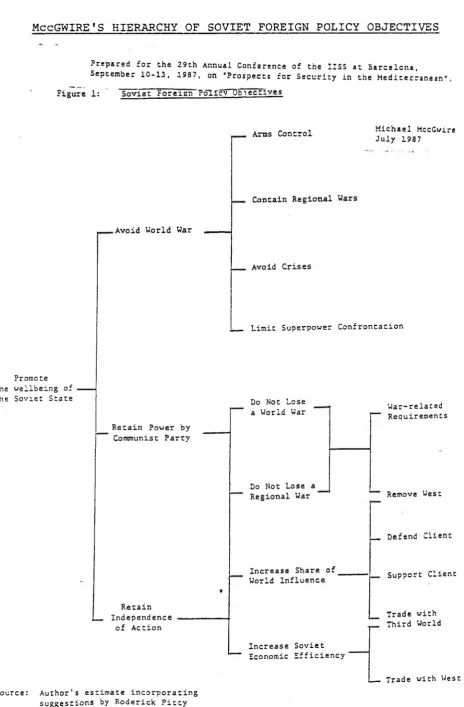
Diagram: MccGwire's Hierarchy of Soviet Foreign Policy Objectives 93
Chapter 3: The Decline of Dependent Allies 94
The Historical Character of National Liberation Revolutions 97
The Dimensions of 'Non-Capitalist Development' 108
Nationalism and the Foundations of 'Socialist Orientation' 117
The Implications of 'Multistructurality' and Backwardness 133
The Cost of Dependent Allies 145
Footnotes 160
Chapter 4: The Prospects for Capitalism in the Third World 178
Sources of Backwardness and Economic Independence 183
The Uneven Growth of National Capitalism 200
The Problem of State Capitalism Unresolved 212
A New Liberal Orthodoxy about Oriental Capitalism 224
Reflections Upon the Transition to Socialism 275
Civil Society and the Need for Reform 298
The Contradictions of 'Statocracy' 320
Footnotes 344
Conclusions 364
Acknowledgements
This thesis would not have been finished without the careful supervision of
Geoffrey Jukes, whose close interest, regular encouragement and great patience
ensured that quality was neither sacrificed for the sake of a target nor turned into
a perpetual illusion. Amin Saikal provided a balance of supervision, and made
sure that I had all the facilities needed for researching and writing this work. Jim
Richardson provided many useful comments as an advisor, particularly on the
first chapter. Hugh Collins obtained a travel grant from the Faculty of Arts that
enabled me to visit the Institute of Oriental Studies in Moscow on an academic
exchange. My supervisor there, Nodari Simoniya, gave me an invaluable insight
into his society, while Aleksandr Lukoyanov and Boris Rubtsov were always
helpful as guides. Several Soviet scholars provided encouraging feedback on an
early draft of the empirical chapters, and David Christian, Stephen Fortescue, and
Elizabeth Waters gave me comments on drafts of the theoretical chapters. Harry
Rigby took a continuing interest in my work, and was always ready with his
advice as an old hand. I would also like to thank Karen Dawisha and Jerry Hough
for sharing their Soviet contacts, Michael MccGwire for his advice and supply of
books, Neil Malcolm and Craig Nation for their hospitality and encouragement,
and Hillel Ticktin for his hospitality and knowledge. I benefited a lot from John
Fitzpatrick, both through his own work and through discussing my work with
him. The Department of Political Science of the Faculty of Arts has been a good
place to write a thesis, particularly because of the interesting group of
postgraduate students it attracted during my time. I would like to thank Nancy
Viviani for allowing me continued use of the Department's facilities in order that
I could finish this thesis as soon as possible. I am also indebted to Eunice and
Geoffrey Jukes, and Mark and Zen Shadur for their generous hospitality, which
was crucial in the closing stages. My parents, Janet and Will Pitty, always
provided complete support in the expectation that I would do my best. Finally, I
wish to acknowledge a special intellectual debt to Jo-anne Pemberton, who showed
me the value of seeing interpretation as a way of considering the light ’in front of
Note on references and abbreviations
The references use a modified Oxford format with the full citation being
given on the first occasion in a chapter and subsequent citations in that chapter
giving a recognisable shortened form of the title. The references for each chapter
are treated separately, so that if a source has been cited in a previous chapter the
full citation is still provided for the first reference to it in a new chapter. In
references for the first two, theoretical chapters, titles of key Soviet journals are
not abbreviated, but in the last three, empirical chapters they are, as follows:
AAS = Aziia i Afrika Segodnia (issued monthly)
MEMO = Mirovaia Ekonomika i Mezhdunarodnye Otnosheniia (monthly)
NAA = Narody Azii i Afriki (bi-monthly)
RKSM = Rabochii Klass i Sovremennyi Mir (bi-monthly)
The Library of Congress transliteration of Russian is used for all reference titles,
but not for proper names, since some Soviet scholars prefer otherwise (e.g.
Simoniya) and an alternative version of other names is common (e.g. Trotsky,
Levkovsky). Within reason, I have sought a blend of simplicity and consistency.
A scholar's first name or initial is given at the first reference in the text, but
subsequent references use only the surname. Two Vasil'ev s are referred to in the
text, Vladimir F. in chapter three and Leonid S. in chapter five; otherwise, only
one scholar with the same surname is discussed in the text. Apart from common
abbreviations like CPSU, two specific acronyms are used throughout the thesis:
IMEMO = Institut Mirovoi Ekonomiki i Mezhdunarodnykh Otnoshenii
IVAN = Institut Vostokovedeniia Akademii Nauk
(The Institute of World Economy and International Relations is also part of the
Soviet Academy of Sciences, but this usage is common in Moscow.) Throughout
the thesis, original emphasis is designated by italics and my emphasis by
A b stra c t
This thesis investigates three layers of Soviet debate since the mid 1960s about
problems of development. A protracted debate about the importance of 'socialist
orientation' in the third world is considered principally as a dispute between
conservative officials and liberal critics about the significance for Soviet foreign
policy of dependent allies in a global struggle with imperialism. A parallel debate
about the prospects for a capitalist transformation of the third world is evaluated
mainly as the first phase of a substantial discussion amongst leading scholars
searching for an adequate theory of the developing world. A subterranean debate
about the nature of modem Soviet society is presented as an example of the
profound criticism of Brezhnev's regime which some leading scholars were able
to make in print during the 'years of stagnation'. These empirical interpretations
are based on two theoretical arguments, which establish the main historical
contexts of Soviet development debates and the position of an outside reader as
someone necessarily concerned with the same questions as the participants in the
debates. The thesis demonstrates the intellectual achievements of a group of
committed Soviet scholars, whose thought was not constrained by a dogmatic
system of censorship. By showing the openness of Soviet discussions to a foreign
interpreter, it questions the view that 'Marxism-Leninism' has constituted the
to get around men's brains with their astuteness; and in the end they have overcome those who have founded themselves on loyalty. ... But it is necessary to know well how to colour this nature, and to be a great pretender and dissembler, and men are so simple and so obedient to present necessities that he who deceives will always find someone who will let himself be deceived. ... For the vulgar are taken in by the appearance and outcome of a thing, and in the world there is no one but the vulgar,
Niccolo Machiavelli, The Prince, trans. Harvey C. Mansfield Jr.,
University of Chicago Press, Chicago, 1985, pp. 69-71.
all science would be superfluous if the outward appearance and the essence of things directly coincided.
Karl Maix, Capital, volume III, Progress, Moscow, 1959, p. 817.
The error often committed in historico-political analyses consists in having been unable to find the correct relationship between what is
organic and what is occasional: thus one succeeds either in expounding as directly operative causes which instead operate indirectly, or in asserting that diiect causes are the only effective causes; in the one case there is an excess of 'economism' or pedantic doctrinairism, in the other an excess of 'ideologism'; in the one case an overestimation of mechanical causes, in the other an exaltation of the voluntarist and individual element. The distinction
between 'organic' movements and events and 'incidental' or occasional movements and events must be applied to all types of situations, not only to those where one sees a reactionary development or an acute crisis, but to those where one sees a progressive or prosperous development and to those where one sees a stagnation of the productive forces. The dialectical nexus between the two kinds of movement, and, therefore, of research, is difficult to establish; and if the error is serious in historiography, it is still more serious in the art of politics, where we are dealing not with reconstructing past history but with building present and future history; one's own inferior and immediate desires and passions are the causes of error, insofar as they are substituted for objective and impartial analysis, and this happens not as a conscious 'means' to stimulate action but as self-deceit Here also, the snake bites the charlatan, or rather the demagogue is the first victim of his demagogy.
Antonio Gramsci, The Modern Prince, International Publishers, New York,
In trod u ction
The word, if it is not an acknowledged falsehood, is bottomless.
(Mikhail Bakhtin, Speech Genres and Other Late Essays, p. 127.)
This thesis began within a comer of one of the two basic language-games for
writing about the USSR, but has finished toward the centre of the other game.
The first game is called Sovietology, and involves reading Soviet sources in order
to disclose the Soviet state's policy in various domains. The second game might
be called 'anti-Stalinism', and involves a dialogue with an "intellectual opposition"
in the USSR.* Both games can be played in parallel, since they share a concern
for "what is manifest in the text" of Soviet political discourse, and have basically
"the same method: measurement of the deviation of a current statement from the
traditional c l i c h e .What initially distinguishes these games is the texts they
consider worth reading. Sovietologists value documents which either express or
might influence the behaviour of the Kremlin, while 'anti-Stalinists' value
documents which expose the inadequacies of Soviet society. Glasnost' has brought
these games closer together but by no means merged them into one. Some of the
interpretations presented herein belong to the first game, while others belong to
the second. Since the leading Soviet scholars discussing problems of development
have played both games from 'inside the whale', I have followed suit.^
The main originality of this thesis is in demonstrating that some key documents
can be read in terms of both these language-games. What is manifest in the key
texts of Soviet development debates is not one meaning but several
complementary meanings, which exist at different 'levels' of analysis or
conceptual 'depth'.^ Three broad layers of Soviet debate about development were
revealed in a process of empirical discovery which roughly corresponded to the
argument presented in a recent article entitled "Once More About the Problem of
Socialist Orientation".^ First, the official view of the third world from the early
1960s until the early 1980s, which declared 'non-capitalist development' to be a
critique by some leading scholars who were dissatisfied with quoting Marx and
Lenin out of context in order to affirm a simplistic account of social change in the
developing countries.^ This critique was investigated as the most significant part
of a broad debate about Soviet policy toward the third world, the key question of
which was gradually discerned as the importance or marginality of dependent
allies. Second, behind this critical response to the ruling dogma of 'socialist
orientation' there lay a more complex and intellectually substantial debate about
the prospects for capitalist development in post-colonial societies. This discussion
was viewed as part of a broad settling of accounts with the official slogan of
capitalism's 'general crisis', which many Soviet scholars seem to have engaged in
since at least the early 1960s. While some of the ideas expressed in this debate
reinforced the orthodox view of 'socialist orientation' and most supported the
emerging critique of it, the scope of the questions at issue clearly transcended the
immediate priorities of Soviet foreign policy, involving a consideration of the
objective force of capitalism and the limitations of possible alternatives to it in
backward countries without the necessary prerequisites for a transition to
socialism.^ Third, beneath this consideration the most critical scholars were
found using the logical power of comparative analysis in order to reflect upon
key historical situations in which the basic structures of Soviet society had been
forged. At this level, problems of development oriented toward socialism were
being earnestly reconsidered in the profound context of twentieth century world
history, rather than treated sophistically in terms of the subjective requirements o
of "ideological struggle in the international arena".
These three broad layers of Soviet debate about development are distinguished
by the participants involved and the resonance of the ideas discussed, as well as by
the scope of the questions at issue. At the top layer, debate about the significance
of states of ’socialist orientation' for Soviet foreign policy tended during the
1970s and early 1980s to involve a growing number of prominent liberal critics
attacking a conservative orthodoxy which was affirmed by senior officials and
supported by a decreasing band of lesser scholars. The influence on Soviet policy
precisely by the fact that the main objects of criticism were key officials like
Rostislav Ul'ianovsky. By the same token, the influence of this critique under
Gorbachev has been greatly extended as a result of the rejuvenation of the Soviet
foreign policy apparatus.^ At the middle layer, debate about the prospects for
peripheral capitalism developed in the 1970s and 1980s mainly through arguments
amongst leading Soviet scholars themselves, rather than between prominent
scholars and current officials. The resonance of this debate amongst specialists
has grown gradually in accordance with the increasing sophistication of the
arguments elaborated, not sharply as a result of a change in the political climate,
although the new atmosphere of open discussion has allowed the arguments to be
taken further and encouraged more participants to join in debating a complex
topic. At the bottom layer, esoteric debate about the nature of Soviet society had
from the late 1960s until recently involved only a relatively small group of the
leading scholars, whose implicit meanings would have been largely restricted, by
small publication runs and the apparently foreign subject matter, to themselves
and any fortunate and perceptive onlookers. Here the effect of glasnost' has been
quite dramatic, opening up the most critical level of Soviet development debates
to a wider audience. Ideas elaborated in a cramped code have been allowed to
breath the fresh air of rhetorical suasion, and this together with the topicality of
debate about the nature of Stalinism will have increased significantly the influence
of that criticism which accurately named its referent.
Fortuitously, the top and bottom layers of Soviet development debates have
just finished in the form that they have taken since the late 1960s, while the
middle layer has reached a new peak of all-round discussion, from which
previous arguments can be evaluated with the benefit of hindsight. The debate
about dependent allies finally ended last year with a complete victory for the
critics, both on the specific question of foreign policy priorities involved and on
the general issue of the legitimacy of relatively independent scholarly input into
policy-making. The attempt by old officials to restrict scientific discussion
largely to an endorsement of the official line failed slowly but surely, and a new
clearly begun. A more interdependent division of labour between scholars and
policy-makers is reflected also in the effervescence of debate about the prospects
for capitalism in the third world. While the empirical difference between
remaining states of ’socialist orientation' and various types of peripheral capitalist
development is still recognised, automatic consideration of the former as more
reliable partners for the USSR has been dropped. Consequently, the distinction
between the top and middle layers of debate has recently become less marked,
since while a new liberal orthodoxy has emerged, it has the support of most
leading scholars, and criticism of this orthodoxy is predominantly a continuation
of arguments between specialists, not scepticism toward the new line. The
opening up of the bottom layer of esoteric debate about Soviet society has also
reduced its distinctiveness as a separate discussion, and in some cases enabled
straightforward confirmation of inferences about meanings which might hitherto
have seemed incongruous to an informed sceptic.
This thesis focuses on debates amongst leading Soviet scholars not on actual
policies conducted by the Soviet state, but it assumes that the arguments of the
former shed some light on the actions of the latter. Ideas or 'perceptions' are an
inalienable part of any action, so Soviet policies cannot be understood by ignoring
the dominant beliefs of decision-makers and interpreting only the use of hard and
fast capabilities.^ And since the beliefs of those responsible for policy do not
exist in a social vacuum, the evidence available for illuminating these beliefs is not
limited to statements by decision-makers themselves. In broad terms, the tenor of
Soviet scholarly debate about third world development was considered as a
response to the prevailing concerns of the Soviet leadership. Many different
particular responses were analysed in terms of a hierarchy of basic policy
objectives, derived from a directive speech to Soviet orientalists by a leading
foreign policy official of the Brezhnev regime and an interpretation of Soviet
actions in the third world. The general tone of the response from leading
scholars to official concerns changed from increasing criticism in the late
Brezhnev years to enthusiastic support after the proclamation of 'new political
leadership compared to the world view of their predecessors in the Politburo.
From this perspective, the process of conceptual change or learning in Soviet
foreign policy has been more like a 'spiral' creeping up a bureaucratic pyramid
than a 'curve' expressing the depressed expectations of incumbent officials. Since
the topic of the thesis is limited to scholarly debates, statements of the new
leadership have not been studied in order to work out the new hierarchy of basic
Soviet policy objectives toward the third world, but some broad hypotheses about
the extent of conceptual change are suggested in the conclusions. At the bottom
layer of debate about the nature of Soviet society, the contrast between scholarly
arguments and official concerns is considerably starker, and the lag of policy
behind theory much more evident. Although Gorbachev complained at the
January 1987 Plenum of the CPSU Central Committee that the "moving forces
and contradictions" of Soviet society had "not become the object of profound
scientific investigations", it is clear that this statement was not entirely accurate.^
Whereas most of the critical liberal arguments about understanding the third
world advanced by Soviet scholars in the 'years of stagnation' have readily been
accepted as part of the re-evaluation of Soviet foreign policy under Gorbachev,
many of the radical criticisms of Stalinism made in the esoteric debate about the
nature of Soviet society disputed the existence of a 'socialist order' in the USSR,
and so cannot be embraced without a more substantial revision of dogmas than has
yet occurred.
A principal concern of the theoretical section of this thesis is to elucidate the
nature of 'Marxism-Leninism' as the milieu of Soviet development debates. Since
the empirical research was informed by a sceptical attitude toward the view that
'Marxism-Leninism' constitutes the conceptual framework of Soviet discussion, it
seemed necessary to substantiate this through an alternative explanation of 'Soviet
ideology'. Rather than a coherent and believable theory, official Soviet dogma
was interpreted as an idiom of censorship, the 'revisions' of which in the
post-Stalin era were adjustments to accommodate social pressures for reform, not
concessions to the unrealisability of a liberating utopia. This materialist approach
with accounts by emigres and dissidents of life within the Soviet intelligentsia
during the Brezhnev years, then confirmed by an interpretation of the one text in
the esoteric debate about Soviet society which analysed the problem of 'mass 1 9
consciousness’, and buttressed with some recent statements by liberal Soviet
intellectuals published as a result of glasnost'. Viewing 'Marxism-Leninism' as a
loyalty test rather than a belief system did not mean discounting the role of Marx
and Lenin as sources of ideas for some leading participants in Soviet development
debates. On the contrary, this approach highlighted cases in which these
theoretical sources were used in order to explain features of third world
development or Stalinism, particularly where competing arguments were
presented by scholars relying on different views expressed by Marx and Lenin,
without discounting the presence in Soviet debates of a variety of ideas deriving
from other sources.
The basic problem in interpreting the political meaning of Soviet development
debates was not to find the key to a hidden ’operational code’, but simply to find
some questions with which to pass through an open door by means of an "actual
dialogue in the field". ^ The sign ’Marxism-Leninism' did not mark a threshold
of debate, but rather a mirror of narcissism, whose "pretentious" claim to a
monopoly of self-truths effectively precluded the "mutual outsideness"
presupposed by all dialogue.^ By denying the contingency of its own context,
this sign obscured the questions which participants in Soviet development debates
were trying to answer. Finding these questions involved assuming that some key
problems were perceived in broadly the same terms by these participants and the
outside reader. The basic task was to find the most interesting common problems,
as opposed to either viewing Soviet problems as a reason for Western
self-satisfaction or focusing on unproblematic commonalities. In this sense, "the
person who understands inevitably becomes a third party in the dialogue", a
'superaddressee' "whose absolutely just responsive understanding" mediates
between the author and the immediate audience from outside and after the fa c t.^
The position of this third party is not objective but interested, so that justice in
by exhausting one question after another. Finding meaning in a text requires not
only reading it, but asking what it sought to do for whom. Such understanding
responds to the text by incorporating it into a new language-game in which the
dialogue between author and audience is re-awakened. The polysemy inherent in
the key texts of Soviet development debates shows that the different outside
perspectives represented by Sovietology and 'anti-Stalinism' are founded upon
different questions rather than different documents.
My research is presented in two short theoretical chapters and three long
empirical ones. The first chapter endeavours to resolve some fundamental
methodological and epistemological problems involved in understanding the broad
practice of 'esoteric communication' in the Soviet context. The main features of
policy debates amongst the Soviet intelligentsia are characterised through a review
of previous Western studies, then the process of interpreting Soviet political
discourse is shown to depend upon the outside reader making a bridging
assumption of some common meanings. The second chapter establishes such
meanings through an investigation of the three general contexts of Soviet
development debates. The first context is a broad 'loosening' of ideological
censorship in the post-Stalin era, while the second is the renewal of serious
comparative research which occurred in the theoretical field of Soviet oriental
studies gradually from 1956 onwards, reaching a 'critical mass' by the late 1960s.*
The third context is the hierarchy of basic Soviet policy objectives toward the
third world during the Brezhnev years, which forms the main period covered by
the empirical research. The third chapter presents an analysis of the most
significant arguments in the long-running Soviet debate about 'socialist
orientation', known initially as 'non-capitalist development'. The main theme of
this debate is revealed as the declining significance of dependent allies for Soviet
foreign policy in the opinion of an increasing number of leading scholars. The
fourth chapter presents an account of the first twenty years of Soviet debate about
the prospects for capitalism in the third world, which began in earnest in the late
1960s. The main theme of this debate is revealed as a change from initial
that some key issues have not been resolved and substantial dispute is likely to
continue amongst the leading scholars for some time to come. The fifth chapter
presents a reading of a subterranean debate in which a select group of scholars
critically reconsidered the nature of Soviet society while ostensibly only
discussing the 'third world'. This reading reveals the existence within the Soviet
intelligentsia of a diversity of radical and liberal responses to the legacy of
Stalinism, at a time when this wounded heart of Soviet history was apparently
forgotten. The conclusions highlight the key points of the thesis concerning
Introduction, Footnotes:
1. Michael E. Urban, "The Structure of Signification in the General Secretary's Address: a semiotic
approach to Soviet political discourse", Coexistence, vol. 24, 1987, pp. 187-8.
2. Ibid., p. 188; Vladimir Shlapentokh, "The XXVII Congress - a case study of the shaping of a
new party ideology", Soviet Studies, vol. XL, no. 1, January 1988, p. 14. Urban, pp. 188-9,
criticises both these approaches for being "confined to what is manifest in the text", arguing that semiotics "isolates the text from its sociopolitical context" and aims "to allow the text to speak for itself, as it were, without encumbering it with our own interpretations and interests". If the former abstraction is unwise, the latter is simply impossible, as Aron Gurevich, "Istoricheskaia nauka i istoricheskaia antropologiia", Voprosy filosofii, 1988, no. 1, p. 58, has stressed: "The first condition of scientific understanding is the 'outsideness' of the interpreter, the recognition by him that he belongs to another time, to another culture, than the people whose works he wants to understand."
3. Cf. Edward Thompson, "Outside the Whale", in idem., The Poverty o f Theory and Other
Essays, Merlin, London, 1978, p. 13.
4. Cf. M.M. Bakhtin, Speech Genres and Other Late Essays [selected translations from Estetika
slovesnogo tvorchestva, Nauka, Moscow, 1979], Vem W. McGee trans.; Caryl Emerson and
Michael Holquist eds, University of Texas Press, Austin, 1986, p. 127: "The criterion of depth
understanding [is] one of the highest criteria for cognition in the human sciences."
5. Yu. Aleksandrov and V. Maksimenko, "Eshche raz o probleme sotsialisticheskoi orientatsii",
Aziia i Afrika Segodnia, 1987, no. 10, pp. 22-6.
6. Ibid., pp. 22-4.
7. Ibid., pp. 24-6.
8. Ibid., pp. 25-6.
9. Jerry Hough, Russia and the West: Gorbachev and the politics o f reform, Simon and Schuster,
New York, 1988, p. 226.
10. Cf. Gurevich, "Istoricheskaia nauka", pp. 63-4.
11. Materialy Plenum TsentraVnogo Komiteta KPSS, 27-28 ianvaria 1987 goda, Politizdat, Moscow, 1987, p. 8.
12. V.P. Lukin, "'Ideologiia razvitiia' i massovoe soznanie v stranakh 'tret'ego mira’", Voprosy filosofii, 1969, no. 6, pp. 35-46.
13. Brice R. Wachterhauser, "History and Language in Understanding", in idem, ed.,
Hermeneutics and Modern Philosophy, State University of New York Press, Albany, 1986, p. 32.
14. G.G. Diligensky, "Perestroika i dukhovno-psikhologicheskie protsessy v obshchestve",
Voprosy filosofii, 1987, no. 9, p. 4; Yuri Afanas'ev, "Perestroika i istoricheskoe znanie",
Literaturnaia Rossiia, 17/6/88, p. 9; Bakhtin, Speech Genres, p. 168.
Chapter 1: Interpreting the Political Meaning of Soviet Debates
The central task of the interpreter is to find the question to which a text presents the answer, to understand a text is to understand the question [it addresses].
(Josef Bleicher, The Hermeneutical Imagination, Routledge and Kegan Paul,
London, 1982, p.75) 1
Many students of Soviet foreign policy toward the third world have implicitly
assumed that the political meaning of Soviet sources is self-evident.^ This
assumption may be questioned theoretically by attempting to formulate some
guidelines for interpretation that elaborate the old adage, 'read between the lines'.
An elaborate theoretical approach is in itself no guarantee of producing
significant empirical results. Archie Brown has warned about the "danger ... of
merely presenting familiar knowledge in a less familiar framework. Even this
may not be entirely devoid of interest, but the change of approach can be really
justified only if its different conceptual framework leads the researcher into
somewhat less familiar territory, the exploration of which produces new
knowledge and a refinement of our understanding of Soviet political life.'0 The
task of theoretical questioning is to establish where a new area of research exists,
and to suggest how it is best investigated. In this sense, theoretical and empirical
work are complementary not opposed; they are simply different aspects of a
process of asking the most pertinent questions. As C. Wright Mills succinctly
said: "'Method' has to do, first of all, with how to ask and answer questions with
some assurance that the answers are more or less durable. 'Theory' has to do,
above all, with paying close attention to the words one is using, especially their
degree of generality and their logical relations. The primary purpose of both is
clarity of conception and economy of procedure." ^
Identifying Political Perceptions
The topic of policy debates amongst the Soviet elite about various foreign and
of research. Many detailed studies have been undertaken, but the methodological
difficulties of this research have not always received sufficient attention. These
difficulties exist principally because of the strict censorship which has existed in
the USSR over what could be said publicly to selected audiences, and increasingly
also because of "the vastly greater organisational complexity of the Soviet polity
and policy-making process."^ Central control over information and public
expression together with more diverse inputs into policy formation mean that it is
difficult to determine at first glance what is politically significant in Soviet
sources. Yet, as Mary McAuley said in a recent debate about Soviet political
culture, "if we are to analyse political perceptions and to try to explain them, we
must first be able to identify them."^ Any such identification must proceed by a
method of inference from Soviet sources, so the problem of correctly identifying
political perceptions amongst the Soviet elite is essentially one of avoiding errors
of inference when interpreting Soviet sources. Elaborating an adequate method
of inference from Soviet sources is difficult, as shown by the fact that such
methods have usually been implicitly assumed rather than explicitly argued for.
Explicit inferences may not be intrinsically superior to implicit ones, but it is
important to specify the assumptions upon which certain expressions in Soviet
discourse are considered more significant than others as indicators of political
belief.^ At least, as Erik Hoffmann suggested in 1966, "a rudimentary but
important piece of advice would be to infer carefully the m ea n in g of
communications, and not to take the stated meaning or contents literally.
The carefulness of inference from Soviet sources depends fundamentally on a
preliminary assumption about the existence of political argument within the Soviet
elite. If it is assumed that no significant political differences exist, whether
because of the supposed "unifying dynamic of common ideology" or because of
strict censorship, then careful inference is not necessary, since every source will
equally be "an index of real perceptions".^ But "censorship is introduced by
those who fear public opinion, [so] the very existence of censorship is a sign that
oppositional thought is alive and cannot be eradicated."^ Significant political
differences have been shown to exist even at the topmost level of the Soviet elite,
uniformity of all opinions expressed (this would logically negate the purpose of
any detailed and sophisticated investigation of Soviet sources, since if two
different Soviet "schools of thought” are found, the only conclusion consistent
with the initial assumption is that there is no effective political difference between
them).** Once the existence of political argument is recognised, a number of
interpretative difficulties must be resolved. The first problem is understanding
the forms or methods of public debate within the Soviet e lite .^ Without this
understanding it is impossible to avoid making false inferences about the policy
implications of particular Soviet statements. A consideration of the forms in
which policy debate occurs is also the best way of approaching perennial
problems of interpretation, like distinguishing between genuine perceptions and
propagandists affirmation, and identifying the link between scholarly debates and
the making of foreign policy decisions.
Public debate within the Soviet elite has been restricted by three different
forms of censorship. Specifically, the central censoring body Glavlit "checks to
ensure that numerous types of concrete information, primarily military or
economic, are not included in the manuscript."^ Banning of particular subjects
prohibits direct mention of sensitive political issues which might offend foreign
governments, but mainly affects the provision of information rather than the
extent of debate a llo w e d .^ Generally, the main political and ideological
restrictions on debate are instituted principally by editorial boards of newspapers,
journals and publishing houses, who control the expression of political arguments
in print. ^ This institutional form of censorship sets the tone of discussion in
particular fields, defining the extent of self-censorship which scholars must use if
they wish to present their views publicly. Both central and institutional forms of
censorship can shift in scope, markedly as a result of new policies and
appointments made from above, and marginally as a result of persistent struggles
by authors and editors to open a crevice for thought. Socially, these two directly
political forms of censorship have been reinforced by a third: the "influence on
culture as a whole" of Soviet ideology, which, as Andrei Sinyavsky pointed out,
"forbids silence. A degree of silence is necessary for clear thinking, so an
lies can best be understood as part of a comprehensive system of censorship.
The result of these forms of censorship, as Jerry Hough pointed out several
years ago, has been that in the USSR ’’foreign policy is almost impossible to
discuss [openly] in any sophisticated manner.”^ This limitation has affected
different types of Soviet sources in quite different ways, so that distinguishing
between the kinds of discussion possible in Soviet sources is an important
requirement for any careful method of inference. As Ronald Hill has suggested,
there are
three basic types of political literature in the Soviet Union: first, the 'official' literature ... including the speeches and writings of politicians, together with official handbooks and commentaries; second, 'propagandistic' literature, written in a popular style, for home or foreign consumption, and designed to present the accepted view, revealing no secrets, no serious problems; and, third, 'heavy' political science, published by academic or provincial presses or in specialist journals, often by scholars whose work also appears in more popular format or in the periodical press. This literature tends to be more revealing, more realistic in its assessment... more willing to discuss problems
in a serious manner. It relies much less on pure assertion, more on the results
of detailed study, backed up with argumentation and judgement. There is also a concern for methodology that immediately raises such work to a level of respectability that few would accord the unsophisticated accounts.^
Soviet sources in the ’official’ category are the most difficult to characterise, since
their nature depends on the position of the official(s) whose views they represent,
as well as on the subject matter discussed and the context of the audience
addressed. The distinction between academic and propagandistic literature was
confirmed by a leading Soviet foreign policy official, Boris Ponomarev, who, in a
speech to the Institute of Oriental Studies (hereinafter IVAN), informed Soviet
scholars that they were required to undertake "scientific-research and
popularising work”. ^ The meaning of this distinction is essentially that serious
discussion with implications for policy occurs only in the scientific-research work
performed by Soviet scholars, not in their propagandistic work, which simply
endorses official policy. But the demands of the latter for a long time restricted
the influence of the former, leading a prominent reformist scholar to claim in
publications and publications reflecting the official position”, so that scholars can
work out answers to current problems and not waste time defending old
policies.^
Most errors of inference from Soviet sources result from attempts to deduce
political perceptions from propagandistic statements, thus confusing the two most
different types of Soviet sources. While central and institutional censorship
ensures that all Soviet sources avoid direct discussion of sensitive issues,
propagandistic material must in addition provide a lot of noise affirming the
"postulate” that the USSR ”may conduct only such a foreign policy which, by
definition, is from the beginning correct, free from mistakes and answering the
interests of all progressive f o r c e s . * Because of this, most direct comment in
the USSR on Soviet foreign policy is mere polemical affirmation, the purpose of
which is not to discuss problems or suggest changes, but simply to persuade all
that this policy is being conducted in the best possible way. Moscow Radio
foreign language broadcasts are crucial for a study of Soviet propaganda, but of
little or no interest for investigating Soviet perceptions. Even articles in New
Times and International Affairs, while more nuanced and informative than most
radio broadcasts, consisted until recently almost entirely of statements trumpeting
Soviet p o l i c y . T h e s e "obligatory polemical banalities", as Neil Malcolm has
aptly termed them, also exist in Soviet academic discourse, but there they are
usually ritual emendations from which "the author's real meaning has to be
carefully disentangled".^ The dividing line between these two types of Soviet
discourse is rarely clear-cut — the same article can include both types of discourse
— but it nevertheless exists. If any article by a Soviet foreign policy official is
simply read as a literal expression of the beliefs impelling complex Soviet actions,
then an error of inference is the most likely re su lt.^
While the danger of confusing propagandistic affirmation with genuine
perceptions affecting Soviet foreign policy formation can be minimised by
considering the contexts of particular statements, this assumes that Soviet
specialists themselves manage to keep their affirmatory and explanatory activities
academic discourse might make many analysts in Moscow "the victims of their
own propaganda."^ Such an effect should not be ruled out as impossible, but it
is necessary to specify the type of situation in which it could occur. This is where
a specialist or official has no access to information that casts doubt on the
accuracy of a purely affirmatory view of events, and also will not seek such
information because the responsibility for making ill-advised decisions does not
rest with them. These conditions are definitive at most only of John Steinbruner's
category of ’grooved’ thinkers, who, as Robert Cutler has suggested, in the Soviet
context "are the low-level functionaries in the Ministry of Foreign Affairs.
Situating Steinbruner's two other categories institutionally, Cutler comments that:
"The 'uncommitted' policy-makers are the chief political decision-makers in the
country: the Politburo and the Secretariat, and to some degree the Central
Committee Departments. The 'theoretical' policy-makers are the institute-based
advisors and ministerial co n su ltan ts."^ Both these groups would be very
unlikely to mistake propagandists justification for actual perception (the accuracy
of their perceptions is another matter). The former receive much classified
information at odds with a purely affirmatory view, including special summaries
of foreign political commentary; they are also responsible for the general
supervision of political propaganda, a task which requires the ability to
distinguish justification from perception, or words from deeds. The latter
have access to fairly diverse sources of public information, and are able to
discriminate readily between the requirements of policy affirmation and the
opportunités for genuine articulation of opinions since, as Franklyn Griffiths has
pointed out, they have regularly "said different things to different audiences at
about the same time."29 When unorthodox scholars put forward conventional
arguments at certain times, they are consciously making concessions to tradition
in some areas in order to advance other opinions of a more controversial
n a t u r e .^ Rather than an effect of propaganda, this is simply one of many
techniques which Soviet specialists regularly use in order to get around the
restrictions on open discussion.
Several other techniques regularly appear in Soviet academic literature as
not infringe what Hough has called the two basic "rules of the gam e".^ These
rules are: 1) that Soviet policy itself cannot be discussed directly in any critical
manner; and 2) that certain postulates, like the consistently peace-loving nature of
Soviet policy, the ultimate irreconcilability of the two social systems and the
absence of a third way between them, must be accepted without question. The
consequence of the first rule is that, instead of an open debate about policy options
for the USSR, "published discussion of foreign policy takes place within the
framework of a discussion of the 'objective situation' in the outside world." And
since, in accordance with the second rule, "any change in Soviet policy, when
acknowledged at all, is described as the natural response of a perfectly consistent
program to differences in conditions", the focus of public debate must always be
on the nature and implications of those conditions.^^ The techniques of
conducting such debate vary, depending on the scope and sensitivity of the matter
at issue. Relatively open discussions became more regular after the fall of
Khrushchev, when "the collective leadership adopted a comparatively detached
approach in which specialists were evidently given greater freedom to resolve
their own differences and to carry out research and a n a l y s i s . T h e s e open
discussions usually focus on broad questions, rather than on what is occurring in a
particular country, but, as Hough has pointed out, "the more abstract the debate,
the more sensitive the real issue is likely to b e ." ^ While broad questions may be
debated with some openness, this is not possible for particular sensitive issues, on
which "a controversial position is presented in a straightforward manner, without
any indication that it is controversial or that another position is being attacked."^
Sometimes points of criticism are made esoterically through commentaries on
historical or foreign surrogates, or by means of a "false denial", when a new
interpretation is raised and apparently rejected, simply in order to circulate it.
An important example showing the context of esoteric criticism is cited by
Malcolm, who notes that "when the head of the USA Institute's Department of
Internal Politics delivered the opinion in 1981 that American officials ignore
valuable analyses submitted by foreign policy brains' trusts because of their own
narrow-minded and blinkered attitudes, their 'bureaucratic inflexibility' and their
attachment to 'stereotyped habits of thought established during the Cold War', it
' i n
An important methodological implication of such esoteric forms of debate is
that an accurate and sophisticated understanding of the political meaning of
statements by Soviet specialists requires much more than a translated exposition
or content analysis of the arguments put forward. Such an exposition, used by
Hoffmann and Robbin F. Laird, effectively obscures from view significant
differences amongst Soviet specialists by focusing on general, self-serving
statements which have few implications for policy. The brief account which
Hoffmann and Laird provide of Soviet writing about the third world does not
mention any controversial points at all, while their conclusion only discusses
different Soviet statements in terms of the general categories of "conservatives
and modernisers".-^ There are fundamental differences between conservatives
and modernisers, but this is only the most immediate level of debate. If the
conservatives lose ground, then differences amongst modernisers become more
significant, and understanding these differences requires a detailed interpretation
of the issues at stake. Significantly, Hoffmann and Laird rely more on popular
Soviet publications than on academic works, and when they do refer to the latter
material it is not in a sufficiently thorough way to extract the main explanatory,
not affirmatory, frameworks of interpretation used by Soviet scholars. y Their
superficial form of content analysis lumps together a lot of apparently similar
statements without considering whether, in view of the specific terms used and the
audience addressed, similar meanings were being communicated. In short, the
method of translated exposition, by not defining the basic categories of Soviet
debates, fails to recognise that "it is not the significance of repetition that is
important but rather the repetition of significance."^
The problem of interpreting the significance of Soviet debates is not limited to
defining the political meaning of key words, although that is very important and
also difficult because often "it is the variation in the definition or in the emphasis
that constitutes an important part of the debate, not just which word to choose."^*
An equally important and difficult task is to specify the place of specialist debates
in the formation of Soviet foreign policy. The significance of a particular debate
will depend both on its intrinsic meaning and on its resonance within the Soviet
arbitrary limit before a debate should be considered worth investigating. After
all, a discussion carried on in rather crude terms may be important if the
participants have some political influence, and a debate which is known only to a
select group of scholars may be significant if its terms are politically insightful.
What is required theoretically is an adequate conceptualisation of both these
aspects of significance. Since the question of how to define and investigate the
political meaning of a debate raises fundamental philosophical problems of
interpretation, it will be considered after discussing the task of understanding how
academic debates within the Soviet elite connect with the policy-making
hierarchy.
Political Debate is Transactional
In the first section the character of political debate within the Soviet elite was
specified largely in negative terms, noting a number of difficulties which must be
overcome in making careful inferences from Soviet sources. This section attempts
to characterise such debate positively, in terms of the concept of "transactional
perceptions" originally developed and effectively used by Franklyn Griffiths in 4.9
his study of changing Soviet images of the United States. This concept focuses
on the significance of publicly articulated political arguments between informal
groups in the Soviet elite concerned with foreign affairs. It does not deny the
importance of the largely hidden views of particular Politburo members for the
taking of major policy decisions, but emphasises that, even in such an extremely
centralised political hierarchy as exists in the USSR, these leaders do not exist in a
social vacuum, forever unaffected by the arguments occurring between less
celebrated mortals of the Soviet elite beneath them.
Dimitri Simes has pointed out that it is "a mistake to assume that debates
among academics and experts necessarily mirror disagreements at the to p ." ^
While existing policy or previous decisions may be subjected to esoteric criticism,
a major, open debate amongst specialists usually indicates that policy-makers have
implications. Scholarly arguments may delineate the range of policy options
which might be under consideration, but they do not normally show whether
some group of Politburo members supports one position rather than another (and
the positions of opposed specialists are likely to be further apart than those of
divergent l e a d e r s ) . W h e t h e r certain Politburo members are ’’sponsoring''
particular specialist views is usually an almost impossible question to answ er.^
It is not the most important question, because the leadership and academic
specialists operate at quite different levels of analysis and action, having vastly
different limits of responsibility. The latter spend most of their time researching
and writing, publicly and in classified reports, about the implications of particular
foreign issues, from an academic and policy point of view. The former,
excepting the Foreign Minister, the Secretary of the Central Committee's
International Department and to some degree the General-Secretary, devote
relatively little time to international affairs, only ever spend a relatively short
amount of time on any one foreign issue, and when so engaged as individuals are
principally concerned with policy implementation (negotiating and signing
agreements). The mediation between these different levels is undertaken by
institute directors and senior Central Committee or Foreign Ministry officials, not
by regular foreign policy bureaucrats, who operate at the level of day-to-day
policy. Although some channels for direct scholarly input exist (such as informal
personal contacts, classified reports and ad hoc committees), these are usually
restricted to senior specialists and constitute a supplementary rather than an
essential part of the policy-making p r o c e s s . G e o r g y Arbatov defined the role
of academic institutes in the making of government policy as "to study long-term
problems and trends, and to develop fundamental research that can contribute to
understanding more deeply and reliably the countries we study. As Hough has
stressed, the major contribution of specialist debates lies in affecting gradually the
assumptions current within the Soviet foreign policy establishment about how
aq
various foreign issues should be interpreted. °
This primarily indirect and long-term nature of scholarly influence on foreign
policy formation within the Soviet elite needs to be conceptualised as a political
Richard Remnek, who tried to "extract policy-relevant analyses and concrete
recommendations from Soviet scholarly literature and determine whether they
were later reflected in Soviet p o licy ".^ Remnek's conclusion "that scholarly
influence is limited mainly to areas where the requirements of expertise are
high", such as economic aid and trade, is based on a very narrow definition of
direct influence which makes it difficult for anything but purely technical advice
to q u a l i f y . T h i s limited conclusion results from reading the influence of
academic specialists back to front, i.e. considering the implementation of policy
before analysing scholarly debates, and downplays the more interesting and
substantial results of Remnek's analysis, such as the finding that debates among
Soviet experts on India in the late 1950s and early 1960s generally undermined
some assumptions on which Khrushchev's aid programme was based, although the
focus of Soviet policy did not change toward trade rather than aid until after
Khrushchev was o u ste d .^ This example suggests that a major function of
scholarly debates amongst Soviet specialists is to get new issues or new
interpretations of old issues onto the agenda of senior bureaucrats and
policy-makers, to initiate new policy options as well as discuss the appropriateness
of current policy. To understand this feature of Soviet policy formation,
empirical research must be undertaken from the perspective of a moving picture
rather than a snapshot.^ This perspective is necessary because of the long-term
nature of specialist debates themselves. As Hough has pointed out, not only does
the meaning and importance of particular terms change over time, but the
"implications of concepts are often much more evident as they are first explained
and criticised than when they come to be taken for granted". Therefore, "reading
the debates cannot be limited to a brief period", but must be undertaken
extensively and with "a clear perception of the historical background against
which the changes occur.
It is primarily as a means of conceptualising the long-term influence of
scholarly debates upon Soviet foreign policy that Griffiths' concept of
"transactional perceptions" is u sefu l.^ The key contribution of this concept is to
elucidate the nature of a topical scholarly debate in the USSR as "a foreign policy