Rochester Institute of Technology
RIT Scholar Works
Theses Thesis/Dissertation Collections
1-22-2007
Tourism and the environment in small island
developing states: Development of a new
framework for assessing sustainability
Katie KimmelFollow this and additional works at:http://scholarworks.rit.edu/theses
This Thesis is brought to you for free and open access by the Thesis/Dissertation Collections at RIT Scholar Works. It has been accepted for inclusion in Theses by an authorized administrator of RIT Scholar Works. For more information, please [email protected].
Recommended Citation
___________________________________________________________________________________
Tourism and the Environment in Small Island Developing States:
Development of a New Framework for Assessing Sustainability
____________________________________________________
Masters in Science, Technology, and Public Policy Thesis Submitted in Fulfillment of the Graduation Requirements for the
College of Liberal Arts/Public Policy Program at ROCHESTER INSTITUTE OF TECHNOLOGY
Rochester, New York
By:
Katie L. K. Kimmel
January 22nd, 2007
Submitted by:
________________________________________________________________________
Katie L.K.Kimmel Signature Date
Accepted by:
________________________________________________________________________ James J.Winebrake, Ph.D. Signature Date
________________________________________________________________________ M. Ann Howard, J.D. Signature Date
Table of Contents
Introduction... 4
1.0 Background ... 5
1.1 Sustainability ... 6
1.2 Efforts to Develop Sustainability... 11
1.3 Tourism... 12
1.4 Tourism and the Environment ... 15
Country Snapshot: Zanzibar, Tanzania... 18
2.0 Small Island Developing States ... 19
2.1 Energy on SIDS ... 22
2.2 Solid Wastes ... 23
2.3 Tourism Impacts and water use in SIDS ... 24
Country Snapshot: Turkey ... 26
2.4 The Bahamas... 29
3.0 Research Methodology ... 37
3.0 The Six Frameworks ... 38
4.0 Critique of Frameworks ... 47
4.1 New Framework Development ... 51
4.2 Indicators ... 59
4.3 Optimal Framework ... 61
4.4 Application to the Bahamas ... 62
5.0 Issues with Framework ... 63
5.1 Policy Implications ... 65
5.2 Community Involvement ... 69
6.0 Conclusion ... 71
Country Snapshot: East Sussex, UK... 71
Acknowledgements... 75
Selected References ... 76
APPENDIX A... 82
APPENDIX B ... 87
APPENDIX C ... 94
List of Figures and Tables
Figure 1. Definitions of Sustainability within Tourist Destinations... 8
Figure 2. Ranges of Sustainable Tourism Development ... 10
Figure 3. International Tourist Arrivals 1950-2020 ... 14
Figure 4 Contribution to the GDP in 1995 of various sectors of the Bahamian Economy. ... 32
Figure 5. Foreign Direct Investment and Total Debt Service, Bahamas ... 34
Figure 6. Integrated Tourism Yield Framework... 43
Figure 7. Conceptual framework for tourism sustainability assessment ... 44
Figure 8. System indicators leading towards system orientors ... 60
Figure 9. Regional, National, and Island Decision Triangle ... 69
Table 1. Comparison of Water Resource Options... 27
Table 2. Six Aspects that are Important When Generating Indicators ... 40
Table 3. Three Dominant Process areas as defined by ESSD (Harger and Meyer, 1996) ... 41
Table 4. Framework Evaluation Matrix ... 49
Table 5. Framework Evaluation Matrix, Highlighted Strong and Weak Aspects ... 50
Table 6. Process-oriented criteria for evaluating the approach of sustainable development programs ... 53
Table 7.Outcome-oriented criteria for evaluating sustainable rural development projects ... 54
Table 8.Top three objective indicators of each dimension ... 57
Table 9. A Journey towards sustainability for tourism enterprises ... 58
Abstract
Title: Tourism and the Environment in Small Island Developing States: Development of a New Framework for Assessing Sustainability
Author: Katie L.K. Kimmel
Thesis Summary:
Purpose. The purpose of this thesis is to develop an analytical framework that can be used to better understand the impacts of tourism on small island developing states (SIDS). In particular, the framework will address tourism in light of sustainability goals (environmental, economic, social, and political). Because tourism is both a major
economic driver for many SIDS, as well as a primary cause of environmental degradation within these states, a framework is needed that allows for systemic, value tradeoff
evaluation. Currently there are multiple frameworks and plans for sustainability and development in SIDS; but few frameworks take into account how tourism can further stress resources within these nations. With the framework developed herein, analysts will have a tool for evaluating policies and programs aimed at integrating tourism within a sustainability context.
Approach. The approach for this thesis was to develop a new framework to evaluate how tourism contributes to stresses of water resources, energy, environmental degradation, and wastes during sustainable development. Previous reports provide a framework for the issues at hand. Through meta-analysis, current practices and methods for evaluation will be examined. Methods that are being used worldwide will be considered as well as methods that are used and/or proposed in the Bahamas. The Bahamas serve as the main focus of this study. The findings from the meta-analysis and “snap-shots” of practices in other countries will provide information as to strengths and weaknesses of current sustainable frameworks. A new framework for sustainable development was then formulated and applied in the Bahamas.
Introduction
The purpose of this thesis is to develop an analytical framework that can be used
to better understand the impacts of tourism on small island developing states (SIDS). The
developed framework was then applied to the case of the Bahamas. The outcome of the
application and framework provides a better understanding and implications that can be
of use for more effective policy programs. Problem areas usually lie within small island
developing states with regard to issues such as salinization of coastal aquifers, increased
energy needs, increased solid waste, and environmental degradation. Existing geographic,
climatic, and socio-economic factors of small island developing states coupled with
increases in international transport development, and a rise in living standards has
increased the amount of mass tourism. Actions such as these carry a large burden for
small island developing states as pressure increases on the carrying capacity of the
coastal areas. For example, water is usually supplied from groundwater; this water is
often pumped to meet the increasing demands of newly developed areas. This action
lowers the water table, increasing the vulnerability of salt-water intrusion of the coastal
aquifers.
SIDS not only experience stress on water resources but they also rely on less
dependable means for energy. Often islands have large generators that supply power by
burning diesel fuel. This diesel fuel is delivered by barge to islands. The cost
effectiveness of this power generation seems poor. In addition to water and energy, solid
waste disposal is becoming an increasing issue. Poor management techniques and
increasing garbage loads are stressing the resources on SIDS. Overall the ecological and
Small developing islands can often be overused and mismanaged, resulting in
serious degradation to the island. Tourism has continued to grow through many regions
of the world, and in less developed locations resources and their quality have begun to
decline. Many studies acknowledge the need for sustainable tourism development, mainly
touching on eco-tourism and minimal impact development. What seems to be missing is
that tourism stresses resources and many tourism practices are not eco-friendly. In
addition, a framework that includes tourism in sustainable development is lacking.
1.0
BackgroundThroughout the world, countries must confront the issue of sustainable
development. Sustainable development requires one to use resources efficiently and
effectively so that future use is not compromised by today's actions. Communities should
utilize their own resources so that they can survive without brining in outside resources;
this is the best long-term approach. A problem exists in that there are many
countries/communities throughout the world that cannot provide enough resources for
themselves to maintain their current living conditions. This can be due to poor
management techniques and also to over consumption. Evidence of this is usually seen
first in small islands.
Many studies have acknowledged that sustainable tourism development is needed
in order to make the standard of living better for the local communities. What is of
concern is that most of these evaluations discuss the development of eco-tourism or low
impact development. Ideally all tourism would be based around those concepts, but in
issues/concerns are elaborated upon in a further section.
1.1 Sustainability
The term sustainability has been used in multiple disciplines with varying
definitions. The World Commission on Environment and Development (WCED)
developed the most familiar concept of sustainability. The WCED termed sustainable
development as “development that meets the needs of the present without compromising
the ability of future generations to meet their own needs”. Apart from this general
concept of the term ‘sustainable’ or ‘sustainability’ the actual definition really has two
components. The components are the meaning of development and the conditions that are
necessary for sustainability (Tosun, 1998). Development in this context does not simply
refer to the concept of economic growth; rather it means development in terms of change.
“Development is not just about increased wealth. It means change; changes in behavior,
aspirations, and in the way which one understands the world around one” (Dudley, 1993).
Sustainable development is a concept that is used in long-term planning, most often in
regards to conserving environmental resources. It is also implied that today’s society will
use resources wisely so that the level of welfare is balanced for future generations.
Sustainable development does not only refer to countries with a low level of
development, it encompasses all countries.
The idea of sustainable development became the idea of a solution to a multitude
of problems. The most common concept of sustainability is with the environment.
However, other uses can also be sustainable such as economics, health, employment, etc.
identify what aspects or areas they are covering. This can be more difficult to identify
then expected. For instance when considering helping an area become more sustainable
to provide them the best means for life should the resource be sustained or should the
services. In other words should a forest be sustained or the lumber that it provides. Even
though both things are essentially the same thing they would require different
measurements to track or evaluate sustainability. Popp (2001) argues that sustainability
should consider what is being sustained and should also be inclusive enough to account
for multiple services. The term sustainable or sustainability in this paper refers to having
the environment, culture, human resources, and economy at the most beneficial level with
little ‘negative’ change for the current and future citizens of a nation. These aspects of a
nation need to remain viable and managed in respect to the particular dynamics
(environmental, social, and political) of the nation at hand.
Surprisingly although there are a multitude of groups that are working on
sustainable development, they mainly focus on the physical and economic environments.
Tourism development is disregarded as a main topic in sustainable development, and
many of the indicators that are identified for sustainable development are not applicable
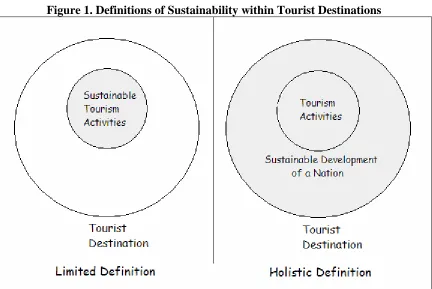
for monitoring development in tourism. Figure 1 illustrates the differences between two
different applications of sustainability in tourist destinations. The shaded region within
the definitions refers to the areas that have sustainable practices. The limited definition on
the left represents how tourism activities are treated in a sustainable manner; the nation
itself is excluded from sustainable development. However, the holistic definition
represents the concept of what should be happening in a nation in terms of sustainable
one unit and both operate with sustainable practices in order to ensure that all dynamics
[image:10.612.92.524.152.441.2]of a nation are considered for optimal sustainability.
Figure 1. Definitions of Sustainability within Tourist Destinations
Source: Lee, 2001
The term or concept of sustainability can differ from author to author, and can be
applied to numerous areas. The use of the term really depends on what the focus of the
study is, as stated before it is important to clearly state what the particular focus is.
Different researchers have also classified sustainability assessments or practices as
sustainable or unsustainable. Depending on the application a range should be used, some
authors use low, medium or high sustainability. Two authors (IUCN, 1995 and
Prescott-Allen, 1997) propose a five-sector scale (1-20, bad; 21-40, poor; 41-60, medium; 61-80,
sustainable. Basically, depending on the depth that one wishes to make an evaluation and
what level they would like to communicate this information with stakeholders would
determine what scales they should use. Ko (2005) suggests that the simpler the scales are
the more useful they may be in communicating basic information to the general public.
More detailed scales would be beneficial in explaining more complicated information to
stakeholders. Similarly to the scales used, researchers can use more or less information
when developing sustainability goals. Figure 2 illustrates different ways that someone
may develop sustainable development plans. The quadrants (1) - (4) represent the ideal to
less ideal options. Quadrant (1) is the most optimal option in that it strives for sustainable
development with the highest scope of sustainability. Also, this quadrant has long-term
goals for development using the strictest criteria for measurement. A strict criterion
means utilizing multiple indicators for evaluation rather than a simple indicator that may
have multiple implications. On the opposite end quadrant (4) is the worst option for
sustainable development. This quadrant focuses on short-term goals that apply only to
Figure 2. Ranges of Sustainable Tourism Development
Source: Foh Lee, 2001.
Many other groups have been involved in working to increase the applicability of
sustainability and development. Some of the national and international bodies active in
development of sustainability concepts are the United Nations, International Institute of
Sustainable Development (IISD), United Nations Commission of Sustainable
Development, the United Nations Commission of Sustainable Development (UNCSD),
United Nations Development Program (UNDP), the World Bank, the National Round
Table on the Environment and the Economy (NRTEE), and the US Interagency Working
Group on Sustainable Development Indicators. Lee, 2001 explains how there are certain
steps in sustainable development, the steps were originally only for use for sustainable
tourism development, yet slightly tweaked can be used for an all-encompassing
sustainable development. The first three steps are actions that should be developed or
done by a national or state authority, and steps four through eight should be done by
Steps for Sustainable development:
1.) Understand the Sustainable Development Issues of a Destination
2.) Set Criteria
3.) Develop Performance indicators
4.) Build Consensus and Destination Level
5.) Formalize Sustainable Policy
6.) Agree on Roles and Responsibilities
7.) Design Management System for Sustainable Development
8.) Implement Initiatives and Monitor Process
1.2 Efforts to Develop Sustainability
In 1992 in Rio de Janeiro the United Nations held a conference on Environment
and Development. This conference produced a program titled Agenda 21, in which 3
main areas were highlighted. The three areas are social and economic dimensions,
conservation and management of resources for development, and strengthening the role
of major groups. Agenda 21 is successful in pinpointing key areas of concern, but still
fails to elaborate on situations pertaining to SIDS. The need for a SIDS specific
conference was identified and in 1994 there was a Global Conference in Barbados on the
Sustainable Development of Small Island Developing States. From this conference a
Programme of Action (POA) was developed for SIDS, this program highlights fourteen
priority areas for action at the national, regional, and international levels. In 1999, the
the Programme of Action. The outcome identified the need to track progress in SIDS and
increased effort for implementation. In 2002, the World Summit on Sustainable
Development (WSSD) developed the Johannesburg Plan of Action and included SIDS
specific issues. The latest meeting to identify and assist SIDS in developing was in
January 2005, when the international community met in Mauritius reporting on the need
for increased implementation of the Programme of Action. These meeting are beneficial
in that they acknowledge the need for identifying issues and projects to help SIDS in
sustainable development. Many countries have taken these actions and developed while
keeping in mind the fragile dynamics of their country. Unfortunately, many countries do
not have the resources to conduct research to develop programs of implementation. This
is the case with the Bahamas. In the Bahamas 2005 report on the National Sustainable
Development Strategies they stated that they are not implementing an approved NSDS
program nor do they have one developed. The Bahamas does have a National
Environmental Management Action Plan (NEMAP) in place. However, the NEMAP
simply identifies the problems for many environmental areas but fails to state how those
specific problems will be solved.
1.3 Tourism
In the last century the increased globalization, movements of populations, and
progress in transportation technologies have helped to developed tourism into an
ever-expanding industry. In the 1980’s tourism and environmentalism grew, it became evident
that tourism growth could not continue at its current rate (Berry, 1997). This revelation
comprised of travel to and around a destination. The very concept of tourism implies
‘consuming’. Visitors use a range of resources such as; shops, marinas, infrastructure
(water, waste disposal, garbage, communication technologies), and local facilities
(hospitals, restaurants, gas stations, banks, car rentals). These resources are also resources
that locals use as well; therefore, consumption by tourists and locals can reduce the
quantity available and the quality (Briassoulis, 2002). These simple resources are
important to have to attract tourists to an area, to give them more comforts. Background
tourism elements are important inputs for tourism, as they often are the reason that people
visit a certain destination. These elements are things such as coasts, mountains, national
parks, and cultural artifacts (Briassoulis, 2002).
Various researchers (Lee, 2001, Garrod, 1998, Budeanu, 2005, and Braissoulis,
2002) have noted the defining and redefining of the concept of sustainable tourism.
Authors have written about sustainability, community sustainability, tourism
sustainability, all are similar but the focus is very different. Budeanu (2005) states that
researchers are, “inclined to study concepts like eco-tourism or alternative tourism, the
tourism research community has largely overlooked the problems cause by mass tourism
in relation to sustainability.” This seems to be the main problem in review and
development of a solid concept for sustainable development while noting the large role
that tourism plays in affecting the very resources that need to be managed.
The World Travel and Tourism Council estimates that the travel and tourism
economy will generate 234,305,000 jobs, and industry jobs will reach 76,729,000. In
other words one in every 11.5 jobs will be in tourism. Economic activity is expected to
experienced in 2004 continued into 2005, tourism grew by more than 10% in 2005 (Ashe,
2005). Figure 3 below illustrates the growth in tourism over the years. It is evident that
tourism has and will continue to grow at an ever-increasing rate. The impact of tourist
activity has already been seen, and with the projections of increased arrivals can only be
[image:16.612.91.475.259.500.2]anticipated to grow as well.
Figure 3. International Tourist Arrivals 1950-2020
Source: WTO, 2000
Each countries share is different, but tourism has made development on certain
countries possible. Countries are becoming more reliant on tourism due to the fact that
tourism increases jobs, income, and taxes. “In most SIDS the tourism sector provides a
disproportionate share of economic activity. Individually any one of the shared SIDS
critical role in the linkages between tourism and economic development” (Ashe, 2005).
Although a large amount of money is generated in a country due to tourism, the World
Trade Organization estimates that 50-70% of the gross tourism receipts leak out of the
country of destination through imports.
Although tourism has a range of benefits for countries, it also significantly
contributes to environmental degradation, negative social and cultural impacts, and
habitat destruction (Choi, 2005). For these reasons international and national bodies have
searched for tourism planning management and development methods. Just as sustainable
development has changed and gained meanings and applicability over the years, so has
sustainability in terms of tourism. Choi and Sirakaya 2005) discusses how the term
sustainable community tourism (SCT) has developed yet has had limited application.
Unfortunately as Choi and Sirakaya noted many countries lack a defined national policy.
Many countries also lack a regular management framework with corresponding indicators
that are applicable to manage sustainability in their area. Tourism development and
sustainable development are both political concepts. Therefore, respective development is
only as beneficial as a particular political system will allow.
1.4 Tourism and the Environment
An investigation was made into the causes and consequences of water abstraction
by the tourist industry in Zanzibar, Tanzania through the use of surveys (Gossling, 2001).
The results showed that present levels of withdrawal are not sustainable, and parts of the
local populations are already experiencing water deficits on a daily basis. In the future, if
correspondingly increase (Gossling, 2001). Results of this may include the possibility
that tourism in the area becomes unsustainable, which could have an adverse effect on the
national economy and also on the local population and environment. A study based in
Turkey found that the coastal zones constituted 30% of the total land, whereas coast
populations are about 20% but increase three to ten fold in the summer months. Concerns
about the long-term viability of coastal areas have been rising due to worry of global
warming. Some researchers believe that global warming will increase sea level, if this
happens the coastal zones will shrink and the density and impacts of tourism can
increase. The WWF (2002) estimates that if global warming continues at the current rate
then in 100 years some of the most popular destination in the hottest regions will become
undesirable due to severe increases in temperature. Even though the prediction is one
hundred years down the road it is still a possibility, and still a serious concern. Turkey is
experiencing an increase in sewage generated by the congested population, which has
caused the pollution level of water to exceed standards related to human health and
environmental protection. Also, water has been supplied mostly from groundwater to
satisfy the demand for new settlements, lowering the water table and increasing salt water
intrusion (Burak, 2004).
The marine and terrestrial environment has also been effected due to changes in
tourism. In 1997, the Bahamas accommodated 1,617,595 visitors. 30% of these visitors
reported that they were in the Bahamas for the beaches, and another 30% stated that they
were there for SCUBA diving and snorkeling. The coastal environment is the main
attraction in the Bahamas; therefore much development has taken place in these areas to
impacts (resource consumption and waste generation) created during a two week holiday
account for 20-50% of the earth share of one person for an entire year. This fact is
astounding considering what a short period of time visitors are at their destination in
respect to the impacts that they leave.
There have been many studies of the impacts of human flow on terrestrial areas;
however the impacts of human interaction with marine environments have been minimal.
One study by Rouphael and Inglis examined the impacts of recreational SCUBA diving
at sites with different reef topographies. The results of the study found that the impact of
divers on the marine environment was determined by a multitude of factors, specifically
the type of benthic assemblages that are present (sandy bottom, hard corals, soft corals,
rubble, etc.). The study examined the frequency that SCUBA divers came into contact
with the substratum. The examination found that 73% of divers made contact with the
substratum during the 10-minute observation period. Given a longer period, a greater
percentage of divers may have been in contact with the substratum. In addition to the
amount of divers that come in contact with the substratum, the study also found that 45%
of qualified divers who visit dive sites break coral colonies. The amount of damage done
by each diver is usually minimal. The study suggests that the dive location should be
dependent on the skill level and experience of divers. The less experienced diver should
dive in more durable environments before entering fragile coral environments (Inglis,
1997). This study illustrates the impact that people have on the environment even when
Country Snapshot: Zanzibar, Tanzania
The island of Zanzibar (Unguja) in Tanzania is a “water poor” island that relies of freshwater derived from seasonal rains and stored in aquifers. In the 1960’s- 1970’s the island exported cloves, which accounted for 85% of foreign exchange earnings. The government decided that promoting the trade and tourism industry could bring in more money. In 1984 the government initiated a liberalization policy for trade and tourism, which lead to the tourism investment act of 1986. These actions by the government brought in mass changes on Zanzibar and development on the island began immediately. In 1984 the tourist arrivals were 8,967, the tourism industry grew rapidly and in 1997 tourist arrivals grew to 86,495.
The majority of the massive tourist infrastructure development in the 1980’s was built on the east coast of Zanzibar. Unfortunately, the topography divides the watersheds on the island and the west coast receives more rain, even though the east coast is where most of the resorts are located. The west half of the island is cultivated land and the east half of the island consists of coral rock, bushy vegetation, and beaches. Since the development salt-water intrusion has already been reported on the eastern portion of the island. The pressure on the aquifers occurs during the dry season, which is also the peak of the tourist season. Over fishing has also been reported around the island due to the high demand of seafood for tourists.
A survey of hotels and resorts found that a tourist’s demand for water is 15 times that of the daily demand of a local resident. 50% of a hotel/resorts water usage is for gardens and pools. The other half of water use was for direct use (showers, toilets, washing hands) and indirect use (cleaning, washing, restaurant purposes). Regarding sewage systems on the island the study found that out of 24 hotels, 12 of them had fully concreted tanks. The other 12 had open systems where the sewage would leak into fissures and caves. One particular guesthouse piped its waste directly into an empty cave and another pumped into a former well. Both the cave and the well provide access to the aquifer, leading to contamination of the water system.
Recommendations were provided upon conclusion of the study to area hotels and resorts. The study suggested that flow limiters be place on taps and showers and a reduced flush option be installed on toilets. Also, signs pointing out the limitations of the area resources would provide education to tourists who may not understand the impacts of their actions. On a grander scale, distributing wells may alleviate the stress on the aquifers and salt-water intrusion may be reduced when decreasing the pull on the aquifer in one particular hot spot.
2.0
Small Island Developing StatesSmall Island Developing States or SIDS are islands or low-lying coastal
communities that are small in terms of population, physical area, and/or size of the
economy. The United Nations uses the size of the economy to qualify a country, while
other organizations and researchers may use only population or a variation of all three.
Many researchers believe that population is the most significant criterion in
determining the true economic status of a country. Abeyratne (1999) discussed how
population determines many of the basic characteristics of a national economy, because
the size of the economy is considered directly proportionate to population levels and per
capita income. Other researchers believe that GNP and GDP are not appropriate criterion
to classify a nation as developing, as GNP and GDP may show growth and development
but may not be sustainable over time. A Maltese Ambassador proposed to the United
Nations in 1990 the need for a vulnerability index for SIDS, in his speech he noted
“that the per capita GDP of Island Developing Countries is not by itself an
adequate measurement of the level of development of island developing countries as it
does not reflect the structural and institutional weaknesses and the several handicaps
facing Island Developing Countries.”
The UN has classified 51 countries as SIDS; 23 are located in Latin America and
the Caribbean, 22 are in Asia and the Pacific, and six are in Africa. What is interesting is
that all small island developing states do not have the same dynamics. For instance there
Bermuda, Cyprus, and the United States Virgin Islands. There are also low-income
countries such as Haiti, Maldives, Samoa, Solomon Islands, and Tuvalu and Vanuatu
(Abeyratne, 1999). Although SIDS may differ in terms of their incomes or economies,
they all still face the same disadvantages.
Small Island Developing States face multiple disadvantages, many of
these disadvantages do occur in other countries, but the impacts are multiplied due to the
smallness of the islands. Many researchers have discussed issues that SIDS face such as;
small size, insularity and remoteness, proneness to natural disasters, and environmental
factors. Each of these factors has multiple implications that affect the island, and should
be considered when trying to create a development plan.
Small size of the island is the largest disadvantage as it has many other
implications that are associated with it. Small islands usually have limited natural
resources, which limits the ability to generate goods. This also creates a high dependence
on imports so the nation has the goods that it needs. Importation also has issues due to the
fact that these islands have limited import options and limited substitution possibilities.
Many SIDS that do develop import substitution policies tend to have higher prices in
order to regulate the economic environment (Briguglio, 1995). SIDS also need to keep a
high foreign exchange in order to maintain or increase economic status, in order to do this
many SIDS increase exports. Due to the small domestic markets the services and
products that a country creates is limited; this often leads to limited control in the prices
of exports and imports (Abeyratne, 1999; Briguglio, 1995). In addition, with limited
production and limited specialization costs of production, construction, and specialized
administration problems due to the ‘small size’ of the country. These types of issues deal
with having a small resource base, for instance natives who become specialists in a
particular field often leave the islands to find better work. Also, due to smaller
populations the costs of government functions increase as the costs are distributed
amongst fewer people. Lastly, it is hard to recruit and promote people within the
government sectors due to the fact that the people in the workforce are often related.
Insularity and remoteness is another disadvantage of small island
developing states (Abeyratne, 1999; Briguglio, 1995). Transport costs tend to be higher
as a result of being distant from other main transport routes or commercial centers. Also,
shipments tend to be smaller because the islands are not on route to main destinations,
which again increases the costs of these goods. SIDS also face uncertainty with supplies,
some countries are actually archipelagic which means they are made up of multiple
islands. The dispersion of goods between all of these islands can be limited which creates
the uncertainty with supplies. Many countries choose to keep a large stock of supplies on
hand, but this increases costs for products because of operations for the warehouses and
personnel.
Environmental factors in SIDS are a disadvantage as they increase
pressures and make the countries more susceptible to additional problems. SIDS are
extremely prone to natural disasters. As islands hurricanes, typhoons, earthquakes,
landslides, and volcanic eruptions can devastate the countries as the actual size of the
communities are relatively small so the impacts spread throughout the nation. Many of
these disasters can wipe out agricultural areas and severely impair the produced goods of
industries continue to take over traditional agriculture areas, which increase the stress on
the remaining environment. In addition, tourism relies heavily on coastal zones and other
marine areas. Multiple uses of the environment can render significant negative impacts.
Typical characteristics of SIDS is their unique and fragile ecosystems, they are large
contributors to global biodiversity. In addition, they are also fragile in the sense that they
have low resistance to changes in the environment such as global warming, rise in sea
level, and erosion (Abeyratne, 1999).
2.1 Energy on SIDS
The majority of islands are still using expensive and degrading fossil fuels as their
main source of energy. One of the main reasons that islands have not been utilizing
growing renewable energy is the lack of knowledge and awareness. The Danish
non-governmental organization Forum for Energy and Development (FED) conducted a study
that found that islands are great targets for renewable energy (Jensen, 2000). Already
there has been an increased focus on renewable energy for islands, Samsoe was listed as a
renewable island in 1997, in 1999 there were two global conferences on renewable
energy islands (Spain & Denmark), and in 2000 four SIDS (St Lucia, Dominica,
Vanuatu, and Tuvalu) announced their intentions to become a renewable energy nation
(Jensen, 2000).
Duic, et al. (2003) studied the potential of the Kyoto Protocols’ clean
development mechanism in the transfer of clean energy technologies to SIDS. They
found that SIDS typically use diesel fuel to produce their energy and that it was the most
lower on SIDS then in other nations, there is still potential for renewable energy
technologies for these countries, creating a strong market presence. One aspect of
concern for SIDS is their specific characteristics that limit the degree that the power
sector can be transformed in comparison to large continental developing countries
(Weisser, 2004). Based on SIDS characteristics, Weisser found that there are options for
renewable energy technology that does not decrease economic production. He found that
reform programs should work with the market, strengthen human capacity, consider long
term interests, and make selective choice for power sector reform (Weisser, 2004).
2.2 Solid Wastes
The sustainable use of natural resources and the sound management of wastes
play a large role in the status of the environment in small island developing states. As a
result of SIDS unique social, economic, and environmental characteristics potential
options for management strategies are minimal. Islands often have high population
density, limited land space availability, and limited economic resources. In addition,
tourists produce large amounts of waste during select tourist periods, increasing the
difficulty of solutions.
Wastes are often deposited in landfills, composted, incinerated, or dumped in
water bodies. Landfills that are appropriately designed are rarely managed properly and
become a site to simply deposit all wastes and not separate materials. As a result of poor
management many island communities simply dump their wastes around the island
(United Nations, 1998). Tourism also plays a large role in stressing the carrying capacity
large numbers of visitors and the significant amount of materials they use can contribute
to the depleting environment.
The United Nations Economic and Social Council’s commission on sustainable
development found five main aspects to improve the status of wastes on SIDS: improve
management; separate types of wastes for disposal; secure long-term storage facilities
and final disposal options; improve efficiency of septic systems; and require
environmental impact assessments for all projects related to waste disposal (United
Nations, 1998).
2.3 Tourism Impacts and water use in SIDS
Many small islands face severe constraints in terms of both the quality and
quantity of freshwater due to their small size and particular geological, topographical and
climatic conditions. This is precisely the case for low-lying coral-based islands such as
the Bahamas, where groundwater supplies are limited and are protected only by a thin
permeable layer of soil. Even where rainfall is abundant, access to clean water has been
restricted by the lack of adequate storage facilities and effective delivery systems.
Conservation seems to be an easy remedy to minimize the effects of overuse of
water, and lack of water. There are a few freshwater augmentation technologies available
to locations that cannot extract their own freshwater due to a variety of reasons which
may include: lack of resources, pollution, or political reasons. Therefore, there are a few
ways to provide better water and more water to communities. One way is through water
quality improvement technologies and the other is through freshwater augmentation
process treats water and separates the salts from the saline water to produce water that
has low total dissolved solids. There are four different types of desalination processes,
including: distillation, electro dialysis, reverse osmosis, and solar desalination.
Freshwater augmentation alternatives include importation of fresh water, and rainwater
Country Snapshot: Turkey
Turkey represents a case where there are enormous challenges to sustainable tourism. Tourism in turkey provides the main source of foreign currency. Poor management since the early 1960’s has plagued the tourist industry. The tourism sector is represented and managed at the ministry level and has been for decades which has led to a lack of an approach to development. From 1963 to 1996 there have been 30 ministers appointed for tourism, a service average of 1.1 years each. This time frame does not provide adequate training and knowledge to develop and implement working programs. The government enacted the Tourism Encouragement Law, No.2634. This law encourages public and private entrepreneurs to invest in building hotels, yacht ports, pools, etc. The law provides fiscal and monetary incentives and appropriates state land for development, reduces bureaucratic formalities, reduces restrictions on the employment of foreigners, and provides telephone and postal priorities to investors.
There is uncontrolled hotel construction in coastal areas and developers are disregarding the land use planning codes and the coastal law to follow architectural styles. As hotels continue to pop up around the country the infrastructure for water and sewage remains the same as it was to support only the indigenous peoples. Many hotels extract hot water from a thermal supply to fill pools and baths, which is lowering the water table and exhausting the natural springs. Researchers are finding that water that is filling in the springs or dried up fissures is full of pollutants and solid wastes. Worse yet, some hotels are not even hooked up to sewage systems and simply leach their wastes into the ground. Other sources of wastes and pollution are yachts; the owners/ operators simply dispose of their solid waste and sewage into the ocean.
Tourism is truly developing at the expense of the local people. Places that were once small fishing villages are now homes to a tourist center, which can house 100,000 tourists. That is an astounding number considering the population capacity of 10,000. Indigenous people are now banned from hotel (public) beaches. Due to poor planning and the development of hotels instead of public housing Indigenous people live in slums where they have no water, no toilets, and no baths. The locals are employed by the tourism industry, but they only work the low service jobs with little to no opportunity for skill development and transferability to other jobs. In addition, the majority of stores fail to recognize the needs of the local people and only carry goods that would be of interest to tourists. Local people are concerned that even if laws are re-evaluated for sustainable development that they may be disregarded due to politics and economic priorities.
Source: Tosun, Cevat. (2001)
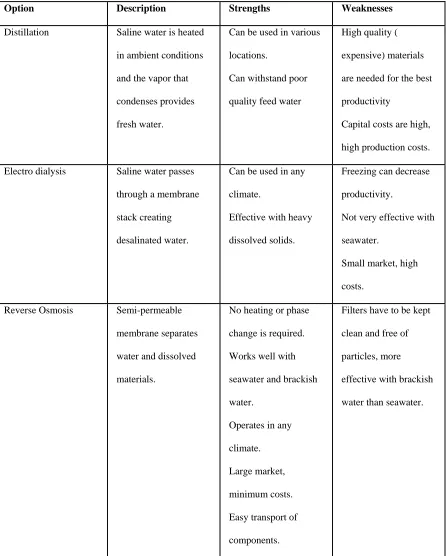
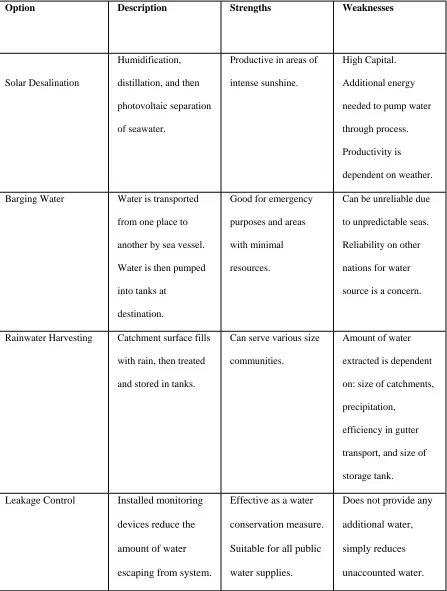
There are various options for producing fresh water on small island developing
states. Two main categories are desalination and freshwater augmentation alternatives
(described above). These options are shown in respect to one another based on the
Table 1. Comparison of Water Resource Options
Option Description Strengths Weaknesses
Distillation Saline water is heated
in ambient conditions
and the vapor that
condenses provides
fresh water.
Can be used in various
locations.
Can withstand poor
quality feed water
High quality (
expensive) materials
are needed for the best
productivity
Capital costs are high,
high production costs.
Electro dialysis Saline water passes
through a membrane
stack creating
desalinated water.
Can be used in any
climate.
Effective with heavy
dissolved solids.
Freezing can decrease
productivity.
Not very effective with
seawater.
Small market, high
costs.
Reverse Osmosis Semi-permeable
membrane separates
water and dissolved
materials.
No heating or phase
change is required.
Works well with
seawater and brackish
water.
Operates in any
climate.
Large market,
minimum costs.
Easy transport of
components.
Filters have to be kept
clean and free of
particles, more
effective with brackish
Table 1 (Continued). Comparison of Water Resource Options
Option Description Strengths Weaknesses
Solar Desalination
Humidification,
distillation, and then
photovoltaic separation
of seawater.
Productive in areas of
intense sunshine.
High Capital.
Additional energy
needed to pump water
through process.
Productivity is
dependent on weather.
Barging Water Water is transported
from one place to
another by sea vessel.
Water is then pumped
into tanks at
destination.
Good for emergency
purposes and areas
with minimal
resources.
Can be unreliable due
to unpredictable seas.
Reliability on other
nations for water
source is a concern.
Rainwater Harvesting Catchment surface fills
with rain, then treated
and stored in tanks.
Can serve various size
communities.
Amount of water
extracted is dependent
on: size of catchments,
precipitation,
efficiency in gutter
transport, and size of
storage tank.
Leakage Control Installed monitoring
devices reduce the
amount of water
escaping from system.
Effective as a water
conservation measure.
Suitable for all public
water supplies.
Does not provide any
additional water,
simply reduces
[image:30.612.85.532.99.690.2](Table 1) Extracted from: Green, M.G., Schwarz, D. (2001). Extracting Drinking Water
from Salt Water: An overview of Desalination options for developing countries. gtz-gate.
p. 1-6.
As the table shows there are multiple options for producing freshwater. The
applicable options for each community is dependent on multiple factors, most notably
economic conditions and climate. Therefore, the status of the small island developing
states determines which process would be the most applicable.
Many developing countries in the tropics have focused on tourism to generate
additional income sources and to diversify the economy. Coastlines in particular have
been on the forefront of tourism infrastructure development. The presence of a large
number of tourists has often had negative consequences for the sustainable use of the
available resources, which in turn has had an effect on the ecosystems. The high numbers
of tourists paired with their intense use of resources in a community of minimal resources
depletes the ecosystem, decreasing resources for the natives and tourists.
2.4 The Bahamas
The Bahamas consists of 700 islands and islets1.It covers nearly 13,940 square
kilometers2 and is located to the southeast of Florida down almost to Haiti. Since there
are multiple islands that cover such a great area, the management of resources for the
country is difficult. A large tourism industry increases the difficulty to manage resources.
In 2004 tourism accounted for 40% of the gross domestic product (GDP), government
1
www.bartleby.com/65/ba/Bahamas.html
2
spending was 20%, financial services was 15%, construction (mainly tourism related)
was 10%, and manufacturing (pharmaceuticals, rum) was 8%, and lastly agriculture and
fisheries was 3% of GDP. Tourism and tourism related commerce accounts for 50% of
the gross domestic product (GDP), as well as 60%3 of employment. 80% of the eligible
work force works in the service industry (tourism, banking, fishing, and agriculture).
These values illustrate how the Bahamas is heavily dependant on the tourism industry.
Almost 60% of the Bahamas GDP was made up of tourism related activities and
services in 1995 and in 2004 consist of 40%, this shows a substantial decrease. The
downturn in tourism after September 11, 2001 created a period of economic struggles in
2001-2002. The Bahamian government has worked to increase large scale private sector
investments in tourism. Three future goals of the current administration is to develop
tourism properties on the Family Islands, expand ship-repair facilities, and begin film
producing facilities on Grand Bahamas Islands. Knowing the intent to develop on family
islands and the fact that their resources are minimal compared to the larger islands, a
framework for sustainable development needs to be created for current hotels and
operations to review the impacts on the local communities.
Educational attainment in the Bahamas is a critical issue; the main islands
receive many resources while the outer islands have fewer resources. The data that was
available for school enrollment was limited to years 1990 and 2002. Therefore, the
dynamics of the educational system may be hard to recognize. There were 32,873 pupils
enrolled in primary school in 1990, and 34,079 in 2002. The growth in pupils enrolled
was almost 4%, higher then the increase in population for those years. This reflects the
positive development of the educational system. In 2002, there were 31,975 pupils
3
enrolled in secondary education, no other years are reported for comparison.
The Human Development Index (HDI) focuses on three different factors
of human development; long healthy life, education, and standards of living. The
measures that are analyzed for these three factors are life expectancy, school enrollment,
literacy, and income. The Bahamas ranked 50th out of 177 countries in the HDI ranking.
The islands GDP per capita rank was 37th, and the overall HDI value was 0.8324.
Unfortunately, due to lack of data the HDI-1 score could not be calculated, this score
evaluates poverty in developing countries. What is interesting of the Bahamas is how
active women are in economic and political life. The gender empowerment measure or
GEM reflects gender inequality in economic and political participation and
decision-making. The Bahamas ranks 17th out of 177 nations. 26.8% of parliamentary seats are
held by women, women make up 51% of professional and technical workers, and 40% of
administrators and managers are women5
The Gross Domestic Product for 2002 was 4,815,877,0006 an increase of only 1%
from 2001 values. The Purchasing Price Parity GDP was 5,754,000,000 in comparison,
reflecting that in comparison to U.S. goods the people could purchase more in the U.S. in
2002, the GDP per capita was 15,338 which was a 1% decrease from 2001 values. It is
evident that although the GDP seems to be increasing steadily over the past 20 years, the
GDP per capita has experienced many more extreme fluctuations. As one can see the
slope of the trend line in Figure 4 illustrates the slow growth of GDP per capita or may
reflect changes in the amount of producers in the Bahamas, changes in taxes, or in
subsidies. Therefore, development has most likely been minimal as the GDP per capita
4
Human Development Report, 2005. hdr.undp.org/statistics/data/country_fact_sheets/cty_fs_BHS.html
5
Human Development Report, 2005. hdr.undp.org/statistics/data/country_fact_sheets/cty_fs_BHS.html
6
growth didn’t grow or decreased from 1986 to 1994, then decreased again after 2000.
[image:34.612.182.462.184.451.2]
Figure 47 Contribution to the GDP in 1995 of various sectors of the Bahamian Economy
.
Figure 4 shows how the GDP was distributed in 1995. in 2004 (in shares
of GDP), tourism was 40%, government spending was 20%, financial services was 15%,
construction (mainly tourism related) was 10%, and manufacturing (pharmaceuticals,
rum) was 8%, and lastly agriculture and fisheries was 3% of GDP. The main markets are
the Americas (U.S.-77.5%, Canada-1.6%, and Mexico-.4%) and the European Union
(17.8%)8
7
The Bahamas. Kenneth C. Buchan. Marine Pollution Bulletin Vol. 41, Nos. 1-6, pp.94-111,2000.
8
Official Development Assistance (ODA) and Financial Flows show that
comparatively to Central America and the rest of the Caribbean, the Bahamas is receiving
much more assistance. From 1998-2000 the ODA was 13 million U.S. dollars9,
comparatively the rest of the Caribbean has about 2 million in ODA. In per capita terms it
is 44 U.S. dollars in the Bahamas compared to 14 U.S. dollars in Central America and the
Caribbean. The Bahamas was suffering an account balance deficit in 2000 of -438
million $U.S. Unfortunately, even though the islands are receiving a lot of ODA the
amount of foreign investment seems weak compared to the surrounding areas, which may
reflect the need for increase ODA. Foreign direct investment is investment in the country
that acquires a lasting management interest (10% or more of voting stock) in a particular
business that is operating in an economy other than that of the investor (WRI, 2003). In
2000, foreign direct investment was 250 million U.S. dollars, compared to other nations
that receive 17,828 million dollars (figure 5, the values are of million current $US from 0
to 300 in increments of 50) of investment. A particular strength for the Bahamas is the
high amounts of tourism that it receives annually. From 1995 to 1997 the islands received
1,435 million U.S. dollars in International tourism receipts.
9
Earth trends, World Research Institute, the Bahamas.
Figure 5. Foreign Direct Investment and Total Debt Service, Bahamas
Source: World Resource Institute, Earth Trends 2003.
The Constitution of 1973 governs the Bahamas, which has a parliamentary
form of government10. The head of government is the prime minister, as well as the
monarch of the United Kingdom, which is an appointed governor-general. Perry Christie
became the prime minister in 1997; the previous 25 years Lynden O. Pindling was the
prime minister. The current administration is committed to social development, which is
evidenced by 30% of the national recurrent budget going to social sectors, notably
education, health, and housing. Bahamians have access to universal health care,
regardless of the ability to pay
Tourism and tourism related commerce accounts for 50% of the gross domestic
product (GDP), as well as 60%11 of employment. 80% of the eligible work force works in
the service industry (tourism, banking, fishing, and agriculture). In 1992 the
10
The Columbia Encyclopedia, Sixth Edition.2001-05. The Bahamas.
11
unemployment rate was 14.8% and decreased to 11.5% in 1996. According to the World
Bank, 1992 experienced the worst unemployment when 15% of the total workforce was
unemployed. Unemployment decreased overtime, and in 1998 (last record) the
unemployment rate was 8%.12
Almost 60% of the Bahamas GDP was made up of tourism related activities and
services in 1995, and in 2004 consists of 40% shows a substantial decrease. The
downturn in tourism after September 11, 2001 created a period of economic struggles in
2001-2002. The Bahamian government has worked to increase large-scale private sector
investments in tourism. Three future goals of the current administration is to develop
tourism properties on the Family Islands, expand ship-repair facilities, and begin film
producing facilities on Grand Bahamas Island.
The Bahamas faces many economic challenges ahead; employment is and will be
a large concern as demand will increase in the upcoming years. Privatization is also
lacking in the islands, and government debt is exorbitant. One change may be to instill
taxes to alleviate the pressure and debt. Currently, the Bahamians do not have an income
or sales tax. Trade and foreign investment is also low, reflecting the need to decrease the
high tariffs and import fees.
The Bahamas has faced and is facing serious environmental changes. Wetlands
have been altered, sand mining and dredging continues, water resources become
diminished, and wastes have been increasing. Coastal wetlands are continuously altered
for development. Wetlands in Nassau (New Providence), Freeport (Grand Bahama),
Marsh Harbour (Abaco), and George Town (Great Exuma) were cleared for mosquito
control and for waterfront access (Inniss, 2002). Mangroves are a particular feature of
12
certain wetlands and are a very fragile ecosystem. A particular development in Bimini
dredged, extracted, and in filled mangroves (Buchan, 2000).
Sand mining and dredging is occurring throughout the islands of the Bahamas.
Bimini is being mined for oolitic sand that is sent to Florida to be used on beaches
(Buchan, 2000). Many of the family islands use sand as a material for local construction
purposes. Unfortunately, removing the sand alters the beach profile that reduces
protection from the elements and increases erosion. In Montague Bay, Nassau sand from
the beach is removed and used for the golf course at Paradise Island and for cable beach
golf course in Goodman’s bay. Apart from the areas of sand extraction being more
susceptible to the elements, hotels that are down current from the extraction sites have
reported loss of beach front due to erosional processes. In addition, Marina Access
through natural channels has become more difficult as the walls of the current channels
have begun erosion. Sand removal behind beach fronts have also become an issue,
erosion as increased at the north coast on New Providence. At this location cars and
pedestrians have damaged vegetation on the back beach areas. The vegetation helped to
stabilize the sand and provided a place for sand to consolidate, without the vegetation the
dunes have continued to shrink. A similar situation is happening at the sand dunes at
Delaporte in New Providence, where litter lines the beaches now that the vegetation that
once trapped it is gone. One disturbing fact is that from 1943 to 1995 approximately 29
hectares of seafloor were altered for construction, this included dredging and coral
removal (Sullivan-Sealey, 1999).
There are no rivers or major freshwater lakes in the Bahamas; therefore, rainfall is
(BEST, 2005). Once this rain has percolated through the limestone it meets with the salt
water where it forms a layer called the freshwater lens. Water resources have become an
issue in the Bahamas. New Providence has a freshwater lens of 17,500 acres to serve a
population of 171,542 people. Andros Island has a freshwater lens of 338,585 acres for a
population of 8155. New Providence is an island that has a larger population and also
hosts a large majority of the hotels in the Bahamas. In order to provide the freshwater to
everyone on the island 40% of the needed water is pumped and shipped in by barge from
Andros Island (Buchan, 2000). One of the positive actions on Paradise Island is that
wastewater is recycled and used for irrigation on its golf courses.
The family islands are often used for whatever resources they have to support the
larger islands. For instance, to make servicing cruise ships easier and so they can travel
less distances for service the cruise ship companies developed facilities for garbage
disposal and holding tanks for flushing on small islands and cays. Three cays (Gorda
Cay, Little San Salvador, and Little Stirrup Cay) currently have these facilities and more
are being proposed. In addition, the family islands have reported debris that has washed
up on shore that is identifiable from cruise ships.
3.0
Research MethodologyThe main problem for small developing islands is that they can often be overused
and mismanaged, resulting in creation of serious degradation to the island. Tourism has
continued to grow through many regions of the world, and in less developed locations. In
order to determine the impacts of tourism on the energy, waste, and water resources of
understand all of the systems dynamics a meta-analysis was conducted. A meta-analysis
was conducted by reviewing articles from areas of sustainability, small island developing
states, tourism, environment, development, and (environmental, tourism, and
sustainability) frameworks. These articles provided information on the issues of
sustainability and problems and concerns that apply to SIDS. Once frameworks were
found the criteria (indicators) that were used were put into categories based on systems
dynamics and a matrix was created that illustrated the main focus and evaluation of each
framework. Once this was complete indicators that were appropriate for sustainability
and tourism development were highlighted. Indicators that were missing or areas that
were not covered by one of the six frameworks were then added. Missing indicators are
indicators or areas that were discussed in literature to be important to the system of a
particular nation or island. The criteria that were used to evaluate the six frameworks will
be discussed in the next section. The criteria were selected based on understanding of
what the literature stated regarding needs for sustainability and for tourism development.
The two areas needs were merged as a result of SIDS strong dependence on tourism.
Based on the strengths and weaknesses that were apparent after the evaluation, a
framework was created using the strongest indicators. Added indicators that were lacking
and the strongest aspects of the frameworks evaluated criteria. The new framework was
then applied to the Bahamas to evaluate its feasibility.
3.0 The Six Frameworks
Six studies are used to represent different ways that researchers are approaching
accessible. Due to the fact that there are different types of “frameworks” different types
of frameworks were found that included or associated tourism, sustainability, and
development. Some frameworks are focused on eco-tourism, some on tourism
management, eco-footprints, and/or general sustainability. Also, some of the
“frameworks” covered indicators, processes, and/or the concepts of sustainability at
different levels. A discussion follows on the description of each of the studies included
and the reasoning on why it was included. The six studies that were used in this study are:
• Definition of Indicators for Environmentally Sustainable Development (1996).
Harger, JRE. and Meyer, M. Chemosphere 33, 1749-1775.
• Conceptualizing Yield: Sustainable Tourism Management (2005).
Northcote, J. and Macbeth, J. Annals of Tourism Research 33,199-220.
• Development of a Tourism Sustainability Assessment Procedure, a Conceptual
Approach (2005). Ko, Tae Gyou. Tourism Management 26,431-445.
• Ecological Footprint Analysis as a Tool to Assess Tourism Sustainability
(2002). Gossling, Stefan, et.al. Ecological Economics 43, 119-211.
• World Statistics Pocketbook SIDS (2003). U.N. Series V.No. 24/SIDS
• 2005 Environmental Sustainability Index, Benchmarking National
Environmental Stewardship (2005). Esty, Daniel. et al. Yale Center for
Environmental Law and Policy.
The Definition of Indicators for Environmentally Sustainable Development study
how “environmentally sound and sustainable development results from human actions
which permit continued development with the environment as the final arbitrator.” The
authors Harger and Meyer then attempt to create a useful model to “compare and
correlate actions undertaken in environment…to do this a scale of indicators for
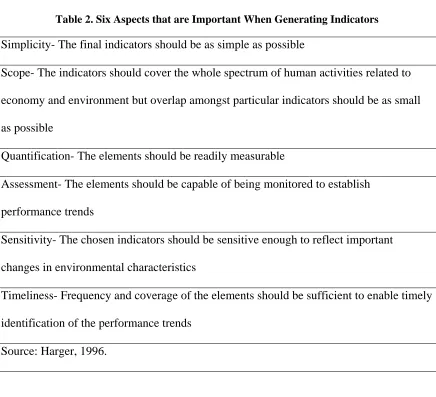
sustainable development have to be identified.” Harger and Meyer present six aspects
[image:42.612.89.525.225.622.2]that are important when generating indicators (see table 2).
Table 2. Six Aspects that are Important When Generating Indicators
Simplicity- The final indicators should be as simple as possible
Scope- The indicators should cover the whole spectrum of human activities related to
economy and environment but overlap amongst particular indicators should be as small
as possible
Quantification- The elements should be readily measurable
Assessment- The elements should be capable of being monitored to establish
performance trends
Sensitivity- The chosen indicators should be sensitive enough to reflect important
changes in environmental characteristics
Timeliness- Frequency and coverage of the elements should be sufficient to enable timely
identification of the performance trends
Source: Harger, 1996.
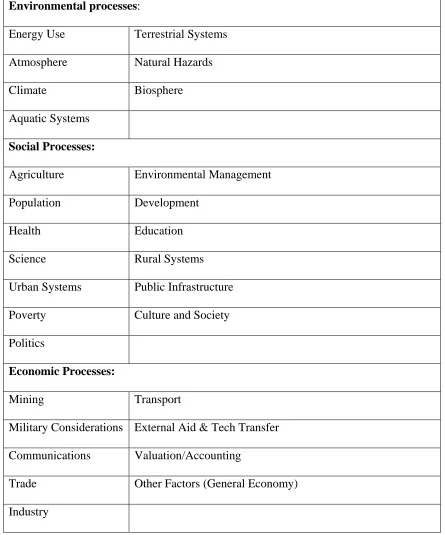
UNESCO in Indonesia created the indicators when UN agencies suggested general
indicators. Three dominant processes were outlined then were broken down into
Table 3. Three Dominant Process areas as defined by ESSD (Harger and Meyer, 1996)
Environmental processes:
Energy Use Terrestrial Systems
Atmosphere Natural Hazards
Climate Biosphere
Aquatic Systems
Social Processes:
Agriculture Environmental Management
Population Development
Health Education
Science Rural Systems
Urban Systems Public Infrastructure
Poverty Culture and Society
Politics
Economic Processes:
Mining Transport
Military Considerations External Aid & Tech Transfer
Communications Valuation/Accounting
Trade Other Factors (General Economy)
Agencies recommendations were compiled and then broken down to fit under the
subdivisions. The authors chose to break these subdivisions down even further because
the indicators are topics, actions, or specific parameters, and should be broken down
further for better objective quantification.
The Harger and Meyer article was included in this study because it provides a
breakdown of topics and a creation of indicators for evaluation. Major international
parties were a source of input for Harger and Meyer’s analysis. Having their compilation
of evaluating measures by key agencies provides this study with actual information that is
used than just academic purposes.
The study Conceptualizing Yield: Sustainable Tourism Management by Macbeth
and Norcote developed a framework for evaluation of pros and cons of developments in
tourism systems. The authors focus on the concept of “sustainable yield”. This “term can
incorporate non-economic gains in the environmental, cultural, and social spheres”, thus
the yield concept refers to these considerations. Macbeth and Norcote developed an
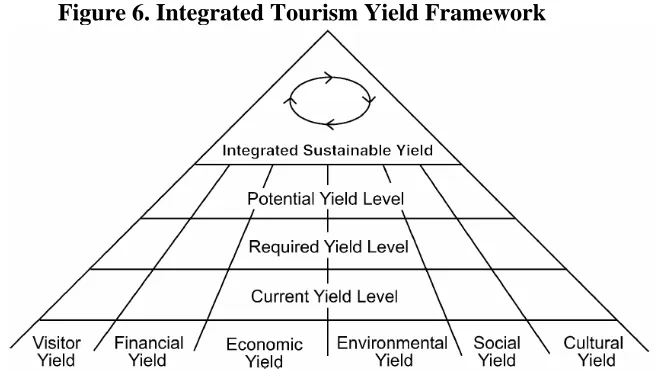
Integrated Tourism Yield Framework to evaluate tourism systems in terms of sustainable
parameters. The framework (figure 6) is shaped in a pyramid form with the base being
general areas (tourist, financial, economic, environmental, social, and cultural). The
second level is the expected returns from the base level, and the next (3rd) is the level that
the system needs to be sustainable. The fourth level is the potential level, or the
“maximum permissible conditions that will be allowed in a specific opportunity class.”
The pinnacle of the pyramid is the integrated yield dimension, which is the acceptable