This is a repository copy of Text Mining–Based Review of Articles Published in the Journal of Professional Issues in Engineering Education and Practice.
White Rose Research Online URL for this paper: http://eprints.whiterose.ac.uk/147893/
Version: Accepted Version
Article:
Chen, W, Xu, Y, Jin, R et al. (1 more author) (2019) Text Mining–Based Review of Articles Published in the Journal of Professional Issues in Engineering Education and Practice. Journal of Professional Issues in Engineering Education and Practice, 145 (4). 06019002. ISSN 1052-3928
https://doi.org/10.1061/(ASCE)EI.1943-5541.0000425
© ASCE. This is an author produced version of an article published in Journal of
Professional Issues in Engineering Education and Practice. Uploaded in accordance with the publisher's self-archiving policy.
[email protected] https://eprints.whiterose.ac.uk/
Reuse
Items deposited in White Rose Research Online are protected by copyright, with all rights reserved unless indicated otherwise. They may be downloaded and/or printed for private study, or other acts as permitted by national copyright laws. The publisher or other rights holders may allow further reproduction and re-use of the full text version. This is indicated by the licence information on the White Rose Research Online record for the item.
Takedown
If you consider content in White Rose Research Online to be in breach of UK law, please notify us by
A Text-Mining-based Review of Articles published in ASCE Journal of Professional 1
Issues in Engineering Education and Practice 2
Wei Chen1, Yidong Xu2, Ruoyu Jin3, Dariusz Wanatowski4MASCE 3
Abstract 4
This study extends the existing reviews targeting on Journal of Professional Issues in 5
Engineering Education and Practice (JPIEEP) by incorporating the text-mining review 6
methodology. A total of 1,810 papers published in JPIEEP since 1982 were selected as the 7
literature sample. Dividing the whole sample into four sub-samples according to publication 8
time spans, this review indicates that literature published before 2000, especially articles from 9
the 1982-1991 period emphasized more civil engineering related practical and practical issues 10
(e.g., legislation). Since early 2000s, literature from JPIEEP has been focusing more on 11
engineering education-based research, such as teaching methods and undergraduate education. 12
Specifically, more recent studies show emerging topics of the education and practical 13
subjects (i.e., BIM and sustainability), pedagogical approach (i.e., problem-based learning, 14
active learning, simulation, teamwork, and distance education), and diversity issues. 15
Accordingly, future research directions are proposed, such as integration of emerging 16
pedagogical methods in the emerging subjects (e.g., BIM). This study contributes to review 17
of engineering education and practice by demonstrating that the text-mining approach could 18
be reproduced to assist other review-based studies. Finally, this Technical Note addresses 19
questions regarding the latest research topics and proposes directions for future scholarly 20
work. 21
Senior Engineer, School of Civil Engineering & Architecture, Ningbo Institute of Technology, Zhejiang University, Ningbo, 315100,China. Email:[email protected]
Professor, School of Civil Engineering & Architecture, Ningbo Institute of Technology, Zhejiang University, Ningbo, 315100,China. Email:[email protected]
3Senior Lecturer, School of Environment and Technology, University of Brighton, Cockcroft Building 616, Brighton, BN24GJ, UK. Email: [email protected]
Keywords:Literature review; engineering education; professional practice; text-mining 22
Introduction 23
Journal of Professional Issues in Engineering Education and Practice (JPIEEP) 24
publishes both engineering education and professional practice related papers. However, over 25
the years it has evolved in its scope more towards education (Barry and Roberts, 2016). It has 26
also been indicated by Barry and Roberts (2016) that there has been more education-based 27
scholarly research in the field of civil engineering. Continuing from the study of Barry and 28
Roberts (2016), further work can be performed to specifically identify the mainstream and 29
latest research topics published in JPIEEP, as well as how these research topics change over 30
time. 31
Although Wankat (1999, 2004) and Whitin and Sheppard (2004) provided reviews of 32
several papers published in JPIEEP, there have been limited studies to continue the review in 33
this journal to provide the latest trend analysis of main research topics. Another drawback of 34
many existing review-based studies (e.g., Li et al., 2014) is that they have been based on 35
manual reviews prone to subjectivity and restricted in their lack of reproducibility (Hosseini 36
et al., 2018). This subjectivity includes identifying keywords in the selected literature sample. 37
A text-mining-based review method proposed by van Eck and Waltman (2014) could 38
minimize the subjectivity and also reduce human errors. A text-mining-based review 39
introduced in this study can also form a part of the systematic review approach recommended 40
by Borrego et al. (2014) in terms of uncovering patterns, connections, relationships, and 41
trends across multiple studies. It can also complement the analytic review approach 42
conducted by Hurwitz et al. (2016) by quantitatively measuring the popularity and impact of 43
research topics in a given literature sample. 44
The more recent review-based study of Barry and Roberts (2016) provided a 45
citation rates, author affiliations, frequency of keywords, and international collaborations. 47
Researchers perceive the work of Barry and Roberts (2016) more in the general view, which 48
was based more on the overall movement of the journal indicated by prescriptive data. For 49
example, it was concluded that the citation rate of articles published by the journal had 50
increased, contributing to the increased impact factor of the journal (Barry and Roberts, 51
2016). This review-based study aims to extend the earlier review work performed by Barry 52
and Roberts(2016) in a more specific and technical perspective, particularly: (1) this study 53
targeted technical keywords in the literature sample of JPIEEP by addressing the latest 54
research topics since 2010. A comparative study of main keywords from papers published in 55
different periods. These keywords would be more technical and specific, e.g., “problem-56
based learning” instead of “engineering education”, or “geotechnical engineering” instead of 57
the general term “civil engineering”; (2) this study applies a text-mining approach to allow 58
automatic computation of frequency and citation related measurements for keywords and 59
documents. Using a visualized and quantitative method, this new review methodology also 60
enables a more in-depth analysis of main research keywords in JPIEEP; (3) this study further 61
provides a summary of most influential publications from JPIEEP measured by not only total 62
citation or frequency, but also normalized citation, which was a quantitative measurement of 63
a publication or keyword’s influence by correcting the bias that older publications have had 64
more time to receive citations (van Eck and Waltman, 2017). Overall, this Technical Note 65
contributes to the body of knowledge in civil engineering education and practice by utilizing 66
the database of JPIEEP in that: (1) it provides the in-depth analysis of the emerging research 67
focuses and influential studies; and (2) it serves as a guide for scholars by offering an 68
overview of the research trend and recommending future research topics. The text-mining-69
based review approach used in this study could also be applied to other review-based research. 70
The text-mining-based review method adopted in this study incorporated the citation 72
analysis (e.g., normalized citation). It started with downloading all JPIEEP articles which had 73
been indexed in Scopus, the mainstream database of scientific literature. All types of Scopus-74
indexed papers from JPIEEP, including Technical Papers, Technical Notes, and Case Studies 75
digitally available since 1982, were adopted as the literature sample saved inCVS-based data 76
file. Due to the electronic data availability inScopus, papers published before 1982 were not 77
included for the text-mining-based review. The database of the sample was then uploaded 78
into VOSViewer (van Eck and Waltman, 2010), a text-mining tool to conduct the literature 79
review. According to van Eck and Waltman (2014), VOSViewer fits the purpose of 80
visualizing larger networks with special text mining features. Consistent to the data 81
categories adopted in the review conducted by Pietroforte and Stefani (2004), the abstract, 82
keywords, and article title were saved in CVS files for the review. A total of 1,810 papers 83
were downloaded from Scopus, with the first JPIEEP paper indexed in 1982. This whole 84
literature sample was then divided evenly into four sub-samples, namely the subsample of 85
papers published from 2010 to the end of 2018,from 2001 to 2009, from 1992 to 2000, and 86
from 1982 to 1991. Each sub-sample of literature was based on a nine-year period. Although 87
the sub-sample from 1982 to 1991 covers a ten-year period, only four papers published in 88
1982 were indexed in Scopus, allowing them to be combined with the nine-year span until 89
1991. The aim of dividing into four sub-samples was to allow the comparative analysis of 90
research keywords to explore the evolvement of research topics in the past decades. Besides 91
the keyword analysis, most influential studies published in JPIEEP measured by occurrence 92
(i.e., frequency) and normalized citation were also identified, enabling a further in-depth 93
analysis of the research focuses in JPIEEP. 94
A total of390,414,462, and544 papers fell into the sub-samples of literature published 96
in the periods of 1981-1991, 1992-2000, 2002-2009, and 2010-2018 respectively. Following 97
the text-mining-based analysis in VOSViewer, the four sub-samples of literature are 98
visualized of their frequently studied keywords in Figs.1-4, respectively. 99
<Insert Fig.1 here> 100
<Insert Fig.2 here> 101
<Insert Fig.3 here> 102
<Insert Fig.4 here> 103
It should be noticed that these general keywords such as engineering education and 104
professional practice are excluded in the text-mining process, because they are expected 105
scopes for any studies published in JPIEEP. The font and circle size indicate the frequency of 106
the given keyword being studied in the sub-sample. The closeness between any pair of 107
keywords can be indicated by their physical distance in the visualized network. Keywords in 108
both figures are also categorized into clusters defined by different colors, meaning that the 109
same cluster of keywords have a higher chance of being co-studied. Comparing the keywords 110
in Figs.1-4,, it could be indicated that the two sub-samples of literature published after 2001 111
have been focusing more on construction related education and practice, differing from the 112
1982-2000 period literature which focus more on the general civil engineering education. 113
Specifically, the 1982-1991 period literature cover more civil engineering education and 114
practice issues related to teaching, training, practice, project management, and other 115
professional issues (e.g., social and public aspects). Consistent with the study of Barry and 116
Roberts (2016) who found that more recent studies published in JPIEEP had been more 117
related to education-based research, it is also identified in this study that literature published 118
in JPIEEP has been focusing more on pedagogy-based studies rather than practical issues 119
on legal issues (e.g., litigation, legislation, and dispute). However, the more recent literature 121
since 2010 has been focusing more on educational techniques and technological evolvement. 122
Compared to Barry and Roberts (2016), this study provides a more technical view of keyword 123
evolvement in JPIEEP. Specifically, BIM has been gaining the momentum in the recent 124
decade by being incorporated in the curriculum. More digital or electronic technologies 125
involved in engineering education can be seen more recently, in terms of virtual reality, 126
simulation, and distance learning. Other emerging research topics since 2010 could also be 127
found, such as education and practice of women, distance education, and teamwork. More 128
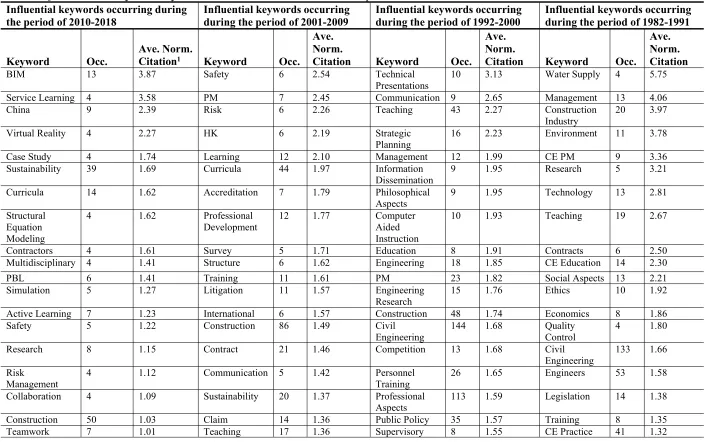
quantitative measurements of main research keywords between these two time periods can be 129
found in Table 1. 130
<Insert Table 1 here> 131
Keywords listed in Table 1 follow the value of average normalized citation, which is the 132
measurement to evaluate the impact of the given keyword on the global academic community. 133
It is calculated by dividing the total number of citation of the given keyword by the average 134
number of citation published in the same year. The normalization corrects the bias or 135
misinterpretation that earlier publications have more time to receive citations than more 136
recent ones (van Eck and Waltman, 2017). The normalized citation shown in Table 2 is 137
calculated in the consistent approach and conducted in VOSViewer. More details of applying 138
the normalized citation in literature can be found in Jin et al. (2018). Consistent to the 139
visualized networks in Figs.1-4, the main differences of research focuses among the four time 140
periods are: BIM has replaced safety and other civil engineering practical issues (e.g., water 141
supply) to be the most influential keyword during the recent decade; JPIEEP has become 142
more international by having more published work coming from China; sustainability has 143
become a focus in engineering education and practice; teaching methods have more involved 144
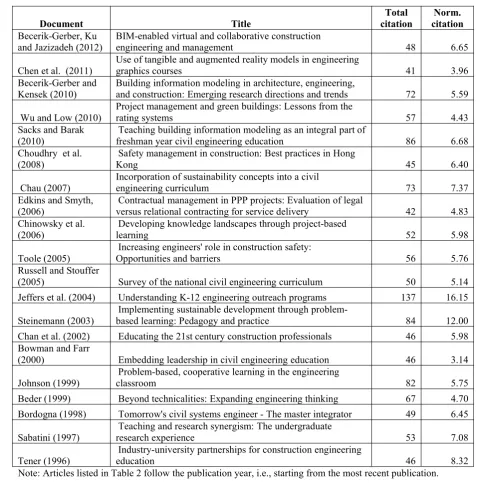
and minority (e.g., women). Table 2 showcases the most influential studies measured by the 146
total citation and normalized citation (Norm. citation). 147
<Insert Table 2 here> 148
Table 2 shows results consistent with the keyword analysis in Table 1. For example, BIM 149
and its relevant IT technologies (e.g., augmented reality) have become mainstream and 150
influential topics in engineering education and practice. Zou et al. (2019) stressed the need 151
for optimizing BIM education resources to bridge the gap between academic research and 152
industry practice. Sustainability and safety have also showed the impacts in engineering 153
education. Safety, specifically employee health and wellbeing, has been the research focus 154
throughout all the decades. Earlier studies over a decade ago had emphasized nurturing the 155
next generation of civil engineering practitioners through specific ways such as industry-156
university partnership (Tener, 1996). 157
Summary of observations 158
This study extends existing review-based research targeting on Journal of Professional 159
Issues in Engineering Education and Practice(JPIEEP) by introducing the text-mining-based 160
review methodology, which could be applied in other reviews in the future. A total of1,810 161
documents indexed in Scopus were adopted as the literature sample, which was further 162
divided into four sub-samples based on the year of publication. The text-mining-based review 163
revealed the information regarding: (1) the evolvement of research keywords in engineering 164
education and professional practice; and (2) the most influential papers published in JPIEEP. 165
It was found that compared to earlier studies, research published before 2000 targeted more 166
on general civil engineering education and practical issues. . Since early 2000s, published 167
work in JPIEEP has focused more on construction related education, and the education is 168
more specifically divided into undergraduate and graduate levels, with the former more 169
found among the four publication periods. The published work since 2010 in JPIEEP has 171
targeted more on specific education and practical themes (i.e., BIM and sustainability), 172
pedagogical approach (i.e., problem-based learning, active learning, simulation, teamwork, 173
education & practice integration, distance education), and diversity issues including women 174
in education have been gaining the momentum. Generally, the earlier published work (i.e., 175
1982-1991) emphasizes more on civil engineering professional issues (e.g., social, 176
professional, and practice). Afterwards, more education-based topics have been studied such 177
as teaching methods. Following the research topic review adopting the text-mining approach, 178
the current review aligns with the upcoming update of the focus of JPIEEP related to 179
education-based research. Future research directions can be recommended in engineering 180
education and practice, including but not limited to: (1) integration of pedagogical methods 181
(e.g., problem-based learning) in the emerging subjects (e.g., BIM); (2) investigation of the 182
diversity issue (e.g., demographic factors) in terms of their effects in engineering education; 183
and (3) distance learning enhanced by IT, such as Internet-of-things involving BIM. Only 184
electronically available literature indexed in Scopus since 1982 was included for the text-185
mining review. Therefore, this study only reflects the change of research topics published in 186
JPIEEP over time from 1982 to the end of 2018. 187
Acknowledgement 188
This research was supported by Natural Science Foundation of Zhejiang China (Grant 189
No. LY16E020014), Municipal Natural Science Foundation of Ningbo China (Grant No. 190
2016A610217), and Institutional Laboratory Research Project of Zhejiang Province (Contract 191
No. YB201828). 192
Data Availability Statement 193
Data generated or analyzed during the study are available from the corresponding author 194
References 196
Barry, B. E., and Roberts, M. W. (2016). "First 60 Years of the Journal of Professional Issues in 197
Engineering Education and Practice."J Prof Issues Eng Educ Pract, 142(4). 198
Becerik-Gerber, B., and Kensek, K. (2010). "Building information modeling in architecture, 199
engineering, and construction: Emerging research directions and trends."J Prof Issues Eng Educ
200
Pract, 136(3), 139-147. 201
Becerik-Gerber, B., Ku, K., and Jazizadeh, F. (2012). "BIM-enabled virtual and collaborative 202
construction engineering and management." J Prof Issues Eng Educ Pract, 138(3), 234-245. 203
Beder, S. (1999). "Beyond technicalities: Expanding engineering thinking."J Prof Issues Eng Educ
204
Pract, 125(1), 12-18. 205
Bordogna, J. (1998). "Tomorrow's civil systems engineer - The master integrator."J Prof Issues Eng
206
Educ Pract, 124(2), 48-50. 207
Borrego, M., Foster, M. J., and Froyd, J. E. (2014). "Systematic literature reviews in engineering 208
education and other developing interdisciplinary fields." J. Eng. Educ., 103(1), 45-76. 209
Bowman, B. A., and Farr, J. V. (2000). "Embedding leadership in civil engineering education."J Prof
210
Issues Eng Educ Pract,126(1), 16-20. 211
Chan, E. H. W., Chan, M. W., Scott, D., and Chan, A. T. S. (2002). "Educating the 21st century 212
construction professionals." J Prof Issues Eng Educ Pract, 128(1), 44-51. 213
Chau, K. W. (2007). "Incorporation of sustainability concepts into a civil engineering curriculum."J
214
Prof Issues Eng Educ Pract,133(3), 188-191. 215
Chen, Y. C., Chi, H. L., Hung, W. H., and Kang, S. C. (2011). "Use of tangible and augmented reality 216
models in engineering graphics courses."J Prof Issues Eng Educ Pract,137(4), 267-276. 217
Chinowsky, P. S., Brown, H., Szajnman, A., and Realph, A. (2006). "Developing knowledge 218
landscapes through project-based learning." J Prof Issues Eng Educ Pract, 132(2), 118-124. 219
Choudhry, R. M., Fang, D., and Ahmed, S. M. (2008). "Safety management in construction: Best 220
practices in Hong Kong."J Prof Issues Eng Educ Pract, 134(1), 20-32. 221
Edkins, A. J., and Smyth, H. J. (2006). "Contractual management in PPP projects: Evaluation of legal 222
versus relational contracting for service delivery." J Prof Issues Eng Educ Pract, 132(1), 82-93. 223
Hosseini, M. R., I. Martek, E. K. Zavadskas, A. A. Aibinu, M. Arashpour and N. Chileshe (2018). 224
"Critical evaluation of off-site construction research: A Scientometric analysis."Automation in
225
Construction87: 235-247. 226
Jeffers, A. T., Safferman, A. G., and Safferman, S. I. (2004). "Understanding K-12 engineering 227
outreach programs."J Prof Issues Eng Educ Pract,130(2), 95-108. 228
Jin, R., Gao, S., Cheshmehzangi, A., and Aboagye-Nimo, E. (2018). “A holistic review of off-site 229
construction literature published between 2008 and 2018.”J. Clean. Prod., 202, 1202-1219. 230
Johnson, P. A. (1999). "Problem-based, cooperative learning in the engineering classroom."J Prof
231
Issues Eng Educ Pract,125(1), 8-11. 232
Li, Z., Shen G. Q. , and X. Xue (2014). "Critical review of the research on the management of 233
prefabricated construction." Habitat International 43: 240-249. 234
Pietroforte, R., and Stefani, T.P. (2004). “ASCE journal of construction engineering and management: 235
Review of the years 1983-2000.”J. Constr. Eng. Manage. 130(3), 440-448. 236
Russell, J. S., and Stouffer, W. B. (2005). "Survey of the national civil engineering curriculum."J
237
Prof Issues Eng Educ Pract,131(2), 118-128. 238
Sabatini, D. A. (1997). "Teaching and research synergism: The undergraduate research experience."J
239
Prof Issues Eng Educ Pract, 123(3), 98-102. 240
Sacks, R., and Barak, R. (2010). "Teaching building information modeling as an integral part of 241
freshman year civil engineering education."J Prof Issues Eng Educ Pract,136(1), 30-38. 242
Steinemann, A. (2003). "Implementing sustainable development through problem-based learning: 243
Pedagogy and practice." J Prof Issues Eng Educ Pract, 129(4), 216-224. 244
Tener, R. K. (1996). "Industry-university partnerships for construction engineering education."J Prof
245
Issues Eng Educ Pract, 122(4), 156-162. 246
Toole, T. M. (2005). "Increasing engineers' role in construction safety: Opportunities and barriers." J 247
van Eck, N. J., Waltman, L. (2010). Software survey: VOSviewer, a computer program for 249
bibliometric mapping. Scientometrics 84(2), 523-538. 250
van Eck, N.J., Waltman, L. (2014). Visualizing bibliometric networks, In: Ding Y., Rousseau R., 251
Wolfram D. (eds) Measuring Scholarly Impact. Springer, Cham, 285-320. 252
van Eck, N. J., and Waltman, L. (2017). "VOSviewer Manual. Manual for VOSviewer version 1.6.6." 253
Wankat, P. C. (1999). “An analysis of the articles in the Journal of Engineering Education.” J. Eng. 254
Educ., 88(1), 37–42. 255
Wankat, P. C. (2004). “Analysis of the first ten years of the Journal of Engineering Education.”J. Eng.
256
Educ.,93(1), 13–21. 257
Whitin, K., and Sheppard, S. (2004). “Taking stock: An analysis of the publishing record as 258
represented by the Journal of Engineering Education.”J. Eng. Educ., 93(1), 5–12. 259
Wu, P., and Low, S. P. (2010). "Project management and green buildings: Lessons from the rating 260
systems."J Prof Issues Eng Educ Pract, 136(2), 64-70. 261
Zou P.X.W., Xu X., Jin R., Painting N., and Li B. (2018). “Investigation of AEC students’ 262
perceptions towards BIM practice-a case study of Swinburne University of Technology.”J. Eng.
263
Educ., In Press, DOI: 10.1061/(ASCE)EI.1943-5541.0000410. 264
265
Table 1. Quantitative analysis of keywords studied in the four literature samples fromJPIEEP 275
Influential keywords occurring during
the period of 2010-2018 Influential keywords occurringduring the period of 2001-2009 Influential keywords occurringduring the period of 1992-2000 Influential keywords occurringduring the period of 1982-1991
Keyword Occ. Ave. Norm.Citation1 Keyword Occ.
Ave. Norm.
Citation Keyword Occ.
Ave. Norm.
Citation Keyword Occ.
Ave. Norm. Citation
BIM 13 3.87 Safety 6 2.54 Technical
Presentations 10 3.13 Water Supply 4 5.75
Service Learning 4 3.58 PM 7 2.45 Communication 9 2.65 Management 13 4.06
China 9 2.39 Risk 6 2.26 Teaching 43 2.27 Construction
Industry 20 3.97
Virtual Reality 4 2.27 HK 6 2.19 Strategic
Planning 16 2.23 Environment 11 3.78
Case Study 4 1.74 Learning 12 2.10 Management 12 1.99 CE PM 9 3.36
Sustainability 39 1.69 Curricula 44 1.97 Information
Dissemination 9 1.95 Research 5 3.21
Curricula 14 1.62 Accreditation 7 1.79 Philosophical
Aspects 9 1.95 Technology 13 2.81
Structural Equation Modeling
4 1.62 Professional
Development 12 1.77 ComputerAided Instruction
10 1.93 Teaching 19 2.67
Contractors 4 1.61 Survey 5 1.71 Education 8 1.91 Contracts 6 2.50
Multidisciplinary 4 1.41 Structure 6 1.62 Engineering 18 1.85 CE Education 14 2.30
PBL 6 1.41 Training 11 1.61 PM 23 1.82 Social Aspects 13 2.21
Simulation 5 1.27 Litigation 11 1.57 Engineering
Research 15 1.76 Ethics 10 1.92
Active Learning 7 1.23 International 6 1.57 Construction 48 1.74 Economics 8 1.86
Safety 5 1.22 Construction 86 1.49 Civil
Engineering 144 1.68 QualityControl 4 1.80
Research 8 1.15 Contract 21 1.46 Competition 13 1.68 Civil
Engineering 133 1.66 Risk
Management 4 1.12 Communication 5 1.42 PersonnelTraining 26 1.65 Engineers 53 1.58
Collaboration 4 1.09 Sustainability 20 1.37 Professional
Aspects 113 1.59 Legislation 14 1.38
Construction 50 1.03 Claim 14 1.36 Public Policy 35 1.57 Training 8 1.35
Methods Personnel
Structure 7 1.00 Geotechnical 7 1.34 Sustainability 24 1.52 Information 8 1.08
Teaching 15 0.97
Education-Practice Interchange
7 1.33 Codes
(Standards) 16 1.52 Public Works 11 0.91
PM 7 0.94 Undergraduate
Study 21 1.30 Software 8 1.50 Hazardous 5 0.60
Design 6 0.89 Contractor 10 1.27 Structural
Design 31 1.40 Writing 6 0.59
Innovation 4 0.84 Licensing 5 1.26 Standards 27 1.39 Registration 4 0.58
HK 4 0.81 Delay 6 1.26 Economic And
Social Effects 26 1.37 Bridges 4 0.58
Distance
Education 5 0.79 IT 9 1.22 Societies AndInstitutions 55 1.28 EnvironmentalEngineering 5 0.39
Women 6 0.76 Arbitration 6 1.21 Planning 11 1.25 Liability 8 0.34
Transportation 9 0.75 Research 6 1.11 Economics 19 1.21 Computer
Aided 4 0.29
Liability 9 1.09 Laws And
Legislation 36 1.19 CE PublicPolicy 7 0.11
Software 6 1.06 Environmental
Impact 18 1.17 UrbanPlanning 7 0.11
Legal 21 1.05 Social Aspects 45 1.16
Dispute 25 1.04 Technology 18 1.16
Ethics 11 1.00 History 10 1.09
Design 5 0.98 Public Works 10 1.08
1The Ave. Norm. Citation (i.e., Average Normalized Citation) or Norm. citation shown in Table 2, represents the normalized number of citations of a keyword or a paper. 276
Table 2. A summary of most influential studies published in JPIEEP 280
Document Title citationTotal citationNorm.
Becerik-Gerber, Ku
and Jazizadeh (2012) BIM-enabled virtual and collaborative constructionengineering and management 48 6.65
Chen et al. (2011) Use of tangible and augmented reality models in engineeringgraphics courses 41 3.96 Becerik-Gerber and
Kensek (2010) Building information modeling in architecture, engineering,and construction: Emerging research directions and trends 72 5.59
Wu and Low (2010) Project management and green buildings: Lessons from therating systems 57 4.43 Sacks and Barak
(2010) freshman year civil engineering educationTeaching building information modeling as an integral part of 86 6.68 Choudhry et al.
(2008) KongSafety management in construction: Best practices in Hong 45 6.40
Chau (2007) Incorporation of sustainability concepts into a civilengineering curriculum 73 7.37 Edkins and Smyth,
(2006) versus relational contracting for service deliveryContractual management in PPP projects: Evaluation of legal 42 4.83 Chinowsky et al.
(2006) learningDeveloping knowledge landscapes through project-based 52 5.98
Toole (2005) Opportunities and barriersIncreasing engineers' role in construction safety: 56 5.76 Russell and Stouffer
(2005) Survey of the national civil engineering curriculum 50 5.14 Jeffers et al. (2004) Understanding K-12 engineering outreach programs 137 16.15
Steinemann (2003) based learning: Pedagogy and practiceImplementing sustainable development through problem- 84 12.00 Chan et al. (2002) Educating the 21st century construction professionals 46 5.98 Bowman and Farr
(2000) Embedding leadership in civil engineering education 46 3.14
Johnson (1999) classroomProblem-based, cooperative learning in the engineering 82 5.75 Beder (1999) Beyond technicalities: Expanding engineering thinking 67 4.70 Bordogna (1998) Tomorrow's civil systems engineer - The master integrator 49 6.45
Sabatini (1997) research experienceTeaching and research synergism: The undergraduate 53 7.08
Tener (1996) educationIndustry-university partnerships for construction engineering 46 8.32 Note: Articles listed in Table 2 follow the publication year, i.e., starting from the most recent publication. 281