Rochester Institute of Technology
RIT Scholar Works
Theses
Thesis/Dissertation Collections
2007
Into the Shell
Jee Hee Bang
Follow this and additional works at:
http://scholarworks.rit.edu/theses
This Thesis is brought to you for free and open access by the Thesis/Dissertation Collections at RIT Scholar Works. It has been accepted for inclusion
in Theses by an authorized administrator of RIT Scholar Works. For more information, please contact
Recommended Citation
Rochester
Institute
ofTechnology
A Thesis Submitted
to the
Faculty
ofThe College
ofImaging
Arts
andSciences
In
Candidacy
for
the
Degree
ofMaster
ofFine Arts
Into
the
Shell
By
Tee Hee
Bang
Final Approvals
Chief Advisor:
Leonard Urso
Date:
Associate Advisor: Juan Carlos Caballero
Date:
Associate Advisor: Barbara Heinrich
Date:
Chairperson:
Julia Galloway
Date:
If
Jee Hee Bang prefer to be contacted each time a request for reproduction
is
made. I can be reached at the following address.
Kyung-Gi-Do SungNamsi Btll1-Dang-gu
Seo-Hyun Dong 335-15ho 3
rd
FI
South Korea
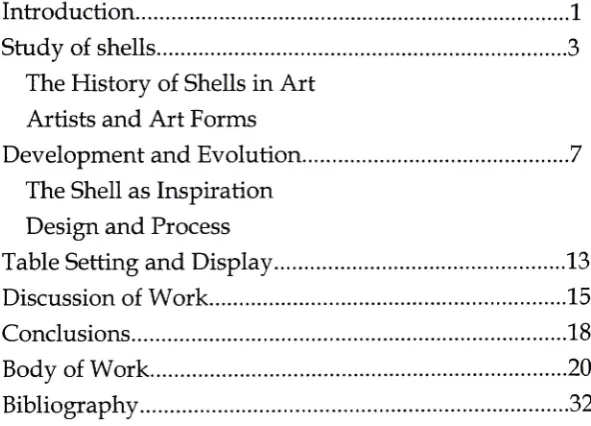
Table
ofContents
Introduction
1
Study
of shells3
The
History
ofShells
in
Art
Artists
andArt
Forms
Development
andEvolution
7
The
Shell
asInspiration
Design
andProcess
Table
Setting
andDisplay
13
Discussion
ofWork
15
Conclusions
18
Body
ofWork
20
[image:4.554.128.424.196.409.2]Introduction
One
major purpose ofthis
thesis
wasto
examinethe
forms
and rhythms of nature.I
do
not always appreciatethe
beauty
of nature.I
wantedto take this
opportunity
to
give
thanks to the
gifts of natureby
applying
nature'sbeauty
to
new artforms.
My
thesis
work consists of spiralforms,
asthey
naturally
are expressedin
shells.Shells
have
long
been
called nature's works ofart,
andmany
artistshave
long
been
inspired
by
the
gracefulsymmetry,
asymmetry
anddiversity
ofthe shell,
suchthat
they
have incorporated
them
into
art pieces or architecture.I
have been
attractedto
the
symmetric and asymmetriclines,
the
curvedlines
andsurfaces,
andthe
spiralforms found
in
shells.This
research exploresthese
unique movements andrhythms,
and
these
are reflectedin
my
thesis work,
as well asin
my
thesis
paper.The
thesis
work consists oftableware,
including
plates,
avase,
a candleholder,
napkin rings and chopstick rests
to
createfour
table
settings.This
workincluded
not
just
making
the
tableware,
but
setting
the table.
The dinner
table
is like
a magicplace,
where one can create an atmosphere ofhappiness for
family
or guests.I
enjoy expressing my
affectionfor
and attentionto
my
guestthrough
my
table
settings.
Hence,
I
completedfour
placesettings, together
consisting
offour
plates,
four
chopstick rests andfour
napkinrings,
one of eachfor
eachguest,
as well asseveral
decorative
piecesfor
the
center ofthe table
and aroundit.
In
doing
so,
I
reflect
the
curvedlines
andvolumetricforms
that
arerevealedin
the
spiralforms
ofcolor
that
I
desire.
Silver
is
secondin
malleability
andductility
only
to
gold.It is
the
whitest of metals and can
be
polishedto
aluster
ofhigh
reflectivity.I
used walnutwood
for
the
table,
pedestals and chopsticksto
addthe
warmth of woodto the
coolness of silver and glass.
I
also used realflowers,
leaves
andbranches for
the
table
setting.My
primary
challenge wasto
achieveelegance,
whileemphasizing
simplicity.Using
fragments
in
spiralform,
I
also applieddifferent
shapes and sizesto
eachpiece
to
givemy
workvariety.I
am convincedthat
achieving simplicity is
difficult,
but it
should notlimit
the
expressivity
ofthe
work.Also,
choosing
traditional
techniques,
yet alsoselecting
non-traditional shapesfor
plates and vasesis
challenging.
I
choseto
study
the
graceful curves andvolume ofthe
spiral.The
shellhas
been
admiredthrough the
agesfor
its
simple elegance,andhas been
a source ofStudy
of
Shells
The
History
ofShells in Art
The
shellhas
long
been inspirational
in
many
ways,
because
ofits
gracefulsymmetry
andbeauty.
Man has
used shellsboth
as a cult symbol and as anaesthetic object.
This
treasure
from
the
seahas
inspired
architectsto
incorporate
shell-like
designs
in
the
bases
ofvaults, staircases, arches, porticoes,
and niches.The
Phoenicians,
Greeks,
andRomans
appliedthe
shell's shape as part ofthen-building
design
anddecoration.
Here,
I
direct
attentionto
man's attachmentto
shells
throughout
history.
1.
Ancient Times
The
shell was used ascurrency
and as adecoration for
the
body during
ancienttimes.
The
shelltribute that the
ancientAztecs
paidto the
Emperor
Montezuma
is
only
one example ofthe
shellbeing
used as money.This
practice,
in
fact,
wasrepeated
in
many
countries,
atmany
different
times,
andfor
many
different
purposes.
Also,
manhas been using
shellsto
decorate his
dwelling
and publicmeeting
places sincebefore
the
dawn
ofhistory.
During
someeras, the
shellenjoyed mythological and religious symbolism.
During
others,
it
wasfree
ofreligious
connotations,
manrestricting
his
interest
in
the
shellto
aesthetics.Man
startedapplying
the
shell'sintricate
beauty,
unending
variety,
an complexmathematical structure
to
generatefunctional
and yetaesthetically-pleasing
thousands
of yearsin
many
countries.Shell
music was used as a summonsto
prayer,
to
sound warningsin
time
ofdanger,
andto
inspire
warriorsmarching
to
battle.
2.
Pre-Columbian
American
Pre-Columbian
civilization employed shells as containersfor
perfumes andointments.
Additionally,
artistic representations of shells were sculptedin
gold,
silver,
clay
and stone.3.
The Renaissance
During
the
Renaissance,
architects copied shell shapesto
createdesigns
in
niches,
facades,
tombs
and pedestals.This
period,
as weknow,
brought
fourth
greatideas
developed
by
prolific personalities ofimmense
talent.
The
religiousdevotion
ofthe
Middle
Ages
had
passed.Almost
allthe
architecture ofthis
period was rich and
decorative.
No
longer
were shells symbolic of religion.Instead,
the
shell was admired and cherished as an example of superiorarchitectural mastery.
The
Renaissance
granted such a multitude of usesfor
shell
forms.
An
endlessarray
of greatchurches, sculptures, altars, porticoes,
andtapestries
would usethe
shell as a motif or model of construction.4.
The Baroque
Period
Throughout
the
Baroque
period,
shells were usedin
extravagantly
lavish
pieces,
and sometimes were
displayed
in
their
naturalform
as acup
placed on or5.
18thCentury-Rococo
The Terms
'Rococo'is
derived
from
the French
word'rocaille',
which refersto
a
type
of rock-and-shelldecoration
employedin
the
construction of grottoes andpleasances.
Shells
were anideal
example ofthis,
andmany
such pieces werecreated
by
a number of great porcelain sculptors ofthe
Rococo
period.Additionally,
many
objects-like
tableware pieces, accessories,
and evenboxes
-were shaped
like
shells or erupted with shellforms.
The Rococo
periodlaughingly
threw
way
any
trace
of religious sentimentregarding
shells,
instead
viewing
the
shell as ajoyous
design
element,
acharming,
fanciful,
lively
objectwhose aesthetic appearance embodied a whole repertoire of
forms
and colorsthat
servedto
inspire
gilded and polychrome ornamentsfor
interior
decoration.
6.
The
20th and21*Century
Even
today,
the
small circle shelldenotes
beauty,
shape,
and artfuldesign;
andman's
love
affair withthe
shell continuesto
be
expressedin
many
ofhis
crafts.Artists
andartforms
Leonardo
da
Vinci,
whose geniusis timeless,
recognizedthe
beauty
andfunctional
perfection of
the
shell's spiral structure.He drafted
the
first
spiral staircaseplan,
the
design
of which stillis
usedby
architectstoday.
He
derived
this
planby
studying
the
architecturefound
in
natureitself,
and madedrawings
utilizing
the
Tempietto
in
Rome,
which wasthe
forerunner
ofSt. Peter's
Basilica,
is
decorated
inside
and outside with scallop-shaped niches.Verrochio
usedthe
shellin his
depiction
ofthe
Cathedral
ofPistooria
wefind
in
his painting(c.l480)
depicting
the
Maddona
andChild
seated under a shell-shaped canopy.Botticelli's The Birth
of
Venus
(c.1480)
is
the
mostfamous depiction
of ascallop
shellin
the
world.Even
though not
true to nature,
it
embodiesthe
essence of allscallop
shells,
and,
thus,
maybe considered an
ideal
representation.Many
artists were soinspired
by
the
beauty,
diversity
anddesign
ofthe
shellthat
they
incorporated
them
into
their
Development
and
Evolution
The
Shell
asInspiration
Nature is
rarely
as simple as we mightlike it
to
be. The
shellshape,
whichhas
alogarithmic
spiral,
is
so elegantin its
simplicity
andin its
powerto
explainthe
concept of
diversity. The
shell'slogarithmic
shapes, textures
and colorshave been
aconstant source of
inspiration
to
the
creative genius of man.The
shellhas
something
that
is
aesthetically satisfying
to
the
human
eye and mind.The
proportions of shells are perfect at
every
stage ofgrowth,
and alwayslook
complete.There
is
a sense ofprogression, continuity,
andeternity
that
is
expressedin its
ascending
coil,
whichis
comparableto
no otherform
of nature.The
logarithmic
curve of
the
shellis
one ofthe
simplest ofallknown
curves.I
have been
attractedto
the
graceful symmetric and asymmetric curvedlines,
volumes,
and movementsin
shells.
In
addition,
some shellslend themselves,
by
the
very
nature oftheir
shapeand
substance, to
avariety
of practical uses.The
upper valve oflarge
scallops,
which
is
flat,
canbe
used asaplate,
whilethe
lower
concave canbe
used as alittle
dish.
Their
functional
shapehas been
copiedin
metal,
porcelainandwood,
and stillis
found
used as containersfor
jams
and sweets.Their
shapes also are comfortableto
handle
as a plate ordish.
Throughout
the ages, their
shapes and colorshave
inspired
painters,
sculptorsand architectsfor
allthese
reasons.The Great
American
architect,
Frank Lloyd
Wright,
who appliedthe
shell shapein
his design
ofthe
Guggenheim
Museum,
paidtribute to shells,
and what architects canlearn
from
order
of
life,
but
it
is
ahousing
withexactly
what welack: inspired
form."1Shells may
have
less
appealto the
artist anddesigners
oftoday.
Yet,
it is
unlikely
that the
shapes which
have
enjoyed such a universalpopularity
over somany
thousands
ofyears ever can
fall
out offavor
forever.
I
have
gleaned some ofmy
greatestinspiration
from
the
shapes ofshells,
sothat
nowI
wantto
capturethis
inspiration
in
silver.Design
and processTo
do
this,
I
observed natureforms,
sketch shapesthat
inspired
me,
andthen
created specific natural art
forms from
these
sketches.I
drew
my
inspiration
from
many different
places,
notonly
from
books,
but
alsofrom
natureitself,
including
shells,
leaves,
andthe
wind...I
repeatedly
referencedthe
beauty,
purity,
simplicity
and
diversity
ofthe
shellform
throughout
my
thesis
work.1.
Form
and shapeIn
most natureforms,
the
quality
of equilibriummay be difficult
to
recognize.However,
seashells are one ofthe
naturalforms
whosefunction
is
simple enoughto
be
approximatedby
measurable mathematical relationships.In
particular,
spiralforms
of shells are elegant and simple;but
they
alsohave
variety,
movement andrhythm.
I
wantedto
apply
these
elementsto
my
thesis
work.1
Mary
Soul,
"Shell"All Illustrated Guide
to aTimeless
andFascinating
World."(London:First
ofall,
I
chose'the
spiralform
in
seashells'
as
my design
concept.I
decided
to
both
createtableware
and set atable
for
my
thesis
andthesis
show.By
means ofmy
research on
shells,
I
have
cometo
know
that the
shellhas been
usedfor
plates anddishes
for
along
time,
because
their
functional
shapesboth
easily
hold
food
and arecomfortable
to
handle.
I
focused
ondesigning
simplified and minimizedforms.
The
spiral
form
was enoughto
expressthis restraint,
but I did
notfeel limited
by
this.
I
finished
designing
plates,
avase,
and chopstick rests via several modifications.I
started
by designing
a maindish
anddeveloped
the
rest ofthe
worksbased
uponthat
first
workdesign.
I
designed four
mainplates,
several centerpieces,
a vase andfour
chopstick rests.Most
ofthe
platesfeature
an asymmetrictetragonal
shape.Traditionally,
plates are round.However,
tetragonal
plateshave
become
populartoday,
because
oftheir
practical uses andindividuality. The
four
main plateshave
similar spiral and
tetragonal
forms,
but
their
sizes and shapes arevery different.
I
wanted
to
unify
the
piecesby
applying
the
spiral andtetragonal
form,
but
I
alsowanted
to
generatediversity
by
using
different
sizes and shapes.Each
platehas
aspiral
form
shaped withline
andvolume.The
spiralform
is
very
simple,
but
soft.It
has
notonly
adecorative
effect,
but
also afunctional
effectthat
givesthe
plateheight. The
plateinitially
appears morelike
a2-dimensional
(2-D)
form,
but
the
spiral
form
in
the
plate reveals a more3-D
appearance.The
combination ofthese
forms
reveals abalance
of2-D
and3-D
characteristics.I
also created twolarger
andtwo
smaller platesfor
center pieces.Each
ofthese
center pieceshas
a spiralform;
one
larger
and one smaller plate are tetragonalin
shape;
but
one ofthe two
larger
vase
I
createdhas
along
neck.I
used spiralfragments for
the
four
chopstick rests.When
you seethe
chopstickrests,
you cannot seethe
spiralform
but
you canimagine
that
each oneis
afragment
in
the
spiralform.
2.
Materials
I
madeevery
plate out ofsterling
silver,
but
the
one vasefrom fine
silver.My
primary
reasonfor
choosing
silveris its
elegant white color.The
second reasonis
its
resistanceto
corrosionby
foods
and organicacids,
whichis
afactor
in
its
popularity for
usein
hollowware.
I
usedsterling
silverfor
every
platebecause both
gold and
fine
silver aretoo
softfor
practicaluses;
but
creating
asterling
silveralloy
with another
metal,
normally
copper,
provides additional strength.Consequently,
sterling
silveris
morefunctional
than
fine
silver.For
the vase,
I
neededmore volumethan
for
the plates,
soI
employedfine
silver.In
its
pureform
fine
silveris
soft enoughto
be
moldedin
such away
asto
createmore volume.
I
madethe
vaseby
means ofdie forming.
Die
forming,
hammering
to
shape,
raising
aform,
orstamping
withdies
or adapping
block
all resultin
the
eventual
hardening
ofthe
metal.However,
stressesfrom
these
process are createdin
the
metalthat
makeit difficult
to
workor cause cracksin
the
surfaceor structure.Sterling
silveris
more proneto
cracksthan
fine
silver;
hence,
fine
silver was used.3.
Techniques
andSurface
I
mainly
usedsinking,
die
forming,
chasing,
andwelding
for
the thesis
work.First,
I
wouldlike
to
define
these techniques to
allowfor better
understanding
of thework that went
into
my
pieces.Sinking
is
a methodby
which aform is
raisedby
directing
blows from
ahammer
ontothe
inner
(concave)
surface ofthe metal,
asit
is
positioned over asandbag,
block
of wood or metal surface.The
raised shapesconsist of variations of
cylinders, cones,
orfree form
shapes,
all capable ofholding
a volume.
They
may
be
shallow ordeep.
Sinking
aform
to
create volume consistsof
forcing
the
metalfrom
the
concave sideinto
a mold orsandbag,
orhammering
it
directly
while on a metal surface.2Sinking
is
the
most appropriate methodto
makea
flat-form
plate.After
sinking
was performed severaltimes,
and oncethe
desired
form had been
achieved,
I
finished
the
form
through
planishing
over a stakebefore
starting
the
chasing
process.At
certain periodsin
history,
plain silverhas been
mostfashionable; but,
as arule,
some
form
ofdecoration is
addedto the
surface of apiece.The
three
principalwaysof
decorating
a surface areembossing, chasing,
andengraving.Chasing,
in
general,
canbe
distinguished
from
engraving,in
that
the
design
canbe
seen onthe
reverse orinner
side ofthe piece,
shapedby
punch and hammer.3I
usedchasing
to
have
anoutline of
the
spiral pattern onthe
surface,to
refine anddefine
the
forms
ofthe
design,
andto
bring
each pieceto
its
desired height.
For
the vase,
I
employeddie-forming
and welding.I
cutthe
same size of silversheet,
hammered
silver onthe
die,
andweldedboth
sidestogether.
Die-forming
is
2
Willhelm
Braun-Feldwes,
"Metals."(New
York:Van
Nost Rad Reinhold
Company Inc,
1975)
480,
240.
3
Richard
Came,
'Silver'.(Octopus
Books,
1975) 7
one effective
way
to
generatetwo
similar volumes ofthe
same shape.I
usedwelding
instead
ofsoldering
to
fuse
the
halves. If I had
usedsoldering,
I
wouldhave
been
ableto
seethe
soldering
seam.Also,
afterrepeatedly
hammering
andplanishing,
it
is
easy
to
obtain cracks onthe
surface.With
welding, these
risks neednot
be
considered.To
enhancethe
final
products'appearance after
coloring
andfinishing,
the
texturing
produced
by
the
hammer
wasleft
on each surfaceto
generate a more naturalappearance.
Thereafter,
each piece washeated,
washedby
hand
in
a50
percentsolution ofnitric
acid,
rinsedthoroughly
in
water seventimes
or moreto
bring
outthe pure silver's white
color,
andleft
unpolished.The
spiralseam wastouched
up
with a
burnisher
to
create ashiny line for final finishing.
This
distinguishes
the
spiral
form from
the
rest ofthe surface,
andrefines each plate's edgebeautifully.
It,
thereby,
gives each plate an air ofsimplicity
and colorcontrast,
adding
to
its
elegance.
Table
Setting
and
Display
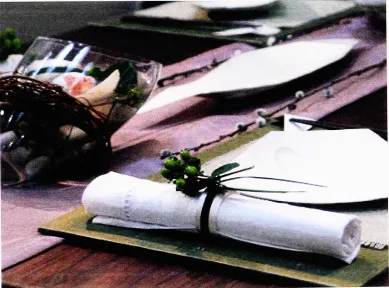
I
sculpted eightplates,
onevase,
four
chopstickrests,
andfour
napkin rings.Using
these,
I
planned anddesigned
adinner
table
andthree
pedestalsthroughout
the
thesis year,
for
purposes ofthe thesis
work andthesis
show.The
thesis
show was apresentation of
the
workI
had finished
that
preceding
thesis
year.Both
making
anddisplaying
the
workis
very
important,
especially for
tableware.
I
choseto
use atable
setting
for
the thesis show,
ratherthan
apedestal,
because
I
wantedto
showvisitors an effective and artistic
way
to
usethe tableware
in
atable setting,
thereby
demonstrating
my
affectionandappreciationfor my
guests.Eating
is,
perhaps,
the
most critical part of our socialexistence,
even moreimportant
than
how
we clothe orhouse
ourselves.How
we eatis influenced
by
many
factors,
including
our personal wealth andtastes,
but
also our culture andsetting.
I
camefrom South
Korea,
an eastern culture.I
lived
there
for
morethan
twenty
five
years.Consequently,
I
feel
more comfortable with easternthan
westernculture.
However,
I
subsequently have been
studying
aboutjewelry
and metalsin
the
United
States,
during
whichtime
I
have been
learning
about western culture.One
goalin
this thesis
wasto
fuse
the
eastern and western stylestogether,
in
the
context of a
table setting,
thereby
expressing my
thanks
to
both
culturesin
whichI
have lived
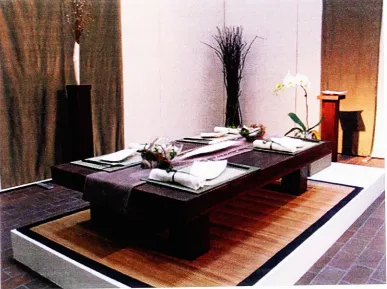
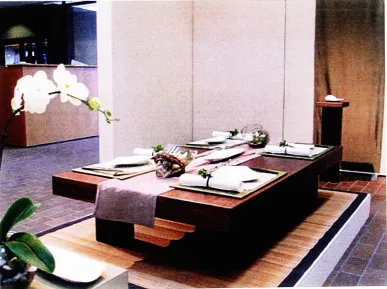
and studied.As
youcan seein Figures
1,
2
and3,
1
adoptedthe
low
table,
bottom
rug
and chopsticksthat
are characteristic of the easternculture,
andthe
silver plates
from
the
west.Koreans
traditionally
use silver chopsticks andspoons;
the
Japanese
andChinese
use wood chopsticks andspoons;
but
none ofthe three
cultures uses silver
plates;
instead,
ceramic plates andbowls
generally
arepreferred.
I
electedto
change all ofthis,
both for
convenience andfor individuality.
This
certainly
seems reasonable.The
division
between
eastern and western culturesis
closing rapidly
in
our global world.More
and more eastern ways arebeing
adopted
by
the west,
and viceversa,
because
ofincreasing
travel
between
the
eastand west.
I
feel
that
it
is very important for
everyoneto
learn
about othercultures,
as
the
world strivesfor
peace andglobal,
mutual understanding.Maintaining
anddisplaying
traditions
proudly
areimportant
components ofthis,
asI
have done.
Being
resistantto change,
onthe
otherhand,
defeats
these
efforts.I
feel
that the
table
setting
I
displayed
in
my
thesis
workis
an excellentbalance
ofproudly
displaying
tradition,
whilewillingly accepting
change.I
chose walnutfor both
the table
andthe
pedestalsto
unify
the theme.
I
chose agreen
tone
for
the walls,
andfor
a runner and placemats,because
the
color greenis
internationally
recognized asthe
color oflife
and growth.Also,
I
used realleaves
and
flowers
to
harmonize
withthe
walnuttable andthe
greencolors,
adding
to the
natural,
decorative
effect.I
pursuedsimplicity in
my
display,
but
also soughtto
tie
in
the theme
of nature.Discussion
of
Work
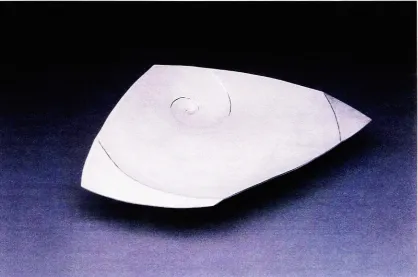
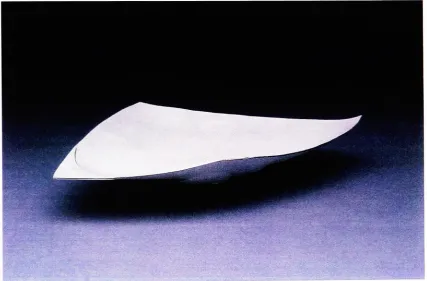
1. Four
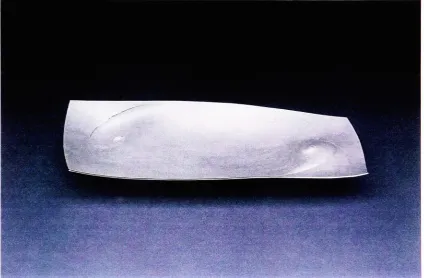
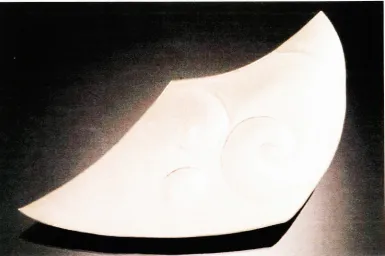
main plates(Figures
4, 5,
6
and7)
When
I
walkalong
the
beach,
I
see variouskinds
of seashells and sometimes seethe
fragments
of seashellsthat
have been broken
by
natural phenomena orhumans. I
have been
attractedto
the
fragments
morethan the
undamaged seashells.I
designed
the
four
main plates withthese
images
in
mind.I
tried to
create a sense ofunity
in
the
main platesby
making
them
allasimilar size.When
I designed them, I
preparedlimited
sizepapers,
A4
papers,
andI
developed
shapes within
the
confines ofthese papers,
thereby
limiting
the
size.They
plateshave different
shapes.All
use a spiralform,
but
two
(Figures
4
and6)
have
two
folding
forms
andthe
othertwo
(Figures 5
and7)
have
onefolding
form. The
spiraland
folding
form
appear notto
have
aconnection;
but,
when youfollow
the
spiralline,
you arrive atthe
folding
line. The
folding
line
alsois
afragment
ofthe
spiralline. I designed
each piece'sspiral volume suchthat
onecanencompassit
with onehand,
soit is
comfortableto
hold.
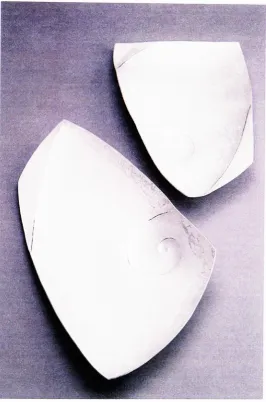
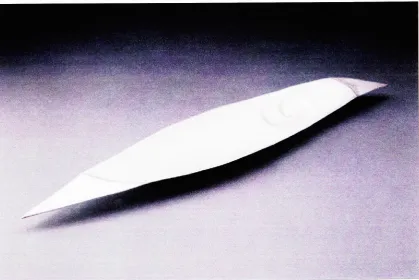
2. Center
plates(Figures 8
-11)
The
center piecesinclude
two
large
and two smaller plates.I
madethese
bigger
than the
four
dinner
platesto
givethe table
stability.I designed
these
for
decorative
effect as well as
function.
These
platescanbe
used notonly
for
food,
but for
flowers.
One
ofthe
larger
center plates(Figure
8)
I
designed
in
the
shape of along
leaf,
including
one spiralform
andtwo
folding
forms,
like
twothe
main plates(Figures
4
and6).
The
otherlarge
center plate(Figure
9)
I
gave a rectangular shape withtwo
spiral
forms;
but
one spiralform
is
concave onthe
front,
whilethe
otheris
concaveon
the
back.
I
shapedtwo
spiralforms
to
giveit
space applicationfor
alarger
sizeplate and show
both
negative and positive volume effects on each side.The
two
smaller center plates are shownin
Figures 10
and11.
As
withthe
four
main
dinner
plates,
I
usedimages
offragments
of shellsin
my
design.
3. Vase (Figure
12)
All
the
plateslargely
look
two-dimensional.
The
vase,
however,
is
much more of athree-dimensional shape, though
it is
designed
to
be
a good match with allthe
other pieces.
It has
along
neck with a spiralform,
andhas
a teardrop-shapedmouth.
With
the
otherpieces,
I
touched
up
the spiralline
with aburnisher
to
generate a
shiny
surface,
but
I
only
touched
up
the
mouthofthis
piece.Vases usually have
a narrowertop
and abroader bottom
to
givethem
stability.I
gave all
my
works stability,but
I
broke
the
rulefor
this
vase, sothat
it
wouldhave
a unique shape.
I
also wantedthe
vase's non-traditional shapeto
be
afocus
ofthe
thesis
work.4. Chopstick
Rests
I designed
the
chopstick restsby imagining
that
I
had
cut aseashellup
in
variousways.
I
drew
spirallines,
cut outthe
lines
and modeled several shapesby
paper.I
obtained
the
shapesI
usedhere
viathis
process.The
rests allhave
simpleshapes,
but
they
can standby
themselves,
andthe
chopsticks sitvery
wellonthem.
As
withall
the pieces,
they
arevery
simple,
but functional.
Conclusions
Over
the
years,
manhas
created variouskinds
oftableware, using
different
materials and shapes.
In
recenttimes,
some artistshave
become inspired
by
othercultures,
while othershave
tried to
stay
true to
local
tradition.
Both
considerationsare
very
important. In
this
thesis,
I
stroveto
combinethese
two
objectives,
combining
other cultures withtraditional
local
ones.To
makedinnerware
interesting,
one mustbe willing
to
develop
newmaterials,
techniques,
anddesigns,
albeitin
line
with a sense ofthe times.
Shells
are a perfectform
to emulate,
because
they
appealto
man at somany
levels;
their
geometricdesign
nonethelessis
beautiful;
theirartistry
is
melded withfunction.
Shells
have
withstoodthe test
oftime,
having
been
usedin
almost allforms
ofdesign,
throughout
virtually
all erasdating
back
to
ancienttimes.
I incorporated
the
spiral
form,
andthe
sense of movement and rhythmin
shells,
into
allfacets
ofthe
dinnerware
I
created.I
usedsterling
silver andfine
silver asmaterials,
because
silveris
the
whitest ofmetals.
However,
silverhas
the
flaw
ofbeing
easily
tarnished
andrequiring
frequent
cleaning,
in
orderto
prevent color changes.Also,
the
piecesI
createdhave
unpolished and matt
surfaces, that
inherently
are easierto
scratchthan
polished orcoated surfaces.
Admittedly,
some other material or materials mighthave been
more practical.
My
inspiration
wasthe seashell,
in
particular,the
spiralform
ofthe
seashell.Consequently,
I
focused
onthe
spiralform,
avoiding
morediverse designs. Some
may
seethis
ashaving
limited
the
work.I
also missedapplying
any
natural surfacetexture
oradding
the
various colorsthat
canbe
found
in
seashells.On
the
otherhand,
the
all-whitecoloring
createstremendous
contrast withthe
surroundingsin
the room,
drawing
one's eyeto the
piecesthemselves.
Like
abstractart,
it
alsoallows
the
viewerto
addthe
details
themselves,
in
their
own mind's eye.Throughout
the
preparation and completion ofthis thesis
andthesis work,
I
have
learned
whatI
needto
do for
future
designs
and works.Art
does
nothappen
in
isolation.
It
invariably
reflectsits
environment,
including
its history. To
optimizemy
effect as anartist,
I
needto
study
notjust
art,
but everything from
history
to
architecture.
Also,
it
willbe necessary for
meto
study
and striveto
understandthe
multitudeof materials and
techniques that
areavailable,
andhow
to
integrate
them
into
my
future
work.Only by doing
this,
canI
truly
realizemy
potentialas anartist.Figure.
1
Table
Setting
Figure.2
Table
Setting
[image:25.554.84.472.230.519.2]Figure.3
Table
Setting
[image:26.554.83.473.230.518.2]Figure.4
Plate,
Sterling
Silver,
8.5x11 inches
Figure.5
Plate,
Sterling
Silver,
8.5x11 inches
Figure.6,7
Plate,
Sterling
silver,
11x8
inches
[image:29.554.145.412.155.558.2]Figure.8
Plate, Sterling
Silver,
6x28 inches
Figure.9
Plate,
Sterling
Silver,
8x18 inches
Figure.10
Plate,
Fine
silver,8.5x11
Figure.ll
Plate,
Sterling
Silver,
6x6 inches
[image:33.554.65.491.225.505.2]Figure. 12
Vase,
Fine
Silver,
4x18 inches
[image:34.554.139.417.185.600.2]Figure.
13
Chopstick
Rest,
Sterling
Silver,
2x3
inches
Bibliography
Hugh
andMargueritie
stix andR. Tucker Abbott. "The
shell."
Five
Hundred
Million Years
ofInspired Design. New York:
Harry
N.
Abrams,
Incoporated
,April. 1973.
Mary
Soul. "Shell All Illustrated Guide
to
aTimeless
andFascinating
World."
London:
Country
Life,
1974.
Geerat J. Vermeij. "A Natural
History
ofshells."
New
Jersey:
Princeton
University,
1993
Richard Came.
"Silver"Octopus Books."1975
Willelm
Braun-feldwes."Metals."(New York: Van Nost
Rad Reinhold
company
Inc,1975)480,240