Bradley, N.A. and Dunlop, M.D. (2005) Towards a multidisciplinary model
of 'context' to support context-aware computing. Journal of Human-Computer
Interaction, 20 (4). pp. 403-446. ISSN 1745-4360
http://eprints.cdlr.strath.ac.uk/2
602
/
This is an author-produced version of a paper published in The
Journal of Human-Computer Interaction, ISSN 1745-4360
.
This version has been peer-reviewed, but does not include the
final publisher proof corrections, published layout, or pagination.
Strathprints is designed to allow users to access the research
output of the University of Strathclyde. Copyright © and Moral
Rights for the papers on this site are retained by the individual
authors and/or other copyright owners. Users may download
and/or print one copy of any article(s) in Strathprints to facilitate
their private study or for non-commercial research. You may not
engage in further distribution of the material or use it for any
profitmaking activities or any commercial gain. You may freely
distribute the url (http://eprints.cdlr.strath.ac.uk) of the Strathprints
website.
Towards a Multidisciplinary
Model of Context to Support
Context-Aware Computing
Nicholas A. Bradley and Mark D. Dunlop
Strathclyde University
Abstract
Capturing, defining, and modeling the essence ofcontextare challenging, com-pelling, and prominent issues for interdisciplinary research and discussion. The roots of its emergence lie in the inconsistencies and ambivalent definitions across and within different research specializations (e.g., philosophy, psychology, pragmatics, linguistics, computer science, and artificial intelligence). Within the area of computer science, the advent of mobile context-aware computing has stimulated broad and contrasting interpretations due to the shift from traditional static desktop computing to heterogeneous mobile environments. This transition poses many challenging, complex, and largely unanswered research issues relat-ing to contextual interactions and usability. To address those issues, many re-searchers strongly encourage a multidisciplinary approach. The primary aim of this article is to review and unify theories of context within linguistics, computer science, and psychology. Summary models within each discipline are used to pro-pose an outline and detailed multidisciplinary model of context involving (a) the
Nicholas A. Bradleyis an HCI researcher with an interest in the usability of con-text-aware systems; he is a PhD student in the Department of Computer and In-formation Sciences, Strathclyde University, Glasgow.Mark D. Dunlopis com-puter scientist with an interest in the usability and evaluation of mobile systems, context-aware systems, and novel text input methods; he is a Senior Lecturer in the Department of Computer and Information Sciences, Strathclyde University, Glasgow.
differentiation of focal and contextual aspects of the user and application’s world, (b) the separation of meaningful and incidental dimensions, and (c) important user and application processes. The models provide an important foundation in which complex mobile scenarios can be conceptualized and key human and so-cial issues can be identified. The models were then applied to different applica-Contents
1. INTRODUCTION
2. DEFINITIONS AND CATEGORIZATIONS OF CONTEXT
2.1. General Definitions ofContext 2.2. Linguistics and Context
Usability Issues for Context-Aware Applications
Proposed Summary Propeller Model of Linguistic Context 2.3. Computer Science and Context
Definitions of Context Categorizations of Context Models of Context
Contrasting Definitions, Categorizations, and Models Proposed Summary Model of Context in Computer Science 2.4. Psychology and Context
Usability Issues for Context-Aware Applications Proposed Summary Model of Context in Psychology 2.5. Context Within Other Research Areas
3. CONTRASTING AND ANALYZING PROPOSED MODELS
3.1. Contextual Interactions 3.2. The Notion of Relevancy
3.3. Proposed Multidisciplinary Definition ofContext
4. PROPOSED MULTIDISCIPLINARY MODEL OF CONTEXT
4.1. Differentiation of User and Application’S World
4.2. Separation Between Meaningful and Incidental Dimensions Quadrant 1
Quadrant 2 Quadrant 3 Quadrant 4
4.3. Application and User Processes User Processes
Application Processes
5. APPLYING THE MULTIDISCIPLINARY MODEL TO DIFFERENT APPLICATIONS OF CONTEXT-AWARE COMPUTING
5.1. Mobile Tourist Guides 5.2. Mobile User Communities 5.3. Applying the Model in Practice
tions of context-aware computing involving user communities and mobile tourist guides. The authors’ future work involves developing a user-centered multidisciplinary design framework (based on their proposed models). This will be used to design a large-scale user study investigating the usability issues of a context-aware mobile computing navigation aid for visually impaired people.
1. INTRODUCTION
The phenomenon of context has become an increasingly intriguing multidisciplinary talking point. Davies and Thomson (1988) remarked that the main reason for context assuming a central role in various research areas is “the acknowledgement, explicit or implicit, that organisms, objects and events are integral parts of the environment and cannot be understood in iso-lation of that environment.” Although context is frequently cited, and its im-portance repeatedly proclaimed, Dervin (1997) argued that it is rarely given a detailed philosophical and theoretical treatment, in particular to its multiple interdependencies; its dialectical relationships between product and process; and its temporal and spatial (i.e., here-and-now) confluence of people, set-tings, activities, and events.
The roots of its emergence also lie in the inconsistencies and ambivalent definitionsacross andwithin different research specializations (e.g., philoso-phy, psychology, pragmatics, linguistics, and artificial intelligence). Benerecetti, Bouquet, and Ghidini (2001) stipulated that a general and unify-ing theory or formalization of context is still in its infancy and that it is unclear whether each research area is addressing aspects of the same problem or dif-ferent problems with the same name.
Chen and Kotz (2000) illustrated the discrepancies in the use of the word contextwithin different areas of computer science (e.g., context-sensitive help, contextual search, multitasking context switch, etc.). The advent of mobile context-aware computing, for instance, has stimulated broad and contrasting interpretations, due to the shift from traditional static desktop computing to heterogeneous mobile environments. This transition poses many challeng-ing, complex, and largely unanswered research issues relating to contextual interactions and usability.
and Edwards (2001) stated that “it is the human and social aspects of context which are crucial in making a context-aware system a benefit rather than a hindrance—or even worse—an annoyance.” Selker and Burleson (2000) stip-ulated how context-aware design needs to explicitly draw on cognitive sci-ence, user experisci-ence, and situation in the design process.
Many researchers in computer science have illustrated the benefits of un-derstanding context. Dey (2001) remarked that it could lead to improved us-ability of context-aware applications. Dey and Abowd (1999) stated that “by improving the computer’s access to context, we increase the richness of com-munication in Human–Computer Interaction (HCI), making it possible to produce more useful computational services.” An understanding of context will also enable application designers to choose what context to use in their applications, therefore helping them to determine what context-aware behav-iors to support. Brezillon and Abu-Hakima (1995) remarked that context plays an important role in person–machine and machine–machine interac-tions and in the representation of knowledge-based systems.
Context is also analyzed and discussed considerably within industry and is regarded as the key to unlocking the true value of business applications on handheld devices (Zetie, 2002a). For example, Sun Microsystems, Giga Infor-mation Group, and US Bancorp Piper Jaffray have recently identified context as a key enabling technology missing from today’s mobile platform applica-tions (Unwired Express, 2002). It is therefore not surprising that next-genera-tion applicanext-genera-tions and Web services are increasingly taking into account the user’s context to use contextual information to modify the application’s busi-ness logic, presentation, and navigation.
The primary aim of this article is to review and merge theories of context within linguistics, computer science, and psychology, to propose a multidisciplinary model of context that would facilitate application develop-ers in developing richer descriptions or scenarios of how a context-aware de-vice may be used in various dynamic mobile settings. More specifically, the aim is to:
1. Investigate different viewpoints of context within linguistics, computer science, and psychology, to develop summary condensed models for each discipline.
2. Investigate the impact of contrasting viewpoints on the usability of con-text-aware applications.
3. Investigate the extent to which single-discipline models can be merged and the benefits and insightfulness of a merged model for designing mobile computers.
We anticipate that this review will provide a stepping stone to the develop-ment of a user-centered and multidisciplinary design framework for building and assessing context-aware applications. The purpose of this article is not to advance the philosophical debates on context, such as the phenomenological or positivist accounts of action (which are widely covered elsewhere, e.g., Dervin, 1997) but to draw on theories of context within each discipline to il-lustrate their practical implications for designing mobile context-aware com-puters. This article is therefore intended for application developers, although more exclusively for usability researchers (advancing user-centered design theories, models, or frameworks) and usability practitioners (incorporating key design and usability context principles in an applied setting).
2. DEFINITIONS AND CATEGORIZATIONS OF
CONTEXT
This section is divided into the following key areas: (a) general definitions of context, (b) linguistics and context, (c) computer science and context, (d) psychology and context, and (e) context within other research areas. The in-vestigation focuses on the disciplines of linguistics, computer science, and psychology because their theories and principles were considered to be the most applicable to, and beneficial for, context-aware computing.
Definitions and categorizations of context are provided within Sections 2.1 through 2.5. Within Sections 2b through 2d, we present a proposed model of context and a subjective analysis in relation to context-aware computing. The purpose of creating models was to (a) show conceptually how context is inter-preted within each discipline, (b) facilitate the visual and theoretical identifi-cation of similarities and links for creating a multidisciplinary model, and (c) illustrate how principles within other disciplines have direct implications for context-aware computing.
2.1. General Definitions of
Context
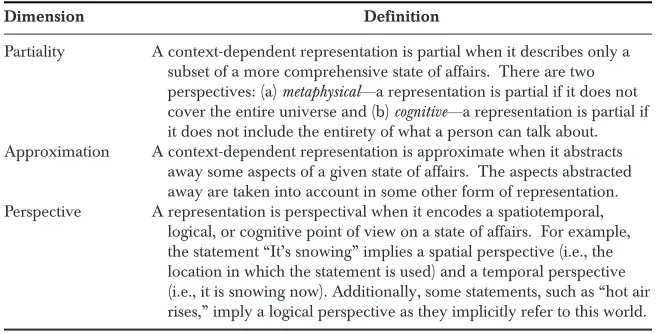
TheChambers 21st Century Dictionary(1996) and theOxford Pocket Dictionary of Current English(1992) both definecontextas either “the pieces of writing in a passage which surround a particular word, phrase, paragraph, and so on,” and “the circumstances, background or setting.” Benerecetti et al.(2001) pro-vided a more analytical perspective of context. As described in Figure 1, three dimensions of context dependence1are identified: (a) partiality, (b) approxi-mation, and (c) perspective.
In relation to context-aware computing, the approximation dimension is closely tied to the notion of relevancy (discussed in Section 3.4). Contextual information not required by the user must be abstracted away, making the re-maining informationpartial. The perspective dimension, however, indicates how information must account for a spatial perspective (e.g., a user’s loca-tion), temporal perspective (e.g., is the information relating to the past, pres-ent, or future?), and logical perspective (e.g., does the information match that of the surrounding environmental context?). Although these context-depend-ence principles stimulate ruminative discussion, it is unclear how they can be used to develop techniques for capturing, measuring, and assessing parame-ters of context within complex tasks and systems.
2.2. Linguistics and Context
Researchers in the area of linguistics and communication have studied many aspects of context. These include: (a) the changes in utterance interpre-tation when spoken in different contexts, (b) the production of a speaker’s ut-terance in accordance with what he or she perceives is the current conversa-tional context, and (c) the method in which a hearer selects or constructs the context in order to comprehend the message.
Fetzer (1997) definedcontextas a “tripartite system of objective, social and subjective worlds, their sub-systems and presuppositions.” The objective world is measurable and consists of a true–false paradigm. The subjective world is characterized by sincerity in that a speaker’s conversational intention is spoken as intended and the social world is represented by textual,
interper-Figure 1. Dimensions of Context Dependence.
Dimension Definition
Partiality A context-dependent representation is partial when it describes only a subset of a more comprehensive state of affairs. There are two perspectives: (a)metaphysical—a representation is partial if it does not cover the entire universe and (b)cognitive—a representation is partial if it does not include the entirety of what a person can talk about. Approximation A context-dependent representation is approximate when it abstracts
away some aspects of a given state of affairs. The aspects abstracted away are taken into account in some other form of representation. Perspective A representation is perspectival when it encodes a spatiotemporal,
[image:7.432.48.378.95.262.2]sonal, and interactional meaning. In other viewpoints, Ochs (1979) distin-guished between thesocialandpsychologicalworlds. These include people’s be-liefs and assumptions about (a) temporal, spatial, and social settings; (b) prior, ongoing, and future actions (both verbal and nonverbal); and (c) the state of knowledge and attentiveness of those participating in the social interaction.
Categorizations of contextual information used within a communication act have been proposed. Bunt (1997) believes that the relevant factors of con-versational context can be grouped into five categories:
1. Linguistic: Properties of the surrounding linguistic material (textual or spoken).
2. Semantic: Constructed by the underlying task and the task domain (the objects, properties, and relations relevant to the task).
3. Physical: The physical circumstances/environment in which the interac-tion occurs.
4. Social: The type of interactive situation, combined with the participant’s roles in that situation, as depicted in terms of their communicative rights and obligations.
5. Cognitive: The participants’ beliefs, intentions, plans and other attitudes; their states of processing relating to perception, production, interpreta-tion, evaluainterpreta-tion, execution; and their attentional states.
Connolly (2001) separated between thelinguisticcontext andnonlinguistic (orsituational) context.Linguistic contextrefers to the units that give meaning to words, phrases, or sentences. Connolly identified two types:
1. Cotext: The text that surrounds a unit of language (words, phrases, etc.) that gives its linguistic context. This is similar to the concept of anaphora, whereby the coreference of one expression is made with its antecedent. The antecedent provides the information necessary for the expression’s interpre-tation—for example, when the nameDavidis replaced withhisin for succeed-ing text.
2. Intertext (or intertextuality): The notion that, to comprehend/interpret part of one text, information from some other text may be required. Situa-tional context refers to the pertinent aspects of the environment that are nontextual in nature (but where the text exists), for example, an author’s cog-nitive decisions and ideas regarding the compilation of the text.
situa-tion(at the bottom of hierarchy), which consists of who is addressing whom, where, and when, and what utterances are produced. Thediscourse situation re-lates to the entire conversation, which is part of theembedding situation(an ac-cumulation of discourses). At the top of the hierarchy, theworlddepicts the maximal situation in which all other situations occur. The meaning of lan-guage was also addressed extensively by Wittgenstein (1958), who believed that the meaning of sentences depends on the context of utterance. It is de-scribed how words do denote meaning in isolation, but only when used inside a language game consisting of a social environment of speech and action. The termlanguage gameis used to illustrate that speaking of language is part of an activity. So if the sentence, for instance, is the basic move in the language game, a language game itself is taken to be the basic unit in linguistic activity. Words become meaningful only when we consider the occasion on and pur-pose for which it is said.
In other investigations, Bunt (1997) described how human dialogue con-sists of two simultaneous tasks: (a) attempting to achieve the underlying noncommunicative goal and (b) communicating to achieve the associated communicative goal. To illustrate, if a person is visiting a car dealership with the intent of purchasing a car, the noncommunicative goal (which will moti-vate a dialogue) may be to buy a car within a particular price range. However, although the communicative goal will be to verbalize this to the car salesman, the noncommunicative goal will be reshaped as the salesman’s feedback is be-ing weighed and compared with the original noncommunicative goal (thereby allowing the salesman to convince the buyer that this more expen-sive car is justified!).
Last, Fetzer (1997) illustrated how speakers/hearers create and interpret their utterances in and through an already-existing context. Therefore, speak-ers link and anchor their utterances to that context. Fetzer also pointed out that context represents both a process and a result as it is selected and con-structed through an act of verbal and nonverbal communication. It is selected in the sense that the speaker selects contextual information on the basis of previous communication acts and then accepts or rejects this information and it is constructed in the sense that the speaker adds new contextual information to the already-existing contextual information through his or her response.
Usability Issues for Context-Aware Applications
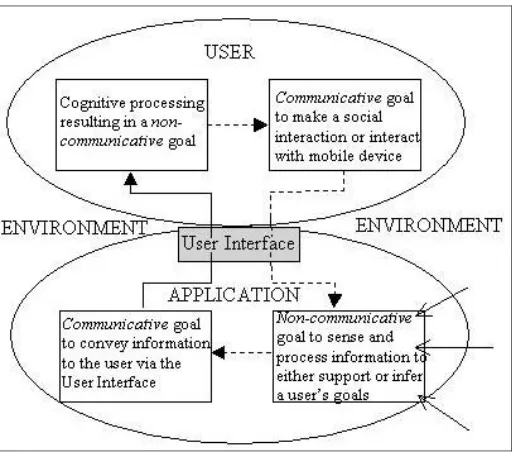
Bunt’s (1997) research can be used to model the interaction of a user with a context-aware application, as illustrated in Figure 2.
use a scenario involving a person, Alice, who is traveling to the train station using her mobile computing travel aid.
[image:10.432.91.349.100.329.2]Alice makes a noncommunicative cognitive goal to travel to the train sta-tion to catch her last train home (i.e., a goal formed without communicasta-tion with the mobile device). She may need to construct a communicative goal, or an interactional goal, in which to solicit trip information (e.g., which actions are required to obtain travel directions via the user interface?). This would re-sult in a noncommunicative application goal to sense and process information in which to support her query/instruction. However, before Alice realizes her communicative goal, the context-aware application may be able to infer her noncommunicative goal from sensed information, such as the time of day and GPS location (thereby making the user’s communicative goal unnecessary). In either situation, the application would need to execute a communicative goal to transmit travel details appropriately, comprehensibly, and in a timely manner with respect to Alice’s personal preferences, situation, and environ-ment. Other noncommunicative application goals may be to actively check the status of the train, which is communicated to her only if a delay is encoun-tered. As a result, this information would be given to Alice, who would cognitively process it and then possibly form additional noncommunicative goals (e.g., stop at nearest café for a drink).
The preceding scenario, in relation to Fetzer’s (1997) research, also illus-trates how a context-aware application must link and anchor information in accordance to the user’s current context, as described next:
•
Selected application intelligibility: To make accurate inferred decisions regarding Alice’s current and future intentions, the application may need to select previously captured information regarding her behavioral patterns. The application, for instance, may have tracked from previous train and bus delays that Alice visits cafés and bookshops to pass time; subsequently, the application could automatically select, or make in-formed, recommendations.•
Constructed application intelligibility: This is temporally driven as the application contributes to constructing present and future user contexts. The application must therefore intelligently filter, modify, or add to in-formation from past contexts to suitably construct Alice’s current con-text. For instance, in the preceding scenario, the application creates a context by informing her that the train is delayed. She is now aware of this and may not require this information again unless the status of the train changes. A key issue would be: To what extent should the applica-tion construct Alice’s context—how much should be left to her own in-terpretation? If Alice is about to walk past a café after being told of a train delay, should the application assume she has spotted this or should it provide an inferred recommendation regardless?To illustrate this last point further, with respect to Connolly’s (2001) descrip-tion of intertextuality and cotext, the applicadescrip-tion must be sensitive to Alice’s acquired knowledge and experience. The application, for instance, may not need to alert Alice of train departure times if she has already acquired this knowledge. In terms of intertextuality, she will be referring more to knowl-edge-based information than to application-based information. However, to what extent can assumptions be made relating to user knowledge, experi-ence, and memory capabilities when considering the diversity of human ca-pabilities (and disabilities)?
Proposed Summary Propeller Model of Linguistic Context
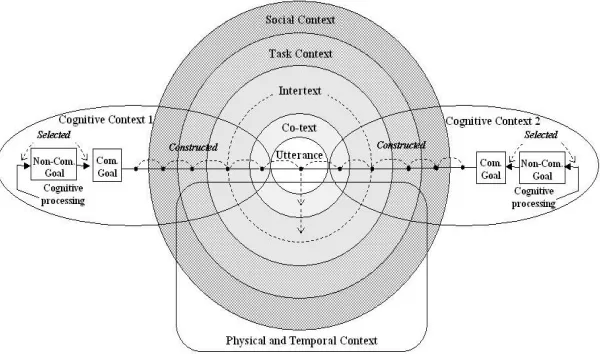
These viewpoints of linguistic context have been captured and used to cre-ate our summary propeller model of context, as illustrcre-ated in Figure 3.
asso-ciated noncommunicative goal then shapes/constructs the social and task context, the intertext, and the cotext. Whether it is an utterance or discourse, both the cognitive contexts will expand with more contextual information, which is used to process and select future goals.
After the utterance has occurred, this becomes the cotext to the next utter-ance. Similarly, after this discourse, the utterance will form the intertext to the next discourse. Last, all of this operates within a physical and temporal con-text (i.e., it has been influenced by previously occurring events).
2.3. Computer Science and Context
The notion of context is a powerful and long-standing concept in hu-man–computer interaction. Over the years, computer scientists have contrib-uted to an expanding and varied list of definitions, categorizations, and mod-els, examples of which we now describe and contrast and use to propose a model of context for computer science.
Definitions ofContext
[image:12.432.69.369.121.298.2]Computer scientists’ definitions ofcontextcan be loosely placed into three distinct types: those that describe the primary focus of context from the per-spective of (a) the application, (b) the user, and (c) any entity of interest.
Primary Focus as the Application. Moran and Dourish (2001) defined contextas the “physical and social situation in which computational devices are embedded.” Ward, Jones, and Hopper (1997) view context as the state of the application’s surroundings. Similarly, Brown (1996) defined context as the elements of the user’s environment that the user’s computer knows about. Chen and Kotz (2000) defined context as the “set of environmental states and settings that either determines an application’s behaviour or in which an ap-plication event occurs and is interesting to the user.”
Primary Focus as the User. Dey, Abowd, and Wood (1999) defined con-textas the user’s physical, social, emotional, or informational state, whereas Zetie (2002b) described context in software applications as “the knowledge about the goals, tasks, intentions, history and preferences of the user that a software application applies to optimizing the effectiveness of the applica-tion.” Zetie (2002b) also identified the key dimensions of context by asking questions about the user: who the user is (e.g., personal characteristics), what the user is doing (i.e., activity/task), where the user is, and how to contact the user (based on his or her location, time of day, preferences, priority of interac-tion, etc.). Similarly, Schilit, Adams, and Want (1994) treated the user as the primary entity to ask questions such as where you are, who you are with, and what resources are nearby.
Primary Focus as Any Entity of Interest. Schmidt (2001) views context as facts that matter for an application/user/device, which are inherently con-nected to time and location. In more general definitions, Funk and Miller (1997) described contextas “everything surrounding an item of interest, in-cluding the ‘mindset’ of any humans involved in the context.” Similarly, Dey and Abowd (1999) defined context as “any information that can be used to characterize the situation of an entity. An entity is a person, place, or object that is considered relevant to the interaction between the user and an applica-tion, including the user and application themselves.”
Categorizations of Context
A variety of categorizations of context have also been proposed. Common categories include a user’s location and environment, identities of nearby peo-ple and objects, and changes to those objects (Brown, Bovey, & Chen, 1997; Dey, 1998; Ryan, Pascoe, & Morse, 1997; Schilit & Theimer, 1994), whereas some use additional categories such as time of day (Brown et al., 1997; Ryan et al., 1997) and the user’s emotional state and focus of attention (Dey, 1998).
de-vices accessible for user input and display, network capacity, connectivity, and computing costs; (b) theuser environment, which depicts the location, col-lections of nearby people, and social situation; and (c) thephysical environment, which includes parameters such as lighting and noise level. Chen and Kotz (2000), however, stipulated that this categorization neglects thetime context. Temporal recordings of user, computer, and physical contexts provide useful sources for supporting applications.
Models of Context
Coutaz and Rey (2002) proposed a mathematical model in which the con-text of a situation is defined as the “set of periphic variables and relations be-tween them.” The following formula represents how a series of situations (i.e., snapshots in time) are combined to give the context for a user (U), task (T), and time (t):
Context (U,T,t) = Cumul[Situation (U,T,t0) … Situation (U,T,t)]
In this formula,Cumulis a union operation that labels periphic variables and remaps relationships between variables as necessary. Coutaz and Rey also introduce the notion of contextor, which is a reflexive and hierarchically composable context sensor with data inputs and outputs plus control inputs and outputs.
In other models of context, Zetie (2002b) illustrated the interactions be-tween an application and a user, as shown in Figure 4.
As shown, the interactions of the application and user provide four possi-ble combinations of what the user and the application know about the user’s intentions: (a)explicit—user’s intentions that are known to the user and appli-cation; (b)Inferred—information about intentions that the application infers but which are not explicitly part of the user’s intentions; (c)implicit— inten-tions known to the user but not to the application; and (d) hidden—intentions that are not known to either the application or to the user. These four quad-rants provide a valuable base point in which to separation of design issues in relation to context-aware applications.
Contrasting Definitions, Categorizations, and Models
is impossible to stipulate what aspects will be pertinent. Using a mathematical model of context, for instance, may restrict the likelihood of being able to fully capture a user’s complex interactions with other people and objects in his or her environment. This explanation also demonstrates why it is danger-ous to use the application as the primary focus when definingcontext. To maxi-mize usability, users and their heterogeneous interactions need to be placed at the center of a design process; otherwise, systems will become negligent of us-ers’ requirements, making them obtrusive and frustrating to use.
Some definitions are also too general and nonspecific (e.g., Dey & Abowd, 1999; Funk & Miller, 1997; Schmidt, 2001). They imply that context is any-thing that is relevant (or matters) to an entity or interaction of entities. Because it is not explicitly described how relevant dimensions of context can be identi-fied and quantiidenti-fied, it would be very difficult to transfer or operationalize these definitions into a complex contextual scenario. It would also be uneco-nomical and tedious to identify from scratch which entities are germane to more than one situation. Midway points are required whereby generic cate-gories (or reference points) of context can be applied to every situation. The content, importance level, interactions, and influences of each category can be measured for each situational purpose.
A key issue that transpires from the previous two points is: How are dimen-sions of context identified, quantified, and interrelated for each situational purpose? Zetie (2002b) stipulated that to ensure the application adopts itself to the intentions of the user, task analysis is critical for a suitable and sufficient investigation.
Proposed Summary Model of Context in Computer Science
The contrasting viewpoints, definitions, and categorizations of context within the area of computer science have been illustrated in our model, which is shown in Figure 5. Whether the primary focus is from the perspective of the user, the application, or from any entity of interest, Figure 5 illustrates the key components and characteristics of context that are present during user– com-puter interaction (i.e., use context).
[image:15.432.49.376.96.140.2]As shown, surrounding people and objects may influence the user–computer interaction, making it an intrinsic factor in shaping the use context. The broken
Figure 4. Interactions of Application and User (Zetie, 2002a).
Unknown to the User Known to the User
Known to the application Inferred Explicit
line demonstrates how, as a result of temporal changes, other objects and people may pass from being relevant or irrelevant to the interaction taking place.
2.4. Psychology and Context
Over the years, researchers in psychology have studied how changes in context can affect various cognitive processes, such as perception, language interpretation, reasoning, decision making (framing effects), problem solving (fixedness and set effects), learning (lack of transfer from one context to an-other), and memory (priming effects).
Many psychologists have attempted to define and categorize context. In relation to context-dependent memory, Smith (1988) defined contextas “a concept that denotes a great variety of intrinsic or extrinsic characteristics of the presentation or test of an item.” On the basis of previous research: Smith also contrasted two different conceptualizations of context:
1. Focal versus contextual:Focal information is directly in the focus of atten-tion (e.g., likened to foveal vision), whereas contextual informaatten-tion is pro-cessed outside the focus of attention (e.g., likened to peripheral vision).
[image:16.432.63.377.108.278.2]2. Meaningful versus incidental: Meaningful contextrefers to verbal/semantic material (e.g., accompanying words/text that may directly bias meaning se-lection processes).Incidental contextis not meaningfully related in any implicit or explicit way (it just happens to be present). Kokinov and Grinberg (2001) demonstrated how perceiving some incidental objects from the environment may change the way in which we solve problems.
In other viewpoints of context, Ziemke (1977) stated how context has been previously categorized into external (or objective) context and internal (or subjective/cognitive) context.External contextwould be the situation or envi-ronment the person is in, and theinternal contextwould be the internal knowl-edge/mechanisms underlying the person’s cognitive processes (e.g., mood, state-dependent effects). Bekerian and Conway (1988), however, added an-other dimension of context, namely,everyday context, which includes scripts or frames for action that prepare the person to expect subsequent events and to anticipate particular outcomes.
In relation to internal context, Ziemke (1997) distinguished between two major paradigms in contemporary cognitive science: (a) cognitivism and (b) enaction. They are described thus:
1. Cognitivism:In any specific situation, not all knowledge about the world is applicable, useful, or pertinent. The information solicited to make a cogni-tive process is therefore the subset of information that is available (e.g., ac-quired information regarding weather forecasts would be useful for planning holiday activities; however, it would not be useful for cooking a meal).
2. Enaction:Cognition is not considered an abstract human internal process; instead, it is an embodied process that is the outcome of the constant human– en-vironment interaction (and their mutual relation during evolution/individual de-velopment). The cognitive processes required to effectively interact with a lap-top, for instance, would have been influenced by previous computer interactions, during which skills, knowledge, and experience would have been gained.
Last, Davies and Thomson (1988) provided an interesting insight into the impact of context on memory. On the basis of investigations into environ-mental context (EC) dependent memory, two types of effects were identified. Long-term reinstatement effectswere the memories experienced when returning to a former residence after a long absence (e.g., often triggered by important lifestyle changes, such as marriage, divorce, emigration, etc.).Short-term EC effectsrelate to the familiarity of people/objects in particular situations/envi-ronments. If encountered in another environment, it is common not to recog-nize this person/object in this new context.
Usability Issues for Context-Aware Applications
experi-ences. For instance, a tourist called Bob is visiting Rome for his second time. Since his previous trip, certain features of the EC may be familiar (i.e., long-term reinstatement effect). To provided tailored functionality of contex-tual detail, the application must determine from its own memory (a) the length of time since Bob’s last visit, (b) the information that was provided to him, and (c) his previous activities. A key question would be: How does the application account for variabilities in human memory (e.g., a decline in cog-nitive function due to age)? A possible solution would be to use a mem-ory-triggering process involving snippets of information.
There may also be instances when it is useful to provide information about EC that has changed since a previous visit (e.g., buildings erected, shops and restaurants changed, etc.). If Bob were blind, for instance, and depended on building a comprehensive cognitive map2 or internal representation of the environment, the mobile device may need to inform him of EC modifications to ensure he does not become disorientated or confused in his surroundings as a result of information being conflicting to his memory (i.e., short-term re-instatement effect). This could be achieved by contrasting the geographic ap-plication database used during Bob’s last visit with a new, updated version. Providing such feedback enhances the development, evolution, and mutual relation of humans with their environment.
The differentiation between incidental and meaningful context also has a major design implication for context-aware applications. If the application senses a nearby art gallery (unknown and incidental to Bob), while directing him to the train station (his meaningful task), how should this information be presented (if at all) and prioritized with respect to his current task and per-sonal preferences? For the application to make those types of inferences, the following parameters may need to be accounted for: the time available before his train arrives, whether he has visited galleries before, and so on.
Proposed Summary Model of Context in Psychology
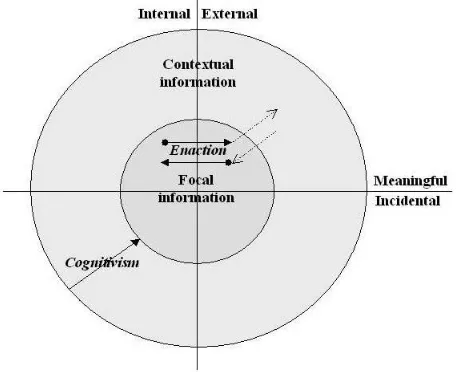
On the basis of the conceptualizations and theories of context within the psychologist’s domain, we propose the following summary model of context, shown in Figure 6.
The model is composed of an inner and outer circle forming the focal and contextual layers. One line splits the circles perpendicularly into internal and external contexts, although the other line splits the circles horizontally into
2Acognitive mapis an interpretive framework of the world which, it is argued, exists
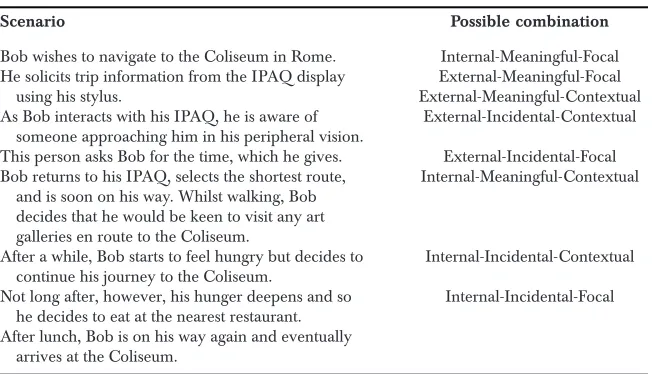
meaningful and incidental contexts. As illustrated in Figure 7, the following scenario, involving Bob en route to the Coliseum in Rome using his GPS-en-abled Palmtop for navigational assistance, is used to illustrate the eight possi-ble combinations.
Bob’s scenario can be used to illustrate the enaction paradigm, shown in Figure 6. Within Bob’s internal context, decisions that are focal and meaning-ful are made prior to, and during, his trip. These decisions are influenced, changed, and created by his interaction with focal and contextual information within his external context.
The cognitivism paradigm can also be illustrated using Bob’s scenario. If Bob had extensive knowledge of Spanish and Italian culture and history, only his Italian knowledge (a subset of his total knowledge) would influence his cognitive processes or imminent decisions. If Bob, however, had been in Ma-drid, the opposite would have occurred.
2.5. Context Within Other Research Areas
[image:19.432.97.326.102.288.2]The notion of context has also been investigated within many other areas of research, including artificial intelligence (AI), neuroscience, pragmatics, and phi-losophy. Researchers in AI, for instance, have recently attempted to formalize context in order to model it in computer simulations. They are predominantly interested in how context is connected to reasoning, for instance, how people change their perspective, their line of reasoning, how they think of and compare
states of the world in different situations or moments of time. See Theodorakis and Spyratos (2002) for a detailed discussion of issues of context in AI.
Neuroscientists, however, have explored the differences between implicit and explicit memory and learning, shedding light on the mechanisms that process information in the human brain. A number of differences have been discovered, as described by Tijus (2001), between explicitly and implicitly represented information and its processing and storage.
3. CONTRASTING AND ANALYZING PROPOSED
MODELS
The proposed models of context for linguistics, computer science, and psy-chology (described in Sections 2.2–2.4) will now be critically analyzed and compared, in order to propose a multidisciplinary model in Section 4. This assessment has been captured under two headings relating to contextual in-teractions and the notion of relevancy. The last section proposes a multidisciplinary definition of context based on Sections 2 and 3.
3.1. Contextual Interactions
[image:20.432.58.389.90.277.2]Contextual interactions appear to comprise the quintessential cross-disci-plinary component for understanding and using principles of context. From a high-level perspective, within linguistics it is the interaction between two peo-ple; within computer science it is the user–application interaction (combined
Figure 7. A scenario depicting eight possible combinations in psychology.
Scenario Possible combination
Bob wishes to navigate to the Coliseum in Rome. Internal-Meaningful-Focal He solicits trip information from the IPAQ display External-Meaningful-Focal
using his stylus. External-Meaningful-Contextual
As Bob interacts with his IPAQ, he is aware of someone approaching him in his peripheral vision.
External-Incidental-Contextual
This person asks Bob for the time, which he gives. External-Incidental-Focal Bob returns to his IPAQ, selects the shortest route,
and is soon on his way. Whilst walking, Bob decides that he would be keen to visit any art galleries en route to the Coliseum.
Internal-Meaningful-Contextual
After a while, Bob starts to feel hungry but decides to continue his journey to the Coliseum.
Internal-Incidental-Contextual
Not long after, however, his hunger deepens and so he decides to eat at the nearest restaurant.
Internal-Incidental-Focal
with possible interactions with other people and objects), and within psychol-ogy it is the internal and external interactions.
Despite the fact that each discipline has contrasting viewpoints of context, their principles can be conceptualized across one another, which, although adding greater complexity, provides a deeper understanding in how people interact with the environment. A person speaking to a friend using his mobile phone, for instance, is both making an interaction with his mobile device at the same time as he is constructing dialogue that has been filtered through a cognitive, task, social, physical, and temporal context. So, in this example, the linguists would be interested in how a speaker changes his utterances during phone-based dialogue compared with human–human dialogue. The com-puter scientists would be interested in how this context-driven communica-tion influences the design of the user interface as well as to the services and in-formation provided to them, and the psychologists would be interested in the cognitive processes by which knowledge is acquired, stored, selected, and used to both interact with the mobile phone and converse with the friend. Each discipline has therefore implications for the other two disciplines.
To address an important comment made in the beginning of this article, each discipline is tackling different representations of context but at the same time can be considered as addressing similar, overlapping, and complemen-tary themes of the same problem, perhaps the most important of these being: How do people decide what aspects of their cognitive, task, social, physical, and temporal context are relevant to them when undertaking, or planning for, future activities?
Last, contextual interactions should also be considered through the notion ofembodiment, as described by Dourish (2001), whereby anything that pro-vides a presence and participation to an activity or action (e.g., physical ob-jects, conversations, actions, cognitive process, etc.) needs to be accounted for. This enables one to explore the social, cultural, organizational, and interactional context in which actions emerge.
3.2. The Notion of Relevancy
Issues of context and relevance are frequently cited in the science and phi-losophy literature. Although they are normally treated separately as unre-lated topics, Ekbia and Maguitman (2001) argued that context and relevance are inextricably linked and should be analyzed together within a framework of logic. Dewey (1931) provided a pragmatic definition of context (in relation to relevancy) and differentiated between two components:
a thought emerges). Background is considered to be that part of the context that “does not come into explicit purview, does not come into question; it is taken for granted.”
2. Selective interest: Context is considered to dictate the person’s thought process. The notion of relevancy arises when the theory of selective interest occurs. There is evidence to suggest that humans take a selective interest in in-formation (consciously/unconsciously) that is considered to be a cognitive benefit, either to enhance their knowledge or to use this resource to carry out specific activities (Matsui, 2001).
As depicted in each of the proposed models for linguistics, computer sci-ence, and psychology (see Figures 3, 5, and 6), the notion of relevancy is of critical importance for all disciplines when attempting to understand human behavior. So, within a communication act, illustrated in the linguistics model, backgroundandselective interestwould refer to the process by which humans take selective interest in both their own background cognitive purview (se-lecting relevant aspects of previous experiences and knowledge) and their background environmental situation (involving the person with whom they are conversing as well as their social and physical surroundings) in which to form communicative and noncommunicative goals.
This concept can be extended when considering the model of context for psychology. The selective interest process (i.e., determining what is relevant) may have been meaningfully or incidentally motivated, possibly resulting in different conversations and levels of significance/relevance. For instance, a student who visits a lecturer at the lecturer’s office on the spur of the moment, compared with a student who prearranges a meeting with that lecturer, may have entirely different conversational and situational outcomes.
A user’s interaction with a mobile device also illustrates these concepts. A person may take selective interest in surrounding people or objects (either meaningfully or incidentally) that may have been previously regarded as background context. This also nicely demonstrates one of the design chal-lenges for context-aware computing: Systems must, in a sense (i.e., from a physical interaction perspective), be pushed into the background so that the user can focus and freely take selective interest in, and learn about, other peo-ple and objects in his or her environment.
3.3. Proposed Multidisciplinary Definition of
Context
Context:a process whereby a person consciously or unconsciously compares an external context with acquired personal experiences/knowledge (both of which may contain task, physical, social, and temporal dimensions) to form goals for undertaking concise actions, possibly with other people and/or objects.
4. PROPOSED MULTIDISCIPLINARY MODEL OF
CONTEXT
Two versions of our multidisciplinary model of context are presented: (a) an outline version (see Figure 8) and (b) a detailed version (see Figure 9; Bradley & Dunlop, 2003). The model captures the relationship between dif-ferent interpretations of context by researchers within psychology, computer science, and linguistics. The key principles are described under three head-ings, concerning (a) the differentiation of the user and application’s world, (b) the separation of meaningful and incidental dimensions of context, and (c) the user and application’s processes.
4.1. Differentiation of User and Application’s World
The horizontal center line shown in our outline model in Figure 8, sepa-rates the user’s world from the application’s world.
The oval-shaped circle in the center of Figure 8 represents what is focal to the:
1. Userwith respect to carrying out actions in an attempt to achieve goals (e.g., interact with Palmtop to find the time of a train home, interact with self-service ticket machine to acquire a train ticket). Goals and associated ac-tions may be interrelated and form part of a higher level structure or goal (e.g., to get home). Actions can also occur independently or simultaneously.
2. Applicationwith respect to transmitting contextual information and ser-vices to the user (e.g., alerting the user that a friend is in a nearby café).
In contrast, the circular layer that surrounds the user and application’s world represents anything in the contextual world that influences the process in which focal user actions are undertaken and focal application services are executed. The contextual world can be broken down into several dimensions, four of which are common to both the user and application and are described as follows:
•
Physical context: The environmental location, including its gradient and altitude, consisting of surrounding physical objects, such as buildings, cars, trees, and so on. This also includes the orientation, position, state, and purpose of those objects and the types of information they transmit through audio and visual means, odor, texture, temperature, and move-ment. Contrasting weather conditions (e.g., cloudy or sunny, cold or hot, etc.) and lighting conditions (e.g., daylight or darkness) may also influ-ence how objects are perceived.•
Social context: The relationship with; dialogue from; and density, flow, noise, and behavior of surrounding people (e.g., sitting on a crowded train).•
Temporal context: The temporal context is embedded withinevery-thing (as illustrated in Figure 9) and is what gives a current situation meaning, based on past situations/occurrences; expected future events; and the higher level temporal context relating to the time of day, week, month, or season.
[image:24.432.113.326.99.324.2]Another contextual dimension affecting the user’s world is the application’s context, which to the user would concern transmitted information regarding focal application services and his or her perception of the application’s capa-bilities or limitations and of how it operates. Although part of the user’s world, the cognitive context also affects focal actions, as described next.
•
Cognitive context: A user’s cognitive processing abilities, short- and long-term memory abilities, dislikes and preferences, opinions and be-liefs, cultural interpretations, perceptual sensing abilities, cognitive map-ping strategies for encoding spatial information, and so on. [image:25.432.58.372.98.449.2]Within the application’s world, another contextual dimension that could be sensed is the user’s context. This may include information regarding (a) the user’s personal diary, including planned activities, notes, and reminders, as well as user-defined application settings and preferences; (b) physiological sensing, such as heart rate, to measure levels of anxiety; and (c) monitored be-havioral patterns of the user. Similarly, although part of the application’s
world, the application context also affects how focal services are executed, as described next.
•
Application’s context: The capabilities and limitations of both the appli-cation (e.g., battery usage life, processor speed, memory capacity, sen-sors, input and output technologies, etc.) and the sources from which data are derived (e.g., the processing speed of a Web-based server).4.2. Separation Between Meaningful and Incidental
Dimensions
The next separation to make is between incidental and meaningful con-text, as depicted by the center vertical line in Figure 8. Generally speaking, meaningfulcontext is implicitly related to the user’s primary high-level goal, whereas incidental context is concerned with incidental occurrences in the contextual world that are normally unrelated to the user’s primary high-level goal (e.g., bumping into a friend, being caught in a sudden down-pour, etc.). To illustrate in more detail, we describe each of the four quad-rants separately.
Quadrant 1
The user is undertakingmeaningful focalactions (e.g., interacting with his or her Palmtop) and is using, or being positively or negatively influenced by, meaningful contextual dimensions in order to realize his or her primary high-level goal (e.g., influenced by the surrounding people while he or she is on a busy train). This quadrant is similar to the techniques of task analysis, which are aimed at eliciting the structured set of meaningful actions or activi-ties people carry out to accomplish an explicit goal or task (see Preece et al., 1994).
Quadrant 2
The application is aware of (or thinks it is aware of) the user’s primary high-level goal (either inferred by the application or explicitly given by the user) and uses sensed data acquired from thecontextualworld to execute a mean-ingfully focalservice (e.g., informing the user that the train home is delayed).
Quadrant 3
contextualif they have no impact on the user’s meaningful activities (e.g., other people walking past), becomeincidentally focalif the user needs to temporarily deviate away from his meaningful activities (e.g., has to cross the street to nav-igate past road work), becomemeaningfully contextual(e.g., decides to walk an-other route on subsequent days), or becomemeaningfully focal(e.g., if the per-son badly injures himself by falling down a hole in the road).
Quadrant 4
The application uses sensedcontextualdata, similar to Quadrant 2, to either supportincidental focalevents (as described in Quadrant 3) or infer future user intentions of which the user may be currently unaware (e.g., informing the user of a friend in a nearby café). The application may also acquire sensed data and discover resources and tools in the environment that, although per-haps unrelated (and therefore incidental) to the present high-level goal, are considered of potential benefit to the user in future meaningful activities (e.g., a tool to provide a weather report whenever a new city is visited).
4.3. Application and User Processes
The space between the center focal circle and the inside perimeter of the contextual layer in Figure 8 concerns the user and application processes that link the contextual world to the focal world and differentiate the incidental and meaningful worlds. This is illustrated in our detailed multidisciplinary model of context shown in Figure 9.
In general, the depiction of the user’s world in Figure 9 illustrates how cogni-tive goals of a user are continually shaped by people’s perception of the mean-ingful and incidental contextual worlds, consisting of task, physical, social, ap-plication, and cognitive dimensions, all of which are embedded in a temporal context. These goals are used to carry out concise focal actions, which may in-volve interactions with the application or surrounding people and objects. Fo-cal interactions shape the context within which subsequent interactions take place and also contribute to the user’s construction of future goals.
The depiction of the application’s world illustrates how the application senses, stores, and interprets contextual data. Focal services, the purpose of which may be to transmit information to the user, leave information at a spe-cific location in space (i.e., contextual augmentation), or communicate to other computers, possibly without the user’s knowledge or intervention, are then executed. Similarly, these focal services construct the application’s con-text and the concon-text within which the application senses.
User Processes
Within the meaningful world, shown in the top right quadrant of Figure 9 (Quadrant 1 of Figure 8), the user utilizes, or is influenced by, dimensions of thecontextualworld. We now describe this process in more detail using a sce-nario illustrated in Figure 10.
Shown in the “Goals” circle on the far left, the user has a high-level goal of catching the last train home. This goal would be broken down into a series of low-level goals—the current one being to purchase a train ticket. When at-tempting to realize this goal, the user is selecting meaningful and relevant as-pects of the external contextual environment, such as the option of a manned counter and ticket machine. In contrast to selection of context, the user is also being influenced, either positively or negatively, by the external contextual environment (e.g., the manned counter closing in 10 min—so in this case the arrows in Figure 10 would start from the right).
In either situation, meaningful aspects of the contextual environment, all of which are embedded in a current, past, and present temporal context, are perceived by the user through the five human senses, namely, sight, hearing, smell, touch, and taste. The information is then interpreted through the user’s cognitive context (e.g., intolerant of queues and highly stressed) leaving a per-ceived meaningful representation of the external world that is compared with relevant past experiences or acquired knowledge. The user then makes a de-cision regarding the most appropriate goal with which to undertake a concise, meaningful focal action. After the user has executed a focal action, this both forms an experience with which future perceived cognitive representations of the external environment can be compared and constructs the context within which future contextual interactions take place as shown in Figure 9.
A feature not captured in the model is the way in which interactions of ob-jects and people influence the context within which users interact and make de-cisions. For instance, if people over a period of time leave electronic reviews of the same restaurant, how do these combined reviews influence users’ decisions on whether to eat there? This type of issue is captured in our design framework.
Application Processes
Dey, Salber, and Abowd’s (2001) component-based conceptual frame-work for building context-aware applications is partially used to represent the application’s world shown in Figure 9. This framework was chosen because it represents a significant milestone in ubiquitous computing and has been used as an anchor article for a special issue on context-aware computing (Moran & Dourish, 2001).
The context abstractions used were widgets, aggregators, and interpreters. The processes within the aggregator and interpreter, and the flow of context data, have also been represented slightly different to illustrate the key princi-ples of Figure 9. In essence,widgetsrepresent sensor abstractions that conceal details of how sensing and interpretation of the environment occurs. Widgets essentially wrap around underlying sensors and provide an interface to auto-matically deliver information to interested components or services of the sys-tem.Aggregatorsstore multiple pieces of low-level information (e.g., a person or location) that is logically related and stored in a common repository for rel-evant application entities.Interpretersare responsible for abstracting low-level data to higher level information (e.g., using the user’s location, time of day, and travel velocity to infer that he or she is on the train home from work). The two remaining context abstractions of Dey et al.’s (2001) framework, namely, servicesanddiscoverers, are not shown but would be included within the focal application service section of Figure 9. Discovers are responsible for main-taining a registry of what capabilities exist in the framework, and services are the same as context widgets, except the output is abstracted and the actuators or change of environmental state information is controlled.
We now describe in more detail the processes of collecting, transforming, and delivering contextual information, as illustrated in Figure 11.
Figure 11 illustrates how the context-aware system senses meaningful as-pects of thecontextual world, the dimensions of which are embedded within a past, current, and future context. The availability and accuracy of sensed data, however, will be dependent on the application’s context (i.e., the capa-bilities and limitations of the application and the sources from which the in-formation was derived).
so-cial, and application context. Aggregated sensed data contain past, current, and future dimensions and can be used to interpret meaningful and incidental activities of the user. The application’s incidental world, shown in Figure 9, also contains aresource discovery. Here, tools in the environment are discovered and (if inferred to be relevant to the user) are downloaded to enhance its func-tionality and robustness. These tools may be used to either support incidental or meaningful application processes.
Within the interpreter, shown in Figure 11, our representation illustrates the conceptual process in which aggregated data could be abstracted (either driven by commands of the user or application). This has been depicted using a matrix (the characteristics of which are identical for both incidental and meaningful processes) consisting of the dimensions of aggregated sensed data on the horizontal axis and the different levels/stages of abstraction on the ver-tical axis. The path through the matrix is governed by rules (possibly derived by previous paths or from application design) that are used to select relevant sensed aggregated data for each subsequent stage. The following superficial example, as depicted in Figure 11, is described in the following sections.
Stage 1. Physical aggregated data—the user located in the train station. Rule: From previous matrix paths, the user typically decides to buy a train ticket when entering a bus or train station. Find out what objects are nearby.
Stage 2. Physical aggregated data—a ticket machine and manned coun-ter. Rule: From previous matrix paths involving Stages 1 and 2, the user typi-cally uses the counter to buy his ticket, although if there is a queue and time is pressing, he uses the ticket machine. Find out the status of train and queues at counter and ticket machine.
Stage 3. Task and social aggregated data—train leaves in 5 min, there is a queue at counter and no queue at the ticket machine. Application infers that user will wish to use the ticket machine. Rule: From previous matrix paths in-volving Stages 1, 2, and 3, the application has had Bluetooth connection prob-lems with the ticket machine. Find out strength of Bluetooth signal.
Stage 4. Application aggregated data—Bluetooth signal is strong. Rule: From previous matrix paths involving Stages 1, 2, 3, and 4, the user pays for his ticket either by using hard cash or by direct debit using Bluetooth. Find out what payment preferences the user has set.
Once aggregated data have been abstracted or interpreted, the path through the matrix, along with the selected sensed data, is passed to the focal application service section, as shown in Figure 9. Focal services can take one of four forms: (a) task-specific information, either inferred by the application or requested by the user, is presented to the user via the user interface (e.g., the application meaningfully infers that the user is catching a train home and informs him or her of a delay); (b) information is not presented to the user, al-though the application executes a focal service as directed by the user (e.g., the user couldaugment, as shown in Figure 9, the environment at a precise lo-cation, informing friends of a good bookstore); (c) the application meaning-fully or incidentally infers a particular course of action without the user’s in-tervention (e.g., automatically calling the user’s doctor if he or she were to become ill); or (d) an application service is executed to facilitate other applica-tion services (e.g., the applicaapplica-tion downloads a software tool for obtaining football scores, in order to more accurately infer a user’s likely course of ac-tion—to the pub to celebrate!).
5. APPLYING THE MULTIDISCIPLINARY MODEL TO
DIFFERENT APPLICATIONS OF CONTEXT-AWARE
COMPUTING
Dey and Abowd (1999) defined the essence of context-awareness or con-text-aware computing as “the use of context to provide task-relevant informa-tion and/or services to users wherever they may be.” In other words, con-text-aware systems sense information within the user’s context (e.g., location, time of day, nearby people and objects, personal preferences, etc.) to support, enhance, and predict a user’s mobile activities, thereby minimizing the need for traditional human–computer interaction.
The purpose of this section is to illustrate how the concepts and principles of the proposed multidisciplinary model of context (described in Section 4) might apply to different applications of context-aware computing. Those included are mobile tourist guides and devices to support mobile user communities. An ad-ditional section at the end provides a superficial illustration of how an applica-tion developer might use our multidisciplinary model in practice.
5.1. Mobile Tourist Guides
are integrated to support the information and navigation requirements of visi-tors to a city. Presented information is tailored to both personal (e.g., visitor’s interests) and environmental (e.g, time of day) contexts.
In another system, CATIS (Context-Aware Tourist Information System) adapts its tourist information services using contextual elements such as loca-tion, time of day, speed, direction of travel, personal preferences, and device type (Pashtan, Blattler, Heusser & Scheuermann, 2003). Brown (2000) also demonstrated how weather is an important factor in filtering relevant infor-mation, especially for ranking tourist attractions in accordance with current weather conditions.
Using a scenario involving a tourist named Alice whose high-level goal is to experience and learn about the art and culture of Glasgow, the following observations can be made with respect to our multidisciplinary model of con-text in Figure 9 (along with Figures 10 and 11).
User’s meaningful world. Alice’s lower level meaningful goal is to decide which attraction to visit. Her perceived cognitive representation of the environment includes a mixture of contextual information:
•
Current physical context—A bus stop is 30 m away, positioned up a gradual incline. It is a cold day, and rain looks ominous.•
Current task and application context—Her Palmtop ranks the Hunterian and Lighthouse Art Galleries as the top two nearby attrac-tions. The Lighthouse Art Gallery would take 35 min to walk to (with no option of public transportation), whereas the Hunterian Art Gallery could be reached in 15 min by bus, one of which is expected in 10 min.•
Current social context—There is no queue at the bus stop.•
Past and current cognitive context—Alice dislikes walking, although she would slightly prefer Lighthouse Art Gallery.Alice’s representation is compared with her conversation with Bob (a rele-vant personal experience, as illustrated in Figure 10) who strongly recom-mended a visit to the Hunterian Art Gallery. Alice makes a decision and forms a goal to carry out concise meaningful focal actions to catch the bus to the Hunterian Art Gallery.
Application’s meaningful world. The following aggregated sensed data are used by the application to interpret and support Alice’s high-level goal:
temperature is just above 0° C. Rule: Check Alice’s diary whenever she visits a new city.
•
Current and past user context—Alice’s diary indicates that she is on hol-iday. On previous holidays, Alice has visited art galleries and likes to be reminded of weather reports. Rule: Find out weather reports and what galleries are nearby.•
Current physical context—A Web-based geographical database indi-cates that the Hunterian and Lighthouse Art Galleries are nearby. A Web-based weather report reveals that intermittent heavy downpours are expected. Rule: Discover timetables of public transport.•
Future task context—Web-based public transport timetables indicate that the Hunterian Art Gallery can be reached in 15 min by bus, one of which is expected at the bus stop in 10 min. No mode of transport to the Lighthouse Art Gallery was found, although a distance calcula-tion and Alice’s average walking speed indicate it would take around 35 min to reach by foot. Rule: Check Alice’s preferred mode of inner city travel and check whether these preferences change in different weather conditions.•
Past user context—When it is a cold day, Alice prefers to travel by bus.On the basis of this interpreted information, the application executes a fo-cal meaningful service to rank a set of tourist attractions (along with methods of transport), having the Hunterian Art Gallery at top since Alice’s preferred mode of inner city travel is by bus when it is cold day.
Incidental world of the user and application. There is a sudden downpour while Alice waits at the bus stop, which results in Alice taking cover at a shop entrance 15 m away while she waits for the bus (an incidental focal action). The application senses a change in Alice’s location and infers from Web-based weather reports that Alice may have been caught in a downpour (or is at least likely to later on). Because the application dis-covers an umbrella shop that is en route to the next bus stop (approxi-mately half a meter away), it calculates that Alice would have enough time to walk there, so it executes a focal service informing Alice of this information.