Comparing macroscopic continuum models for rarefied gas dynamics:
A new test method
Yingsong Zheng
Department of Mechanical Engineering, University of Strathclyde, Glasgow G1 1XJ, UK [email protected], Tel: +44-141-548-4497, Fax: +44-141-552-5105
Jason M. Reese
Department of Mechanical Engineering, University of Strathclyde, Glasgow G1 1XJ, UK [email protected], Tel: +44-141-548-3131, Fax: +44-141-552-5105
Henning Struchtrup1
Department of Mechanical Engineering, University of Victoria, Victoria V8W 3P6, Canada [email protected], Tel: +1-250-721-8916, Fax: +1-250-721-6051
Mathematics Subject Classification: 65Nxx, 76P05
Abstract
We propose a new test method for investigating which macroscopic continuum models, among the many existing models, give the best description of rarefied gas flows over a range of Knudsen numbers. The merits of our method are: no boundary conditions for the continuum models are needed, no coupled governing equations are solved, while the Knudsen layer is still considered. This distinguishes our proposed test method from other existing techniques (such as stability analysis in time and space, computations of sound speed and dispersion, and the shock wave structure problem). Our method relies on accurate, essentially noise-free, solutions of the basic microscopic kinetic equation, e.g. the Boltzmann equation or a kinetic model equation; in this paper, the BGK model and the ES-BGK model equations are considered.
Our method is applied to test whether one-dimensional stationary Couette flow is accurately described by the following macroscopic transport models: the Navier-Stokes-Fourier equations, Burnett equations, Grad’s 13 moment equations, and the Regularized 13 moment equations (two types: the original, and that based on an order of magnitude approach). The gas molecular model is Maxwellian.
We also show that the above conclusions from our tests are general, and independent of the kinetic model used.
1. Introduction
The Boltzmann equation is the basic mathematical description of rarefied gas flows commonly encountered in aerodynamics, environmental problems, aerosol reactors, micromachines, the vacuum industry, etc. [1, 2]. Kinetic models with simplified expressions for the molecular collision term are often considered in order to reduce the mathematical complexity of the original Boltzmann equation [2-4]. Macroscopic continuum-type equations for rarefied gas flows can also be derived from the Boltzmann equation, or from other kinetic models, by a variety of means [4] including the Chapman-Enskog method [2-7], Grad’s moment method [4, 5, 8], and variations and combinations of these [4, 9-22].
Consequently, many competing Macroscopic Continuum Models (MCMs) are now available in the literature. These include the Navier-Stokes-Fourier (NSF) equations and the Burnett equations from the traditional Chapman-Enskog expansion method [2-7], the Augmented Burnett equations [9], Chen & Spiegel’s modified NSF and Burnett equations [10, 11], the Regularized Burnett equations [12, 13], Grad’s 13 moment equations (abbreviated as Grad13 in this paper) [4, 5, 8], moment equations from some method related to maximum entropy [14, 15, 16], 13 moment equations from consistent order extended thermodynamics [17], the original Regularized 13 equations (abbreviated as R13A in this paper) [3, 4, 18, 19], and Regularized 13 equations based on an order of magnitude approach (abbreviated as R13B in this paper) [3, 4, 20, 21], NSF equations with a wall function technique [22], and others.
18], thermodynamic consistency (validity of the 2nd law of thermodynamics) [12, 14-17], and description of the Knudsen layer in Couette flow [4, 25] (or its limiting case, Kramer’s problem [26]).
Since boundary conditions for sets of MCMs are still in development, non-mature and inconsistent [4, 20, 25-27], existing test techniques (except the description of Couette flow and Kramer’s problem) do not generally predict the flow in the Knudsen layer, even though this is a very important aspect of rarefied gas dynamics [2, 5, 28]. In [25], only the general structure of linear solutions of several MCMs applied to the Knudsen layer in Couette flow was discussed, and some coefficients still need to be determined by the unknown boundary conditions. In [26], these boundary conditions were obtained from the kinetic theory solution of Kramer’s problem based on the linearized BGK model.
In this paper we present an alternative test method for assessing MCMs for rarefied gas dynamics. It allows us to incorporate the Knudsen layer without requiring boundary conditions but relies on an accurate numerical solution of the microscopic equation (e.g. the Boltzmann equation, or other kinetic model equations). This allows us to compute accurate values of macroscopic quantities (i.e. the moments of the distribution function), such as mass density ρ, temperature T, velocity ui, pressure tensor pij, viscous stress (or pressure deviator) σij, and heat flux qi. In this paper we call the values of these moments from this type of computation “direct values”.
Any differences between the values of the viscous stress and heat flux calculated in this manner and their direct values is then a measure of the quality of the MCM. An MCM can be considered to be more physically realistic (at least for this test flow) than another when its calculated values of viscous stress and heat flux are closer to the direct values.
We also note that this test technique does not require a solution of the governing equations of the MCMs (coupled partial differential equations), but even so real rarefied gas flows involving the Knudsen layer are considered using the full equations, not just linear solutions as in [25, 26]. On the other hand, our method requires the solution of a kinetic equation for rarefied flows, which is numerically expensive. The spatial derivatives of moments using their direct values are required in the tests, which means a high accuracy is needed of the computations of the kinetic equations.
The most common method for simulating rarefied gas flows — Direct Simulation Monte Carlo (DSMC) [29] — could be used here, although very intensive computational effort is required to limit the amount of stochastic noise which can spoil our calculations of spatial derivatives. In this paper, we use instead a deterministic solver for the kinetic models proposed by Mieussens [30-32].
work is that the research community do not need to develop boundary conditions for every MCM, we just need to focus on which MCM shows better results than others. If the additional boundary conditions are developed in the future, this test method becomes unnecessary and obsolete.
In this paper, we investigate the effectiveness of the NSF equations, the Burnett equations, the Grad13, the R13A and the R13B from the BGK model and the ES-BGK model [7, 32-34] with a Prandtl number Pr=2/3, for a one-dimensional steady Couette flow. We model the gas as Maxwellian molecules [1-4, and Appendix B]. A brief description of the Boltzmann equation, BGK model and ES-BGK model is given in Appendix A.
2. Macroscopic continuum models
In continuum theories of rarefied gas dynamics, the state of the gas is described by macroscopic quantities such as mass density, ρ, macroscopic flow velocity, ui, temperature, T, which depend on position, xi, and time, t. These quantities are moments of the particle distribution function, f, in the Boltzmann equation [1-7] and are obtained by taking velocity averages of the corresponding microscopic quantities, i.e.
, 3
2
1
∫
∫
==
ρ m fdcdc dc m fdc ρui =m
∫
cifdc ,, 2
2 3 2
3 2
c
fd C m RT p
e= = ρ =
∫
ρ pij = pδij +σij =m
∫
fCiCjdc,,
∫
< >=
σij m fC iCj dc ,
2 2
∫
= m C C fdc
qi i
,
c
d C C C f
m i j k ijk> < > < =
∫
ρ ρrr<ij> =m
∫
fC2C<iCj>dc,, 4
c
d C f m rrss =
∫
ρ
where ρe is the internal energy density, R=k/m is the gas constant, k is Boltzmann’s constant, m is the mass of a molecule, ci is the microscopic particle velocity, Ci =ci −ui is the peculiar velocity, p is the hydrostatic pressure, pij is the pressure tensor, qi is the heat flux , σij is the viscous stress (and an angular bracket around indices denotes the symmetric and trace-free part of a tensor, i.e. 2 /3
ij j
i j
iC CC C
C< > = − δ ; for more details on the computation of symmetric and trace-free tensors, see [4, 21]). The third expression in Eqs. (1) gives the definition of temperature based on the ideal gas law. Higher order moments ρijk,
> <
ρrr ij and ρrrss appear in the 13 moment equations in Section 2.2 below.
Multiplying the Boltzmann equation successively by 1, ci, and c2 /2, then integrating over particle phase velocity and utilizing the conservation laws at the microscopic level [2, 4], yields the macroscopic conservation laws for mass, momentum and energy,
, 0 ) (
= ∂
ρ ∂ + ∂
ρ ∂
i i
x u
t (2.a)
0 )
(ρ + =
∂ ∂ + ∂ ρ ∂
ij j i j
i uu p
x t u
, (2.b)
0 2
1 2
1 2 2
=
ρ + ρ + +
∂ ∂ +
ρ + ρ
∂ ∂
j ij i j j
j
i eu u u u p q
x u
e
t . (2.c)
In some MCMs such as the NSF, the Burnett equations [2-7], Augmented Burnett equations [9], and the NSF equations with a wall function technique [22] σij and qi are expressed as explicit functions of density, velocity, temperature and their spatial derivatives, which means the constitutive relations for σij and qi are not governing equations of similar form to the conservation laws Eqs. (2). The set of equations in this type of MCM have only five independent variables in general three dimensional problems. We denote these MCMs as “first type” MCMs.
In other MCMs such as Chen and Spiegel’s modified NSF and Burnett equations [10, 11], the Regularized Burnett equations [12, 13], the Grad13 [5, 8], moment equations from some method related to maximum entropy [14-16], 13 moment equations from consistent order extended thermodynamics [17], the R13A [3, 4, 18, 19] and the R13B [3, 4, 20, 21] σij and qi can only be expressed as implicit functions of density, velocity, temperature. The equations for σij and qi are coupled governing equations in the system, in addition to the conservation laws Eqs. (2). This means that the number of variables in these sets of equations is thirteen (or sometimes more) in general three dimensional problems. These MCMs are denoted as “second type” MCMs here.
In this paper, we consider one-dimensional steady Couette flow between two parallel plates a distance L apart, with one plate moving in the x1 direction; the direction perpendicular to the plates is x2. Therefore the velocities u2 =u3 =0, and ∂/∂x1 =∂/∂x2 =0. The unknown quantities in the viscous stress and heat flux for this flow are σ11, σ22, σ12, q1, and q2, while
(
11 22)
33 =− σ +σThe NSF and Burnett equations for the BGK and ES-BGK models in three dimensions are listed in Appendix B.1. The Grad13, R13A and R13B equations for the BGK and ES-BGK models in three dimensions are listed in Appendix B.2. The derivation of the corresponding governing equations for one-dimensional steady Couette flow is quite straightforward, but long and tedious and so is omitted from this paper for reasons of conciseness.
2.1. NSF and Burnett equations for the BGK and ES-BGK models
We have the following expressions for the NSF equations in one-dimensional Couette flow,
2 1 2 1 12 2 x u x u NSF ∂ ∂ µ − = ∂ ∂ µ − = σ >
< , 0
22 11 =σ =
σNSF NSF
, (3.a)
2 2 x T qNSF ∂ ∂ κ −
= , q1NSF =0. (3.b)
Similarly, the governing Burnett equations for the ES-BGK model with Maxwellian gas molecules in one-dimensional Couette flow are,
NSF B
12 12 =σ
σ , 11
2 2 11 = Φ
p B µ
σ , 22
2 2 22 = Φ
p B µ
σ , (4.a)
NSF B
q
q2 = 2 , 2 1 2 1
PrΓ
=
p
qB µ , (4.b)
where
(
)
, 3 1 2 3 4 3 2 3 2 3 2 3 2 2 2 2 2 1 2 1 2 2 2 2 2 2 2 2 2 2 2 2 2 2 2 2 11 x T x T R b x u x u p x x T T R x x T R x x T T R b x x T R ∂ ∂ ∂ ∂ ρ − − ∂ ∂ ∂ ∂ + ∂ ρ ∂ ∂ ∂ + ∂ ρ ∂ ∂ ρ ∂ ρ − ∂ ∂ ∂ ρ + ∂ ∂ ρ ∂ = Φ (5.a)2 2 1 2 2 1 2 2 2 2 1 2 1 2 7 7 x T x u pR b x x u T R x x u pRT ∂ ∂ ∂ ∂ − + ∂ ρ ∂ ∂ ∂ − ∂ ∂ ∂ =
Γ , (5.d)
with b=1−
(
1/Pr)
. Eqs. (4-5) simplify to the Burnett equations for the traditional BGK model when b=0 [7].From Eqs. (4-5), we can see that the expressions for shear stress, σ12, and normal heat flux,
2
q , are the same in both the NSF and Burnett. However, the expressions for normal stresses,
11
σ , σ22, and parallel heat flux, q1, are different. Non-zero values of σ11, σ22 and q1 reflect rarefaction effects which are not described by the NSF equations.
2.2. Grad13, R13A and R13B equations for BGK and ES-BGK models
The nine basic moment equations from the general ES-BGK model for one-dimensional steady Couette flow, are the same in the Grad13, the R13A and the R13B equations, viz.
0 2 =
u , (6.a)
0 2 12 = ∂ σ ∂
x , (6.b)
0 2 22 2 = ∂ σ ∂ + ∂ ∂ x x p
, (6.c)
0 2 1 12 2 2 = ∂ ∂ σ + ∂ ∂ x u x q
, (6.d)
11 2 112 2 1 21 2 2 3 4 15 4 σ µ − = ∂ ρ ∂ + ∂ ∂ σ + ∂ ∂
− < > p
x x
u x
q
, (6.e)
22 2 222 2 1 21 2 2 3 2 15 8 σ µ − = ∂ ρ ∂ + ∂ ∂ σ − ∂
∂ < > p
x x
u x
q
, (6.f)
12 2 122 2 1 22 2 1 2 1 5 2 σ µ − = ∂ ρ ∂ + ∂ ∂ σ + ∂ ∂ + ∂
∂ < > p
x x u x u p x q
, Pr 2 1 5 7 2 5 1 2 1 112 2 12 2 1 2 2 22 12 2 12 11 2 12 2 12 q p x u x x u q x x x p x RT rr µ − = ∂ ∂ ρ + ∂ ρ ∂ + ∂ ∂ + ∂ σ ∂ ρ σ − ∂ σ ∂ ρ σ − ∂ ∂ ρ σ − ∂ σ ∂ − > < > < (6.h) . Pr 6 1 2 1 5 2 2 5 2 5 2 2 1 212 2 2 22 2 1 1 2 22 22 2 12 21 2 22 2 22 2 q p x u x x x u q x x x p x RT x p RT rrss rr µ − = ∂ ∂ ρ + ∂ ρ ∂ + ∂ ρ ∂ + ∂ ∂ + ∂ σ ∂ ρ σ − ∂ σ ∂ ρ σ − ∂ ∂ ρ σ − ∂ σ ∂ − ∂ ∂ − > < > < (6.i)
These equations do not form a closed set for the nine variables since they contain the higher order moments ρ<112>, ρ<122>, ρ<222>, ρrr<12>, ρrr<22> and ρrrss. The difference between the Grad13, the R13A, and the R13B equations arises from the expressions for these higher moments.
For the Grad13 equations, we have: 0 13 222 13 122 13
112 =ρ =ρ =
ρ<G > <G > <G >
, ρGrr13<12> =7RTσ12, (7.a)
22 13
22 =7 σ
ρG< > RT
rr , ρ = ρ
2 13 15 p G
rrss . (7.b)
For the R13A equations , we have:
, 15 2 15 8 3 1 75 16 Pr 3 15 2 3 1 15 2 3 1 Pr 3 2 22 22 2 12 12 2 22 11 2 1 1 2 22 2 11 2 22 2 11 13 112 ∂ σ ∂ ρ σ + ∂ σ ∂ ρ σ − ∂ σ ∂ ρ σ − ∂ ∂ + µ − ∂ ρ ∂ σ ρ + ∂ ρ ∂ σ ρ − ∂ σ ∂ − ∂ σ ∂ µ − = ρ< >
x x x x u q p x RT x RT x RT x RT p A R (8.a) , 15 2 15 8 3 1 Pr 3 75 16 15 8 15 8 Pr 3 2 12 11 2 22 21 2 12 22 2 1 2 2 12 2 12 13 122 ∂ σ ∂ ρ σ + ∂ σ ∂ ρ σ − ∂ σ ∂ ρ σ − µ − ∂ ∂ + ∂ ρ ∂ σ ρ − ∂ σ ∂ µ − = ρ< >
, 6 5 6 5 2 1 2 1 7 5 Pr 5 28 2 1 2 1 2 1 2 1 2 1 Pr 5 28 7 2 1 12 12 2 2 12 2 1 22 2 1 11 2 12 2 2 22 1 2 1 2 1 2 1 12 13 12 ∂ ∂ σ ρ σ − ∂ ∂ ρ σ − ∂ ∂ σ + ∂ ∂ σ + µ − ∂ σ ∂ ρ − ∂ σ ∂ ρ − ∂ ρ ∂ ρ − ∂ ∂ + ∂ ∂ µ − σ =
ρ < >
x u x q x u x u RT p x q x q x RTq x T Rq x q RT p RT A R rr (8.d) , 6 5 6 5 21 5 3 1 Pr 5 28 3 2 3 2 3 2 3 2 Pr 5 28 7 2 1 12 22 2 2 22 2 1 21 2 12 1 2 22 2 2 2 2 2 2 2 22 13 22 ∂ ∂ σ ρ σ − ∂ ∂ ρ σ − ∂ ∂ σ + ∂ σ ∂ ρ µ − ∂ σ ∂ ρ − ∂ ρ ∂ ρ − ∂ ∂ + ∂ ∂ µ − σ =
ρ < >
x u x q x u RT x q p x q x RTq x T Rq x q RT p RT A R rr (8.e) ∂ ∂ σ + ∂ σ ∂ ρ − ∂ σ ∂ ρ − ∂ ρ ∂ ρ − ∂ ∂ + ∂ ∂ µ − ρ = ρ 2 1 12 2 22 2 2 12 1 2 2 2 2 2 2 2 13 2 5 Pr 8 15 x u RT x q x q x RTq x T Rq x q RT p p A R
rrss . (8.f)
For the R13B equations, we have:
∂ ∂ + ∂ ρ ∂ σ ρ + ∂ ρ ∂ σ ρ − ∂ σ ∂ − ∂ σ ∂ µ − = ρ< >
2 1 1 2 22 2 11 2 22 2 11 13 112 75 16 15 2 3 1 15 2 3 1 Pr 3 x u q x RT x RT x RT x RT p B
R , (9.a)
∂ ∂ + ∂ ρ ∂ σ ρ − ∂ σ ∂ µ − = ρ< >
2 1 2 2 12 2 12 13 122 75 16 15 8 15 8 Pr 3 x u q x RT x RT p B R
, (9.b)
∂ ∂ − ∂ ρ ∂ σ ρ − ∂ σ ∂ µ − =
ρ< >
2 1 1 2 22 2 22 13 222 25 4 5 3 5 3 Pr 3 x u q x RT x RT p B
R , (9.c)
(
)
, 2 1 2 1 7 5 Pr 5 28 2 1 2 1 2 1 Pr 5 28 2 7 2 1 22 2 1 11 2 1 2 1 2 1 22 11 12 2 12 13 12 ∂ ∂ σ + ∂ ∂ σ + µ − ∂ ρ ∂ ρ − ∂ ∂ + ∂ ∂ µ − σ + σ σ ρ + σ =ρ < >
x u x u RT p x RTq x T Rq x q RT p b RT B R rr (9.d)
(
)
, 21 5 3 2 3 2 3 2 Pr 5 28 2 2 3 2 7 2 1 21 2 2 2 2 2 2 22 11 2 11 2 22 2 12 2 22 13 22 ∂ ∂ σ + ∂ ρ ∂ ρ − ∂ ∂ + ∂ ∂ µ − σ σ − σ − σ + σ ρ + σ =ρ < >
If we use accurate computational results from kinetic models (what we term here “direct values”) for all moments in Eqs. (6), that is to say without considering any of the closure
relations (7-9), then Eqs. (6) should be satisfied within the limits of computational error. This is because this set of equations is exact: no assumption or approximation is applied. Indeed, Eqs. (6.a-d), which state that u2, σ12, p22, and q2+u1σ12 are constant in the whole domain at steady state, can be used to check whether the kinetic computational results are converged and at steady state or not [3, 32].
Verification of Eqs. (6.e-i) is more difficult, since this requires the calculation of derivatives. If a good expression for calculating the derivatives can be chosen, Eqs. (6.e-i) should also be satisfied if results from kinetic models are used. This is shown below.
3. Description of the test method
We rewrite Eqs. (6.e-i) as:
∂ ρ ∂ + ∂ ∂ σ + ∂ ∂ − µ − =
σ < >
2 112 2 1 21 2 2 11 3 4 15 4 x x u x q
p , (10.a)
∂ ρ ∂ + ∂ ∂ σ − ∂ ∂ + µ − =
σ < >
2 222 2 1 21 2 2 22 3 2 15 8 x x u x q
p , (10.b)
∂ ρ ∂ + ∂ ∂ σ + ∂ ∂ + ∂ ∂ + µ − =
σ < >
2 122 2 1 22 2 1 2 1 12 5 2 x x u x u p x q
p , (10.c)
. 6 1 2 1 5 2 Pr 2 5 2 5 Pr 2 1 212 2 2 22 2 1 1 2 22 22 2 12 21 2 22 2 22 2 2 ∂ ∂ ρ + ∂ ρ ∂ + ∂ ρ ∂ + ∂ ∂ + µ − ∂ σ ∂ ρ σ − ∂ σ ∂ ρ σ − ∂ ∂ ρ σ − ∂ σ ∂ − ∂ ∂ − µ − = > < > < x u x x x u q p x x x p x RT x p RT p q rrss rr (10.e)
If a good expression for calculating derivatives is chosen, Eqs. (10) should be satisfied (within the limits of computational error) by the computational results of kinetic models for a particular flow problem. This is because Eqs. (10) are exact, without any assumption or approximation. In other words, if we use direct values of all moments in the right hand side of Eqs. (10), and calculate the derivatives accurately, our calculated values of σij and qi on the left hand side of Eqs. (10) should be the same as our direct values of σij and qi. We use this equality test as the basis for choosing the best technique for calculating derivatives in our tests.
From this description, we can see that no boundary conditions for the MCMs are needed for these tests, no coupled governing equations are solved, but still a real flow involving the Knudsen layer can be considered. What is necessary, though, is to compute the direct values of the moments from an accurate solution of the microscopic kinetic equation.
For the first type of MCMs, introduced in Section 1, i.e. the NSF and Burnett equations, the expressions for σij and qi are explicit functions of density, velocity and temperature, and their spatial derivatives. These expressions can therefore be used directly in the tests. For the second type of MCMs, the governing equations for σij and qi are implicit, and must be transferred first into a form similar to Eqs. (10) in order to apply the test method. Furthermore, if some higher order moments are used in the expressions for σij and qi, e.g.,
> <
ρ 112 in Eqs. (10), the direct values of the 13 moments (i.e., ρ, ui, T, σij and qi) should be used in the closure relation of these higher order moments.
The relevant characteristic dimensionless numbers for these flows are the Mach number, the Reynolds number and the (global) Knudsen number, which are defined:
p p
a u 2
Ma = ,
ref p aveu L
µ ρ
= 2
Re ,
Re Ma ~ Kn
L l
= ,
p ave
p ref
RT RT l
ρ µ
= , (11)
where l is the molecular mean free path, up2 is the speed of the moving plate, 3
/ 5 p
p RT
a = is the sound speed at plate temperature Tp, L is the distance between the two plates, µref is the viscosity of the gas at temperature Tp, and ρave is the average mass density in the whole domain.
Once we obtain direct values of the moments from the kinetic model, it is important to find an appropriate way of calculating the spatial derivatives of these moments. We consider two ways of calculating the derivatives for the viscous stress, σij, and heat flux, qi, in Eqs. (10). These are:
• the classical three point formula [35] (central difference),
( ) ( )
(
1 1)
2 1
− +
=x = ∆ i − i
x F x F x
x dx
dF
i , (12)
where function F =F(x), and ∆x is the regular spatial stepsize;
• the five point formula [35],
( )
( )
( )
( )
(
2 8 1 8 1 2)
12 1
+ +
− −
=x = ∆ i − i + x − i
x F x F x F x F x
x dx
dF
i . (13)
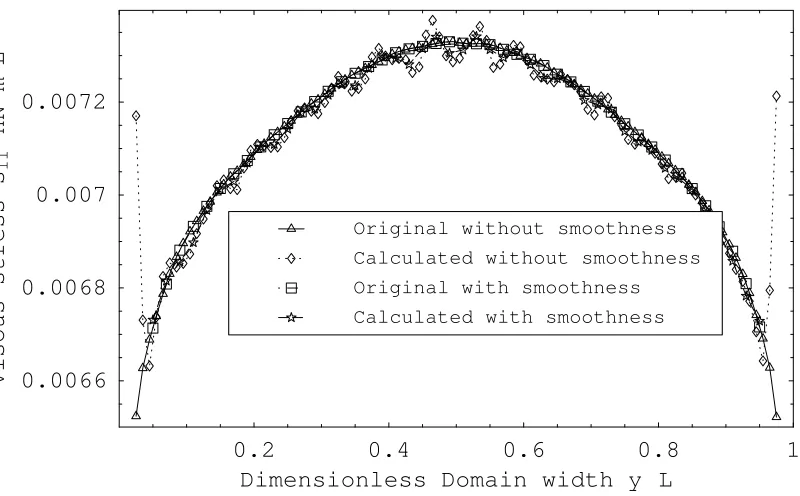
It should also be noted that if we calculate the viscous stress and heat flux in Eqs. (10) from the original computational results of kinetic theory including higher order moments, the calculated σij and qi have some small oscillations, and a jump in values adjacent to the boundaries. These oscillations in our calculated results show that the original computational results of kinetic theory do not seem to accurate enough for our test method, even though these results are quite good when the conservation laws are checked [3, 32]. The jumps adjacent to the boundaries in our calculated results come from the fact that there are inconsistencies immediately adjacent to the boundaries even in the original computational results of Mieussens’ discrete velocity method [30-32]. These lead to a slight violation of the conservation laws due to numerical inaccuracy, and can be reduced when the grid spacing in the kinetic theory computations is reduced [3]. Note that in all the figures in this paper the values of viscous stress and heat flux adjacent to the walls are not shown because of these inconsistencies. Since results at those positions are needed in the calculation of spatial derivatives nearby, the calculated results from MCMs very near the walls, not only the nodes immediately adjacent to the walls, are not shown in all Figures.
This can be seen in Figure 1, which shows the original results for σ11 in Case 2 of Table 1 using the ES-BGK kinetic model, with the σ11 calculated using Eqs. (10) with and without smoothing.
Therefore, we apply central differences for calculating derivatives, and smoothed data from the kinetic theory computation as direct values, for all our tests. The average relative error in the viscous stress between values calculated from Eqs. (10) with all direct data including higher order moments on the right hand side and the direct values is less than 0.01 in all test cases. Since the relative error becomes meaningless when a quantity approaches zero (as the heat flux does in the middle of the channel), we have not checked the average relative error in the heat flux.
4. Numerical results
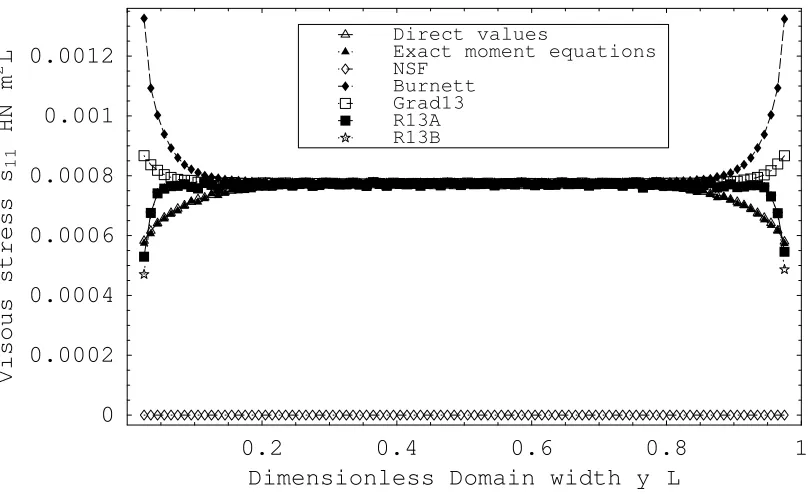
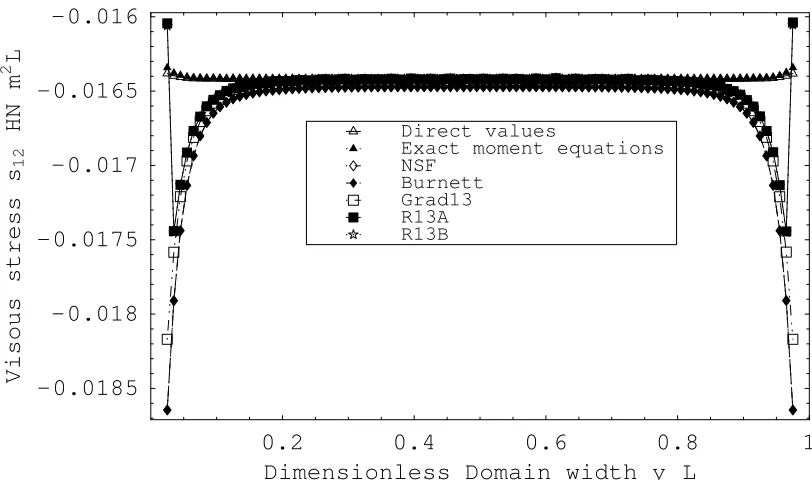
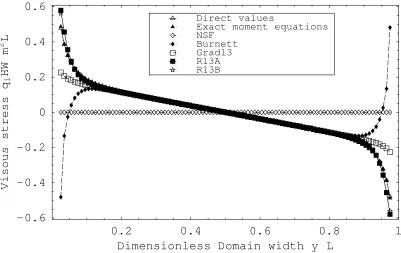
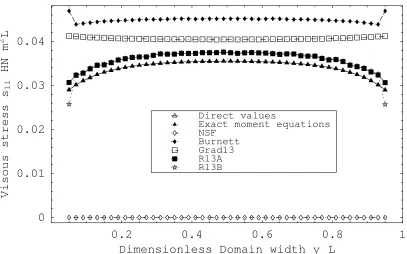
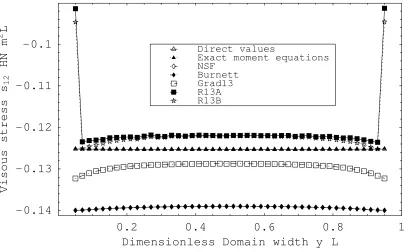
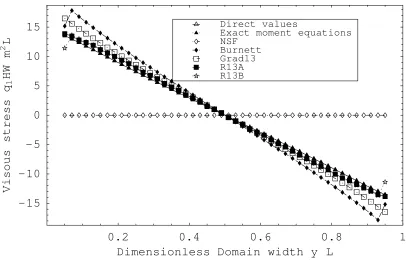
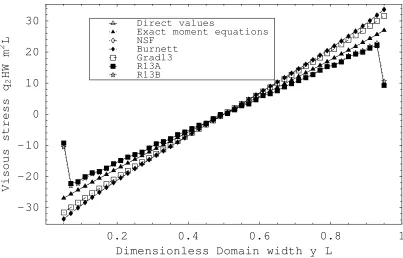
Figures 2-13 show the direct values of σij and qi, and their calculated values from the NSF equations (3), the Burnett equations (4, 5), the Grad13 (7, 10), the R13A (8, 10), the R13B equations (9, 10). The test cases shown in the figures are Case 1 with the ES-BGK model, Case 7 with the ES-BGK model, and Case 6 with the ES-BGK model. Note that, since the profile of σ11 is similar to the profile of −σ22, and no new information can be obtained from graphs of σ22, graphs of σ22 are omitted in the figures.
The NSF equations are first order in Kn, the Burnett equations are second order in Kn, the Grad13 equations are between second and third order in Kn, the R13B equations are third order in Kn, and the R13A equations are between third and fourth order in Kn [4, 20]. Therefore, we would expect that at small Knudsen numbers the R13A and the R13B would give the best results, followed by the Grad13, the Burnett equations, and that the NSF equations would provide the worst results.
At small Kn numbers, such as in Case 1 (Figures 2-5), the calculated values of σ11, σ22, q1
and q2 give very good agreement with the direct data in the main part of the flow for all models except the NSF equations. Recall that the NSF equations do not account for any rarefaction effects on σ11, σ22 and q1, and, by Eqs. (3), predict their values as zero, while the direct values of these quantities are not zero even in the middle of the domain.
said to be a suitable model for Kn>0.1. To our surprise, the calculated σij and qi from the R13A and the R13B equations have the opposite sign to the direct data, and also have a discontinuity near the boundaries when Kn >0.1, i.e., in Figures 10-13 for Case 6. (Note that this discontinuity disappears or can be neglected when Kn≤0.1, i.e. see Figures 2-5.) These two unusual phenomena are difficult to understand, and the reasons for them are still under investigation.
Generally, the calculated values of σij and qi from all sets of macroscopic equations fit the direct data well at small Knudsen numbers, but not so well at large Knudsen numbers. We suggest that the R13A or the R13B equations may be more appropriate as macroscopic continuum equations in rarefied gas flows with Kn≤0.1, and up to moderate Mach number. As the Knudsen number increases, and boundary effects dominate, all tested models fail, which can be attributed to their inability to properly describe non-equilibrium near solid surfaces. Note that the above discussion is independent of the kinetic models (BGK or ES-BGK) used in the tests.
Our observations here match those in the calculation of shock structures [19]: Burnett, Grad13, and R13A equations yield shock structures in agreement with DSMC computations for Mach numbers below about Ma=3.0, but not for higher Mach numbers, where rarefaction effects and deviations from equilibrium states become increasingly important.
5. Knudsen layers and the Knudsen number
All MCMs discussed are related to the Knuden number as a smallness parameter: by their derivation, the NSF equations are exact within an error of the order O
( )
Kn2 , the Burnett and Grad 13 moment equations are exact within an error of the order O( )
Kn3 , and the R13 equations are exact within an error of the order O( )
Kn4 . Based on this, we expect the differences between the kinetic solution and the solutions of the MCMs to be related to their respective errors, i.e. powers of the Knudsen number.Normally, the Knudsen number is defined as the ratio between mean free path, l, and a relevant macroscopic length, Lref: Kn = l/Lref. For the description of Couette flow, the intuitive
choice for the macroscopic reference length is the channel width, L; which we do indeed use to define the Knudsen number in our numerical experiments. However, the failure of the MCMs to describe the Knudsen layers in our test indicates that this conventional definition of the Knudsen number (with the channel width) is appropriate to describe the bulk flow but not the Knudsen layers.
We may argue that, if the Knudsen layer is to be resolved, its thickness should be chosen as the reference length. Since the Knudsen layer has a thickness of the order of a molecular mean free path, this would imply Lref=l, which results in a Knudsen number of order unity [4].
Then, none of the MCMs would be appropriate, since the basic requirement of their derivation — small Knudsen number — is not fulfilled.
relevant Knudsen number Knloc = l/Lloc>>Kn. A common definition of the local reference
length uses the density gradient [29, 36]
dx d Lloc
ρ ρ
= . (14)
For the numerical data in our test cases, the local length defined by Eq. (14) turns out to be larger than the channel width, and thus would lead to Knudsen numbers well below the Knudsen number based on the channel width. In any case, the length definition given by Eq. (14) is not well suited, since it relates a quantity that does not vanish in equilibrium (the density) to a non-equilibrium quantity (the density gradient). So for linear processes, where gradients are small, the corresponding lengthscale would be very large. Knudsen layers can be considered as linear phenomena [4, 25, 26], and thus the length scale defined by Eq. (14) is not suitable to identify Knudsen layers. The same holds true for dispersion and damping of ultrasonic sound waves.
Thus, the local reference length scale must be defined differently, but presently it is unclear what definition would be a proper choice. In any case, one will expect that the local Knudsen number should be larger in regions of large gradients, in particular within the Knudsen layers.
6. Critique of the testing method
In this section we take a critical look at our proposed test method. For this discussion we need to distinguish between three sets of values for the moments:
(a) the direct values, which result from the solution of the kinetic equation,
{
D}
i D ij D D i D D
q T
u , , ,
, σ
ρ =
φ ;
(b) the hypothetical solution of the MCMs with reliable boundary conditions,
{
H}
i H ij H H i H H
q T
u , , ,
, σ
ρ =
(c) the values computed from our test,
{
T}
i T ij T = σ ,qφ , which use the MCM equations
together with the direct values, φD. In this case, the direct values for ρ, ui, T are used for both types of MCMs. For MCMs of the first type, stress and heat flux are computed in the test, while the test for the second type of MCMs computes the test values for stress and heat flux by means of the complete set of moments from the kinetic solution, including stress and heat flux.
We emphasize that the proper test for quality of an MCM should be a comparison of the direct values, φD, to the full numerical solution of the MCM, φH, but this route is not accessible while the boundary conditions are not known. Instead, our test method compares the direct values, φD, with the test values, φT, and so the question arises whether an insufficient agreement between φD and φT implies an insufficient agreement between φD and φH.
In our test the hydrodynamic variables ρ, ui, and T are given by the kinetic solution, and only the test values for σij and qi differ from the kinetic solution. In contrast, in the full numerical solution of the MCM, the values of all variables will be different from the accurate kinetic result. This difference leads to the question whether the variance between the kinetic results and the full numerical solution can be smaller than the variance between the kinetic results and test values. Indeed, in the test method some of the variables are forced to follow the kinetic solution, and that might lead to a larger variance for the remaining variables [37].
values) should be related to (powers of) the Knudsen number for all variables. This should be so for the test values as well as for the hypothetical full solution.
It is possible that the absolute differences are, in fact, less important than relative differences. If the absolute values of two variables differ, but the absolute error in those values has the same size, then the relative errors can be quite different. We recall that (as can be seen, e.g., from the Burnett equations, Eqs (4-5)) ρ, ui, and T are equilibrium quantities that will be
larger than σ12, q2, which are of first order in the Knudsen number. For Couette flow, σ11,
22
σ , and q1 are even smaller (second order in Kn). The higher order MCMs lead to corrections of the values for all variables, and the relative importance of the corrections is more marked for those moments that are “small” (σ12, q2) or very small (σ11, σ22, q1) [4].
In our test method we use direct values of ρ, ui, and T and force all deviations from the direct
values on σ12, q2, σ11, σ22, q1. It is quite likely that the overall relative error for all variables could be smaller, by forcing some deviation on the equilibrium variables ρ, ui, and
T. This would allow us to reduce the relative errors in the non-equilibrium variables (which
are large in the current tests), that might then result in small relative errors for ρ, ui, T. It is not
clear, however, how this could be done technically, and we have not attempted this here.
non-equilibrium variables (σ12, q2, σ11, σ22, q1) quite well (for Kn=0.1), while discrepancies were forced on ρ, ui, and T where the relative errors are comparatively small.
In summary, we propose that our presented test method can give important insight into the behavior of MCMs, but the full solution of the MCMs (with proper boundary conditions currently unknown) would certainly be a more comprehensive approach.
7. Conclusions
Many Macroscopic Continuum Models (MCMs) have been proposed for rarefied gas flows. No single model is commonly accepted, especially for gas microfluidics where the Knudsen layer is important and the gas rarefied even at normal pressure. For computational efficiency, MCMs would, however, be preferred over kinetic models or the DSMC for rarefied gas flows as long as a physically accurate and numerically tractable model can be found. Unfortunately this question cannot yet be answered, for the boundary conditions of MCMs, except for the conventional NSF equations, are still under development.
The aim of our test method proposed in this paper is to contribute towards an answer to the question of which macroscopic model is suitable for gas microfluidics. The characteristics of our test method are: it does not require boundary conditions in the calculations and comparison; coupled governing equations need not be solved; full (non linear) expressions are considered; the solution of the same flow using a kinetic equation is required.
investigated for their ability to describe one-dimensional steady Couette flow accurately. For relatively low Knudsen numbers (Kn≤0.1) in the transition-continuum regime, it is found that the two types of R13 equations give results similar to each other, which are better than results from Grad’s 13 moment equations, which however give better results than the Burnett equations. The NSF equations give the worst results in comparison. This, in fact, is as expected from the order of accuracy in the Knudsen number of these MCMs.
For large Knudsen numbers (Kn>0.1), all MCMs we tested fail to describe the flow with acceptable accuracy. Problems in describing Knudsen layers, as well as previous work on strong shock structures, indicates there may be severe limitations on the applicability of some current MCMs for rarefied gas flows. In particular, the failure of MCMs in the vicinity of the wall can be attributed to the large local Knudsen number, so that models that were derived under the assumption of small Knudsen number lose validity. The proper definition of the local Knudsen number is unclear, although a deeper discussion of this question is outside the scope of this paper.
While we have examined one dimensional steady Couette flow in this paper, other benchmark flow problems should be considered in the future.
Acknowledgments
Appendix A: A brief description of relevant kinetic theory
In the microscopic theory of rarefied gas dynamics, the state variable is the distribution function f
(
x,c,t)
, which specifies the density of microscopic particles with velocity c at time t and position x [2-6]. The particles, which can be thought of as idealized atoms, move freely in space unless they undergo collisions. The corresponding evolution of f is described by the Boltzmann equation [2, 4], which, when external forces are omitted, is written as) (f S x
f c t f
i i ∂ =
∂ + ∂ ∂
. (A.1)
Here, the first term on the left hand side describes the local change of f with time and the second term is the convective change of f due to the microscopic motion of the gas particles. The term on the right hand side, S(f), describes the change of f due to collisions among particles. For a monatomic gas the collision term reads
(
)
∫
− σ θ θ ε= 1
c
d d d g ff f f f
S( ) ' '1 1 sin , (A.2)
where the superscript 1 denotes parameters for particle 1 (which is the collision partner of the particle considered), the superscript ′ denotes parameters for the state after collision,
1
c c−
=
g is the relative speed of the colliding particles, σ is the scattering factor, and ε and θ are the angles of collision.
In kinetic models, the Boltzmann collision term, S(f), is replaced by a relaxation expression which is typically of the form
(
ref)
m f f f
S ( )=−ν − . (A.3)
Here, fref is a suitable reference distribution function, and ν is the (mean) collision frequency;
The BGK model [4, 32, 33] is the simplest kinetic model, where the reference function is simply the Maxwellian,
− ⋅
π ρ = =
RT C RT
m f
fref M
2 exp 2
1 3 2
, (A.4)
and its evaluation in the hydrodynamic limit yields (see, e.g., [4])
ν =
µ p,
ν =
κ pR
2 5
, Pr=1. (A.5)
While this model is widely used for theoretical considerations, it gives the wrong value (Pr=1) for the Prandtl number. More recent models have been proposed to correct this failure.
The ES-BGK model [4, 7, 32, 34], replaces the Maxwellian with a generalized Gaussian, so that
(
)
(
)
− ε
⋅ π
⋅ ρ =
= −
j ij i ij
ES
ref f C C
f
2 1 exp 2
det 1/2 , (A.6)
and it yields
ν − =
µ p
b 1
1 ,
ν =
κ pR
2 5
,
b
− =
1 1
Pr . (A.7)
The matrix is defined as
(
−)
δ + ρ= ρ σ + δ =
λ ij
ij ij
ij ij
p b RT b b
RT 1 , (A.8)
Appendix B: MCM equations in three dimensions
B.1. NSF and Burnett equations for the BGK and ES-BGK models
The Knudsen number, Kn, is normally defined as the ratio of the gas molecular mean free path to the relevant macroscopic length scale of the problem, e.g. the channel width in our Couette flow problem. The viscous stress, σij, and heat flux, qi, for the NSF equations are obtained from the Chapman-Enskog (CE) expansion technique to first order in the Kn, while the expressions for the Burnett equations are obtained at second order in the CE expansion. For details of the CE technique, see [4-6]; here, only the final expressions are listed.
The viscous stress and heat flux at first order, the NSF order, are given by
> < ∂ ∂ µ − = σ j i NSF ij x u 2 , i NSF i x T q ∂ ∂ κ −
= , (B.1)
where µ is the viscosity and κ is the thermal conductivity.
Equivalent Burnett expressions, calculated using the general ES-BGK model, are [3, 7]
ij j i B ij p x u Φ µ + ∂ ∂ µ − = σ > < 2 2
2 , i
i B i p x T
q + µ ⋅Γ
∂ ∂ κ − = Pr 2 2
, (B.2)
where
(
1)
,(
)
[
( 13 ) (14 10 )1]
, 6 1 2 3 1 2 7 6 2 3 45 2 2
2 2 i j j j i j j j i j i j j j i j i j i x T x u pR b b x T x u pR b x T x u pR b x x u T R x x u pRT x x u pRT b ∂ ∂ ∂ ∂ ω − − + − − + ∂ ∂ ∂ ∂ +ω+ + ∂ ∂ ∂ ∂
+ω− + ∂ ρ ∂ ∂ ∂ − ∂ ∂ ∂ + ∂ ∂ ∂ − = Γ > < (B.3.b)
with b=1−
(
1/Pr)
. Eqs. (B.2-B.3) simplify to the Burnett equations for the traditional BGK model when b=0 [7]. In the above, ω is the power index (a positive number of order unity) used in the following expression for the gas viscosity, µ, as a function of temperature [5]:( )
ω µ = µ 0 0 T T
T , (B.4)
where µ0 is the viscosity at a reference temperature T0. Maxwellian gas molecules have 1
=
ω , which are used in our numerical simulations. The expressions for B ij
σ and B i
q in Eqs. (B.2-B.3) are irreducible forms in terms of the gradients of density, velocity, and temperature.
B.2. Grad13, R13A and R13B equations for the BGK and ES-BGK models
There are 13 unknown variables, and 13 moment equations in the Grad13, R13A and R13B models for a three-dimensional problem. The independent variables are: ρ, u1, u2, u3, T,
11
σ , σ22, σ12, σ13, σ23, q1, q2 and q3; while other variables can be derived from these
quantities, such as p=ρRT, σ33=−
(
σ11+σ22)
, σ21 =σ12, σ31 =σ13, σ32 =σ23.After multiplying the kinetic equation by polynomials of the peculiar velocity, viz. 1, Ci, C2,
> <iCj
C and 2 /2
i C
C , and then integrating over velocity space, the basic 13 moment equations for the general ES-BGK model are obtained [3,4]
0 = ∂ ρ ∂ + ∂ ∂ ρ + ∂ ρ ∂ k k k k x u x u
t , (B.5.a)
0 = ∂ σ ∂ + ∂ ∂ + ∂ ∂ ρ + ∂ ∂ ρ k ik i k i k i x x p x u u t u
, (B.5.b)
0 2 3 2 3 = ∂ ∂ σ + ∂ ∂ + ∂ ∂ + ∂ ∂ ρ + ∂ ∂ ρ k i ik k k k k k k x u x u p x q x T Ru t T
R , (B.5.c)
(
)
ij k ijk k j i k j i j i k k ij ij p x x u x u p x q x ut ∂ =−µσ
ρ ∂ + ∂ ∂ σ + ∂ ∂ + ∂ ∂ + ∂ σ ∂ + ∂ σ
∂ > < >
< >
< >
< 2 2
5 4
, (B.5.d)
(
)
, Pr 6 1 2 1 5 2 5 2 5 7 2 5 2 5 i k j ijk i rrss k ik rr k k i i k k k i k k jk ij k ik k ik i k k i i q p x u x x x u q x u q x u q x x p x RT x p RT x u q t q µ − = ∂ ∂ ρ + ∂ ρ ∂ + ∂ ρ ∂ + ∂ ∂ + ∂ ∂ + ∂ ∂ + ∂ σ ∂ ρ σ − ∂ ∂ ρ σ − ∂ σ ∂ − ∂ ∂ − ∂ ∂ + ∂ ∂ > < > < (B.5.e)with the definition of the moments as in Eqs. (1). Equations (B.5) simplify to a similarly basic 13 moment equation set for the BGK model when we make Pr=1 [3, 4, 32]. Equations (B.5.a-B.5.c) are, in fact, the non-conservative form of Eqs. (2). Note that Eqs. (B.5) do not form a closed set of equations for the 13 variables, since they contain the higher order moments
> <
ρ ijk , ρrr<ik> and ρrrss. In the Grad13 equations from the general ES-BGK model, these are
given as [4, 8]
0 13 = ρ<G >
ijk , ij
G ij
rr = RTσ ρ 13< > 7 ,
ρ = ρG13 15 p2
, 3 2 7 5 Pr 5 28 6 5 6 5 Pr 5 28 Pr 5 28 7 13 ∂ ∂ − ∂ ∂ + ∂ ∂ − ∂ ∂ − ∂ ∂ − − ∂ ∂ − ∂ ∂ − ∂ ∂ + ∂ ∂ − = > < > < > < > < > < > < > < k k ij j k i k k j i k l k kl ij k k ij k k j i j i j i j i ij A R ij rr x u x u x u RT p x u x q p x q x RTq x T Rq x q RT p RT σ σ σ µ σ ρ σ ρ σ µ σ ρ ρ ρ µ σ ρ (B.7.b) . 2 5 Pr 8 15 2 13 ∂ ∂ σ + ∂ σ ∂ ρ − ∂ ρ ∂ ρ − ∂ ∂ + ∂ ∂ µ − ρ = ρ k i ik k ik i k k k k k k A R rrss x u RT x q x RTq x T Rq x q RT p p (B.7.c)
In the R13B equations from the general ES-BGK model, the expressions for higher order moments are similar to Eqs. (B.7), but some higher order terms are removed and non-linear terms in the production terms (which have been omitted in [3]) are accounted for, i.e.
∂ ∂ + ∂ ρ ∂ σ ρ − ∂ σ ∂ µ − = ρ > < > < > < > < k j i k ij k ij B R ijk x u q x RT x RT p 5 4 Pr 3
13 , (B.8.a)
, 3 2 Pr 7 28 Pr 5 28 2 7 2 13 ∂ ∂ σ − ∂ ∂ σ + ∂ ∂ σ µ − ∂ ρ ∂ ρ − ∂ ∂ + ∂ ∂ µ − σ σ ρ + σ = ρ > < > < > < > < > < > < > < k k ij j k i k k j i k j i j i j i r j i r ij B R ij rr x u x u x u p RT x RTq x T Rq x q RT p b RT (B.8.b) , 2 5 Pr 8 2 15 2 2 13 ∂ ∂ σ + ∂ ρ ∂ ρ − ∂ ∂ + ∂ ∂ µ − σ σ ρ + ρ = ρ k i ik k k k k k k sr rs B R rrss x u RT x RTq x T Rq x q RT p b p (B.8.c)
Appendix C: Discussion on higher order moments ρ<ijk>, ρrr<ij>, and ρrrss
In this Appendix we briefly discuss the values of higher moments that appear in the MCM equations. We found that the computed values of the moments ρrr<22> from the Grad13 equations fit the data from the kinetic model better than, or at least similar to, results from the R13A and the R13B equations for all test cases. While for ρ<ijk> and ρrr12, the opposite is the case, that is the R13A and R13B equations give better results than the Grad13 equations. At small Knudsen numbers or small plate velocities, the computed values of ρrrss from the Grad13, the R13A and the R13B equations fit the original data very well; however they are not so good when Kn or the plate velocity is large. The computed ρrrss from the Grad13, R13A and R13B equations do not fit the original data. There is no apparent way of deciding which one of the R13A and R13B equation sets is better. As an example, Figure 14 shows the comparison of calculated ρ<112> with its direct values from the BGK model in case 1 (Kn=0.025, Ma=0.975).
References
[1] G. E. Karniadakis and A. Beskok, Micro Flows: Fundamentals and Simulation, Springer-Verlag New York, Inc., 2002.
[2] C. Cercignani, Rarefied Gas Dynamics: From Basic Concepts to Actual Calculations, Cambridge University Press, 2000.
[3] Y. Zheng, Analysis of kinetic models and macroscopic continuum equations for rarefied gas dynamics, Ph.D thesis, Dept. Mech. Eng., Univ. of Victoria, Canada, 2004.
[4] H. Struchtrup, Macroscopic transport Equations for Rarefied Gas Flows— Approximation Methods in Kinetic Theory, Interaction of Mechanics and Mathematics Series, Springer, Heidelberg, 2005.
[5] M. N. Kogan, Rarefied Gas Dynamics, Plenum Press, 1969.
[6] S. Chapman and T. G. Cowling, The Mathematical Theory of Non-uniform Gases, Third Edition, Cambridge Univerisity Press, 1970.
[7] Y. Zheng and H. Struchtrup, Burnett equations for the ellipsoidal statistical BGK model, Continuum Mech. Thermodyn. 16 (2004) 97.
[8] H. Grad, Principles of the kinetic theory of gases, Handbuch der Physik XII (1958) 205. [9] X. Zhong, R. W. MacCormack and D. R. Chapman, Stabilization of the Burnett
equations and application to hypersonic flows, AIAA J. 31 (1993) 1036.
[10] X. Chen, H. Rao and E. Spiegel, Continuum description of rarefied gas dynamics. I. Derivation from kinetic theory, Phys. Rev. E 64 (2001) 046308.
[12] S. Jin and M. Slemrod, Regularization of the Burnett equations via relaxation, J. Stat. Phys. 103 (2001) 1009.
[13] S. Jin, L. Pareschi and M. Slemrod, A relaxation scheme for solving the Boltzmann equation based on the Chapman-Enskog expansion, Acta Math. Appl. Sin. (English Series) 18 (2002) 37.
[14] C. D. Levermore, Moment closure hierarchies for kinetic theories, J. Stat. Phys. 83 (1996) 1021.
[15] E. V. Volpe and D. Baganoff, Maximum entropy pdfs and the moment problem under near-Gaussian conditions, Probabilistic Eng. Mech. 18 (2003) 17.
[16] R. S. Myong, A generalized hydrodynamic computational model for rarefied and microscale diatomic gas flows, J. Comput. Phys. 195 (2004) 655.
[17] I. Müller, D. Reitebuch and W.Weiss, Extended thermodynamics – consistent in order of magnitude, Continuum Mech. Thermodyn. 15 (2002) 113.
[18] H. Struchtrup and M. Torrilhon, Regularization of Grad's 13 moment equations: Derivation and linear analysis, Phys. Fluids 15 (2003) 2668.
[19] M. Torrilhon and H. Struchtrup, Regularized 13-Moment equations: shock structure calculations and comparison to Burnett models, J. Fluid Mech. 513 (2004) 171.
[20] H. Struchtrup, Stable transport equations for rarefied gases at high orders in the Knudsen number, Phys. Fluids 16 (2004) 3921.
[23] J. M. Reese, L. C. Woods, F. J. P. Thivet and S. M. Candel, A second-order description of shock structure, J. Comput. Phys. 117 (1995) 240.
[24] A. V. Bobylev, The Chapman-Enskog and Grad methods for solving the Boltzmann equation, Sov. Phys. Dokl. 27 (1982) 29.
[25] H. Struchtrup, Failures of the Burnett and super-Burnett equations in steady state processes, Cont. Mech. Thermodyn. 17 (2005) 43.
[26] D. A. Lockerby, J. M. Reese and M. A. Gallis, The usefulness of higher-order constitutive relations for describing the Knudsen layer, Phys. Fluids 17 (2005) 100609. [27] T. Thatcher, Microscale gas flow: A comparison of Grad’s 13 moment equations and
other continuum approaches, Masters Thesis, Dept. Mech. Eng., Univ. of Victoria, Canada, 2005.
[28] Y. Sone, Kinetic Theory and Fluid Dynamics. Birkhauser Boston, 2002.
[29] G. A. Bird, Molecular Gas Dynamics and the Direct Simulation of Gas Flows, Oxford Science Publications, Oxford, 1994.
[30] L. Mieussens, Discrete-velocity models and numerical schemes for the Boltzmann-BGK equation in plane and axisymmetric geometries, J. Comput. Phys. 162 (2000) 429. [31] L. Mieussens and H. Struchtrup, Numerical comparison of BGK-models with proper
Prandtl number, Phys. Fluids 16 (2004) 2797.
[32] Y. Zheng and H. Struchtrup, Ellipsoidal statistical Bhatnagar-Gross-Krook model with velocity-dependent collision frequency, Phys. Fluids 17 (2005) 127103.
[34] J. Lowell H. Holway, New statistical models for kinetic theory: methods of construction, Phys. Fluids 9 (1966) 1658.
[35] R. L. Burden and J. D. Faires, Numerical Analysis, Sixth Edition, Brooks/Cole Publishing Company, 1997.
[36] M. Gad-el-Hak, The fluid mechanics of microdevices – The Freeman Scholar lecture, J. Fluids Eng. 121 (1999) 5.
List of Figure captions
Figure 1: Cross-Channel Couette flow profile of σ11 in Case 2 (Kn=0.1, Ma=0.975); original values from the ES-BGK model and calculated values from Eqs. (10), with and without smoothing.
Figure 2: Cross-channel Couette flow profile of σ11; direct values from the ES-BGK model and corresponding calculated values from indicated sets of macroscopic equations; Case 1 (Kn=0.025, Ma=0.975).
Figure 3: Cross-channel Couette flow profile of σ12; direct values from the ES-BGK model and corresponding calculated values from indicated macroscopic sets of macroscopic equations; Case 1 (Kn=0.025, Ma=0.975).
Figure 4: Cross-channel Couette flow profile of q1; direct values from the ES-BGK model and corresponding calculated values from indicated sets of macroscopic equations; Case 1 (Kn=0.025, Ma=0.975).
Figure 5: Cross-channel Couette flow profile of q2; direct values from the ES-BGK model and corresponding calculated values from indicated sets of macroscopic equations; Case 1 (Kn=0.025, Ma=0.975).
Figure 6: Cross-channel Couette flow profile of σ11; direct values from the ES-BGK model and corresponding calculated values from indicated sets of macroscopic equations; Case 7 (Kn=0.1, Ma=1.950).
Figure 6: Cross-channel Couette flow profile of σ11; direct values from the ES-BGK model and corresponding calculated values from indicated sets of macroscopic equations; Case 7 (Kn=0.1, Ma=1.950).
Figure 9: Cross-channel Couette flow profile of q2; direct values from the ES-BGK model and corresponding calculated values from indicated sets of macroscopic equations; Case 7 (Kn=0.1, Ma=1.950).
Figure 10: Cross-channel Couette flow profile of σ11; direct values from the ES-BGK model and corresponding calculated values from indicated sets of macroscopic equations; Case 6 (Kn=0.5, Ma=3.251).
Figure 11: Cross-channel Couette flow profile of σ12; direct values from the ES-BGK model and corresponding calculated values from indicated sets of macroscopic equations; Case 6 (Kn=0.5, Ma=3.251).
Figure 12: Cross-channel Couette flow profile of q1; direct values from the ES-BGK model and corresponding calculated values from indicated sets of macroscopic equations; Case 6 (Kn=0.5, Ma=3.251).
Figure 13: Cross-channel Couette flow profile of q2; direct values from the ES-BGK model and corresponding calculated values from indicated sets of macroscopic equations; Case 6 (Kn=0.5, Ma=3.251).
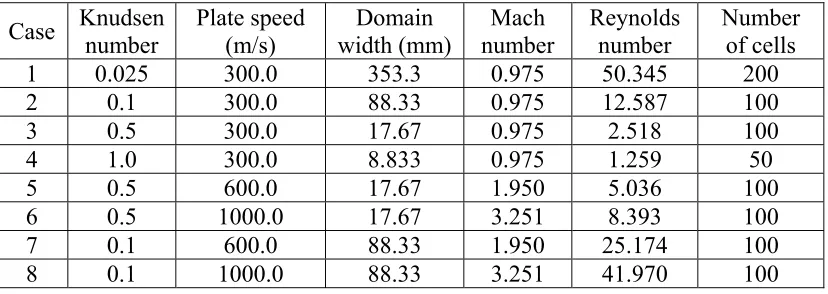
Table 1: One-dimensional steady Couette flows used in the tests Case Knudsen
number
Plate speed (m/s)
Domain width (mm)
Mach number
Reynolds number
Number of cells
1 0.025 300.0 353.3 0.975 50.345 200
2 0.1 300.0 88.33 0.975 12.587 100
3 0.5 300.0 17.67 0.975 2.518 100 4 1.0 300.0 8.833 0.975 1.259 50 5 0.5 600.0 17.67 1.950 5.036 100 6 0.5 1000.0 17.67 3.251 8.393 100
7 0.1 600.0 88.33 1.950 25.174 100
0.2 0.4 0.6 0.8 1 Dimensionless Domain width y L
0.0066 0.0068 0.007 0.0072
Visous
stress
s11
HN
m
2 L
[image:42.595.101.501.78.326.2]Calculated with smoothness Original with smoothness Calculated without smoothness Original without smoothness
0.2 0.4 0.6 0.8 1 Dimensionless Domain width y L
0 0.0002 0.0004 0.0006 0.0008 0.001 0.0012
Visous
stress
s11
HN
m
2 L
R13B R13A Grad13 Burnett NSF
[image:43.595.97.501.79.326.2]Exact moment equations Direct values
0.2 0.4 0.6 0.8 1 Dimensionless Domain width y L
-0.0185 -0.018 -0.0175 -0.017 -0.0165 -0.016
Visous
stress
s12
HN
m
2 L
R13B R13A Grad13 Burnett NSF
[image:44.595.93.499.82.322.2]Exact moment equations Direct values
0.2 0.4 0.6 0.8 1 Dimensionless Domain width y L
-0.6 -0.4 -0.2 0 0.2 0.4 0.6
Visous
stress
q1
HW
m
2 L
R13B R13A Grad13 Burnett NSF
[image:45.595.97.498.78.331.2]Exact moment equations Direct values
0.2 0.4 0.6 0.8 1 Dimensionless Domain width y L
-2 -1 0 1 2
Visous
stress
q2
HW
m
2 L
R13B R13A Grad13 Burnett NSF
[image:46.595.98.499.72.334.2]Exact moment equations Direct values
0.2 0.4 0.6 0.8 1 Dimensionless Domain width y L
0 0.01 0.02 0.03 0.04
Visous
stress
s11
HN
m
2 L
R13B R13A Grad13 Burnett NSF
[image:47.595.95.502.73.327.2]Exact moment equations Direct values
0.2 0.4 0.6 0.8 1 Dimensionless Domain width y L
-0.14 -0.13 -0.12 -0.11 -0.1
Visous
stress
s12
HN
m
2 L
R13B R13A Grad13 Burnett NSF
[image:48.595.96.505.78.330.2]Exact moment equations Direct values
0.2 0.4 0.6 0.8 1 Dimensionless Domain width y L
-15 -10 -5 0 5 10 15
Visous
stress
q1
HW
m
2 L
R13B R13A Grad13 Burnett NSF
[image:49.595.94.500.72.332.2]Exact moment equations Direct values
0.2 0.4 0.6 0.8 1 Dimensionless Domain width y L
-30 -20 -10 0 10 20 30
Visous
stress
q2
HW
m
2 L
R13B R13A Grad13 Burnett NSF
[image:50.595.95.498.73.331.2]Exact moment equations Direct values
0.2 0.4 0.6 0.8 1 Dimensionless Domain width y L
-3 -2 -1 0 1 2
Visous
stress
s11
HN
m
2 L
R13B R13A Grad13 Burnett NSF
[image:51.595.97.500.66.332.2]Exact moment equations Direct values
0.2 0.4 0.6 0.8 1 Dimensionless Domain width y L
-1 0 1 2 3 4
Visous
stress
s12
HN
m
2 L
R13B R13A Grad13 Burnett NSF
[image:52.595.100.498.73.331.2]Exact moment equations Direct values
0.2 0.4 0.6 0.8 1 Dimensionless Domain width y L
-2000 -1000 0 1000 2000
Visous
stress
q1
HW
m
2 L
R13B R13A Grad13 Burnett NSF
[image:53.595.98.502.78.327.2]Exact moment equations Direct values
0.2 0.4 0.6 0.8 1 Dimensionless Domain width y L
-4000 -2000 0 2000 4000
Visous
stress
q2
HW
m
2 L
R13B R13A Grad13 Burnett NSF
[image:54.595.97.503.80.326.2]Exact moment equations Direct values
0.2 0.4 0.6 0.8 1 Dimensionless Domain width y L
-1 -0.5 0 0.5 1
Moment
r112
HW
m
2 L
R13B R13A Grad13
[image:55.595.93.502.76.327.2]Direct values